May 26th, 2017 · Comments Off on CHATTER (MAY 2017): Central Tech dome down in flames

PHOTO BY GEREMY BORDONARO/GLEANER NEWS: A fire destroyed a large portion of the dome’s surface for the field at Central Technical School on May 15.
A large portion of the roof of the dome that covers the field at Central Technical School was destroyed in a fire on May 15. The dome was in storage for the summer after it was dismantled on April 27. The cause of the fire remains unknown, but the Toronto Police Service has not ruled out arson.
Students were out on the field around mid-afternoon when smoke was spotted coming from the dome’s storage area. Police shut down Bathurst Street south of Bloor Street for a few hours to conduct their investigation, and damage is expected in be in the range of one million dollars.
—Geremy Bordonaro/Gleaner News
READ MORE
NEWS: Central Tech field renewal back on track (May 2016)
LETTERS: HVRA still on board for CTS plan (March 2016)
EDITORIAL: Ship to wreck (February 2016)
Construction halted at Central Tech: Student athletes launch online petition by Marielle Torrefranca (February 2016)
Agreement reached for Central Tech field (April 2015) by Annemarie Brissenden
To dome or not to dome, that is the question (February 2015) by Terri Chu
Editorial: Mobs don’t rule, nor do pawns (February 2015)
Dome plan inches closer (February 2015) by Brian Burchell
School board appeals ruling and loses, again (October 2014) by Brian Burchell
Editorial: A strategy run amok (September 2014)
Dome plan quashed by courts (September 2014) by Brian Burchell
Raucous meeting on CTS field (April 2014) by Annemarie Brissenden
Tags: Annex · News
May 26th, 2017 · Comments Off on CHATTER (MAY 2017): Annex Family Festival returns on June 11
Over 20,000 attendees and 120 craft and unique food vendors are expected to descend on Bloor Street between Spadina Avenue and Bathurst Street on June 11 for the 21st running of the Annex Family Festival.
The festival will once again feature a street parade with marching bands, and a main stage music venue at Bloor Street and Brunswick Avenue. There will be performances for the younger crowd, and a children’s village with an interactive hockey experience, street hockey, basketball, button-making, life-sized chess, and skateboard lessons.
Sponsored by the Bloor Annex BIA (whose chair publishes this newspaper), and organized by the Miles Nadal JCC, the event will also feature sidewalk sales and run rain or shine.
—Brian Burchell/Gleaner News
Tags: Annex · News
May 26th, 2017 · Comments Off on NEWS (MAY 2017): Development dominates discussion
ARA holds annual general meeting
By Geremy Bordonaro
Development dominated the Annex Residents’ Association (ARA) annual general meeting on April 27.
The area has seen an increase in developments over the last few years, most notably the Westbank Projects Corp.’s Mirvish Village development, and that coloured every topic of discussion, from bike lanes to community housing.
[pullquote]“We’ve got to figure out a way to accommodate people, move those people efficiently and safely”—Albert Koehl, vice-chair, Annex Residents’ Association[/pullquote]
“Our time here at the ARA in the past year has included a very strong focus on planning and development. As we discussed last year, the Annex has a lot of different developments around our ward,” said David Harrison. “We became somewhat overwhelmed by the amount of development activity that we needed to be on top of and participate in.
“It’s my estimate that between Yonge and Bathurst [streets] along the Bloor Corridor if you take all of the development that has been approved there could be up to 20,000 more people in that strip. And there’s already difficulties moving people around.”
The traffic and transportation committee reported mostly on matters of public safety concern, which it believes are being alleviated by lower speed limits on side streets and the implementation of the Bloor Street bike lanes.
However committee member Albert Koehl, also the organization’s vice-chair, sees a new trend coming as new buildings are completed and filled with residents.
“If you look at the dozen of development applications for our neighbourhood you’ll see that the future is not going to be single-occupancy cars,” Koehl said. “We cannot accommodate new residents if they insist on being in single-occupant cars.”
A big believer in bike lanes, Koehl has advocated for the Bloor Street pilot bike lanes as a part of Bells on Bloor. He said that more support for public transit and bike lanes is necessary to accommodate the ever-growing Annex population.
“We’ve got to figure out a way to accommodate people, move those people efficiently and safely. That’s got to mean better transit, more walking, and more cycling,” he said. “With the bike lanes we’ve seen some people change their behaviour. We’ve seen more cyclists on Bloor [Street] and fewer cars. That’s got to be the way of the future.”
“Our ward is sort of the heart of [development in the city],” said Joe Cressy (Ward 20, Trinity-Spadina) at the meeting. “Right now one quarter of all proposed development in the entire city is in Ward 20.”
Speaking of the community’s future, Cressy said that the city needs to change in order to keep up with the demand.
“On one hand we are thriving, but on the other the cracks have emerged…. Our infrastructure is 40 to 50 years old. And it’s not always sexy to invest in what is below the ground. But it is needed.”
READ MORE
CHATTER: Annex Residents’ Association app tracks developments (April 2016)
Tags: Annex · News
May 26th, 2017 · Comments Off on CHATTER (MAY 2017): University to appeal Ten Editions heritage designation
The University of Toronto plans to appeal Toronto City Council’s March 9 decision to designate 698 Spadina Ave. as a heritage site. The university intended to demolish the building and build a 23-storey student residence on the site.
Home to the much loved Ten Editions bookstore, the building itself is considered a key piece of Victorian-style architecture dating to 1885. It is typical of a type of business from that era: a window storefront with a residence on the second floor.
The appeal will go to the Conservation Review Board. However, the board’s decision is not binding, and only city council call repeal the designation.
The Harbord Village Residents’ Association has stated that it intends to oppose the appeal.
—Geremy Bordonaro/Gleaner News
READ MORE
NEWS: New chapter for student residence? (February 2017)
NEWS: Preventing a wall of towers (October 2016)
CHATTER: Two new rezoning applications submitted to city (September 2016)
Tags: Annex · News
May 26th, 2017 · Comments Off on EDITORIAL (MAY 2017): Revoke U of T’s unchecked “licence to build”
The University of Toronto is seeking broader powers to do as it pleases with respect to developing new buildings in certain designated large swaths of its campus. In effect, it wants to be an off-leash development dog, a request that has the community wary. The City of Toronto should be too.
Twenty-five years ago the university convinced the city to adopt its Master Plan.
[pullquote]“Consider what the university has done with its “as of right” building envelopes over the past couple of decades.”[/pullquote]
Formalized as a city bylaw, the plan gave the school the right to greater density, height, and less set-back on 29 specific building sites. The university packed more into these envelopes than any single property owner could have hoped to achieve. There was a certain quid pro quo at play that worked so well then that the university is trying it again, dressed up in the latest planning language speak.
Here’s how it goes.
First U of T will point to its vast inventory of heritage buildings and wide-open green spaces. It will undertake not to build new buildings there or on top of Hart House or University College. Then, while residents are supposed to be feeling grateful for the university’s stewardship it will ask for some flexibility elsewhere so that it can, in effect, move that lost density opportunity onto other parts of the campus.
Though the argument was strategically successful, it was, and remains, deeply flawed. The university was trading something it did not and does not possess. There is no way an application to plop a high rise on the front campus would succeed, and neither would filling in the University College quadrangle with office space. The argument is a sleight of hand.
Further, consider what the university has done with its “as of right” building envelopes over the past couple of decades. About one half of the sites were developed. Part of the original argument was that an approved master plan would avoid a lot of process and negotiations. However, many required a trip to the Committee of Adjustment, as U of T wanted to pierce the theoretical envelope in one way or another. The time saving argument did not exactly hold.
One building currently under construction is 47-55 St. George St., or Site 10 in the Master Plan. In 1993 the university undertook to make that building no taller than 23 metres, but then turned around and got approval from the city for 44 metres! The new building could put part of the adjacent heritage Knox College on St. George Street in shadow, but since the university also owns that building there was no one to advocate against the increased height. In this case, U of T has used the super-sized envelope as a spring-board to even greater height and density and appears to have simultaneously ignored its own heritage interests.
Enrolment at the university is not predicted to increase in the next ten years, though there is an intention to shift to a greater percentage of graduate students, but not more students in total. Why then is there need for more buildings? The institution is silent on this question.
The Official Plan amendment would apply to 108 hectares bounded by Bloor Street, College Street, Spadina Avenue, and Bay Street, even though those buildings are not governed by the university. Yet none of the other building owners appear to be at the table, and it’s a big omission: what’s good for one, may not be best for all.
The draft document suggests that the university should endeavour to transition its new built form into adjoining local communities. Sounds good on paper, but the institution long ago breached its borders, buying property west of Spadina Avenue and south of College Street. For example, it’s planning to build a 23-storey student residence on the northwest corner of Spadina and Sussex avenues. That is hardly a transition step to Harbord Village where a typical Victorian house is two-and-a-half stories. Further, the site includes Ten Editions bookstore, housed in a 100-year-old building recently designated by the city as heritage. The university has appealed that designation, a move that does not exactly advance its case as a heritage protector.
The University of Toronto has not demonstrated it can be trusted with a “licence to build” without permissions. The leash shouldn’t be thrown away; it should be shortened.
READ MORE
NEWS: U of T seeks to expand planning exemption (April 2017)
EDITORIAL: Westbank’s positive precedent (April 2017)
NEWS: New chapter for student residence? (February 2017)
NEWS: Preventing a wall of towers (October 2016)
CHATTER: Two new rezoning applications submitted to city (September 2016)
NEWS: Tall tower before OMB, as city battles back with block study (August 2016)
NEWS: Planning for the future (May 2016)
DEVELOPINGS: Annual review reflects tension between community activism and OMB (March 2016)
Tags: Annex · Editorial
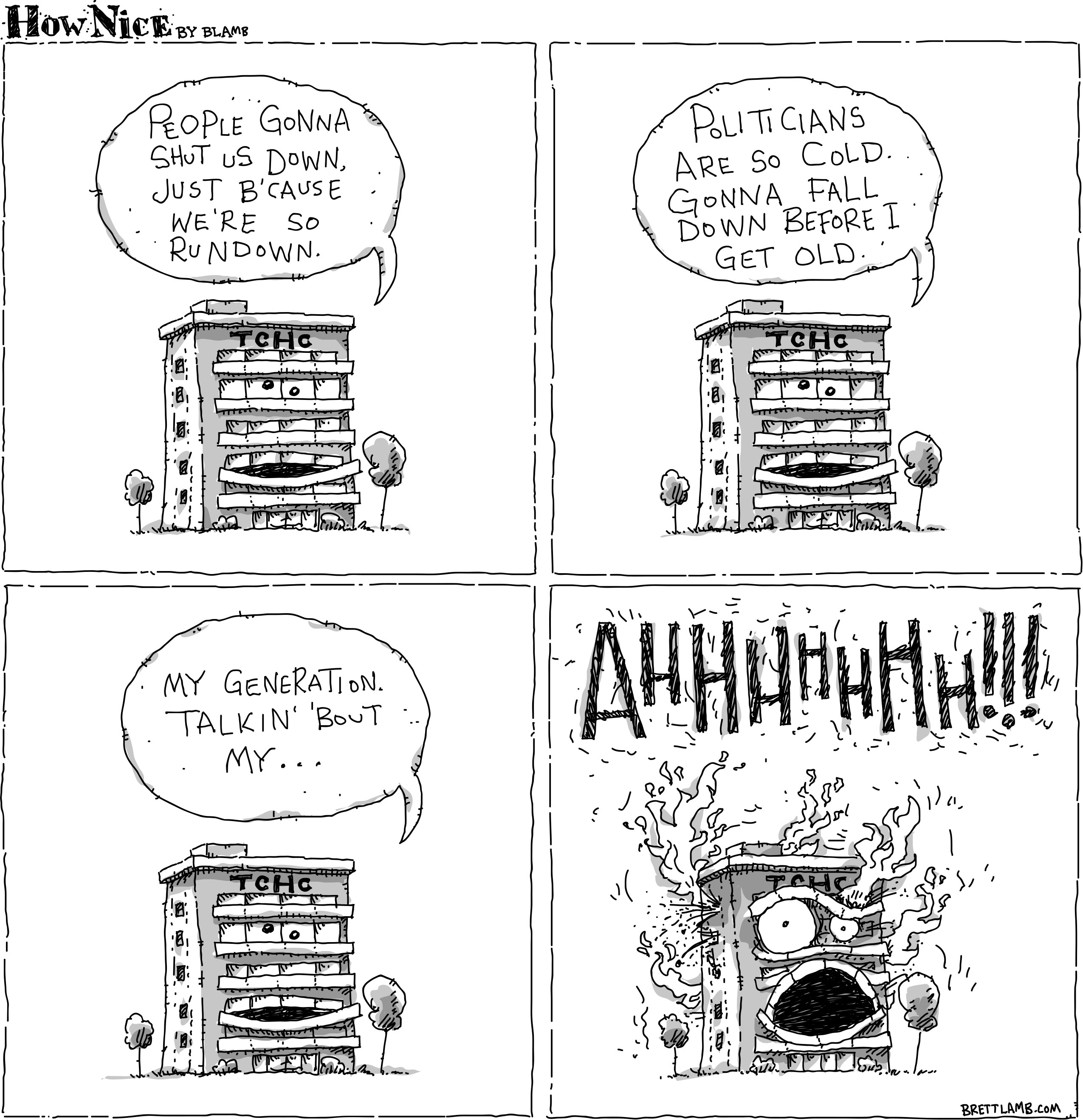
May 26th, 2017 · Comments Off on EDITORIAL CARTOON (MAY 2017): TCHC by blamb
More how nice!
EDITORIAL CARTOON: The Grand Tory (April 2017)
FORUM: Celebrating 20 years of cartoonist Brett Lamb (April 2017)
EDITORIAL CARTOON: A second chance! by Brett Lamb 2037 (February 2017)
EDITORIAL CARTOON: Not really! It’s actually nice! by Stumpy the Subway (January 2017)
Tags: Annex · Editorial · Opinion
May 26th, 2017 · Comments Off on FORUM (MAY 2017): No relief for small business
TABIA argues for tax fairness across Ontario
By John J. Kiru
In 1998, Ontario took over school boards’ authority to set property tax rates. Residential education rates were immediately equalized across the province and an advisory panel recommended moving quickly to equalize business education tax rates as well. It is now 19 years later and Ontario has failed to adopt this recommendation to provide tax fairness to businesses across the province, although the current government has repeatedly promised to do so once the deficit was eliminated.
[pullquote]“The province uses an arcane rate-setting system that arbitrarily burdens some jurisdictions over others for no added benefit or service.”[/pullquote]
The province uses an arcane rate-setting system that arbitrarily burdens some jurisdictions over others for no added benefit or service. Remember, the education tax is now a general revenue tax, just like the corporate income tax.
That means a dollar less in education tax is offset by a dollar more in provincial grants, keeping total school board funding at the targeted level.
Businesses taxed at a higher rate than others receive no added benefit. Consider that:
- A Toronto business property worth $5 million pays $15,500 more annually than it would in Halton Region — a 34 per cent premium for no added benefit or service
- ?London, Waterloo, and Windsor businesses pay some of the highest rates in Ontario and pay 61 per cent more than Halton Region for no added benefit
- 5.3x ratio of commercial-to-residential education tax rates for Toronto as applied by the province
- 7.5x ratio of commercial-to-residential education tax rates for London, Waterloo, and Windsor as applied by the province.
The Province of Ontario succeeds when its businesses succeed. When choosing where to locate or expand a business, our province has a lot to offer in terms of an educated and talented workforce. The next step is showing businesses a commitment to long-term economic competitiveness, which includes a stable, business-friendly tax environment.
John J. Kiru is the executive director of the Toronto Association of Business Improvement Areas (TABIA).
Tags: Annex · Letters · Opinion
May 26th, 2017 · Comments Off on NEIGHBOURHOOD PROFILE (MAY 2017): Crisis breeds unity
Narayever synagogue’s private sponsorship builds community

PHOTO COURTESY NARAYEVER SYNAGOGUE: Narayever members Mona Kornberg and Ricki Sharpe greet the Syrian family at the airport.
By Clarrie Feinstein
It took almost two years, but in March the First Narayever Congregation on Brunswick Avenue was finally able to welcome a Syrian refugee family into their community. When the couple and their five-year-old son arrived in Toronto, they became one of 14,000 privately sponsored families now living in Canada.
For the congregation, the journey began in September 2015 when its Social Action Committee made the decision to sponsor a Syrian refugee family. For the determined committee members, it was an easy decision.
[pullquote]“We want them to know that there is a strong support group for them here, they are not alone”—Lia Kisel, Jewish Immigrant Aid Services[/pullquote]
“We did it for a number of reasons,” says Pippa Feinstein, chair of the Social Action Committee. “As Jews we felt it was important to take a stand for other people who were being displaced and persecuted because of the Jewish history of displacement and persecution. There was a moral obligation.”
The committee created an active listserv with 100 people from the congregation who were eager to aid the sponsorship.
“Some days I would get up to 80 emails from the community on how to help with the sponsorship,” says Feinstein.
“This really brings the community together,” says committee member Micky Fraterman. “I also do work with the Church of the Redeemer, [whose congregation is a] seasoned sponsor and we have so far brought in three other refugee families from Iraq and Burma.”
This activism also allows members of the Jewish community, who are not necessarily religious, to use their professional skills to connect with the community in an active way, as some social workers and lawyers contribute their expertise to the difficult process of sponsoring refugees.
The Narayever partnered with the Jewish Immigrant Aid Services (JIAS), which is a government- and community-funded immigrant service organization providing comprehensive services to 8,000 immigrants a year. JIAS is a Sponsor Agreement Holder, a group that has signed an agreement with the Government of Canada that allows them to support refugees from abroad when they come to Canada. The Narayever and JIAS submitted their paperwork over two years ago, and the family arrived this spring.
“We offer settlement and integration services, which encapsulates everything,” says Lia Kisel, director of Language and Settlement at JIAS. “This includes English-as-a-second-language classes, literacy workshops, employment counselling, healthcare, school enrolment, and bank account and phone account set-ups — you name it. And we have capable social workers who can help with the psychological trauma and cultural shock the families are experiencing. It is an extremely difficult adjustment and transition they are making.”
There are volunteers around for 24 hours of the day, providing counselling and social services to the families. “We want them to know that there is a strong support group for them here, they are not alone.”
While there are translators offered and English classes are mandatory, the language barrier is the hardest obstacle to tackle in the transitioning period. Without this skill, the employment rate is low and economic alleviation is almost non-existent. Government-assisted refugees receive $9,500 as a start-up and $1,600 a month for the first year, providing barely enough money for basic necessities.
But what Kisel has found since working with JIAS for the past 13 years is that the families are just relieved to be safe.
“We focus specifically on family reunification and they are just happy to be reunited with their loved ones and to be in an environment where they do not have to fear for their life. They are always so grateful.”
While members of the Narayever volunteer their time to assist with the transition period for their sponsored family it is only the beginning of an arduous journey ahead.
“You are dealing with some people who are not literate in their native language,” explains Fraterman. “It is such a difficult process acclimatizing them to Canadian society. You’re teaching them the concept of rent and bank accounts, because it’s completely different from their own communities.”
Even though the work is taxing, Fraterman finds the experience to be ultimately rewarding, a sentiment shared by Kisel.
And while the support from the Jewish community was overwhelming it was not surprising for Kisel: “when people want to come together and help others in a desperate situation it impacts the relationship the Jewish community has with other communities. Reform synagogues are working with orthodox synagogues; we have a mosque and a synagogue working together…. It just speaks to our shared strengths, values, and principles.”
The future for the Syrian family is uncertain, but it is one that at least guarantees basic security from the life-threatening situations they were experiencing during the Syrian conflict.
“It’s still early days for the family,” says Feinstein. “We can’t predict what the future holds in store for them.”
Pippa Feinstein, chair of Social Action Committee, is the writer’s sister.
READ MORE:
HISTORY: Yiddish sign evokes rich history (October 2016)
NEWS: Building community over fattoush (June 2016)
NEWS: A warm welcome for new arrivals (January 2016)
EDITORIAL: Embrace refugees (December 2015)
NEWS: Churches raise funds for refugees (November 2015)
HISTORY: First Narayever marks 100 (February 2015)
Tags: Annex · Life
May 26th, 2017 · Comments Off on ARTS (MAY 2017) A month of festivals and finales
Royal Conservatory of Music marks Canada 150
By Heather Kelly
May is a month of fantastic festivals and concert season finales on the Bloor St. Culture Corridor. It is also Museum Month, and there is no better time to visit the Bata Shoe Museum, Gardiner Museum, and the Royal Ontario Museum (ROM).
Festivals
From May 10 to 18, the Miles Nadal JCC presents the ReelAbilities Toronto Film Festival, the largest film festival in North America dedicated to the lives, stories, and art of people with disabilities.
Photography exhibitions that are part of Scotiabank CONTACT Photography Festival include Alliance Française’s Making An Offering photos by Alexander Rousseau, and the Gardiner Museum’s ARTIFACT by fashion and celebrity photographer Deborah Samuel. The group exhibition The Family Camera at the ROM explores the complexity of family photographs. Women of the Bimah by Victor Helfand looks at gender-equal participation in Jewish religious services at the Miles Nadal JCC. National Treasures at Todai-ji Temple, Nara photographs by Miro Ito, is now on at the Japan Foundation. Struggles with Images by Parker Kay, a site-specific installation that addresses the shift from images being analog objects to digital entities, is at the Toronto Reference Library.
The Royal Conservatory of Music presents the 21C Music Festival May 24 to 28, marking Canada 150 with nine concerts and 31 premieres in five days. Highlights include the Canadian Opera Company Orchestra conducted by Johannes Debus, the Canadian Art Song Project, Cecilia String Quartet’s commissioned compositions by Canadian women, Montreal violinist Angèle Dubeau, and Bang on a Can All-Stars’ “Bang on a Canada”. Soundstream’s last concert of this season, The Music of Unsuk Chin, is the Festival finale on Sunday, May 28, at Koerner Hall, with a humorous exploration of opera styles across history and a world premiere by Canadian composer Chris Paul Harman, re-imagining the 1930s jazz standard “It’s All Forgotten Now”.
Festivals this month cap off with the Miles Nadal JCC’s annual Downtown Tikkun Leil Shavuot: All-Night Jewish Learning Festival on Tuesday, May 30, from dusk until dawn, and the return of the Tafelmusik Baroque Summer Festival, kicking off a series of four concerts starting May 30 at Trinity-St. Paul’s Centre with Delightfully Baroque.
Concert season finales
Of all the concert season finales this month, one is by far the most significant: the Talisker Players have announced that their May performances will be their final concerts. Ever. At A Mixture of Madness, May 16 and 17 at Trinity St. Paul’s Centre, soprano Ilana Zarankin and baritone Bruce Kelly join the Talisker Players in an exploration of the fine line between revelation and insanity. It will feature a selection of Henry Purcell’s Mad Songs, a new commission from Alice Ho, and Peter Maxwell Davies’s gripping Eight Songs for a Mad King. This final production marks the culmination of Talisker Players’ 17 years in the Annex.
Additional concert season finales — by ensembles that will return — include The Toronto Consort’s final performance of this season, Helen of Troy by Francesco Cavalli. The world’s first great comic opera, it runs May 12 to 14 at Trinity-St. Paul’s Centre.
May is Museum Month
At the Gardiner Museum, acclaimed exhibition Janet Macpherson: A Canadian Bestiary of curious porcelain creatures, closes May 22. Not to be missed at the ROM is Out of the Depths: The Blue Whale Story, and on May 11 join ROM Mammologist Jacqueline Miller for The Renaissance of the Blue: The Odyssey of the ROM’s Great Whale. The Bata Shoe Museum presents special activities on Mother’s Day, May 14, and celebrates International Museum Day May 18 with pay-what-you-can admission and the opening of a new exhibition Shining Stars: Celebrating Canada’s Walk of Fame. Also May 14 and 18, everyone interested in bespoke shoe-making can watch Peter Feeney make a pair of handmade shoes for BSM Director Emanuele Lepri.
All of these arts and culture events are part of the Bloor St. Culture Corridor, a collaboration of 19 arts and culture organizations located on Bloor St. West.
Heather Kelly is the founder and director of the Bloor St. Culture Corridor, one of the city’s leading cultural districts.
Tags: Annex · Arts
May 26th, 2017 · Comments Off on ARTS (MAY 2017): Examining pre-Confederation treaties
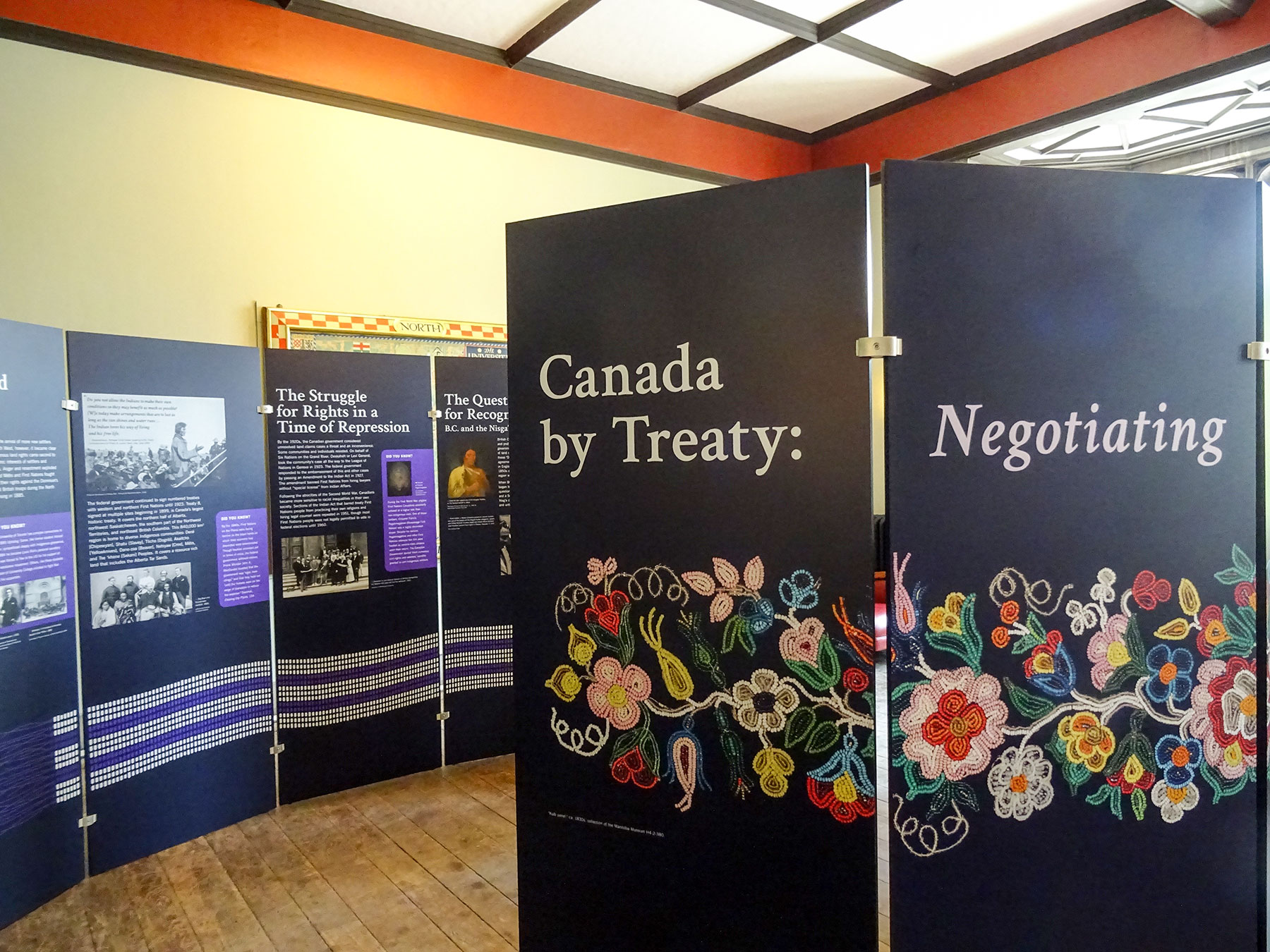
PHOTO BY CLARRIE FEINSTEIN/GLEANER NEWS: A Hart House Map Room exhibition that runs until May 26 aims to educate Canadians on the role of treaties in Canadian history. Canada By Treaty: Negotiating Histories — curated by history professors Heidi Bohaker and Laurie Bertram, and senior undergraduate student James Bird — is a direct response to one of the calls to action put forward by the Truth and Reconciliation Commission of Canada in 2015.
As Canada celebrates 150 years of colonialist history, this display presents another vital component to our history, which has forever shaped the relationship between Indigenous and non-Indigenous people. The exhibit delves into the geographic land negotiations — treaties — that predate Canadian Confederation. Each of the 24 panels provides a comprehensive explanation of the complicated history of treaties, with panels providing information on residential schools and treaties, wampum belts and treaty records, the role of Indigenous women in treaty-making, and the University of Toronto’s own complicated affiliations with land negotiations.
The exhibit contextualizes the nuances of these agreements, tracing the shift from alliance treaties initially between various First Nations and later with the European settlers in Canada, which brought on the period of land surrender, and ends with the recent treaties of the Nunavut Land Claims Agreement and the Nisga’a Final Agreement — the latter of which was approximately 100 years in the making. The land claims process is still going on: much of British Columbia, Quebec, and Newfoundland and Labrador are the subject of claims that have not yet been settled.
The display strongly emphasizes the important distinction that needs to be clarified: treaties were shaped by negotiation not conquest. The repercussion of treaties has resulted in the displacement and exploitation of Indigenous peoples because colonialists did not follow through on promises made in these land negotiations. The exhibit highlights a history that must come to the forefront in our national consciousness — an accessible room in Hart House teaching this history for all Torontonians is a start, but more needs to be done.
—Clarrie Feinstein/Gleaner News
READ MORE
NEWS: Reclaiming the Anishinaabe past (April 2017)
LIFE: Indigenous Games coming in July (March 2017)
NEWS: Building a stronger relationship (February 2017)
FOCUS ON EDUCATION: Decolonizing our schools (December 2016)
FOCUS ON EDUCATION: Building a respectful future (November 2016)
HISTORY: Honouring those who honour history (October 2016)
NEWS: U of T committee tasked with responding to Truth and Reconciliation Commission delivers interim report (August 2016)
ON THE COVER: Tracking history in the Annex (April 2016)
Tags: Annex · Arts · History
May 26th, 2017 · Comments Off on SPORTS (MAY 2017): Leafs return with sights on a title
Local nine look to take next step to winning championship

PHOTO BY R.S. KONJEK/GLEANER NEWS: The Toronto Maple Leafs take batting practice during a spring training session at Christie Pits on April 26.
By R.S. Konjek
It’s a casual April evening at Christie Pits Park.
A handful of locals play a pickup soccer game on one of the fields. An occasional runner pounds up the slopes near the baseball diamonds. Walkers amble past, many of them joined by canine companions who lead the way. The bright afternoon sun has moved low in the sky.
Inside the fences of Dominico Field, young men in athletic gear perform stretches and sprints. There are familiar faces and some new ones.
[pullquote]“Each new season brings the promise of excitement to be had and memories to be made.”[/pullquote]
The Toronto Maple Leafs are holding a spring training session in preparation for their 49th season in the Intercounty Baseball League, scheduled to begin in a few days. The Leafs are coming off a 2016 post-season run that saw them make it all the way to the league championship before falling short of the trophy.
The mood tonight is light. A coach’s instructions mingle with banter and laughter from the players. It doesn’t take long for the players to start up with some good-natured ribbing. It’s as if they never left this place.
They split into groups for some long tossing (pitchers) and infield practice (fielders).
Leafs owner Jack Dominico huddles with field manager Damon Topolie near the home bench. As they watch practice, they review the team roster and discuss a player who finds himself caught between baseball and work. The player wants to commit to the team, but only if his employer allows him enough time to be able to play regularly.
In this working man’s league, players come and go. Some leave for school. Some get married. Some start jobs in new cities. There are holes to fill at the start of every season. The owner and manager face these challenges every year. By opening day, they’ll have it figured out.
While the pitchers head to the bullpen, the crack of a bat heralds the start of batting practice for the other players. They take turns smashing baseballs over the fences, where team volunteers dutifully retrieve them.
A few curious passers-by have stopped to watch. Soon, these moonshots will be cheered by masses all around the park. For tonight, it’s only the players who howl after each blast.
Jonathan Solazzo is back for a third season with the Leafs. The third baseman says it’s always great to see his teammates again after the off-season.
“Everyone does their own off-season training, if it’s at the gym or baseball facilities,” he says. “Once we see everyone, it’s all family back again.”
A swashbuckling slugger and fan favourite, Solazzo is modest about his goals: “Stay healthy and be able to come and play every day.”
As far as team goals are concerned, the Leafs have lofty ambitions. Solazzo’s time with Toronto has seen the club progress deeper into the post-season each year.
“We were always one step closer to the prize,” he says. “[In 2015] we lose in the semi-finals in game seven to Barrie. [In 2016] we lose in the finals against Barrie. We’re hungry. We know what it takes to win the trophy, so hopefully this year we’ll take that next step.”
Based at one of the smallest ballparks in the league, the Leafs have always been a big-hitting team. On this night, it’s good to see that there are some new additions to the pitching staff, offering the hope that the Leafs will have all the pieces necessary to win it all this year.
The historic ballpark at Christie Pits has been the scene of baseball thrills for almost a half-century, and each new season brings the promise of excitement to be had and memories to be made.
Fans will be pleased to know that the park’s restrooms — located in the building behind centre field — have been upgraded. This follows on some revitalizations of the park that began in 2015. While the restroom facilities may have resembled something out of the Middle Ages before, they positively gleam now. Go with confidence.
The Toronto Maple Leafs’ 2017 schedule includes home games at Christie Pits every Sunday afternoon from May through July, plus a handful of Wednesday night games. Admission to Leafs games at the Pits is free.
READ MORE
SPORTS: Late summer blues (September 2016)
Tags: Annex · Sports
May 26th, 2017 · Comments Off on GREENINGS (MAY 2017): Thoughts on hitting the 400 benchmark
Governments need to change behaviour through policy
By Terri Chu
This past Earth day, the planet surpassed 400 parts per million (ppm) of carbon dioxide in the atmosphere. I remember being taught in primary school that 350 ppm was the magic number we weren’t supposed to reach. We sang songs about loving the earth and all the little individual things we can do to lower our environmental footprint. Despite all the singing, we blew through that target, so then the politicians decided that the next target would be 400. Having blown through that, I’m thinking the political response is to sit down and wait for self-annihilation (oh wait…that’s pretty much what we’ve been doing this whole time).
If you’re losing faith in governments to take meaningful action on climate change, you are not alone. Somewhere there must be a support group.
[pullquote]“Creating waste has never been easier, yet no politician dares raise a hand to tax garbage for fear of upsetting people’s right to have pre-peeled bananas in plastic packages.”[/pullquote]
While the Great Barrier Reef suffers a second mass bleaching event, buildings in Canada’s north are destabilizing due to lost permafrost, and Western Quebec is still under flood water, our government has pretended we can continue on with business as usual just because we have a carbon tax on a limited number of things. Kinder Morgan pipelines got the go-ahead, our high-emissions agricultural sector continues to enjoy subsidies (a pound of local organic beef is responsible for more greenhouse gas emissions than taking pretty much any vegetable-based food, slapping it on an airplane, and flying it around the world), and transit users continue to flee back into their cars due to the lower marginal cost of driving.
And in the meantime, new consumer “innovations” are here to help us fast-track our pollutions. Take for example the Silicon Valley based Juicero. They raised $120 million to market a $400 “smart juicer” that literally squeezes a juice packet for you into a cup. Creating waste has never been easier, yet no politician dares raise a hand to tax garbage for fear of upsetting people’s right to have pre-peeled bananas in plastic packages.
For years I’ve been writing about the little things we can do as individuals to reduce our carbon footprint. The sad reality is that none of what you, or I, do matters when half the city is still throwing out a dozen K cups a day. For every innovation that helps us reduce our carbon footprint, a Juicero comes along and spits in our faces, edging us closer to the dinosaurs.
There’s no easy solution, and definitely no quick fix. We need structural changes that stop rewarding our own laziness.
It is unconscionable that governments have done so little to curb food-packaging waste. Look at the lowly juice box. In three decades it has remained fundamentally unchanged, unchallenged by either consumers or governments. A three-pack comes wrapped in plastic, each individual box comes with a straw that will never decompose, and each straw is protected by its own plastic sleeve.
If we are to tackle climate change and our rapid destruction of our resources, we need structural changes. Washing something and reusing it needs to be price competitive with mining oil, forming it into a single-use disposable product, and getting it hauled away on the back of a gigantic truck.
Labour, not materials, has become the most expensive part of food distribution. Why pay a milkman to deliver milk and reclaim bottles when we can throw out mountains of containers at near zero cost? Meanwhile, our innovations are decreasing the need for human labour so much that we are looking at a population that’s about to face massive unemployment.
Without the right incentives, we will continue to double down producing garbage that will never decompose and adding more emissions to the air. It is how we have defined progress for over two centuries.
Depending on individuals to save the earth isn’t working anymore. It doesn’t matter how many K cups you and I don’t use when they still produce enough to circle the globe multiple times a year. We need governments to have the courage to enact policies that would effectively put them out of business unless they change their business model from one that treats the earth as a free garbage dump. When dumping onto the earth is no longer free, muscle power to reduce and reuse might actually start making economic sense.
Terri Chu is an engineer committed to practical environmentalism. This column is dedicated to helping the community reduce energy, and help distinguish environmental truths from myths.
READ MORE GREENINGS BY TERRI CHU:
Solving the food waste problem (April 2017)
Kellie Leitch was right (March 2017)
Feeling the carbon tax crunch? (January 2017)
Tags: Annex · Columns · Life