June 30th, 2017 · Comments Off on CHATTER (JUNE 2017): The latest from the OMB
A mediated settlement has been reached regarding the future of 316 Bloor St. W. Representatives from the City of Toronto, the Annex and Harbord Village residents’ associations, and State Building Group (which owns the building) met for two days to address concerns about the developer’s original proposal to raise a 42-storey building on the site.
It was to have consisted of 535 single bedroom or bachelor condominium units. The proposal — derided by some as a “vertical rooming house” — was loudly opposed at a community meeting in April 2015, and since then has been subject to several appeals at the Ontario Municipal Board (OMB). In opposing the development, the city argued that it did not meet the criteria set out by the Bloor Block Plan, passed by Toronto City Council in January.
The settlement includes lowering the number of storeys from 42 to 29, adding community space, and changing the unit mix so at least 30 per cent of the units are two- or three-bedroom condominiums.
In other OMB news, the University of Toronto has taken its application to build a student residence at the corner of Spadina and Sussex avenues to the provincial body. The application includes an appeal of the city’s decision to list the building that houses the Ten Editions bookstore. Meanwhile, community consultations continue on the university’s proposed application to revise and update its secondary plan. Essentially an exemption to the Planning Act, the application would allow the university to build any structure in a 108-hectare area so long as it is consistent with what the school calls character areas.
—Geremy Bordonaro/Gleaner News
READ MORE:
NEWS: Tall tower before OMB, as city battles back with block study (August 2016)
NEWS: “Vertical rooming house” rejected (May 2015)
Catching up with history (May 2014)
Tags: Annex · News
June 30th, 2017 · Comments Off on CHATTER (JUNE 2017): It’s flea (market) season
Flea markets are coming to two of the area’s most historical neighbourhoods. The Kensington Market Flea Market will launch June 25 and run every last Sunday of the month from 10 a.m. to 7 p.m. until October 29.
“I’m a part of the Kensington community and I always thought a flea market would be a good addition, and Kensington has got a flea market feel to it already,” said organizer Brock Sheppard.
The flea market, which coincides with Pedestrian Sundays, will offer a diverse array of goods in keeping with the market’s multicultural flavour. Shoppers can expect repurposed and handmade artisanal items like accessories and wooden carvings. There will also be a variety of foods and an ice cream maker serving coconut-based ice cream. Vendor spots are still available; contact kensingtonflea@gmail.com for further information.
Running the last Saturday of each month from 10:00 a.m. to 4:00 p.m. at 252 Dupont St. is the Madame Boeuf Flea Market. Organizer Desiree Kotnala envisions the market as a place to “engage with the neighbourhood and have a place where the neighbourhood can pass by and get fresh baked goods, cups of coffee and have a really great afternoon.” The market will run until October.
—Nathalie Rodriguez/Gleaner News
Tags: Annex · News
June 30th, 2017 · Comments Off on CHATTER (JUNE 2017): Building business on Bloor Street
Cycle Toronto has launched a new program aimed at boosting business on Bloor Street. Pick up a “Bike and Buy: Tour de Bloor Passport” from Cycle Toronto and have it stamped every time you eat or shop at one of 73 participating businesses between Avenue Road and Shaw Street. Passport-holders will be entered in a draw for discounts and prizes, including a Simcoe Bike valued at $850 from Curbside Cycle. The program will run until the end of the September. Passports are available at Curbside Cycle, Sweet Pete’s B-Side (Annex), and bloorlovesbikes.ca.
The program is a “win-win for everyone”, says Albert Koehl, one of the founders of Bells on Bloor. “If businesses are happy, they will support bike lanes.”
The program is supported by all local residents’ associations, the Bloor St. Culture Corridor, Trinity-St. Paul’s United Church and Centre for Faith, Bells on Bloor, as well as councillors Mike Layton (Ward 19, Trinity-Spadina) and Joe Cressy (Ward 20, Trinity-Spadina). Cycle Toronto is a not-for-profit advocacy group that promotes cycling, cycling infrastructure and policies.
—Annemarie Brissenden with files from Nathalie Rodriguez/Gleaner News
Tags: Annex · News
June 30th, 2017 · Comments Off on EDITORIAL (JUNE 2017): A watershed moment
At 150, Canada has much to celebrate. We are, relatively speaking, an open, democratic, tolerant, and welcoming nation set amongst a vast, beautiful landscape that has few peers. Indeed, called upon to describe Canada, many among us may point to our pristine lakes and rivers. But such an image may yet prove to be a mirage, for a recent nationwide assessment of Canada’s watersheds found significant disturbances to their quality and sustainability.
[pullquote]“With just 0.5 per cent of the world’s population Canada has jurisdiction of 20 per cent of the global freshwater supply.”[/pullquote]
Canada has 25 watersheds, each made up of 167 sub-watersheds. And, according to a WWF-Canada study released this month, all of the watersheds are under threat. The first national effort of its kind in decades, the report chronicles how pollution, habitat loss, fragmentation, alteration of flow, climate change, and invasive species are having an impact on the nation’s freshwater supply.
This isn’t just a national issue. With just 0.5 per cent of the world’s population Canada has jurisdiction of 20 per cent of the global freshwater supply. In an increasingly thirsty world, it is incumbent on us to understand the impact on our population, our industries (including transportation and energy production), and climate change is having on our finite resource. We have a duty to be stewards of our planet — something that strikes us as downright Canadian.
Pollution remains the most serious threat to our water resource, with wastewater effluent, industrial discharges, and urban runoff being the largest contributors. In the Prairies and in southwestern Ontario, agricultural contamination includes pesticides, phosphorus, and nitrogen. Pipeline incidents and pollution from transportation accidents affect water far outside areas of population density. The Canadian National Railway Company was recently fined $2.6 million for spilling 90 litres of diesel fuel into Edmonton’s North Saskatchewan River. The fine was higher because the company failed to report the spill, and only admitted to it after authorities traced its source back to CN, whose name is now on the list of the federal Environmental Offenders Registry (oh that it had the same weight as the Sex Offender Registry).
Alteration of flow — installing large dams and reservoirs — disrupts the flooding cycles and variations that are natural to all river systems. The Churchill River in Labrador was highly altered to permit the Muskrat Falls hydroelectric facility. The largest such installation in Canada is located in the La Grande sub-watershed in Quebec.
As Canada tries to find ways to meet its greenhouse gas emission goals, we must be cautious about developing more hydroelectric power projects, as they will no doubt have a commensurately higher impact on our waterways and the ecosystems that they support.
The WWF-Canada report also attempted to identify the quantity of water used for drinking, mining, and manufacturing (except for oil and gas production). Significant habitat loss was found in the 167 sub-watersheds as natural habitat adjacent waterways have been converted to farmland or cleared for lumber extraction, both of which add to the polluted run-off.
What may have started as a four-year long comprehensive analysis of the state of our water may soon yield a realization of the massive depth of our data deficiency: we only have data on 67 of our 167 sub-watersheds. Of the 67 we do have data on, 42 have poor or merely fair water quality, not exactly a promising predictor about the health of the rest. And, we are still ill equipped to understand the wild card effects of climate change more broadly.
We lack a national standard for measuring various stressors and a need to bring existing data to a common place that is open to everyone. Data collection, analysis, sharing, and updating should be an initiative that is bolstered. It’s not that provincial, regional, and municipal authorities should stop doing what they are doing, but it should be a coordinated effort led by the federal government.
The watersheds themselves transcend boundaries and Canadians need to work together to make informed decisions about how we use and protect our freshwater ecosystems and wildlife.
Imagine that as a legacy to the next 150 years: a freshwater monitoring system.
READ MORE
EDITORIAL: Revoke U of T’s unchecked “licence to build” (May 2017)
EDITORIAL: Westbank’s positive precedent (April 2017)
EDITORIAL: Foreign buyers tax a necessary cliff jump (March 2017)
EDITORIAL: Clement’s petulance diminishes parliament (February 2017)
EDITORIAL: Pot a remedy in opioid crises (January 2017)
Tags: Annex · Editorial
June 30th, 2017 · Comments Off on EDITORIAL CARTOON (JUNE 2017): how nice! by blamb

More how nice!
EDITORIAL CARTOON: TCHC (May 2017)
EDITORIAL CARTOON: The Grand Tory (April 2017)
FORUM: Celebrating 20 years of cartoonist Brett Lamb (April 2017)
EDITORIAL CARTOON: A second chance! by Brett Lamb 2037 (February 2017)
EDITORIAL CARTOON: Not really! It’s actually nice! by Stumpy the Subway (January 2017)
Tags: Annex · Editorial
June 30th, 2017 · Comments Off on FORUM (JUNE 2017): Address affordable housing
All levels of government must take responsibility
By Joe Cressy
Some people measure the progress of a city by the speed of its transit systems or the quality of its public parks, by the number of schools in a neighbourhood, or by the number of potholes filled each year.
These are significant factors for a city’s livability, but I believe that one of the most important measures of a city’s progress is how well it cares for all of its residents, especially those who are most vulnerable.
I will be blunt: Toronto is experiencing a crisis in affordable housing. There are currently 181,000 people on the Toronto Community Housing (TCHC) waiting list. In 2018, money for capital repairs to address the over $2 billion backlog at TCHC will run out.
This not only means that we cannot complete the necessary repairs that make our neighbours’ homes livable, but it also means that when the funds run out, units will be in danger of closing.
This is not acceptable. We cannot let that happen.
All levels of government have a responsibility to invest in our social housing system to ensure that units are safe, affordable, and livable. All levels of government have a responsibility to ensure that all residents of Toronto, regardless of income, have access to a safe place to live. Closing units, with more families being denied access to safe housing, should not be an option.
What are the other levels of government doing? The federal government has promised funds, but details are yet to be confirmed. And the provincial government is absent — they have made no commitment to provide any funding for these desperately needed repairs within TCHC. They must come to the table and fulfill their obligation to all the residents of Toronto.
Let me be clear: even without the partnership of the federal and provincial governments, we cannot let a single TCHC unit close in 2018. We must do more as a city if our government counterparts do not step up. The situation is too serious, and the consequences of inaction are too dire.
We must all continue to push the federal and provincial governments strongly and loudly to help TCHC. I will also fight to ensure that not a single unit is closed in 2018 — I hope you will join me.
Please write to your local member of Parliament and member of provincial Parliament to advocate for the desperately needed funds for our social housing system and to Mayor Tory to let him know that closing TCHC units in 2018 is unacceptable.
Joe Cressy is the councillor for Ward 20, Trinity-Spadina.
READ MORE BY JOE CRESSY
FORUM: Build a neighbourhood (March 2017)
FORUM: Conserving past to enrich future (January 2017)
FORUM: Our dynamic Kensington Market (November 2016)
FORUM: A new central park for Toronto (September 2016)
Tags: Annex · Columns · Opinion
June 30th, 2017 · Comments Off on GREENINGS (JUNE 2017): Lessons from Madrid

PHOTO BY TERRI CHU/GLEANER NEWS: Cars rule the road in Madrid (above), a city whose culinary delights and historic sights are marred by the population’s refusal to use public transit.
Time to end the car era
By Terri Chu
While I grant you that visiting a place for a mere two days can’t possibly do it justice, I was more than happy to leave Madrid after what felt like a very long 48 hours. Despite great cuisine and historic vistas, the city felt destroyed by its accommodation of cars.
Encountering traffic when coming in from the airport at 9 a.m., we asked our taxi driver if we were running into rush hour. No, he exclaimed, explaining that it was far too late for that, it was simply normal traffic. He added that a family of four typically has four cars, and spoke of the love affair this city has with driving despite the number of transit lines.
Traffic in and out of stations seemed light for a weekday compared to downtown stations in Toronto. Sure enough, for a city slightly larger than Toronto (3.1 million compared to Toronto’s 2.7), Madrid’s daily ridership is around 1.5 million compared to roughly 2.8 million in Toronto.
[pullquote]“Sadly, what was once no doubt a lovely city is so overwhelmed by pollution I couldn’t wait to leave.”[/pullquote]
For a historic city, we noted that a lot of money was sunk into car infrastructure. There are car overpasses in districts that include castles and churches dating back hundreds of years. The costs involved must have been enormous. A walk along the beautiful, tree-lined boulevard quickly became unbearable as the smog made breathing difficult for someone with asthma. One can only guess how the trees manage to survive. Indeed, pollution was so bad last December that Madrid banned half of the cars from the city by alternating odd and even licence plates.
The city is tackling the problem. The day we arrived was the first day of a four-euro-per-hour parking tax. It was difficult to tell how much of an impact the tax had, but we certainly didn’t see a lot of empty parking spots. The love of driving was clear. When you build a city to accommodate cars, sure enough, they will come. Sadly, what was once no doubt a lovely city is so overwhelmed by pollution I couldn’t wait to leave.
As Toronto’s own transit debate rages on, the biggest lesson we can learn from Madrid is that a carrot itself is not enough. Opponents of tolled roads argue that you can’t unjustly penalize car drivers without giving them viable alternatives (like better transit). The existing “better transit” in Madrid shows that behaviours won’t change unless you penalize.
Toronto’s utter failure has been its horrific transit decision-making over the last four decades. The Sheppard Stubway to nowhere is still a financial disaster while the single stop to Scarborough is guaranteed to bleed money for longer than the Montreal Olympics.
Meanwhile, the 401 has been widened repeatedly yet traffic is as terrible as ever. It takes nearly three hours to drive to London now whereas when I first moved to Toronto, it was a reliable two-hour trek home. My dad recently said there were grumblings about a GO train to Toronto from London when he first bought the house 35 years ago when the bulk of the 401 was a mere two lanes in each direction.
We now have three to six lanes in each direction and more congestion than there ever was in the 90s. The population has increased substantially, and we have condemned newcomers to Canada to embracing the car lifestyle by not providing affordable transit options.
If Toronto were a young city, I’d advocate for building subway access to where there are no people yet and let the city fill in around it. However, in a city with 2.8 million people and 6 million in the surrounding area, the majority of whom are already under served by transit, the priority needs to be to get existing people off the road. Give people options and then penalize heavily for car traffic. Let’s not build a single stop subway when an LRT can serve many more people. Let’s start tolling the roads and substantially increase parking costs.
Madrid shows us how even a gorgeous historic city can be destroyed by traffic. If you accommodate cars, they will drive. We don’t need a return to smog days. The car era is over, and politicians need to start catching up.
Terri Chu is an engineer committed to practical environmentalism. This column is dedicated to helping the community reduce energy, and help distinguish environmental truths from myths.
READ MORE GREENINGS BY TERRI CHU:
Thoughts on hitting the 400 benchmark (May 2017)
Solving the food waste problem (April 2017)
Kellie Leitch was right (March 2017)
Feeling the carbon tax crunch? (January 2017)
Tags: Annex · Columns · Life · Opinion
June 30th, 2017 · Comments Off on SPORTS (JUNE 2017): Weather permitting

PHOTO BY R.S. KONJEK/GLEANER NEWS: Johnathan Solazzo (right) is greeted at home plate by his teammates after blasting a grand slam for the Toronto Maple Leafs on June 7 at Christie Pits.
Hometown Leafs battle foes and forecasts as season gets under way
By R.S. Konjek
It was a rainy May.
The elements proved to be the Toronto Maple Leafs’ greatest adversary in the first month of the 2017 Intercounty Baseball League season. Three scheduled games at Christie Pits were rained out, as well as a road game in Hamilton.
“We only play every second Sunday now,” lamented Al Ross, a witty fixture on the Christie hillsides. “That’s what we should call the season: Every Second Sunday.”
[pullquote]“Fans will recognize the pattern: the Leafs have gotten off to neither a blistering hot start, nor a brutally cold one. They have been beating the lousy clubs, but getting edged out by the stronger ones.”[/pullquote]
The traditional showers of April arrived late this year, regularly drenching the city throughout the month of May. Pondering on it, one might start to believe that our planet’s seasons have become displaced, with the change of seasons shifting back a month.
Lately, April weather has been hanging around into June. Then summer will click on like a light switch and last deep into September, maybe even October. Things will cool off in time for Halloween, but then the autumn months will carry over into the new year. It barely ever snows in December anymore. When the snow does come, it’s for briefer periods, punctuated by flash storms rather than lasting snowfalls. Temperatures will finally rise above freezing sometime in March or even April, making for a delayed spring. And the cycle repeats.
I am not a professionally trained climatologist, nor am I in possession of a Ph.D. in any of the applied sciences, but I have a pair of eyes and my theory is this: the seasons are shifting. To what cataclysmic end this shift is taking us, no one can say.
In the meantime, we have baseball.
Rainouts aside, the Leafs have managed to play a good number of games to start the season. By early June their record stood at five wins and five losses, good for fourth place in the league standings.
Fans will recognize the pattern: the Leafs have gotten off to neither a blistering hot start, nor a brutally cold one. They have been beating the lousy clubs, but getting edged out by the stronger ones.
Case in point: in two games against the perpetually rebuilding Burlington Herd, the Leafs dispatched their opponents handily by scores of 11-4 and 8-2.
Against the defending champion Barrie Baycats, the Leafs have stumbled. On the opening day of the season, a close game got away in the seventh inning when Barrie scored four runs en route to a 6-1 victory.
More recently, the rival clubs battled it out in a classic Christie slugfest.
The game took place on June 7, a cool but dry evening in Toronto. The Baycats arrived looking to extend their perfect 6-0 record, while the Leafs were eager to hand them their first loss.
The game got off to a bang in the bottom of the first inning, when Leafs third baseman Johnathan Solazzo blasted a grand slam to give his club a 4-0 lead.
Barrie punched right back in the second inning with three runs of their own, and the slugfest was on. The home nine put two more runs on the scoreboard in the third inning, and three more in the fourth to take a commanding 9-3 lead.
The Baycats clawed their way back against starting pitcher Zach Sloan, who was making his debut for the Leafs. Sloan lasted into the sixth inning before handing a 9-6 lead over to Pedro De Los Santos, another new face on the Toronto pitching staff. De Los Santos could not halt Barrie’s momentum. The visitors scored three more runs and the game was tied 9-9 after six.
The score remained deadlocked until the bottom of the eighth, when it looked like the Leafs might sneak a win. Pinch hitter Greg Carrington hit a single and then stole second base. Solazzo returned to the plate and calmly knocked a double into the outfield. Carrington scored, it was Solazzo’s sixth RBI of the night, and with that, the Leafs were three outs away from victory.
The visitors, however, demonstrated why they are the three-time defending champions. Bowed but not broken, they jumped all over De Los Santos for three hits and two walks with an error thrown in. When the dust settled, they had scored four runs. Toronto was unable to respond in the bottom of the ninth, and Barrie made off with the 13-10 win. A frustrating loss, but not discouraging. The season continues.
Weather permitting, the Leafs play at Christie Pits every Sunday through the rest of June and July. Games start at 2:00 p.m. The Leafs also host the occasional night game on Wednesdays.
READ MORE
SPORTS: Leafs return with sights on a title (May 2017)
SPORTS: Late summer blues (September 2016)
Tags: General
June 30th, 2017 · Comments Off on ARTS (JUNE 2017): Bata Shoe Museum celebrates heels and stars

PICTURE COURTESY?THE?ROYAL?ONTARIO?MUSEUM: The Family Camera, at the ROM?until October 29, invites viewers to consider family portraits with a different lens.
Music and art at the Gardiner
By Heather Kelly
Looking for something interesting and unusual? Consider enjoying family time and learning something new at an exhibition. Shining Stars: Celebrating Canada’s Walk of Fame is on at the Bata Shoe Museum, and while you are there, see the exhibition Standing Tall: The Curious History of Men in Heels, with footwear from privileged rulers, rock stars, cowboys, and bikers, including John Lennon’s original 1960s Beatle boot and platforms worn by Elton John in the 1970s. At the Museum of Estonians Abroad the Metsaülikool/Forest University 50! anniversary exhibition is on display, and the Toronto Reference Library TD Gallery looks at personal stories of migration in an exhibition called Destination Canada. Ocean giants awe and fascinate at the Royal Ontario Museum’s Out of the Depths: The Blue Whale Story, featuring one of the largest, most complete blue whale skeletons ever displayed.
Concerts and music-related events include The Royal Conservatory of Music’s New Canadian Global Music Orchestra, a major initiative by the conservatory to celebrate Canada’s cultural and musical diversity, with musicians from 12 different countries who now live in Canada. Alliance Française presents Les Petits Nouveaux on June 10 and talented young French artists Frànçois and the Atlas Mountain on June 15 and Fishbach on June 19. Hot Docs Ted Rogers Cinema will show Score: The Film Music Documentary, where the greatest film composers in the world discuss their craft, and launch the new series, Bob Dylan on Screen. The Miles Nadal JCC presents DRUMHAND and Nagata Shachu on June 10, the Children’s Musical Theatre Project on June 19 and 20, and the Royal Canadian Legion Concert Band Annual Gala on June 25, in the Al Green Theatre. The ROM’s popular Friday Night Live is back each week with music, food, and museum activities based on special themes.
A range of visual art can be explored, including an exhibition of Italian comic artist Paolo Bacilieri at the Istituto Italiano di Cultura until June 14, with original illustrations from his latest graphic novel Fun (in English), La Magnifica Desolazione and Sweet Salgari. Opening June 20 at the Istituto Italiano, Toronto-based artist Rino Noto contemplates candid human activity in Wave. At Alliance Française, photos from the Lycée Français Toronto’s photography competition are on view June 12-16, and I Remember: Vimy 100 by photographer Racheal MacCaig, opens June 20.
The ROM launches Anishinaabeg: Art & Power June 17, about the life, traditions, and sacred stories of one of the most populous and diverse Indigenous communities in North America, and continues The Family Camera exhibition looking at family photographs and migration. The Gardiner Museum presents SMASH: Voyeur*ish on June 22, with immersive contemporary art installations accompanied by food and music. The Japan Foundation exhibition, Road of Light and Hope: National Treasures at Todai-ji Temple, Nara Photographs by Miro Ito is on until June 28.
Heather Kelly is the founder and director of the Bloor St. Culture Corridor. Her column focuses on arts and culture events from the district.
Tags: Annex · Arts
May 26th, 2017 · Comments Off on ON OUR COVER (MAY 2017): Annex in an instant
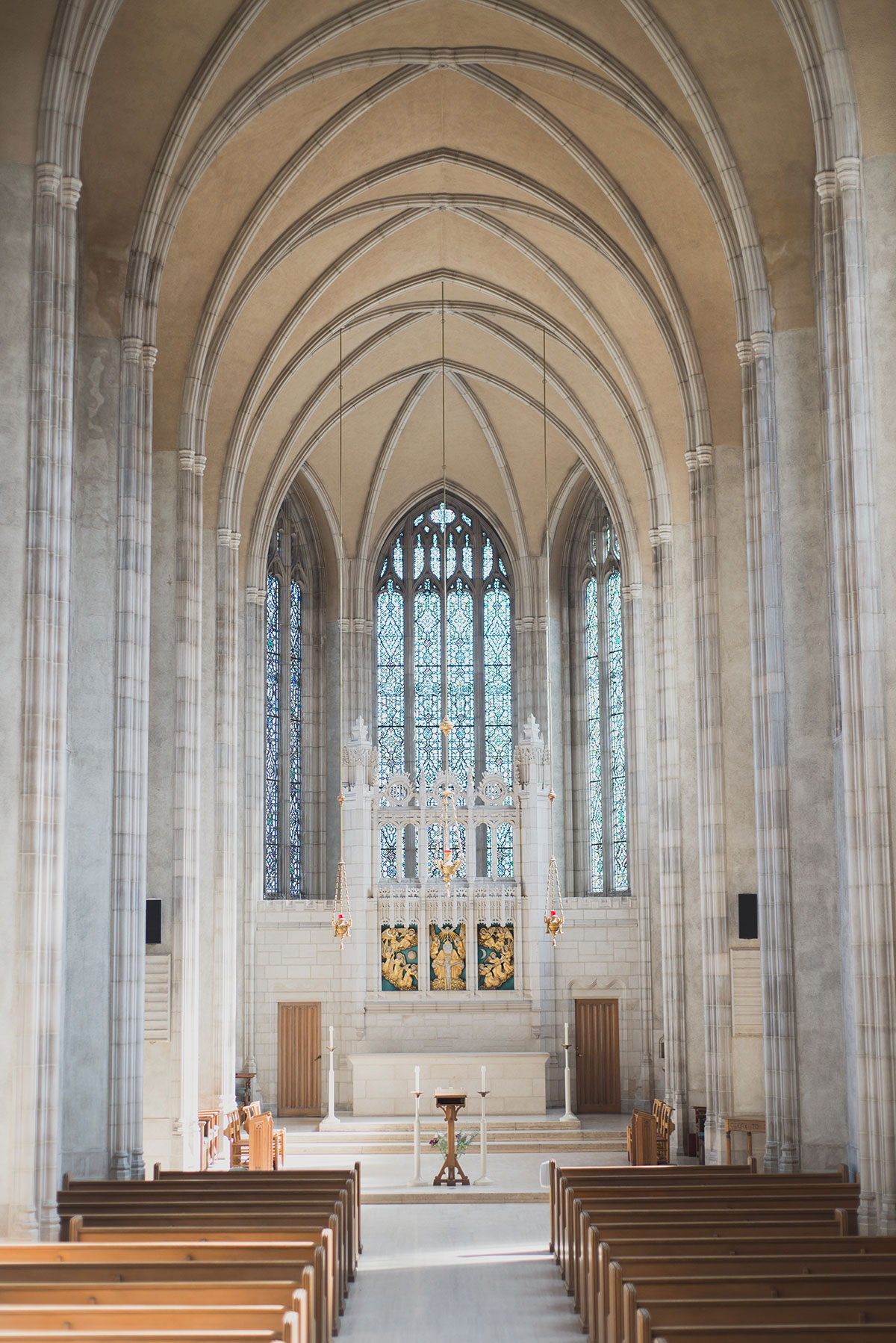
PHOTO COURTESY DANIELLE SUM: “Presence” by Danielle Sum, from Toronto in an Instant, featuring the work of photographers from Toronto working with Fujifilm Instax cameras. Part of this month’s Scotiabank CONTACT Photography Festival, each work represents urban life with a single image or small series. Sum’s image of Trinity College Chapel is on display at Annex Photo on Bloor Street West.
Tags: Annex · News
May 26th, 2017 · Comments Off on NEWS (MAY 2017): Miles Nadal JCC submits electronic roof sign application
Centre needs to address funding shortfall
By Clarrie Feinstein
The Miles Nadal Jewish Community Centre (JCC) has resubmitted an application to erect a third party electronic advertising sign on the roof of its building at the southwest corner of Spadina Avenue and Bloor Street.
In 2015, the City of Toronto’s Sign By-Law Unit refused the JCC’s first application because it broke all its bylaw requirements. The current proposal, which Toronto City Council will consider on May 31, is exactly the same.
[pullquote]“These bylaws were created for a reason”—Zoe Newman, Huron-Sussex Residents’ Organization[/pullquote]
The sign would be 10 by 3 metres (three times the size of what is allowed), 2.5 metres away from the intersection (signs must be at least 30 metres away), and it would face the street and properties.
“New roof signs are prohibited in the city,” said Ted Van Vliet, manager of the Sign By-Law Unit. “Electronic signs are not permitted in residential districts — only commercial areas like Yonge-Dundas Square. This sign is high impact with variable light levels and is facing two arterial intersections and the size of the sign is visible from nearby residences.”
Ten people attended a community consultation at Trinity-St. Paul’s United Church and Centre on April 20 to voice their concerns about the visual impact the sign would have on the neighbourhood.
“These bylaws were created for a reason,” said Zoe Newman, representing the Huron-Sussex Residents’ Organization (HSRO) at the meeting. “What concerns me is that no changes have been made to this proposal. Two years ago the same concerns were made by residents. This should be a collaborative process with community members and this proposal isn’t reflective of that.”
While the sign would provide the JCC with more funding, residents are worried that permitting it would set a precedent for future sign proposals that also do not follow the bylaw requirements.
Yet none of the residents from the buildings the sign would impact most were at the community meeting to provide comment.
The sign would have electronic moving advertisements that would change approximately every 10 seconds. The JCC would advertise its community services, including the fitness centre, swimming pool, in-house theatre, Jewish schools, adult night classes, film programming, and child day care.
“We would have complete veto power over the third party advertising if it didn’t fit in with the mandate of the JCC or the community at large,” said Ellen Cole, executive director of JCC. “We would inform the neighbourhood traffic of what is constantly going on inside the building.”
The city receives approximately 10 to 20 sign proposals a year, most of which are not approved. Indeed, city council has granted only two third party roof signs since 2010.
The JCC has been in the Annex for over 60 years, and it serves both Jewish and non-Jewish communities.
“Our membership is made up of 50 per cent non-Jewish and 50 per cent Jewish members,” added Cole. “People always ask us if they have to be Jewish to be a member. A sign like this can really show that we provide services for everyone. It’s a Jewish centre and community centre.”
The JCC is entering a period of uncertainty with sponsorship, leaving them with few available options to provide substantial revenue.
“We will lose our sponsorship from United Way next year, losing $100,000,” said JCC representative David Sadowski at the community meeting. “This will be the first year the JCC will be in deficit. Having this third party sign will bring us in a revenue of $100,000 annually without having to increase membership prices or cut programming.”
“It’s an innovative and entrepreneurial way for us to get revenue,” said Cole. “People can say no all they want, but what alternatives do they have? This is the best option we’ve got.”
Tags: Annex · News
May 26th, 2017 · Comments Off on NEWS (MAY 2017): Restored Brunswick House reopens
Exhibition features musical memorabilia
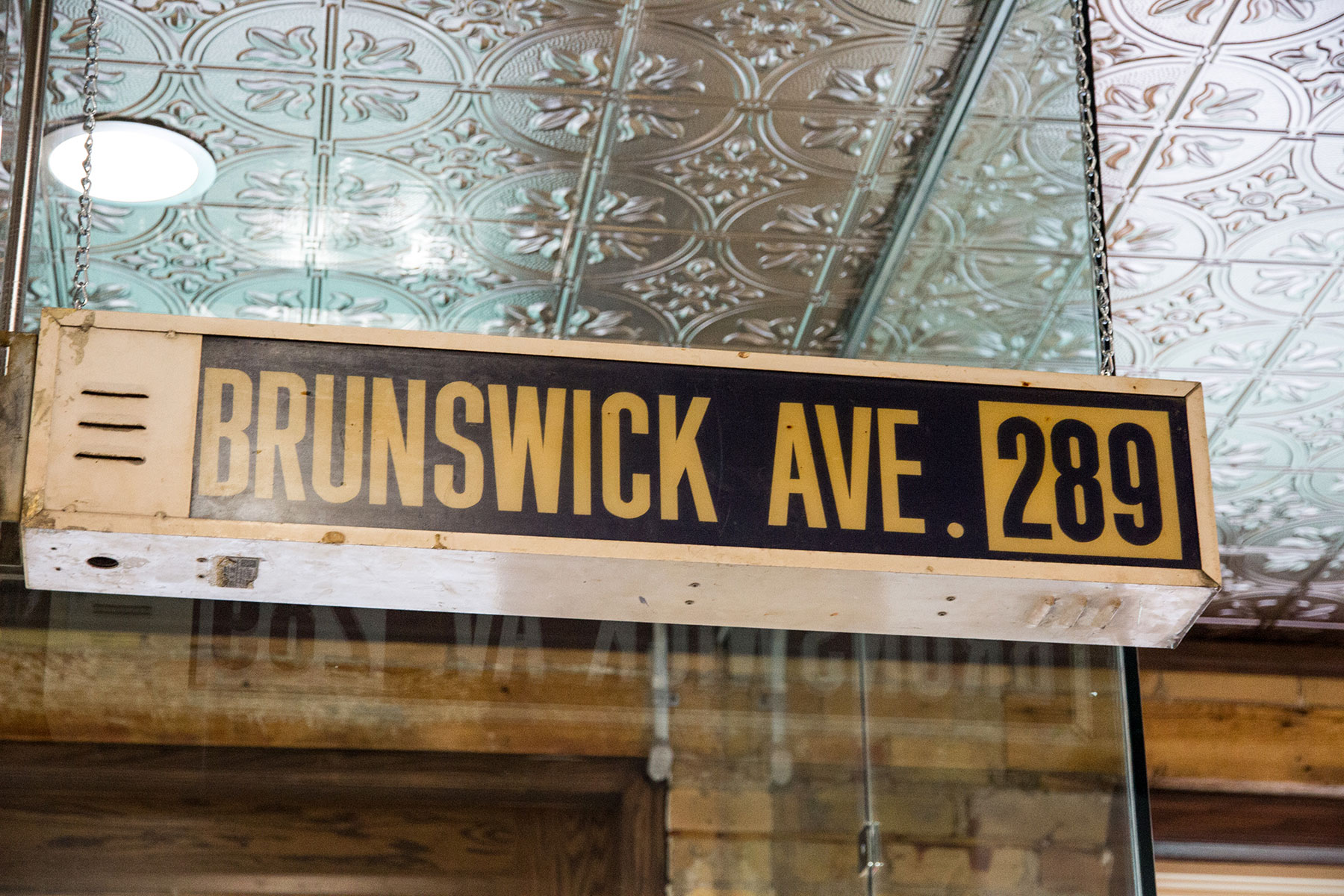
PHOTO BY GEREMY BORDONARO/GLEANER NEWS: Rexall Brunswick features many nods to history and community, such as this street sign.
By Annemarie Brissenden
It was a grand opening for a grand old dame. Approximately 45 community members, music aficionados, and company dignitaries celebrated the transformation of Brunswick House from a notorious student dive bar into a boutique flagship drugstore when Rexall/Pharma Plus officially opened Rexall Brunswick on Bloor Street West late last month.
“It’s a remarkable renovation, and well beyond what would have been required in terms of scale,” said Brian Burchell, chair of the Bloor Annex BIA, who also publishes this newspaper. “The biggest thing Rexall has achieved in the Annex is bringing the building back to life.”
[pullquote]“What they’ve done as a chain store is adapt to the community that they’re in”—Gus Sinclair, chair, HVRA[/pullquote]
Great care has been taken in the restoration. The limestone walls have been polished, the exterior brick restored, and barrels that used to serve as seating and serving stations have been incorporated into the decor. The keg barrel bar is now the main checkout area.
“We were committed to building and operating a store that respected and recognized the history of the Brunswick House,” explained Derek Tupling, Rexall’s director of Communications and Government Relations. “All of the original archways and chandeliers have been incorporated into the store. When we were digging back into the building, we found a window behind a wall, and it’s now a really cool feature.”
The splashy April 27 opening emphasized the building’s history as a live music venue, and featured radio broadcaster and music historian Alan Cross.
He curated the Rexall Brunswick Music Artifacts Exhibition, featuring memorabilia from the artists who had performed there including Jeff Healey, Oscar Peterson, and Etta James. Representatives from each of the donated artifacts were also on hand to explain each item’s history. The exhibition will remain on display until May 11, after which it will become part of the Studio Bell’s permanent collection at the National Music Centre in Calgary.
“The musical component was an obvious choice. Some of the most well-known and recognizable names in Canadian history have played there,” said Tupling. “We wanted to play homage to what it meant to so many people for so many years.”
Gus Sinclair, chair of the Harbord Village Residents’ Association, said he’s pretty pleased with the restoration.
“What they’ve done as a chain store is adapt to the community that they’re in,” he said. “Brunswick in its last incarnation was not conducive to a good relationship with the community. It’s no longer a blight at the top of the street.”
For Joe Cressy (Ward 20, Trinity-Spadina), that aspect — heritage restoration — was the most important.
“Rexall has taken great care to get this right, and to ensure that the building itself continues to reflect what was once there.”
The councillor added that Rexall was fully engaged with the city through the restoration process, and addressed long-standing issues with the site, like the placement of dumpsters.
“They have been good partners with us and in the community. They have been really pro-active and positive partners.”
Cressy, Sinclair, and Burchell all agree that Rexall has taken great pains to integrate seamlessly into the fabric of Bloor Street.
“It’s certainly consistent with what the city hopes to do with maintaining that scale along Bloor Street,” said Burchell.
Sinclair pointed out that “the stable built form of the street is pretty much the same as it has been for one hundred years.
“As bad as the Brunswick was, I like the idea of the building’s history being respected.”
According to Burchell, “If the choices are Rexall or Brunswick House, we certainly welcome the change. It adds more reasons to stay in the Annex, a village unto itself with an eclectic mix of businesses and dining options.”
“We’re very comfortable and very confident that we have lived up to our commitment to restoring the heritage elements and incorporating them into to the broader design of the store,” said Tupling.
—with files from Geremy Bordonaro
Correction: The photo credit in the print version made reference to a file photo. The picture was taken at the April 27 event.
READ MORE
NEWS: Rexall replaces Brunswick House (April 2016)
NEWS: Brunswick on the block (December 2015)
Tags: Annex · News