September 13th, 2017 · Comments Off on CHATTER (AUGUST 2017): Don Watterson dies at 71
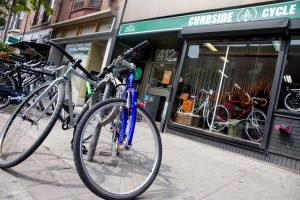
PHOTO BY GEREMY?BORDONARO/GLEANER NEWS
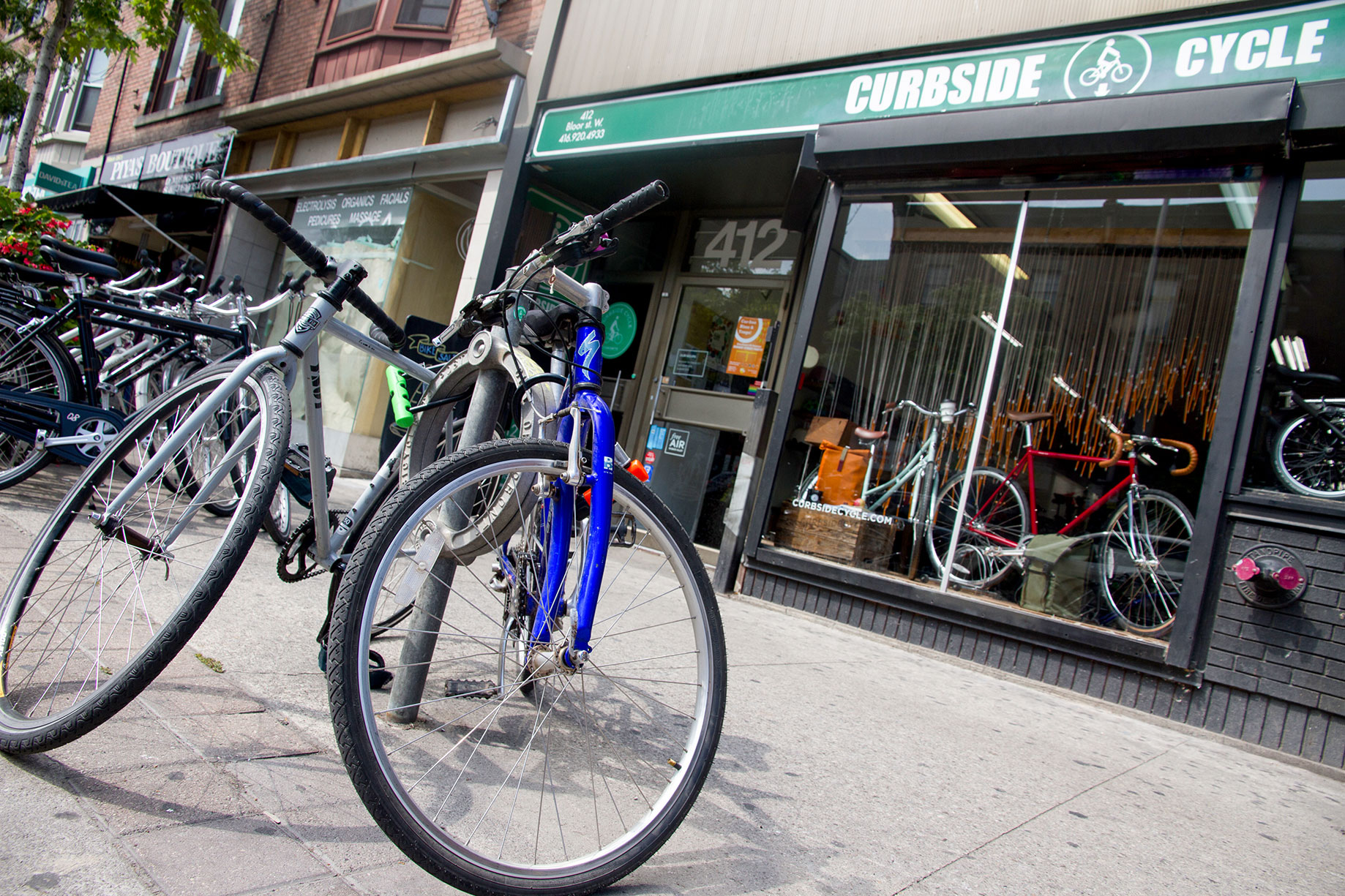
The founder and owner of Bloor Street retailer Curbside Cycle died of an apparent heart attack on August 16. He was 71 years old.
Don Watterson launched Curbside in 1991 as a tent on the side of a curb (hence the name) near Bloor Street and Brunswick Avenue, not far from its current storefront at 412 Bloor St. W. He was also heavily involved in Bells on Bloor, which advocates for bike lanes on Bloor Street, and was instrumental in making Toronto more accessible for cyclists.
Like his advocacy work, cycling in the city is at the heart of his shop. As a result, Curbside’s focus has always been on bikes that people use primarily to get around the city, rather than bikes for recreation (mountain bikes) or sport (racing bikes).
His entrepreneurial spirit enabled him to break from a rigid pre-existing supply chain structure and import city bikes directly from Europe, establishing Fourth Floor Distribution to distribute European city bikes across a Canada-wide network. According to their website, “it remains the case that bike stores tend to be run by males, often really grumpy males, and only sell products that are designed for other males, many of whom can also be quite grumpy. So while we dream of sharing our vision of city bikes with retailers across North America, it’s going to take a while to convince them.”
A recent visit to Curbside Cycle found not one grumpy staffer but rather a mechanic with a smile, eager to get a flat fixed on the spot to get the rider back on her way.
Watterson would have been proud.
—Brian Burchell/Gleaner News
Tags: Annex · News
September 13th, 2017 · Comments Off on CHATTER (AUGUST 2017): New after-school club launches at Central Tech Stadium
Central Tech Stadium is introducing a new after-school program. Open to children from schools within a 15 to 20 minute walk of the stadium, the CTS After School Club is a physical adventure program in which students will participate in sports at the stadium, activities in local parks, and excursions throughout the Annex. Participating children will be picked up from their school. The program, which begins in September, runs from the minute the school bell sounds until 6 p.m.
—Geremy Bordonaro/Annex Gleaner
Tags: Annex · News
September 13th, 2017 · Comments Off on CHATTER (AUGUST 2017): Celebrate the season in Harbord Village
This year’s Harbord Village Fall Fair will take place at Margaret Fairley Park on Sept. 10 from noon to 6 p.m. The block-busting party, say the organizers, will include live music, games for children, and a feast of food. There will also be a silent auction, as well as a selection of beer and wine. It’s hosted by the Harbord Village Residents’ Association, which is still looking for volunteers.
For further information, please visit www.harbordvillage.com.
—Geremy Bordonaro/Annex Gleaner
Tags: Annex · News
September 13th, 2017 · Comments Off on CHATTER (AUGUST 2017): A feast and festival of mulberries
Delicious mulberries were at the height of season in early July for the Annex Residents’ Association’s (ARA) first ever Mulberry Festival. Organized by Trees Please, an ARA working group, and sponsored by the association and COBS Bread, the event drew about 70 to 80 participants who celebrated the urban forest and a love of mulberries.
The participants picked six local mulberry trees, and visited what the ARA calls “the most incredible back yard garden”. Other activities included a seeding demonstration, a talk about the city’s tree canopy, and, of course, eating copious amounts of mulberries.
The association hopes to make the festival an annual event. To volunteer or have your mulberry tree picked next year, please email events@theara.org.
—Terri Chu/Gleaner News
Terri Chu, a member of the ARA, helped organize this event. She also writes this paper’s Greenings column.
Tags: Annex · News
September 13th, 2017 · Comments Off on NEWS (AUGUST 2017): Regulating short-term rentals
Vacancy rate for apartments getting even lower
By Geremy Bordonaro
If you’re coming to the Annex for a quick visit, you’re in luck. From hotels to condos to student residences, there’s lots of places that will give you a taste of what’s it like to live in Toronto’s most livable neighbourhood. If you actually want to live here, however, you’re out of luck. Long-term housing, especially affordable housing, is at a premium.
[pullquote]“We’ve got units being used in, essentially, a hotel function in residential communities” —Mike Layton, Ward 19, Trinity-Spadina[/pullquote]
And some say that’s because of the very perk available to visitors: short-term rental units, offered online through services like Airbnb, Flipkey, and Homeaway. Potential renters are being forced out in favour of hosts who rent out exclusively on online services to make a steady profit off short-term renters.
“The data is pretty clear. There are thousands of units that are being pulled off the rental market currently,” said Geordie Dent, executive director of the Federation of Metro Tenants’ Association. “What that means is that the city, which is under a housing crisis, continues to suffer and this exacerbates that.”
Neil Wright of Wright Real Estate said the situation has become so bad that he’s wary of those who want to purchase rental properties.
“I’ve had a number of people call me and ask me if we had any rentals that they could look into,” Wright said. “And these were people accumulating rentals that they had no intention of renting themselves. They wanted to rent them for Airbnb. It’s a huge business.”
“We’re in a situation where we’ve got units being used in, essentially, a hotel function in residential communities,” said Mike Layton (Ward 19, Trinity-Spadina). “The platform allows for us to really modernize some things that were legal in the past, like sublets. But it also has a dual purpose of allowing things that would otherwise not be permitted by our by-laws. For instance, some of the hotel-like arrangements.”
Such hotel-like arrangements have a big impact in areas of the city that are especially desirable.
“You can look at places like Kensington Market, Liberty Village, and the Annex where there is a really sought after place for people to live and visit,” Layton said. “People come here and they can’t afford to live there because of the lack of availability of units.”
The City of Toronto has responded by proposing new regulations that would require short-term rental companies and operators to register with the city. Short-term rentals would only be permitted in the principal residence of the owner or tenant, and would be limited to the entire dwelling unit, a secondary suite or up to three rooms rented for up to 28 days. The proposed regulations are now undergoing public consultations.
The city is particularly concerned with losing future rental units — such as those from Westbank Corp.’s Mirvish Village development — to a service like Airbnb.
“The fear is the loss of residential units. And thereby increasing the cost of renting,” Layton said. “When you see that sheer number of units up on Airbnb you know that that is taking away units from dozens, maybe hundreds or thousands, across the city. When you have a vacancy rate as low as ours, those units count.”
It’s a case of finding balance. Some Airbnb hosts provide a great service renting out the units they live in, and aren’t taking a potential rental unit out of the market.
“I know a number of people doing this and they’re very excited about it. They have beautiful accommodations in the interior,” Wright said. “It’s quite like a junior B?&?B. People get a taste of how to deal with management and proper etiquette of having guests coming into their home.”
Some of those people fear the impact the proposed regulations could have on a much-needed source of income. “I rent out a small unit and the regulations would definitely hurt me,” said an Airbnb host in the Annex who wished to remain anonymous for fear of backlash. “I use that income to help support myself, pay for rent and all that stuff. I need this money to survive in the city.”
Layton is sympathetic. He hopes the public consultation process will help make sure the regulations won’t hurt people who rely on Airbnb to help meet their cost of living.
“Not all of it is something that would have been on the housing market otherwise and that’s the careful piece that we have to determine. What is the level of intervention that our government needs to do to protect our communities from these party hotels that are popping up but at the same time protect affordable housing? It’s a very difficult line for a regulatory perspective, but we’re working on it.”
Tags: Annex · News
September 13th, 2017 · Comments Off on EDITORIAL (AUGUST 2017): Don’t sacrifice safety for political gain
The deeply divisive debate on whether or not the Toronto Police Service (TPS) should continue the School Resource Officer (SRO) program reveals fault lines among those responsible for ensuring that secondary education be conducted in a safe, supportive environment. Under the program, thirty-six police officers are assigned to work in Toronto’s public and Catholic high schools.
In June, a group including Black Lives Matter, Education-Not-Incarceration, Latinx and the Afro-Latin-Amercia Abya Yala Education Network presented a petition to the TPS Board calling for the immediate cessation of the program, and in response, the TPS Board in August ordered an independent study on the program. A few days later, in a seeming rebuke of this strategy, the Toronto District School Board (TDSB) suddenly voted to cancel it.
The trustees who voted for cancellation said it was impossible to conduct a study while the police where still in the schools. The chair of the Toronto Catholic District School Board for whom the program also applies, wrote “how important the program is to fostering safe and acceptable learning environments”. The mayor, ever measured, said he wants to “wait for the facts” from the study before entering the fray of public opinion. And the premier, ever dithering, and apparently not sure where the bandwagon is headed, offered her support for all sides.
In opposing the program, critics have been loud on rhetoric but light on facts. These groups have said that they speak for the marginalized youth who have become victims of the hostile presence of armed police officers. Further, they have argued that the police have effectively become stooges of the federal government by demanding citizenship papers from students that appear to be immigrants. They have also argued that, paradoxically, the previously safe schools have become dangerous places because of the police presence and that effectively, the SRO program is a pipeline to prison for racialized high school students.
It’s a lot of loaded language, and the police services board has responded by requesting an academic study to determine whether such claims are supported by facts. As it happens, Dr. Linda Duxbury of Carleton University has conducted an academic study for the Peel Regional Police. Serving Mississauga, its Neighbourhood Policing Unit (NPU) has ten officers in five high schools. Duxbury interviewed 1300 students in grades 9 and 10 with surprising results.
Overwhelmingly, students answered yes to the question “Do the police protect me and can they be relied upon to come to my aid?” In response to the question, “Are the police as a group a racist organization?” the students answered “yes”. And “Are the police officers in the school racist?” the students say “no”. Mostly, the students report feeling safer, more likely to play on a sports team, less likely to be bullied a higher desire to not skip school with the NPU present.
Duxbury says she was “stunned at how positive the impact was and how much time and energy is being spent on proactive policing, essentially stopping issues before they arise”. Despite the TPS budget woes, Toronto’s SRO program puts precious resources where it matters most. Emphasizing prevention the program allows police officers to form relationships in neighbourhoods where breaking down barriers is key.The Duxbury report also found that students were more likely to report incidents of domestic violence, other serious crimes, and their own mental health concerns, to an officer with whom they had developed a trusting relationship.
The TDSB trustee decision to suspend the SRO program abruptly without even consulting with its own leadership or the students is reckless and sacrifices the safety of the learning environment for political convenience.
The TPS decision to invite an independent academic review is warranted but the groups that have been so militant in their badgering don’t want the study, because they are wary of facts. Perhaps they should be as they appear to have none of their own.
READ MORE
EDITORIAL: Thank you Mr. Asti (July 2017)
EDITORIAL: A watershed moment (June 2017)
EDITORIAL: Revoke U of T’s unchecked “licence to build” (May 2017)
EDITORIAL: Westbank’s positive precedent (April 2017)
EDITORIAL: Foreign buyers tax a necessary cliff jump (March 2017)
Tags: Annex · Editorial
September 13th, 2017 · Comments Off on EDITORIAL CARTOON (August 2017): how nice! by blamb
Tags: Annex · Opinion
September 13th, 2017 · Comments Off on CORRECTION (AUGUST 2017): A better historical view
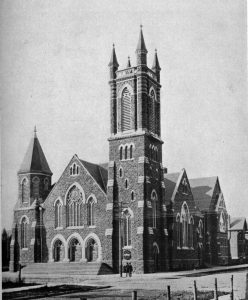
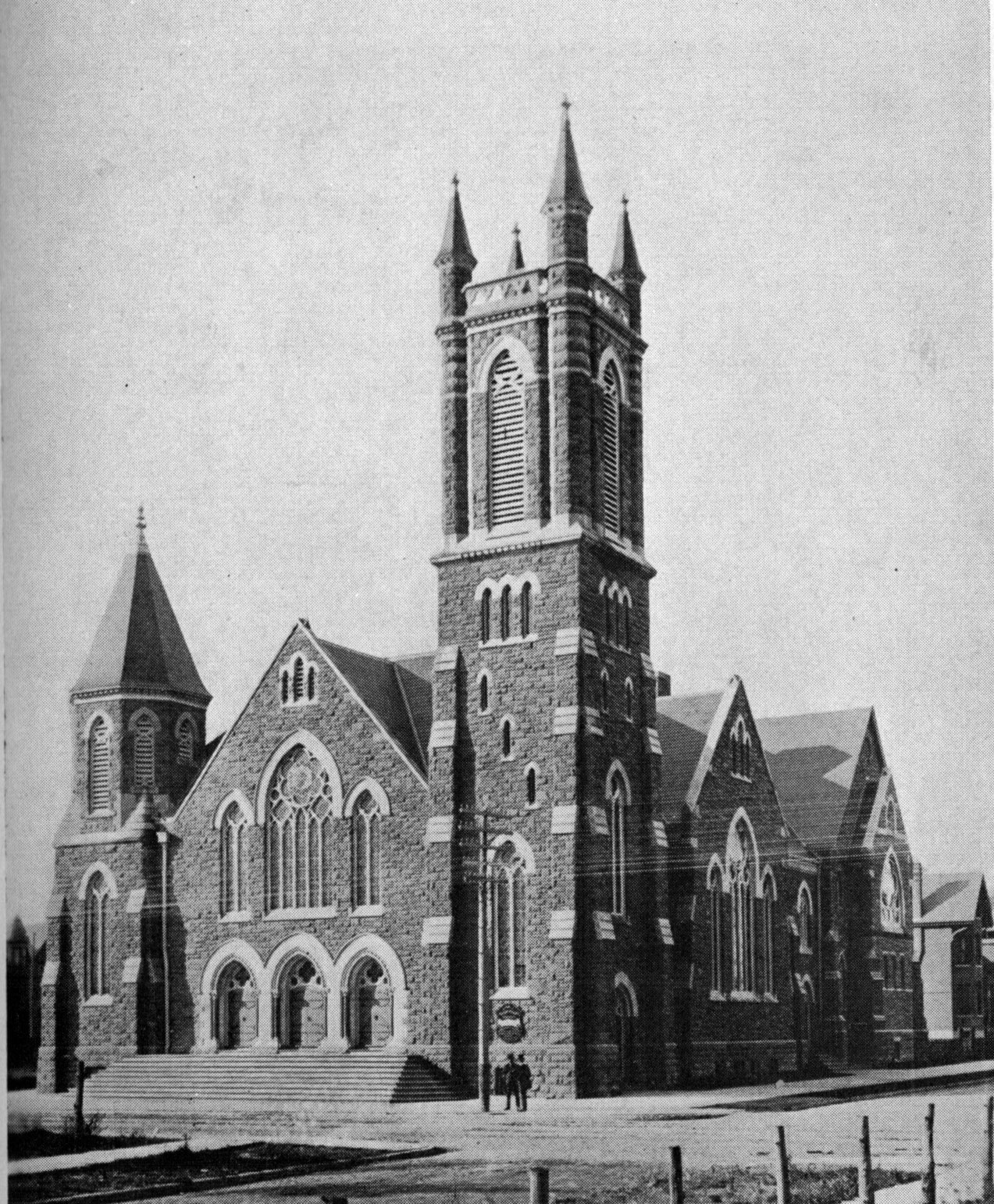
Kent Jackson, a member of the Bloor Street United Church congregation, noted that the archival photo we ran with this article did not match the cutline: “The church lost its steps and main entrance when it was truncated in 1927 to make way for the widening of Bloor Street West.”
While the steps were indeed removed in 1927, that photo did not show the steps in question. This photo, however, does. It is from Seventy Years at Bloor Street United Church 1887-1957, and has been reproduced with permission of the publisher.
Have a correction??A comment? We want to hear from you. Please email us your feedback or mail us at P.O. Box 414, Station P, Toronto, ON??M5S 2S9.
Tags: Annex · General
September 13th, 2017 · Comments Off on LETTER TO THE EDITOR (AUGUST 2017): An inspiration to us all
Remembering an unsung hero
On behalf of the Richardson family and the Central Technical School community I would like to thank you for the lovely story on Olympian and Jesse Owens U.S. counterpart, Sam Richardson.
It is important to share the stories and experiences of our fellow school alumni and neighbours, as it enriches our lives.
Upon reading the article I would like to clarify that Central Technical School celebrated its 100th anniversary in 2015. Harbord Collegiate Institute celebrated 125 years in 2017.
There is some confusion as to Sam Richardson’s birthdate. Although we have resource material stating that Sam was born in 1919, we have most recently accessed Sam’s school registration card from King Edward School, which states that he was born in 1921. This would mean that he would have been 15 years of age at the 1936 Berlin Olympics, 13 at the British Empire Games, very young indeed and what moxie!
The Canadian Olympic website and Wikipedia post his year of birth as 1917. To date, we have not been able to access Canada census information, which leaves the issue of his age at the Olympics unverified.
To quote a letter that we received from the Ontario Black History Society:
“Sammy Richardson, as he was known to his friends, was born just after the end of the First World War. His father served in the war and his great-grandparents came up through the Underground Railroad. Prior to attending Central Tech, he attended King Edward Public school with Stanley Grizzle and they used to race one another. Sammy, always a gifted athlete, travelled across Canada and the U.S., winning numerous medals. As a teenager, he competed and won both a gold medal and a silver medal at the British Empire Games in London in 1934. Upon his return members of the Black and white community came out in force to celebrate his return.
Still a teenager, he competed in three events at the 1936 Olympics with Jesse Owens and fellow Canadian Phil Edwards.
He was an inspiration to all.”
Once again thank you for the article, we look forward to further tributes in honour of Sam.
Fernanda Pisani
Central Tech Alumni
Archives Chair
Editors’ note: Thanks for the correction, and a great addition to the story of Sam Richardson.
Tags: Annex · Letters
September 13th, 2017 · Comments Off on FORUM (AUGUST 2017): Modernizing an extraordinary agreement
Prepare for excitement and drama during trade talks
By Chrystia Freeland
As we undertake our discussions with the United States and Mexico on the renegotiation of NAFTA, we are seeking your views. Are there areas of the agreement that could be clarified? Are there parts that should be updated? Are there any new sections that should be part of a modernized agreement? Please visit www.international.gc.ca/nafta to participate in the public consultation process.
In his book about the war of 1812, the historian Alan Taylor describes how, at the height of the conflict between the United States and British Canada, the U.S. forces unaccountably held off trying to invade the St. Lawrence River valley.
Such an invasion might have dramatically changed the outcome of the war. But it never happened.
The reason, Taylor writes, is that American and Canadian merchants and farmers in the border towns were enthusiastic cross-border traders. And some of them, on the American side, had influence in Washington.
Any actual fighting, these Yankee entrepreneurs successfully argued, would be bad for business. So they urged Washington to take care.
This story epitomizes one of the most important aspects of trade: it brings us into shared purpose across national borders, working to address common needs — even in the most extraordinary circumstances.
This brings me to the North American Free Trade Agreement (NAFTA) — and the historic project on which we are embarking, with our neighbours, to modernize this landmark pact for the twenty-first century.
Trade is about people. It’s about creating the best possible conditions for growth, for jobs, and for prosperity.
Thanks to NAFTA, the North American economy is highly integrated, making our companies more competitive in the global marketplace and creating more jobs on our continent.
NAFTA has been an extraordinary success story. And, Canadians today largely agree with me in that assessment. A Pew Research poll in May found that 74 per cent of those surveyed think NAFTA has been good for Canada. This is a remarkable consensus. It extends across the political spectrum. It is reflected in the high calibre of the people who recently joined our NAFTA Council. These members set partisan politics aside to work to pursue the national interest. I am grateful.
Our mission is clear. We are in this effort for all Canadians — and beyond that, for the broader North American community. Because if we get this right, the working people of all three countries will benefit.
Canada, the United States, and Mexico have a powerful shared interest in reaching a mutually beneficial agreement.
Strong economic fundamentals are a compelling argument for bolstering what works, and improving what can be made better. I am confident that this is a story with a happy ending.
But, as I am sure Canadians appreciate, the path to getting there could well include some moments of excitement as well as a few moments of drama.
I am no stranger myself to moments of drama in trade talks. We are delighted CETA has been signed and ratified and will be provisionally applied on Sept. 21. But before we got there, our talks with the Wallonian government in Namur broke down. I had to make the difficult decision to get up from the table, and go home.
Preparing for these negotiations has already united us as a country.
I have been astounded and moved by the extremely high level of support and collaboration. That is because of this fundamental reality: the Canada-U.S. economic relationship is the most significant, the most mutually beneficial, and the most effective anywhere in the world. We know that. And, particularly after six months of constant reminders from their friends in the north, our American neighbours now know it, too.
Good fundamentals lead to good results — and that is what we will achieve.
Chrystia Freeland is the Minister of Foreign Affairs and the Member of Parliament for University-Rosedale.
Tags: Annex · Opinion
September 13th, 2017 · Comments Off on ARTS (AUGUST 2017): Prepare for a season of festivals and events
September marks the start of performance season and arts classes
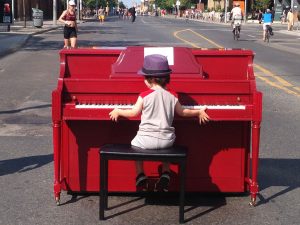
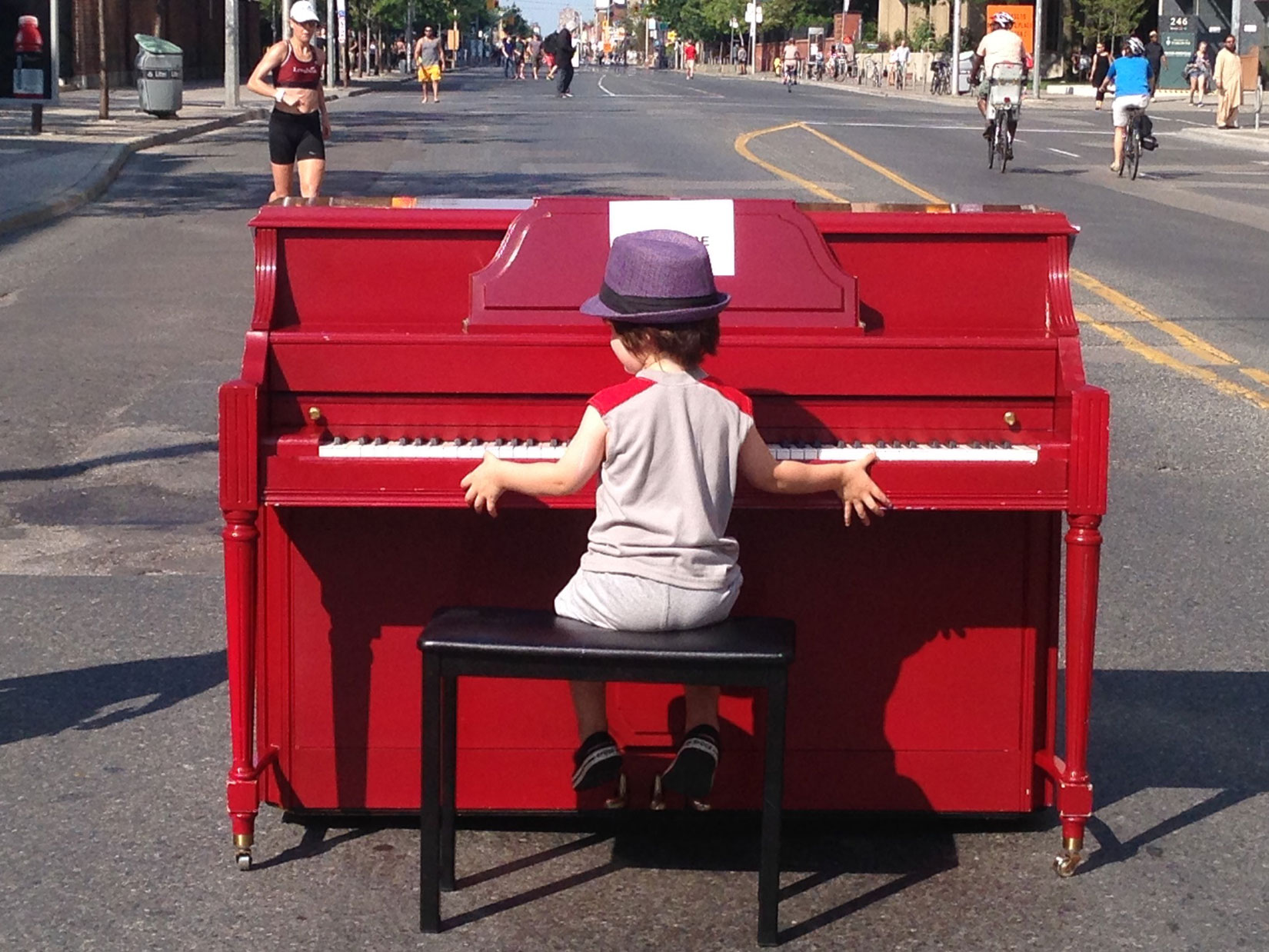
PICTURE COURTESY HEATHER KELLY: The Royal Conservatory’s red piano at Open Streets TO.
By Heather Kelly
Concert season begins!
Fanfares herald Tafelmusik’s 2017-18 concert season and new Music Director Elisa Citterio, who makes her debut directing A Joyous Welcome at Koerner Hall, September 21 to 24. Vivaldi’s Summer, the first in a complete cycle of his The Four Seasons being performed this year, will showcase Tafelmusik’s dynamic new leader. The University of Toronto Faculty of Music starts its concert season September 7 with percussionist Berndt Thurner in a free noon recital and Q&A at Walter Hall. On September 10, the faculty hosts Mysterious Barricades, a free noon concert in honour of World Suicide Prevention Day with Russell Braun, Judy Loman, and more. The Gryphon Trio and clarinetist James Campbell kick off Thursdays at Noon free concerts on September 14, and on September 21 the Toronto Symphony Orchestra’s Winona Zelenka and the Gryphon Trio’s James Parker perform Bach’s Three Sonatas for Viola da Gamba and Harpsichord. The Miles Nadal JCC presents folk duo Dwight & Sue in a daytime concert honouring Leonard Cohen and Bob Dylan on September 14, and the Istituto Italiano di Cultura presents the Vesuvius Ensemble on September 18. The Royal Conservatory’s 2017-18 season begins with a free concert by Ensemble Made in Canada with Scott St. John on October 1 as part of the Bloor St. Culture Corridor hub of Culture Days.
Culture Days
Celebrate Culture Days, the annual weekend of free arts and culture, at the special Bloor St. Culture Corridor hub, Friday, September 29, through Sunday, October 1. The Gardiner Museum will be free all weekend. On Saturday, September 30, the Bata Shoe Museum is free 7 p.m. to 7 a.m. with three special art installations and all galleries open as part of Culture Days and Nuit Blanche. Saturday only, Alliance Française presents an exhibition about the Allied Landing in Provence. On Sunday, October 1, the University of Toronto Faculty of Music’s Bass Day includes a world-record attempt for the most bassists ever to play “The Elephant” from Carnival of the Animals and a fun Bass Petting Zoo for the whole family. Also on October 1, the Royal Conservatory presents a free concert by Ensemble Made in Canada with Scott St. John, and the Museum of Estonians Abroad brings Estonian fashion design to Canada with pop-up stores and a fashion show.
Open Streets
At Open Streets TO on Sunday, September 17, 10 a.m. to 2 p.m., you can dance in the streets as you listen to the University of Toronto Jazz Street Band, or play the Royal Conservatory’s famous red piano in the middle of the road. There will also be folk music, arts and crafts, buskers, and more at the activity hub located at Bloor and Spadina.
Arts & Culture Talks
The Istituto Italiano di Cultura presents Italian-Canadian writers of Calabrese origins with hosts Francesco Loriggio and Damiano Pietropaolo on September 13. On September 8, the Istituto presents Extra Virgin Olive Oil lecture and tasting, and on September 15, a talk and tasting of Italian bread. Alliance Française presents French lectures Louis Riel and language rights in Court with Gérard Lévesque on September 13, Scandal and the peripatetic with Chantal Pontbriand September 20, and English lectures Bill Davis, the life of an Extraordinary Premier with Steve Paikin September 27, and Film memories of the Great War with Brian Jacobson September 28.
The ROM launches ROM Speaks Tuesday, September 19, with author Drew Hayden Taylor Spreading the Gospel of Native Literature. Then, The Next Fire Fight: Transitioning Out of Uniform features the inspiring story of decorated Lt.-Col. David Quick on September 26. The Museum of Estonians Abroad celebrates Tartu College’s 47th anniversary on Saturday, September 23, with a lecture by Estonian Academy of Arts Prof. Mart Kalm (in Estonian). The Gardiner Signature Lecture Series returns September 27, with Chief Curator Meredith Chilton bringing to life Lord Milton’s 1862 cross-Canada odyssey and the Minton bone china commissioned to commemorate the journey. Learn about Canadian cartoonists Josh Silburt and Gary Clement at The Power of Political Cartoons with Ralph Wintrob September 28 at the Miles Nadal JCC, in conjunction with their exhibition A Colourful Life.
Get Creative at Hands-On Classes
The Royal Conservatory School’s music courses for adults and children start on September 9 and their free Band Day on Sunday, September 10, offers people a chance to try instruments and meet instructors. The Bata Shoe Museum offers moccasin-making workshops and new evenings of sketching in the museum after it closes on Friday, September 29. At the Gardiner Museum, choose from hand building, wheel throwing, at drop-in classes every Wednesday, Friday, and Sunday, or discover the meditative qualities of clay in the new six-week workshop Reclaim This Moment: Finding Your Centre Through Clay.
Heather Kelly is the founder and director of the Bloor St. Culture Corridor. Her column focuses on arts and culture events from the district. More information about events and locations can be found at www.BloorStCultureCorridor.com.
Tags: Annex · Arts
September 13th, 2017 · Comments Off on GRADING OUR GREENSPACE (AUGUST 2017): Parks on the fringe
Some worth a look, others deserve a miss
In this, the final part of our 2017 annual review of parks, we consider parks that are on the fringe of our traditional coverage area, as well as those that are often overlooked. As you will discover, some are worth the extra distance, while others need work and can be missed.
By Geremy Bordonaro with files from Brian Burchell
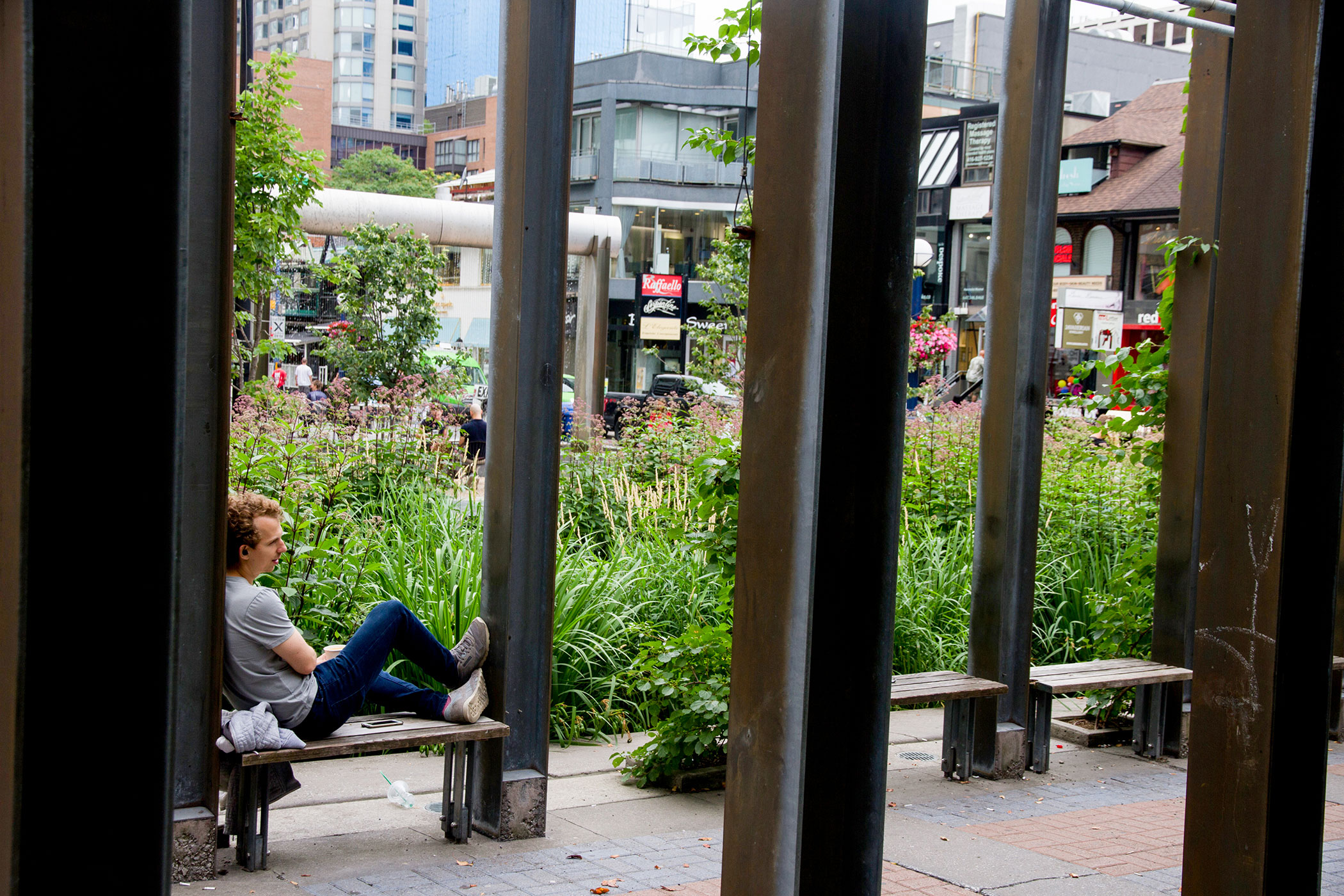
Bloor-Bedford Parkette
248 Bloor St. W.
Time: 2:00 p.m.
Grade: B- (Last year: B)
Reason to go: Bloor-Bedford Parkette is blessed with a convenient location. This oasis of green is remarkably easy to access from the busiest section of Bloor Street. There’s plenty of seating, which is usually well used. It’s clean and comfortable. The problem is that there is nothing else to do here except rest, and even then, there is very little shade to go around.
Overheard: “She totally dumped him! Which sucks ’cause he’s such a nice guy!”
Did you know: Varsity Stadium, home to the University of Toronto’s Varsity Blues, is across the street.
Art Eggleton Park
323 Harbord St.
Time: 1:30 p.m.
Grade: C (2013: B+)
Reason to go: This is a park of thirds. Two thirds are vacant, misused pieces of land, while, the central third is a bustling busy playground and wading pool. Art Eggleton Park lacks a real identity because of its odd layout that seems to contain three separate parks in one. The middle section is worth going to if you live in the area and have a child wanting to stretch out and play. Otherwise skip this park.
Overheard: “Okay. We can swing a little bit later. Let’s go to the pool!”
Did you know: Art Eggleton was Toronto’s mayor for 11 years, making him the city’s longest serving mayor. He went on to be the Member of Parliament for York-Centre, and now serves as a member of the Senate.
Sgt. Ryan Russell Parkette
250 Avenue Rd.
Time: 11:30 a.m.
Grade: D- (Last year: D+)
Reason to go: There were plans to rehabilitate this parkette into a beautiful and community-friendly space, yet these appear to be at a standstill, and in its current state the park is barely usable. Garbage lies everywhere, grass is uncut, and plant life has been overtaken by weeds. The small playground at the back corner of the park looks about ready to collapse into itself, and the noise is simply unbearable. Until something is done there is no reason to come here.
Overheard: Large amounts of traffic coming up and down Avenue Road.
Did you know: In an interview with the Gleaner last year, park supervisor Brian Green said the parkette was due for a major renovation, but news since then has been sparse.
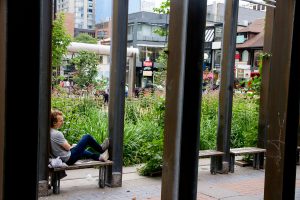
PHOTO BY GEREMY BORDONARO/GLEANER NEWS: The Village of Yorkville Park is a go-to destination for anyone visiting the neighbourhood.
Village of Yorkville Park
115 Cumberland St.
Time: Noon
Grade: A- (Last year: A)
Reason to go: This is a go-to destination if you find yourself in Yorkville. The park is colourful and unlike anything else even in the Annex. There is a lot of art and the surrounding shops provide some nice colour. What the park lacks in variety of plant life it easily makes up in interesting structures and rock formations. Proximity to the subway makes it all the more convenient for travellers in the area. Unfortunately, the park loses marks from last year due to deterioration of some of the structures, making the area feel slightly grimy.
Overheard: “Ooh, look at the pretty fountain!”
Did you know: When we visited, the park featured Sculptures from the Brain Project, which uses art to raise awareness about brain diseases like Alzheimer’s.
Casa Loma Parkette
328a Walmer Rd.
Time: 12:00 p.m.
Grade: C (Last year: C)
Reason to go: Very little has changed in Casa Loma Parkette: there are few benches, little shade, and a lot of open space. Visitors to Casa Loma might get a kick out of stopping by and having a picnic.
Overheard: Mutterings of nearby tourists visiting the Casa Loma stables.
Did you know: Juno award winner Sean Jones performed a series of concerts at Casa Loma over the summer.
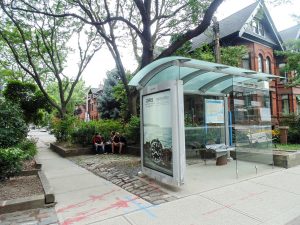
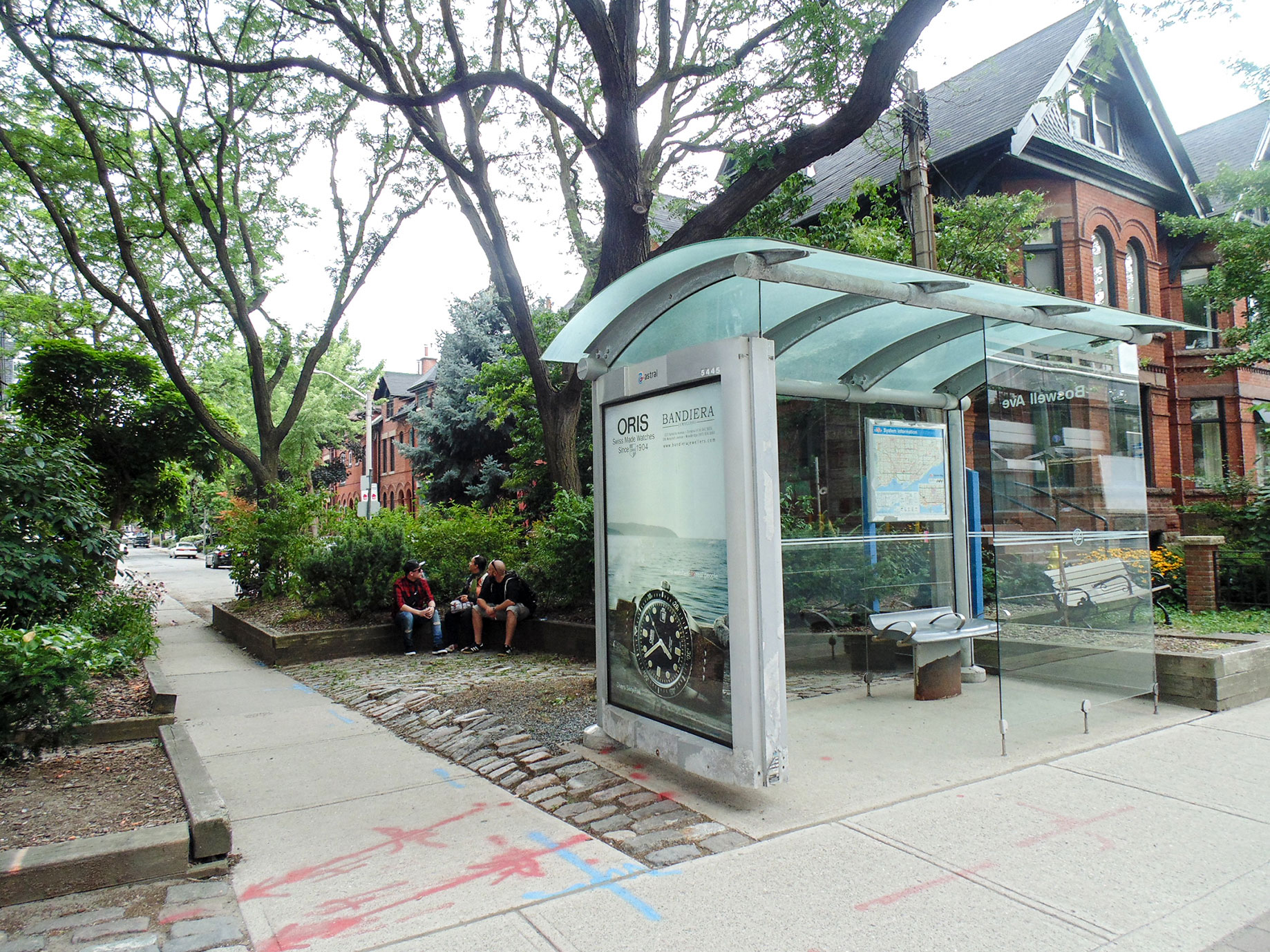
PHOTO BY BRIAN BURCHELL/GLEANER NEWS: Looking west from Avenue Road, Boswell Parkette transforms Boswell Road into a quiet dead-end oasis.
Boswell Parkette
2 Boswell Ave. (at Avenue Road)
Time: 1:30 p.m.
Grade: B (Last year: N/A)
Reason to go: This is a very clever conversion of publicly-owned pavement to a public green space. This parkette makes Boswell Avenue a dead-end, blocking vehicular thoroughfare to Avenue Road. The east west sidewalks along Boswell Avenue are maintained to Avenue Road and the rest of the parkette has raised planters along its edges. Three very healthy honey locust trees occupy the centre section, with the rest of the plantings unremarkable bushes all the same hue of green. No bee or butterfly would bother stopping here unfortunately, as there is not much to pollinate. The parkette includes its own bus stop to collect passengers heading south on Avenue Road, but there is no garbage bin, so refuse can accumulate. Other than the need for a trash can, to say nothing of more creative landscaping, the parkette is a green wall between a decidedly tony residential street and the hustle and bustle of Avenue Road.
Overheard: “Are you with a movie studio, I hope I didn’t ruin your picture.”
Did you know: The street gets its name from Arthur Radcliffe Boswell (1838-1925), a lawyer who was mayor of Toronto from 1883 to 1884 and a 14-time commodore of the Royal Canadian Yacht Club.
READ MORE
GRADING OUR GREENSPACE: Open spaces in the heart of the Annex (July 2017)
GRADING OUR GREENSPACE: Survey reveals significant upgrades (June 2017)
GRADING OUR GREENSPACE: Meet our parks supervisor (August 2016)
Part two of our 2016 parks review (July 2016)
PART ONE: Green sanctuaries in the heart of the city (June 2016)
Grading our Greenspace (2015)
Tags: General