November 24th, 2017 · Comments Off on CHATTER (Nov. 2017): Kensington Market HCD enters planning phase
Planning has officially begun on the Kensington Market Heritage Conservation District, after city staff and Taylor Hazell Architects spent more than a year studying how best to preserve the area’s unique character. It comes shortly after the National Film Board of Canada released a Heritage Minute about the history of the market’s cultural diversity.
This HCD is different because it is not so much about preserving an area’s built form — which is usually the subject of an HCD — but something much less tangible: the area’s culture.
So the challenge for the study was how to promote and protect something that can’t be seen. Local community organizations participated in many sessions with city staff, and helped determine what could and could not be classified as protected under an HCD.
The planning phase is expected to take up to a year, and will determine which limitations should be put in place.
—Geremy Bordonaro/Gleaner News
READ MORE
NEWS: Preserving culture and history (MARCH 2017)
FORUM: Our dynamic Kensington Market (November 2016)
NEWS: Kensington Market to become heritage district (May 2016)
Tags: Annex · News
November 24th, 2017 · Comments Off on CHATTER (Nov. 2017): Forcillo arrested for breach of bail
The officer convicted in the death of a troubled teenager on a Toronto Transit Commission streetcar in July 2013 has been re-arrested for breach of his bail conditions.
Constable James Forcillo was acquitted in January 2016 of second-degree murder but found guilty of attempted murder in the death of 18-year-old Sammy Yatim. Forcillo had continued firing his weapon even after Yatim had fallen to the floor of an empty streetcar. In his ruling the trial judge, Justice Edward Then, said that Forcillo’s second volley of shots constituted an “egregious breach of trust”. At the time of the shooting, Forcillo was assigned to 14 Division, which covers the Annex area west of Spadina Avenue.
The Special Investigations Unit provided the information that spurred the arrest. Its news release did not specify which bail conditions were breached.
—Brian Burchell, Gleaner News
READ MORE
EDITORIAL: “An egregious breach of trust” (August 2016)
EDITORIAL: Turning the Queen Mary (July 2016)
NEWS: Report: equip officers with tasers (October 2014)
Tags: Annex · News
November 24th, 2017 · Comments Off on NEWS (Nov. 2017): Collateral damage
Community outreach suffers with TDSB ban on SROs
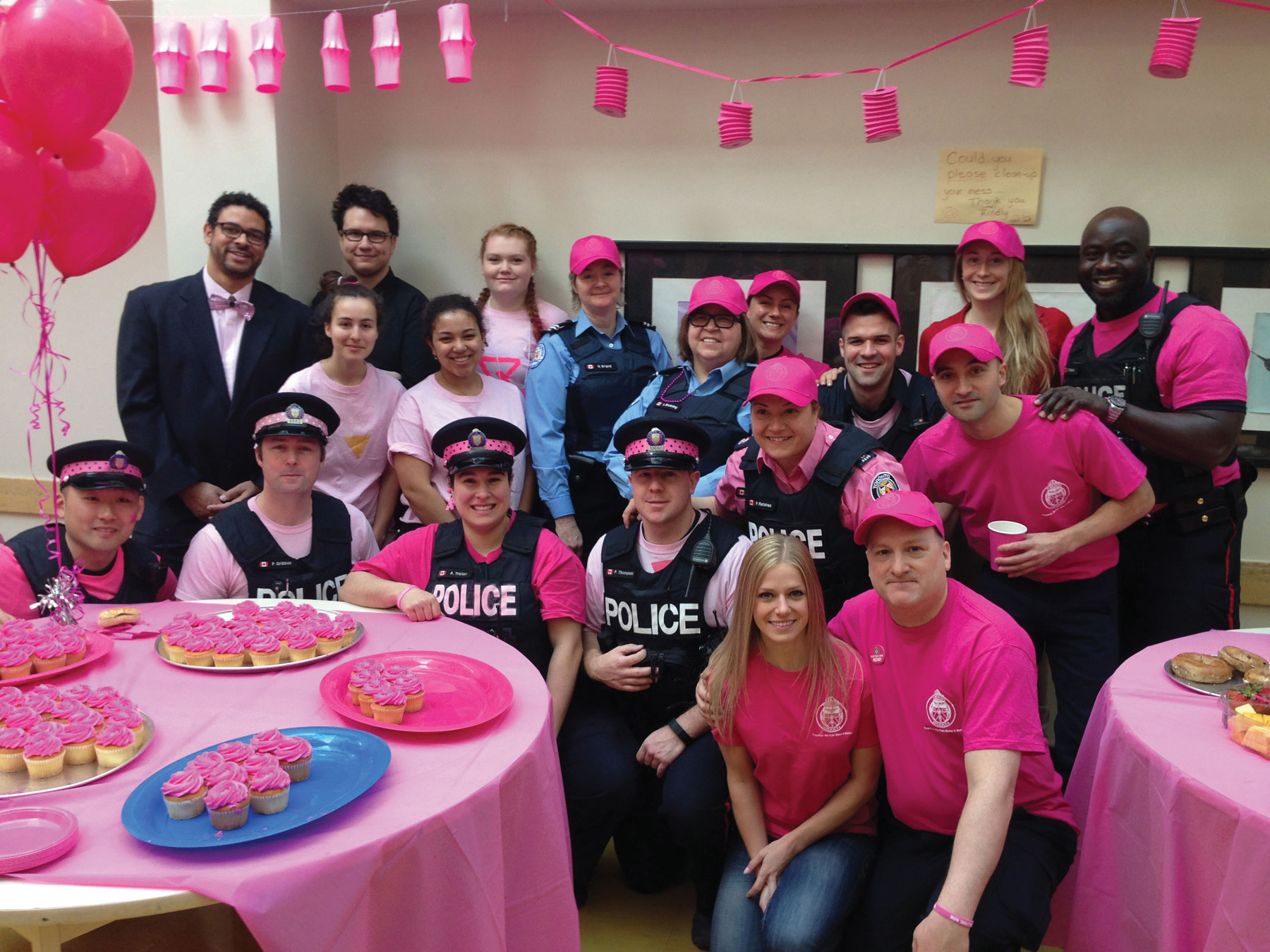
COURTESY JESSICA LEE/TORONTO DISTRICT SCHOOL BOARD School Watch Officer Andrea Harris (front row, third from left) was part of a group of officers from 14 Division who celebrated the Day of Pink at Harbord Collegiate Institute in April 2016. The Day of Pink is a worldwide event aimed at raising awareness to stop discrimination, gender-based bullying, homophobia, and transphobia.
By Brian Burchell
It was a novel idea: one cellphone, a shoestring budget, and a few bikes. All shared by the four police constables who made up 14 Division’s School Watch Officer (SWO) program. Together, they served ten schools west of Spadina Avenue, including Central Technical School, Central Toronto Academy, Harbord Collegiate Institute, and Heydon Park Secondary School. Available before, after, and during school, the officers ran programs (dodgeball every Thursday at Palmerston Public School), and got to know the school community.
The program was cancelled this school year, swept up in the temporary suspension of the similarly named School Resource Officer (SRO) program, a suspension that a newly released Toronto District School Board (TDSB) staff report recommends making permanent.
Approximately 36 police constables were assigned to 75 Toronto schools under the SRO program. It was created after a report into the death of a student at a Toronto school in 2007 recommended placing “more caring adults” in schools. However, the program has come under fire in recent years from groups like Black Lives Matter who say it promotes racial bias and is insensitive to students who are intimidated by the presence of a uniformed officer on school property.
“The suspension and the ending of the [SRO] program is the direction we should be going,” said Ausma Malik (TDSB Ward 10, Trinity-Spadina), who co-authored the motion to suspend the SRO program pending a review.
She said that the report “called for more youth workers, more counsellors, but it never said we should have uniformed police officers in schools.
“The SRO program is one step beyond and it’s not the type of environment, where police in some schools even have offices, where many students will feel comfortable or thrive in.”
Malik said she was not aware that the SWO program, which she views as something very different, had also been suspended.
“[It’s more of a] community liaison officer relationship that schools in our area have,” explained the trustee. “It is a capability for school communities to get to know and build relationships with local police.”
Indeed, the two programs are quite different.
Unlike SROs, who were assigned to work eight-hour shifts Monday to Friday at a specific school, four constables serving ten schools formed the SWO team. “We work eight days in a row of ten-hour days, then get six days off,” said Police Constable Andrea Harris, one of the officers assigned to the program. “Thursdays are our overlap day where we have all four School Watch officers in. We use this day to pass on info for the next team to continue working on.”
While SROs usually used patrol cars to get around, SWOs favoured a two-wheeled approach.
“We like using the bicycles as we find people are more likely to approach us and speak to us,” said Harris. “We can ride our bikes right to the front door of a school. The youth like seeing our bikes and are always asking us questions about them. We’ll use cars mostly when we are transporting youth or equipment for our programs.”
It’s not the only community-based program caught up in the suspension.
Balazs Zanati, another 14 Division police constable, has spent considerable time working with Hungarian-speaking students at Parkdale Collegiate Institute. Part of the Community Response Unit, Zanati has been a member of the Toronto Police Service for eight years. Previously an officer in the Hungarian Army who served in Afghanistan before emigrating to Canada, Zanati heard reports of Hungarian-Roma students getting into fights and skipping classes, and decided to get involved.
“Hungarian students just don’t want to go to school. There are a few reasons for that: one is they don’t speak the language, the other is they don’t see the value in education where they don’t see their parents getting anywhere in life,” said Zanati. “Their parents didn’t go to school and they think they are not going to be any better than their parents.”
Zanati works with the students to help them realize the importance of getting an education.
“[We’ll play] soccer and then [go] to English class together, where I’ll sit with them and help interpret. I try to tell them they will need education to get a job, and they will be better than their parents.”
Getting the students to trust him was the hard part, he admitted.
“Initially they had issues with [authority], so I started handing out my business cards with my personal cell number written on it. They call me every day, even on my days off, with their personal problems and sometimes it’s police related, often not, and I try to help out.”
Harris had also started a program funded by ProAction Cops & Kids for Harbord students. ProAction is a grant initiative that funds programs that connect police and youth.
“The TDSB suspension of the SRO program has affected that program,” said Harris. “The suspension also prevents us from starting up other ProAction programs that run in the schools.”
It’s all for the same reason: while the suspension remains in effect, 14 Division officers cannot go on to school property without a call for service.
Malik has said that was never the intent of the motion, and she’ll look into it.
READ MORE
EDITORIAL: Don’t sacrifice safety for political gain (August 2017)
EDITORIAL: Student safety suffers as trustees cave (November 2017)
Tags: Annex · News
November 24th, 2017 · 1 Comment
Toronto District School Board (TDSB) trustees are poised to accept a staff recommendation to permanently discontinue its 10-year relationship with the Toronto Police Service (TPS). Instituted after 15-year-old Jordan Manners was shot and killed in a stairwell at C. W. Jeffreys Collegiate Institute, the School Resource Officer (SRO) program was developed after a report on the incident recommended that more caring adults should be present in schools on a daily basis. Forty-five officers were deployed to Toronto high schools under the program, even though critics have correctly pointed out that the caring adults were never defined as uniformed police officers.
In June, a group led by Black Lives Matter presented a petition to the police board calling for the immediate cessation of the program. Suggesting that the program had created a “pipeline to prison” and that police were reporting students who were in Canada illegally, Black Lives Matter demanded that the program be investigated. The Toronto Police Services Board responded by asking Ryerson University to conduct an independent review, which is due in June 2018. Trustees, on the other hand, responded by rashly suspending the program in late August, pending a review that has now been completed.
Unfortunately that review was rushed, used a flawed methodology, skewed survey questions, and made conclusions that even if taken at face value, don’t make sense if the goal is to provide a safe environment for students. Incidentally, the board still hasn’t bothered to ask how many students have gone to prison or are facing deportation as a result of the program.
Intentionally light on facts, the review process included an anonymous survey of students that practically begged participants to agree that a police presence of police made them feel uncomfortable, intimidated, targeted, watched, and made schools feel unsafe. Despite such leading questions, Jim Spyropoulos, the TDSB’s executive superintendent of equity, engagement, and well-being, could only get 10 per cent of respondents to agree.
When asked if they felt uncomfortable attending school due to the SRO presence, only two per cent of total respondents agreed. Fifty-seven per cent, however, disagreed, with the rest reporting that they had no opinion.
(We note that the question should really have been how comfortable do you feel attending school with the SRO present, but will take the answer as read.)
As to parents, 67 per cent said they’d like the SRO program to continue. Only 26 parents said the police presence made their child feel unsafe, uncomfortable, or intimidated. Of the 1100 TDSB staff who completed the survey, 95 per cent agreed that police officers added value to their school, and that they were comfortable interacting with them.
There would seem to be overwhelming support among students, parents, and staff for having some police presence in schools. But for some reason Spyropoulos said that the board has “a clear duty to act” to “mitigate against the differentiated and potentially discriminatory impact of the SRO program”. Instead, he promotes a new police partnership “that honours the voices of ALL [Spropoulos’ emphasis] students”.
Clearly, the board isn’t interested in hearing what their main stakeholders are saying. Sources tell us that during the suspension period high school leaders have been calling the police’s non-emergency line to report a “unspecified disturbance” in the morning — just to get the police back in the schools.
If the trustees really care for their students, they should have the moral courage to stand up to special interest groups. It’s unfortunate that the TDSB could not have taken a more measured approach, one that places facts over political convenience.
READ MORE
EDITORIAL: Pandering to religious intolerance (October 2017)
EDITORIAL: Bike lanes, good for business (Fall 2017)
EDITORIAL: Don’t sacrifice safety for political gain (August 2017)
EDITORIAL: Thank you Mr. Asti (July 2017)
EDITORIAL: A watershed moment (June 2017)
EDITORIAL: Revoke U of T’s unchecked “licence to build” (May 2017)
EDITORIAL: Westbank’s positive precedent (April 2017)
EDITORIAL: Foreign buyers tax a necessary cliff jump (March 2017)
Tags: Annex · Editorial
November 24th, 2017 · Comments Off on FORUM (Nov. 2017): Establishing a new Indigenous Affairs Office
A dedication to reconciliation and Aboriginal issues
By Joe Cressy and Mike Layton
We gratefully acknowledge that the City of Toronto is located on the traditional lands of the Ojibwa, Hodenosaunee, and the Huron Wendat and is part of the Treaty Lands and Territory of the Mississaugas of the New Credit.
These words we hear at the beginning of public gatherings and morning announcements in our schools mean something important that goes far beyond mere recognition. By making this acknowledgement, we are recognizing that there were people who stood here before us. We are recognizing the stewards of the land before colonization and the respect that recognition commands.
[pullquote]We must let go of our contemporary understanding of who we are as Canadians and accept that we are guests in someone else’s house.[/pullquote]
This respect involves a responsibility on the part of all of us to do something that is difficult — be ready for change from business as usual.
We must let go of our contemporary understanding of who we are as Canadians and accept that we are guests in someone else’s house. That the arrival of some of our ancestors caused irreversible damage to
lives and an entire culture (or more correctly, many cultures). Broken treaties, residential schools, racism, and discrimination led to intergenerational damage that persists today. We must be willing to change our societal structures so we can better address the generations of injustice. We must be open to the difficult discussions that come with reconciliation and rebuilding trust among all people of Canada. We must be willing to make meaningful change to address the inequality that generations of unjust treatment of Indigenous people has resulted in today.
Don’t be alarmed by the enormity of the task. All long journeys begin with some small first steps. We begin with the acknowledgement and the commitment to start listening to our partners in reconciliation from the Indigenous community for help along this journey.
At Toronto City Council, the next step in our journey comes from the work done by the Aboriginal Affairs Advisory Committee, which has for decades been asking for a distinct and independent Aboriginal-led office at City Hall, dedicated to reconciliation and Aboriginal issues. After decades of inaction, next week at executive committee this step in our shared journey will be closer to reality.
Why is an Indigenous Office important in Toronto? An office gives distinction, independence, and resourced action. Distinction raises the profile among the public service, giving it a stronger voice. Independence provides an undiluted voice so other priorities don’t take away from their important work, and resources allow for action that wasn’t possible before.
The City Manager arrived at the recommendation to form this office by speaking with members of Toronto’s Indigenous community, and by hiring a consultant experienced in Aboriginal affairs and organizations. The City Manager is proposing that the new Indigenous Affairs Office report directly to him — the top bureaucrat in the City of Toronto — giving this office the broadest possible reach and influence.
The implementation of the Truth and Reconciliation Calls to Action in the City of Toronto and the fulfilment of the city’s own Statement of Commitment create the basis on which the Indigenous Affairs Office will operate.
The stated goals in the reports detail what we need to work towards and focus on in addressing the intergenerational struggles faced by Aboriginal people in our city.
The office will work to address the struggles that stem from the many injustices Aboriginal peoples have faced, working towards a shared prosperity and understanding for all.
We thank the Aboriginal Affairs Advisory Committee for its continued activism to make this office a reality and we are proud to have participated in bringing this proposal to City Council.
Mike Layton and Joe Cressy are city councillors for wards 19 and 20 (Trinity-Spadina) and co-chair and member, respectively, of the Aboriginal Affairs Advisory Committee.
READ MORE BY JOE CRESSY:
FORUM: Toronto — an artistic city (FALL 2017)
FORUM: Address affordable housing (June 2017)
FORUM: Build a neighbourhood (March 2017)
FORUM: Conserving past to enrich future (January 2017)
FORUM: Our dynamic Kensington Market (November 2016)
FORUM: A new central park for Toronto (September 2016)
READ MORE BY MIKE LAYTON:
FORUM: Building a better Bickford Park (Oct. 2017)
FORUM: Recognize and reconcile Canada at 150 (July 2017)
FORUM: San Francisco a model to follow (April 2017)
FORUM: Tolls, taxes, and Toronto (February 2017)
FORUM: Seeing our neighbourhood through new eyes (December 2016)
FORUM: We can do better: Dangerous summer for Toronto pedestrians and cyclists (October 2016)
FORUM: Curious story of Christie Pits pool liner ends in extended hours at Alex Duff (August 2016)
FORUM: A tribute to a friend (June 2016)
FORUM: Large problem, small solution (March 2016)
FORUM: Happy New Year from a new Dad with a new perspective (January 2016)
Tags: Annex · Opinion
November 24th, 2017 · Comments Off on ARTS (Nov. 2017): Starting to feel festive
Gearing up for the season

COURTESY GARDINER MUSEUM
This year’s 12 Trees at the Gardiner Museum are light-inspired art installations, co-curated by Canadian writer and artist Douglas Coupland and vice president of Public Art Management Ben Mills.
By Heather Kelly
Game changers and trail blazers
At key moments in history, remarkable individuals find the courage to reinvent the world as we know it. Hot Docs Ted Rogers Cinema presents the popular series, Game Changers, which pays tribute to the cultural visionaries who point the way forward.
Films that tell the stories of remarkable individuals include artist Marina Abramovic on November 14, technology and design genius Buckminster Fuller on November 19, architects and painters Charles and Ray Eames on November 25, and activist Angela Davis on November 26.
Hot Docs also presents Big Time, an insightful look at “starchitect” Bjarke Ingels’ reinvention of Manhattan’s skyline, and French New Wave legend Agnès Varda and artist JR create murals in Faces Places. Both films start December 1.
Also on screen, the Bata Shoe Museum presents The Road Ahead in November. The musical history of native nationalism by Dene-Métis playwright Marie Clements premiered at Hots Docs this spring.
In celebration of the House of Dior’s 70th anniversary, the Royal Ontario Museum celebrates the House of Dior’s 70th anniversary with Christian Dior, a special exhibition that explores the brilliance behind Dior’s dramatic creations. Attendees at the November 24 Friday night party event, Friday Night Live: Chic will have a sneak peek at the exhibition before it officially opens the next day. Discover the scope and depth of the Dior Heritage archive with Soizic Pfaff, Director of Dior Heritage, at the ROM Speaks Keynote Lecture: Dior by Dior on December 10.
The Graphic Liberation of Gender: Eiko Ishioka Poster Exhibition spotlights the work of Eiko Ishioka, who created Academy Award winning costumes for Bram Stoker’s Dracula, The Cell, and Mirror Mirror.
Sixty-seven posters celebrate her work from 1971 to 2021 in the exhibition, running until December 20 at The Japan Foundation.
The festive season begins
This year’s 12 Trees at the Gardiner Museum are light-inspired art installations, co-curated by Canadian writer and artist Douglas Coupland and Vice President of Public Art Management Ben Mills. Opening on November 17, the exhibition includes a disco-ball Christmas tree, a manually-powered holiday tree light show, an animated winter dreamscape, and a tree comprised of illuminated cubic blocks.
The Royal Conservatory of Music invites everyone to Holidays in Harmony on November 26. The afternoon of free programs includes a faculty concert, a holiday sing-a-long, and How Music Works and Musician Spies lectures. Attendees will also be able to learn more about the violin, viola, cello, guitar, and piano at interactive demo classes.
Who makes the Best Black Rum Fruit Cake in Toronto? At A Different Booklist Cultural Centre, it’s Black Rum Cake Day on December 2, with an afternoon of a sampling and celebration of delicious Caribbean Rum Cakes.

COURTESY MILES NADAL J.C.C. The Miles Nadal Jewish Community Centre will celebrate the 70th anniversary of the founding of Israel with seven cultural events. Prolific Israeli musician Assaf Amdursky will launch the celebration on the first night with a a concert at the Al Green Theatre.
The Miles Nadal JCC celebrates the holiday season with a huge Chanukah Groove Party on December 3 where family members of all ages sing, dance, and enjoy treats. Then on December 7, The Rev-Tones and The Pistons perform hits from the 50s and 60s at Jump & Jive @ the J, a daytime Chanukah sock hop in the Al Green Theatre.
The Bata Shoe Museum will shine with holiday cheer with a new exhibition, The Gold Standard: Glittering Footwear from Around the Globe, opening December 6. Featuring some of the museum’s most impressive and precious artefacts, the exhibition explores the meanings and cultural uses of golden footwear around the globe.
The Bata Shoe Museum is also holding its annual Warm the Sole Sock Drive for the Scott Mission until November 30. Socks are one of the first items people request when asking for assistance and are a staple of basic care for the homeless.
A group of young artists has created an art installation in conjunction with drive called Stockings. Created by Nicholas Reddon, Stephan van Eeden, and Erik Skouris, Stockings comments on the disposability of clothing. All socks used in the installation will be donated to charity.
The Toronto Consort presents music from across Spain and Latin America at Navidad: A Spanish Christmas, December 8 through 10, at Trinity-St. Paul’s Centre. Flashing rhythms and sensuous melodies will feature in early music from the Spanish-speaking nations on both sides of the Atlantic.
All of these arts and culture events are part of the Bloor St. Culture Corridor, a collaboration of 19 arts and culture organizations located on Bloor St. West.
Heather Kelly is the founder and director of the Bloor St. Culture Corridor, one of the city’s leading cultural districts.
Tags: Annex · Arts
November 24th, 2017 · Comments Off on GREENINGS (Nov. 2017): Celebrate science not milestones
Researchers shouldn’t have to spend their time asking for money
The federal government recently announced that it provided $1.6 million to the Polar Environment Atmospheric Research Laboratory (PEARL) to great fanfare. It is enough to keep it running through 2019. It seems like such a paltry amount considering we spent half a billion dollars to throw ourselves a Canada150 party. Really? $1.6 million is worthy of pats on the back, or the endless self-congratulatory tweets from Liberal members of Parliament. For a government that just appointed an engineer and astronaut as Governor General, this feels like a slap in the face for science.
[pullquote]Publicly-funded research helps inform everything from tap water standards to air quality targets.[/pullquote]
If we want scientific research excellence, researchers need to know they can conduct long-term research, free from political interference, and not have to go grovelling for money in another year and a half. This is not being an ally to science, it’s throwing science a bone in hopes they get re-elected in 2019. True friends of science would have put in a long-term funding plan so these scientists know they can conduct 10 year experiments and spend more time doing research than writing funding proposals. Researchers spend far too much time asking for money and not enough time trawling through data that will benefit all of us in the long run.
I appreciate the need for accountability, but forcing efficiencies isn’t the best way to deal with the problem. Taxpayers demand value for money, but we need to have a longer term view, not just election cycles. If we want high impact research, we have to accept that duds are part of the package. It’s part of risk taking. We praise chief executive officers for taking gambles that sometimes pay off tenfold, yet aren’t willing to take the same risks for our research institutions.
What surprised me when talking to a relative was how little public appreciation there is for government-funded research. The “this doesn’t affect me” attitude is more pervasive than I thought. Publicly-funded research helps inform everything from tap water standards to air quality targets.
High Arctic research might be the only thing saving lives in the Arctic region as climate change takes its toll. Good research absolutely affects us even if we don’t see it from our comfy kitchen tables in the city. Scientists, for their part, must make their work more accessible to the average layman. Sounding impressive in jargon speak has taken over the ability to write papers in plain English that everyone can understand. As a result, there’s a bigger and bigger gulf between academics and those who should be consuming the fruits of their labour. It also doesn’t help that papers are often difficult and expensive to access. When people can’t see the point of the work being done, no wonder there’s more money going towards throwing ourselves a giant birthday party than funding invaluable research.
Research that is publicly-funded should also be freely available to everyone. Thank goodness the Harper era gag orders on federal researchers have been lifted, but we still have a long way to go. We know climate change is real. We know we’re in a lot of trouble. Now we need to understand how to mitigate as much harm to ourselves as we can. This is particularly true for those who live in Northern regions of the country.
That’s why $1.6 million is an insultingly paltry sum. Let’s not give our government kudos for cutting back on a few steak dinners to fund scientific research that might save our skins. Instead, we need to demand that scientists get steady and stable funding for the work that ultimately benefits all of us.
Science isn’t political. Our government needs to make sure funding it isn’t either.
Terri Chu is an engineer committed to practical environmentalism. This column is dedicated to helping the community reduce energy, and help distinguish environmental truths from myths.
READ MORE GREENINGS BY TERRI CHU:
Down to the data (Oct. 2017)
Reducing paper waste (Fall 2017)
Taking tolls to the Gardiner and Don Valley Parkway (July 2017)
Lessons from Madrid (June 2017)
Thoughts on hitting the 400 benchmark (May 2017)
Solving the food waste problem (April 2017)
Kellie Leitch was right (March 2017)
Tags: Annex · Opinion
November 24th, 2017 · 1 Comment
Dutch Dreams owner recalls Nazi terror, jubilation after liberation

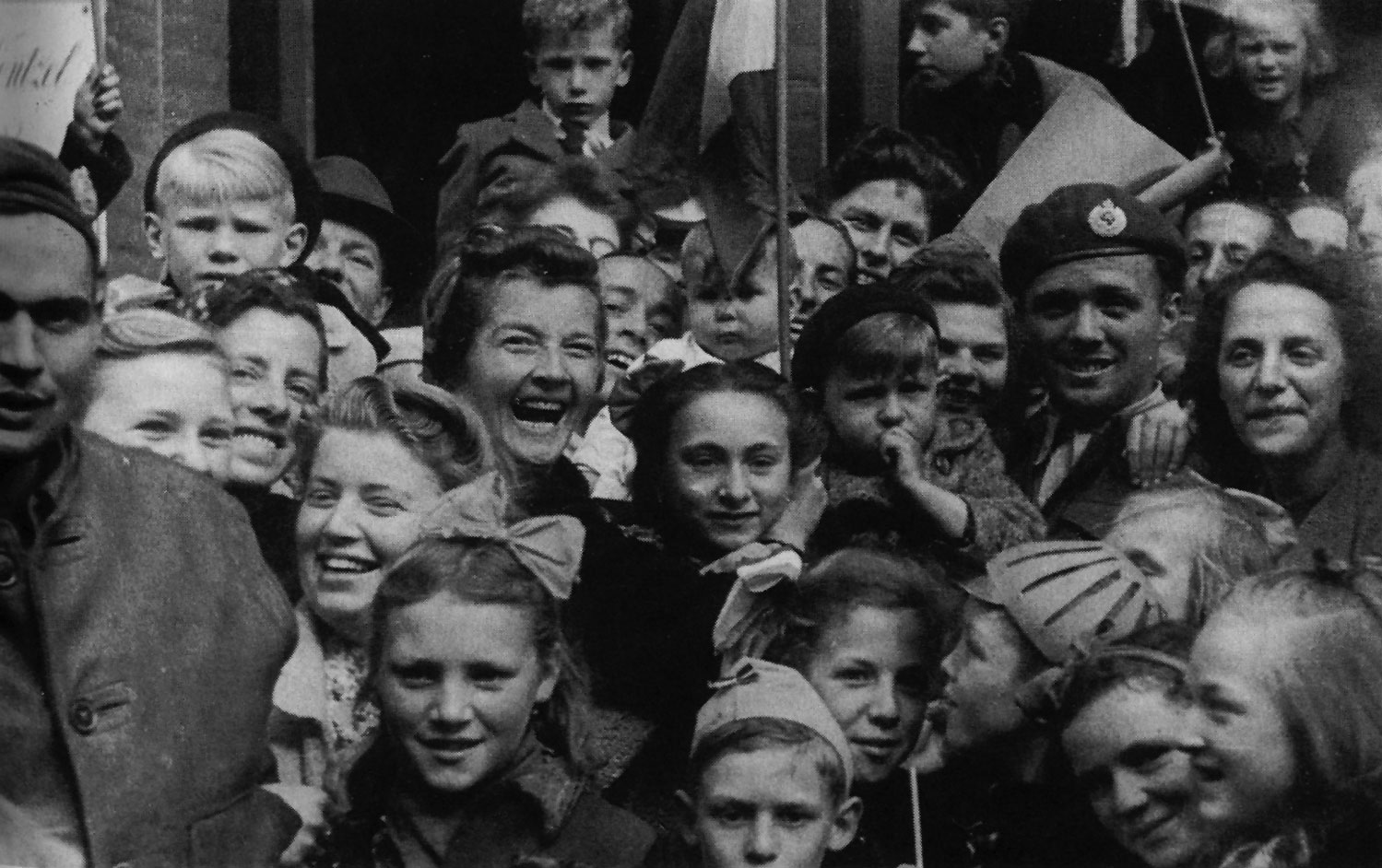
COURTESY J.L. BLOEMHOF’S AMERSFOORT ’40-’45 “Look at him, I find that so beautiful a picture. He’s from the Polar Bear Brigade, they liberated us. Isn’t that a beautiful picture? You can see in his face that he knows he liberated the Dutch, he’s proud and happy!”
In honour of Remembrance Day, we’re reprinting the story of Theo Aben, co-owner of Dutch Dreams. It first appeared in November 2004.
By Jessica Shulman
Eight-year-old Theo Aben stood rapt as Canadian troops descended upon his town of Amersfoort, Holland. He fought hard to suppress a triumphant grin as he thought gleefully, “The Tommies are coming! The Tommies are coming!” He thinks back fondly on that day. “I was so happy.”
As a child in German-occupied Holland during the Second World War, Aben knew nothing but suffering his entire early life. “I remember how hungry we were. My mother used to send me out to the fields to go and find nettles and dandelions that she’d try to cook. But to cook, she needed wood. She had these beautiful dining room chairs, and [eventually] I had to cut them all up. I was six or seven years old.”
The Germans bombed Rotterdam on May 10, 1940, and after five days of fighting, the Dutch capitulated. Aben was only three years old.
“I remember the Dutch escaping,” said Aben, “running away from the Germans, and throwing all their stuff, their clothes and army stuff, gas masks and pistols and everything out of the trucks. All the streets were loaded with it left and right. That’s what I remember.”
Just over 800 Jews lived in Amersfoort before the war, and only 400 returned. Despite his own suffering, Aben remembers feeling terribly sorry for his Jewish neighbours. “I remember when [the Germans] were picking up this very old Jewish couple. They were bent over with their bags, and they were tired, just standing there.”
Aben stands up to demonstrate the feeble old couple, hunched and exhausted.
“I remember I wanted to go help them to carry the bags, but I knew that if you were close to a Jew maybe you could get yourself in trouble. So I was too scared to go and help them.”
He knew many Jewish families in hiding, and throughout the war watched as Nazis took away families, looted houses, and shot people in the streets.
Aben and his family suffered, too.
“[The corners of] my mouth were torn from lack of vitamins. I had lice, and I had fleas in my hair, and I had three types of worms. Maggots used to just come out of your behind, you would scratch yourself — ’cause it itches like hell — and you’d [come away with] a whole handful.” He holds out his hand as if it were full of the writhing creatures.
Once all of the town’s Jews had been “taken away”, the Germans, who still needed labourers, began to fill their quotas with Dutch men, including Aben’s own father.
“One day,” he says of sometime in 1943 or 1944, “I saw him [coming home] in the front window, and he waved and I waved. I ran to the back of the house [to meet him]…and he never showed up.” Aben and his mother went outside, risking trouble for breaking curfew, to investigate.
“He was standing with some other Dutch people and all these Germans with their guns trained on them. And we didn’t see him back ’till after the war.” His father had been taken to Germany to work in a hotel.
On May 5, 1945, Allied troops invaded Holland. When they liberated Amersfoort on May 7, Aben couldn’t believe his luck. “I could never understand why they would come to liberate us when they didn’t even know us. That was the biggest thing.” He smiles, clearly still amazed at the prospect. “I felt so good that they were coming. And it was the Canadians.”
Aben clearly remembers his first contact with a Canadian soldier.
“He gave me a little green can,” recalls Aben. “I had on one of my mother’s old purple pullovers — I had no more clothes — and I put it under my pullover like this,” (he hugs his arms protectively to his body), “and I took it home.”
“When my mother cut it open, there were mixed vegetables in it. I remember the potatoes, beautiful square pieces. And I couldn’t understand how they got in the can!” Aben had never seen canned food before. “I thought Jesus, they must be so smart, these Canadians! We ate it right away, out of the can.”
Aben’s pale blue eyes gleam as he thinks back on the Canadian troops, who cleaned up the town, picking up garbage and rebuilding bridges.
“They organized parties for the children. I remember once I won this toy jeep. They had a game with a tent cloth tight on the field, and you had to scramble under it and the first one to come out won a prize, and I got my jeep — but I had no more skin on my back! It was terrible! It got infected and scabby….” He laughs. “But at that moment, I was so happy.”
Aben left Holland in 1967. Since then he has lived all across Canada, in Guinea, Africa, and in Iran, working in food services roles. He and his wife are now settled near Bathurst Street and St. Clair Avenue, running Dutch Dreams, an ice cream parlour on Vaughan Road.
Memories of his war-torn childhood stay with Aben, he says, but they don’t bother him. “What bothers me is what’s going on now. I think about the poor kids in Israel and Palestine and Iraq. It’s terrible for these kids.”
READ MORE
HISTORY FROM THE ARCHIVES: Sculptor marks the lessons of war (November 2016)
BLACK HISTORY MONTH: A long history of activism (February 2017)
FROM THE ARCHIVES: A time of loss, horror and excitement (March 2017)
FROM THE ARCHIVES: Harbord C.I. connects with history (April 2017)
CHATTER: University community stops to remember (November 2015)
Tags: Annex · General · History
November 2nd, 2017 · Comments Off on ON THE COVER (Oct. 2017): Transitory night

NEILAND BRISSENDEN/GLEANER NEWS
The Annex played host to several installations late last month for Nuit Blanche Toronto. Nine artists contributed to OnePath Toronto, a group exhibition that explored ideas of identity and nationhood through large-scale and interactive installations on the grounds of Spadina Museum. In Ephemerality (above), a multi-media installation founded on the Greek concept of all things being transitory, Barbara Cook asks if our efforts to improve the environmental condition of Canada and the earth ultimately be transitory.
READ MORE:
ON THE COVER: Celebrating Bloor Street (OCTOBER 2016)
ARTS: Interactive installations celebrate Annex icons (OCTOBER 2016)
Tags: Annex · News
November 2nd, 2017 · Comments Off on NEWS (Oct. 2017): Here to stay?
Committee votes in favour of Bloor Street bike lanes
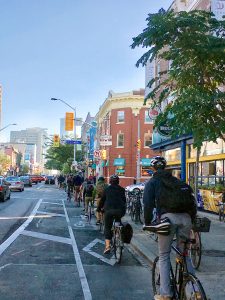
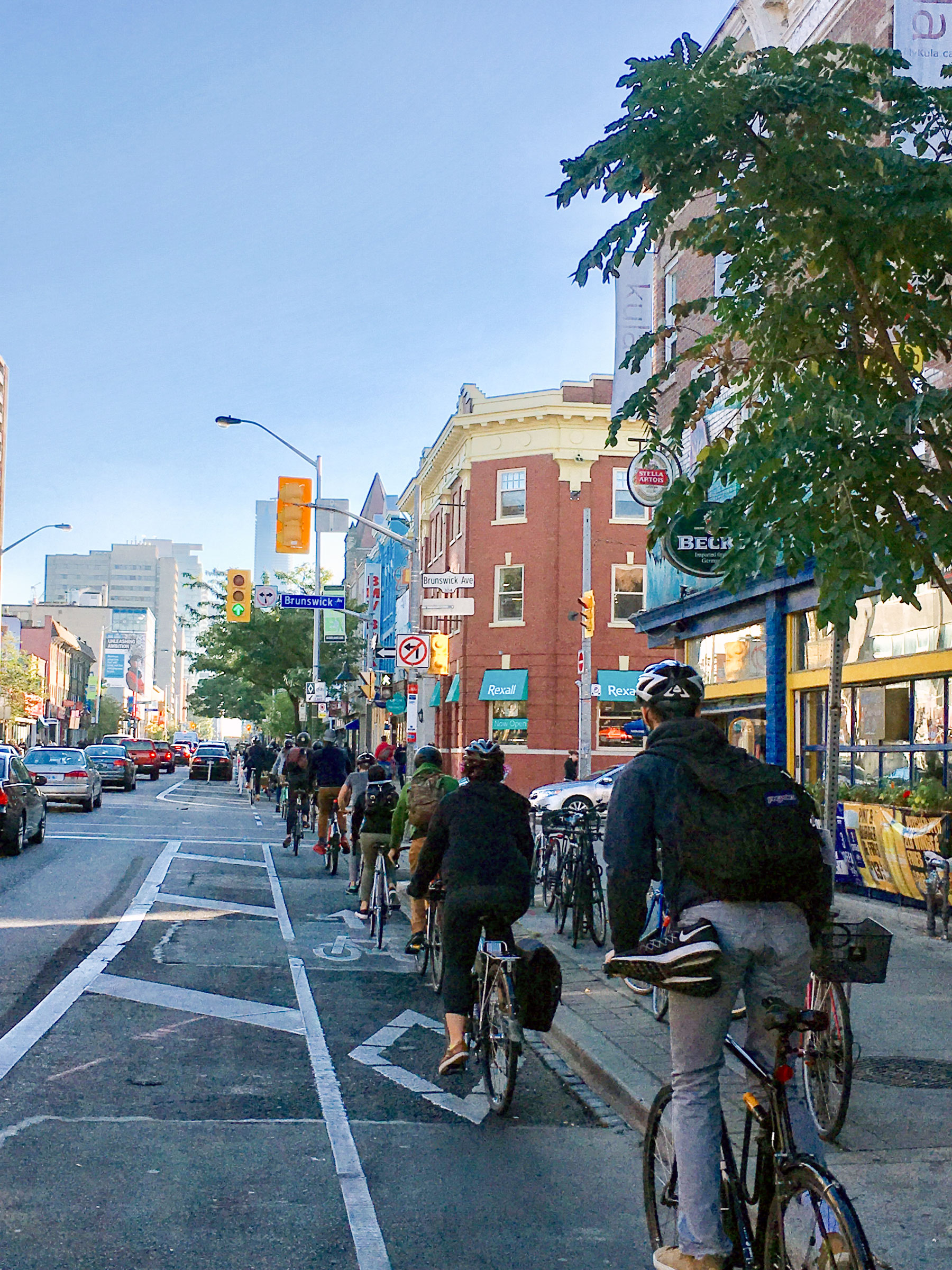
Toronto City Council’s Public Works and Infrastructure Committee voted in favour of making the Bloor Street pilot bike lanes permanent. The lanes have been very popular with cyclists since being installed, and a recent study demonstrated that the lanes have not had a negative impact on local business. COURTESY ANDRE VALLILLEE
By Geremy Bordonaro
It’s been a little over a year since bike lanes were installed on a trial basis on Bloor Street between University and Shaw avenues, and it’s looking more and more like they are here to stay.
On October 19, Toronto City Council’s Public Works and Infrastructure Committee (PWIC) voted in favour of city staff’s recommendation to make the lanes permanent.
Over 60 speakers signed on to speak to PWIC about how the lanes had changed their lives and the lives of those living around the Annex.While a large percentage of speakers supported keeping the lanes, there were still reservations based on some of the design flaws surrounding the pilot.
“While the overall feedback has been that the bike lane has been a success, on the basis of improved safety, increased cycling, and improved overall business, it’s not perfect,” said Joe Cressy (Ward 20, Trinity-Spadina). “We need to work on improvements towards safety. We need to look again at deliveries and loading zones for business. And we need a stronger focus on accessibility.”
Cressy has been a stalwart advocate for the bike lanes as a member of council. Though installing bike lanes on Bloor Street is not a new idea, it was under Cressy that the pilot became a reality. He believes that more needs to be done in terms of bike infrastructure.
“Our city is growing. And our streets are increasingly less and less safe. As we continue to grow in size and population we have to focus, not just on moving cars, but moving people safely,” said Cressy. “That includes people in cars. So people are passionate about this.”
Some still have their reservations about how the bike lanes have been put in place. One such resident is Hamish Wilson, who thinks that in their current form the lanes are just not enough.
“On one hand it is wonderful that we’re seeing this. On the other hand the pilot is only a third of what was promised to be studied a decade ago,” Wilson said. “Where’s the rest of it? I’m glad that we’re finally getting to see a little bit of permanency but where is the rest of it?”
During the meeting there were still some objections and questions about whether the safety benefits of the bike lanes outweigh the increased motorist times or the possibility of economic decline. Some even questioned whether this should be an issue left to politics at all.
Though Albert Koehl, co-founder of Bells on Bloor and long-time cycling advocate, thinks that safety will always come first, he believes there is a need for the lanes to be part of a political discussion.
“How we share our road is, of course, a political issue. All modern cities are moving to a new vision of what roads should be. That there are to be shared roads,” Koehl said. “I think the safety is not up for debate but it is a political question about how we share our roads.”
Early in October the Toronto Centre for Active Transportation (TCAT) released the results of a comprehensive study commissioned by the Bloor Annex BIA on the economic impact of the bike lanes.
“The number of cyclists on the road dramatically increased. At the same time we know from the economic study that the impact has been positive on business. So I think that this has been a success all around and that we can’t, in any way, diminish that effect by saying travel times have gone up by two to three minutes.”
Jennifer Klein, who owns Secrets From Your Sister, said the bike lanes have been good for business.
“I’d say that we have more face-view on our storefront,” said Klein. “We have more cyclists going by. And that’s more business.”
Though there are some disputes from businesses about the impact the loss of on-street parking has had on loading, shipping, and sales, Klein said she thinks that the issues have been dealt with well.
“I speak to the businesses around me and everyone has their own point of view,” Klein said. “The main concern for businesses are the loading zones. That problem was solved, as far as I’m concerned, by the addition of the loading parking spots on the side streets.”
Even with the matter close to being settled, Cressy said there is still work to be done.
“Mayor Tory has announced his support. I’m very optimistic that this will pass at council. Frankly my next step here, in addition to the council work, is rolling up my sleeves and working with our local residents and business owners to ensure that we make this the best possible bike lane during the permanent design.”
READ MORE:
FORUM: A magical new supply of parking spots (October 2017)
EDITORIAL: Bike lanes, good for business (Fall 2017)
CHATTER: Preliminary data on Bloor Street pilot bike lane released (March 2017)
CHATTER: Ground-breaking bike lanes launch on Bloor Street (August 2016)
NEWS: Bikes blessed for another season (June 2016)
FOCUS: An early advocate for bike lanes (June 2016)
NEWS: Bike lanes for Bloor Street (May 2016)
The faster we lower speeds, the more lives we save (October 2015)
Tags: Annex · News
November 2nd, 2017 · Comments Off on NEWS (Oct. 2017): First look at Bloor Street United
Residents balk at tall tower plan
By Emilie Jones
Local residents got their first look at plans to renovate Bloor Street United Church late last month. The proposal calls for a 38-storey mixed-use building, a renovation, and partial demolition of the church, as well as a new promenade. Located at the corner of Bloor and Huron streets, the building is over a hundred years old.
It was the second time the church hosted a meeting on the future of the building, and this time, representatives from StrategyCorp., KPMB Architects, and Bousfields Inc. were on hand to present the initial plans.
Joe Cressy (Ward 20, Trinity-Spadina) set the tone from the outset, applauding the church for its attempt to engage with the community.
“This isn’t an application yet. The way we are engaging in the development process is a longer process, and it means the community has a better say,” he said, adding, “I encourage a constructive dialogue, this is not a point of pitch forks, it is a point of conversation.”
Aware that many residents would be anxious about the proposed height of the new building, Louis Tinker, a partner with Bousfields Inc., took pains to assure the audience that the proposal was in line with the planning guidelines for the area.
“The Toronto Core Study is a comprehensive secondary plan for downtown Toronto in response to growth in the past 15 years,” said Tinker. “It has identified areas of growth, and this space is one.”
He added that the church’s essence will stay the same.
“Buildings that have an identity are important to our city, we don’t just want residential buildings along the street. Accessibility is an issue, as we welcome the more diverse, and we want to make sure there is more transparency on Bloor [Street].”
His remarks, however, fell largely on deaf ears.
“Why a tower of 35 [storeys] when the study said 20 to 24?” asked Norman Track, a local resident. “If you are negotiating with us, why do you play this game?”
That sentiment reverberated — angrily — throughout the meeting.
“I don’t know how you are talking about community when you’re talking about something so destructive,” said Reva Landau, also from the area. “It sets a dangerous precedent of high spaces north of Bloor [Street]. The community is going to get nothing, the only people who benefit are the church, because they don’t want to pay for [the renovation] themselves.”
Marianna McKenna, a partner at KPMB, explained that projections from a shadow study showed a tall building to be the best option.
“We tried to put density around, but a tall elegant building is better than a short fat one. Height is not the issue, it is beauty. We are asking for a trade-off of densities…a low stockier building would have a continued shadow.”
One member of the congregation defended the proposal, noting that “of the whole footprint, the tower takes a small part of it, and is at the back. There is a lot of air space even with the tower, that’s a very good thing…going up means we can have air space.”
Other than the height, another big concern brought up at the meeting was the congestion this plan will create. The proposal includes only about one hundred parking spaces, which will not even be enough for the proposed number of residential units, without accounting for the parking spaces needed for church events.
“There are people living there, office spaces, people coming and leaving, how are they going to get there? The TTC, which is already over-subscribed?” asked Track.
McKenna reiterated that this was still an initial proposal.
“The application is not done yet, everything is fresh out of the oven. We welcome all feedback.”
The next community meeting will be held in November.
READ MORE:
NEWS: New vision for Bloor Street United (JULY 2017)
U of T, community in talks over Bloor United project (JUNE 2012)
Tags: Annex · News
November 2nd, 2017 · Comments Off on CHATTER (Oct. 2017): The doctor is in
COURTESY RICHARD LONGLEY
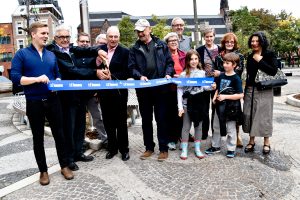
Kensington Health chief executive officer Bill O’Neill, Joe Cressy (Ward 20, Trinity-Spadina) and members of the Harbord Village Residents’ Association celebrated the opening of Doctors Parkette on October 14 with a ribbon cutting ceremony. Formerly Brunswick-College Parkette, the space has been redeveloped from a pokey park into something bright, modern, and functional.
READ MORE:
CHATTER: Doctors’ Parkette close to completion (JANUARY 2017)
GRADING OUR GREENSPACE: Survey reveals significant upgrades (JUNE 2017)
Part two of our 2016 parks review (JULY 2016)
Tags: Annex · News