March 22nd, 2018 · Comments Off on HISTORY: Remembering an unsung hero (March 2018)
Central Tech student raced alongside Jesse Owens

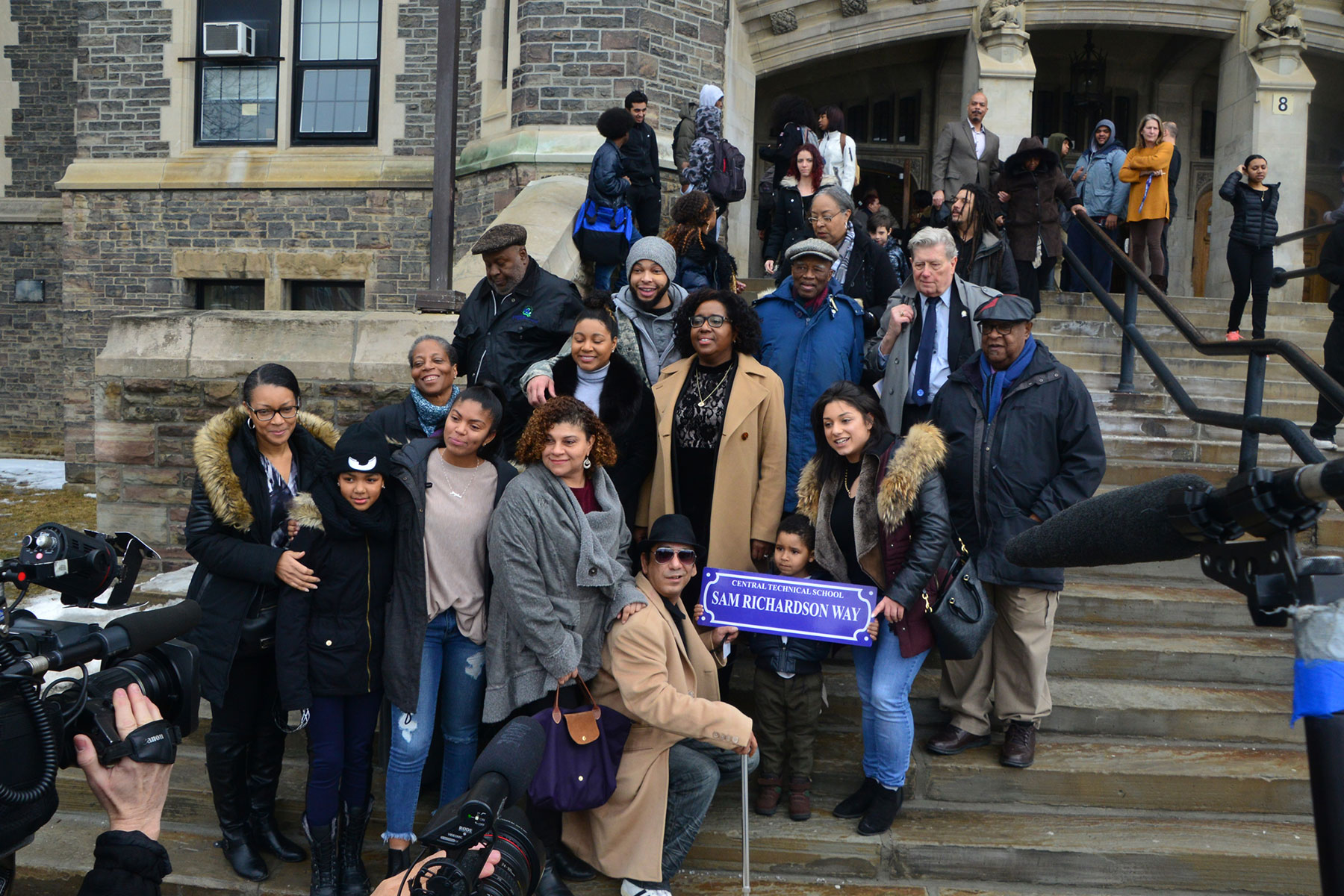
Sam Richardson’s descendants pose on the steps of Central Technical School last month. Richardson’s family also spoke on the influence he had on the Black community, Toronto, and the nation at large. COURTESY CENTRAL TECHNICAL SCHOOL
Students and staff at Central Technical School joined the descendants of Sam Richardson to officially declare the school’s front laneway Sam Richardson Way and unveil a new street sign on February 15. The celebration was also one of the school’s events that marked Black History Month. We thought it appropriate to reprint our piece on Sam Richardson, a Canadian Olympian, which we originally published last August.
By Justin Viviera
Long before Canadian legend Donovan Bailey took to the track, athlete Samuel “Sam” Richardson realized his own dream when he sprinted on the grandest field of them all at the 1936 Summer Olympics in Berlin, Germany.
Competing against the likes of Jesse Owens (who became a friend), Richardson held his own, coming in fifth as a member of the men’s 4×100 metre relay team, and finished 14th and 20th in the long and triple long jumps. Like Owens, he proudly represented his nation while facing the institutionalized racism of Nazi Germany.
“I’ll always remember his grace and the feeling of pride once I found out who he was and what he accomplished,” said his son Stacey Richardson, 47. “When I think about him, I’m always revisited by the gratification I grew up with from my father and his accolades.”
A local boy, Sam Richardson was born on Nov. 18, 1919, to Franklin and Maria of 222 Lippincott St. He went to school at King Edward Public School, then Lord Lansdowne Public School, and finally Central Technical School. It was there that he spent hours training on the track.
“My father used to go out onto the field at Central Tech with a rugby ball, kick it up the length of the field, run the distance and catch the ball himself,” relates Stacey. “Apparently he would do that almost all day long. I was amazed by that story and it was a reminder of how great an athlete my father was.”
At 15, Richardson won the gold medal in long jump in London, England, at the 1934 British Empire Games, now known as the Commonwealth Games.
At that time, he was the youngest competitor to ever win a gold medal in track. A year later, he would set a Canadian record of 25 feet in long jump at the Canadian Track and Field Championships in Winnipeg; a record that wouldn’t be broken for another 25 years. Between London and Berlin, he also represented Canada in France, New Zealand, and Australia. After his athletic career, Richardson began his service at the CBC in 1955 where he worked as a stagehand crew leader on the hit comedy The Wayne and Shuster Show, which aired the same year he started, as well as the children’s television show Mr. Dressup.
It was thanks to a school project that Stacey got to know more about his dad.
“There was an assignment I was given in school to do some research on a Canadian athlete. My teacher was assigning different athletes and I had mentioned to my teacher that I knew of an athlete that wasn’t mentioned.
“I talked about my father and they allowed me to do my research project on him. It was something I felt proud of doing and that’s when I started to learn more about him. I felt special to be his son.”
Richardson was 51 when his son Stacey was born, and 70 when he passed away in 1989.
Some of the faculty and students at Central Tech, which recently celebrated its 125th anniversary, are aware of the handful of Olympians who got their start at the school: Atlee Mahorn, Carl Folkes, Anthony Wilson, and Keturah Anderson.
“There’s a display case and a Wall of Fame of alumni who’ve made it to the Olympics. I know there’s been quite a few runners that went to school here but I didn’t know he [Richardson] was one of the first,” said Ryan, a Central Tech student. “If he raced alongside Jesse Owens that must have been a very special experience for him.”
The CTS community is planning a tribute in honour of Richardson’s long-lasting legacy. “He was Toronto’s son,” said Stacey. “His unsung stories are a distant memory but will never be forgotten.”
READ MORE:
LETTER TO THE EDITOR (AUGUST 2017): An inspiration to us all
NEWS (JULY 2017): Remembering an unsung hero
Tags: Annex · History · Life
March 22nd, 2018 · Comments Off on ARTS: Celebrate diversity through stories (March 2018)
March Break fun with art, music, and culture

Audience and art interact in Riverbed by Yoko Ono at the Gardiner Museum. The museum is showing Ono’s films from the 1960s and 1970s, and hosting a lecture about the artist’s activism on March 26. COURTESY GARDINER MUSEUM
By Heather Kelly
March break arts and culture
Young family members will have plenty of inspiration to sing, dance, make music, enjoy art and crafts, see films and exhibitions, and participate in adventures at the many March break camps and family events along the Bloor St. Culture Corridor March 12 to 16 and beyond.
At the Miles Nadal JCC, people 5 to 10 years old will enjoy cooperative play and team building with activities at local parks, drama, arts and crafts, cooking, and more.
Go for the Gold March break activities at the Bata Shoe Museum March 10 to 18 are inspired by the current exhibition The Gold Standard. The museum will be chockablock with activities for children ages 3 to 12. (If your little one is too small for March break activities, there will be a Baby Stroller Tour at the Bata Shoe Museum on March 27.)
You can go to the Japan Foundation to watch anime and other family-friendly film screenings, as well as films by Japanese women in celebration of international women’s history month. While there, stop in to see the exhibition Variation and Autonomy: Prints by Contemporary Japanese Painters, featuring original prints by Yayoi Kusama.
Alliance Française will be presenting a theatre and dance performance for children, Les Moutons by Sylvie Bouchard where a bucolic country scene in an urban setting is a strange, poetic and baffling universe that takes audiences into the lives of sheep, in a double-bill with the dance performance C’est Comme Ça Qu’on Aime (This Is How We Love) by Susie Burpee and Marie-Josée Chartier, on March 18.
March break is also a time for exploration, and The Royal Conservatory School offers day camps where budding young musicians can experience what it’s like to play a real instrument at the Instrument Exploration Camp for children 6 to 7 years old, or try the fun-sounding camp, A Few Of Our Favourite Musicals, where children 8 to 10 years old will learn to sing selections from favourite musicals including Oliver, Anne of Green Gables, and Moana, and learn movement routines, design and build costumes, sets, and then showcase their new repertoire in a performance.
Children can explore Norse culture at the Royal Ontario Museum, as Vikings take over the museum during March break. Kids can play interactive games, explore a Viking Village and the daily lives of the legendary Norse people with living history re-enactors, make Viking bling to wear, pretend to be a mighty Viking warrior, go on scavenger hunts through the museum, and participate in other Viking and Norse-themed activities during the ROM’s extended dates and hours, March 10 to 18.

An original print by Yayoi Kusama from Variation and Autonomy: Prints by Contemporary Japanese Painters, on display now at the Japan Foundation’s Toronto gallery. COURTESY JAPAN FOUNDATION
Storytelling
The Toronto Storytelling Festival celebrates diversity as tellers, listeners, story-lovers, adults, youth and kids are invited to gather at many Bloor St. Culture Corridor organizations for intimate performances, storytalks, workshops, open mics, games, and informal conversations.
On March 3, the Japan Foundation will be part of the 25th Katari Storytelling Show-Hina Doll Festival, with traditional and contemporary children’s stories accompanied by guitar. The event features Nathalie Vachon, Noriko Yamamoto, Koko Kikuchi, Yusuke Tanaka, Aisha Masoka and Rui Umezawa. Also on March 3, the Bata Shoe Museum is the place to hear Stories, Rhymes and Songs…Oh My! with Rita Cox, Carol Ashton, and Sally Jaeger.
A Different Booklist Cultural Centre will be a hub of storytelling activity, starting with Fabulous Brazilian Fables, with Fabio Lisboa telling folktales and native South American stories from the Atlantic forest on March 3. Then on March 19, Judith Liberman and Aubrey Davis lead International Storytalk: Back-To-Front and Upside Down.
At another International Storytalk event at A Different Booklist, focusing on Stories of Resilience, award-winning storytellers from Holland, Sahand Sahebdivani and Eric Borrias, share stories about the resilience of imagination when the unimaginable occurs, on March 20.
Storytelling and Social Change, features Gcina Mhlophe and Itah Sadu, who share their experiences with the power of storytelling to bring about social change on March 21, the anniversary of the Sharpeville massacre in South Africa.
On March 22, Laura Simms and Dan Yashinsky lead Dr. Scheherazade Storytelling in Healthcare and Community Healing, focusing on the important role a storyteller can play in creating solace, understanding, and transformation. Also on March 22, Stories and Music From Southern Africa will be shared by Tich Maredza and Gcina Mhlophe. International Storytalk: Honouring the Elders with Humour, on March 23, will feature Yukon storytellers and comedians Sharon Shorty and Duane Gastant’Aucoin who offer a wry and hilarious commentary on modern life from the perspective of traditional Yukon wisdom.
When Strangers Come Knocking, at Alliance Française de Toronto’s Spadina Theatre, features Mariella Bertelli, Eric Borrias, Aubrey Davis, Donna Dudinsky, Judith Liberman, Laura Simms, and Sage Tyrtle, exploring how we welcome — or not — the strangers who come to our borders, our homes, and our hearts, on March 20.
At the Native Canadian Centre of Toronto on March 21, Gramma Susie and Cash Creek Charlie (Sharon Shorty and Duane Gastant’Aucoin) join Metis storyteller Ron Evans and host Denise Booth McLeod from the First Nations comedy troupe Manifest Destiny’s Child, for a night of comedy, creation tales, and impossible-to-predict adventures at an event called MinwaaJimo.
On March 22, Oral History: A Storm Fool Visits the ROM, takes place at the Royal Ontario Museum where Ron Evans shares histories of his Métis ancestors and stories from the Chippewa Cree oral tradition. The next day at the museum, FNLROM: Equinox, on March 23, features CTV’s The Launch winner Logan Staats, Juno-nominated singer Brenna MacCrimmon, and renowned storytellers Gcina Mhlophe and Judith Liberman to share stories from Turkey, Southern Africa, and Jewish traditions.
The festival finale on March 25, Story Jam, is a full day of family-friendly storytelling and activities throughout the Toronto Reference Library, including folktales from around the world, an African Riddle Contest, international guests, Indigenous creation tales, and many more storytelling activities.
Heather Kelly is the founder and director of the Bloor St. Culture Corridor. Her column focuses on arts and culture events from the district. More information about events and locations can be found at www.BloorStCultureCorridor.com.
Tags: Annex · Arts
January 29th, 2018 · Comments Off on ON THE COVER: Wage protest (Jan. 2018)

The Ontario Federation of Labour and the Fight for $15 & Fairness Campaign protested outside the Bloor Street and Spadina Road franchise of Tim Hortons on January 10. They were protesting franchise owners who cut paid breaks and some benefits in order to pay for the province’s mandated minimum wage increase, which went from $11.60 to $14 on January 1. GEREMY BORDONARO/GLEANER NEWS
Tags: Annex · News
January 29th, 2018 · Comments Off on NEWS: Open kitchen (Jan. 2018)
Media coverage saves program for now
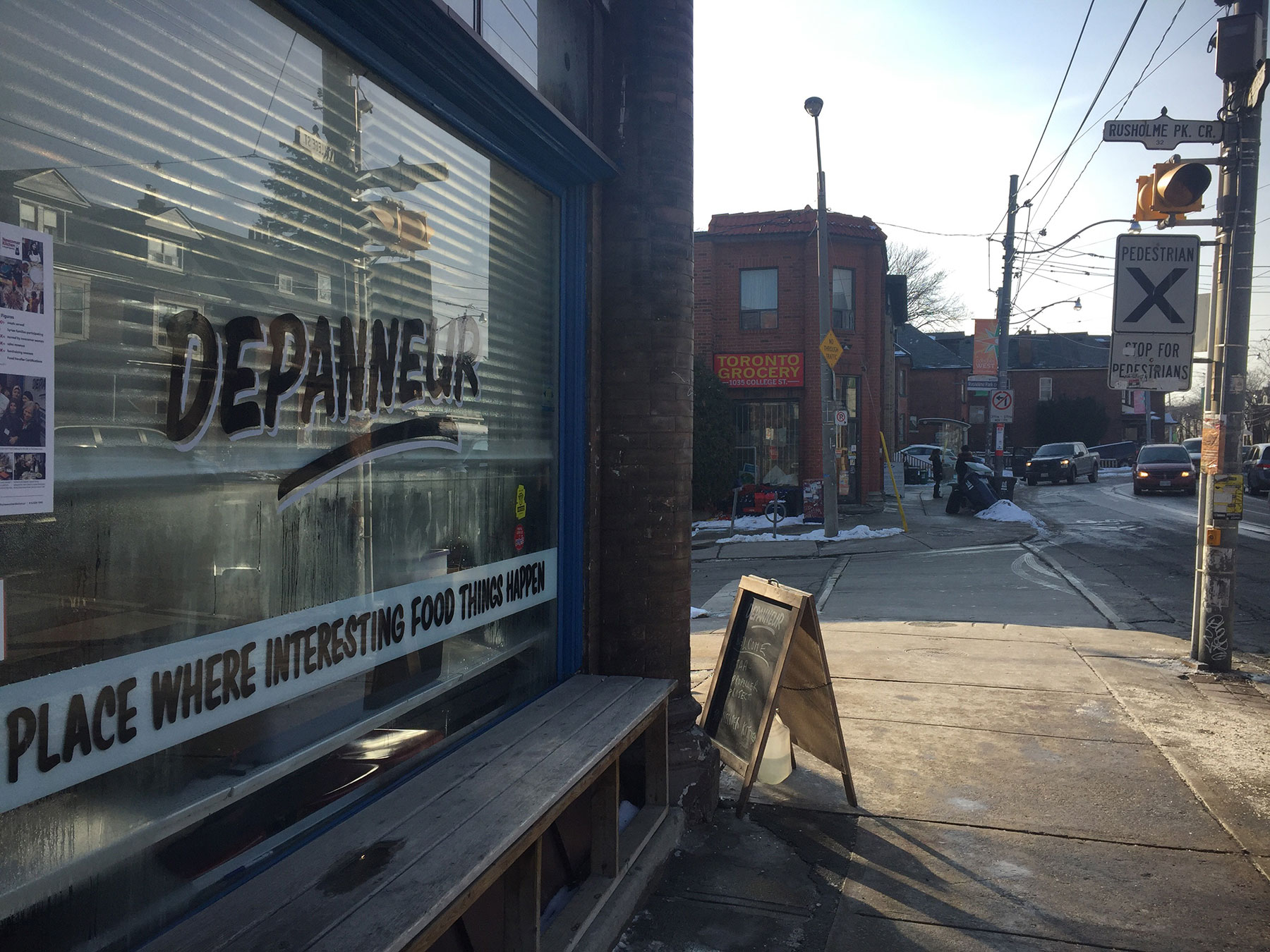
Newcomer Kitchen began at Butler’s Pantry on Markham Street before moving to Depanneur on College Street when Butler’s Pantry was closed due to the Mirvish Village redevelopment. BRIAN BURCHELL/GLEANER NEWS
By Geremy Bordonaro
A streak of luck, international media attention, and more than a little bit of hope have saved Newcomer Kitchen, which had its roots in Mirvish Village. The Gleaner first covered the initiative — which gave Syrian refugees temporarily housed in hotels the opportunity to make a home-cooked meal from a stocked restaurant kitchen — in May 2016.
After running for nearly two years, it seemed like the last meal would be cooked in December 2017. Administrative costs were high and, without funding, there was no way to keep up with the growing program.
Then, an article on the program’s financial troubles appeared in a Toronto daily newspaper, a documentary filmmaker amended her online funding campaign, and donations started to pour in. Within a day, Newcomer Kitchen was saved.
Kelli Kieley is the filmmaker who managed the online fundraising campaign. She used an existing Indiegogo campaign, which she had created to fund her documentary Shway Shway: The Newcomer Kitchen Story. She started working on her film almost as soon as Newcomer Kitchen got cooking.
“It was something that I wanted to witness myself,” she said, highlighting the interest in Syrian culture and the unique setting. “There’s a reason everybody is interested. Many people want to help other people. Hear their stories. Feel connected to the community by helping.”
Kieley heard about the program from someone who had been in one of previous films and was compelled to make a documentary about it.
“We were hearing more and more about the families stuck in the hotels,” explained Len Senater. “It became clear that those families had no access to kitchens at all to cook for themselves or their families. I have this large kitchen and I have a venue…that is not being used during the day. Why not invite these families to come so that they can cook food for themselves and for their family.”
“I…bumped into Len Senater…who had been in a series I had produced at Bell,” Kieley said. “He told me about Newcomer Kitchen and I said ‘Oh my God. I totally have to film this.’ It was myself and a cinematographer, who actually spoke Arabic himself by luck, who would show up and start filming prior to all the news coming out. And then it sort of became a viral story not long after that.”
Newcomer Kitchen got a lot of attention — even landing on the front page of The New York Times in early January. It’s thanks to this attention that it’s been able to keep going.
“It feels really good,” said Kieley. “The whole thing that happened with Newcomer Kitchen was magical.”
While Newcomer Kitchen has been saved for now, there are still worries about the future. It’s not lost on the mind of Atique Azad, a friend and mentor to Senater, who helped set up a pop-up brunch at Butler’s Pantry when it was operating out of Mirvish Village.
“[Longevity] is a driving force,” said Azad. “For a project like this it’s important to keep the future in mind.”
READ MORE:
NEWS (JUNE 2016): Building community over fattoush
Tags: Annex · News
January 29th, 2018 · Comments Off on NEWS: Celebrating a legendary Leaf (Jan. 2018)
Charlie Conacher banner presented to Jesse Ketchum
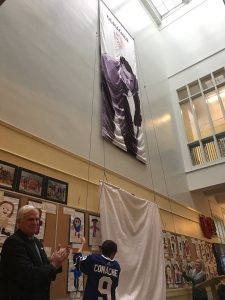
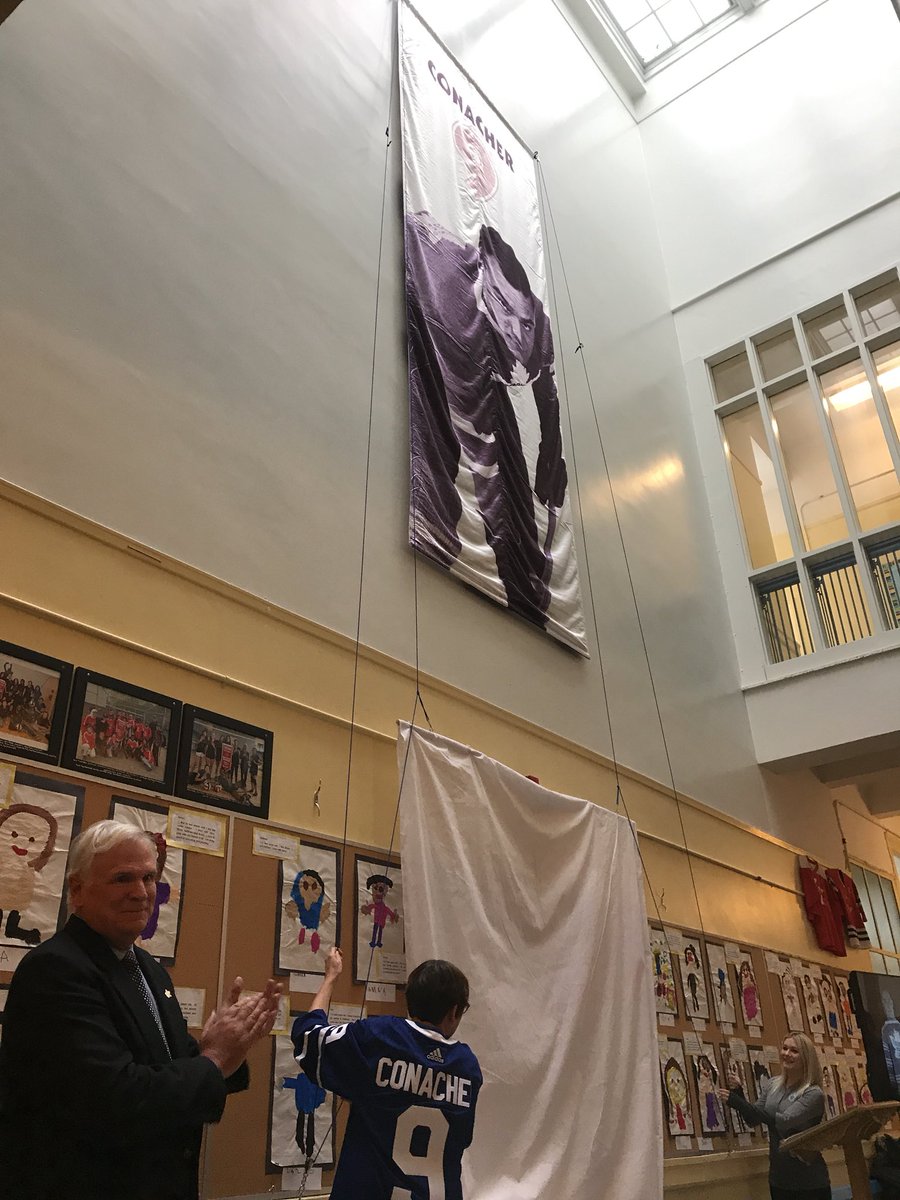
Charlie Conacher’s nephew Brian applauds at the unveiling of Charlie Conacher’s banner at Jesse Ketchum Public School. COURTESY JOHN CALDARONE
By R.S. Konjek
Jesse Ketchum Public School on Davenport Road received a special gift from the Toronto Maple Leafs just before the holidays, thanks to one of its most famous graduates.
On December 12, the school was presented with the original Charlie Conacher banner that used to hang from the rafters of the Air Canada Centre.
Born in 1909, Charlie was one of ten Conacher siblings who grew up in the Yorkville neighbourhood. They all attended Jesse Ketchum, where the children were encouraged to participate in sports.
A poor skater at first, Charlie found himself playing goalie on the hockey team. Eventually, he grew to over six feet tall and played in the NHL for 14 seasons.
Playing as a power forward, Conacher was known for his dominant size and strength, and nicknamed — courtesy of his booming shots that tore a hole through many a net —The Big Bomber.
Charlie realized the dream of almost every local schoolboy when he joined the Leafs, and became a Stanley Cup winner in 1932 and captain of the team for the 1937-38 season. He retired in 1941 and was elected to the Hockey Hall of Fame in 1961.
Charlie’s career and legacy are only one part of the Conacher story.
His brothers Lionel and Roy also played in the NHL and won four more Stanley Cups between them. The Conachers are the only family to have three siblings in the Hall of Fame. Over the years, three more Conacher descendants have also played in the NHL.
“There can be only one Royal Family of Hockey, the Conachers,” wrote Paul White in a recent biography of the sporting family. “The list of scoring titles, all-star game appearances, Stanley Cup and league championships, not to mention other unique hockey achievements, are all documented.”
Charlie’s number 9 is one of thirteen numbers, honouring nineteen different players, that were officially retired in 2016. At that time, the hockey club created brand new banners that now hang at the ACC.
Since then, the Leafs have been delivering the old banners to the hometowns of their honoured players. Charlie’s banner made the shortest trip, just four kilometres up Bay Street to the primary school where he spent his formative years.
“Like the Toronto Maple Leafs, Jesse Ketchum Public School has been part of the fabric of this city for a very, very long time,” said school principal Elizabeth Holmes at the presentation. “In fact, our school actually predates our beloved hockey team. And like the Leafs, our school is about community. That’s why this event is so important for us. It recognizes the importance of community and how our school and our community helped to shape Charlie Conacher into not just the great player that he was, but also the person that he was.”
Charlie’s connection with the Leafs is special because he is a home-grown hero.
In the club’s entire history, the Leafs have had only three Toronto-born captains. The most recent one was Sid Smith in the 1950s. Since then, the team has named captains from far-flung locales ranging from Saskatchewan to Sweden (Wendell Clark and Mats Sundin, respectively).
Today, there are only two players on the team roster who were born in this city. Professional hockey is now an international affair, and a local-born player making it to the top is increasingly a rarity.
At the presentation ceremony, Charlie’s banner was raised to its new home inside Jesse Ketchum school with the help of his sons Peter and Brad, and his nephew Brian.
Perhaps Charlie’s image will help inspire the youngsters at Jesse Ketchum to pursue their dreams, be they athletic, academic or artistic. Maybe other tributes and banners will someday join Charlie’s.
“Our school today is home to about 450 students whose cultural backgrounds represent countries from all over the world, just like the Leafs of today,” said Holmes. “But what remains constant is that commitment to community, and to working together as a team to achieve success.”
As go the Leafs, so go the kids at Jesse Ketchum.
Tags: Annex · News
January 29th, 2018 · Comments Off on NEWS: Cressy to stand for re-election (Jan. 2018)
Ward boundaries redrawn
By Geremy Bordonaro
Joe Cressy has confirmed that he will be standing for re-election at the next municipal election. He’s just not sure which ward he’ll be running in, now that the Ontario Municipal Board has approved Toronto City Council’s decision to increase the number of wards from 44 to 47.
This landmark decision will see one ward removed and three added in an attempt to create voter parity in the upcoming municipal election.
Local wards 19 and 20 (both Trinity-Spadina) have been significantly redefined. Ward 19 — represented by Mike Layton — will now absorb Seaton Village into its boundaries and Ward 20 — represented by Cressy — will be split.
The boundaries of the new Ward 20 will be Queen Street West to Harbourfront from Bathurst to John streets. The boundaries of new Ward 24 will be Queen Street West to Dupont Street from University Avenue to Bathurst Street.
A large factor in splitting up Ward 20 was giving residents of the ward a fair amount of voting power and the more undivided attention of the city councillor.
“Ward 20, as it exists today, has nearly 100,000 residents. Some other wards in the city have 30,000,” said Cressy. “What that means, practically, as the local councillor I’m not able to respond to my constituents’ concerns and requests as quickly as many of my colleagues simply due to the fact that it is three times larger than some wards.”
Cressy was happy with the review as the highly researched project of over four years stayed sensitive to the needs and issues of certain communities.
“There was an exceptionally robust process towards the development of these boundaries,” he said. “Consultants were hired, who I should note live in the Palmerston area of our community, and they did detailed research looking at population patterns and historical boundaries. They made proposals and consulted with the public.”
Ward 19 will expand to encompass the entirety of Bathurst Street along with Seaton Village. Layton said the ward review was necessary to prevent further disparities between the wards.
“A ward boundary review was the necessary thing to do. We had the obligation to review whether or not there was voter parity across the city. And there was not,” said Layton. “We had some wards with 140,000 people represented by [one vote on the council], and some wards with 40,000 people with one vote on the council.”
At its worst this disparity in population made a voter’s power in the largest areas a third of what the power of the votes from the smallest areas was. Though this issue was pressing there was still, however, a need to have some mindfulness about splitting neighbourhoods into different wards.
“It’s important for us to remember that change needed to happen. I was supportive of the ways the boundaries were redrawn because I thought, in particular in Ward 19, that it kept communities intact,” Layton said. “It didn’t split communities so that they would be dealing with two different councillors if they crossed the street.”
Although there is going to be little change for most communities the increased attention from a lower population area is a welcome change for community groups like the Annex Residents’ Association (ARA).
“I think it’s better. We certainly made the plea for it,” said David Harrison, ARA chair. “It’s basically a much more cohesive unit for the interests of the neighbourhoods. Whoever happens to be councillor at the time will be able to focus on our needs and on the needs of the people of the ward. The ward at the moment is just too big…. It’s just too much work.”
Cressy said he is planning to run in one of the wards created by the redrawn boundaries.
“I will be running for City Council in 2018. I will be running for re-election. I have not decided in which of my current areas I will be running,” said Cressy. “The ward south of Queen has many projects that I care deeply about that I’ve been working on for years. In the north there are also neighbourhoods that I love and adore. The Annex is where I was born, and raised, and live today. So I’m agonizing over that decision.”
Tags: Annex · News
January 29th, 2018 · Comments Off on CHATTER: Carbon tax fuels upgrades at Kensington School (Jan. 2018)

Mitzie Hunter (right), Ontario’s minister of education, sits in on a Kensington Community School kindergarten class discussion about climate change. BRIAN BURCHELL/GLEANER NEWS
Just in time for the relentlessly extreme cold this winter, Kensington Community School on College Street is basking in warmth, thanks to two new energy-efficient boilers. The provincial government spent $358,000 on the installation, using funds from a $200 million dividend from the carbon market created by its cap and trade program. So far, 594 schools have received energy-efficient upgrades totalling $84 million from the dividend.
Mitzie Hunter, the provincial minister of education, announced the investment at the school on January 12. She said that buildings, and the energy they consume, account for almost one quarter of Ontario’s greenhouse gas pollution, and that reducing our carbon footprint was critical in order for us to “leave a sustainable legacy for our children and grandchildren”.
“The province’s public schools are doing their part to fight climate change,” she said. “These upgrades will reduce green gas emissions to create a greener school environment for students and staff and a healthier future for the province.”
With Ontario’s public schools facing an estimated $15 billion backlog in deferred and major maintenance, Hunter was asked how such a relatively small investment of $358,000 could begin to address this general condition of deterioration.
Hunter explained that the Kensington investment was part of a larger plan to upgrade schools with solar panels and replace roofs, flooring, and plumbing systems.
“We are investing $1.4 billion in school boards, and that’s an annual figure, to help them begin to address the backlog,” added Hunter.
—Brian Burchell/Gleaner News
Tags: Annex · News
January 29th, 2018 · Comments Off on CHATTER: No more funding for Annex Family Festival (Jan. 2018)
The future of the Annex Family Festival is up in the air after most of its funds were cut by the Bloor Annex BIA at its annual general meeting on January 9. The organization’s board of directors presented the annual budget, which included funding for the festival, for approval by the general members.
Barry Alper from Fresh Restaurant moved from the floor to reduce the festival budget from $22,800 to $2,800 and was seconded by Miranda Black from Theodore 1922, a men’s clothing store. The motion passed 11 to six, effectively ending what’s been a Bloor Street tradition for 20 years.
Alper and Black argued that the money could be better spent on more research on the economic impact of the Bloor Street bike lanes, improving the design of the lanes themselves, and promoting local business.
“It seems a bit hasty to just pull the funds on the Annex Festival without a whole lot of research or response,” said board member Chris Cousineau, who represents Sweet Pete’s Bike Shop. “I would have thought maybe a more thorough investigation on whether or not to kill the festival would be prudent first.”
Member Eric Mills said he was perplexed by Alper’s motion.
“You say this to help redesign the bike lanes, but that consultation and design change is something the city is prepared to do for free and all this does is offset the city’s costs, at the expense of the businesses.”
Those who supported the motion said they did so because of low sales on the day of the festival.
Black explained that her store had always suffered on the day of the festival and now, as a result, she closes her shop during the festivities.
BIA chair Brian Burchell, who also publishes this newspaper, said that the point of the Family Festival is not to necessarily enhance same-day sales but make a broader audience more aware of the street.
“Merchant participation reached a record high last year, and as a result of a recent merchant survey it is not evident that our members oppose it,” he said.
The Annex Family Festival has run every June for 21 years as a cooperative effort between the Bloor Annex BIA and the Miles Nadal JCC.
—Geremy Bordonaro/Gleaner News
Tags: Annex · News
January 29th, 2018 · Comments Off on CHATTER: An homage to Ed (Jan. 2018)

Joe Cressy (Ward 20, Trinity-Spadina), Daniel Freeman of Freeman Realty, Ted Winick of Spirit of Math, and Joe Mihevc (Ward 21, St. Paul’s West) gave away 500 turkeys in three hours just before Christmas. Now in its second year, the event is an homage to Ed Mirvish, who also used to give away turkeys before Christmas at Honest Ed’s. “We feel a strong obligation to give back to the community,” said Elden Freeman, who co-sponsors the event with Winick. BRIAN BURCHELL/GLEANER NEWS
Tags: Annex · News
January 29th, 2018 · Comments Off on CHATTER: Innovating for the future (Jan. 2018)

Royal St. George’s College students Henry Gold, Charlie Botterell, Luke Ovenell, and Kieran Tisdal present their project to help the nation to a parent in December. The project was a part of a grade nine assignment that tasked students with developing innovative ideas for improving the state of the world. COURTESY ROYAL ST. GEORGE’S COLLEGE
Tags: Annex · News
January 29th, 2018 · Comments Off on LETTERS: A bushel of tomatoes (Jan. 2018)
Re: “Height-ened fears” (December 2017)
In response to the comments of Ms. McKenna of KPMB Architects in Height-ened fears:
First — the BSUC proposed 38 story tower will not be glorifying Bloor Street — it will be behind the church on a smaller side street, Huron Street, where traffic for the proposed 220 residence units, plus three office floors, plus two parking levels plus major service vehicles all will enter and exit as kids pass by on their way to their elementary school down the block.
Second — it is interesting that not one of the people whom she states came up to her personally at the end of the community feedback evening saying they were for it, were ever heard from in the public forum.
Her sample of one such feedback — “look, my tomato plants will be shadowed for half an hour. I get it. I’m in favour of this” — eerily echoes a complaint made in the public forum from someone who said “I hope you plan to send me a bushel of tomatoes every summer because I’ll never be able to grow them again”.
That’s because the shadowing from the proposed height will shut off sunshine for hours — not half an hour — each day.
The proposal for 38 storeys is over-reaching and greedy — it serves the United Church Canada while negatively affecting the well-being of the surrounding community.
—Sheila Arkin
Prince Arthur Avenue
Tags: Annex · Letters
January 29th, 2018 · 1 Comment
Provincial fund for making homes energy-efficient
By Han Dong
As I look to the new year, I always look for ways we can improve. There are so many great organizations, businesses, and non-profits looking to make positive changes in our community. In many ways, these places are on the forefront for creating opportunities to make Ontario a world-class place to live.
[pullquote]Helping families make their homes greener with small changes[/pullquote]
Ontario’s new Spadina-York subway line has replaced 2,500 bus trips per day. The trip to York University has never been easier (or greener!). What used to be a lengthy commute to the university has been shortened significantly. Getting to school is easier, faster, and more energy-efficient.
The provincial government is working to help Ontarians make similar changes in their own lives. Sometimes a simple, small fix can make the greatest impact. The Green Ontario Fund helps families adjust to make their homes more energy-efficient. Climate change is real and is not going away. We need those who are willing to make changes with us.
The Green Ontario Fund, a non-profit provincial agency funded by Ontario’s carbon market, can help families make their homes greener with small changes. The program helps homeowners save money on major retrofits to fight climate change.
GreenON Rebates, which will require homeowners to work with qualified contractors, includes:
- Up to $20,000 to install ENERGY STAR certified ground source heat pumps
- Up to $4,500 to repair existing heat pump systems
- Up to $5,800 off air source heat pumps that are ENERGY STAR certified or meet program requirements
- Up to $5,000 for high-performance replacement windows that meet program requirements
- Up to $7,200 off new insulation and an additional $100 rebate for air sealing.
Any contractors willing to participate should visit GreenON.ca/contractor-signup, find out how to qualify, and then register. Only certified contractors can ensure the best results for energy efficiency.
GreenON Rebates is one of the agency’s first consumer programs focused on helping people save money as they reduce greenhouse gas emissions at home.
The Green Ontario Fund was launched in August 2017 with a mission to reduce harmful greenhouse gas emissions from buildings and the production of goods — two of the most significant contributors to climate change. You can learn more at GreenOn.ca.
The agency is a key pillar in the province’s Climate Change Action Plan, which has more than 90 measures to reduce Ontario’s carbon footprint to help meet the province’s short- and long-term greenhouse gas emission reduction targets.
Without Ontario’s cap and trade program, these programs couldn’t exist. Cap and trade has been controversial in some circles, but the funds made available have been able to finance green initiatives across the province. The November cap and trade auction generated an estimated $422,081,073 in proceeds. By law, these funds must be invested in programs reducing greenhouse gas.
It’s important to ask ourselves: how can we be better for the community? How can we come together to solve problems? What can we do better than we did last year? Big problems like climate change require complete community support to solve. I want to raise my family in a clean and healthy province. Together, I know we can make Ontario a leader in climate change policies.
Han Dong is the member of provincial parliament for Trinity-Spadina.
Tags: Annex · Opinion