April 22nd, 2025 · Comments Off on ON THE COVER: Pitching history at the Pits (Apr. 2025)
Ayami Sato, maybe the best female baseball player of all time, joins the Toronto Maple Leafs at Dominico Field this season. Click here to read more. COURTESY WBSC
April 22nd, 2025 · Comments Off on FOCUS: Candidates queried (Apr. 2025)
Where the parties stand on key questions
Compiled by Brian Burchell
The Gleaner asked five key questions of four parties competing in University-Rosedale and is publishing each candidate’s answers to help voters make a more informed choice come voting day. Questions are compiled by the Gleaner’s editorial staff and answers are edited for length and clarity. Election date is April 28, 2025. For more information on voting, please visit elections.ca. Note: despite repeated attempts by the Gleaner the candidate for the Conservative Party of Canada did not reply to the questions.
Question 1: Donald Trump is threatening economic warfare on Canada ostensibly to force our annexation as a nation. How will your party respond to his threats?
Ignacio Mongrell, Green Party candidate: Donald Trump’s threats pose serious challenges to Canada’s sovereignty, democratic institutions, and economic stability. The Green Party will immediately strengthen our diplomatic relationships with democratic allies worldwide and build a collective defense against any economic or political aggression. We propose creating an “Economic NATO,” a coalition of nations committed to supporting each other economically and diplomatically when faced with external threats.
We will divest from U.S.-controlled defense and critical IT systems, prioritizing Canadian-made security and technology solutions to protect our infrastructure and economy. Additionally, the Greens will significantly enhance measures against foreign interference and disinformation, safeguarding our electoral integrity and public discourse.
Our strategy includes securing Canada’s borders and essential resources from economic coercion, ensuring key industries remain resilient against potential tariffs and trade disruptions. Unlike other parties, we won’t rely solely on the U.S. market—our plan diversifies trade relationships to help Canadian businesses and communities maintain stability and independence. By reinforcing our sovereignty and democratic values, we will stand firmly against Trump’s authoritarian threats and uphold Canadian independence and democracy.
Chrystia Freeland, Liberal Party candidate: Canada must remain strong, smart, and united against Donald Trump’s illegal and unjustified tariffs. Our Liberal government will respond forcefully and effectively to protect Canadian workers and our economy. Our reciprocal tariffs are targeted, and all proceeds will be used to uplift Canadian workers. Canada will never be the 51st state. We are collaborating with like-minded allies to develop new agreements aimed at diversifying our trade. Additionally, we are committed to rebuilding, reinvesting in, and rearming the Canadian Armed Forces to safeguard our sovereignty in an increasingly perilous and divided world.
Serena Purdy New Democratic Party candidate: Any response to economic warfare that doesn’t prioritize working-class Canadians will destabilize our country. As MP, I would fight to bolster domestic production capacity and minimize the impact of tariffs on consumers and the working class.
In response to threats of annexation, I believe Canada needs a stronger response to foreign interference in elections and the spread of disinformation.
The NDP will:
Implement a Build Canadian Buy Canadian strategy to build more of what we need here in Canada and prioritize products made by Canadian workers in public procurement.
Cut off the U.S. supply of minerals.
Require federal projects to use 100 per cent Canadian steel.
Apply dollar-for-dollar retaliatory tariffs. Also, 100 per cent tariffs on Teslas and a $10,000 rebate for Canadians who choose a Canadian EV instead.
Put money collected through retaliatory tariffs into affected sectors like steel and auto manufacturing.
Fix Canada’s EI system so every worker—including contractors—have security.
Place an ad campaign in the U.S. that informs Americans that a trade war will hurt us both and that we are better off by working together.
Protect communities and stop disinformation campaigns.
Introduce new security measures, including a Foreign Influence Transparency Registry to stop illegal activity by foreign governments
Question 2: What measures will your party take to tackle climate change and combat its catastrophic impacts?
Chrystia Freeland, Liberal Party candidate: Our government has invested over $100 billion to combat climate change and build a clean economy. We are committed to achieving net-zero emissions by 2050. We created a $15 billion Canada Growth Fund that operates independently to attract private capital and investments in clean energy and clean technology businesses and projects across Canada. These investments are already creating more well-paying jobs and building Canada’s clean economy. We are also holding large polluters accountable and providing middle-class Canadians with resources to combat climate-related disasters.
Serena Purdy New Democratic Party candidate: Canadians are known for their intelligent innovation. We also need to hold extractive industries accountable for the full impact of their operations.
The NDP would:
eliminate handouts to big oil.
Provide free and easy-to-access home energy retrofits and clean power.
Make big polluters pay for their pollution.
Tax over-the-top profits of oil and gas companies.
Invest in climate adaptation and disaster preparedness.
Create hundreds of thousands of well-paying jobs by investing in clean energy, energy-efficient affordable homes, electric transit and zero-emission vehicles.
Ignacio Mongrell, Green Party candidate: The Green Party is the only party committed to real climate action. Unlike the Liberals, Conservatives, and NDP—all of whom still support pipelines and extending our fossil fuel dependence—we will immediately end the over $8 billion in annual fossil fuel subsidies. Many oil companies operating in Canada generate massive profits which flow largely outside our borders—Imperial Oil, for example, is nearly 70 per cent owned by the American company ExxonMobil, and over 70 per cent of oil sands production is foreign-owned. Canadians deserve better than to subsidize profitable corporations whose earnings leave our economy.
We will implement a legally binding timeline to phase out oil and gas extraction, aligning Canada’s climate targets with the Paris Agreement. We’ll invest urgently in renewables like solar, wind, and geothermal through a Green Innovation Fund and create a National Green Grid.
Our plan provides a just transition—offering comprehensive retraining for fossil fuel workers and funding renewable energy projects, some led by municipalities and Indigenous communities.
While other parties delay meaningful action, only the Greens have a clear, credible path to urgently reduce emissions and build a sustainable, equitable economy benefiting Canadians directly.
Question 3: The lack of affordable housing is a national problem that it is acutely felt in University-Rosedale. What federal measures would your party take to address the crisis?
Serena Purdy New Democratic Party candidate: Housing affordability is a key focus for me, as a candidate. I have seen the impact of eviction, displacement, and precarious housing in University-Rosedale. Our riding has already lost too many friends and neighbours. I want to see an end to the housing crisis. To accomplish that we need to support community building (land trusts and co-ops) and address the root cause: financialization.
The NDP will:
Build more homes that people can afford, faster.
Support first-time homebuyers.
Stop renovictions.
Lower rent.
Ban corporations from buying up homes that are still somewhat affordable.
Ban renovictions and fixed-term leases.
Crack down on corporate landlords like Brookfield using AI to fix rent.
Ignacio Mongrell, Green Party candidate: Affordable housing is a human right. The Green Party will immediately declare housing as such and implement a robust National Housing Strategy focused on deeply affordable, non-profit, and co-operative housing. Unlike other parties, whose policies often enrich large real estate developers and speculators, our investments prioritize permanent affordability and community-driven solutions that serve residents rather than corporations.
We will allocate substantial federal funds directly to community land trusts, co-operative housing projects, and non-profit developments—this will address profit-driven speculation in the housing market. Our goal is clear: ensuring housing remains permanently affordable and accessible for generations and benefiting residents rather than large real estate companies.
Additionally, we will fund energy-efficient retrofits of existing affordable housing, lower energy costs for residents, and create local green jobs. Recognizing the disproportionate impact of the housing crisis on vulnerable groups, our policies prioritize marginalized populations, including Indigenous Peoples, seniors, disabled Canadians, 2SLGBTQIA+ youth, and women-led households.
By investing directly in communities rather than developers, the Green Party will guarantee that all Canadians will have equitable access to stable, affordable, sustainable housing—addressing the housing crisis at its root.
Chrystia Freeland, Liberal Party candidate: If re-elected, we will eliminate the GST on homes up to $1 million for first-time homebuyers. This tax cut will save Canadians up to $50,000, helping more young people and families enter the housing market and achieve the dream of homeownership. Since 2015, the Liberal government has introduced several measures to improve housing affordability, including the tax-free First Home Savings Account, the First-Time Home Buyers’ Incentive, and the Apartment Construction Loan Program, which encourages builders to increase housing supply. We’ve also supported cities like Toronto in cutting red tape and overcoming barriers to construction through the Housing Accelerator Fund, which is helping build more homes across the city.
Question 4: Though inflation has been curtailed, prices remain high, making the cost of living overwhelming for many. How will your party deal with the high cost of goods and services?
Ignacio Mongrell, Green Party candidate: Canadians are facing unprecedented affordability challenges due to persistent high prices. The Green Party’s solution is clear: implementing a Guaranteed Livable Income (GLI) so every Canadian can meet their basic needs. A GLI will reduce the financial stress and insecurity exacerbated by inflation and provide individuals with the economic stability to pursue education, job retraining, caregiving, or entrepreneurship without fear of financial ruin.
To tackle the corporate greed driving high prices, we will strengthen oversight and accountability for large corporations—particularly in the telecom, airline, and grocery industries—to eliminate deceptive marketing, hidden fees, and unfair pricing. Transparent, fair pricing standards will be enforced nationwide, complemented by anti-scalping laws and increased competition to reduce consumer costs.
Furthermore, investments in affordable housing, universal pharmacare, and public transit infrastructure will directly reduce household costs. By focusing on policies that bolster economic security, protect consumer rights, and maintain transparent, competitive markets, the Green Party will effectively tackle affordability and significantly reduce the overwhelming cost of living for Canadians.
Chrystia Freeland, Liberal Party candidate: The Liberal party will cut taxes for the middle class, create higher-paying jobs, and build the fastest growing economy in the G7. We will introduce a middle-class tax cut that will save two-income families up to $825 a year, by reducing the marginal tax rate on the lowest tax bracket by 1 percentage point. More than 22 million Canadians will benefit directly from this tax cut, and middle- and low-income Canadians will benefit the most. We are building upon the Liberal government’s achievements, including $10-a-day childcare, a National School Food Program, free birth control and diabetes medication, as well as the Canadian Dental Care Plan.
Serena Purdy New Democratic Party candidate: In 2019 I chaired a meeting of the downtown Business Improvement Associations (BIAs) to discuss their fears about the pandemic and prepare for the worst. I have stood beside and fought for the many small businesses that have become part of the fabric of our communities. As MP I would prioritize small business, fight policies that threaten to increase inflation, and fight for a stronger safety net for families struggling the most.
The NDP will
Scrap the GST on grocery meals, diapers, kids’ clothes and more.
Implement a price cap on essential items so working families can put food on the table for less.
Bring in more price transparency, stop shrinkflation and increase fines for price fixing.
Question 5: Given the uncertainty of the outcome of tariffs and reciprocal tariffs on Canadian businesses, what measures will your party put in place to help businesses survive?
Chrystia Freeland, Liberal Party candidate: Amid current economic challenges, the Liberal Party of Canada has a bold plan to help Canadian workers and industries thrive during uncertain times. We will introduce a $2 billion Strategic Response Fund to increase our auto sector’s competitiveness and protect manufacturing jobs. We will also build an All-in-Canada network for auto manufacturing component parts to build more car parts in Canada, limit those parts crossing the border during production, and attract investment into our own industry. We are also working with premiers across all provinces and territories to build one Canadian economy and remove all federally regulated internal trade barriers by Canada Day. By cutting taxes for the middle class, making EI supports easier to access, and using all Canadian tariff proceeds to support Canadian workers we will ensure businesses thrive.
Serena Purdy New Democratic Party candidate: University-Rosedale is home to many independent, family-run grocers. Their hard work ensures that our communities can access the freshest, best-priced food. In Kensington Market, we have been doing the work of standing up to big supermarkets. As MP, I would stand up for independent grocers.
The NDP will:
Support more competition in the grocery sector by helping small and medium grocers,including community-driven food co-operatives, get into the market and set up shop.
Ignacio Mongrell, Green Party candidate: The Green Party recognizes the severe impacts that tariffs and trade uncertainties create for Canadian businesses, particularly small- and medium-sized enterprises. We propose immediate, targeted financial support and strategic reserves of key tariff-affected goods, enabling businesses to continue production and retain employees while alternative markets are developed.
We will proactively diversify Canada’s international trade relationships, reducing our dependence on the U.S. market. Through our proposed “Economic NATO,” Canada will build strong, mutually beneficial trade partnerships with other democratic nations, stabilizing our economy against external economic threats and disruptions.
Additionally, the Green Party will support Canadian businesses through investment in innovation, helping them adapt and transition to sustainable business practices and diversified supply chains. Our strategy includes providing businesses with technical support and logistical resources, enabling resilience and competitiveness in new and emerging markets.
By directly addressing tariff impacts, diversifying our trade relationships, and fostering innovation, we will protect Canadian businesses, jobs, and communities from external economic pressures and build a strong, resilient Canadian economy.
Comments Off on FOCUS: Candidates queried (Apr. 2025)Tags:Annex · News
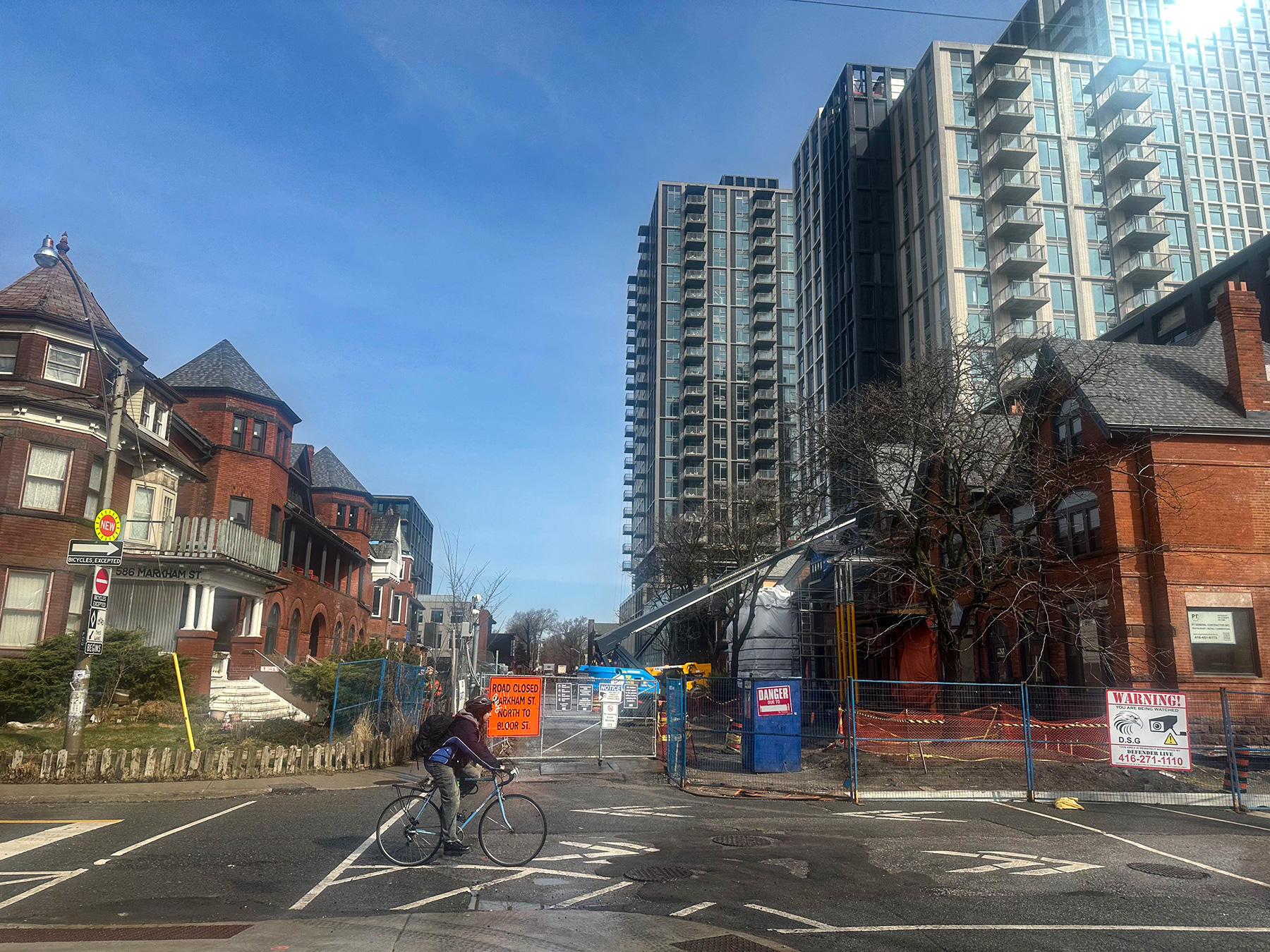
Mirvish Village inches toward completion. BRIAN BURCHELL/GLEANER NEWS
In the final days of 2016, Torontonians said goodbye to what was considered a city landmark, the iconic Honest Ed’s department store whose neon presence occupied the southwest corner of Bloor and Bathurst for decades. The replacement for the store was to come soon, an ambitious project melding residential accommodation for up to 2500 residents with commercial space. Over eight years later, the site is still unfinished.
After years of unfinished infrastructure lining Bloor and Bathurst Streets, there has been recent progress on the site.
The project will be a 100 per cent purpose-built rental community. But the question remains: when is it going to be finished?
“Like many businesses and most development projects, the project was impacted by the COVID-19 pandemic,” said Ian Duke, head of the development group at Westbank.
The project faced issues from supply chain disruptions , resulting in construction delays. Westbank Corp., the developer behind Mirvish Village, has faced multiple lawsuits related to this project and others. Notably, four construction companies have sued Westbank for over $25 million for unpaid work on the project. EllisDon, the general contractor, vacated the site and is seeking $8.7 million in unpaid bills.
“The construction has been challenging locally, for businesses and our residents,” said Melanie Ramsey, co-ordinator of the Mirvish Village BIA. “The BIA’s role is to support people and businesses, new and existing. When the time comes, it’ll be a great reopening.”
However, construction is now on track according to the developer, and the first two occupancy phases are complete. Commercial tenants like Niagara College, LCBO, Stretch Lab, and BMO have moved in, along with residents in the first building at 748 Bathurst St. Completion dates for the whole project have not been stated; however, the remaining residential components of the project should be complete by spring or early summer, with the other non-residential areas to follow.
“Mirvish Village isn’t a typical redevelopment project—it’s a natural extension of the neighbourhood and designed to include a mix of uses that will bring the community together…We see Mirvish Village as a place for everyone, including our neighbours,” said Duke.
With the lack of affordable housing in Toronto right now, affordable rental spaces are more welcome than ever. The Mirvish Village project comprises six rental buildings with 916 units, of which 366 are designated as affordable housing. The Canada Mortgage and Housing Corporation (CMHC) is providing $200 million in federal financing to support these affordable units. In Canada, housing is considered “affordable” if it costs less than 30 per cent of a household’s before-tax income. By providing this financing, the federal government, through CMHC, is ensuring that a significant portion of the Mirvish Village development is dedicated to affordable housing.
The project has begun offering leases and currently 85 units are available. A distinct aspect of the Mirvish Village development is the inclusion of multiple-bedroom units which can accommodate families. The project is offering over 200,000 square feet of retail which will include a new park and The Kitchen, a vast marketplace selling everything from groceries in the food hall to vinyl in the music venue. Described as an extensive public realm, the space includes 24 restored heritage buildings. There will be numerous indoor and outdoor performances, lights, and public art installations, including a mural by artist Frank Stella. It sounds like an extensive, ambitious endeavour, and many in the community are excited for its long-awaited opening.
“At the end of the tunnel, the promises of what we will have added to the community will be huge,” said Ramsey.
April 22nd, 2025 · Comments Off on NEWS: The evolution of 364 Huron St. (Apr. 2025)
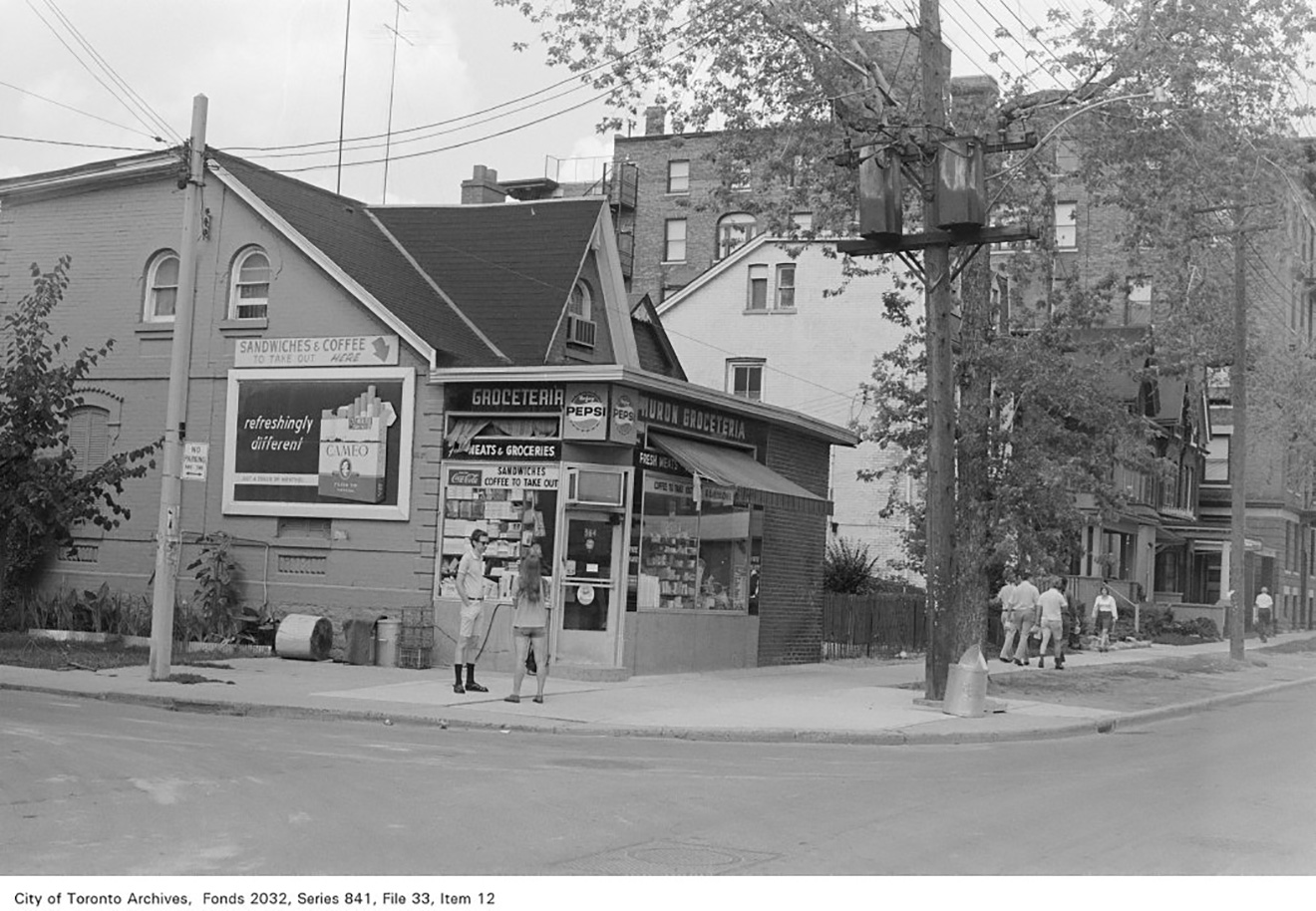
Before its recent demolition the building at 364 Huron served many functions including the Huron Grocerteria seen here in the 1960s.
By Nimrah Khan and Brian Burchell
Before its recent demolition the building at 364 Huron served many functions including the Huron Grocerteria seen here in the 1960s. COURTESY CITY OF TORONTO ARCHIVES
The building at the corner of Huron and Glen Morris Streets, just west of the Robart’s Library, has been many things, but its built form has been largely unchanged for 140 years—until now.
According to the Architectural Conservancy of Ontario, 364 Huron St. was constructed in 1879. A bricklayer named Charles Williams made it his home according to the City of Toronto Archives (CTA).
There is a long gap in the historical record, but at some point, it became the Huron Groceteria. A post on X by the CTA suggests you could buy meat, groceries, sandwiches, coffees, and more there. The business evolved into the Huron Deli which thrived in the 1980s.
The building, which was largely unchanged, then became the Varsity Deli: “The best Korean restaurant on campus” and the only one apparently, according to Four Square, a now shuttered online city food guide.
In its final iteration before the building’s demolition, it was occupied by the U kitchen, which according to the banner out front, featured “Chinese food-fast-food takeout.”
According to a City of Toronto report published in 2021, the MarsRock Development Group proposed a redevelopment of the site. The proposal was a “three-storey mixed-use building with nonresidential uses on the first two storeys and one dwelling unit on the third storey, and a two-storey laneway suite at 364 Huron Street.”
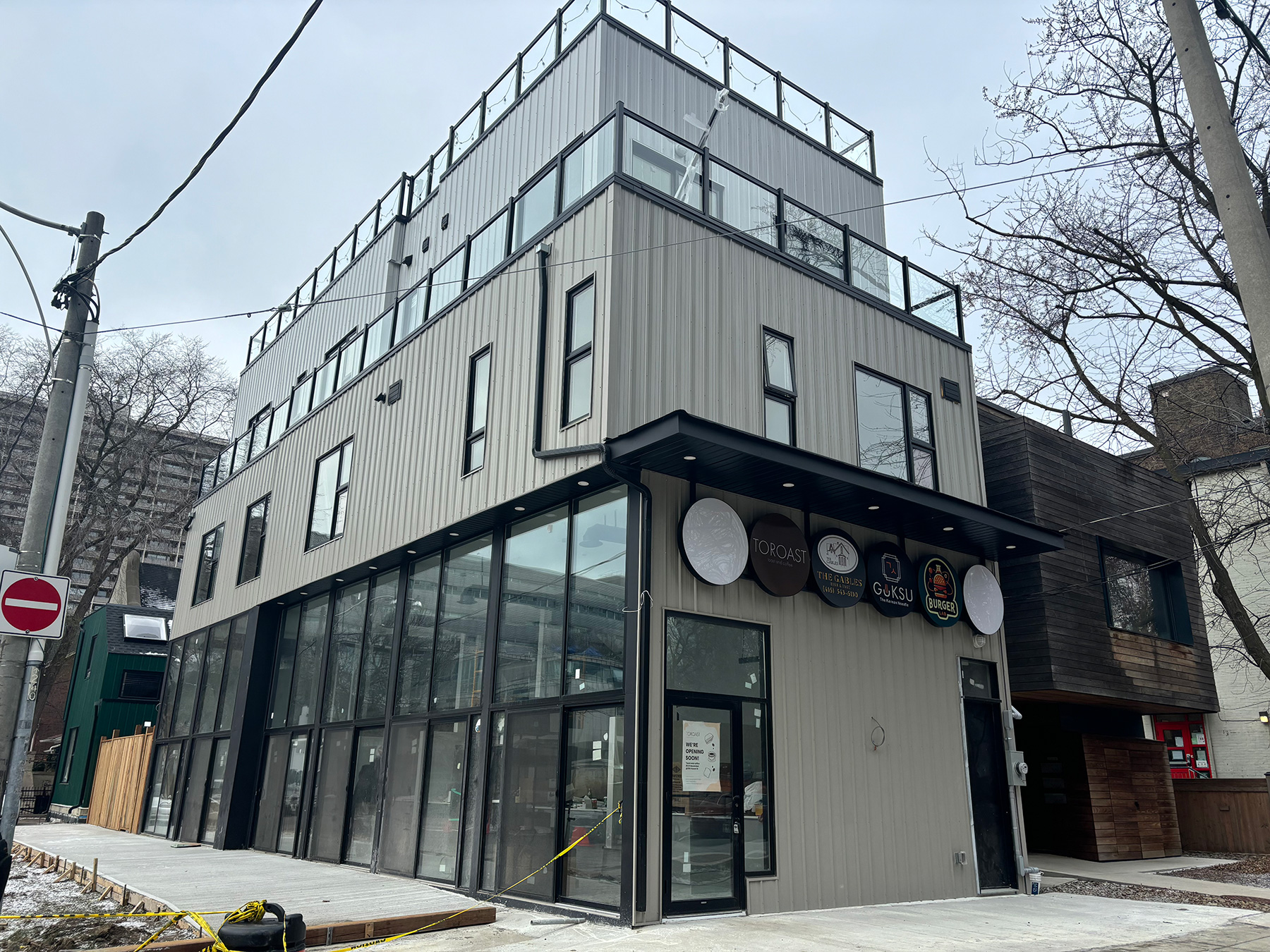
New build at this address will feature an array of food offerings with apartments above. BRIAN BURCHELL/GLEANER NEWS
The new build at 364 Huron St. is now nearly complete, and a few of the restaurants featured at the front of the building will be: Tororoast, a toast and coffee shop; The Gables, European cuisine; Guksu, a Korean restaurant known for its noodles; and Burger Lab: “stay tuned for burgers.”
From a bricklayer’s home to burgers in 146 years.
Comments Off on NEWS: The evolution of 364 Huron St. (Apr. 2025)Tags:Annex · News
April 22nd, 2025 · Comments Off on CHATTER: Presse Internationale finds new digs on Bloor (Apr. 2025)
Presse Internationale’s new home above Maji Curry at 515 Bloor St. W. BRIAN BURCHELL/GLEANER NEWS
Things looked grim for the award-winning magazine store facing a nearly 50 per cent rent hike. Presse Internationale was on its way to closing because it was unable to negotiate a lower rent, and it was unable to find a new affordable location.
For nearly 20 years, Presse Internationale has been located at 537 Bloor St. W. near Lippincott Street. The store is known by the community for the friendly owners and their vast offering of magazines.
However, when the building was sold, the new landlords sought a rent increase from $7,000 to $11,000 per month. Owners, Edith and her husband Huashan, were devasted. They felt that staying close to their original location was important because of their loyal client base, but other commercial rents on Bloor were prohibitive.
After many stressful months, they found a find a new location at 515 Bloor. St. W., just a 30-second walk from their original location. They are now on the second floor, above Maji Curry.
The new location is calm, quiet, and spacious, with plenty of natural light. There are newspapers and magazines on many subjects. The store is open from 11 a.m. to 11 p.m., Monday to Friday and on Sundays. On Saturdays they are open from 10:30 a.m. to 11:30 p.m. It is a great place to find something new to read.
—Eleanor Viella Silva/Gleaner News
Comments Off on CHATTER: Presse Internationale finds new digs on Bloor (Apr. 2025)Tags:Annex · News
April 22nd, 2025 · Comments Off on CHATTER: Penguin Pick-up packs it in (Apr. 2025)
Penguin Pick-up at 527 Bloor St. W. closed in March. BRIAN BURCHELL/GLEANER NEWS
The parcel depot Penguin Pick-up which was located at 527 Bloor St. W. closed its doors on March 21, 2025. Established in 2014, the company makes deliveries and drop-offs simple, convenient, and secure for customers by providing a location where packages can be safely stowed away or shipped. The company is struggling due to high overhead costs, with rent at the Annex location as high as $13,000 per month, plus the costs associated with staffing, utilities, and insurance. While the business appeared quite popular, the physical storefront has become financially unsustainable.
In a message to customers, Penguin Pick-up announced they are finding partner stores that will offer their services as part of the first phase of their transformation. In a letter to subscribers the company said that “Automated parcel lockers will be introduced in select Toronto and Montreal subway stations,” though no such subway locker installations have been observed by the Gleaner to date. Subscribing customers will have access to both the partner stores and automated parcel lockers.
Current subscribers affected by the closure are encouraged to send their next shipment to one of three partner locations: 250 University Ave., 93 Peter St., or 410 Roncesvalles Ave.
The parcel outlet says it will advise customers when it secures a new partner near the now- shuttered Bloor location. Customers can direct any inquiries to: info@penguinpickup.com.
In their letter to customers the company stated: “We want to express our heartfelt appreciation for your support and loyalty as a valued customer of Penguin Pickup and we look forward to serving you in the future. Thank you once again for your understanding and continued support.”
—Elliot Barker/Gleaner News
Comments Off on CHATTER: Penguin Pick-up packs it in (Apr. 2025)Tags:Annex · News
April 22nd, 2025 · Comments Off on EDITORIAL: Thou shalt not park in a bike lane (Apr. 2025)
Is the death of a cyclist in Toronto enough to spur the city to take action to improve road safety? When it comes to the perennial problem of illegal parking in bike lanes, the answer, sadly, is “no.”
Illegal parking in bike lanes is as old as bike lanes themselves. Soon after the installation in 1991 of a short bike lane on Bloor Street East (from Sherbourne Street to Broadview Avenue, across the Viaduct), some motorists quickly put the new space to work, for themselves. Parishioners at a church on Bloor East were among the first to break the bylaw commandment: Thou shalt not park in a bike lane.
A person walking along Bloor in the Annex 35 years later couldn’t be blamed for thinking that nothing has changed to reduce illegal bike lane parking. Indeed, there are new transgressors, including the many drivers engaged by faceless companies that run ride-hailing and food-delivery services. New measures to deter scofflaws—who still excuse themselves with “I’ll just be a minute” (even though a crash can happen in mere seconds)—haven’t kept pace, especially along some of the city’s main street bike lanes.
“Protected” bike lanes that feature physical separation between cars and bikes (the south side of Bloor in the Annex, for example), largely prevent illegal parking—by design. But other bike lanes delineated only by paint allow easy access for motorists. These bike lanes either date from an earlier era or the city considered a painted line as the only feasible option, given a narrow roadway or other restrictions.
Toronto Police now have a bicycle-mounted unit of three Parking Enforcement Officers (PEOs) who patrol bike lanes, but the chances of getting caught are slim given the size of the city. To make matters worse, these PEOs go home at 6 p.m. and don’t work on weekends, precisely the worst times for illegal parking.
After a young woman was killed in July, 2024 on Bloor at Avenue Road (in that case attempting to steer around a construction bin in the bike lane), Mayor Olivia Chow committed to tackling the problem of illegal parking. She proposed licence plate readers that serve a purpose similar to that of speed cameras. Technology is indeed a key part of the solution, but nine months after this latest tragedy, we’ve yet to see any action. The mayor owes us an update.
Another part of the solution is to rein in the app companies, whether they’re acting as ride-hailing or food-delivery services. More regulation is vital to stop the companies from washing their hands of responsibility for their drivers. Last year, city council passed a motion by Councillor Dianne Saxe calling on Queen’s Park to grant new powers to cities to license the food apps, which would allow for new obligations and responsibilities to be imposed on the companies. More pressure on the province will be needed. In the meantime, local merchants who serve take-out could provide a simple community service by posting signs such as “Parked in the Bike Lane. No Food”—in the same way as they currently post: “No [insulated] Bag. No Food.”
The city should also explore its existing business licensing powers to determine how it might restrict the use of cars for food delivery. Surely, using one tonne cars to deliver burgers and tacos is absurdly inefficient, and largely unnecessary given the availability of e-bikes with significant range.
There are two other victims of illegal parking in bike lanes. First, the community, which has invested its time and resources in advocating for safe cycling infrastructure. Second, the growth of cycling, especially among prospective riders who may forego cycling altogether to avoid the danger.
We certainly shouldn’t have to wait for a cyclist to die before we get serious action to reduce illegal parking in bike lanes.
The Gleaner invited this guest editorial from Albert Koehl, an environmental lawyer, coordinator of Community Bikeways, and author of Wheeling through Toronto, A History of the Bicycle and Its Riders (University of Toronto Press).
April 22nd, 2025 · Comments Off on FORUM: Exciting spring initiatives (Apr. 2025)
Many promising plans for parks and the 501 Streetcar returns
By Dianne Saxe
Isn’t spring wonderful? Thank you to everyone who came out and waved during the rainy St. Patrick’s Day parade.
March was a tumultuous month, including Trump madness, snow removal, March Break, tariff chaos, city staff strike threat, a federal election call, a contentious council meeting and a Yorkville fire that destroyed heritage homes and melted fire trucks.
On the plus side, it is very exciting that some of my initiatives have come to fruition. March 17 was the grand opening of the Nancy and Ed Jackman Performance Centre at 877 Yonge Street. This collaborative community theatre space beneath supportive housing features a state-of-the-art performance hall, a rehearsal and recording space, a greenroom, and offices to support Tapestry Opera, Nightwood Theatre, and dozens of other artists. It could not have happened without the innovative leadership and partnership of St. Clare’s, Nightwood Theatre, Tapestry Opera, local residents, donors, and city staff. It will dramatically increase cultural opportunities in midtown.
March 24 saw the kickoff for the long-awaited Ramsden Park Community Recreation Centre (Visit the website to join the community advisory committee). Plus, the Weston family has offered to fund exciting upgrades for Queens Park North.
My successful motions at the March council meeting included the following:
A redesign of Pricefield Park to go with the pink grapefruit fountain under construction at Scrivener Square.
Funding arrangements for a new park at 819 Yonge Street, the previously uncelebrated intersection of Yonge Street which marks the historic Indigenous Portage Trail. A tentative design is being reviewed with First Nations, in hopes of construction in 2026.
A new partnership agreement for Paul Martel Park.
Requiring parks and recreation to install gates at Paul Martel Park to allow the Indigenous park guardians to lock the gate at night to protect the native plants.
A Ward 11 pilot project to allow food to be sold from trailers, not just trucks.
Directing staff to report on how to take effective action on long-derelict buildings, instead of leaving them boarded up indefinitely.
Directing staff to report on how to improve protections for rooming house tenants threatened by demovictions. Toronto’s affordable housing is being lost at an accelerating rate and rooming house tenants are particularly vulnerable.
A plan for enforcing our anti-idling bylaw.
Directing transportation services to require the owners of 135 Glen Road to remove their giant wall from public property because it breaches the Ontario Heritage Act.
Providing additional funding to the Kensington Market Community Land Trust (KMCLT) to acquire and renovate affordable rental housing in the Market. With my help, the Trust has reached three significant milestones: raising $1 million in community bonds, buying more affordable rental housing, and publishing the report KMCLT as Place Keeper.
One issue raised by KMCLT applies across Ward 11: the need for better succession planning by small businesses.
The Toronto Public Library (TPL) has agreed to host a workshop on small business succession planning if appropriate volunteers will lead it. If you are interested in giving such a workshop, please apply on the TPL website.
In TTC news, I am proud to deliver results for Ward 11. Upgrades at Spadina station are well underway:
The Spadina streetcar line is back in operation with enough power to support accelerated service.
Work is underway to improve how TTC performance is measured in ways that matter to riders.
My fare enforcement initiative is bringing cheating rates down. Fare cheats deprive the TTC of essential revenue and undercut the willingness of others to pay. They also cause many subway delays and drive paying customers away. The SafeTTC app now makes it easy to report harassment, panhandlers, and other safety concerns on the TTC. Enforcement will get another boost this month with 31 additional special constables.
A bubble zone law to protect religious minority institutions in Toronto has been delayed again. Please don’t forget to answer the survey on the City of Toronto website.
Dianne Saxe is city councillor for Ward 11, University-Rosedale.
April 22nd, 2025 · Comments Off on FORUM: Coming up this legislative session (Apr. 2025)
Fines for homeless, drug-addicted on the horizon
By Jessica Bell
The Ontario legislature will return on April 14 and run until June 5, 2025. We expect it to be a history-making time. This is what could be in store for us.
We will respond to the Trump tariff crisis. President Trump imposed tariffs on Canadian energy, steel, and aluminium, along with products and services not covered under the Canadian-United States-Mexico Tade Agreement. Countries are responding with counter-tariffs, including our own.
The global economy has been upended, stock markets are in shock, the trade war has begun.
With over 80 per cent of Canada’s exports going to the U.S, the tariffs are creating fear, anxiety, and instability for all of us: families, workers, and businesses. We feel overwhelmed by this threat and worry how it’s going to impact our jobs and our costs.
How do we respond? Who do we help? What do we invest in? What kind of province are we going to build that can not only withstand these economic challenges and the recession that is to come, but build back better?
The premier has just announced $11 billion in tax deferrals and rebates for all businesses to help them weather the coming downturn..
With crisis comes opportunity. Out of the 1930s depression came Roosevelt’s New Deal which led to better regulation of the financial system, massive public works programs that employed workers and built infrastructure like bridges and dams, a 40-hour work week, and a minimum wage.
Tomorrow’s future will be built out of today’s daunting challenges.
What we can all do, each and every day, is buy local and buy Canadian.
The Toronto District School Board (TDSB) will set its budget for 2025-2026
Our public schools are beloved and essential, yet they also face huge problems.
Since the Conservatives came to power, the TDSB has lost $1500 per student when inflation is factored in.
Every parent has seen the impact of these cuts: the large class sizes; kids who are not being challenged, along with kids who are falling behind; the difficulty hiring permanent teachers and French teachers; broken washrooms and aging buildings.
For 2025-2026, the TDSB is facing a big funding shortfall. We already know the TDSB is short $38.5 million to support students with special education needs, $10.9 million to support student and staff mental health, safety, and well-being, and $4.4 billion to fix our schools and maintain them in good repair.
We are hearing that some schools in University-Rosedale are already being told they will lose teachers and programs. Beverley School, which provides education to the most vulnerable and high-needs kids, has been told they are losing a teacher, which will mean they will have to close a classroom.
We have been effective in pressuring the province to do the right thing for our kids and our schools. We will be keeping the pressure on this legislative session by organizing with parents, teachers, and students, supporting rallies, and raising issues in Question Period and in the media.
The legislation to fine and criminalize homeless people will be re-introduced.
The premier will re-introduce legislation that will give municipalities and police services the power to clear encampments and issue up to $10,000 fines and jail time for people using drugs publicly.
Penalizing people is an incredibly ineffective, costly, and cruel response to the homelessness crisis the Conservatives helped create. It will lead to more people dying from overdoses in alleyways and more people in jail, and it won’t solve the homelessness crisis, because people will still be homeless. Moving a tent to another park doesn’t make someone any less homeless.
We are calling for the construction of 300,000 affordable homes and supportive housing units, along with greater investment in mental health and addiction services.
Please reach out to our offices if you’d like to request a meeting, invite us to an event, or want to work or volunteer with us.
Jessica Bell is the MPP for University-Rosedale. You can reach her office at jbell-co@ndp.on.ca or 416-535-7206.
April 16th, 2025 · Comments Off on SPORTS: Leafs make history (Apr. 2025)
Star Japanese pitcher will be first female in the league and Canada
Ayami Sato is the first woman to be signed to the International Baseball League. COURTESY TORONTO MAPLE LEAFS BASEBALL
By R.S. Konjek
One of the popular streaming services hosts a sports drama called Pitch. First aired in 2016, the show explored the scenario of a woman playing for a men’s major league baseball team.
This summer at Christie Pits, fantasy will become reality.
The Toronto Maple Leafs of the Intercounty Baseball League made international headlines when they announced the signing of Ayami Sato, one of the world’s greatest female baseball players.
Sato, 35, has pitched in the Japan Women’s Baseball League since 2013 and helped Japan win six straight Women’s Baseball World Cups—the highest level of international competition in the women’s game. In three of those tournaments, she was named Most Valuable Player.
When she takes the field this summer, Sato will become the first female to play in the IBL and the first in Canadian pro baseball history.
“We’re really in new waters here,” said Keith Stein, CEO of the ownership group that bought the Leafs in 2023. “Think about that moment: [Sato] facing her first hitter in the IBL. There’s a lot riding on that moment. A very powerful moment, maybe a bit nerve-wracking.”
How that anticipated moment came about is surprisingly straightforward.
Stein and fellow ownership group member Andreas Kloppenborg like to bounce ideas off each other. One day last year, they were discussing how to enhance the fan experience at Christie Pits. Stein wondered why the Leafs didn’t have any women involved in managing or coaching the team. Kloppenborg went a step further and wondered why they didn’t have any female players. He identified Sato and contacted her. She expressed interest, conversations took place, and the signing came together quickly.
According to Stein, Sato is very excited about the opportunity. He is confident that her pedigree on the mound will translate to success in Toronto.
“People will be really impressed by her ability to mow down men in the IBL.”
Interest in Sato’s arrival has the Leafs discussing the production of a documentary, with cameras and sound people following her journey.
“This is an incredible moment for women’s sport,” Stein said.
As for her new teammates on the Leafs, Stein says they are supportive and intrigued.
Last season, the Leafs finished in seventh place and were swept in the first round of the postseason. Improvement on the field will be welcome, with Sato playing an important role beyond the hype of history. The team roster continues to take shape, and the club has begun announcing signings on social media.
One key announcement was that veteran pitcher Dustin Richardson will take on additional responsibilities as general manager, heading the club’s baseball operations.
A former major leaguer who pitched for the Boston Red Sox, Richardson will play a role in providing mentorship to Sato as she adjusts to her new surroundings.
Also joining the club as a senior advisor is Cito Gaston, who managed the Toronto Blue Jays to their two World Series victories in 1992 and 1993. Gaston will assist the club on the baseball side of things and make some public appearances during the season.
Longtime fans will notice a shake-up in the team schedule. In 2025, the Leafs will play fewer Sunday afternoon home games. Two-thirds of the schedule will be night games, spread over Wednesday, Friday and Saturday evenings.
The change is part of a strategy to attract more people to the Pits. Names like Sato and Gaston are sure to draw serious baseball followers, but Stein and company also want to attract casual fans looking for a fun evening.
“We are very committed to what happens around the field,” Stein said.
The upgraded fan experience initiated last year will continue. There will be giveaways and promotions, enhanced food and drink options, and merchandise sales.
Games will continue to be free. A new ticketed seating area will be installed along the fence on the third base side of the park.
It will offer enclosed, lounge-style seating for 50-75 people, a DJ, a mixologist and entertainment between innings. Come for the baseball, stay for the party, or vice versa.
“We’re just getting started,” Stein said. “This is like the first inning of the reinvention of the team.”
The Leafs’ season runs from May to August. Their home opener is scheduled for Sunday, May 11, 2:00 p.m. at Christie Pits.
More information about the team can be found at www.mapleleafs baseball.com.
April 16th, 2025 · Comments Off on LIFE: 50 years and still running (Apr. 2025)
The Runners Shop celebrates milestone
The Runners Shop with its ever-pleasing window displays. BRIAN BURCHELL/GLEANER NEWS
By Amna Ahmad
In 1975, The Runners Shop (374 Bloor St. W.), opened its doors with a simple mission: to support runners and help them achieve their goals. Half a century later, that mission is just as strong, and the store has become a cornerstone of the local running community.
Originally opened in Port Credit by David Ellis, The Runners Shop is Canada’s oldest running speciality store, and it just celebrated its 50th anniversary. Lynn Bourque, current owner and longtime runner, is a testament to the strong community fostered by the shop.
Over 25 years ago, Bourque discovered the shop as a member of the run club. From there, her running journey took off, and along with it, her new career.
“I started running, and I just never stopped,” said Bourque.
Having owned the shop for seven years, Bourque has witnessed it all, from a surge in running during COVID to significant changes in footwear technology in the last five years. From all of this, she says her favourite thing about the job is connecting with people and being a support in their journeys.
“Theres a lot that goes on here beyond selling shoes,” said Bourque.
Greg Lindsay, store manager, has been at The Running Shop for almost five years and has been a runner for even longer.
“My favourite part of this job, undoubtedly, is every Monday morning, when Lynn comes in, and after she’s been here for five minutes, she always says, ‘you know on the weekend I was thinking’ and then who knows where we’re gonna go,” said Lindsay.
Lindsay first met Bourque over 20 years ago during their fine dining days working at Canoe. From there they started a lasting friendship that extended to working together at the shop.
From long-time friends to new team members, the staff at The Running Shop form a close-knit group who enjoy working together. Their shared passion for running and helping customers creates a welcoming atmosphere for everyone who walks through the door.
Michael Denomme, a newer hire, has worked at the shop for three years. Referred to as the shop’s ‘shoe dog’ by Bourque, Denomme is your go-to guy for gear-related interests.
“I’m a bit of a gear head when it comes to running shoes, so I really love just getting to talk to lots of different people about nerdy things about running shoes,” said Denomme.
Denomme, like Bourque, started his career at the shop by joining the running club. From there he started working part-time, and before he knew it, he was there every day.
Whether you are a seasoned runner, or just starting out, The Running Shop has something for all.