May 1st, 2018 · Comments Off on CHATTER: Little Island Comics reopens on College Street (Spring 2018)
After closing its doors for what might have been the last time in December 2016, Little Island Comics has reopened at 323 College St., beside its parent store, The Beguiling Books & Art. Beguiling and Little Island moved from their locations on Markham Street to make room for the Mirvish Village redevelopment.
The comic book store for kids was the first of its kind when it opened in Mirvish Village in 2011, and served as a hub for young readers. The store also hosted many kid-centric events and classes on how to make comics.
“Independent bookshops are important spaces for learning, for exploration, and for building community, especially for young people,” said store manager Andrew Woodrow-Butcher. “The community has been showing us lots of love during the last week, and we are looking forward to serving them in our new College Street location for a long time to come.”
—Billie Wilner/Gleaner News
Tags: Annex · News
May 1st, 2018 · Comments Off on CHATTER: U of T proposes laneway housing pilot on Huron Street (Spring 2018)
The City of Toronto has received an application to build three residential buildings just west of Robarts Library on 366, 368, and 370 Huron St. The applicant would like to build one three-storey residential building facing Huron Street and two residential buildings on the laneway off Huron Street near Glen Morris Road.
The plan is significant to the downtown neighbourhoods because of the laneway housing, which was identified as a way to meet the community’s housing needs in the 2014 Huron-Sussex Neighbourhood Planning Study in 2014. The University of Toronto (U of T) announced a pilot project last March to build two laneway houses on Huron Street.
“The laneway houses are a pilot project that will provide good rental housing and valuable information on what can work or not work for laneway housing in our neighbourhood,” said Julie Mathien, co-president of the Huron-Sussex Residents’ Association, which supports of the development. “With sensitivity to location and flexibility regarding size, laneway housing has the potential of providing more stable and affordable rental and owned housing.”
The Toronto and East York Community Council meeting will consider the application at its meeting on May 2.
—Ahmed Hagar/Gleaner News
READ MORE:
ON THE COVER (JANUARY 2017): Putting the city’s laneways to work
NEWS (JANUARY 2017): Laneway living
NEWS (OCTOBER 2016): Preventing a wall of towers
Tags: Annex · News
May 1st, 2018 · Comments Off on CHATTER: Bike swap returns to Bathurst Street (Spring 2018)
Bateman’s Bicycle Company will host its Spring Bike Swap at its flagship store at 913 Bathurst on April 14 and 15. Anyone can bring their used and working bikes before April 13 and Bateman’s will evaluate their value within minutes. Sellers can choose to get their bike’s value in store credit or 80 per cent of the value by cheque.
“This is one of those unique opportunities where price point and the quality of bike meet,” said Mike Nurse, a Bateman’s employee.
The event has taken place since 2012 and is now semi-annual. Nurse said it usually attracts hundreds of customers “who line up and down the street,” and recommends arriving early to get the best deal.
The bike swap runs 10 a.m. to 5 p.m. on April 14 and from 12 to 5 p.m. on April 15. For further information, please visit www.batemansbikeco.com.
—Ahmed Hagar/Gleaner News
Tags: Annex · News
May 1st, 2018 · Comments Off on NEWS: Freshening the field (Spring 2018)
Improving Huron Street to make a positive impact
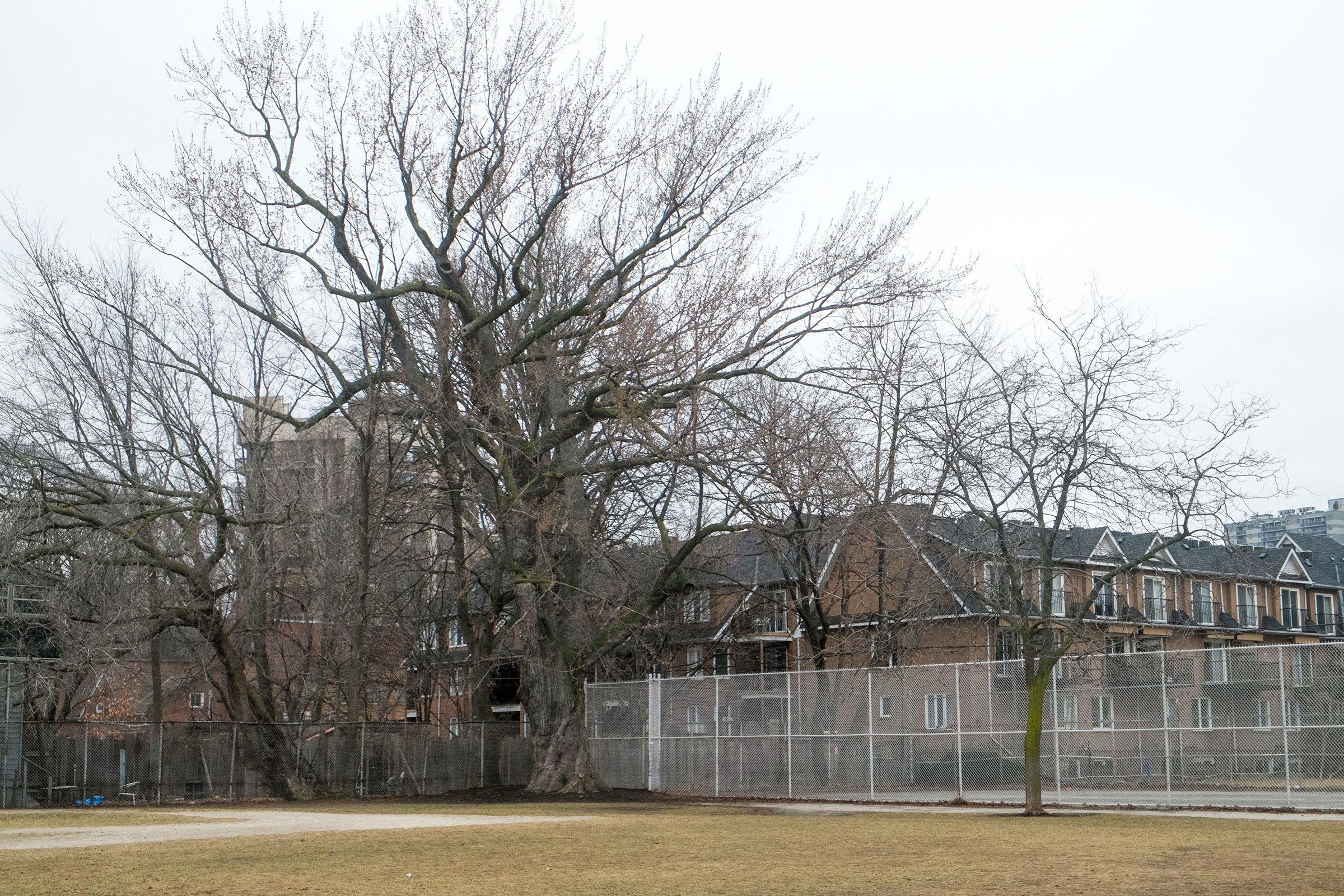
Huron Street Junior Public School’s Big Tree, a heritage tree that is about 150 years old, is at the centre of a plan to revitalize the schoolyard. School representatives want to create a welcoming space around the tree, clean up the tennis courts, and remove the fences. GEREMY BORDONARO/GLEANER NEWS
By Geremy Bordonaro
Huron Street Junior Public School hosted a community meeting in late January to discuss plans for revitalizing its playground.
“There’s been a lot of rumbling, a lot of discussion, and a lot of thought over the last few years. I think what really started it was the full day kindergarten. When that started in 2014 it made us think bigger,” said Meg Gardner, who is both a teacher at Huron and a director of the Annex Residents’ Association. “We’ve got these kids, they’re little and here all day, they represent 25 per cent of the school population and we need a dedicated space for them to play.”
[pullquote]“We want to celebrate and create more of a welcoming space around the big tree” —Meg Gardner, Huron Street Junior Public School[/pullquote]
While upgrades to the yard are sorely needed, the school highlighted four points that could use improvement: the large and old “Big Tree” that they want to use as a gathering point for the school, the grass playing field that is uneven and has drainage problems related to its original foundation, the baseball diamond that has an uneven sandlot and may end up becoming a safety hazard, and the tennis courts that have been falling apart.
“What we’re hoping to see is kind of a three-pronged approach,” explained Gardner. “We want to celebrate and create more of a welcoming space around the big tree. We also really want to clean up the tennis courts. We want to get rid of the concrete and the fences and make that a more usable space. We also really want to look at what the permanent sports areas will have to offer.”
“It’s really exciting for the community,” said Ausma Malik, the local trustee (Ward 10) for the Toronto District School Board. “The possibilities of this revitalization are really great. This master plan process is a wonderful opportunity to engage the ambitions for the playground with the entire community.”
It’s still unclear how the revitalization would be paid for, but the school’s representatives spoke openly at the meeting about their hope that some Section 37 funds could be allocated to the project. (Under Section 37 of the Ontario Planning Act, the City of Toronto can ask a developer for funding toward community projects when a zoning by-law is amended for a development.)
“It’s not so much about where the money is coming from at the city,” said Joe Cressy (Ward 20, Trinity-Spadina). “It’s all public land. I think we need to stop thinking in silos. Is this school board land? Is this city land? It’s all green space that the community uses. It’s all play space that our kids use. Therefore we just need to think about partnering together.”
Malik seemed to agree.
“Huron is a really amazing school that’s very connected to the community. The green space around the school that is obviously used during the school day is also used after hours as well. It’s a huge benefit to have improvements to the school playground. Not just for the kids and the families who participate in the life of the school but for the neighbourhood.”
The school is hopeful that funding can found so the revitalization can be completed quickly.
“I would like to see this done within the next two or three years,” said Gardner. “Likely it is going to take a little bit longer than that. With everyone’s help, from not only the school but the community, I think we can push this along.”
READ MORE:
NEWS: Huron Street Playground renewal (April 2016)
Tags: Annex · News

More how nice!
EDITORIAL CARTOON: How Nice (Mar. 2018)
EDITORIAL CARTOON: How Nice (Dec. 2017)
EDITORIAL CARTOON How nice! (August 2017)
EDITORIAL CARTOON How nice! (JULY 2017)
EDITORIAL CARTOON: how nice! by blamb (June 2017)
EDITORIAL CARTOON: TCHC (May 2017)
EDITORIAL CARTOON: The Grand Tory (April 2017)
FORUM: Celebrating 20 years of cartoonist Brett Lamb (April 2017)
EDITORIAL CARTOON: A second chance! by Brett Lamb 2037 (February 2017)
EDITORIAL CARTOON: Not really! It’s actually nice! by Stumpy the Subway(January 2017)
Tags: Annex · Editorial
Sometimes a mea culpa comes in the form of a memoir. Such is the case with Alok Mukherjee, who was the chair of the Toronto Services Board from 2005 to 2015, a period that included the G20 economic summit in June 2010 in Toronto.
In Excessive Force, published last month, Mukherjee considers how police, particularly the Toronto Police Service (TPS), (mis)managed security during the summit. According to Mukherjee, there was a lack of training and planning, and perhaps most damning, no common articulation of shared values that one should expect from the police service.
The “21,000 security personnel on Toronto streets during the summit included 6,200 Toronto officers, 5,000 from the RCMP, 3,000 from the Canadian Armed Forces, 3,000 from the Ontario Provincial Police and 740 from Peel Region,” writes Mukherjee in his book. “Collectively, the police response was one of confusion, communication breakdowns and overreaction.”
It’s a timely mea culpa.
Canada is preparing to host the G7 summit in Quebec in June, and Mukherjee’s inside account of how and why things went so awry could hopefully prevent the problems — including blurred lines of authority, no accountability, and a lack of operational preparedness — from happening again.
The author describes the “darkest chapter in Toronto police history, where officers — as many as 100 — removed their identity badges during confrontations with protesters, in clear violation of police board policy requiring every uniformed member of the police service to wear their name badge. As many as 1,140 protesters, peaceful and otherwise, were arrested.”
These arrests and the time spent in an overcrowded, chaotic, temporary jail may represent one of the worst breaches of civil rights in the history of peacetime policing in Canada.
At Queen’s Park, designated by event planners as a peaceful protest site, protestors were targeted by police and subjected to violent take-downs, heavy-handedness, and other mistreatment that’s been widely documented in media accounts. The police also used “kettling” at Queen Street West and Spadina Avenue, a tactic that indiscriminately confined protestors and passersby alike in the intersection during cold torrential rain for hours. It’s since been determined that this was ordered by TPS Superintendent Mark Fenton, who had not considered how to disengage from hundreds of people corralled inside a solid circle of cops in riot gear.
Fenton — who said he was following an order from the police chief to “take back the city” — is the only senior police official to face discipline under the Police Services Act for his conduct on that day. He was reprimanded and docked 30 days’ vacation. He appealed, lost, and had that penalty increased to 60 days.
While these failings are now well known, Mukherjee’s book reveals just how disconnected former police chief Bill Blair seemed from the ongoing operations. Mukherjee writes that Blair spent most of his time before the event telling the board to keep its nose out of “operational” matters, and that on one of the days in question, he found Blair alone in an anteroom watching the events unfold on CP24 from a tiny television. Meanwhile, there was a command centre down the hall with CCTV feeds from across the city and a live link to an integrated security unit managed by the Royal Canadian Mounted Police (RCMP) and conveniently located in Barrie.
No one may ever know the extent to which the RCMP was calling the shots (though to his credit, Blair seems to have halted the kettling). Ostensibly, they were in charge of security, but the former chair writes that his board was under the clear impression that the Toronto police chief at the time was solely or primarily responsible for security operations during the G20.
Let’s hope that those planning security for the upcoming G7 read Mukherjee’s book and find ways to avoid the mistakes made in Toronto in 2010.
Peaceful protest and dissent should be welcome in Canada.
READ MORE EDITORIALS:
EDITORIAL: A social contract is a precious thing (March 2018)
EDITORIAL: Intolerance leading to Quebec’s decline (Dec. 2017)
EDITORIAL (Nov. 2017): Student safety suffers as trustees cave
EDITORIAL: Pandering to religious intolerance (October 2017)
EDITORIAL: Bike lanes, good for business (Fall 2017)
EDITORIAL: Don’t sacrifice safety for political gain (August 2017)
EDITORIAL: Thank you Mr. Asti (July 2017)
EDITORIAL: A watershed moment (June 2017)
EDITORIAL: Revoke U of T’s unchecked “licence to build” (May 2017)
EDITORIAL: Westbank’s positive precedent (April 2017)
EDITORIAL: Foreign buyers tax a necessary cliff jump (March 2017)
Tags: Annex · Editorial
May 1st, 2018 · Comments Off on FORUM: Provincial government is developer-friendly (Spring 2018)
Affordable housing missing from proposed inclusionary zoning
By Mike Layton
Over the past five years, the City of Toronto could have built nearly 10,000 new affordable housing units, according to the former chief planner. How? By mandating affordable units in new developments.
Unfortunately, despite repeated requests, the provincial government has not given the city the power to mandate affordable housing, called inclusionary zoning. Having these powers would have meant that there would be 10,000 fewer of the 100,000 families waiting for a place to call home.
[pullquote]Every day that developers are able to apply for new building permits without an inclusionary zoning policy in place is a lost opportunity to build more affordable housing units.[/pullquote]
Every day that developers are able to apply for new building permits without an inclusionary zoning policy in place is a lost opportunity to build more affordable housing units. The construction boom in Toronto has its limits, and if we wait too long, the opportunity for permanent growth of our affordable housing portfolio will be lost.
Cities across the United States use inclusionary zoning policies to address shortages in their affordable housing stock. For example, the mandatory affordable housing policy in some New York City neighbourhoods requires 20 to 30 per cent of a development to be permanent affordable housing. This not only creates new affordable units, but helps build mixed income communities that are proven to help lift people out of poverty.
Late last year, the province released draft regulations (finally!) to allow cities to use inclusionary zoning to mandate affordable housing, but it was not what advocates for inclusionary zoning expected.
The draft policy was released quietly just days before Christmas, limiting the amount of time available for cities and organizations to comment. The proposed rules would only apply to new condominium construction, not new purpose-built rental buildings. Developers also retained the ability to choose if the new affordable units would be rental or ownership.
Lastly, the proposed rules require cash-strapped cities to subsidize these newly built affordable units by directly giving money to developers. To be clear, cities will need to pay developers to construct these units while they make millions off our shared municipal infrastructure. The fees would be taken from development charges necessary to build and expand new services like transit, libraries, and parks. As cities grow, new services and infrastructure are necessary to accommodate the growth.
It is clear that the province is more interested in the developer’s bottom line than the determination of the municipalities to shape their own policies to meet their unique needs. Municipalities need to be given the authority to make decisions about their housing stock. Developers shouldn’t be driving housing policy when their motives are profit, not people.
The good news is that housing advocates and progressive councillors continue to fight back and push the province to pass legislation that will achieve the housing goals of the City of Toronto. I remain hopeful that we will see meaningful changes to the inclusionary zoning policies and the province will see the demand for comprehensive legislation that gives all municipalities the power they need to give their residents a place to call their home.
Mike Layton is the city councillor for Ward 19, Trinity-Spadina.
READ MORE BY MIKE LAYTON:
FORUM: Establishing a new Indigenous Affairs Office (Nov. 2017)
FORUM: Building a better Bickford Park (Oct. 2017)
FORUM: Recognize and reconcile Canada at 150 (July 2017)
FORUM: San Francisco a model to follow (April 2017)
FORUM: Tolls, taxes, and Toronto (February 2017)
FORUM: Seeing our neighbourhood through new eyes (December 2016)
FORUM: We can do better: Dangerous summer for Toronto pedestrians and cyclists (October 2016)
FORUM: Curious story of Christie Pits pool liner ends in extended hours at Alex Duff (August 2016)
FORUM: A tribute to a friend (June 2016)
FORUM: Large problem, small solution (March 2016)
FORUM: Happy New Year from a new Dad with a new perspective (January 2016)
Tags: Annex · Opinion
May 1st, 2018 · Comments Off on FOCUS: Davenport development goes to mediation (Spring 2018)
Councillor aiming for negotiated settlement
By Geremy Bordonaro
The Ontario Municipal Board (OMB) has completed its pre-hearing process for 321 Davenport Rd., where Alterra Developments has applied to build an eight-storey glass building including 16 penthouse condominiums and a two-level parking garage on the site. The development would require a by-law amendment, as the application as it stands now exceeds restrictions on height and density for the area.
[pullquote]“It’s just an eight-storey mid-rise that just happens to be near a famous writer” —Barry Brooks, senior planner, City of Toronto[/pullquote]
The proposed development became infamous after famous local residents aired their opposition in public letters and on Twitter last year. Chief executive officer Galen Weston Jr. of Loblaw Companies Limited and author Margaret Atwood said they’re concerned about the height of the development, and argued that people on the balconies of the proposed development would be able to see into their homes.
When some observers on Twitter accused Atwood of NIMBY-ism, she tweeted in response, “make it affordable housing that doesn’t kill all the trees and divert all the groundwater and the neighbourhood would be all for it!”
Barry Brooks, a senior planner with the City of Toronto who has worked on projects in the Annex for 12 years, attributes the attention the proposed development has received to Atwood.
“It’s just a eight-storey mid-rise that just happens to be near a famous writer. She’s taken on supporting the neighbourhood,” Brooks said. “Not that she’s directly affected herself. It’s more that her neighbours are and she’s supporting them.”
The application has been considered at Toronto and East York Community Council, and is now under mediation at the OMB.
“At community council in September I spoke with the developer. I spoke to the local community and I spoke to our city staff,” said Joe Cressy (Ward 20, Trinity-Spadina). “Everybody agreed that rather than try to go the route of a full legal hearing, given that it was at the board, to be part of a mediation to work towards a settlement.”
If mediation is not successful, there will be a full hearing at the OMB in February 2019.
“Everybody acknowledges that this is a development site,” Cressy said. “The outstanding question simply relates to issues around tree protection and appropriate overlook. We’re into the details here.”
Many proposed developments for the area have been before the OMB in the last several years. Those that have been scaled down have tended to be very high, or have zoning discrepancies, as with the proposed development for 328 Dupont St. However, this development lacks the extreme height, zoning violations, or density of such projects.
And Alterra has not changed its marketing for the condominiums at 321 Davenport Rd., which are described as “an incredible portrait of modern sophistication.”
The Gleaner made multiple attempts to get a comment from Alterra but they did not respond.
The councillor remains hopeful that a compromise can be found.
“My hope and expectation here is that when everybody rolls up their sleeves and gets in a room together there will be an agreement that everyone can be a part of,” Cressy said.
Tags: Annex · News
May 1st, 2018 · Comments Off on ARTS: Heralding spring with film and music (Spring 2018)
Hot Docs returns and eclectic sounds abound

Yoko Ono’s The Riverbed, continuing at the Gardiner Museum until June 3, is an interactive exhibit that invites viewers to participate. PHOTO COURTESY OF THE BLOOR STREET CULTURE CORRIDOR
By Heather Kelly
Film festivities
North America’s largest documentary festival celebrates its 25th anniversary this spring, and the Hot Docs Ted Rogers Cinema kicks off the festivities early with Epilogues, a series of five films running from April 9 to 26. The festival itself, which runs April 26 to May 6, screens more than 200 films from Canada and around the world.
On April 15, Hot Docs pairs up with the Bata Shoe Museum to present Manolo Blahnik: The Boy Who Made Shoes for Lizards, a 2017 documentary about the man regarded by most influential fashion figures as the best shoe-maker of the 20th and 21st centuries. It’s presented in anticipation of Manolo Blahnik: The Art of Shoes, which opens at the museum in May and includes a question and answer with senior curator Elizabeth Semmelhack.
Looking for something lighter? On April 8, the Miles Nadal JCC presents Hanna’s Journey at the Al Green Theatre, featuring two guest speakers: Jeremie Abessira, program manager for the Toronto Jewish Film Festival, at 4 p.m., and Rabbi Elyse Goldstein at 7:30 p.m.
Music revelations
Did you know the Bloor St. Culture Corridor’s 20 different arts and culture organizations all present music-related events? This month is a great example, as the neighbourhood overflows with awe-inspiring and genre-defying live music.
[pullquote]Did you know the Bloor St. Culture Corridor’s 20 different arts and culture organizations all present music-related events?[/pullquote]
The Music Gallery, the newest music organization to join the Bloor St. Culture Corridor, now makes its home base at the 918 Bathurst Centre for Culture, Arts, Media & Education. Its concerts in April all explore the wonders of “comprovised” music — composition mixed with improvisation.
Emergents III on April 6 is an intergenerational encounter featuring music composed by the late Toronto guitarist/composer Ken Aldcroft, performed by emerging artists with guidance from his former bandmates. A panel discussion on the history of creative music coverage in mass media with journalists Mark Miller, Carl Wilson, and Jennie Punter will precede the concert, and a fundraising silent auction will follow.
On April 29, the Music Gallery welcomes legendary multi-instrumentalist Joe McPhee with Quebec duo Not The Music opened by Montreal’s Mercury, the duo of Lori Freedman and bassist Nicolas Caloia.
For a different flavour, check out River Moon, Flower Garden: The Music of Fuhong Shi on April 12, and Montreal musician and photographer Tess Roby with singer-songwriter Dorothea Paas on April 21, both at 918 Bathurst.
Soundstreams presents Freddy’s Tune: Turntable Bach, strings attached at Trinity-St. Paul’s Centre on April 21 with the Gryphon Trio, DJ SlowPitchSound, drummer Dafnis Prieto, trombonist/composer Scott Good, and bassist extraordinaire Roberto Occhipinti. The concert will include the world premiere of a contemporary, cross-genre remix inspired by Bach’s magnum opus The Musical Offering and an arrangement of dazzling Phrygian Gates by John Adams.
The Royal Conservatory presents more than half a dozen fantastic concerts at Koerner Hall in April. One highlight will be the KUNÉ — Canada’s Global Orchestra performance on April 7.
The Royal Conservatory of Music created KUNÉ (which means together is Esperanto) last year in celebration of our country’s cultural diversity and pluralism. The ensemble includes 13 virtuoso musicians: 12 from different countries all over the world who had each chosen to start a new life here in Toronto, and one Métis Canadian whose ancestors have been here for centuries. This concert launches KUNÉ’s self-titled recording on Universal Music Canada, and the evening will also feature David Buchbinder and Hilario Durán with their band Odessa/Havana.
The University of Toronto Faculty of Music’s UofT Opera presents its season finale “From the 19th Century,” on April 3, with costumed and staged scenes from the golden age of opera, including Delibes, Donizetti, Wagner, and Verdi.
On April 5, Thursdays at Noon, the U of T’s free lunchtime concert series in Walter Hall, concludes with pianist Asher Ian Armstrong and violinist Emily Kruspe performing an all-Brahms program.
Then just down the street from April 5 to 8 at Jeanne Lamon Hall in Trinity-St. Paul’s Centre, Tafelmusik Baroque Orchestra and Chamber Choir presents Bach B-Minor Mass, a choral masterwork considered one of the most supreme pieces of music ever written. Directed by Ivars Taurins with soprano Dorothee Mields, mezzo-soprano Laura Pudwell, tenor Charles Daniels, and baritone Tyler Duncan.
Then Tafelmusik brings the music of Vienna and Madrid to Toronto with Close Encounters, an intimate chamber concert of charming classical gems for oboe and string trio, on April 21 at Temerty Theatre in the TELUS Centre.
The Toronto Consort will present Quicksilver, a new ensemble of virtuoso players of early Baroque music, on April 13 and 14. The concert will be full of extravagant music from 17th-century Germany with works by Buxtehude, Bertali, Weckmann, and Schmeltzer.
Alliance Française, which hosts concerts in its Spadina Theatre, will present 100 Years of Jazz Double Bass with Bernard Dionne and his guests on April 21. The concert will include pieces interpreted and composed by the great double bassists of jazz history, with music by Duke Ellington, Oscar Pettiford, Miles Davis, Charles Mingus, Paul Chambers, Scott LaFaro, Oscar Peterson, Dave Holland, and Christian McBride.
Heather Kelly is the founder and director of the Bloor St. Culture Corridor. Her column focuses on arts and culture events from the district. More information about events and locations can be found at www.BloorStCultureCorridor.com.
Tags: Annex · Arts
Toronto is busy planning for yesteryear
Mayor John Tory doesn’t think much of me. He doesn’t even acknowledge my existence. In fact, he said there are incredibly few of me.
The “me” in this case is a parent without a car.
Yet I know for a fact that I am not alone. The endless discussions at parent groups about car seats for the car-less tell me I’m not alone, yet nobody wants to acknowledge we exist. There are few car seats that are designed for parents who use them primarily in cabs and in friends’ cars.
[pullquote]It seems our leadership and decision-makers are largely stuck in 1960 when car ownership meant freedom and independence.[/pullquote]
The most “portable” stage two car seat on the Canadian market comes in at a whopping 15 kilograms. There’s a lightweight car seat in the U.S. but no Canadian version. Strollers have gotten so big now that getting on transit is a feat in and of itself. Most telling though is that our mayor got up to a microphone and proclaimed that we don’t really exist in Toronto, the country’s largest city.
It seems our leadership and decision-makers are largely stuck in 1960 when car ownership meant freedom and independence. They’re still selling us the American dream that a car symbolizes prosperity and status.
Those days are long gone.
The power of oil companies and carmakers to dictate our psyche has waned and we’ve collectively moved on. Most of us recognize how disastrous car-centric communities are and few of us care to sit in the horrendous traffic that has evolved in this city.
Even those who have moved to the suburbs decry driving in the city. Nobody likes to do it.
In response, there are a lot of us who have chosen not to. Yet, despite our growing numbers, we are still largely invisible. With growing acknowledgement of climate change, the understanding of the role gas guzzlers and our personal choices play, it’s no wonder that more and more people are choosing to live low-carbon lives.
I realize that the older generation isn’t on board yet, and they might never be.
When we first moved to the Annex and decided to go car-free, my parents drove two hours every week to visit us with coolers full of food for us.
They’re terrific cooks so I didn’t complain, but it took me a while to figure out why they were doing it. My parents were convinced the only reason anyone would give up a car is because of financial difficulty and they were worried we couldn’t afford to eat!
Thankfully, my parents are not making lasting infrastructure decisions in the country’s largest city. They have no influence over how terrible the future will be. The mayor on the other hand does. Poor infrastructure planning affects us for generations. Once roads are built and tracks are laid, the undo button is exceedingly hard to push.
He’s already shown how much he favours cars. He chose the ill-advised option to maintain the Gardiner. He is fighting bike lanes in North York. The Scarborough subway is meant to be a hub for drivers. It is not a realistic option to get people out of cars. At best, it’ll slightly reduce the amount of downtown traffic, but it does nothing to create a walkable neighbourhood in Scarborough. This is an expensive option that shortchanges the health of Scarborough children.
No other level of government has the kind of direct impact on reducing green house gas emissions that municipalities do. Ours has failed, over and over. Rather than building reliable transit now, we’re going headlong into a project that has no reasonable prospect of actually getting people out of cars.
We could have invested in municipal loans for homeowners to insulate with loans tied to the home, not the owner. The next purchaser can continue to pay it as part of their taxes and keep enjoying the savings. Instead, we got commitments to keep our taxes low at an exponential cost to our quality of life.
I know I’m not alone. There are many other parents who have made similar choices for the sake of all our children’s futures. We want political leaders who not only acknowledge our existence, but also make policies that support our choices. We’re already making sacrifices in hopes of delaying human extinction.
Car-free parenting is not exceedingly rare. We are growing in numbers and we need to exert that power in numbers. This municipal election, I will be looking for candidates that support a greener Toronto.
I want leadership that acknowledges the existence of people who make greener choices. I will be looking for candidates who support pedestrian zones, stroller spaces on transit, and connected bike lanes. We are no longer beholden to big oil. Their days are over. It’s time to let go.
Terri Chu is an engineer committed to practical environmentalism. This column is dedicated to helping the community reduce energy, and help distinguish environmental truths from myths.
READ MORE BY TERRI CHU:
GREENINGS: The science of board games (Mar. 2018)
GREENINGS: Driving fuelled by unseen subsidies (Jan. 2018)
GREENINGS: No solutions for nobody’s problem (Dec. 2017)
GREENINGS: Celebrate science not milestones (Nov. 2017)
GREENINGS: Down to the data (Oct. 2017)
GREENINGS: Reducing paper waste (Fall 2017)
GREENINGS: Taking tolls to the Gardiner and Don Valley Parkway (July 2017)
GREENINGS: Lessons from Madrid (June 2017)
GREENINGS: Thoughts on hitting the 400 benchmark (May 2017)
GREENINGS: Solving the food waste problem (April 2017)
GREENINGS: Kellie Leitch was right (March 2017)
Tags: Annex · Columns
May 1st, 2018 · Comments Off on FROM THE ARCHIVES: Marking the end of the beginning (Spring 2018)
A look back to when the Barns first opened its doors
As we come up to the tenth anniversary of the opening of the Artscape Wychwood Barns, we thought it an opportune moment to reprint an article about its opening. The following appeared in our October 2008 issue.
By Patricia Marcoccia
Nearly a century after his death, Canadian painter Marmaduke Matthews’ dream may finally come true.
He left the legacy of a historically and architecturally significant enclave of homes at Wychwood Park in mid-Toronto, but when he purchased the property in the 1870s, he initially wanted to create an artists colony. Today, just a couple of blocks over, the Artscape Wychwood Barns hopes to fill that niche.
On November 1, Minna Koistinen, a glass artist and designer, will move into the Barns with her two sons, aged one and four. She said she is looking forward to living in such a supportive community with her children.
“That’s one extra — being that they will get to grow up in this environment,” Koistinen said.
“It’s almost like a microcosm for a very wholesome kind of living. Hopefully it will turn into a model that can be learned from,” she added.
[pullquote]“I cannot remember one meeting that was not richly attended. There are lots of feelings about this place” —Joe Mihevc, Ward 21, St. Paul’s West[/pullquote]
Construction began in March 2007 to transform the former TTC streetcar repair site near St. Clair Avenue West and Christie Street into a multi-tenant arts and environmental centre. The 1.8-hectare area contains four rectangular, inter-connected barns and 11,800 square metres of park space that will feature a children’s playground, a splash pad, an enclosed off-leash dog park, an outdoor volleyball court, and trees and shrubs that are all indigenous to the area. The latter is one of the environmental attributes granting this area Leadership in Energy and Environmental Design (LEED) certification.
The Green Arts Barns Community Association in partnership with the Taddlewood Heritage Association will host a fundraising gala on November 15 — the Street [Car Barns] Party — to celebrate its completion.
The Studio Barn stands along the northern end of the site, facing homes on Benson Avenue. It houses 26 rent-geared-to-income (RGI) work/live studios, ranging from bachelor to three-bedroom units, and 15 work-only studios for professional artists. The Studio Barn will also exhibit work from local and international artists in a community gallery.
Rebecca Singh, a performer and freelance writer, has been seeking affordable housing and artist support for nearly three years.
“It’s a real challenge to make ends meet and live autonomously in Toronto. There’s definitely a need that needs to be addressed,” she said.
The Covered Street Barn marks Toronto’s first LEED-certified heritage property. Built in 1913, this 743-square-metre space boasts soaring ceilings and floor-to-ceiling windows like the other barns, and is lined with the artist work studios on the north end. Community members can reserve this space for events, exhibitions, and festivals.
The Green Barn Farmers’ Market, which currently runs at St. Michael and All Angels Church at St. Clair and Wychwood avenues, will pack up at the end of October and find its new home here beginning on November 22.
The Community Barn also provides space for 12 not-for-profit community arts and environmental organizations in areas such as theatre, cultural art, storytelling, sound, and tree planting.
Tim Jones, executive director of Artscape, describes the Barns as “a place where artists and environmentalists will rub shoulders.”
He believes that the mix of tenants and variety of uses throughout the space will make for a dynamic environment that has more of an impact on the community.
“They’re not just buildings, but platforms for collaboration,” Jones remarked.
Artscape has raised nearly $21.2 million to fund the project, and he hopes to close the gap at its fundraising gala on October 23.
The Stop Community Food Centre will operate the Green Barn — a 929-square-metre space including a year-round temperate greenhouse, a sheltered garden, an outdoor bake oven, and a compost demonstration site.
Nick Saul, executive director of the Stop, describes it as “a big classroom where people will be inspired to rethink food and how it affects them and their surroundings.”
Local Councillor Joe Mihevc (Ward 21, St. Paul’s West) has played a strong role over the last eight years in the revitalization process.
“I cannot remember one meeting that was not richly attended. There are lots of feelings about this place,” Mihevc said.
“It really shows a committed community that really believes in this building and in participation in the community building,” he added.
In anticipation of the Barns’ completion, Roscoe Hanford, local resident and manager of the Green Barn Farmers Market, has been looking at old photos of TTC workers playing hockey, skating, and enjoying social gatherings at the site.
“My daughter went down there the other night to take photos. She’s 11. She made a web album and sent it to her friends. She called it ‘The End of the Beginning,’ which is so poetic, and it is — we’re just nearing the end of the beginning of the Barns being a social hub.
“We’re just on the cusp now of starting to live up to the congeniality that’s so evident in these old photos. I just can’t wait.”
READ MORE:
ON THE COVER: Artscape Wychwood Barns 10th anniversary (March 2018)
CHATTER: Cultural hub marks 10 years (March 2018)
Tags: Annex · History
March 22nd, 2018 · Comments Off on ON THE COVER: Artscape Wychwood Barns 10th anniversary (March 2018)
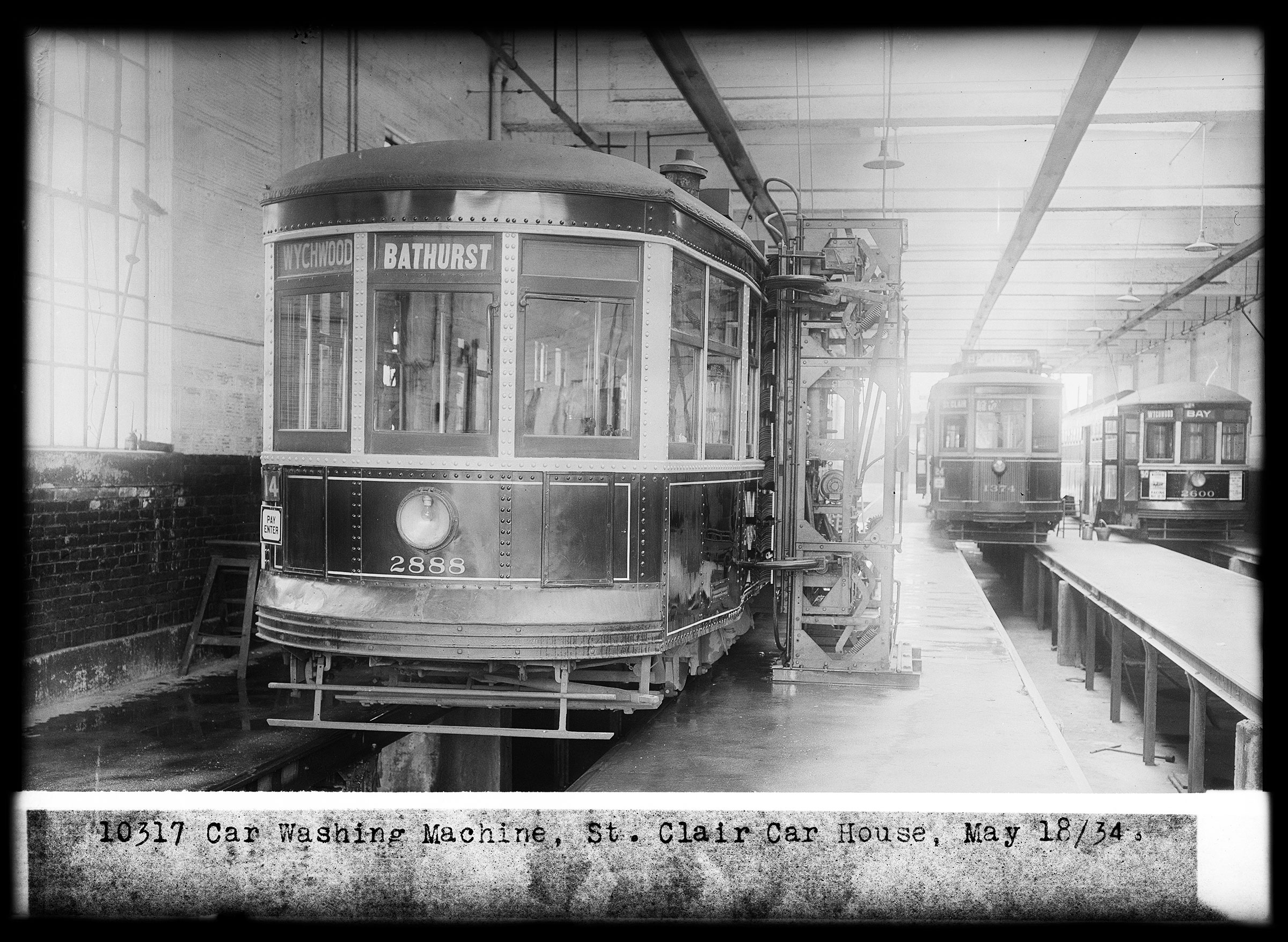
A car washing machine cleans a Toronto Transit Commission (TTC) streetcar at the St. Clair Car House in 1934. The site at Christie Street and St. Clair Avenue West was a streetcar maintenance facility from 1913 to 1978, and then fell into disrepair for several years until Artscape, a not-for-profit urban development organization, redeveloped the site into a community cultural centre. On March 3, Artscape Wychwood Barns celebrated its 10th anniversary with The 512 Showcase!, a talent show hosted by Amanda Martinez featuring a diverse range of local performers. COURTESY CITY OF TORONTO ARCHIVES
READ MORE:
CHATTER: Cultural hub marks 10 years (March 2018)
ON THE COVER: Wage protest (Jan. 2018)
ON THE COVER: Snowshoes and a red sweater (Dec. 2017)
ON THE COVER (Nov. 2017): Remembering
ON THE COVER (Oct. 2017): Transitory night
ON THE COVER (AUGUST 2017): Setting up for a new season
Tags: Annex · News