May 29th, 2018 · Comments Off on FORUM: Bold new initiatives for Ontario (Election Special 2018)
Making the case for the provincial Liberals
By Jo-Ann Davis
Elections have consequences. On June 7, voters in Ontario will make a choice that will have a profound impact on the welfare of students, seniors, families in our community, the economy, and environment.
Premier Wynne and the Liberal government are offering Ontarians bold new initiatives to grow an Ontario that’s fair, just, and offers new opportunities. One where human dignity is valued, climate change is combatted, a workforce is well educated, skilled, healthy and agile, and a business environment that is growing and innovating, while creating jobs and supporting workers’ rights.
A desire for change that lifts people out of poverty and improves our everyday lives is what brought Ontario a fair minimum wage, full-day kindergarten, expanded daycare, more skilled trades apprenticeships, free tuition for students from low income families, youth and senior pharmacare, expanded home care, a basic income pilot, a cap-and-trade system that reduces pollutants and raised $1.9 billion in 2017 to support green initiatives in our homes, schools, hospitals, and on our streets, and world-leading research and development.
Meanwhile, Doug Ford and his “Progressive” Conservatives (PC) would reverse change — abandoning the environment, taking away a fair minimum wage, axing rent controls, and a modern sex education curriculum, while threatening to cut billions. With no carbon tax, Mr. Ford needs to replace $4 billion — without any tax cuts — to make good on the PC platform. This means cuts to hospitals, schools, mental health, low income seniors, and supports for families trying to make ends meet.
At the same time the New Democratic Party platform is long on promises for additional funding for everything from health care to social housing, and education to public transit with no details on where the additional revenue will be found.
I support electoral reform, and therefore empathize with Green party supporters, and agree that new funding sustainable funding sources are needed for public transit, bike and pedestrian infrastructure.
University-Rosedale needs a strong, progressive representative at Queen’s Park — one that listens to local voices, works effectively with other levels of government, and has a proven track record of success. That why I’m running to be your Member of Provincial Parliament (MPP) for University-Rosedale.
I’ve spent much of my life studying, volunteering and living in and around University-Rosedale. It’s where I went to high school, and completed my undergraduate studies, as a University of Toronto student. It’s where my son plays soccer for SC Toronto, and my husband coaches.
It’s where Torontonians from all walks of life live, work, study, volunteer and play, with a diversity found in few other places. This is a riding knitted together by distinct neighbourhoods — welcoming to all. Neighbourhoods seeking a local voice in development, main streets with local businesses, diverse housing that’s affordable, daycare that’s accessible, and urban spaces where children and seniors have a place.
In 2010, I chose to run to be the local Toronto Catholic District School Board (TCDSB) trustee to advocate for vulnerable students and families, and shape a system built on public accountability, evidence and transparency.
As trustee for the last eight years, I’ve fought for students with special needs at budget time, focused staff resources on working to close the student learning opportunity gap between rich and poor, partnered with the City of Toronto to transform a pavement-covered playground into an urban garden and park at Markham and London streets opening this September, and championed making the TCDSB the first net zero energy school board in Ontario.
Professionally, I lead large-scale change for some of Canada’s biggest corporations. Bringing people with diverse perspectives together to achieve important change is a skill every politician should have — it’s what I’ve been doing for 15 years.
Knocking on thousands of doors, I’ve heard from people that they want an MPP who knows the community, who listens to and understands local issues, and who has the passion and skills to advocate for change at Queen’s Park. A proven community advocate with a track record of innovation is what I would bring as your MPP for University-Rosedale.
Jo-Ann Davis is the Ontario Liberal Candidate for University-Rosedale.
READ MORE BY OTHER CANDIDATES:
FORUM: The Green Party’s platform (Election Special 2018)
FORUM: Reducing downtown’s vehicles by 25 per cent (May 2018)
FORUM: What kind of Ontario do we want? (May 2018)
FORUM: What kind of province do we want? (March 2018)
READ MORE ON THE ELECTION:
EDITORIAL: The market has no moral compass (Election Special 2018)
NEWS: Grilling potential MPPs (Election Special 2018)
GREENINGS: Choosing the lesser evil (Election Special 2018)
Tags: Annex · Opinion
Focus on innovative measures and renewable energy
By Tim Grant
I have lived all my life in our new riding of University-Rosedale. My involvement as a teenager in the fight against the Spadina Expressway propelled me into a lifetime focus on local and provincial issues. For the past 15 years, I have served on the board of the Harbord Village Residents’ Association, one of the most active residents’ associations in the city, chairing the organization for the last seven years.
In this election, we have a choice. We have two parties that will fund new programs by adding to our debt, one party that will cut social programs, and another option: the Green Party. Here are a few examples of how we Greens approach some of our current challenges.
[pullquote]Rather than taking on debt, let’s look for stable sustainable sources of new revenue to pay for the things we need.[/pullquote]
Capture new sources of revenue to help pay for the services we need. As I’ve previously written in the Gleaner, we supported Toronto City Council’s request for road tolls on the Gardiner Expressway and Don Valley Parkway. Had the province agreed, tolls would now provide $350 million annually to the Toronto Transit Commission. A $2 per day parking surcharge in commercial lots across the Greater Toronto Area would raise $2 billion a year for transit. If we increase royalties charged for the extraction of groundwater, gravel, and minerals, we can raise billions of dollars to pay for dental care and other new programs. Rather than taking on debt, let’s look for stable sustainable sources of new revenue to pay for the things we need.
Replace aging nuclear generators with clean green energy. Expensive nuclear refurbishments, perpetually over budget, are a major factor in hydro rate increases. The other three parties are willing to borrow now to lower electricity rates, leaving it to the next generation to pay for today’s wasteful consumption. We want hydro bills that don’t hide the real cost of electricity. If we replace nuclear with green energy, our electricity bills are going to be lower. We would close the 47-year-old Pickering Nuclear Generating Station and replace its power with safe low-cost hydro from Quebec, and renewable energy and conservation programs here in Ontario.
Fight poverty with innovative measures. Let’s implement a guaranteed annual income, which would remove the stigma experienced by those on social assistance and provide stability for everyone in a time when jobs are increasingly precarious. Let’s make sure that 20 per cent of all units in new condominiums are affordable. With rich and poor on the same elevator, we’ll have healthier communities. Finally, let’s copy European governments and focus on preventative health care. We would tax junk food to pay for school food programs — reducing child hunger — and ensure that those on social assistance receive a monthly $200 fruit-and-vegetable supplement.
Such measures will improve public health, and the savings in health care costs can be used to fund a wider array of health services.
Merge Catholic and public school boards. It is time to have kids of all faiths (and no faiths) growing up side by side.
Merging the boards would save $1 billion every year for use in reducing class sizes and repairing school buildings.
License local businesses to sell cannabis. With legalization around the corner, our goal should be to ensure public safety and capture revenue to fund health care and other programs.
Licensing only 40 Liquor Control Board of Ontario (LCBO) outlets this year and 120 within two years (only nine in Toronto) is not going to eliminate the black market or raise significant revenue. Let’s learn from our experience of supporting craft breweries against the beer monopolies and license local businesses to supplement LCBO sales.
Making significant progress on any of these issues will require a Green Party voice in the legislature. For years, I have worked on long-term solutions to enhance our downtown communities. It would be an honour to continue that work as your MPP.
Tim Grant is the Green Party of Ontario candidate in University-Rosedale.
READ MORE BY OTHER CANDIDATES:
FORUM: Bold new initiatives for Ontario (Election Special 2018)
FORUM: Reducing downtown’s vehicles by 25 per cent (May 2018)
FORUM: What kind of Ontario do we want? (May 2018)
FORUM: What kind of province do we want? (March 2018)
READ MORE ON THE ELECTION:
NEWS: Grilling potential MPPs (Election Special 2018)
EDITORIAL: The market has no moral compass (Election Special 2018)
GREENINGS: Choosing the lesser evil (Election Special 2018)
Tags: Annex · Opinion
Assessing the parties through an environmental lens
At the risk of sounding like a single-issue voter, it will be no surprise to anyone who has read any of my columns that the environment ranks high. There are lots of other issues, such as healthcare, debt, economic growth, but all that is moot as we stare mass extinction in the face. If you think I’m being hyperbolic, you aren’t paying attention. Before his death, Stephen Hawking gave humanity another two centuries before we’re toast. To me, the long-term survival of our species trumps any short-term issue we are facing at the moment, no matter how pressing it might seem.
[pullquote]The Liberals have come up with a number of good ideas in the environmental department, but execution leaves a lot to be desired.[/pullquote]
The Progressive Conservatives under Patrick Brown’s leadership actually had a promising platform. They acknowledged climate change and would have followed the federal carbon tax rules. That was at least a start. His actions however were not becoming of a premier, or anyone in a position of leadership.
Doug Ford has reversed his promise to open up the Greenbelt to development. It’s a good thing he’s abandoned these short-sighted and ridiculous plans — you don’t fix the housing crisis by creating a food crisis.
How much farmland do we reduce down to before we realize we can’t feed ourselves? The Greenbelt isn’t just uninhabited tundra, it’s some of the most fertile farmland in the world.
We don’t need more McMansions on top of productive land. We need higher density in areas we have already inhabited. We need to put homes where people don’t need to get in their fossil-fuel-powered boxes and expel carbon dioxide in order to get to work or buy a carton of milk.
The policy reversal was a good step, but refusal to take on carbon pricing tells me he’s stuck in a model of growth at all costs. Extinction is too high a cost.
The Liberals have come up with a number of good ideas in the environmental department, but execution leaves a lot to be desired. Carbon tax is great, cap and trade, meh. Better than nothing.
They have recycling fees that are so pathetically low it makes no sense, but at least it’s there on items like electronics. The environmental fee they tried years ago was a fantastic idea, but the execution was so bad it didn’t last.
I’m very happy about the renewable energy capacity increase in the province, less so about our management of it. While not entirely the Liberals’ fault, they should have known the underlying issues and started trying to deal with them. When it comes to transit, I will never forgive them for giving Rob Ford the hammer he needed to reopen Scarborough subway.
While it is easy to criticize those in power, I actually couldn’t tell you what the New Democratic Party platform is without looking it up.
Upon investigation, there was some poetic waxing about a better environment, renewable energy that will be integrated responsibly (I don’t know what that means), but the thing that really stood out to me was a 30 per cent reduction in hydro rates. WHAT? We want to make it cheaper to use electricity when so much of it still comes from fossil fuels? WHAT?
I thought only the Liberals were nonsensical enough for this. Few details exist on the NDP’s website for me to make any determination at this point, but perhaps things will become clear.
The Greens are the closest to my heart. They want to axe Catholic schools so we don’t have redundant buses on the same route, and they want to let the city toll the Gardiner and DVP. They want to collect carbon fees, phase out internal combustion engines, and give incentives for energy efficiency.
They are after my own heart. It’ll be expensive, everyone will hate them for it, and we won’t be able to waste energy willy-nilly like we do right now without it costing a LOT.
I love this party, but let’s be honest, Schreiner’s not going to be premier.
Whoever sits in the premier’s office, I wager it will be a minority. I would love to see a handful of Green Members of Provincial Parliament elected so they can start to have meaningful influence over public policy.
Terri Chu is an engineer committed to practical environmentalism. This column is dedicated to helping the community reduce energy and distinguish environmental truths from myths.
READ MORE BY TERRI CHU:
GREENINGS: Reduce, reuse, and then recycle (May 2018)
GREENINGS: Car-free parenting is not rare (Spring 2018)
GREENINGS: The science of board games (Mar. 2018)
GREENINGS: Driving fuelled by unseen subsidies (Jan. 2018)
GREENINGS: No solutions for nobody’s problem (Dec. 2017)
GREENINGS: Celebrate science not milestones (Nov. 2017)
GREENINGS: Down to the data (Oct. 2017)
GREENINGS: Reducing paper waste (Fall 2017)
GREENINGS: Taking tolls to the Gardiner and Don Valley Parkway (July 2017)
GREENINGS: Lessons from Madrid (June 2017)
GREENINGS: Thoughts on hitting the 400 benchmark (May 2017)
GREENINGS: Solving the food waste problem (April 2017)
GREENINGS: Kellie Leitch was right (March 2017)
Tags: Annex · Columns
May 29th, 2018 · Comments Off on SPORTS: Maple Leafs back at the Pits (Election Special 2018)
R.S. Konjek/Gleaner News File Photo
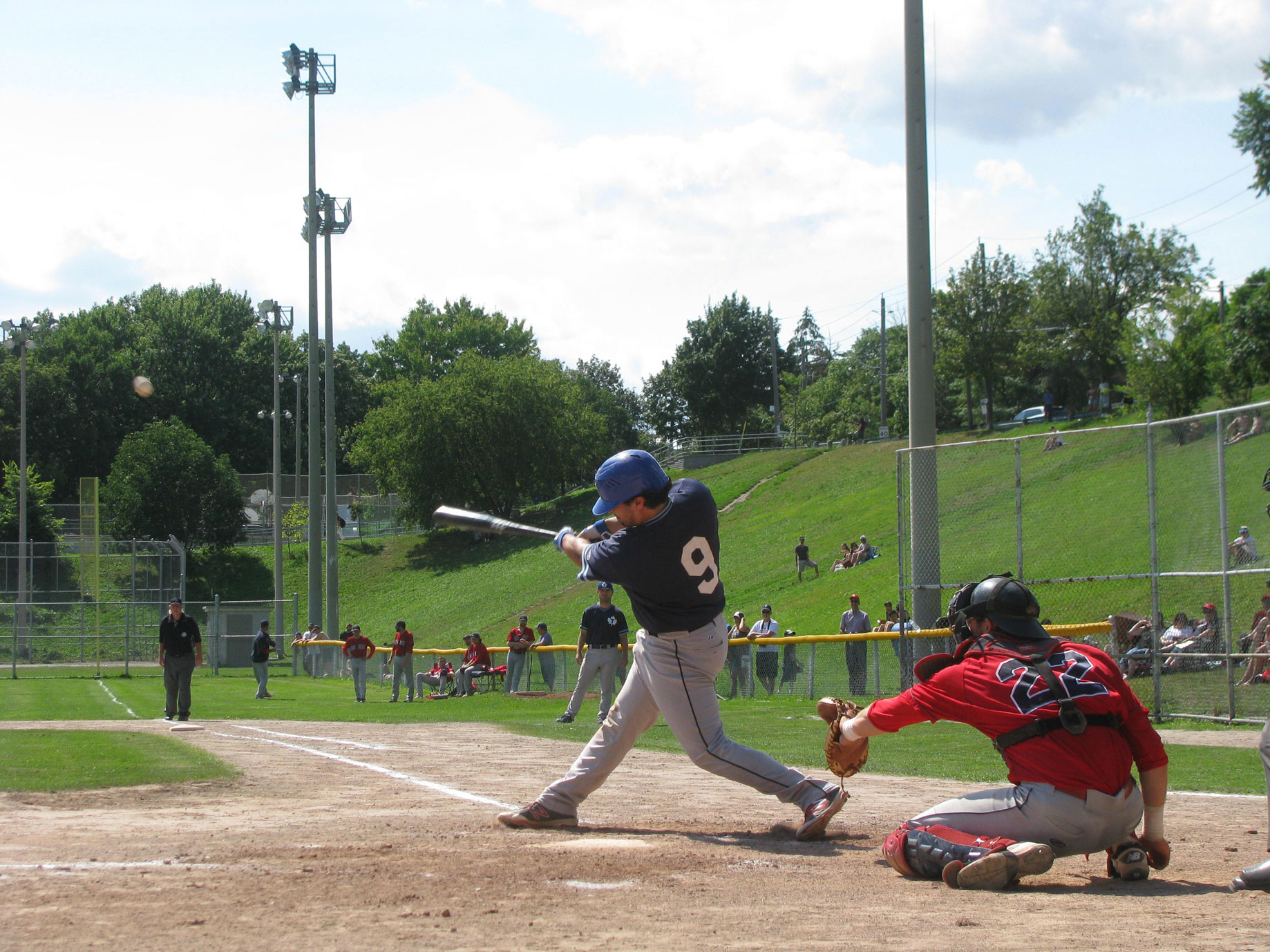
The bats are back. The Maple Leafs are swinging once more in Dominico Field at Christie Pits, and marked the 100th anniversary of the Intercounty Baseball League with a home opening 10-6 win over the London Majors on May 6. The Leafs, which have won five games to two this season, play every Sunday and most Wednesdays. Games are free.
For more information, please visit their website at pointstreaksites.com/view/mapleleafs.
—Annemarie Brissenden/Gleaner News
Tags: Annex · Sports
May 29th, 2018 · Comments Off on NEW IN BUSINESS: A café with a different angle (Election Special 2018)
Computer engineer’s love of Annex leads to gallery café
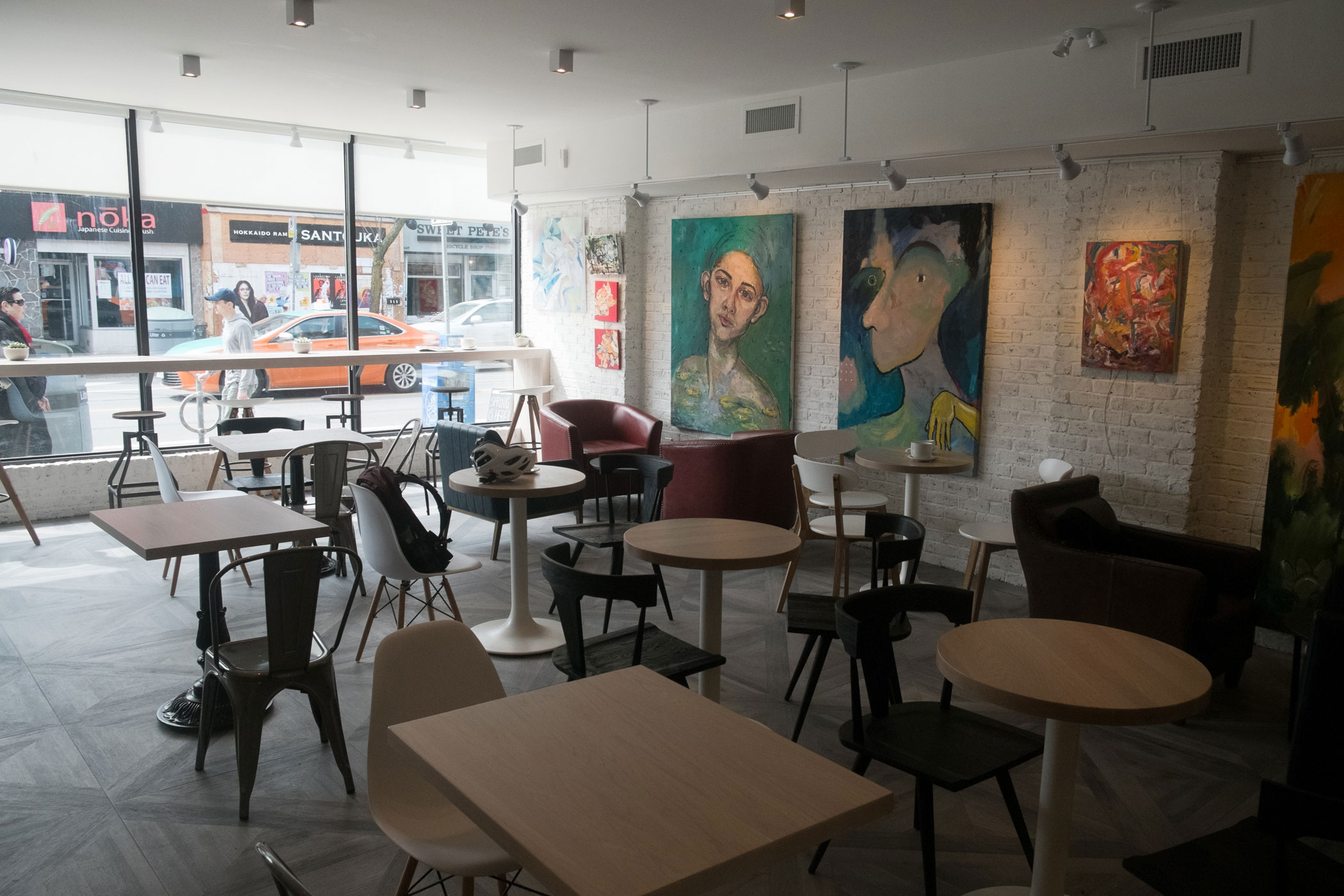
Slanted Door (422 Bloor St. W.), a new gallery café opened on Bloor Street West late last month. It’s owned by Patrick Jabbaz, who wants to promote work by emerging artists from Toronto. GEREMY BORDONARO/GLEANER NEWS
By Geremy Bordonaro
Daylight pours through the window of the café. Customers sit, sip coffee, and enjoy the splashes of remarkable colour that adorn the walls from paintings by new and emerging artists from across the city.
This is Slanted Door, the Annex’s newest café and art gallery, which is owned by Patrick Jabbaz, Silicon Valley engineer turned businessowner.
“I’ve always had a love for the arts,” said Jabbaz, adding he wanted to give back to the community he loves so much. “I was an engineer for the last 20 years, designing electronic products, so I’m not an artist myself. But a lot of artists are having a hard time making a living doing what they love. I wanted to help out, even a little bit.”
Jabbaz wanted his art gallery to stand out so he located it at 442 Bloor St. W., which is well known for the bee mural done by Nick Sweetman. The artist has also been commissioned to do several murals inside Slanted Door.
It’s part of Jabbaz’s aesthetic — preferring to highlight the work of new artists, particularly those from the neighbourhood.
“I wanted local artists,” he said. “I didn’t want famous artists. I wanted emerging artists, local, from Canada. I contacted a few artists and there was a lot of interest in showing their art in here.”

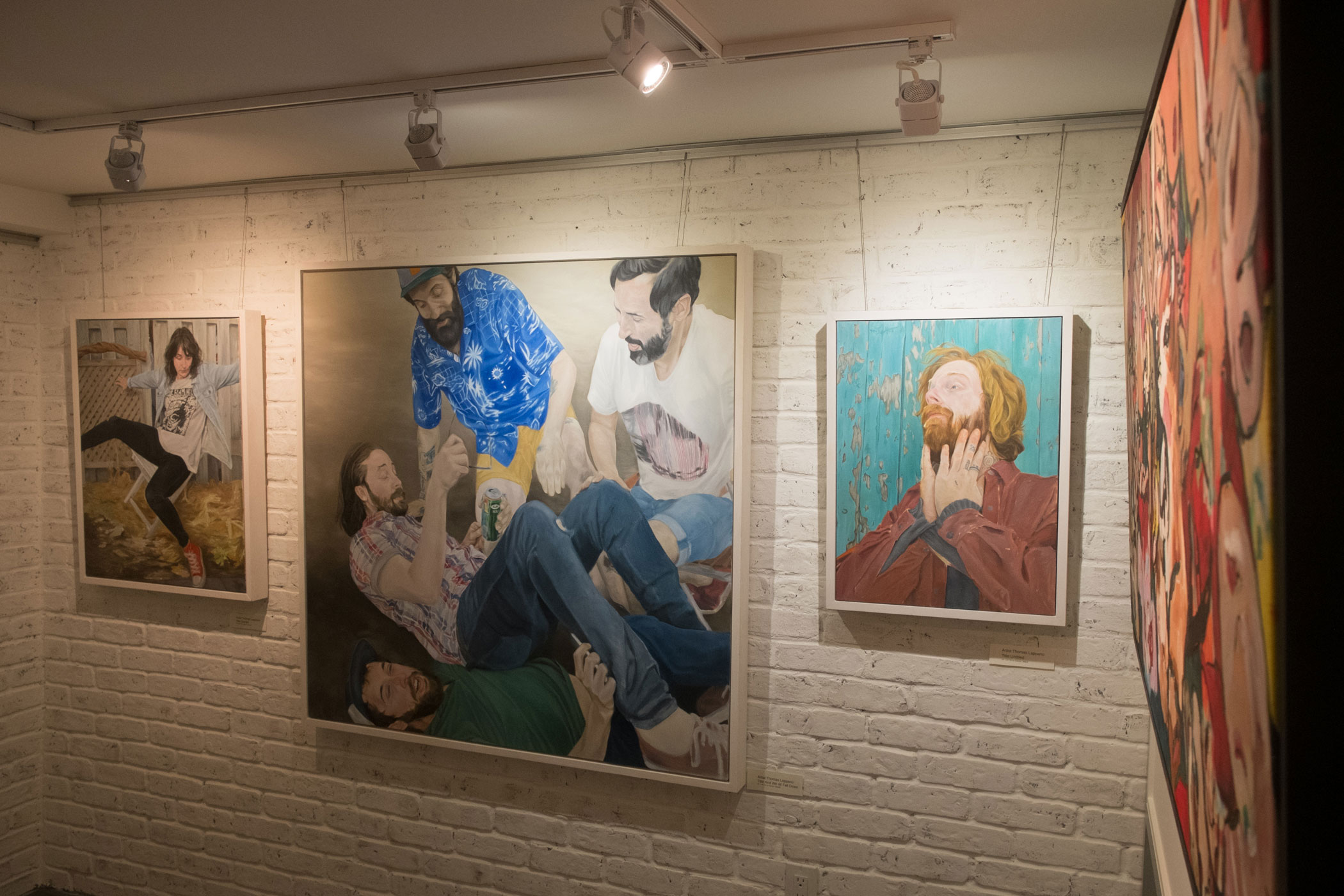
Thomas Lappano’s Still Series is currently on display in the café, originally home to The Futon Store. GEREMY BORDONARO/GLEANER NEWS
Despite Jabbaz having bought the building, there was still an issue of funding. To that he had a fairly simple but well-thought-out idea.
“Little did I know that art galleries need a lot of funding: they don’t make a lot of money. So I coupled it with a coffee shop. I wanted it to be trendy, inviting, and to have a good atmosphere.”
“The space, decor, and what we serve draws people in,” said Michele Lee, the gallery café’s manager. “We are supporting local artists and I think that’s something that people can appreciate as well.”
One such artist is Thomas Lappano, an up-and-coming artist and OCAD University graduate whose Still Series of portraits is on display.
“Patrick reached out to me by email. He had seen my website,” he said. “He asked me if I was interested in being a part of the show in the art gallery he was opening. It sounded really interesting and I was totally excited about it.”
A highlight of the gallery, Still Series captures a series of moments. Together, they form an evocative narrative from a beautiful, colourful, and modern perspective.
“With this series I wanted to explore the portrait as a narrative,” said Lappano. “I was really interested in taking snapshots of a moment, right in the middle of an action.”
Lappano is also excited to have work on display near to home.
“It’s nice to have the opportunity to show work in a public setting, in the neighbourhood I live in.”
Jabbaz himself is also no stranger to the neighbourhood.
“When I was younger I used to go to a lot of parties here. So I’m familiar with the neighbourhood,” he said, explaining that he went to Ryerson University. “I lived here for quite a while but I moved to California. I was going to be there for two years but I got married, had kids, worked so much, even moved to China for a while. I just wanted to come back here.”
While the lavish lifestyle of a jet-setting engineer may have been appealing, there was something that needed to change.
“I loved my job as an engineer but I wanted a challenge,” Jabbaz said. “I wanted to do something totally new, that I had never done before.”
And so far, there’s been a steady flow of customers at the café.
“It’s been good. It’s been nice, very steady. It is locally known for the moment,” Lee said.
Tags: Annex · Life
May 9th, 2018 · Comments Off on ON THE COVER: Accidental Parkland (May 2018)
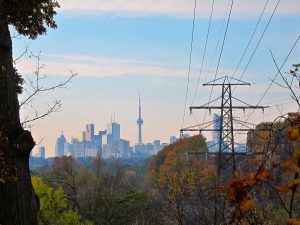
Hybrid Spaces, Partly Natural and Partly Engineered (2015) by Dan Berman, from Accidental Parkland, a documentary project that showcases the city’s changing environment. Curated by Berman, this collaboration with U of T’s New College and Daniels School of Architecture, Landscape and Design is on from May 10 to 20 and includes visual exhibitions, talks, documentaries, screenings, and Beadwork by students at the First Nations School of Toronto. Accidental Parkland is part of the Scotiabank Contact Photography Festival, running this month at locations throughout Toronto. COURTESY SCOTIABANK CONTACT PHOTOGRAPHY FESTIVAL
MORE COVERS:
ON THE COVER Palm Sunday pageant (Spring 2018)
ON THE COVER: Artscape Wychwood Barns 10th anniversary (March 2018)
ON THE COVER: Wage protest (Jan. 2018)
ON THE COVER: Snowshoes and a red sweater (Dec. 2017)
ON THE COVER (Nov. 2017): Remembering
ON THE COVER (Oct. 2017): Transitory night
ON THE COVER (AUGUST 2017): Setting up for a new season
Tags: Annex · News
May 9th, 2018 · Comments Off on NEWS: Shelter blamed for spike in crime (May 2018)
May shift to women only next year
By Geremy Bordonaro
A temporary drop-in homeless shelter at 348 Davenport Rd. is once again home to controversy. Some local residents say that there’s been a noticeable increase in violence and drugs in the area since the shelter — publicly supported by Joe Cressy (Ward 20, Trinity-Spadina) and the Annex Residents’ Association — opened in January.
“We have seen a significant increase in crime in the Davenport area compared to last year. It’s safe to say that this is due to the shelter,” said Staff Sergeant James Hogan of the Toronto Police Service’s 53 Division.
Steven Boujikian, who runs a laundromat near the shelter, said there’s been a huge increase in crime.
“There’s way more crime…way more violent crime. People shooting up on the streets. Even a few weeks ago someone walked into a local bar and died. Just on the spot…How is that acceptable?”
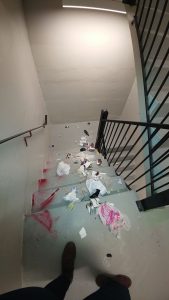
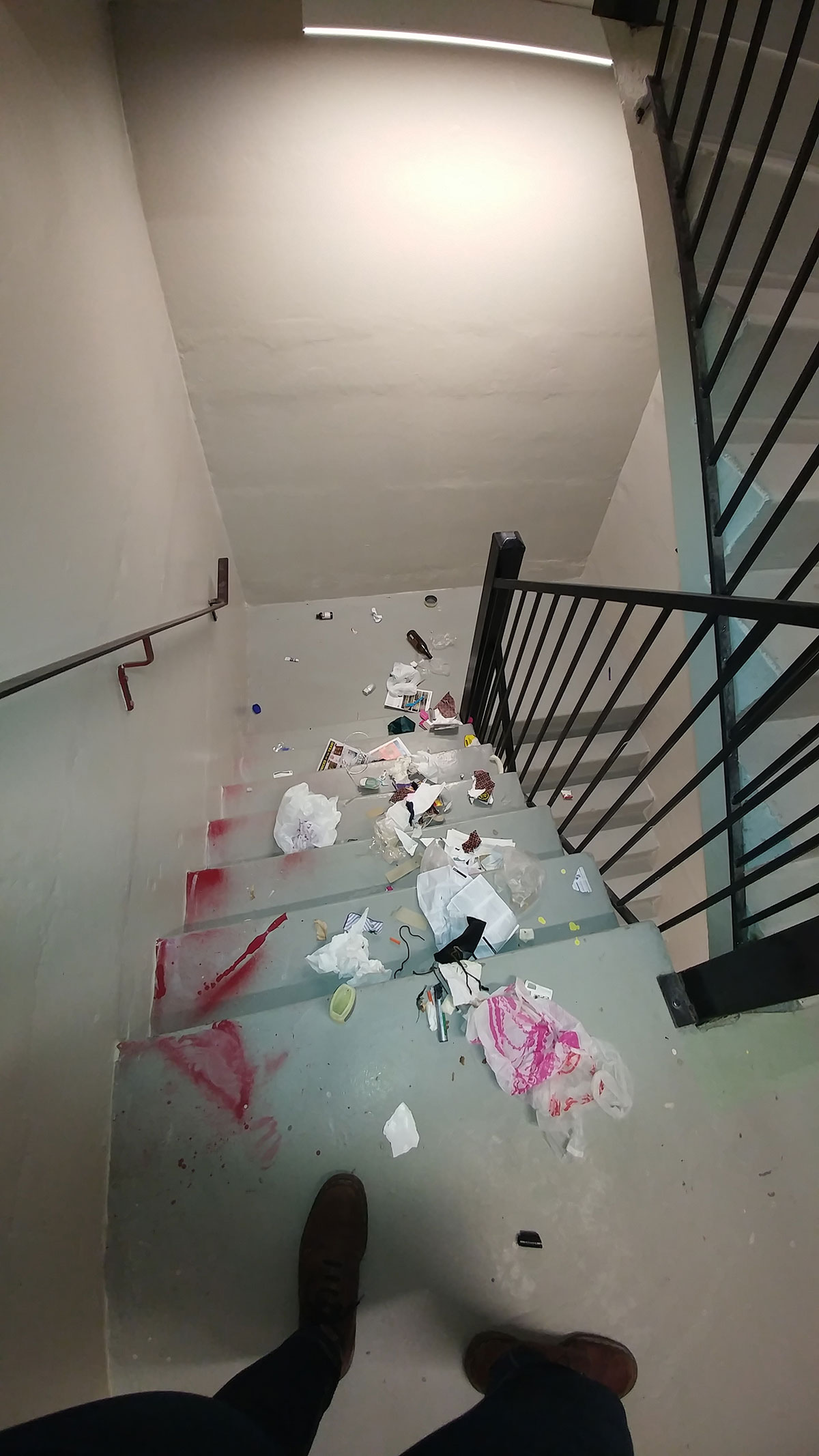
“Since the shelter opened,” said Cheryl Zimmer, a tenant representative at 250 Davenport Rd. who provided this photo, “we have seen an increase in people coming into our building, doing drugs in the stairs [and] hallways, and then leaving to go to the shelter.” COURTESY CHERYL ZIMMER
And tenant leaders from 250 Davenport Rd., which is run by Toronto Community Housing, came armed to a February 15 community meeting with pictures that showed used needles and said that shelter users were having “drug parties” during the day.
“Since the shelter opened,” said tenant representative Cheryl Zimmer, “we have seen an increase in people coming into our building, doing drugs in the stairs [and] hallways, and then leaving to go to the shelter.”
“This whole thing was uncalled for,” said Boujikian. “It just doesn’t fit in the area. You have all these homeless people walking around with nothing to do, causing trouble…. You can ask anyone in the area. Ask them ‘was this a bad idea?’ and they’d say ‘yes!’”
Cressy acknowledged that “respites are challenging…. They are challenging for the residents and they can also be challenging for the neighbourhood.”
However, he didn’t offer much of a solution.
“The purpose of a respite is very much that of a band-aid. It is to provide an emergency response to ensure the people have a warm place to go in the cold winter months.”
Cressy added that respites simply are not good enough to provide adequate safety for the neighbourhood and those within the building itself.
“What respites don’t have, because they’re open on an emergency basis, is that comprehensive series of supports” he said. “They don’t have all of those supportive programs to help people get out of homelessness. That’s the distinction.”
Boujikian said that the police also haven’t been very effective in addressing the increase in crime.
“The police are ignoring us,” he said. “They’re doing nothing with our complaints. Nothing to help us.”
Hogan conceded that resources have been stretched, and that it’s been difficult to respond.
“We’ve done what we can to help the community but it’s been tough.”
“The clientele that uses these respites are often homeless, dealing with addiction issues, mental health issues, and they’re hard,” Cressy said. “There’s no question that it’s hard.”
The councillor said that there needs to be a way to address homelessness in Toronto.
“It’s not enough to just do band-aids, these respites. What we need to do is create supportive housing facilities where people can transition out of homelessness,” Cressy said. “The objective here can’t just be to provide shelter. We need to have a program to end homelessness.”
The shelter closed at the end of April. It will be redeveloped into a women’s shelter with residents who will stay between three to six months. More amenities are also planned, as well as programs to help the residents find more permanent housing. This new program will be the first of a new model of shelters that Cressy says “are a stark improvement”.
—with files from Terri Chu
READ MORE:
NEWS: Shelter offers temporary respite (March 2018)
Tags: Annex · News
When preservation leads to deterioration
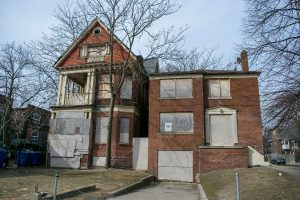
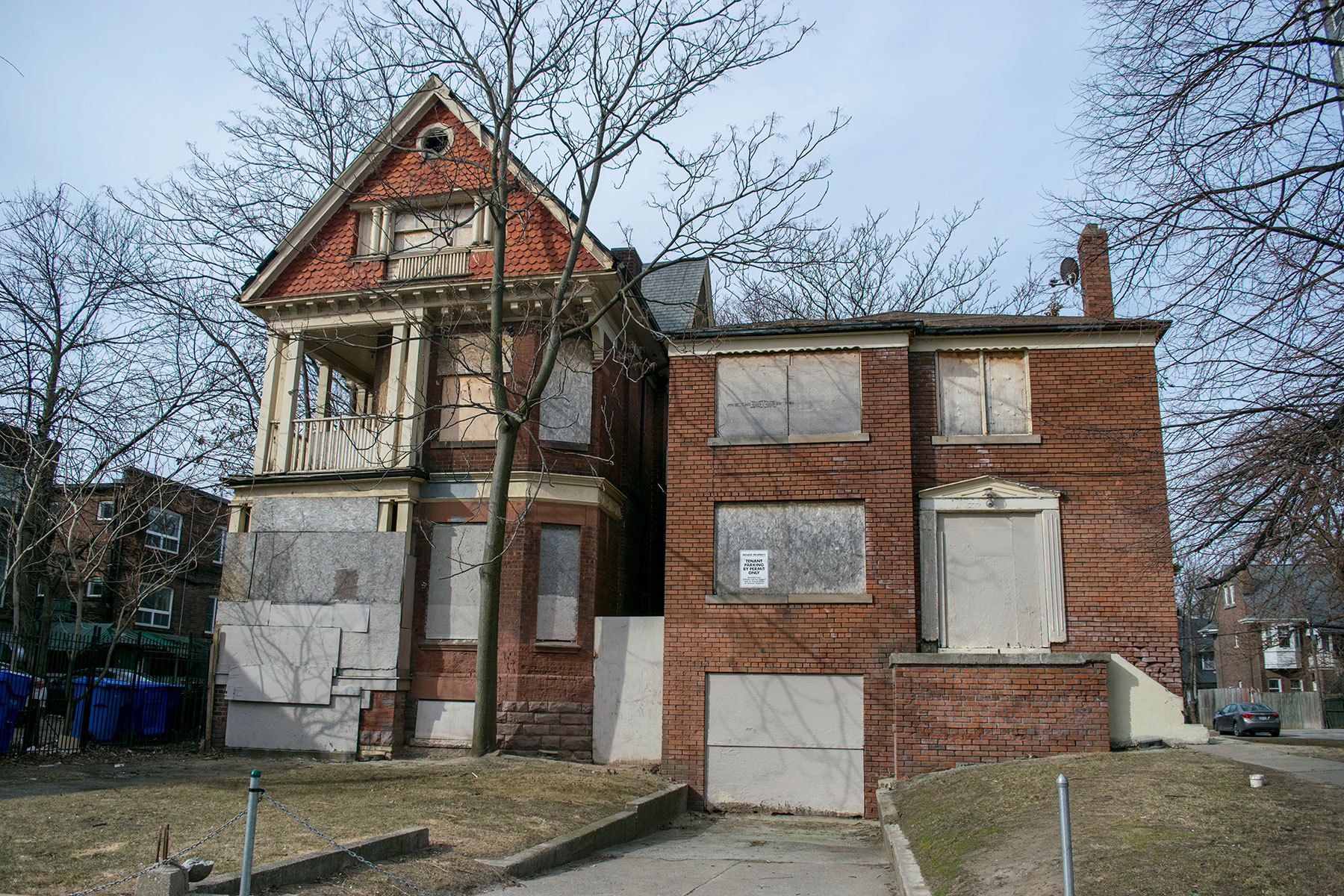
Designated a heritage property by the City of Toronto, crumbling and neglected 6 Walmer Rd. is causing problems for its neighbours. AHMED-ZAKI HAGAR/GLEANER NEWS
By Ahmed-Zaki Hagar
At over 120 years old, 6 Walmer Rd. is at once a crumbling symbol of the area’s rich history and, a sign of the city’s inability to protect its built heritage. And it’s causing no small amount of problems for the neighbours.
“When I initially moved [here], it was not an issue. It was an abandoned house,” said Neil Jain. “Over the years, it has been deteriorating. There have been a number of issues.”
These include litter that attracts rats and other pests, graffiti covering the house, and a type of loitering best left to the police to handle. Then there’s the hole in the roof, which has been there since at least February.
Built in the Queen Anne style, which was popular in the Annex in the late nineteenth century, 6 Walmer Rd. was originally number 2 Walmer Rd. and designed by architect Frederick Henry Herbert for Presbyterian minister Thomas Goldsmith and his family in 1896. It’s one of five Walmer Road properties designed by Herbert designated as a heritage property under the Ontario Heritage Act.
Many houses of a similar style in the area were replaced by apartment towers during the latter half of the twentieth century, but 6 Walmer Rd. remains — boarded over, covered in graffiti, and a hazard to the neighbourhood.
Sandra Shaul, chair of the Annex Residents’ Association’s (ARA) heritage committee, described it as the “highest-profile negligence problem in the Annex”.
“Over the years, we filed 311 requests for garbage, for graffiti, for various issues,” said Jain. “A lot of times, especially in the past couple of years, I have seen it would take weeks or months before any action is taken.”
Shaul said that sometime after she moved into the neighbourhood 32 years ago, somebody bought the property and fixed it up so “that it looked better than new. It was beautiful.”
However, when 6 Walmer Rd. was rented, according to Shaul, there were issues between the owner and the tenant, which was where the problems began.
Jain contacted Albert Koehl, environmental lawyer and vice-chair of the ARA, who investigated further into the matter.
“When I saw what the condition of it was and heard from the neighbour, I was quite disappointed to see little action by the City [of Toronto] in terms of ensuring that the property owners keep the property protected,” he said.
Koehl sent a list of bylaws from the Toronto Municipal Code that the owner of 6 Walmer Rd. was violating, such as maintaining the heritage property’s “character, visual, and structural character”. Other bylaws state owners must minimize damage from natural causes or neglect.
The municipal code says owners can protect their property by boarding up all doors and windows to prevent people and animals entering the property.
Municipal Licensing & Standards enforces the bylaws for maintaining heritage properties, but Koehl questions how committed the city is to heritage preservation if it does enforce its own bylaws.
“After doing all of [the work of researching a property and designating it], there does not seem to be any kind of follow-up, enforcement, or interest,” he said.
Adding to the problem is that it’s not clear who owns on the property, as there’s conflicting information on the public record. According to the Ontario Land Registry, the City of Toronto owns 6 Walmer Rd., which is confirmed by an official from Municipal Licensing & Standards. However, a search of the Municipal Property Assessment Corporation database yields different information, and lists the owner as NSCL Investments Limited. And there’s a record of an owner applying to demolish the property in 2011, an application that was refused even though a staff report did state that there was “concern for the future of the site”.
Shaul said the city should secure the house to prevent further damage, and invest in its restoration.
“Even if it were not a heritage site, you do not want a house in that state in your community,” she said. “It becomes a beacon for vagrancies, for drug deals, for pests. That should not be permitted.”
It appears that it’s not the only property in the area lost in a limbo of preservation and deterioration.
“Another one is 10-14 Prince Arthur Ave., and if you look at it, that is really a sad story,” said Shaul. “That house is the last of the Yorkville houses, those wonderful white houses that were characteristic of Yorkville in the early 1800s.”
As the house’s ownership switched hands over the years, the property began to deteriorate. Today, 10 Prince Arthur Ave. is fenced with its windows barricaded by bricks and its white paint falling off.
“When you see that house and you think of what it looked like through the years, you would want to cry,” said Shaul. “Any city with any civic pride would insist that people keep up a minimum standard of maintenance.”
Neither Heritage Preservation Services nor Municipal Licensing & Standards responded to repeated requests for comment.
READ MORE ON HERITAGE ISSUES:
CHATTER: Kensington Market HCD enters planning phase (Nov. 2017)
CHATTER: University to appeal Ten Editions heritage designation (MAY 2017)
NEWS: Restored Brunswick House reopens (May 2017)
NEWS: Kensington Market to become heritage district (May 2016)
NEWS: Mad House: Madison dweller alleges harassment over heritage home (Nov. 2010)
Tags: Annex · News
May 9th, 2018 · Comments Off on NEWS: JCC rebuilding playground (May 2018)
Community centre emphasizing accessibility
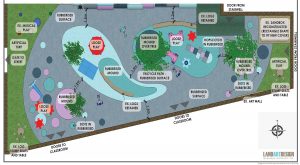
The new rooftop playground at the Miles Nadal JCC will feature natural elements, equipment that encourages learning through play, and be accessible to children in wheelchairs.
By Geremy Bordonaro
The Miles Nadal Jewish Community Centre (JCC) is fundraising to build a new rooftop playground at its home at Bloor Street West and Spadina Avenue. A large portion of the funds has been raised in memory of Al Green on behalf of his family but there is still a little way to go before the construction begins.
The centre’s existing playground has served the community and the 125 children who attend school there well for a long time, but it is time for an upgrade, according to Harriet Wichin, executive director of the JCC.
“It’s flat now. It just looks like some dirt with some nice trees. We tried a natural playground for a while,” she said. “Now we’re trying to stay ahead of the curve. We’re doing what is necessary to keep the playground accessible.”
[pullquote]“They’re going to have just so much fun engaging with all the new materials in the playground”—Parveen Virdi, assistant director, JCC[/pullquote]
A key focus is making sure that all children from 15 months to five years, regardless of ability, will be able to enjoy the space. The surface, which is currently flat and made up of wood chips and dirt, will be changed to rubber at varying elevations, and there will be enough space to accommodate those in wheelchairs. There will also be many natural elements and gardens. There will be different rubberized pieces — similar to a large Lego set — that can be used to build whatever a child could dream up and help inspire creativity.
The JCC is working with architectural firm Land Art Design to help bring its vision to reality.
“There are many unique challenges to designing on a rooftop,” said Joaquin Sevillano, an associate at the company. “You have to keep weather and safety in mind…. As far as I can tell this is one of the only playgrounds of its kind in the city.”
A key goal is to create an opportunity for young children to learn and grow.
“It is designed for what is known as emergent play,” said Sevillano. “Kids will have the opportunity to learn through many different methods on this playground, whether it be through nature or otherwise.”
The design is in line with the JCC school, which is focused on creating emergent play that facilitates learning in a fun environment.
“The notion with all of our schools is ‘learn through play’. The idea is, even if you look out there [in the playground] now, you can see all the children are playing with trucks, nature, and different things. That’s the sort of learning we aim for,” said Wichin.
“It will just inspire the children,” said Parveen Virdi, the assistant director of children’s education at the JCC, who is ecstatic about the new playground. “[Children] have so much curiosity and imagination and they’re going to have just so much fun engaging with all the new materials in the playground.”
Meanwhile Sevillano, who worked on the plans, said that the JCC has been a good partner throughout all of this.
“The JCC have been great,” Sevillano said. “Generally they have been giving their feedback to us about what types of things they want to see in the playground and we’ve been putting them in. It’s a great relationship.”
To learn more about the JCC’s fundraising campaign for the new playground, please visit www.canadahelps.org/en/charities/milesnadaljcc/campaign/playground. The centre expects to break ground this year once the fundraising is complete.
MORE ON THE MILES NADAL JCC
NEWS: MNJCC makes giant splash (OCTOBER 2016)
NEWS: Miles Nadal JCC submits electronic roof sign application (MAY 2017)
Tags: Annex · News
May 9th, 2018 · Comments Off on CHATTER: Provincial all candidates meeting on May 23 (May 2018)
All seven of the registered candidates running for election in University-Rosedale have been invited to participate in an all candidates meeting at Trinity-St. Paul’s United Church (427 Bloor St. W.) on May 23 at 6:30 p.m.
The local residents’ associations and BIAs are sponsoring the event, which will include an opportunity to ask questions of the candidates.
—Billie Wilner/Gleaner News
Tags: Annex · News
May 9th, 2018 · Comments Off on CHATTER: Bill Bolton Arena closed for upgrade (May 2018)
The buzzer sounded for the last time until the leaves fall at William H. (Bill) Bolton Arena (40 Rossmore Rd.), near Bathurst and Dupont streets. The arena has been closed for mechanical upgrades, and all of its skating programs are cancelled until October. Some other options for skating and hockey while the arena is closed are Moss Park, McCormick, Forest Hill, and North Toronto Memorial arenas.
A portion of Vermont Square Park behind the arena will be used for contractor staging, while the corner of the park at Rossmore Road and Vermont Avenue will be used for parking and storage. According to a City of Toronto Forestry and Recreation flyer, work will be organized to minimize impacts on park and street access, trees will be protected, and surfaces and sod will be restored once the work is complete. The wading pool and playground will remain open.
Opened in 1971, the Bill Bolton Arena provides programs that respond to community needs and complement local facilities. It includes a rink, pro shop, and snack bar. It runs hockey camps, house leagues, adult hockey and skills programs, and public skates.
For further information about the arena or its programs, please visit www.billboltonarena.ca.
—Annemarie Brissenden with files from Billie Wilner/Gleaner News
Tags: Annex · News
May 9th, 2018 · Comments Off on CHATTER: Kick off Bike Month by riding with Mike (May 2018)
Councillor Mike Layton’s (Ward 19, Trinity-Spadina) eighth annual kick off to Bike Month returns May 27 from 12 to 5 p.m. at Christie Pits Park.
Bike with Mike is a free, family-friendly community cycling event open to anyone who wants to participate. It will feature a free barbecue and many children’s events like bike decorating, bicycle-themed story telling, and tricycle races. There will also be free bike safety checks, tune-ups, and community cycling information.
The annual Kids Bike Swap, which is held in conjunction with the events, starts at 10 a.m. Parents of children ages 4 to 12 can drop off their child’s outgrown bike and pick up a new, better fitting one from 1 to 5 p.m. Celebrated every June in the Greater Toronto and Hamilton Area, Bike Month promotes bike-centric events aimed at improving the health of Canadians and the environment.
—Billie Wilner/Gleaner News
Tags: Annex · News