July 18th, 2018 · Comments Off on FORUM: Celebrate citizen activists (July 2018)
Residents’ associations cultivate neighbourhoods
By Mike Layton
At the Palmerston Area Residents’ Association (PARA) annual general meeting last month, I realized something. We are so lucky to have such informed, open, and dedicated neighbours. Often people, including the media, are critical of neighbourhood associations labelling them as NIMBY, meddling neighbours standing in the way of change favouring homeowners.
In my experience, this can’t be further from the truth.
Over the past several years I have relied heavily on the advice, expertise, and leadership of residents’ associations in Ward 19 and beyond.
Some are quite large, while others are only a single street. Some have bank accounts, some don’t. Some have elaborate constitutions and bylaws that govern them, while others have no rules. They hold meetings in parks, party rooms, living rooms, or bars. However they define themselves, these associations are a wealth of information and connectivity with the local community.
No, they are not elected officials. Yes, sometimes they don’t have membership that is as diverse as those who live in the community they represent. No, their views are not always shared by everyone in their community (even within their own leadership). However, none of this takes away from their value as an organizing unit, a sounding board, and a communications tool.
My office routinely calls on residents’ associations to circulate information about planning applications, laneway namings, streetscape designs, emergency shelter plans, and so on. We also request that they join steering committees, working groups, and construction liaison committees, to name a few.
Let me give you a couple examples of where I have found the input and participation of residents’ associations to be invaluable.
In 2013, I was approached by Native Child and Family Services about their plan to open a new youth facility on Bloor Street West. A minor Official Plan Amendment was necessary because the rear of the property was not zoned properly on a map. I loved the idea, but I was worried about how it, and they, would be received by the surrounding community.
So, I set up a call with the chair of the local residents’ association, Allan Reynolds, to discuss the plan and get his feedback. On that call, he explained his experience with Native Child and Family Services on another housing development in the neighbourhood and he committed his full support for the proposal. He brought the proposal back to the local residents to explain the necessity of the facility and the good reputation of the operator. When it came time for the City of Toronto to host the public meeting on the official plan amendment, it was met with unanimous support from the surrounding community.
Through the engagement with the local community association and their conversations with their members, we reduced barriers to ensure that this important facility serving Indigenous youth could open its doors.
PARA, the Harbord Village Residents’ Association, the Annex Residents’ Association, and the Seaton Village Residents’ Association organized themselves into a new working group that, over the next few years, would spend hundreds of hours across dozens of meetings to ensure that we proactively developed a vision for our community that reinforced what was great, but at the same time made accommodations for new residents and affordable housing.
The power and influence of these four residents’ associations resulted in significant changes to the Westbank Development proposal on the former Honest Ed’s site. Their leadership and willingness to engage with councillors, the city, and developers in a constructive relationship is a model for large-scale development proposals.
Finally, if you’d like a snapshot of how residents’ associations organize in modern neighbourhoods full of tall buildings, just look at the Liberty Village Residents’ Association’s (LVRA) Facebook page. You’ll find everything from people posting thoughts about development proposals to people asking for recipes, tools, or DVDs from their neighbours.
In the LVRA’s model, buildings as a whole become members and they host large events for the neighbourhood to allow people to get to know one another.
So to PARA, the OCA, Seaton Village, the Fort York Neighbourhood Association, the LVRA, and all the rest of the RAs, CAs, and ratepayers — thank you for meddling.
If you’re not currently a member of your residents’ association, or just haven’t been to a meeting in a while, join your neighbours and get active in your community.
Mike Layton is the city councillor for Ward 19, Trinity-Spadina.
READ MORE BY MIKE LAYTON:
FORUM: Provincial government is developer-friendly (Spring 2018)
FORUM: Establishing a new Indigenous Affairs Office (Nov. 2017)
FORUM: Building a better Bickford Park (Oct. 2017)
FORUM: Recognize and reconcile Canada at 150 (July 2017)
FORUM: San Francisco a model to follow (April 2017)
FORUM: Tolls, taxes, and Toronto (February 2017)
FORUM: Seeing our neighbourhood through new eyes (December 2016)
FORUM: We can do better: Dangerous summer for Toronto pedestrians and cyclists (October 2016)
FORUM: Curious story of Christie Pits pool liner ends in extended hours at Alex Duff (August 2016)
FORUM: A tribute to a friend (June 2016)
FORUM: Large problem, small solution (March 2016)
FORUM: Happy New Year from a new Dad with a new perspective (January 2016)
Tags: Annex · General · Opinion
July 18th, 2018 · Comments Off on GREENINGS: Results beg for electoral reform (July 2018)
Environment would benefit from a system that’s not a winner takes all
Big congratulations to Jessica Bell who is now representing us in University-Rosedale at Queen’s Park.
It’s unfortunate that someone who doesn’t agree with science is calling the shots but the silver lining in the June 7 election is that we now have a Green Party Member of Provincial Parliament (MPP) whom I presume won’t let the Greenbelt get paved over without a fight. It would have been nice to see a few more Green MPPs, but at least it’s not zero.
If ever there was a case for electoral reform, this election makes it.
[pullquote]All the environmental gains made…risk getting undone by a man who acknowledges the existence of climate change, but has doubled down on his indifference to human extinction.[/pullquote]
Doug Ford got 60 per cent of the seats with 40 per cent of the vote. This means there is no effective opposition. However much we might like individual MPPs on the other side of the legislature, there isn’t a lot they can do when the government makes a decision. We’ve handed unchecked power to a party that couldn’t handle enough math to give us a costed platform.
Despite the bloodbath, it is bewildering to me to see Liberals still defend the first past the post system. Having to negotiate with the far right for every decision is dangerous, they argue. Well, we just handed the far right absolute control with no opposition.
All the environmental gains made in the last decade and a half risk getting undone by a man who acknowledges the existence of climate change, but has doubled down on his indifference to human extinction.
The Liberals will have to take a long hard look in the mirror and ask themselves whether retaining absolute majorities the last three elections has been worth the electoral wipeout they are about to face.
The federal Liberals should be looking at Queen’s Park and seeing this as a warning shot across the bow. It’s hard to scrap a system that hands you majority government but the cost can often be high — as we are seeing now. Nobody wanted to give away their power when a minority of votes can lead to a majority of seats.
Their short-sightedness cost them, big.
In a proportional system, we are often able to get other voices into the legislature. Outside of our own Mike Schreiner and Elizabeth May, and some colleagues in France, Mexico, Australia, and Hungary, nearly all other Green lawmakers are in countries with some kind of proportional representation. (Australia is a strange beast because senators are elected via proportional representation but members of parliament use first past the post.)
In Canada, the last federal election gave the Greens 3.5 per cent of the popular vote. Instead of getting the 12 seats that would normally represent, they were lucky enough that enough votes were concentrated in Elizabeth May’s riding to give them 1.
Conversely, the Liberals have 54 per cent of the seats with under 40 per cent of the vote.
Taking 40 per cent of the seats would have still given the Liberals a strong mandate but forced them to compromise on many issues, perhaps with the greens.
If that had happened, we might not be proud owners of a $4.5 billion pipeline.
Prime Minister Trudeau has walked back on his promise of electoral reform and if there’s anything that Premier Kathleen Wynne’s implosion can teach him, it is that popularity doesn’t last forever. We need a system that encourages parties to work together. Both our democracy and our environment would benefit from a system that isn’t winner take all.
Terri Chu is an engineer committed to practical environmentalism. This column is dedicated to helping the community reduce energy and distinguish environmental truths from myths.
READ MORE BY TERRI CHU:
GREENINGS: Choosing the lesser evil (Election Special 2018)
GREENINGS: Reduce, reuse, and then recycle (May 2018)
GREENINGS: Car-free parenting is not rare (Spring 2018)
GREENINGS: The science of board games (Mar. 2018)
GREENINGS: Driving fuelled by unseen subsidies (Jan. 2018)
GREENINGS: No solutions for nobody’s problem (Dec. 2017)
GREENINGS: Celebrate science not milestones (Nov. 2017)
GREENINGS: Down to the data (Oct. 2017)
GREENINGS: Reducing paper waste (Fall 2017)
GREENINGS: Taking tolls to the Gardiner and Don Valley Parkway (July 2017)
GREENINGS: Lessons from Madrid (June 2017)
GREENINGS: Thoughts on hitting the 400 benchmark (May 2017)
GREENINGS: Solving the food waste problem (April 2017)
GREENINGS: Kellie Leitch was right (March 2017)
Tags: Annex · General · Life · Opinion
July 18th, 2018 · Comments Off on GRADING OUR GREENSPACE: More attention to green spaces means parks are improving (July 2018)
Tall trees provide lots of shade for the University of Toronto faculty and students who often congregate at Bloor-Bedford Parkette. Easily accessible from St. George station or the parking lot behind the Ontario Institute for Studies in Education, the park also features paved walkways and several benches. AHMED-ZAKI HAGAR/GLEANER NEWS
Annual review highlights spots for a picnic, spots for strolling, spots for playing
Our annual review of the green spaces in the Annex is one of our most popular features. This year’s inspection reveals that a local focus on green spaces has yielded parks that, for the most part, are cleaner and better maintained. There’s a definite improvement this year over last. However, some standouts remain — Paul Martel Park on Madison Avenue is woefully neglected and, given the amount of picnicking that goes on, many of our picnic tables could use some love. Watch out for part two in our next edition, and be sure to let us know what you think of our reviews or the parks themselves.
By Geremy Bordonaro, Ahmed-Zaki Hagar, and
Billie Wilner
Huron Washington Parkette
Huron Street and Washington Avenue
Time: 12:30 p.m.
Grade: B+ (last year B-)
Reason to go: Directly behind the University of Toronto Schools you will find Huron Washington Parkette, a lively park busy with people of all ages. The park includes a large, fenced-in playground with benches as well as a large empty sand area where groups of older kids can be found goofing around. Outside the fence, there are plenty of picnic tables and benches, as well as a grassy area and hill. Large parts of the park are well shaded by the many trees that have been planted around the site, but there is also no shortage of sunny areas to enjoy. Even when crowded, there’s still plenty of room for both younger kids and teenagers without them getting in each other’s way. The grass and trees are maintained well but the picnic tables are slightly cracked and not all that clean, but this did not stop people from sitting down to eat their lunch. There is a functioning water fountain, and the garbage bins, though a little dirty, seem to be regularly emptied.
Overheard: “Why does this always happen!”—teenage boy after tripping, face first, into the sand.
Fact: Earlier this year, Huron-Sussex Residents’ Association hosted a Parkette Design Charrette, where community members worked with architects to redesign the Huron-Washington Parkette.
Paul Martel Park
Madison Avenue, north of Bloor Street West
Time: 2:30 p.m.
Grade: D+ (Last year D-)
Reason to go: The Annex Residents’ Association (ARA) intended Paul Martel Park to be a volunteer-run small community green space. Unfortunately, the park does not seem to have lived up to expectations. There is a dirt trail through a garden, which includes many different plants but is poorly maintained, and the trail itself is littered with cigarettes. There are three relatively clean benches and recently emptied garbage bins. There is a sign at the front of the park explaining the history and plant life that grows there, but it seems to imply that there were plans for much more planting to occur than actually did.
Overheard: Birds chirping
Did you know: The first Ecology Park, which was located in the same spot, was founded in 1987 by the Pollution Probe Foundation.
Matt Cohen Park
393 Bloor St. W.
Time: 1:30 p.m.
Grade: C (last year: C)
Reason to go: Matt Cohen Park serves as an adequate place to take a break from work or school, but it is in no way a break from the city. The park is located at the intersection of Bloor Street West and Spadina Avenue, right next to University of Toronto Schools, and the noise level remains equal to its surroundings. Every honk, siren, and car can be heard. There is a smattering of litter and graffiti here and there, and only small patches of grass, which have been trampled down. That being said, the park does act as a solid place for students and people working in the area to sit down, socialize, or eat lunch. There is lots of seating, even more so if you count the large sculpture of dominoes found at the front of the park, on which students can be found.
Overheard: Sirens, loads of sirens.
Did you know: Part of Spadina Avenue is dedicated to Matt Cohen, who often wrote of Spadina Avenue and its impact on him and his stories.
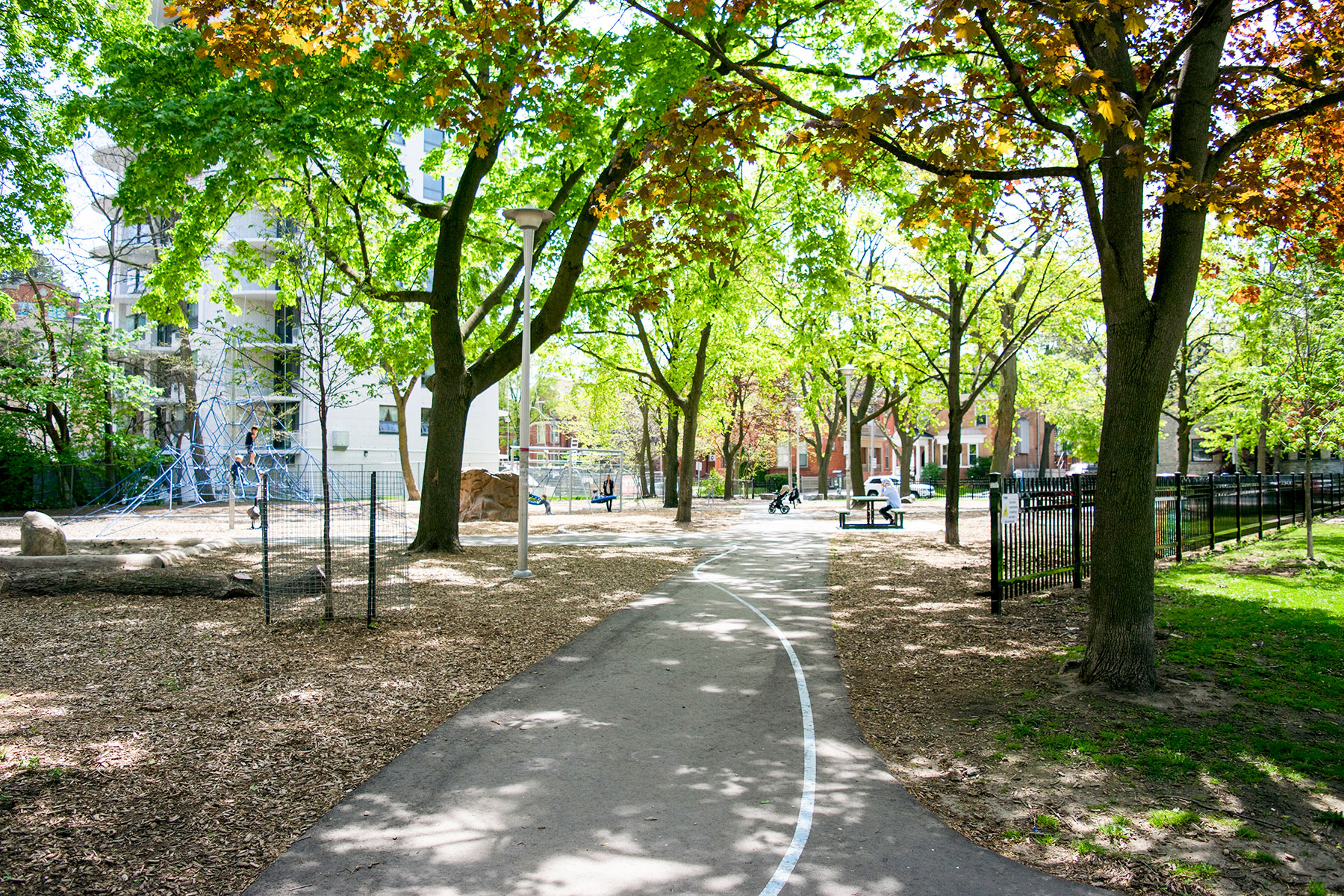
Several large trees provide shade at the recently renovated Huron Street Playground. This popular spot for local children has a pair of tire swings and a tall climbing web.
AHMED-ZAKI HAGAR/GLEANER NEWS
Huron Street Playground
495 Huron St.
Time: 12:00
Grade: B (last year B+)
Reason to go: Huron Street Playground is a popular spot for young children to play in. With a pair of tire swings and a tall climbing web, it is a great place for parents to bring their children. There are several large trees that give shade and a little grass, as a large part of the playground is covered in brown wood chips. The apartment building nearby is undergoing renovation, which may cause loud noises for park visitors.
Overheard: The sound of construction from the nearby apartment tower as children play.
Did you know: Huron Street Playground underwent a renovation two years ago, transforming it from a park with near failing grades to its current incarnation.
Taddle Creek Park
40 Bedford St.
Time: 1:00
Grade: A (last year A+)
Reason to go: With large trees providing cool shade, this park has more adults relaxing and eating lunch than other parks. The park’s centrepiece is “The Vessel,” a tall avant-garde sculpture of a water jug by artist Ilan Sandler, which also serves as a fountain. Many people use the park to play, socialize with friends and neighbours, or relax in the spring weather. While there are several adults and children at the park, it is quieter than the Huron Street Playground, which is a short walk away. The park is well-maintained and clean, even with the number of people who visit. Despite being quite close to Bloor Street West, it is a quiet and peaceful oasis in the busy city.
Overheard: A dog barking as it returns a ball to its owner.
Did you know: The Vessel is made out of four kilometres of stainless steel rod, which is approximately the length of Taddle Creek, which stretches from the park to Lake Ontario.
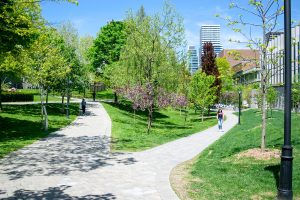
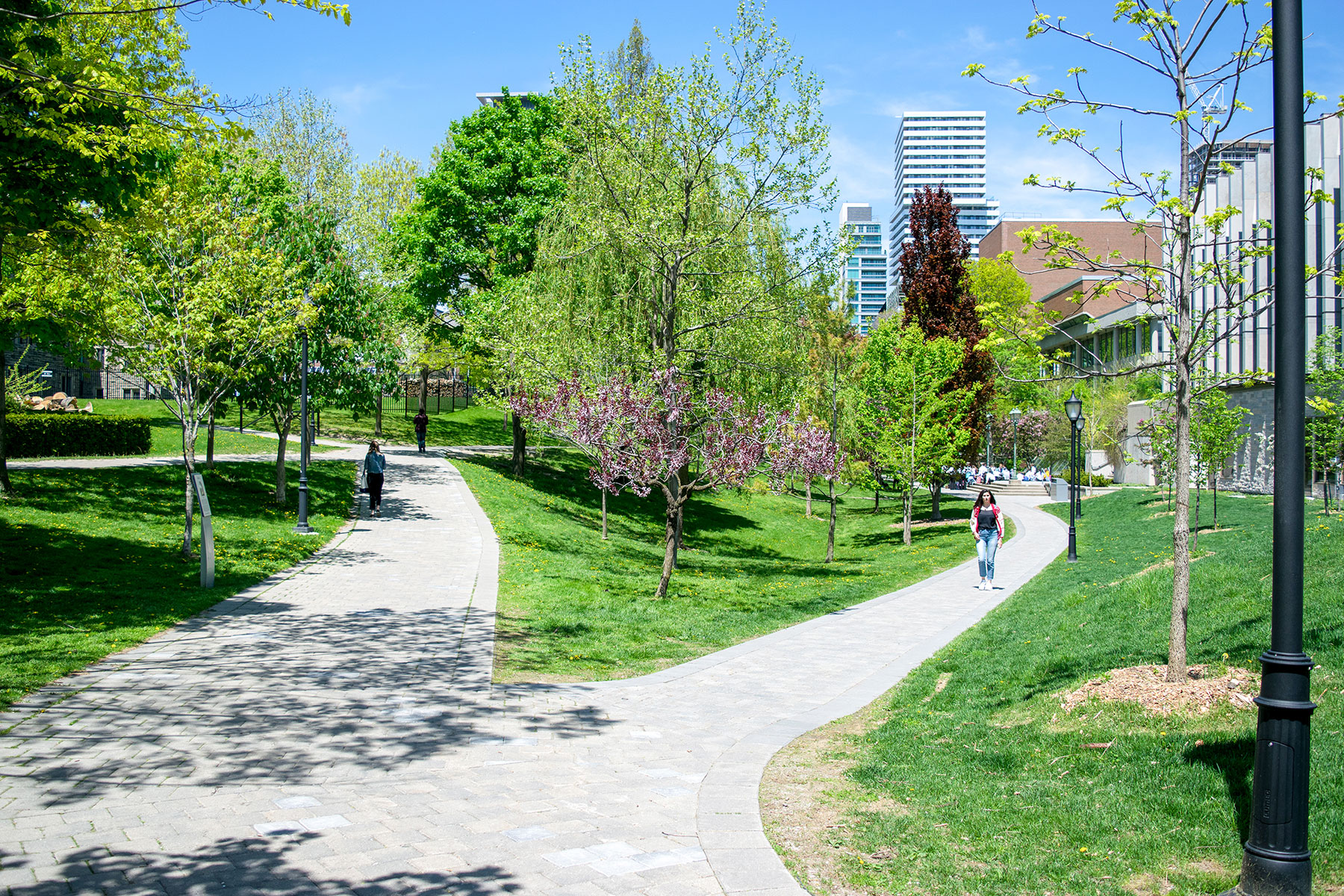
Philosopher’s Walk offers a mini tour of the city’s architectural history as you traverse from area to the next. AHMED-ZAKI HAGAR/GLEANER NEWS
Philosopher’s Walk
78 Queen’s Park Cres. W.
Time: 12:30
Grade: A- (last year A)
Reason to go: Philosopher’s Walk is a scenic trail that connects Queen’s Park Crescent with Bloor Street. Located on the U of T campus, Philosopher’s Walk is a popular spot for students and faculty for a peaceful stroll or a place to relax. The trail is also a short detour from Bloor Street West to Queen’s Park. You can choose to relax underneath the shade of a tree or on the several black benches on the path. When you walk the trail, you get a sense of the city’s architectural history, from the Gothic Revival style of Trinity College to the modern Lee-Chin Crystal at the ROM. The trail is well-maintained and has several trash bins, but the ROM’s Crystal is undergoing renovation, which means the north side of the trail is very noisy.
Overheard: A guy sitting on a bench playing guitar for a friend.
Did you know: The north entrance of the trail has a plaque that commemorates Prince George and Princess Mary’s royal visit to Philosopher’s Walk in 1901.
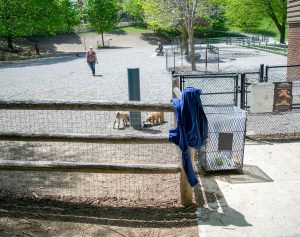
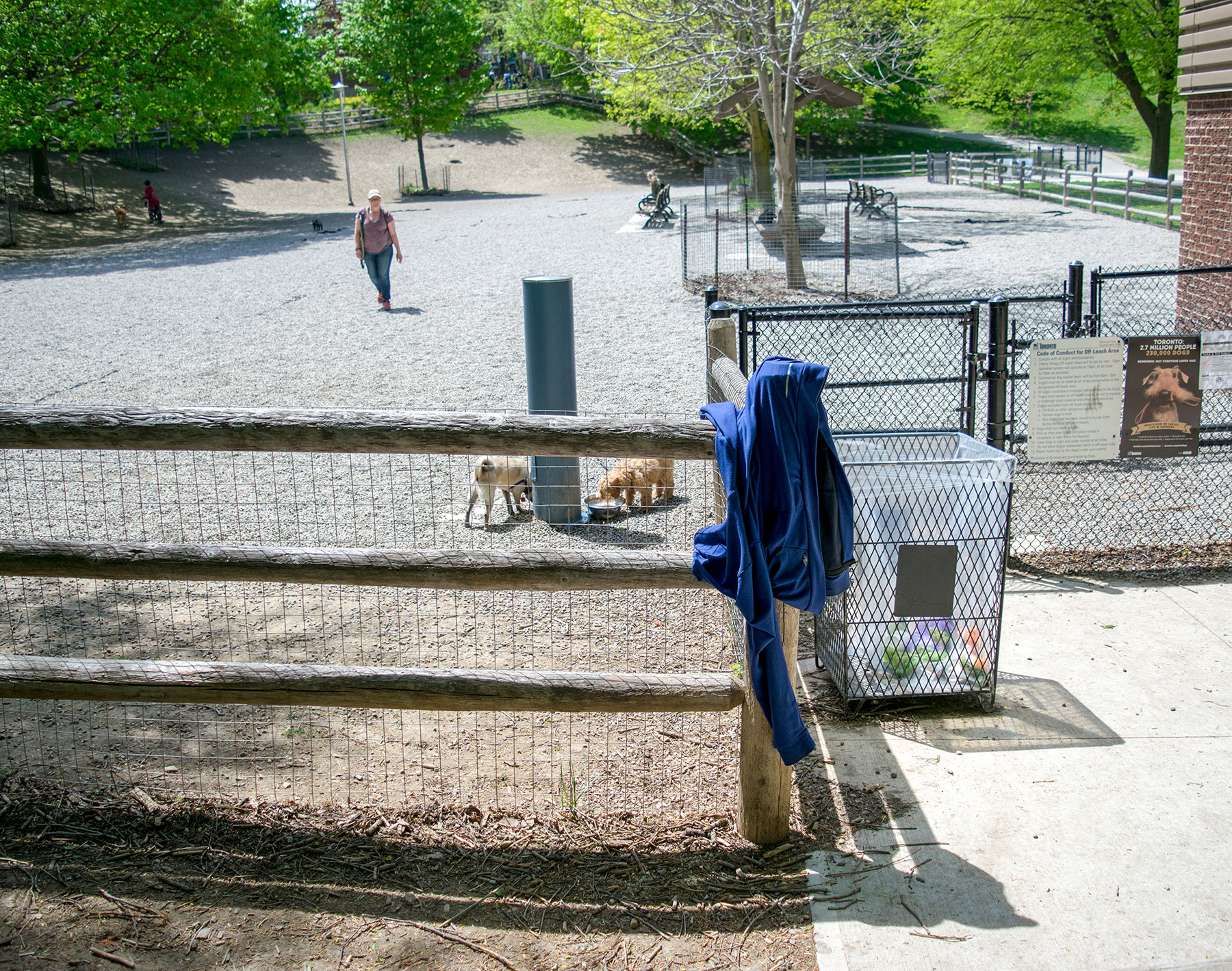
Bickford Park has is popular with dog owners for its large open off-leash area. AHMED-ZAKI HAGAR/GLEANER NEWS
Bickford Park
468 Grace St.
Time: 2:30
Grade: A (last year A)
Reason to go: Bickford Park is a large, spacious park in Little Italy. Many joggers run down the long path that starts from Grace Street and ends at either Montrose Avenue or Harbord Street. There were picnickers under the trees, and people conversing on benches. It also has two baseball diamonds, two bocce ball courts, and a soccer field. The park is very popular with dog owners who walk their dogs in the open field or let them play in the off-leash area. Public amenities like the bathroom and drinking fountains are clean and usable. The park has a scenic view of the neighbourhood and of the CN Tower on a clear day.
Overheard: Several dogs barking as they play in the off-leash area.
Did you know: Bickford Park was named after wealthy railway contractor Edward Bickford, who owned the land until the City of Toronto bought it in 1908.
Village of Yorkville Park
115 Cumberland St.
Time: 12:30
Grade: A (last year A-)
Reason to go: Surrounded by designer stores, the park is a great place to relax during a shopping trip. It is divided into 11 sections including marshland, orchards, and a large granite outcrop that showcase Canada’s diverse landscapes and is packed at around noon, with people of all ages sitting on the benches, at picnic tables or on the granite socializing and having lunch. The park is a block away from Bay Station, making it easy to access, and there are drinking fountains available. The park is very clean and colourful, however, the amount of traffic may cause a lot of noise.
Overheard: The sound of music playing from a group of people having lunch on top of the rock.
Did you know: The Village of Yorkville Park received a Landmark Award of Excellence from the American Society of Landscape Architects in 2012 for its strong presentation of Canadian identity.
St. Alban’s Square
90 Howland Ave.
Time: 1:50
Grade: B+ (last year A)
Reason to go: St. Alban’s Square is a simple spot for strolling and relaxing. A green square with a paved sidewalk cutting through the middle, it provides a shorter path through the neighbourhood. Several trees are placed around the square, providing shade for people sitting on the benches. The park was very clean and has garbage and recycling bins. The square is next to the historic St. Alban’s Cathedral, the former owner of the park.
Overheard: A couple of kids skateboarding down the path.
Did you know: Environmental group Grassroots Albany had a beautification project of the square in 1990, which included planting a rose walk on the north fence.
Bloor-Bedford Parkette
245 Bloor St. W.
Time: 11:20
Grade: B (last year B-)
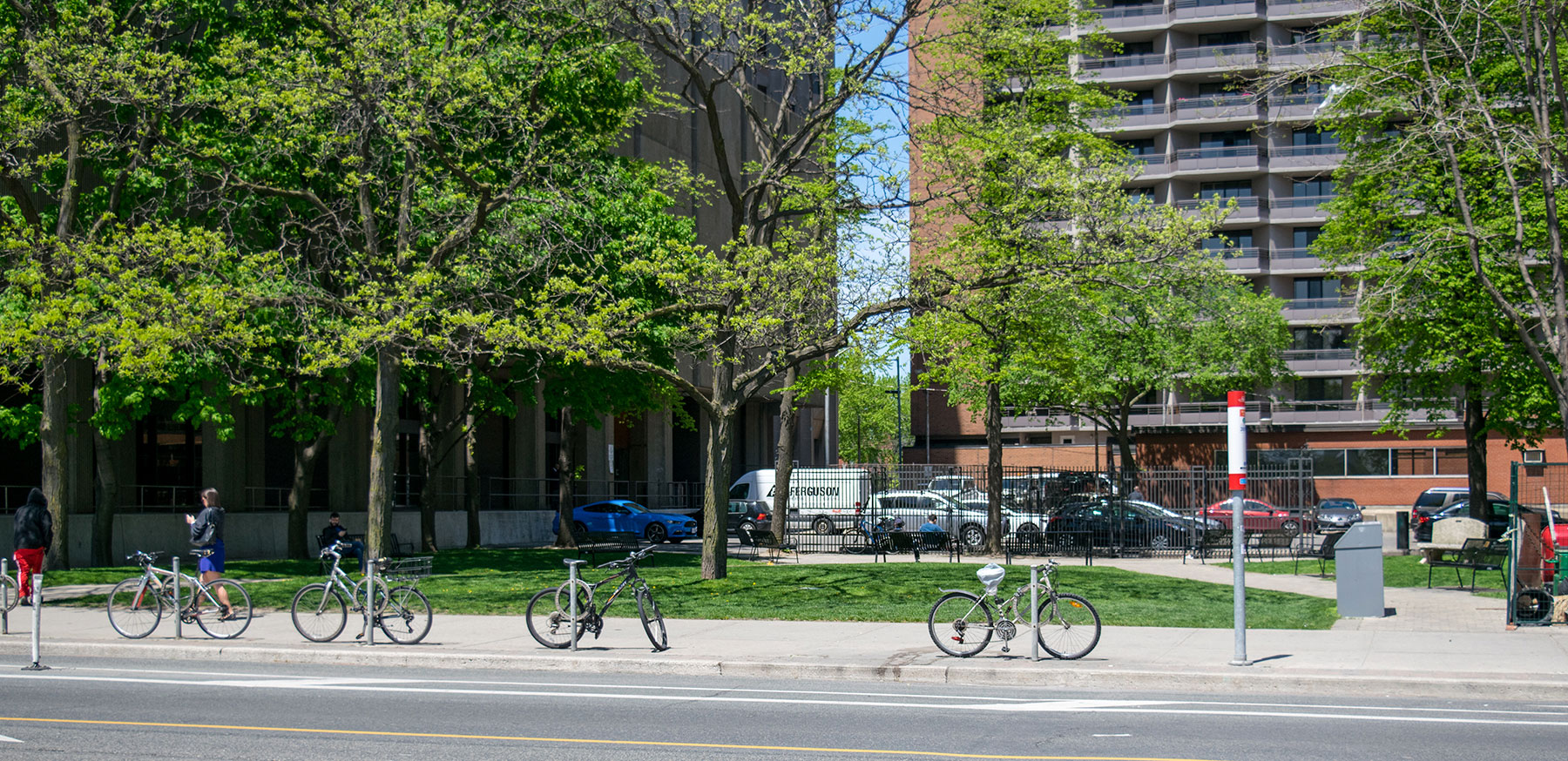
Reason to go: Located near a Tim Hortons and a Starbucks, this spot serves as an outdoor space to sit on one of the several benches and enjoy a coffee. Since it is beside the Ontario Institute for Studies in Education (OISE) building, U of T students and faculty are often sitting in the area. The park has several tall trees that provide a cool shade for people sitting on the benches. You can easily access the parkette by bus or by subway at St. George station, or by car by parking in the lot of the OISE building.
Overheard: The sound of cars driving down on Bloor Street.
Did you know: The city added paved walkways to the Bloor-Bedford Parkette in 2008.
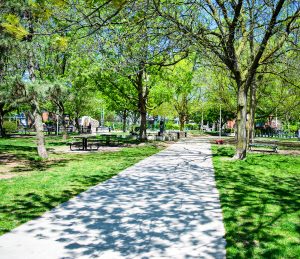
Home to some of the area’s most popular events including the Open Tuning Festival and the Annex Residents’ Association’s annual corn roast, Jean Sibelius Square has a lot of space and a little bit of everything for everyone. AHMED-ZAKI HAGAR/GLEANER NEWS
Jean Sibelius Square
50 Kendal Ave.
Time: 1:30
Grade: B+ (last year B+)
Reason to go: Jean Sibelius Square has a bit of everything, a playground for children, picnic tables for friends and family to relax, and space to go for a stroll. The park was relatively clean and also has public bathrooms and fountains, making it a great pit stop for a jog in the neighbourhood. Jean Sibelius also has Bike Share for people who want to rent a bike to cycle around the neighbourhood.
Overheard: Children yelling as they play on the jungle gym.
Did you know: The square hosts a variety of popular events, including the Open Tuning Festival and the Annex Residents’ Association’s annual corn roast.
READ MORE
GRADING OUR GREENSPACE: Parks on the fringe (AUGUST 2017)
GRADING OUR GREENSPACE: Open spaces in the heart of the Annex (July 2017)
GRADING OUR GREENSPACE: Survey reveals significant upgrades (June 2017)
GRADING OUR GREENSPACE: Meet our parks supervisor (August 2016)
Part two of our 2016 parks review (July 2016)
PART ONE: Green sanctuaries in the heart of the city (June 2016)
Grading our Greenspace (2015)
Tags: Annex · General · Life
July 18th, 2018 · Comments Off on SPORTS: Many hats, one goal for Topolie (July 2018)
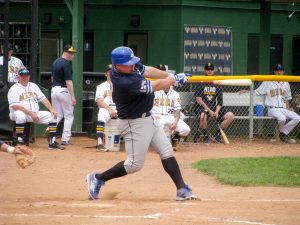
Player-manager Damon Topolie hits one out during a game in Burlington May 2018.
R.S. KONJEK/GLEANER NEWS
An interview with Toronto Maple Leafs’ player-manager
A recent ESPN column declared that “parts of baseball are disappearing before our very eyes”.
Any grump would happily tell you that every play of the game is becoming dominated — ruined even! — by analytics and probabilities, guiding Major League Baseball (MLB) managers towards risk-averse decision-making. Aggression on the basepaths is declining in favour of waiting for the home run. As a result, stolen bases and pitchouts are trending downwards, same with sacrifice bunts and the hit and run.
All of these features of the game we grew up with are becoming rarities.
Another rarity is the player-manager.
The Miami Marlins made Martin Prado their player-manager as a one-off for their final game of the 2016 season. The last full-time MLB player-manager was Pete Rose from 1984 to 1986.
Player-managers have appeared throughout the game’s history, a list that includes names such as Connie Mack, John McGraw, Ty Cobb, Joe Torre, and Frank Robinson. An interesting combination of mind and muscle, this dual role has vanished from the major league game.
With players reduced to data, the modern manager can sit back and let a ballgame play itself out like computer chess. The only on-field participation expected of managers these days is delivering lineup cards and changing pitchers.
In the Intercounty Baseball League, the Toronto Maple Leafs have been bucking this trend for years.
Damon Topolie is a bona fide player-manager of the old school, and he relishes the role. He stepped into the position in 2015, after the Leafs parted ways with manager Perry Mader.
The 42-year-old wears many hats. He works for a tech company based out of Vaughan, but baseball is very much a part of his daily life. He began his Intercounty Baseball League (IBL) playing career with the Stratford Hillers in 1995, and joined the Leafs in 1998. When he is not running the show at Christie Pits, Topolie is the catching coordinator for the Ontario Blue Jays baseball development organization. He also provides a lot of private lessons.
“Most of our current players have been coached by me at one time or another,” he says, and immediately rattles off half of the Leafs’ current roster.
Asked if he still feels like “one of the guys”, he doesn’t agree. He prefers to see himself as a manager who is lucky enough to still be able to play.
“I have some baseball equipment that is older than some of the players on the team.”
While his playing time has been reduced, his output remains solid. Batting .263 in 38 plate appearances, he has 10 RBIs, including a home run.
Topolie no longer sees himself as the kind of alpha dog team leader that can rally a club, but believes that the Leafs have found those types of players. A look at the league standings would indicate that this is the case. The Leafs have been off to one of their best starts in years with a 12-8 record to start the month of July, just two games behind the Kitchener Panthers.
“The team chemistry has changed,” Topolie says. “Some of the new players have really helped the team bond quickly.”
The ballclub that has been put together for 2018 reflects the long time partnership that Topolie has forged with Jack Dominico, who is marking his 15th year as the Maple Leafs’ owner.
“It’s a combined effort. Jack has been around for 50 years so I count on his opinion, but we both have a solid network of people that we know in the game.” In that sense, you could add a general manager’s hat to Topolie’s collection.
Despite all the responsibilities of running the team, from building the roster, to coaching, to literally hauling equipment around, Topolie still has the greatest zest for the game itself.
“I love being on the field, especially when I hear the camaraderie in the dugout — guys talking the game and making in-game adjustments. That has become a lost art in the analytics age,” he says, noting that he likes to see the ex-pros helping the younger college guys understand the game.
He wants to see more of that.
“I had some awesome veterans who really helped mentor me when I started in this league.”
Topolie is currently fourth all-time in hits in the IBL. He began the season with 750 and would like to break the record of 769 held by Arden Eddie.
At the end of the season, however, it’s all about bringing the Jack and Lynne Dominico Trophy back to its ancestral home, Christie Pits. Topolie is a veteran of three championship-winning Leafs teams (1999, 2002, and 2007), but winning again would mean the world to him, and stand as the culmination of one man’s unique effort as a player, manager, and team-builder in Toronto sports.
READ MORE BY R.S. KONJEK:
SPORTS: Maple Leafs back at the Pits (Election Special 2018)
NEWS: Celebrating a legendary Leaf (Jan. 2018)
ON OUR COVER: Cycling the Pits (Fall 2017)
SPORTS: Leafs fall early this summer (AUGUST 2017)
Tags: General
May 29th, 2018 · Comments Off on ON THE COVER: The Ballot Bunch (Election Special 2018)

Candidates vying for your support on June 7 include (clockwise from top left): Gillian Smith, Jo-Ann Davis, Jessica Bell, Daryl Christoff, KathleenWynne, Doug Ford, Andrea Howarth, and Tim Grant. Ford,Wynne, Howarth and Mike Schreiner (centre) are party leaders. NEILAND BRISSENDEN/GLEANER NEWS, PHOTOS COURTESY ALL CANDIDATES
READ MORE ON THE ELECTION:
NEWS: Grilling potential MPPs (Election Special 2018)
EDITORIAL: The market has no moral compass (Election Special 2018)
GREENINGS: Choosing the lesser evil (Election Special 2018)
FORUM: Bold new initiatives for Ontario (Election Special 2018)
FORUM: Reducing downtown’s vehicles by 25 per cent (May 2018)
FORUM: What kind of Ontario do we want? (May 2018)
FORUM: What kind of province do we want? (March 2018)
Tags: Annex · News
May 29th, 2018 · Comments Off on FOCUS ON THE ELECTION: Grilling potential MPPs (Election Special 2018)
University-Rosedale candidates answer your questions
Over the last five months we’ve published forum pieces by five people running to be your Member of Provincial Parliament in the newly formed riding of University-Rosedale: Jessica Bell (New Democratic Party), Daryl Christoff (New People’s Choice Party of Ontario), Jo-Ann Davis (Ontario Liberal Party), Tim Grant (Green Party of Ontario), and Gillian Smith (Progressive Conservative Party of Ontario).
Now, in our final issue before the provincial election on June 7, we’re publishing their answers to questions we received from local residents’ associations and BIAs. Answers have been edited for style and length. You can read the candidates’ forum pieces on our website, gleanernews.ca.
Compiled by Geremy Bordonaro
What will your party do to address the severe shortage of affordable rental housing in major urban areas like Toronto?
Jessica Bell: Andrea Horwath and the NDP have committed to funding the province’s one-third share of repairing social housing across Ontario. We will build 65,000 new affordable homes over the next decade, and provide the co-op housing sector with $3 million to seed co-op bid development. We will maintain rent-geared-to-income and rent supplements and overhaul the government’s inclusionary zoning regulations, so they actually accomplish what they set out to do: require a certain number of affordable homes in new housing developments. We will encourage an array of options for housing, and working with municipalities, we’ll create a new residents’ rights act so homeowners can add legal apartments, laneway houses, and granny flats to their properties. Finally, we will crack down on housing speculators who are driving up housing costs.

Daryl Christoff: Revitalizing and rehabilitating locations and looking to maximize use of the space that we have is essential to ensuring [there is sufficient] affordable housing. New development should not only be required to match previous affordable housing units, but consideration needs to be included at neighbourhood levels alongside with greenspace, community space, education, and healthcare infrastructure. These locations need to have accessibility integrated with normal priced housing in places where community can be promoted.
Jo-Ann Davis: Liberals are boosting affordable housing through inclusionary zoning, which calls for affordable housing units to be included in new condo developments. Through this planning tool, cities will be able to create inclusive, accessible communities that will help increase the supply of affordable housing. Before the recent expansion of rent control, tenants who lived in apartments, condo units, and houses built or first rented on or after Nov. 1, 1991 were exempt from rent control protections. These tenants faced unpredictable, arbitrary, and sometimes massive rent increases, with many forced out of their homes. Inclusionary zoning and a rent control framework that provides stability and predictability for renters and landlords is part of the mix of affordable housing solutions needed.
Tim Grant: The Green Party would strengthen Ontario’s inclusionary zoning legislation to ensure that a minimum of one in five new housing units is affordable, whether in new condo or apartment buildings or in single family developments. We would provide incentives to municipalities to prioritize mixed-use, medium-height buildings on main streets while at the same time protecting the interior of established neighbourhoods. In addition, we would update zoning laws to allow tiny homes, and more secondary suites and laneway housing. Finally, we would work with the federal government to increase support for new and existing non-profit and co-operative housing.
Gillian Smith: There is a lack of supply in Ontario’s rental market — specifically in the Greater Toronto Area — and we know this is a real challenge for families in our riding and beyond. The best way to bring down rental costs is by increasing supply. We are in favour of reducing red tape and increasing supply to address this need and we’ll do so without touching the Greenbelt. No one should have their rent increased by 300 per cent overnight, but we need to balance this with a system that encourages new rental properties to be built.
The Auditor General has determined that the provincial government’s finances are worse than reported. If elected, how will you promote financial transparency, fairness, and openness for the Ontario taxpayer?
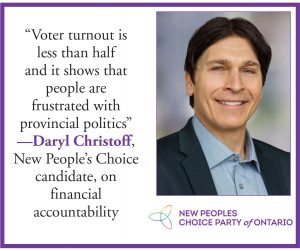
Christoff: Government accountability is at a low. Voter turnout is less than half and it shows that people are frustrated with provincial politics. By creating easily accessible sources for taxpayers to understand government spending and simple ways to actively provide opinions on non-partisan facts, we can make people feel more engaged. When people are more engaged they can help to hold the government more accountable. The people [would] be more likely to respect the words of the Auditor General and demand that the government maintain its fiscal promises.
Davis: I am committed to openness and transparency and truly believe that people in Ontario have a right to know how their dollars are being invested. As trustee, this was one of my lasting contributions to the Toronto Catholic District School Board, as I worked collaboratively to build a governance framework that promotes greater public transparency in the decision-making process at the board. The Ontario Liberal government was the first government in Canada to pass legislation like the Fiscal Transparency and Accountability Act. It’s a great building block for further systemic reforms that support public transparency and accountability.
Grant: The first step is to establish financial transparency. To that end, Greens support the creation of an open data portal where a broad range of government data would be available to citizens to assess and use for data analysis. This data would include government contracts and expenses, road traffic information, and environmental reports. This would reduce the number of freedom-of-information requests. In the meantime, we would ensure that such requests are answered promptly and without political interference. In addition, we would cap executive salaries in the public service to double the premier’s salary.
Smith: We are going to restore responsibility, accountability, and trust in government. We want the people of Ontario to have the whole truth about what’s going on in government because Kathleen Wynne is not telling you the whole truth. This is why we will call a commission of inquiry to get to the bottom of Kathleen Wynne’s billion-dollar hidden deficits and propose solutions to the largest financial scandal in Canadian history. We will also go line by line through the government’s finances to make sure we are getting value for money and we will restore the Auditor General’s power to monitor government advertising. The people of Ontario have been lied to and taken advantage of for far too long.
Bell: Ontarians deserve politicians and leaders who will behave with integrity and transparency. Andrea Horwath and the NDP will bring in a strong MPP code of conduct, with regular updates in plain language so all Ontarians know what is expected of the people they elect. We will return full, independent oversight of Hydro One to the eight independent offices. We will work to increase government transparency and public access to information, while protecting the privacy of Ontarians and eliminate costs for freedom of information requests. And we will ensure true independent oversight of Ontario’s health care by bringing it under the oversight of the Ontario Ombudsman.
What will your party do to correct the funding formula for schools to ensure a safe, healthy environment that is conducive to learning and working?
Davis: As a local school board trustee and a parent, ensuring students and families — especially the most vulnerable — have the resources they need for student achievement and well-being is one of the primary reasons I first ran for office. The Liberals have invested more in education than ever before — leading to historic increases in student achievement and high school graduation rates. Even with this investment, I know firsthand that school boards are facing maintenance backlogs. I’ve supported the Fix Our Schools campaign for some time and believe we should revise the funding formula to ensure that it’s transparent and equitable, given the differing age and states of repair of schools across our province. In addition, we should expand the ways in which education development charges can be used by school boards to include school renewal, retrofitting, and additions.

Grant: We would merge the publicly-funded Catholic and public school systems, creating annual savings of $1 billion that could be used to reduce class sizes and repair school buildings. It is time to have kids of all faiths and no faith growing up together. Reducing class sizes and fixing old buildings would result in a better classroom experience for our kids, and thus better learning outcomes.
Smith: An Ontario PC government will make sure that students have a safe place to learn and teachers have a safe place to teach. When only half of our Grade 6 students are meeting the provincial standard in math, it is clear there is a problem. We need to support our teachers with comprehensive and practical curricular documents. An Ontario PC government will revisit curricular documents in all core subject areas and make changes to ensure that our kids are being provided with the building blocks they need to succeed in the workforce, post-secondary levels, and life. Ontario’s education system should be a force to be reckoned with. I want to see children from hard-working Ontario families ranking in the top percentiles of international education rankings.
Bell: Andrea Horwath and the NDP will fund schools properly. We will work with parents, front-line educators, students, and educational experts to overhaul the education funding formula starting with a comprehensive public review based on two key principles: equity and quality. A new funding formula will address violence in classrooms, and will mean boards, teachers, and education workers have the resources they need to ensure the well-being and safety of all learners, and all educators. We will also end standardized tests and work collaboratively with educators to determine how random sampling could support spotting early trends and deciding where we should focus on improvement, without driving teachers to “teach to the test”. We estimate this will save $40 million, which we will reinvest in the classroom.
Christoff: The issues facing our education systems are numerous. The necessities required for all children need to be considered. Fundraising that covers gaps for some families leaves other students with less. We need to reallocate our systems to promote optimization and remove some of the power from unions and place the focus on the needs of children along with what their parents see is needed.
What will you do to ensure the Municipal Property Assessment Corporation (MPAC) incorporates the current use of a property and the city’s density restrictions on development when assessing commercial properties?
Grant: MPAC’s policy of assessing taxes on commercial properties on the basis of their highest and best use has been devastating to independent businesses on Toronto’s main streets. Most don’t own the property where their stores are located. When MPAC decides that a property could be replaced with a high-rise condo, these businesses have faced big tax increases. This is unfair. Commercial properties should only be assessed based on their current use.

Smith: An Ontario PC government will put taxpayers first.
Bell: The Ontario NDP has been calling for MPAC reform for years. Under the Conservative and Liberal governments, MPAC has created needless uncertainty by assessing commercial properties not based on the actual value of the business, but on the value of the imaginary condo tower that might stand in its place. The NDP will conduct a full review of MPAC and the Assessment Review Board to ensure that commercial and industrial property tax assessments are fair, reasonable, predictable, and consistent.
Christoff: Community watchdogs and municipal leaders need to be brought into any development to ensure that it is enhancing a neighbourhood and not steamrolling it. Our communities have been developed over decades and should be considered as one of the infrastructures to accommodate when a neighbourhood faces change.
Davis: I’ve heard first hand from residents and local business owners about the impact of assessments to our neighbourhoods and local business. It’s a system that needs to be fixed, and fast. Many have suggested that assessments should be based on actual use rather than market fluctuations in rent or best and highest use. MPAC must work with both provincial and municipal partners to ensure properties are assessed in a way that is fair and predictable so that no one is caught off guard in property valuations.
In 1992, Canada signed the United Nations Convention on Biological Diversity, committing to protect 17 per cent of our lands and waters by 2020. Ontario has only protected 10 per cent. What will you do to ensure that Ontario contributes more to land and water protection in Canada?
Smith: We all have a role when it comes to protecting the environment, and the Ontario PCs will do so in a way that respects the taxpayer.

Bell: We believe water is a public trust, and an Ontario water strategy will prioritize planning for water needs now and for future generations, based on the public interest and sustainable public access to water. The Ontario water strategy will be based on the principle that the public should have access to water for drinking, sanitation, and food, and ensure that communities have water for planned sustainable growth. The strategy will create an inventory of water use and return across the province, prioritizing sustainable long-term water use planning.
Christoff: Our built ecosystems provide our clean air, water, and food. All water bodies should be safe, but pushing to protect 17 per cent of our land should be a minimum. We believe 25 per cent of land and water in Ontario should be protected to ensure our large ecosystems and biodiversity are protected for today and our future generations.
Davis: Ontario has committed to supporting a coast-to-coast-to-coast network of nationally protected land and water and as MPP I would do what I could to see that this commitment is met. A Liberal Government would continue to build on its record of environmental protection by expanding the Greenbelt into ecologically sensitive areas like the Waterloo and Paris/Galt Moraine complex, the Orangeville Moraine, the Oro Moraine, and the Nottawasaga River corridor, as well as additional wetlands and small moraines in Dufferin and Simcoe counties.
Grant: Greens would set aside a minimum of 17 per cent of the land base in protected areas according to the internationally-agreed-upon Aichi biodiversity targets. In support of this, we would establish a rigorous biodiversity monitoring and reporting program as an early warning system of species loss. We would freeze urban boundaries now to stop sprawl and expand the Greenbelt to protect a “Bluebelt” of significant hydrological and ecological areas. And we would invest in the monitoring and protection of the Great Lakes. Finally, we would significantly raise royalty rates paid by companies that extract aggregates, ground water, and minerals. This would ensure that Ontario fully recovers the costs of monitoring and managing these essential resources, while providing companies with a financial incentive to prioritize conservation.
READ MORE ON THE ELECTION:
EDITORIAL: The market has no moral compass (Election Special 2018)
GREENINGS: Choosing the lesser evil (Election Special 2018)
FORUM: Bold new initiatives for Ontario (Election Special 2018)
FORUM: Reducing downtown’s vehicles by 25 per cent (May 2018)
FORUM: What kind of Ontario do we want? (May 2018)
FORUM: What kind of province do we want? (March 2018)
Tags: Annex · News
May 29th, 2018 · Comments Off on NEWS: ARA holds annual meeting (Election Special 2018)
Peter Steen receives Community Builder Award
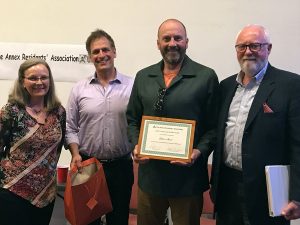
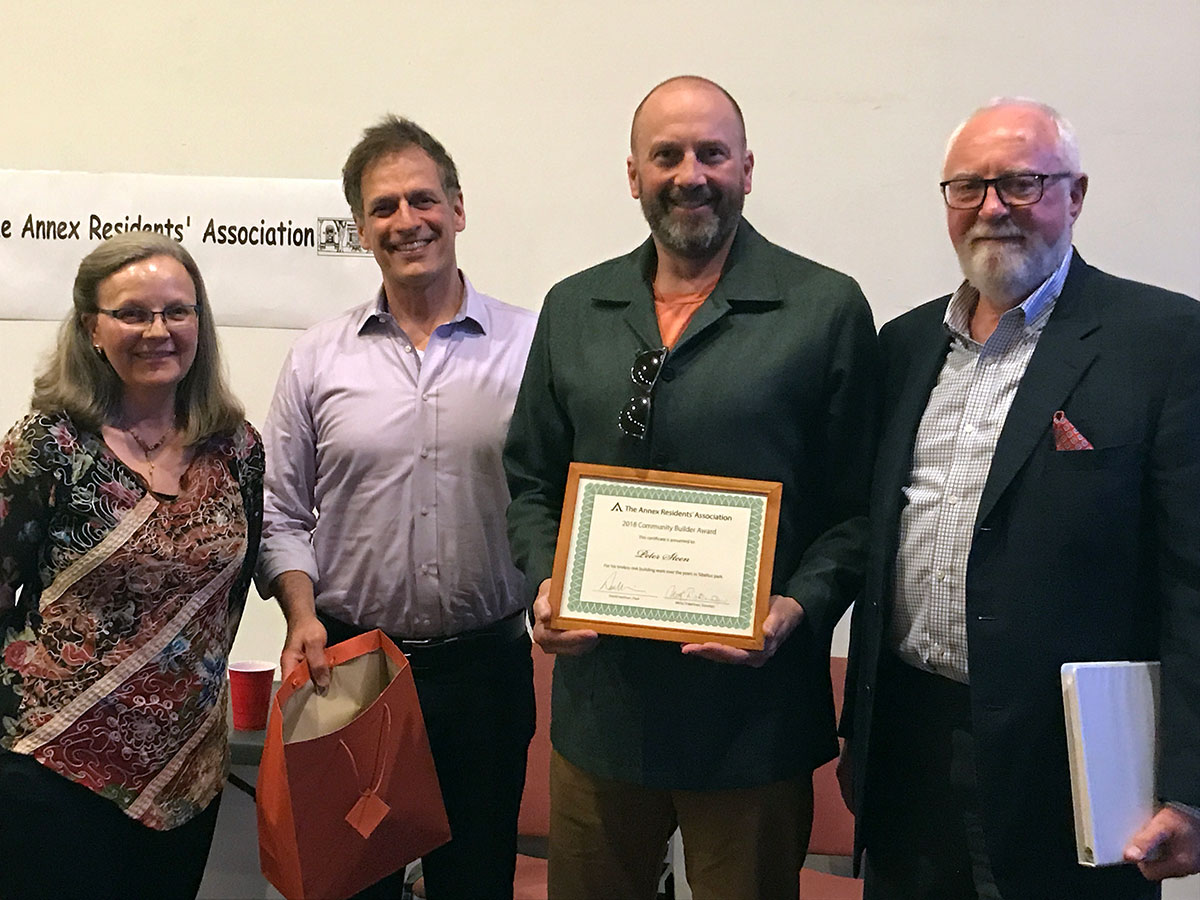
Annex Residents’ Association board member Christine Innes, vice-chair Albert Koehl, Peter Steen, and chair David Harrison (from left). Steen received the Community Builder award for building and maintaining an ice rink at Jean Sibelius Park over many years. COURTESY ALBERT KOEHL
By Ahmed-Zaki Hagar
Development and politics were the main subjects at the Annex Residents’ Association (ARA) annual general meeting at a packed Friends’ House (60 Lowther Ave.) on April 26.
Former Member of Provincial Parliament (Parkdale-High Park) Reverend Cheri DiNovo was this year’s keynote speaker. Known as the “queen of the tri-party bills,” she sponsored many private member bills that had the support of the three major political parties, like the one in 2007 that raised the minimum wage to $10.
Now a minister at Trinity-St. Paul’s United Church, she hosts Radical Reverend, a radio program on CIUT 89.5 FM, the University of Toronto’s campus radio station.
During her remarks, DiNovo touched on the provincial election, particularly a potential Doug Ford premiership. She said that she will work with Ford if he wins and urged the audience to “vote with their heart.”
“No matter who gets in, make sure you are knocking on their door, calling them up on the phone, writing to them,” she said. “You are your own best lobbyist for whatever your interest is.”
The ARA also announced the winner of the Community Building Award, Peter Steen. He was recognized for building and maintaining an ice rink at the Jean Sibelius Square Park on Kendal Avenue since 1998.
Created last year, the Community Builder Award is given to an Annex resident who makes a significant contribution to the neighbourhood.
“It is an honour, it is a really sweet thing and I appreciate it,” said Steen. He wanted to make sure that all those in the community who helped him over the years were acknowledged too. It was “always appreciated” as it’s “never one person’s work, there was a lot of help”.
Steen says that he always loved hockey, which was his motivation to build the rink. He has also seen the popularity of the sport grow in the neighbourhood in the past few years.
“I have certainly seen an increase in skaters coming out,” he said. “I do not think you can ever not have a neighbourhood in this country without someone playing hockey if it is cold enough.”
Steen added that a family will take over the task of maintaining the rink, and that there has been growing interest in the community rink over the past couple of years.
Finally, Joe Cressy (Ward 20, Trinity-Spadina) spoke about how the city is doing very well economically, but still has to address things like homelessness.
“I encourage all of us, and every neighbourhood in the city,” he said, “as we move into a discussion about the future and vision of the city, that as we succeed, we only truly succeed if we care for the most vulnerable.”
Cressy spoke about the downtown core’s growing population and said that more people will work and study downtown. He said this shows the need for better transit and “livable neighbourhoods” marked by new parks and community centres, adding that the design for a new public park at Spadina and Sussex avenues will soon be released.
Another topic Cressy addressed was fraternities and sororities, which he said should be licensed as multi-tenant housing, something he brought to Toronto City Council’s executive committee last year.
“This is entirely about ensuring, when you have large multi-tenant houses, that they are helped, that they are safe, and that they are good community neighbours,” he said.
Cressy also spoke about the changes to the ward boundaries, which has created three new seats at city council.
What is now Ward 20 will be split in half. The north part will become Ward 24, and run from Queen Street to the rail tracks just north of Dupont Street, bounded by University Avenue on the east and Bathurst Street on the west.
The southern part will remain Ward 20, and run roughly from Queen Street to Lake Ontario, bounded by John Street on the east and Bathurst Street on the west.
Cressy will run for re-election “in our home community [Ward 24]. I grew up in this area [and] it is home. I cannot imagine being anywhere else.”
On May 23, Toronto City Council voted to amend the city’s by-laws so that fraternities and sororities may be required to be licensed. Annemarie Brissenden, contributing editor, is the president of a not-for-profit corporation that owns and operates a women’s fraternity house on Madison Avenue. She edited this article.
Tags: Annex · News
May 29th, 2018 · Comments Off on CHATTER: Discover Daphne Cockwell Gallery dedicated to First Peoples art & culture (Election Special 2018)
The Royal Ontario of Museum (ROM) has been providing free access to the Daphne Cockwell Gallery dedicated to First Peoples art & culture since April 18. It’s all part of an initiative to educate Canadians on Indigenous culture and welcome more people to the museum.
Located on the main floor of the Hillary and Galen Weston Wing, the gallery has more than one thousand pieces by Indigenous artists, and has been one of the museum’s most important cultural spaces since opening in 2005. The museum has an Indigenous Advisory Circle, and an Indigenous Knowledge Resource Teacher is available Monday to Friday from 10 a.m. to 2 p.m.
The gallery is named for Daphne Cockwell, a nurse in the Second World War. Her son, Jack, is a dedicated ROM supporter and received its Distinguished Service Award in 2012.
—Billie Wilner/Gleaner News
Tags: Annex · News
May 29th, 2018 · Comments Off on CHATTER: Live from your laneway (Election Special 2018)
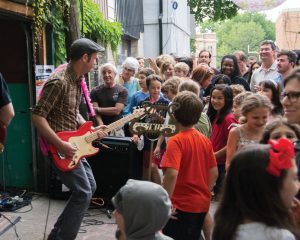
Seaton Village resident Charles Spearin of Broken Social Scene performs at Open Tuning’s 2015 festival, which returns June 9. GLEANER FILE PHOTO/COURTESY NEIL MUSCOTT
Musicians of all genres, ages, and levels are set to perform from garages, porches, storefronts, and restaurants when the Open Tuning Festival returns to Seaton Village from noon to 9 p.m. on June 9. Founded in 2014 by a group of local residents, the free music festival will feature over 100 performers and 20 venues.
Billed as a listening experience, Open Tuning encourages audience members to roam from stage to stage (or porch to porch as it were), taking in the music from all corners of Seaton Village, a historical neighbourhood bordered by Bloor, Dupont, Bathurst, and Christie streets.
Run entirely by volunteers, the festival is open to performers of all ages and skill levels. For more information on the festival, please visit opentuningfestival.wordpress.com.
—Billie Wilner/Gleaner News
READ MORE:
ARTS: Connecting neighbours through music (May 2016)
Tags: Annex · News
May 29th, 2018 · Comments Off on NEWS: A little stress at work can be good (Election Special 2018)
U of T study shows that anxiety can be productive

Researchers from the University of Toronto have recently published a study demonstrating that some workplace anxiety motivates employees to be more productive and focused on a task. COURTESY SHUTTERSHOCK
By Ahmed-Zaki Hagar
About 500,000 Canadians are unable to work during a given week due to a mental illness, according to a 2008 study by the Centre for Addiction and Mental Health. And, according to the Mental Health Commission of Canada, mental illness affects seven out of ten Canadians in the workplace, with anxiety being the most common symptom.
However, a recent University of Toronto (U of T) study has found that workplace anxiety can be beneficial for workers.
Bonnie Cheng, an assistant professor at Hong Kong Polytechnic University and U of T graduate, and Julie McCarthy, a U of T professor, say that their findings show how moderate levels of anxiety can motivate people.
[pullquote]“It just does not make sense that everyone is having a bad performance. You see people who are anxious who just get their stuff together and perform quite well”—Bonnie Cheng, assistant professor, Hong Kong Polytechnic University[/pullquote]
Cheng says that she was interested in the growing public discussion on mental health and her study aims to show that anxiety “is something we do not have to run away from”.
“If we only accept that anxiety is bad for us, what are the implications of that, if you think about the workplace from so many people being anxious?” she says. “It just does not make sense that everyone is having a bad performance. You see people who are anxious who just get their stuff together and perform quite well.”
Going through past research on the subject, Cheng and McCarthy say that there are three facts that can impact a worker’s performance: motivation, ability, and emotional intelligence.
Cheng says that these factors can either aid with anxiety or “turn it into a fear and [let it] debilitate you”.
“Having some level of anxiety is good because that can stimulate you to put out your best work,” she says. “It is really about embracing that anxiety so that you can use it to facilitate your performance.”
Cheng and McCarthy break down workplace anxiety into two categories.
Dispositional workplace anxiety is based on a person’s traits, like their general level of anxiety. Situational workplace anxiety is how a person feels anxious in certain situations, such as from a job interview or a deadline.
Cheng explained how employees who have to provide a “service with a smile”, at times when they are not happy, have to suppress their anxiety.
The article says that jobs with high emotional labour demands coupled with high customer turnover could lead to heightened anxiety. Other characteristics that can trigger anxiety include office politics, high expectations, and tight deadlines.
Cheng says that these two types of anxiety are “tightly linked”, but can impact performance differently.
“For trait-levels of anxiety, you can think of it as something that is chronic. Over time, it can hurt your performance because it will exhaust you,” she says. “For situational levels of anxiety, because it is more short-term, it can hurt your performance because, in those situations, it will distract you.
“The facilitative side of anxiety for both of them is very similar, they both centre around self-regulation.”
Cheng says that organizations and employers can help their employees with managing their anxiety. She points to Google’s efforts to train managers with helping their employees with their emotional intelligence as an example to follow.
“Organizations can help to invest in employees in terms of offering the right training and giving them the right tools so that employees can feel that they have the necessary resources to perform their tasks,” she says.
Tags: Annex · News
May 29th, 2018 · Comments Off on EDITORIAL CARTOON: How Nice (Election Special 2018)

More how nice!
EDITORIAL CARTOON: How Nice (May 2018)
EDITORIAL CARTOON: How Nice (Spring 2018)
EDITORIAL CARTOON: How Nice (Mar. 2018)
EDITORIAL CARTOON: How Nice (Dec. 2017)
EDITORIAL CARTOON How nice! (August 2017)
EDITORIAL CARTOON How nice! (July 2017)
EDITORIAL CARTOON: how nice! by blamb (June 2017)
EDITORIAL CARTOON: TCHC (May 2017)
EDITORIAL CARTOON: The Grand Tory (April 2017)
FORUM: Celebrating 20 years of cartoonist Brett Lamb (April 2017)
EDITORIAL CARTOON: A second chance! by Brett Lamb 2037 (February 2017)
EDITORIAL CARTOON: Not really! It’s actually nice! by Stumpy the Subway(January 2017)
Tags: Annex · Editorial
What’s lost in the provincial debate over whether minimum wage should be $14 or $15 an hour is an accompanying discussion of what full-time employment at minimum wage actually pays for. It’s a glaring omission when you consider that many people spent the biggest portion of their money on a place to call home.
The cost to keep a roof over one’s head is eating more and more of one’s paycheque, and a buck or two more an hour won’t make much of a difference. The increasingly stark juxtaposition of the cost of renting a dwelling and average wages is worth examining, particularly because all four provincial parties are promising the voting public the world.
The lack of affordable housing is a growing problem across the province, but even more so in Toronto. Given how much renters pay each month relative to their incomes, they cannot endure a single hiccup in their income stream or they will be out on the street. The Advocacy Centre for Tenants Ontario (ACTO) recently released Where Will We Live? Ontario’s Affordable Renting Housing Crisis, which demonstrates that 46.9 per cent of Toronto’s renter households are spending 30 per cent or more of their income on rental costs. That means a tenant would have to earn at least $24 per hour to afford the average rent in the Greater Toronto Area.
(The 30 per cent margin of income is a widely-used benchmark to determine if rent is in fact affordable. It also provides a window into whether or not there will be enough left over for a decent quality of life after the rent gets paid.)
According to the Canadian Mortgage and Housing Corporation (CMHC), a one-bedroom condominium goes for $1,800 and a one-bedroom apartment for $1,200. But these averages reflect existing rents in occupied dwellings instead of what is on the market, given a landlord’s ability to spike the rent once they have a vacancy, and do not reflect local rates in places like the Annex, which is a whole other kettle of fish.
According to ACTO, a renter here would need to earn $30 per hour in order to afford rent. At $14 an hour, one would to have to log 86 hours a week, which is equivalent to over two full-time jobs!
The federal government has committed $40 billion to a national housing strategy aimed at lifting 530,000 families out of unaffordable or substandard housing. Where is the province on this? The province needs a matching program — adding another dollar or two to minimum wage will not solve the problem.
Westbank Projects Corp.’s redevelopment of the former Honest Ed’s site is a local example of a developer identifying and filling a need for more rental units. They even made 10 per cent of the 850 units affordable, and included one, two, and three bedroom units in the affordable mix. But this will hardly meet all the rental needs in Toronto, where the vacancy rate for one bedroom apartments is about one per cent.
The peace of mind afforded by having a roof over one’s head is incalculable. When provincial candidates come knocking at your door, perhaps you’ll consider asking them what they plan to do about it.
READ MORE ON THE ELECTION:
NEWS: Grilling potential MPPs (Election Special 2018)
GREENINGS: Choosing the lesser evil (Election Special 2018)
FORUM: Bold new initiatives for Ontario (Election Special 2018)
FORUM: Reducing downtown’s vehicles by 25 per cent (May 2018)
FORUM: What kind of Ontario do we want? (May 2018)
FORUM: What kind of province do we want? (March 2018)
READ MORE EDITORIALS:
EDITORIAL: Lessons to be learned from Excessive Force (Spring 2018)
EDITORIAL: A social contract is a precious thing (March 2018)
EDITORIAL: Intolerance leading to Quebec’s decline (Dec. 2017)
EDITORIAL (Nov. 2017): Student safety suffers as trustees cave
EDITORIAL: Pandering to religious intolerance (October 2017)
EDITORIAL: Bike lanes, good for business (Fall 2017)
EDITORIAL: Don’t sacrifice safety for political gain (August 2017)
EDITORIAL: Thank you Mr. Asti (July 2017)
EDITORIAL: A watershed moment (June 2017)
EDITORIAL: Revoke U of T’s unchecked “licence to build” (May 2017)
EDITORIAL: Westbank’s positive precedent (April 2017)
EDITORIAL: Foreign buyers tax a necessary cliff jump (March 2017)
Tags: Annex · Editorial