August 12th, 2018 · Comments Off on ARTS: Summertime arts and culture (Summer 2018)
Fascinating films, family fun, and fabulous festivals
By Heather Kelly
For the family
Open Streets TO, the recreational program that opens our streets to people, returns August 19 from 10:00 a.m. to 2 p.m. on Bloor and Yonge streets. These active living events are a great way to enjoy walking, cycling, rollerblading, and dancing in the streets of our city!
The Very Hungry Caterpillar by Eric Carle has delighted generations of readers since 1969, selling more than 43 million copies worldwide. Now the timeless classic will be on stage at the Miles Nadal JCC Saturdays and Sundays throughout the summer, as Joseph Patrick Presents: The Very Hungry Caterpillar Show.
The Bata Shoe Museum continues its Summer Family Fun programs where children ages 3 to 12 can complete a shoe-themed craft, play I spy in the galleries, and try on some funky shoes.
New camp sessions start in August, too. 918 Bathurst hosts Theatre Direct camps at the end of July, and Alliance Française offers music, creative arts, photography, and theatre camp. Children can make music at the Royal Conservatory School at instrumental exploration camps, band camps, and free Smart Start classes on Saturdays.
Stay cool indoors
Dora award nominee Thom Allison directs Randolph Centre for the Arts’ third-year students in Stephen Sondheim’s masterpiece A Little Night Music, the Tony Award-winning musical inspired by the Ingmar Bergman film Smiles of a Summer Night. Set in 1900s Sweden, A Little Night Music whisks audiences away to a weekend in the country where infinite possibilities of new romances and second chances bring endless surprises. On stage at the Randolph theatre August 2 to 4 and 9 to 11.
Some of the most anticipated new documentaries of the summer will be on the big screen at Hot Docs Ted Rogers Cinema.
Discover the star-studded secrets of Manhattan’s most exclusive hotel with Always at The Carlyle. Go behind-the-scenes of the movie industry with Filmworker and Hitler’s Hollywood, or glimpse the historic process behind the Oslo Accords in The Oslo Diaries. Take a musical road trip across Elvis Presley’s America in Eugene Jarecki’s The King, and embark on a globe-spanning journey inside the lives of the international wealthy elite with Lauren Greenfield’s Generation Wealth. And for those of us who loved Mr. Rogers, screenings of Won’t You Be My Neighbour? start August 10.
Istituto Italiano di Cultura hosts the photo exhibition Melodramatic Realism, with photos from three masterpieces by Luchino Visconti. The first steps of Visconti and of Neorealism are documented in this exhibition, with photos by Osvaldo Civirani and Paul Ronald.
The Japan Foundation invites you into the universe of Noh Theatre through images of masks in Yokoyama Noh Theatre Photography. Designated as Intangible Cultural Heritage by UNESCO in 2001, Noh Theatre has been an elaborate theatre form since the fourteenth century.
The travelling exhibition Manolo Blahnik: The Art of Shoes, a retrospective of one of the world’s most iconic shoemakers with more than 200 shoes and 80 original sketches from Blahnik’s personal archive, is a summer highlight at the Bata Shoe Museum. The fashion theme continues at the ROM with Iris van Herpen: Transforming Fashion, where metal umbrella ribs, magnets, and 3-D printing are some of the astonishing materials the Dutch fashion designer uses to create striking haute couture.
The Gardiner Museum is continuing Community Arts Space free programs. Each project considers how the city’s unique and varied local histories of art and social activism can be re-mapped for the future. Reclaiming Artifacts, co-presented with Art Starts from August 2 to 16, invites visitors to explore the “discovery” of artifacts found during the construction of a condo in the year 2050. Then the Gardiner Museum hosts a public opening for Maldewin Weskijinu / Blood Soaked Soil, an exhibition by artist Louis Esmé, on August 24.
Ashkenaz Festival opens on the Bloor St. Culture Corridor this year with a Yiddish Glory, a concert at Koerner Hall on August 28 featuring an all-star ensemble of virtuosi from the worlds of classical, jazz, and Roma and Jewish folk music. The songs were written by Holocaust victims and survivors in the Soviet Union during the Second World War, collected by a team of Jewish Soviet ethnomusicologists during the war, confiscated, then restored by University of Toronto Professor Anna Shternshis, who will introduce the concert.
Tags: Annex · Arts
August 12th, 2018 · Comments Off on SPORTS: Slumping Leafs hope to change (Summer 2018)
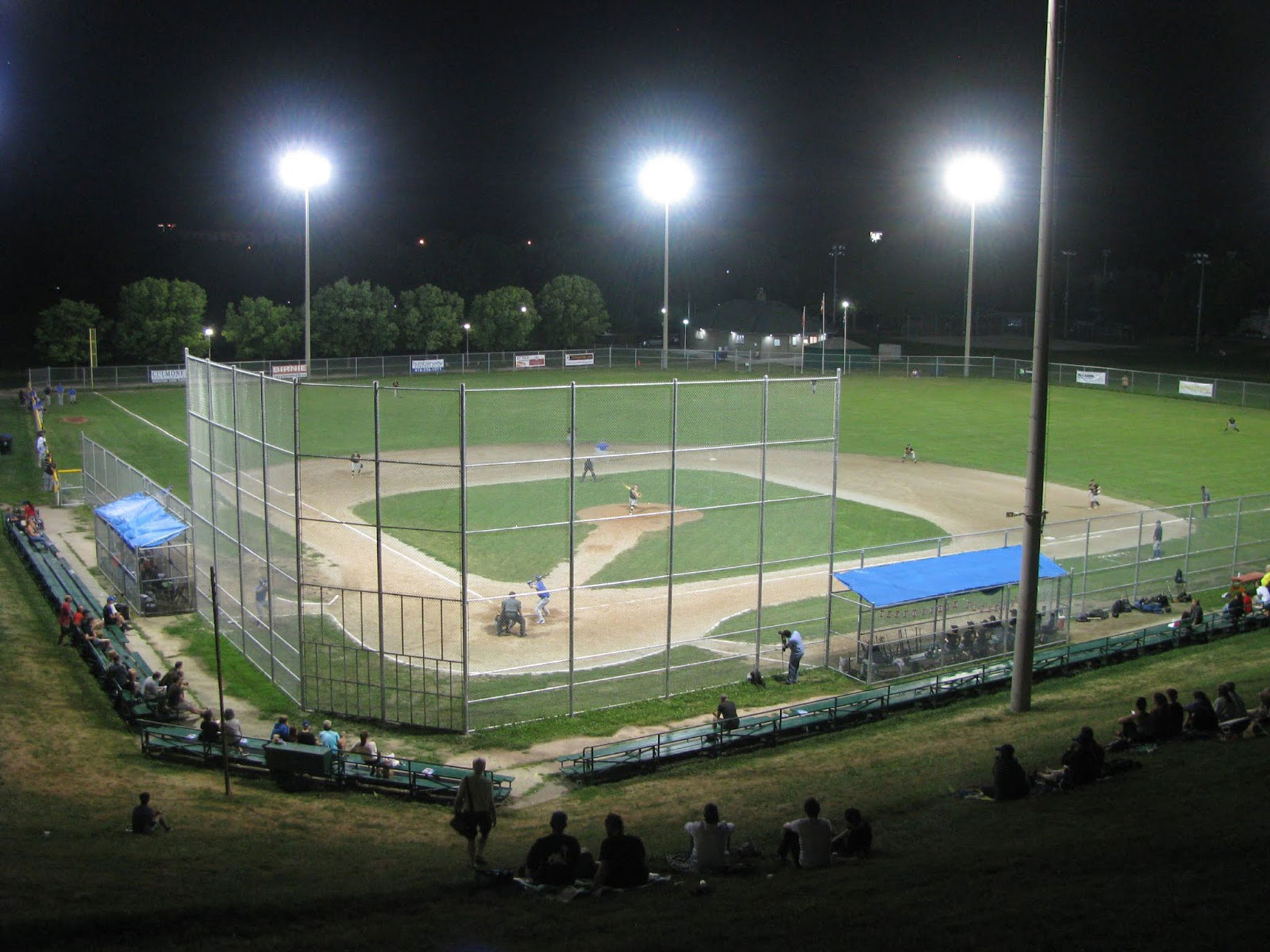
Fans on the slopes of Christie Pits take in Maple Leafs baseball action on July 25. R.S. Konjek/Gleaner News
Lengthy losing streak dulls early season momentum
By R.S. Konjek
July was the cruellest month for Toronto baseball fans.
Over at the dome, the major league Blue Jays drifted out of contention, waved the white flag and traded away all-star pitcher J.A. Happ.
At Christie Pits, the Maple Leafs plunged into a protracted slump. After a promising start to the 2018 season, a 10-game losing streak dropped them down to the middle of the Intercounty Baseball League standings.
With the club enjoying an improved roster this year and most players avoiding injuries, the downswing has been puzzling.
The Leafs attempted to return to the win column on July 25 when they hosted the Kitchener Panthers for a night game at Dominico Field.
As the players emerged from the clubhouse for warm-ups, I asked some of them to describe the mood of the ballclub during the slump.
“We talk about it, but we keep it in the back of our heads,” said outfielder Grant Tamane. “We have to keep playing hard and stay healthy.”
Pitcher R. J. Page offered a calm perspective.
“With a streak like that you would expect bickering and negativity, but it’s not that way,” he said. “We will snap out of it.”
Throughout this season, there has been a pattern to games between the Maple Leafs and Panthers.
It goes like this: the Panthers take an early lead and they stretch it out a mighty distance. The Leafs battle back like scrappers and legends, but fall just short of victory. All four of their games this year have followed this script.
Would the team take a different approach this time?
“We have to grind tonight,” said pitcher Zach Sloan. “We have lots of confidence in each other. They’re one of the best teams, but we always play well against the best teams.”
“Start earlier,” added Tamane, with a nod to the Panthers’ habit of jumping ahead and the need to counter that by scoring early.
Despite the positive vibes and assertive approach, the Leafs and Panthers both got off to a quiet start during the Wednesday night game.
The first few innings flew by as a pitchers’ duel ensued. Toronto starter Pedro De Los Santos completed five scoreless innings before it even got dark.
The Panthers scored first in the top of the sixth. They racked up six hits and scored four runs. De Los Santos was relieved by Will Newton, who got out of the inning with a pair of strikeouts.
The Leafs punched right back in the bottom of the inning. Manager Damon Topolie — who was also Toronto’s designated hitter on the night — hit a two-run single to make it 4-2 Panthers through six innings.
The momentum stayed with the home nine, who were urged on by a boisterous crowd spread out on the slopes surrounding the field. They rallied for four more runs in the seventh inning to take a 6-4 lead.
Sloan was called out of the bullpen to pitch the final two innings and nail down that elusive win. The lanky lefty pitched a scoreless eighth inning, setting the stage for a decisive final frame.
Then the roof caved in. The Panthers pounced on Sloan and knocked in five runs on five hits, including a home run. Sloan battled his way out of the inning, but Kitchener had taken a 9-6 lead. The Leafs were unable to respond in the bottom of the ninth. They changed the script, but the result was the same.
As the players trudged back to the clubhouse and fans melted away into the night, it was important to remember something said earlier by pitcher Page.
“Everything evens out. You can have a .400 hitter who goes into a .100 streak, but everything evens out.” This is very true in the game of baseball, where hot streaks can quickly become cold ones, and vice versa.
Perhaps it is better that the Leafs go through the doldrums now and get hot again in time for the playoffs.
The regular season at Christie Pits will be wrapping up soon, and playoff action will begin in early August. Please visit mapleleafsbaseball.point streaksites.com for schedule updates.
READ MORE:
SPORTS: Many hats, one goal for Topolie (July 2018)
SPORTS: Maple Leafs back at the Pits (Election Special 2018)
NEWS: Celebrating a legendary Leaf (Jan. 2018)
ON OUR COVER: Cycling the Pits (Fall 2017)
SPORTS: Leafs fall early this summer (AUGUST 2017)
Tags: Annex · Sports
July 18th, 2018 · Comments Off on ON THE COVER: Ghost bike installed (July 2018)
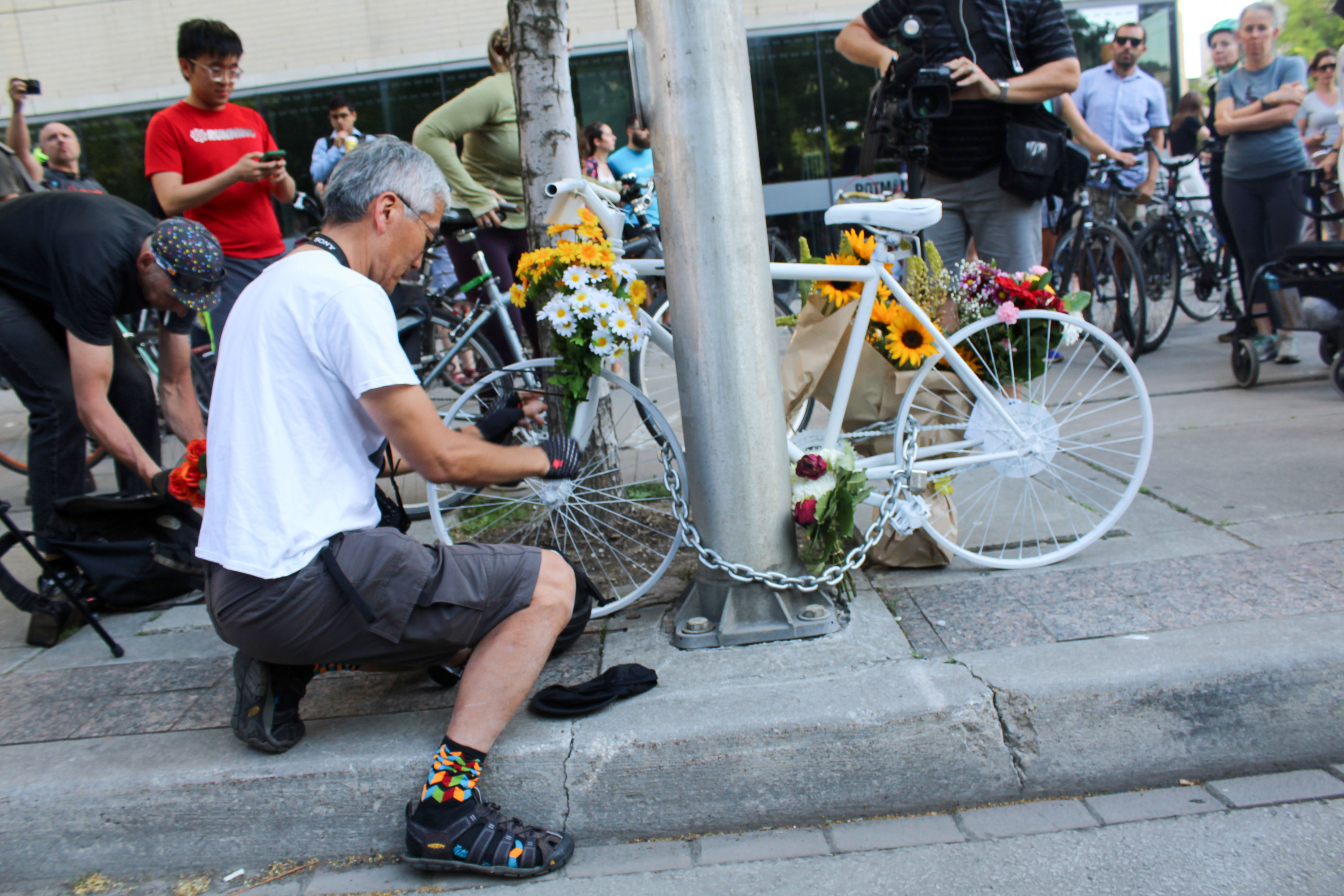
A ghost bike and flowers have been installed as a memorial to cyclist Dalia Chako, who was killed in an accident at the corner of St. George and Bloor streets in June. Advocacy for Respect for Cyclists organized a ghost ride in Chako’s memory, and cycling activists have renewed calls for increased safety for cyclists and pedestrians. There have been 21 cycling and pedestrian fatalities in Toronto this year. TEMI DADA/GLEANER NEWS
READ MORE ON CYCLING:
NEWS: Shock, sadness at cyclist’s death (July 2018)
EDITORIAL: City staff ignore bike lanes (July 2018)
NEWS: Bike lanes (March 2018)
CHATTER: Cyclists prey for open doors (Dec. 2017)
NEWS (Nov. 2017): Pilot project becomes permanent
NEWS: Here to stay? (Oct. 2017)
FORUM: A magical new supply of parking spots (October 2017)
EDITORIAL (FALL 2017): Bike lanes, good for business
CHATTER (MARCH 2017): Preliminary data on Bloor Street pilot bike lane released
CHATTER: Ground-breaking bike lanes launch on Bloor Street (August 2016)
NEWS: Bikes blessed for another season (June 2016)
FOCUS: An early advocate for bike lanes (June 2016)
NEWS: Bike lanes for Bloor Street (May 2016)
The faster we lower speeds, the more lives we save (October 2015)
Tags: Annex · News
Tragedy results in memorial ride, call for greater safety
By Temi Dada
Cyclists gathered on June 20 at 6.30 p.m. to honour Dalia Chako with one final ride. Among the mourners at the ghost ride were family and friends of Chako, who was killed by a truck at Bloor and St. George streets on June 12.
Chako’s fatal accident was the sixth cycling accident in 10 days in Toronto, and highlighted bike and pedestrian safety across the city.
“I think at the end of the day as the city grows there has to be dedicated infrastructure for cyclists and pedestrians, [or] you won’t be able to handle the amount of traffic a large city produces. It is better to get ahead of the curve before it becomes a bigger issue than it is,” said Skylor Brummans, Chako’s son. He believes that change is paramount for the safety of cyclists in Toronto and hopes that the memorial touches people and encourages them to be more careful on the road.
For others present at the event, protected lanes are not the only thing that will bring an end to the fatal accidents. There needs to be more awareness on the road and education for drivers, cyclists, and pedestrians.
“There is a serious divide between cyclists, pedestrians, and motorists,” said Robert Lawson, who has been a bike courier for about 15 years. “The city councillors and politicians worry about the popular vote; they’re not going to worry about the cyclist and pedestrian issue because there are more cars who pay more taxes. A designated lane is not a protected lane.”
Brummans added that “there needs to be some kind of awareness campaign to do that as well to tell people who are not familiar with it to be more aware when they open their doors or make a right turn”.
Michael Stein, a cyclist and bike technician, said that “education towards drivers is a needed thing. I have actually had a couple of discussions with drivers who have almost hit me and they didn’t understand the rules.
“They didn’t know [cyclists] are meant to be on the road, but sometimes when you explain the rules to them they understand. There should be awareness for cyclists too because there are some crazy cyclists out there as well.”
Stein, who has been a cyclist in cities like Edmonton, Calgary, Vancouver, and Winnipeg, said that he and his cyclist friends call cycling in Toronto “horizontal skydiving”.
He has had his fair share of bad experiences with drivers in Toronto, where a driver once used his car as a weapon to push him and his bike off the road. Experiences like that and the sudden spurt of accidents prompted him to start wearing a GoPro camera on his head while cycling.
“Over the last couple of weeks I would say [fear for safety on the road] has gotten worse,” Stein said. “I would say Toronto is the scariest city I have biked in. I don’t think the police keep drivers accountable and I don’t think they hold cyclists accountable also; there are some crazy cyclists out there as well.”
He also believes that inclusion of more protected bike lanes would help to make cyclists feel safer on the road.
The Toronto Police Service is still investigating the accident and no charges have been laid so far.
The intersection remains a memorial to Chako: flowers started appearing the day after the accident and a white ghost bike was placed in her memory near the street.
READ MORE ON CYCLING:
EDITORIAL: City staff ignore bike lanes (July 2018)
NEWS: Bike lanes (March 2018)
CHATTER: Cyclists prey for open doors (Dec. 2017)
NEWS (Nov. 2017): Pilot project becomes permanent
NEWS: Here to stay? (Oct. 2017)
FORUM: A magical new supply of parking spots (October 2017)
EDITORIAL (FALL 2017): Bike lanes, good for business
CHATTER (MARCH 2017): Preliminary data on Bloor Street pilot bike lane released
CHATTER: Ground-breaking bike lanes launch on Bloor Street (August 2016)
NEWS: Bikes blessed for another season (June 2016)
FOCUS: An early advocate for bike lanes (June 2016)
NEWS: Bike lanes for Bloor Street (May 2016)
The faster we lower speeds, the more lives we save (October 2015)
Tags: Annex · News
July 18th, 2018 · Comments Off on NEWS: PARA plans for a green future (July 2018)
Annual general meeting includes Mirvish Village update
By Ahmed-Zaki Hagar
Future development and maintaining community green spaces were the main topics at a well-attended annual general meeting of the Palmerston Area Residents’ Association (PARA) on May 15.
Kristina Reinders, a senior urban designer with the City of Toronto, spoke about the TOcore initiative, focusing on parkland and community spaces.
TOcore — approved by Toronto City Council on May 22 — is a long-term plan to redesign the city’s downtown core aimed at preparing for the upcoming population and employment growth in the next 25 years.
As a public and private investment, TOcore aims to improve the downtown core for residents, workers, and students, ensuring that “growth positively contributes to Toronto’s downtown as a great place to live, work, learn, play, and invest”, said Reinders.
She added that the increase of high-rise buildings will result in “an [increased] need for parks”.
According to census data, downtown residents only have 5.5 square metres of parkland per resident, whereas the city average is 28 square metres per resident.
“Downtown residents have among the lowest percentage of parkland space in the city,” she said. “The land is just not available, but what is important is how we use the space that we have and that we design it in a way that is most useful for residents and employees.”
The Parks and Public Realm Plan consists of “five transformative ideas”: the core circle, great streets, the shoreline stretch, park districts, and local places. According to the plan, these ideas “establish a clear vision for the Downtown’s future urban landscape”.
Reinders said that the city has tools to pay for implementing the plan, like a bylaw amendment currently under consideration by council that would require new developments to provide more park space. In addition to what she called a “sizable capital budget”, she said that other ways of funding the project include partnerships with public and private agencies and philanthropy.
After Reinders spoke, board member Frumie Diamond presented the PARA Green Plan, which is currently in draft form. The plan will be an official green document that’s approved by the city and advocates for bylaws that support the environment.
“We want to promote…green initiatives that contribute to the wellness of our community,” Diamond said. “We need to respond to climate change because it is happening now and it is already impacting our community.”
The plan identifies public spaces — like the Palmerston Gates, Healey Willan Park, churches, and synagogues — for improving or adding green spaces.
It addressed PARA’s discussions with Westbank Projects Corp., which is redeveloping Mirvish Village, on adding park space to the new development.
“We need to make sure that the whole [Mirvish Village] project is integrated into a continuous green space,” she said.
The green plan will also include a community greening project that is still to be decided.
“There are a lot of educational opportunities to educate our neighbours and people in our community,” added Diamond.
Mike Layton (Ward 19, Trinity-Spadina) spoke with Roy Sawyer, one of PARA’s representatives of the Mirvish Village Task Group, about how construction will impact movement around the neighbourhood.
Sawyer said that progress has been made in planning for vehicle movement in the Village, including making Markham Street a one-way street and widening Lennox Street near Honest Ed’s to include a dedicated left-turn lane.
He added that the development will connect with the rest of the neighbourhood and make the streets “much more beautiful.”
“On the Palmerston [Boulevard] side of Mirvish Village, there are all these beautiful heritage houses that had lost green space behind them, that is going to be combined with park space,” Sawyer said. “That will be partially used as outdoor space for a new daycare.”
Layton said that he wants the development to not only accommodate movement but also provide the community with “a very special public space”.
To accomplish this, Layton and Joe Cressy (Ward 20, Trinity-Spadina) proposed a motion to work with several city divisions, including Transportation Services, to help with planning the movement and street priorities in the development.
“It will take many years to build this development,” Layton said. “Before these 1,800 people move in and the retail opens up, we will have a significant opportunity to look at the traffic pattern, model it, and try to figure out solutions.”
Layton said that the development is currently at the site plan application phase, and that he hopes to involve the community, including PARA, and not “try to work in isolation”.
Tags: Annex · News
July 18th, 2018 · Comments Off on NEWS: Bell wins ballot bunch (July 2018)
NDP scores more votes than all rivals combined
By Geremy Bordonaro
Jessica Bell of the New Democratic Party (NDP) is the first ever Member of Provincial Parliament (MPP) for the newly formed riding of University-Rosedale. The riding, which encompasses the northern half of what was once Trinity-Spadina, includes all of the Annex.
The 2018 Ontario provincial election marks a definitive shift in the politics of the city and province as Doug Ford’s Ontario Progressive Conservatives (PC) gained a majority government with 76 seats. Kathleen Wynne’s Liberals, formerly a majority government, lost their status as a party after taking only seven seats, even though Wynne managed to hold on to her riding of Don Valley West.
Jessica Bell said she was “humbled but proud” to represent the Annex, and spoke about how much this meant to her.
“The very next day I had to start working. I walked up the steps of Queen’s Park and it felt very historic,” Bell said. “I’m going to remember that moment for the rest of my life.”
Bell received an incredibly strong 24,537 votes, nearly half of the riding’s voter turnout.
She won more votes than the Liberal, PC, and Green party candidates combined and more than twice as many votes as the runner-up.
The runner-up, Jo-Ann Davis, from the Liberal Party, got 10,898 votes, with 22 per cent of the vote, and was closely followed by Gillian Smith from the PC Party with 10,431 votes at 21 per cent. Tim Grant, representative of the Green Party, ended up with 2,652 votes, at 5 per cent.
Bell is part of a strong NDP contingent from Toronto. Most of the city’s ridings flipped from Liberal to NDP with the NDP taking two incumbent seats in Toronto-Danforth and Parkdale-High Park.
“This election was very clearly a change election,” she said. “People in Toronto did not want Doug Ford and the budget cuts that the Conservatives typically do. They overwhelmingly voted for change.”
The story in Etobicoke, Scarborough, and parts of North York is very different. In these ridings, outside of the city’s core, the PC party took hold. Prior to this election there were no Conservatives holding a seat within Toronto, yet 11 seats flipped from Liberal to PC.
In the small amount of time since the election the premier-elect has already signalled he will axe the Green Ontario Fund, which according to Gus Sinclair, former Chair of the Harbord Village Residents’ Association, has already had an effect on the community.
“The HVRA prides itself on trying to be the greenest community in Toronto,” Sinclair said. “We used that money to subsidize energy audits for people’s houses. “Now people are like ‘well geez, what do I do?’ That kind of initiative I think is essential if we believe global warming is a problem.”
Sinclair is waiting for whatever changes come in the future but is not exactly optimistic.
“I don’t know what else he is going to do. People wanted change. Change is what they’re going to get,” said Sinclair. “They may not like the change they get.”
Three of the seven remaining Liberal party strongholds are in Toronto. The ridings of Don Valley West and East, with the addition of Scarborough-Guildwood, all remained Liberal despite the party’s overall unpopularity.
READ MORE ON THE ELECTION:
ON THE COVER: The Ballot Bunch (Election Special 2018)
NEWS: Grilling potential MPPs (Election Special 2018)
EDITORIAL: The market has no moral compass (Election Special 2018)
GREENINGS: Choosing the lesser evil (Election Special 2018)
FORUM: Bold new initiatives for Ontario (Election Special 2018)
FORUM: Reducing downtown’s vehicles by 25 per cent (May 2018)
FORUM: What kind of Ontario do we want? (May 2018)
FORUM: What kind of province do we want? (March 2018)
Tags: News · General
July 18th, 2018 · Comments Off on CHATTER: A festival of mulberries (July 2018)
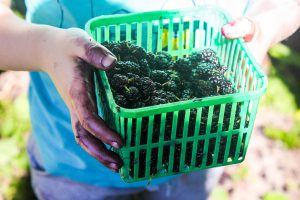
COURTESY MARTIN REIS
Have you ever cursed the mess of mulberries on the sidewalk from mid-June through early August? Did you know these mulberries are actually delicious?
The Annex Residents’ Association hosted its second Annual Mulberry Festival on July 7 at Jean Sibelius Park. Attendees picked mulberries from trees in the neighbourhood, and participated in a tree canopy tour with Sandy Smith, a professor in the University of Toronto’s forestry department, who shared her vast knowledge of our urban forest.
One of the most beautiful gardens in the Annex also hosted visitors, and there were talks about native plant species and what grows best in our soils.
Snacks and refreshments were available — participants brought a cup for some cool lemonade as this was a waste-free affair.
—Terri Chu/Gleaner News
Tags: Annex · News
July 18th, 2018 · Comments Off on EDITORIAL CARTOON: How Nice (July 2018)

More how nice!
EDITORIAL CARTOON: How Nice (Election Special 2018)
EDITORIAL CARTOON: How Nice (May 2018)
EDITORIAL CARTOON: How Nice (Spring 2018)
EDITORIAL CARTOON: How Nice (Mar. 2018)
EDITORIAL CARTOON: How Nice (Dec. 2017)
EDITORIAL CARTOON How nice! (August 2017)
EDITORIAL CARTOON How nice! (July 2017)
EDITORIAL CARTOON: how nice! by blamb (June 2017)
EDITORIAL CARTOON: TCHC (May 2017)
EDITORIAL CARTOON: The Grand Tory (April 2017)
FORUM: Celebrating 20 years of cartoonist Brett Lamb (April 2017)
EDITORIAL CARTOON: A second chance! by Brett Lamb 2037 (February 2017)
EDITORIAL CARTOON: Not really! It’s actually nice! by Stumpy the Subway(January 2017)
Tags: Annex · Editorial
July 18th, 2018 · Comments Off on CHATTER: Farmers’ market returns to Green P (July 2018)
The Bloor-Borden farmers’ market returned for its 11th year on June 6.
Open every Wednesday until the middle of October, the market offers a little bit of everything to delight the tongue from berries to honey, vegetables, meat, bread, and even wine! All the fresh produce is direct from the farm to the city.
While there have been funding concerns in the past, Helen Goldlist, who chairs the Bloor-Borden Farmers’ Market Advisory Committee, says the farmers’ market has at least “three to four years left before we have to look for different funding”.
It’s an entirely volunteer-run market, and funding from BIAs and other local organizations help make up any funding shortfalls. Goldlist also suggests getting local sponsors to pay for the musicians who perform throughout the day.
The market currently gets much of its funding from its partners in Farmers’ Markets Ontario which, among other things, ensures that every farmer attending the market is certified local. The Bloor-Borden farmers’ market runs every Wednesday from 3 to 7 p.m., rain or shine, in the Green P parking lot on Borden, south of Bloor Street West.
—Geremy Bordonaro/Gleaner News
Tags: General
July 18th, 2018 · Comments Off on CHATTER: REDress Project inspires local solidarity (July 2018)
Jaime Black’s REDress Project has inspired three churches along Bloor Street to show their solidarity with those seeking redress for Canada’s Missing and Murdered Indigenous Women and Girls.
In 2014, the Métis artist created an art installation at the Canadian Museum for Human Rights in Winnipeg that featured red dresses as symbols of the missing and murdered women. Since then, the installation has grown, and Black is collecting 600 dresses by community donation that will later be installed in public spaces across Winnipeg and Canada to symbolize the “staggering number of women who are no longer with us”, according to her website, redressproject.org.
Her project has inspired many collaborators across Canada, including an art display last year at the University of Toronto’s St. George campus, and now Bloor Street United Church, Church of the Redeemer, and Trinity-St. Paul’s Church. All three have hung red dresses around their exteriors.
“As members of the church and community I think we have a duty to raise awareness on serious societal issues like this,” said Randi Helmers, who helped with the display. She’s a long-time member of the Bloor Street United Church and a theatre and visual artist.
“The 60s and 70s were the awakening of the feminist movement in the church. Part of our duty is to raise consciousness and teach people the challenges faced by urban and reserve Indigenous people. Hopefully this starts a conversation and makes people act and look to help,” said Pamela Thomson, a member of the Church of the Redeemer.
She’s a leader of the Indigenous Solidarity Working Group and the Indigenous Justice Coalition, and was influential in the collaboration between the churches.
“The idea is to raise awareness, and a basic part of any work in this area is to listen to Indigenous people and take our lead from them because we have this long history of giving solutions which were not appropriate,” said Dianne Johnson, a member of the Bloor Street United Church, who’s also a representative of the church’s Social Justice Committee and the Indigenous Rights Group.
“It is very powerful, effective, and a political statement in an artistic form,” said Helmers.
The displays started on June 4 and will most likely run till further notice. St. Paul’s Bloor Street is set to join the other three churches and add a display in August.
For more information on the National Inquiry into the Missing and Murdered Indigenous Women and Girls, please visit mmiwg-ffada.ca.
—Annemarie Brissenden with files from Temi Dada/Gleaner News
Tags: Annex · News · General
July 18th, 2018 · Comments Off on CHATTER: Church raising funds to preserve glass (July 2018)
The Church of Saint Stephen-in-the-Fields has launched a fundraising campaign to save its historic stained glass windows. One of Toronto’s oldest buildings, the Anglican church at 103 Bellevue Ave. in Kensington Market was built in 1858. The impressive stained glass windows date from 1878, and were built by one of the leading stained glass studios in Canada at the time.
Experts have assessed the state of the windows and believe the windows are in extremely poor condition due to their age, which means they are at risk of glass failure at any time.
The parish is particularly keen on preserving the window depicting Mary Magdalene, which is a stained glass piece that is valued by the church and community alike. Saint Stephens is working with Eve Guinan Design-Restoration, a prominent stained glass conservationist.
It will cost over $150,000 to save the windows. Heritage Toronto has promised $75,000, contingent upon the church raising matching funds.
Saint Stephens launched its fundraising campaign on June 1. You can make a donation through the church’s website at saintstephens.ca, or send a cheque to the church. Charitable receipts will be issued for donations over $10.
—Billy Wilner/Gleaner News
Tags: News · General
In “The Pothole”, the award-winning 150th episode Seinfeld, Cosmo Kramer adopts a one mile stretch of the Arthur Burghardt Expressway after running over an abandoned sewing machine. Kramer decides to make his newly adopted section of a highway a more luxurious experience for drivers by reducing four lanes to two extra-wide ones. What results — to great comedic effect — is mass confusion and chaos and, a lesson in how not to manage a highway.
Here in the Annex, we are at risk of learning a similar lesson, though this time courtesy of city staff.
Reducing the number of car lanes on Bloor Street West between Shaw Street and Avenue Road to make way for bike lanes along the curb has been largely successful. The lanes launched as a pilot project in August 2016, and were later made permanent by Toronto City Council in November of 2017.
According to a city staff report submitted to city council’s Public Works and Infrastructure Committee in October of 2017, the Bloor Street West pilot had, even by then, become the “second highest bike facility by volume in the city, improved safety for all road users, and increased customer spending at local businesses within the pilot area”. Sixty-six per cent of motorists report feeling more comfortable driving next to cyclists, 85 per cent of cyclists feel safer with the lanes in place (compared to just 3 per cent prior to the installation), and pedestrians overwhelmingly said that their experience walking along (and across) Bloor Street felt the same or safer. Collisions between motor vehicles have been reduced, perhaps because the hazard of changing lanes is no longer possible. Even with more bikes on the road, the bike/motorized collision data has not changed, which means that the effective collision rate has gone down.
So it all appears to be a win-win for all users.
But the bike lane design on Bloor Street is no panacea. Tragically, cyclist Dalia Chako was struck and killed by a right-turning truck at St. George and Bloor streets in June, one of 21 cyclists and pedestrians who have died in Toronto this year.
Her death is a reminder that the pilot design of the bike lane was never supposed to be cast in concrete. It was a test and now that the city has learned from it, there is a chance to make it better. The “build it and they will come” plan worked as there is now a street full of bikes, and the city now has a duty to protect them.
City council anticipated this when it decided to make the lanes permanent in November 2017. Council instructed the general manager of transportation services to make safety improvements in 2018: setting back parking areas to improve sight lines for all road users, better signage, and adding green area markings in conflict zones.
City staff responded by doing nothing. No improvements to the bollards, no road paint, no new signage. It’s shameful, irresponsible, and insubordinate.
So frustrated by staff inaction, local councillors Joe Cressy (Ward 20, Trinity-Spadina) and Mike Layton (Ward 19, Trinity-Spadina) led a motion — passed in June — directing staff to “accelerate plans to improve separation in the Bloor Street West bike lane to enhance corridor safety” and to “immediately improve corridor safety along the bike lane route”.
While a good step forward for all road users, the bike lanes are not perfect.
We expect the city’s transportation division to be more conscious and conscientious about how the changes are affecting our streets and our safety.
Otherwise it will become yet another lesson in how not to manage a roadway.
READ MORE EDITORIALS:
EDITORIAL: The market has no moral compass (Election Special 2018)
EDITORIAL: Lessons to be learned from Excessive Force (Spring 2018)
EDITORIAL: A social contract is a precious thing (March 2018)
EDITORIAL: Intolerance leading to Quebec’s decline (Dec. 2017)
EDITORIAL (Nov. 2017): Student safety suffers as trustees cave
EDITORIAL: Pandering to religious intolerance (October 2017)
EDITORIAL: Bike lanes, good for business (Fall 2017)
EDITORIAL: Don’t sacrifice safety for political gain (August 2017)
EDITORIAL: Thank you Mr. Asti (July 2017)
EDITORIAL: A watershed moment (June 2017)
EDITORIAL: Revoke U of T’s unchecked “licence to build” (May 2017)
EDITORIAL: Westbank’s positive precedent (April 2017)
EDITORIAL: Foreign buyers tax a necessary cliff jump (March 2017)
Tags: Annex · Editorial · General