September 11th, 2018 · Comments Off on ARTS: Celebrate fall with a return to culture (Aug./Sept. 2018)
Anniversaries for Koerner Hall, U of T Faculty of Music
By Laura Philipps
September is a time to celebrate new beginnings on the Bloor St. Culture Corridor, when we bring together all partner destinations for two fabulous free events.
Open Streets Toronto on September 20 animates Bloor Street with family-friendly programming where you can play music, dance, and do yoga. The Bloor St. Culture Corridor HUB of Culture Days events September 28-30 includes free concerts at Koerner Hall and talks at the Toronto Reference Library.
Join us this September for outdoor activities and inside access to explore Toronto’s most diverse arts and culture district.
The new cultural season begins at Alliance Française Toronto with the screening of Les Garçons et Guillaume, à table!, a movie by Guillaume Gallienne, on September 6 as part of the Movie Thursday series. The series continues with Amour by Michael Haneke on September 13, Le Salaire de la Peur by Henri-Georges Clouzot on September 20, and Le Matou by Jean Beaudin on September 27.
Learn the art of Indigenous beading in a three part earring-making workshop with Anishinaabekwe beading artist Stephanie Pangowish at the Bata Shoe Museum on September 8, 15, and 22.
Canadian fashion debuts their Spring/Summer 2019 collections in Bloor-Yorkville during Toronto Fashion Week, September 4-6. Shop in the RE\SET designer showroom (987 Yorkville Ave.), an engaging, consumer-facing retail experience where the public will have the opportunity to meet designers and shop current collections in addition to pre-ordering SS’19.
Spark your imagination with the next slate of Curious Minds courses at the Hot Docs Ted Rogers Cinema. Explore Canadian literature, nineteenth century Paris, Joni Mitchell’s music, and Art Nouveau. Music lovers won’t want to miss a new season of Music on Film, kicking off with Cathedrals of Culture, presented in partnership with the Royal Conservatory of Music.
September is packed with events and programs for the pottery lover at the Gardiner Museum. Opening September 7, Japan Now: Female Masters, the museum’s final Year of Japan lobby display, showcases the brilliant work of some of the most celebrated contemporary female ceramists of Japan. Then there’s A Passion for Porcelain from September 21-22, an international symposium that attracts ceramics experts from all over in celebration of Meredith Chilton, who was the chief curator of the museum.
The Istituto Italiano di Cultura launches the Vesuvius Ensemble 2018-2019 concert series on September 11 at 6:30 p.m. And on September 19 it will complement its photo exhibition Melodramatic Realism with a lecture on the relationship between Visconti and literature by Carlo Coen.
And So We March: Defending women’s rights in the Trump age opens on September 1 in the Miles Nadal Jewish Community Centre gallery. It features Irene Borins Ash’s photos of the signs and messages of the Toronto Women’s Marches in January 2017 and 2018. And The Very Hungry Caterpillar eats on at the Al Green Theatre Saturdays and Sundays until September 30. September also marks the beginning of the Music Gallery’s 43rd season, which presents the first of four Listening Choir events on September 15 and releases Clips, an album by the Brodie West Quintet on September 21.
Koerner Hall opens its tenth anniversary season with a festival from September 28 to October 5 featuring the Royal Conservatory Orchestra on September 28, Free for All on September 29, and a performance by Fern Lindzon on Sunday. Music lessons begin September 8, and you can try out an instrument during the Conservatory’s free band day on September 9.
Not to be outdone, the University of Toronto Faculty of Music is celebrating its 100th anniversary this 2018-19 season. Sound Knowledge, a new six-part lecture series featuring leading U of T Music professors, kicks off September 12 in Walter Hall. There will be performances from the Bedford Trio, bandoneón artist Amijai Shalev, the Toronto Symphony Orchestra cello section, and soprano Karina Gauvin. On September 15, the faculty will participate in an annual cross-Canada event in honour of World Suicide Prevention Day with Mysterious Barricades, a concert featuring Marie Bérard, Russell Braun, Norine Burgess, John Greer, Judy Loman, Carolyn Maule, Nathalie Paulin, Steven Philcox, Monica Whicher, and Turkwaz.
918 Bathurst is also getting back into gear after a relaxing summer. The Annex Chess Club kicks it off with their annual Labour Day Chess Tournament, and then Vegan Social Events will host a vendor marketplace featuring sustainable, local vegan fare and goods on September 6. And on Saturday, September 22, The Hand Eye Society will transform the space for their fancy-dress video game party.
Laura Philipps is with the Bloor St. Culture Corridor. This column focuses on arts and culture events from the district. More information about events and locations can be found at www.BloorStCultureCorridor.com.
Tags: Annex · Arts
September 11th, 2018 · 1 Comment
Maple Leafs advance to semifinals after historic no-hitter
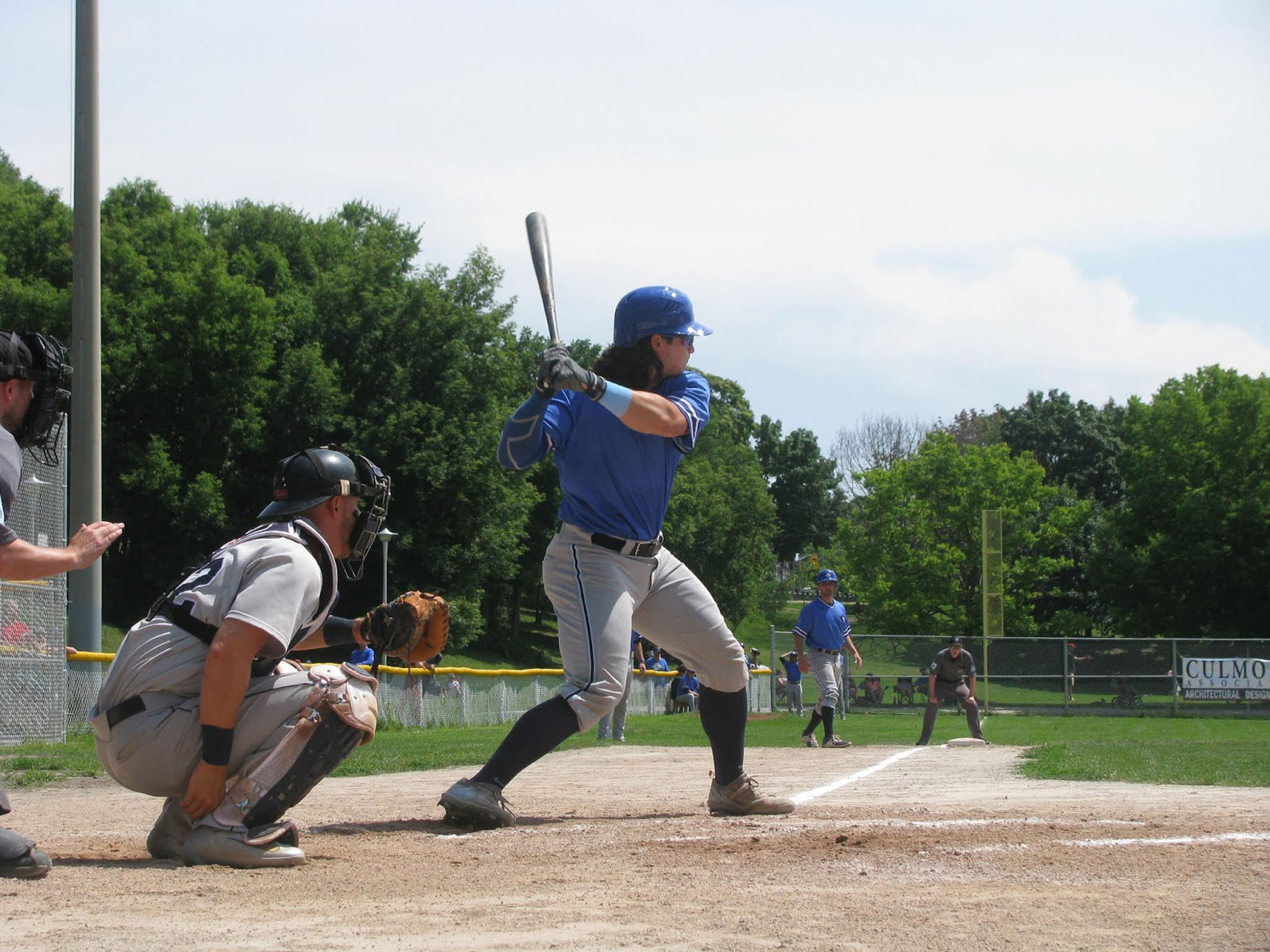
With his youthful energy, rookie Garrett Takamatsu became a fan favourite at Christie Pits this summer. R.S. KONJEK/GLEANER NEWS
By R.S. Konjek
It has been a memorable summer for Garrett Takamatsu.
Having completed his freshman year at Central Alabama Community College, the North York native signed up to play for the Toronto Maple Leafs of the Intercounty Baseball League.
A new face at Christie Pits, Takamatsu burst onto the scene with his youthful energy and aggressive approach at the plate. His athleticism allowed him to play first base, catcher, outfielder or designated hitter, depending on the day’s lineup. His thickset build and the flamboyant flow of dark hair that tumbles out from behind his cap made him an unmistakeable presence on the diamond. He quickly became a fan favourite.
In turn, he has become a fan of Toronto’s legendary sunken ballpark.
“Christie Pits, you’ll never play in another park like that,” he says. “People told me stories and they’re sure living up to it. It’s a really competitive league with a lot of older guys, so they all know what they’re talking about.”
For the first two months of the season, Takamatsu led the Leafs in batting and his performance earned him a surprise fan club. A group of regulars who come to every game began chanting his name before each of his at bats:
“Tak-Tak-Tak-Tak-Tak-Takamatsu!”
It caught on in no time. By season’s end, the entire ballpark was greeting his every appearance at the plate in full voice.
“There’s awesome fan interaction. It’s great having a group like that around,” he says with appreciation.
Takamatsu was one of several new additions that changed the character of the club. The Leafs bonded as a team and got off to one of their best starts in years, riding high in the standings through May and June. Their momentum came to a sudden halt in July, however, as a 10-game losing streak threatened to derail everything.
The good news is that the Leafs pulled it together and won their final two games of the regular season to finish fourth in the league standings. They entered the post-season with a modest head of steam. Their first-round playoff matchup was against the Guelph Royals, in a best-of-five series.
The Leafs jumped out to a 1-0 series lead with a victory at Christie Pits on August 9.
Takamatsu hit a game-winning home run to the delight of the home crowd.
The Royals won the next two games, meaning that the Leafs faced elimination and an early departure from the playoffs for the second year in a row.
The fourth game of the series was played in Guelph, and the Leafs seized the wheel, winning a 6-5 nailbiter in 10 innings. That set the stage for a fifth and final game at Christie Pits on August 15.
Years from now, thousands of people will say they were there, because history was made.
The series was closely fought without any blowouts for either team. Game five continued the pattern. It was a low-scoring affair, tied 2-2 until the bottom of the sixth inning. A scriptwriter could not have outlined what happened next.
Garrett Takamatsu happened. He stepped up to the plate and crushed a home run into the trees. It was another game-winning home run. The Pits went collectively insane, or at least boisterously batty.
The Royals were unable to respond, at which point fans began to notice that the Royals had not even recorded a hit all night. Their two runs were the product of a wild inning filled with errors, walks, and a hit batsman — but not one hit.
The delirium over Takamatsu’s big fly shifted to the mound, where Zach Sloan had just finished pitching six innings for Toronto. He was replaced in the seventh by Marek Deska, who needed to shut down the Royals for three more innings.
Deska is a longtime Leaf and seasoned veteran. He got through the seventh with ease, the eighth with barely a worry, and it was on to the ninth and a chance at history — a no-hitter.
No-hitters are rare in baseball and especially in the heavy-hitting Intercounty Baseball League. The league’s last 9-inning no-hitter was pitched in 1977 by Jesse Orosco (of New York Mets World Series fame).
What Deska was now attempting to complete was rarest of all. In the league’s entire 100-year history, no one had pitched a post-season no-hitter.
The first Guelph batter grounded out. The second one struck out swinging.
Destiny knocked on the door.
Deska reared back and struck out the final batter of the game.
A no-hitter!
Game over, and a series win for the Leafs. Sloan and Deska combined to achieve something no one had ever done before.
It will go down as one of the most historic nights of baseball at Christie Pits. Best of all, the Leafs now advance to the semifinals and the season rolls on. They will take on the Kitchener Panthers, hoping for a shot at the championship series.
No matter what happens next, Takamatsu says that this season has been something special.
“I’m going to miss this year for sure. The guys — this is an awesome group we had. I learned a lot here.”
Will he keep the hair when the season comes to an end?
“I’m going to have to cut it a little, I can’t leave it this long for school.”
Find the Toronto Maple Leafs’ complete postseason schedule at http://www.pointstreaksites.com/view/mapleleafs/home-page-720.
READ MORE:
SPORTS: Slumping Leafs hope to change (Summer 2018)
SPORTS: Many hats, one goal for Topolie (July 2018)
SPORTS: Maple Leafs back at the Pits (Election Special 2018)
NEWS: Celebrating a legendary Leaf (Jan. 2018)
ON OUR COVER: Cycling the Pits (Fall 2017)
SPORTS: Leafs fall early this summer (AUGUST 2017)
Tags: Annex · Sports
August 12th, 2018 · Comments Off on ON THE COVER: Pop up pit stop (Summer 2018)
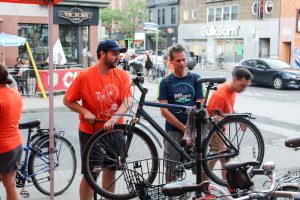
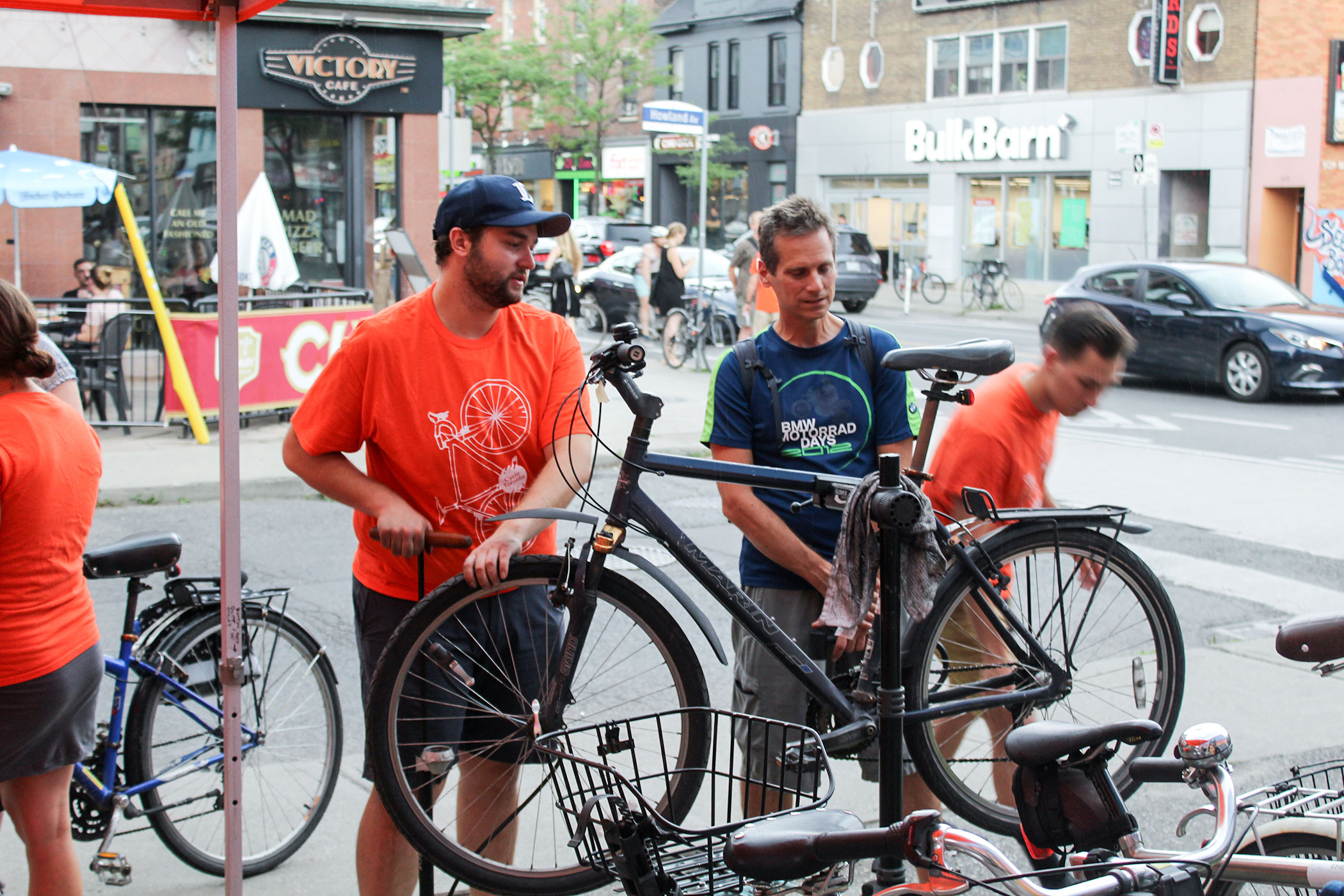
A bike undergoes a safety check-up at a pop up pit stop on Bloor Street West last month. The Bloor Annex BIA (whose chair publishes this newspaper) sponsored the safety checks, which were performed free of charge by Cycle Toronto staffers. Free check-ups will be offered again on August 14 on Bloor Street West at Howland Avenue by the bee mural. TEMI?DADA/GLEANER?NEWS
Tags: Annex · News
August 12th, 2018 · Comments Off on NEWS: First meeting on new Mirvish Village park (Summer 2018)
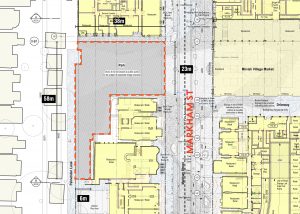
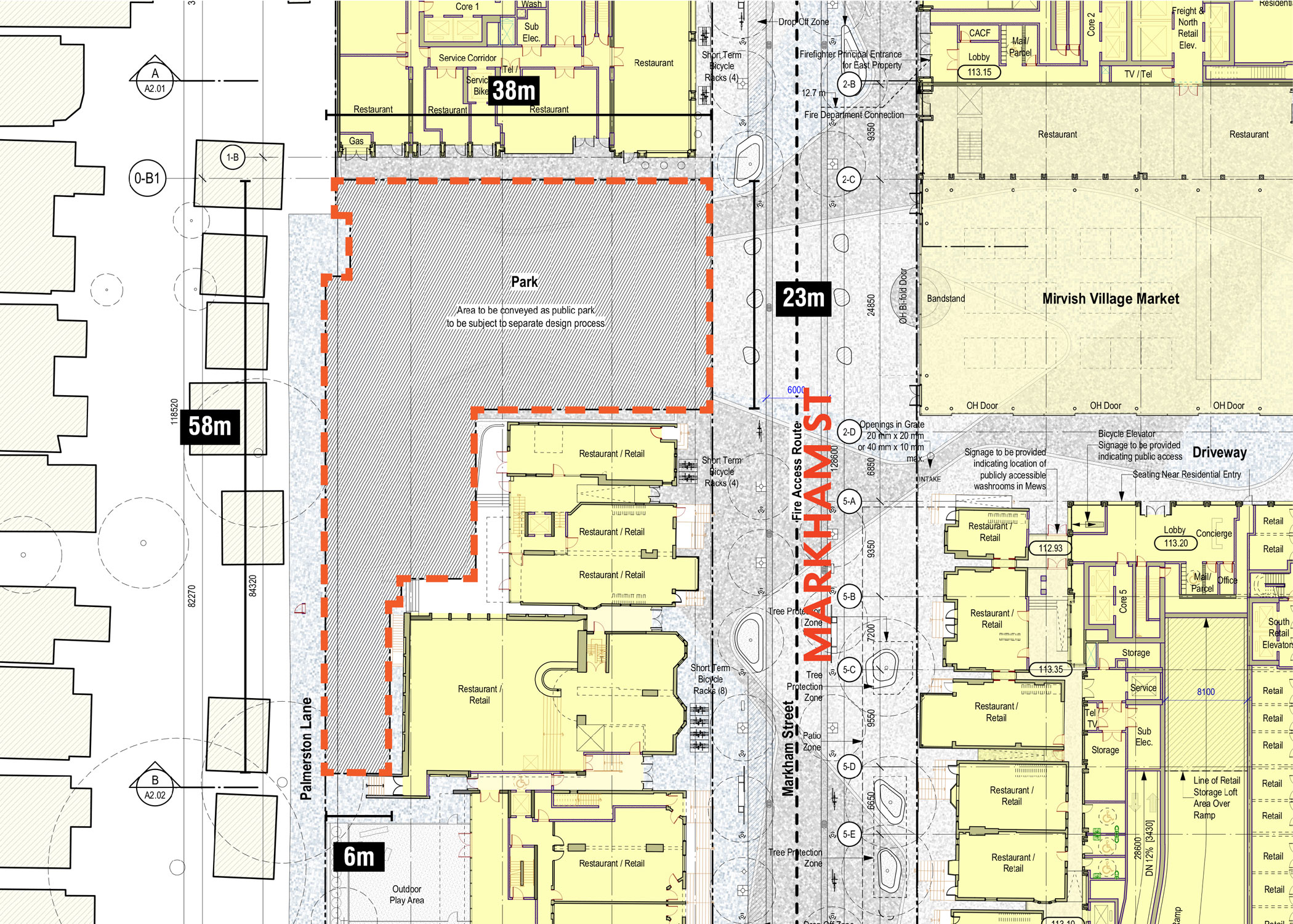
A preliminary drawing of the area that is set to become a new park as part of the Mirvish Village redevelopment. Local residents had their first opportunity to make suggestions for the design and features of the park at a meeting in early July. Courtesy of Janet Rosenberg & Studio Inc.
Plan is to make Markham Street an extension of the green space
By Ellie Hayden
Local residents had their first opportunity to contribute to the development of a new local green space at a public meeting on July 8. Part of Westbank Projects Corp.’s redevelopment of Honest Ed’s and Markham Street, the park meets bylaws that require new builds to include a green space. It will be paid for by the developer and, once built, maintained by the City of Toronto’s parks department.
Janet Rosenberg and Studio, the project’s landscape architect, will design the park, so it will share cohesive design elements with the development while remaining distinctly public. It will serve existing Annex-area residents, roughly 2,000 new residents in the development, and the thousands of shoppers who are expected to patronize the development’s 300,000 square feet of new retail.
“We want to make sure that the park offers something for all of those individuals to enjoy and that [the] elements can stand the test of time,” said Jonah Letovsky, a Westbank development manager.
With over a year of planning to go, Mike Layton (Ward 19, Trinity-Spadina) explained that “this was really just the first meeting to come up with the basic principles for how the community would like the park to function.”
Approximately 30 people including developers, landscape architects, city officials, residents, and other stakeholders attended the preliminary meeting, including Sue Dexter, who represents the Harbord Village Residents’ Association on the Mirvish Village Task Force.
After visiting several parks throughout the city, Dexter says the task force identified “a need for calming. The park should not be so much of an event space as it is a space for refuge.
“There will be a huge amount of busyness in the development as well as along Bloor Street, and the park tucked away from Bloor Street frames an opportunity to have more of a contemplative space.”
With activity and people bustling about, she envisioned the space as a sanctuary for residents and visitors to enjoy a cup of coffee or maybe people-watch. She was among many residents at the meeting who expressed an interest in extensive greenery, including plenty of trees to provide canopy and a peaceful water feature. The park will also include a mural on Markham House and other forms of public art.
One of the unique attributes of the park is its shape. The site, abutting Markham Street and overlooking the new shops, will wrap around the newly located Markham House and then continue along the Palmerston laneway.
At just over 1,200 square metres, several residents suggested that the park is too small.
“The biggest concern or anxiety is that the park is not large enough to do everything for everyone really well and so tradeoffs and choices are going to be made,” said Roy Sawyer of the Palmerston Area Residents’ Association.
Sawyer explained that the park is positioned within the neighbourhood to optimize sunlight throughout the day. To expand the limits of the park, more heritage buildings would have to be torn down, which both the city and the community have been adamant about preserving.
“Markham Street will be pedestrian first with lots of trees, greenery, public seating, etc. If Markham Street is successful, it will feel like an extension of the park,” said Letovsky.
Dexter characterized the meeting as promising.
“There was such a consistency in views. I think we’re on the same page and we understand the site very well now,” she said.
The park is projected to be finished within two years of the development’s completion.
Westbank will continue to consult with the landscape architect to make sure the design fits its plan for the entire site, and then the final designs will be sent to the city for approval.
The public will then have a chance to provide input through a series of public meetings as part of the review process.
“We’re really excited because hopefully this will achieve integration into the site as well as into the city’s network of parks,” said Layton.
Added Sawyer, “there’s a great opportunity to create a real jewel of a park here,” despite its small footprint.
READ MORE ON MIRVISH VILLAGE
CHATTER: Coming down (Nov. 2017)
EDITORIAL: Westbank’s positive precedent (April 2017)
NEWS: Westbank presents latest proposal (MARCH 2017)
FORUM: Build a neighbourhood (March 2017)
NEWS: Height, density still top concerns (July 2016)
NEWS: Westbank submits revised application (June 2016)
DEVELOPINGS: Annual review reflects tension between community activism and OMB (March 2016)
Westbank towers over 4 Corners (January 2016)
City hosts first Mirvish Village community consultation (November 2015)
Residents’ associations share concerns for Mirvish Village (October 2015)
Westbank submits application (August 2015)
BABIA endorses Westbank proposal (July 2015)
How do you make it real? (April 2015)
Tags: Annex · News
August 12th, 2018 · Comments Off on GRADING OUR GREENSPACE: The best and worst of local parks (Summer 2018)
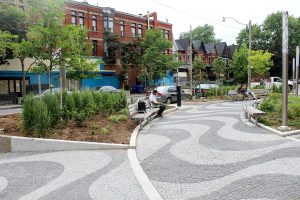
Brunswick-College Parkette has received an upgrade and a new name, Doctors’ Parkette. A well-maintained and tidy spot, it’s great place to catch a breather in the midst of the busy city. AHMED-ZAKI HAGAR/GLEANER NEWS
From Christie Pits to Robert Street Park
In this year’s final series of park reviews, we discover the best and the worst of our local green spaces. The best, exemplified by Christie Pits, feature wide open spaces, fields and courts, playgrounds and swimming pools, all of which are well maintained. The worst can be summed up with one word: neglect. We highlight Robert Street park in particular, as it earns the dubious distinction of earning an F grade for the fifth year in a row. Equally disappointing is Euclid Parkette, which resembles an abandoned laneway in a B-grade thriller movie. We hope these spaces will get some attention in the near future, but aren’t holding our breath.
By Geremy Bordonaro and Temi Dada
Sally Bird Park
194 Brunswick Ave.
Time: 2:15 p.m.
Grade: B (last year B-)
Reason to go: Located between two houses on Brunswick Avenue, smallish Sally Bird Park looks more like a very nice garden with a concrete walkway than a park. Ideal for getting away from the noise of the world, it seems designed for solo visits or couples looking for a break from the city’s buzz. The serene air complements the few benches, while two separate sets of workout equipment make Sally Bird a great spot for a low key workout. The City of Toronto has some work to do here — the water fountain, wall, and garbage bin have been recently vandalized with graffiti.
Overheard: Just your own voice…accompanied by chirping birds.
Did you know: The concept for outdoor workouts originates from the Great Depression, when it was feared the population’s physical fitness would decline because of a shortage of money.
The Doctors’ Parkette
15 Brunswick Ave.
Time: 3:00 p.m.
Grade: B (last year B)
Reason to go: Reopened last year with a new name, the Doctors’ Parkette (formerly Brunswick-College Parkette) has maintained its stylish and neat look. Shaped like an almond and surrounded by young trees, the park mixes concrete and greenery with aplomb. With plenty of seating, it’s a perfect spot to rest where Brunswick Avenue and College Street intersect, and we hope the park stays that way.
Overheard: “He just shot at him!” said a man while having an excited conversation with a friend about a movie.
Did you know: The Harbord Village Residents’ Association (HVRA) Brunswick-College design competition received 27 submissions from eight countries. The final design was chosen by HVRA members at the spring 2012 meeting.
Vermont Square
819 Palmerston Ave.
Time: 4:00 p.m.
Grade: A (last year A)
Reason to go: Balance. This park is one for everyone. Vermont Square Park is large in size with enough space for picnics, walks, seating, and shade from the plentiful trees, as well as a playground for kids. This active park has an air of excitement from kids playing and dogs gambolling about in the off-leash area. Even with the middle of the park undergoing maintenance to fix compacted soil and drainage issues, the park remains a must-visit.
Overheard: “Ice cream truck!”
Did you know: The playground is named for Dennis Lee, Toronto’s first poet laureate.
Hillcrest Park
950 Davenport Rd.
Time: 4:30 p.m.
Grade: A+ (last year A+)
Reason to go: Climbing the stairs from Davenport Road means Hillcrest Park can be a bit of a hike, but it’s worth every calorie burned. With three tennis courts, a stone tennis table, and a basketball court, Hillcrest has a clubhouse atmosphere. There’s also a large sand playground and wading pool. It’s a vibrant, well maintained park made for enjoying the moment. You can even lie on a blanket on the hill, admiring the city’s skyline while listening to the hum of the cool summer breeze.
Overheard: “I swear I touched it!” If only the attempted block had prevented the basket.
Did you know: Lake Ontario can be seen from the edge of the hill.
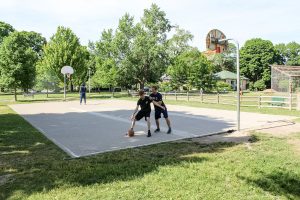
Hillcrest Park is a vibrant space with lots of activity. It has three tennis courts, a stone tennis table, a basketball court, sand playground, and wading pool. AHMED-ZAKI HAGAR/GLEANER NEWS
Margaret Fairley Park
100 Brunswick Ave.
Time: 4:30 p.m.
Grade: A (last year A-)
Reason to go: Officially reopened last October after a renovation, Margaret Fairley Park has a playground that looks like Tarzan’s treehouse. Well-positioned chairs beneath the shade of large trees provide a spot for lounging on a hot day, and the wading pool offers a place to cool off as the temperatures soar. This is an ideal space for a walk, a romantic oasis, and a spot for families and kids.
Overheard: “Go! Go! Go!” A mother laughed recording her dancing toddler son.
Did you know: Margaret Fairley Park, named for the writer, activist, and educator, first opened in 1972.
Queen’s Park
47 Queen’s Park Cres.
Time: 12:15 p.m.
Grade: A (last year B+)
Reason to go: Space. Even with half of the park closed for renovation, the other half is comfortably as large as any other park, if not larger. An island in a sea of cars, it is full of large trees that shade everything except the statue of King Edward VII, which basks in the glory of the sun. The park’s many paths can make it seem like an urban maze featuring campers in tents, university students, cyclists, and grandparents minding their grandchildren.
The grass is well trimmed, and the monuments — when not being renovated — are a thing of beauty. In fact, the renovation is the only reason the park remains a B+.
Overheard: “You’re going to sign for the Blue Jays?” A group of women teased a child as he played baseball with his dad.
Did you know: The renovation started March 12, 2018, and will run till October before the other half goes under renovation from October till August next year.
Aura Lee Playground/ Robert Street Park
Robert Street and Sussex Avenue
Time: 11:00 a.m.
Grade: F (last year: F)
Reason to go: None. We’ve graded this park an F for five straight years, and nothing has changed. There’s been no attempt to make it an asset for the community. All the courts, rinks, and facilities are slowly falling to pieces while a perfectly good playing field is locked off to the public. In January, we published an open letter by Nicholas Provart about the park’s history and the need to bring it back to life. Apparently, that has fallen on deaf ears.
Overheard: Nothing. Not even ghosts come to this park.
Did you know: The park is jointly owned by the City of Toronto and University of Toronto Schools, which may explain its eternally failing grade. Perhaps it’s time to end the never-ending game of “After you, sir.”
Euclid Parkette
711 Euclid Ave.
Time: 4:00 p.m.
Grade: F (last year D-)
Reason to go: DON’T. This is an eyesore. Only the ironically neat and new-looking city sign reading Euclid Parkette signals that this semi-abandoned walkway is actually a city-owned park. Unkempt, overgrown clumps of grass and flowers grow on either side of the dusty path that trails through the small park, decaying banana peels decorate rusting chairs, and flies buzz around waste from fast food restaurants, as if to add to the aura of decay. Bugs are the only thing attracted to this wasteland.
Overheard: Unintelligible conversation a man was having with himself as he walked by the sidewalk beside the park.
Did you know: Euclid Parkette is just a few blocks away from Christie Pits, one of the best parks in the area. Seriously, don’t go here.
Healey Willan Park
504 Euclid Ave.
Time: 12:45 p.m.
Grade: B (last year ??)
Reason to go: Located in a quiet neighbourhood, Healey Willan Park is perfect for children. At its heart is a large wading pool that is surrounded by chairs. The park is full of toys, and there are two playgrounds, one with playhouses and the other with swings and rides. Conducive to a quiet conversation or brooding alone, the park does need some work — there’s litter on the grass, aging toys that need to be replaced, and sand that should be cleared from the wading pool.
Overheard: “Talking about effort, like how dare you question my effort?!” said a young man to his friend, ranting about his relationship
Did you know: Healey Willan Park is where the Sisters of the Church convent was once located.
Christie Pits Park
747 Bloor Street West
Time: 4:00 p.m.
Grade: A+ (last year A+)
Reason to go: Home to a basketball court, two baseball fields, a swimming pool, and a playground, Christie Pits is one of the area’s best parks. There’s lots of hills (for sledding in the winter), trees, benches, and pretty flowers. This is a spot for getting active, and just as easily a spot to relax. With so much to do, there’s always people in the park, and many community events are hosted there. In fact, it’s not unusual to light upon an impromptu musical jam, or even a pick-up game of basketball.
Overheard: “Okay now watch me hit this hill!”—Skateboarders, shooting a YouTube video.
Did you know: You can watch a different film every Sunday night in the summer courtesy of the Christie Pits Film Festival (christiepitsff.com).
READ MORE:
GRADING OUR GREENSPACE: More attention to green spaces means parks are improving (July 2018)
GRADING OUR GREENSPACE: Parks on the fringe (AUGUST 2017)
GRADING OUR GREENSPACE: Open spaces in the heart of the Annex (July 2017)
GRADING OUR GREENSPACE: Survey reveals significant upgrades (June 2017)
GRADING OUR GREENSPACE: Meet our parks supervisor (August 2016)
Part two of our 2016 parks review (July 2016)
PART ONE: Green sanctuaries in the heart of the city (June 2016)
Grading our Greenspace (2015)
Tags: Annex · Columns · Life
August 12th, 2018 · Comments Off on NEWS: Slowing the flow (Summer 2018)
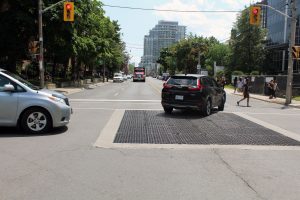
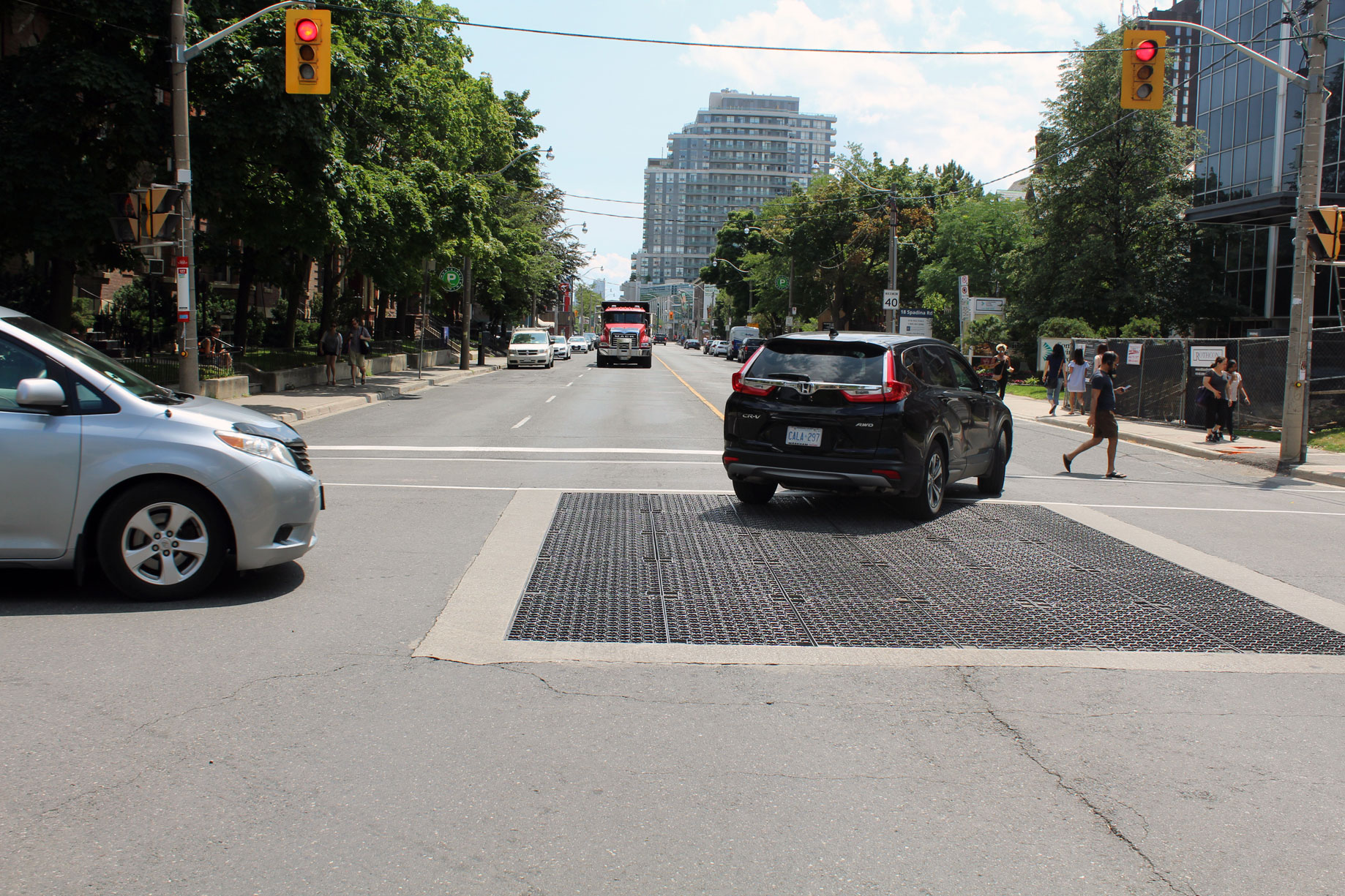
Spadina Road from Bloor to Dupont streets will be narrowed to create a safer space for pedestrians and cyclists. The new lanes will be installed in August, with tree planting and the widening of the sidewalks done at a later date. COURTESY MARTIN REIS
City moves to narrow car lanes on Spadina Road
By Temi Dada
Following an active campaign led by Sandra Shaul and other members of the Annex Residents’ Association (ARA), the City of Toronto is moving to give pedestrians a little more space (and safety) on Spadina Road.
“I’m not a downtown elitist who hates cars. I’m a downtown person that gets from A to B by walking or cycling. Cars are not the best way to get around so you have to respect other modes of transportation and make them safe,” said Shaul about her initiative to reduce the dangers of Spadina Road, particularly between Bloor and Dupont streets, where the road is wider than other parts of Spadina Road.
[pullquote]“The intention is to separate motorists slightly further away from the pedestrians on the sidewalk” —Bruce Clayton, manager, traffic operations[/pullquote]
“The priority is the safety of citizens. As the city continues to grow, we have to redesign our streets from the focus of moving cars swiftly to moving pedestrians safely,” said Joe Cressy (Ward 20, Trinity-Spadina). “This is important in our downtown neighbourhood where many cars are driving in and out of the city to get to work, which is all the more reason to ensure that it is safe for the people walking or living nearby.”
The City of Toronto plans to slow traffic down in the area by narrowing Spadina Road between Bloor and Dupont streets and make wider sidewalks while retaining the road’s four-lane format. The road is currently 15.2 metres wide, and each lane is 3.8 metres. The narrowed passing lanes will be 3 metres, and the curb lanes will be 3.3 metres. The new lanes will be painted in August, with tree planting and widening of the sidewalks done at a later date, still not set.
“The intention is to separate motorists slightly further away from the pedestrians on the sidewalk to create a bit of a buffer area and increase pedestrians’ feeling of comfort walking on the sidewalk,” said Bruce Clayton, manager of traffic operations for Toronto and East York. “It is also hoped that by narrowing the lanes, motorists will reduce their speeds.”
Shaul has lived in three houses in the Annex over the course of 32 years, and calls that section of Spadina Road a racetrack, having seen various accidents in the area.
She also says the sidewalks and appearance of the street are due for an upgrade.
“My husband and I can’t walk side by side on Spadina Road because you might bump into a telephone pole or a parking meter.”
Her vision includes bringing back grassy boulevards and the tree canopy that once used to mark the street.
“We want safety and we want the city to look beautiful,” she said.
The city will also add two new traffic lights on Spadina Road next year. One will be between Bloor and College streets, and the other near Blue Butterfly Montessori School. And a new mid-block traffic control signal was approved for Spadina Road between Bloor Street and Lowther Avenue.
“These drivers think that when we want to ride our bicycles and walk it is just a nice recreational activity when all we really want is alternative forms of transportation,” said Shaul. “That’s why we need to improve the transit structure.”
Tags: Annex · News
August 12th, 2018 · 1 Comment
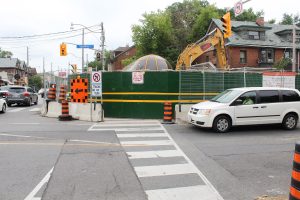
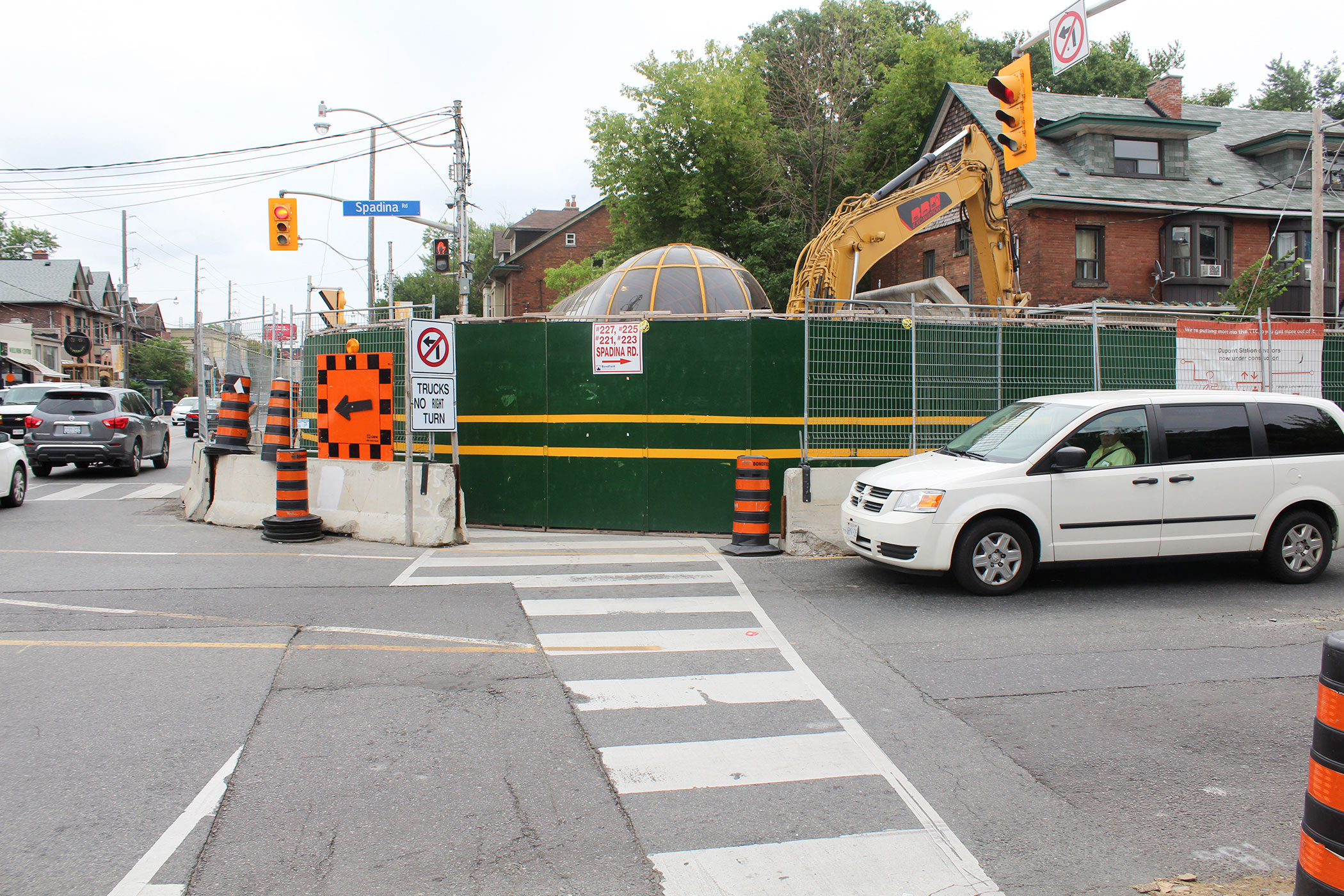
The Toronto Transit Commission (TTC) recently announced that construction would be delayed one year at Dupont Station due to difficulties with the third-party contractor in charge of the project. Elevators are being installed at the Dupont Street and Spadina Road station, which has led to regular traffic delays at the intersection.
“It is another issue of a city in constant traffic chaos,” said David Harrison, chair of the Annex Residents’ Association. “It doesn’t matter where you try to get to, you can’t get there. It is very disruptive, it creates traffic problems, [and] people get frustrated because it takes so long to get anywhere. I hope the construction is complete soon.”
Joe Cressy (Ward 20, Trinity-Spadina) characterized the delay as “unacceptable” and said that the TTC will monitor work at the site for six weeks, and request a recovery schedule for the lost time.
“Our objective is to get this service there as soon as possible,” said Stuart Green, a senior communications specialist with the TTC. “We have an obligation to our customers and we want to make the station accessible to everybody but we can’t do that without the support of our contractor.”
Green added that it is not yet clear whether the TTC will issue financial penalties to the contractor, because meetings between the TTC and the contractor about completing the project sooner are still ongoing.
However, that is not the only problem with the construction.
“That station is many decades old. It was not built to accommodate an elevator so we have to go in and completely reimagine what the station would look like with the inclusion of an elevator,” said Green. “This station is very compact and very condensed within the neighbourhood. You have the busy roadway above and the little room around to work it which makes it more challenging to work in.”
The Dupont Station construction is part of an ongoing initiative to make the TTC more accessible. Currently 44 stations are fully accessible, and Green says the TTC wants all of its 75 stations to be accessible by 2025.
—Temi Dada/Gleaner News
Tags: Annex · News
August 12th, 2018 · Comments Off on CHATTER: Harbord athlete hits the Major League (Summer 2018)
The Harbord Collegiate Institute varsity baseball team will have to make do without its star catcher when it resumes play in the fall.
Tillie Burlock, 15, their starting catcher, who helped lead the team to a Tier 2 championship, has moved on to Silverthorn Collegiate Institute, where she’ll participate in the Toronto District School Board’s elite athletes program. She played for Harbord for two years, and was a starter even in her rookie year in grade nine.
“I could tell right away she has a strong arm, great fielding, great positioning and she just had all the fundamentals down. She was impressive when we got to hitting, she makes good contact and she almost never strikes out. She is a great base runner too,” said Greg Smith, Harbord’s baseball coach.
Her skills and performance earned her a trip to Florida in June to participate in the Major League Baseball’s (MLB) first-ever Girls Baseball Breakthrough Series. One of 65 girls at the camp, she was the only Canadian.
“She has everything it takes to get involved with baseball and nothing will stop her from going as far as she can,” said Smith. “Besides being an amazing baseball player, Tillie is an extraordinary student as well. She can do whatever she wants and she will be good at it.”
Though Burlock’s natural position is second base, she excelled as last season’s catcher. The position switch happened during the final game of the prior season when injuries to the starting and backup catcher meant the position was vacant, until Burlock volunteered, proving to be a revelation.
“That is what Tillie is like, she is the perfect player on the team. She never complains, she shows up for everything, she will do whatever it takes. She never says anything negative about anybody, even calling people out if they are being that way, which is pretty brave for someone in Grade 9,” said Smith. He’s positive that Burlock made the most of the camp, and said he hopes to see female MLB players in the future.
“It is a great idea…. I love baseball and there is no reason why women should not be encouraged to participate. Tillie is an example of what baseball should be. A sport which encourages boys and girls to play. It seems like that is happening late but better late than never.”
—Temi Dada/Gleaner News
Tags: Annex · News · Sports
August 12th, 2018 · Comments Off on EDITORIAL: Reclaiming our city (Summer 2018)
Doug Ford announced his intention to cut Toronto City Council from 47 to 25 members last month. Coming when the municipal election had already begun, without notice or consultation, this move is a threat to our right to be represented equitably and effectively. While this bombshell seems to have taken everyone by surprise, it’s certainly nothing new. We thought it fitting to reprint a May 1997 forum piece by Evelyn Rupert in lieu of an editorial. It has been edited for length.
This is just the end of the beginning of a long struggle against the provincial take-over of local government and democracy in Metro Toronto.
Citizens and communities have their work cut out for them as they confront the Tory implementation machinery and try to reclaim what has been unilaterally been taken away from them in the name of municipal reform.
Will the dialogue on the principles of local democracy continue? During the past few months a space has opened up for public debate about democracy and citizenship for public policies: whether it is civic institutions (municipal governments and school boards), public institutions (hospitals and libraries) or public resources (water).
A space has been created for public dialogue about the implications about transferring control away from locally elected governments to provincial bureaucracies and appointees, and away from governments to presumably arms-length and unaccountable commissions.
In this political context, how can the public dialogue be sustained and advanced to challenge the powerful corporate, private, and provincial interest that will continue their agenda of appropriating public and civic institutions?
Many groups, forums, and individuals have emerged as strong voices challenging official definitions and established claims about what constitutes a democracy. Diverse interests and groups have undertaken numerous activities, bringing to the debate a lot of concerns and issues, but with agreement on a few fundamental principles about democracy and active citizenship.
One of the major strengths of what may well be an emerging citizens’ movement, has been the bringing together of these diverse interests, of a coalition of interests that cut across the political spectrum, that goes beyond left and right. As such, it has been a mirror of the city itself — as a place where the people come together with their differences.
It’s a movement that has found Citizens for Local Democracy as an umbrella or coalition group, joined by numerous other groups — which have all come together at key moments.
The provincial government and its supporters are self-declared revolutionaries who are attempting to overthrow local democracy. They are taking over the city.
The best hope for maintaining the public dialogue on democracy and challenging the strong corporate and provincial interests is the sustained actions of the diverse groups who have been reclaiming citizens’ rights to the governance of the city.
Being engaged, being an active citizen of Toronto is no longer merely a right; it has now become a necessity, a responsibility. But the challenge ahead is to harness the energies that have arisen from diverse citizens in the past few months and channel them into an effective movement. The work has just begun.
READ MORE EDITORIALS:
EDITORIAL: City staff ignore bike lanes (July 2018)
EDITORIAL: The market has no moral compass (Election Special 2018)
EDITORIAL: Lessons to be learned from Excessive Force (Spring 2018)
EDITORIAL: A social contract is a precious thing (March 2018)
EDITORIAL: Intolerance leading to Quebec’s decline (Dec. 2017)
EDITORIAL (Nov. 2017): Student safety suffers as trustees cave
EDITORIAL: Pandering to religious intolerance (October 2017)
EDITORIAL: Bike lanes, good for business (Fall 2017)
EDITORIAL: Don’t sacrifice safety for political gain (August 2017)
EDITORIAL: Thank you Mr. Asti (July 2017)
EDITORIAL: A watershed moment (June 2017)
EDITORIAL: Revoke U of T’s unchecked “licence to build” (May 2017)
EDITORIAL: Westbank’s positive precedent (April 2017)
EDITORIAL: Foreign buyers tax a necessary cliff jump (March 2017)
Tags: Annex · Editorial · Opinion
August 12th, 2018 · Comments Off on EDITORIAL CARTOON: How Nice (Summer 2018)

More how nice!
EDITORIAL CARTOON: How Nice (July 2018)
EDITORIAL CARTOON: How Nice (Election Special 2018)
EDITORIAL CARTOON: How Nice (May 2018)
EDITORIAL CARTOON: How Nice (Spring 2018)
EDITORIAL CARTOON: How Nice (Mar. 2018)
EDITORIAL CARTOON: How Nice (Dec. 2017)
EDITORIAL CARTOON How nice! (August 2017)
EDITORIAL CARTOON How nice! (July 2017)
EDITORIAL CARTOON: how nice! by blamb (June 2017)
EDITORIAL CARTOON: TCHC (May 2017)
EDITORIAL CARTOON: The Grand Tory (April 2017)
FORUM: Celebrating 20 years of cartoonist Brett Lamb (April 2017)
EDITORIAL CARTOON: A second chance! by Brett Lamb 2037 (February 2017)
EDITORIAL CARTOON: Not really! It’s actually nice! by Stumpy the Subway(January 2017)
Tags: Annex
August 12th, 2018 · Comments Off on FORUM: Why I’m running for re-election (Summer 2018)
Building a more livable and caring city
By Joe Cressy
It’s been four years since I was first elected to represent Trinity-Spadina on Toronto City Council. It has been both an exhilarating and, at times, exhausting experience. I’ve loved every minute of it.
Our ward is a truly diverse and vibrant collection of neighbourhoods: the central Waterfront and the Entertainment District, vertical neighbourhoods like CityPlace and the historic Grange neighbourhood, Queen West and Kensington Market, Chinatown and the University of Toronto, Huron-Sussex and Harbord Village, and of course the neighbourhood I was raised in, the Annex. In so many ways, our downtown community reflects the very best of our city.
In so many ways our beloved City of Toronto is doing well, exceptionally well. Amidst the strife and rhetoric regarding immigration south of the border and in parts of Europe, Toronto has become a model for how we all live together. As global talent and jobs move across borders, Toronto has become a tech and creative economy destination with the Googles, Amazons, and Thompson-Reuters of the world looking to us. And, you only have to look up at the cranes in the sky to see first-hand the nearly decade long (and continuing) demand for growth in our city.
In so many ways, Toronto is becoming a welcoming, intelligent, and smart twenty-first-century city. This is no small measure and we should be proud of it.
However, as our city sprints forward, far too many people are being left behind. According to the United Way, Toronto is now the inequality capital of Canada with 25 per cent of adults and 29 per cent of children living in poverty. More than 181,000 people are on the waiting list for affordable housing, and that list is growing every year. And even for those doing well, buying a home (let alone renting one) is becoming less affordable every day. These facts are simply unacceptable in a city as wealthy as ours.
I was brought up in a household where I was taught that we should measure ourselves, and our society, by how well we treat others. Sadly, on this metric, as a city we are letting people down.
I believe deeply that the role of our civic government is to make our city more livable for those fortunate enough to be doing well, and to provide the infrastructure and supports to care for those who are struggling. This is why I am running for re-election, to build a more livable and caring city.
On both fronts there is so much more that we can do. As downtown continues to grow in height and density, we must ensure that we are building the social infrastructure to ensure that downtown remains livable.
That means continuing to invest in the parks, community spaces, and childcare centres that make downtown accessible and enjoyable. It means investing in the pedestrian, cycling, and public transit infrastructure to ensure downtown residents can continue to get around in an urban century that will be driven by active, rather than vehicular, transportation.
It means redesigning our streets to move people around safely, rather than cars quickly. And it means creating the tax and economic incentives to support small and independent businesses as well arts and culture. Taken together, it’s this vision for a livable and vibrant downtown that I want to continue working towards.
However, just as our work to build a livable downtown is necessary, my passion for addressing inequality is what wakes me up every morning. I simply cannot accept living in a city where only the fortunate can thrive. Building affordable housing, investing in the health and social services to end homelessness, and supporting strong and safe neighbourhoods to end the cycle of violence. A truly equitable city and downtown is not a dream, it is a platform that can and must be implemented by city council.
When I first ran for city council four years ago I was driven by the issues, but if I’m being completely honest, part of it was also about myself. There was some ego involved as well.
Four years later and I’ve been humbled. I’ve learned that the best form of politics is one where people are empowered to improve their own neighbourhoods. That’s what this is all about, working together to build a more livable and equitable downtown for all. I hope to have the opportunity to continue doing just that with you.
Joe Cressy is the councillor for Ward 20, Trinity-Spadina. He submitted his forum piece before the premier announced his plan to cut the number of city councillors.
Joe Cressy is a candidate for election in the newly created Ward 24.
READ MORE BY JOE CRESSY:
FORUM: Small businesses create a liveable city (March 2018)
FORUM: Looking back on 2017 in Ward 20 (Dec. 2017)
FORUM: Establishing a new Indigenous Affairs Office (Nov. 2017)
FORUM: Toronto — an artistic city (FALL 2017)
FORUM: Address affordable housing (June 2017)
FORUM: Build a neighbourhood (March 2017)
FORUM: Conserving past to enrich future (January 2017)
FORUM: Our dynamic Kensington Market (November 2016)
FORUM: A new central park for Toronto (September 2016)
Tags: Annex · Opinion
August 12th, 2018 · Comments Off on GREENINGS: Nurture the neighbourhood by cultivating green canopy (Summer 2018)
Replace those trees lost to weather and politics
Thanks to Premier Doug Ford, gas will be cheaper and our lungs fuller of it than ever since there will be no incentives to buy an electric vehicle. Thanks to this Neanderthal, we are now back to debating whether or not science is a thing.
Thanks to the premier’s late brother, we also have a less healthy tree canopy to suck up all the excess carbon and pollutants spewed by the dirty cars he wants to keep on the roads at lower cost. Rob Ford had slashed Toronto’s tree maintenance budget and voted against investing in planting new trees.
[pullquote]Neighbourhoods with a lot of tree coverage are shown to be healthier than neighbourhoods without.[/pullquote]
Earlier this year, we lost a lot of trees in this neighbourhood due to a combination of ice and wind storms. Entire trees were uprooted in some areas and, in at least one case, ended up on top of a house. Cars were smashed and we are lucky nobody died (though there was one loss of life in the Mississauga area).
The Annex Residents’ Association’s Trees Please project has given us a good handle on how many trees are in the neighbourhood (about 10,000), but not a good handle on how many have been lost to these global warming linked weather events. We know it’s a lot, just by walking around, but exact numbers elude us.
It is hard to overstate the importance of the tree canopy.
A tree, especially a mature one, sucks up carbon and locks it away in its roots and trunk. It also helps filter the pollutants out of the air. Neighbourhoods with a lot of tree coverage are shown to be healthier than neighbourhoods without.
A 2015 study by researchers from Toronto, Chicago, and Adelaide used data from Toronto to suggest that cardio-metabolic conditions decreased in ways that were comparable to a median income increase of 20,000. While the study included several caveats and did not speculate for the reason behind this correlation, I have a few theories.
My first theory is that trees make a neighbourhood walkable. Thanks to the generous tree canopy, it is always lovely to walk to where you need to go. We have a walkable neighbourhood, where most of what we need is within walking distance.
Contrast this to where I used to live in Brampton. I would walk out of my apartment and be greeted by a massive parking lot. Walking to the shopping complex across the street was not very pleasant as you might get burned to a crisp in the summer. In the winter, there was nothing blocking the wind. Shamefully, we often drove to the plaza that was honestly less than 200 metres away. I have no doubt that trees making a neighbourhood more walkable contributes greatly to overall health.
Sadly, the tree loss this year has been substantial. A walk along Wells Street during the mid afternoon no longer provides a pedestrian with any shade. One tree stands majestically tall with all but the main trunk now trimmed. Without a single leaf, it could be a long time before it sprouts new limbs again.
If you lost a tree, I cannot stress enough the importance of replacing it. If you have a good spot for a tree, please stick a sapling in it.
Choose a native species that will thrive (not a Norway maple) and provide the children who grow up here with pleasant walks around the neighbourhood as they grow up to be adults. Invest in our neighbourhood and the health of our community. We need these trees.
If you lost a tree to tell us about or would like to get involved with our tree canopy preservation efforts, please contact parksandtrees@ theara.org.
We would very much like to get a handle on what was lost.
Terri Chu is an engineer committed to practical environmentalism. This column is dedicated to helping the community reduce energy and distinguish environmental truths from myths.
READ MORE BY TERRI CHU:
GREENINGS: Results beg for electoral reform (July 2018)
GREENINGS: Choosing the lesser evil (Election Special 2018)
GREENINGS: Reduce, reuse, and then recycle (May 2018)
GREENINGS: Car-free parenting is not rare (Spring 2018)
GREENINGS: The science of board games (Mar. 2018)
GREENINGS: Driving fuelled by unseen subsidies (Jan. 2018)
GREENINGS: No solutions for nobody’s problem (Dec. 2017)
GREENINGS: Celebrate science not milestones (Nov. 2017)
GREENINGS: Down to the data (Oct. 2017)
GREENINGS: Reducing paper waste (Fall 2017)
GREENINGS: Taking tolls to the Gardiner and Don Valley Parkway (July 2017)
GREENINGS: Lessons from Madrid (June 2017)
GREENINGS: Thoughts on hitting the 400 benchmark (May 2017)
GREENINGS: Solving the food waste problem (April 2017)
GREENINGS: Kellie Leitch was right (March 2017)
Tags: Annex · Opinion