October 16th, 2018 · Comments Off on ON THE COVER: Laneway lit up (October 2018)
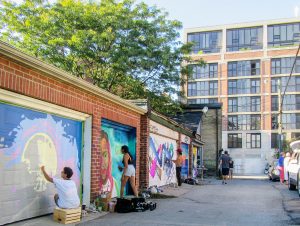
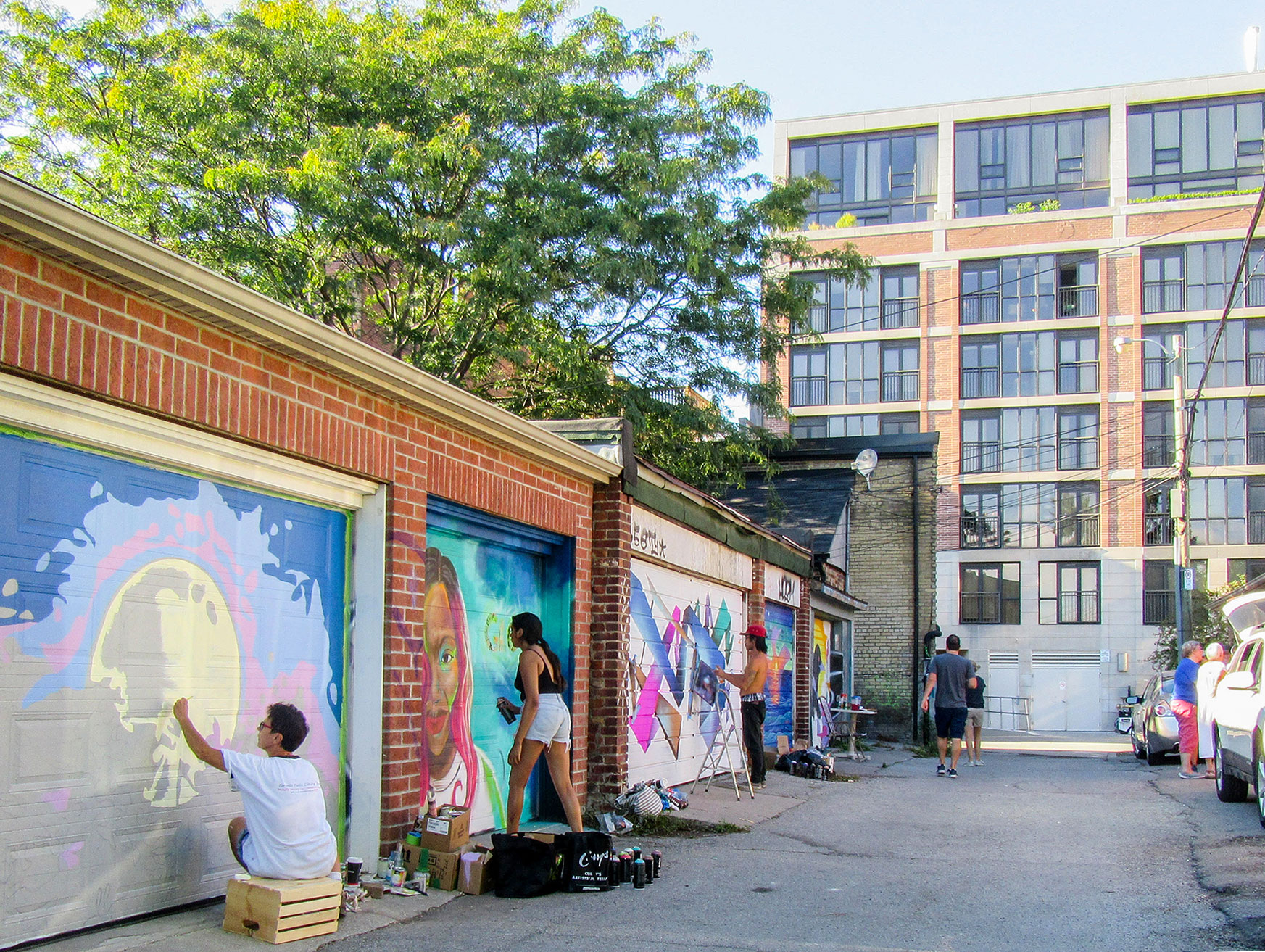
Mural and street artists transformed tagged garage doors in the Euclid Avenue-Palmerston Boulevard laneway into animated, colourful canvases on September 15 and 16. The event celebrated the Laneway Light Up project, and was sponsored by StreetArt Toronto, a City of Toronto program that reduces graffiti vandalism by replacing it with community-engaged street art. Other participants included KJ Bit and Open Field Collective. ELLIE HAYDEN/GLEANER NEWS
MORE COVERS:
ON THE COVER: Bringing it to the table for 40 years (Aug./Sept. 2018)
ON THE COVER: Pop up pit stop (Summer 2018)
ON THE COVER: Ghost bike installed (July 2018)
ON THE COVER: The Ballot Bunch (Election Special 2018)
ON THE COVER: Accidental Parkland (May 2018)
Tags: Annex · News
October 16th, 2018 · Comments Off on NEWS: Funding for Indigenous housing (October 2018)
Affordable units made possible by development charges
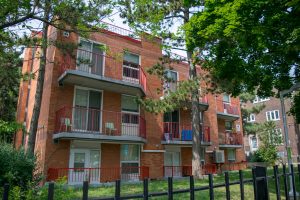
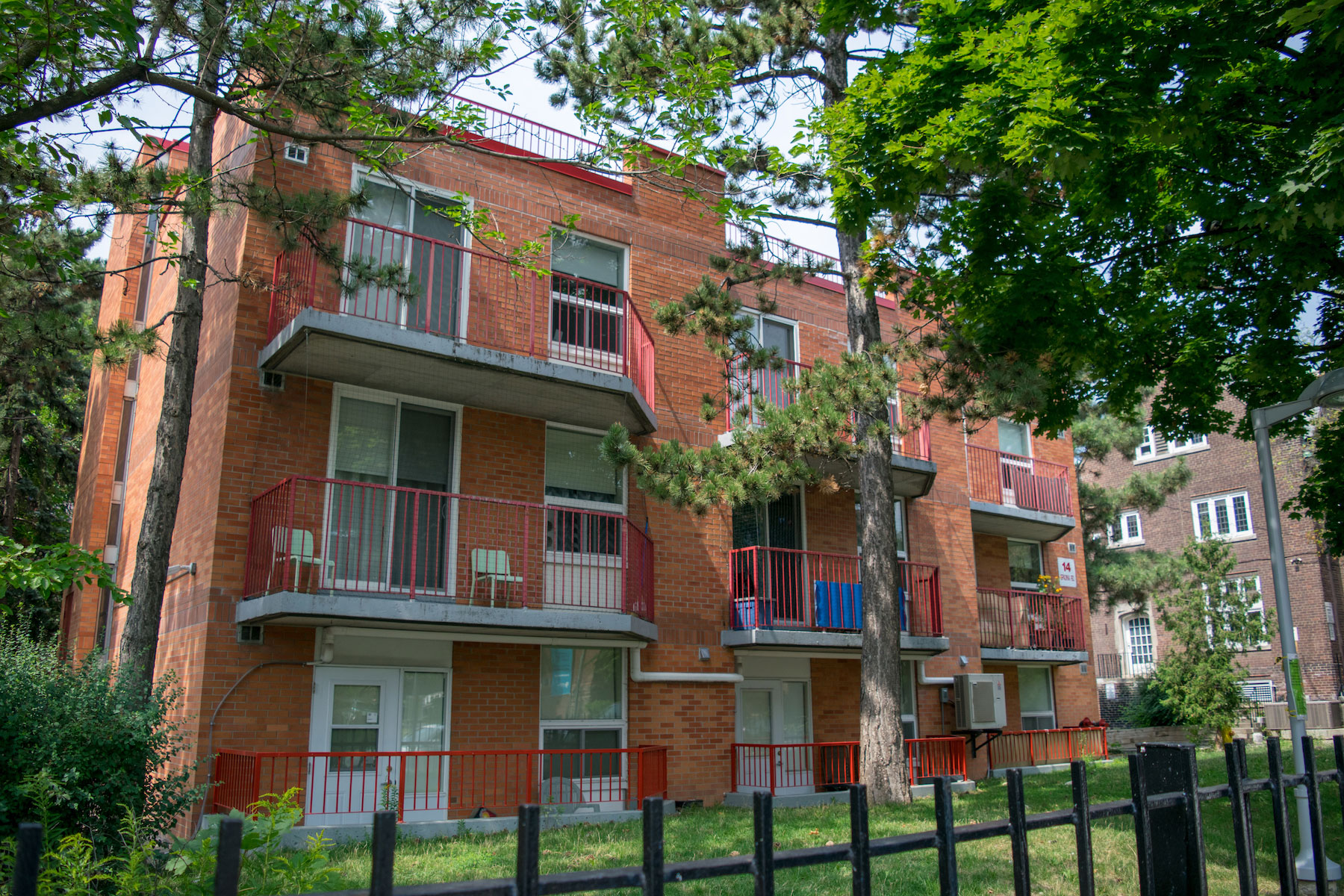
Spadina Road’s Wigwamen Terrace will receive $700,000 from the city to add 24 affordable housing units for Indigenous seniors. AHMED HAGAR/GLEANER NEWS
By Ahmed Hagar
Wigwamen Terrace (14 Spadina Rd.) has received $700,000 to fund a three-storey expansion that will add 24 new affordable housing units for Indigenous seniors. Toronto City Council approved the funding late last month.
“What this does is ensure that Indigenous seniors can continue to live in downtown Toronto and that the Annex can continue to be a truly mixed-income neighbourhood and truly compassionate, complete community,” said Joe Cressy (Ward 20, Trinity-Spadina), who sponsored the motion approving the funding.
Wigwamen contacted Cressy last year about finding money to expand the building, and raised $1.1 million for the expansion. This also includes funds received from two local developments, including the 666 Spadina development.
Cressy worked with the Annex Residents’ Association (ARA) and the Harbord Village Residents’ Association (HVRA) on bringing the project to fruition.
ARA chair David Harrison said that the association’s planning and zoning committee reviewed the plan to expand the Spadina Road apartment building.
HVRA chair Gail Misra said that Cressy asked her association if it would be okay to use Section 37 money being held for the community for expansion, which she approved because it was an extremely worthwhile project.
(Section 37 is a section of the Planning Act that allows the city to approve projects that exceed height and density zoning limitations in return for community benefits.)
“Even though Wigwamen is outside the boundaries of the Harbord Village area, our board was unanimously supportive of the creation of more affordable housing in our general community, and especially for Indigenous community members,” said Misra.
Built in 1979, the Wigwamen Terrace is a 104-unit apartment building that provides affordable housing for Indigenous seniors. Each unit is a wheelchair-accessible one bedroom with a private balcony. Wigwamen is also part of Open Door, a city program that aims to build up to 7,000 affordable homes to buy or rent by 2020.
The Terrace is owned by Wigwamen Incorporated, a non-profit organization that is the oldest and largest provider of urban affordable Indigenous housing in Ontario. They also have two other apartment buildings in Scarborough, Estorada at 228 Galloway Rd. and Waabnog at 20 Sewells Rd., along with 214 housing units throughout the city.
“The way the building is designed is there is a six-storey section and a three-storey section,” said Angus Palmer, Wigwamen’s general manager. “What this proposal relates to is the addition of 24 units over top of the three-storey section so that it will be built up to the six-storey level.”
The average rent of a one-bedroom apartment in Toronto rose by almost 9 per cent in 2017, and the vacancy rate is at 1 per cent, the lowest in 16 years. The trend continued in the first half of this year, according to a report from Urbanation, a real estate research firm. It also showed that almost half of renters pay more than 30 per cent of their income towards their rent.
Cressy said home affordability and availability is a citywide issue that should be addressed.
“We have a waiting list for affordable housing for about 181,000 people,” he said. “Increasingly, downtown Toronto is becoming unaffordable, which speaks to the pressing need to ensure that we continue to build more affordable housing.”
According to a report by Dr. Janet Smylie, an Indigenous health researcher at St. Michael’s Hospital, there are between 34,000 and 69,000 Indigenous people living in Toronto, which is approximately two to four times more than what’s reported by the census. Her report ascribes this difference to the more than one third of Indigenous Torontonians who live in precarious housing or experience homelessness.
This means Indigenous seniors are at greater risk, said Palmer, and that the Wigwamen Terrace expansion is “one small step towards providing deeply affordable housing for people who are in great need of it”.
“If you take a look at the income profile of Indigenous seniors, you will find the vast majority of them are on pensions,” he added. “In truth, it is not possible for someone to find housing if they rely on [Canada Pension Plan] or [Old Age Security].”
Cressy said affordable housing can solve many of the city’s challenges, and that providing housing is not just the smart thing, but the moral thing, to do.
“When someone has a home, they can go to work,” he said. “When a senior has a home, they can take care of their grandchildren. When a kid has a home, they can go to school. Housing is very much the solution, not just the challenge.”
Palmer said the federal and provincial governments must act to help the Indigenous community.
“It is time to move beyond consultation and it is time to actually roll out an affordable housing program for urban Indigenous people,” he said.
Tags: Annex · News
October 16th, 2018 · Comments Off on NEWS: Election chaos (October 2018)
Council cuts a concern
By Ellie Hayden
Local residents’ associations, business improvement areas, and community organizations are concerned that reducing Toronto City Council from 47 to 25 seats will wreak havoc with the business of the city in their neighbourhoods.
“Clearly Ford is going to put his foot down wherever he feels like putting his foot down,” said David Harrison, chair of the Annex Residents’ Association (ARA), of the premier’s threat to use the notwithstanding clause.
The notwithstanding clause refers to Section 33 of the Canadian Constitution, which allows governments to pass laws that may contravene the Charter of Rights and Freedoms, after a judge rules a law unconstitutional.
The provincial government introduced legislation that invoked the notwithstanding clause after the Superior Court of Justice ruled that reducing city council in the midst of an election breached the charter’s freedom of expression clause.
Harrison recently sent a letter to all Members of Provincial Parliament urging them to exercise their free vote to “truly represent the people of Ontario” and to “vote NOT to use the notwithstanding clause”.
“I think there’s shock, I think there’s dismay, and I think there’s astonishment,” said Sue Dexter, who sits on the board of the Harbord Village Residents’ Association (HVRA), of the cuts to council. “The astonishment is that there have been no breaks on a premier who said he wants to rule the roost. But if he’s going to do that, this isn’t the way to do it.”
The issue became moot after the Ontario Court of Appeal stayed the lower court’s ruling, essentially setting it aside pending appeal, and allowing the province’s cut to go ahead.
Joe Cressy (Ward 20, Trinity-Spadina) will now be running in the new Ward 10, Spadina-Fort York, which is south of the Annex, and Mike Layton (Ward 19, Trinity-Spadina) will be running for councillor in new Ward 11, University-Rosedale.
Brian Burchell, chair of the Bloor Annex and Mirvish Village BIAs (who also publishes this newspaper), characterizes city councillors as the squeaky wheels of municipal government who often kick-start action that’s been delayed by city bureaucracy.
He’s worried that councillors under the 25-ward system will “have too many constituents to serve, on average 110,000 each, and they will have to cherry-pick the files that get their attention.”
“The presumption is that…each councillor will have to have a much larger staff to accommodate the needs of the ward,” said Harrison. “All of a sudden we have to train new people. It’s going to be a lot of work.”
For Sue Dexter more staff isn’t always an effective solution.
“Staff can field some things really well, but if it’s a complicated matter you need the councillor,” she said. “If it’s the councillor who produces legislation, then what you want to do is have a clear line of communication with the councillor.”
That said, an increase in staff seems inevitable if councillors are to continue to serve their constituents effectively. But that means more money, which will eat into the $25 million that will be saved (according to Ford) by reducing council.
“If you’re adding ward assistants, say two ward assistants equal one councillor in terms of income, so in the end, your savings aren’t even there,” said Dexter.
Burchell agreed, saying “councillors will have to hire more staff and the cost to change the 25-ward system is in the millions.”
While the city’s own estimates suggest that cutting council will save approximately $2 per Toronto resident, “the real cost in losing an advocate for your concerns is much more,” he argued.
Still Burchell, Dexter, and Harrison remain hopeful.
“In a way, BIAs are like mini-municipalities, born of necessity, that have taken root and made Toronto as a whole a so much more livable place,” said Burchell.
For her part, Dexter said that “the [provincial] government has done something that is ill considered, but we have to be smarter than that.”
In the same vein, speaking on behalf of the ARA, Harrison said, “It becomes very important for residents to get involved. I think more will devolve to us in a funny way.”
Tags: Annex · News
October 16th, 2018 · Comments Off on CHATTER: Sergeant Ryan Russell Parkette set for a redo (October 2018)
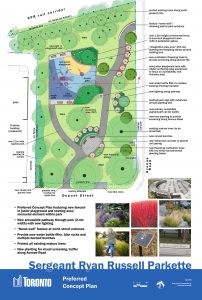
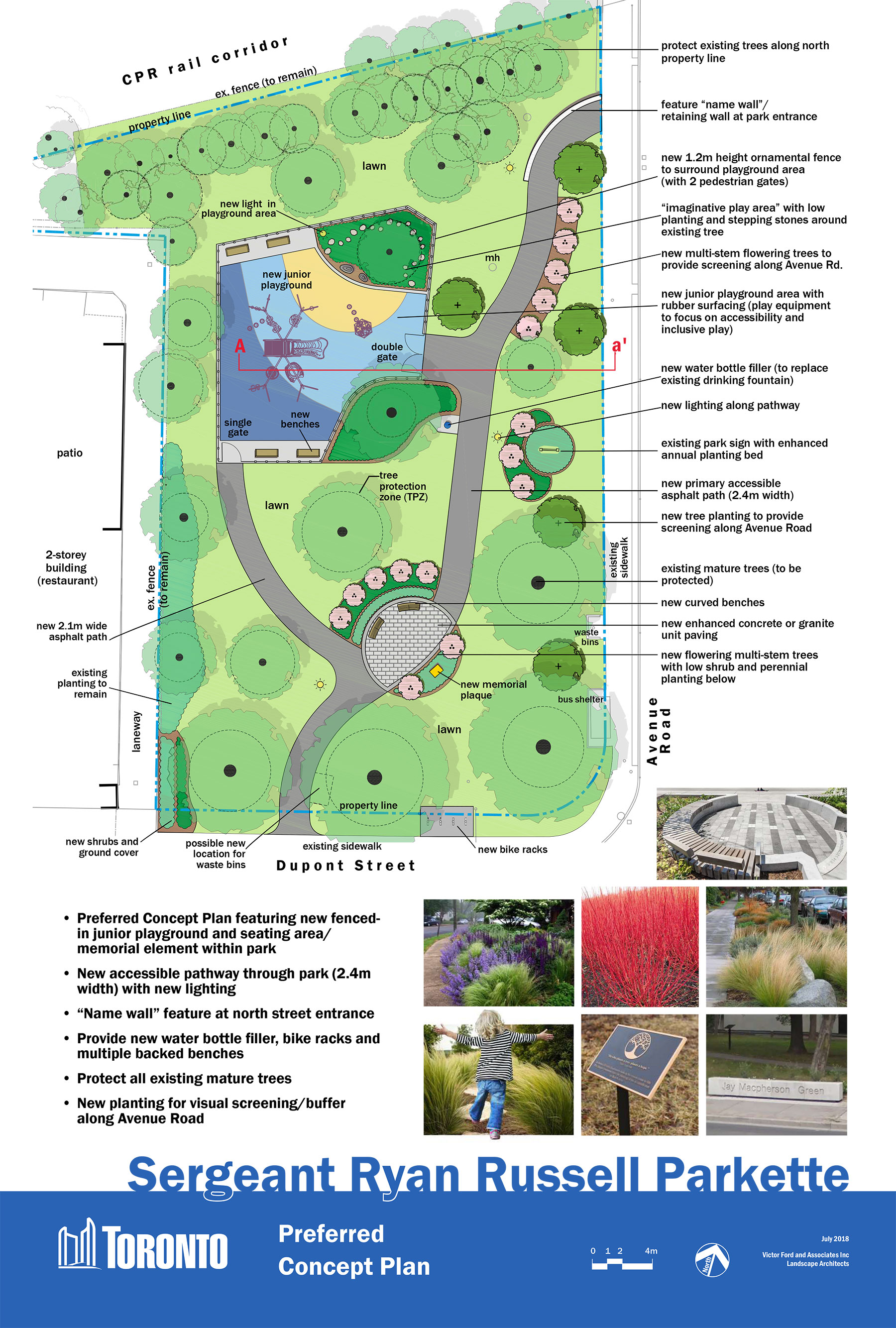
A plan to revitalize Sergeant Ryan Russell Parkette is set to be completed by the end of the year, with construction scheduled to begin next spring. The small greenspace at Dupont Street and Avenue Road — which in 2011 was named after Russell, who was killed in the line of duty that same year near the corner of Avenue Road and Bloor Street — has been neglected for some time.
A working group including representatives of the local business improvement area and residents’ association was formed in March to oversee the park’s redevelopment. A public meeting was held in June and Russell’s family was asked what elements they’d like to see in the park. The current version of the plan, which is still being finalized, will cost approximately $370,000 to implement.
“It has been a very productive and positive process, one which we have proactively thought to bring together the neighbourhood and stakeholders to make sure that this plan works rather than us designing the park,” said Joe Cressy (Ward 20, Trinity-Spadina).

“It lacked an ability for people to sit and enjoy the park,” added Brian Green, a parks supervisor with the City of Toronto. “There are some benches, but they can be more than that.
“People want a place where they can relax, get a drink, while still maintaining the recognition of Sgt. Ryan Russell who is important to the community and the Toronto Police [Service].”
Russell’s dedication to his family will be at the heart of the revitalized parkette.
“The family [was] keen that including a playground would be especially fitting because [Russell] was all about family and spending time with his son Nolan,” said Cressy. “The tragic death of Ryan Russell is…not lost in the minds of any Torontonian and we hope that in some small way for the Russell family this park does and will provide a space of commemoration and memorial for him.”
—Temi Dada/Gleaner News, images courtesy of the City of Toronto
Tags: Annex · News
October 16th, 2018 · Comments Off on NEWS: A way to honour the past (October 2018)
Exploring the roots of Korea Town
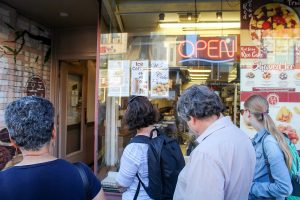
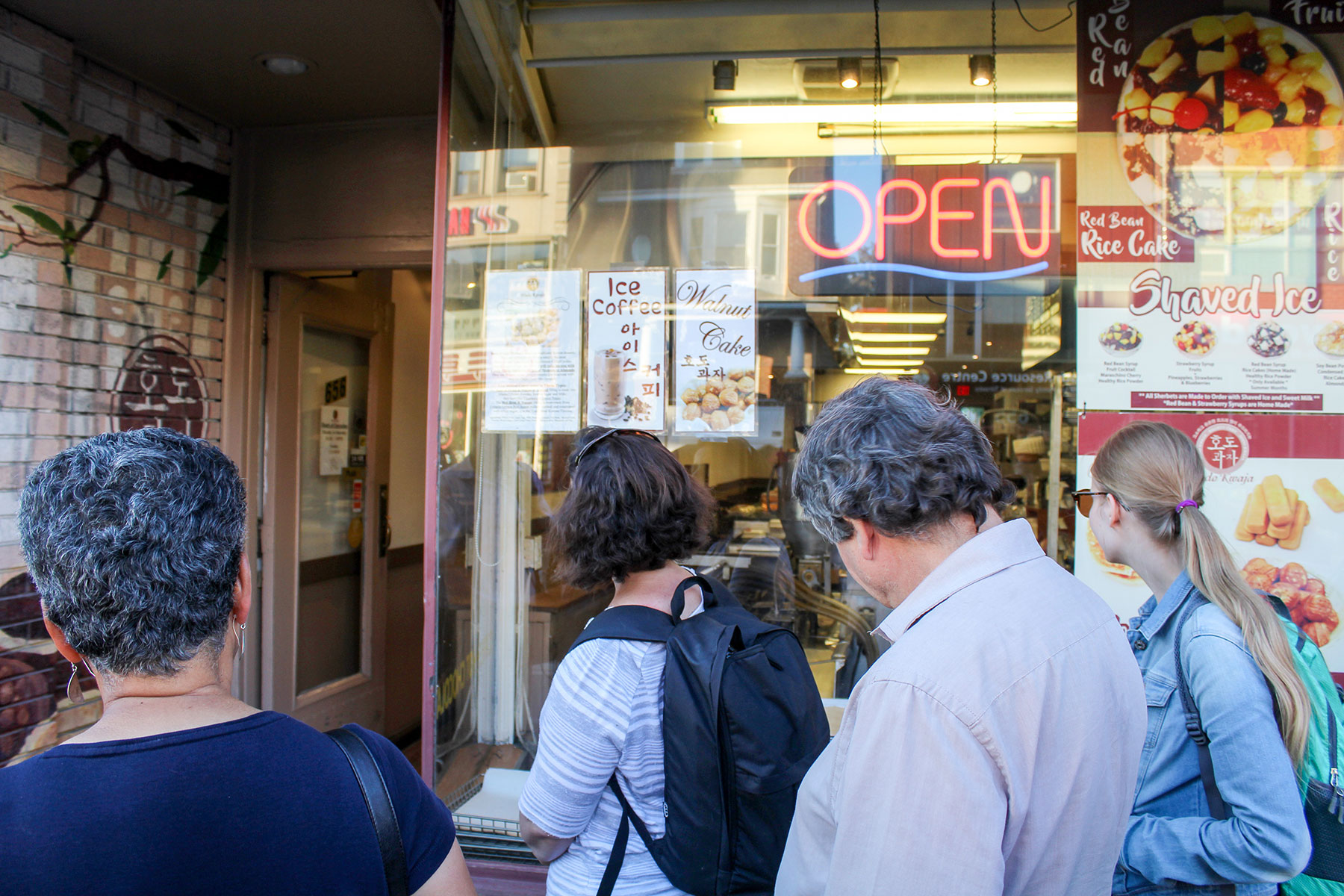
Tour-goers stop at Hodo Kwaja (656 Bloor St.?W.) for a taste of walnut cake. TEMI DADA/GLEANER NEWS
By Annemarie Brissenden
A heritage tour of Toronto’s Korea Town starts — as it should — at the Bloor Street United Church of Canada, once home to the Alpha Korean United Church.
Founded in 1967 when there were just over 200 Koreans living in Toronto, it’s the oldest Korean congregation in the city, and the third oldest in Canada after Montreal and Vancouver.
The history of Korean immigration to Canada is inextricably linked to some of Canada’s early religious institutions and their missions. The first Canadian (that we know of) to visit Korea was a missionary from Toronto, James Scarth Gale. After arriving in 1888, he would become famous in Korea for creating the first Korean-English dictionary and the first Korean translation of the Bible.
Another missionary, Dr. Francis Schofield, sent by the Presbyterian Church of Canada to Korea in 1916, would become involved in the 1919 Independence Movement against Japan and later be the only foreigner buried in the patriots’ section of the Korea National Cemetery.
These are but two of the 184 Canadian missionaries who helped to modernize education and medicine in Korea between 1888 and 1941. But it wasn’t until a 1967 change in Canada’s immigration policy that Koreans started coming to Canada, settling mostly in Toronto, where the Alpha Korean congregation served as a haven of faith and togetherness.
These days, there are approximately 73,390 Canadians of Korean descent who call Toronto home. And while few actually live in Korea Town any more, the stretch of Bloor Street between Bathurst and Christie streets in Seaton Village is still an epicentre of Korean business, culture, and, of course, food.
“We have special places that are Korean [and] that focus on celebrating Korean culture, like my parents’ restaurant [Korean Village Restaurant],” says Jason Lee, who grew up in Korea Town and gives tours of the strip on behalf of Heritage Toronto.
The stops on his tour include KCWA Family and Social Services on Madison Avenue, the Palmerston Library, P.A.T. Central, and the Korean Senior Citizens Society of Toronto.
Each stop has its own significance.
Founded in 1985 by a group of women concerned with women and family issues, the KCWA is dedicated “to building the Korean-Canadian community, one person at a time”, according to its website.
“I didn’t know of the [KCWA],” said Camille Begin, a program coordinator with Heritage Toronto, who participated in Lee’s most recent walk during the summer. “That is the point of this walk; even if you live in the neighbourhood there is still a lot you don’t know and you could learn a lot.”
The Korean Village Restaurant and P.A.T. Central are key stops on the tour because they are emblematic of key aspects of Korean-Canadian culture: entrepreneurship and food.
The Korean Village Restaurant is a traditional Korean family business, while P.A.T. — which calls itself Canada’s first Korean supermarket — supplies everything you need to host a traditional Korean meal, including, of course, kimchi.
The Palmerston Library — once affiliated with the YMCA — was where immigrants took classes to learn how to speak English and got help adjusting to their new city. Still a part of the local Korean-Canadian experience, the branch has over two thousand Korean language pieces in its collection.
Finally, the Korean Senior Citizens Society of Toronto is a drop-in centre that provides counselling, recreational programs, and classes from its location at the corner of Grace and Bloor streets.
This year’s tour came at a time when some people are wondering whether Korea Town is on a decline, with businesses starting to change hands to newer immigrant groups and many Koreans moving north. (Even the Alpha Korean United Church has relocated to a new site near Sheppard Avenue and Yonge Street.)
But Lee remains undaunted.
“As long as those places are still there, we are promoting Korean culture; in my view Korean culture is still alive. People say that it is dying but the way I look at it Korea Town is changing just like any other neighbourhood. We adapt, we survive.”
He wants to keep hosting the walks — glimpses into the immigrant experience — for as long as he can.
“It is a privilege. I do this as a way of honouring the past,” Lee said.
—with files from Temi Dada
Tags: Annex · News
October 16th, 2018 · Comments Off on CHATTER: Getting corny for a cause (October 2018)

Corn, corn, and more corn was on the menu at Jean Sibelius Park for the Annex Residents’ Association’s annual Corn Fest. This year’s festival featured a silent auction that raised money for those affected by the fire at 650 Parliament St. GEREMY BORDONARO/GLEANER NEWS
Tags: Annex · News
October 16th, 2018 · 1 Comment

READ MORE:
EDITORIAL CARTOON: How nice (Aug./Sept. 2018)
EDITORIAL CARTOON: How Nice (Summer 2018)
EDITORIAL CARTOON: How Nice (July 2018)
EDITORIAL CARTOON: How Nice (Election Special 2018)
EDITORIAL CARTOON: How Nice (May 2018)
EDITORIAL CARTOON: How Nice (Spring 2018)
EDITORIAL CARTOON: How Nice (Mar. 2018)
EDITORIAL CARTOON: How Nice (Dec. 2017)
EDITORIAL CARTOON How nice! (August 2017)
EDITORIAL CARTOON How nice! (July 2017)
EDITORIAL CARTOON: how nice! by blamb (June 2017)
EDITORIAL CARTOON: TCHC (May 2017)
EDITORIAL CARTOON: The Grand Tory (April 2017)
FORUM: Celebrating 20 years of cartoonist Brett Lamb (April 2017)
Tags: Annex · Editorial · Opinion
October 16th, 2018 · 1 Comment
For some time now, perfume and cologne companies have marketed their wares as if the wearer would be donning a new character, not just a new scent. High Endurance, Wild, and More Swagger are just some of the options on offer, to which we humbly suggest another, Just Swagger.
Designed especially for the newly-minted Ontario premier, this special edition will embolden its wearer to act and speak for political viewpoints that are light on facts and heavy on bluster, without working up a sweat.
Consider Ford’s rampage through the ongoing Toronto municipal election as a fit of vindictive rage. This failed mayoral candidate threatened to launch the nuclear option — the Canadian Constitution’s Section 33, which allows governments to override judicial rulings — if he did not get his way, something that’s rarely used, certainly never to achieve such petty ends.
It’s legislative bullying, and we couldn’t be more appalled. Particularly because while the provincial government did not invoke Section 33 this time around, the premier is clear that he is willing to go there again, and again, if necessary, on everything from sexual education to cap and trade.
Indeed, even though the bill invoking the clause was set aside after the Ontario Court of Appeal granted a stay pending appeal, the provincial government has left it on the order paper. That means that if someone successfully challenges the province’s changes to Toronto City Council in a court of law, the bill can be voted on at a moment’s notice.
If that happens, we think it should be the Attorney General, not protestors, who should be removed from the legislature in handcuffs. Spending a night in jail might wake her up to the weight of her responsibilities.
You’d be right to think that this is all a bit cuckoo-bananas.
But let’s take a step back from the premier’s antics and the apparent blind and selfish willingness of his caucus to follow his lead. With so much collective energy expended on this Ford-sponsored chaos, we’re neglecting the municipal election at our peril.
In a matter of weeks, we’ll elect a mayor, councillors, and school board trustees. And this is no small decision. We need to deliberate on John Tory’s record and take a measure of Jennifer Keesmaat to determine which candidate should have our vote for mayor.
With one councillor incumbent in the old system running to the south of our coverage area, we need to consider whether Mike Layton, the second incumbent, should be granted another term, albeit for the new system, or if a new face should stand in his place. And there’s a whole new batch of trustee candidates to evaluate.
Issues that need to be aired include affordable housing, transit, property taxes, safe-injection sites to help combat the opioid crisis, homelessness, pedestrian safety, bike lanes, the privatization of city services, and whether our infrastructure can support all of Toronto’s intensive growth.
We must remain focused on these issues, carefully evaluating the candidates and their platforms, so we can thoughtfully exercise our democratic right to vote on October 22. We can’t be distracted by the Doug Ford show — its scent may be strong, but at the end of the day, it’s just a lot of hot air.
READ MORE EDITORIALS:
EDITORIAL: A lost cause worth fighting for (Aug./Sept. 2018)
EDITORIAL: Reclaiming our city (Summer 2018)
EDITORIAL: City staff ignore bike lanes (July 2018)
EDITORIAL: The market has no moral compass (Election Special 2018)
EDITORIAL: Lessons to be learned from Excessive Force (Spring 2018)
EDITORIAL: A social contract is a precious thing (March 2018)
EDITORIAL: Intolerance leading to Quebec’s decline (Dec. 2017)
EDITORIAL (Nov. 2017): Student safety suffers as trustees cave
EDITORIAL: Pandering to religious intolerance (October 2017)
EDITORIAL: Bike lanes, good for business (Fall 2017)
EDITORIAL: Don’t sacrifice safety for political gain (August 2017)
Tags: Annex · Editorial
October 16th, 2018 · Comments Off on FORUM: Build the grid, build the vision (October 2018)
City council should catch up on traffic safety
By Liz Sutherland
Do you remember the day you first rode the protected Bloor bike lanes?
For me, it was a hot day in late August — almost exactly two years ago — and I had my dog Sadie in the bike trailer. Coming from Bloordale, I experienced a close pass by a truck at Ossington Avenue and then entered the pilot area. What a difference those bollards made!
[pullquote]In a congested city, a protected bike lane actually moves more people than the same space dedicated to motor vehicles.[/pullquote]
The two kilometres of protected bike lanes on Bloor Street — now permanent — were possibly the most hard-won, and certainly the most studied, bike lanes in history. Bloor Street and Danforth Avenue were identified decades ago as natural choices for bike lanes because of the high density of destinations like schools, workplaces, and shops. These vibrant streets also link diverse neighbourhoods on a direct and flat street with transit running below.
The Bloor Street campaign provides many lessons in building a big tent of supporters who are passionate about safer, more vibrant, and livable streets. We engaged a broad group of residents, business owners, schoolchildren, politicians, and organizations, in addition to cycling advocates.
The work, of course, is far from over.
We need to see these lanes extended east and west. We need to see intersection improvements to respect the memory of Dalia Chako, who was killed while riding her bike this spring at Bloor and St. George streets. And, finally, we need the permanent design to accommodate the major increases in ridership we’ve seen since the bike lanes were installed (up 56 per cent in the first year!).
But there’s no question that the Bloor Street pilot provides a model we can use elsewhere to demonstrate the health, safety, economic, and environmental benefits of cycling infrastructure — not to mention the positive impact on moving people more efficiently.
This last issue is probably the least understood aspect of installing bike lanes in busy cities. Some people worry that these lanes will make congestion worse, especially if a bike lane means removing a lane of car traffic.
What’s interesting is that the reverse is true — in a congested city, a protected bike lane actually moves more people than the same space dedicated to motor vehicles. A study from the United Kingdom found that a new protected bike lane can move five times as many people per hour as a motor vehicle lane in the most congested parts of London. We need to do a better job of explaining how bike lanes improve congestion for everyone, no matter how they get around.
The good news is that public support for protected bike lanes has grown as drivers and bike riders alike have become used to this new infrastructure. Cycle Toronto and the David Suzuki Foundation commissioned a poll last month showing that 82 per cent of Torontonians across the city support protected bike lanes, including a surprising 75 per cent of drivers.
The challenge is to help our leaders catch up with this shift in public opinion. Debates at Toronto City Council often polarize the issue unnecessarily. The result is a frustratingly cautious approach to installing bike infrastructure that fails to capture the urgency of preventing people from being killed and injured on our streets. We’re behind schedule and only two years into a 10-year bike plan. Other Canadian cities are leaving Toronto behind in the rapid build-out of their protected bike lane networks. We need to find a way to accelerate the process in Toronto so we can keep people moving — safely — and remain a world-class city.
Our polling shows two-thirds of Torontonians want a cycling grid by 2022. We are hoping that these polling numbers will help city council see that it’s time for a rapid build-out of our 2016 Bike Plan — with the main streets included — so we can enjoy the freedom we have on Bloor Street everywhere in this city.
The upcoming municipal election is a great opportunity to ask candidates about their commitment to supporting this build-out. The Bloor Street bike lanes have shown that if you build it, they will indeed bike it. Now let’s build the grid and spread the benefits.
Liz Sutherland is the interim director of advocacy and government relations at Cycle Toronto. Learn more about cycling safety as an election issue at cycleto.ca/buildthegrid and sign up for Action Alerts at cycleto.ca.
Tags: Annex · Opinion
October 16th, 2018 · Comments Off on FORUM: Changing times and travel modes (October 2018)
Councillors should ask new questions
By Albert Koehl
Is City Hall’s preoccupation with facilitating the movement of cars now just a bad habit that can no longer be rationalized in light of actual travel modes by residents?
According to the numbers, among other reasons: yes.
[pullquote]Dominance of the car in public debates masks the diminishing role of the automobile in everyday transportation.[/pullquote]
A recent EKOS poll of 801 Toronto residents found that 59 per cent identify walking, cycling, or transit as their main mode of transportation. Likewise, the Ministry of Transportation’s analysis of a much larger data set from the Transportation Tomorrow survey concludes that 55 per cent of city residents identify walking, cycling, and transit as their main way of getting around the city. The figures are even higher for downtown Toronto.
The census profile of the City of Toronto for 2016 showed that the “main mode of commuting” for the employed labour force was almost equally divided between walking/cycling/transit on the one hand and driving, including passengers, on the other.
The Transportation Tomorrow survey, using slightly different metrics, shows that 53 per cent of all rush hour trips by Toronto residents are made by car, a decline from 60 per cent only a decade earlier. And an increasing number of city households (28 per cent) don’t own an automobile at all.
What the numbers suggest is that politicians who challenge every initiative to widen sidewalks, add bike lanes, or give priority to transit vehicles with questions like “Will motorists be delayed?” or “Will any parking spots be lost?” need some new questions, like “How will this project improve our community?” “Will greenhouse gas emissions be cut?” or “Will people be able to get around the city more easily?”
Automobiles still dominate Toronto in two obvious ways, namely the amount of space devoted to them and the attention they get in public debates. However, this dominance merely masks the diminishing role of the automobile in everyday transportation, while highlighting the motorist’s sense of entitlement created and nurtured over the last half century.
Since many city councillors have been in office for decades, it’s no surprise that they feel obliged to fight, or at least to apologize for, any initiative that doesn’t put the car first. Sadly, we don’t have much to show for this courtesy. Every year the automobile kills dozens of our fellow residents, pumps tonnes of contaminants into our air, and consumes massive public resources.
True, even though walking, cycling, and transit are starting to lead the way in Toronto, the city is surrounded by many automobile-dependent communities. But must we disfigure our community and sacrifice our well-being to accommodate planning choices made by those municipalities and their preference for single-occupant cars?
The recent debate about the renewal of Yonge Street in North York was an excellent example of how our city has changed, and how some politicians have yet to notice this. Central to the debate was whether six-lane Yonge Street should be narrowed to four for the benefit of local residents, some of whom describe Yonge Street as a frightening chasm. Motorists are now a minority in this densely populated residential area, and their numbers are projected to shrink even further.
Curiously, despite the fact that the project had all the hallmarks of safe road design — wider sidewalks, bike lanes, and more pedestrian crossings and benches — Mayor John Tory opposed the project, despite local councillor John Fillion’s, support, fighting instead to keep the six lanes even though the main beneficiaries would be motorists from beyond the city. (Only a last-minute intervention by Joe Cressy (Ward 20, Trinity-Spadina) — a strong supporter of city staff’s recommended safe design — pre-empted a vote that almost certainly would have left Yonge Street at six lanes.)
There are certainly places in the city where a reliance on cars can be rationalized based on poor transit options, but perpetuating the car’s priority does nothing to improve transit. In fact, such efforts generally make transit, as well as walking and cycling, worse. Automobile infrastructure usually creates a hostile environment for non-motorists and discourages many people from any inclination to get out of their cars.
Our dependence on automobiles has never made much sense, especially from a transportation perspective, but today’s numbers make it increasingly bizarre to try to rationalize the old approach.
The new transportation reality allows us to start building, without apology to the motorist, the type of community that we want — clean, safe, vibrant — instead of continuing a slavish devotion to a by-gone era.
Albert Koehl is an environmental lawyer, author of the online guide Road Follies, and a founder of Bells on Bloor.
READ MORE BY ALBERT KOEHL:
FORUM: A magical new supply of parking spots (Oct. 2017)
FOCUS: An early advocate for bike lanes (June 2016)
FORUM: The faster we lower speeds, the more lives we save (Oct. 2015)
Tags: Annex · Opinion
October 16th, 2018 · Comments Off on ARTS: Openings and anniversaries (October 2018)
Celebrate 100 years of Estonian independence
By Heather Kelly
It’s the time of year when arts organizations launch new concert seasons, new exhibitions, and new film and talk series. Arts and language classes start again, too. Not only are there enriching and fun arts events coming up all across the Bloor St. Culture Corridor, but some of our cultural organizations are also celebrating momentous anniversaries.
From 10 to 100, arts organizations in the Annex are marking milestone anniversaries. The University of Toronto Faculty of Music is celebrating its 100th anniversary and the Museum of Estonians Abroad/ VEMU is celebrating the 100th anniversary of Estonia’s independence.
The University of Toronto Faculty of Music kicks off its 100th anniversary with Handel’s Dixit Dominus on September 30. Canadian music legend Phil Nimmons teams up with JUNO Award-winning pianist and composer David Braid for an evening of improvisation and reflection on almost a century of music making on October 1, hosted by jazz vocalist Heather Bambrick.
On October 10, Jeanne Lamon and David Breitman present an all-Mozart program of Sonatas for Fortepiano and Violin. On October 15, America’s foremost baritone Thomas Hampson presents a free, public master class in Walter Hall. The Faculty of Music’s free concert series Thursdays at Noon continues the centenary celebrations with pianist Younggun Kim performing The Music of Walter Buczynski on October 11, Music and Poetry on October 18, and more.
Also celebrating a centenary, the Museum of Estonians Abroad/VEMU is celebrating Estonia 100. A new photo exhibition “Estonia Through 100 Pairs of Eyes” dedicated to Estonia 100 opens on September 22. The exhibition is 100 portraits of 100 Estonians aged from 1 to 100, a visual memory spanning 100 years, created by Kaire van der Toorn-Guthan and Toomas Volkmann. Each beautiful black-and-white portrait depicts an Estonian born in a different year during Estonia’s hundred years, accompanied by an insight into the person’s story.
The Toronto Consort’s season, The Colours of Early Music, kicks off in the musical world of one of Italy’s most celebrated early Baroque luminaries, Girolamo Frescobaldi, and his contemporaries Palestrina, Landi, and Caroso. This is a multi-media event, so the music will be enhanced with images of Rome’s glittering treasures. Frescobaldi & The Glories of Rome takes place October 19 and 20 at Trinity-St. Paul’s Centre.
Opening October 11, the Istituto Italiano di Cultura presents Guido Guidi – A New Map of Italy, an exhibition of more than 50 works from the collection of the Canadian Centre for Architecture of Montreal. Guidi focuses on spontaneous suburban architecture, on harsh secondary roads, on piles of garbage, on spray-painted walls, abandoned depots and construction sites to form a complex and stratified portrait of the contemporary landscape. Admission is free.
The Native Canadian Centre of Toronto’s first Big Drum Social of the season, “Waabaabaga Giizis” on September 20 at 6:30 p.m., will be a special night of teaching, dancing, and singing, with door prizes, a community craft table, and more.
The Music Gallery’s marquee event is the X Avant New Music Festival from October 11 to 14. The theme of the festival, which is curated by Bear Witness (from A Tribe Called Red), is “The Halluci Nation”, promoting inclusivity, empathy, and acceptance amongst all races and genders in the name of social justice.
The Six Pianos musical spectacle opens Soundstreams’ 36th season at Koerner Hall on October 12. The contemporary repertoire for multiple pianos is exemplified by Steve Reich’s seminal work, and includes a world premiere for multiple pianos from Canadian composer André Ristic. The performance features a who’s who of pianists/percussionists, including Russell Hartenberger, Greg Oh, Jamie Parker, Stephanie Chua, Ryan Scott, and Midori Koga.
Hot Docs’ Curious Minds Speaker Series kicks off with The CanLit Boom: 1950s – 1970s on Wednesdays from September 26 to November 7. Other talks include Joni Mitchell: Words and Music on Mondays, and Around the World with Art Nouveau. And Hot Docs opens its Doc Soup season October 3 and 4 with the extraordinary film, The Woman Who Loves Giraffes, followed by an extended Q&A.
The Gardiner Museum’s chief curator, Sequoia Miller, will lead a talk on conceptual ceramics, kicking off the first Gardiner Signature Lecture of the fall season, on September 25. And the Japan Foundation opens its new gallery exhibition, Noriko Maeda Foundations, on October 16, showcasing Japanese Contemporary Calligraphy.
Heather Kelly is the founder and director of the Bloor St. Culture Corridor. Her column focuses on arts and culture events from the district. More information about events and locations can be found at www.BloorStCultureCorridor.com.
Tags: Annex · Arts
October 16th, 2018 · Comments Off on GREENINGS: Short-term solutions haunt future (October 2018)
Florida’s red tide a harbinger of what not to do
By Terri Chu
Premier Doug Ford has scrapped cap and trade, embarking on a path of environmental destruction that’s fuelled by subsidies to polluters. The shamelessness is galling and we’re likely to see more of it over the next four years.
The most concerning thing is the implicit belief that society should, at its core, subsidize pollution. We need not look very far to see how that comes to bite us in the behind.
The once popular Governor Rick Scott of Florida was recently booed out of a restaurant. What seemed like a good idea at the time, benefitted some at the time, is now causing widespread pain for many across the state.
Scott fought against, and ultimately won, the battle against the American Environmental Protection Agency’s standards on waterway pollution. At the time, like Ford does now, he argued it would hurt the economy. He argued that jobs would be at stake.
Scott gutted the state’s EPA, stacked it with developers, and eventually got his way of an underlying belief that unfettered pollution is the way of the people.
That fundamental belief that business knows best and risking a single job from 2010 is causing empty hotels, laid off workers, lonely restaurants, and unusable beaches in 2018. I certainly hope being a short term sellout was worth the devastation as toxic red algae takes over Florida’s coastal waters.
Something locals know as red tide has bloomed so aggressively this year that Floridians can’t even open their beach-front windows. In addition to the stench, people are at higher risk of respiratory illness thanks to the toxins, and the state’s beaches are littered with the carcasses of dead marine animals.
The algae, while a natural occurrence, have been fed by agricultural runoff, and very likely exacerbated by some of Scott’s other measures, like a killed septic tank inspection program. There is little scientific doubt that tighter waterway standards eight years ago would have mitigated some of the disaster that Floridians face now.
In short, Scott sacrificed 2018 jobs, health, and quality of life, for profits in 2010. No doubt his constituents will let him know what they think of the trade-off now.
Ford is making similar trade-offs with his attack on green energy, a carbon tax, and low emission vehicles. He is trading off a quick buck for status quo players for long-term respiratory illnesses, and an overall lower quality of life that we will probably see in about a decade.
Perhaps Ford thinks he won’t be vying for re-election by then so it isn’t his problem. For those of us who live here, it’s our problem, if we’re lucky enough to be alive by then. We shouldn’t be forced to subsidize polluters anymore with our health and well-being. If polluters don’t pay up now, as Florida is showing us, the rest of us will pay up eventually. Whether or not it’s worth the trade-off, I suppose it depends on whether or not you’re making the buck now.
Terri Chu is an engineer committed to practical environmentalism. This column is dedicated to helping the community reduce energy and distinguish environmental truths from myths.
READ MORE BY TERRI CHU:
GREENINGS: Urban under-representation (Aug./Sept. 2018)
GREENINGS: Nurture the neighbourhood by cultivating green canopy (Summer 2018)
GREENINGS: Results beg for electoral reform (July 2018)
GREENINGS: Choosing the lesser evil (Election Special 2018)
GREENINGS: Reduce, reuse, and then recycle (May 2018)
GREENINGS: Car-free parenting is not rare (Spring 2018)
GREENINGS: The science of board games (Mar. 2018)
GREENINGS: Driving fuelled by unseen subsidies (Jan. 2018)
GREENINGS: No solutions for nobody’s problem (Dec. 2017)
GREENINGS: Celebrate science not milestones (Nov. 2017)
GREENINGS: Down to the data (Oct. 2017)
Tags: Annex · Life