April 23rd, 2019 · Comments Off on CHATTER: Meet’n’Eat in the Annex (Spring 2019)
Annex residents are meeting and eating their way through the neighbourhood. In an initiative launched early this year, the Annex Residents’ Association (ARA) is inviting neighbours to gather at a different local restaurant every month to enjoy some food, support local businesses, and get to know people.
The ARA hopes that initiatives like this can help neighbours develop closer relationships, creating a sense of local warmth that melts away the isolation that can sometimes occur in big cities. As one Toronto-bashing Conservative MP stated, when you live in downtown Toronto, no one would dare knock on a neighbour’s door to ask for a cup of sugar. In case others feel the same way, the ARA hopes that get-togethers like these can shift the dynamic.
If you’re interested in learning more about the ARA or getting involved in community-building initiatives, there are plenty of ways to get in touch online. There’s a website (theara.org), a Facebook page, mailing list (theara.org/Sign-up-for-the-ARA-Newsletter), and Twitter handle @AnnexResidents. While the ARA welcomes your online engagement, they think meeting in-person is even better. The next Meet’n’Eat is on April 3.
—Terri Chu, Gleaner News
Comments Off on CHATTER: Meet’n’Eat in the Annex (Spring 2019)Tags:Annex · News
April 23rd, 2019 · Comments Off on CHATTER: Annex icon Queen Video slated to close (Spring 2019)
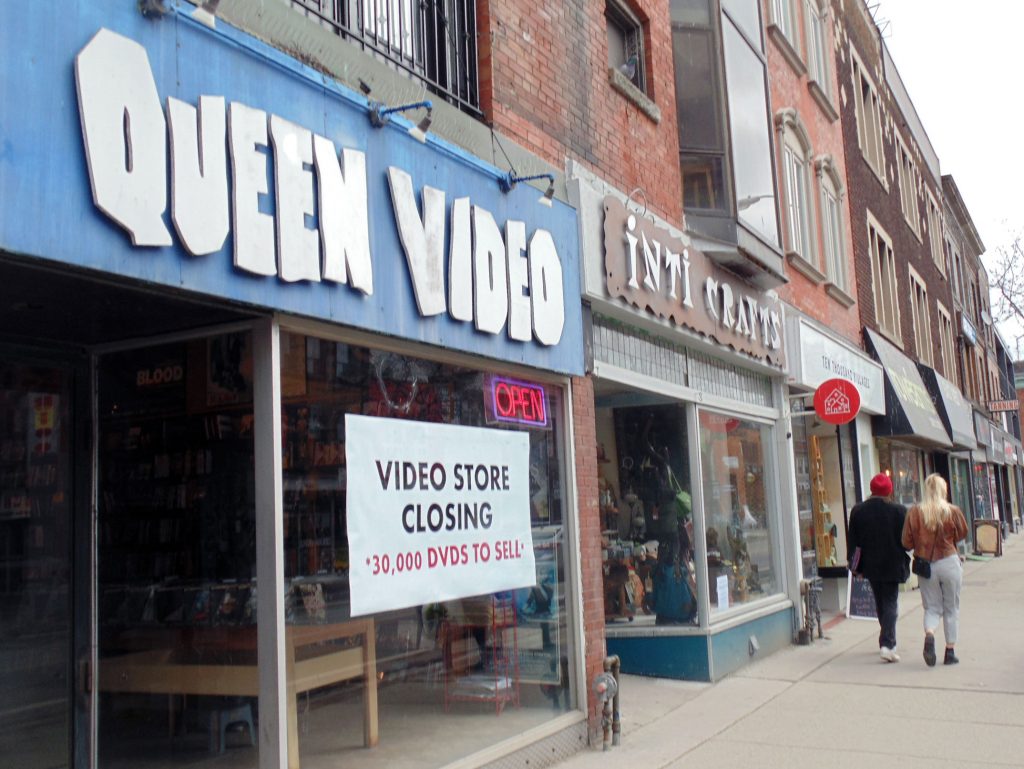
Queen Video’s Bloor Street location is having a closing sale until April 28. NABAHAT HUSSAIN/GLEANER NEWS
Queen Video has been serving film buffs in Toronto for 38 years, and now its last remaining location is closing down. Located in the Annex across the street from Lee’s Palace, the video rental company opened its Bloor St. store in the year 2000. The shop is known for attracting film fanatics from all over the city.
“This place has movies you can’t get anywhere else, not on Itunes, not on Amazon,” remarked a customer named Bob. “It has been a jewel, so for somebody like me who’s a bit of a film geek, this was the best thing in Toronto.”
Store owner Howard Levman says the number of people renting movies has declined steadily over the past seven years. “I’ve loved the interaction with the customers,” he says. “It’s just that there aren’t enough of them. There’s also an availability issue: some really good TV shows and movies are never even made into DVDs now.”
Levman told his staff that the Annex store has been the busiest branch of Queen Video, and he’s going to miss it. Customers can take advantage of Queen Video’s closing sale until April 28.
—Nabahat Hussain/Gleaner News
Comments Off on CHATTER: Annex icon Queen Video slated to close (Spring 2019)Tags:Annex · News
April 23rd, 2019 · Comments Off on EDITORIAL: It’s not your private police force, Mr. Ford (Spring 2019)
When an Ontario public servant decided to leak the province’s secret plan to overhaul the healthcare system to the media, Premier Doug Ford shifted into attack mode and demanded an investigation by the Ontario Provincial Police (OPP). It seems the Premier has an affinity for calling in the police, in the hopes they’ll do his bidding. The leak story is, as Liberal MPP Mitzie Hunter, and former Minister of Education stated, “Exhibit A of why Ron Taverner cannot be OPP commissioner… the OPP is not the Premier’s private police force.”
What would the OPP investigation on the leak have looked like if it were? The leak publicized evidence that the government was planning to eliminate many health agencies and create a “super agency” as part of its overhaul of Ontario’s healthcare system. The unnamed public servant deemed responsible for it has been fired.
If Taverner was running the OPP, would the Premier being cruising around Ontario in a $50,000 van, complete with a leather Lazy-Boy and Blue-Ray? That was what he asked for, but with Brad Blair running the police force, the premier didn’t get his way.
In the late fall, when Ford hatched the plan to hire Taverner the Premier’s office faced a major obstacle: Taverner was not qualified. The process needed re-engineering or “rigging” as critics would come to describe it. Enter Dean French, who worked with Cabinet Secretary Steve Orsini, Ontario’s top civil servant, to lower the bar on behalf of the Premier’s friend. Orsini was on the hiring committee and was integral to seeing Ford’s plan come to fruition. When the public announcement about Taverner getting the job was met with outrage, Ford strangely tried to distance himself and claim that the process had been “independent.” It was at this is the point that Orsini lost his stomach for the sham. According to Ontario’s Integrity Commissioner, J. David Wake’s report on the matter, Orsini gave an ultimatum to the Premier: “If you feel that the installation [Taverner’s] must proceed, it is with heavy heart that I recommend the appointment of a new Secretary of the Cabinet who will fully support your decisions as the Premier of Ontario…”
In the end, Orsini retired abruptly after 27 years of serving provincial governments of every stripe. Brad Blair was fired because he revealed what Ford was up to, and is now suing Ford for $5 million for wrongful dismal and defamation. Taverner withdrew his name from consideration in the face of the lingering public outcry over his relationship to the Premier and the process by witched he managed to leap frog ahead of other more qualified candidates including Blair.
The lesson, which is evidently lost on Ford, is that democratic countries need to put a wall between government and police, lest police feel beholden to those in authority. Police become the enforcers for the political will of those in power and people stop believing that laws will be enforced without favour.
The Premier would eventually come to describe decisions like hiring Taverner are a result of him talking to “thousands of people across the province.” It’s not clear who these people are or when these consultations happened, but he claims it included the OPP’s “front line officers,” who were apparently clamouring for Ford to hire Taverner. How would these officers would even have know of Taverner existence? This refrain that he is taking his cues “from the people” is something Ford loves to invoke. He uses it to justify acts of autocracy like slashing the size of city council, forcing a one-sex fits all autism strategy, or stealing the Toronto subway system. It’s a faux democracy that’s looking more and more like a dictatorship.
April 23rd, 2019 · Comments Off on FORUM: Layton laments city’s snow job (Spring 2019)
City budget a place to lock in priorities
By Mike Layton
The city’s 2019 budget deliberations are underway and I have had many residents from across the city reach out about the issues that affect them and the services they depend on the most. We are in the midst of one of the most damaging winters on our roads and no amount of pothole blitzing is going to be able to patch up the decline in public assets that Torontonians depend on every time they step out of the door.
My discussions with you have confirmed that the issues you care most about are the same ones I have been working on to get added to the budget. These include funding for affordable childcare and youth hubs, a litter picking strategy in our ravines, and reversing the fare increase on the TTC. I have also spoken out about the fact that this budget does not substantially address our growing State of Good Repair backlog on public assets (like roads) and Toronto Community Housing.
What is top of mind for most people right now is the request to see the city provide enhanced snow removal, salting, and clearing city-wide. The three week response times most residents have been told to expect before their roads and sidewalks are cleared (if they even receive sidewalk clearing) is unacceptable.
The city’s ombudsman recently released a statement saying that this lack of service is having an effect on the quality of life of our residents. When we fail to provide safe passage on our public rights-of-way we are putting public safety at a serious risk. It does not need to be this way.
Our ability to quickly respond to recent snow storms has been seriously impacted by the degradation of funding for these services over the last nine years. The downtown core is seemingly “stuck in time”, grappling with a service standard for snow clearing from the time of amalgamation that no longer works in our denser core. Putting off problems for future generations to solve is not going to work. I have brought this issue up at budget committee and will continue to advocate for proper investment until it is made.
I recently moved a request in Budget Committee for Transportation Services to report back on the cost to expand and enhance winter maintenance in response to the issues with snow clearing, and the extreme freeze-thaws we have been experiencing. Unfortunately, this request for information was not approved by my colleagues on the committee, but I remain committed to getting this funding approved as quickly as possible.
Another issue that is top of mind for the residents of Ward 11 is the need for substantial investments in affordable housing. The Housing Now strategy that was passed in January aims to increase the supply of affordable rental housing within mixed-income communities by making municipally-owned properties available to non-profit and private organizations for redevelopment on long-term leases.
I was successful in having council agree to add an additional property in Ward 11 to the list of sites to be considered, bringing the total number of sites to 12. Council also agreed to my request to look at alternative ways of financing affordable housing through refundable debt.
Unfortunately, council rebuffed my efforts to add a higher percentage of deeply affordable and affordable housing units to the approved strategy. Some councillors even shared their belief that this would make the development less profitable. I hope that one day City Council will learn to put people before profits.
If you would like to chat about the budget, or want to share any local concerns with me, please do not hesitate to write to me at councillor_layton@toronto.ca or call 416-392-4009. I am looking forward to hearing your ideas on how to build a city we can all be proud of.
Mike Layton is the councillor for Ward 11, University-Rosedale.
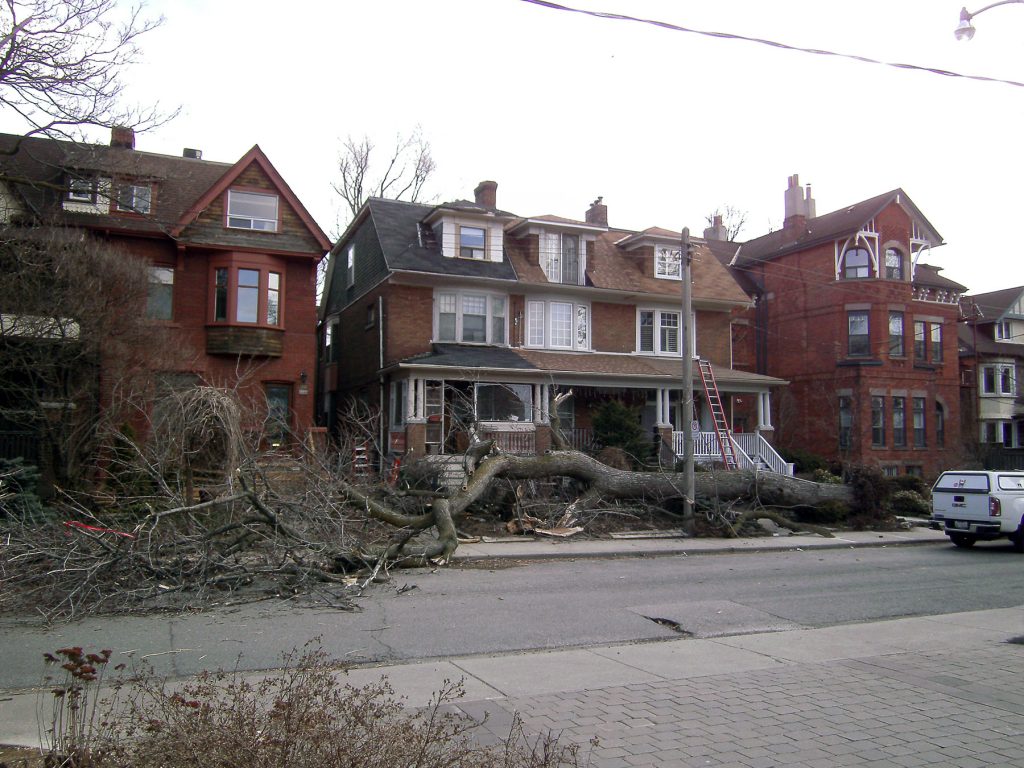
A mature tree at 113 Howland Ave. fell victim to a windstorm in April 2018. COURTESY ARTHUR GRON
By Arthur Gron
In the Annex and Harbord Village, large maples and majestic Dutch elms are maturing and dying out. The trees that are taking their place tend to be smaller ornamental trees, throwing the future of the area’s beloved canopy into question.
On December 3, TreesPlease held a “Tree Talk” event at 918 Bathurst. I presented an analysis I had completed of the trees on Howland Ave. The Harbord Village Residents’ Association (HVRA) presented their extensive survey of the approximately 5,000 trees from that neighbourhood.
Between 2009 and 2012, TreesPlease collected data on almost all of the trees in the Annex, both backyard and frontyard trees. The information can be found at the Annex Residents’ Association website. On the same website, one can view all the reports detailing the Annex’s tree varieties.
COURTESY ARTHUR GRON
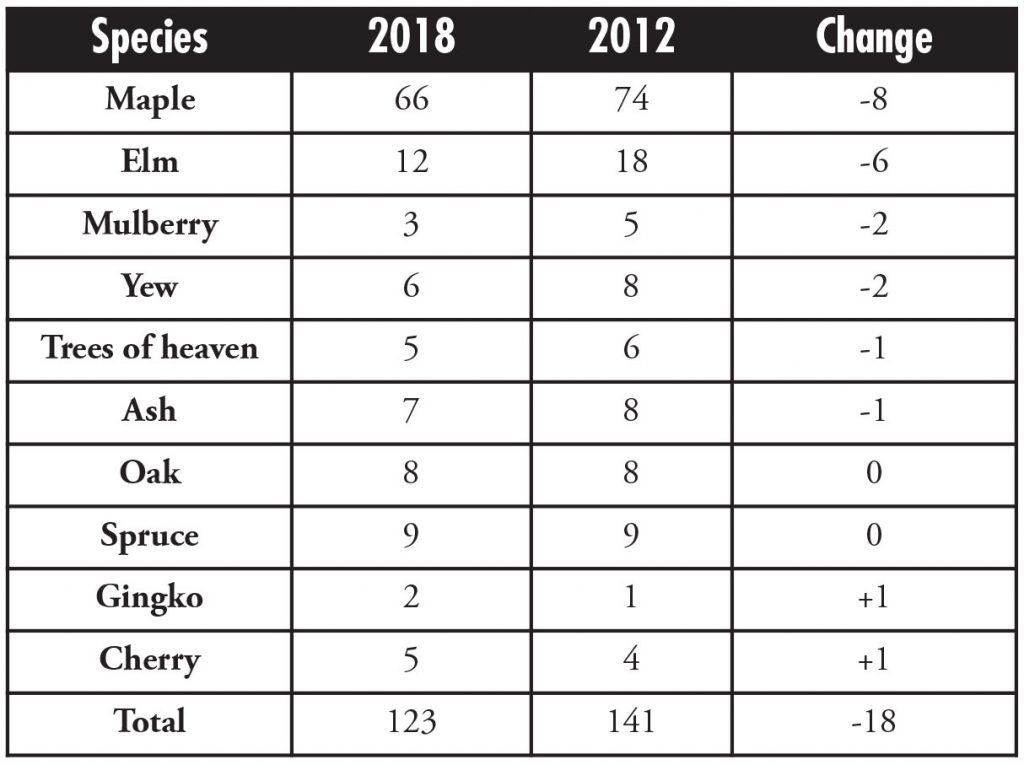
Almost 10 years later, and before the December event, I resurveyed the front yard trees on Howland Avenue. Using the 2009 data, I looked to see what had changed and found the results startling: the street had lost almost 10% of its trees.
In 2012, there were 74 large maple trees along Howland, but by late 2018 only 66 remained. Elms had decreased from 18 to 12. Even more worrying, the replanting rate was only 1 percent, and the trees that were replanted are of small ornamental varieties – no substitute for broad maples or majestic elms. Out of the 141 trees that Howland Avenue had lining the street, 123 were left in 2018. That’s almost a 10% loss, in less then 6 years.
Though this is a sampling of the trees, it suggests that if the trend is accurate 10% of the 10,000 trees surveyed in 2009 have vanished. That would be 1,000 trees, the majority of which would be maples and elms.
Data collected from the Harbord Village Residents’ Association shows an even worse decline than that which I found on Howland Ave. The HVRA carried out an inventory of trees in 2007-8 that counted 6,386 trees. In 2017-18 in a followup inventory, they counted only 4,552 trees demonstrating a remarkable loss of 30% of trees in a decade. Again, the loss is amongst the large mature trees, such as the maple. And, just like on Howland Ave., the trees that are being planted in Harbord Village are of a small ornamental variety, which will not enclose the street in a canopy and generally have a shorter life-span.
What explains the loss of the maple and the elm? To begin with, the urban tree has a shorter life than its rural counterpart. City maples, such as the pervasive and invasive Norway maple, can be expected to live 100 to 120 years in the city. Compare that to 250 years in a natural settling. Several factors speed a city tree’s demise: road salt, not enough space for roots, pavement preventing water from reaching the roots, air pollution, compacted soil, and damaged bark from accidents or construction.
The planting of large maples and oaks in the 1800s, when the Annex was being built, was part of the culture of that time. Sailing ships required large amounts of good wood and the British navy in particular sought sources of premium wood for its masts despite the shift at this time towards iron masts.
Iron furniture, having been mass-produced since the 1850s, took on a taint of cheap plastic: prized furniture was made of woods such as walnut, mahogany, and rosewood. Yet another reason to plant a hardy, large tree in the front yard. These trees were symbols of elegance and status.
The front yard itself was a showcase for a house, as landscape architecture was coming into vogue. Central Park in New York was established in 1857 and Toronto’s High Park in 1876. Parks were no longer game reserves for the rich, but were manicured to look like paintings of pristine, scenic forests. Green space provided an attractive contrast to the rapidly industrializing landscape of the time.
Lastly a home was seen as something that would be passed down from one generation to the next, so planting a maple that would take 30 or 40 years to grow into a large tree was an investment in the future and the family.
Recent storms including the ice storm of December 2013, the wind storm of October 2017, the ice storm of April 2018, and the wind storm of May 2018 have all taken their toll on the behemoth-sized trees of Howland Ave. Undoubtedly, with climate change, we can expect more severe weather and less hospitable conditions for these aged trees.
The Annex and Harbord are changing, and I cannot say how long the tree canopy will last. The smaller trees will look pretty, but they will never provide us with the majestic canopy we now enjoy.
For a printed walking tour of Howland Ave., visit my website gron.ca. and for a tree map visit the ARA’s website at theara.org/Interactive-Tree-Map.
Arthur Gron is a member of Trees Please, a committee of the Annex Residents’ Association. Gron has participated in long term surveys that chronicle a demise of the Annx’s treasured tree canopy.
April 23rd, 2019 · Comments Off on ARTS: Spring fever brings corridor to life (Spring 2019)
Annex cultural communities bring their best to the table
By Meribeth Deen
The Bloor St. Arts Corridor offers some of the richest and most diverse cultural opportunities anywhere in Toronto, all within a subway-accessible 1.5 kilometre strip. Each year, more than three million members of the public go to Bloor St. Culture Corridor exhibitions, performances, and events. Each month, the Bloor St. Arts Corridor offers readers of the Annex Gleaner a taste of what we’ve got to offer in upcoming events. This spring brings a plethora of offerings, so get out and make the most of your neighbourhood.
MUSIC
The sounds of the 1930s are bound to get spring swinging in the Arts Corridor, starting at the Bata Shoe Museum on April 10. The museum is welcoming students from some of the city’s most prestigious music programs to play works from the 1930s. This free event (if you register, by emailing rsvp@batashoemuseum.ca or calling 416-979-7799) will provide the perfect mental soundtrack for your viewing of the exhibition Want: Desire, Design and Depression Era Footwear. You may want to continue enjoying the spirit of the age by hopping over to the the Alliance Française for the film Django, on April 11. This film serves as a warm up to the Stephen Wremble Band’s April 13 concert, performing The Django Experiment, celebrating the 109th anniversary of Django Reinhardt’s birth.
On the weekend of April 12, step out onto your experimental edge at the Music Gallery. In co-operation with Arraymusic and Native Women in the Arts, the Music Gallery is hosting the Raven Chacon Mini-Festival. Born on the land of the Navajo Nation, Raven Chacon is acclaimed as a composer of chamber music, performer of experimental noise music, and as an installation artist. The festival will feature the world premiere of For Zitkála-Šá, dedicated to the first American Indian librettist with the Array Ensemble (Allison Cameron, Nicole Rampersaud, and Germaine Liu) and others. Go to www.musicgallery.org for more information.
If you want to keep mixing up musical melodies, head to the Royal Conservatory of Music’s Koerner Hall on April 14 to experience DakhaBrakha’s “ethnic chaos”. DakhaBrakha was created at the Kyiv Center of Contemporary Art by avant-garde theatre director Vladyslav Troitskyi. Accompanied by Indian, Arabic, African, Russian, and Australian traditional instrumentation, the quartet’s astonishingly powerful and uncompromising vocal range creates a trans-national sound rooted in Ukrainian culture.
FOOD & FILM
Hungry for the taste of spring? Be sure to make your way to the Japan Foundation for a free screening of the Hunt for Matsutake, on April 4. This documentary features the Japanese-Canadian history of Matsutake hunting. The mushrooms are prized for their distinctly spicy and aromatic flavour in Japanese cuisine, and can only be found in the wild.
Speaking of mushrooms, try pairing them with vodka on April 12 at the Museum of Estonians Abroad. Estonia has a long history of producing and enjoying vodka. Sada ja seened (100g with mushrooms) refers to the tradition of having a bite of salted mushrooms or mushroom salad with 100g of vodka. At this event led by Paul Lillakas and vodka specialist Wes Galloway, participants will have a chance to taste different vodkas and learn how to make tasty bites to go along with them. Tickets: $35/$20 (students). 19+ event. Please register by April 8 to vemu@tartucollege.ca.
If you’re still craving a story with flavour, put April 16 in your calendar. Hot Docs is featuring the world premiere of Red Chef Revival, a docu-series showcasing the work of three indigenous chefs from across Canada who bring traditional ingredients to the modern table. The premiere includes dinner, a cocktail, and a post-film Q&A, all for under $50.
LEARNING
Ever wonder What happened to Yiddish Theatre in Toronto? Well head to the Miles Nadal JCC to find out on April 4 at 1 pm. Ralph Wintrop, founding member and chair of the Jewish Theatre Committee of Toronto, will be offering this entertaining presentation which includes dramatic readings from plays that once graced local stages.
To zoom out and see humanity from a completely different perspective, head over to the ROM on April 11 at 11 am to discover the museum’s newest permanent project dedicated to the story of the dawn of life. This new space will take visitors on a journey from the origin of life itself, close to 4 billion years ago, to the dawn of dinosaurs, roughly 200 million years ago. Speaker Dr. Jean-Bernard Caron, the Senior Curator of Invertebrate Paleontology at the ROM, will show spectacular fossils never before exhibited to the public.
Finally, delve into the history of Toronto’s hip hop scene by checking out For the Record: An Idea of North, an interactive mixed-media exhibition at the Toronto Reference Library, which illuminates the emergence of Toronto’s hip hop culture, and includes a panel discussion on Tuesday, April 16, 6:30-7:30 pm, and free guided gallery tours on Tuesdays at 2 pm. www.tpl.ca.
Comments Off on ARTS: Spring fever brings corridor to life (Spring 2019)Tags:Annex · Arts
April 23rd, 2019 · Comments Off on GREENINGS: Confronting consumption (Spring 2019)
What does the emergence of Marie Kondo mean?
By Terri Chu
Few celebrities have given me hope about the fate of the planet quite like Marie Kondo has. We literally created a mega celebrity out of a woman who teaches you how to throw stuff away. Did coffee just come out your nose? Stop to think about this. A person who teaches you to throw things away is a social media superstar making millions from Youtube, Instagram, and books.
Can we say FIRST WORLD PROBLEM? “Help! I have so much stuff I need to pay someone to help me throw it away!”
We need to make a choice between over-consumption and survival. It shouldn’t be so hard.
My hope for humanity doesn’t so much lie in her existence, but rather in the response to her sudden fame. At least according to my social media feed, people are questioning why they need so much stuff in the first place. There hasn’t been nearly as much introspection about the resources, greenhouse gases emitted, and plastic packaging that went into those goods, but the fact that people are now wondering what the point of shopping for sport is… well that’s a welcome shift.
As consumers start rejecting the “buy buy buy” lifestyle that has been sold to us the last half century, policy makers will need to adjust for a low employment, low carbon economy. This is OK! We obviously produce far more than we need and isn’t the point of automation to give us free time to pursue sports, literature, the arts? Maybe we can finally relax and get to know our neighbours?
Adapting to climate change means we have to change our ways. We don’t need “stuff”. We don’t need to be constantly busy. Yes, this will all hurt current metrics of success, but that is OK, we just need to create new metrics.
It means we have to fundamentally change how we measure success in our lives. When people are no longer buying things they don’t need, retail will inevitably suffer, GDP will decrease, and no doubt jobs will be lost. Though jobs can and will be created in other areas, manufacturing, retail, and supply chain jobs will need to be transitioned.
It is hard to understate the role that Universal Basic Income will have to play in a low carbon economy. Low carbon also means lower consumption, lowering waste, and lowering the number of hours in the work week. Not having to work should be a blessing, not a death sentence.
Politicians need to be ahead of this curve and start preparing for alternate metrics that they can boast about. We also need to value work differently. If monetary value was assigned the same for a stay at home parent cleaning the bathroom the same way it is assigned for a professional cleaner, the GDP wouldn’t fall at all. If we valued washing a spoon the same way we valued buying a piece of single use plastic and throwing it away, we wouldn’t have this problem in the first place.
The sexist nature of how we value work plays into environmentalism as well. Work like cleaning and child minding have never been valued in an economy committed to buying trinkets and disposables. Every disposable diaper I buy contributes to GDP and goes on to measure my economic contribution.
We are so addicted to consumption that we need to pay people to help us throw stuff away. Our standard of living will shift when we kick our consumption-based lifestyles to the curb, but we’ll thrive in a whole new way. We need to make a choice between over-consumption and survival. It shouldn’t be so hard.
Marie Kondo does great work, but the need for her speaks volumes about what we’ve become. It’s ugly, it’s pointless, and it’s devastating to the planet. It’s time to listen to Kondo’s deeper message, and to find the things in life that truly spark joy – and ditch the rest.
In March of 2015 the Gleaner featured coverage of the pending play, The Postman, that was staged on neighbourhood porches in the summer of that year. The Harbord Village event commemorated the life and times of Albert Jackson, Canada’s first black postie. On the occasion of Canada Post issuing a stamp in Jackson’s honour, we are reprinting this article
By Annemarie Brissenden
There are nearly 500 miles between Miliford, Del. and St. Catharines, Ont. These days, it would take approximately 10 hours to drive a highway that meanders through New Jersey, Pennsylvania, and then New York, before finally reaching Ontario. One hundred and seventy-five years ago, it would have been a different matter altogether.
Imagine bundling up your seven children, ranging in age from three to 16, gathering your meagre possessions, and making the journey on foot. You travel at night, because you’re escaping slavery, and are being hunted. Should you not evade capture, you would be returned to a life in chains, or worse.
For Anne Maria Jackson and her children, who would eventually walk the equivalent of 20 marathons along the Underground Railroad, freedom would not be elusive. They would make it north and settle in Toronto, where the family would prosper.
The youngest child, Albert, would grow up to become the city’s first African-American postman. But that success would not come without struggles of a different sort. Albert Jackson’s white colleagues refused to work with him, and it would take the intervention of Canada’s first prime minister, Sir John A. Macdonald, to secure Jackson’s position at the post office. Jackson would remain in this role for the rest of his life, buying several houses in the greater Annex, which was also home to his postal route.
“It’s the largest family group ever to come to Canada [via the Underground Railroad],” explained David Ferry, the artistic director of Appledore Productions, which debuted The Postman, a promenade-style musical play that recreated Albert Jackson’s life along local streets.
Ferry first learned of the story following media coverage of the Harbord Village Residents’ Association’s Laneway Naming Project, which unearthed Albert Jackson’s story. Inspired as much by Jackson’s mother as by Jackson himself, Ferry promoted the play, in which different scenes will be performed from different porches along Jackson’s postal route in Harbord Village and the Palmerston Avenue area, with infectious enthusiasm.
In workshops, he bubbles with energy, and just can’t help himself from dancing along as the cast rehearsed the musical numbers. Such ebullience is necessary as he marshals community members to help with logistics and volunteer their front yards for performances, and collaborates with seven playwrights of diverse backgrounds on the script.
“It’s my first experience working almost in a collective. You’re trying to be distinct in your writing, yet finding a singular voice,” explained Leah Simone-Bowen, Obsidian Theatre’s artistic producer, one of the play’s writers. Layne Coleman, who played Sir John A. Macdonald, also spoke about Ferry’s unique approach. “There’s not harmony in the way the story telling usually is,” said Coleman, “but David is threading it all together with music, [which] adds some unity.” Coleman, who has played Sir John A. several times before, believes there is “something particularly mythic about the Jackson family.” Like Ferry, he’s inspired by their horrifying and remarkable journey.
“Consider what it’s like to walk 500 miles at night in the northeastern states pursued by very unscrupulous people,” he said, adding he’s learned so much about the history of Toronto, and the deep roots of the city’s Black community thanks to the play.
“Learning that there was so much history, and Black history, was stunning to me,” echoed Simone-Bowen. In some ways, “[Jackson’s] story is such a specific story,” but in others, “it’s very similar to every immigrant story ever,” she added.
“It is such an empowering story overall,” said Laurence Dean Ifill, the actor who played Albert Jackson. Not an at-risk youth while growing up (“my father was and still is a beautiful role model”) he believes “stories like this should be told. “Would it make a difference to someone?” wondered Ifill, who has always been interested in historical pieces when it comes to theatre.
He has been involved in The Postman ever since Ferry brought the idea to him while they both working on a Eugene O’Neill play three years ago. “[The play] is like a journey for me,” said Ifill.
Moved by the life Jackson and his wife built in the Annex, the actor notes how the end of Jackson’s journey is as inspiring as its beginning. Jackson and his wife achieved so much, and built such a life here. “They made a beautiful team,” he said. “All because his mother decided to escape. That’s beautiful.”
March 14th, 2019 · Comments Off on NEWS: Condo plan evolves (Winter 2019)
Developers, city planners, hold meeting
By Ahmed Hagar
Annex residents packed into Bloor Street
United Church’s McClure Hall on December 17 alongside planners and developers
to express their continuing concern about the development plans for the church,
known as 300 Bloor Street West.
The development will include 256
residential units, spaces for offices, community programs, retail and cafe
space on the ground floor, and a renovated multi-faith worship space. The
project will also maintain the historic stone facade of the church, which has
been a part of the community since 1886.
The proposed height of the project, which
started at 38 storeys and has been decreased to 27, remains a point of concern
for many locals. City planner Barry Brooks says that the height change, which
amounts to a decrease of 45 metres, was proposed and reviewed at a previous
Working Group meeting, and presented at a community meeting in September 2018.
“However, as mentioned at that meeting,
there are still some outstanding planning issues about the massing and height
of the tower base, tower floor plate size, and the proximity to the existing
church roof and structure to be addressed,” Brooks said. “Both these proposals
will be further discussed by the Working Group in January 2019 prior to any
further planning reports being completed. The two options would have similar
densities and number of units.”
During the question and answer period, a
number of people living in the neighbourhood expressed a concern that the
proposed building was still too tall.
“We just want it to be lower and
reasonable,” said one such resident, Margaret Hoffman. “It is a domino effect.
Once a tall building goes up, it sets a precedent and another one goes up and
another one goes up.”
The 300 Bloor Street West project is a
partnership with BSUC, Collecdev Inc., and Northrop Development. Collecdev
president Maurice Wagner responded directly to one concerned neighbour’s
question about how much profit developers would lose by cutting the height of
the building.
“With 10 storeys less, or even a couple of
storeys less than the 27 storeys, we do not see this as a viable project,” he
said. “In the perspective of the sources of capital that are required to get a
project like this off the ground, we would not get financing for a project that
does not have the type of margins it requires on costs.”
Councillor Mike Layton said that the
initial proposal was “very ambitious” and commended the developers for making
changes and listening to the residents’ feedback. He added that a conversation
about the building’s height should focus more on how it impacts the
neighbourhood.
“Is it the density that the concern is, or
is it the shadow impacts?” he asked. “Height is not always the first thing that
impacts how great a development can be. It is related to the tangible things
people can feel and touch.”
Locals have also taken issue with the
development’s impact on traffic since the entrance to the underground parking
garage will be on Huron Street. Brooks says that the developers are proposing
to have fewer parking spaces than what is required by the zoning by-law.
“The required parking is 174 parking spaces
and proposed is 109 parking spaces,” he said. “The applicant’s transportation
consultant for the development has indicated that they believe traffic will
have a minimal impact at the intersection within the study area based on a taller
building with more dwelling units than is currently proposed.”
Some residents have voiced support for the
project as it includes affordable housing and accessible community spaces. Paul
McLean, chair of Palmerston Area Residents’ Association, spoke about his
experience working with developers to get affordable housing in the Mirvish
Village project and the importance of having it as a part of the project.
“We happen to believe that the opportunity
of living in this neighbourhood needs to be shared by a broad spectrum of
income levels,” he said. “Your absolute best choice is to have it in the
building. The second choice would be to take your money, section 37 or whatever
else the developers are willing to put on the table, to make affordable housing
in other parts of this neighbourhood.”
Brooks said that the council and city staff
will consider whether section 37 contributions can be used to fund social
housing during further negotiations.
Layton will oversee the latest working
group on this project and Brooks will provide a report to the community council
by March.
“I do not think you will see a completed
project for three years,” says Layton. “It takes 18 months to build an
eight-storey building, so building a 20- or 30-storey building adds on some
time.”
Comments Off on NEWS: Condo plan evolves (Winter 2019)Tags:Annex · News