May 28th, 2019 · Comments Off on EDITORIAL: Ford’s angry budget (May 2019)
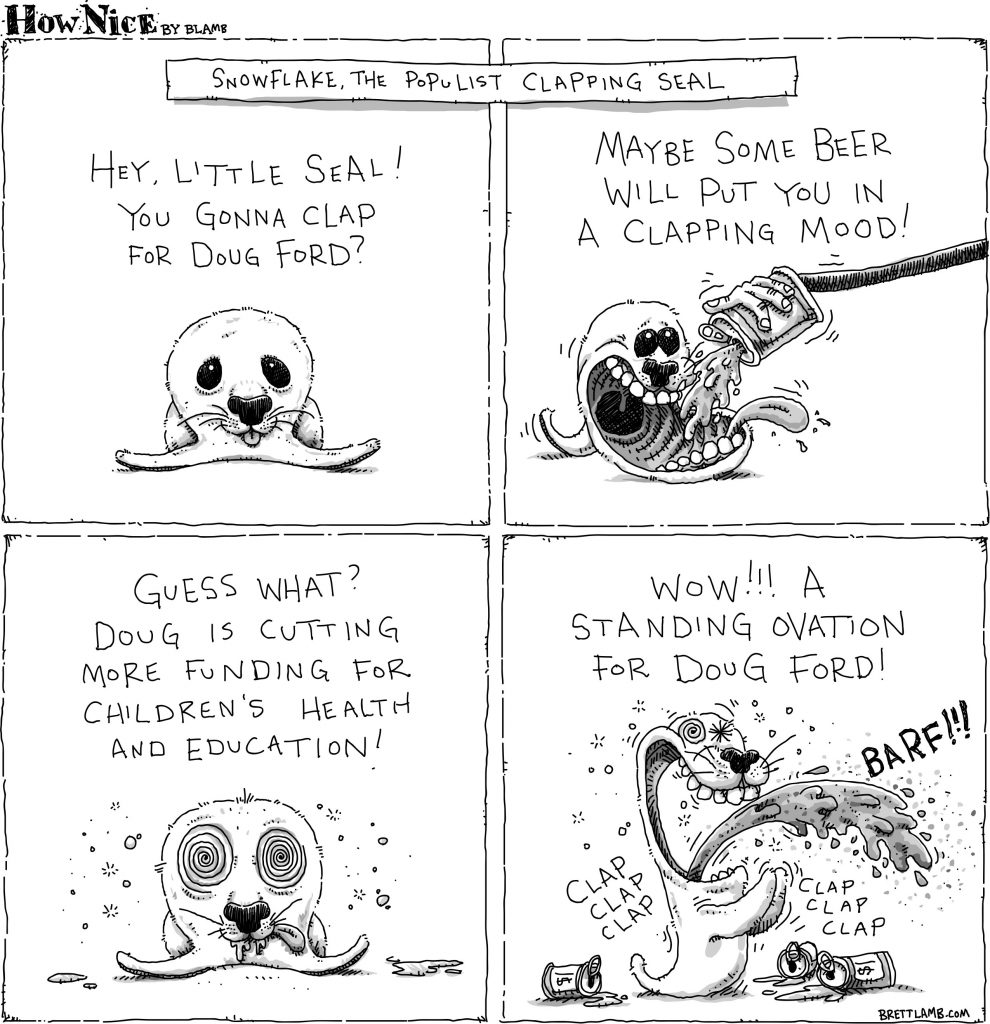
The most recent Ontario budget targets Toronto for over $177 million in annual provincial funding cuts. The targeted cuts are to Toronto’s programs in healthcare, child care, legal aid, tourism, and transit. In exchange, Premier Ford’s province-wide base gets a few shiny trinkets, and as a whole the budget still fails to resemble the kind of plan that could lead our province in the direction of fiscal balance.
Let’s consider a few numbers:
$4.9 billion – that’s how much more the province of Ontario will spend this year, than it has ever spent before. Last year, the Wynne government spent $158.5 billion, a record number. This year, the budget will spend even more: $163.5 billion.
40.4 % – That’s the percentage of our current debt to GDP ratio, and that is likely to grow in the coming year and slow economic growth as it does so.
$11.7 billion – that’s the actual size of Ontario’s deficit, according to the budget document. Then again, that’s just a number to be twisted and manipulated by Ford and his cronies. While they were campaigning, they claimed the deficit was $15 billion; now they claim to have reduced it to $11.7 since taking power. Right.
One reason for the increased pressure on the budget is the cancellation of the province’s cap-and-trade plan. This plan had helped lower our carbon emissions and brought in $2 billion in net revenue. That revenue funded green initiatives, like providing incentives to generate electricity from wind and solar to feed back into the grid. As a result of the cancellation, the federal government has imposed a carbon tax. Ford is spending $30 million to fight the feds on this in court. Ford argues that their tax will kill jobs and and push Ontario into a new recession, yet his budget actually predicts increased economic growth and employment with the federal carbon tax in place. Which is it, Mr. Ford?
In a recent report to city council, city manager Chris Murray tallied $177.65 million in provincial cuts to Toronto this year alone. That’s equivalent, in Murray’s estimation, to a 6 per cent residential property tax hike. Is Ford banking on Toronto raising property taxes and then asking him to come to the rescue? Budget impacts include $24 million in a loss of provincial gas tax funding, money intended to offset anticipated TTC day-to-day maintenance expenses. Councillor Joe Cressy (Ward 10, Spadina-Fort York) called this a “vicious cycle by design. The province breaks the TTC by not funding the TTC, then they propose to upload the TTC to fix the system they broke.” Toronto Public Health is facing a $65 million cut. In addition, this will devastate the 200,000 children who rely upon the city’s school nutrition program on a daily basis. Toronto Paramedic Services can look forward to a $3.85 million cut. Children’s services face the largest single cut of $84.8 million.
“If you look through the budget, it mentions booze and gambling 63 times. It mentions climate change 15 times and it mentions poverty zero times,” observed Green Party leader Mike Schreiner. The budget promises corner store availability of beer and wine. To make up for this, the province will give hundreds of millions to the Beer Store, which is owned by a multinational corporation that has an iron-clad contract that allows them (and the LCBO) to virtually corner the beer market. It’s one of the strange trinkets that one might see in a pre-election budget, like the pie-in-the sky vastly expanded subway system, open drinking in city parks, bars open at 9 a.m., on-line gambling, tailgate parties in the parking lot of sports arenas, more speed on 400-series highways, and a circus for the site of Ontario Place.
It’s a budget that makes no fiscal sense, and takes no responsibility for the well-being of … Torontonians. Which, it seems, is the point. Sticking-it to the big city plays well with the base, and for Ford, it probably feels good too. The Ontario budget for 2019 is an ode to ugly politics: it’s not lean, just mean.
Since the province decided to cut Council in half, there has been a clear trend of decision making that aims to marginalize the City of Toronto and its residents’ voices on many critical issues. The trend continued this month as the province revealed details of their plan to try and steal our subway, and made life-and-death decisions about addiction treatment.
The announcement that the province will cut funding to two of Toronto’s overdose prevention sites, Street Health at Dundas and Sherbourne streets and St. Stephen’s Community House in Kensington Market, where 60% of their clients are women, was widely condemned by health professionals. These sites have saved hundreds of lives in Toronto. They are now at risk of closing completely as they require funding to continue operations.
Toronto Public Health has made it clear that the opioid crisis is far from over. Last month we saw a record 474 calls to Toronto Paramedic Services from overdose cases and a surge in overdose deaths. This is the second highest month on record since Toronto Public Health first began reporting on paramedics’ data in August 2017. The majority of these calls and cases continue to come from Toronto’s downtown core, but the issue is widespread.
The City’s Chief Medical Officer of Health, frontline workers, and those who use harm reduction services as a life line are all in agreement: we are in a dire situation that needs further attention and support, not cuts.
Overdose is the leading cause of death for young people in our province and supervised consumption sites are a proven life-saving healthcare tool. People on the frontlines of harm reduction models of service have been developing networks of support and programming based on the realities of addiction in Toronto for over 30 years. These sites are the direct evolution of Public Health-sanctioned and evidence-based programming.
Toronto Public Health needs to be trusted to do their job. Doctors should determine treatment, not politicians. Doug Ford and the Ministry of Health are turning a blind eye to the evidence and life experience of those who are closest to the issue.
The chief medical officer of health was unequivocal in stating that the closure of these sites will absolutely lead to more deaths and take us further from the solution to the opioid epidemic that our city needs.
This is the defining health crisis of our time and the mayor, councillors, and the city’s chief medical officer of health have all condemned the decision to cut funding. I will continue to advocate for its restoration and look for ways to maintain funding for these life-saving services.
While dealing with this public health emergency, we are also facing the threat of losing control of our transit planning and subways. I recently had the opportunity to canvass Christie Station and heard from many residents concerned about rising fares, with no tangible service increases.
The proposal by Doug Ford to steal our subway has zero evidence, zero consultation, zero funding, and therefore no plan. It is a core responsibility of a major city to plan its transit routes and to do that our ownership must be maintained. This intrusion into the planning of our transit routes will have serious economic and transportation impacts, and a negative impact on the future of transit riders across the city.
I passed a motion at the March city council meeting requesting the public disclosure of a value-for-money assessment for all transit projects that are currently under discussion. This information will provide all residents of Toronto with the real cost of the projects the province plans to prioritize and will help guide our decision making on this integral policy matter.
The decisions of the provincial government this past week are setting us on a dangerous course toward creating a Toronto that will lead to a decreased quality of life for many. We cannot stand for this. I will fight alongside you to ensure that the future of our city is one where we are prioritizing plans and services that meet the needs of all residents.
Mike Layton is city councillor for Ward 11 University-Rosedale.
May 28th, 2019 · Comments Off on FORUM: Taking a stand against Ford’s cuts to education (May 2019)
MPP decries slashing of school budgets province-wide
By Jessica Bell, MPP (University—Rosedale)
Every child in Ontario deserves a quality public school education.
Great public schools have reasonable class sizes so teachers can help every student. Great schools are properly maintained so they are safe and healthy places to work, learn, and play. Great schools have a curriculum that is academically rigorous, encourages critical thinking, and honours diversity. Great schools are those that have support available, including additional teachers, educational assistants, and social workers, to meet the needs of all students.
I’ve spoken to parents, students, and educators and we agree: cutting the budget on the backs of children is wrong
Premier Doug Ford isn’t working to build up our cherished public school system. Instead, he’s tearing it down by slashing the funding and support that our children need to be able to learn.
The Ford government is directing school boards to cut more than $1 billion from Ontario classrooms. Their plan includes raising caps on class sizes starting in Grade 4. The 2019 Ontario budget confirmed that education funding won’t keep up with inflation, much less need. School boards are warning that this will mean class sizes of up to 46 students, with fewer available courses and support for students.
All of this means that up to 10,000 teacher and educator jobs will be cut, leaving students in crowded classrooms where they can’t get the attention they need. Layoffs have already started: this year, surplus notices for high school teachers in Toronto quadrupled.
Adding insult to injury, the Ford Conservatives have slashed $100 million from school repairs. This comes at a time when our chronically underfunded schools need $16 billion in basic repairs. Central Technical School at Harbord and Bathurst, for example, has nearly 30 repairs deemed critically urgent in its backlog – everything from replacing windows to elevator maintenance and roof repair. Many of these are crucial to ensure our children’s safety. Clinton Street Junior Public School, which has a serious Facility Condition Index of 70%, is in urgent need of renewed fire alarm systems. These are investments that cannot be ignored.
The Ford Government has also cancelled therapy and supports for children with autism. Starting April 1, more children with autism will be entering the public school system. Many parents are terrified about their children’s safety and learning. School boards have not been provided with any support, funding, or information from the Ministry of Education to ensure a smooth transition for all.
In the face of all this destruction, we are taking a stand for our education system. Earlier this month, more than 100,000 students from over 700 schools across Ontario organized the largest student protest in Canadian history in response to Doug Ford’s education proposals. I joined students at Harbord Collegiate and Rosedale School of the Arts, and was inspired by the passion, leadership, and commitment of young people in our community who are demanding more educational opportunities.
Only days later, I saw 10,000 people come together at Queen’s Park to rally for high quality public education and against Ford’s callous cuts.
I’ve spoken to parents, students, and educators throughout University—Rosedale, and we agree: cutting the budget on the backs of children is wrong. That’s why I’m glad that Ontario’s NDP supports investing in our children and in their future – not taking opportunities away from them.
I want to hear your thoughts on how Ford’s education cuts will impact you and your family. You can call my Community Office at 416-535-7206 or drop by at 719 Bloor St. W., Unit 103. I also encourage you to sign our petition, which you can download and print, or sign electronically at: https://www.jessicabellmpp.ca/petitions.
Families in our community know what’s at stake. We know that kids deserve more help from their government, not less. That means more access to teachers, more educational opportunities, and more chances to learn and thrive.
Let’s work together and give our children the quality public education they deserve.
Jessica Bell is Member of Provinical Parliament for University-Rosedale.
May 28th, 2019 · Comments Off on ARTS: Culture Corridor adds members (May 2019)
Women’s Art Association and Thomas Fisher Rare Book Library join
The Thomas Fisher Rare Book Library is the newest member of the Bloor Street Cultural Corridor. Among their treasures is this decorative binding from the 1601 book Instructionis sacerdotum libri septem. It is covered with block-printed paper with an elaborate floral design, and is an example of the binding technique known as ‘drawn-on solid’. COURTESY THOMAS FISHER RARE BOOK LIBRARY
By Meribeth Deen
The Bloor Street Culture Corridor offers some of the richest and most diverse cultural opportunities anywhere in Toronto, all within a subway-accessible 1.5 kilometre strip. Each year, more than three million members of the public go to Corridor exhibitions, performances, and events.This spring we are pleased to welcome several new partners to the group.
The Women’s Art Association of Canada (WAAC) is one of these new partners. This not-for-profit has been supporting Canadian artists for more than 130 years by providing scholarships and a haven for writers, musicians, and visual artists. The Mary Dignam Gallery (23 Prince Arthur Ave.) hosts openings, receptions, and member exhibitions. During the month of May, the gallery will display the work of thirteen member photographers who find beauty in obscure places. The show is called Beauty is Where You Find It, and it is a part of the Scotiabank Contact Photography Festival.
Another Corridor newcomer is the Thomas Fisher Rare Book Library. The library is the largest repository of publicly accessible rare books and manuscripts in Canada.
On May 21, the library will launch its latest exhibition, Uncovering the Book: An Exhibition in Honour of Greta Golick. Every book tells its story in its making. Books reflect their makers, their readers, and their users. This exhibition will feature the covers or the bindings of books as a reflection of their production and consumption – or, in other words, it will show the material book as witness to its manufacture, use, and survival.
More rare books will be on display at the Toronto Reference Library’s exhibit Retro Futures, which launches May 18. These books, alongside magazines, art work, and ephemera from the Merril Collection of Science Fiction, Speculation and Fantasy, will explore futures that might have been – inspired by the 50th anniversary of NASA’s first successful lunar landing. Guided tours will be available.
If you’ve got a Friday evening open, be sure to head over to the ROM for a Friday Night Live (#FNLROM). In the second half of May, you can enjoy the feature exhibition Treasures of a Desert Kingdom, alongside entertainment by DJ Parthobeatz and the Shiamak Toronto Dance Team. You can also just go to dance, and be inspired by forms of dance from around the world.
On the film front don’t forget about the Reel Abilities Film Festival (May 24 – June 2). This is Canada’s largest film festival showcasing disability and deaf cultures. Film screenings take place at the Al Green Theatre at the Miles Nadal JCC and Innis Town Hall at the University of Toronto. Buy your tickets at reelabilities.org.
May 28th, 2019 · Comments Off on GREENINGS: Plastic ban born of necessity (May 2019)
China done with being the world’s dumping ground
By Terri Chu
The Ontario government has announced it is mulling a ban on single-use plastics. As environmentalists rejoice at the small bone this gas guzzling loving government throws at us, we should all take a moment to thank China for this small miracle from the “red tape cutting” bandits.
Provincial rumblings about a ban on single-use plastics do not represent a sudden ideological shift on behalf of the current government. Premier Ford is still a climate change denier.
For decades China has taken in the world’s trash. Valuable bits, usually metals, are recycled, while less valuable bits are burned. Sometimes they end up in the oceans. However, a year ago China decided it was done with being the world’s dumping ground. The government decided there was enough internal garbage to deal with and shut its doors to recycling. Since then, landfills around the world have been scrambling to deal with the pile-up of plastic that was once shoved onto a boat bound for China. Some are burning it, some are burying it, but all are feeling the pain of suddenly having to confront their waste addiction.
Provincial rumblings about a ban on single-use plastics do not represent a sudden ideological shift on behalf of the current government. Premier Ford is still a climate change denier, and his cronies have not gotten suddenly passionate about clean water. The plastic pile-up is simply too big to manage. A solution is needed, and fast.
We’ve known for two years about this impending problem and have been grappling with its reality for more than a year. And now are we throwing open a “consultation” process.
Since Premier Ford took office, the political process has been moving at the speed of light. We can barely get our heads around the most recent devastation when the next cut hits us. It’s hard to keep up, but on this issue, we’ve got to step up.
We should definitely take advantage of China’s policy on imported waste and tell the Ontario government that yes, we want a ban on single-use plastics. We should tell them that all waste should be dealt with in the jurisdiction where it is produced. We should tell them we support measures like taking away flat municipal garbage collection fees and instead collecting those fees at the till with each cup of coffee sold, every television brought home, and every over-packaged box of individually wrapped candy. All waste collection fees should be line-items at the till so we know what every item costs to dispose of. Every bit of plastic needs to be charged by weight to the consumer so those of us who choose not to drink smelly water from bottles no longer subsidize those who do.
Opportunities like this do not come often. Those who manage waste are seeing their profits soar at the expense of those who produce waste. Normally, the environment is a loser with no dollar value attached. This time it’s different, and we have a chance to remind people that pollution is not, and should not, be free. We either pay for it now or force someone else to pay for it later.
We should be responsible adults and choose to pay for our own trash. Our children will be far better off for it than a handful of tax cuts.
Terri Chu is an engineer committed to practical environmentalism. This column is dedicated to helping the community reduce energy use, and help distinguish environmental truths from myths. Send questions, comments, and ideas for future columns to Terri at terri.chu@whyshouldicare.ca.
May 28th, 2019 · Comments Off on HISTORY: Plaque planned for track star Sam Richardson (May 2019)
CTS track star student attended Berlin Olympics on behalf of Canada
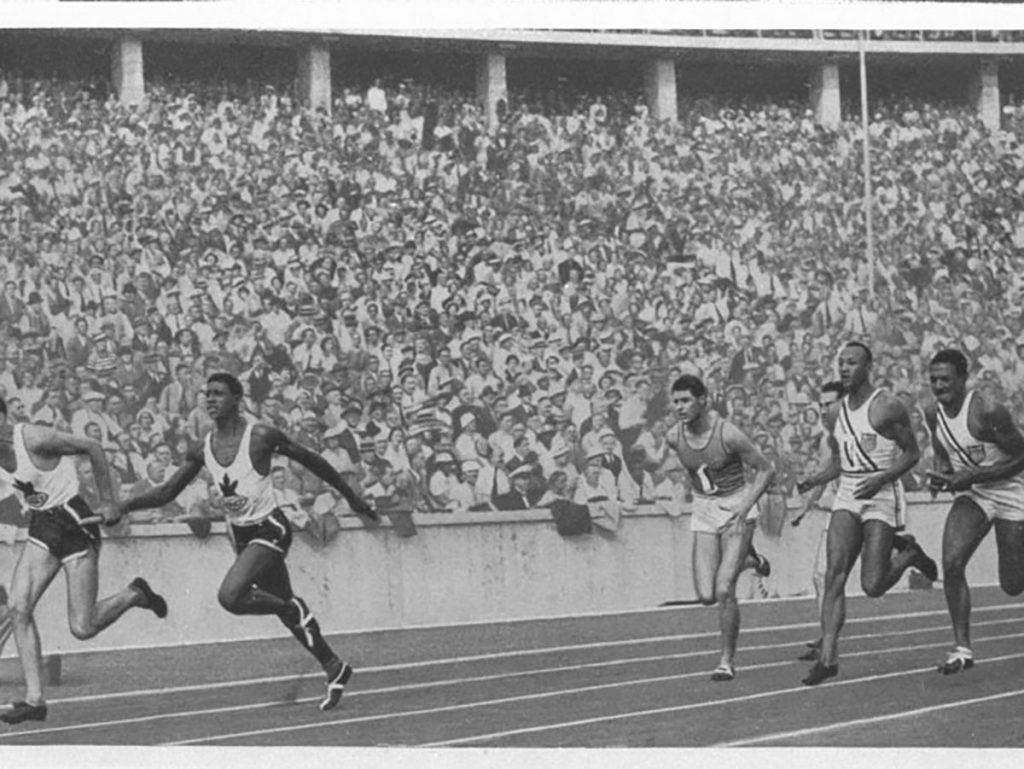
Sam Richardson passes the baton during the men’s 4×100 relay during the 1936 Summer Olympics in Berlin. Like Jesse Owens, who became a friend, Richardson proudly represented his nation while facing the institutionalized racism of Nazi Germany. PHOTO COURTESY CENTRAL TECHNICAL SCHOOL ARCHIVES
By Nabahat Hussain
Alumni of Central Technical School (CTS) are raising funds for a plaque commemorating the late Sam Richardson. The former student came in 5th place in the 4×100 metre relay race alongside his teammates in the 1936 Berlin Olympics. The heritage plaque in his honour will be placed in front of the high school while plans for a new scholarship in Richardson’s name are underway.
Richardson attended Lord Lansdowne, King Edward, and Central Technical schools. At the age of 10, he set his first record, jumping a length of 7 feet 6 inches. As a 13-year-old, he set the Canadian outdoor long jump record of 24 feet 11 inches. That record was not broken until 1965.
As a 15-year-old, Richardson joined Canada’s Olympic team and set off for the Berlin Olympics.
The ruling Nazi party banned German Jews from participating in the games and saw them as an opportunity to promote their propaganda of racial superiority. While black athletes were not banned, their participation in the games was certainly not welcomed. US track and field star Jesse Owens smashed any claims to Aryan racial supremacy by winning four gold medals at the games. He also mentored his young African-Canadian rival, Sam Richardson.
Last February, CTS renamed the street facing the establishment Sam Richardson Way. The Ontario Black History Society supported the event as Richardson’s family, friends, and fans attended the opening on Feb. 15, 2018. Having attended the secondary school in his youth and been a part of the track and field team, Richardson would often go back with his son and practise the sport. Richardson passed away in 1989, but his memory lives on today and his accomplishments are continually celebrated by the Central Technical School Alumni Association.
Fernanda Pisini, a representative from the CTS Alumni Association, says the plaque to be made in Richardson’s honour will cost $3,500.
“We want people to know that the plaque is part of bringing awareness and pride not just at Central Tech but also to the community as a whole, because it’s a big part of Toronto history,” Pisani says. “Also we want to bring awareness to athletes who competed in circumstances that were quite adverse, but who succeeded despite the odds.”
In regard to their plans for a scholarship, she says the school wants to build a legacy for Sam Richardson in order to contribute to the education of future students.
“If we could get a bursary together that would be fantastic, if we could get an on-going endowment or a scholarship that would be even better,” she says. The CTS Alumni Association expressed their belief that Sam Richardson’s legacy deserves some long overdue recognition and praise.
The school aims to have the plaque ready by autumn 2019. Assistance in funding it in the form of donations is welcome. Online donations can be made at www.ctsalumni.ca or by mail in the form of a cheque to the school at 160 Springhurst Ave., Suite 208, Toronto, ON M6K 1C2.
April 23rd, 2019 · Comments Off on ON THE COVER History delivered (Spring 2019)
COURTESY CANADA POST
Canada Post recently issued a new stamp in honour of Canada’s first black postman, Albert Jackson. His route included Harbord Village. For a reprise of Gleaner coverage on Jackson see page 10 and for more on the stamp, please see page 2.
April 23rd, 2019 · Comments Off on NEWS: Huron-Washingon Parkette relocates while UTS expands (Spring 2019)
Concerns expressed about future of playspace
A rendering by architects Diamond Schmitt of the new east face of University of Toronto Schools on Huron St. south of Bloor St. COURTESY SHANE GERALD, CITY OF TORONTO ECONOMIC DEVELOPMENT AND CULTURE
By Ahmed Hagar
In December Councillor Mike Layton announced the closure of the Huron-Washington Parkette to residents on his website, stating that it will be moved from 420 Huron St. and relocated to 406 Huron St. The parkette is now closed, but concerned residents are being assured that this closure is only temporary.
“Eventually the new park will be placed back at the old site, albeit in a slightly smaller space due to the presence of the gym under the ground of the park,” says Layton.
The Huron-Washington Parkette is temporarily closed due to construction at U of T Schools, with the playground equipment having been removed in January.
The closure of the park is part of the University of Toronto School’s (UTS) Building the Future campaign. The 371 Bloor St. West location is undergoing a major renovation as a condition to the new affiliation agreement signed with U of T in December 2015. The campaign states that prior to this agreement, the school’s future was uncertain with the school being at risk to losing both its name and location.
The project will increase the school space by 33 per cent to 120,000 sq. ft., and will include new facilities such as a 700-seat auditorium, a sky-lit atrium, new science and media labs, and a restoration of the historic facade. UTS has a temporary location at 30 Humbert St.
The school also raised $51.6 million for their campaign from alumni, parents, and other donors, which is about 86 per cent of their $60 million-dollar goal.
Huron-Sussex Residents’ Organization co-chair Julie Mathien says that the park and the playground are “very important” for the community.
“Throughout the planning process with the University of Toronto and UTS, we were very clear how important it was,” she said. “And they agreed.”
Mathien says the residents have worked with U of T, UTS, and councillors Joe Cressy and Mike Layton for two years on the development.
“We were concerned about the loss of trees,” she said. “The underground double gym would have taken up all of the space that is above ground in the park.”
After consulting with residents, UTS changed their plans regarding the underground gym, reducing its size to accommodate the parkette. The gym was also moved to avoid “crowding out the houses”, according to Mathien.
Mathien and the HSRO took part in a public consultation about the parkette last spring. She says that green space and playground equipment are important factors for the community.
“One of the things that needs to be understood is that it is not just green space but a place where children can play,” she said. “We are going to need equipment and amenities for a playground.”
Mathien says that the councillor’s office, U of T, and UTS were upfront and “willing to consult” with residents during public consultations and meetings.
Councillor Layton says that Huron-Washington Parkette will be redesigned and that there will be a public consultation in the near future, with no specific date yet.
“The city will be hosting consultation with the Huron-Sussex Residents’ Organization and U of T in the coming years as we plan the new space,” he said, adding that the parkette will re-open temporarily in the spring.
“The major thing we are looking for now is that everything is ready to go once the bad weather stops,” she said. “The city would need to have certain kinds of weather and soil conditions to move the equipment and we do not want to have any hold-up.”The new parkette will open when UTS completes their work, which is estimated to be in three years’ time.
April 23rd, 2019 · Comments Off on NEWS: Ten Editions Bookstore calls it a day (Spring 2019)
Heritage designation of building does not extend to its occupants
By Lena Sanz Tovar
Ten Editions, a beloved book store at 698 Spadina Avenue, has officially closed after 35 years. The University of Toronto is set to begin its newest residence-building project at the site, and many community members are feeling bittersweet.
Open since 1984, the bookstore was named after the owner’s ten children – her “ten editions”. The eccentric and romantic vibe of the store has drawn in people from many walks of life, including Ryerson University film students and McDonald’s advertising teams hoping to shoot in the store. After the passing of her mother, Susan Duff took over the store and has been the primary operator for approximately thirty years.
“My family is all around this place,” she says. “My sister wrote the history of the store on the wall. My nephews did the artwork on the wall at the front of the store. It’s always been a very family affair.”
The Harbord Village Residents’ Association (HVRA) and others in the community have long fought alongside Duff against the store’s closure.
“No one I’ve spoken with wants the store to close, but bookstores are closing,” says Duff. “You would expect an institution of higher learning to protect one a bit.”
Nearly a decade ago, the University of Toronto purchased the property. Sometime after the purchase the university expressed interest in redeveloping the land. The proposed site will consist of a new student residence, faculty housing, and a coffee shop that will serve as a place where U of T students and members of the community can gather. According to Duff, however, Ten Editions has acted as a gathering place in the Annex throughout its operation.
“At every meeting we ever went to someone in the audience would say, ‘Well, what about the bookstore? We want to keep the bookstore,’” says Duff. Ten Editions, a staple of the neighbourhood, had been a place where community members gathered and socialized.
For five years the community has attempted to save the store and the building together, but as the new plans for the U of T residence proves, only the structure of the building will be preserved as a heritage site under Part IV, Section 29 of the Ontario Heritage Act.
A site is considered for heritage designation based on the cultural heritage value of the building’s physical attributes. Though current and past occupants of the sites considered for heritage designation may be mentioned in heritage impact assessments, their occupancy is not part of the criteria used to designate a building as a heritage site.
While this project will help address housing challenges for U of T students, it has been a difficult process for Duff and members of the community.
“I’ve never met one person who was happy about this decision. When we got partial heritage, everybody thought ‘Oh, you can stay!’ But they don’t tell you exactly what this means. U of T has never said anything to me about staying,” says Duff. “You want to believe that your actions accomplished something or at least it’s explained to you why your mindset is so different, but there was never any word of explanation.”
April 23rd, 2019 · Comments Off on NEWS: BIA behind green plan (Spring 2019)
BIA infrastructure improvements, parkettes construction to begin in 2019
By Meribeth Deen
Big changes are coming to Bloor Street: new sidewalks, new water-mains, new trees in the ground, and four new parkettes. At the recent Bloor-Annex Business Improvement Association AGM, BIA chair (and publisher of this newspaper) Brian Burchell told local business and property owners that, after years of planning, the City of Toronto is confident that the Bloor St. Greening Initiative will come to fruition in the coming year.
“We’re working with the city to co-ordinate construction efforts,” says Burchell. “The idea is to have work related to the greening project and infrastructure work done at the same time. The challenge is that the equipment and the expertise required to do this work is very different.”
Take, for example, the granite rocks that will be found in the parkettes.
“They’ve been quarried from Quebec and are the size of small cars,” says Burchell. “They are going to have laser-cuts in them to create seating areas even though they are technically intended as art installations. Installing these will require large cranes to get them into the correct position.”
The parkettes are located on city-owned rights-of-way that abut Bloor Street at Robert Street, Major Street, Brunswick Avenue, and Howland Avene. Each parkette will have new trees and feature wood decking made from sustainably sourced wood that is infused with resin so it will last for decades, and a pollinator-friendy garden catering to the 350 species of bees living in the Toronto area as well as birds and butterflies.
Another challenging aspect to the project will be the removal of the planter-boxes on Bloor St. and replacing them with in-ground trees.
“First of all, we want to provide more space for pedestrian traffic,” says Burchell. “But also, these boxes are known as tree-coffins. There’s not enough space for their roots, which means the lifespan of the trees in those boxes is limited. By planting trees in the ground with space for proper root systems, we’re making an investment that will outlive us. That said, the engineering costs of making it happen are not insignificant.”
To complement the new bike lanes on Bloor St., the greening project will also increase the amount of bike parking by 30 per cent.
“This is one pillar of our greening plan. We are the only business improvement association in the city that endorses bike lanes,” says Burchell. “As a whole this project is about creating value out of providing non-commercial space in the neighbourhood. Simply put, we want to give people another reason to come to the Annex. Bike lanes are a part of that, but we’ve also done the research and we know that, contrary to popular belief, they’re actually good for business.”
With the pending construction, Burchell acknowledges that the board of the BIA is aware of its members’ concerns. The board has already made steps towards mitigating the effects of construction in several ways including helping businesses improve their e-commerce presence. The BIA has engaged the services of Digital Main Street, a City of Toronto consultant. DMS has been meeting with members and advising them how to better position their products and services on line. In addition, the BIA has sanctioned an aggressive construction schedule for the road work which will permit the contractor to work two shifts a day – six days a week if necessary – which will make the total time of disruption to Bloor shorter.
At the AGM, Councillor Mike Layton assured the members that he would serve as a strong ally and advocate for the project, just as Councillor Cressy had been up until the recent ward redistribution. As a local resident, he said, he looks forward to assisting the work of the BIA.
Canada Post issued a stamp honouring Albert Jackson just in time for Black History month this year. Born a slave in Delaware in the 1850s, Jackson came to Canada as a toddler on the Underground Railway. He grew up in Toronto and won a position as a letter carrier in 1882. The other Canada Post employees refused to train him because of the colour of his skin, and the media fuelled a heated public debate about “the coloured postman”.
The local black community came to Jackson’s defence publicly, and Sir John A. Macdonald, who was courting their vote, chimed in as well. He promised that the youth would go to work as a carrier “come what may,” according to one newspaper article.
Jackson persevered, and went on to work for 36 years with the postal service.
“Albert Jackson’s determination opened the doors for many Black Canadians to enter the postal service,” says Ann Therese MacEachern, chief human resources officer at Canada Post. “His courage laid the foundation for the diverse workforce we have at Canada Post today.”