July 16th, 2019 · Comments Off on EDITORIAL: Time for Ford to press “eject” (Summer 2019)
A recent poll confirms that Doug Ford’s favourability ratings are falling hard and fast. His level of support is lower than Kathleen Wynne’s was at the end of her tenure, lower, as the president of Mainstreet Research Quito Maggi says, than any incumbent premier has ever seen this soon after being elected.
Mainstreet asked voters what choice they would make if there were an election today and 39.9% (+13.9% since April) approved of interim Liberal leader John Fraser.
If Toronto Mayor John Tory were leading the party, the poll says the Liberals would do even better.
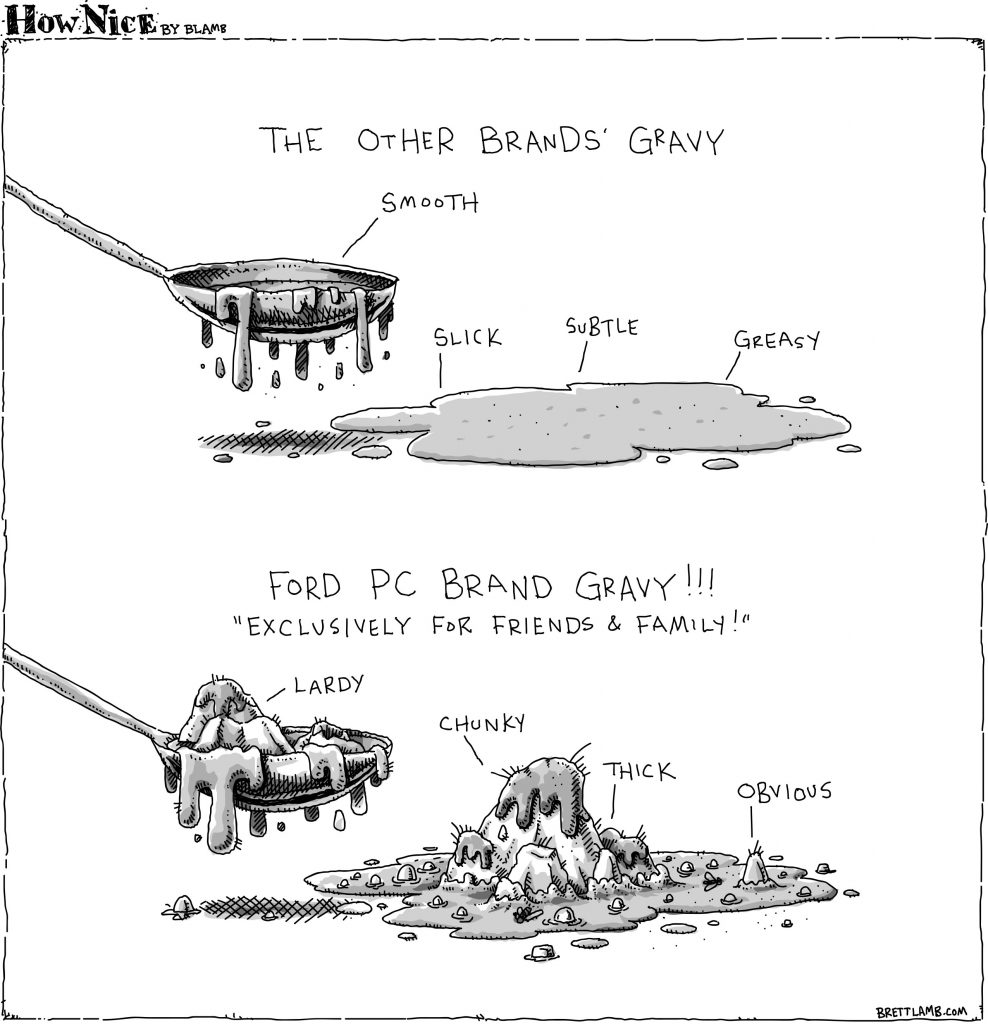
In response to the news of his government’s trouble and getting booed off stage at public events, Ford has axed his most prominent cabinet ministers. Just two months after delivering a miserly budget, Finance Minister Vic Fedeli is dumped.
After a series of blunt and insensitive efforts to push through an ill-conceived plan to change the way autism programming is delivered, Lisa McLeod finds herself demoted from the head of Children, Families and Social Services to minister of tourism.
Caroline Mulroney is relieved of her post as attorney general over cuts to Legal Aid Ontario which will, by definition, target the most vulnerable. Lisa Thompson loses the chair of education minister after clashing with school boards over cuts that will lead to larger classes sizes, saying it would make students more resilient. Nice.
It would be optimistic to think this shuffle indicated some kind of shift in the government’s approach, but are these ministers actually the problem? Ford’s government is deeply centralized, and its agenda is nothing short of insane.
We can’t blame the ministers for failing to carry out his edicts, but we can blame them for failing to stand up to their leader and his hand-picked team of staff.
Premier Ford must sense that his attempt to rebrand his government falls short, just a little.
He skipped all of the external appointment processes and recommended several insiders for lucrative jobs, including a 26-year-old named Tyler Albrecht to the post of Ontario’s agent-general in New York City. The position earns $185,000 plus expenses. Albrecht is a friend of Dean French’s son, a lacrosse buddy.
Fortunately the appointment has already been rescinded, but the take away from this bit of drama is that the new cabinet approved it uncritically.
Doug Ford is still Doug Ford. He’s hapless, inexperienced, and lacks understanding of the workings of government.
He has no interest in deep briefings. He likes to get into scrappy political fights and is quick to U-turn when there is a backlash or to fire people when things don’t go his way.
Ford’s sagging popularity has reached, in short order, a tipping point, recovery from which is extremely unlikely.
Avoiding public events for the next three years for fear of being booed is hardly a manifestation of “governing for the people”.
It’s time for Ford to consider a graceful resignation, even though grace might be hard to muster.
July 16th, 2019 · Comments Off on FORUM: Top takeaways for our community from Ontario’s 2019 budget (Summer 2019)
Education, health care, social services, legal aid, all on chopping block
By Jessica Bell, MPP (University—Rosedale)
On April 11, the Ford government presented their first budget called “Ontario’s Plan to Protect What Matters Most”. It’s an ironic title, considering how many cuts to key services are included. Below is a brief round-up of some of the biggest announcements and their impact on our community.
One of the biggest cuts in the budget is for Community and Social Services, which will lose a billion dollars over the next four years
Post-secondary education
The budget made it clear that the Conservatives are taking a stand against colleges and universities. The government has announced that funding for post-secondary educations will decline by $400 million, with a significant impact on student affordability. In addition, universities and colleges will now have their funding tied to “performance agreements”, requiring institutions to reach targets set by the government in order to access as much as 60 per cent of funding. Details on the targets and metrics that will be used have not been provided.
Thousands of students, faculty, administrators, and others that work and study at the University of Toronto live in University-Rosedale. I will continue to push for more, not less, funding for post-secondary institutions.
Education
The budget confirmed that, under Premier Ford, education funding for kindergarten to grade 12 will not keep pace with inflation. We’ve already seen what that means: larger classes, fewer available courses and teacher layoffs. School boards are warning that this level of funding will mean class sizes of up to 46 students, fewer courses, and thousands of fired teachers.
University-Rosedale is home to great public schools. Students at these schools have been standing up for their right to a quality education. I recently received a letter signed by hundreds of students at Rosedale Heights School of the Arts, asking me to stand up to Ford’s education cuts. I will continue to advocate for them and for all students in University-Rosedale.
Health care
Like education, the annual funding allocated for health care in the budget doesn’t keep pace with inflation. That means that as our population ages and needs go up, funding will be less in real terms than it is today. Hospitals have already warned that this level of funding will mean cuts to services and layoffs of frontline staff.
University-Rosedale is home to some of the best hospitals and health care facilities in Canada. I am deeply concerned about Premier Ford’s clear cut in health care spending, as well as the decision to slash $200 million by reducing the number of public health units to just 10, down from 35. Public health units help prevent diseases and injury, and this decrease has generated concern from experts including Ontario’s former chief medical officer of health.
Social services and legal aid
One of the biggest cuts in the budget is for Community and Social Services, which will lose a billion dollars over the next four years. The Conservatives have refused to tell us how this will impact people with disabilities and other vulnerable citizens. One thing we do know is that the Conservatives have cut legal aid funding by 30 per cent, including eliminating funding for legal services for immigrants and refugees.
In our community we have a range of legal clinics that help low-income people access essential legal services. Denying legal representation and advice to some of our most vulnerable residents is wrong. I support the petition put forward by the Refugee Lawyers Association of Ontario to reverse these harmful cuts, and will continue to push for a fair and accountable justice system where everyone’s rights are met.
Jessica Bell is Member of Provinical Parliament for University-Rosedale.
July 16th, 2019 · Comments Off on GREENINGS: Not sure what’s worse, climate crisis or denying it? (Summer 2019)
Act local to address the reality of climate change
By Terri Chu
Here’s a question for you: What’s more depressing, the ever-worsening predictions we hear from climate scientists, or the daily news of continued denialism from the Trumps and Fords of the world? If you live on Toronto Island, you are probably too busy to contemplate. The floodwaters are rising as quickly as forests are burning and communities are being evacuated in other parts of the country. This is real life, and this is climate change. What can we do about it?
We’re better off facing our new reality head-on: relocation from flood and fire-prone areas is going to be a fact of life as our planet heats up.
Well, when we talk about Toronto Island in particular, we see city councillors calling for more action to protect houses on the island while engineers offer what looks like a collective eye-roll.
The cost of controlling lake levels would likely cost billions. We’re better off facing our new reality head-on: relocation from flood and fire-prone areas is going to be a fact of life as our planet heats up. As writer Bill McKibben says, the world is shrinking.
It’s been said for decades but for me, the best way to focus energies is by acting local.
The Annex Residents’ Association (ARA) has recently added an environmental mandate to its parks and trees committee, which I proudly chair.
We will be engaging in projects and programs designed to reduce the environmental impact of living and doing business in the neighbourhood, watching over the well being of our precious green spaces, and making sure new developments don’t increase flood risks in the neighbourhood.
Every time a new parking pad gets added in the neighbourhood, we lose ground water absorption capacity and increase the run-off to our century-old sewer system.
Every time a tree comes down, we lose canopy coverage, its evaporative cooling effects, and capacity for water absorption.
Even if we can’t knock sense into either end of the political spectrum, we can try to control the things that happen in our own neighbourhood.
On the top of the ARA’s list is increasing our neighbourhood tree canopy coverage.
The triple hit of wind, ice, and wind storms brought down a lot of trees in the spring of 2018. Our tree database shows an estimated loss of 10 per cent of neighbourhood trees. That’s a staggering 1,000 trees.
You can see the holes in the tree canopy on sunny summer days. Streets that used to be shady are now in full sun all afternoon.
Premier Ford has canned a program that would have planted 50 million trees in Ontario by putting even city-funded tree planting programs on hold.
We’re on our own now, so having strong community support is more important than ever. Let’s not only replace those 1,000 lost trees but make sure we can make up for the trees we are expected to lose in next 20 years.
Environmentally speaking, political action is the most powerful. A carbon tax will do a lot to reduce carbon emissions (when done right).
A policy to respect local land formations in land use planning will go a long way towards flood prevention.
However, in the absence of sane policies, the rest of us must act locally to keep our wits about us and vote like hell when elections come around.
Join the ARA environment committee to get involved and don’t let the depressing news get you down. We can at least make a difference here: parksandtrees@theara.org.
Terri Chu is an engineer committed to practical environmentalism. This column is dedicated to helping the community reduce energy use, and help distinguish environmental truths from myths. Send questions, comments, and ideas for future columns to Terri at terri.chu@whyshouldicare.ca.
July 16th, 2019 · Comments Off on GRADING OUR GREENSPACE: Open spaces in the heart of the Annex (Summer 2019)
Lots of places for ambling with a dog, playing sports, or watching the world go by
This is our first set of park reviews for 2019. The Annex and its surroundings are blessed with a rich array of green space — much of it under the umbrella of city parks. We grade them here, every year using many parameters. Many a venue to run your dog, laze away a day, grab a seat in the sunshine, or shade, push a child on the swing set, the Annex has it all.
Compiled by Nabahat Hussain and Juan Romero
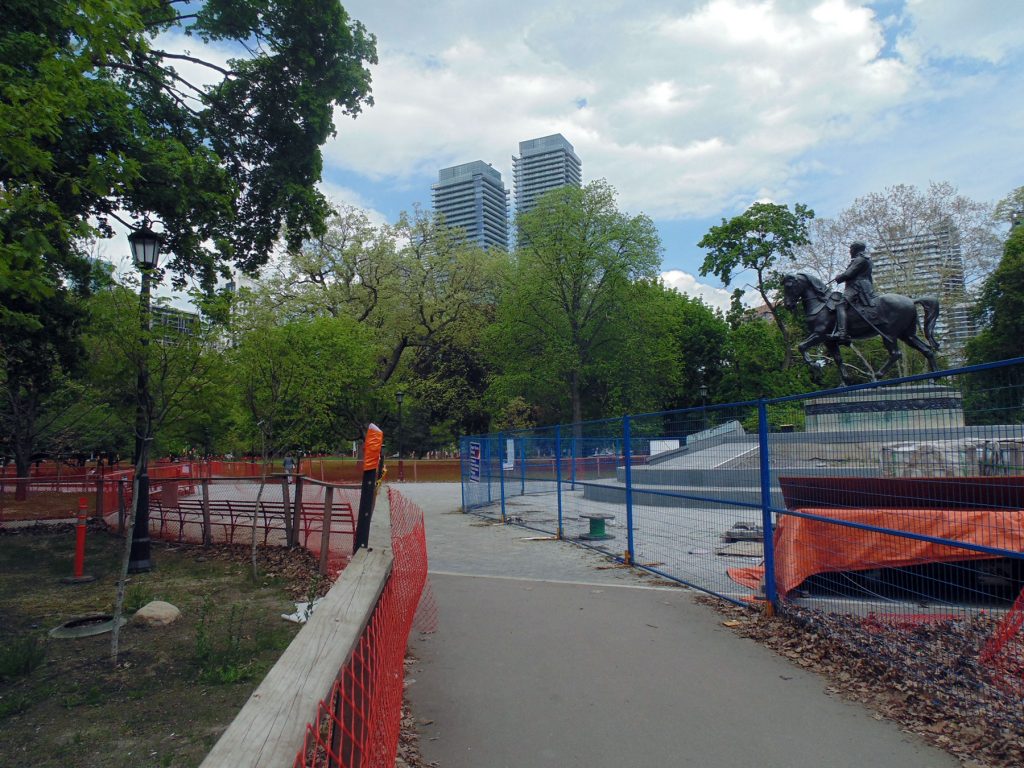
Queen’s Park improvements under way. NABAHAT HUSSAIN/GLEANER
Queen’s Park
47 Queen’s Park Cres.
Time: 2:00 p.m.
Grade: B (last year A)
Reason to go: There are many paths on which to stroll, run, or bike-ride. The park is like a huge maze this year as all of the grass areas are closed off as grass seeds take root. The park’s maintenance has gone down as the “Queen’s Park north improvements” are implemented. Though the park is not in its prime at the moment, the efforts to improve it are commendable and will surely benefit the community once they are completed in August 2019.
Overheard: Silence, not a lot of activity going on at the moment. Even the construction wasn’t loud.
Did you know: Established in 1860, this well-known park was named to honour Queen Victoria; her son, Edward VII, attended its opening. Today a statue depicting the king on a horse stands in the centre of the park.
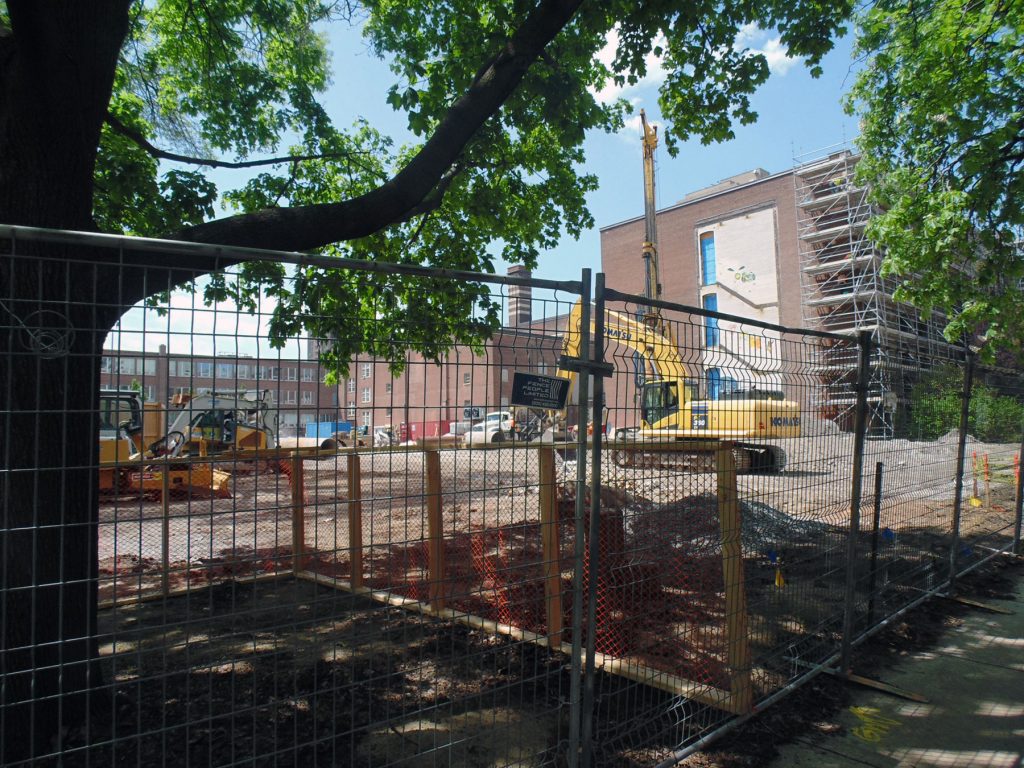
Huron-Washington Parkette is being relocated while UTS is under construction. NABAHAT HUSSAIN/GLEANER NEWS
Huron Washington Parkette
Huron Street and Washington Avenue
Time: 11:30 a.m.
Grade: No grade (last year B+)
Reason to go: The park is currently being relocated to 406 Huron St. as University of Toronto Schools (UTS) expands. All the park equipment has been removed and all that remains at 420 Huron St. are two benches and a few tree protection area fences. Until the park has been relocated, this park is a pass.
Overheard: The deafening sound of construction next door at UTS.
Fact: The space where the park used to be will be used to increase the UTS location by 33 per cent. The addition will include a new auditorium, a skylit atrium, and science and media labs. There is a Gleaner article from the Spring 2019 issue about the parkette’s relocation titled “Huron-Washington Parkette relocates while UTS expands”.
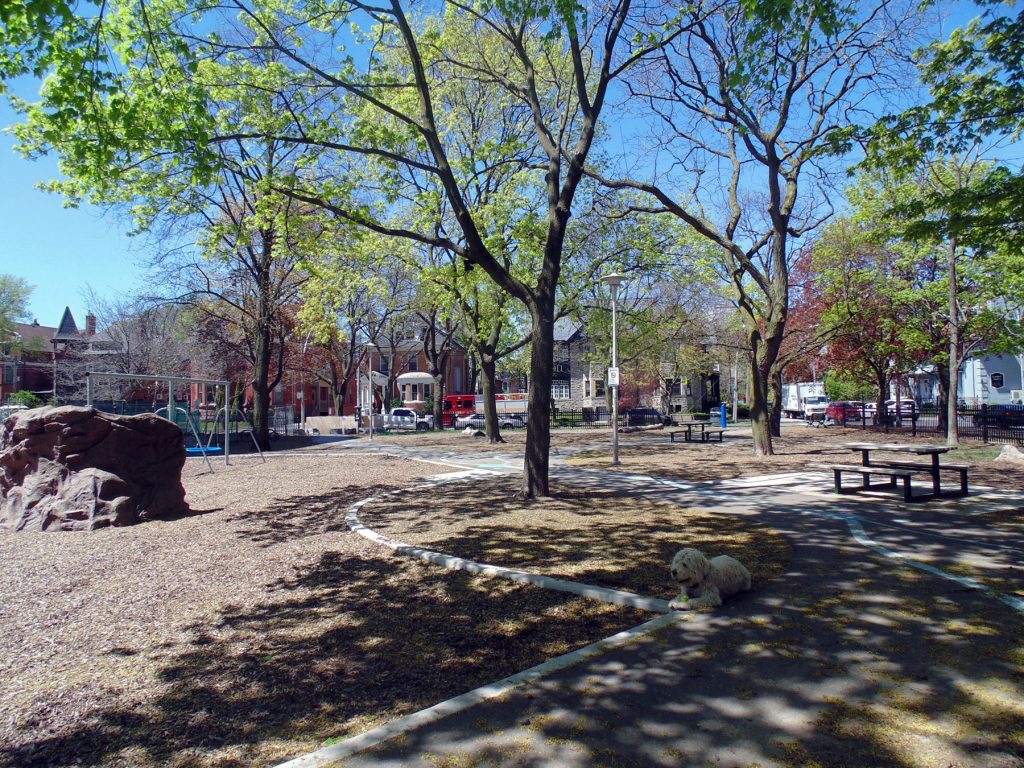
A dog rests in the shade at the Huron Street Playground. NABAHAT HUSSAIN/GLEANER NEWS
Huron Street Playground
495 Huron St.
Time: 11:00 a.m.
Grade: B (last year B)
Reason to go: Not much has changed since last year at this park. It still appears to be well liked by children and features unique park equipment such as tire swings and a climbing web. The neighbouring apartment building is still under renovation; nonetheless the park attracts many passers-by from dog walkers to teachers and students from local schools. The variety of seating and abundance of shade created by the canopy make it perfect to take a break from the hustling and bustling main street.
Did you know: The park was renovated in 2016 bringing the new spider web, tire swings, and rock climbing area.
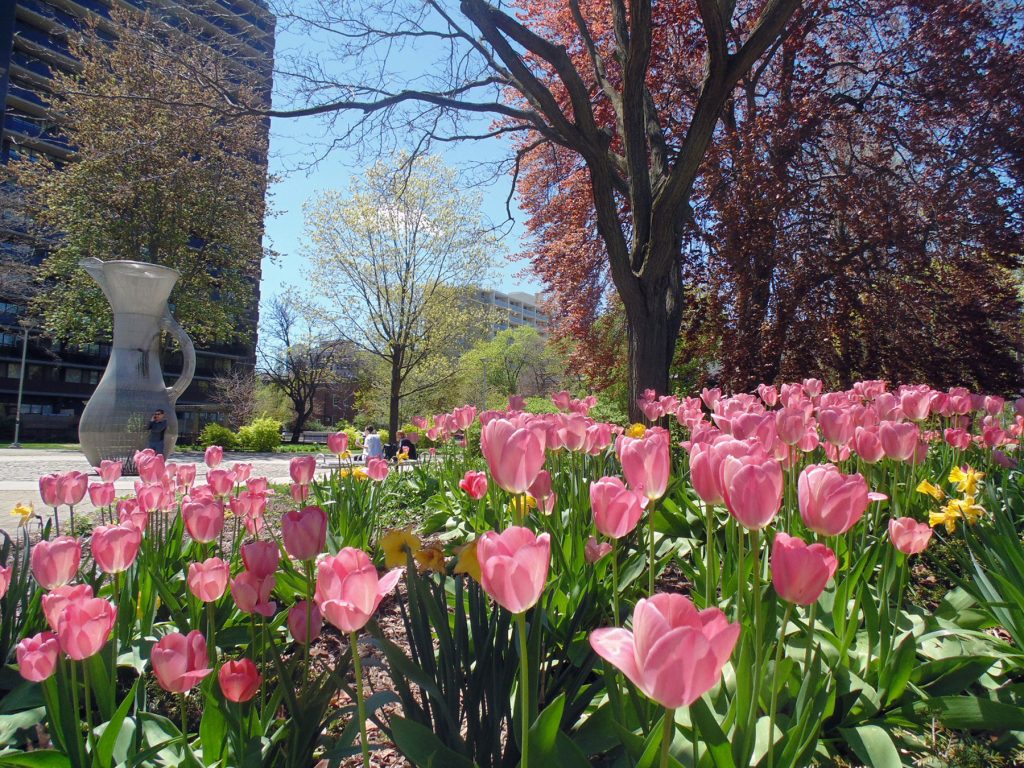
Taddle Creek Park is recognized for “The Vessel”, a sculpture by Ilan Sandler, which sits right at the middle of the park surrounded by beautiful green space. NABAHAT?HUSSAIN/GLEANER NEWS
Taddle Creek Park
40 Bedford St.
Time: 12:30 p.m.
Grade: A+ (last year A)
Reason to go: Taddle Creek Park has something for everyone including a relaxing atmosphere with a variety of park equipment, which makes it an enjoyable destination for adults and children alike. There are pink tulips and yellow daffodils in full bloom attracting many photos from people walking by. Well maintained and clean without any litter, this park really is an urban oasis. The centrepiece, “The Vessel” by artist Ilan Sandler, gives the park an artistic touch among the luscious green space surrounding it.
Overheard: A lot of birds chirping, perched on the top of trees.
Did you know: The park is named after Toronto’s buried stream, Taddle Creek, which used to run from the park’s location to Lake Ontario through the U of T area.
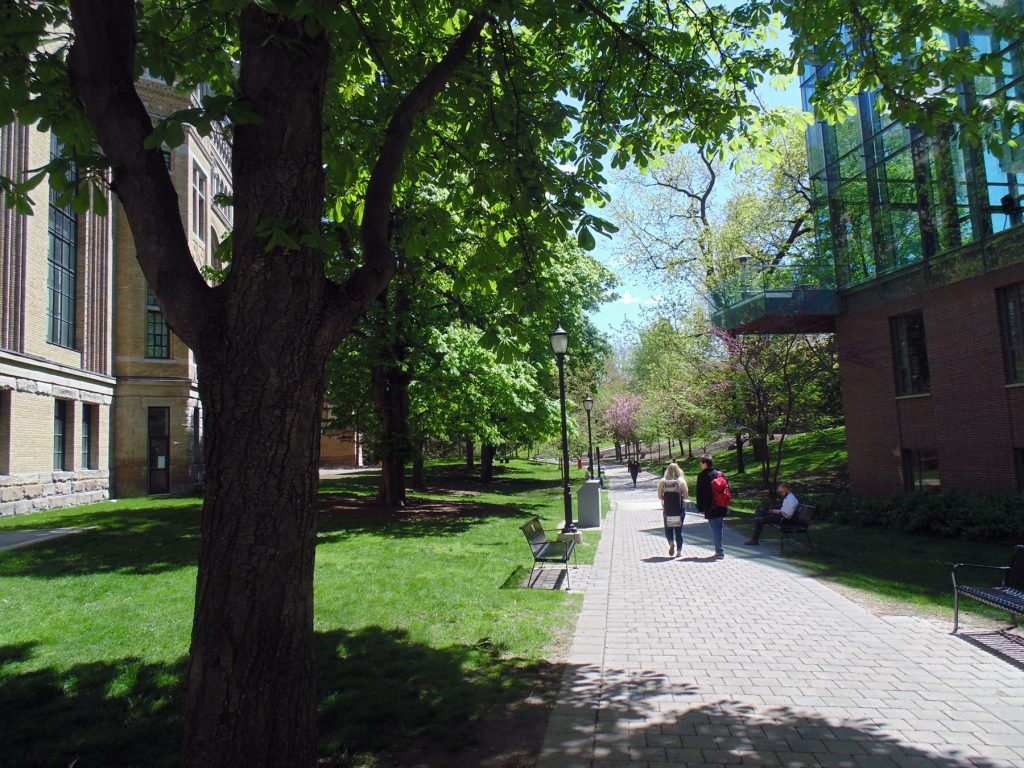
Philosopher’s Walk runs across many iconic spots of the Annex area such as the University of Toronto and Royal Ontario Museum. The path itself is extremely rich in tree variety and green space. NABAHAT?HUSSAIN/GLEANER NEWS
Philosopher’s Walk
78 Queen’s Park Cres. W.
Time: 2:00 p.m.
Grade: A (last year A-)
Reason to go: A first stroll through Philosopher’s Walk is bound to leave one starstruck. Scenic in every sense of the word, this park is like a slice of heaven. The U of T buildings on both sides of the path are breathtaking in their architectural appeal. Who wouldn’t want to attend the Royal Conservatory of Music just to be able to enjoy this retreat on a daily basis? Well maintained, relaxing, clean and unique, this is a park popular among adults. The variety of plantings adds an extra layer of allure to the space, it’s a must-see.
Overheard: A professor conducts an outdoor lecture talking about trees to a group of students.
Did you know: Taddle Creek used to flow where the walk now resides; there is a plaque on the U of T premises with information about the vanished stream.
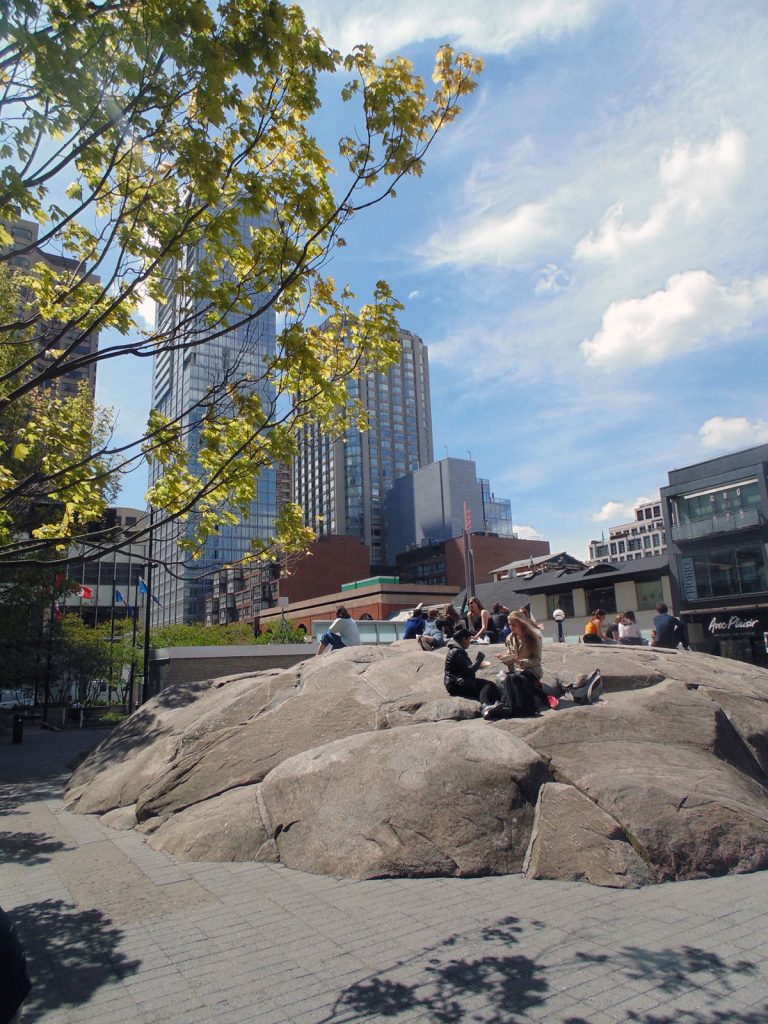
Yorkville Park is a very common spot for workers from the area to enjoy their lunch outdoors. You can spot this park easily due to the large rock in it that stands out. NABAHAT?HUSSAIN/GLEANER NEWS
Village of Yorkville Park
115 Cumberland St.
Time: 2:50 p.m.
Grade: A (last year A)
Reason to go: This park is immensely popular among working adults and is packed to the brim as people hunt for seats. There is close to no grass and the trees are all ornamental making it similar to a parkette. The park is gorgeous in its minimalistic and uniform design. The colossal rock next to Bay Station is the standout piece, attracting many people enjoying their lunch. There are a variety of high-end boutiques and shops facing the park. It is noisy, so not an escape from the city but more of a resting spot among the chaos. The cherry trees when in bloom are a spot where many people take photos this time of year.
Overheard: Harmonica, being played by a man seated on a nearby bench.
Did you know: In the 1950s a row of Victorian homes were demolished to start construction on the subway underneath the park. Local residents wanted a park to be built over the station, but a parking lot was built instead. In 1991 their requests were finally heard and the Village of Yorkville Park was built over the lot.
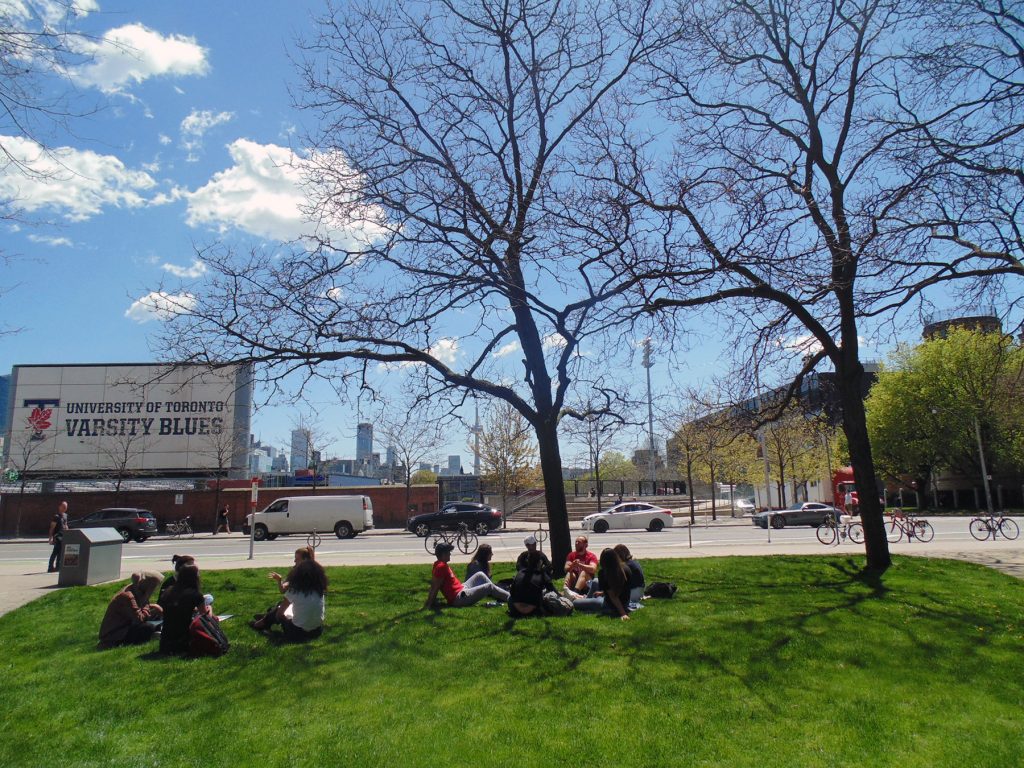
Bloor-Bedford Parkette is a great place to stop for a rest. NABAHAT HUSSAIN/GLEANER NEWS
Bloor-Bedford Parkette
245 Bloor St. W.
Time: 1:30 p.m.
Grade: B+ (last year B)
Reason to go: With seven benches and clean-cut grass to sit on, this is the ultimate resting station for those walking along Bloor Street West. One can expect a group of university students to be seated on the grass painting a perfect picture of youth. Traffic moves right in front of the park, making it less peaceful than other parks.
Overheard: The sound of traffic on the main street and college students conversing in groups.
Did you know: The parkette is right in front of U of T’s Varsity stadium and sits above St. George station.
Matt Cohen Park
393 Bloor St. W.
Time: 11:30 a.m.
Grade: C- (last year C)
Reason to go: Matt Cohen Park is popular among university students and local workers enjoying a lunch break. At almost any time during the day you will find people sitting on the park’s many benches and seating areas. However, it does not have a relaxing atmosphere. Since the park is located right at the intersection of Bloor Street West and Spadina Avenue, it gets very noisy with all the cars, street cars, and honks you would expect from a busy intersection. The green spaces are minimal and they do not seem to be well maintained, as you will find litter all over the park and the grass has a lot of undergrowth. There is not much in terms of activities, so if you are looking for a place to take your kids to play, Matt Cohen Park should not be your go-to. However, if you work or study in the area, or you are just simply walking by, this park offers a place to sit down, take a break, and enjoy the summer weather.
Overheard: Honking, streetcars, and construction nearby.
Did you know: Canadian writer Matt Cohen wrote children’s books under the nickname “Teddy Jam”.
Margaret Fairley Park
100 Brunswick Ave.
Time: 12:00 p.m.
Grade: A+ (last year A)
Reason to go: Margaret Fairley Park is the perfect spot to take young children out to play. The park offers a big playground with swings, a tree house, and a sandbox, and it is a popular spot for students from nearby public schools to spend their recess. For adults, Margaret Fairley Park can also be an enjoyable spot. Overall the park is well maintained as it is very clean. The atmosphere is calm as the site is in a residential area and not many cars pass by. The park offers lots of seating surrounding the playground as well as picnic tables in the green spaces. Families can come and enjoy a nice outdoor lunch, as the picnic tables are in shaded areas.
Overheard: “You’re it!” A child playing tag with his dad.
Did you know: Margaret Fairley Park was originally opened in 1972, but it was renovated and re-inaugurated in 2017.
Sally Bird Park
194 Brunswick Ave.
Time: 2:15 p.m.
Grade: B (last year B)
Reason to go: Sally Bird Park is so small that you will miss it if you are not paying attention. It is located between two houses on Brunswick Avenue. It is a great spot for people who enjoy exercising outdoors as the park offers workout machines. It is a pretty common meeting place for students from the Central Technical School during their lunch and after school, but for the most part it remains empty. Since the park is so small the green space is minimal especially because there is a sidewalk across it that connects Brunswick Avenue and Alan Powell Lane. The park is pretty isolated from traffic and even people which makes the atmosphere extremely calm and silent if you are by yourself. Since the park is somewhat hidden it has been prone to vandalism, and you will find graffiti on the walls and the benches. Overall it is a great spot to exercise or to have a relaxing break without much interruption.
Overheard: Birds chirping.
Did you know: Working out in local parks to stay fit can be a great alternative to having to pay for a monthly gym membership.
Doctor’s Parkette
15 Brunswick Ave.
Time: 5:00 p.m.
Grade: B (last year B)
Reason to go: Right along the intersection of College Street and Brunswick Avenue, you will find the Doctor’s Parkette. It is a place where workers and passers-by can sit down and take a break from their day. Doctor’s Parkette has plenty of benches and it is well maintained and is very clean. The few plants and trees in the park are also in good shape but it is, however, not a very relaxing spot. The intersection gets busy at times, and the background noise you will hear consists of honks, cars, and streetcars. It also lacks green space. Most of the park is concrete, so its purpose is basically to be a seating area. Doctor’s Parkette is a popular spot, with people in it at most times during the day. It is a good place to take a break if you live or work in the area.
Overheard: “Just let me give her a call, and I will call you back,” a woman said while talking on the phone.
Did you know: Doctor’s Parkette was formerly known as Brunswick College Parkette before it was renovated in 2017 and its name was changed to the current one.
Robert Street Park
60 Sussex Ave.
Time: 4:30 p.m. and 10 a.m.
Grade: D- (last year F)
Reason to go: Robert Street Park has been our lowest ranked park for years. This park needs regular maintenance which it is clearly not getting. There is a lot of green space, but it was not accessible. It also has a hockey rink that is closed off and seems to be used just for storage. There are two areas of black-top, one is empty and the other has hockey nets in it; this seems to be the only playground that is accessible in this park. The only good thing about Robert Street Park is a small area behind the hockey rink that is well shaded with a good variety of trees and some benches. The only reason for giving Robert Street Park an improving grade is its potential for restoration. The size, as well as the perfect mix of green space and playground, could make it a go-to park destination.
Overheard: A truck passing by, that’s it! The place was totally empty.
Did you know: Back in 2017 a local resident launched a petition to restore the park’s facilities, but so far it would seem that no work has been done.
Bickford Park
400 Grace St.
Time: 12:00 p.m.
Grade: A (last year A)
Reason to go: You’ve got a dog! There is an off-leash dog park and a huge green area that covers most of the land, and so this park is nowhere near short of space. Located close to Christie Station, Bickford Park is very accessible, with entrances from all the surrounding streets. There are plenty of benches, tables, and different varieties of trees for nature lovers. The park also offers a large baseball diamond and washrooms. There is some graffiti in the washroom area and on one of the water fountains, but overall Bickford’s spacious green area offers people the opportunity to take part in different summer activities or even a picnic on a nice day.
Overheard: Dogs barking and enjoying themselves in the off-leash area.
Did you know: Bickford Park was established in 1908, when the city of Toronto bought the land from a former Toronto businessman and politician named Edward O. Bickford.
Healey Willan Park
504 Euclid Ave.
Time: 12:30 p.m.
Grade: B- (last year B)
Reasons to go: For anyone looking to take young children outdoors, Healey Willan Park is a great solution. It is located in a calm and quiet neighbourhood that doesn’t see much traffic, the park has a good-sized playground, a sandbox, lots of toys and a functioning wading pool. There are plenty of benches for parents as well as picnic tables in the shaded area of the park. The only downside is the maintenance of the place. There is a lot of litter that should be regularly cleaned. During the summer, the wading pool will make Healey Willan Park a popular attraction. No dogs are allowed in the playground areas.
Overheard: “Vrooom!” A young child playing with a toy truck in the sandbox.
Did you know: Healey Willan was a British-Canadian organist and composer with more than 850 compositions to his name.
July 16th, 2019 · Comments Off on LIFE: Losing the hood (Summer 2019)
Tree canopy of Harbord Village depleted by 20 per cent
By Nabahat Hussain
A thorough tree inventory in Harbord Village shows that the neighbourhood’s tree canopy has decreased by 20 per cent in the past 12 years. This rate of decline is similar to that of trees in the Annex, north of Bloor.
According to the Harbord Village Residents’ Association (HVRA) database, in 2007 Harbord Village was home to 6,386 trees. Today, almost 30 per cent of those trees are gone with 4,552 left standing.
Leah Ritcey-Thorpe, a graduate of the University of Toronto’s Ecology and Forestry program, conducted the inventory.
“We have an age gap in our forest,” says Ritcey-Thorpe. “There are a lot of large trees reaching their end and not a lot of trees to replace their canopy size. The next 5 to 10 years will be a transitional period in the areas canopy.”
The HVRA’s past chair, Rory (Gus) Sinclair, says the first step to getting bigger trees planted is to raise awareness about the current situation.
“Nobody is thinking long-term, people want something pretty they can see right away so they buy ornamentals and shrubs,” says Sinclair. “People need education on the value of planting a tree that won’t reach its desired size for another generation or two. It doesn’t offer the immediate payoff of an ornamental, but it is a very nice thing to do for your community.”
Besides planting new trees, Sinclair says that removing paving from around a tree’s base is a great way to extend its life.
University of Toronto forestry professor Sandy Smith agrees. She suggests that the City of Toronto follow in Mississauga’s footsteps by taxing homeowners for the amount of land they decide to pave.
“These surfaces put a huge load on the sewer system,” she says. “They increase the cost of maintenance and cause sewage overflow in the lake and in basements.”
However, Smith adds that the reason for the canopy decline is mostly due to the fact that many of the local trees are close to a hundred years old.
That said, the benefits of trees in the city are clear. As stated by the City of Toronto’s street tree brochure, trees “clean the air, reduce stormwater runoff, provide habitat for birds and other wildlife, and enhance the urban landscape.”
Professor Smith also brings up capturing carbon, intercepting air pollutants and salt pollution, and cooling.
“As the climate heats up, we need to cool,” she says. “Nature’s best air conditioner is a tree.”
Former HVRA chair and federal green party candidate Tim Grant seconds that claim
“It’s better for keeping summertime temperatures lower. Some places are at least 5 degrees Celsius lower if they have good tree canopy compared to places that don’t.”
The City of Toronto’s goal is to increase the tree canopy to 40 per cent. To help make that happen, they’ve launched the Every Tree Counts campaign which offers neighbourhood grants starting at $10,000 for tree-planting initiatives (Every Tree Counts); a program to ensure trees planted along major roadways are planted in a way to ensure their health and survival over the long term (Street Tree Trust); and native tree give-aways for individual homeowners (Tree for Me).
As of June 12, the Tree for Me program gave out 3,218 trees to Torontonians. More tree give-away events are coming up.
May 28th, 2019 · Comments Off on ON THE COVER (May 2019)
Ambition, Innovation and Excellence: A Decade at Skule an exhibition of photos featuring creative design and emerging technoology taking place May 3-31 at the Myhal Centre U of T (55 St. George St.) as part of the Scotiabank Contact Photography Festival. COURTESY OF AEROVELO
Comments Off on ON THE COVER (May 2019)Tags:Annex · News
May 28th, 2019 · Comments Off on NEWS: Cities trump space (May 2019)
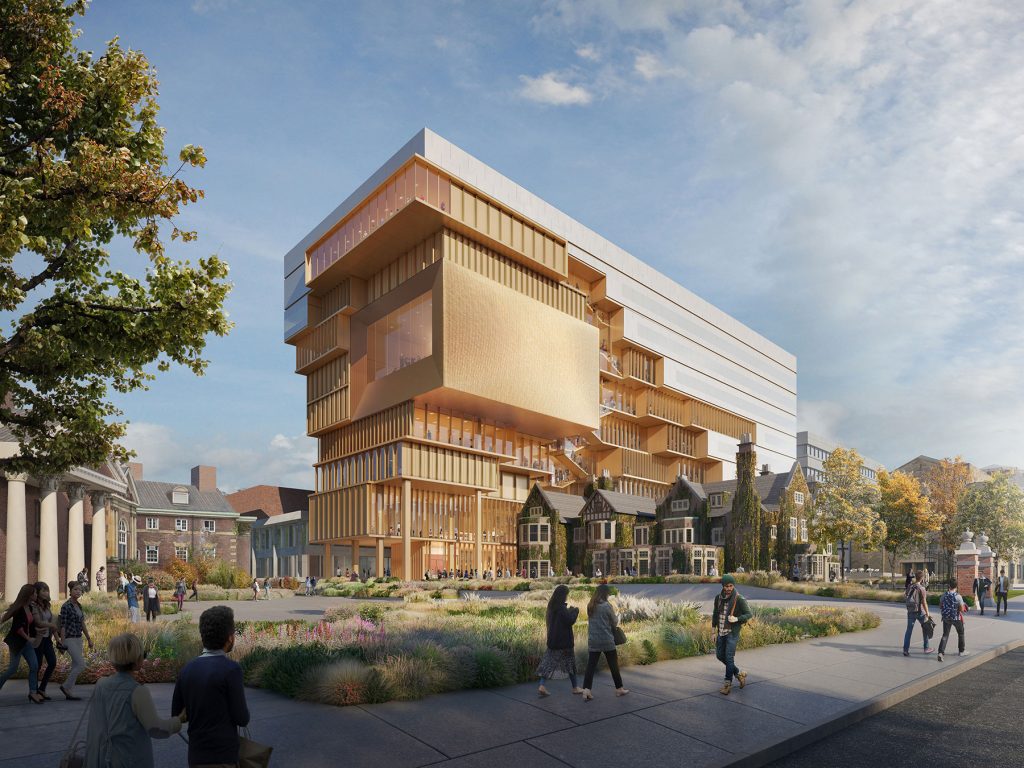
U of T School of Cities build to replace McLaughlin Planetarium
Architects’ rendering of the new U of T building to be erected on the site of the Planetarium. COURTESY DILLER SCOFIDIO + RENFRO
By Ahmed Hagar
The University of Toronto announced a new building project on 90 Queen’s Park Crescent to be named the Centre for Cities and Civilizations. The nine-storey building will provide a space for several departments in the Faculty of Arts and Science, such as the Near and Middle East Civilizations, the Faculty of Music, and the Faculty of Law. It will also be the permanent home for the School of Cities.
The building will have a music hall with a large window that presents the city skyline as a backdrop. There will also be a 400-seat auditorium on the next floor above with a similar view.
U of T chief of planning, design, and development Gilbert Delgado says that the project was created out of a desire to advance the thinking about how cities are made.
“With all new university projects, we have instructed our architects to create buildings are that are very open on the ground floor,” he said.
The McLaughlin Planetarium is currently located at 90 Queen’s Park Crescent, but has been closed since 1995. The university bought the planetarium from the ROM in 2009. Despite a popular petition to preserve the building as historic architecture, the university plans to demolish it. In November, U of T announced plans to build a new planetarium at 50 St. George St.
Delgado says that the university is currently in discussions with the ROM about having a floor in the building.
The building is designed by Diller Scofidio + Renfro, a New York architecture firm known for designing New York’s iconic High Line. The studio is also collaborating with the Toronto firm Architects Alliance, who worked on two other U of T buildings: the Terrence Donnelly Centre for Cellular and Biomolecular Research and the Woodsworth College Residence. As well ERA Architects is working on the project as heritage consultants.
Delgado says that the project aims to preserve the historic Falconer Hall, a building for the Faculty of Law which dates back to 1901.
“The city has identified this building as a particularly valuable heritage resource,” says Delgado. “Its design responds to that in a very constructive and innovative way.”
Councillor Mike Layton says that he has communicated with Councillor Joe Cressy’s office in the past and has been in contact with U of T recently about their project.
“I have also hosted a meeting about the project with representatives of the neighbouring residents’ associations, as well as the assigned City Planners in Community Planning and Heritage Preservation Services to discuss the application and any concerns they have,” he said.
The building will have public spaces for the community. Layton says that he is “looking forward to working with all parties” to ensure that the project “meets the needs of the community”.
“On every project, I look to secure community benefits, and while it is still too early in the process to determine specific benefits,” he said, “I am looking forward to the discussions with the community to determine what is best.”
While Delgado says there is no completion date set, the Diller Scofidio + Renfro website states that groundbreaking for the project will start in 2020.
Comments Off on NEWS: Cities trump space (May 2019)Tags:Annex · News
May 28th, 2019 · Comments Off on NEWS: Wychwood Library aims to attract (May 2019)
Demolition of 1970s element makes way for modern addition
Architects’ rendering of what will be the main floor “Urban Living Room” in the new addition to Wychwood Library on Bathurst Street. COURTESY SHOALTS AND ZABACK ARCHITECTS
By Nabahat Hussain
When the Wychwood Public Library reopens its doors in 2020, the community will find a dramatic shift to the modern in this heritage building. The 1978 addition to the library has been demolished and will be replaced by a 9,000-square-foot space designed by Shoalts and Zaback Architects. Project architect Eric Riddel says the decision to demolish was not taken lightly, but the design intends to make library-goers feel at home while attracting new people to the building.
The library is almost identical to the Beaches and Hyde Park branches created in the same decade. Between 1907 and 1916, the Scottish-American industrialist and philanthropist Andrew Carnegie gave Toronto Public Libraries $487,500 to build ten new libraries. The libraries in the Beaches and Hyde Park are also Carnegie libraries and are nearly identical to the Wychwood branch.
The Wychwood Library’s standout piece is the front door on Bathurst Street, which will be reopened, restored, and made fully accessible.
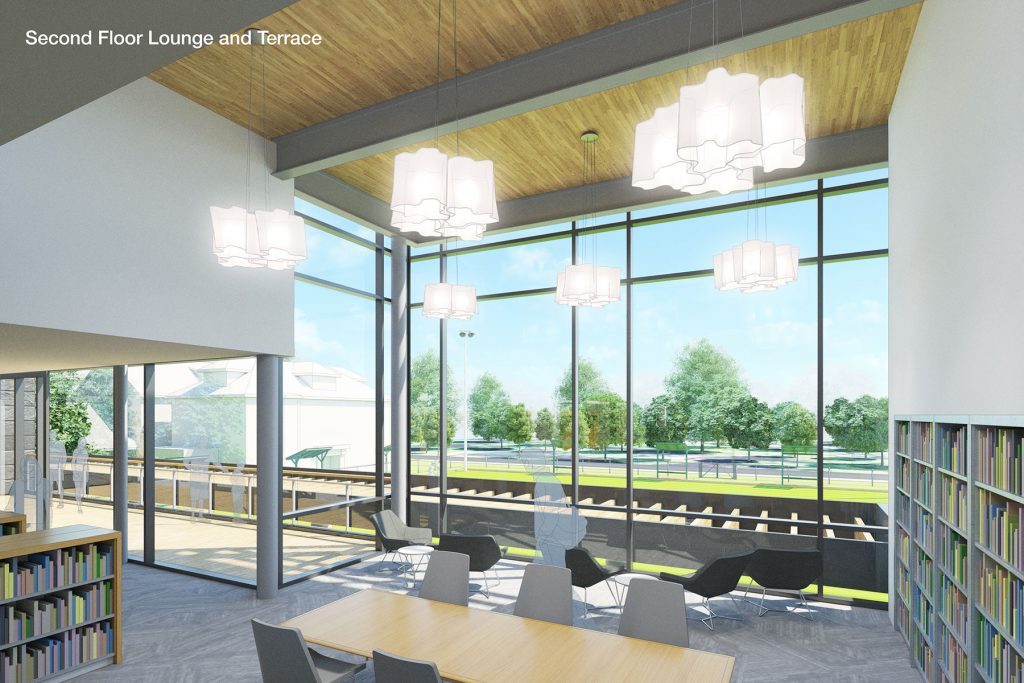
Architects’ rendering of the 2nd floor lounge and terrace of the new addition. COURTESY SHOALTS AND ZABACK ARCHITECTS
“The 19th century public library was thought of as a refuge, a place away from the hustle and noise of daily life,” says Riddel. “Today libraries are more lively with more activities and community involvement. Wychwood will provide the values of the old and the new; the best of both worlds.”
In terms of environmental sustainability, there will be a green roof on the new addition to help conserve energy.
“The extra wing was built in the 1970s, but it doesn’t really fit into today’s accessibility standards,” says Sarah Bradley, library services manager. “There wasn’t any way to preserve it and have our goals met, which are to see an accessible, flexible, welcoming, open space.”
The Toronto Public Library system will see more renovations and expansions in branches across the city in order to meet their tagline: Activate something great. Bradley says the TPL’s goal is to be “More visible, more welcoming, more personal, and more engaging.”
The expansion and renovation will include many new services including a “kids-stop,” which will be a fun and interactive area for kids. There will be books as well as hands-on activities. Senior citizens will be welcomed with a new section devoted to them, which will include a dedicated quiet area for relaxation.
In the public consultations that took place prior to the library’s new design being finalized, community members expressed their wish for more space and some place to escape to find peace and quiet. Bradley says the new space will aim to meet the needs of the community by providing an exceptional customer experience, innovation, while remaining close to the library’s roots.
In terms of technology, people will be able print items from their phone through the print and scanning system in 2020. Wychwood Library hopes to make more robotics and coding equipment available to children and teens by adding on to their pop-up learning program that includes a 3-D printer. More e-books and e-audio books will be made available, as well as more online learning opportunities.
Davenport Library has offered extended hours on Mondays from 10:00 a.m. to 6:00 p.m. to accommodate Wychwood Library patrons. Books cannot be dropped off during the library’s closure. In terms of picking up holds, people can go online and change their pickup location to any other Toronto Public Library; Deer Park, Davenport, and Oakwood libraries are nearby alternatives. For bedridden or physically disadvantaged community members, the Home Library Service is available to deliver books.
May 28th, 2019 · Comments Off on NEWS: Creating a friendlier Dupont (May 2019)
Creation of city square and Dupont greening to begin this summer
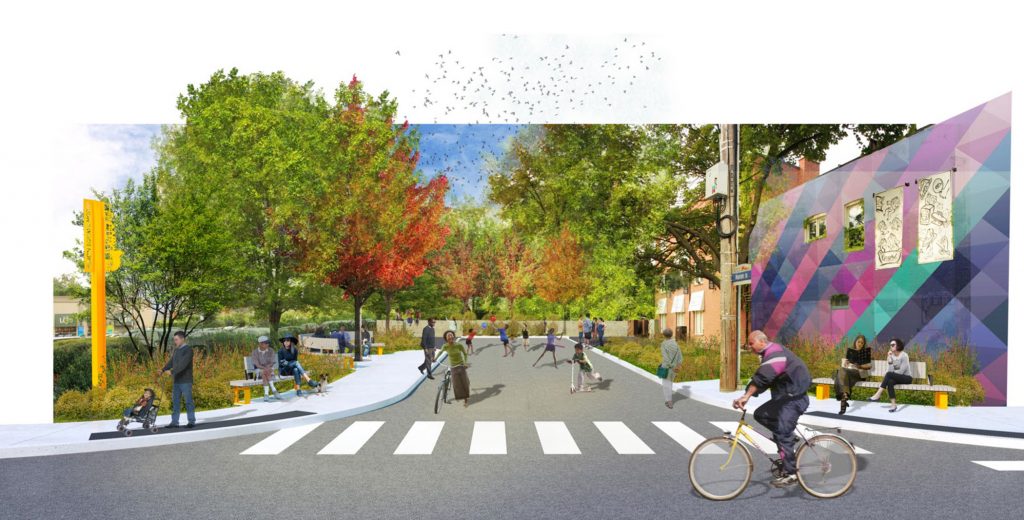
Designers’ rendering of the future square on Huron and Dupont streets. COURTESY OF PLANT ARCHITECT INC.
By Nabahat Hussain
Construction on a proposed square at the intersection of Huron and Dupont streets is expected to start late this summer. The development is part of the local business improvement association’s Streetscape Master Plan. The improvements will include benches, sidewalks, trees, perennial planting, and identity signage, in addition to preserving the four existing trees on either side of the street.
“It will be a little resting island in what is otherwise a very busy, bustling street. Dupont is going through a lot of changes, I am hopeful that this will make it more hospitable,”
—Councillor Mike Layton, Ward 11 (University-Rosedale)
The Dupont-by-the-Castle BIA includes Dupont Street from Avenue Road to the east and Bathurst Street to the west. Huron Street meets Dupont around the centre of the business improvement area, making it a new focal point for the area. Dupont-by-the-Castle spokesperson Stephen Boujikian says the BIA’s goal is “to have a safe, clean presentable place that will attract people”. They also hope to liven up the area, and see the project as the beginning phase of a 30-year development spree.
Pedestrian safety will also be prioritized by encouraging slower car turns. Huron Street will be narrowed down north of Dupont and the crossing distance will shortened.
In terms of making the look of the area more appealing, a mural will be painted on the north-east corner of the square. There will also be plantings on both sides to improve the green-scape of the area and make it more welcoming. The Annex Residents’ Association welcomed the idea, said chair David Harrison. “Any landscaping improvement to this area is welcome. This design should add positively to the streetscape.”
BIA coordinator Emilia Filippelli-Ochana says the history of the area was taken into great consideration while coming up with the plan.
“In order to maintain the original heritage of the area, the BIA has installed custom street name signs at Davenport Road and Spadina Road which have Indigenous names along with English names on each,” she says. “Wendat Square was proposed as a name for the development, but this is yet to be officially chosen. The Wendat tribe was the first to settle in the Dupont and Davenport area, most settlers know them as the Huron. This idea for the name was brought up at the public open house hosted by the BIA on March 20.”
The project will cost $300,000 and is being funded by the City of Toronto, the Dupont-by-the-Castle BIA, and two city councillors. The former councillor for the areas riding, Joe Cressy, pledged $50,000 in Section 37 money for the project which is being carried through by Mike Layton. Section 37 entails money for community development from the city as long as there is an Official Plan for the project.
The Section 37 money results from contributions paid by the developer of 740 Dupont Street, a mid-rise development.
“In this case the amount was secured for streetscape improvements. I don’t think there’s a better example of a streetscape improvement than taking a derelict, dead-end side of a street and turning it into something beautiful,” says Layton. “It will be a little resting island in what is otherwise a very busy, bustling street. Dupont is going through a lot of changes, I am hopeful that this will make it more hospitable.”
May 28th, 2019 · Comments Off on CHATTER: Community Builder of the Year: Neil Jain (May 2019)
The Annex Residents’ Association (ARA) presented Neil Jain with the Community Builder of the Year award during their meeting on April 25. “The award recognizes a good neighbour in the Annex community who has contributed in the areas of social justice, heritage, and environment,” according to the vice chair of the association, Albert Koehl.
This year’s winner was commemorated for his efforts to preserve a house deemed a heritage building according to the Ontario Heritage Act. Previous winners of the award were Chris Wright for working to help Syrian refugees and Peter Steen for making and maintaining an ice rink at Jean Sibelius Square. Koehl commented, “We are recognizing Neil for his determination in exhorting the city to take action on the deteriorating condition of properties at 6-8 Walmer Rd.” Jain resides beside 6 Walmer Road, which is how it caught his attention. The house was built in 1896 and was declared a heritage property in 2013.
The issue brought to the city’s attention was that the building was deteriorating with a hole in the roof. Some issues people in the neighbourhood had were that litter on the lawn was attracting pests and trespassing was taking place. There was graffiti on the building, and local residents expressed concerns that it could be used for drug dealing.
More than three hundred requests were directed at the city to preserve this property. “Over the years Neil has ensured that trash gets picked up to prevent vermin, graffiti gets cleaned up, and illegal entry is prevented,” said Koehl. Though Jain was out of town during the meeting, his parents accepted the award on his behalf. “I’m thrilled to have won the Community Builder of the Year award. It’s great recognition for a lot of work that a number of folks have done on this issue,” says Jain; “though the award is valuable, it would be more rewarding to see further action taken by the city.”
Jain stated, “The city should use its enforcement powers more vigorously to ensure owners comply with heritage legislation, meaningfully showcase heritage properties, and not let them deteriorate.”
May 28th, 2019 · Comments Off on CHATTER: St. Stephen’s safe-injection site loses provincial funding (May 2019
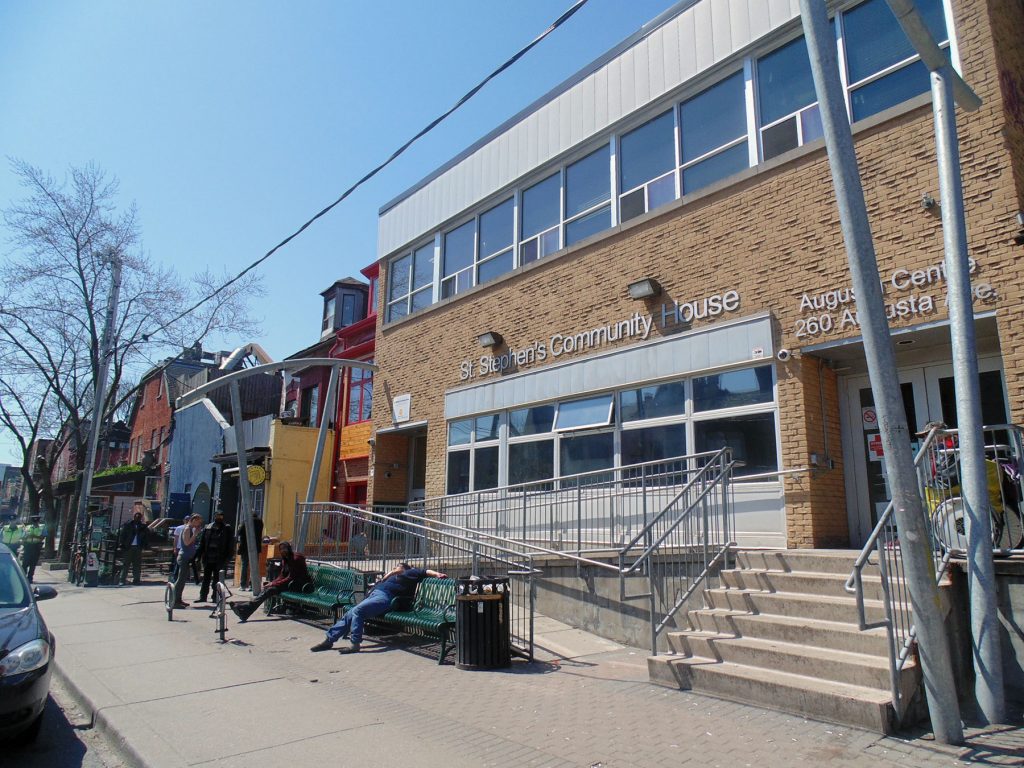
Funding cuts announced by the province in April will likely mean safe-injection sites such as St. Stephen’s (pictured above) may shutter. NABAHAT HUSSAIN/GLEANER NEWS
On April 1, the provincial government, led by Premier Doug Ford, announced they would keep funding fifteen overdose prevention sites in the province, while cutting funding for three. St. Stephen’s Community House in Kensington Market located on Augusta Avenue is one of the two sites at risk of closure in Toronto.
The sites are run with the permission of Health Canada but are not sustainable without funding. Executive director Bill Sinclair says St. Stephen’s will keep running six days a week until mid-July thanks to $65,000 in donations.
On April 18, the Toronto Overdose Prevention Society donated $20,000 to St. Stephen’s Community House and Street Health Community Nursing located on Dundas Street. However, Sinclair says St. Stephen’s will need $175,000 to keep running until next May.
Kensington Market residents gathered at a protest in front of the establishment on April 5 and many of them wrote in support of St. Stephen’s. “St. Stephen’s has made a positive impact on our community,” says Adam Clare, board member of the Kensington Market Action Committee. “We need this site in our community and we welcome it.”
Toronto medical officer of health Dr. Eileen de Villa says that too many people are dying of preventable deaths related to overdose. “The reality is that we need more of these evidence-based life-saving services, not fewer.” De Villa conducted a TED talk earlier this year, speaking about the opioid crisis.
Sinclair claimed St. Stephen’s staff were able to save 10 lives from overdose last year. He puts emphasis on a drug called Naloxone which can be used to save a person from an overdose death. People can come to St. Stephen’s to learn how to use it and are able buy it from any pharmacy. “We’re recommending that work places, public places, and schools all have it, everyone has the ability to prevent overdoses,” he says. Provincial minister of health spokesperson Hayley Chazan refused to comment on concerns about lives that might be lost due to the closure of overdose prevention sites.
St. Stephen’s has re-submitted their application for funding to the province. To support St. Stephen’s Community House, donations are welcome at www.sschto.ca.