October 8th, 2019 · Comments Off on EDITORIAL: How not to manage the retail sale of pot (Sept. 2019)
Just ask Doug Ford. Ford lost $42 million selling pot last year. Then he botched the roll-out of retail licences so badly that it is now under judicial review. Illegal pot is widely available and is in fact necessary to satisfy the market demand that the province has failed to meet.
New figures released about the Ontario Cannabis Store (OCS) show that despite revenues of $104 million from the online sale and distribution of weed, the Ontario government found a way to lose over $40 million. That the loss comes without a brick and mortar investment and when the government essentially held a monopoloy is quite an achievement, really. The province also lost customer data in a cyber-theft that they blamed on Canada Post. Curiously, other provinces did not suffer the same fate. Hmmm….
Recall that Ontario’s plan, right from the start, was to hand retail sales to the LCBO which had an existing network with a professional and accountable approach to doing business. Then Doug Ford got elected, threw that Liberal plan out of the window, and started applying his own business prowess to the new industry.
To be fair, Canada is only the second country, after Uruguay, to legalize marijuana. So there’s no guidebook on how to launch the sale of legal marijuana. There have been challenges, such as a lack of legal cannabis, across the country, but the absence of stores is a Doug Ford made-in-Ontario problem.
In January, the province held a lottery for the first licences for retail stores, offering up 25 stores for a province with 14 million people. The winners of that lottery did not require any relevant experience. In late August the province announced the results of a second lottery to apply for a retail store licence. Potential store owners were required to set aside $300,000 to be able to apply and 42 applicants were given the green light to proceed to the next level. Innisfil, a bedroom community of Barrie, scored three winners. One winner in our area was 11180673 Canada Incorporated, which proposes to set up shop at 104 Harbord Street, the site of a unlicensed pot dispensary called CAFE which has been raided numerous times by police who ultimately blocked its doors with large concrete barricades.
The rules of the lotteries were supposed to exclude applicants who had been running illegal operations, but not here, apparently. Now they operate on the sidewalk, in full view, causing much hardship for the community according to the residents’ association and their BIA. Highlife is another applicant who submitted bids, some six hundred, apparently for the same 15 addresses in Northern Ontario, despite having contravened the rules. If Highlife had $300,000 set aside for each application, they would have required $180 million in speculative investment. This is not Doug Ford allowing mom-and-pop retailers into the marketplace. This is the myth of Doug Ford supporting the little guy.
Not all successful lottery winners in round two made it through initial scrutiny. The Alcohol Gaming Commission of Ontario (AGCO) emailed each winner telling them they won the lottery and what they needed to do next. Eleven of the winner’s emails bounced back, so the AGCO sent them the same message by registered mail. Those winners tried to comply with the requirements of these letters but were then told that registered mail was meaningless and they were disqualified because their email was not deliverable. The government appears to be making things up as they go along.
Now the courts have entered the fray, halting the roll-out of the lottery’s second round while it attempts to unravel yet another Ford-spun mess. How sad, and unsurprising.
Throughout my time at City Hall I have worked hard to increase the quality of life for Toronto residents and to make living here more affordable. This year, the Ford government has been going out of its way to reduce quality of life and make it more unaffordable to live in Toronto, through their many service cuts and downloading.
They need to explain why they are allowing for the destabilization of our childcare system.
The cuts which will have the greatest impact on families in our ward will be to childcare provisions, to which the Conservatives have confirmed significant cuts are coming in 2020. These will come in the form of eliminating subsidies to low-income families, subsequently making costs higher for all parents, and cancelling plans for thousands of new childcare spaces.
Toronto is already one of the most expensive cities to live in in Canada. As it is, there aren’t enough affordable spots for the families that need them, but Ford has put a plan in motion that will raise fees for the limited spaces we already have, and will also eliminate many more.
With their most recent announcement made this August, the province has officially backed away from funding 51 new daycare capital projects that were already planned, and that families were counting on. This means we will lose 3,049 new childcare spaces, on top of cuts to occupancy grants that have been in place since 1998 and have helped countless families afford childcare and allowed them to return to the workplace.
What is especially troubling about these cuts is that they do not represent any savings for Ontario residents. The plan, in reality, moves the source of funding away from the provincial government, which raises most of its money through income taxes, and pushes it onto municipal governments, which raise most of their money through property taxes. It is a move that gives the province a false sense of accomplishment. They are acting as if they have cut the deficit, when they are really just transferring the costs to a system that has less equitable resources to draw from.
After the initial announcement in May about these cuts, the City Manager shared that this situation will create additional budgetary pressures that may put other vital city services at risk. In the coming year, the city will be forced into a position of making increases to our capital budget and potentially raising property taxes simply to maintain services, while continuing to fight back against a government that refuses to prioritize vital services.
Childcare advocates, parents, and local politicians are working together to raise awareness of the cuts and to pressure the province to stop them. This pressure led to a delay in implementation, and continued advocacy will make an impact again.
I put forward two motions at the July City Council meeting on Occupancy Agreements and Capital Funding for Childcare, directing council to tell the province to restore funding to support all future provincially-funded childcare projects. This included funding for the 51 daycare capital projects that are now at risk of not proceeding, and proposed finding a way to fund these programs if provincial funding is not restored.
On a council where most items are divisive, these motions both carried unanimously. I am proud to be able to bring all sides of this debate together to improve quality of life for our residents.
As a parent and ardent childcare advocate, I know that these cuts are forcing families to make tough choices in wards across the city. They are harmful and fiscally irresponsible.
I want to stress that we cannot let Toronto Conservative MPPs off the hook — they need to explain why they are allowing for the destabilization of our childcare system, and why they are supporting a future that will push young families out of our city. I will continue to work to find a way to make childcare more affordable for the residents of Toronto, and encourage you to join me.
Mike Layton is city councillor for Ward 11 University—Rosedale.
October 8th, 2019 · Comments Off on FORUM: Defending the free press to preserve democracy (Sept. 2019)
Concrete measure protects truth, complexity, and journalists
By Chrystia Freeland
This autumn we will celebrate the 30th anniversary of the fall of the Berlin Wall. Those of us who lived through that time, as I did, remember it as a euphoric moment. It was hard to imagine that liberal democracy was anything less than both inevitable and eternal.
A free and independent media in all of its disputatious, cantankerous glory is one of the cornerstones of liberal democracy.
That was such a seductive idea, but it has proven to be an illusory one. It is clear today that liberal democracy and the rules-based international order are under greater threat than at any time since the Second World War.
As Robert Kagan argues in his recent book The Jungle Grows Back, “If the liberal order is like a garden, artificial and forever threatened by the forces of nature, preserving it requires a persistent unending struggle against the vines and weeds that are constantly working to undermine it from within and overwhelm it from without. Today there are signs all around us that the jungle is growing back.”
I agree with that so profoundly.
There is no part of our liberal democratic garden that is more threatened by the jungle’s resurgence than the free press. The danger is often specific and physical. The troubling reality is that journalists and other members of the media are increasingly the target of abuse and attack.
This must stop.
Journalists must be able to do their work safely and without fear of reprisal.
I’d like to pause and address the elephant in the room, the seeming paradox of elected politicians coming together to support a free press. We politicians may seem to be surprising champions for the media and that’s because of the inherent structural conflict between the press and the government.
The job of journalists, after all, is to hold our feet to the fire—and as someone who is regularly on the receiving end of that treatment I can assure you it is not a very pleasant experience. But it would be a terrible mistake for any politician, smarting perhaps from that discomfort, to conclude that journalists are the enemy; quite the contrary.
A free and independent media in all of its disputatious, cantankerous glory is one of the cornerstones of liberal democracy. The truth, to be sure, is that it is harder to be a politician, to be a government, in a country with a free and independent media. That’s the point.
By holding us—their governments—accountable, journalists make us better than we would otherwise be. Facts matter. Truth matters. Competence and honesty among elected leaders and in our public services matter. These assertions may seem so obvious as to be trite but the objective of authoritarianism is to undermine the very idea of fact, of truth. We need to fight back, with specific collective and practical steps.
The first step we have already taken is the Global Pledge for Media Freedom. We must seek accountability for crimes against journalists. That is why Canada has used sanctions as a tool to address abuses of media freedom. Following the brutal murder of Jamal Khashoggi, Canada imposed sanctions on 17 people. As an extension of the pledge, we are also launching a Media Freedom Coalition that will connect governments with civil society organizations and members of the press to save journalists and media workers at risk.
This coalition and the Media Freedom contact group are cousins to the rapid response mechanism launched during Canada’s G7 presidency last year to address malign disinformation.
On World Press Freedom Day this year, Canada announced $12 million for the organization Journalists for Human Rights. On July 11th, at the Global Conference for Media Freedom in London, I announced another $10 million annually to promote and protect democracy.
This funding will focus on supporting electoral processes, reinforcing democratic practices by combating disinformation, and strengthening civic engagement. An initial one million dollars will go to the new Global Media Defence Fund housed at UNESCO, including an independent panel of legal experts to support and advance media freedom worldwide.
I outline these actions, not as an exhaustive list, but as examples of some first concrete steps we can take together.
Canada has been delighted to co-host this year’s Media Freedom Conference with the UK and we are honoured to serve as next year’s host.
We all need to defend our independent press—even, and perhaps especially, when it criticizes us—as a central institution of democracy. We need to fight for an open society against a closed one. We need to fight for the complexity of democratic truth rather than the beguiling simplicity of authoritarian rhetoric. Then and only then will we have tended our democratic garden, preventing it from being swallowed by the persistent weeds that seek to undermine it.
Chrystia Freeland is member of parliament for University—Rosedale and serves as Canada’s Minister of External Affairs.
Comments Off on FORUM: Defending the free press to preserve democracy (Sept. 2019)Tags:Annex · Opinion
Veteran Green Party candidate aims for federal seat
By Tim Grant
This fall’s election comes at a pivotal time for Canada and the global community. Last October, the world’s climate scientists told us we have only 11 years to prevent runaway climate change. To do that, we have to meet a new internationally agreed goal of cutting carbon emissions by 60 per cent by 2030 and eliminate our use of fossil fuels by 2050. If we fail, we will be condemning future generations to unspeakable hardship.
As a three-time provincial Green candidate, I find it very gratifying that many voters now appreciate that we are more than a single-issue party.
In spite of all the talk you will hear about climate action in this election, the Green Party is the only party with a plan to meet international goals. When we released our Mission Possible plan in the spring, some commentators said it was too ambitious and not realistic. But those commentators were silent when Denmark and the UK — two countries whose per capita emissions are already much lower than ours — committed to the same goals. It was clear to all that if Denmark and the UK can reduce their emissions by another 60 per cent by 2030, it is possible and realistic for us in Canada to do it, too. But our window of opportunity is small — 2030 will be upon us before we know it. We have to change course, starting with this election.
As a three-time provincial Green candidate, I find it very gratifying that many voters now appreciate that we are more than a single-issue party. Here is a sampling of some of the issues we’ll be championing in this election.
A New Deal for Cities When Doug Ford slashed the size of Toronto’s City Council, it was a painful reminder that cities across Canada have little control over their affairs. This lack of autonomy is accompanied by a lack of resources: cities receive only 10 per cent of all taxes collected by all levels of government. We know that is too little. The Green Party is committed to working with the provinces to ensure that cities have much more independence in decision-making and receive a greater share of overall tax revenues. In 2015, the Federation of Canadian Municipalities determined that we had the strongest urban platform of all federal parties. Check out our 2019 urban platform at www.greenparty.ca. It is even stronger.
Guaranteed Annual Income Greens are the only party in favour of a guaranteed annual income (also known as basic income). A basic income would lift many families out of poverty, remove the stigma of social assistance, and provide all adults with the financial security to retrain, take new courses, or start new businesses. At a time when precarious work affects more and more Canadians, a basic income is needed more than ever.
Electoral Reform Many Canadians voted Liberal in 2015 because Justin Trudeau promised that that election would be the last under our current voting system. After the election, he abandoned that commitment. University-Rosedale voters clearly disagreed with his decision. A 2017 poll by Strategic Directions showed that 72 per cent of voters in this riding agreed that it was time to change the voting system.
Rail Safety We have one of the busiest rail lines in Ontario running across the northern edge of our riding, one that frequently carries hazardous cargo. The Liberals promised to improve rail safety after a runaway train exploded in Lac Megantic in 2013 — a train that had passed through University-Rosedale only 36 hours earlier. Yet little has changed. The incidence of runaway trains has increased 10 per cent over the last decade. In 2017 alone, there were 62 occurrences.
To learn more about these and other reasons to vote Green — such as reconciliation with First Nations, ending fossil fuel subsidies, and expanding health care — visit www.votetimgrant.ca.
The polls strongly suggest that we will have a minority government after October 21st. More than ever, we will need strong Green voices in Ottawa. A vote for the Green Party is a vote for real change. Our future depends on it.
Conservative candidate Helen-Claire Tingling makes her case
By Helen-Claire Tingling
Canada is a beautiful country that is rich in natural resources, is home to some of the world’s most talented individuals, and has been a leader on the world stage. I am a proud Canadian, but watching the direction that Trudeau’s Liberals have taken this country worries me. Over the past four years Justin Trudeau has raised taxes, racked up debt and deficits, and made life more expensive for people like you and me. I am running to champion the people of University–Rosedale so that they can get ahead, not just get by.
When it comes to housing affordability, this Liberal government is not as advertised.
I am running as the Conservative candidate in University–Rosedale to put more money in your pocket. I am running to lower personal taxes. And I am running to make life more affordable for Canadians.
Two-thirds of Canadians feel that they either can’t pay their bills or they have nothing left over at the end of the month after they do. Gasoline. Groceries. Home heating. Real estate. Debt. Everything keeps getting more expensive. People are barely getting by. And they’re definitely not getting ahead.
Trudeau has hiked taxes on small business owners and ended tax credits that make things like dance lessons and transit passes more affordable. Another four years of Trudeau’s runaway spending and we will have an economic crisis on our hands with debt and deficits forcing either massive tax hikes or deep cuts to essential services to cover the spending. Or, some terrible combination of the two.
When it comes to housing affordability, this Liberal government is not as advertised. Their heavy-handed mortgage stress test, their raising of mortgage insurance premiums, and their punishing new taxes on middle class Canadians have made it harder to realize the dream of homeownership.
Another four years of Trudeau’s runaway spending and we will have an economic crisis on our hands with debt and deficits forcing either massive tax hikes or deep cuts to essential services to cover the spending.
Not only is Canada failing to hit our Paris Agreement targets, we are getting further and further away. Canadians trusted Justin Trudeau when he said he would protect the environment and lower Canada’s emissions. Instead, all they got was a carbon tax.
The good news is that we have an opportunity to change course.
A Conservative government will live within its means. Under a Conservative government, any new spending not already budgeted for must be paid for from savings within the government. Put another way, if you decide to take a family holiday, your roof repair has to wait. You can’t do both. Your bank account is not a bottomless pit, and neither is the taxpayer’s pocket.
A Conservative government has committed to working with provinces and municipalities to knock down regulatory barriers that discourage new home construction so more homes can come on the market to lower prices.
Under the Conservative plan, it will not be free to pollute – and unlike the Liberal scheme, there will be no sweetheart deals for anybody. The Conservative plan recognizes that we can create more jobs in Canada through technological growth while at the same time lowering global emissions.
It is hard enough to get by without the government making it more difficult. And if you work hard, you should be able to buy a home, save for retirement, and care for your children and your parents as they age.
Canadians families work hard; they deserve a government that will work just as hard for them.
October 8th, 2019 · Comments Off on GREENINGS: Addiction to capitalism will lead to overdose (Sept. 2019)
As we take the drug of economic development, the planet burns
As the Amazon burns, we are reminded of what unfettered capitalism looks like. Greed has literally blotted out the sun in Sao Paulo. Images taken in the mid afternoon appear as dark as midnight, as smoke from the burning Amazon darkens the sky.
Farmers in Brazil feel it is within their right to burn the Amazon. Why shouldn’t they be able to herd cattle and aspire to a higher standard of living? They aren’t wrong.
This is the legacy that capitalism is leaving us. Ironic that I’m sitting in Canada’s economic capital as I write this. The planet is now literally on fire, not just with the Amazon burning but also with unprecedented Arctic wildfires this summer. Does this sound like an apocalyptic end time? If you’re living in Sao Paulo, it is. Climate change is not some far-off distant thing. The crisis is upon us now. Children born right now have increasing odds of premature death due to the planet’s inability to sustain human life. This is not hyperbole.
As city dwellers, we can take small steps: ride a bike, stop eating beef, consume less… All this is great, but useless when the ultra-elite are flying in their jets and corporations are profiting from unending ecosystem destruction. These crimes against humanity are carried out in the name of economic progress. Once upon a time we could look the other way as there were more rivers to provide us with drinking water, more forests to provide us with oxygen. As these resources begin to dwindle against a backdrop of increasing population, we have done lots to protect stock prices but nothing to protect something as fundamental as air. Our entire economic system is a positive feedback loop that requires more and more to sustain it. The more resources we take, the more the bankers expect us to take the following year. In my lifetime, not a single politician has failed to boast about “economic growth”. It’s a drug that we can’t seem to be able to wean ourselves from.
Farmers in Brazil feel it is within their right to burn the Amazon. Why should they too not be able to herd cattle and aspire to a higher standard of living? They aren’t wrong. They were promised wealth so long as they worked the land, why shouldn’t they be part of the “growth”?
The short-term gains will quickly give way to long-term pains when not only their cattle starve, but millions of people on the planet die from the consequences of climate catastrophe and ecosystem destruction. While the corporations and farmers clear land, Indigenous people in Brazil are losing their homes, and many more will die as a direct result of losing the land they depended upon for survival. Capitalism spares no one who is not part of the system.
Money pledged by world leaders at the G7 to fight the Amazon fires is woefully inadequate. While Canada is boasting about its $15 million contribution, remember that a single family (Irving) just got a $7.4 million loan forgiven. That’s right, while propping up a single family’s business ventures, we will send merely double the amount to fight for 20 per cent of the earth’s oxygen-producing capability. At the end of the day, capitalism and profits are STILL more important than the literal survival of human beings.
The system all of us depend upon is about to fall apart and none of us have any idea how to save ourselves from extinction without sacrificing our income and means of survival based on our unreal fiscal expectations of infinite growth.
This is the crux of the crisis. Most of us have become very comfortable living on a system that we know is on borrowed time. Without infinite growth, our economic model collapses, and right now, the entire earth is reminding us that the planet is finite.
This is the harsh reality. We can drastically slow down climate change if we tell everybody to stop shopping for clothes they don’t need, going on vacations they can’t afford, and wasting food they don’t eat. What would happen to the stock prices around the world? What would happen to the prosperity of major financial hubs? What would happen to your own income?
We are addicted and we can’t stop. The overdose is coming. Our reality of finite resources is pushing against the economic models of infinite resources. So are we willing to go through withdrawal or just go over cliff when we get there?
Terri Chu is an engineer committed to practical environmentalism. This column is dedicated to helping the community reduce energy use, and help distinguish environmental truths from myths. Send questions, comments, and ideas for future columns to Terri at terri.chu@whyshouldicare.ca.
October 8th, 2019 · Comments Off on ARTS: Indigenous arts revealed (Sept. 2019)
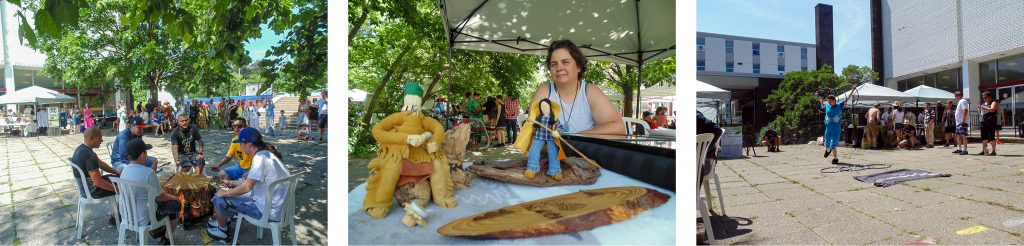
The Bickford Centre hosted a celebration of Indigenous culture and arts for the second summer in a row. Sue Crow Eagle (centre) showcased her corn husk figures alongside 15 other indigenous artisans as well as dancers and drummers. NABAHAT HUSSAIN/GLEANER NEWS
First Nations come together for arts and crafts festival
By Nabahat Hussain
On Saturday, July 20, the second annual Indigenous Harvesters and Artisans Market took place at Bickford Centre, just south of Christie Pits Park. Visitors were afforded a glimpse of a rich native cultural history through the prism of arts and crafts.
Fifteen stalls were featured including handmade crafts and art pieces made by Indigenous artists from all around the country. This year boasted a mural reveal, with a tour and explanation from the various past and present artists at the event.
The festival started off with a prayer recited by Elder Pauline Shirt while tobacco was handed out and recollected after the prayer. “Tobacco is our connection from the physical to the spiritual world,” says Shirt.
Opening remarks were made by many people including artist Phil Cote, who said, “It’s important that Indigenous people begin to tell their own story, we’ve had our story told from outsiders for a long time.” Councillor Mike Layton made a brief appearance, thanking Nish Dish restaurant owner Johl Ringuette for enabling the murals at the centre to become a reality.
Mike Izzo from the TDSB, Catherine Campbell from Street ARToronto, Chief LaFormel of the Mississaugas of the Credit First Nation, and Elder Cindy White also spoke.
There were many drum and singing performances from the All Nations Big Drum group and Eagle Woman Singers. Originally from Alberta, Sue Crow Eagle re-created the group in Ontario: “It’s all ceremonial songs for the dancers to dance to.”
Many dances took place, listed as “Jingle dance, Traditional dance, and Fancy Shawl” on the itinerary. Local Indigenous restaurant Nish Dish at 690 Bloor Street West, just east of Christie, was popular at the event, with a long line at its tent.
Many notable artists were present, with unique and popular pieces. Wesley Lori Havill, an Ojibway, Batchewana First Nation artist is best known for working with moose, deer and elk antlers, carving art into them. One antler sells at over one thousand dollars, Havill says. “I have to stare at an antler for a long time before inspiration comes to me,” and that his ideas come from nature.
Saskatchewan-raised artist, Ren Lonechild says his upbringing played a vital role in his life. Lonechild works mainly with watercolour, his heritage being the main theme of all his pieces.
The third shoutout-worthy artist is Trip Phoenix of Sunheart Rises Designs, whose stall boasted variety in its jewellery, decorative pieces, and cultural keepsakes. After a financial crisis in his life, Phoenix says, “I met a woman at a powwow who urged me to learn to make crafts, and I expanded from there,” explaining how it helped him get back on his feet.
Event-goer Karen said, “I came to support Indigenous artists and the Indigenous community, they’ve come from all over Ontario including from the reserves. Many people here I’ve already bought art from.”While the dances and shopping was going on, so was an educational program at the school’s medicine garden. The speakers told stories and gave tips on how to take care of certain plants in the space. Once all mural reveals, performances, music, selling, and programs were over, a closing prayer by Elder Pauline Shirt was said and the event closed off with a Drum Song with Dancers. The Indigenous Harvesters and Artisans market will be back next year for its third run.
Comments Off on ARTS: Indigenous arts revealed (Sept. 2019)Tags:Annex · Arts
September 2nd, 2019 · Comments Off on ON THE COVER: (August 2019)
A Different Booklist, located at 779 Bathurst St., has long been a repository of local history and recently initiated a unique time capsule project burying some of the culture of the present beneath the re-development of the Honest Ed’s site by Westbank Corp. at Bathurst and Bloor. For more on the project, please see click here. JUAN ROMERO/GLEANER?NEWS
Comments Off on ON THE COVER: (August 2019)Tags:Annex · News
September 2nd, 2019 · Comments Off on NEWS: Plans for a “slender” building (August 2019)
Compromise found for new build on 300 Bloor St. W. church site
By Ahmed Hagar
A redesigned and more “slender” 29-storey tower looks to be the future for 300 Bloor Street, after a lengthy public process and, finally, an agreement between developers, city councilors, and residents.
The tower will attach to the historic Bloor Street United Church (BSUC), and will include office space, public space for community events, 249 residential units, and an underground parking garage.
The developers, Collecdev Inc., KPMB Architects, and ERA Architects in partnership with the church, originally proposed that the building be 38 storeys high. But they shifted their proposal to a 27-storey development due to concerns about the height. The height remained a concern for a number of vocal residents at a public meeting last December.
City planner Barry Brooks says what led to the final 29-storey height is that the base of the building to the rear was lowered by the applicant from 8 storeys to 5 storeys.
“The tower height increased 2 storeys as a result to maintain a reasonable overall project density,” adds Brooks. “The height adjustment will greatly improve the pedestrian relationship and experience on the adjacent sidewalks, and it will not cast a shadow on the residential neighbourhood.”
Councillor Mike Layton explains that the shadow of the more slender building will move more quickly through the day, and therefore make less impact on important spaces in the area.
He adds that the updated plan also includes the developer-contribution of $2.3 million for affordable housing and $416,000 in assistance for the accommodation of the Annex Seniors Adult Services in the building.
At the final working group meeting for this proposal, Annex Residents’ Association (ARA) chair David Harrison said the negotiations were successful due to all parties wanting to reach a consensus.
The proposal also includes refurbishing the interior of the 133-year-old church to create a multi-faith space for the church congregation and the City Shul synagogue. Layton says the Bloor Street entrance will be removed to create a “more inviting and acceptable” entrance to the worship space.
Michael Hilliard, a member of the BSUC and chair of the church’s redevelopment committee, says that the building plans were 20 years in the making. He also says that it will have accessible public spaces for the community and office spaces for the new headquarters of the United Church of Canada.
“When I step back and envision the future of this project I imagine a beautiful space that’s vibrant and live with activity, a place where people can live, work, play, and pray,” he said.
September 2nd, 2019 · Comments Off on NEWS: CTS art programs cut (August 2019)
Classes cut in wake of funding changes
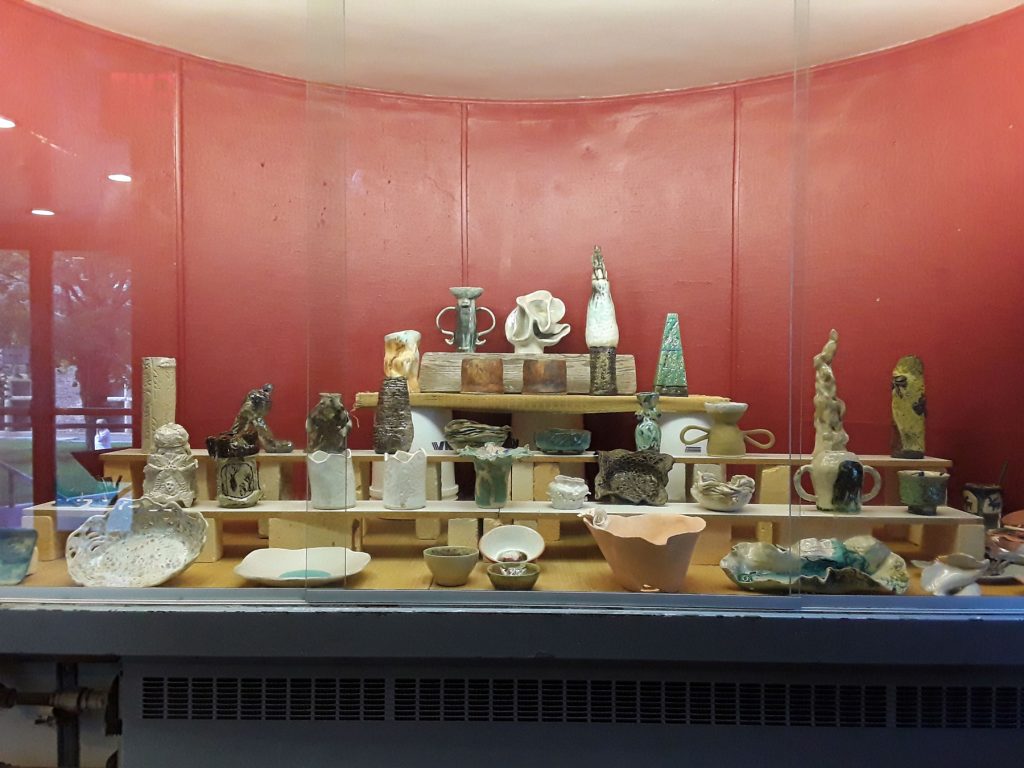
Examples of student work from the soon-to-be cancelled art sculpture program at CTS. JUAN ROMERO/GLEANER?NEWS
By Juan Romero
The Toronto District School Board (TDSB) has approved a budget reduction plan for the 2019-20 school year. The budget reduction comes as a result of the provincial government’s education cuts across Ontario in the past year.
The board announced that $67.8 million will be cut from the budget and as a result there will be a reduction of staff as well as changes to certain programs across schools in the city. The news puts the future of the art courses and some teachers at Central Technical School in jeopardy.
Fernanda Pisani, who is a member of the Alumnus Association at Central Tech, was very critical of the TDSB for allowing the provincial government to make these cuts without putting up a fight. She also blames the Ford government for “eviscerating bills that benefit our community”.
“I can’t understand why the Toronto District School Board is not standing up to Queen’s Park in a really big way, because this is not the first time it has happened under a Tory government. It seems now that it is enabling the demise of the public education system as we know it,” Pisani said.
There have already been many cuts at Central Tech according to Pisani. The staff there has recently been cut dramatically. The most affected have been the technicians that help the professors ensure the safety and maintenance of the facilities.
“There have been cuts in regard to hiring of technicians, which is a necessity when you do a program like sculpture or ceramics. You need a technician to help keep the environment and facilities safe and functioning properly. That is not the job of the teacher because these are qualifications over and above teaching qualifications,” Pisani explained.
Teachers with lack of seniority have also been affected by staff reductions, leaving some specialized courses at Central Tech to be taught by teachers who may not be trained in that specific field.
The art program at Central Tech dates back to 1915, which makes it one of the oldest in the city. It has served as a foundation for some well recognized Canadian artists such as Joyce Weiland and Kazuo Nakamura.
Linda R. Goldman is a former student, who later on went on to teach fabric arts at Central Tech from 1990 to 1992. She says she’s seen the arts program put in jeopardy repeatedly over the years and stated her belief that art programs should be given equal importance as other subjects in order to give equal opportunities for people who are on the artistic side.
“The art school there has had close calls like this before. For kids that are interested in going into the arts it is important to have these specialized programs available for them,” Goldman said.
She was also very critical of all the cuts Doug Ford has made since he came into power, especially regarding education.
“I don’t know what he thinks he is accomplishing with this. I love the course at Central Tech and of course I am upset about the decision that was made,” she said.
The mood among students at Central Tech is also somewhat of disbelief. The program has been running for many decades, laying a great foundation for students who want to pursue careers in art; to see it come down to this has left most students upset.
Angela Walcott is a student of the adult art program at Central Tech. She has attended the school since 2015. She has a lot of praise for the program and believes the board should find a way to keep art programs running steadily.
“Personally for me and for some of my fellow classmates that I have talked to, we have felt that the courses really changed our approach to a lot of things and it helped us develop our sense of style and sort of our sense of understanding the process. So for that to disappear after decades in the educational system is just sad,” Walcott said. “I do hope that the program remains or comes back in a new form. It would be nice because there is a vision there and there is a foundation.”
However, there are a few reasons why the board might argue why they approved certain cuts. According to Fernanda Pisani, there has been a decrease in enrolment in high schools all across the city. At Central Tech the decrease has also been caused due to the fact that its art program is not longer as unique as it once was. There is more competition from schools in the area that offer similar programs.
Yet despite the recent enrolment issues, she believes that the real threat to programs such as the art one at Central Tech has been the budget given by the provincial governments throughout the years.
“At one point it was under the control of the municipal government. Ever since the mandate at Queen’s Park began to take over the budget for education in the city, things changed. It has been very impactful because depending on who is in power at the provincial level you have funding that reflects that,” she said.
With regard to the Toronto District School Board, its chair Robin Pilkey said that the board worked very hard to maintain a balanced budget for 2019-20 at the same time as they were coping with the budget reductions from the government.
“Despite these challenges, we have been careful to ensure that we continue to have sufficient resources to offer an outstanding education experience for our students,” Pilkey said.
They have also announced that, despite the cuts, they will still have a budget of $3.4 billion. Over 90 per cent of the budget will go toward school operations and instruction. They also predict a small increase in enrolment for the next few years.
Comments Off on NEWS: CTS art programs cut (August 2019)Tags:Annex · News
September 2nd, 2019 · Comments Off on NEWS: Robarts lets in the light (August 2019)
Expansion to add study space to face of library
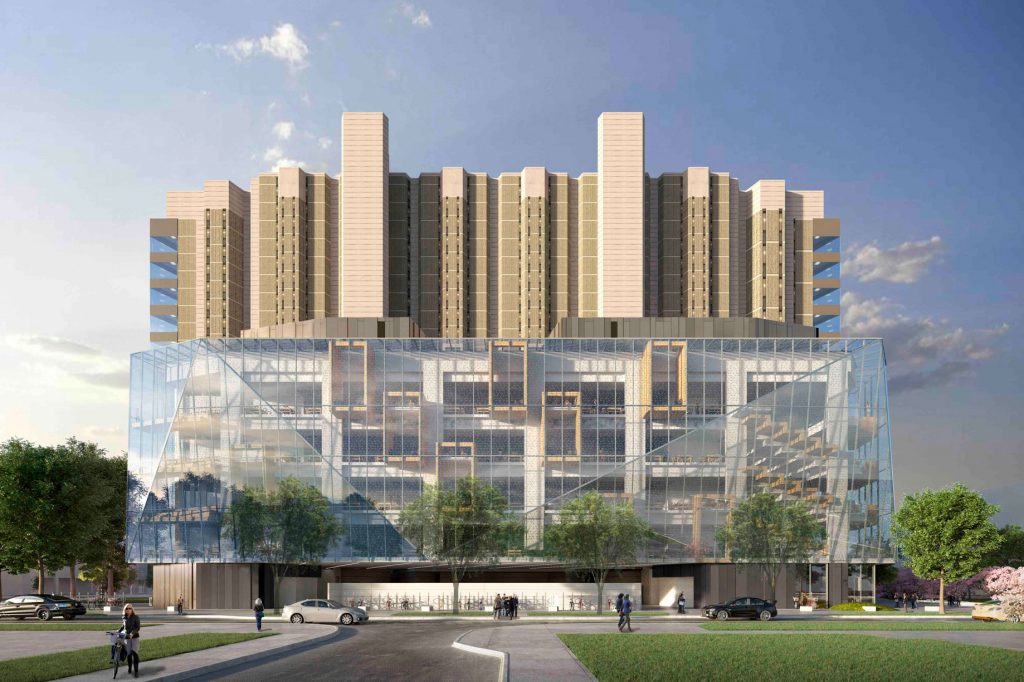
Architects’ rendering of an expanded Robarts Library at U of T. Perspective is of the face along Huron Street. The addition will primarily feature increased study space.
COURTESY DIAMOND SCHMITT ARCHITECTS
By Ingrid Philipp
The Brutalist concrete façade of the original Robarts Library at the University of Toronto is renowned for its seemingly forbidding entry to any but the most serious scholar.
While the topmost stacks have remained sacred ground to protect books and materials from casual use, the library has become under-graduate and community-friendly. According to Canadian Architect magazine, the intimidating peacock-shaped structure has even hosted filmmakers who needed a prison or UFO setting. As many as 18,000 people have been known to visit the library in a single day.
Even with a multi-year renovation to open up the original structure to daylight and improved study space, student growth has maxed out the capacity for such space. Already Canada’s largest academic library, Robarts and other campus libraries serve a current university population of approximately 90,000 undergraduates and 20,000 post-graduate students.
According to Diamond Schmitt Architect’s associate Aaron Costain, the freestanding addition along the west side of the Robarts site will add 1,200 seats for student study. Costain explains that the 25 per cent increase over Robarts’ current 4,800 seats will include study options ranging from group study tables and rooms to an amphitheatre and individual carrels. Students will be able to use the private rooms for collective work while sharing their computers on a large screen, and to escape to a lounge for more relaxed social space. Even staircases will double as seating, as Diamond Schmitt demonstrates in the Toronto Four Seasons Centre for the Arts.
The new addition along the west side of the Robarts property will have a street level entrance and be open 24 hours a day, seven days a week. The expansion’s wrap-around glass façade with wood accents contains some echoes of the main concrete building, and will connect to the original 14- storey building by a bridge on floors two, three, four, and five.
Unlike the main building, glass will flood the area with light, even as a thematic relationship between the buildings is maintained through the Commons faceted shapes. Rolling blinds will control the amount of window light for both interior and external residents.
Huron-Sussex Residents’ Organization co-president Julie Mathien said that a major concern for the group was the possible effect of the new building’s 24-hour lighting on nearby residents, who live as close as 50 feet away. Because all new developments in the university are brought to the City University Community Liaison Committee headed by Councillor Mike Layton, the residents were able to get the university to mitigate the effect of the lighting.
Even though the residents would have preferred not to have construction, the organization understands the university’s need to serve students. Mathien called the five- to six-year discussions constructive and says, “We can live with the building.”
Costain points to the new University of Ontario Institute of Technology in Oshawa, the Ottawa Public Library, which will have National Archive holdings, and the Gerstein Library at the University of Toronto as proof of the firm’s experience designing libraries. Canadian Architect recently published an illustration of Diamond Schmitt’s library build at Wilfrid Laurier University. Although Laurier is not as large a school as Toronto, a student there explained the importance of library study space in an age when many students choose or are forced to live off campus with several roommates. In a word, they need a quiet place to concentrate.
Today, the University of Toronto can only promise residential housing to first-year students. Consider the current costs of Toronto housing, and the number of students who commute to U of T from other towns and cities, and it becomes even harder to dispute the need for university-based study space.
The new addition should be ready to open by the spring of 2020.
Comments Off on NEWS: Robarts lets in the light (August 2019)Tags:Annex · News
September 2nd, 2019 · Comments Off on CHATTER: Excavators discover giant rock off Bloor Street (August 2019)
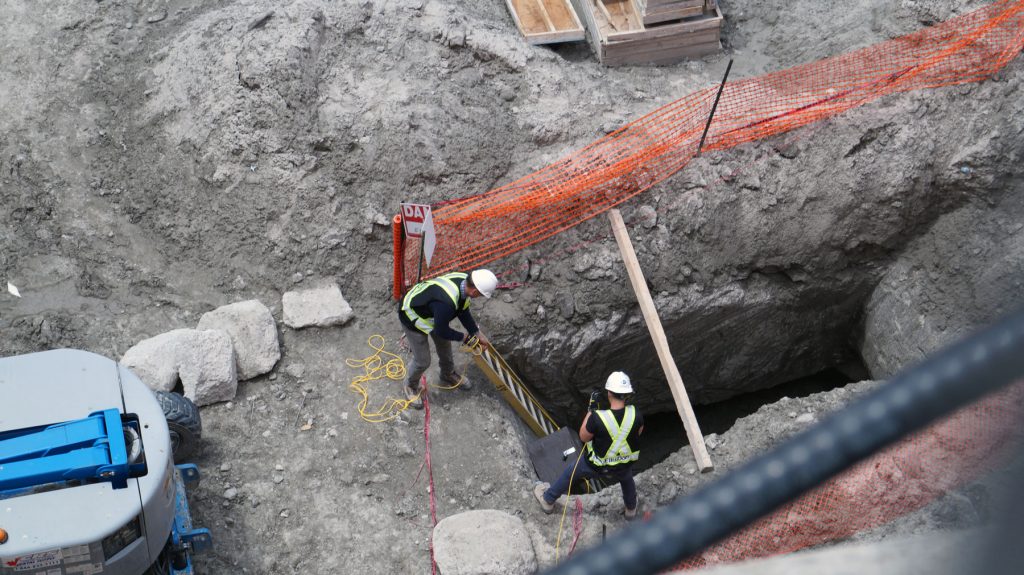
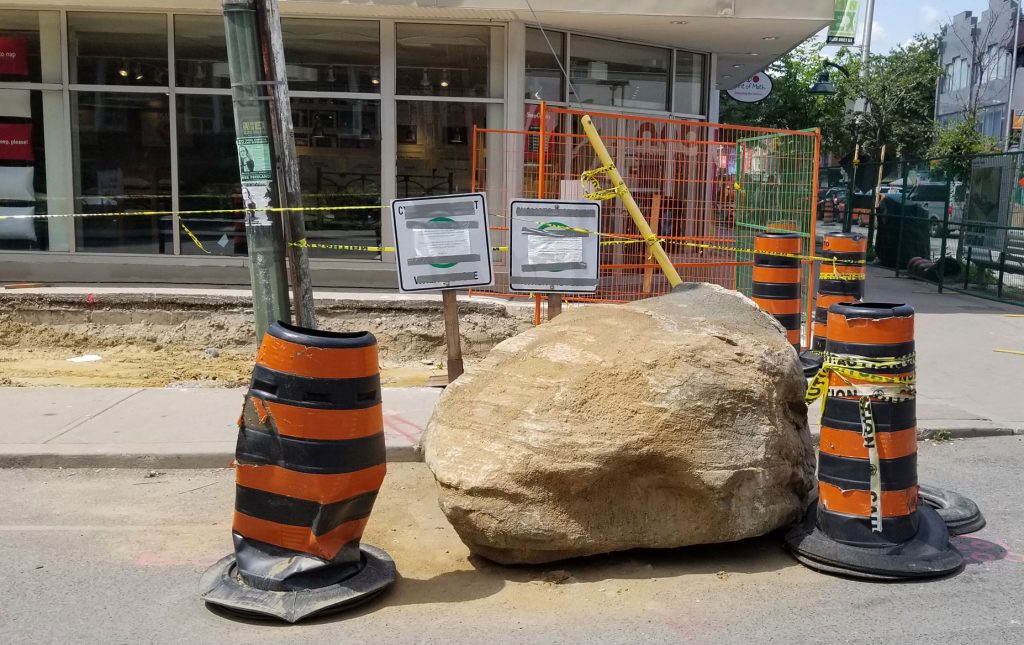
Contractors excavating to create a BIA-sponsored parkette made a surprise discovery. BRIAN BURCHELL/GLEANER NEWS
Residents got a taste of the ice age in the form of a large boulder found at a construction site on Bloor Street at Major. Construction workers excavating the location of a new parkette dug up the boulder at the end of July.
Joe Desloges, an Earth Sciences professor at the University of Toronto, says that the rock most likely came from an iceberg in Lake Iroquois, which had its shore near Casa Loma.
“If you drill down through here, you mostly hit about 70 to 80 feet of glacial lake sand; below that you get the Georgian Bay formation which is the local geology. To find a big piece of this buried on glacial Lake Iroquois sands means that icebergs were floating around and they had pieces of this embedded,” Desloges said.
It weighs close to two tonnes and is estimated to be between 1.2 and 1.5 billion years old.
According to Desloges, the ice started melting between 25 and 15 thousand years ago. During that melt, stones such as the one on Bloor Street were dropped out of the melting ice into local lake sediments.
Rocks like these are actually common, just not in this area.
“You are more likely to find rocks like this when you look at the gullies and the ravines cutting through the Humber and the Don and creeks,” says Desloges.
The rock will likely find a new home at one of the many planned parkettes along Bloor Street.
The chair of the Bloor/Annex BIA (and publisher of this newspaper) Brian Burchell says he is fascinated by the discovery, and will try to have the rock placed at a new parkette on Howland Avenue alongside a pollinator garden.
When planning the parkettes, the Bloor/Annex BIA had actually planned to include large granite boulders in the form of artistic seating.
“For the rock to appear during the excavation period, it kind of validates that plan,” says Burchell. “It gives us a link to the past and to incorporate that into our future plans to make a cottage-like environment in our parkettes seems very appropriate.”