

ON THE COVER: All hands on deck! (Nov. 2019)
December 9th, 2019 · Comments Off on ON THE COVER: All hands on deck! (Nov. 2019)
Comments Off on ON THE COVER: All hands on deck! (Nov. 2019)Tags: Annex · News
NEWS: Freeland re-elected (Nov. 2019)
December 9th, 2019 · Comments Off on NEWS: Freeland re-elected (Nov. 2019)
Minister of Foreign Affairs handily wins riding
By Khyrsten Mieras
Chrystia Freeland will continue her work representing University-Rosedale as a member of parliament following the federal election on Oct. 21.
The Liberal candidate won her seat for the downtown Toronto riding with 51 per cent of the vote and 28,088 ballots, slightly more than during the previous election in 2015 (27,849 votes or 49.8 per cent). She surpassed candidate Melissa Jean-Baptiste Vajda of the New Democratic Party (NDP), who received 15,988 votes or 22 per cent. Conservative candidate Helen-Claire Tingling brought in 9,008 votes or 16.5 per cent, and Tim Grant’s Green Party won 4,585 votes at 8.4 per cent of the total vote.
The NDP and Conservative votes were down slightly from the last election, at 15,988 votes (28.6 per cent) and 9,790 votes (17.5 per cent) respectively, while the Greens rose by a margin of 1,641 votes or 2.9 per cent four years ago.
The election was competitive for all parties, both locally and nationally. In Toronto, the Liberals won all 25 seats in the city. Across Canada, votes were mixed but ultimately resulted in the Liberals winning a minority government with 157 seats in total.
Freeland carried out her campaign with the help of her volunteer team, who knocked on doors, made phone calls, and talked to constituents to gain support for her party. According to Freeland, this remarkable team effort allowed her to travel across the country and support 39 other Liberal candidates with their campaigns in British Columbia, Alberta, Quebec, and Ontario.
Ian Sharpe, a student at George Brown College, says he had a very positive experience as a volunteer for Freeland’s campaign.
“It was a great team. Chrystia’s fantastic, she’s really nice and very intelligent so that’s a great candidate to support,” he says.
Freeland is also Canada’s Minister of Foreign Affairs, a former journalist, and an author. She attended Harvard University and later Oxford University on a Rhodes Scholarship. She began pursuing politics in 2013 and from 2015 to 2017 she was Canada’s Minister of International Trade, overseeing the successful negotiation of NAFTA. In 2018, she was named Foreign Policy’s Diplomat of the Year for her efforts in strengthening international relations.
Freeland based her campaign platform on the Liberal party’s overarching strategy. Her main priorities, as outlined in the campaign, are ensuring equality among Canadians by investing in science and innovation, fighting climate change, and growing the economy.
As a respected and accomplished female politician, Freeland was highly favoured to win in University-Rosedale, a largely Liberal riding in the city. On a national level, however, many Canadians were divided in their political views and expressed their disappointment with the current government this election season.
“I think the election was a bit disappointing in how it was run. I think there was a lot of negativity both from the parties and from the general public and I think that a lot of people were very angry,” says Sharpe. “There was a lot of anger that was kind of misplaced and those expectations were high. They thought the government didn’t live up to those expectations, but I think in a lot of ways the government actually did a lot of what they set out to do.”
On election night, Freeland and her campaign team held a victory party at the Peacock Public House in downtown Toronto where they watched the election unfold.
“I’m very happy with the results. Obviously, as a Liberal I was nervous going into things but I’m very content with what we’ve seen, especially because Minister Freeland won her seat,” says Maddy Mackintosh, a volunteer and high school student from Moore Park. “I’ve been putting in a ton of hours since early August so to see that pay off in this sort of fashion is really, really rewarding.”
Shortly after the official results came in, Freeland gave a speech by congratulating the other candidates. She then thanked her team, family, and the re-elected prime minister Justin Trudeau for their efforts throughout the long and gruelling campaign.
“We have a terrific result, the result of our fabulous work here in University–Rosedale and we have a very strong result, a strong mandate across the country,” said Freeland. “It is truly a gift and it is truly spectacular to see Canadian democracy in action. That is a gift all of you gave me today and the people of University–Rosedale gave us a great victory.”
Polling: University-Rosedale 2019
- Chrystia Freeland, Liberal: 28,088 (51.4%)
- Melissa Jean-Baptiste Vajda, NDP: 11,996 (22.0%)
- Helen-Claire Tingling, Conservative: 9,008 (16.5%)
- Tim Grant, Green: 4,585 (8.4%)
- Aran Lockwood, PPC: 489 (0.9%)
- Liz White, Animal Protection Party: 152 (0.2%)
- Drew Garvie, Communist Party of Canada: 135 (0.2%)
- Karin Brothers, Stop Climate Change: 124 (0.2%)
- Steve Rutchinski, Marx/Leninist: 27 (0.0%)
READ MORE ON THE 2019 FEDERAL ELECTION:
- FOCUS: Federal election candidates queried (Oct. 2019)
- NEWS: Candidates face-off (Oct. 2019)
- EDITORIAL CARTOON: How nice (Oct. 2019)
- FORUM: Vajda makes the NDP case (Oct. 2019)
- GREENINGS: Another election, another round of disappointing platforms(Oct. 2019)
- FORUM: Hold Conservative MPPs to account (Sept. 2019)
- FORUM: “If you work hard, you should be able to buy a home” (Sept. 2019)
- FORUM: Tim Grant wants to be your Green voice in Ottawa (Sept. 2019)
Comments Off on NEWS: Freeland re-elected (Nov. 2019)Tags: Annex · News
HISTORY: The Gleaner looks back at 25 years (Nov. 2019)
December 9th, 2019 · Comments Off on HISTORY: The Gleaner looks back at 25 years (Nov. 2019)
Lunch with Jane Jacobs in 1997
In May 2020, The Annex Gleaner celebrates 25 years of publishing. In celebration, we are republishing highlights of our past; this feature, Lunch with Jane Jacobs, was originally printed in August of 1997. Jacobs, the celebrated urban thinker, was a long-time Annex resident. Deanne Fisher, who interviewed Jacobs, is the founding editor of the Gleaner.
By Deanne Fisher
“Lunch is ready!” comes the call from down the hall in a warehouse on Eastern Avenue. Jane Jacobs, her friends, and I line up at the buffet table with the staff and volunteers of Field to Table, a multi-faceted non-profit organization that puts fresh produce on the tables of thousands of low-income Torontonians.
Lunch has been specially prepared for today’s honoured guest. Jane Jacobs – author, philosopher, activist – has come to test the menu for the banquet to be held later this month as part of the five-day celebration of ideas that bears her name. Each menu item has been selected by Jacobs and “has served some purpose in some period of my life,” she says. The meal was prepared by some local community kitchens – groups of people who have come together to either learn about food or start their own small businesses.
In fact, this low-key lunch with the folks at Field to Table represents one of the few ways that Jacobs is directly involved in organizing Jane Jacobs: Ideas that Matter, which takes place Oct. 15-19. The idea to celebrate her work was not her own, but came from Alan Broadbent, chair of Avana Capital Corporation.
“I regarded myself as a good excuse for a lot of people who should meet each other to get together,” says Jacobs. She agreed, she adds, on the condition that she not be expected to organize it. “I really prefer being a hermit and getting my work done.”
At the age of 81, Jacobs might be expected to retire from her long writing career. Instead, she is as busy as ever in her Albany Avenue home, emerging from time to time as issues or events like this one draw her out.
Jane Jacobs is like an urbanite’s Farley Mowat – someone who observes behaviour with incredible patience and diligence and records it in a way that makes entertaining reading. With research based on real people and communities, her ideas, however unconventional, become irrefutable to anyone willing to escape the confines of what they have been told about the way cities work.
Her first book, The Death and Life of Great American Cities, provided a foundation for a loosely connected movement of architects, planners, politicians, and others concerned with retaining and creating livable cities that has endured for the 36 years since the book was first published. To quote from Jane Jacobs in defence of your own argument is tantamount to quoting scripture.
That inevitably leads to distortions of her ideas to fit the issue of the day. Jacobs knows it happens but it isn’t a big concern. “I can’t run around correcting them or repeating myself. Anybody can read what I wrote.”
Remarkably, in the decades that have passed since Death and Life, Jacobs’s ideas about city planning have not changed in any significant way. “That’s because I was writing about principles, not about fads or styles,” she says.
It is perhaps both an asset and a liability for the city of Toronto – and for her neighbours in the Annex – that Jane Jacobs chose to settle here after leaving New York City in 1968. Within our midst is perhaps one of the most profound thinkers on issues of city planning, transportation, city economies, and the moral foundations of our society. Yet living up to the expectations of being home to Jane Jacobs is a challenge. Toronto continues to make mistakes; there are still disbelievers in our political and bureaucratic structures.
A gentle, generous, and utterly disarming individual, Jacobs has not withered into a complacent old lady. She still reserves harsh words for those who have failed to understand the basic principles of urban behaviour. Chief among her foes: civil engineers.
“At the turn of the century, one of the most exciting things a young man could do was become a civil engineer,” she says. “Then engineering went through a time when it was very dull and, to a degree, dull people chose to go into it.”
They still don’t teach Jane Jacobs 101 in engineering school and she has few converts within the profession. “They know it all already,” she says with sarcasm. “They got those great concepts in the 1938 World’s Fair and that was the last word in transportation. That’s why new ideas don’t come out of departments of transportation.”
This is the bitter side of Jane Jacobs – a cutting tone that can, if you’re on the wrong of a debate, send you squarely back to grade school.
I made the mistake of suggesting she and her family might have been pioneers when they made the decision to live in the Annex in the late 1960s, a time when the Annex was not the gentrified home of the almost-rich and quasi-famous that it is today. Jacobs objects to the question. “The last thing I would want to do is live in a place where everybody was like me,” she says, disputing the idea that it takes any degree of pioneering spirit to settle in an area largely populated by rooming house tenants and lower income residents.
This response reveals what is most overlooked about Jane Jacobs in public discourse: she is the quintessential egalitarian. She believes wholeheartedly in the ability of ordinary individuals to shape their own communities; the people who live in a place know best how to run it.
As we tour the warehouse, kitchen, and backyard growing projects at Field to Table, Jacobs approaches everything and everyone with the curiosity of a child. She learns from the people she meets – the young inventor who’s finding new ways to grow in the city’s confined spaces, the last farmer in Scarborough who’s dropped in with his latest harvest, volunteers packing boxes of fruit and vegetables specifically for Toronto’s Caribbean community.
Her profound respect for “ordinary” people is reflected in her own self-imposed exclusion from the world of formal higher education. She admires, above all, people who enjoy learning. And as she says, “Highly educated people are not always people who keep learning.”
A few hours at Field to Table have disappeared. It’s time to head back home to the Annex. Jacobs is pleased with their versions of some of her favourite dishes and even more enthralled with the whole Field to Table operation. “It gives you hope for the human race.”
Comments Off on HISTORY: The Gleaner looks back at 25 years (Nov. 2019)Tags: Annex · History
NEWS: Heritage house deteriorates (Nov. 2019)
December 9th, 2019 · Comments Off on NEWS: Heritage house deteriorates (Nov. 2019)
Residents frustrated by inaction
By Khyrsten Mieras
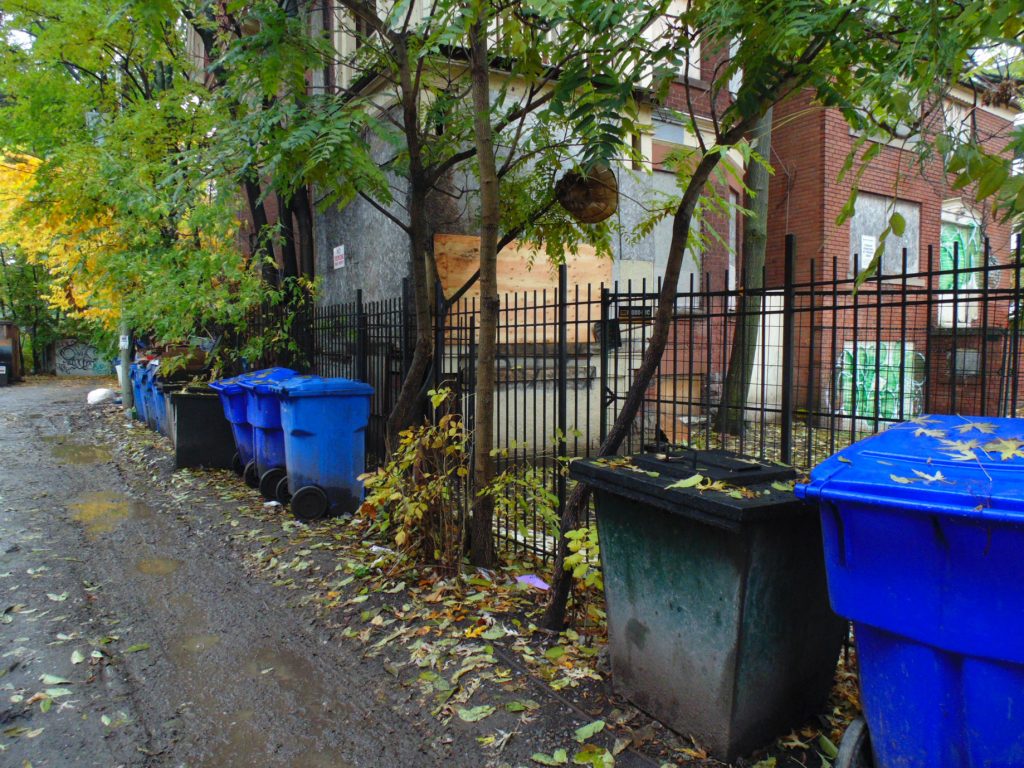
The property at 6 Walmer Rd. is covered in litter. The house has boarded-up windows and doors, the walls are covered in graffiti, and there are holes in the roof. It has been a long road of deterioration for the property, a heritage house, and its poor condition continues to draw complaints from neighbouring residents.
Last year The Annex Gleaner noted the historical significance of the property: it was designed by Frederick Henry Herbert in 1896 for Presbyterian minister Thomas Goldsmith and his family. Later, it was designated a heritage site under the Ontario Heritage Act. In recent years, there have been many issues with the house that still remain and have not been addressed by the owners or the city to preserve its heritage.
In August 2018, the city ordered the current owner, NSCL Investments Ltd., to repair the damage to the heritage features by Oct. 1, 2018. However, the company appealed this and the deadline was extended to Nov. 1, 2019.
Neil Jain, who lives at 10 Walmer Rd., has observed the decline of both 6 Walmer Rd. and the adjoining building at 8 Walmer Rd. Jain has been involved with efforts to restore it for about five years. He and other residents share similar concerns for the state of the properties.
“Under the Heritage Act the owner is supposed to comply with certain standards… so that it doesn’t become a safety hazard with perhaps a collapse of the roof or collapse of a wall,” says Jain. “In general, the property is not being maintained to the standards that I think the city of Toronto would expect through its bylaws.”
Albert Koehl, an environmental lawyer and vice-chair of the Annex Residents’ Association (ARA), has been working to restore the house at 6 Walmer Rd. since Jain contacted the ARA in January 2017.
“Last year we were very concerned about it. Now a full year has passed and there is still no action being taken,” says Koehl. “It looks to us that the building is being allowed purposefully to deteriorate and we don’t see the city intervening despite the community having first brought this to their attention five years ago.”
Days before the November deadline, the order was extended for a second time. Through email, Elizabeth Glibbery, director of Investigation Services at the city of Toronto, informed the Gleaner that the property owner has been granted an extension to Jan. 1, 2020.
“The owner is working closely with the city, including City Planning Heritage Preservation Services and Municipal Licensing & Standards, to accomplish the necessary repairs,” says Glibbery.
According to Koehl, this further delay and the approach of winter will allow for another season of inaction at the crumbling heritage site.
READ MORE:
- NEWS: From heritage to hovel (May 2018)
Comments Off on NEWS: Heritage house deteriorates (Nov. 2019)Tags: Annex · News
CHATTER: Park gets a haircut (Nov. 2019)
December 9th, 2019 · Comments Off on CHATTER: Park gets a haircut (Nov. 2019)

After two Gleaner stories amplifying community concerns over the city’s neglect of Paul Martel Park (on Madison north of Bloor), city staff gave the green space a major clean-up and its long promised new sign. Residents are hopeful that park staff bring the planting beds back to life in the spring.
—Brian Burchell/Gleaner News
READ MORE ON PAUL MARTEL AND OTHER ANNEX PARKS:
- CHATTER: Park still ignored by city (Oct. 2019)
- NEWS: City fails to maintain park (Sept. 2019)
- GRADING OUR GREENSPACE: Park it here (August 2019)
- GRADING OUR GREENSPACE: Open spaces in the heart of the Annex (Summer 2019)
- NEWS: Huron-Washingon Parkette relocates while UTS expands (Spring 2019)
- GRADING OUR GREENSPACE: The best and worst of local parks(Summer 2018)
- GRADING OUR GREENSPACE: More attention to green spaces means parks are improving (July 2018)
- GRADING OUR GREENSPACE: Parks on the fringe (AUGUST 2017)
- GRADING OUR GREENSPACE: Open spaces in the heart of the Annex (July 2017)
- GRADING OUR GREENSPACE: Survey reveals significant upgrades (June 2017)
- GRADING OUR GREENSPACE: Meet our parks supervisor (August 2016)
- Part two of our 2016 parks review (July 2016)
- NEWS: Renewing Margaret Fairley Park (JULY 2016)
- PART ONE: Green sanctuaries in the heart of the city (June 2016)
- Grading our Greenspace (2015)
Comments Off on CHATTER: Park gets a haircut (Nov. 2019)Tags: Annex · News
CHATTER: U of T re-build gets Heritage Toronto Award (Nov. 2019)
December 9th, 2019 · Comments Off on CHATTER: U of T re-build gets Heritage Toronto Award (Nov. 2019)
Recently renovated, the building at 1 Spadina Crescent received an award for its impressive transformation at the 2019 Heritage Toronto Awards last month.
On Oct. 28, Heritage Toronto announced the winners of its annual awards recognizing exceptional contributions to the conservation and celebration of heritage in Toronto.
John H. Daniels Faculty of Architecture, Landscape and Design won a William Greer Built Heritage Award for the transformation of 1 Spadina Crescent, an 1874 Gothic Revival building, into a modern learning centre. The architects for this project were NADAAA Architects, ERA Architects, Adamson Associates, and PUBLIC WORK.
The building underwent immense construction over the past few years, with renovations occurring in two phases; the first focused on the existing building and former home of Knox College and Connaught Laboratories, while the second phase involved the addition of a contemporary wing with a multi-story glass façade on the north side.
The space officially reopened in November 2017 as the new home of the University of Toronto’s John H. Daniels Faculty of Architecture, Landscape, and Design for students in related programs. The building now includes studio space, an amphitheatre, a digital fabrication library, commons space, and a testing laboratory. Overall, it features a sustainable urban design that also preserves the heritage of the historic site.
The Daniels faculty’s website describes the building as “a world-leading venue for studying, conducting research, and advocating for architecture, landscape, and sustainable urbanization.”
—Khyrsten Mieras/Gleaner News
READ MORE:
- NEWS: John H. Daniels Faculty of Architecture, Landscape, and Design (April 2015)
- NEWS: Tall tower before OMB, as city battles back with block study (August 2016)
- NEWS: Planning for the future (May 2016)
Comments Off on CHATTER: U of T re-build gets Heritage Toronto Award (Nov. 2019)Tags: Annex · News
CHATTER: Multiple stabbings at Halloween party on Madison Avenue (Nov. 2019)
December 9th, 2019 · Comments Off on CHATTER: Multiple stabbings at Halloween party on Madison Avenue (Nov. 2019)
On Oct. 31, several stabbings were reported during a late-night Halloween party at a frat house on Madison Avenue, north of Bloor Street West.
“At about 11:30, someone walked down from the northern part of the street, was bleeding, and came for assistance,” says Chris Haslett, who works at the Madison Avenue Pub. “Our door staff took a look at him, and immediately called 911 to get an ambulance to come and help him. Within a few minutes there were multiple ambulances and multiple police responding to calls at Theta Delta Chi at 22 Madison Ave. for incidents that had happened in there,” Haslett told the Gleaner.
Police arrived at the scene to find many people with injuries. Five people were taken to hospital, two of them in life-threatening condition while the others were in serious condition. Another victim later showed up at a hospital with life-threatening injuries and died in hospital the following Saturday night, Toronto Police said.
“My understanding is the frat house was rented to another party, possibly through Airbnb, and they threw a party,” Haslett speculated. The Gleaner was unable to confirm this detail.
Toronto Police say one male suspect believed to be responsible for stabbing the six victims is in custody. A female suspect was also taken into custody early the next morning.
The suspects were originally charged with three counts of aggravated assault, three accounts of assault with a weapon, weapons dangerous and attempted murder; however, the male suspect is now being charged with second degree murder.
—Khyrsten Mieras, Gleaner News
Comments Off on CHATTER: Multiple stabbings at Halloween party on Madison Avenue (Nov. 2019)Tags: Annex · News
EDITORIAL CARTOON: How Nice (Nov. 2019)
December 9th, 2019 · 1 Comment
READ MORE BY BRETT LAMB:
- EDITORIAL CARTOON: How Nice (Oct. 2019)
- EDITORIAL CARTOON: How Nice (Sept. 2019)
- EDITORIAL CARTOON: How nice (August 2019)
- EDITORIAL CARTOON: How Nice (Summer 2019)
- EDITORIAL CARTOON: How Nice (May 2019)
- EDITORIAL CARTOON: How Nice (Spring 2019)
- EDITORIAL CARTOON: How nice (December 2018)
- EDITORIAL CARTOON: How Nice (City Election 2018)
- EDITORIAL CARTOON: How Nice (October 2018)
- EDITORIAL CARTOON: How nice (Aug./Sept. 2018)
- EDITORIAL CARTOON: How Nice (Summer 2018)
- EDITORIAL CARTOON: How Nice (July 2018)
- EDITORIAL CARTOON: How Nice (Election Special 2018)
- EDITORIAL CARTOON: How Nice (May 2018)
- EDITORIAL CARTOON: How Nice (Spring 2018)
- EDITORIAL CARTOON: How Nice (Mar. 2018)
- EDITORIAL CARTOON: How Nice (Dec. 2017)
- EDITORIAL CARTOON How nice! (August 2017)
- EDITORIAL CARTOON How nice! (July 2017)
- EDITORIAL CARTOON: how nice! by blamb (June 2017)
- EDITORIAL CARTOON: TCHC (May 2017)
- EDITORIAL CARTOON: The Grand Tory (April 2017)
- FORUM: Celebrating 20 years of cartoonist Brett Lamb (April 2017)
→ 1 CommentTags: Annex · Columns · Opinion
EDITORIAL: Don Cherry’s deeply revealing words (Nov. 2019)
December 9th, 2019 · 1 Comment
Don Cherry made it easy for Rogers’s-owned Sportsnet to fire him on Nov. 11. His attack on newcomers for not wearing symbols of allegiance (the poppy) advances a very non-Canadian agenda that is entirely contrary to the values that our soldiers and allies fought for over several wars. It’s not so much that times have changed and Cherry’s views have failed to evolve, but that we believe Cherry is advancing views that were never very Canadian. The fact that he was fired on Remembrance Day is the real tribute to those troops.
This long-standing face of Canadian hockey has represented, unabashedly, a right-wing, nationalistic, white male-centred viewpoint that divided the world into “us” and “them”. A Nov. 9 televised rant on Coach’s Corner went on the attack against “you people” who come to Canada and in Cherry’s view must toe the line and wear poppies on Remembrance Day.
No elected official, of any stripe, has come to his defence. Cherry’s words were so inappropriate and divisive, they really cornered conservatives who would normally have stood by him. Even the Royal Canadian Legion, which one might think of as “poppy obsessed”, tweeted “Mr. Cherry’s personal opinion was hurtful, divisive and in no way condoned by the Legion”. Every moment of peace we have in Canada is a testament to the veterans who have fought and to those that have fallen. We live without fear of oppression and have freedom of choice. The choice to not wear a poppy for whatever reason, ignorance of the tradition, disagreement about whether or not it must be worn on one’s lapel at certain times of year, should not be imposed by Cherry or others, otherwise the choice is not real. His comments lead to inciting hate towards identifiable groups and the possibility that the poppy itself might become a fascist symbol, which would negate the very honour we seek to bestow upon veterans because those were not the values they fought for.
Cherry’s view is as objectionable as Quebec demanding by law that people NOT display any symbol of religious affiliation. He tried to clarify his comments following his firing by saying instead of “you people” he meant “everybody”. That does not jibe with the rest of remarks that were “you people … that come here, you love our way of life, you love our milk and honey, at least you can pay a couple of bucks for a poppy, these guys paid for the way of life that you enjoy in Canada”. He also singled out Toronto and Mississauga, whose populations are now majority non-white. Even if we give him the benefit of the doubt and allow that he was speaking not only about Syrian refugees but also families of “Scottish and Irish” descent, a real stretch, this still smells like an entirely assimilationist regime seeking to impose a totalitarian view of a one-colour world that should be long gone, and really should never have existed in a country consisting mostly of immigrants of many origins and traditions.
Cherry and his online supporters touting their own intolerant views have argued his freedoms have been taken away but they have taken the principle of freedom of speech and have twisted it and demeaned it in such a way that it is no longer meaningful. Freedom of speech is not freedom from consequences. And now, Mr. Cherry, your long career of rants is bookended in disgrace for essentially being very non-Canadian.
READ MORE EDITORIALS:
- EDITORIAL: The hidden cost of Conservative climate plans (Oct. 2019)
- EDITORIAL: How not to manage the retail sale of pot (Sept. 2019)
- EDITORIAL: Let cabinet do its job (August 2019)
- EDITORIAL: Time for Ford to press “eject” (Summer 2019)
- EDITORIAL: Ford’s angry budget (May 2019)
- EDITORIAL: It’s not your private police force, Mr. Ford (Spring 2019)
- EDITORIAL: It’s hardly ‘for the students’ (Winter 2019)
- EDITORIAL: Blowing smoke on the climate file (Dec. 2018)
- EDITORIAL: This premier is not for the people (City Election 2018)
- EDITORIAL: Eight weeks lost to Ford’s madness (October 2018)
- EDITORIAL: A lost cause worth fighting for (Aug./Sept. 2018)
- EDITORIAL: Reclaiming our city (Summer 2018)
- EDITORIAL: City staff ignore bike lanes (July 2018)
- EDITORIAL: The market has no moral compass (Election Special 2018)
- EDITORIAL: Lessons to be learned from Excessive Force (Spring 2018)
- EDITORIAL: A social contract is a precious thing (March 2018)
- EDITORIAL: Intolerance leading to Quebec’s decline (Dec. 2017)
- EDITORIAL (Nov. 2017): Student safety suffers as trustees cave
- EDITORIAL: Pandering to religious intolerance (October 2017)
- EDITORIAL: Bike lanes, good for business (Fall 2017)
- EDITORIAL: Don’t sacrifice safety for political gain (August 2017)
→ 1 CommentTags: Annex · Editorial · Opinion
FORUM: Winter woes in Ward 11 (Nov. 2019)
December 9th, 2019 · 1 Comment
Layton seeks a more “robust” approach to snow clearing
By Mike Layton
Before the weather goes below zero, and the fall rain turns into ice and snow, I thought I could take a moment to talk about a topic that will be top of mind for many Ward 11 residents in the coming months – snow removal.
In early 2019, City Council requested a report to review winter operations, after an onslaught of issues in the downtown related to the safe clearing of sidewalks, parking restrictions, and streetcar disruptions from the previous winter. Recommendations from the resulting report made clear that Toronto needs a more robust approach to snow removal, and that 96 per cent of Toronto residents would support increased sidewalk snow removal services.
Snow clearing is an issue of equity and accessibility. When a sidewalk isn’t cleared, there are large groups of people whose lives become incredibly disrupted. Whether you are someone with accessibility requirements, an aging person, or new parents with a stroller, our services need to evolve alongside the growing needs of our residents. Further, as we have committed as a city to taking action on climate change, we need to continue to implement services that allow residents to build a greater reliance on active, or public, transportation.
At the last Infrastructure and Environment Committee, I brought forward an amendment to be voted on at City Council that would have pushed our winter services forward in a way that would actually address significant problems outlined in the original report.
Firstly, I wanted to increase the scope of the sidewalk clearing pilot, and push forward the kind of clearing residents are asking for and need in a bigger and broader way. This is an issue of equity and access for many in Toronto, especially as our population ages.
Secondly, I wanted to enhance snow clearing for bike lanes – ensuring that action would be taken within the first 48 hours of snow fall, and that staff use finer tools, such as brushes and narrower plows so as not to damage the existing infrastructure.
Lastly, I wanted to see the removal of parked cars (a “friendly tow”) to clear parking spaces adjacent to bike lanes, where necessary.
These amendments, did not carry, but I will continue to advocate for these necessary changes through the budget process in the coming months.
With Toronto constantly having to adapt to the impacts of climate change, it is critical that we continue to review and update service levels to provide a safe and reliable transportation network for everyone in our city.
The city’s snow-clearing services must continue to respond to this change, and I will continue to do everything possible to find a way to make enhanced snow clearing a reality for residents in Ward 11 and beyond.
Mike Layton is councillor for Ward 11 University-Rosedale.
READ MORE BY MIKE LAYTON:
- FORUM: Hold Conservative MPPs to account (Sept. 2019)
- FORUM: Layton laments city’s snow job (Spring 2019)
- FORUM: Moving forward in the new reality (Dec. 2018)
- FORUM: Celebrate citizen activists (July 2018)
- FORUM: Provincial government is developer-friendly (Spring 2018)
- FORUM: Establishing a new Indigenous Affairs Office (Nov. 2017)
- FORUM: Building a better Bickford Park (Oct. 2017)
- FORUM: Recognize and reconcile Canada at 150 (July 2017)
- FORUM: San Francisco a model to follow (April 2017)
- FORUM: Tolls, taxes, and Toronto (February 2017)
- FORUM: Seeing our neighbourhood through new eyes (December 2016)
- FORUM: We can do better: Dangerous summer for Toronto pedestrians and cyclists (October 2016)
- FORUM: Curious story of Christie Pits pool liner ends in extended hours at Alex Duff (August 2016)
- FORUM: A tribute to a friend (June 2016)
- FORUM: Large problem, small solution (March 2016)
- FORUM: Happy New Year from a new Dad with a new perspective (January 2016)
→ 1 CommentTags: Annex · Columns · Opinion
FORUM: Ford’s backtracks show our resistance is working (Nov. 2019)
December 9th, 2019 · Comments Off on FORUM: Ford’s backtracks show our resistance is working (Nov. 2019)
With his popularity in free fall, the premier tries reverse gear
By Jessica Bell
Over the past year, Doug Ford has hacked away at our schools, hospitals, and communities. He’s made devastating cuts to OSAP, ambulance services, and cancer-screening programs. Under his term, class sizes have ballooned, wait times at emergency rooms have increased, and university has become more expensive. It’s a bleak picture. But the good news is we have been fighting back – and Ford is now forced to listen.
While these victories are important to celebrate, none of them would have happened without a fight.
With Queen’s Park finally back in session, it’s important to recognize the progress we’ve made. Parents, advocates, teachers, young people, and politicians have all stood up to fight for a better Ontario. Over the past few months, Ford has been forced to backtrack on a number of destructive cuts and ill-advised actions such as:
Transition Child Benefit Cuts.
Ford was set to eliminate the Transition Child Benefit – a $230 monthly benefit to assist vulnerable low-income families, including refugee claimants, who aren’t eligible for other forms of child benefit assistance. After public outcry led by refugee advocates and organizations, including University–Rosedale’s Christie Refugee Welcome Centre, Ford reversed this cruel cut.
TTC Upload
As part of his back-of-the-napkin transit scheme, Ford announced that the province would take over the entirety of the TTC. For the past year, we’ve built a coalition and fought hard for the TTC to remain in Toronto’s hands. In October, Ford finally backed down, agreeing to end his hostile takeover if Toronto supports the Ontario Line.
Sex-Ed Curriculum
Ford campaigned on repealing the updated sexual education curriculum in an effort to appease far-right Conservatives. But after thousands of parents, educators, and students – including those at Harbord Collegiate, Central Tech, Central Toronto Academy, and St. Joseph’s College – demanded the right to a comprehensive sexual education, Ford backed down. The “new” curriculum he introduced in August is almost identical to the one he swore to destroy a year ago.
Autism Support
Rather than provide families with much-needed assistance to help pay for support and therapy, the Ford government attempted to overhaul the system by slashing funding for high-needs children. After months of demonstrations and testimonials by impacted families, Ford reversed his position and has said he’ll increase funding and use a needs-based approach to determine support. We will hold him to this promise.
Vaping Regulations
Ford made sure that Ontario was “open for business” to vaping companies by loosening advertising restrictions. After hospitalizations and sustained pressure from the NDP and the health community, Ford has finally backed down and admitted that vaping companies shouldn’t be advertising to children.
Public Health Cuts
In the spring, Ford announced huge cuts to municipal public health services that would have cost Toronto up to $1 billion over the next decade. After thousands of people signed petitions, protested at Queen’s Park, and wrote to their public officials, Ford finally relented and halted this year’s cut. However, funding reductions are still planned to go forward for 2020 – unless we continue the pressure.
?While these victories are important to celebrate, none of them would have happened without a fight. Doug Ford has shown us what his priorities are, and what he’ll cut without a second thought, if he can get away with it. With a new legislative session upon us, it’s more important than ever that we continue to organize, work together, and stand up for a better future.
I’m committed to continuing to fight Ford’s cuts to education and teacher layoffs. I’m committed to pushing for investments in good quality public transit and affordable housing, and to forcing real action on our climate crisis.
If you would like to join me, please contact my Community Office at 416-535-7206 or by email at jbell-co@ndp.on.ca to get involved. I also encourage you to join your local residents’ association, parent group, or advocacy organization that is fighting for bold change. Together, we are stronger – and we’ve shown that we can win.
Jessica Bell is the Member of Provincial Parliament for University-Rosedale. Wyndham Bettencourt-McCarthy is MPP Bell’s Legislative and Policy Advisor. With files from Wyndham Bettencourt-McCarthy.
READ MORE BY JESSICA BELL
- FORUM: Our streets should be safer (Oct. 2019)
- FORUM: Top takeaways for our community from Ontario’s 2019 budget (Summer 2019)
- FORUM: Taking a stand against Ford’s cuts to education (May 2019)
- FORUM: With people-power there is hope (Winter 2019)
- FORUM: Take back Toronto on the 22nd (City Election 2018)
Comments Off on FORUM: Ford’s backtracks show our resistance is working (Nov. 2019)Tags: Annex · Opinion
FOCUS: Defacement or marginalia? (Nov. 2019)
December 9th, 2019 · Comments Off on FOCUS: Defacement or marginalia? (Nov. 2019)
The question of writing in library books at U of T
By Nicole Stoffman
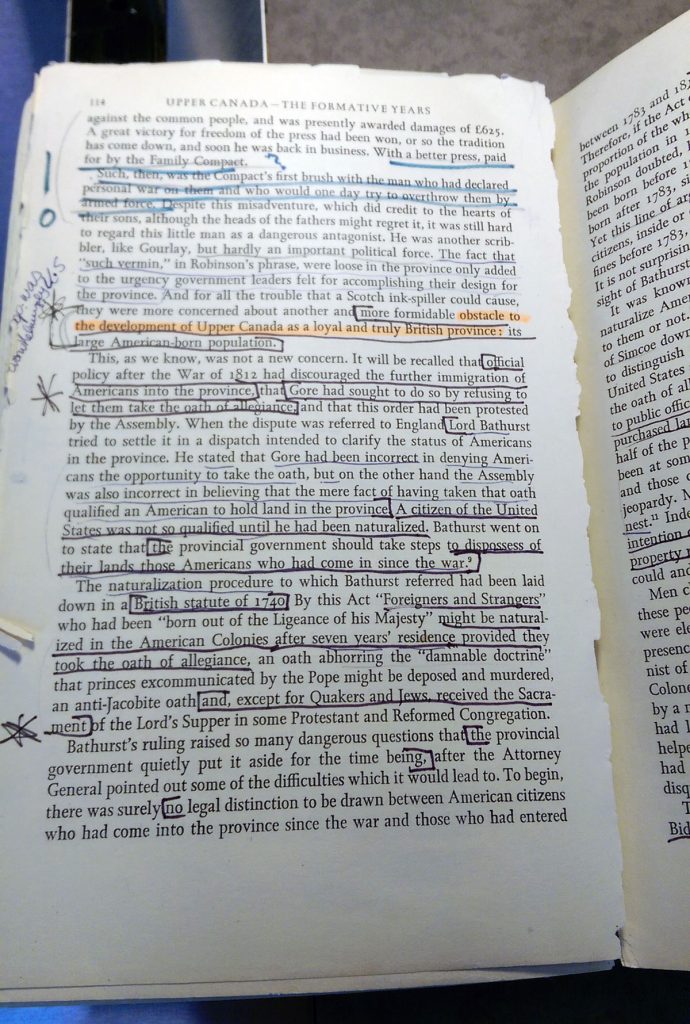
Judging by the state of many books one finds at the University of Toronto Libraries, writing in library books is a U of T tradition. In long-held parts of the collection, especially in books used for course readings and essay research, one finds almost every sentence underlined or highlighted.
Do University of Toronto Library (UTL) staff and librarians notice the state of these books? One front line staff member, who did not wish to be named, told us it is a big problem without a clear solution. University College librarian Margaret Fulford agrees, and says the cost of replacing defaced books would be huge.
“The whole purpose of libraries is that they’re there for everyone and you are highlighting or underlining only what interests you,” says Lisa J. Sherlock, chief librarian of the E.J. Pratt Library at Victoria College. “It’s a selfish use of a library book, which is a shared resource.”
Writing in books is not just an inconvenience for fellow users, it challenges accessibility. Accessibility librarian Katya Pereyaslavska gets her staff to erase markings in books for digitization for readers with a learning disability or visual impairment. Back in November she participated in a social media campaign to draw attention to the extra work writing in books creates for her team. “People didn’t realize the tediousness of erasing that we must do to make this material accessible,” she noted.
Could staff at least erase underlining in pencil? “Once I had a student at the front desk go through a book and erase, but it consumes too much staff time,” says Fulford.
What about catching book vandals when they return the book?
“Even if they return the book, we never pin a fine on them, because there’s no way to track who did it,” explains David Hagelaar, associate chief librarian at the John M. Kelly Library, at St. Michael’s College. “What if it was a user who never checked the book out who is responsible?”
If the task of cleaning U of T’s existing collection is vast, managing the issue of book defacement on a yearly basis is possible. In the last year, only six or seven books had to be replaced at the John W. Graham Library, and only one book replacement fee was issued, after a coffee spill. Similarly, at the E.J. Pratt Library only three books were replaced last year. Fortunately, not all types of books are equally likely to be victimized. John Papadopoulos, director of the John W. Graham Library at Trinity College, has only had complaints about defacement when one particular chapter of a book has been studied many times over. Ms. Fulford has never seen writing in her literature, bestseller, or graphic novel collection.
Surprisingly, graduate students are the biggest culprits.
“They think, ‘no one else is doing this kind of work, so no one else will notice,’” surmises Mr. Papadopoulos.
Fulford says she was shocked to learn that a graduate student would do such a thing, and the single book vandal she was able to catch was a graduate student who borrowed a new acquisition.
“I phoned her and asked, ‘Is this something you did?’ and she said, ‘I write in all my books, and I guess I did it again.’ I bought a new one and charged her a $50 book damage fee. She felt guilty, and probably won’t do it again.”
On the other hand, there is a long history of considering the commentary written in the margins of books “marginalia.” It is the sign of an active reader. The poet Samuel Taylor Coleridge wrote marginalia so copious it was published in its own volume and is considered a completely different aspect of his life’s work.
How to distinguish between marginalia and defacement? For Papadopoulos, the distinction is one of time.
“If a book is recently underlined, it’s defacement. If it’s been underlined 100 years ago, it’s marginalia. It’s interesting to see historically how the reader engaged with the book.”
For Hagelaar, the marginalia of famous people is very valuable, but he says he’s willing to consider a student’s commentary marginalia as well. For him, marginalia does not interrupt the flow of text, and is therefore not grounds for replacement, whereas underlining and highlighting does.
“I loved it in high school, when you got a Shakespeare book, and people had written notes for you,” says U of T undergraduate, Jodi Pereyaslavska. She adds that students are often happy to come across marginalia and consider it a form of “peer mentoring.”
Writing in books at U of T may not be a plague, yet UTL could be more proactive in discouraging it. After all, online forums may not have diminished the temptation to underline or write in the white space of actual books. At the E.J Pratt Library, for example, while the practice has not increased over the last 10 years, it has remained a fairly consistent issue.
The problem is not unique to UTL, but their collection, used for study and research, is more vulnerable to defacement than the public library system, where books are being taken out for leisure reading.
UTL’s social media campaigns and “Library Conduct Regulations” pamphlets are praiseworthy initiatives, but are less visible than posters in washrooms and common areas could be. At the smaller college libraries, front desk staff could be empowered to conduct random spot checks. Should they note that a book is clean upon being signed out, they could insert a reminder slip, advising the borrower that it has been noted the book is clean, and that defacement incurs a fine. Notices pasted to inside covers of new acquisitions could be another low-tech, proactive step towards ensuring an accessible collection for all scholars, now and in the future.
*****
Next time you are passing through the St. George Campus, step back in time and enjoy some famous marginalia. Here are two notable examples from college libraries:
John W. Graham Library at Trinity College:
– A copy of Dante’s Divine Comedy from 1497. This rare book, a gift of Guy and Sandra UpJohn, features marginalia “noting that the book has been reviewed by the Expurgation Commission of the Spanish Inquisition at Toledo Spain, 1614.”
Danthe Alighieri fiorentino 1497 Upjohn-Waldie 1497 D36 fol.
E.J. Pratt Library at Victoria College:
– Annotated Frye, a collection of over 2000 books by the famous literary scholar, academic, and former Chancellor of Victoria University. Some of the richest marginalia is to be found in The Complete Writings of William Blake. Frye’s writing is so tiny and cramped that the library will offer you a magnifying glass.
NOTE: Advance notice of 24 hours is required for special collection use. Retrievals take place at 10 am, 1 pm, and 3 pm daily. The collections are available for use from 9:30 am until 4:30 pm Monday to Friday.
Happy Marginal Reading!
Comments Off on FOCUS: Defacement or marginalia? (Nov. 2019)Tags: Annex · Life