January 31st, 2020 · Comments Off on ARTS: Commit to culture in 2020 (Jan. 2020)
A myriad of activities meet the new year in the Arts Corridor
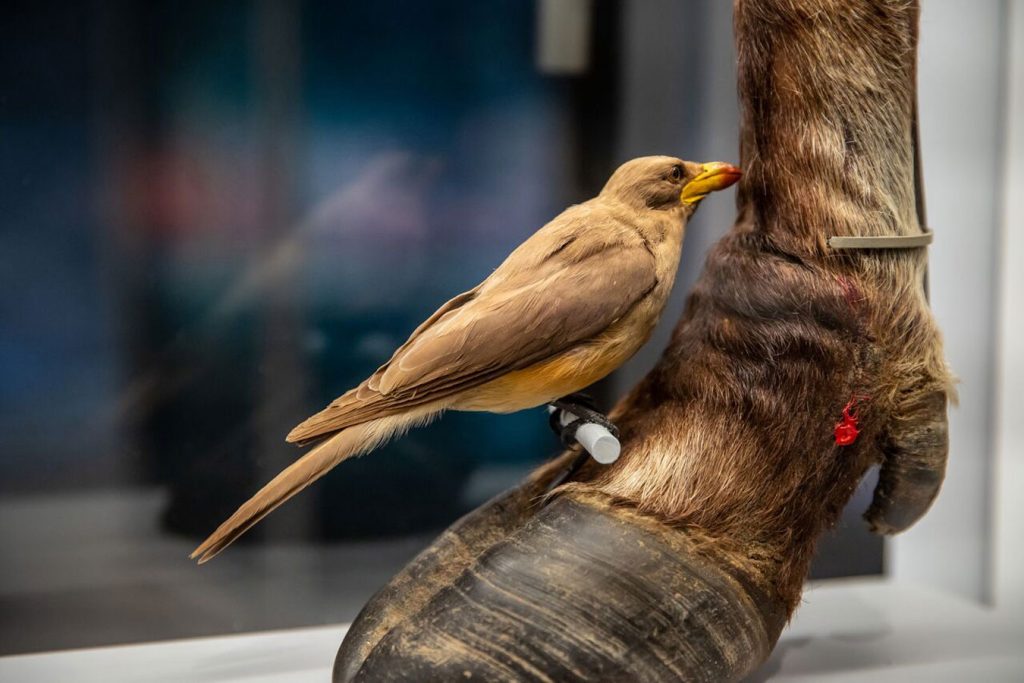
The African oxpecker consumes the blood of its host. Featured in the ROM’s Bloodsucker exhibition. Courtesy the Royal Ontario Museum
By Meribeth Deen
How about making the most of the city’s culture as a resolution for 2020?
It’s easy, too. All you need to do is make your way up to Bloor Street and pop into any one of the many galleries, music venues, cinemas, museums, and cultural centres that make up the Bloor St. Culture Corridor. This month, there’s lots to hear, touch, see, and learn.
Bring the kids (ages 7 – 14) down to the Gardiner Museum (111 Queeen’s Park) to get their hands dirty and learn ceramics from a professional artist for Saturday morning kids clay classes. Adult classes are also ongoing.
Head to the Thomas Fisher Rare Book Library at U of T to get the big-picture story of CanLit. There are many names to know in the CanLit scene beyond Atwood, Ondaatje, Gallant, and Davies.
The writers were and are supported by a host of editors, publishers, illustrators, marketers, and book sellers.
Drawing on the rich archival material in the library (including the first draft of A Handmaid’s Tale) this exhibition explores the diverse community that shaped CanLit.
For a shot of colour, head to Galerie Pierre Léon (at the Alliance Française, 24 Spadina Rd.) to see the work of Laurianne Simon in the exhibit, The Parrot’s Intrigue.
Simon has been painting birds since 2012, and says that “for a long time now, my paintings of birds, more specifically of fighting cocks and parrots, have been a metaphor for the artist. More recently, I have come to realize that they are perhaps more a metaphor for human beings.”
Learn about the diversity of nature’s vampires as well as the myths, legends, and pop culture they have inspired at the ROM’s Bloodsuckers: Legends to Leeches exhibit on until March 22.
You’ll get to know the vampire bat, who exclusively feeds on the blood of birds and mammals, and on occasion, humans.
They cut the skin using razor-sharp teeth, lapping up blood from the wound.
You’ll get some rare images of the human practice of bloodletting, and get to dive in deep on blood-related topics at talks running on various evenings until the exhibition closes in March.
On January 25, head to 918 Bathurst to celebrate the release of Anishinaabe experimental-electronic producer Ziibiwan’s debut album Giizis, featuring Phedre and Melody McKiver.
Ziibwan is a genre-hopping producer who experiments with hip hop, triphop, R&B and more.
He was nominated for the Best New Artist award and best instrumental category for his album, Time Limits. Tickets are available online.
And why not head to HotDocs, where this month you can get your fill of bio-docs at the Game Changer Series which is sure to inspire with the stories of Malcom X, Edward Said, Susan Sontag, and more.
Comments Off on ARTS: Commit to culture in 2020 (Jan. 2020)Tags:Annex · Arts
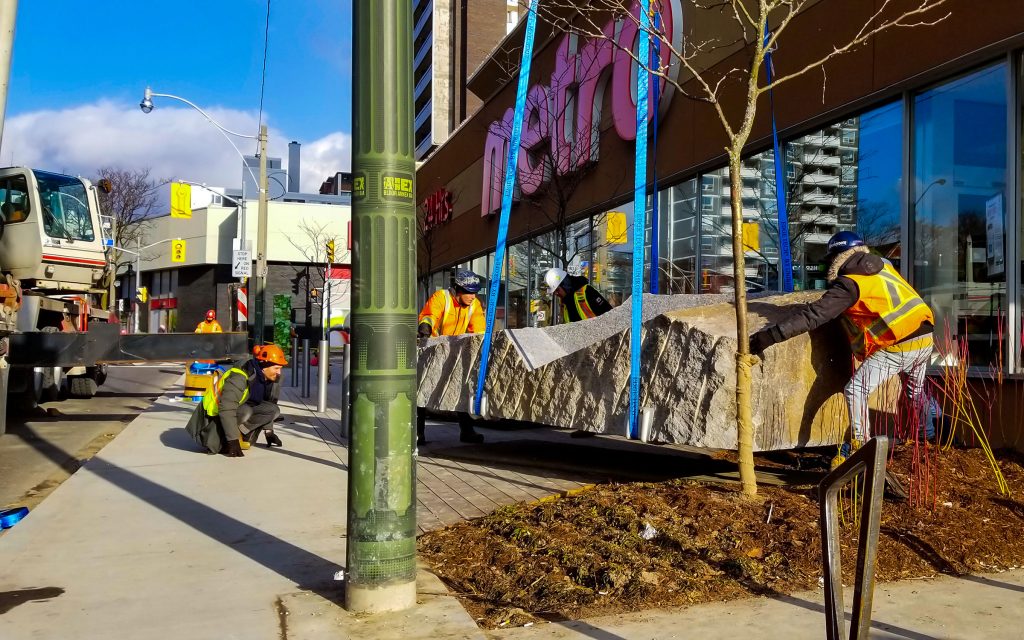
Artist Robert Cram spots as Sanscon Construction employees carefully place the first granite bench at the Robert Street Parkette. NEILAND BRISSENDEN/BLOOR ANNEX BIA
Originally published in October of 2016 in anticipation of the granite installations in the Bloor Street Parkettes.
By Geremy Bordonaro
Humans have been moving stones to create monuments since at least prehistoric times, an act that is taking on a very local incarnation, thanks to the Bloor Annex Business Improvement Area, which is installing four parkettes along Bloor Street between Spadina Avenue and Bathurst Street.
Placed at the rights-of-way at Howland Avenue, Brunswick Avenue, Major Street, and Robert Street respectively, the parkettes will provide many user-friendly amenities like a water bottle refilling station and stone seating made of granite sourced from Quebec quarries.
Part art installation, part seating structure, the granite is meant to bring a more human aspect to the landscape, explained Robert Cram of DTAH, the Toronto-based architecture firm responsible for the design of the parkettes.
“This concept was based on something that we, as humans, have been doing for a long time,” Cram said. “We’ve been taking stones from places and carrying them to other places to create these communal, interesting spots where people can gather.”
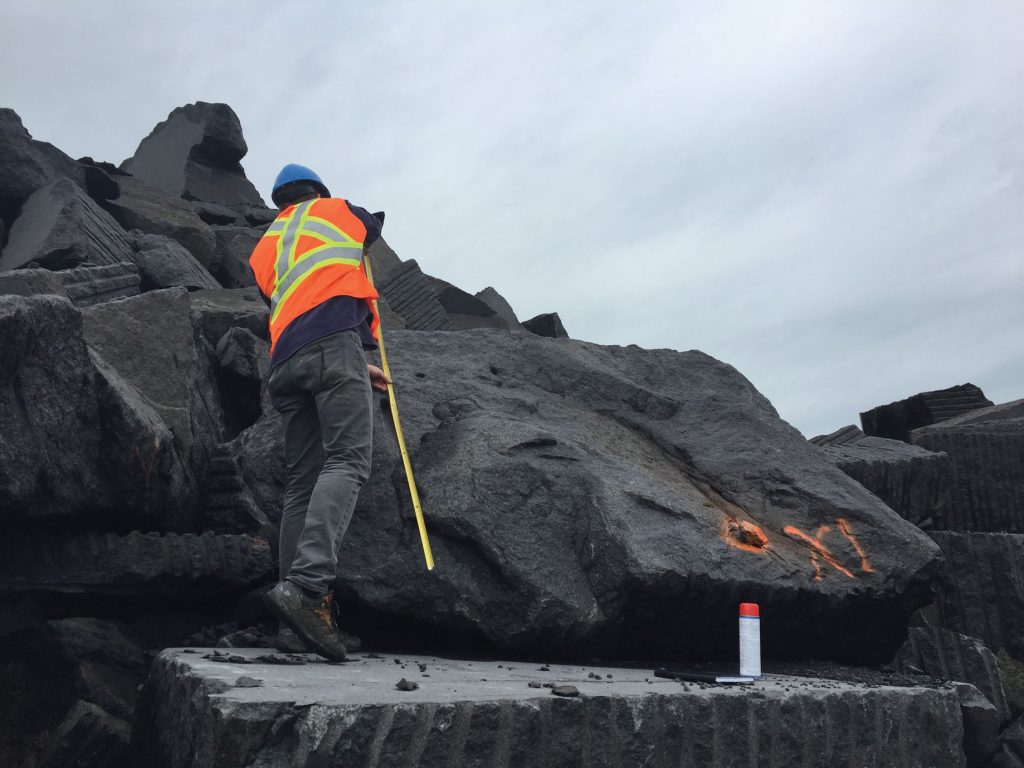
A Quebec quarry worker marks granite destined to become part seating, part art installation in four parkettes set to launch on Bloor Street in 2018. COURTESY ROBERT CRAM
The granite stones, reclaimed off-cuts, weigh upwards of 10,000 pounds and are 2 to 4 feet tall. Cuts to the rocks for seating are specifically being carved with care by Cram.
“The concept for sculpting the stone came from [Isamu] Noguchi, the Group of Seven, and other people who have done these simple techniques into stone,” said the designer, whose design will give each stone “a beautiful modern look that will complement the history of the layers the stone already has”.
Brian Burchell, chair of the BIA (who also publishes this paper), is spearheading the $1.8-million street revitalization plan that includes the parkettes project, said he believes “they will soften the area, creating spaces that are relaxing and non-commercial; an oasis in a very busy landscape.
“You might think it’s unusual that the chair of the business association is advocating for non-commercial spaces but it’s exactly what we need to make the space more human.”
“From a park point of view, [the goal is] to have an integrated public art landscape, not something plunked down in the site, [but] something that becomes part of the site, [and] something that will work at all different times of the year,” said James Roche, a partner at DTAH, which has worked with other BIAs on similar projects.
“Increasingly, Bloor Street is becoming a destination and we want to make that experience as enjoyable as possible,” said Burchell.
“I fully imagine seeing people meeting at these parkettes and them being a place where people can have respite from the completely commercial nature of the street.”
“What’s interesting is the scale of the project,” added Roche. “It’s almost like it’s going to be one of those things where someday someone wakes up and says ‘Wow, this is quite the transformation.’”
In the end, Cram believes that these parkettes will give a sense of connectivity unlike anywhere else in the city.
“When you walk down Bloor [Street], there will be this continual language to it. When you go through, the Annex will have this kind of personal aesthetic that will feed into [its] image.”
December 9th, 2019 · Comments Off on ON THE COVER (Dec. 2019)
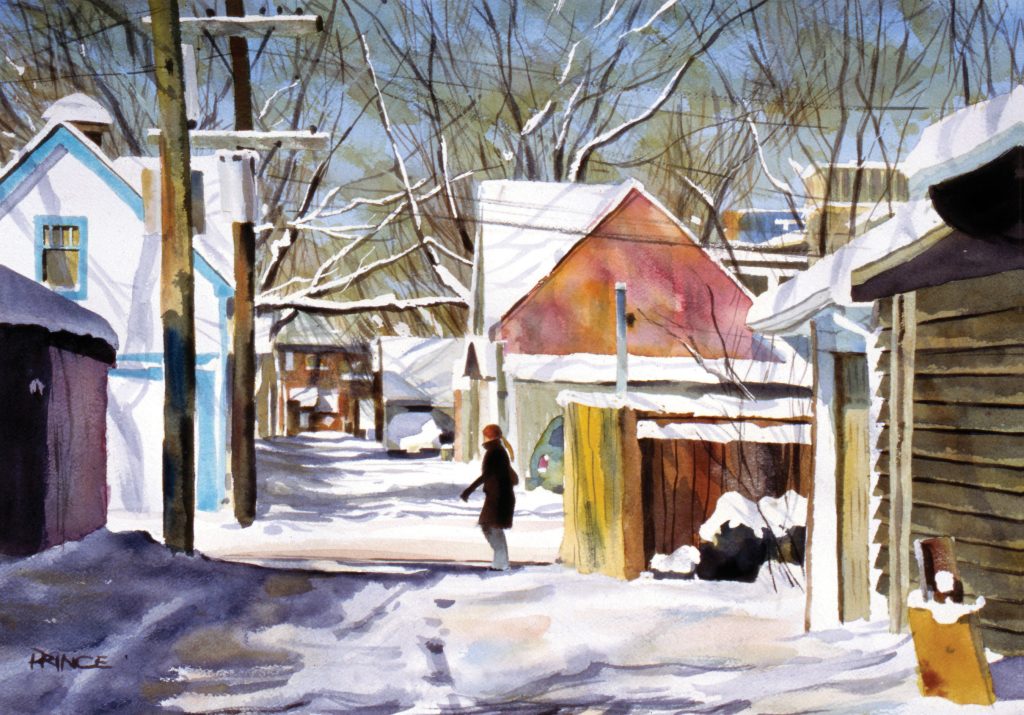
Women Walking in Lane (Watercolour) by Jim Prince from his collection Toronto Winter Themes is featured on our cover this issue.
From his biography: “Jim Prince’s paintings received critical attention right from the start. Shortly after completing art school in Toronto in 1954, Jim exhibited on several occasions at the Art Gallery of Ontario with the Ontario Society of Artisits and the Canadian Society of Painters in Watercolour. One of Jim’s paintings during this period was purchased by J. Hirshhorn, and is now in the permanent collection at The Hirshhorn Museum at the Smithsonian Institution in Washington D.C. More recently Jim had the honour of being one of the artists chosen by the American Watercolor Society for its 133rd Annual International Exhibition in New York City.”
To purchase a print e-mail: jimprinceart@yahoo.com or for more information visit jimprinceart.wordpress.com.
December 9th, 2019 · Comments Off on NEWS: OCAD students design bike rings (Dec. 2019)
Traditional and contemporary pieces win competition
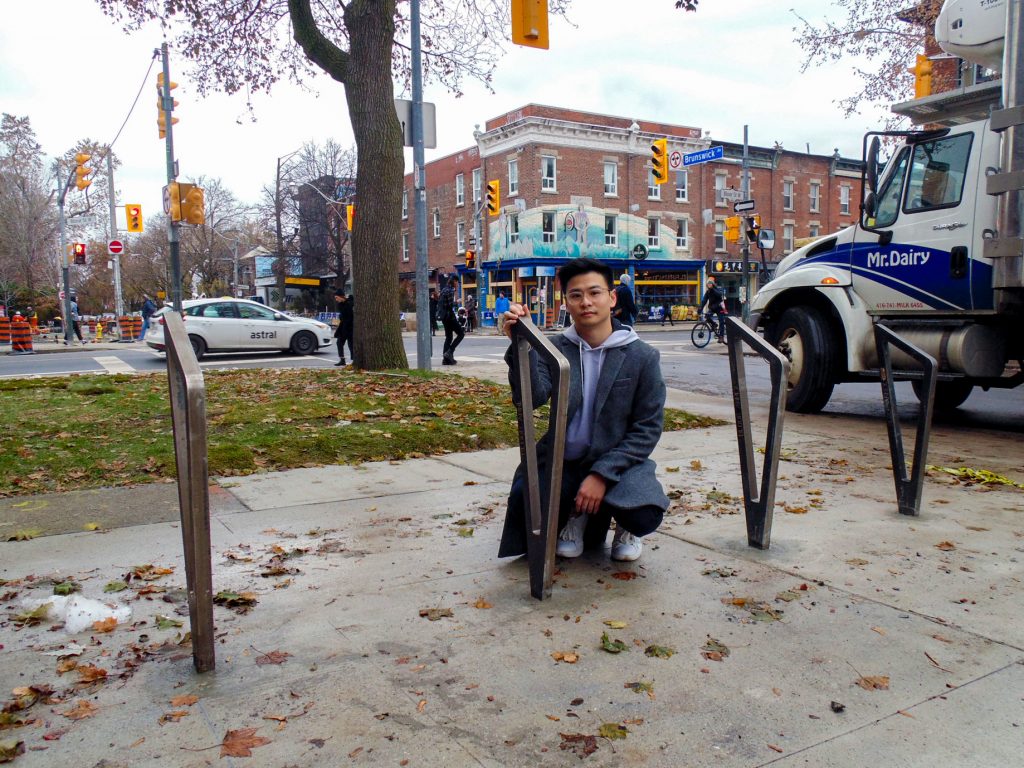
OCAD student Che Huang kneels next to his winning bike ring design for Bloor Annex BIA parkettes. KHYRSTEN MIERAS/GLEANER NEWS
By Khyrsten Mieras
New bike racks are being added to the Annex’s urban landscape after OCAD announced the winners of its design contest in mid-November.
As part of the Bloor Street Revitalization Project, students in two OCAD classes took part in a competition last year to design bike racks for the Bloor Annex area. The two winners, Che Huang and Hadas Green, are both third-year students in the industrial design program at the university. They worked in collaboration with the Bloor Annex BIA, the City of Toronto, and architects DTAH to make their unique designs.
Huang created a leaf design that highlights the neighbourhood’s green spaces with simple, modern, and functional elements. The majority of these racks were recently installed at several parkettes along Bloor Street West, including the Major Street parkette.
“When I set out to start the project, I was inspired by nature mostly,” said Huang. “I refined the shape of the leaf down to angles and it became a more geometric form. I really wanted to set out to make something that was mass-producible and would be cheap to make and would be using the existing infrastructure.”
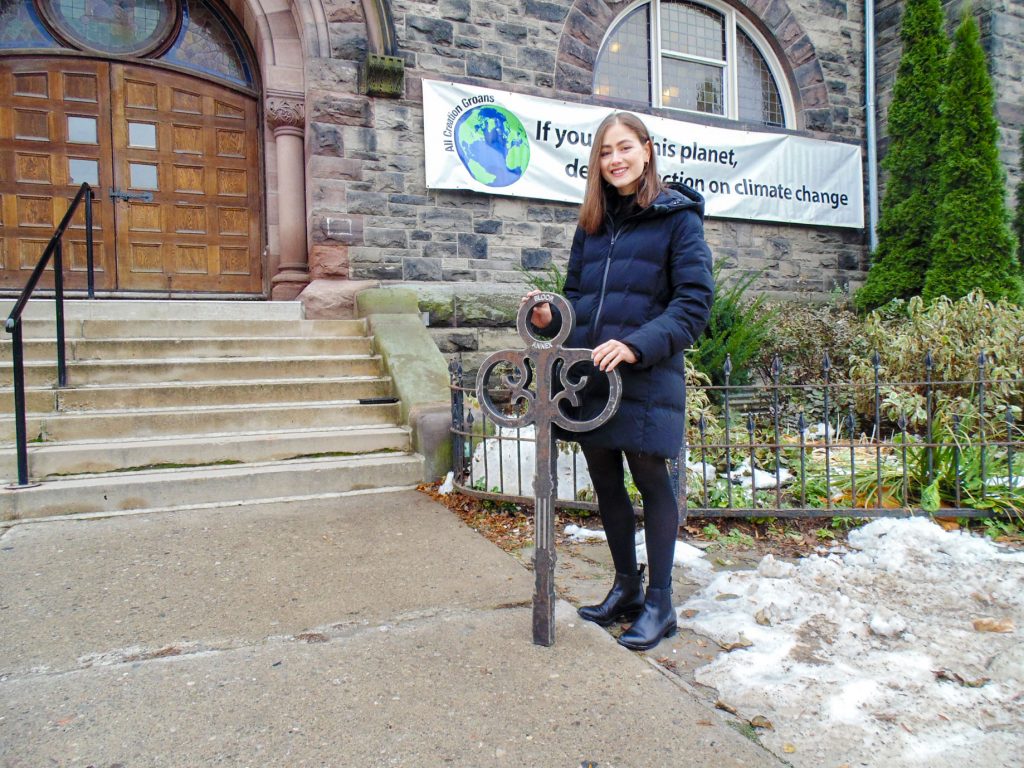
OCAD student Hadas Green with her lamp post bike ring in front of Trinity-St. Paul’s Church. KHYRSTEN MIERAS/GLEANER NEWS
Green designed a more traditional bike rack that is based on a lamp post and made of corten steel. The design is reminiscent of Toronto’s historical culture and was inspired by the city’s historical lighting standards and the Annex in the 1900s. It will be installed at Trinity St. Paul’s United Church to complement the building’s historic architecture.
“With my bike ring, it was really important to me that it captures the whole character of the area,” said Green. “The fact that it’s a bike rack and it’s kind of two dimensional and rustic…captures both the modern aesthetic and then also the history.”
A small jury of stakeholders including BIA, the revitalization committee, and DTAH judged the designs on their security, installation, and aesthetic appeal.
Brian Burchell, chair of the Bloor Annex BIA (and publisher of this newspaper), has led the Bloor Street Revitalization Project and says that the bike rings will bring economic benefits to the neighbourhood by giving cyclists a place to lock their bikes so they can stop and shop.
“It was pure luck that we learned that there [was] a class of students at OCAD that wanted to participate in a competition to make bike rings that are suitable to our specific environment and our vision of the Annex,” said Burchell. “We were just so fortunate to have all those young, creative minds come up with ideas in that competition and we’re grateful for all those who made the effort to submit a design, and we’re especially grateful to the winning designers.”
The OCAD student-designed racks will be located in the new parkettes and on some side streets, while the city-standard “post and ring” designs will continue to occupy Bloor Street sidewalks.
December 9th, 2019 · Comments Off on NEWS: New mural for Major (Dec. 2019)
Parkette location chosen to celebrate Bloor’s rich offerings
Initial concept of mural design by Daniela Rocha for the Major Street parkette (rear, east-face of Sleep Country location) pending for May of 2020. COURTESY DANIELA ROCHA
By Khyrsten Mieras
The Bloor Annex BIA is expanding its Bloor Street Revitalization Project with the addition of a new mural to showcase the neighbourhood’s rich offering of culture and diversity.
In August, the BIA sent a request looking for mural proposals from local artists to design and paint a mural on the façade at 459 Bloor St. W. in the Major Street parkette. They chose Daniela Rocha, an OCAD graduate and muralist who lives in the Annex, to undertake the project.
“The Annex is one of the most popular neighbourhoods in the city, so to me it’s a really great honour to paint it,” said Rocha. “I just feel very excited about it because it’s going to be a very cool mural and I think it’s very different from what the murals are here in the city.”
Rocha’s mural captures many of the distinct landmarks and characteristics in the Bloor Annex community. Her design includes Trinity St. Paul’s United Church, bike lanes on Bloor, a totem pole for the Native Canadian Centre, Lee’s Palace, and a camera to represent Hot Docs Cinema. It also combines images of flying books from BMV, artists’ materials from Midoco, tools from Wiener’s Home Hardware, drinks from local bars, cuisine from the area, neighbourhood animals, and plants and trees to portray the nature of the Annex.
“I was inspired by the Annex in general, mostly the stores or just the restaurants that have been there for a long time,” said Rocha. “I’m originally from Colombia and came to Toronto back in 2007 and the Annex has been the neighbourhood that I’ve always been to, so I wanted to just portray the things that I’ve seen since then.”
Artists needed their ideas to meet four criteria in order to be considered for the project: they needed to take inspiration from cultural establishments, entertainment venues, and art in Bloor Annex; they needed to incorporate the community’s future, contain colourful and positive imagery, and not be overly intricate or simplistic.
Rocha’s piece highlighted all of these aspects with an emphasis on colour.
“I wanted to have a very colourful piece because for me colour is really important. I think that, especially right now during winter, everything becomes really grey and there’s not much sun, so my work is very distinctive because of the colour.”
Twenty-one local artists submitted their designs for the competition. The jury, made up of representatives from the BIA’s board and business members as well as cultural centres in the neighbourhood, chose the winning mural by rating each submission and narrowing them down to five. The group reviewed those five together before coming to a final decision.
Ellie Hayden, the previous project administrator for the Bloor Annex Revitalization project, helped to organize the contest and submissions.
“I’ve orchestrated mural projects for other BIAs and this was by far the biggest response I’ve seen,” Hayden wrote in an email to the Gleaner. “What was even cooler was how many of the artists had connections to the Annex neighbourhood. I think it speaks to the creative nature of this community and how invested people are in making it a welcoming place.”
The mural is expected to be completed next spring with the help of funding from the City of Toronto that was extended until the end of May 2020.
December 9th, 2019 · Comments Off on NEWS: ARA climate plan hits home (Dec. 2019)
TransformTO consultation held to discuss city’s climate plan
Teri Chu of the ARA has launched Plate Share, a free dining-ware program for local parties. KHYRSTEN MIERAS/GLEANER NEWS
By Khyrsten Mieras
The City of Toronto and the Annex Residents’ Association’s (ARA) Parks, Trees and Environment Committee held the latest TransformTO community consultation at the Bata Shoe Museum on November 4.
Along with local communities, the city is holding several public conversations this fall to discuss what actions need to be taken to address climate change and reduce greenhouse gas emissions in Toronto. The Annex consultation gave its residents the opportunity to share their ideas for environmental strategies and ways to make the city greener.
The event was presented by Terri Chu, the chair of the Parks Committee, and Sarah Rodrigues, a senior environmental planner from the city’s Environment and Energy division. It was followed by a conversation with community members to discuss TransformTO, what they like and dislike about it, and suggestions to improve it.
Adopted in 2017, TransformTO is the city’s climate action strategy. The plan sets out long-term, low-carbon goals to reduce greenhouse gas emissions to net zero by 2050 while still benefiting the quality of life for residents. Currently, the city is preparing a TransformTO implementation plan for steps it should take by 2023 to further reduce its emissions.
“The City of Toronto has already faced the impacts of climate change through extreme weather,” said Rodrigues. “So, it’s an important conversation to understand how we can reduce the greenhouse gas emissions that cause climate change but also realize how we can include co-benefits: how we can advance social equity, improve health, [and] support the creation of local jobs while we reduce emissions.”
The ARA’s Parks, Trees and Environment Committee, formerly the Parks, Trees Committee, was recently renamed to highlight its new focus on the environment.
The volunteer committee is involved in several environmental programs that benefit the Annex community. One of its main projects is a tree replacement effort, which will introduce a subsidized tree replacement program in 2020. It has also launched Plate Share, a free dining-ware lending program for parties that reduces single use plastics in the community.
“We try to reduce the GHG emissions on a local level and we do what we can within the community to try to tackle other challenges like flood resiliency, air pollution, and so on,” said Chu.
Community members in attendance at the Annex consultation meeting voiced their concerns about the city’s lack of environmental action and seeming lack of urgency to move forward. With the city’s declaration of a climate emergency in October 2019, members agreed that Toronto needs to do more to prevent irreparable damage in the future.
“I think the city has a long way to go. I would really like to know what’s implementable now versus what the dreams are and what people will accept,” said Chu. “It’s ambitious in some ways but not enough in others and the bottom line is we really need to get people on board and be willing to adapt their lifestyles. Pretending that we can do it with substitutions is not going to cut it.”
Community members offered many suggestions to help the city improve its environmental framework for transportation: lower or free transit costs, higher parking costs, improved sidewalks, a specific plan to reduce cars, and prioritizing pedestrians, bikers, and public transit ahead of roads.
For other areas of the environment, members called for stronger grass roots education, especially in schools and through city-wide advertisements. They also recommended carbon tax rationing at individual and community levels, mandatory environmental standards, stronger leadership from Mayor John Tory, and a war cabinet to enforce quick action. These climate conversations will continue at more community consultations taking part across the city in November to shape TransformTO with the help of local residents. The final TransformTO implementation plan for 2021 to 2023 will be presented to council early next year.
December 9th, 2019 · Comments Off on EDITORIAL: Ford “proud” of cancelling green energy contracts (Dec. 2019)
Ontario’s Progressive Conservative government is cancelling 758 renewable energy contracts, including a newly constructed wind farm in Prince Edward County, a move that will cost the Ontario taxpayer at least $231 million. The PCs are not only hard pressed to justify the move from a fiscal perspective, but it also makes no sense from a political vantage point when the electorate is increasingly concerned about climate change.
The revelation of the cost of ripping up green energy contracts came as the official opposition NDP Ontario Energy Critic, Peter Tabuns, noticed a strange line item in the recently released public accounts for the Ministry of Energy – a $231 million expense for “other transactions”. The NDP got disclosure on this from the Legislative Library, not the government who was not forthcoming to his requests for information. If Ford is so “proud” of the move, it’s surprising his government sought to hide it. One explanation for this is that the expense flies in the face of the Ford government’s claim that ripping up green energy contracts wouldn’t cost Ontario families a dime.
What’s worse from a pure dollars and cents analysis is that only 215 of the 750 projects have so far applied for relief from the government for the contracts’ cancellation. This is eerily similar to how the former Liberal government estimated the cost of cancelling a gas plant contract. First they said it would cost $230 million and then the auditor found it cost more than $1 billion at the end of the day. Breaking your promises made in contracts is not cheap. It also signals it’s not safe to do business with Ontario as the province on a political whim will tear up contracts unilaterally and without due process.
Paying companies to tear down green energy infrastructure is bad policy and bad optics almost anywhere unless you like wasting tax dollars and don’t believe in climate change. To help explain their move, Ontario’s Minister of Energy Greg Rickford enters from stage right. In the legislature on November 25, Rickford, in response to questions about scrapping the projects, quotes one of his “favourite periodicals” Climate Change Dispatch to justify the government’s actions. The website says its mission is to “deconstruct” climate change theory propagated by former U.S. Vice-President and Nobel Prize winner Al Gore and asks for donations to help “fight garbage science”.
A day later, Rickford tried to distance himself from his comments: “I believe in climate change and I believe in literature that supports a balanced article that points out both sides of the same coin.” Rickford did not provide an answer to reporters questions when asked whether he agrees that human activity is contributing to climate change. His comments came on the same day the UN released its annual Emissions Gap Report. The 168-page document compiled by 57 leading scientists from 33 institutions across 25 countries to act immediately, within next decade, to limit global warming to 1.5 degree C or 2 degree C by 2100. “By now, we know all we need to know. The science is pretty clear, and very frightening” said one of the contributing authors. “But we also know we have the technological options that are needed.”
Clearly Premier Ford and Minister Rickford are not subscribing to the United Nations’ news feed, and are instead in a lock-step battle with a long-gone political foe. Green Party Leader Mike Schreiner described Rickford’s choice of briefing material as “incredibly reckless”. Interim Liberal Leader John Fraser said, “If we have a minister of energy who doesn’t believe that humans are responsible for climate change, that’s a pretty serious problem.” We can’t agree more, but it goes a long way to explain how the government finds itself ripping windmills out of the ground and spending millions of tax dollars for the political pleasure of doing so.
December 9th, 2019 · Comments Off on FORUM: Ford plows ahead with cuts (Dec. 2019)
Back at Queen’s Park, Ford resumes his agenda
By Jessica Bell
After ordering the longest break in almost 25 years, Doug Ford finally let Queen’s Park get back to business last month. While the government signalled they would take a more tempered approach, the legislation the government has introduced shows the premier is continuing his destructive path.
Doug Ford has frozen public sector wages to below the rate of inflation for the next three years. There are many public sector workers who struggle on less than $40,000 a year, including sessionals at the University of Toronto, childcare workers at our day care centres, and personal care workers at our hospitals and long-term care homes. This move hurts them.
Ford’s cuts to classrooms continue. His government is pushing forward with its plan to eliminate 10,000 teaching positions and increase class sizes. His cuts are pushing educators and school boards to a breaking point. Last week, the Toronto District School Board (TDSB) announced they are cutting the Kindergarten Intervention Program – a special program that provides additional support to young children with special needs who may have been violent or aggressive in class. These children will no longer have access to a small learning environment, and will be placed back in classrooms with up to 30 other children.
Despite his promises to build more transit, Ford has cut $18.5 billion from the Ontario Government’s five-year capital plan for transit, which will mean his transit projects will see construction delays. He has also cut the subsidy to transit agency, Metrolinx, by 36%. Over the past few months, GO bus service has been cut, and we expect to see the elimination of the $1.50 discount GO riders receive when they board the TTC.
The Conservatives’ Fall Economic Statement announced even further cuts, including $25 million from Environment, Conservation, and Parks, and $330 million from Justice – particularly Legal Aid.
The government also introduced the Plan to Build Ontario Together Act – an omnibus bill that includes amendments to the Planning Act that will make it harder for municipalities to levy community benefits charges on big developers. These charges are critical to ensuring developers pay for the services, community centres, daycares, and infrastructure to cater to the influx of people moving into our neighbourhoods.
Ford claims all these cuts are necessary in order to balance the books. Yet he has no problem throwing away Ontarians’ money when it comes to cancelling programs that his supporters don’t like. Just last week, the NDP discovered that Ford had spent at least $231 million of taxpayer money to cancel renewable energy projects – and then tried to bury the cut in public accounts. One of these projects is the White Pines Wind turbine project, which just happens to be located in Minister Todd Smith’s riding in Prince Edward County.
This feels a lot like a repeat of the last government’s gas plant scandal. It also shows just how far Ford will go to tear up plans he doesn’t like, regardless of the cost.
But what’s maybe most concerning is that Ford is refusing to play by the rules. We recently found out that he’s trying to change the standing orders – which govern procedures in the legislature, and how bills become laws – in order to push through legislation more quickly. This means scrapping consultation requirements and opportunities for community members to provide feedback on new laws. Basically, he’s trying to get away with passing legislation without any public input. For a man who claims to be “for the people”, he doesn’t want to hear anything we have to say.
Jessica Bell is the Member of Provincial Parliament for University-Rosedale.
December 9th, 2019 · Comments Off on FORUM: Affordable housing is a growing crisis (Dec. 2019)
Inclusionary Zoning is the answer for responsible development in Toronto
By Mike Layton
Development in Toronto is continuing to boom. However, we are not building affordable housing at the same pace as we are luxury condominiums. Our waiting lists for affordable housing continue to grow and we are now above 100,000 names on the active waiting list. Last year we only managed to house people in 522 units, while 6,181 names were added to the list.
This is further evidence in a long list of income disparity measures in our city, along with the fact that our shelters remain at capacity every night. This is also a problem that can start to be fixed if the city is willing to spend proactively on deeply affordable housing in their capital budget. The city is and has been booming for over a decade, and council and the province missed an excellent opportunity to create units at very little cost, while taking advantage of the hot condominium market.
Inclusionary Zoning (IZ) is one easy way to ensure responsible development and ensure that affordable housing is built in a way that creates communities with diverse socio-economic levels so future Toronto neighbourhoods can be places that anyone can call home. It is a land-use tool that allows the city to create a requirement that a percentage of units within a new development building is affordable housing. Right now, it is incumbent on councillors and City Planning to negotiate this request with the developer, but there is no requirement that they do so. With new generations of Torontonians increasingly viewing living in Toronto as “out of reach”, this is an important issue to me, and has been throughout my years on council.
I first began advocating for IZ at City Council in May 2015. I brought forward a motion that requested a report from City Planning on a strategy for implementation; a request to the province to make reforms to the Planning Act that would include permissions for municipalities to enact Inclusionary Zoning, and for the province to include affordable housing as part of the review of the Growth Plan and Greenbelt Plan. I appeared in Queen’s Park to speak with the media and to discuss the importance of giving the city the power to implement this, and speak with my provincial counterparts as to its feasibility. It felt like we had momentum and were on the cusp of doing something great for the future of Toronto.
Since then, we had a provincial government under Doug Ford that made changes to the Planning Act through Bill 108. These changes limit where municipalities can implement IZ to only Protected Major Transit Station Areas. This is something that we need to push back on as a city. If we leave it up to the provincial government and developers, we will never build the affordable housing we need.
An update on IZ is coming to council this month. You can count on me to keep up the pressure on this. The longer we wait, the more opportunities we miss. If 10 per cent of new units were subject to IZ over the last 5 years that would have provided upwards of 23,000 affordable units. The city and province must be serious about the affordable housing and homelessness crisis, and IZ is a crucial step forward in empowering the City of Toronto to create a steady and growing supply of affordable rentals and homeownership units.
Mike Layton is city councillor for Ward 11 University-Rosedale.
December 9th, 2019 · Comments Off on ARTS: Corridor calendar chock full (Dec. 2019)
Chrismukkah, mystery, music, and more along the Arts Corridor
By Meribeth Deen
Hop off the Bloor line anywhere between Bathurst and Bay streets to enjoy any number of the unique adventures offered in the city’s most diverse arts and culture district.
This month, the Bloor Street Arts Corridor will bring festive cheer and more to the table this December, so be sure to get out and enjoy some of it.
Here are a few artistic experiences you can enjoy in the coming weeks:
Celebrate the dark nights at the Miles Nadal JCC. On December 12, dance yourself warm at The Night Is Cold But the Music’s Hot daytime concert and dance in celebration of Chanukah with Alex Pangman and her Alleycats. On December 20, pop in for a celebration Chrismukkah, including Chinese food.
Sink into LOVE with three films screening at the Revue Cinema as part of the Japan Foundation’s Aijo Film Series: Modern Love in Japan. On December 7, The Tokyo Night Sky is Always the Densest Shade of Blue, a poetic story of romance between to psychological misfits. Also on December 7, Three Stories of Love, a story of three suffering people who begin to see the preciousness of life, and on December 8, Her Love Boils Like Bathwater, the story of a mother’s fierce and protective love in the face of bankruptcy and terminal cancer.
Get outside, way outside, through the annual Wildlife Photographer of the Year exhibit at the Royal Ontario Museum. Among the 100 vivid and evocative images on display, you’ll see the winning photo, by Yongqing Bao, of a remarkable encounter between a Tibetan fox and a Himalayan marmot.
Get wrapped up in the stranger-than-fiction story of Ambrose Small, with Katie Daubs, author of “The Missing Millionaire” at the Toronto Reference Library on December 10. Daubs will be discussing her own investigation into the sensational disappearance of Small, owner of Toronto’s Grand Opera House. In 1919, he deposited a one million dollar cheque into his bank account and was never seen again. The search for him lasted years, crossed the country, but ended in a cold case.
Get Christmassy with Tafelmusik Baroque Orchestra and Chamber Choir. Between December 4 and 8, the orchestra will be celebrating Christmas with the traditions and songs of southern Italy in mind. Bagpipes called Zampogna, typically played by shepherds, will be a special feature. Then between December 17 and 20, enjoy the annual and treasured performances of the Messiah.
Comments Off on ARTS: Corridor calendar chock full (Dec. 2019)Tags:Annex · Arts
December 9th, 2019 · Comments Off on GREENINGS: Moral cowardice fuels our failures (Dec. 2019)
Silence on Hong Kong and climate crisis has parallels
On November 11, Canadian leaders extolled the virtues of soldiers who lost their lives defending the ideals of democracy. On that day, we might have told the story of the nearly 2,000 Canadian soldiers who fought to defend Hong Kong against Japanese invasion in 1941. Five hundred of those soldiers did not come back, and many others returned deeply scarred after living as prisoners of war.
Hearing this story, we might wonder why our leaders seem so willing to stand by quietly as pro-democracy protestors in Hong Kong are being crushed by the Chinese government. The answer, I believe, is the same reason our global future is in jeopardy.
It has been almost five months since the government of Canada issued a joint statement with the European Union condemning violence in Hong Kong. Day by day, the police, acting on behalf of the Chinese government, show their willingness to escalate that violence with the use of tear gas, pepper spray, and live bullets against pro-democracy protestors.
A Canadian caught in the mayhem in the city’s Polytechnic University, which is under siege by the police, reached out to the Canadian consulate for help. This young Canadian and others have found the consulate to be largely unresponsive.
Even for an ideal as foundational to our society as democracy, we are loathe to offend China and take a single risk to the economic growth of this nation. Perhaps instead of telling children that soldiers died for our freedom and democracy, we should tell them that they died for the economic growth of the one per cent. It seems, that’s all that matters.
If our leaders won’t risk to the economy for something as fundamental to our society as democracy, as these brave young people are doing, can we really expect them to suppress economic growth in the name of environmental sustainability?
Few economists believe that infinite growth and environmental protection is possible anymore. Stopping ourselves from running over the cliff of extinction will require a massive hit to, and the re-shaping of, our economy. There’s absolutely no sugar-coating it. Our leaders won’t do it though. We see their moral cowardice in the face of Hong Kong. They will shut up and let innocent lives be lost to protect their economic interests. The environmental movement should expect nothing but the same.
Terri Chu is an engineer committed to practical environmentalism. This column is dedicated to helping the community reduce energy use, and help distinguish environmental truths from myths. Send questions, comments, and ideas for future columns to Terri at terri.chu@whyshouldicare.ca.