A rendering by the Gleaner of the scale of the project superimposed on the corner of Bloor St. W. and Spadina Rd. GRAPHIC BY NEILAND BRISSENDEN
By Khyrsten Mieras
Connectivity, diversity, and adaptability, these are the buzz words promoters are using to describe a proposed redevelopment of the northwest corner of Bloor and Spadina. Members of the development team presented the project’s updated design during a community meeting at Trinity St. Paul’s United Church in December 2019.
The developers began preliminary consultations in November 2018. Owners of 334 Bloor St. W. and 344 Bloor St. W. and adjoining parking lot (to the east face of Shopper’s Drug Mart) have partnered on this project and billed it as a unified 350 Bloor St. W.
A recent meeting held by the design team and developers included two existing property owners and architects from IBI Group. They informed stakeholders of updates to the plan in advance of submitting an application to the city for approval. Key topics on the agenda included the planning framework, summary of previous meetings, and proposal for floor plans and landscapes.
Peter Venetas independently represents the developers and their process for community engagement, design, and approvals. He said that the redevelopment “offers a really amazing opportunity to provide both new housing, replacement rental housing, expanded offices, and then an interconnection to the TTC, as well as a series of other benefits to the public realm.”
For connectivity, he says the project aims to join the building with the surrounding neighbourhood and make improvements to the public realm through landscaping and widened sidewalks. There will also be a connection to other sites through subway integration that allows access between the building, the Spadina subway station, and loading and parking areas.
Their plan for diversity and adaptability will be incorporated through various uses of the building for retail, office, condo, and rental units, as well as modes of transportation like biking, walking, and public transit. Crossroads will also play a role in the building’s design, as it will be located on the northwest corner of the intersection at Bloor Street West and Spadina Road next to the subway. There will also be outdoor spaces with trees at street level and terraces on upper levels.
Several community members who attended voiced their concerns on issues like environmental stewardship, affordable housing, parking, shadow studies, and height of the projected 36-storey building. Team members said they are still making adjustments to the proposal.
In a subsequent interview with the Gleaner, Councillor Mike Layton explained that maximum height for the development is based on the Knox College Corridor, which protects the view of Knox College from the south side of College Street at Spadina Avenue to the north side of Bloor Street West.
“That would essentially put the maximum height of the building around 110 metres, which if you translate that into storeys is probably in the low 30s,” said Layton. “But then there’s also other things to address: the shadow impacts on any park space in the northwest [and] the transition from the tall building to the neighbourhood designation further west. So there’s a lot of other things that may impact the height that we don’t know yet.”
“Around sustainability the city has our green building standards that this building would have to follow as well. But when you look at how our city’s growing…it’s difficult to argue that this wouldn’t be an appropriate place for development, it’s just how is this development going to interact with the surrounding area,” Layton added.
Edward Leman, co-chair of Planning and Zoning for the Annex Residents’ Association (ARA), said that the project developer approached the ARA in the summer of 2018 to collaborate. Along with the Harbord Village Residents’ Association (HVRA), they set up a working group and held meetings to discuss plans and address concerns for the development.
“I think the really important thing is the shadow studies and the underground parking. They haven’t decided how much and that has a big impact on Bloor, the shops on Bloor, and so on,” said Leman. “So, we don’t know the two very important bits of information still missing.”
Venetas noted that it is difficult to speculate the timing for the completion of the project, as the application has not yet been submitted. He said that the approval process will likely take two to three years and the construction start date will depend on the market.
The developer’s representative declined repeated requests to share an image of their proposed development for this story.
Emerging from the dust will be much greater density
The Annex is by no means exempt from the building boom that sees the City of Toronto with more cranes in the sky than any other North American municipality.
The Gleaner is distributed to homes from College Street in the south, Dupont to the north, Avenue Road to the east and Christie Street to the west, and includes thirteen development sites all within our catchment.
These developments are at various stages along the stream from pie-inthe- sky to near completion. Many have shovels in the ground. What’s clear is that there is no consensus within the development industry whether it is wise to consult with the local community ahead of an application or skip the talking and get right to it by aiming high and planing to fight it out to try and get as much density as possible.
Notably, Westbank, the Honest Ed’s redevelopment of Mirvish Village, took the pre-application community consultation to a whole new level creating a win-win situation for developer and local stake-holders alike.
There is a mix of condominium, rental, and institution uses planned. In the next two to five years the population of the Annex will increase considerably.
See the image below for more on what to expect. Click on the image to enlarge.
January 31st, 2020 · Comments Off on NEWS: Aroma suddenly shuttered (Jan. 2020)
Closure leaves customers shocked
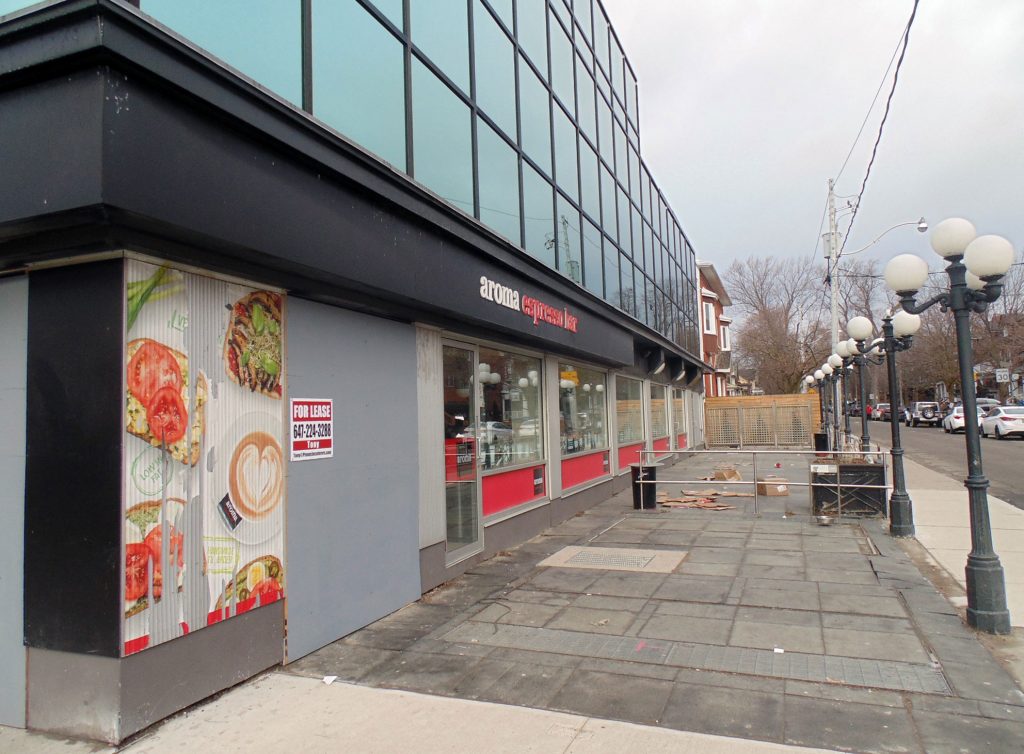
Locally loved, this Aroma Espresso Bar location (the first in Canada) was locked out by the landlord, unable to meet its rent obligations. Brian Burchell/Gleaner News
By Brian Burchell
A bailiff, acting for the landlord, has changed the locks at Aroma Espresso Bar (500A Bloor St. W.) having posted a notice stating rent in arrears of $24,538.70. The landlord is Harbour Sixty Steakhouse Inc., and the first Aroma Cafe location in Canada was beloved by many members of the Annex community.
“A franchisee buys a dream, which like any dream has a bit of a nightmare all wrapped up in it. You have to hit the ground running and eventually you run out of breath…”
—Philip Kuntz, longtime loyal customer
Philip Kuntz claims he was the first customer of this Aroma location.
“Aroma Canada came to have its own direction after a number of years trying to fulfill the original vision of the founder, who is based in Tel Aviv, Israel,” says Kuntz. “Aroma Canada sought to source local foods instead of having everything flown in as per franchise rules as it would be more economical given the high rent at the place. [The location], except perhaps for the first year, never made any money.”
For Kuntz, the story of Aroma Canada illustrates how difficult it is for many franchisees to cope with high rents and a highly competitive marketplace for food and drink while concurrently trying to toe the strict corporate line dictated by their agreements with head office.
He says the first operator of the cafe was so popular that people would stand in line just to be ignored by him.
“A franchisee buys a dream, which like any dream has a bit of a nightmare all wrapped up in it. You have to hit the ground running and eventually you run out of breath. I have lived through at least six administrations which never made money and eventually would pass it on, selling the dream. It was an unsustainable trajectory where the incoming management did not do its due diligence.”
Compounding the problems, he says, were strict rules from Tel Aviv requiring food to be imported. Kuntz says those rules began to be strictly enforced about a year ago, a point which he describes as “the beginning of the end”.
The last operator, Levi Tobe, confirmed to the Gleaner Kuntz’s background information for the reason for closing.
Tobe regarded the corporate requirement to import food from Tel Aviv as “untenable, and as things inside Aroma were changing [those rules being enforced], things did not work out.”
There are unconfirmed reports the location may become a wine bar venue.
The Tel Aviv headquarters for Aroma did not respond to a request for an interview for this story. The landlord, Harbour Sixty Steakhouse Inc., also did not reply to a request for an interview.
Comments Off on NEWS: Aroma suddenly shuttered (Jan. 2020)Tags:Annex · News
January 31st, 2020 · Comments Off on FORUM: University-Rosedale has a housing affordability crisis (Jan. 2020)
Ford forgets “affordable” in his housing plans
By Jessica Bell
Leonard is 72, lives at 103 Avenue Rd., and is the latest victim of Toronto’s affordable housing crisis. Here’s Leonard’s problem: he lives on $1,600 a month from his pension, and $1,500 of that is spent on rent. He has $100 a month to spend on everything else. For food, Leonard has protein shakes and one small meal a day.
Leonard’s corporate landlord wants to increase his rent by nine per cent, well above the legal limit. Leonard is terrified that if the increase is approved by the Landlord Tenant Board he will be homeless.
Eighty-six-year-old Roland is facing a similar crisis. Roland lives alone in a one-bedroom apartment on Walmer Road, his home for nearly 50 years. Roland just received an eviction notice, which says that he has to move out so the building can be renovated. The property manager says all tenants have to be out, even though none of the permits for the renovations have been filed. Roland doesn’t know where he’s going to go.
Leonard and Roland’s experience is common. Big business and global capital have set their sights on Toronto’s booming rental housing market, and our neighbours are the target. Corporate landlords are taking advantage of legal loopholes by pushing through above-the-guideline rent increases, and renovating apartments in order to evict long-term tenants and replace them with new renters who pay exorbitant market rents.
Toronto is the most expensive place for renters in Canada, and it’s getting worse. A report by Rentals.ca estimates rent will increase by 7% in 2020, reaching $2,800 a month. The Canadian Centre for Policy Alternatives calculates a person needs to earn $33 an hour to afford to live in Toronto. The majority of Torontonians earn far less than that. To survive, many residents are working longer hours, taking on debt, living in overcrowded apartments, moving out of the city, or falling into homelessness.
The Ford government says the housing crisis can be solved by building more homes, but the real solution is to create more affordable homes. Here are four policies we can implement right now to achieve this goal:
1. The Ontario Government and its agency, the Local Planning Appeals Tribunal, should stop stymieing the City of Toronto’s plan to restrict short-term rentals to a person’s primary residence. In today’s unregulated short-term rental market many investors are buying homes, kicking out tenants, and listing the property on AirBnB. In its review of AirBnB listings, advocacy group, Fairbnb, calculated that Toronto’s new law could return 5,000 homes to the long-term rental market.
2. The Ontario government should introduce sensible inclusionary zoning rules that require new large developments to make an agreed-upon percentage of units affordable, and an agreed-upon percentage of units to be two and three bedroom. Toronto has more cranes in the sky than any other city in North America, but the homes being built are too small and too expensive to meet our city’s needs.
3. Ontario should look to the BC government’s work to tame global capital with a vacant homes tax. Statistics Canada estimates Toronto has 65,000 vacant homes — and 9,000 homeless. A tax would encourage absentee owners to rent out these homes and also raise revenue for new housing.
4. Ontario should provide better protection for renters against illegal evictions. Duty council should be available at the Landlord Tenant Board to level the playing field. Currently, only 2% of tenants attending an LTB hearing have legal representation, yet 79.5% of landlords do. The Ontario government should also enforce its own rules by finding and fining landlords who illegally evict a tenant by falsely claiming they are renovating or moving a family member in, only to relist the property for a higher price.
Toronto should be a fair, vibrant, welcoming, and thriving city for all. Our elders, including Roland and Leonard, as well as our entertainers, nannies, caregivers, cleaners, teaching assistants, bus drivers, and paramedics deserve to live a good life here. This is our city too and we are going to fight to stay.
Contact our office at jbell-co@ndp.on.ca to get updates on our work to make housing affordable.
January 31st, 2020 · Comments Off on CHATTER: Homicide on Harbord (Jan. 2020)
On December 22, police responded to a call from a residence in Harbord Village, where they found a woman suffering from severe head trauma. They immediately arrested a 29-year-old man named Colin Harnack, who was charged with second-degree murder. The woman, 51-year-old Julie Berman, was rushed to hospital. She succumbed to her injuries a short time later.
Berman, 51, was a trans woman who actively fought for LGBTQ2S+ rights for 30 years.
The accused made his first court appearance on December 23, but has yet to enter a plea. His next court appearance will be on January 15. He is believed to have been remanded into custody.
In late December, friends gathered to remember Berman and spoke about her work on behalf of the transgender community, who suffer disproportionally from violence, hate crimes, suicide, and murder.
—Patricia Mamede, Gleaner News
Comments Off on CHATTER: Homicide on Harbord (Jan. 2020)Tags:Annex · News
January 31st, 2020 · Comments Off on CHATTER: Police seek help in identifying robbery suspect (Jan. 2020)
Image of suspect still at large. Courtesy Toronto Police Service
The Toronto Police Service has released new images of a man involved in a robbery that took place in the Annex area last month and is seeking help from the public to identify him.
According to police, the incident occurred on October 14 at around 5:30 p.m., when an 87-year-old woman was walking on Brunswick Avenue, south of Bloor West. The woman was attacked by a man from behind. He threw her to the ground and robbed her of her belongings. He then fled the area on foot, heading east through an alleyway.
Police previously released images of the suspect, however newly released security camera images and photos show the man’s face more clearly. He is described as about six feet tall with a thin build. At the time of the robbery, he was carrying a white bag and wearing a dark toque, two-toned sweater, dark pants, and dark shoes.
Anyone with information is asked to call police at 416-808-1400 or Crime Stoppers anonymously at 416-222-8477.
—Khyrsten Mieras/Gleaner News
Comments Off on CHATTER: Police seek help in identifying robbery suspect (Jan. 2020)Tags:Annex · News
January 31st, 2020 · Comments Off on CHATTER: College Street bar owner and manager convicted of sexual assault (Jan. 2020)
The owner and the manager of a now-closed bar on College Street have been convicted of gang sexual assault and administering a stupefying drug to a 24-year-old woman in 2016. The bar where the incident took place was closed shortly after charges were laid.
According to the victim’s recollection of the assault, she asked for two drinks and subsequently started to feel disoriented. At a later point, she accepted a shot of whiskey, another drink, and two lines of cocaine before blacking out. The victim’s name is not being released, due to a publication ban.
Nine hours of video footage from the bar’s security camera show the two men snorting cocaine, drinking, and taking part in multiple sex acts with a woman in various locations throughout the bar. This footage, a key piece of evidence during the trial of this case, shows the woman tripping and struggling to stand up.
Both the bar owner, Gavin MacMillan (age 44), and the manager, Enzo De Jesus Carrasco (age 34), pleaded not guilty to all charges and claim that the sex was entirely consensual.
MacMillan received bail but remains under strict house arrest. Carrasco’s bail was revoked, but he maintains his innocence and his lawyer says they are considering an appeal. Carrasco remains in custody awaiting two other sexual assault trials involving three other women.
A sentencing hearing for the men has been set for the end of January 2020.
—Patricia Mamede, Gleaner News
Comments Off on CHATTER: College Street bar owner and manager convicted of sexual assault (Jan. 2020)Tags:Annex · News
January 31st, 2020 · Comments Off on EDITORIAL: Bat crazy (Jan. 2020)
The government that decimated the Endangered Species Act is now in the business of protecting bats. At least that’s what Ontario’s Minister of Environment, Jeff Yurek, claimed when he revoked the approval of the Nation Rise wind farm project on December 4. As costs pile up, so do the false premises that come with the Ford regime’s attack on green energy.
Let’s begin with the bats.
Minister Yurek is concerned that the blades of the 29 planned turbines at Nation Rise (16 of which were already partially built by early December) would be detrimental to nearby hoary bats and endangered little brown bats. EDP Renewables, the company behind the project, says the permitting provisions for bats went beyond industry standards and provincial requirements, including the monitoring of bird and bat deaths and additional measures if the kill rate exceeded 10 bats per turbine annually.
Meanwhile, recent changes to Ontario’s Endangered Species Act will allow developers and municipalities to pay a fee rather than take precautions to protect species at risk. These changes, which flow from the omnibus Bill 108, also give more power for the government to override ecological concerns and “temporarily suspend” protections for habitats and any of the 243 species in Ontario that are currently considered at risk. Green leader Mike Schreiner called it a “pay to slay” provision which “green lights the destruction of species and their habitat. The act is worthless if deep-pocketed companies can just pay to ignore it.”
Ian Arthur, the NDP’s environment critic, said, “Considering that this is the government that gutted the Endangered Species Act very recently, I am incredibly skeptical that bats are truly the priority for this minister.”
The changes to the act also allow the province to suspend the protections to species at risk if they are not at risk elsewhere. The grey fox, now classified as threatened, and any other flora or fauna in similar circumstances, would see protections scrapped providing their population is common elsewhere in North America. The species is distinguished from the more common red fox because of its unique colouring, its bushy tail, and the fact it can climb trees. Though it is classified as “threatened” here in Ontario it is not in the United States, therefore its protection from habitat protection here will lapse.
“The health of species elsewhere should not give Ontario permission to exterminate them locally,” said Schreiner, who accused the Conservative government of breaking with previous Tory administrations of Bill Davis and Mike Harris which protected the Niagara Escarpment and Oak Ridges Moraine, respectively.
Now on to the business case for this, and other cancellations of green energy projects.
The NDP said the cancellation could cost Ontario at least $200 million, on top of the $231 million the government expects to pay for the demolition of another large wind farm in Prince Edward County. There is no “business case” for these cancellations and these rash actions only make a mockery of Ford’s claim that Ontario “is open for business”. Thomas Timmins, head of the energy sector group at the Toronto-based Gowling WLG law firm, said the fate of these wind farms has worried pension funds and other major investors in energy projects. “Anything that appears arbitrary coming from government makes them nervous,” he said.
These are not the actions of a conservative cause, this is reckless conduct which fails to respect the ecology, the economy, and the electorate. No one for a moment believes that Minister Yurek or Premier Ford give a hoot about the little brown bats or have even bothered to learn about them. This is all about tearing down what the last government did, no matter what the consequence.
January 31st, 2020 · Comments Off on FORUM: Build a more livable city, together (Jan. 2020)
Bike lanes, affordable housing, parkettes, and road safety
By Mike Layton
I want to begin by wishing everyone a happy 2020 and a wonderful start to the new year. I am renewed in my commitment to working closely with you all to build a more livable and equitable city, and I want to thank the many residents who have been volunteering their time to better our ward.
This year, I am resolved to expand on existing projects that directly affect our day to day lives. We need to continue working on the creation of deeply affordable housing, the Bloor bike lane expansion, strengthening our parks, preserving our ravines, and accelerating Transform TO with new actions and targets.
Pedestrian fatalities are preventable and I know there is so much more we can do to effect change.
Locally, 2020 will bring with it the completion of the construction plans for the Bloor Street Watermain Replacement, Road Re-Surfacing and Street Revitalization Project. With the Bloor bike lanes officially confirmed as a permanent part of the landscape, this stretch will serve as the basis for the upcoming expansion of the lanes to the east and west.
Alongside the completion of sidewalk reconstruction and the replacement of the 142-year-old water main, the parkettes have been a great example of the good that can come from strong community collaboration.
I want to thank the Bloor Annex BIA for their unique vision and dedication towards growing our city’s green spaces through the design of the area’s new parkettes: Howland Street Parkette, Brunswick Street Parkette, Major Street Parkette, and Robert Street Parkette
The revitalization has been an intensive community process, and not without its surprises — one of which has been the unearthing of a 1.5-billion-year-old boulder. The 2,000 kg boulder, which I was told travelled via iceberg to the Annex from Georgian Bay approximately 15,000 years ago, has now become an interesting and unexpected feature of the pollinator planting area at the Howland Street Parkette.
Another local change for 2020 will be moving forward with the Automated Speed Enforcement Camera installation under the Vision Zero plan. Vision Zero is always top of mind for me. I have worked to fast-track implementation of safety measures related to the plan, and believe strongly in lower speed limits. Pedestrian fatalities are preventable and I know there is so much more we can do to effect change.
The upcoming enforcement system uses a camera and a speed measurement device to detect and capture images of vehicles travelling in excess of the posted speed limit. The images will be reviewed by Provincial Offence Officers with tickets being issued to the owner of the vehicle, regardless of who was driving. Penalties will be fines with no demerit points issued. One of the first installation spots within Ward 11 will be locally on Huron Street between Bernard Avenue and Lowther Avenue. It was selected using a data-driven process, with spots around the city being rotated every 3 to 6 months.
As always, you can contact me with your questions or concerns at councillor_layton@toronto.ca or by calling 416-392-4009.
Mike Layton is city councillor, Ward 11 University-Rosedale.
January 31st, 2020 · Comments Off on GREENINGS: Emergency climate calls to city met with busy signal (Jan. 2020)
City is caught flat-footed as alarm bells ring
By Terri Chu
I was mildly optimistic when Toronto City Council officially declared a “Climate Emergency”, in October, 2019. How naïve I was to think that an “emergency” meant that something might actually happen. The situation appears to me as though teenagers are dialing 911 and screaming in terror into the phone while the operator on the other end says: Please hold, your call is important to us.
The Annex Residents’ Association hosted a TransformTO community consultation in November. While the city facilitator fielded questions about what policies residents would go for, the majority in the room just angrily pleaded: Just do anything. We’re tired of watching you do nothing. We don’t care. Do anything! We don’t need perfect policies, we just need the kind of action required in an emergency.
The car industry is that dead-beat uncle with a drinking problem that keeps asking us to subsidize its failing “business”.
Currently, 53% of Toronto’s capital budget is still getting blown on a single elevated road. Toronto transit is facing yet another fare hike. It’s like the city doesn’t understand basic supply and demand economics. It already costs a family of 2 adults and 2 teenagers over $20 to take transit for Saturday morning brunch. That same family can get in the car they already own, splurge maybe a $1 in gas (probably less), and drop $4 on parking. It doesn’t take a genius to figure out which mode of transport a family with the ability to do basic arithmetic will choose.
Are we actually in an emergency? We’re still holding on the line waiting for someone, anyone, to pick up the phone!
A hundred and fifteen thousand cars per day use the Gardiner Expressway. Nearly 15 times that number of people use the TTC yet the Transit Commission barely gets double the capital budget we are giving to a single road. Are we angry? Damn straight we are angry. We scream about not having enough money. The money is there. We’ve just chosen to spend it on the wrong things. Rather than buying milk and bread, we drop the monthly budget on three bottles of single malt scotch. Then we scream at the kids for eating too much.
The car industry is that dead-beat uncle with a drinking problem that keeps asking us to subsidize its failing “business”. The money we drop on the Gardiner is enough to give the city 50,000 km of bike lanes.
The car industry needs to shrink. No amount of catering public policy to drive their sales will change their long-term prospects. Break out of it. Get that uncle the help he needs rather than feed his addiction. The longer we drag it out, the more we all suffer.
The lack of moral courage of this city council is appalling. Even from the progressive wing, strong positions are hard to take because of the need for re-election. We are well past the time for term-limits. People who have been on council for the last 30 years should not still be sitting there making decisions like they were back when we won the World Series.
Rather than raising TTC fares, the city could have chosen to raise surface parking rates to bring an hour of parking in line with two or three people taking transit. The city could have chosen to raise the vehicle registration tax. The city could raise the cost of the large garbage bins, rather than the small ones. The city has the power to enact an infinite number of policies that actually start to address this very real climate change emergency.
The kids are waiting impatiently on the line, but the mayor won’t take the call. He’s punting to the next mayor because re-election is more important than a livable future for the next generation.
Terri Chu is an engineer committed to practical environmentalism. This column is dedicated to helping the community reduce energy use, and help distinguish environmental truths from myths. Send questions, comments, and ideas for future columns to Terri at terri.chu@whyshouldicare.ca.
January 31st, 2020 · Comments Off on LIFE: Unsung heroes of Uni-Rose feted (Jan. 2020)
MPP Bell hosts community appreciation celebration
Multi-generational activists Roy Bateman, Malina Fritz-Schwarts (on behalf of Allie Rougeot), Betty Robinson, and Zoe Keary-Matzner with MPP Jessica Bell. NICOLE STOFFMAN/GLEANER NEWS
By Nicole Stoffman
A ninety-seven-year-old named Betty Robinson and a thirteen-year-old named Zoe Keary-Matzner have more in common than you might think. Both are residents of the University-Rosedale riding, both are a little headstrong, and both have been recognized for the impact they are defiantly trying to make.
An annual Community Celebration at the Cecil Community Centre honoured Robinson, Keary-Matzner, and a host of other local activists for their work with a Middle Eastern-style buffet catered by the Free Times Café and a live jazz performance by Alex Seredenko. MPP Jessica Bell spoke about the issues each honoree is fighting for. Each one then joined Ms. Bell onstage to receive their certificate of recognition to sustained applause.
“It’s a very decent and community-minded thing to do to eat dinner together and recognize these people are unsung heroes,” said Bell. “The people we are recognizing tonight don’t get quoted in the Toronto Star. They are the people that make a difference in their own small and special way.”
Robinson is currently the only remaining tenant at Davenhill Senior Living. All other residents moved out after a numbered company purchased the building that housed the seniors’ home and began to remove care services such as nursing and meals. Still able to live independently, Mrs. Robinson has hired her own caregivers and is visited daily by her daughter, Dianne.
MPP Bell, who is now fighting on Robinson’s behalf, explains what’s at stake.
“Private retirement homes should not be able to force residents out without a formal eviction process by suddenly cutting off the vital services that these seniors rely upon and pay for,” she says.
If Robinson and Bell get their way, care services will be included in the Residential Tenancies Act.
The case also prompted Bell and her office to educate Davenhill residents about how eviction works in Ontario. A tenant can be evicted only if it is authorized by a hearing at the Landlord and Tenant Board. In the meantime, Davenhill has signed an ongoing tenancy agreement with Mrs. Robinson.
Zoe Keary-Matzner is one of seven applicants suing the Government of Ontario for weakening the province’s climate targets, claiming their Charter Rights to life, liberty, and security of the person are being violated.
“If we take action, it will set an example for other places around the world to take action as well,” explains Zoe.
Miss Keary-Matzner’s case is backed by Ecojustice in response to the Ford Government’s revised 2030 climate target under the Cap and Trade Cancellation Act, 2018.
The case aims to compel Ontario to set a Greenhouse Gas Emissions reduction target in line with what science says will limit global warming to 1.5C by mid-century. This could mean raising Ontario’s new GHG reduction target of 30% below 2005 levels by 2030 to 45% below 2010 levels by 2030, as the UN’s Intergovernmental Panel on Climate Change has suggested.
Ecojustice is not, however, asking for a specific percentage when it comes to a revised emissions target in Ontario.
Miss Keary-Matzner, along with Allie Rougeot and Roy Bateman, were recognized for their climate action leadership. These youth are among the very first to participate in the monthly Fridays for Future climate rallies at Queen’s Park, which have grown from hundreds to thousands in the space of a year. From the youngest to the most senior, our riding’s activists have shown tremendous courage. The Community Celebration was an opportunity to take a moment to honour the work that has been done. With five times more nominees than could be recognized, it surely won’t be the last.
Correction
An earlier version incorrectly identified Ms. Bell as MP Bell instead of MPP Bell. The Gleaner regrets the error.
Comments Off on LIFE: Unsung heroes of Uni-Rose feted (Jan. 2020)Tags:Annex · Life