February 27th, 2020 · Comments Off on LOCAL HEROES: MPP Bell honours pharmacare advocate (Feb. 2020)
Little Italy’s Nav Persaud makes the case for free meds
By Nicole Stoffman
This article is the first in a series about local residents making a difference in our community. These unsung heroes were brought to the Gleaner’s attention by MPP Jessica Bell, who honoured them at her Annual Community Celebration, in December of 2019.
Dr. Nav Persaud had a problem: his diabetes patients weren’t getting better because they couldn’t afford medication.
Little Italy resident Nav Persaud recognized for his advocacy for free medicine. COURTESY NAV PERSAUD
“Even though the rights for insulin were sold for a dollar by Banting and Best with the idea that everyone should have access to them, in Canada the type of job you have determines if you have access to medicines,” says Persaud, the Palmerston-Little Italy resident and outspoken advocate for National Pharmacare.
Dr. Persaud, who is a staff physician in the Department of Family and Community Medicine at St. Michael’s Hospital, started keeping a supply of medications on hand to give for free to patients with chronic illnesses. Still, the issue of inequitable drug coverage weighed on him and his team.
“Ultimately, we realized that there are millions of people in Canada facing this problem, and so we wanted to do something that could inform a public policy change that would help everyone.”
That something was the CLEAN Meds study. The 2016-17 study provided almost 800 people with free access to more than 125 medicines. Free access improved participants’ health in more ways than one. Not only were their illnesses better managed, but those receiving free medicine were 53% more likely to afford rent and food than those in the control group who did not.
The study was supported by the Canadian Institutes for Health Research, the Province of Ontario, the Canada Research Chairs program, and the St Michael’s Hospital Foundation.
Some study participants, as well as members of the community guidance panel who helped to design the study, were Annex residents. According to a 2016 Statistics Canada survey, 7.5 million Canadians lack or have inadequate drug coverage.
Canada is the only high-income country in the world with free Medicare but not free medicine. Instead, we have a mixed system of private and public insurance, while many pay for medicines out of pocket. The exception is Quebec, which provides prescription drug coverage to everyone in the province.
Advocates of maintaining the current system argue that most Canadians are covered in some form or another. Indeed, the majority of the CLEAN Meds participants had insurance but could not afford the co-payments or deductibles.
According to a 2016 UBC-led study, almost 1 million Canadians find themselves in a similar situation, and elect to spend less on food and heating costs in order to afford their medications.
Interestingly, not all CLEAN Meds participants were the working poor. Some had incomes of up to $70,000 yet lacked adequate drug coverage because they had larger households, or very expensive medication.
“It’s important for people to understand and recognize that every day, they are passing people in the street who can’t afford medicines, including lifesaving ones,” notes Dr. Persaud.
Much of the debate around National Pharmacare in Canada centres on cost. The Parliamentary Budget Officer calculated it would save 4.2 billion a year in spending on drugs, but the government’s Advisory Council reported it could cost taxpayers $15.3 billion. The Green Party estimated it would cost 26.7 billion.
Even these estimates represent a savings considering Canadians paid $28.5 billion on medications in 2015, making our drug spending per capita the third highest among industrialized countries, according to an OECD study.
Dr. Persaud, who is also a Canada Research Chair in Health Justice, prefers to focus on the kind of society we want to live in. Do we want our factory workers, taxi drivers, entrepreneurs, and artists to have access to life-saving treatment, if necessary?
“The reality is that saying to people that this is going to save billions of dollars isn’t very persuasive, and it’s not actually the most important issue,” he explains.
“We all live in this city and country together, and it’s very clear that Canadians support our publicly-funded health care system, and it’s very obvious that the publicly-funded healthcare system should include medicines.”
“Many times I’ve seen people come back with the same problems that don’t get any better,” adds Dr. Persaud. “Ultimately, you get a phone call that they are in the hospital. You start thinking that you wish there was something we could have done sooner.”
Comments Off on LOCAL HEROES: MPP Bell honours pharmacare advocate (Feb. 2020)Tags:Annex · News
February 27th, 2020 · Comments Off on CHATTER: Zero-waste grocery opens on Bathurst (Feb. 2020)
According to Statistics Canada, from 2002 to 2016 the total amount of waste collected in Canada increased by 11 per cent, the equivalent of 3.5 million tonnes. Low and no waste grocery stores are a market-driven response to the trash problem, and they seem to be catching on.
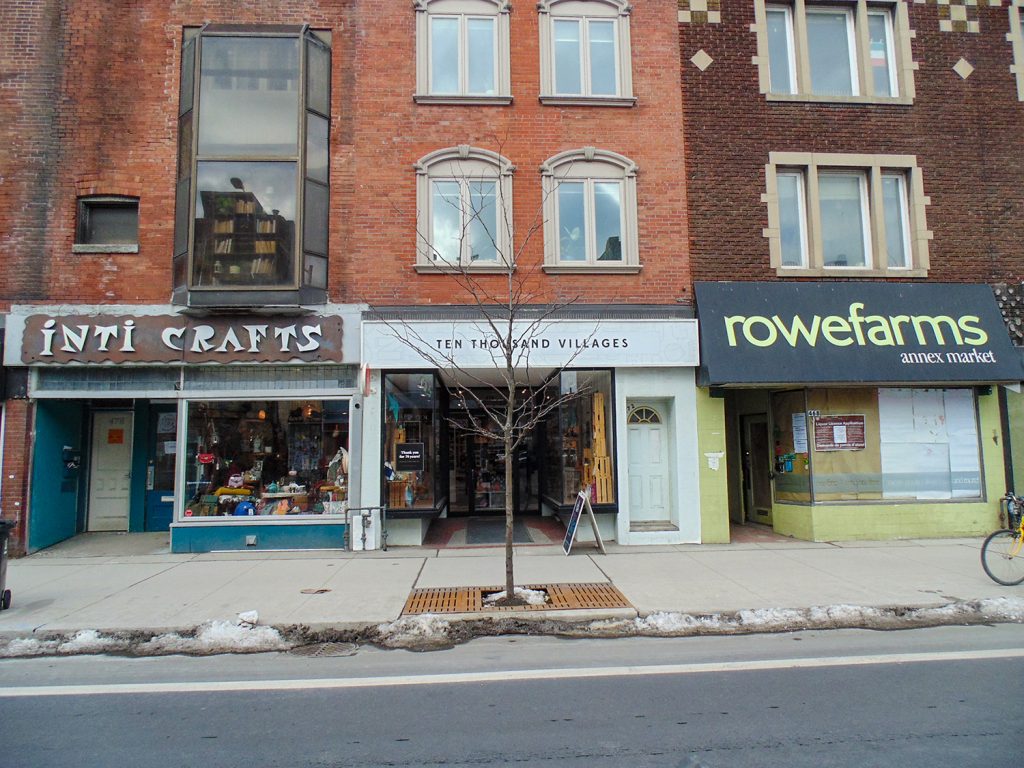
The newly opened Annex Market (718 Bathurst St.) is a grocery store with a mission: to re-invent grocery stores and the food system, too.
This zero-waste store started as an idea in summer 2019 to help a local bean farmer who grows kidney beans and other legumes. His business was limited to selling to a few independent stores in Ontario. That’s how the owner of the Annex Market built his business model.
“I quickly realized that with kidney beans, we could deliver the product to market, organic kidney beans, cheaper than anyone else in the space by reusing the jar rather than recycling. And as the idea evolved, we realized we can put a lot of other things in a jar too,” says founder and owner of the Annex Market, Corey Berman.
The Annex Market seeks to create a new standard of packaging, and provide the infrastructure which includes packing, dishwashing, and transportation across Ontario to facilitate it.
Berman applied the beer store model where it is more efficient to reuse and rewash the packaging rather than to buy it.
So, he adapted the business to the closed-loop supply chain scheme, meaning that everything that enters the supply chain comes back. This makes it easier for anybody to be a producer by standardizing and simplifying the packaging, so producers can make more money by paying less for packaging. At the same time, this allows for a conversation to exist between the people who consume the food and the people who grow it.
“Our concept store here is meant to emulate and show how a local market can do it themselves,” said Berman.
The Annex Market works with local farmers and producers who share the store’s belief that growing food should respect the environment and farmers. You don’t have to remember to bring your own jars, to wash your jars, and to fill up your jars.
The Annex Market completely removes packaging and offers returnable and reusable Mason jars to contain the products. When you choose a product a 1.50 Canadian dollar deposit will be added to your purchase, but it will be re-credited upon its return.
“So, we believe that if we make it as easy as possible in today’s busy world, we can capture more of the consumers and not only is it easier, but it’s also more convenient,” said Berman.
The store has a wide variety of products, things common in the average pantry such as coffee, tea, chocolate, and granola. Household cleaners and shampoos are also available.
—Tanya Ielyseieva, Gleaner News
Comments Off on CHATTER: Zero-waste grocery opens on Bathurst (Feb. 2020)Tags:Annex · News
February 27th, 2020 · Comments Off on CHATTER: Ten Thousand Villages folding (Feb. 2020)
TANYA IELYSEIEVA/GLEANER NEWS
After seventy-four years in business, the Canadian company Ten Thousand Villages announced the close of its head office, distribution centre, web store, wholesale operations, and several remaining company stores.
The store at 474 Bloor St. W. has been a fixture of the community for fifteen years. The stores aimed to connect artisans and marginalized communities to the market and provide a fair and stable income to the producers of their goods.
Ten Thousand Villages is the oldest and largest fair-trade organization in North America, selling artisan-crafted home decor, gift items, and personal accessories from around the world.
Products come from 27 countries, and more than 73 artisan groups, which provide work for more than 20,000 individual people.
About 70 per cent of the artisans are women. Some groups also seek to employ persons with physical disabilities.
“We had hoped for a different outcome,” says Interim CEO Brent Zorgdrager. “But we are grateful for the opportunity to have been part of more than seven decades of providing a sustainable and fair income for tens of thousands of artisans. In bringing their products to Canadian consumers, we’ve been able to share traditions of beauty and creativity across the globe.”
Some of Ten Thousand Villages Canada stores are independently owned and have chosen to remain open and will be able to operate under licensing agreement with the Mennonite Central Committee Canada (MCCC).
Stores in Alberta, one in Quebec, and two in Ontario will remain open.
Carolyn Quinn has been a manager at Ten Thousand Villages on Bloor for a year and a half. She started as a volunteer six years ago before being promoted to assistant manager at the Danforth and then manager at the Bloor St. location.
“Everyone is here because they are super passionate about what we do,” said Quinn. “I’ve really enjoyed my time working here. It has been a sad week but it has been so amazing, the response we have gotten from everyone coming in. I think sometimes you don’t realize the impact it’s made until you find out it’s leaving. It’s really helped us process it here, just seeing how much of an impact it’s made to the community.”
Ten Thousand Villages on Bloor St. will close its doors on March 31.
—Tanya Ielyseieva, Gleaner News
Comments Off on CHATTER: Ten Thousand Villages folding (Feb. 2020)Tags:Annex · News
February 27th, 2020 · Comments Off on EDITORIAL: Fictions, falsehoods and a crisis in leadership (Feb. 2020)
On February 21, members of all four Ontario Teacher’s Unions walked off the job leaving 2 million students out of school and leaving parents scrambling for childcare. Meanwhile, the Ontario government has been trying to sell citizens a story about striking teachers: that they are fat cats led by union boss “thugs” looking to gouge us of tax dollars. The premier likes to paint himself as a hero out to save us all, rescuing the province in a time of crisis, but the only crisis the electorate can buy into at this point is a crisis in leadership – his leadership.
It’s been more than two decades since all four teachers’ unions have walked off the job in Ontario. You can bet that the inconvenience this caused had the Premier certain he was headed for a win with frustrated parents. The polls tell a different story: even in conservative ridings, people support the teachers by a measure of two-to-one.
Ontario teachers have been without a contract since August 31 and months of negotiations have brought few dividends. The battle with the teachers sees no end in sight and the government has long since passed that point on the highway where there are face-saving exits. Ford either has to cave to the union’s position or seek to legislate them back only to be overruled later by the courts. The teachers, of course, could accept the government’s proposal to increase class sizes, force students into multiple on-line courses, reduce the amount of support workers in schools, and get a wage increase of a meagre one per cent. But why would they? Unions can smell blood, and the public can smell it, too.
The government recently enacted legislation capping public sector wage increases to one per cent. Ford proves yet again he is the most myopic premier in recent memory. The courts have ruled you can’t meaningfully have collective bargaining, a charter right, if you pre-set the outcomes.
Let’s put aside the long-term economic benefits of a robust and inclusive public education system and suppose for a moment these cuts to education are absolutely necessary to keep Ontario afloat. If austerity is the only path forward, why is Ford spending a half a billion dollars to cancel green energy projects, spending one billion to cancel the Beer Store contract so we can have beer in corner stores, fighting a losing battle with Ottawa over a carbon tax, giving OPP officers a 2.1 per cent wage increase, and trying to take over Toronto’s TTC subway? (Oh wait he walked back that last one as long as Toronto built new lines to his design – starting from scratch.)
Though the government is facing opposition in almost every corner, including in ridings held by their own MPPs, it is enjoying strong support from one sector – fake parents. A series of pro-government newspaper ads ran recently in various national dailies which echo the government’s language and accuse the unions of using the students as “pawns.” The group that placed the ads as “Vaughan Working Familes” appears to be backed by Conservative insiders and large donors. The opposition NDP have called for a probe due to the ad campaign being a potential violation of the Election Finances Act prohibiting the government from acting “in collusion” with third-party supporters for advertising.
The government has lost credibility, and is bleeding support. According to a recent CTV news poll 59 per cent of parents in PC-held ridings think the government is doing a poor job and it can’t even buy that support without getting caught. It’s time for Ford to go; the flying monkeys in his cabinet would be thrilled.
February 27th, 2020 · Comments Off on FORUM: Budget challenges at City Hall (Feb. 2020)
Not all priorities can be met by property tax base
By Mike Layton
It is with great pride that I have the privilege of serving on the City of Toronto’s Budget Committee, which allows me the opportunity to help shape the direction of services over the coming year. Simply put, the annual budget is a chance for Toronto to set priorities as a city and take action on what needs to change.
At its core, the annual budget debate is about people, and I view the process as a way to determine how we support and protect each other. The choices made in these sessions also govern how we interact with our parks and greenspaces, and how we get around – whether on foot, bike, transit, or car.
This year my focus was on advocating for a budget that will create healthy, sustainable communities. This included supporting asks that will help us meet our climate targets, supporting the creation of truly affordable housing, providing affordable childcare, improving our parks and ravines, and expanding road safety initiatives.
You may have participated, or sent me your thoughts on the priorities for our budget over the last month and for this I thank you. In addition to my commitments on the Budget Committee, I also had the opportunity to have senior city staff at a downtown budget town hall I hosted with neighbouring Ward Councillors Kristyn Wong-Tam and Joe Cressy.
When the city does its budget deliberations, we look at the operating budget for 2020 in tandem with our capital plan over the next 10 years. For the first time in a number of years, I believe that we have not produced an austerity budget. This is an important step in the right direction if we are going to build a city that is for everyone, not just the rich.
We have been dealing with the effects of underfunding in our growing city for close to a decade. The decision to implement a dedicated tax increase to help pay for much needed infrastructure improvements and housing needs is definitely a step in the right direction.
We also funded a Ravine Strategy that will finally be implemented to deal with the biodiversity, erosion, and litter issues in our ravines, with the Vale of Avoca/Yellow Creek being identified as a priority area for investment. In combination with my Ravine Working Group, we are positioning ourselves well to secure funding for both immediate and long-term restoration in sensitive ecological areas.
There are, however, still troublesome trends.
TTC fares are continuing to increase without substantial service improvements; repairing the Gardiner still absorbs 44 per cent of yearly capital spending on transportation infrastructure which affords us less money for implementation of Vision Zero; and the city is not moving quickly enough on its TransformTO and climate change mitigation strategies.
Lastly, as the city cannot legally carry a deficit, we are forced to figure out ways to maintain existing service levels in the face of provincial cuts. For example, Children’s Services is sitting $15 million short of its growth strategies. That will have an immediate impact on expecting and current parents in the coming years. The status quo will not do.
In order to shift the burden off the property tax base, we have to commit to a combination of new revenue tools. I am particularly excited about the prospect of a vacant homes tax which has been implemented successfully in Vancouver and saw the dual benefit of increased housing availability and revenue to put toward affordable housing initiatives. It is creative policies like these which are integral for a growing city to thrive and I look forward to supporting this in Council.
Mike Layton is the City Councillor for Ward 11 University-Rosedale. Please visit www.mikelayton.to for the latest on this, and other city-related issues.
February 27th, 2020 · Comments Off on FORUM: Catastrophic climate change is here. How do we respond? (Feb. 2020)
Australia is the canary, we must act now
By Jessica Bell
Australia is my original home, and it is experiencing a climate catastrophe. Armageddon fires are still burning up the country. Half a billion animals are dead. Towns have been destroyed. Billions are needed for rebuilding.
The fires in Australia are the latest dark sign that natural disasters at this destructive scale are becoming the new normal. The enormity of the disaster is a reckoning for us to review how we meaningfully respond to the global climate crisis.
The cost of taking action is great. But the cost of inaction is immeasurable because we are fighting for our future. There is no fate but what we make. It’s up to us to make it together.
Feelings matter: Of all the dangers we face, from climate chaos to nuclear war, none is so great as the deadening of our response. Those words come from Australian activist scholar Joanna Macey, who argues it is important to recognize our personal response to environmental harm because it is healthy to acknowledge feelings like grief and despair and because strong feelings can motivate people to take useful action.
Like many of us, I regularly suppress my thoughts about the impact of climate change. I don’t want to think about the fear my mother felt when she was temporarily evacuated from her home until the fires passed. I don’t want to grieve about my children and the hard future they are likely to face. I don’t want to think about coming food shortages, civil unrest, or forced migration.
It is easier for me to channel the deep anger I feel when I see our leaders failing to take action. Australia’s prime minister is charging ahead with new coal mines. Our prime minister bought the TransMountain pipeline. Doug Ford has literally no climate change plan or hard targets at all. We can’t rely on them.
As Australia takes war-level action to quell the fires and save lives, it’s up to us to take useful war-level preventative action to stop future catastrophes from happening.
Making personal choices like using public transit or buying eco-friendly shampoo can help to create new markets for products and inspire our friends and family to change habits. Evidence shows, however, that the overall impact of behavioural change is limited because it’s only the motivated minority who are willing to always pay and do more.
Strategically tackling climate means working together to change laws and policies at an institutional level to make it easier for everyone to make good choices. This means changing what our banks and pension funds invest in, changing what our schools and universities teach and do, and passing real environmental policies at all levels of government, from investing in public transit to putting a decent price on carbon.
There are many groups in our city that are doing useful work to achieve these big system-wide changes. They need our support.
In this upcoming budget cycle, the Toronto Environmental Alliance, ClimateFast, Mike Layton, and more are campaigning for the City of Toronto to fund and implement its TransformTO climate plan to reduce greenhouse gas emissions and adapt our city to our changing climate.
GreenPAC is a non-partisan political organization that endorses and supports environmental champions from all political parties who are running for provincial and federal office. This is very strategic because climate change should be meaningfully addressed by all political parties, and this is only going to happen if there are politicians at each party pushing this agenda.
Fridays for Future and Extinction Rebellion are youth-led movements organizing creative protests in Toronto to force urgent and real action.
Then there’s the Green New Deal, an ambitious plan calling for net-zero emissions, good green jobs, and an end to inequality.
National advocacy organization Our-Time.Ca helps people organize in their communities to build support for the Green New Deal. At the Ontario NDP we have just finalized our first blueprint of our Green New Democratic Deal. The draft plan is online, and we taking feedback right now.
Ontario should be a place with energy-efficient buildings, where we can walk or take public transportation to our destination, where our electricity grid is green and affordable, where we produce minimal waste, and where the products we make are truly needed and built to last.
The cost of taking action is great. But the cost of inaction is immeasurable because we are fighting for our future.
There is no fate but what we make. It’s up to us to make it together.
February 27th, 2020 · Comments Off on GREENINGS: Short-term gains lead to long-term losses (Feb. 2020)
Province has no business case for reckless cuts
By Terri Chu
Last year, Premier Ford and friends dropped $231 million of “taxpayer” money on killing wind energy projects. It’s one thing to not build any more but spending money to cancel projects? That’s next level “respecting” taxpayer money (as he likes to say). What this government has shown us is that it cares not one whit for being fiscally responsible and it cares not one whit for the best interests of the citizens.
Rather than installing more EV charging stations, Ontario is removing them in a step that’s sending air pollution in the wrong direction. GO’s justification is that the spots are not making sufficient revenue to justify their existence. I’m pretty sure there’s a Greek proverb that reads society grows great when old men plant trees whose shade they know they shall never sit in, not society grows great when we make decisions solely based on first quarter profits.
We are in this climate mess precisely because of our narrow focus on short-term monetary results. Now Ford wants to take the driving forces of our climate crisis and spread them to every facet of our society. As if it wasn’t bad enough that our children face food shortages in the future, he wants to ensure they aren’t educated enough to think critically about how to cope with the crisis.
Universities now have ridiculous metrics that funding is to be measured against, including “graduate earnings” and “proportion of graduates employed in related fields.” What this spells is essentially the death of liberal arts. Schools will now only focus on pumping out graduates in high earning professions. I don’t even know how liberal arts graduates measure up, whether or not their profession is in a “related field.” The point of education is to broaden your mind and allow you to think critically, regardless of the profession you choose in life.
At the secondary level, the Ford government wants to institute mandatory e-learning despite the fact that students in primarily e-learning-based institutions are finding themselves unmotivated by the format.
Other than saving money, there’s no reason to push students to get their education online. On the one hand, Ford pats himself on the back for banning cell phones in school and then, in a move consistent only with profit-based ideology, he demands students do mandatory e-learning courses. There’s only one meaningful motivation behind this and it is NOT in the best interests of the youth. Meanwhile, we have enough money in our budgets for tax cuts to the tune of billions, primarily targeted at wealthy individuals.
At the primary level, class sizes have ballooned. On the personal side, my daughter’s JK classroom has 29 students in it. Teachers are asking for a raise that matches inflation, something that isn’t an unreasonable ask. However, Ford is refusing to budge on an issue he knows he’s on the losing side of. Teachers aren’t worth a pay raise of 2%, but MPPs are worth an additional 14%. These are all ideological attacks. They’re not even consistent with the “saving money” claims.
Our climate is on the cusp of losing its ability to sustain human life because of short-term focus on profits over trifling details like clean drinking water. If our education system collapses, it will not be able to even produce the workforce that has been instrumental in operating the levers of capitalism. Short-term thinking means we kill the golden goose for a tasty roast goose. This is being implemented at every level of this government.
Our kids deserve a lot better than this. Australia is feeling the effects of short-term thinking. We need not follow suit. Let’s plant those trees, even if we won’t sit in their shade. Let’s stop going profitably backwards.
Terri Chu is an engineer committed to practical environmentalism. This column is dedicated to helping the community reduce energy use, and help distinguish environmental truths from myths. Send questions, comments, and ideas for future columns to Terri at terri.chu@whyshouldicare.ca.
February 27th, 2020 · Comments Off on ARTS: Bloor St. Culture Corridor celebrates Black History Month (Feb. 2020)
February corridor offerings abound
A Tafelmusik presentation, The Indigo Project, which starts Feb. 27 at 427 Bloor St. W. (Trinity St-Paul’s) is a musical journey exploring the implications of the blue dye that touched the lives of the lowest classes. COURTESY TAFELMUSIK
By Meribeth Deen
For many institutions on the Bloor St. Culture Corridor, Black History Month is every month. However, if you’re keen to jump into the spirit of the month, there are plenty of ways to do that between Bathurst and Bay streets.
If you find yourself on Bathurst, head directly to A Different Booklist Cultural Centre (Bloor and Spadina). They have a stellar line up of events that you do not want to miss, and the bookstore will be offering 20 per cent off on “essential” books to celebrate African Liberation Month (Franz Fanon, W.E.B DuBois, Walter Rodney, Roxane Gay). On February 20, enjoy the Literary Salon with Roger McTair, who will discuss his short story collection My Trouble with Books.
Also on February 20, Rivka Campbell will discuss Jews of colour with a focus on Jews of Jamaica at the Miles Nadal Jewish Cultural Centre (750 Spadina). Campbell, a Jewish woman of Jamaican descent, seeks to build community among Jews of colour in Canada while opening dialogue about cultural and ethnic diversity. Campbell has faced challenges finding harmony in both the Black Canadian and Jewish communities. She’s called herself “too Black to be Jewish, too Jewish to be Black,” but despite her challenges, Campbell says she still finds ways to be meaningfully involved in her Jewish community, even serving as a synagogue administrator in Toronto.
Throughout the month of February, Alliance Française (24 Spadina) invites visitors to travel across Africa by viewing the photographs of Nadine McNulty. McNulty photographed families throughout the continent over a 20-year period, and her work focuses on quickly disappearing traditional ways of life. On February 28, the exhibition will be accompanied by a performance by Njacko Backo, a percussionist, singer, storyteller, choreographer, and songwriter/ composer who has been performing for children and adults since his childhood in Cameroon. His programs for children and youth draw on parallels and differences between Canadian and African family life.
Starting on February 27, Tafelmusik (427 Bloor) presents the cross-cultural multimedia project The Indigo Project, created by Alison McKay. This musical journey explores the vast social, cultural, and political implications of the blue dye that touched the lives of Europe’s lowest classes and its courts, North American slave plantations, and current-day garment workers.
On a completely different note – but not to be missed – is the world premier of Up TO and Including Their Limits, a new performance by the internationally-acclaimed artist Cassils at the Gardiner Museum (11 Queen’s Park). Cassils is known for jaw-dropping feats that highlight non-binary and trans visibility and violence, like pummelling a 2,000 lb block of clay and being set on fire in front of a live audience. Only 100 tickets have been released, and they’re going quickly!
These are just a few of February’s highlights of the Corridor, and they offer an important message: even the middle of winter is full of culture and colour in Toronto. So be sure to make the most of it.
Comments Off on ARTS: Bloor St. Culture Corridor celebrates Black History Month (Feb. 2020)Tags:Annex · Arts
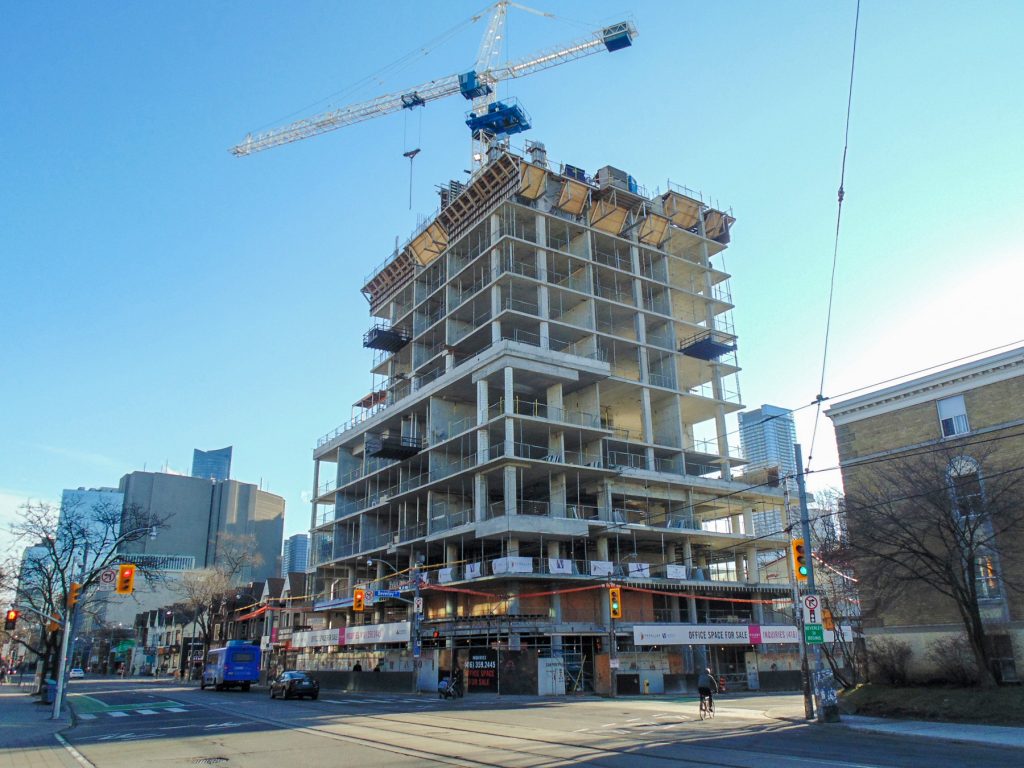
Designed by IBI Group, the Theory Condo building is projected to rise 30 storeys and will house 243 condo units. BRIAN BURCHELL/GLEANER NEWS
In May 2020, the Annex Gleaner celebrates 25 years of publishing. In celebration, we are republishing highlights of our past; this feature, Fear of High Buildings Groundless by city-building columnist Alfred Holden, is from May 2001. As thirteen developments are going up in the Annex area it appears Holden’s views were prophetic.
By Alfred Holden
Howard Cohen and I have lunch together sometimes. He’s the only developer I can talk to – he “gets” the city, rides the streetcars, passes me clippings from the New York Times and, like a journalist, thinks he can earn his living and make the town a better place at the same time.
Cohen is a former City of Toronto planner who now builds condominiums. Many are in or near Gleaner territory, among them 20 Niagara St., the nearly-completed District Lofts near Richmond St. W. and Spadina Ave., and the Ideal Lofts, now under construction on College St., just west of Bathurst.
Without exception the buildings, which have been designed by a team headed by architect Peter Clewes, are clean and contemporary – boldly, bravely so, when you consider how most developers seem to think the public only wants “wedding cake” condos: buildings dripping curlicues and baroque ornament.
Ideal Lofts is in a better class. It has potential to live up to its name, as good design in and of itself – there’s a lot of glass, and glass is great – and it is a nicely-fitted addition to the bustling streetcar strip it will be part of.
On College St. Ideal Lofts’ front – clean and square like old factories nearby – rises right from the sidewalk, continuing the shop facades. Up a few floors Ideal steps back and then back again, yielding open terraces for residents and angles that let more sun down to the street.
At the back, the building’s nine or so storeys step down until the ideal blends at roof-level with the single-family homes to the south on Markham St.
Ideal, eh? By all rights, Howard Cohen should be the hero of neighbourhood groups.
But at the moment he’s not.
Cohen’s firm, Context Development Inc., is the one that’s butting heads with various groups over plans for a condominium on the grounds of St. James Cathedral, east of Yonge St. at Adelaide and Church streets.
It’s all a bit iconic: Context was chosen by the church’s board, from a number of potential developers, because of the higher-grade city-building that it has been doing.
Now they are in the hot seat.
Complicating factors, hugely, is the historic nature of the site, including the proposed demolition of the attractive parish hall there, and the presence of an old burial ground.
There is no easy way to resolve these matters.
But a key anxiety here is a deep-rooted bias against tall buildings. The original proposal for the site called for a 34-storey tower.
Enough said. You can hear the anger and the catcalls rising – the arguments about increased traffic; the angst about “crowding” in the city; the fury over the sacred god – the church – under siege by the secular one, money.
Yet time and experience and change are telling us our fear is unjustified, and ultimately harmful to the city.
Building up, not out, is the solution to a range of issues related to sprawl, transportation, pollution, long-term stewardship of land and, closer to our streets, improved quality of urban and community life.
Ideal shows how it can be done – what a long way Toronto’s planners, architects, and better developers have come since the 1960s and 70s, when angst reached its apex in an emergency height limit slapped on the city’s downtown development.
At the time the norm, indeed the requirement, was to blockbust – buy up the houses, shops, everything on entire blocks, bulldoze them and erect the era’s famous “towers in the park”.
“Open spaces” were somehow to redeem the buildings’ height. But at places like St. Jamestown near Parliament and Wellesley streets, the “parks” became empty, windswept, and ugly. All the demolition and destruction, and the disappointing city spaces that resulted, earned tall buildings a bad rap.
Fast-forward to 2001. Design principles have changed, but the terror over tall remains. Witness public upset over plans for two tower condominiums at Yonge St. and Eglinton Ave.
Here too is interesting irony.
The progressive left that once decried development and opposed towers now supports greater urban density – “Mainstreeting”, or building more compactly, building up not across, infilling, not sprawling.
The right-wing now owns the kind of properties it once blockbusted and has embraced NIMBY – not in my back yard. The headline on a National Post story about Minto’s Yonge-Eglinton point-tower project said simply, “Up is Down.”
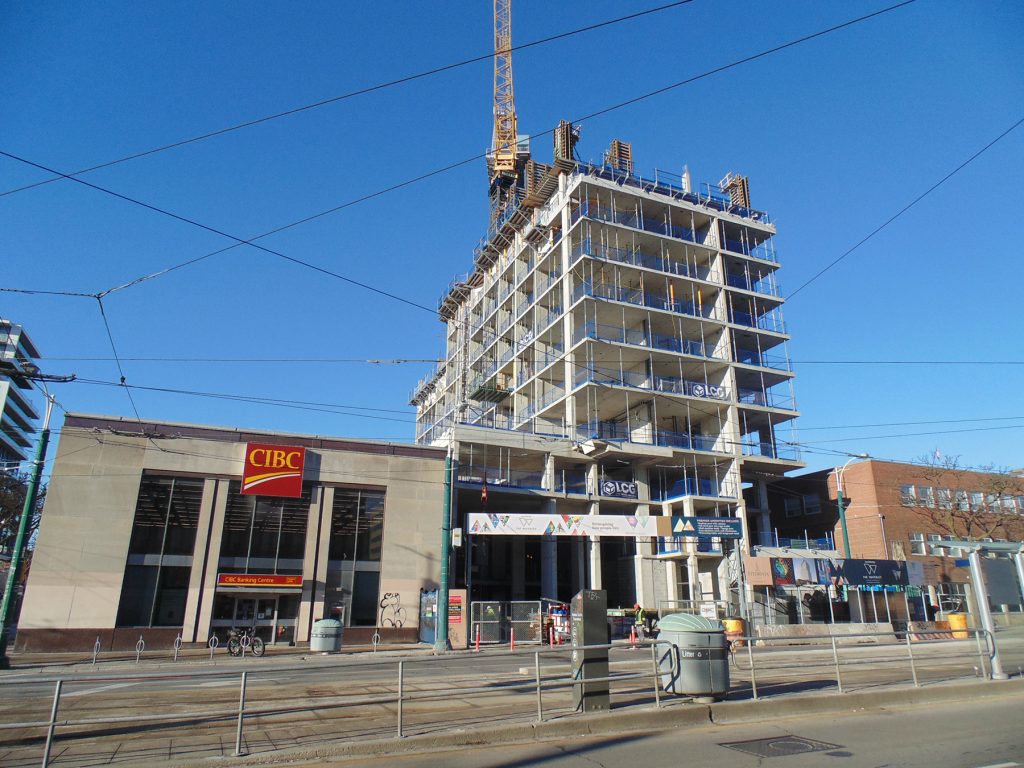
Construction for The Waverly, a rental tower at 484 Spadina Avenue north of College Street, is currently underway. BRIAN BURCHELL/GLEANER NEWS
Yet neighbours are not threatened; those battles are still won. The need to weigh scale and context is embedded – as Howard Cohen has demonstrated. “You don’t want point towers at College and Bathurst,” he told me over coffee in his office in the Ryrie Building on Yonge St.
Some problems, like shadows, have serendipitous solutions. A tall thin tower, for instance, may yield a twenty-minute shadow; a lower long slab-building can cast darkness that lasts all day.
Some issues, such as traffic and parking, are proved moot with high buildings. Witness the mid- and high-rise Spadina Rd. and St. George St. apartment houses, where garage space can be rented by the public because many tenants living close to the subway, or who walk, don’t have cars.
Finally, at another level, the architectural opportunities created by tall buildings – for grandness, for innovations, for buildings that support modern life and embrace urbanity – are many, and not always predictable.
One of New York’s best-known images is of the Trinity Church at Wall St. and Broadway, with its spire nestled among the skyscrapers.
In Toronto, “I walk under this building, and its freedom,” Inez Zangger, a guest from Switzerland, told me last month while he walked through Commerce Court, where Toronto skyscrapers reach their peak. “Looking up, you see that anything is possible.”
Yet fear of heights persists in Toronto’s heart. “Sometimes,” Cohen tells me, “it seems like people (downtown) want Mississauga in the city.”
January 31st, 2020 · Comments Off on ON THE COVER (Jan. 2020)
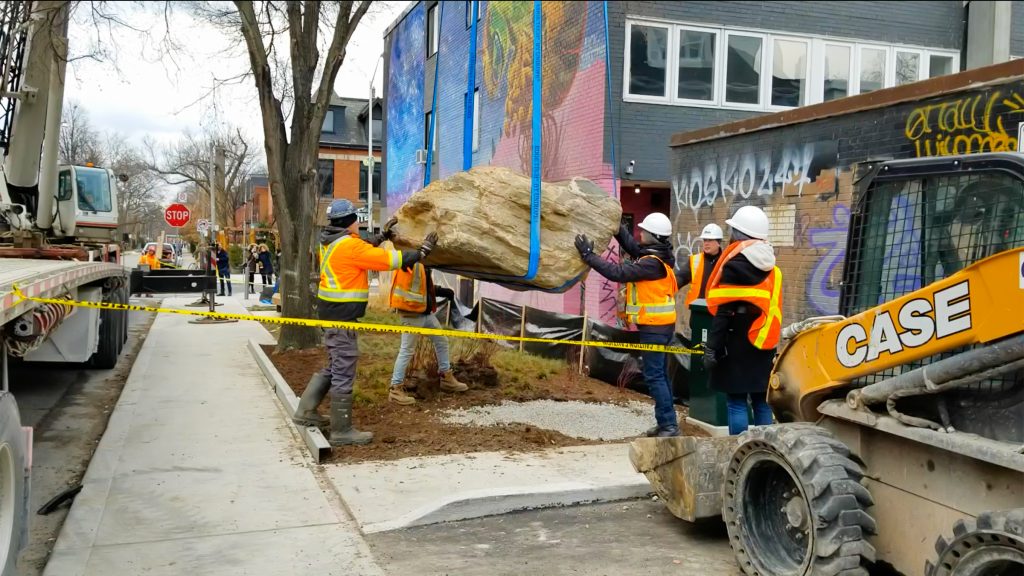
Sanscon Construction crew members carefully guide the granite erratic found during construction of the Major Street Parkette to its new home in the Howland Avenue Parkette. James Roche of DTAH looks on. For more on the parkettes and their granite benches, please click here. NEILAND BRISSENDEN/BLOOR ANNEX BIA
Comments Off on ON THE COVER (Jan. 2020)Tags:Annex · News