March 24th, 2020 · Comments Off on CHATTER: Faculty Club’s anniversary takes foodies back to the 60s (Mar. 2020)
MARCH 26, 2020 UPDATE: In light of the challenges the Faculty Club is facing due to the COVID-19 virus, this event has been cancelled, but will hopefully be rescheduled as soon as possible.
What was the Toronto food scene like in the 1960s? Come and find out as the Faculty Club marks its 60th anniversary with a culinary trip back to the time of its founding. A multi-course dinner will feature the best-loved dishes of the era.
60 Years of the Faculty Club: A Celebration of Communities, Cultures & Cuisines will feature guest speakers to introduce each course, starting with award-winning cookbook author Bonnie Stern.
Stern will speak about Toronto’s Jewish cuisine at the time, and food historians Daniel Bendear and Irina D. Mihalache will delve further into this key moment in the evolution of dining in Toronto and beyond.
“There was a lot happening in the food scene of the sixties, which I didn’t realize until meeting with Daniel and Irina,” says general manager Leanne Pepper. “It wasn’t just about dining in hotels or eating TV dinners. There was a huge change in the food industry. Julia Child and the classic chefs back then really changed how we eat today.”
New waves of immigration indelibly changed dining in the neighbourhood. Award-winning author Arlene Chan will speak about the very first restaurants in Chinatown. Chan has written seven books on the history, culture, and traditions of the Chinese in Canada. The menu is being created with input from all four speakers.
Sommelier Pierre Lebouedec will be serving sixties-inspired cocktails. A slide show from the Toronto and University Archives will set the scene.
Following dinner, a panel discussion will top off this interactive and delicious evening. 60 Years of the Faculty Club: A Celebration of Communities, Cultures & Cuisines will take place Monday, April 20, at 5:30pm.
Tickets are $60 for members, $75 for non-members. To reserve call 416-946-7052 or email faculty.club@utoronto.ca
—Nicole Stoffman, Gleaner News
Comments Off on CHATTER: Faculty Club’s anniversary takes foodies back to the 60s (Mar. 2020)Tags:Annex · News
March 24th, 2020 · Comments Off on EDITORIAL: Modelling healthy behaviour (Mar. 2020)
As we continue to try and navigate uncharted waters due to the spread of the COVID-19 virus, it has been quite reassuring to hear from the prime minister in almost daily news conferences delivered from the steps of his home, Rideau Cottage. The federal government response to the crisis under Justin Trudeau’s leadership has been calm, measured, and mindful of the significant impact it has on the lives of Canadians now and in the future.
Trudeau announced a huge economic aid package for people in all forms of employment and support for businesses facing a bleak financial outlook. He negotiated with the Americans a closure of our common border to all non-essential travel while leaving it open to trade for what is really one economy.
And the prime minister has done all this from home where he is the sole caregiver 24/7 of three young children. His wife, Sophie Gregoire Trudeau, who has tested positive for the virus following a trip to England, is quarantined in one part of their house. There are no political staff or caregivers at the residence. Following Mrs.Trudeau’s diagnosis, the family took the need to self-isolate very seriously.
Parliament is convening to consider the government’s multibillion-dollar rescue package. Trudeau will be absent. Though the Liberals lack a majority the opposition parties are unlikely to block the legislation as the plan has been widely applauded as necessary.
In the outdoor news conferences media repeatedly ask Trudeau why he has not invoked the Emergencies Act which would give the federal government sweeping powers to limit civil liberties and impose strict rules on the movement of people. He has wisely resisted the call to declare a “public welfare emergency” (language from the Act) unless and until the provinces and other jurisdictions have exhausted their powers to control the crisis, and the scale and severity of the situation warrant a much stronger federal response. Trudeau is wise to wait in fact; the law demands this prudence.
The predecesssor legislation to the Emergency Act is the War Measures Act which then Prime Minister Pierre Trudeau famously enacted in 1970. This was in respsone to a “apprehended insurrection” in Quebec after members of a terrorist group, the FLQ, kidnapped a British diplomat and a provincial cabinet minister. Police arrested and detained hundreds of indiviudals on the basis of their ties to the FLQ. Justin Trudeau is altogether a different leader from is father.
Domestic duties have kept the current Trudeau busy; making meals for his children, Hadrien, Ella-Grace, and Xavier. In between, calls with G-7 leaders continue. Sometimes the two conflict. Sounds of kids yelling and screaming can be heard on the line during some pretty heavy conversations. A late night teleconference with federal officials was delayed recently because it was bath time for his six-year-old Hadrien.
On the occasion of his most significant announcement, regarding the economic measures, he halted the news conference which was being held on a very cold winter day and said “Just before I take questions, I’m supposed to model healthy behaviour, I’m going to go grab my coat and I’ll be right back.” At another presser, he took the high road and wanted to thank Canadians, not only front line medical professionals, but those earning low wages re-stocking grocery shelves or serving coffee, truck drivers, and cleaners.
He took the time to thank the children: “I know this is a big change, but we have to do this not just for ourselves, but for our grandparents, our nurses, our doctors and everyone working at our hospitals and you kids are helping a lot.”
This is exactly the kind of leadership we need right now. Trudeau is modelling behaviour that is positive, caring, inclusive, and proactive.
March 24th, 2020 · Comments Off on FORUM: Safer streets for bikes and pedestrians (Mar. 2020)
Redesigning the roads with necessary rules
By Mike Layton
There are changes coming to local road infrastructure that will be a big step towards improving safety for all road users in our neighbourhoods. These changes will bring a new bike lane on Brunswick to just south of the Annex, connecting to a larger cycling route which includes Shaw, Bloor, and College in the surrounding area. This work will occur alongside efforts to upgrade existing bikeways, resurface roads, refresh speed humps, set parking back from corners to improve sight lines, and other changes aimed at making our roads safer for all who use them.
Through public consultation that began last fall, the City worked to learn about residents’ priorities for their street and shared the planned route through the neighbourhood. In response to the feedback received through this process, the City took steps to address issues with accessibility and access for residents with disabilities.
Prohibiting right turns on red lights is a simple way to reduce collisions between drivers and pedestrians.
As with every project Transportation Services undertakes, this design is subject to evaluation and review. I am dedicated to working with staff while changes are monitored, and if the street is not working as intended, to augment the design as necessary. In the first six to twelve months after installation, Transportation Services will observe new behaviour, conduct new traffic counts, and evaluate the before and after conditions to ensure the project meets the goals as intended. If there are operational challenges, further changes could be considered.
Feedback and dialogue is the basis of how I work to make change, and I welcome those who haven’t participated in the process to reach out to me. For those who have shared their thoughts, I want to thank you for taking the time to engage in the consultation process. Your comments were crucial in the decision-making process and improved the overall design of the streets.
I have recently asked staff to explore a restriction on right turns on red lights (RTOR) at selected intersections to improve road safety. In February, I sent a letter to the Infrastructure and Environment Committee chair to consider the growing call to implement this measure as a part of our Vision Zero road safety principles. Prohibiting RTOR is a simple way to reduce collisions between drivers and pedestrians. In the majority of reported collisions, it was the pedestrian who had the right of way.
While the City currently has a warranting system in place to address requests for RTOR prohibitions, there is an opportunity to proactively review the restrictions and how they will apply to selected intersections to make the road safer for all road users. My letter to committee asked for staff to include a review of RTOR in their speed limit reduction strategy later this year. While it may not work for all intersections, the change could prove to be another significant way to help us meet our Vision Zero target.
If you have questions, or want more information on any of these developments, please do not hesitate to contact my office. You can also visit www.mikelayton.to for the latest on this, and other City-related issues.
Mike Layton is city councillor for University—Rosedale Ward 19.
March 24th, 2020 · Comments Off on GREENINGS: Reflecting on who actually matters (Mar. 2020)
COVID-19 response speaks volumes about those we choose to ignore
By Terri Chu
There’s a China-sized hole in the world’s pollution map thanks to the coronavirus (COVID-19). Flights around the world have decreased, economic activity has gone down substantially, and our air has never been cleaner. Even Venice’s famous canals are running clean, and are once again home to swans and the odd dolphin.
If there’s anything COVID-19 is teaching us, it’s that when faced with an existential threat, we can actually take measures to prevent humans from dying. Unfortunately, preventing humans from dying depends largely on the humans we’re trying to protect.
What we need is an economy that no longer depends upon consumption of goods for consumption’s sake
There have been thousands who have died from or been displaced by flooding, typhoons, and hurricanes who have gone largely unnoticed because they were impoverished. The millions who will die from the famine resulting from locust swarms in Africa don’t matter, because they are poor and, well African. (There has been scant news in this part of the world about the East African locust swarms that threaten the lives of millions.)
The world, however, can and will act when disease threatens those who can afford to put food on the table, buy airplane tickets, and consume endless amounts of stuff. This message has been sent loud and clear. We will only act in the face of imminent danger to those whose lives matter.
Thanks to climate change, diseases are predicted to spread further and faster than ever before. Acting swiftly and decisively might actually happen on a more regular basis.
I feel terrible for everyone stuck in an economic system that dehumanizes the very workers who keep it afloat. For many, there is no other path to putting food on the table other than being a cog in the machine that churns out goods and services that we don’t actually need. The fact is, we can function perfectly fine as a society without fancy handbags, designer clothes, and destination handbags.
We now live in a society that is suffering from the over-abundance of useless products that we pay people to help sort, store, and dispose of. The one thing that we can’t do without is food. Yet in our economic system, being able to eat has less to do with food availability than it has to do with finding a way to produce an economic unit of labour, even if nobody needs that labour. Even more unsettling is that about 60 per cent of what we grow ends up wasted, even as many continue to starve.
At the moment, China has slowed production of the gadgets that will become tomorrow’s landfill. And while there are those for whom the self-distancing measures brought on by COVID-19 are merely an inconvenience, many on our society’s economic margins are suffering.
We don’t need a more robust economy to deal with this fall out. What we need is an economy that prioritizes land, water, and biodiverse ecosystems over immediacy and convenience. We need an economy that will take seriously the threat to the lives of billions of people, even those that don’t “matter”. Because in fact, every human life matters.
COVID-19 demonstrates that the world (minus the United States) is mostly capable of acting. The question is whether we think the lives at stake are actually worth acting for.
Terri Chu is an engineer committed to practical environmentalism. This column is dedicated to helping the community reduce energy use, and help distinguish environmental truths from myths. Send questions, comments, and ideas for future columns to Terri at terri.chu@whyshouldicare.ca.
March 24th, 2020 · Comments Off on FOCUS: Robert Street Field site of geothermal energy (Mar. 2020)
U of T seeks big win on greenhouse gas reductions
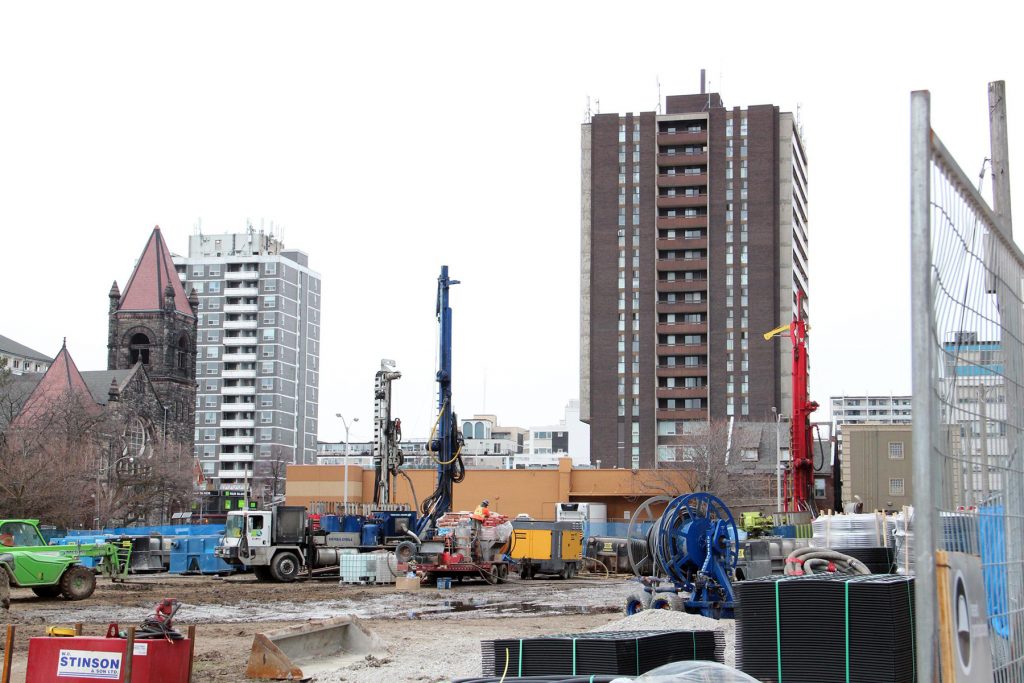
The University of Toronto has embarked on the largest geo-thermal installation in the country which is located on the Aura Lee playing field on Robert Street. TANYA IELYSEIEVA/GLEANER NEWS
By Nicole Stoffman
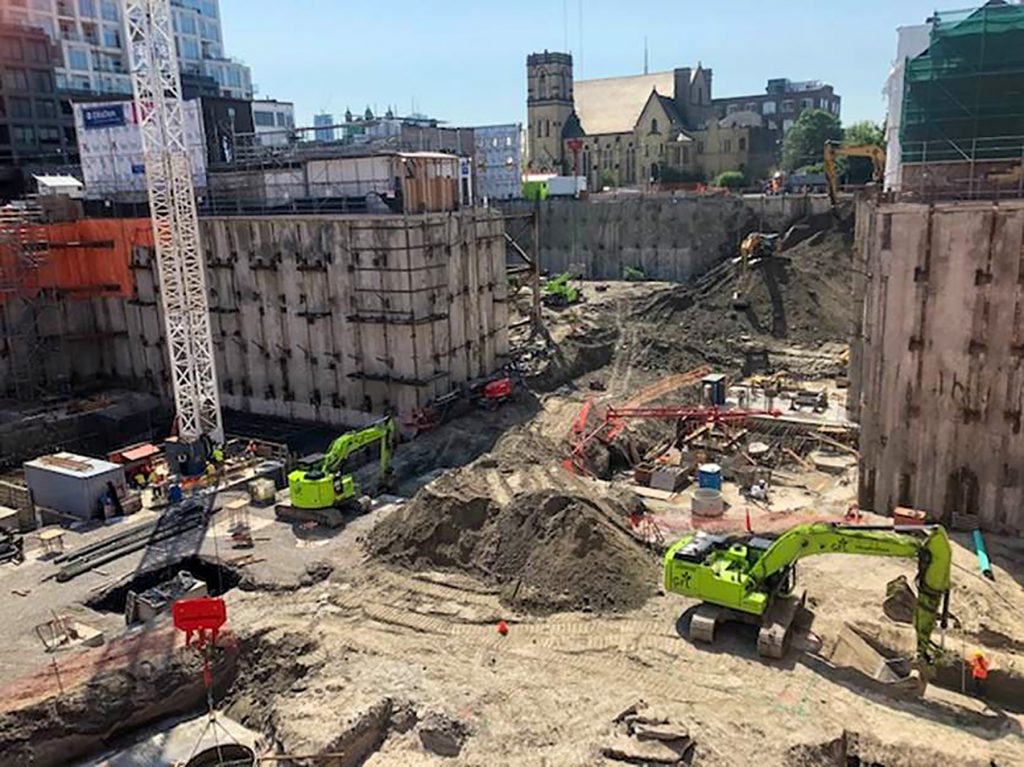
Green energy from the deep earth is coming to the Annex. The University of Toronto is drilling one hundred and fifty-three 850-foot boreholes into the Robert Street Field in order to extract geothermal energy to provide heating and cooling to the future Spadina-Sussex Student Residence and connect to the University on the other side of Spadina.
“It will be the deepest large project in Canada,” says Brian Beatty of Beatty Geothermal Consulting.
Geothermal energy systems take advantage of the fact that the earth 10 feet below the surface maintains a temperature of 11-12 degrees Celsius year-round. Fluid running through pipes that go down into the boreholes absorb heat, bring that heat to the surface and then transfers it to a heat pump that warms the air circulated throughout a building.
In summer, heat from the building warms up the water going into the borehole loop and transfers it to the rock. The cool water flowing back can then be used to cool the building.
This project will mean a 90% reduction in greenhouse gas emissions for heating and cooling university buildings, compared with natural gas.
That’s an annual reduction of 1,150 tons of carbon dioxide. It is in lock step with the university’s pledge to fight climate change and reduce campus-wide emissions 37% by 2030, and to reach carbon neutrality by 2050.
“There was a plan to revitalize the Robert Street Field, and this presented an opportunity,” says Campus & Facilities’ David Sasaki.“This is exactly the kind of big step necessary to create a cleaner, healthier system.”
The 7 million dollar project is expected to pay for itself within 28 years.
At a recent public meeting, Councillor Mike Layton said that if the neighbourhood could tap into this geothermal system instead of gas it could be a model for the City of Toronto on how to integrate sustainability into recreational facilities, and connect to urban growth.
The city has pledged to be net zero by 2050, and is supporting green community initiatives under its “Transform TO” action strategy. Since buildings account for 50% of carbon emissions, the city could consider tying into this geothermal field.
The U of T is not opposed to a future partnership, and talks with the city are ongoing.
“The community would be delighted to discuss the opportunity to feed into the system,” says Susan Dexter of the Harbord Village Residents’ Association. “It is very clear geothermal is the quickest route to reducing household carbon emissions.”
Geothermal technology is not new and Canada has significant potential to tap into this energy source.
However, the initial investment into these systems is high, so it requires long-term vision to justify the pay-off.
“Geothermal is a very clean, renewable source of electricity,” says Jack Gibbons, chair of the Ontario Clean Air Alliance. “It will help the U of T reduce its natural gas consumption. We must phase out fossil fuels and move to renewable energy to protect our climate.”
The end result will be a revitalized and expanded natural sod playing field.
The Robert Street skating rink, change rooms, and tennis courts will be demolished, but will be replaced by an inviting community park featuring a butterfly garden, playground, climbing boulders, and seasonal plantings.
STUDIO tla Landscape Architects will complete the park by the end of summer.
Geosource Energy Inc. will complete the field by June 2020.
Comments Off on FOCUS: Robert Street Field site of geothermal energy (Mar. 2020)Tags:Annex · Life
March 24th, 2020 · Comments Off on FROM THE ARCHIVES: University no longer fielding exemplary behaviour (Mar. 2020)
Can a park’s past set the tone for its future?
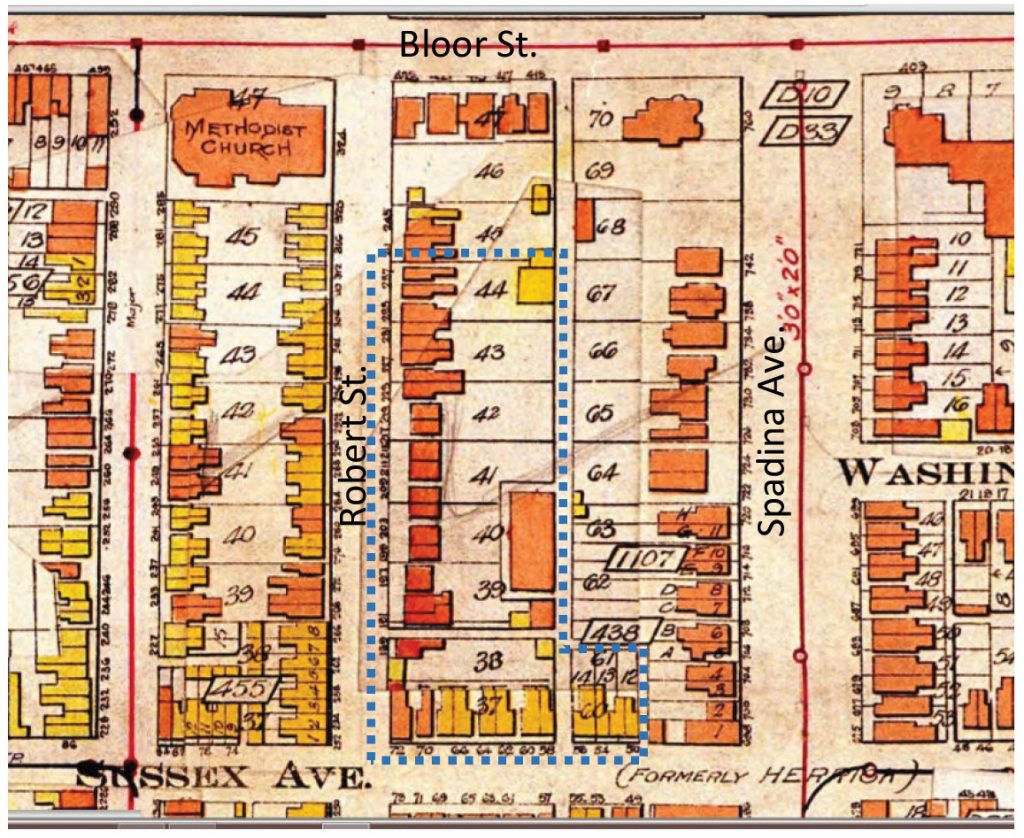
Had the Spadina Expressway been built, there might have been a development like St. James Town west of Yonge Street. The city had rezoned the area, and a developer had quietly purchased many of the 32 properties on Robert and Sussex avenues. COURTESY CITY OF TORONTO ARCHIVES
The Aura Lee playing field located on Robert Street has quite a storied history. In January of 2018 the Gleaner chronicled its past in a piece written by Nicholas Provart. It is reprinted here on the occasion of U of T’s decision to extract green energy from the site.
By Nicholas Provart
Fifty years ago, around the same time that the City of Toronto was planning the Spadina Expressway, urban planners had a bold vision for the area surrounded by Robert Street, Sussex Avenue, Bloor Street, and Spadina Avenue. The thought was to build two tall towers and create another St. James Town. The city rezoned the area, and a developer quietly purchased many of the 32 properties on Robert and Sussex avenues.
The residents who lived in the area, however, were not so quiet.
The Sussex Area Residents’ Association responded with an 80-page report detailing their grievances. They highlighted the loss of affordable housing both for students and owners of the houses in the area, increased density, and limited green space.
They also underscored the lack of recognition of how the area functioned “in the creation of the Canadian nation”, absorbing successive waves of immigrants.
By June 1967, the rezoning was repealed, and the developers, University of Toronto, and City of Toronto agreed to what’s become known as the Aura Lee Transfer.
The city wanted to extend Ramsden Park, between Roxborough and Pears avenues, all the way to Avenue Road.
The university’s Aura Lee Playing Field was just east of Avenue Road at the west end of Ramsden Park, and the developer had properties on the south side of Pears Avenue.
Instead of purchasing the playing field, the developer exchanged its Robert Street land for the Aura Lee Playing Field.
By 1968, the developer had enough land to build two towers on Pears Avenue, and received permission to build from the city by pledging the northerly 1.6 acres of Aura Lee lands to create the western extension of Ramsden Park.
In 1968-69, deaf to affordable housing concerns, the university tore down 32 houses on Robert Street and Sussex Avenue to create the Robert Street Field.
It was well used by the community, and a skating rink and tennis courts were built on the site.
In 1971, the university and the city came to what council called an exemplary agreement: the public would be able to use the facilities and the city would pay the cost of maintaining them.
The city also created a children’s play area at the site’s south end, now a parkette on Sussex Avenue, and the University of Toronto Schools built its own changing facilities for the rink house.
In 1973, the university renamed the Robert Street Field the Aura Lee Playing Field.
Over 20 years later, and the university’s once lauded behaviour isn’t quite so exemplary.
The rink’s ice making equipment — deemed the university’s responsibility in the agreement with the city — failed in 1998, the university is storing an army of garbage cans (including, oddly, garbage cans labelled “Ryerson”) on the rink, there’s snow fencing in lieu of nets on the pitted tennis courts, and the university’s ground crews are using what was once the three original tennis courts as storage space for landscaping materials.
With this history, it’s no wonder local residents have a sense of déjà vu about the university’s plan to build a student residence on the northeast corner of Sussex and Spadina avenues.
It would be an interesting exercise to have students from the university’s architecture program reimagine this area with a view to incorporating heritage and green space.
Or if the university is unable to maintain the rinks and the tennis courts, perhaps the land could be given to the city for much-needed green space.
Nicholas Provart is a member of the Harbord Village Residents’ Association.
This article is condensed from the original version, which appears on the association’s website www.harbordvillage.com. It has been reprinted with the writer’s permission.
Comments Off on FROM THE ARCHIVES: University no longer fielding exemplary behaviour (Mar. 2020)Tags:Annex · History
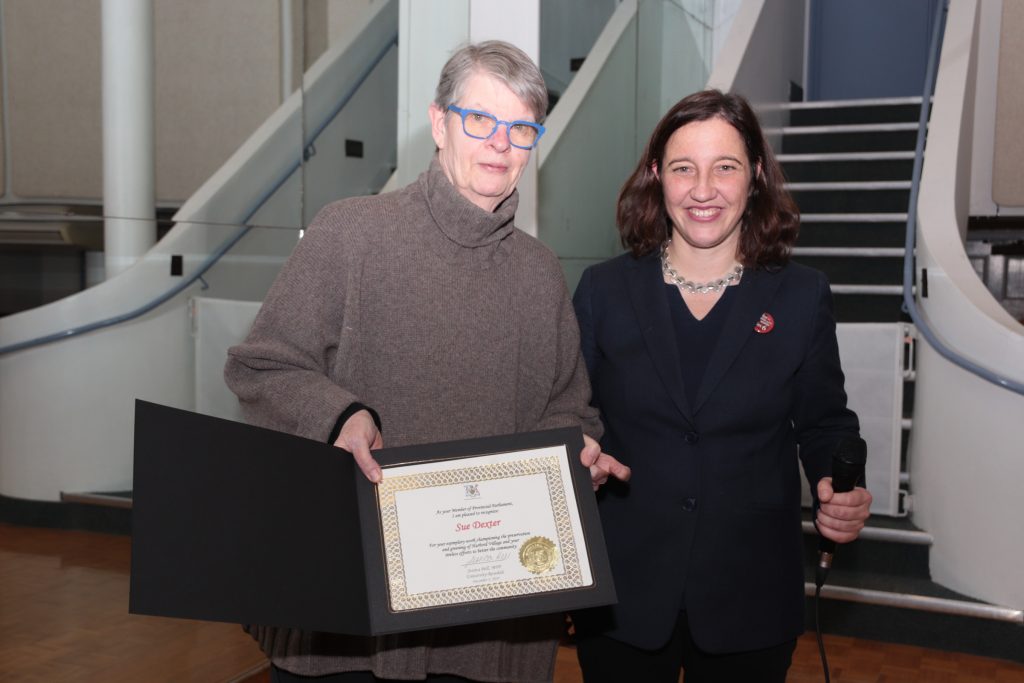
Sue Dexter (left), with Jessica Bell, has championed the preservation and greening of Harbord Village and worked tirelessly to better the community. COURTESY JESSICA BELL
This article is the second in a series about local residents making a difference in our community. These unsung heroes were brought to The Gleaner’s attention by MPP Jessica Bell, who honoured them at her Annual Community Celebration, in December of 2019.
By Nicole Stoffman
Susan Dexter loves a challenge, especially if it involves designing a system that could help slow climate change. These days she’s asking herself how to get Harbord Village to net-zero.
“Is it possible to get property owners to spend money to get rid of fossil fuels in their houses,” she wonders, “even though there will likely be subsidies and loans from the city and the feds?”
The likely answer is yes, if Dexter is on the case. A founding board member of the Harbord Village Residents’Association (HVRA) she co-authored the group’s Green Master Plan, which was passed into legislation and led to in-street planters at four intersections, with more village greening initiatives on the way.
Now she’s working with TranformTO to dramatically reduce Harbord Village’s carbon output through home retrofits.
“Sue is a leader in the work we all must take on to make our cities sustainable,” says MPP Jessica Bell, who honoured Dexter’s work at her recent Community Celebration.
Dexter also helped change the direction of Koerner Hall from north-south to east-west, which saved some of the forest in Philosopher’s Walk.
When the provincial government cut City Council, Dexter banded together with residents’ associations from across the city to protect councillors’ staffing levels.
“She puts in a lot of hours to try to understand the issues and find solutions,” says Councillor Mike Layton. “Although you might not always see them, Sue’s fingerprints are on many of the positive changes in our community.”
Susan Dexter’s activism began when she saw that construction of the Spadina LRT was hurting trees. She started working with Olivia Chow on tree policy. Soon after, she joined the U of T’s City Liaison Committee to represent local residents’ concerns about green space preservation on campus.
That’s where she was plucked for the HVRA board one day.
In the intervening years, the HVRA has completed two tree inventories, installed 30 solar home energy systems, cleaned up graffiti, completed an award winning oral history project, and won Heritage Conservation designation for 349 houses. “When a residents’ association is really working, it’s capturing the imagination of the residents,” explains Dexter. “It’s a very progressive and early-adopter community.”
Gail Misra, chair of the HVRA Board, calls her “the biggest thinker and doer in the community.”
Yet the ecologist and former journalist is not comfortable in the spotlight. “The main thing is it’s not about me, it’s about the people in my neighbourhood,” Dexter insists.
When pressed, she will admit that she understands policy. Her journalist’s ability to research complex problems and her love of the natural world born of childhood summers in the Gatineau Hills, inform her activism.
Journalism was the family business. Her father was legendary wartime political reporter Alexander Grant Dexter of the Winnipeg Free Press.
Over a 30-year career, Dexter wrote for the Globe and Mail, the Star, TVO, Maclean’s, and covered public affairs for the CBC.
In 1975 she moved to Washington with her husband John Young, an economist, who worked for the International Monetary Fund. Upon his death, she returned to Toronto and settled in Harbord Village. In keeping with her lifelong interest in the health of trees, she signed up to study botany at the University of Toronto.
Susan Dexter is optimistic about the future of local activism. She sees a “rising tide” among residents and residents’ associations.
“The journalists will have you think we’re just a bunch of NIMBYs who complain about development, but we do a whole bunch of other stuff that’s really trying to realize a city that’s prospering, functional, and environmentally responsible, with a creative class. These are huge issues.”
March 24th, 2020 · Comments Off on FOCUS: Legal weed dispensary opens on Bloor (Mar. 2020)
Tokyo Smoke location aims to educate consumers
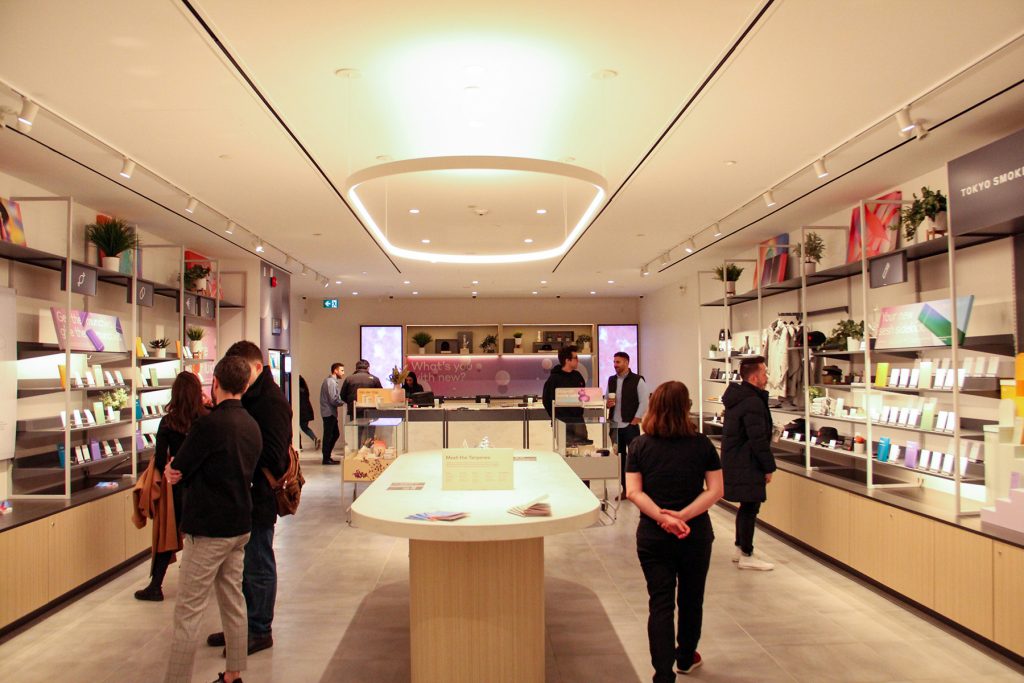
Resembling the Apple Store rather than a weed shop, Tokyo Smoke invested heavily in an interior design that it’s welcoming and facilitates it’s educational approach to the legal sale of marijuana. TANYA IELYSEIEVA/GLEANER NEWS
By Tanya Ielyseieva
The first legal marijuana dispensary has opened in the heart of the Annex just steps from Bathurst and Bloor.
The new Tokyo Smoke store is located at 570 Bloor St. W., just opposite the emerging Mirvish Village development; currently it is the largest location of Tokyo Smoke with 4,200 sq ft of retail space. The store features products from a number of growers including the first of its kind Houseplant brand as well as Tweed, Edison, Aurora among many others.
The Houseplant line is a Canadian cannabis company founded by Vancouver-born actor and director Seth Rogen, screenwriter Evan Goldberg, and partners, including United Talent Agency (UTA). It is owned in partnership with Canopy Growth Corporation. Under the terms of the partnership Canopy Growth will support and help scale the Houseplant’s success in their licensed sites, including Tokyo Smoke. Houseplant offers dried flower cannabis, pre-rolled joints, and softgel capsules.
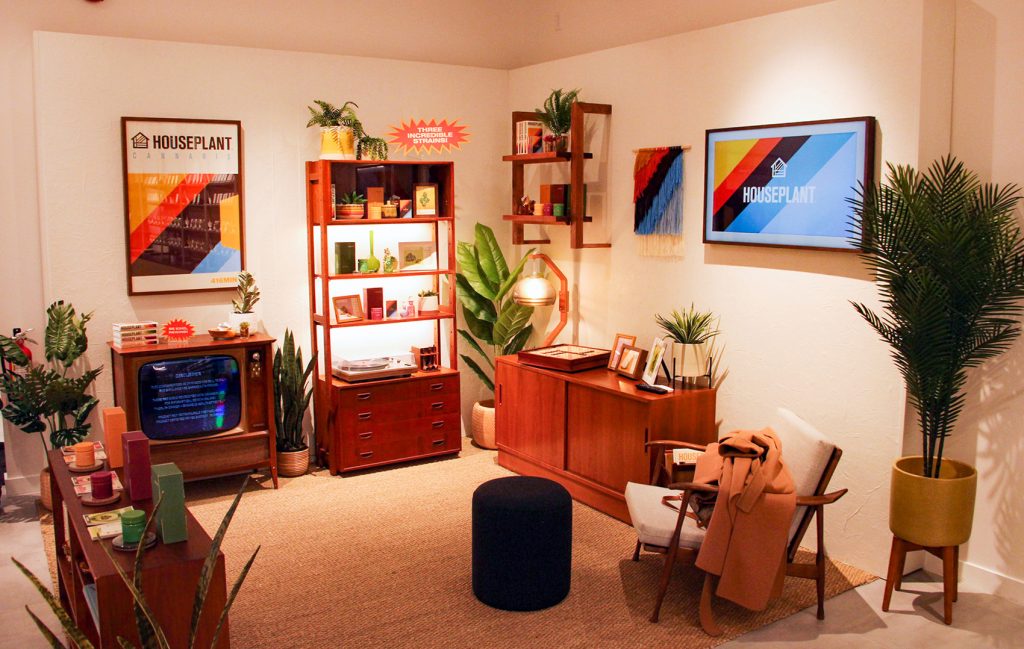
Houseplant, a brand of cannabis, designed the nostalgic living room pop up located right in the retails space. TANYA LELYSEIEVA/GLEANER NEWS
To further promote its brand in the store, Houseplant offers a pop-up lounge, complete with elements of a nostalgic living room, curated displays, and moments of discovery for guests.
In November 2019 Tokyo Smoke, owned by Canopy Growth Corporation, announced its intention to open ten retail cannabis stores across Ontario.
“As a company, we are pleased to see this progress in the Ontario retail market,” said Mark Zekulin, CEO, Canopy Growth, in the release by Canopy Growth Corporation. “Increasing our presence in Toronto and for the first time north of the GTA is an important step to building the Tokyo Smoke brand with an emphasis on consumer education and cannabis destigmatization.”
With Tokyo Smoke 333 Yonge at Dundas Square in Toronto and Tokyo Smoke Oshawa, this will bring the number of Tokyo Smoke retail cannabis stores in Ontario to a total of 12.
The store itself looks similar to an Apple store; it is stark and minimalist, with a few accents and pops of colour. There is a cannabis terpene (basically aromatic oil) podium in the centre of the store which, according to staff, “soothes the mind and the body”.
The store categorizes its products into five sections: Go (high energy), Rise (creativity), Equalize (balance), Ease (comfort), and Pause (relaxation). The sections are split into spray and oils, pre-rolled joints and capsules, edibles, and bud. Edibles have only recently been legalized for retail sale and are very popular among customers who are new to marjuana use.
“The idea was to create a community for creators where it was also a safe space for them to talk about cannabis and just educate, not consume, but just educate themselves,” said Melissa Gallagher, Director, Franchising at Canopy Growth Corporation, while explaining the goal of Tokyo Smoke.
In the store, the customer is greeted by an educator who can walk the person through the system and help them understand the difference between Sativa and Indica and how that can impact their experience.
Comments Off on FOCUS: Legal weed dispensary opens on Bloor (Mar. 2020)Tags:Annex
February 27th, 2020 · Comments Off on ON THE COVER: Enjoy your trip (Feb. 2020)
The first legal marijuana dispensary in the Annex, Tokyo Smoke, opened on February 12 at 570 Bloor St. W. (just west of Bathurst). Featuring a full-range of cannibus products including edibles. See the full Gleaner story soon on-line at www.gleanernews.ca or in the March edition. TANYA IELYSEIEVA/GLEANER NEWS
Comments Off on ON THE COVER: Enjoy your trip (Feb. 2020)Tags:Annex · News
February 27th, 2020 · Comments Off on NEWS: Affordable housing brought to Bathurst (Feb. 2020)
Feds invest $200 million
Due for occupancy in 2022, the redevelopment at Bathurst and Bloor by Westbank Corp. dubbed Mirvish Village, will house an increased affordable housing component thanks to a $200 million financial contribution by the federal government. COURTESY WESTBANK CORP.
By Tanya Ielyseieva
Last month we included a snapshot of thirteen major developments underway or pending with the Gleaner’s distribution area. In this edition we focus on eleven of those that include a large residential component and ask the question: “Are they affordable?”
Keenly aware of Toronto’s lack of affordable housing, the federal government came to Bathurst and Bloor in January to announce a major investment in the Mirvish Village development making many more units affordable.
On January 16, Mayor John Tory joined Deputy Prime Minister Chrystia Freeland and Ahmed Hussen, social development minister, to pledge $200 million to provide affordable rental units in the multi-tower Mirvish Village development. Hussen said the Mirvish project will ensure the location stays true to its roots as a new-immigrant and low-income hub.
“Today’s announcement reinforces our government’s commitment to creating homes that are affordable, energy-efficient, and accessible,” said Freedland. “By helping build communities such as Mirvish Village, where people can live close to jobs, schools, and public transit, we can make a meaningful difference in the lives of Canadians.”
Toronto Mayor John Tory said the project is a milestone in the battle for cheaper housing.
“Affordable housing has long been a challenge in our city, and it continues to be as big a challenge as ever today. Today shows how we can work together to actually start to make real progress in addressing that challenge.”
According to a study released by the group ACORN Canada, affordable housing in Toronto is defined as housing where the total monthly shelter cost (including heat and hydro) is at or below Toronto’s average market rent (AMR) by unit type.
The province of Ontario defines affordable housing as the least expensive of two variables: the first option demands that rent not exceed 30 per cent of gross annual household income for low- and moderate-income households, meaning households with incomes in the lowest 60 per cent of the income distribution for renter households for the regional market area. The second option demands that rent be at or below the average market rent of a unit in the regional market area, meaning the area generally broader than a lower-tier municipality that has a high degree of social and economic interaction.
According to Statistics Canada, the Annex population increased by 4.6 per cent from 2011 to 2016, and renter and owner households changed as well. Sixty-two per cent of households are rented, thirty-eight per cent are owned. The population of the Annex area will spike as these buildings are made available for occupancy.
Notwithstanding the significant stock of affordable units to be made available in Mirvish Village, the vast majority of the new towers are being built for the well-to-do. Below is a summary of each development, number of units, and base prices:
Bianca Condo – 420 Dupont St.
This new residential condominium is being erected at 420 Dupont Street. Bianca Condo will have 9 storeys and 216 units. This condo is self-described as a “perfect condo for university students”. However, the starting point for a condo is $1.3 million. No affordable units are included in this building.
Mirvish Village and Honest Ed’s – 581 Bloor St. W.
The Mirvish Village project is set to include 916 rental units, 225,000+ square feet of retail, offices, and community uses, along with public green spaces.
Six buildings will include 916 rental units, 366 of which will be affordable, costing no more than one-third the median Toronto income. The unit mix will include 279 studio apartments, 230 one-bedroom units, 284 two-bedroom units, 87 three-bedroom units, and 36 live and work units.
Of those, 100 will be secured at 80 per cent of the average market rate in Toronto – far less than the going price in the downtown neighbourhood.
Officials say that a one-bedroom “deeply affordable” unit will cost about $1,000 a month while the affordable units will be a little more expensive but still below market rate.
“We want mixed housing whereby the affordable units, the deeply affordable units, the market units, all of them are mixed together and will have the same design and the same quality,” Hussen said.
Hussen, who is also responsible for the Canada Mortgage and Housing Corporation, said the funding comes from a rental construction financing initiative.
Northwest corner Madison and Bloor – 316 Bloor St. W.
The new condominium is set to rise at 316 Bloor St. and will have 29 storeys. The development proposes 341 residential units consisting of bachelor units, one-bedroom and two-bedroom units. A minimum of 30 per cent of the building will be residential units varying between two and three bedrooms. The starting point for a condo is $1.5 million. No affordable units are included.
Northwest corner of Spadina and Bloor – 350 Bloor St. W
A new 36-storey development is a mixed-use building with spaces for retail, offices, condos, and rental units. The project is in the discussion process and hasn’t been approved yet.
666 Spadina Ave.
A new 11-storey mixed-use building with a total of 133 rental apartments and will have a new park at the north end of the site. It will be located south of the existing 25-storey building. A minimum of 30 per cent of the building’s units will be residential, varying between two and three bedrooms. The existing 25-storey apartment building contains 334 rental units. Based on the city’s Official Plan housing definitions, one unit is considered affordable, 258 units have mid-range rents, and 73 units have high-end rates.
The Waverly – 484 Spadina Ave.
A new 15-storey rental building will bring 167 “Class A” apartments, meaning luxury apartments and high rents. This project is positioned as a premium rental building offering the same level of amenities and suite finishes as high-end condominiums. The development proposes residential units consisting of bachelor units, one-bedroom and two-bedroom units. No affordable units will be included.
Theory Condos — 203 College St.
This new 30-storey building is a mixed-use development, featuring residential and commercial retail units. The development will house 356 residential units in total, including 60 bachelor units, 34 one-bedroom units, 146 one-bedroom-plus den units, 87 two-bedroom units, and 29 three-bedroom units. The starting point for a condo is $400.000+. Four units are going to be affordable rental homes. These units are 503, 601, 603 and 701 – all one-bedroom barrier-free units, measuring between 520 and 560 square feet. The units will be at or below 80 per cent of average market rents.
328 Dupont St.
This new 13-storey condo is a mixed-use condo which will have 104 modern units, between one and four bedrooms. ANX Condos will rise 13 storeys and will house just 105 private suites, which will include five one-bedroom units, 54 two-bedroom units, 36 three-bedroom or more units, and 10 four-bedroom units. The starting point for a condo is $600.000. No affordable units will be included.
300 Bloor St. W.
This new 28-storey condo development will have 259 units. The tower would include mostly residential use with a mix of 30 per cent one-bedroom units, 60 per cent two-bedroom and 10 per cent three-bedroom units. The starting point for a condo is $725.000. No affordable units will be made.
College Street at Huron – 231 College St.
This new 17-storey residential condominium building will consist of 142 residential units along with 4 retail units and a two-level underground parking garage. The starting point for a condo is $250,000. Two one-bedrooms will have no rent stipulation, at least two one-bedroom and two two-bedroom units will have affordable rents and the remainder will have no higher than mid-range rents.
Cost of housing is one of the main themes of any election campaign in recent years and in Toronto, where real estate prices and rents are extremely high, affordable housing is one of the biggest issues facing voters in the city. Mayor John Tory made big promises for the city’s housing plan when he announced a new affordable housing plan in December 2019.
The plan, which includes approving 40,000 new affordable rental homes, 18,000 new supportive housing units for vulnerable residents and, 10,000 new affordable rental and supportive homes for women and girls, is meant to help more than 340,000 households when it’s fully completed.
Despite the mayor’s aspirational goals, and the federal government’s meaningful investment in affordable housing at Bathurst and Bloor, there seems to be a landscape of housing being built in the Annex that most people could not afford to live in.
February 27th, 2020 · Comments Off on NEWS: U of T loses eight in plane crash (Feb. 2020)
Community mourns the deaths of students, staff
U of T flies its flag at half mast to honour victims of the shooting down of Ukraine International Airlines Flight PS752. BRIAN BURCHELL/GLEANER NEWS
By Tanya Ielyseieva
The University of Toronto has confirmed that eight members of the university community died in the crash of Ukraine International Airlines Flight PS752, on January 8.
The Kyiv-bound flight, which carried a total of 176 passengers including nine crew members and 15 children, was shot down shortly after taking off from Tehran Imam Khomeini International Airport at 6:12 a.m., local time. The plane crashed 15 km from the airport and the wreckage was strewn over a wide area, leaving no survivors.
Hassan Rouhani, the president of the Islamic Republic of Iran, later called the firing of the missile that brought down the plane a “disastrous mistake”.
According to the Ukrainian Foreign Affairs Minister Vadym Prystaiko, 82 Iranians, 63 Canadians, 11 Ukrainians as well as 10 Swedish, four Afghan, 3 German, and 3 British citizens were on board the flight.
The Canadian government later lowered the number of Canadians killed in the plane crash to 57. The total number of victims remained the same, at 176.
The route from Tehran to Toronto via Kyiv is a popular route for Iranian-Canadians. The stop-over in Kyiv is only four hours long while others last more than eight hours, and the price is two times cheaper for Ukrainian Airlines than for any other airline.
“Many of the passengers on this flight were university students, faculty, researchers, alumni, and other members of Canada’s academic community. This heartbreaking loss is truly a national tragedy,” said president of the University of Toronto Meric Gertler.
The released statement from the University of Toronto confirms the identities of these students:
Mojtaba Abbasnezhad was a first-year international student doing his PhD in engineering, as well as a teaching assistant for a second year course on digital systems. His friends called him Sorush.
Mohammad Asadi Lari, PhD student in the Faculty of Medicine, and his sister Zeynab Asadi Lari, who was in her fourth year pursuing a Bachelor of Science at UTM, both died on their way back to Toronto after visiting family.
Mohammad was involved in numerous youth- focused activities through his efforts with the Canadian Commission of the United Nations Educational and Cultural Organization (UNESCO), and the Canadian Red Cross. Zeynab was an advocate for mental, public, and global health; her friends recalled that she always followed up her ideas with action.
Mohammad Amin Beiruti, was a PhD student in the Department of Computer Science. Born in 1990, he was determined and focused on his academic goals but took the time to mentor undergraduate students and help them with their research projects.
Mohammad Amin Jebelli MHSc was a candidate in the Faculty of Medicine’s Translational Research Program. He had practised medicine and served as a medic in Iran after graduating from the Tehran University of Medical Sciences with a doctorate in medicine. He was due to graduate from the U of T program later this year.
Mohammad Salehe, a PhD student and researcher in computer technology, and his wife, Zahra Hasani, also a U of T student, both died in the crash.
Mohammad Mahdi Elyasi was studying MSc mechanical engineering and was a researcher at the U of T’s Institute of Aerospace Science.
“Many members of our university – and many across the GTA and Canada – have been directly affected by this tragedy,” Gertler said. “We are all heartbroken.”
The University of Toronto hosted vigils on campus and around the city to remember those who lost their lives in the Ukraine International Airlines crash. The Centre for International Experience held a support drop-in, where people could come together to remember and find support.
“Many people were touched by this kind of tragic loss. So, for us, this is a way of supporting our community in their grief and to offer the opportunity to come by, talk to somebody else who’s been affected. It’s just a way of showing that we care for and with each other,” said Katherine Beaumont, U of T’s Senior Director of Global Learning Opportunities and International Student Success.
The University of Toronto has launched the Iranian Student Memorial Scholarship Fund.
This fund will provide needs-based scholarships for both graduate and undergraduate students from Iran, or students from any background pursuing Iranian studies at U of T.
According to the University of Toronto statement, donations to the fund will be matched by the university. The first $250,000 will be matched at an effective rate of 3:1, with all funds beyond that threshold to be matched dollar-for-dollar.
“With the creation of this scholarship we hope to honour the memory of those we have lost by helping students from Iran pursue their studies at U of T and by supporting students of all backgrounds who are interested in exploring Iranian studies,” Gertler said.
Comments Off on NEWS: U of T loses eight in plane crash (Feb. 2020)Tags:Annex · News