COVID-19 has changed our world. Many of us are anxiously living in private, reading our screens, and feeling helpless. At the same time, the essential workers among us are working overtime to keep us fed and safe. They are our farmers, our scientists, our truckers and cleaners, our midwives, postal workers, doctors, and supermarket staff. We see you and appreciate you all.
“The pandemic has laid bare the utter unfairness of our economy on so many people,”
Jessica Bell, University-Rosedale MPP
Our phones have been ringing off the hook as we grapple with the pandemic and its impact on our health care system, our economy, and way of life. We get calls from residents who can’t pay rent and fear eviction. From workers who are being told they must work even though their workplace doesn’t enforce physical distancing. From health workers who don’t have enough personal protective equipment. From residents who want the construction near their home to stop. From seniors who can’t leave their home and are relying on the kindness of strangers. This is a very hard time, and the worst is yet to come.
I have been looking for insight to help me draw meaning and comfort, and this is what I have found so far:
The pandemic is bringing out the best in humanity. Volunteers have stepped up to create local neighbourhood pods to leaflet their neighbourhood and then help people who need it. We care about each other, and my hope is this deepening compassion for our neighbours lives well beyond this time.
The decline in car and airplane traffic is something I have never seen before. I am savouring the clean air and the quiet streets. It is true that this peace has come about through our temporary forced hibernation, but even so it is letting us imagine what our cities could be and what we are capable of. If we can reduce air and car traffic for a pandemic, we can take these kinds of steps to tackle a climate crisis that threatens our very future.
The pandemic has laid bare the utter unfairness of our economy on so many people. Deena Ladd, the executive director of the Workers Action Centre, explained it well when she talked about the working conditions of janitors on the CBC. During COVID-19 janitors are doing the invisible work of helping stop the spread of the virus, and we treat them so badly for doing so. Many janitors get minimum wage or less, they have no access to benefits, like paid sick time, they have less money saved for hard times, and many are not even eligible for government help if they are fired because some have no social security number.
What is true for janitors is also true for many of the low-paid workers who are keeping our economy on life support, from our delivery drivers to our security guards. They are overwhelmingly poor women of colour. As we recover from this pandemic, I hope more of us will work to make our economy fair. For a start, that means demanding governments raise the minimum wage and guarantee decent benefits for all.
Someday soon things will come back to normal. It will be easier to be happy again. My hope is that when we look back we will remember this period not just for its boredom, anxiety, horror and grief, but also for it being a turning point where humanity changed for the better.
Until then, stay home, wash your hands, and practice physical distancing. You are saving lives.
Please contact our office at 416-535-7206 if you want to know what all levels of government are doing, what we are advocating for, or if you want to receive or provide help to others.
May 1st, 2020 · Comments Off on NEWS: Clinton’s Tavern on Bloor closes after 83 years (Apr. 2020)
The tavern that’s been serving the west-end community with drinks, dance parties, and DJ nights announced in mid-February it will close permanently.
In a post to social media pages, Clinton’s Tavern announced its sudden closure.
“Clinton’s has always been a bar with a lot of heart. The people who have worked at Clinton’s throughout the years have shown incredible loyalty to this place. Unfortunately, we have some sad news to share. Clinton’s has closed,” the statement reads in part.
According to the staff’s statement, the closure appears to be permanent and was not related to issues with the landlord, but with the owner of the bar.
“Behind the scenes we’ve been fighting a tireless battle to keep our doors open – trying to push beyond lies and greed, trying to ignore the carelessness of the owner, and trying to work for each other because we all loved Clinton’s fiercely. We rallied together to do whatever it took, often without pay, to keep things going,” the post reads.
All scheduled events were cancelled or relocated, including Choir! Choir! Choir!, a singing event hosted at Clinton’s every Tuesday. Choir! Choir! Choir! has since held a fundraising event for the staff members “who are not only owed a lot of money but are also for now, out of work.”
“Clinton’s closure is part of a larger trend. Across Toronto, local and independent businesses are struggling to survive,” said MPP for University–Rosedale Jessica Bell. “The closure of an institution like Clinton’s is a big loss.”
Bell expressed her support to the hard-working staff and management of Clinton’s Tavern.
—Tanya Ielyseieva, Gleaner News
Comments Off on NEWS: Clinton’s Tavern on Bloor closes after 83 years (Apr. 2020)Tags:Annex · News
May 1st, 2020 · Comments Off on FOCUS: Apartment plan for Huron Street meets opposition (Apr. 2020)
Maintaining historical built-form at odds with need for rental units
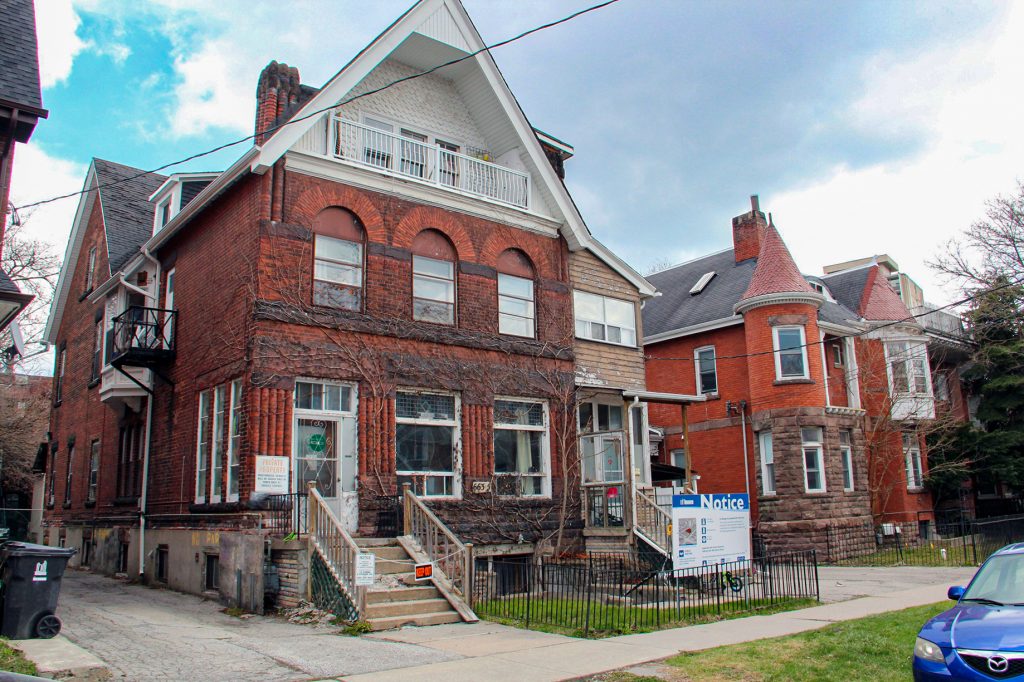
Heritage conservation activists oppose the demolition of this classic Annex home to allow for the building of an apartment complex. TANYA IELYSEIEVA/GLEANER NEWS
By Tanya Ielyseieva
The demolition of classic Annex houses built in the late 1800’s will be required in order to build a proposed four-storey apartment building with 48 new residential units at 661-665 Huron Street. While the proposal aims to address housing affordability, it is drawing criticism from local residents and Heritage conservation advocates.
The Annex Flats would replace single-family homes at 661-665 Huron Street with a total of 19 rental units in two buildings including 12 one-bedroom units, 6 two-bedroom units, and 1 three-bedroom unit.
“Rental accommodations are essential in attracting new, talented labour streams that contribute to a city’s upward trajectory,” says the developers, Originate Developments Inc., in a statement. “In Toronto, quality rental properties are in dramatically short supply. With Annex Flats, our vision is to address this need with personality-rich accommodations ideally suited to the area’s student and arts/culture populations.”
Sandra Shaul, Chair of Heritage Conservation for the Annex Residents’ Association (ARA), said that the project developers first approached the ARA to collaborate on July 3, 2018. After meeting with city planners, the developer revised the project design and presented again on April 2, 2019. Several improvements had been made (circulation, parking, deliveries, unit sizes, Huron facade), but Heritage Preservation Services needed to be consulted before a formal application was made. The developer did not contact the ARA again and simply submitted a formal application on Nov. 22, 2019, according to Shaul.
“There are good ways to intensify and they require a certain amount of imagination. And there are less good ways. And I would say that this building would simply take down houses, in my opinion unnecessarily, and replace them with a building that albeit at only four storeys is still out of character with the neighborhood,” said Shaul. “But you do want to build in ways that through the massing and the height, you can create something that is new, but fits in with the rest of the streetscape and doesn’t destroy it.”
According to Shaul, the developer brought a heritage architect for an assessment of the buildings.
“They basically discounted these houses because they are not by known architects, [decided that] they’re not a special interest to the street and essentially ignored the continuity they give to a heritage streetscape,” she said.
The application to the City of Toronto states that both properties comply with the designation criteria laid out in Ontario Regulation 9/06 but states that their integrity is “degraded”. The application proposes their demolition but recommends that they are commemorated with an internal display in the new building and by a plaque on the exterior.
According to Originate Development Inc., Annex Flats will feature “an exterior of red and black brick, plus rich medium-brown wood and black stainless-steel accents, it comfortably fits within the Annex community fabric while making a distinctive architectural statement”.
“I think the developer felt that by keeping it to four storeys, which is still considerably taller than the buildings on either side. And by sloping the roof a bit, he is paying homage to the historic buildings,” said Shaul. “And that’s where we disagree.”
“Some of us have called this home for over twenty years; and we believe that it would be a shame to tear down such a unique structure, and replace with a very modern-looking complex, with much higher rents,” said Catherine Tramsek in an email to the Gleaner.
Comments Off on FOCUS: Apartment plan for Huron Street meets opposition (Apr. 2020)Tags:Annex · News
May 1st, 2020 · Comments Off on FOCUS: Keeping beloved market “cool”? (Apr. 2020)
Kensington BIA hones its market masterplan
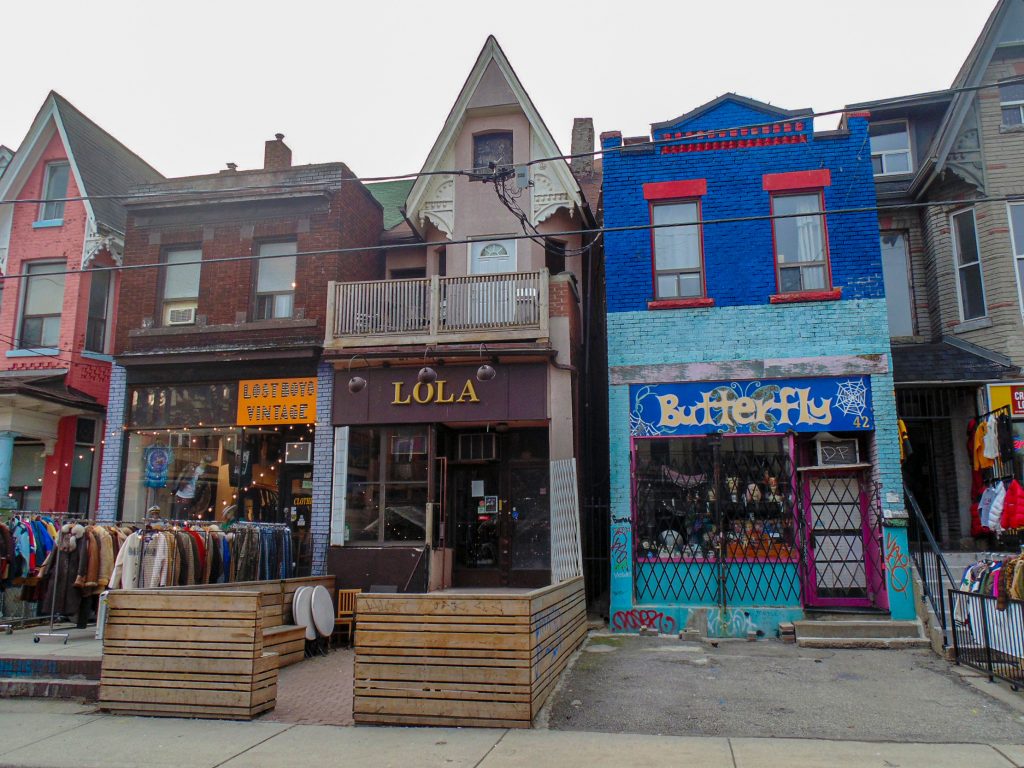
A new masterplan aims to achieve what Kensington Market has already mastered, says one resident. KHYRSTEN MIERAS/GLEANER NEWS
By Khyrsten Mieras
Before the pandemic, the Kensington Market BIA held an open house to share and adjust their Public Realm Masterplan. The goal of the plan is to provide a community-driven framework that will create positive change for Kensington Market’s public spaces while prioritizing equity and inclusion.
Sumo Projects, along with Gladki Planning Associates, Greenberg Consultants, and PMA Architects, developed the masterplan after a year of consultation, planning, and design. During the process, several meetings took place with stakeholders, the BIA, and Councillor Mike Layton.
Overall, the plan aims to improve many aspects of Kensington Market, including streets, sidewalks, green spaces, waste management, lighting, and parking for cars. It will also expand and enhance bike and pedestrian areas. However, consultants at the open house clarified that the plan is not final; it is a framework of ideas to kickstart the process for improving the neighbourhood.
Gaston Soucy, an urban design consultant for Sumo Projects, has worked closely with the BIA over the past year to create a plan that benefits the Kensington Market community.
“Kensington Market is a very, very beloved place, not only by the residents but also by the entire city,” said Soucy. “It is important to put a plan in place that can help protect the market or at least allow it to grow in a manner that is similar to the way it has been growing so far because there [are] a lot of external pressures… that could potentially damage the market.”
The open house featured a discussion with vision boards of the plan for the community to give their feedback on. Macro ideas for the plan are: decluttering the streetscape, implementing an urban tree system, enhancing the existing lighting system, improving the public waste bin disposal strategy, introducing curbless streets, and integrating historical values. Micro ideas consist of physical improvements like lighting, seasonal greenery, temporary seating, art, as well as activities and event programming for different audiences.
Many local business owners and residents who attended the meeting offered their thoughts and suggestions for improving Kensington Market. Some of these community members were looking for a change, while others wanted to keep the market the same.
Molly McGregor, a student at Ryerson and a long-time resident of Kensington Market, was unhappy with the negative impacts of the plan.
“This masterplan is trying to achieve what Kensington Market has already mastered, which is to create a positive sense of community and really beautiful foot traffic,” she said. “It’s going to be a huge disruption to the life of the area. This kind of construction is unnecessary and will take up way too much time, money, and resources.”
Gwen Bang, the new BIA chair and owner of Lola, a bar and restaurant in Kensington Market, noted that the masterplan was created to protect the future of the neighbourhood. She said that protection should focus on the area’s residents and the success of its businesses year-round.
“I feel that the BIA should care about its members by way of sustaining the businesses in the area as well as keeping with its maintenance projects if there are any, and safety. But really sustaining businesses throughout the seasons, not just the summer,” she said.
“My main goal now is to provide the transparency for everyone, for all the organizations and everything else, bridge everything together, and help our streets and help our businesses.”Final steps for the masterplan are ongoing and amendments are being made based on community input from the open house.
Comments Off on FOCUS: Keeping beloved market “cool”? (Apr. 2020)Tags:Annex · News
May 1st, 2020 · Comments Off on LIFE: Portable potable vegetables (Apr. 2020)
What to plant in your container garden
In May 2020, the Annex Gleaner celebrates 25 years of publishing. In acknowledgement of this history we are republishing highlights of our past; this feature, Portable potable vegetables by gardening columnist Bardi Vorster, is from May 1998. As spring is here this advice is timely.
By Bardi Vorster
There is a unique pleasure to growing your own food. The double reward of watching plants grow and then savouring the harvest is especially satisfying. A pinch of fresh sage or a snip of chives will enliven any boring dish and growing your own veggies is the best way to discover the real meaning of freshness.
An acre is not necessary; planting herbs and vegetables in containers is a great way to try a variety of comestibles on even the smallest balcony. Containers make it possible to cater to the exact soil requirements of each plant and separate them if invaded by pests. Contrasting foliage such as sage and parsley and purple basil is delightfully decorative. Try a lemon tree or a rosemary bush and it can double as a house plant in the winter.
The planter environment
Plant life in a pot is somewhat different from life in the ground. Porous clay pots will dry out more quickly than plastic or metal containers. Adding peat moss to the planting mix will help retain water as will mulching if there is soil showing before the plants fill out. Because pots need more watering, they also need regular fertilizing. It’s a good idea to check nutrition requirements for each type of plant you grow as preferences vary.
The smaller volume of soil means greater temperature fluctuation. Roots need a cooler than air temperature in the heat of our summers. Consequently, thin metal containers may need insulation to allow optimum growth. This can be done most easily by using a plastic pot as a liner, or bubble wrap (around the sides only).
Good drainage is critical, and to this end all pots should have a drain hole. Cover holes with landscape fabric or a piece of J-cloth before filling the pot with soil, which will prevent soil but not water from washing out. Containers without holes can be used as pot covers but be sure that plants do not stand in water.
Another consideration is portability. If you are growing something that must be moved inside for the winter, or during the season, permanent casters or a dolly will make life easier.
Probably the most useful size pot for growing vegetables is the five gallon one. Peppers need 12-inch depth and 15-inch diameter for each plant. Herbs will be fine in smaller pots but 6-inch would be a minimum. A grapefruit tree would need a 10-gallon pot – with wheels and long term commitment!
Most suitable plants
There are some vegetables which are not suitable for growing in containers; corn, potatoes, winter squashes, or grains take up too much room. Broccoli does not develop properly indoors. Brussels sprouts are slow and difficult.
Varieties should be chosen for their date to maturity, unless you want to start them indoors or extend the gardening season by taking them inside in the fall. Summer squashes such as early prolific, fordhook, or early white bush will mature in approximately 60 days. Bush beans delinel, tendergreen, and eureka wax are fast growers. The seed germinates in four to seven days and the beans are ready in approximately eight weeks. Date to maturity is usually found on the seed package.
Dwarf varieties are the most useful. Sometimes several can be grown in one large container. For example, dwarf modern lettuce produces heads about the size of tennis balls.
I’ve always liked eggplant because the plant is attractive. I recently discovered that it is actually a perennial which can live for four to six years. It is very sensitive to frost so it would be a good candidate for keeping over the winter. Remarkably, the dwarf plants produce full size fruit.
Apart from the above mentioned unsuitables, many other vegetables have been successfully grown in containers; as long as you group plants with similar requirements, I don’t see why you shouldn’t try anything.
Herbs are even easier. Most do not have special soil requirements. Many prefer drier, sandy soils and are happy being pot-bound. There are always exceptions such as parsley which prefers a rich, humus mix.A very important component is the quantity and quality of light for growing herbs and vegetables. Full sun is always best, however, part-shade is tolerated by some. If your area is less than perfect, stick to salad greens and herbs for foliage. The plants which don’t have to spend their energy on producing flowers and fruit have the lowest light needs.
Comments Off on LIFE: Portable potable vegetables (Apr. 2020)Tags:Annex · Life
At your fingertips and while in your pjs – enjoy it!
By Meribeth Deen
We’re a month into the new COVID reality, so at this point, you’ve either re-shaped your life entirely and decided to stay inside forever, or you are going absolutely bananas staring at your own four walls and talking to your cat. We’re obviously not going to tell you to hit the town, or tell you how to spend your time in general, but we are here to remind you that opportunity abounds. So many of the organizations affiliated with the Bloor Street Culture Corridor have stepped up to find innovative ways to keep connecting to the city. This might be the moment where the internet takes over our lives, and this might be the beginning of a whole new artistic and community flourishing. Either way, offerings are changing and shifting as quickly as COVID news, so make a point of staying up to date. Facebook and Instagram are your new best friends for doing so… now let’s get you inspired.
At this stage you are probably sick to death of whatever streaming service you watch TV and movies through, so don’t forget about Hot Docs, which normally screens films at the Ted Rogers Cinema. Their collection is available through a number of services, including Apple TV, Crave, Encore, CBC Gem and more. There are hundreds of films available, screened at past festivals and at the Ted Rogers Cinema. Look up Hot Docs at home for staff picks, trailers, and information about where to watch these documentaries.
Check in with the Music Gallery’s Facebook page to find out about live-streamed performances and talks on Mondays and Fridays. Done in collaboration with the Canadian Music Centre, the interviews (Mondays) highlight creative individuals, veterans, and elders who stand out in Toronto’s musical history. On April 27, Suba Sankaran will interview Professor Trichy Sankaran, percussion virtuoso, Indian music scholar and producer as well as the founding director of Indian music studies at York University. Friday evening (7pm) performances are being built around an instructional piece by Xuan Ye, adapted from a piece she couldn’t perform in person. The goal of these events is to connect artists who might not otherwise get the chance to work together, and bring the spirit of community and experimentation into people’s living rooms.
Pick up the phone for a unique theatrical and cultural experience offered by Instituto Italiano de Cultura and Dopolavoro Teatrale (DLT). The two have teamed up to create an intimate and immersive experience at a distance with Theatre On Call. “The goal of Theatre On Call is to become somewhat of a counter-virus that spreads and generates artistic responses, supporting the two categories of people that immersive theatre brings together best: artists and audiences,” explains DLT. One such experience can be booked at any time and goes on for six days: How to Improve Life in Your Living Room with DLT artists Franco Berti and Violante Binazzi, offers tips about artistically capturing life’s moments and involves daily tasks. Other performances shift regularly, so check out the Instituto’s Facebook page. All offerings occur on a pay-what-you-can basis.
Now, if your body can’t get outside and stretch, at least your brain can. Learning a language is a great way to do it, and Alliance Francaise is making it easy. Not only are all courses now being offered online, their Facebook page is highlighting their instructors favourite online learning portals and unique opportunities like “speak dating,” to practice your language skills – for free.
The Toronto Reference Library, like all libraries, is closed to the public. Keeping up with library updates is a great way to stay positive, though. Not only has the Toronto Public Library partnered with local food banks to turn branches into food distribution centres, they have also loaned out 3-D printers to a team at Toronto General Hospital to produce personal protective equipment for frontline healthcare workers. Plus, TPL Digital Services has put out a guide to 38 Ways to Use the Library From Home. There are a ton of resources for kids, including online tutoring for students between kindergarten and grade 12 and dial-a-story, which offers stories for kids in more than 16 languages. There’s also access to movies, music, book clubs, and e-books for all ages.
When you’re done with putting information in your brain, it’s time for output, and the Bata Shoe Museum is there to help. Every week, they’re putting out sneaker-themed drawing prompts aimed to spark imagination and creativity. They’ve also got colouring sheets based on shoes in their collections. As you might expect – they’re hoping you will share what you make.
The Miles Nadal Jewish Cultural Centre has lots of online happenings for everyone, but plenty of fun for kids in particular. They’ve hosted online pre-school aquatic bingo, a show with Lost & Found Puppet Co., and of course Shalom Sesame, with Passover Grover. Check out their Facebook site for more upcoming fun.
All this goes to show that Toronto’s artists and cultural institutions are still there for you, and if you can’t come out of this thing smarter, at least you’ll come out of it cross-eyed. So don’t forget to stick your head out a window, and breathe in some unusually fresh Toronto air. Stay safe and stay healthy.
April 16th, 2020 · Comments Off on LIFE: Two wheels keep on turning (April 15, 2020)
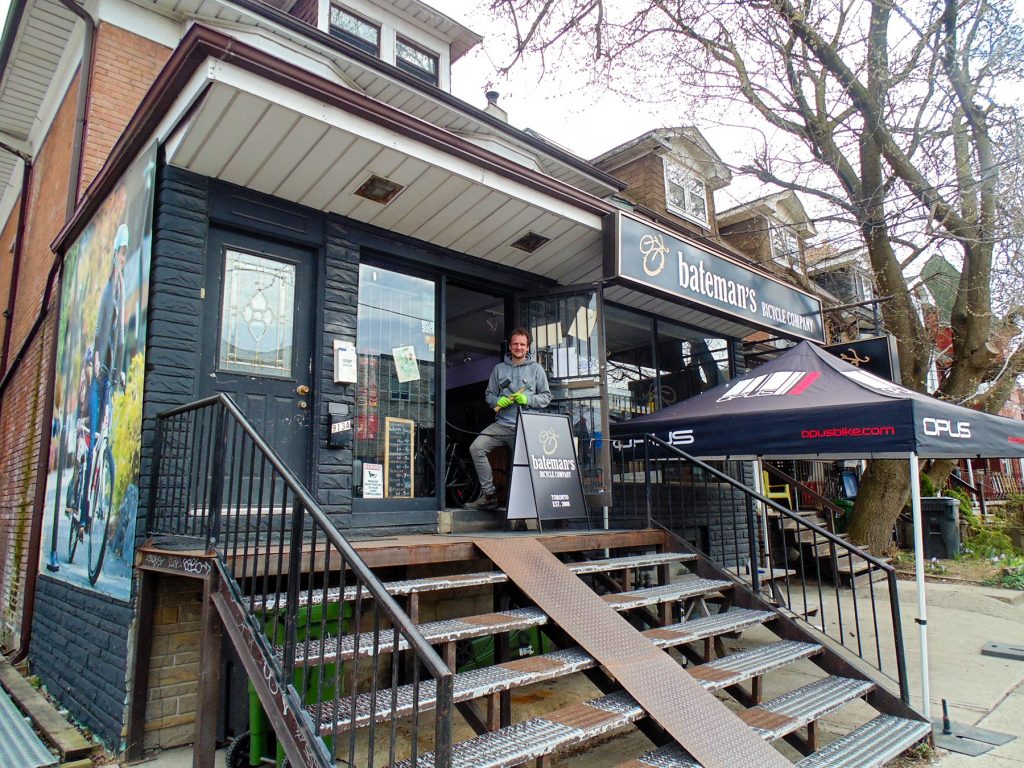
Robert Bateman poses outside his Bathurst St. shop. BRIAN BURCHELL/GLEANER NEWS
Bike repair shops take “essential” classification seriously
By Brian Burchell
News that the provincial government had declared bicycle repair shops an “essential service” during this crisis came as a welcome surprise to area bike shops and cyclists alike. The Gleaner contacted four of these businesses to find out how customers can support these important outlets and also get their bikes serviced for spring while keeping a safe distance.
Bateman’s Bicycle Company is keeping one location open for business, its flagship store at 913 Bathurst St. Owner Robert Bateman welcomes the challenge, “Our mandate is to keep our customers safe while providing our essential service. We will be focusing on what matters most, keeping cyclists moving safely and supporting those seeking an alternate to public transit.” Their Express Shop on Dupont and the Top Shop and Rentals, also on Bathurst are closed for now. Bateman’s can also ship product directly through online shopping at: https://www.batemansbikeco.com/ . If you want your bike repaired they request you knock on the door; a mechanic will come outside to collect your bike keeping a safe distance from you. (416) 538-2453
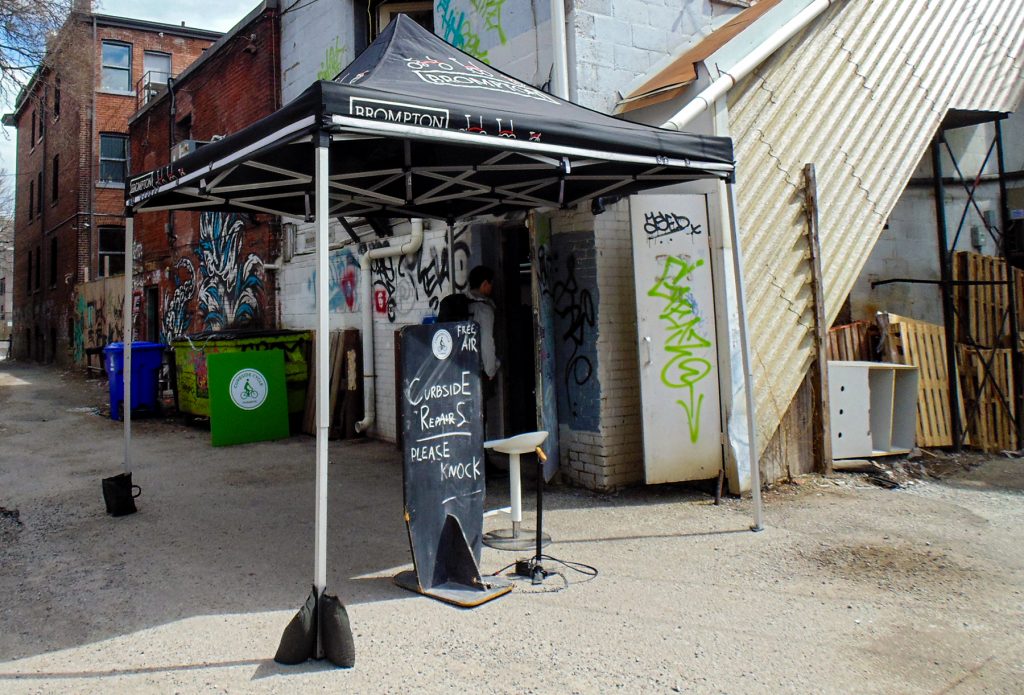
Curbside offers service behind their Bloor and Brunswick location. BRIAN BURCHELL/GLEANER NEWS
Curbside Bike Repair located at 412 Bloor St. West is open for repairs and online sales. Though they are locked, knocking on the door Tuesday to Friday from 2-5 pm or Saturday 12-5 pm, will get you service. In the alleyway behind the store a tent is erected where they are able to safely pass bikes in and out of their repair facility. More info is available at https://curbsidecycle.com (416) 920-4933
Dave Fix My Bike located at 254 Christie St. has been keeping Annex residents’ bikes safely rolling for 28 years. Dave is pleased to look after your bike during this crisis and has adopted a similar knock-on-the-door approach to help keep everyone safe. Dave’s shop is open Tues 12-6, Thurs 12-8, Fri 12-8, and Sat 12-6. (416) 944-2453
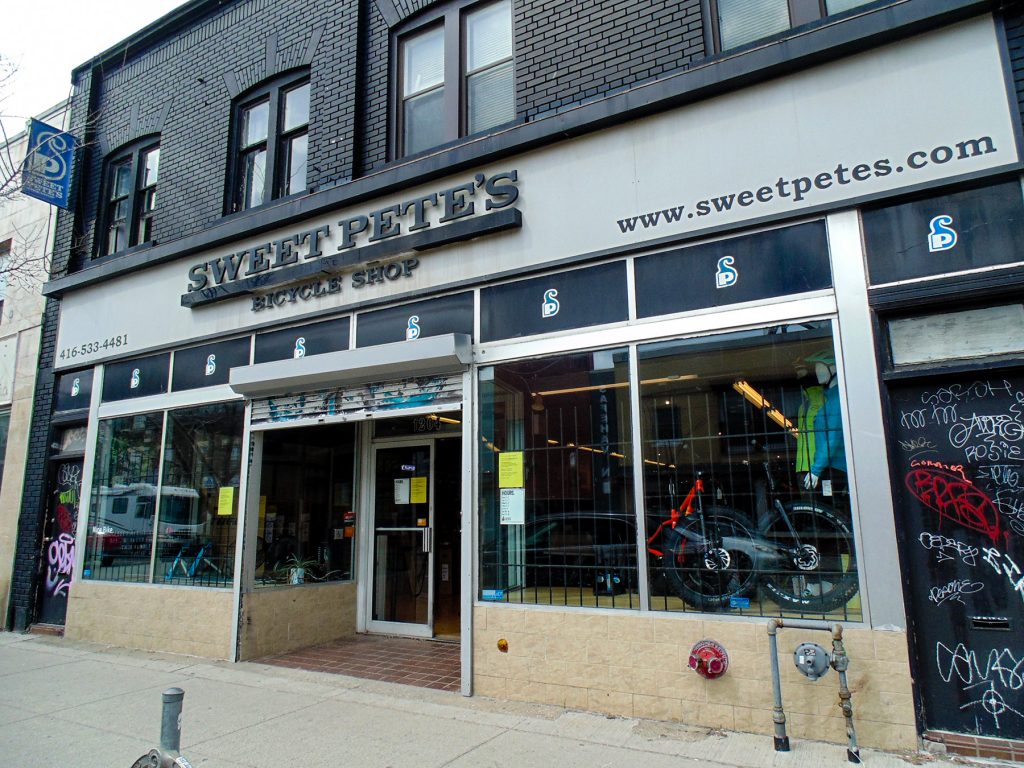
Sweet Pete’s Annex location may be closed but they’re open just down the street at 1204 Bloor St. W. BRIAN BURCHELL/GLEANER NEWS
Sweet Pete’s Bike Shop has closed it’s Annex location for now but is operating at 1204 Bloor St. W. Though their showroom is closed, the online store is open with free shipping on any purchase over $100. Visithttps://www.sweetpetes.com . Repairs can be booked over email at info@sweetpetes.com . No drop-offs will be accepted without an appointment. A staff person is available at the door to safely accept or deliver your repaired bike to you. Operating hours: Mon-Fri 11-7 pm, Sat 10-6 pm, and Sun 12-5 pm. At this time, Sweet Pete’s will not be accepting phone calls.
March 24th, 2020 · Comments Off on ON THE COVER: Order in (Mar. 2020)
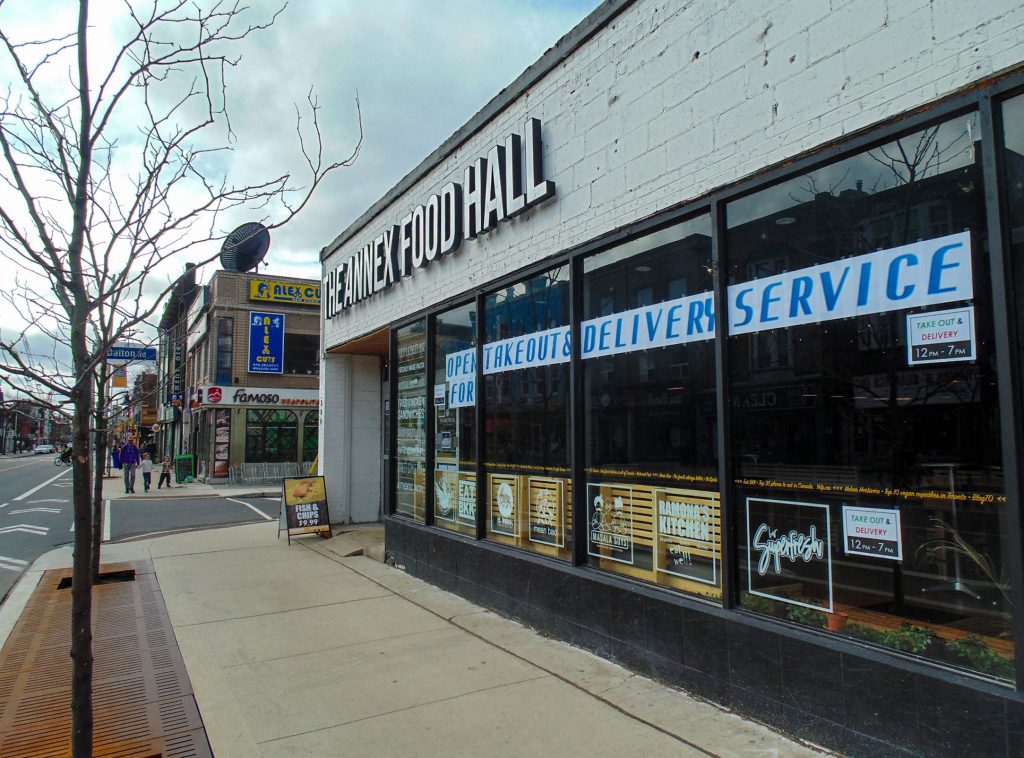
The provincial response to global pandemic COVID-19 forced the closure of sit-down restaurants and bars. Many Bloor Street restaurants, like the Annex Food Hall pictured above, are trying to keep going by offering take-out and delivery services.
BRIAN BURCHELL/GLEANER NEWS
Comments Off on ON THE COVER: Order in (Mar. 2020)Tags:General
March 24th, 2020 · Comments Off on NEWS: Local resources for a global pandemic (Mar. 2020)
An early guide to services
By Gleaner Staff
Staying local, living local, and shopping local is going to be the new normal in the coming weeks as the world hunkers down to battle the 2019 novel coronavirus (COVID-19).
As your local newspaper, we’ve put together this guide to Annex resources that will help you stay healthy and informed. Please note the following references to hours of operation and services were valid at time of press and may change at any time. The Gleaner will strive to keep this updated and current online, at gleanernews.ca.
The basics
Both the City of Toronto and the Province of Ontario have declared a state of emergency. Please stay home, wash your hands, take care of yourself and your loved ones. If you have to go out, practise safe social distancing, wash your hands frequently, and return home as quickly as you can. Follow the City of Toronto dedicated website for the most up-to-date information: www.toronto.ca/home/covid-19/ or the Province of Ontario’s: www.ontario.ca/page/2019-novel-coronavirus.
If you meet any of the criteria found there, contact your family doctor or Telehealth Ontario at 1-866-797-0000. Let them know you used the province’s self-assessment tool.
If you have severe symptoms like shortness of breath, chest discomfort, lethargy, drowsiness, weakness, or dizziness, go to your nearest emergency department.
There are three COVID-19 assessment centres that are near to the Annex:
If you are not well enough to take personal transportation, call 911.
The doctor is in
For medical issues unrelated to COVID-19, please reach out to your primary care provider or family doctor. Many are now offering virtual appointments. If you don’t have access to a family doctor there are several walk-in clinics still open:
GSH Medical – 481 Bloor St. W., second floor: open for people with non-flu like symptoms. They are also offering virtual appointments that can be set up by calling 416-928-0217 or emailing annex@goldstandardhealth.ca. There is no cost for this service, you don’t need to be an existing patient, and they are accepting all requests at this time.
Downtown Doctors Walk-in Medical Clinic – 720 Spadina Ave., #100: still open for walk-ins. You can also call them to set up a phone appointment at 416-929-1530.
Watson Medical Walk-in Clinic, located inside Snowdon Pharmacy at 264 Bloor St. W., is asking clients to call 416-962-7304 to schedule a phone appointment. They will take your information, healthcard details, and arrange for an appointment.
Please remember, if you are experiencing any flu symptoms, don’t go in person to either walk-in clinic, please call first.
Pharmacies
The following pharmacies in the Annex are still open, and many offer special hours or delivery:
Snowdon Pharmacy – 264 Bloor St. W.: offering delivery to seniors and at-risk customers. 416-922-2156.
www.snowdoncompounding.com
Rexall – 481 Bloor St. W.: dedicating the first hour of shopping exclusively to those who are 55 and older. 416-929-8213
Rexall – 474 Spadina Ave.: encouraging shoppers to allow seniors access to the first hour but will serve all who are in need. 416-413-1060
Pharmasave Spadina Medical – 720 Spadina Ave., #100: offering some local delivery. 416-929-7000
Green Pharmacy – 620 Bloor St. W.: open with their regular hours. 416-530-4004
Loblaw Pharmacy – 650 Dupont St.: free delivery, open to seniors only from 7 a.m. to 8 a.m., pharmacy opens at 8 a.m. 416-588-4793
Shoppers Drug Mart – 360a Bloor St. W.: phone orders, free delivery. 416-961-2121
Shoppers Drug Mart – 292 Dupont St.: phone orders, free delivery. 416-972-0232.
UT?Pharmacy +?Print – 193 College St.:?open regular hours and weekends. Phone orders, free delivery, 647-351-1708.
Need a hammer, nail, or tool? With so much time at home, there’s time to tackle all those home repairs. Wiener’s Home Hardware at 432 Bloor Street West is open from 10 a.m. to 5 p.m., and is taking extra measures to protect staff and customers.
They are asking customers to limit foot traffic to one person per family in the store. They can also help you over the phone: 416-922-7043. MARCH 24 UPDATE: Wiener’s Home Hardware is temporarily closed. You can find updates on their instagram feed here.
Groceries
There’s no need to panic shop, as retailers’ supply chains are still operating, with many offering delivery and seniors’-only shopping hours.
“Supply chains across Canada are strong. There are no food shortages – just some empty shelves due to a sudden rush in shopping. Rest assured that items will soon be re-stocked,” said the Retail Council of Canada in a recent tweet.
Pets still need care
Annex Animal Hospital (716 Bathurst St.) remains available for essential visits, food, and medication. Please call them at 416-537-3128 and they’ll accommodate you in the safest way possible.
Temporary closures
Many local businesses and centres have closed temporarily to comply with government mandates, and to protect staff and customers. These include: the Madison Avenue Pub, Lee’s Palace, Hot Docs Ted Rogers Cinema, the Miles Nadal JCC, the Annex Hotel, Futures Bistro, By the Way Café, Insomnia Restaurant, BMV Books, the Tranzac, Trinity-St. Paul’s Centre, Midoco, the Royal Ontario Museum, Tokyo Smoke, the Bata Shoe Museum, and the Gardiner Museum.
Please try and support local businesses by ordering online, buying gift cards for later use, calling ahead, and by paying with credit or debit.
Support local businesses
While many local restaurants are closed to dining in, they are offering food delivery service through DoorDash, fooddora, Ritual, Skip the Dishes, and UberEats.
Please try to order locally—you can find Bloor Annex BIA restaurants that are open for delivery and pick up at www.bloorannex.ca/food-drink.
Mortgage deferrals
If you’re a homeowner and are interested in speaking with your mortgage provider about a mortgage deferral, please contact your mortgage broker, bank representative, or account manager. If you’re unsure where to start, here is a list of lenders and their contact lines for mortgage deferral inquiries:
Bank of Montreal: 1-877-788-1923
B2B: 1-800-263-8349
Bridgewater: 1-866-243-4301
CMLS: 1-888-995-2657
Equitable: 1-888-334-3313
First National: 1-888-488-0794
Haventree: 1-855-272-0051
Home Trust: 1-855-270-3630
ICIC: 1-888-424-2422
Industrial Alliance: 1-800-463-4396
Lendwise: 1-866-675-7022
Manulife: 1-877-765-2265
MCAP: 1-800-265-2624
Merix: 1-877-637-4911
Optimum: 1-866-441-3775
RMG: 1-866-809-5800
Scotia: 1-800-472-6842
Street/RFA: 1-877-416-7873
TD: 1-866-222-3456
Wealthline: 1-855-892-5400
XMC: 1-877-775-2970
Support for tenants
The Ontario government announced on March 16 that no new eviction orders would be issued until further notice, and asked the Sherriff’s office to postpone any currently scheduled enforcement of evictions.
If you’re a tenant who needs advice or assistance, please contact
MPP Jessica Bell’s office at 719 Bloor St. W., Unit 103, phone 416-535-7206 and email: jbell-co@ndp.on.ca
the Federation of Metro Tenants’ Associations (FMTA) tenant hotline at 416-921-9494. The FMTA has updates available on their website www.torontotenants.org/eviction_ban_now_2020.
stepstojustice.ca offers step-by-step information about a wide range of legal issues, include for tenants.
Local organizations are helping and staying active as well. The Good Neighbour Project is helping the vulnerable by delivering supplies and groceries and can be reached at 647-873-2230 or by visiting their facebook page at www.facebook.com/ groups/GoodNeighbourProject. The Annex Residents’ Association would like to hear about and celebrate local acts of kindness. Please email your stories to aracares@theara.org.
Thank you
We know that the Annex is home to many people who work in hospitals, government, and other essential support roles.
Thank you for all that you’re doing to keep us safe. And if you have a story to tell, please email us at gleanereditor@gmail.com. Because even as we all continue to stay local, live local, and shop local, we also think it’s important to celebrate local.
Comments Off on NEWS: Local resources for a global pandemic (Mar. 2020)Tags:Annex · News
March 24th, 2020 · Comments Off on FORUM: We need to do our part (Mar. 2020)
Listen to public health officials, cancel play-dates, work from home
By Jessica Bell
We are in a new normal. The COVID-19 pandemic is impacting our country, our city, and our community. While our healthcare workers, public health staff, and others – including pharmacists, grocery store workers, and TTC staff – are working around the clock to keep us safe, we also need to do our part.
The most important thing we can do right now is to continue to listen to our public health experts. That means practising social distancing: working from home if you can, cancelling playdates and social gatherings, avoiding retirement and long-term care homes, and maintaining a 6-foot distance from others in all public spaces. It’s also important that we frequently wash our hands for 20 seconds, especially when leaving the house and coming home.
Public health officials have also been very clear that any person who has travelled abroad in the past two weeks must self-isolate at home immediately upon return. That means staying home and not going into any public spaces, including grocery stores, for 14 days, even if you don’t have symptoms.
I know that these are not easy adjustments to make. This is a significant shift in the way we live our lives. But for the time being, it’s a necessary one. Many groceries stores and local restaurants provide delivery services that can be accessed from the safety of our own homes. While libraries and recreation centres are closed, the Toronto Public Library’s online tool Hoopla has a host of movies, audiobooks, ebooks, and TV shows you can stream directly, and many local fitness centres are offering free online classes and exercise tutorials.
This is also a time when communities are banding together to help one another. Across University-Rosedale, there are Facebook groups and community networks of folks who are picking up groceries and medicine for those who are vulnerable, setting up online playdates, and finding ways to connect while staying safe. City-wide, Volunteer Toronto is organizing volunteers who are able to respond to local opportunities and ensuring that safety and infection-prevention measures are in place. Interested residents can register with Volunteer Toronto at volunteertoronto.ca or at 416-961-6888.
Over the past week, my office has also heard from many community members who have lost their jobs or income because of this pandemic. If you are worried about how to buy groceries, pay rent, or pay your bills in the coming weeks, please reach out to my office at 416-535-7206 or by email at jbell-co@ndp.on.ca
I also want to let you know that last week, the Ontario Government approved a bill protecting sick leave for workers who are unwell, are caring for someone who is unwell, are under orders to self-isolate, or cannot work due to childcare responsibilities.
Also last week, the federal government announced two financial benefits for workers who don’t qualify for Employment Insurance: one for workers who are sick or caring for someone who is, and one for workers who have lost their job due to the pandemic. More information about these and other federal supports will be available in coming weeks.
While these are welcome announcements, I know that much more needs to be done.
I strongly support the province’s move to halt all evictions during this time, but I also want to see a bill tabled at once that would guarantee that no one can be punished in any way for missing a rent payment, such as being charged interest or late payment penalties, and that renters’ rights are protected during this time.
The Ontario government must also step up and do its part by providing direct funding to protect families from missing meals or rent and mortgage payments, and prevent small businesses from going under.
I will continue to advocate for all leave from work to be paid, not unpaid, and expanded protections for workers. I will continue to fight for supports for vulnerable people, including seniors and those receiving OW and ODSP support, so they can access the groceries and medications they need.
Right now, we need to thank our amazing healthcare and frontline workers. We need to stay informed through accurate sources of information, like the City of Toronto’s website. And we need to take care of each other – by staying home, but also staying connected.
March 24th, 2020 · Comments Off on NEWS: 15 storeys planned for Davenport & Bedford (Mar. 2020)
Neighbours are opposed due to traffic and density
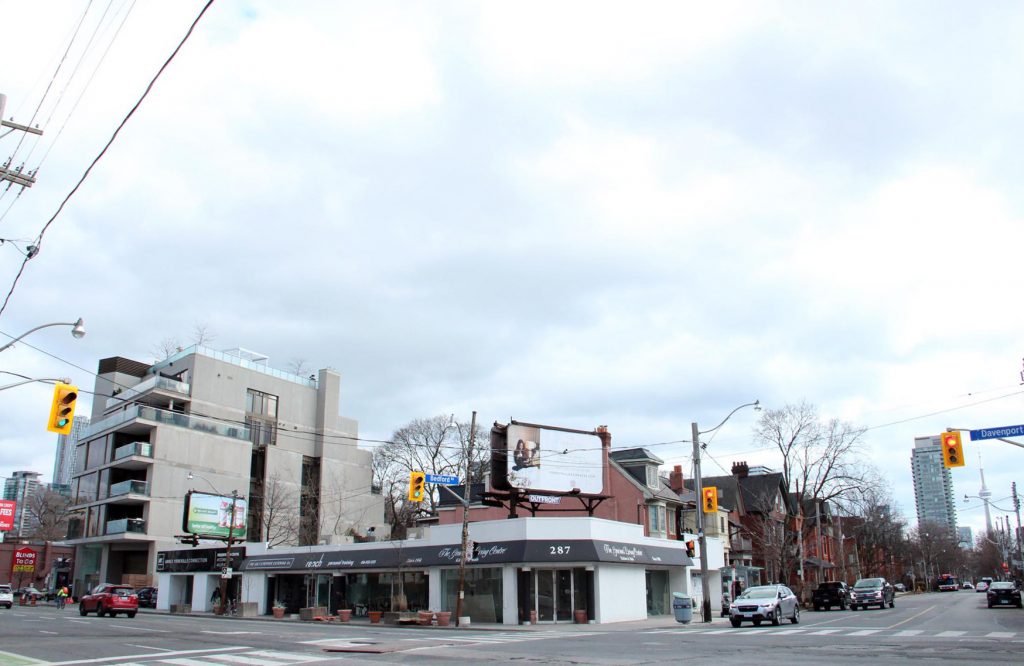
The skyline may soon change dramatically for the neighbourhood near Davenport and Bedford. TANYA IELYSEIEVA/GLEANER NEWS
By Tanya Ielyseieva
A proposed mixed-use building with ground-level retail and residential uses above at 287 Davenport has neighbours up in arms.
The project hopes to include three townhomes along Bedford Road and was designed to transition gently down to the low-rise Annex neighbourhood, which means stepping down from the Davenport frontage of the building to the neighbourhood to the south. The highest point of the proposed building will face Davenport Road.
At a Community Consultation on Monday, February 24, Anita Genua spoke on behalf of the Bernard community and stated that she and her neighbours are “strongly opposed” to the proposed 15-storey development.
“We strongly believe it would destroy the residential nature of Bernard Avenue and our community,” said Genua.
The project’s architects, from the firm Audax, spoke in response.
“One of the reasons that we’ve been hired, I think, is because of our sort of approach to design is much mores sensitive in terms of materiality,” said Gianpiero Pugliese, project architect at Audax. “We don’t want to do a glass box.”
Plans for the proposed high-rise envision a 15-storey residential mixed-use building with a height of 53.67 metres, containing 106 residential units and approximately 278 square metres (2,990 square feet) of retail space on the ground floor. Among 106 residential units, there are 57 one-bedrooms, 38 two-bedrooms, and 11 three plus-bedrooms. That means that units aren’t really family-oriented in the family-oriented neighbourhood. The price point for the unit hasn’t been set yet, but it’s definitely not a cheap building. No affordable units are currently included in this planned building.
The height limit for the northern portion of the location is 14 metres and the southern portion is 12 metres. However, the application is for 58 metres. “It is above what is allowable in the zoning by-laws, that is the only reason why we are here, height and massing,” said Councillor Mike Layton. “If they were building what was allowing by zoning by-laws, we wouldn’t be having a meeting.”
The city has outlined several issues, and height and massing are first to come to mind.
“We asked for an official plan amendment on this application because a large portion of the site is within the residential designated area and there’s a four-storey maximum height limit in this area. The maximum height for the building is 14 metres versus 58 proposed metres,” said Barry Brooks, senior planner for the City of Toronto.
Brooks also stated that there are other issues as well, including traffic and parking and how traffic is “going to be escalated” in terms of more vehicles and more impact on the neighbourhood.
The proposed project is set to have 124 parking spaces, including 110 for residents, 11 for residential visitors, and 3 for non-residential use. There also will be 169 bicycle parking spaces, including 153 long-term and 16 short-term spaces.
The site is well connected for both transit and cycling opportunities. It is 600 metres to both Dupont and St. George stations and is also served by bike lanes along Davenport and a bike share station at Avenue Road.
Following this meeting, a working group may be formed to try to work through some of the application concerns.
Comments Off on NEWS: 15 storeys planned for Davenport & Bedford (Mar. 2020)Tags:Annex · News
March 24th, 2020 · Comments Off on CHATTER: Human bones found during Brunswick re-build (Mar. 2020)
In late January police were called to a house located at 410 Brunswick Ave., where workers had dug up human remains while doing renovation work.
Toronto Police Constable Victor Kwong said contractors discovered the bones buried in the backyard. At the time, police said, they suspected the remains had been buried there for decades. They proceeded to open an investigation to determine the circumstances of death.
A forensic identification officer from the Toronto Police Service, as well as a forensic anthropologist from the Office of the Chief Coroner, were at the scene to investigate the nature of the find. The big question was, was this anthropological, misfortune, or criminal. Police now say that the bones are from a “human specimen” that was used to assist new doctors.
“It was a teaching aid acquired by a doctor in the 1940s. The doctor disposed of the remains in the backyard. There was no crime committed, and this does not relate to a missing person,” said Toronto Police Constable Michelle Flannery.
The case has been closed.
—Patrica Mamede and Tanya Ielyseieva, Gleaner News
Comments Off on CHATTER: Human bones found during Brunswick re-build (Mar. 2020)Tags:Annex · News