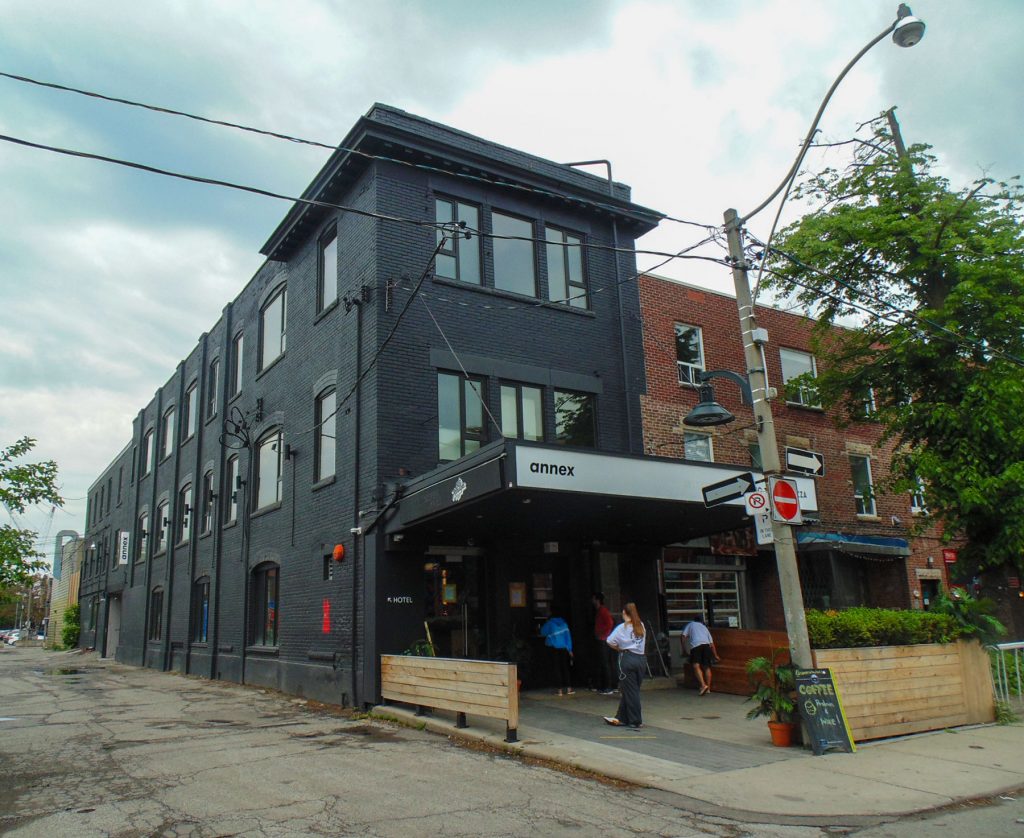
The twenty-four room Annex Hotel at 296 Brunswick Avenue has re-opened its doors to accommodate Toronto healthcare workers fighting the COVID-19 pandemic.
“Mid-March we closed our doors to the public proactively, obviously, as a result of COVID-19 becoming a bigger and bigger kind of presence,” said General Manager Ryan Killeen. “We re-opened the hotel early April to frontline health care workers, and we were able to do so through a private donor. The cost of our rooms has been sponsored through the end of June, which means that we were able to put health care workers up on a complimentary basis.”
The hotel has been fully occupied since the initiative was launched. All services are provided online and by text message or phone.
“The healthcare workers have been very appreciative that we were able to assist and provide them with a place to call home,” said Killeen. “It’s alleviated stress for them. I mean, there’s a lot of healthcare workers who are living with immunocompromised parents and children. So going home after work is a very anxious feeling for them and they’ve been very appreciative that they’re able to come back to The Annex Hotel and self-isolate in their own rooms.”
The Annex Hotel has launched an online store where the community can participate in the initiative.
“We know there are many organizations and people out there stepping up,” Killeen explained. “We hope that by adding our name to the chorus, it will give others a chance to join in to support everyone who is, in turn, supporting us.”
Neighbours come together in a time of “social distancing”
By Tanya Ielyseieva
The Palmerston Area Residents Association (PARA) has donated $7,900 to the Daily Bread Food Bank raised by a community fundraising drive. To help prevent the spread of COVID-19, they also launched an initiative to make non-medical masks, which raised some additional funds for the Daily Bread Food Bank.
Ingrid Nasager, PARA membership coordinator and board member, says the idea for the mask project came after hearing the statistic that one in five people may be asymptomatic carriers of COVID-19, and learning that wearing masks could help curb the spread of the disease.
“I liked the idea of wearing a fabric mask, so as to avoid taking away resources from healthcare professionals,” said Nasager.
PARA made a Facebook post asking for people in the neighbourhood who sew to start making masks on April 7. By the time the Gleaner interviewed Nasagar, PARA had collected more than 100.
Volunteers followed Centers for Disease Control (CDC) recommendations in making the masks.
They used tightly woven 100% cotton for the outside, and non-woven interfacing for the inside.
Though not a medical-grade filter, the interfacing makes it harder for the wearer’s infectious respiratory droplets to escape.
There were no set prices for masks, and people could pick them up from various porch-locations at set times.
“The response has really just been so great. It provided a safe space, with social distancing, of course, for people to promote and ask questions, get the latest updates. I’m really glad to see something being done and I’m glad to participate in that,” said Nasager.
This initiative is part of a larger one launched initially by an anonymous group of neighbours called The Gratitude Project which aimed to raise funds for the Daily Bread Food Bank.
“We called it the Gratitude Project because we’re saying thank you to everybody who helps in the neighborhood and then thank you, to you, who make the donations,” said Paul MacLean, PARA’s chair.
The Daily Bread Food Bank encourages donations, and has a collections button on its web page.
PARA has also provided a community service for seniors like grocery shopping or picking up medications or running errands.
Musicians from Horn on the Cob and the Social Distance outside the home of bandleader Adam Seelig on Brunswick Ave. The impromptu brass band has been playing a song or two every night since March at 7:30 sharp, to the delight of their neighbours. TANYA IELYSEIEVA/GLEANER NEWS
Long-term care homes in the Annex, public, not-for-profit, and profit alike, have fared relatively well in the midst of the COVID-19 pandemic. Sadly, the same cannot be said for similar facilities across the province. Before government starts pointing fingers for the tragedy that has unfolded among our most vulnerable seniors, it would do well to acknowledge its own role in the problem.
A report by the Canadian military following a stint of emergency service at long-term care homes in Ontario this May describes horrific conditions at five homes in particular. To get specific, the report said some patients were left in soiled clothing and beds, some were turned so rarely they developed bedsores. Others were left hungry and developed symptoms of dehydration. According to the report, staff were observed re-using non-sterile supplies including catheters and syringes, and homes were plagued by insect infestations.
Prime Minister Trudeau called the findings, “deeply disturbing and heart breaking.” Premier Doug Ford, whose government is actually responsible for setting the standards of care in these facilities and ensuring those standards are maintained, called the report “gut-wrenching” and vowed to send in provincial inspectors.
Will those inspectors make a difference? How could they possibly have failed to see what the soldiers witnessed first-hand in just a few short weeks?
These conditions help to explain why the novel coronavirus is hitting long-term care homes in Canada so hard. The International Long-Term Care Policy Network found that Canada had the highest percentage of deaths in long-term care homes compared to thirteen other countries including Germany and France. The Public Health Agency of Canada reports that COVID-19 outbreaks at long-term care homes are responsible for 82 per cent of coronavirus-related deaths in this country.
Dr. Samir Sinha, director of geriatrics at Mount Sinai Hospital, calls long-term care homes the “epicentre of this epidemic,” and blames under-funding and neglect. That, in turn, led to workers being employed at multiple sites and moving frequently between them, acting as vectors for the spread of the virus.
In addition, those employed in long-term care homes are paid much less than they would be to perform the same work in hospitals. They may not receive paid sick days, so may well have gone to work when they should have stayed home, in bed. Doug Ford took back their entitlement to paid sick days when he came to office.
On April 15, Ontario announced that, effective April 22, workers may not work at multiple homes (with the caveat that they would be exempt from this rule if they happened to be employed by a temp agency.) British Columbia, by contrast, passed legislation requiring caregivers to wear PPE and not allowing them to travel between multiple seniors’ facilities by March 27.
Why is Ontario unwilling to help this sector and deal with the systemic problems that exist? Is it that they want to keep profits up at those facilities that are privately owned?
Former Ontario Premier Mike Harris, a fellow Conservative, is the chair of the board at Canada’s largest for-profit retirement home chain, Chartwell. He also happened to be the person who removed the minimum care standard on these facilities.
After some unfortunate freelancing in March, when he urged everyone to, “go away for March Break and enjoy yourselves,” Ford has pretty much kept to the script provided for him. At times he has even managed to muster-up some apparent empathy. However, given the military’s report card on the province’s long-term care homes, Ford would do well to abandon the bluster, take some responsibility, and step-up to fix the system.
As we prepare for a summer like we have never seen in Toronto, I want to take a moment to look back on what our community has accomplished so far. Whether you are part of the frontline response, or are doing your part by practicing physical distancing, this has been a challenging time. However, the sacrifices we have all been making have worked and we have saved lives.
When the worldwide response to COVID-19 began to dominate our daily lives, something special hap-pened in our neighbourhoods. There was an almost instantaneous outpouring of help for our most vulnerable, a banding together of communities, and the creation of many new networks of support. The calls we received from people who needed help were matched by the number of those that asked how they could be of service.
The City of Toronto has been working hard to support people in the countless ways this pandemic has affected our lives. It’s been heartening to see all levels of government working together, despite differ-ences, to build new programs to address unemployment, support people experiencing homelessness, and launch new supports for small businesses to slow economic impacts. As I have said many times, no one should have to lose their homes or livelihood because of the impacts of this pandemic.
As part of the City’s recovery effort, I have been given the role of connecting with our unions and workers as part of the Mayor’s Economic Support and Recovery Task Force.
Over the past month, I have been consulting with labour leaders from our many unions, labour econo-mists, and other stakeholders who represent freelancers and workers in the gig economy to provide a set of recommendations to support workers impacted by the pandemic, and to prepare ourselves for a better future.
I have been hearing three key things: the need to stabilize the care sector and protect the health, safety, and rights of workers; the need to improve supports and benefits for workers and their families; and the importance of ensuring the recovery achieves climate goals and builds resiliency and equity. This is not a traditional recession, so we should not default to a traditional stimulus package.
Through addressing the long-standing policy failures and lack of adequate protections for all workers, both of which have become crystal clear through this crisis, we have the opportunity to rebuild our economy in a way that provides more security for workers and communities.
We will be faced with the choices of what kind of jobs we are creating, what infrastructure investments we are making and what projects we are funding. It is critical for our future as a city and country that we invest in measures that help address, not compound, the climate crisis, reduce inequality and that build resilience.
We need to act now to avoid future crises. Investment in building affordable housing is key, as it is a fundamental building block to reduce inequality, insecurity and poverty among Torontonians. It has also been reinforced during this crisis that adequate shelter is essential to our health both immediately and over the longer-term.
As we move into planning for recovery, it’s important to remember that the process will not happen overnight. We should take the lessons we have learned through the crisis, and make sure we invest in recovery efforts that create stability for our communities and build resiliency for the future.
It is also imperative that we continue to follow advice from our public health professionals. I have full confidence in Toronto Public Health to lead us through this situation and keep us all safe. We must stay the course, because it has been working, and you have my commitment that I will do all I can to ensure that residents of Ward 11, and Toronto, are supported through this pandemic.
Mike Layton is city councillor for Ward 11, University-Rosedale.
We need to summon the political will to make long-term change
By Jessica Bell
The COVID-19 pandemic is not only exposing how poorly our economy and society treat our most vulnerable, it’s making it worse.
While Canada is making positive progress at slowing the spread of COVID-19 in the community, the spread of the virus among our most vulnerable is fast becoming a national tragedy.
“After this pandemic, there will be a reckoning on what went wrong and why,”
–Jessica Bell, University-Rosedale MPP
Over half of deaths have occured in long-term care homes – a death rate that is one the highest in the world according to the International Long Term Care Policy Network. Disturbingly, the Ontario Health Coalition calculates the death rate in the province’s privatized homes seems to be far higher than the rate in public and non-profit homes.
In the past month, I have called many long-term care homes, refugee centres, shelters, retirement homes and assisted living facilities in my riding to ask how they were coping. Most were facing staff shortages, and all of them hadn’t been provided with enough access to personal protective equipment to keep staff and residents safe.
Mon Sheong Home for the Aged on D’Arcy St. is in our riding of University Rosedale, and the home has one of the worst COVID-19 outbreaks in the province. After speaking with Helen Lee, the granddaughter of 111 year-old resident Foon Hay Lum, I sent a letter to the Ministry of Health calling on them to provide help immediately. More PPE arrived, however Foon Hay died from COVID-19 less than a week later.
Lum was a tireless advocate for Chinese-Canadians. She was an advocate who fought for reparations for the 81,000 Chinese-Canadians who were subject to the Chinese Exclusion Act and the $500 Head Tax, a policy which kept her family separated until 1959. After 20 years of activism, she secured an apology from Prime Minister Stephen Harper in 2006.
Foon Hay Lum is just one of thousands of loved ones who have died from COVID-19. Mon Sheong is just one of many homes and centres plagued by sickness and death. COVID-19 continues to spread among vulnerable people including those who are old, who struggle with disabilities and mental health challenges, refugees, and people in prisons.
This is what we need now to get through the pandemic. The Ontario Government has done the right thing and increased pandemic pay by $4 an hour for most frontline workers, and banned most workers from working in multiple long-term care facility sites in order to curb the spread. We are calling for all workers to earn $22 an hour or more, for all health care workers to get the PPE they need, more government funding for staff, a robust testing regime to limit the spread, and government takeover of facilities that are not able to maintain care for residents.
After this pandemic, there will be a reckoning over what went wrong and why. We must see real changes to how we treat and care for our vulnerable and those who serve them.
The chronic underfunding, poor regulation and privatization of long term care must end. A new regime of fair government funding for non-profit and public long term care homes, a ban on for-profit homes, jobs that pay better and have more security and benefits, and real regulation and oversight must be ushered in.
We didn’t need a pandemic to learn this, but a pandemic will create the political will to ensure these changes actually happen.
Staying home to help stop the spread of the 2019 novel coronavirus (COVID-19) continues to be the new normal for the foreseeable future.
Read on for our updated guide to Annex resources during COVID-19, the third issue since we all started to hunker down and stay together apart.
You’ll find information about doctor’s offices, pharmacies, grocery stores, and support for small businesses. Hours of operation and service were valid when we went to press, but could change, so check gleanernews.ca for the most up-to-date information.
The basics
Whenever possible please stay home, wash your hands, take care of yourself and your loved ones.
If you have to go out, practice safe physical distancing, wash your hands frequently, and return home as quickly as you can. Dr. Eileen de Villa, Toronto’s Medical Officer of Health now recommends that you wear a mask.
The City’s new Toronto Office of Recovery and Rebuild has partnered with major downtown employers to extend working-from-home efforts. The Office is asking for your ideas so we all can recover, rebuild and emerge from the pandemic even stronger. Take the 15 minute survey before June 30.
You can find the most up-to-date information at the City of Toronto’s dedicated website:
If you think you have COVID-19 symptoms or have been in close contact with someone who has it, this self-assessment can help you determine if you need further care: www. ontario.ca/page/2019-novel-coronavirus-covid-19-self-assessment.
If you meet any of the criteria found there, contact your family doctor or Telehealth Ontario at 1-866-797-0000. Let them know you used the province’s self-assessment tool.
There are three COVID-19 assessment centres that are near to the Annex:
UHN Toronto Western Hospital, 347 Bathurst St., website: www.uhn.ca/Covid19
Women’s College Hospital, 76 Grenville St., use the northeast entrance on Grosvenor St., website: www.womenscollegehospital.ca/
Go to your nearest emergency department if you have severe symptoms like shortness of breath, chest discomfort, lethargy, drowsiness, weakness, or dizziness. If you have to use a car service, please wear a mask, sit in the back seat, and open the windows. If you can, note the company name and operator number of the driver.
If you are not well enough to make your own way to a hospital or assessment centre, call 911.
The doctor is in
For medical issues unrelated to COVID-19, please reach out to your primary care provider or family doctor. Many are now offering virtual appointments.
If you don’t have access to a family doctor there are several walk-in clinics still open. Please remember, if you are experiencing any flu symptoms, don’t go in person to either walk-in clinic, please call first:
GSH Medical – 481 Bloor St. W., second floor: open for people with non-flu like symptoms. They are also offering virtual appointments that can be set up by calling 416-928-0217 or emailing annex@goldstandardhealth.ca or management@gshmedical.ca. . There is no cost for this service, you don’t need to be an existing patient, and they are accepting all requests at this time.
Downtown Doctors Walk-in Medical Clinic – 720 Spadina Ave., #100: still open for walk-ins. You can also call them to set up a phone appointment at 416-929-1530.
Pharmacies
The following pharmacies in the Annex are still open, and many offer special hours or delivery:
Snowdon Pharmacy – 264 Bloor St. W.: offering delivery to seniors and at-risk customers. 416-922-2156. www.snowdoncompounding.com
Rexall – 481 Bloor St. W.: dedicating the first hour of shopping exclusively to those who are 55 and older. 416-929-8213.
Rexall – 474 Spadina Ave.: encouraging shoppers to allow seniors access to the first hour but will serve all who are in need. 416-413-1060.
Pharmasave Spadina Medical – 720 Spadina Ave., #100: offering some local delivery. 416-929-7000.
Green Pharmacy – 620 Bloor St. W.: open with their regular hours. 416-530-4004.
Loblaw Pharmacy – 650 Dupont St.: free delivery, open to seniors only from 7 a.m. to 8 a.m., pharmacy opens at 8 a.m. 416-588-4793.
Shoppers Drug Mart – 360a Bloor St. W.: phone orders, free delivery. 416-961-2121.
Shoppers Drug Mart – 292 Dupont St.: phone orders, free delivery. 416-972-0232.
UT?Pharmacy +?Print – 193 College St.:?open regular hours and weekends. Phone orders, free delivery, 647-351-1708.
Mental health
It’s okay to be not okay. If you or someone you know is struggling with anxiety or other mental health issues, you can find information on government and community-based services from the province’s main service hub, 211 Ontario. Call 211 or visit www.211oncovid19.ca to get help. Live chat is also available online.
Park green spaces are open, while park benches, playgrounds and outdoor fitness equipment remain closed.
Gatherings of up to five people are permitted, and those not of the same household are asked to respect physical distancing of 2 meters.
People can picnic, walk,run,bike in parks and ravine green spaces, trails and boardwalks.
Tennis and basketball courts, as well as Dogs Off-leash Areas are open again.
Please note that the playground and wading pool at Christie Pits remain closed. For updates, visit: www.toronto.ca.
Household fixes
Wiener’s Home Hardware at 432 Bloor St. W. reopened on May 11 and is allowing 3 customers in the store at a time. You can also pre-order and pickup by emailing wienershh.orders@gmail.com.
Pets can get care
Restrictions on veterinary practices in Ontario were lifted as of Tuesday, May 19.
Annex Animal Hospital (716 Bathurst St.) is available for visits, food, and medication. Please call them at 416-537-3128 or email them at clientcare@annexvet.ca to schedule an appointment.
Bark & Meow Pet Supplies (712 Bloor St. W.) is offering free local delivery and is open for call ahead curbside pickup. Contact them at 416-532-2275 or by email at 712barkmeow@gmail.com.
Global Pet Foods at 171 Dupont St. has curbside pick-up and can be reached at 416-964-0450.
Pet Valu at 339 College St. also has curbside pick-up, call 416-944-0314.
Businesses still need help
A recent survey conducted by the Toronto Association of Business Improvement Areas (TABIA) found that 50% of businesses could not make all of April’s rent and 72% of businesses feel they will not be able to make all of May’s rent. The survey also found that 61% of businesses indicate they would close down for good within three months and 76% within five months.
The federal government has begun receiving applications for the Canada Emergency Commerical Rent Assistance program through the Canada Mortgage and Housing Corporation. For more information or to apply, please visit.
Uptake for the Canada Emergency Commercial Rent Assistance (CECRA) program for June rent was lower than expected. Out of 1.2 million commercial properties across Canada, only 16,000 applied.
The Toronto Association of Business Improvement Areas (TABIA) will be advocating for a wage subsidy, and protection from commercial evictions, which could stimulate participation in the CECRA.
Executive Director, John Kiru, advises small businesses to open under existing rules, apply for all available assistance programs, and diversify to include a digital component, like curbside pick up. “Bricks and mortar has to become bricks and clicks,” said Kiru. TABIA is working with the city to expand patios, and on campaigns to encourage people to shop in their local neighbourhoods.
If you are a small-business owner, be sure to check your local Business Improvement Area’s website for resources and support.
You can support local business by ordering online or buying gift cards to use later. You can call ahead and pay with credit or debit.
The City of Toronto and the TABIA have also partnered with distantly.ca. Vetted by mayor’s office, it’s a crowdfunding platform that supports small businesses in Toronto. You can donate directly to businesses for rent and payroll expenses.
While many local restaurants are closed to dining in, you can still order food for delivery through DoorDash, foodora, Ritual, Skip the Dishes, and UberEats.
Ccheck to see if you can order directly from the restaurant by calling them directly, which saves the restaurant up to 30% on delivery fees.
The Ontario government announced on March 16 that no new eviction orders would be issued until further notice, and asked the Sherriff’s office to postpone any currently scheduled enforcement of evictions.
If you’re a tenant who needs advice or assistance, please contact
MPP Jessica Bell’s office at 719 Bloor St. W., Unit 103, phone 416-535-7206, email: jbell-co@ndp.on.ca
stepstojustice.ca, offers step-by-step information about legal issues.
Thank you
We know many of you work in hospitals, government, and in other essential support roles. Thank you for all that you’re doing to keep us safe.Email us at gleanereditor@gmail .com if you have a story to tell. Because even as we all continue to stay, live, and shop local, we also think it’s important to celebrate local.
June 15th, 2020 · Comments Off on FOCUS: Melodies are good medicine (May 2020)
Ninety-four year-old entertains patients
Music volunteer George Linton entertains patients at long-term care homes and hospitals. Despite being 94 years old Linton looks forward to returning to his unpaid gig post COVID 19. TANYA IELYSEIEVA/GLEANER NEWS
By Khyrsten Mieras
George Linton has lifted the spirits of hospital patients and those living in seniors’ residences across the city, one song at a time.
The 94-year-old volunteer and Toronto resident uses his musical talents of singing and playing guitar to brighten the days of patients in environments that are less than joyful. A unique aspect of his performances is the inclusion of melodies from the cultural background of each patient, such as the old Russian melody, “Those Were the Days.”
“Many people in the Toronto area come from far away countries, so I try to do a song from the homeland,” Linton says. “If you’re from Bulgaria I try to do a song in that background and other songs that cover many parts of the world. There are so many good melodies that carry from one country to another.”
His music has been met with a warm response from both patients and staff at the hospitals where he plays. Linton says he has received many positive comments such as, “you made my day,” and even, “your music took my pain away.”
Linton has been playing a range of melodies and music to patients in local hospitals for about 35 years. He recalls that he began by playing music for a friend who was in the hospital at the time. He found that other patients and staff were supportive and enjoyed the music as well, which encouraged him to continue playing in hospitals for those who appreciate it.
“From there it kind of spread and I found that patients in various areas [and] places enjoyed the music,” Linton explains. “When I do music in a hospital room, I feel like I’m in the right place at the right time because of the enjoyment that the patients get and not only patients but staff.”
Currently, Linton volunteers at four different hospitals in Toronto: the Toronto Western Hospital in the southwest of the Annex, St. Michael’s Hospital, Princess Margaret Cancer Centre downtown, and St. Joseph’s Health Centre in the west end. Linton rotates his visits between each hospital, travelling to a different location each week. On other days, he plays his music in different places within the city, including for residents at retirement homes.
Although Linton has no plans to retire any time soon, he hopes others will carry on his legacy and help in bringing the joy of music to the city’s hospital patients.
“I appreciate getting the message out to younger musicians who may be encouraged to go and play for patients in hospitals because the younger [musicians] will enjoy it the way I have,” he says.
Comments Off on FOCUS: Melodies are good medicine (May 2020)Tags:Annex · People · Life
June 15th, 2020 · Comments Off on GREENINGS: Capitalist truths exposed (May 2020)
It’s time to focus on survival
By Terri Chu
India’s population of 1.3 billion people is in a state of “lockdown” until May 3. One of the initial impacts was a massive wave of migrants, suddenly jobless, walking hundreds of kilometres to their home-communities. In the country’s most populated state, Uttar Pradesh, state officials have instructed village councillors not to allow returning labourers in. In India and around the world, Coronavirus is laying bare a capitalistic hard-truth: the poor are expendable.
In Texas, Lieutenant Governor Dan Patrick told Fox News that he and other grandparents would be willing to risk their health and even their lives to get the US back to work and maintain the “America that America loves.” That America would never ask those same grandparents to drive a smaller car for their grandchildren’s future.
Governor Patrick is not alone in his sentiments. There’s plenty of rumbling out there, among the corporate elites especially, that agree: saving the lives of 1-3% of the population is too high a price to pay for a shut-down in the economy.
I’d imagine these same people believe the poor should be “pulling up their bootstraps,” and advocating for “trickle down economics.” If you live on the bottom, you know how that theory works, and likely won’t be surprised to hear this same approach being described as the horse-and-sparrow theory: if you feed the horse enough oats, some will fall to the road for the sparrows. In a world dominated by such beliefs, who would ever want to be a sparrow?
The veneer of caring about the poor is thinly veiled, and a weak excuse for the global failure in the fight against climate change. How can we possibly believe this punishing and destructive economic system could possibly be upheld in the name of supporting the poorest among us? The poor are disproportionally impacted by climate change, and no increase in GDP will rescue them from hurricanes and rising sea levels.
It’s been 28 years since Kyoto was signed. It has proven to be a broken promise that we would look out for the wellbeing of future generations, as emissions have continued to trend upwards. In the name of the economy, we were either unwilling or unable to come off our oil addiction. I am hopeful that this pandemic is the jolt we needed to realize that infinite growth economics was only “working” for the 0.1% of society. We are learning how little we actually need to survive. We don’t need to jet-set around the world every few months. We don’t need fast fashion. We don’t need to drive around pointlessly. There’s so much we have been doing that added nothing to our standards of living or mental health. This is the wake up call to remind us that the life is meaningless next to dollars in this system. This is our chance to get out of it.
The environment cannot sustain infinite economic growth, and it turns out, neither can we. Now we know we don’t have to. The unicorn is exposed for what it is: a fairy tale. People are angry. The youth are angry. We can and should do better. Do you hear the people sing?
Terri Chu is an engineer committed to practical environmentalism. This column is dedicated to helping the community reduce energy use, and help distinguish environmental truths from myths. Send questions, comments, and ideas for future columns to Terri at terri.chu@whyshouldicare.ca.
June 15th, 2020 · Comments Off on LIFE: “P” is for pruning procedures (May 2020)
What to plant in your container garden
In May 2020, the Annex Gleaner celebrates 25 years of publishing. In acknowledgement of this history we are offering highlights of our past; this feature “P” is pruning procedures is from June 1998 by gardening columnist Bardi Vorster.
By Bardi Vorster
One of the most misunderstood and mismanaged techniques in gardendom is the act of pruning.
How else can one explain the appalling buctchery of countless trees and shrubs which go on annually right here in Toronto and even in the Annex. Whyever do people assume that shrubs should be perfectly round?
Have you ever seen a really glorious flowering shrub with blunt ends?
How is that so many landscape maintance companies still perpertrate the bowl on head school of pruning? Are they ignorant of plant material? Possibly. Are they incapable of subtlety? Probably. Can you tell this a pet peeve?
The tools
Anyone who has gardened for more than five days knows that a pair of hand pruners is essential for various tasks – from cutting the perfect rose stem to eliminating deadwood. Perhaps we are seduced by the ease of electric prunning shears which create the order of straight lines in a jumble of greenery; the mechanically inclined, topiary maniacs and growers of hedges will need them. They can be rented. Of course if you are trying to reach two inch diamter or higher branches, long handles loopers are useful but a bit more difficult to control. If you are really serious, a small but viscious pruning saw with a curved blade is essential as well.
Timing
Stop! Before you cut, think of it this was way – every cut should have a well considered reason.
These are reasons to cut anytime:
Prune any dead or diseased wood.
Eliminate any twigs or branches that are rubbing against each other – the weakest must go.
Cut out (at the bottom) very weak limbs which are bending under the weight of a few leaves at the ends of the branches.
Sometimes it is necessary to ruthlessly chop a branch intruding in your path; but it is possible (except for mature evergreens) to do it gracefully. Look for the point where you can do it without a stump as a remainder.
Remove water sprouts as soons as you notice them. Water sprouts are shoots that grow straight up from a branch; they are particulary noticeable on fruit trees – but that’s another specialty.
It’s important to note that most shrubs and some roses (climbing types) flower on old wood – that is, growth of this year will produce flowers next season. Consequently, it stands to reason that yearly pruning for shape, and balance, should be done after the shrub flowers.
Shrubs such a Hydrangea and Spirea bumalda produce flowers on the growth of the current season. Pruning should be done in the fall or early spring.
Evergreens generally do not produce new growth from old wood at all, a fact which should be remembered when trimming lower branches of your favourite Colorado Blue Spruce – they don’t grow back.
Broadleaf evergreeens and rhododendrons scracely need pruning at all; a little shaping and elimination of deadwood or very leggy branches is all that is required. I must say that it is heartbreaking to see balls of Euonymus fortuneii unless it is on a standard.
Pruning mature trees is best left to professionals as considerable skill is necessary to do it properly. A certified arborist is the professional to contact. Ontario has a certifcation program which ensures a basic knowledge and at least three years experience.
Making the cut
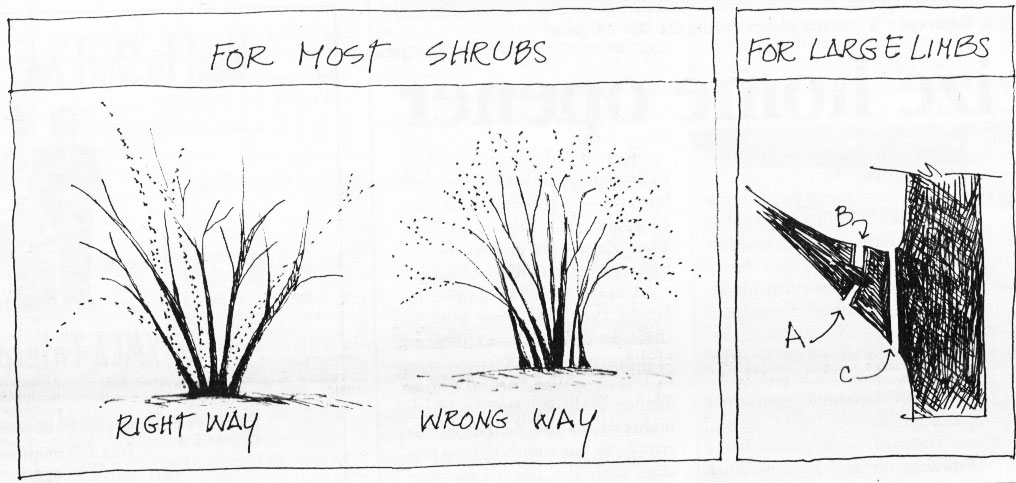
New growth will come from the bud, therefore, choose a bud which is pointing to the outside of a shrub or rose.
With hand pruners, position the hook to the discarded side of the branch and cut through in one motion. They must be sharp to avoid tearin the bark.
Angle the cut so the water will run off the branch.
Position the cut neither too close to the bud (it will dry out and die) nor too far away (it will leave an ugly stump).
If the stem is two inches in diameter or more, a pruning saw is required. Make the first cut beneath the branch, saw through from the top and make a final cut to perfect the angle and neatness if necessary.
Very important
Before you trim, observe the way the shrub wants to grow – vase shaped, horizontally, or naturally round. When you are finished, a shrub should look tidy and in shape appropriate for the species. In fact, it should appear unpruned.
Shapely hedges
Contrary to regular shrub prunning which removes branches from the bottom, hedges are sheared to promote end growth. They need to be trimmed at least once a year, usually after the new growth has sprouted. Ensure that the bottom is wider than the top. This allows light to reach the bottom and inside of the hedge, thereby promoting healthy growth.
Comments Off on LIFE: “P” is for pruning procedures (May 2020)Tags:Annex · Life
At your fingertips and while in your pjs – enjoy it!
The Thomas Fisher Rare Book Library at U of T is making available images to download for colouring. This woodcut was made in 1490. COURTESY THE THOMAS FISHER RARE BOOK LIBRARY
By Meribeth Deen
It’s almost June. The patios should be packed. The streets should be humming, but, the coronavirus. There’s only so-much Zooming a person can take.
So, what to do? Look to your creative neighbours to come up with something. Institutions and organizations affiliated with the Bloor St. Culture Corridor remain as creative and engaged as ever, offering new ways to connect with the community and keep your mind busy.
Follow the Corridor and affiliates on Facebook to stay on top of events (which tend to be promoted close to their dates of streaming), and check out these tips for a taste of what’s out there.
Sharpen your humour
Join comic Courtney Gilmour (winner of the Homegrown Comics Competition in 2017 at Just for Laughs in Montreal for an online workshop on stand-up comedy and joke writing basics. Gilmour’s got a six-part series on stand-up basics on Youtube, you can check those out and head to the workshop to discuss and ask questions. Hosted by Miles Nadal JCC on Sundays at 8pm. Check out the Centre’s jam-packed schedule, with something for everyone at mnjcc.org.
Stay Curious
The Hot Docs Curious Minds speaker series is now online. Acclaimed speakers will lead six-week courses that are available for streaming coast to coast. The Age of Upheaval delves into the cultural and artistic developments between the two World Wars.
Led by Peter Harris, the former Assistant Dean of the Faculty of Arts and Science of the University of Toronto, the series will take you out of your living room and into Manhattan speakeasies, Weimar Science labs and the Art Deco design labs of the worlds’ great cities in the 1920s and1930s.
Grab a seat and dig into Meals that Changed the World with food historian Dr. Laura Carlson. You’ll travel through time from the age of the Roman Empire to the White House under the Kennedy administration and find out how the dishes served at famous meals were shaped by technology, politics, religion, warfare, and art.
There’s much more on offer – head to the Hot Docs website to explore more.
Take your kid to the museum
The ROM remains closed but may be more accessible and inviting than ever, especially for kids. Live read-a-longs of stories are followed by a Q&A session on how the stories connect to an object at the museum.
If you can’t make the live version, head to the ROM’s YouTube channel to watch past events and creativity challenges. Stories include Stellaluna by Jannell Cannon, The Day the Ocean Disappeared by Denise Dias, Blackflies by Robert Munsch, and on May 26, The First Mosquito, read by author Caroll Simpson.
Be sure to keep tabs on the ROM’s Facebook page so that you can stay current on world events and how they connect to museum objects. For example, curator of Islamic Art & Culture, Fahmida Suleman, has been sharing stories of some of her favourite museum objects and their relationship to Ramadan.
Give
The collaboration between your local libraries and food banks seems to keep getting better. The Toronto Public Library (TPL) has recently announced that they will be providing free, age-appropriate books in food hampers sent to families around the city. TPL is encouraging donations of $40 to fund the purchase of five books.
Read
While we are talking books, and kids’ books in particular, consider your local book store. Predictably, A Different Booklist remains closed to the public, but the store is taking orders. If you’ve got any young people in your life, they’ve got a fantastic array of diverse kids’ books with write-ups on their website. They have great adult books too.
Puzzle
If “to puzzle” was not a verb before COVID-19, it surely will become one after. If you’ve run out of jigsaw puzzles and have not yet tired of the dopamine rush that comes with fitting one piece into another, The Thomas Fisher Rare Book Library at the University of Toronto has got you covered. Go to jigsawplanet.com/FisherLibrary to see images from the library’s collection turned into online puzzles, and go for it.
June 15th, 2020 · Comments Off on SPORTS: Leafs hopeful for baseball this summer (May 2020)
Shortened season possible if social restrictions lifted and parks reopen by July
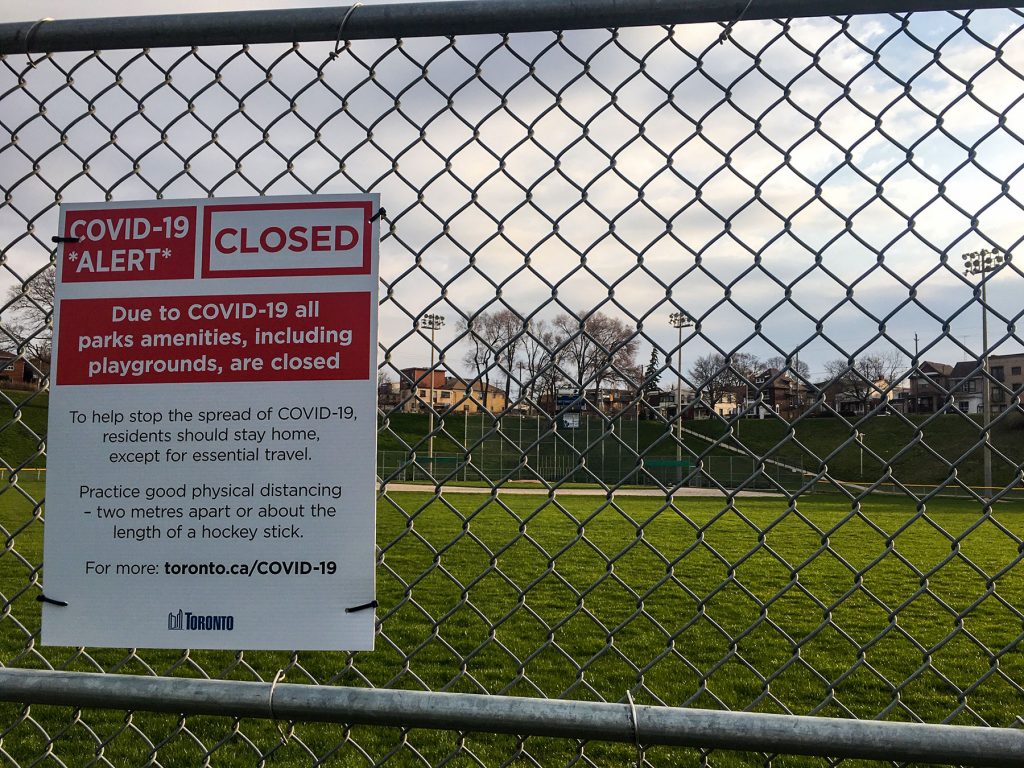
An empty ballpark makes a sombre image as city parks remain closed during the pandemic. R.S. KONJEK/GLEANER NEWS
By R.S. Konjek
The ballpark is quiet.
The grass is unkempt, drifting litter has collected around the backstop, and a tarp covering the pitcher’s mound has been flipped to one side by wind. No one is there to readjust it.
The COVID-19 outbreak has halted most public activities and all organized sports, including the Toronto Maple Leafs baseball season.
Christie Pits Park, where the team should be gathering for pre-season practices, was closed by the city in early April. The sight of fielders chasing fly balls has been replaced by the sight of uniformed police officers shooing park visitors away.
At the same time, the Intercounty Baseball League issued a statement acknowledging that a traditional baseball season in 2020 would not be possible because of the pandemic. In short order, three of the league’s ball clubs – Barrie, Brantford and Kitchener – announced they would suspend all operations for 2020.
The Leafs remain hopeful that a shortened season might still be possible this summer if physical distancing restrictions are lifted and parks re-open by July. Leafs player-manager Damon Topolie envisions a scenario where a condensed season could be played that month, with two play-off rounds in August to decide the league championship.The economic impact of a potentially lost season is not as hard on the Leafs, whose games are free to the public, as it is on other clubs who rely on ticket sales.
“We are not a gate-driven revenue-based team,” says Topolie. “We rely on sponsorships to help support the team. The club has made it for 51 years and it will be able to sustain itself.”
Every May, the Leafs host a forum and reception featuring Major League Baseball greats from the past. The event has been rescheduled to October. The Leafs are also moving ahead with the publication of their annual team magazine.
For now, Topolie has instructed his players to stay at home as much as possible and maintain their fitness.
A final decision on whether the league will attempt a modified season in 2020 is expected in late May or early June.
Comments Off on SPORTS: Leafs hopeful for baseball this summer (May 2020)Tags:Annex · Sports