August 7th, 2020 · Comments Off on EDITORIAL: Ford turns on tenants (July 2020)
One of the strangest things to happen over the course of this very strange spring was the apparent transformation of Premier Doug Ford into to a caring, compassionate leader. This illusion is fading quickly, as his government rams Bill 184 through the Ontario legislature. The new law will almost surely result in mass residential evictions of tenants who were unable to pay full rent during the COVID-19 lockdown.
In March, Premier Ford promised Ontario tenants that he had their backs and they would be protected from evictions during the pandemic. It turns out his actions don’t match that promise. Across Canada, provincial governments have provided rent support for struggling tenants, in Ontario not one cent.
For Torontonians who pay some of the highest rents in the country, the problem is particularly acute. The lack of rent relief from the province hurts tenants and landlords alike.
Governments of every political stripe do this at least once during their time in office: create a law that helps one side but harms another and name the new law in such a way to make it sound like the opposite is true. What Doug Ford is trying to do with Bill 184 is a perfect example of this as the, “Protecting Tenants and Strengthening Community Housing Act,” will do nothing of the sort. This is right out of former Premier Mike Harris’s playbook.
Harris, in 1997 crafted legislation which stripped away tenant rights in the “Landlord and Tenant Act,” but not before clearly re-naming it the “Tenant Protection Act”. The parallels are eerie.
Essentially, this new law, which is expected to be enacted soon, will allow landlords to bypass the Landlord Tenant Board (LTB) who currently must be involved in a quasi-judicial capacity when a renter falls behind. At the LTB a repayment plan must be crafted or an eviction may be granted.
Other issues can be discussed there too: utility disruptions, broken elevators, and soon. Bill 184 allows the landlord to craft his or her own arrangements with the tenant. On the face of it, this may seem reasonable enough but tenants may feel pressured into agreements they can’t afford. Tenants whose first language is not English (highly likely here in the most diverse city in the world) will be at a distinct disadvantage.
Under the proposed rules if the tenant agrees to the rent re-payment terms, and for whatever reason falls behind on the repayment – even a single payment – the landlord can then ask the sheriff to evict the tenant.
Most shockingly, Bill 184 is back-dated to March 17 – the very day Ontario declared a state of emergency. It’s a perfect storm for tenants: unemployment, illness and an overall sense of economic uncertainty. Rent arrears may have accumulated and now the province has come up with tools for landlords to quickly remedy that problem.
Vulnerable tenants, who used to have the LTB as the regulatory referee in the middle, will no longer enjoy that protection. In many cases, the landlords will be thrilled to have their tenants evicted so they can take advantage of the rental market and raise the rents. It almost seems that was Ford’s plan all along: hook the tenants in on debt they could not repay and give the landlord lobby the tools to get rid of below market rent payers.
This all sets the stage for evictions to take place as early as August 1. After all, what better way to stay afloat during a pandemic than to add to the homeless population? Doug Ford, in all his meanness and bluster, is back.
August 7th, 2020 · Comments Off on FORUM: Finding positive outcomes (July 2020)
Rapidly expanding bike lanes a healthy solution
By Mike Layton
As Torontonians diligently work together to progress to the next stage of the recovery plan, we are collectively coming to terms with the fact that we are learning to live with a new normal. This period of rapid change has brought with it a number of difficult issues, and has highlighted the many ways in which we need to do better. However, it has also opened the door for us to imagine new ways forward. Toronto has always been a place where people with vision have put in the work to build their communities, and my recent communications with residents have shown that our city’s passion for progress is only getting stronger.
An integral part of our pandemic recovery response is reviewing our highest single expense, the police budget, to see if there are improved ways to deliver services that ensure the safety of all residents. At the first opportunity, I will work to reallocate resources from the police budget into services to promote anti-oppressive practices in consultation with Black and other racialized communities.
It is imperative that we continue to address systemic racism through the provision of services. We know that racism manifests in poverty, housing discrimination, in cuts to social and community programs, and in negative health outcomes—especially as being observed through the current pandemic. We must take action and invest our resources to address these inequities head on. The city works to apply an equity lens on every budget decision it makes, which is a good first step, but more must be done, starting with properly funding city services.
Learning to live with the COVID-19 pandemic means recognizing that people need to be able to get where they need to go while maintaining a safe physical distance. As retail stores that have a public entrance door that opens onto a street or sidewalk have been allowed to reopen, the opportunity to revive our main streets is possible, with protective measures in place. This also means that many of us will need to consider alternate methods of transportation.
In early June, we welcomed the installation of new protected bike lanes on University Avenue, through Queen’s Park Crescent. These lanes are part of 25 kilometres of new cycling infrastructure. This was approved by city council at the end of May, as part of the city’s ActiveTO program. The bike lanes on University Avenue will connect to existing lanes on Bloor, College, Adelaide, and Richmond Streets, making continuous, protected trips possible. They provide an alternative to the Line 1 subway for commuters, while opening up more space on the subway for those who need to take public transit.
The community has long advocated for safe, protected bike lanes on University Avenue, alongside major hospitals in the area, including SickKids and the University Health Network, who released letters in support of the University bike lanes. Members of the group Doctors for Safe Cycling, some of whom work in the area’s hospitals, have also highlighted the importance of the lanes in enabling health care workers, staff, and clients to safely get to work and access the area’s health care facilities.
The lanes are ready to change the way that many residents get around this summer, and are just the beginning of what’s possible. With this change, Toronto has joined the ranks of London, New York, and Mexico City, all of which have responded to COVID-19 by expanding cycling infrastructure. Going forward, how people get around will continue to be a major public health issue. These new lanes are a step in the right direction towards keeping each other healthy, and keeping our city moving.
I am committed to building an equitable and just Toronto, and I am grateful to work with you to make it happen.
Mike Layton is Councillor for Ward 11, University—Rosedale
August 7th, 2020 · Comments Off on FORUM: Ford failing to address homelessness, racism, schooling (July 2020)
Telling parents to prepare for every eventuality is not a plan
By Jessica Bell
As the pandemic drags on, the social and economic impacts of COVID-19 on the most vulnerable are getting worse. I want to draw attention to three communities that need our help.
Toronto’s homelessness crisis is a ticking time bomb. The city has spent nearly $200 million on housing and supporting 7,000 people in community centres, hotels, and schools. Now, these schools and community centres are reopening, and the four to six-month contracts the city has with hotels are beginning to expire. People have nowhere to go. At the same time, Doug Ford is close to approving Bill 184, which will make it easier for landlords to evict renters. More people will be living and dying on our streets if we don’t take action.
On June 26, I joined Councillor Kristyn Wong-Tam to call on the Ford Government to help the City of Toronto provide basic support to our homeless. We’re talking about food, water, medication, and portable toilets. We have a moral responsibility to help our most vulnerable.
Since April, 9 Black, Indigenous or racialized people in Canada have died in interactions with police. They were loved and should be here today. Their names are: Regis Korchinski-Paquet, Rodney Levi, Chantel Moore, Stewart Kevin Andrews, Jason Collins, Eishia Hudson, Caleb Tubila Njoko, D’Andre Campbell and Ejaz Choudry.
These deaths are not isolated incidents. They are due to a pattern of brutal policing and racism. On June 22, we laid out our commitments to tackling police brutality, these include overhauling police oversight so police are accountable, reinvesting funding into community programs and alternative first responders, demilitarizing the police, ending carding, and heavily investing resources in racialized and poor neighbourhoods to improve quality of life.
The Ford Government is refusing to truly address racism and police brutality. I believe public momentum is so strong that Ford will have no choice but to reverse course.
Just over a week ago, the Ontario Government announced its plan for kids returning to classrooms in September. School boards are being asked to plan three different scenarios for the classroom which will depend on public health advice and the province’s COVID-19 situation in the fall: online, in-class, and a hybrid of online and in-class. Part-time school is on the cards.
As a parent of two school-age children, I know how hard the last few months have been for families. I’m confused by the government’s, “it could be everything or nothing,” plan. I know many of you don’t know what child care plans to make if school returns only part-time, or what part-time means exactly? Many of you don’t want to repeat the months of emergency remote learning we just endured and many teachers are worried about what is being done to keep kids and teachers safe in the classroom, especially individuals with co-morbidities.
On June 29, we hosted a town hall with experts to learn what school should and could look like in September. Panelist Dr. Michelle Science shared the results of her Sick Kids report on COVID-19 and children. Dr. Science’s research shows that kids are less impacted by COVID-19 and there is a real need to balance the risk of COVID-19 with the growing impacts on mental health and child development from keeping schools closed and limiting child-to-child play. TDSB teacher, Nigel Barriffe, said the Ford Government has not consulted with teachers and that teachers are asking for information on what school could look like so they can prepare, as well as what health and safety measures will be taken to keep teachers and kids safe. MPP Marit Stiles spoke to the government’s failure to provide additional funding to school boards to accommodate health and safety guidelines, including paid sick days, smaller class sizes, proper ventilation, and working sinks.
It’s going to be a tough school year. I will be writing a letter to the minister of education summarizing some of the concerns and questions that residents have raised about school re-opening. There are no easy answers. We are in a time of flux. Public health is paramount.
Please contact my office if you have any questions or concerns about these issues and more.
August 7th, 2020 · Comments Off on LIFE: Tulip Fairies surprise (July 2020)
Neighbourly love abounds in Seaton Village
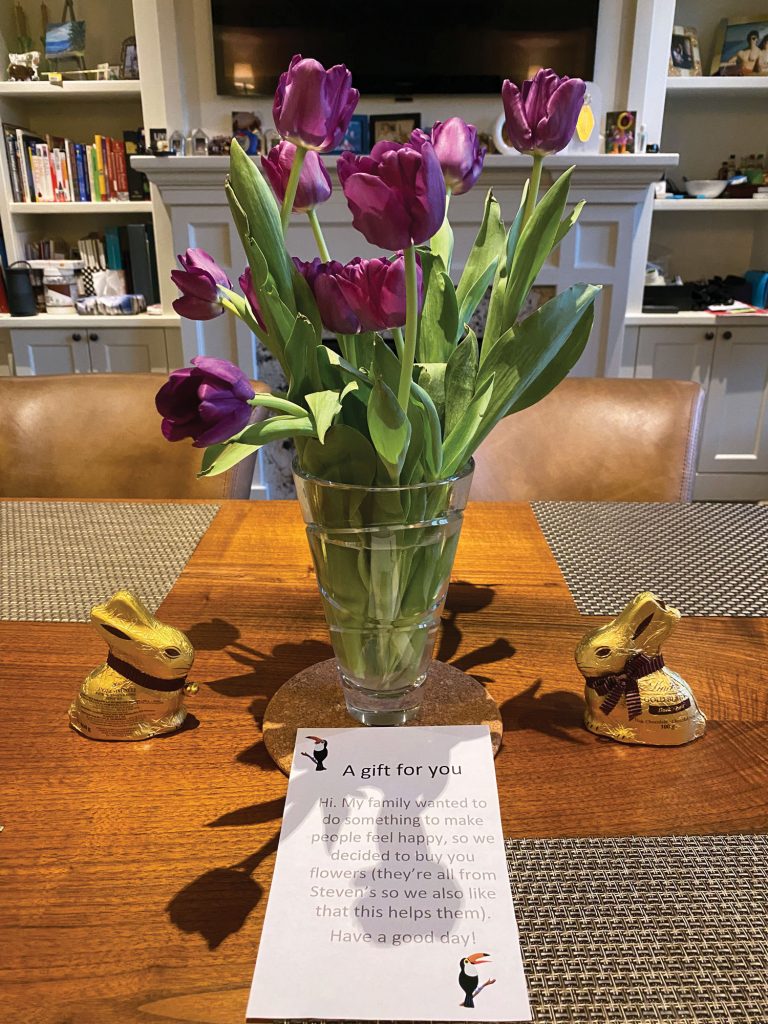
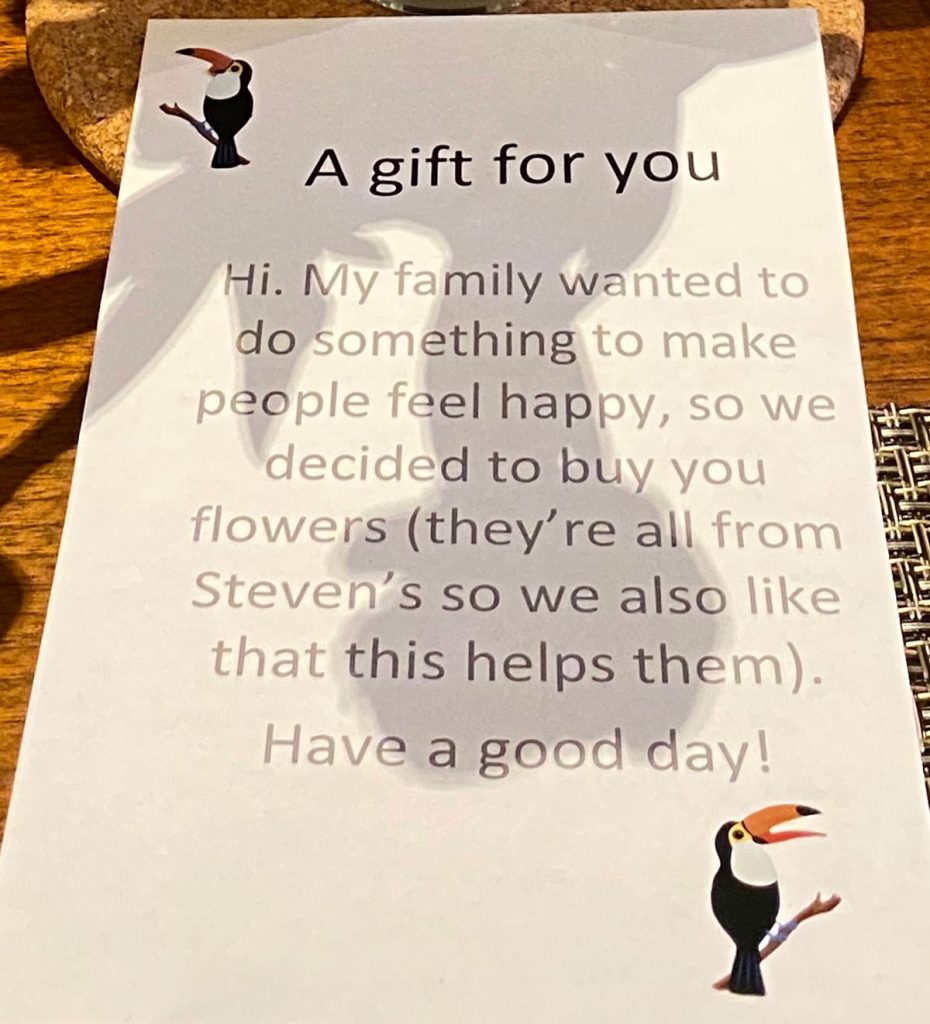
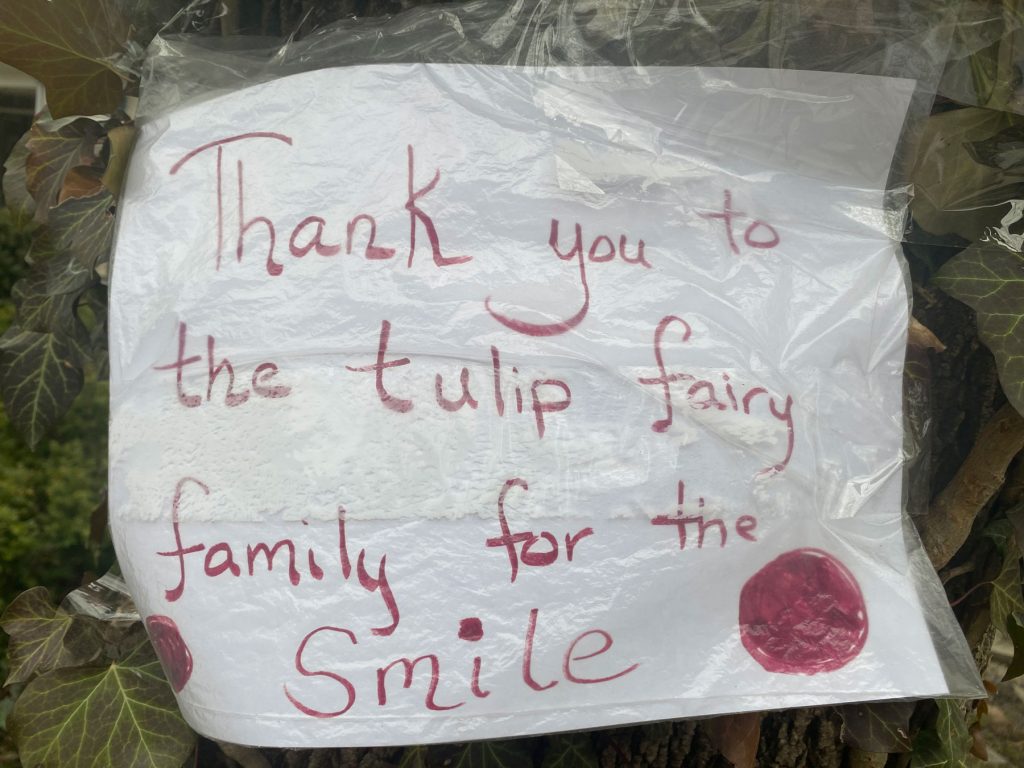
The Tulip Fairy Family proved that they too, are essential workers, when, on April 2, a woman and her two children purchased all the tulips at Steven’s Convenience at Bathurst and Olive streets. They then mysteriously distributed the flowers to houses in the adjacent area. Their identity remains unknown. —Nicole Stoffman/Gleaner News, photos courtesy of Mable Chu
Comments Off on LIFE: Tulip Fairies surprise (July 2020)Tags:Annex · Life
August 7th, 2020 · Comments Off on GREENINGS: What happens if we don’t want to go back to the “before” times? (July 2020)
Pandemic shows we can live on so much less
While many of us are enjoying cleaner air in the neighbourhood, undoubtably there are people up at night worried about what happens if the air never goes back to being as toxic as it once was. Trillions of dollars are at stake if we, as a society, decide we don’t really want to go back to the “before” times where people drove hours to get to work and mindlessly went shopping for entertainment.
Thousands of people are enjoying Toronto’s streets for physical activity. The old guard at city hall must be worrying, ‘What if voters decide they like this?’ Just letting us plebes see the light is a dangerous peek into Pandora’s box.
That old guard has been protecting the car lobby interests for decades. They resist everything from bike lanes to increases in parking rates. Since I’ve been in Toronto, TTC fares have increased from $2 to $3.25, a whopping 63% increase while the upper end of street parking has increased a corresponding 43%. The $2 an hour street parking that existed a decade ago still exists now.
These are not circumstantial decisions. Policy has a very direct impact on how a city runs and every decision maker knows it. More expensive transit and cheaper parking spots pushes people to drive more. This is a very simple supply and demand equation every student learns by 9th grade. Our policies have very intentionally kept congestion high. None of the politicians are so stupid that they don’t understand this. We live in a world where profits have always come at the expense of health and happiness.
What happens if everyone enjoying the streets for the fresh air, physical activity, and other social, yet socially-distant activities that were meant to be the heart of living in a city, decide they don’t want to go back to the way things were? What happens if these reclaimed streets stay reclaimed?
Fewer Canadians will die of air pollution and related illnesses. Fewer Canadians will die of car accidents. All this is terrible news for oil companies like Shell, who have openly admitted that they don’t know if oil will ever recover. Cars are getting 3 weeks to the litre right now and our new reality is a frightening time for those who depended on us being trapped in a cycle of consumption. Cleaner air means lower profits among the top tier of society in the economic system we have in place.
The longer we stay in lockdown, the lower the appetite will be to go back to our once wasteful ways. This partially explains the rush to reopen despite the nearly 200 new cases of COVID 19 a day still being posted.
What the world might look like post-pandemic is a scary thought for many, many people who depended on the way things were. These were the same people who insisted we can’t tackle the climate crisis because of, “the economy .”
This pandemic is showing us that we can indeed live on so much less. We must not be afraid of telling the political class that we want to put people first. We must not be afraid of saying we want the streets for kids, not cars. We need an economy that doesn’t depend on compromising our health and safety to be strong. Teaching my daughter to ride a bike on nearly empty streets has been such an enjoyable experience. As frightening as the new reality may sound, I don’t want to go back.
Terri Chu is an engineer committed to practical environmentalism. This column is dedicated to helping the community reduce energy use, and help distinguish environmental truths from myths. Send questions, comments, and ideas for future columns to Terri at terri.chu@whyshouldicare.ca.
August 7th, 2020 · Comments Off on LIFE: How to arrange flowers in less than 10 easy steps (July 2020)
Flowers in the home relax the mind and nourish the spirit
COURTESY LISA LOMAX
In May 2020, the Annex Gleaner celebrated 25 years of publishing. In acknowledgement of this history we are republishing highlights of our past; this feature, How to arrange flowers in 10 easy steps by gardening columnist Bardi Vorster, is from July 2000. Some guidance still relevant to enjoy summer’s flowery bounty indoors.
By Bardi Vorster
Now that the garden is in full bloom, there comes an irresistable moment when one needs to gaze intimately at its contents.
The beauty of a single lily has been known to inspire novels, paintings or launch crusades, so getting up close and personal with your flowers seems like a good idea.
Whether it’s the fragrance, the colours, the shape, or all three, fresh flowers in the home make wonderful decorations to relax the mind and nourish the spirit.
Personally, I have often found it frustrating to arrange flowers as the arrangement never seems to be as perfect as the subject. Nonetheless, perseverance and practice as well as a lot of reading on the subject has helped. I now have a system.
Choice of Material
There is such an enormous amount of material available in cut flowers, including greenery and fruits or nuts that it’s easy to become confused, give up and buy a pot of mums.
Much depends on your personal preferences for colour, and types of flowers.
But consciously identifying this makes arrangements design easier. (I hate dyed flowers and prefer flowers in season to tulips in July.)
Florists or experienced amateurs can produce amazing bouquets using the “few-of-many types of flowers” approach, but I find it difficult.
I think it’s easier to eliminate some things and narrow the focus before you go to the store.
Here is my system:
Choose a feature flower, it can be whatever strikes your fancy.
Choose a “line” material; this could be twigs, or a flower of contrasting shape.
Choose ‘filler’ material. This would be greens such as ferns or eucalyptus or Baby’s Breath; something which adds bulk to the arrangement.
If you have a lot of something in your garden, a popular approach is to compose a bouquet of all one type of flower in short containers; this is easy to do but it takes a lot of blooms and is expensive to purchase.
Style
Plan ahead, if only vaguely, where the arrangement will be located and what container will be used.
The selection of vase, pot or jam jar seems to influence harmonious outcomes the most.
Mind you, anything goes: a single rose in a beer bottle with a string tie is perfect for someone, somewhere, and granny’s antique crystal vase will look great with wildflowers or exotic orchids.
Tools of the Trade
The following is a basic list of the most useful equipment. Most important is a very sharp knife with a short blade.
Professionals use one with a curved blade but I haven’t mastered the stroke.
Floral foam is good for use in ceramic or other non-see-through containers. This is available from florists or craft shops and really is a snap to use because stems stay exactly where you put them, whatever the angle.
Different formulations of foam are available for fresh, dried or silk flowers.
For fresh flowers, soak the block- perforations up — but cut off what you need and store the remainder in a plastic bag in the refrigerator for next time. Partially fill the container with foam, mounding the top; anchor to the container if necessary with tape. Proceed to place greens and flowers.
Then there’s the floral food, the powder in small packs that often comes with purchased flowers.
It contains food and an antibacterial agent that makes flowers last longer. (it is better than pennies or other old-wives formulas.)
Pruners are useful for heavy stems or twigs. Small sharp scissors are useful for snipping off errant leaves.
Procedures Oversimplified
There is much other information on conditioning and handling flowers that I must omit for space reasons, but here are the bare bones. Start by filling your container with lukewarm water and adding the floral-life product. Next, add the greenery, crossing the stems so that they will support the flowers.
Alternatively, use invisible tape criss-crossed over the top of your container. Begin your design with the feature flower in the topmost position and add the others one at a time for balance or colour, rhythm and mass.
Hundreds of books have been written about how to achieve this minor miracle and the best are well illustrated. The most important thing is to make a fresh, clean, diagonal cut on the stem before inserting in the vase. The objective is to expose the greatest area of cells to the water so that the stem can drink. Don’t use scissors as this compresses the cells.
Try to enjoy the process: however perfect or imperfect the arrangement is, the flowers will be just as beautiful.
Comments Off on LIFE: How to arrange flowers in less than 10 easy steps (July 2020)Tags:Annex · Life
August 7th, 2020 · Comments Off on ARTS: Coronavirus arts update:?Stay engaged (July 2020)
A crisis is a terrible thing to waste
By Meribeth Deen
Welcome to the Bloor St. Arts Corridor monthly Covid-events column number… 4? But who is counting anyways? With a virus in our midst, we are all doing the best we can to stay safe, keep others safe, and to keep enjoying life and the world as best we can. The artists in our midst have not stopped creating, so we offer to you just a few ways to keep connecting to their work, to the world and to be part of shaping it.
The library, or at least the online version of it, is as lively as ever. While schools may be fully closed for the summer, the TPL’s Summer Reading Club, Wonder Wall and Mini Wonder Workshops will keep your kiddo reading learning, discovering and creating all summer long. These online programs even give your kids the chance to ask questions, and make new friends. Digital Innovation Classes can get you programming, making electronic music, designing webpages and more. If it’s books you’re into… they still do that! Just google TPL Live & Online program.
Live music is clearly not a thing anymore, and sadly, like many other venues, Soundstreams has canceled its 2020/21 season. Soundstreams is a global leader in the presentation of innovative, carefully curated, and immersive musical experiences, and has been introducing Canadian audiences to groundbreaking composers since its founding in 1982. They’ve recently launched the Soundstreams Insider Program to help determine a course for the future of the organization and to create a roadmap for future, live concerts. By participating, you’ll get an invitation to town halls and access to concerts before they go on sale for the general public.
Head to Hot Docs Curious Minds at Home to escape to other worlds. Dr. Peter Harris, the former Assistant Dean of the Faculty of Arts and Science of the University of Toronto, leads courses on The Age of Upheaval (between the wars) and The Age of Re-Invention (after the World War II). Music historian Dr. Mike Daley will guide you through Neil Young’s life and career with his course, Words and Music. All three courses are open for registration now, and begin July 30.
For a shorter journey, check out the Lavazza Drive-In Film Festival. A film from a different country will be featured each night at Ontario Place with a special “Focus on Italy” series, presented in collaboration with the Istituto Italiano di Cultura Toronto. The festival is meant to offer families a safe and comfortable manner of re-integrating into social events. A portion of ticket sales will go directly to the Canadian Red Cross to assist with COVID-19 relief efforts.
Celebrate the gradual re-opening of the city with the official re-opening of the Gardiner Museum this month. If you pop by for a visit, you’ll have more space than ever to view Raw, an extended exhibition featuring works made with unfired clay. Artists Cassils, Magdolene Dykstra, Azza El Siddique, and Linda Swanson—invite you to discover new possibilities in an ancient medium. For a sneak peek, check out Cassils video “Up to and Including Their Limits,” on Youtube.
While you figure out how to re-shape the world you are re-entering, pop in to the re-opened A Different Booklist where you’ll find all the tools you need to re-shape your own mind. Until We Are Free: Reflections on Black Lives Matter, published in February 2020 is available in the store now. This book, “busts myths of Canadian politeness and niceness, myths that prevent Canadians from properly fulfilling its dream of multiculturalism and from challenging systemic racism, including the everyday assaults on black and brown bodies. This book needs to be read and put into practice by everyone,” says author Vershawn Young.
Get reading, get learning, get engaged: because a crisis is a terrible thing to waste.
Comments Off on ARTS: Coronavirus arts update:?Stay engaged (July 2020)Tags:Annex · Arts
August 7th, 2020 · Comments Off on SPORTS: Silent Pits hold fond memories for Maple Leafs Pitcher (July 2020)
Pitcher Marek Deska has been a fan favourite at Christie Pits for 13 seasons. R.S. KONJEK/GLEANER NEWS
As 2020 season is cancelled, Marek Deska recounts historic no-hitter
By R.S. Konjek
Marek Deska smiles as he remembers that night.
“The cool thing was, I knew the whole time.”
Deska is recounting his role in one of the most historic baseball games in Toronto Maple Leafs history.
On August 15, 2018, Deska and fellow pitcher Zach Sloan teamed up to defeat the Guelph Royals by tossing the only postseason no-hitter in the 102-year history of the Inter-county Baseball League. On top of that, the 6-2 victory eliminated Guelph and propelled the Leafs onward in the playoffs that summer.
Many of the fans at Christie Pits that night were unaware that they had witnessed history. A rough sixth inning saw the Royals send seven men to the plate and score two runs. Despite all that activity at the plate, they did not record a hit.
Sloan was the starting pitcher for the Leafs, and he cruised through the first five innings of the game, striking out seven Guelph batters.
While Sloan held his opponents in check, the Leafs put two runs on the board early.
It was not until the sixth inning that Sloan ran into trouble. He threw two wild pitches, two intentional walks, hit a batter with a pitch, made an error, and watched one of his fielders make another error. When the dust settled, the Royals had tied the game 2-2.
Deska had watched most of the game from the Leafs’ bench, then moved to the bullpen when manager Damon Topolie asked him to start warming up. After Sloan got through the sixth inning, he trudged off the field and vented to his teammate.
“He sounded disappointed because he pitched so well against that lineup and they still eeked out two runs,” Deska recalls. In the back of his mind, he knew that Sloan had not given up a hit to that point in the game.
“I always know. To me, the goal is always perfection. It may not be realistic at times, but if you set your expectations high enough, you’ll find a higher level of confidence that keeps you constantly sharp.”
A fan favourite for 13 seasons with the Leafs, Deska took the ball with the task of finishing the final three innings in order to win the game, clinch the series, and achieve something every pitcher dreams of. As a teenager, Deska had pitched in three no-hitters, but never at this level.
The Leafs took some of the pressure off their reliever’s shoulders by scoring four late runs to provide him with a comfortable lead, although any pitcher would agree that no lead is ever comfortable enough.
Deska hunkered down and pitched a perfect seventh inning. He survived a slightly-less-perfect eighth, and then three more outs were all that separated Sloan and Deska from destiny.
Toronto baseball has seen many no-hitters.
From 1885 to 1967, over a dozen of them were recorded by the Leafs’ minor league predecessor in the International League.
The Toronto Blue Jays have a lone no-hitter to their name, pitched by Dave Stieb in 1990.
The Leafs of Christie Pits have also recorded no-hitters, most recently by Rob Patterson in 2000.
Never before had there been a situation like this one. It was the deciding game of a postseason series. Not only was a no-hitter at stake, but if the Leafs blew the game their season would come crashing to an end.
Deska was determined not to let that happen, and returned to the mound in the ninth inning with a plan.
“I knew that all I needed to do was throw strikes to secure the win,” he recalls. “The strange thing was that they did not make any real adjustments. I was going with my regular routine of getting ahead of the batter and making them hit my pitch. I did notice that they started taking a strike near the later innings, but that just allowed me to get ahead of another hitter.”
The first batter grounded out.
“I attacked the next two batters with fastballs.”
The next man up struck out swinging.
“My slider was sharp and I had great life on my fastball that night.”
The last man up for the Royals also went down swinging. Deska got the final out and the Leafs won the game and the series.
“That last punch out was a belt-high fastball with some added zip to it to put an exclamation point on the night.”
The Leafs celebrated on the field and Deska kept the ball that marked the final out of the game.
For Sloan, Deska and the rest of the Leafs, that game remains their most recent postseason success. They were eliminated by the Kitchener Panthers in the following round of the 2018 playoffs, and were eliminated by Kitchener again in the first round last year.
In 2020, the COVID-19 pandemic forced the league to postpone its season, and the City of Toronto closed all sports fields. In late June, there remained a faint possibility that the Leafs might be able to play a truncated season at Christie Pits.
If it happens, Deska will be back.
“I’m itching to go,” he says. “A summer without baseball feels odd. I’ll keep pitching as long as I can help the team win games. I’m realistic and I’m sure I’ll know when my time is up. But not yet.”
Comments Off on SPORTS: Silent Pits hold fond memories for Maple Leafs Pitcher (July 2020)Tags:Annex · Sports
June 15th, 2020 · Comments Off on ON THE COVER: Halfway there (May 2020)
Robert Watt House, the former home of Anne Mirvish’s studio, is on its way from 610 to 604 Markham St. The building is being preserved and re-located as part of Westbank’s Mirvish Village development. NEILAND BRISSENDEN/GLEANER NEWS
June 15th, 2020 · Comments Off on NEWS: Kensington Gardens loses eight (May 2020)
Kensington and other seniors’ homes in Annex very well prepared
By Nicole Stoffman
Coronavirus has hit long term care homes and retirement homes hard, accounting for 12% of all Toronto’s cases but 35% of all the city’s deaths, according to data from the National Institute on Ageing and Toronto Public health. As a percentage of Toronto’s cases, 61, or 6.5%, and 8 deaths, or 4%, are in the Gleaner’s coverage area. All of the eight deaths have been at Kensington Gardens, at the time of writing.
Kensington Gardens faced the largest outbreak of any seniors’ home in the Annex, with 29 cases, seven of them amongst staff, and eight deaths. All eight deaths occurred in the most acute ward, amongst residents with advanced dementia or Alzheimers.
The outbreak, one of 38 across the city, was most probably spread by an asymptomatic staff member, whose mother had just returned from the U.K and who subsequently developed symptoms. When it spread to Kensington Gardens’ “lockdown unit,” in the north building, it spread like wildfire. This unit is for patients referred to as “the wanderers”, the residents with significant behavioural issues.
Kensington Gardens is a 350 bed long term care home operated by Kensington Health, a registered charity that also runs an eye surgery institute, screening clinic, hospice, and many other programs and services. Formerly the Doctor’s Hospital, the campus has been serving the health needs of the Kensington Market community for 100 years.
When symptomatic staff in the long-term care home began following protocols to self-quarantine for 14 days, CEO John Yip put out a call for volunteers to replace them. Thirty staff from across the organization answered. Knowing he could not ask them to do something he wouldn’t do himself, Yip bought himself some scrubs, an N95 mask, and a washable gown. He’s worked as an aide on the affected unit for 102 days, feeding bedridden residents.
The Ontario Ministry of Health did not begin purchasing additional personal protective equipment for long-term care homes until March 17. Fortunately, Yip had swung into action in February. Realizing Kensington had only a two-week supply, he instructed staff to order PPE from Amazon, Walmart, “whatever we could get our hands on that was good quality,” he said. It was a good thing he did: PPE ordered from their usual supplier in early March did not arrive until May 5.
Yip implemented outbreak protocols, such as universal masking and limiting staff to one workplace at the end of March, two weeks and three weeks, respectively, before those measures were mandated by Toronto Public Health and the province. A mobile team from their partner, Women’s College Hospital, tested all staff and residents starting March 12, including in the less acute South building, long before universal testing was mandated by the province on April 22.
As of the Gleaner’s May 6 interview with Mr. Yip, the south building was COVID-free, the lockdown unit had been declared out of outbreak, and the remaining residents were recovering well.
“Residents who were bedridden are wandering again, which to me is healthy,” said Mr. Yip. “They’re eating. My guys, that I see, were struggling to eat, and they’re now helping themselves to seconds.”
In other good news, Kensington’s senior team is already planning repatriating staff back to their home positions, as they ramp up their ambulatory-surgical operations.
“This is an unbelievable example of a team,” said Yip. “Colleagues helping colleagues.”
Of the eight seniors’ homes in the Gleaner’s coverage area, Kensington Gardens is the third largest after Castleview-Wychwood (capacity 456), and Christie Gardens (capacity 400). Castleview-Wychwood, a municipally run home, has had two staff cases, and Christie Gardens, a non profit retirement home, is COVID-free as of the beginning of May, after an outbreak of 22 cases, according to data from Toronto Public Health. All have recovered.
Castleview-Wychwood did not respond to the Gleaner’s request for comment. The remaining five homes, which range in capacity from 99 to 238 residents, have had 1-5 cases of COVID-19.
Christie Gardens’ CEO Heather Janes attributes the quick recovery of her home to its partnership with Mount Sinai Hospital, which ramped up April 18. The hospital provided on site testing, risk assessment, and PPE, including over 1,000 disposable gowns, just when they were about to run out. Two weeks later, they were through the worst of it.
Christie Gardens found housing for 18 of their staff, who had been away from their families for two months at the time of writing. The only two coronavirus infections at Christie Gardens were among staff. Of the 61 infections in seniors’ homes across the Annex, 16 were staff cases.
Janes also attributes the home’s complete recovery to the large cohort of independent residents, who live in apartments with their own kitchens, and respected her request that they stay in their suites for three weeks.
“It’s a highly educated crowd,” says Janes, proudly, “a lot of former politicians and profs from U of T.”
Meals, a hallway exercise program, mail and other services were delivered to their doors. “If you walk through the hallways, you wouldn’t believe the notes on people’s doors, thanking staff for ‘caring for us’. ”
Ninety percent of cases at Christie Gardens were asymptomatic.
“COVID-19 is so different from any other kind of flu outbreak,” said Janes.
“We have not done a good job as a province, and as a country on contact tracing, like other jurisdictions,” asserted Yip. “Had we done contact tracing of all international travelers at that time, we would have saved eight lives here, guaranteed.”
There might still be other outbreaks, yet the stories at Kensington and Christie Gardens suggest that a proper PPE stockpile and early testing of both staff and residents kept the virus in check.
If there is a silver lining in all of this, perhaps it is to draw attention to the importance of hospitals partnering with seniors’ homes in times of crisis, as witnessed right here in the Annex.
“Our partnership with Women’s College has helped tremendously. We’ve had a partnership with them pre-COVID, but we drew on that existing relationship for them to come help us,” explained Yip. “ Without them, the numbers would have been drastically different. The testing and protective equipment that they supplied saved lives.”
Christie Gardens’ partnership with Mount Sinai was not pre-existing, and how it came to be still mystifies CEO Heather Janes, who suspects one of her residents made it happen. It allowed them to start testing about three weeks before the ministry of health and local health networks were able to. “I have been in this business almost thirty years,” said Janes. “I have never-seen a hospital-nursing home partnership like this. It’s incredible. I can’t wait to say a proper thank you to the folks at Sinai.”
June 15th, 2020 · Comments Off on NEWS: COVID-19 outbreaks at grocers (May 2020)
Loblaws, Metro, Fiesta Farms all affected
By Nicole Stoffman
How is COVID-19 impacting the health and safety of grocery workers and their customers across the Annex? The Gleaner took a closer look.
DUPONT LOBLAWS
Toronto Public Health is actively investigating two clusters of cases of COVID-19 among staff at grocery stores including the Loblaws at Dupont and Christie, said Dr. Vinita Dubey, Associate Medical Officer of Health, in an email to the Gleaner.
There have been “multiple confirmed cases over many weeks,” of employees who have tested positive at the Dupont Loblaws, according to a May 23rd statement from the company.
“We immediately took a number of steps to ensure the safety and wellbeing of our customers and colleagues, including providing masks and gloves to the team, making temperature checks mandatory before shifts and following the guidance of public health following each confirmed case. The store also significantly reduced the number of customers allowed in at any one time, and proactively sent home many colleagues to self-isolate,” the statement read.
An employee who spoke to the Gleaner, on condition of anonymity, stated there have been 25-30 cases, but Loblaws declined to share exact numbers.
A Dupont Loblaws employee tested positive on April 17, another on April 29, and a few more on May 2. It was not until May 2 that employees had their temperature checked at the start of each shift, and at no time were masks mandatory for workers or customers, according to information shared on the Dupont Loblaws Facebook page.
“It was just a case of ‘wash your hands and practice good hygiene’,” said the employee. “But you can’t trust human beings to do the decent thing.”
All confirmed cases but one came from the day crew who interact with customers, as opposed to the night crew, who restock shelves and prepare online orders, said the employee.
In response to each positive case, and working with Toronto Public Health, the store was sanitized daily, and closed overnight for cleaning, according to statements on the store’s Facebook page.
However, customers writing on the page complained that social distancing measures were not being enforced, staff was not wearing PPE, and the company was not letting people know when the COVID-19 positive employees had worked, making it impossible for them to know if they had been exposed.
“Once we started having cases three, four and five, I feel that they kind of wanted to turn a blind eye and not accept responsibility for it,” the employee said. “At a time like this, you just want to be honest and upfront with people. People will respect that a lot more.”
On May 11, the United Food and Commercial Workers (UFCW), which represents 25,000 grocery workers across the province, including at Loblaws, called on the store to close for two weeks to assess the scale of the outbreak. Instead, Loblaws temporarily closed the store to shoppers, providing pickup orders only. Their pharmacy remains open.
Since then, masks, gloves and temperature checks are mandatory for all staff, and they have only had one case in two weeks, according to the employee, who now feels safe, but says, “it’s also too little, too late… It’s very much been a reaction.”
BLOOR STREET METRO
An employee at the Bloor and Robert St. Metro grocery store tested positive on April 24th. Working with Toronto Public Health, Metro ensured the employee was safe and quarantined, cleaned all surfaces they may have been in contact with and informed all of the store’s employees. The store was deep-cleaned that night, according to a statement from Communications Manager, Stephanie Bonk.
Metro advises, but does not require, everyone to wear masks in store. In early May, all employees were provided a face shield and masks. PPE is now mandatory for employees for whom contact with others within 2 meters is likely because social distancing measures, “have been considered but are not possible,” said Bonk.
Metro publishes a listing of the numbers of all positive employee COVID-19 cases, along with the location details, at the bottom of the FAQ page of their website..
FIESTA FARMS
Fiesta Farms blogged on May 20th that their first employee tested positive that day. The employee’s last day of work was May 16th. Fiesta Farms immediately informed public health, interviewed all staff to discover who had contact with the employee, and closed the store for three days so it could be sanitized by a specialized company.
The employee is recovering very well, at home, according to store managers Tracy Virgona and Kendra Sozinho.
To get ahead of a possible outbreak, all other 149 employees were tested. At the time of writing 60% have come back negative. Employees still waiting for results stayed home, while those who tested negative were part of a small crew stocking shelves for the re-opening on May 23.
Fiesta Farms went beyond Toronto Public Health protocols for plexiglass shields and social distancing markings by providing face shields for employees. On May 13th, they went further and implemented a mandatory mask policy, to the objection of many customers.
“You’re coming here to shop. It’s a 20-30 minute shop, so just go with the rules the store has put in place,” urges Sozinho. “Think of our health care workers. They’re wearing the full gear for 10-12 hour shifts. So, suck it up and wear a mask. Sorry to be so blunt.”
“The best protection from COVID-19 is to keep two metres (or six feet) from others, wash your hands often and avoid non-essential trips in the community,” says Dubey.
Toronto Public Health and the United Food and Commercial Workers (UFCW) both recommend that grocery store staff and customers wear a face mask, as shopping sometimes makes keeping six feet apart difficult.
The Canadian Civil Liberties Association has said that refusing someone service because they are not masked would be a violation of their rights. However, Dubey confirmed that it is within the purview of private businesses to implement Occupational Health and Safety policies for their workers.
‘‘Just as we’ve seen different governments around the world enforce policies around mask wearing, it really is up to the employer or government to make it applicable across the province, country or the workplace,” said Joel Thelosen, of the UFCW.
Grocery store employees have suddenly become front line workers during a pandemic involving an insidious virus that spreads asymptomatically. Keeping them safe, therefore, protects the public too, and may be key to flattening the curve, according to a March 19th statement from UCFW President, Wayne Hanley, who called on the province to take stronger measures to protect grocery workers.
June 15th, 2020 · Comments Off on CHATTER: Green Beans no more (May 2020)
R.H. Thomson, actor and Annex resident, sat down with the Gleaner at the Green Beanery in March of 2016 to discuss his starring role in the Tarragon Theatre play You will remember me. NEILAND BRISSENDEN/GLEANER NEWS
The Annex café at the corner of Bathurst and Bloor has announced its closing after 12 years in business. The announcement came ahead of the pandemic crisis and reportedly as the building had been sold by the tenant’s parent company.
Since no tenant was immediately found, the owners reopened a temporary takeout window on May 7. They will continue serving coffee, tea, ice cream and small bags of freshly roasted beans, until a new occupant is secured.
The Green Beanery café-roastery was a popular source for coffee beans and equipment for Annex’s locals since it opened in 2008.
“Green Beanery began as an experiment in fundraising for Probe International, our charitable foundation. We wanted this enterprise to embody our ideals of bringing together small coffee farmers and Canadians who loved their unique coffees,” reads their statement. “We also wanted to recreate a coffee house of old, without WiFi, where all could come to imbibe superb coffee and explore the important issues of the day without fear of intolerance. We hope we have succeeded.”
The café was a beloved space to connect for the political discussion group Grounds for Thought, and from “first dates (and even proposals), to meetings and poetry readings.”
“We want to extend our heartfelt thanks to you, our loyal customers and friends, who have made this café such a great success,” the statement reads in part.
While the company has closed a location on Bloor Street, it remains in business.
“We are very happy to share the news that our online coffee equipment and bean sales will continue from new locations run by Green Beanery staff and associates,” says the statement.
The Green Beanery takeout window at the corner of Bathurst and Bloor is open every day of the week from 9:30 a.m. to 5:30 p.m. for fresh beans, beverages and ice-cream to go until further notice.
—Tanya Ielyseieva, Gleaner News
Comments Off on CHATTER: Green Beans no more (May 2020)Tags:Annex · News