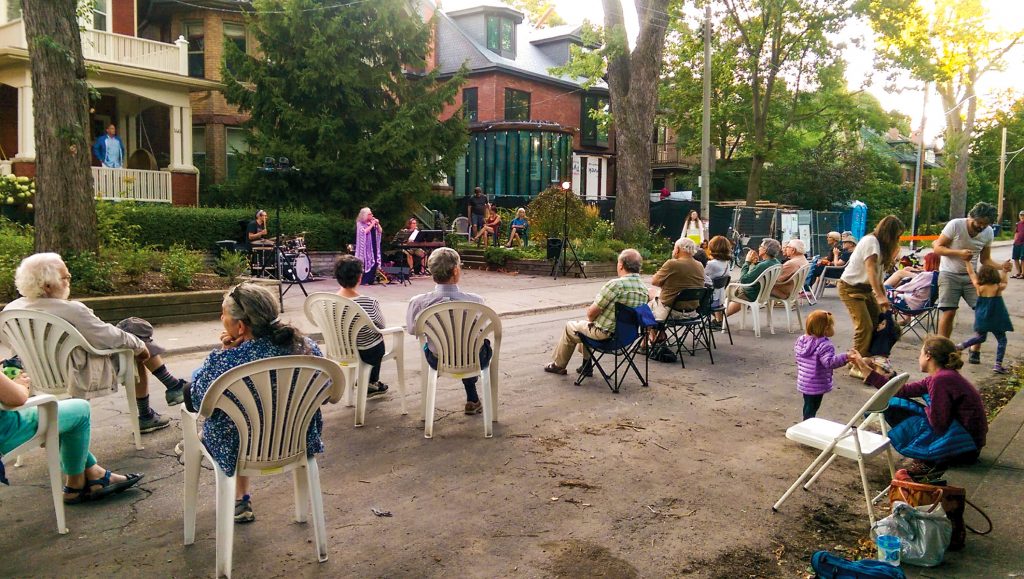
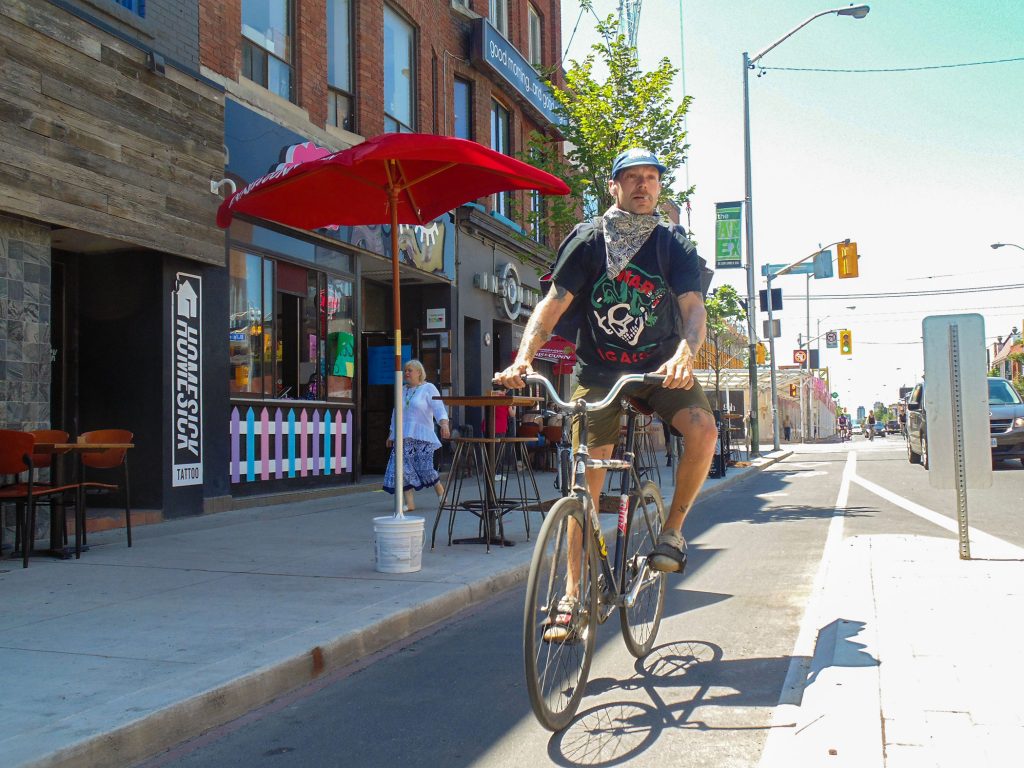
As summer slowly comes to a close, it is important to reflect on the ways that our city has developed during these challenging times. Our response to the pandemic has uniquely highlighted that investing in public green spaces and active transportation infrastructure means a better quality of life for Torontonians.
Cities build parks so that residents can build community, and Toronto is globally known for our parks and natural environment. As our city continues to grow, our green spaces must grow, too. Our parks are much more than their name; they include open spaces, conservation lands, ravines, hydro corridors, schools, and other privately-owned, publicly accessible spaces.
Since I have been Councillor for Ward 11, I have worked hard to maintain the necessary balance between urban intensification and the creation of green spaces that are fundamental for a high quality of life. Locally, this has translated into the opening and improving of several parks across the ward. I am proud to have worked with many of you, and to have seen firsthand the willingness of residents to work together to ensure a liveable Toronto for today, and for future generations.
Located at 10 Dalton Rd., Joseph Burr Tyrrell Park is in the midst of a redesign. A consultant has been hired to develop a site analysis report and, based on this report as well as the feedback from a January 2020 online survey, they produced three high-level preliminary layout options for the park. These contain different ideas for play and passive recreation areas, pathways, and buffer zones. The redesigned park and playground will include: a new park layout, a new playground and play elements, improved accessible pathways, improved seating, updated plantings, and updated amenities such as water fountains and other aesthetic features. I hope to see construction begin in Spring 2021.
The parkettes at Howland Avenue, Brunswick Avenue, Major Street, and Robert Street were completed in partnership with the BIA earlier this year, and are a shining example of ingenuity and community spirit. Situated among various streets in the Annex, they are envisioned to be environmentally conscious spaces boasting features such as pollinator plantings, increased bike parking, and amenities built from reclaimed, recycled, and sustainably sourced material. Alongside the newly constructed permanent cycle track, the streetscape on Bloor through the Annex has never been more inviting.
The new Monsignor Fraser Park (which will undergo a renaming) is a partnership between the city and the Toronto Catholic District School Board (TCDSB). This new park opened for public use in late spring, in the early part of Stage 2, so that more people were able to get outside and use this space. The project utilized development charges from nearby developments to transform the existing asphalt schoolyard into a greener school yard/park that is accessible to the wider community. To ensure community access to the space, the City entered into an agreement with the TCDSB.
The Robert Street Field remains in a state of construction, but we will soon have a new playground and passive park space at the corner of Robert and Sussex. The park will feature a new playground, shade structure, and other passive amenities to allow residents and students to gather and physically distance. This park will take the place of derelict tennis courts and an old ice hockey rink, and provide views into the renovated Robert Street Field on the University of Toronto property.
If you have ideas or suggestions on how we can improve park spaces in your neighbourhood, I encourage you to reach out to my office Councillor_Layton@toronto.ca. I am always looking for opportunities to work with residents on improvements that ensure our green spaces are serving the needs of the local community, and would love to hear from you.
Mike Layton is councillor for Ward 11 University—Rosedale.
September 9th, 2020 · Comments Off on FORUM: What can we do to fight for safe public education? (Aug. 2020)
Premier’s plan creates chaos, sows division
By Jessica Bell
Since school closed in March, our family has been struggling with the impossible job of full-time work and full-time parenting our two school-aged children. I, along with the parents of Ontario’s other two million school-age children, have been waiting for the Ontario government to release its back-to-school plan. However, its release — just weeks before school is scheduled to begin and without any serious consultation with the community — brought feelings of relief, anxiety, hopelessness, and rage.
What exactly is in store for our kids come September is still being feverishly worked out by public health units, schools and the government, but the gist at the time of writing is this:
High school students will go back to in-school learning at least 50% of the time in cohorts of 15, with online learning for the remainder of the time.
Elementary students are back full time with full class sizes.
Lack of government funding means only some of the safety measures Sick Kids Hospital experts are recommending will be implemented; daily screening, mandatory masks for teachers and students grade four and up, and the hiring of 500 public health nurses. However there is not enough funding for improved ventilation in schools, a maximum of 15 kids a class, access to working washrooms and sinks, and safe bussing.
Safely reopening schools to full time learning is essential to our kids’ learning, our mental health, and the economic survival of families who simply cannot work unless their children are in school. Still, the Ontario government’s plan is too little, too risky, too cheap and too late for school to be as safe as it needs to be.
Premier Ford’s plan is also creating chaos and division in the school community. Uncertainty and fear is driving some parents to delay the return to public school for homeschooling pods or to permanently leave for private school, leaving behind many parents who cannot afford to make that choice.
The urgent cry for full time school is creating divisions between parents who are desperate to have their kids return and teachers who are reluctant to risk their health and teach in crowded, poorly-ventilated classrooms.
The government’s decision to underfund its plan is building rifts between some parents and teachers who want school boards to take a stand and pass an unbalanced budget that costs-out what’s truly needed. School board trustees want to protect students from the kind of drastic cuts that a ministry will certainly make if they take over a rebellious school board.
This is exactly what Premier Ford wants. When a school community is divided, and parents with means and political influence leave the deliberately underfunded public school system, we are weak. And when we are weak we are less able to fight the conservative’s agenda to cut public education funding, break teachers unions, and introduce privatization through online learning delivery and charter schools. Our kids’ future is at stake.
If we stick together we can make the Ford government provide the necessary funding and direction to ensure our kids can access affordable, high-quality, safe public education and childcare during the pandemic and beyond.
Teachers, parents and students forced this government to back down on school budget cuts, massive class-size increases and the threat of privatized online learning last year. We can do it again.
Here are three useful ways to take action now:
SEND A PERSONAL MESSAGE TO PREMIER FORD
You can send a message to the Ontario government via jessicabellmpp.ca/ safeschools.
I encourage you to share your story and your activism on social media because powerful stories of personal experience help isolated parents see they are not alone and that action is possible and necessary.
JOIN YOUR SCHOOL PARENT COUNCIL
Now is the time to work with your parent council, principal and teachers to take useful political action as a school community, from safely organizing and attending rallies to having your school community write a sign-on letter to the Ontario government. Friendships and working relationships with your school community are the ingredients to social change and the antidote to division.
DONATE AND VOLUNTEER WITH GROUPS ADVOCATING FOR CHANGE
There are many groups worthy of your support or involvement, including Parents of Black Children, the Ontario Parents Action Network, and Fix Our Schools. There are four million parents, two million students, and 160,000 teachers in Ontario. There’s just 72 Conservative MPPs.
When we work together we will win real and permanent change for our kids, for our public schools and childcare system, and for our province’s safe future. Let’s get to it.
September 9th, 2020 · Comments Off on ARTS: Takin’ it to the streets (Aug. 2020)
A trio of neighbours pooled their money together to bring the Julie Michaels Trio to Walmer Rd. for a soulful driveway concert on Aug. 19.
NICOLE STOFFMAN/GLEANER NEWS
Comments Off on ARTS: Takin’ it to the streets (Aug. 2020)Tags:Annex · Arts
September 9th, 2020 · Comments Off on ARTS: The arts are open! (Almost) (Aug. 2020)
Come tread gently in the Culture Corridor
By Meribeth Deen
Are your eyes crossed yet? If you haven’t already, it’s time to shut the computer down. Yes, we are still in a global pandemic, but you can leave your house now and become re-acquainted with the city’s public spaces. Just be sure to check your venues’ COVID-19-policies so you can follow the rules of entry.
The Royal Ontario Museum, which has been open since July, requires visitors to purchase time-based tickets, wear masks and hand sanitize frequently. Permanent galleries are now open, including Florals: Desire and Design. Winnie the Pooh: Exploring a Classic will re-open in September. September will also bring Egyptian Mummies: Ancient Lives. New Discoveries. This exhibit brings six mummies, each preserved for up to 3,000 years, alongside CT scans, 3D imaging and 200 contemporary objects to recreate the lives of each one. For those of you who are not ready to venture out yet – online programs will continue running.
Make an appointment with the Istituto Italiano di Cultura to check out 50 years of Italian Portraiture in the exhibition, Facing the Camera. Curated by photographer, editor and filmmaker Marco Delogu, the exhibit features the work of 20 photographers in total, and many previously unpublished photographs. In seeking the works for this exhibition, Delogu says he looked for portraits that “started off from personal experiences, in which you can sense the story of the photographer, his or her personal and social identity.”
If you’re feeling in top shape (ie: no fever, cough, chills or other questionable symptoms) book a visit to The Japan Foundation. Be sure to make time for the Manga Hokusai Manga: Approaching the Master’s Compendium from the Perspective of Contemporary Comics, which closes on September 18. Manga fans consider the works of Katsushika Hokusai as the origin of today’s manga, although the appearance of his work and modern manga do not necessarily suggest a continuous tradition. This exhibition approaches the work from a contemporary perspective, “focusing on genre, pictorial storytelling and participatory culture rather than the integration of word and image or the role of popular characters. And instead of aiming at a historiographic verification of influences, the exhibition invites viewers to ponder their own notions about manga by comparing works from different periods while exploring the diversity therein.”
Get back to class! And study French in-person at the Alliance Française. Social distancing rules will be in effect, as well as mask wearing and hand sanitizing stations. For more information, look into upcoming online open house events to get to know the AF community.
Many of the organizations, businesses and institutions affiliated with the Bloor St. Culture Corridor continue to offer events and programming online. No doubt the more than three million members of the public who enjoy these cultural offerings look forward to more live events so that they can tap into the city’s cultural diversity, including: Aboriginal, French, Jewish, Italian, Japanese, Estonian, African and Caribbean arts and culture – but let’s just see how this virus evolves!
Comments Off on ARTS: The arts are open! (Almost) (Aug. 2020)Tags:Annex · Arts
August 7th, 2020 · Comments Off on ON THE COVER (July 2020)
As Toronto remains in Stage 2 re-opening protocols, restaurants are doing their best to satisfy pent-up demand. Establishments such as Insomnia at 563 Bloor St. W. have found innovative ways to serve their clientelle along the sidewalk. BRIAN BURCHELL/GLEANER NEWS
Comments Off on ON THE COVER (July 2020)Tags:Annex · News
August 7th, 2020 · Comments Off on OBITUARY: Architect leaves indelibe marks (July 2020)
Martel was a planner and architect who turned parking into parks
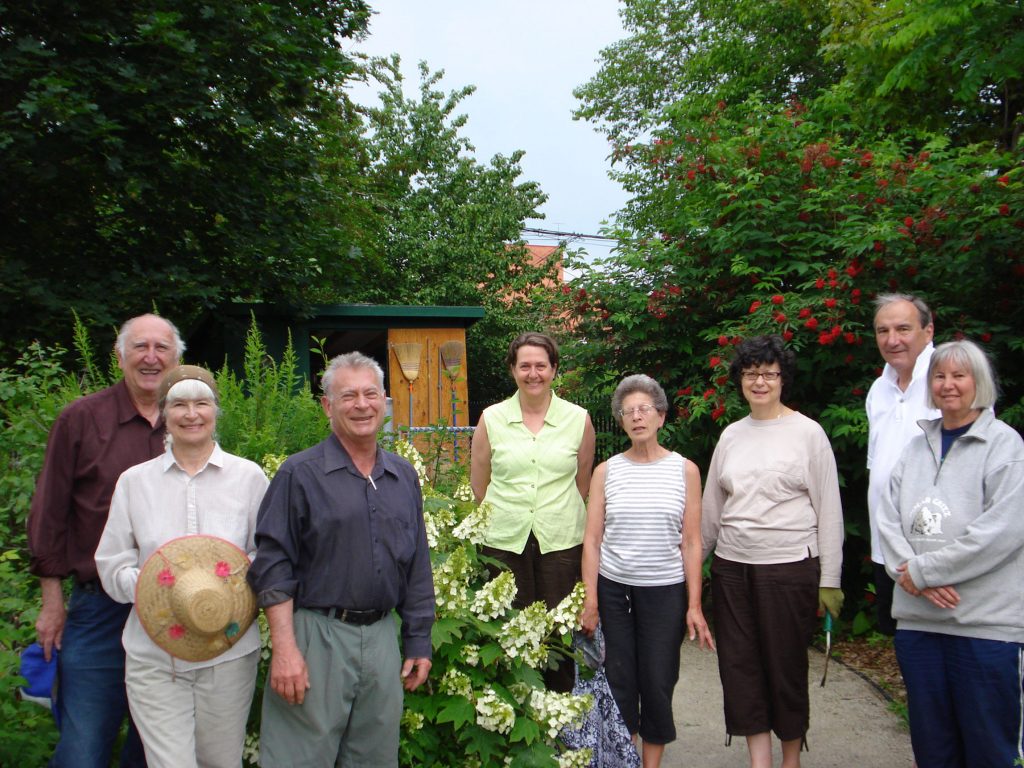
Paul Martel (3rd from left) with his loyal band of Ecology Park volunteer gardeners. He saw the project as contributing to the greening and cohesion of the Annex. COURTESY MICKEY FRATERMAN
By Nicole Stoffman
If you have ever basked in the serenity of Gwendolyn MacEwan Park, delighted in the view of old trees in Taddle Creek Park, or enjoyed the conviviality of the plaza at Jean Sibelius Park, you can thank Paul Martel.
An astute architect, planner, designer and consensus-builder, Paul brought his love of nature to the revitalization of these parks. He also designed and built Ecology Park (now Paul Martel Park) and an innovative infill public housing project on Madison Ave. A passionate modernist, he worked with the great Canadian modern architect, Ron Thom, on Trent University, and with Mathers & Haldenby Architects on Robarts Library. He also had a deep appreciation for heritage homes, as can be seen in his renovation of The Istituto Italiano di Cultura di Toronto (IICT) on Huron St., and the Elmwood Spa and Bangkok Garden on Elm St.
Mr. Martel, who did so much to shape the Annex neighbourhood where he himself resided, died on April 3, aged 83.
Paul Martel was a Fellow of the Royal Architectural Institute of Canada, and a Member of Long Standing of the Ontario Association of Architects. A citation of appreciation from the House of Commons was presented to him by Olivia Chow in 2006 for the contribution of Ecology Park to the community.
In the late ‘70s, Mr. Martel was the consultant on an initiative that saved a group of heritage homes on Madison Ave. and transformed them into a public housing project. Density was added with infill housing, which he designed.
As Mr. Martel explains in the book, Making Cities Work: The Dynamics of Urban Innvovation, the success of the project, completed in 1981, hinged on his ability to include all stakeholders in the process. “He really knew how to integrate good social purpose into architecture,” said Adam Vaughan, MP for Spadina-Fort York. “The project on Madison was very important to him, because it “tied in with his social action,” explained friend Micky Fraterman.
When Mr. Martel was hired to renovate what would be The Elmwood Women’s Club in 1980, the interiors were dilapidated. He kept only the facade of the original building, restoring the beauty of the exterior masonry, and rebuilt everything in behind.
“From the outside, it’s hard to tell the old from the new,” said Executive Manager, Marie Picton. “The way he did that, was amazing.”
Inside, he installed a pool, whirlpool, terraced restaurant, dining room and kitchens; all still enjoyed by guests at the Elmwod Spa. He also detailed new woodwork inside that fit right in.
“In order to house what was going on in here, it was major heavy duty construction,” explained Picton. “But when you entered the building, you would have thought that was how it was in 1897.”
In 1979, when Mr. Martel met with then director of the IICT, Gianni d’Alba, the architect had already envisioned every detail for the renovation of the 1897 Queen Anne Style heritage home at 496 Huron; a library on the main floor with a small theatre next door, offices, archives and a newsletter room on the second floor, classrooms on the third, and more archives and a kitchen in the basement for catering events. This vision was realized and over the years, many Italian and Canadian personalities were guests of the Istituto, from Adrienne Clarkson, filmmaker Liliana Cavani, professor Agostino Lombardo and writer Umberto Eco, to name a few. The theatre is now used primarily as an art gallery.
Paul Martel was born in St. Boniface, Manitoba, to French parents Raoul Martel, and Arlette Grandmont. He was the eldest of four siblings. In 1948 the family moved to Hamilton, where Paul grew up. He moved to Toronto at the age of 17 to study architecture at the University of Toronto, moving into a rooming house on Admiral Rd.
Joan Willsher, an abstract painter, lived below him. Paul would stay up at night doing his projects and drawings and would rock a bit on his chair. Joan complained about the noise to the landlady, who replied, “I think you two should meet.”
They met, and married in 1962. The newlyweds took over being landlords of the house on Admiral Rd., purchasing it in 1968, when their daughter, Anne was born. Years later, when Anne found herself a single mother, the Martels happpily took her in, helping to raise their two granddaughters, Rachel and Rosalyn. “Paul was so smitten with his grandchildren,” recalled Picton.
Paul and Joan created a loving, artistic household. One of Rosalyn Martel’s earliest memories was crawling under Paul’s drafting table, and making drawings beside him and his hired draftsmen. He would encourage her to bring her sketch book on any family trip or outing. “He was like this giant heart,” recalls Rosalyn. “He was very gentle, very calm, an incredible listener, and the type of person you could tell absolutely anything to, without fear of judgement.”
In his role as Chair of the Parks and Trees Committee of the Annex Residents’ Association, Mr. Martel designed Ecology Park, on Madison Ave., just north of Bloor. The garden featured native species representative of all the ecosystems one can find in Southern Ontario. Every Saturday morning for ten years, he led a group of volunteer gardeners to maintain this ambitious little park from April to November. In 2014, it was renamed Paul Martel Park in his honour.
The architect also led the revitalization of Walmer Rd. Circle, an orphaned traffic circle. The city hoped to add some flowers, grass and a statue of a local poet. By the time Gwendolyn MacEwan Park was unveiled in 2010, it was 25% bigger, thanks to the removal of three parking spots on the outside of the circle. It was bulked out on every corner, turning it from a two-way to a one-way circle, calming traffic and making it safer for pedestrians. Adam Vaughan worked with Paul on the project, one of his first as a City Councillor, and remarked that Martel was one of the few people who’s ever put a park where parking spaces literally used to be.
“It was quite spectacular,” said Vaughan.
Paul designed Taddle Creek Park in 1976, and his original concepts held when it was redesigned in 2011, such as the mature trees that ring the park on elevated ground.
“So now when you stand in the middle of the park and look out you still get that expansive view of greenery without seeing parked cars,” recalls friend Eric Jackson. “That part of the park is all Paul.”
Community-based park design was a signature element of Adam Vaughan’s tenure as City Councillor for Trinity-Spadina (now Member of Parliament for Spadina-Fort York), and he says he owes it all to Paul Martel. Paul taught him to lead community consultations during the Jean Sibelius Park revitalization.
“He showed a way to bring voices to the table, and how to blend competing ideas,” recalls Vaughan. “There’s two ways to compromise: you can try and please everyone, or bring people together around a brilliant vision.”
It took six years, including intense debates between the Annex dog owners who wanted a dog-off leash area, and those who did not (this group won), but the park finally opened in 2012 with new playgrounds, pathways and a central plaza.
“Everything he touched had a reason. He had ideas behind it, he knew how to listen,” recalled Vaughan. “I can’t say enough good things about him. He was a real influence on me, a real influence on the neighbourhood, and one of the most gentle, sweet and smart people I think I’ve ever had the pleasure of working with.”
Paul Martel was predeceased by his wife, Joan Willsher-Martel. He leaves his siblings, Lucille, Raymond and Robert; daughter, Anne; grandaughters Rosalyn and Rachel; great-grandsons, Jordan, 11, and Levi, 6; and great-granddaughter, Aleyah, 2.
August 7th, 2020 · Comments Off on NEWS: Boutique condos planned for Davenport (July 2020)
Latest submission taller than earlier versions
By Tanya Ielyseieva
BBB Architects have come back to the community with a new plan for 350 Davenport Rd., near Dupont. Originally submitted in 2015 at 7 storeys (24.2 meters) this project has had multiple re-submissions. The most recent, made in April 2020, is for a mid-rise, mixed-use building with luxury boutique condos at 8 storeys (30 meters).
The project, which has yet to be approved, would include ground floor retail with a mezzanine that will have an overall gross floor area (GFA) of 117 square meters. Total GFA in the building is 1275 square meters.
When the project was first submitted in 2015, it was too big and tall for the Davenport Triangle, which had a height limit of 5 storeys. “The applicant was asked to reduce it to set an appropriate precedent for other new projects on the block and nearby,” said Sipo Maphangoh, senior planner for the City of Toronto.
However, since that time, the maximum height for buildings in the Davenport Triangle has increased, following a community consultation that led to the adoption, in 2018, of guiding principles to inform development in the area. At the time, the Triangle was facing unprecedented levels of development pressure, with taller applications for developments at 314-326 Davenport (8-27 storeys), 342-346 Davenport (9 storeys), as well as a proposal for a smaller office building of 5 storeys at 115 Dupont.
All were eventually approved by settlement at the Local Planning Appeal Tribunal (LPAT). An OMB appeal is underway for the developments at 314-326 Davenport. A 27 storey apartment development at 250 Davenport has already been approved by City Council, so such height in the area would not be without precedent.
“The project [at 350 Davenport Rd.] is slightly taller and bigger since the first submission. The relationship of the building to the lane has improved by providing setbacks that allow clear sight lines for vehicles travelling along Designer’s Walk,” explained Maphangoh. “The separation distance has increased significantly on all levels to mitigate overlook and loss of privacy impacts into the residential properties at the rear and the stacked parking spaces are recessed to allow space for queuing in the lane.”
Eight stories of residential space is proposed for the condominium with a total of 6 high-end units, consisting of a one-bedroom unit, four two-bedroom units, and a three-bedroom unit. Three units are proposed to have two storeys, and three units will take up an entire floor. There will be no affordable units.
“The stepping back of each floor will allow an outdoor terrace with green landscape for each unit, to soften the overall landscape of the building. At the roof level, it will be constructed as a green roof to satisfy the Toronto Green Standard,” said Martin Sun in the application, Project Director at BBB Architects.
Eight parking spaces are proposed and will operate using mechanical lift systems. The parking will be serviced on the back of the building through the Design Walk laneway. The development plans to provide bicycle racks at the lower level to accommodate up to eight bicycles.
Comments Off on NEWS: Boutique condos planned for Davenport (July 2020)Tags:Annex · News
August 7th, 2020 · Comments Off on NEWS: Big-hearted barber gives back (July 2020)
Jack Shewahy provides free haircuts &?a meal to homeless
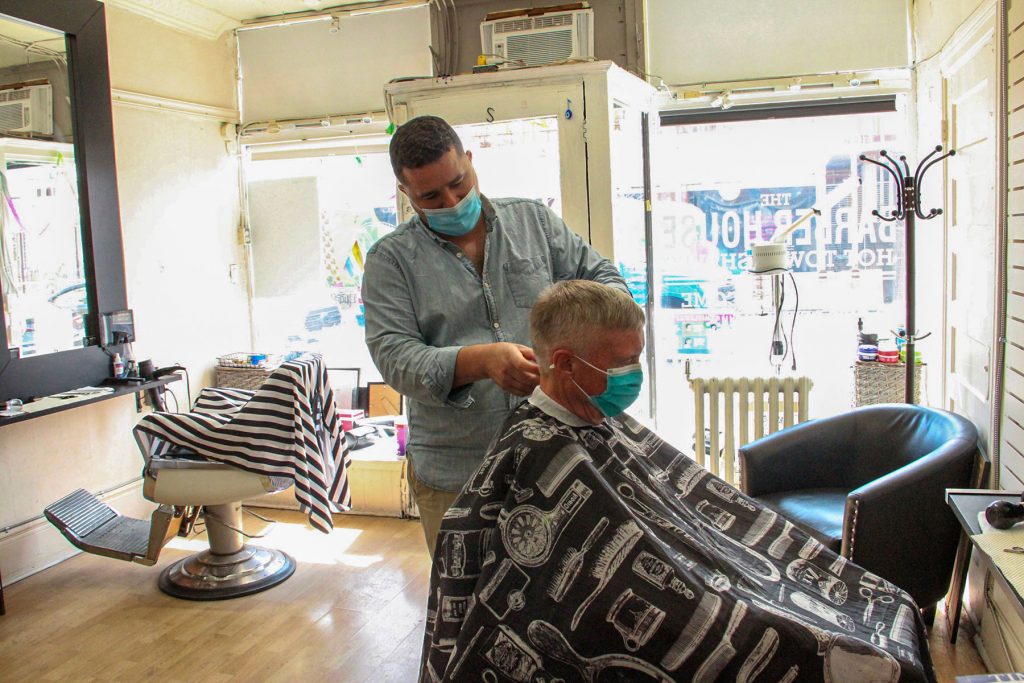
The Barber House at 791 Bathurst St. has reopened and welcomes back clients. TANYA IELYSEIEVA/GLEANER NEWS
This feature was created pre-COVID closures. We waited to publish it until the Barber House has re-opened. It’s helpful to remember that before the pandemic many front-line professionals, like Jack Shewahy, could also be credited with giving back to their commuities. Now they are open again for business, practicising safe protocols, and still trying to be a “good example for people”.
By Tanya Ielyseieva
Jack Shewahy believes that every man deserves to feel like a gentleman. His shop, The Barber House at 791 Bathurst Street specializes in traditional Turkish techniques including hot towel shaves.
When Shewahy, who has worked as a barber in the UK, Turkey and New York City, says “everyone,” he means it. Prior to being shut down, Shewahy and his employees started giving free hair trims to anyone in need, and offered a hot meal and clean clothes on top of that.
“I’m not just working to earn money. I want to be a good example for people in the area,” said Shewahy in a pre-Covid interview. “I don’t mind giving free haircuts and a hot meal to four or five people a day if they can’t afford it.”
Shewahy added that his father, who also happens to be his barbering mentor, was the reason he started helping people. Together they used to go to the families in need to give money to people who weren’t fortunate enough and had to struggle over money issues.
“My father used to go to the houses very early in the morning, like 3 or 4 a.m., so people won’t see him, and drop vegetables, fruits and envelopes with money on their porch. And here, in my barbershop I want to do the same thing,” Shewahy said.
Shewahy opened the Barber House in 2018 but prior to that he used to give free haircuts at the shelters once a month and every Christmas.
Now Shewahy helps people in The Barber House.
“When you get a fresh haircut and fill your stomach with delicious food you boost your confidence to a higher level and it gives you a hope that you can change your life,” Shewahy said.
“I let people know that it is nice to give something back, not just working and earning money. I want to be a good example for people in the area. I don’t do it for anything I do it from my heart for the people,” Shewahy said.
“I keep my door and my heart open for everybody. Some people don’t have houses, some people don’t have jobs, some people just got in a bad situation. Everybody has a different story but what they have in common is the need to figure out the way to overcome the obstacles. People are looking for a better life and our main goal here is to support them.”
Besides Shewahy there are four more barbers at his barber shop who share his views and passion to help the community.
Peter Ndiaye is one of the barbers. When he is on the subway, bus or any community transport he gives a Barber House card to people in need and offers a free haircut.
“I think it is a great initiative and I really like this place because of all the help we can offer to people,” he said.
Comments Off on NEWS: Big-hearted barber gives back (July 2020)Tags:Annex · News
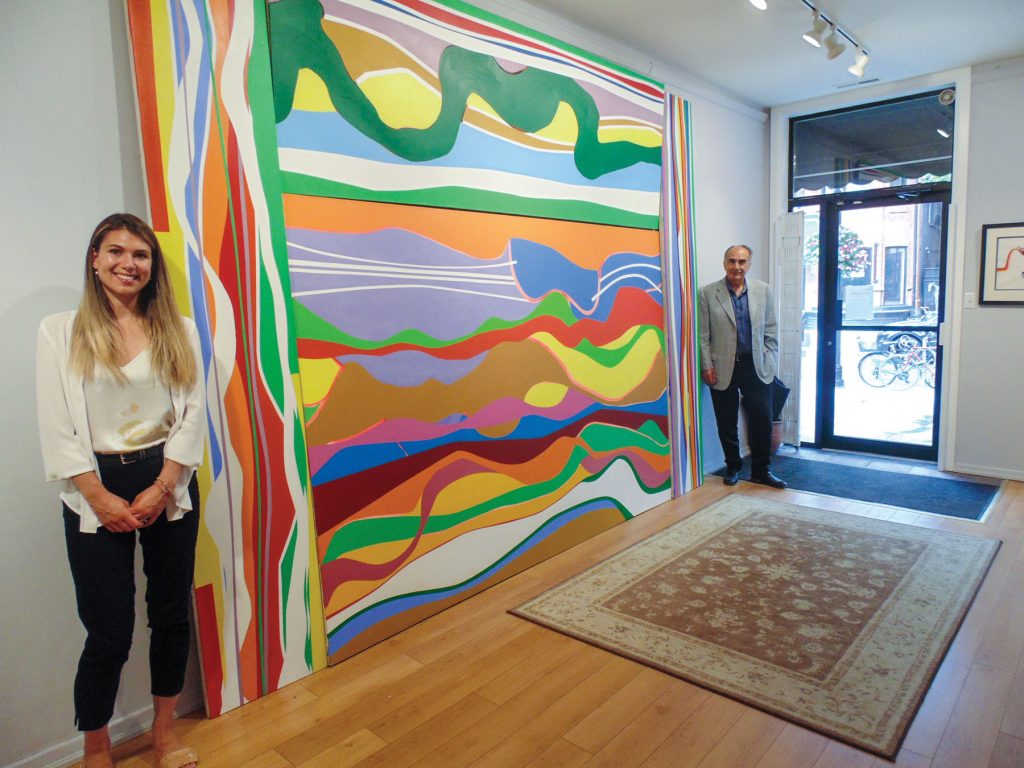
Rosalyn Martel (left), and Philip Gevik (right) flank Sally’s Fright (1968). The exuberant colour-field landscape by Canadian abstract art pioneer, William Ronald, belonged to Martel’s grandfather, Paul Martel. The painting was recently purchased by Gevik Gallery in Yorkville. NICOLE STOFFMAN/GLEANER NEWS
Yorkville’s Gallery Gevik has acquired, Sally’s Fright (1968), a rare colour-field landscape painting by William Ronald from the collection of Paul and Joan-Wilsher Martel. Ronald was a trailblazer, founding Painters Eleven in 1953, a collective of artists that introduced abstract art to Canada. The 9×12 foot work was a birthday gift for Mrs. Martel, a modern artist in her own right, from her husband in 1968. Mr. Martel, an architect who led many greening projects in the Annex, passed away on April 3, 2020. Joan predeceased him in 2017.
William Ronald painted very few such landscapes, composed of strips of exuberant colours. Ronald’s work can be found in the collections of the National Gallery in Ottawa and the Robert McLaughlin Gallery in Oshawa. Gallery owner, Philip Gevik, who represented Mrs. Martel for a decade in the nineties, said he had to buy Sally’s Fright when he saw it at auction at Waddington’s in June, after admiring it over the years during visits to Joan’s home studio.
The Martels had a passion for great Canadian Art, and Sally’s Fright was part of their Painters Eleven collection. The painting holds a special place in granddaughter Rosalyn Martel’s heart.
“I feel all of my memories just flowing through the piece,” she says. “All the vibrant colours of the years that have gone by.”
Here’s hoping this important work finds its rightful place in a new setting.
August 7th, 2020 · Comments Off on NEWS: St. Peter’s Church’s pastor succombs to COVID-19 (July 2020)
Paulist Father Richard Colgan, 68, died of complications from COVID-19 at Washington Hospital Center in Washington, D.C. on Monday, May 25. A former pastor at St. Peter’s Church on Bathurst St., Father Colgan served as a director of novices at the Paulist Fathers’ formation house of studies in Washington D.C.
“With great sadness, we announce that our brother, Paulist Fr. Richard Colgan, has entered eternal life,” the Paulist Fathers’ statement reads. “We pray that Fr. Rich, and all those around the world who have died from COVID-19, are now in God’s warm embrace.”
Not long before Fr. Rich left Toronto in 2008, he was diagnosed with cancer and recieved treatment. The cancer returned while he was in Washington D.C., making his immunity very low.
“When COVID-19 got into the seminary, I think some of the young men who are training to be priests there got it but it wasn’t the same for them. So, Fr. Rich fairly quickly went into the hospital and he went on the ventilator. He was on the ventilator for about a week and I don’t know whether he had pre-planned it, I’m sure he had, but at a certain point the decision was made to turn off the ventilator,” said Heather McClory, coordinator of Toronto Paulist Associates.
Colgan served the Paulist community for 46 years and as a priest for 41 years.
“He was such a kind and patient and wise man,” said McClory. “You could tell by his demeanor that he loved being a priest. And he really was very giving and kind, very good advice, very patient and calm.”
—Tanya Ielyseieva, Gleaner News
Comments Off on NEWS: St. Peter’s Church’s pastor succombs to COVID-19 (July 2020)Tags:Annex · News
August 7th, 2020 · Comments Off on CHATTER: Virus-killing tech used at check-out counter (July 2020)
COURTESY DARA GALLINGER
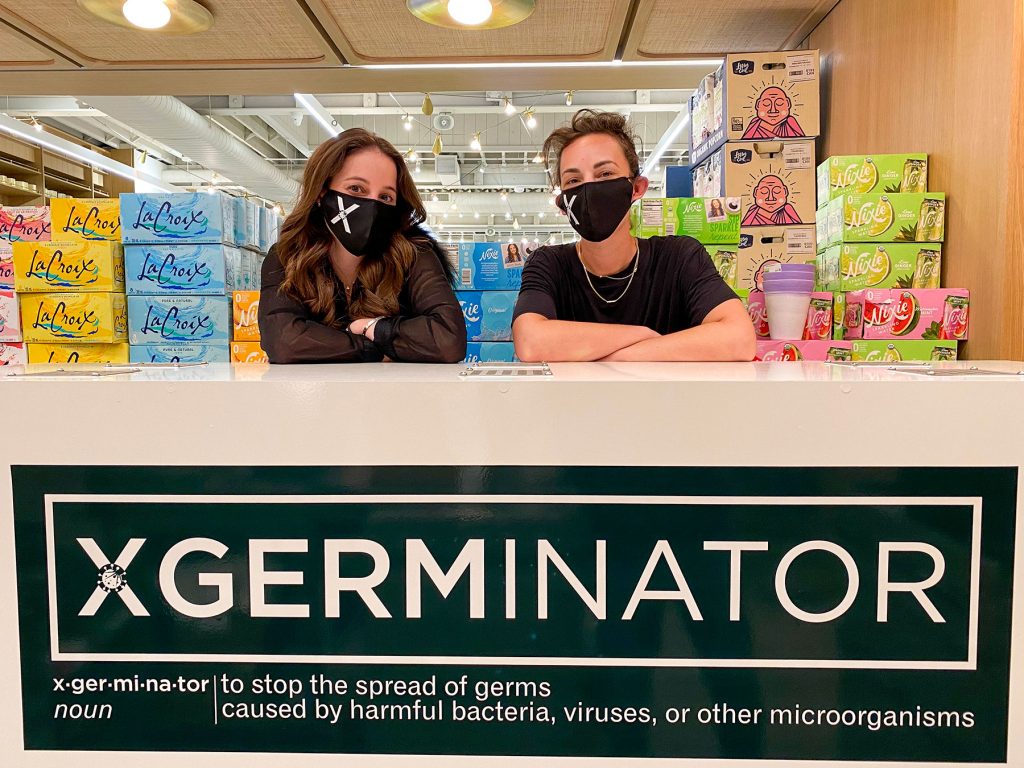
Between May 20 and June 1, a grocery store on Bathurst St took part in a cutting edge experiment to make sure customers took virus-free goods home from their store. The Summerhill Market (1014 Bathurst) worked on a pilot project of a machine called the X-Germinator which uses non-toxic UV light to damage the molecular structure of viruses in less than 30 seconds.
Real estate agent Alyssa Mincer and Dara Gallinger, a co-founder of the Toronto mill and bakery Brodflour, partnered with a medical startup called Prescientx, to develop the machine.
“We had a UV light machine to disinfect cellphones so I was wondering if that could be applied to groceries,” says Gallinger. “We did some research and found the Prescientx, the company which is developing the UV machines to sanitize N95 masks. We discussed the idea and developed the X-Germinator.”
According to the manager of the Summerhill Market, Brad McMullen, there was a lot of interest in the machine from the customers, and people were excited see it in use.
The cashier would scan the grocery items then place them on a closed conveyer belt. On the belt they were passed through a UV-C tunnel where they were then exposed to the germicidal light. While the effectiveness of this process left little to be desired and left customers very pleased, manager McMullen took issue with the size of the machine and the amount of space it required in the grocery store environment.
Gallinger says a second prototype for the X-Germinator is currently in the works, and when it arrives in stores this August, it will be half the size of the original.
—Tanya Ielyseieva, Gleaner News
Comments Off on CHATTER: Virus-killing tech used at check-out counter (July 2020)Tags:Annex · News