December 4th, 2020 · Comments Off on NEWS: Neighbours oppose demolition plans (Nov. 2020)
Heritage building holds monumental significance
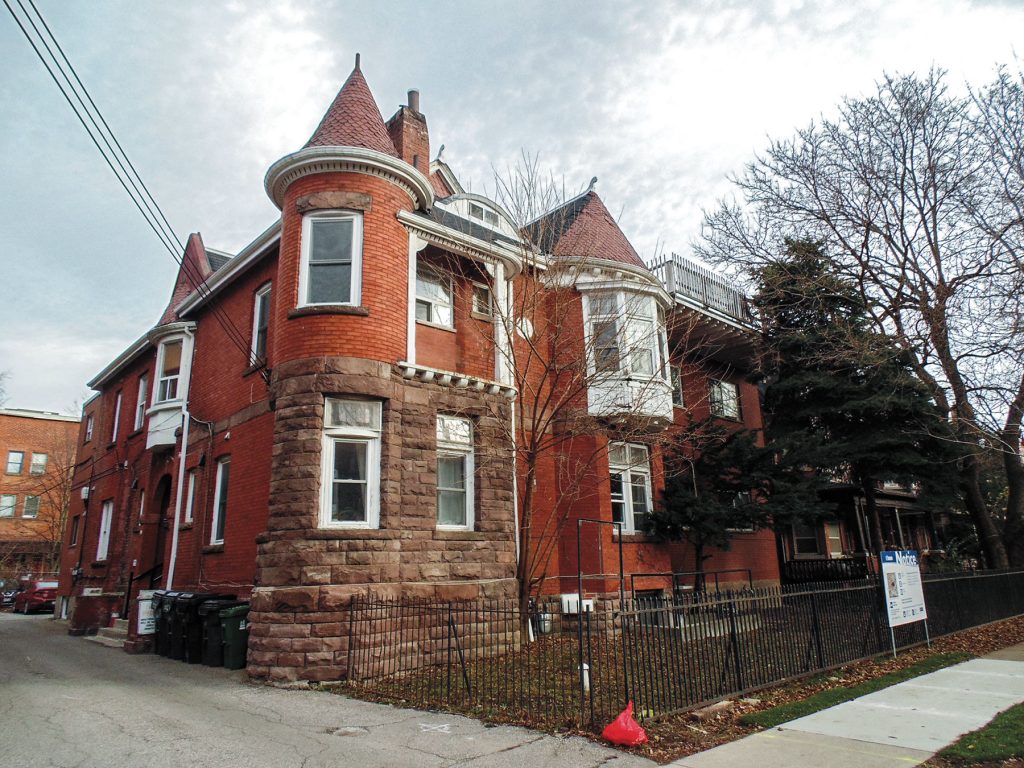
Residents hope heritage designation saves 661 Huron St. MARY AN/GLEANER NEWS
By Tanya Ielyseieva
Annex neighbours are fighting to stop the demolition of the properties at 661 and 663-665 Huron Street.
The plan to replace the single-family homes would see the construction of a four-storey apartment building with 48 residential units.
“The current developer met with the ARA Planning and Development committee where he heard that we were not against an infill project on the large property, but we were not supportive of the demolition of the buildings,” wrote Rita Bilerman, chair of the Annex Residents’ Association (ARA), in the letter to the Toronto Preservation Board. “We offered to show him other infill projects in the neighbourhood that maintained historic buildings that were part of historic streetscapes, but he expressed no interest in working with us to take that approach on Huron Street.”
In spring 2020, members of The Annex Residents’ Association and the British Home Children Advocacy & Research Association nominated the property at 661 Huron Street for a cultural heritage evaluation.
The properties, which are located on the east side of Huron Street just south of Dupont, were both built between 1890-1891 and were originally single-family dwellings. They are now used as multi-unit residential buildings.
According to the City of Toronto Directories for 1892 and 1893, the building at 661 Huron St. was one of the earliest to be constructed in the Annex, and the third completed on Huron Street between Dupont Street and Bernard Avenue.
661 Huron St. stands out not just because of its age and particular architectural style, it also happened to be a landing place for children known as “British-Canadian Home Children.”
Between 1863 and 1949, charities in the UK shipped 120,000 “orphaned” children to Canada from the United Kingdom to work at Canadian farms and households. Some of these children were as young as two years-old, and a majority of them were not actually orphans, but rather, the children of struggling and impoverished parents.
These children passed through receiving homes located in Toronto, and 661 Huron St. was one of them.
By April 1924, 661 Huron St. was occupied by a matron, associated with the Church of England’s “Waifs and Strays Society,” an organization now known in the UK as “The Children’s Society.”
Named Elizabeth Rye Home, this residence was used to train teenage girls prior to placing them in domestic service roles in the Toronto area. In the first year of the house’s operation, Elizabeth Rye Home trained 72 girls for employment.
“The building is a very substantial brick house in a desirable locality and has been adapted for its present purpose – well-furnished and comfortable as a residence for girls who from time to time may sojourn here,” stated a letter from the Juvenile Immigration Supervisor on July 1, 1924.
On January 15, 1932, the home was officially closed but it continued to house girls until 1933.
“Huron Street stands as a monument to the three-million descendants in Canada of the British Home Children,” wrote Lori Oschefski, CEO of British Home Children Canada in a letter to the Toronto and East York Community Council.
“To have this historic home destroyed by the wrecker’s ball is akin to destroying a part of Canadian history, of which too much has been lost already. On behalf of our over 7,000 thousand supporters, we ask that the heritage value of this home and its contribution to our nation be considered and the property saved and designated as a historically significant property in Toronto, as it should be.”
On September 30, October 1 and 2, 2020, City Council adopted the inclusion of 661, 663-665 Huron St. in the City of Toronto’s Heritage Register and its intention to designate the property V Part IV, Section 29 of the Ontario Heritage Act.
Now that the city is on board with the heritage concerns the advocates for preservation hope the developer amends its plans.
December 4th, 2020 · Comments Off on CHATTER: Community groups push pedestrian safety on Avenue Road (Nov. 2020)
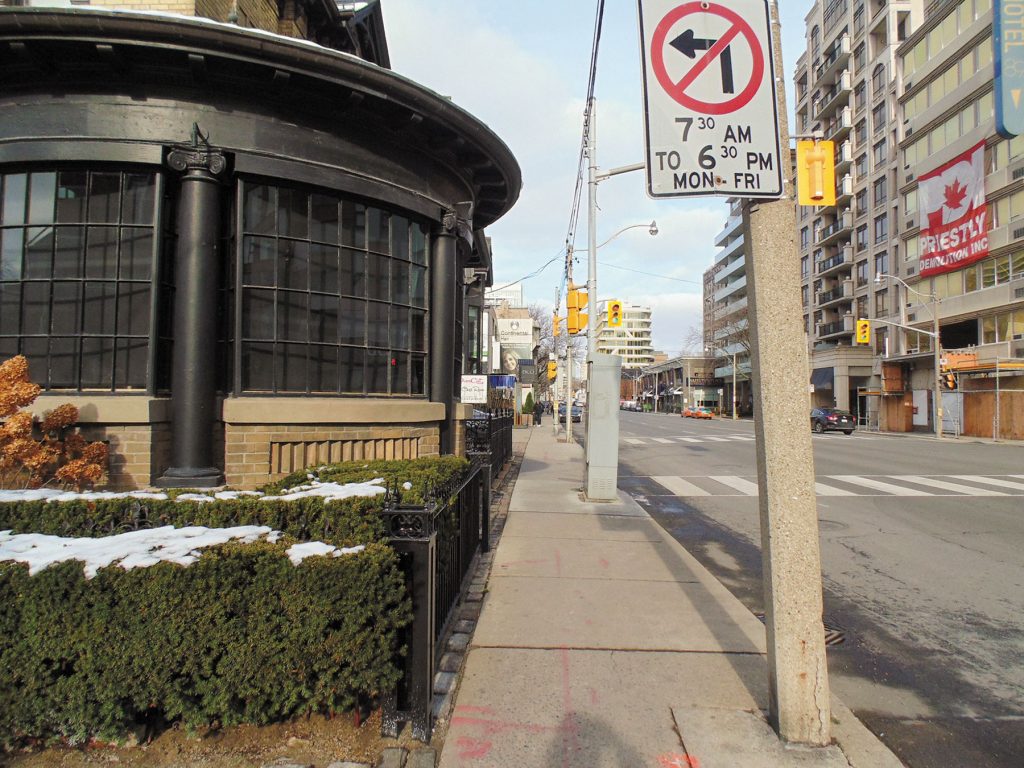
Narrow sidewalks plague pedestrians on Avenue Road. BRIAN BURCHELL/GLEANER NEWS
According to the City of Toronto, over 60,000 cars, on average, are caught driving over the speed limit on Avenue Road every week. The sidewalks between Bloor Street West to St. Clair Avenue West do not meet the accessibility standards requiring a minimum width of 152.5 cm, and local groups want improvements to start immediately. With the support of councillors Mike Layton and Josh Matlow, they have requested the launch of a Pedestrian Safety Improvement Pilot Project that would replace a lane on both sides of the road with a temporary barrier.
With six lanes of traffic, Avenue Road “looks and feels like an Expressway,” says Albert Koehl. Koehl is a co-ordinator with The Avenue Road Safety Coalition (ARSC), a group formed in 2017 because, he says, community groups were not impressed by the attention to safety in the area.
“We want people who live there, go to school there, go shopping, or visit friends, to feel safe walking in that area,” Dylan Reid, co-founder of Walk Toronto said in an interview with the Annex Gleaner.
Councillor Josh Matlow says he has been trying to increase the safety on Avenue Road for “several years.” A recent motion Matlow and Layton presented to community council asks for “Transportation Services to report back to the Toronto and East York Community Council in the fourth quarter of 2020 or as soon as possible.”
But, the motion presented was not what the ARSC or supporting community organizations were expecting. “What we got out of that was a study, and there’s no guarantee that the study will be completed before the end of the year,” Koehl said. Frustrated with the slow process compared to other projects, Koehl says that the only study needed is to stand on Avenue Road and witness the issue itself.
According to Councillor Matlow, before the pandemic the city was slow to take action, but now they’re much quicker to support the needs of Torontonians by doing such things as blocking off streets for CafeTO, or implementing new bike lanes across the city. Matlow says he’s trying to take advantage of City Hall’s new agility in the hopes that this motion “demonstrates the same sense of urgency.”
—Mary An/Gleaner News
Comments Off on CHATTER: Community groups push pedestrian safety on Avenue Road (Nov. 2020)Tags:Annex · News
December 4th, 2020 · Comments Off on CHATTER: 3-alarm blaze in Kensington (Nov. 2020)
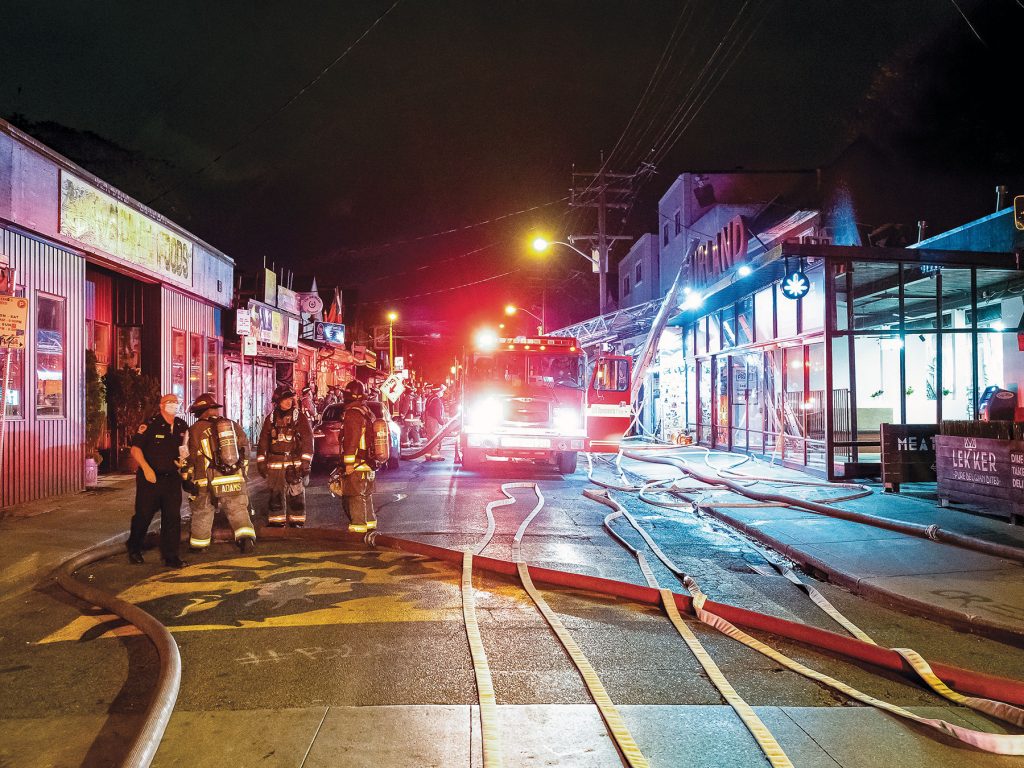
A three alarm blaze summoned twenty fire trucks to Kensington Market’s Latin American Products located at 243 Augusta Ave. Though there were no injuries as a result of the Oct. 17 fire, there was “significant” property damage. ARLYN MCADOREY/GLEANER NEWS
Comments Off on CHATTER: 3-alarm blaze in Kensington (Nov. 2020)Tags:Annex · News
December 4th, 2020 · Comments Off on NEWS: Fairy doors “magically appear” (Nov. 2020)
Though their origin is a mystery, they are being mapped
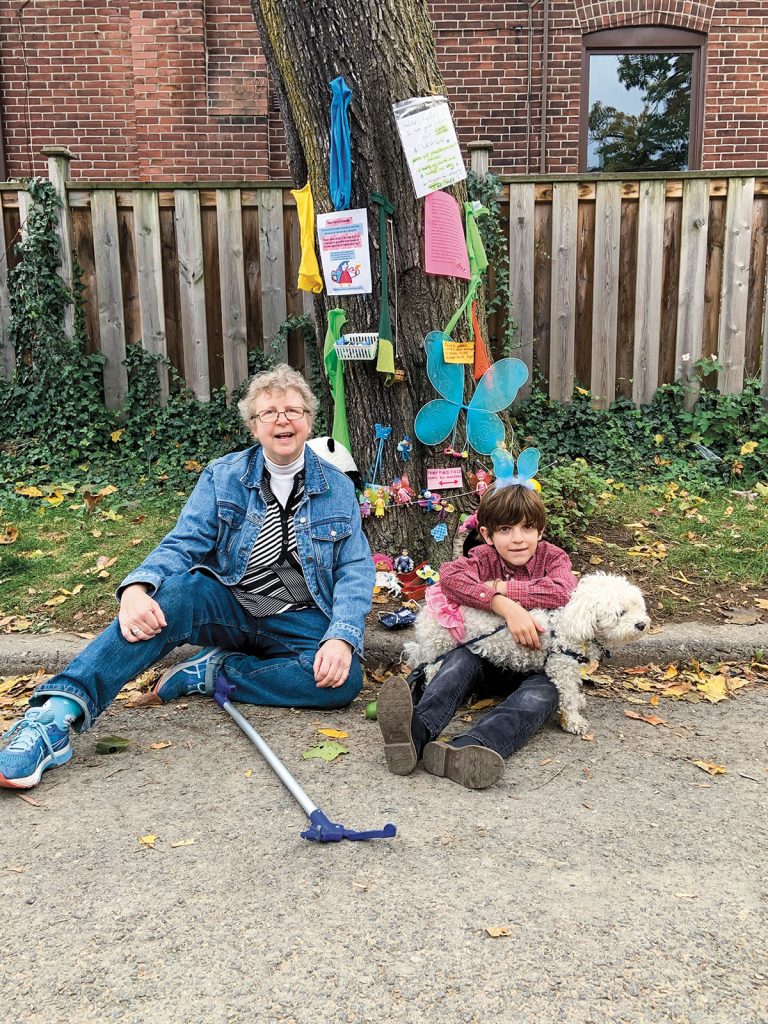
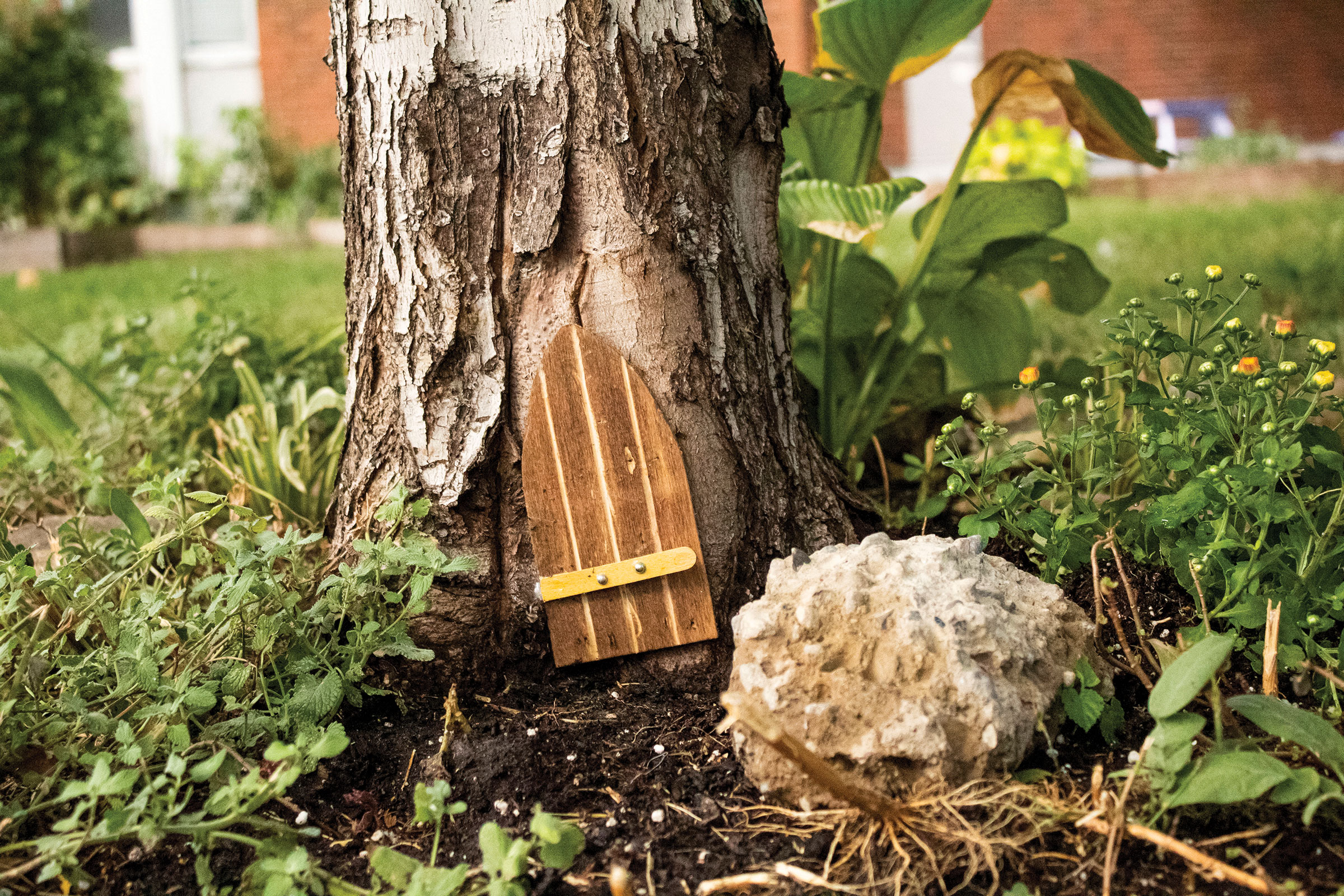
Martha Davis and Daniel Levine created fairies to go along with the doors as a way to help contribute and keep the community spirit up in Seaton Village. Who built the doors remains a mystery. MARY AN/GLEANER NEWS
By Mary An
The Annex has welcomed new mystical community members who live in unconventional dwellings: tiny homes nuzzled into tree roots. Doors to these homes can be found on trees all over Toronto, and if there’s a human-builder behind them, he or she remains anonymous.
A customized Google map showing the fairy door locations can be found on several Toronto neighbourhood community pages on Facebook.
“It’s to help the kids find the fairy doors, otherwise you wouldn’t even know to turn down that street, because you would never discover it,” says Shana Tilbrook, creator of the fairy doors map.
The map has been viewed close to 8,000 times since Tilbrook created it. She says she was inspired to create the map for the community when her five year-old daughter started noticing the doors around the neighborhood over the summer.
“This is something that can help a lot of families, because it is a distraction from the pandemic.”
Fairies go along with the mystical doors. Martha Davis and Daniel Levine “found” fairy tenants at the doors this autumn.
“It was Daniel’s idea to have some action at the doors, because they’ve been going without any action for months,” says Davis, co-creator of the fairies.
Daniel, 7, helped hand out fairy kits in October to those who wanted to create fairies for the existing doors. Inside the fairy kits are a single fairy, along with art supplies to create a fairy. Forty people have requested fairy kits so far. A “message board” can also be seen by the doors to help connect the community by leaving small messages.
This isn’t the first time Toronto has seen fairy doors.
In 2015, Natalie Coulter, an assistant professor of communication studies at York University, created an art initiative called Danny’s Urban Fairies for the Danforth Avenue community. Businesses within the area installed fairy doors inside or outside of their stores, encouraging a stronger community connection through a playful activity.
Now, in the Annex, these doors and fairies help children and families enjoy the outdoors safely.
“Everything’s been cancelled for the kids, but they still need something to look forward to,” says Tilbrook.
“It’s more than just fairy doors for these kids, it helps them believe in magic.”
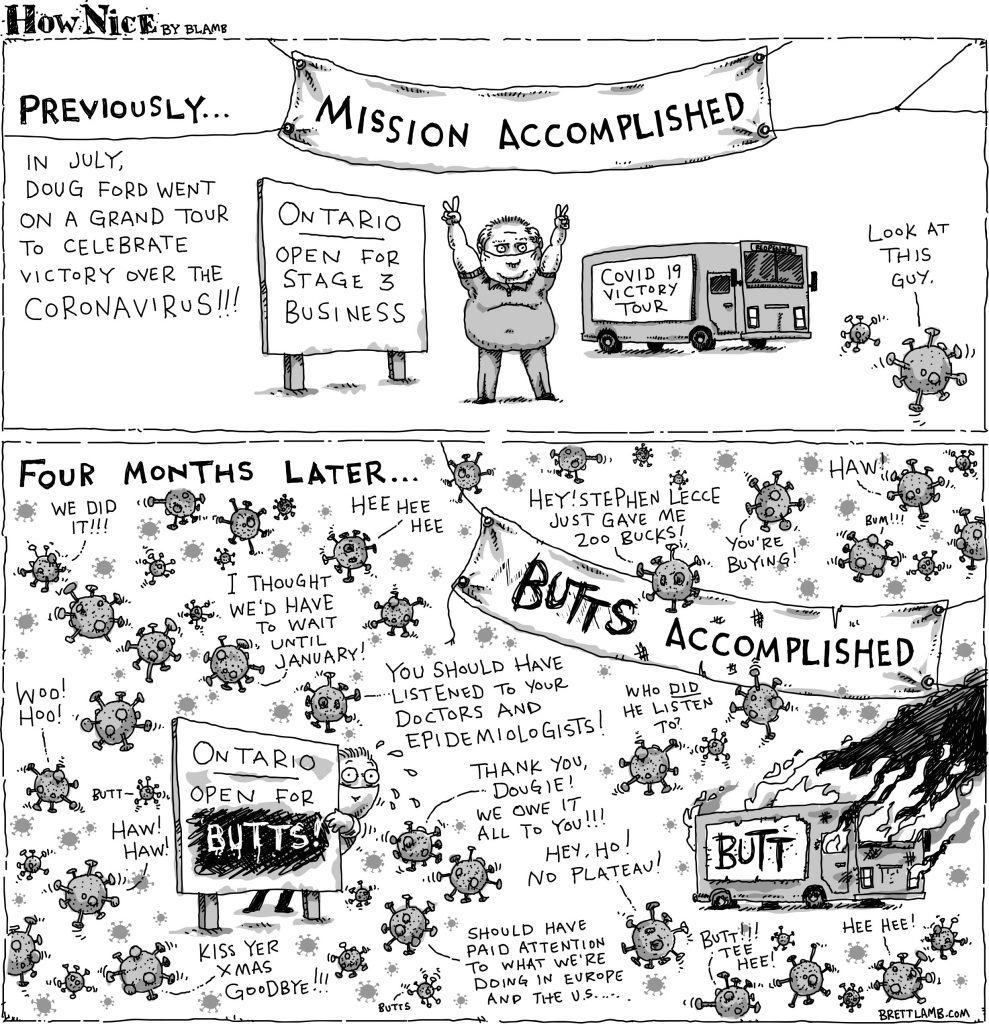
December 4th, 2020 · Comments Off on EDITORIAL: Ford flailing as COVID numbers spike (Nov. 2020)
Ontario’s Auditor General (AG) Bonnie Lysyk recently released a report sharply criticizing the province’s COVID-19 response. The report details a litany of failures by the government and its approach to dealing with the crisis. While some see her timing as unhelpful, to be critical as the proverbial ship is sinking, others see an opportunity to right the boat.
Among other things, the Auditor General said that Ontario’s measures were “slower and more reactive relative to most other provinces.” Lysyk said the province appears to have learned little from the SARS outbreak in 2003 – the SARS Commission said that taking decisive action early was key.
Though the province wisely declared an emergency on March 17, ahead of St. Patrick’s Day celebrations, it then went into neutral gear hiring an outside consultant who took weeks to recommend what is now a health command table of 500 people. The AG describes this as “overly cumbersome,” and subordinate to cabinet. By May, thirty-four medical officers of health in Ontario had jointly prepared and signed a letter begging the province for more direction and regional consistency. That direction ought to have come from Dr. David Williams, Ontario’s Medical Officer of Health, who Lysyk says has not fully exercised his powers under the Health Protection and Promotion Act.
Confusion and inconsistency continues to reign supreme and the recent move by the Ford government to order 28-day lockdowns in hotspots such as Toronto and Peel regions is yet another example.
The examples go on, such as the premier’s announcement on Friday Nov 20 that ordered malls to shut their doors on November 22. This triggered a panicked shopping spree which will no doubt lead to a significant jump in cases. They could, and should have said that malls needed to shut “effective immediately.” What will happen on Dec 20 when the lockdown ends and the malls re-open five days before Christmas? Another case of crowds surging to shop. Doug Ford has created a public health inspired lockdown with COVID-rich book ends.
Meanwhile the province is struggling to do effective contact tracing. Sixty percent of new infections in Ontario have no epidemiological link. More testing of asymptomatic people including students mingling in schools and on playgrounds would narrow the gap considerably. Keeping schools open defies reason if one has a singular goal of driving case numbers below a transmission rate of 1.0.
The decision to close main street retail to indoor shopping and leave big box stores wide open is prejudicial. It makes no sense to force everyone into a crowded cue at Walmart. The decision to prohibit restaurants and bars from serving outdoors is offensive given that health authorities just gave those establishments guidelines for how they can serve safely. Food establishments have spent millions on partial enclosures, heaters, and contact tracing systems. There is no contact tracing in big box stores.
The auditor general repeatedly took issue with Ontario’s COVID response as not being driven by health professionals or as Doug Ford likes to say “the smartest minds in the world.” The AG was unable to obtain a copy of Williams’ advice to the government to see how closely cabinet is following those recommendations. It’s telling that the Ford government would rather not release that document and prefers having a Chief Medical Officer of Health who is quite content to sit on his hands.
The AG’s report is not a footnote in history, it is critical to moving forward with effective decision making in this crisis, and those to yet to come.
December 4th, 2020 · Comments Off on FORUM: City budget a real challenge but we can work together (Nov. 2020)
Impact on homeless is most acute
By Mike Layton
Winter is fast approaching, and with COVID-19 cases on the rise, we must prepare for how to support residents and small businesses through the next couple of months.
The pandemic has highlighted the fact that not everyone is impacted equally, and that we need support from all levels of government to make sure Torontonians are taken care of now and into the future.
At our last council meeting, we put plans in motion to rapidly scale up the permanent housing and shelter capacity response for the 2020-2021 winter season, and to try to extend winter access washrooms for those using our parks. We also expanded efforts to extend support for restaurants to operate outdoor dining and take out.
A concern that I hear regularly from those advocating on behalf of those living in encampments, as well as all park users, is the lack of access to public washrooms, since most businesses are not providing public access to washrooms during the pandemic.
This issue will only get worse as the city closes its washrooms for the winter due to the threat of damage to the infrastructure due to freezing.
This is why I asked council to approve an immediate report back on the impacts of, and options for, keeping more public washrooms open and fully accessible including clearing pathways of snow and ice in our parks through the upcoming winter.
Knowing that this may be difficult, in the long-term, council will also be directing staff to evaluate retrofitting all public washrooms in our parks to withstand the winter climate so we need not have this discussion in the future.
I am also proud to report that I supported the recent approval of council giving city staff the authority to use whatever resources deemed necessary to help those experiencing homelessness now.
But we need to do much more. city staff are projecting a financial impact from the pandemic at over $1.8 billion, at a time where residents need services more than ever.
The mayor and City Council need to continue to advocate for increased powers for municipalities that actually expand available revenue tools.
We need to have options beyond property taxes to fund the services that residents need.
As the 2021 City Budget process begins this month, you have my continued commitment to push for long overdue change that puts the needs of people front and centre.
I will also make clear our collective need for help from all levels of government.
On a hopeful note, the pandemic has also shown us that, together, we can make transformative change happen quickly. There have been some direct supports created in the past few months to assist everyone whose lives have been impacted by the pandemic.
Another issue that has been at the forefront for residents recently is eviction. I want to make clear that if you are experiencing issues with your tenancy and/or eviction, the Federation of Metro Tenants’ Association is an excellent resource for advice on how to file an application with the Landlord and Tenant Board, if needed.
You can contact them by visiting www.torontotenants.org. The city is working hard to enhance and expand available financial support to help tenants to maintain their homes in these times.
The city has also been helping to connect residents with various support networks based on need. Outreach continues to those who are experiencing homelessness as we work to find them stable housing and access to services to support their well-being.
You can find helpful information on all of the above at the city’s website at www.toronto.ca/covid-19.
No matter the issue you are facing, my office remains available to assist and to connect you with the resources you need as we continue to live through the pandemic. Please do not hesitate to reach out to my office at Councillor_Layton@toronto.ca if you have any questions.
My team and I will do everything we can to help.
Mike Layton is the city councillor for Ward 11 University—Rosedale.
December 4th, 2020 · Comments Off on FORUM: How will Doug Ford’s 2020 budget impact us? (Nov. 2020)
The government’s Scrooge-like plan is not what we need
By Jessica Bell
It’s easy to make bold and lofty promises at a press conference, but a budget reveals a government’s true priorities.
The Ford government’s 2020-2021 budget on November 5 comes at a time when Ontario is facing huge social, health and economic challenges. COVID-19 is spreading widely. From Kensington to Little Italy, small businesses are closing for good. Parents, especially women, are leaving the workforce because they cannot hold their jobs while caring for and teaching their children. COVID-19 is resurging in our long-term care homes, including Vermont Square. The growing gap between the well-off and the poor, between white people and racialized people, is immoral and destabilizing. It’s a consolation that Premier Ford didn’t cut funding in this year’s budget, but his plan is too cheap to match the challenges we face.
Here are the budget details:
Funding for long-term care is increasing by 2.6%. We are calling for the government to provide additional funding to increase personal support workers’ wages by $5 an hour and hire more workers so all residents in long-term care homes receive four hours a day of direct care. Homes have staff shortages because workers do not want to work in dangerous and hard conditions when they are paid little more than what they would earn in a retail store.
Base health care spending is up by 1.5%, which is about the rate of inflation. We are calling for health care funding to be closer to 5.3% in order to match inflation, population growth, and the unique needs of communities.
The government is providing additional emergency funding to hospitals, but the Ontario Hospital Association is telling us it’s not enough to cover the additional costs hospitals are facing to treat the surge in COVID-19 patients.
Education funding is essentially frozen. The budget will increase from $13B to $13.1B, but most of that increase is from the federal government. Large class sizes will remain, despite pleas from parents, teachers, and public health experts to reduce cohort size. We are calling for a class size cap of 15.
Annual funding for repairing and building new schools has been cut from $1.4B to $1.3B. This bodes badly for University-Rosedale schools as many of our buildings are old, with windows, furnaces, washrooms, and HVAC systems in need of upgrades.
All parents are eligible for another one-time cash payment of $200 per child under 12, and $250 for children and youth under 21 with special needs.
There is no funding to build affordable housing or supportive housing. There is no ban on residential evictions for people who cannot afford to pay the rent. There is no rent subsidy to help people pay the rent. This inaction is going to make our city’s homelessness crisis worse.
There is no increase in social assistance rates.
There is a new one-time emergency fund of $25M for arts institutions to cover operating losses.
The government plans to extend the temporary ban on evictions for commercial tenants but it’s not yet clear who will be eligible, whether it will be retroactive, or how long the ban will be extended. Ontario’s commercial eviction ban for the small percentage of businesses that were eligible for the federal rent subsidy program ended on October 31.
Starting next year, the government will allow Toronto to create a new small business property subclass to provide targeted tax relief. The province will consider matching these property tax reductions.
In the coming weeks, we will be advocating for additional support for health care, education, small businesses and people in need. We’re in a pandemic. It’s not the time to do things on the cheap. It’s time for government to provide real care and leadership.
Please contact our office if you have comments, questions, or need help.
A team of Indigenous workers are bringing Paul Martel Park back to life
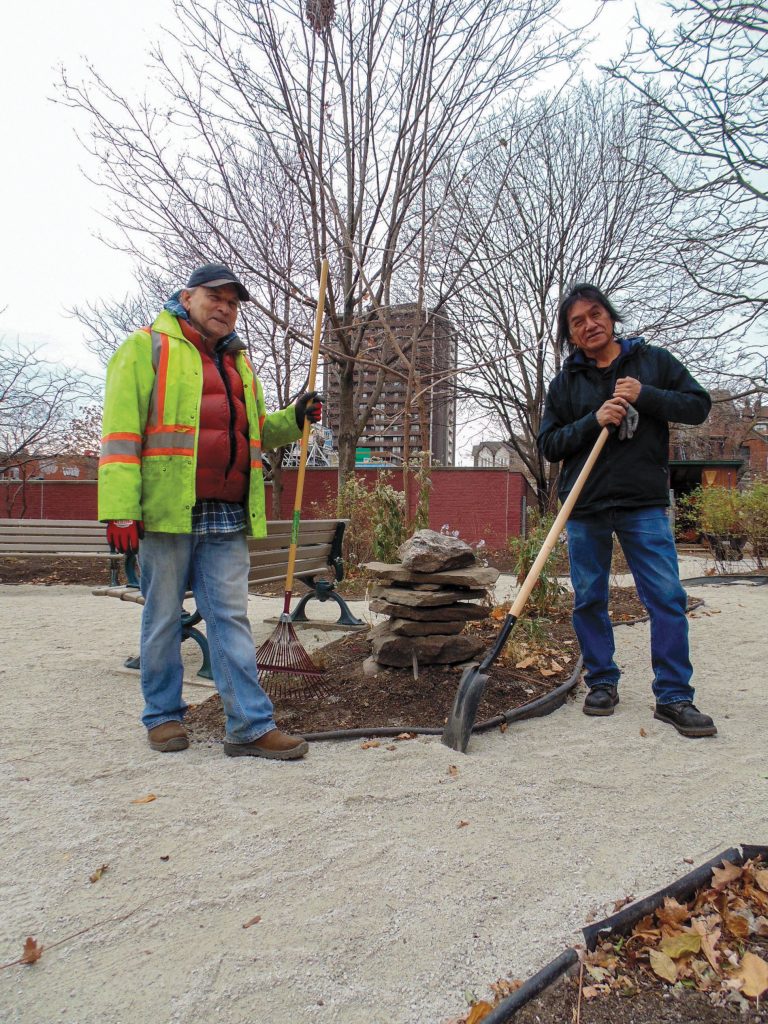
Paul Richard (left) and Joseph Sagaj, part of a team of Indigenous gardeners, have been working tirelessly to bring Paul Martel Park (located on Madison Avenue, north of Bloor Street) back to its original vision. BRIAN BURCHELL/GLEANER NEWS
By Tanya Ielyseieva
After a period of long neglect, Paul Martel Park is undergoing a revitalization.
The small green space, just north of Bloor Street West and right behind the Spadina TTC station, has been forgotten for some time. However, with the help of the community, it is set to be restored.
Ecology Park was designed and built by Paul Martel, an architect who volunteered and helped to design many community green spaces in the Annex and the rest of the city.
It was designed to celebrate the ecosystems of Southern Ontario. Ecology Park was named in his honour in 2014.
“Paul Martel was the driving force many years ago to revitalize the park and it was called Ecology Park as a result of his vision. It has now been renamed in his honour. There were many volunteers that took care of the park, but when Paul became ill, not as much attention was given to the park,” said Rita Bilerman, Chair of the Annex Residents’ Association (ARA).
Currently, the park is being revitalized by Paul Richard, retired City of Toronto gardener.
The goal of the restoration is to bring together the Aboriginal community and the Annex neighbourhood to restore the ecological plantings and clean up the neglected park.
“The park was pleasant, but clearly neglected and when I saw the sign from the Annex Residents Association asking for volunteers I called them up to talk about it,” says Richard. “I asked and they delivered a letter of support to receive a Targeted Wage Subsidy to fix it up.”
According to Richard, the first stage of the project is the removal of invasive species from the native plant exhibits.
Next is the preparation of the planting beds with new soil, replantation of the habitats with native plants and applying mulch around the plants.
The park restoration work has been made possible by a Government of Canada Targeted Wage Subsidy.
As of now, the team has ten weeks of funding. The funding covers only the labour cost. Other aspects of the park’s renewal remain unfunded.
“Due to our late start, we are re-applying for another ten weeks of funding to finish our work and do more planting in the Spring. We are working through the ARA and the BIA to supply job materials, the Madison Pub has donated Triple Mix Top Soil, and Brian Burchell, Chair of the BIA (and publisher of this newspaper), has donated native plants for the Tall Grass Exhibit. As our budget is for the cost of labour only, these donations are greatly appreciated. The ARA gave us a Letter of Support early on and will be helping with the purchase of plants,” said Richard.
Joseph Sagaj, an Anishinaabe designer and muralist, will work on the art installations and mural mosaic for the park. The idea is to collaborate on a concept suitable for the theme of the park.
“The mural would reflect the area, but also the First Nations students and children who are in Toronto,” says Sagaj. “The idea is to engage people and reflect on the issues, especially the rise in suicide.”
Besides the mural, Sagaj transformed the crescent-shaped placement of a seven rocks garden.
“When people do walk in a crescent-shaped garden, they are engaging in the symbology of First Nations people and their teachings and principles of life,” says Sagaj.
November 2nd, 2020 · Comments Off on ON THE COVER: Fairy Doors in Seaton Village (Oct. 2020)
Fairy doors have mysteriously appeared in Seaton Village, adding a certain enchantment to the neighbourhood. Want to follow the trail of these mystical residents? Be sure to consult Shana Tilbrook’s map, which locates the doors and can be found on the Seaton Village and Annex Toronto Facebook groups. There will be more information about why the fairies have settled in the village in our next issue. MARY AN/GLEANER NEWS
Comments Off on ON THE COVER: Fairy Doors in Seaton Village (Oct. 2020)Tags:Annex · News
November 2nd, 2020 · Comments Off on NEWS: Parking versus housing (Oct. 2020)
Kensington Market considers a change
By Mary An
Priorities are shifting in Kensington Market, according to a recent motion adopted by Toronto City Council that declares the parking lot at 25 Bellevue Ave. a surplus location that could be used to build affordable housing.
Mike Layton (Ward 11, University-Rosedale) recently pushed a motion requesting a non-profit organization with strong links to Kensington Market be allowed to operate and develop an affordable housing project at that location and that new parking opportunities be found within the Toronto Parking Authority.
The idea to change the purpose of 25 Bellevue Ave. has been circulating within the Kensington Market community for some time. In 2018, the Kensington Community Land Trust (KCLT) committee brought the idea to Joe Cressy (Ward 10, Spadina-Fort York).
“We had some conversations with Joe, who referred to that piece of land as the largest underutilized piece of land within the whole Kensington Market area,” said Kevin Barrett, co-chair of the KCLT said in a recent interview.
Cressy brought a “visioning” idea for 25 Bellevue Ave. to council, where he requested that the process identify some city-building opportunities to replace the parking lot. Some potential ideas for the space at the time included affordable housing, a community gathering space, neighbourhood gardens, and an area for small businesses. This idea for a “visioning process” to replace the parking lot was adopted by council in 2018.
The KCLT also had their own “visioning exercise” that included many residents and business owners within the area.
“We did some consultation and some advertising around the neighbourhood and gathered a very diverse group of Kensington residents, merchants, and community members,” said Kevin Barrett. “There was a lot of support for redeveloping that site.”
Layton said he hoped this recent motion would jumpstart the process of finding a partner to redevelop the site.
So far, residents and community groups of Kensington Market are reacting positively to Layton’s initiative.
“As someone who lives in Kensington, I think it’s more important to have affordable housing than a parking lot,” said Hope McNeil, a Kensington Market resident of three years.
According to Dominique Russell, Co-Chair of Friends of Kensington Market, community members are excited to see the parking lot turn into affordable housing. She says people are reassured by the idea that the developer will have strong community connections helps ensure faith that the project won’t potentially hinder the “spirit of the neighborhood.” Russell only had a small concern with the development idea, which was a lack of parking space in the community.
“The parking situation is complex because on the one hand, residents need to park, and on the other hand there’s people we need to bring in from the outside to shop,” said Russell.“But again, the motion addresses this by looking at different ways to accommodate this issue.”
Layton predicts that parking won’t be much of a concern in the future.
“The reality is that people who live in the downtown core drive less and ownership of an automobile is lower with the option of public transit, as well as car share services,” Layton said. “We are moving to a world where fewer people will own cars.”
Layton and city staff are currently working on finding an advocate with strong ties to the Kensington Market community to help move forward with this development.