March 5th, 2021 · Comments Off on NEWS: Alleyway on the cutting edge (Feb. 2021)
Croft Street showcases laneway homes and “green” potential
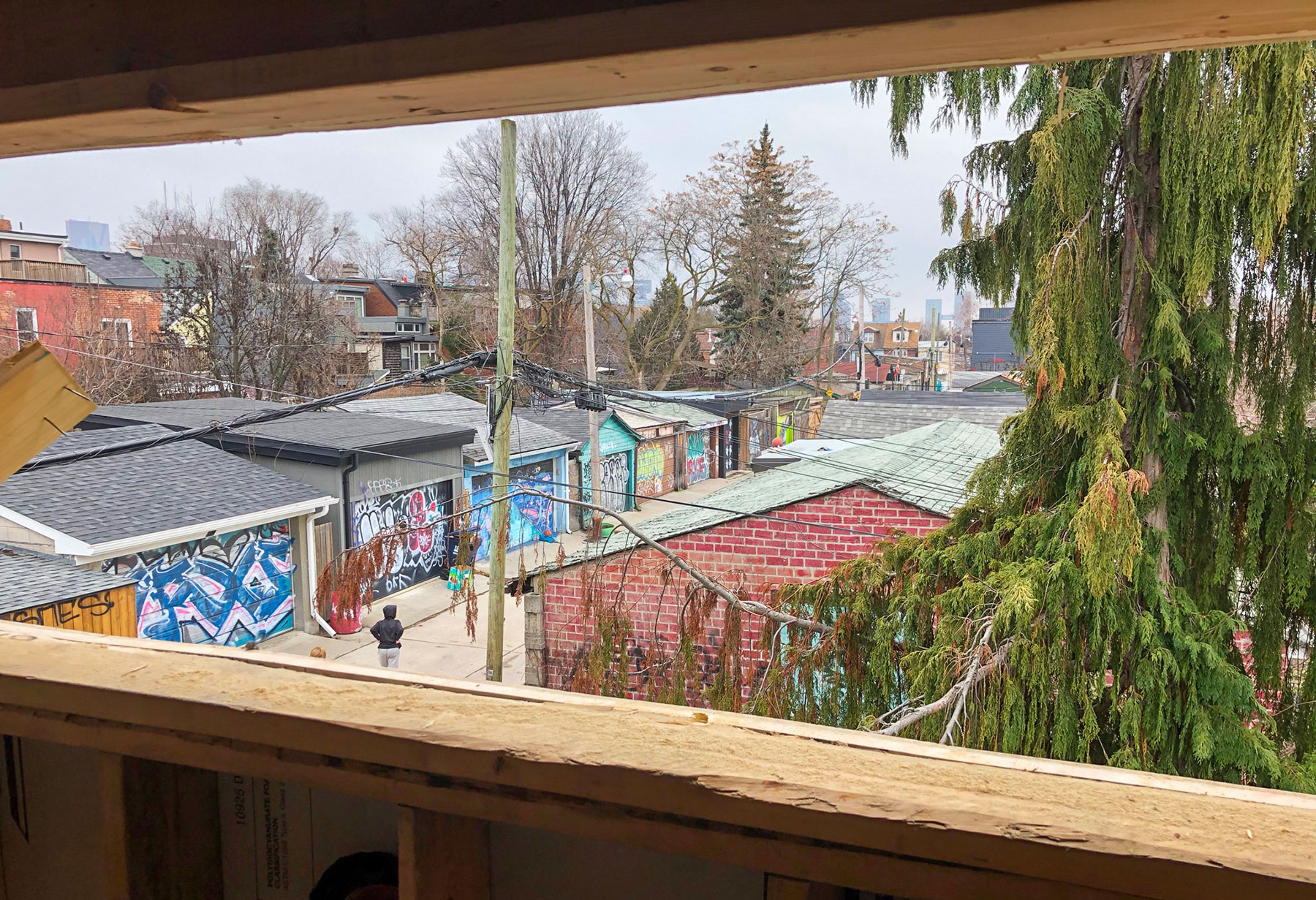
Croft Street, which is in fact an alleyway, could be mistaken for a canvas. COURTESY ALAR KONGATS
By Luca Tatulli
A few blocks east of Bathurst Street running north from College Street, you find Croft Street, which is in fact an alleyway. At the gateway to the laneway on College, there is a colourful mural dedicated to the street’s namesake, John Croft. With murals on most of the garage doors and creative pot planters, one could be forgiven for thinking that the laneway itself is a canvas. There are currently two laneway homes on Croft Street, both of which stand out for their uniqueness and contrast to the Victorian character of the neighbourhood. A third laneway home at 92 Croft St. is under construction. It too, will stand out – not only for its design, but for features which put it on the cutting-edge of environmental sustainability.
The new home will have 1230 square feet of floor space and its exterior will be covered with locally sourced pine and heron-blue steel mirroring the older cottages that used to line the alleyway at a time when it was known as Ulster Lane. It will also share a lush garden with its neighbours.
The home’s roof will be almost entirely covered with solar panels, and they will generate an estimated 93 percent of the home’s electricity needs. The home will be powered only by electricity, with no use of natural gas.
Inside, the temperature will be regulated by a ductless heating and cooling system. This is expected to cut costs significantly by transferring heat instead of simply generating it. According to Energy Star modelling, this form of heating will cut energy consumption by up to 60 percent.
A smart monitor sump pump system will protect the home from floods caused by rising water levels.
“Sustainability runs deep. It’s not just about the materials being used and the energy being generated but the longevity of the build itself,” says Zeke Kaplan, president of ZZ Contracting, the builders of the home. “Sustainable buildings should use materials that can sustain the harsh conditions of our weather and are locally sourced. Of course buying local is more important now than ever. Houses should be designed and built to have an impact and stand the test of time.”
In 2018, the City of Toronto published a set of standards new developments must meet in terms of sustainable design. These are separated into tiers according to the size of developments. Due to its size, the Croft Street project does not fall into any of these tiers, however it does exceed many of its standards. These standards require that residential buildings supply five per cent renewable energy, and an internal space for waste storage such as garbage, recycling and organics. Other standards include planting one shading tree for every five parking spaces and planting 50 per cent native species.
Kaplan says that there is a growing demand for sustainably built laneway homes like the one his company is building on Croft Street.
“There are laneway homes popping up all over the city and we’ve only just begun,” said Kaplan, describing the trend of laneway homes. “The amount of inquiries we field on a weekly basis about laneway developments is staggering.”
While demand may be high, there are also very real barriers to this kind of build. Laneway homes in general are significantly more expensive to build than conventional homes, particularly if we are to take a different property, 62 Croft St. as an example. A tear-down garage down the lane, this property was listed for $1.2 million in June of this year – and that’s before it was even built. Sustainable design features are also likely to add to building costs.
Another challenge to building laneway homes is the disruption to immediate neighbours and the community as a whole.
“There’s no space for us to do anything, whenever anybody does anything, you have to inform your neighbours because you’re going to block them,” said Barbara Donaldson, a Croft Street resident and a laneway home owner,“Even if some
thing’s being delivered to your house, you’re interfering with your neighbours. If you’re getting a new washing machine, you’re interfering with your neighbours. If you’re building something across the street, you’re interfering with your neighbours.”
She adds that living in a laneway home requires people to shift their perspective on shared spaces.
“Because I don’t have a front yard, my laneway is my front yard,” says Donaldson. “I want to tend to and look after the space, which is communal, in some of the ways people might want to look after their front yards. I think that’s a unique way that people need to think about living in a laneway. That shared space is our responsibility.”
The City of Toronto passed the bylaw allowing for the construction of laneway homes on residential properties in 2019, so it’s probably too early to tell whether people are willing to adopt the mindset-shift of laneway living, but there’s lots of potential: an estimated 30,000 properties in the city qualify for laneway building projects.
March 5th, 2021 · Comments Off on CHATTER: Bagel Time faces pandemic’s challenges with high hopes (Feb. 2021)
Bagel Time is now open at 551 Bloor St. W. COURTESY BAGEL TIME
The past year has hit restaurants particularly hard, but some eateries are managing not only to survive, but thrive despite the pandemic. Bagel Time, a family-owned chain specializing in fresh, Montreal-style bagels is one such business, having opened its third Toronto location just east of Bathurst Street in December.
“We are a family-owned traditional business,” Arzoo Pathan, media coordinator of Bagel Time said in an interview with the Annex Gleaner. “Our goal and objective is to make this product that is beneficial to your health, organic, hand-rolled, and fresh. And it is not like any other traditional gas-made bagel.”
Bagel Time owners pride themselves on genuine “Montreal-style” bagels. COURTESY BAGEL TIME
Bagel Time offers handmade bagels (with the option of gluten free bagels) that are boiled in honey water then baked in a wood-fired oven each day. Customers can pair their bagel of choice with a variety of toppings.
According to Bagel Time’s website, Imran Khan worked at the first bagel bakery in Montreal, where he learned the tradition and recipe now being upheld by their family in Toronto. Khan and the family opened their first Bagel Time store located near Danforth and Pape avenues in 2017.
According to Pathan, their first store struggled during the pandemic.
“The pandemic affected the company because one of our locations was at Danforth, and most of the businesses on Danforth closed down,” Pathan added that while the business struggled, they found new opportunities.
“We came up with a strategy of promoting our business by doing curbside deliveries and promoting our online platform as well. We started accelerating on those mediums and then were able to come up from that situation,” Pathan said.
The family opened their third store within the Annex neighbourhood with high hopes.
“The challenge was that people are still afraid to go outside and try new locations or new places,” Pathan said. She then went on to say that due to this challenge, they managed to adjust their business accordingly and connect to their customers through an online platform.
Bagel Time can be found on UberEats, Skip the Dishes, as well as Ritual. They also offer catering.
A steady stream of customers, all masked and socially distanced, can be witnessed coming and going at their new location at 551 Bloor St. West, making the Annex look like a pretty good fit for this start-up.
—Mary An/Gleaner News
Comments Off on CHATTER: Bagel Time faces pandemic’s challenges with high hopes (Feb. 2021)Tags:Annex · News
March 5th, 2021 · Comments Off on EDITORIAL: Legislated dignity for the greater good (Feb. 2021)
COVID-19 case counts are way down from the peaks seen in January, and in response the economy is opening up in many places. However, Toronto’s Chief Medical Officer of Health (MOH) Dr. Eileen de Villa, and Peel’s MOH Dr. Lawrence Loh, have asked the province to continue lockdowns, stating their fear that the worst is yet to come. They also each advocate for mandatory paid sick days to encourage the symptomatic to stay home and stop the spread.
Loh and de Villa are anticipating the impact of COVID-19 variants from Britain, South Africa, and Brazil. In Germany, the number of cases caused by variants went from six to 22 per cent in two weeks, almost doubling every week. This has started happening here, too. According to Dr. Peter Juni, Ontario’s COVID-19 Science Advisory Table director, the variants are doubling every eight days in Ontario. The variants also happen to spread faster, have higher rates of hospitalization and may be more deadly. This growth is happening behind the mask of falling case counts. As Loh put it, we are “looking at a mirage, the numbers are a mirage.”
The tension between the desire to open the economy and the need to keep people safe has some questioning the distinction between the two. Brampton Mayor Patrick Brown, whose region of Peel has been among the hardest hit in the country, argues reopening the economy “won’t work if it’s under threat, and the variants are a threat.”
While we’ve seen limits on how non-essential businesses (restaurants, bars, and retail) can function, factories, warehouses and distribution centres have continued to operate as per usual. According to Dr. Loh, in a study conducted in Peel on 7,874 people who tested positive for COVID-19, almost 2,000 of them went to work with symptoms. Eighty of those people even went to work after a positive diagnosis.
They could’ve just stayed home, if only they had sick leave. Only 42 per cent of Canadians have access to paid sick leave. Only 10 per cent of low-wage and frontline workers have this benefit. Until Doug Ford eliminated them in 2019, workers in Ontario had two whole days of paid emergency leave. These are the people Ford calls “heroes.” These heroes are like everyone else lacking access to paid sick leave. At any sign of illness they are faced with an impossible decision of either staying home or paying rent and possibly infecting co-workers.
The federal government stepped up with its own sick day program called the Canada Recovery Sickness Benefit (CRSB). That benefit offers a maximum of $900 of support over two weeks, though its target is individuals who have tested positive for COVID-19. While it’s a welcome support it is cumbersome and insufficient, amounting to less than a minimum wage benefit that comes weeks later.
Besides, this doesn’t change the fact that employment standards are solely Ontario’s responsibility under the constitution.
As Unifor President Jerry Dias put it so eloquently in a recent Globe and Mail op-ed piece “We can shut all the restaurants we want, force every retailer to switch to curbside pickup and fine people for hugging their neighbours, but until we get serious about paid sick days, there will be no way out of this pandemic.”
No business wants to go first and offer paid sick days when others are holding out. Sick days need to be legislated, for the sake of our population’s health – if not the economy’s.
March 5th, 2021 · Comments Off on FORUM: To curb COVID-19, Ontario must protect workers (Feb. 2021)
Ontario lags behind other jurisdictions
By Jessica Bell
I am concerned the Ford government is opening the economy too fast, setting the stage for another round of illness, preventable death, overwhelmed hospitals and lockdowns. We must make decisions based on what’s best for our public health. When we reopen, we must reopen carefully and slowly, with safety first and foremost in mind. We must make Ontario’s workplaces more safe.
Recently, our office received a call from a resident that I’m going to call Sam. Sam had a complaint about her employer, Starbucks. Sam didn’t want to go to work because a colleague had COVID-19, and Sam felt she wasn’t being provided with proper PPE to protect herself. Sam was too scared to go public because she didn’t want to be fired. Sam eventually caught COVID-19.
Ontario’s laws do not adequately help Sam and the thousands of lower wage, precarious, and frontline workers like her.
It has always been important to raise the wages, benefits and working conditions of lower wage workers, and this pandemic has made it all the more urgent because COVID-19 is spreading at work. Data collected by Peel Health shows the extent of the problem. Peel Health found that sixty-six per cent of confirmed community outbreaks in Peel reported between September and December 2020 occurred at work.
Here are four things that I am asking the Ontario government to do that will help workers and curb the spread of COVID-19 at work.
In Ontario, the majority of lower income workers do not have paid sick days. This forces people to make the impossible choice of going to work with symptoms because they can’t afford to pay their rent or buy food if they don’t. People are going to work sick. One in four COVID-19 cases identified through contact tracing by Peel Health were individuals who had gone to work with symptoms.
My colleague, MPP Peggy Sattler, has introduced a bill called “Stay At Home if You Are Sick” which, if passed, will require employers to provide workers with seven paid sick days a year, and an extra 14 days if there is a pandemic. Doug Ford needs to stop abdicating his responsibility to provide protection to workers and say yes to the bill immediately.
Second, measures to stop the spread of COVID-19 in the workplace, such as physical distancing and the mandatory wearing of masks, need to be properly enforced. The Ontario government has done a halfhearted job of enforcing the rules, only ramping up inspections in recent weeks. And what is also shocking to learn is that the vast majority of workplaces that are found to have been breaking the rules are not being fined. They should be.
To further bolster workplace safety rules, all workplace outbreaks across Ontario should be publicized. Only Toronto has agreed to make workplace outbreaks public, and their reporting has so far been weak.
Finally, workers should also have the right to refuse unsafe work. Many Ontario workers have been trying to refuse work due to COVID-19 fears — but the government isn’t letting them. The Ontario Labour Relations Board, which resolves disputes between employers and employees, has denied nearly all requests by workers to refuse unsafe work because of COVID-19. That is not a sign of a government that cares enough about worker safety.
With the arrival of variants, this pandemic could be reaching a new and more dangerous stage. It is paramount that we listen to public health and take meaningful steps to stop the spread of COVID-19 in the workplace. These steps will not just help us save lives now, but they will help make Ontario’s economy more fair for the people we are grateful for every single day: the minimum wage worker, the front line worker, the essential worker, the people like Sam.
Worried about your workplace safety and want advice? Call the Workers Action Centre hotline (416) 531-0778 or visit their website. You can also call our office at 416 535-7206.
March 5th, 2021 · Comments Off on FORUM: Defund police gains traction (Feb. 2021)
Pilot projects underway to fashion a better approach
By Mike Layton
By voting to fund the Community Crisis Support Service pilot this month, city council took the first step towards systemic change in how we approach 911 emergency response calls. This five year pilot will create a mental health primary first responder team that will answer mental health crisis calls in key areas of our city.
The more I‘ve learned from experts and advocates, the more it is clear that we have lost sight of how we show compassion to people in crisis, and that a huge number of 911 calls would be better responded to by mental health workers, social workers or other trained professionals whose job it is to be able to help people in crisis and experiencing trauma in non-violent situations.
Last summer, there was a sense of urgency with community calls to defund the police. We all felt it.
Despite a global pandemic, Toronto, and the world, protested against the status quo in policing. That status quo includes persistent and systemic racism against Black and Indigenous people with consequences that are often deadly. While many of us took the time to reflect on this, there is still a lack of clarity around calls to “defund the police.”
Re-investing money from police budgets into alternate forms of community safety are of paramount importance for our communities because the number of fatal interactions continue unabated.
Consider the following recent list of fatalities;
D’Andre Campbell (fatally shot by Brampton police in his own home, 2020).
Chantall Moore (fatally shot by police in Edmunston, NB, 2020).
Ejaz Ahmed Choudry (fatally shot by police after his family called the non-emergency help line in Mississauga, 2020).
Rodney Levi (fatally shot by police in New Brunswick, 2020).
Stewart Kevin Andrews (fatally shot by police in Winnipeg, 2020).
Jason Collins (fatally shot by police in Winnipeg, 2020).
Eishia Hudson (fatally shot by police in Winnipeg, 2020).
Caleb Tubila Njoko (fell from balcony during interaction with police, London ON, 2020).
Regis Korchinski-Paquet (fell from balcony during interaction with police, Toronto, 2019).
We cannot continue to look away, and allow this list to keep growing.
Three of the pilots will be implemented in areas where calls for people in crisis are the highest in Toronto;
Northwest Toronto (Wards Etobicoke North, Etobicoke Centre, York Centre and Humber River-Black Creek)
Northeast Toronto (Wards Scarborough Southwest, Scarborough Centre, Scarborough-Agincourt, Scarborough North, Scarborough-Guildwood and Scarborough-Rouge Park)
Downtown East (Wards Spadina-Fort York and Toronto Centre)
A fourth pilot will serve Indigenous communities, recognizing the history of Indigenous peoples and their negative experiences with policing. This pilot will be Indigenous-led and co-developed with Indigenous communities.
All four pilots are set to work with health care providers, including community health centres and not-for-profit organizations, that provide mental health and substance use services. This is meant to ensure that anti-oppressive, user-centred care continues after the initial intervention.
The pilots aim to create multidisciplinary teams of crisis workers with training in mental health and crisis intervention, de-escalation, situational awareness, and field training, prior to the pilots’ launch in 2022.
The team design is based on a set of guiding principles that were created and compiled through community consultations and a round table in late 2020.
The consultations were directly focused on amplifying the voices of Indigenous, Black and 2SLGBTQ+ communities as well as those with lived experience of substance use, mental health challenges, human trafficking, and gender-based violence, as well as racialized youth, newcomers, undocumented Torontonians, the Black Francophone community and those with lived experience of poverty and homelessness.
Mental health service providers, frontline workers from organizations that deal with mental health in the justice system, frontline emergency responders, hospital staff and those who work with the homeless/precariously housed, were also considered as key stakeholders.
Those who will eventually be chosen as part of the team will be incorporating a harm-reduction and trauma-informed approach in all aspects of the service. The service will also be grounded in the needs of the service-user, which will hopefully work to ensure accountability to service users’ voices and outcomes by establishing clear pathways for complaints and issues to come directly from those who will be most affected by the service.
My greatest concern is in making sure that we invest enough money so that this model succeeds as an alternative emergency response, and not just another mental health response program. I would like to take this time to thank all those who reached out to my office, and city staff for their hard work on this issue. Transformative change is never easy, but you can count on me to continue to push for a better future for our city.
As always, my staff and I are here to assist in any way we can. Please don’t hesitate to contact my office by email Councillor_Layton@toronto.ca or call 416-392-4009 to let us know your questions and concerns.
Mike Layton is the city councillor for Ward 11, University—Rosedale.
March 5th, 2021 · Comments Off on ARTS: Annex is still film set central (Feb. 2021)
Strict COVID-19 protocols being followed
Rebecca Breeds, as the heroic Clarice Starling, and her fellow FBI Agents after catching a killer on Walmer Road in the TV series Clarice. COURTESY MGM TELEVISION AND CBS STUDIOS
By Nicole Stoffman
Our beloved Annex stood in for Baltimore when the CBS/MGM TV pilot Clarice took over Walmer Road for three days in October.
Nineties-era Baltimore Police cars, two ambulances, and news trucks labeled “Evening News/Channel 6,” “Breaking News Live Nightly!/Channel 12,” and “News at 5,” lined the street. A location production assistant gingerly sprayed all the vehicles with water because, “everything looks better wet.”
As curious Annexonians looked on, an army of KN95 and surgical double-mask-wearing crew members crafted the following scene:
FBI agent Clarice Starling has just intercepted an attempted murder at 100 “Somersby St.” The victim, an intrepid journalist investigating a murderous conspiracy implicating Big Pharma, is then wheeled out on a stretcher into the twinkling, leafy street, as Starling faces a barrage of journalists who demand to know if the serial murderer has been caught.
Will Starling reveal they only caught a hired assassin that night, and the real villain is corporate greed? You’ll have to tune in the first episode, The Silence is Over on CBS All Access or GlobalTV.com to find out.
Starring Australian actress Rebecca Breeds (Pretty Little Liars, The Originals) the Clarice series focuses on the bravery and psychology of the title character, originally played by Jodie Foster in the 1991 Academy award-winning film Silence of the Lambs. This year marks the films’ 30th anniversary.
“The overarching story is Clarice and her ability to go into her internal dark space, look at who and why these murders where committed, see outside the facts,” said line producer and longtime Annex resident, Paula Devonshire. “The heart of the story is her connecting with these women and taking these deaths to heart and making it her mission to find justice for them.”
Producer Alex Kurtzman (Star Trek: Discovery, Hawaii Five-0) told the Hollywood Reporter that he considers Clarice one of the great heroines of recent film history, a woman working in a man’s world, and succeeding against all odds. “It’s very much Clarice’s time,” he said.
The production team looked far and wide before director Maja Vrvilo (Star Trek: Discovery, Star Trek: Picard, Magnm P.I.) fell in love with 100 Walmer Rd. Devonshire notes that the Annex, with its small streets, and residents who aren’t fond of losing their parking, poses a challenge for film crews. The film company is responsible for finding suitable parking alternatives.
Location manager Malcolm McCulloch had to go door to door, lobbying residents to allow the back to back overnight shoots, which went off without a hitch.
“They were filming all night, but I slept right through it,” said Arthur Ripstein, whose house is attached to the interior location where the gruesome attempted murder scene unfolded.
The Toronto film and television industry spent a record-breaking 2.2 billion in 2019, and is off to an extremely strong start in 2021, according to the Film and Entertainment Industries unit of Economic Development & Culture, at the City of Toronto.
Despite shutting down between May and June due to the pandemic, the industry came roaring back in July. There have been 23 productions shooting in Toronto since October.
It is a welcome source of revenue to shuttered event venues and empty office buildings, whose employees are now working from home. Clarice, for example, shot at Casa Loma, and the Canada Life building, normally a working office building off limits to film crews, said Devonshire.
The screen industry also employs over 30,000 Torontonians. The Annex is always been a particularly creative neighbourhood, with University-Rosedale being home to 2,500 screen industry workers.
In recognition of the disruption they cause, film crews who come to the Annex typically make a generous donation to the Annex Residents’ Association. This year, the ARA donated $1,000 from Precious Productions, the company shooting the Clarice series, to the Avenue Road Food Bank.
“I am very much supportive of allowing film companies to film in the Annex,” said former ARA Treasurer, Louis Florence.
But despite the many benefits the industry continues to bring even in an emergency lockdown (actors only unmask for takes in the presence of a skeleton crew), Clarice could not return to the Annex for Episode 3, due to the objections of a few residents.
As a screen industry location, the Annex is prized for its historical homes and its open green spaces. “This is a popular look for commercials that include walk and talk scenes and require a well-established and lively neighbourhood backdrop,” the spokesperson from the Film and Entertainment Industries unit of Economic Development & Culture at the City of Toronto told the Gleaner in an email.
Current and recent high profile television series that have shot in the Annex include; Suits, Designated Survivor, Taken, In the Dark, Locke and Key, and Workin’ Moms.“I did a series a few years ago called People of Earth and we shot down at Clinton’s,” recalls Devonshire, who exemplifies the abundant creativity in our neighbourhood.
A member of the Mohawks of the Bay of Quinte First Nation, Devonshire’s own production company, Devonshire Productions, is gearing up to shoot the feature film Stellar, this summer. The film tells the poetic story of a man and a woman “connecting through their hesitancy to touch,” set against Indigenous symbolism rooted in the geology of Sudbury.
Her 2017 feature film Indian Horse, a film adaptation of the novel by Ojibwe author Richard Wagamese, won 19 film festival awards. It tells the story of a residential school survivor turned professional hockey player, who must eventually confront his traumatic past through traditional healing.
Comments Off on ARTS: Annex is still film set central (Feb. 2021)Tags:Annex · Arts
January 27th, 2021 · Comments Off on ON THE COVER: While the students are away, the fox will play (Jan. 2021)
In a particularly Canadian version of Fox News, this furry friend boldly struts around the partially shuttered University of Toronto campus. Pat Mullen, who works at University College, snapped this shot as the fox approached as if to question his reason for being at work. PAT MULLEN/GLEANER NEWS
Comments Off on ON THE COVER: While the students are away, the fox will play (Jan. 2021)Tags:General
Former ARA Chair, Metro and City Councillor Ila Bossons passes at 83
By Nicole Stoffman
When big decisions hang in the balance at city hall, councillors often form predictable coalitions along the political spectrum. Ila Bossons was one councillor who bucked that trend. “The middle way is the best way,” the independent candidate declared in 1988, during her successful campaign to become Metro Councillor for the new ward of Midtown, which included the Annex.
COURTESY JOHN BOSSONS
This philosophy characterized her four terms as a Metro and city councillor from 1988-2000, during which she took strong positions on divisive issues from panhandling to property tax increases. More than once, she was one of a small minority of councillors who voted against what she called “glory projects” like the National Trade Centre and Toronto’s two Olympic bids. She argued money would be better spent on fixing roads and investing in housing, schools and hospitals.
Ila Bossons died of a stroke on November 30, at the age of 83. Born in 1937 in Freiburg, Germany, she met her husband, John, while they were both at the University of Pittsburg where she was studying languages and sociology. They moved to Toronto in 1966, where John became a professor in the Economics department at the University of Toronto.
Bossons was Chair of the Annex Resident’s Association from 1984-87, while a resident of Elgin Avenue.
“That was how she got into politics, through becoming concerned about what was happening in the Annex as a result of development pressures,” explained John Bossons.
Ila Bossons did not answer to interest groups in her pursuit of enhancing Toronto’s liveability. As one of only three councillors who voted against the building of the National Trade Centre she noted, “I didn’t feel the pressure of the unions, but obviously others did.”
On the issue of turning Toronto’s sewage into fertilizer, she challenged environmentalists who were concerned about its toxicity, arguing that it would have been tested before being used. “We’re really trying to do something that’s environmentally safe, and all we get is hysteria,” Bossons said at the time.
“Her philosophy was to take the best from both sides, and not get deflected by ideology,” explained John Bossons, her husband of 56 years. “That was her basic attitude toward problems.”
The fight against market value reassessment (MVA) in the early 90s was a big problem Bossons faced in her political career. The majority of homeowners in the Yorkville and Annex neighbourhoods she represented as councillor for Midtown would have seen their property taxes go up, some by as much as 45%. The provincial legislation proposed that property values, not updated since the 50s, be assessed at 1988 levels. Bossons’ vigorous campaign against MVA out of concern for its impact on seniors and small businesses helped to get it introduced more gradually.
In response to the proliferation of aggressive panhandling and “squeegee kids” in the late 90s, Bossons proposed a by-law, modelled after one in Vancouver, that would ban approaching a stopped car to panhandle, or any panhandling near a bank branch, subway, ATM machine, or liquor store. The Toronto Star named it “Bossons’ Bylaw,” and called it mean-spirited and unconstitutional. Emotional letters poured in on both sides, with some thanking Bossons for “reclaiming the streets for all of us.” Though defeated at the city level, The Safe Streets Act was passed by the Province the following year. It was much narrower in scope than “Bossons’ Bylaw,” banning only aggressive panhandling. Belonging to what she called the “middle portion of council,” may have given Bossons the freedom to take on this contentious issue.
Ila Bossons’ interests lay in city-wide issues. As Chair of the Metro Works Committee, Bossons backed practical solutions to waste disposal, arguing that central composting and incineration were strategies that could be used responsibly in Toronto as they are used in Western Europe, the U.S. and the U.K.
“Ila Bossons was at the vanguard of the waste diversion and recycling movement in the 1990s,” recalled Mike Chopowick, CEO of the Ontario Waste Management Association. “Her efforts helped set the stage for the progress we’ve achieved since then. As of today, the City of Toronto now collects approximately 160,000 tonnes of organic food waste a year and processes the large majority of it within city limits. Councillor Bossons’ leadership and dedication to waste management issues will no doubt be a lasting legacy.”
Councillor Bossons was an activist who fought to ensure that Toronto’s boom was thoughtfully managed. “She was certainly a consensus builder,” recalls Chopowick. “And just very genuinely caring for her city and its citizens.”
Ila Bossons cycled to work every day, foregoing the chauffeured vehicles available to Metro councillors. An early advocate of bike lanes, she was instrumental in having the first ones installed along the Bloor Street Viaduct. “Let me tell you, it was the difference between terror and safety,” said neighbour Eric Jackson.
She had a lifelong interest in nature, and served on the Toronto Conservation Authority Board for 14 years, from 1989-2003.
“One of Ila’s passions during her 10+ years on TRCA’s watershed advisory boards was advocating for sustainable and responsible use of our water resources, in both our urban and rural communities,” recalled Ms. Jennifer Innis, TRCA Board Chair.
Ila Bossons leaves her husband, John, son Miles, and brother Walter Haeberle. A celebration of life will follow in late spring.
January 27th, 2021 · Comments Off on NEWS: Carrying on a legacy (Jan. 2021)
Bringing chess to life after Chess Institute of Canada founder’s passing
Every June, when the Bloor Annex BIA closed the street for a festival, the Chess Institute would set-up their giant chess board with life-sized pieces. It was a very popular feature for attendees. BRIAN BURCHELL/GLEANER NEWS
By Tanya Ielyseieva
2020 was a good year for chess: the player base at chess.com increased by 66%, and one of the most popular TV series of the year was about a young woman stealthily moving players on a checkered board. Too bad Ted Winick didn’t see it. The chess enthusiast and co-founder of the Chess Institute of Canada, located at 459A Bloor Street W., believed that the game offered a chance to learn critically important life lessons and that kids of all backgrounds should get a chance to play.
“Learning how to be patient. Learning how to take responsibility for your actions, learning to think before you act, these are the things Ted believed you could learn from chess,” says Keith Denning, an instructor at the Institute. “In the early days, he even had a school janitor come up to him one time and say, ‘Hey, you’re that chess guy, right? I have to thank you because since the chess program has started the lunchroom is much cleaner.’”
Winick founded the Chess Institute and the Spirit of Math with the support of his wife, Heidi. He died in May 2019, and she died in August, 2020. Both institutions stay true to the values and standards Winick instilled in them.
“Ted was a real force of nature,” says Denning. “At the age of 70, even when he was in the hospital, he had more energy than most people half his age who were perfectly healthy. He was just continually working on things. And it’s certainly been difficult without him. Of course, everybody is determined to live up to his vision for the organization and bring it forward.”
Denning adds that COVID-19 has added to the challenge.
“I’ve been teaching online since March and it’s been difficult for the kids, however, they are handling it very well. Occasionally someone will say something like, ‘Don’t you wish that COVID had never happened?’ Of course, that’s true. But I always see smiling, happy, engaged kids who seem to be able to deal with what is getting thrown at them,” says Denning. “I would like to think, at least in part, it has to do with the sorts of values that we’re encouraging through chess.”
Currently, both the Chess Institute and the Annex Chess Club offer online chess classes, workshops, tournaments, and camps. The Annex Chess Club meets every Monday evening online. The chess classes are mainly focused on students between kindergarten and Grade 8. However, the Annex Chess Club also offers online courses for adults.
“That’s been fantastic, in a lot of ways. Ted’s dream was that it would be the Chess Institute of Canada. And we’ve been making moves that way over the last couple of years. We have had programs outside of Toronto. But now we have students all across the country. We run regular chess tournaments for kids that attract kids from as far away as Prince Rupert, Halifax, and all points in between.
I think Ted would be pleased with what we’ve managed to do in a very difficult, weird time,” Denning said.
To honour Ted Winick’s legacy, the Chess Institute of Canada is planning to hold annual chess tournaments in his name once in-person gatherings are possible again.
January 27th, 2021 · Comments Off on DEVELOPINGS: Developments at your doorstep (Jan. 2021)
New builds abound around the Annex
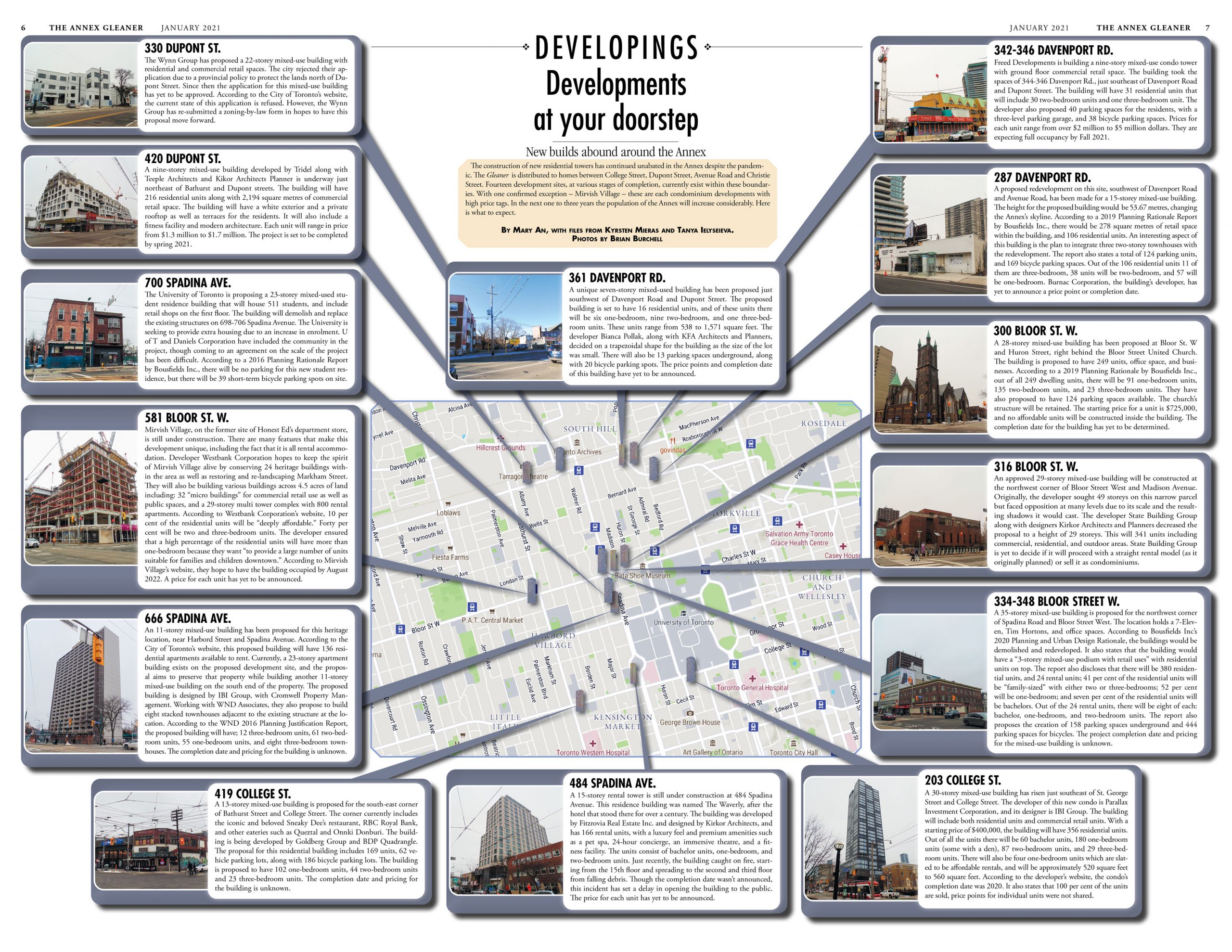
The construction of new residential towers has continued unabated in the Annex despite the pandemic. The Gleaner is distributed to homes between College Street, Dupont Street, Avenue Road and Christie Street. Fourteen development sites, at various stages of completion, currently exist within these boundaries. With one confirmed exception – Mirvish Village – these are each condominium developments with high price tags. In the next one to three years the population of the Annex will increase considerably. Here is what to expect.
By Mary An, with files from Kyrsten Mieras and Tanya Ielyseieva.
New building plan clears hurdles at Committee of Adjustment
View, looking East from Madison Avenue, of the soon to be constructed Estonian Cultural Centre. The proposal has widespread support from the residents’ association and the city alike. COURTESY ALAR KONGATS
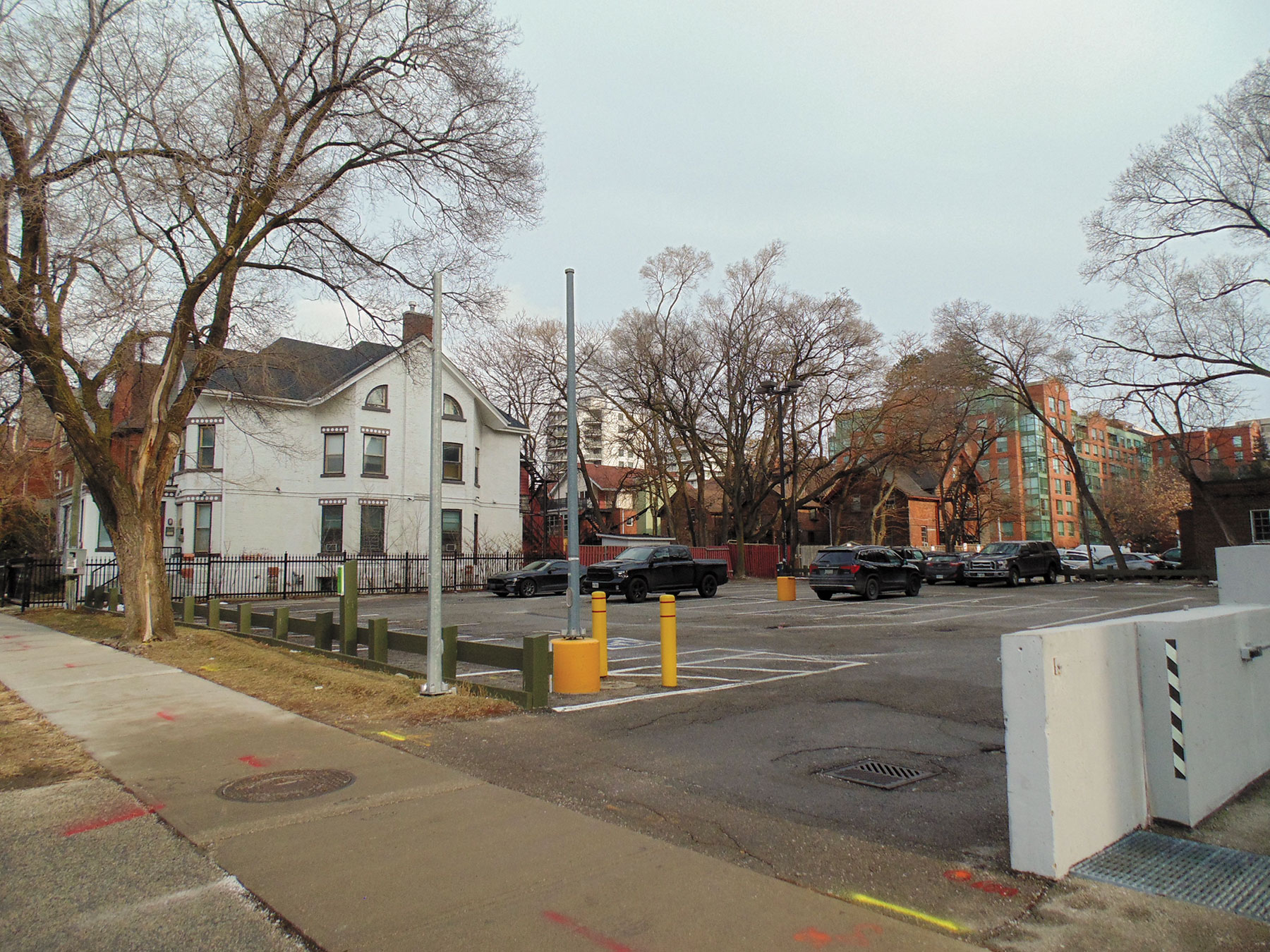
Residents and shoppers alike were surprised to see the Green P parking lot on Madison Avenue close in early January. The city had been leasing the space for Green P but that lease was not renewed by the property owners who also own the adjacent 11 Madison Ave. The owners plan to begin construction soon on the International Estonian Centre, a cultural and community space. In July of 2016, the Gleaner did a feature on that pending development. We include it again here as a reminder.
Site on Madison Avenue to be converted from Green P parking lot to the Estonian Cultural Centre. BRIAN BURCHELL/GLEANER NEWS
BY JUAN ROMERO
The Committee of Adjustment at the City of Toronto and the Annex Residents’ Association (ARA) have approved the latest changes proposed for the New Estonian Cultural Centre. The new centre, to be located in the Annex, will replace the current building, located on Broadview Avenue.
The Estonian Centre’s project committee had submitted eight minor changes to the design of the building. These changes, which included adjustments to the building’s height and parking, were well received by neighbours.
“In the latest proposal we liked the design and we were in favour of the changes. We think it will be really beneficial for the Estonian community,” says Sandra Shaul, the chair and director of the ARA.
The three-storey building will be located on Madison Avenue, where the Green P parking is located, which is very close to the Estonian Tartu College.
The new centre will be used by the Estonian Credit Union, the Estonian Choir, and Estonian schools and it will be occasionally rented out to third parties as well. Public events such as Estonian events and celebrations will also take place there.
Despite wide approval for the development of the centre, the Estonian Vice-Consul in Toronto, Tom Heinsoo, says the community is divided on the project.
“Some people in the community thought it would be better to spend the money on the existing house on Broadview and renovate the current building,” says Heinsoo, who adds that he is in favour of the creation of a new centre. “I do think the majority of people realize that it wouldn’t be financially logical to renovate the old building since it would cost a small fortune to bring it up to modern standards.”
According to the Estonian Centre’s due diligence report, the Madison Avenue project is set to cost approximately $25 million.
Construction is scheduled to begin in January [2021].