July 15th, 2021 · Comments Off on LIFE: Baseball Leafs prepare for a summer of action (Jun. 2021)
Christie Pits set to welcome fans back to the old ballgame
As Ontario reopens after the pandemic shutdowns of the past year, the Maple Leafs look forward to a summer of baseball at Christie Pits. R.S. KONJEK/GLEANER NEWS
By R.S. Konjek
The sights and sounds of live baseball will return to Christie Pits this summer, and the Toronto Maple Leafs are raring to go.
After the 2020 season was wiped out by the COVID-19 pandemic, players are dusting off their spikes and conveying their feelings about playing ball again.
“Ready,” says Garrett Takamatsu.
“Liberated,” says Grant Tamane.
“Super-pumped,” says Johnathan Solazzo.
In June, the Intercounty Baseball League’s proposal to play a shortened 2021 season was approved by the Ontario government, allowing for a July-August regular season and playoffs this September.
Over the next two months, the Leafs will play 15 home games at their traditional 2:00 pm Sunday and 7:30 pm Wednesday start times.
Now that it’s game on, Leafs manager Damon Topolie finds himself doing “a million things” to get his ballclub ready.
In early July he met with City of Toronto officials to confirm that Dominico Field could reopen for baseball, and that fans would be welcomed back to the park.
Although the city did not present any specific rules or requirements for reopening, fans coming to Christie Pits will be encouraged to observe the provincial COVID-19 health and safety guidelines that are still in effect. Social distancing and facial coverings are two things that fans can continue to do.
As well, the Leafs are looking at restricting the seating behind the team benches to avoid those areas becoming overcrowded. The hillsides surrounding the field will be wide open to all and admission is free.
Shortly before the season was scheduled to begin, city staff were seen mowing the grass and preparing the field for play.
Topolie has done an impressive job of constructing a team that will don the famous maple leaf logo this summer.
Popular veterans like Takamatsu, Tamane and Solazzo will be joined by two of the league’s top sluggers, Jordan Castaldo and Sean Reilly. Both are one-time Leafs who spent most of their careers with other teams, but whose return ensures that the home team will have a potent lineup at the plate.
Topolie spent the final days before the season “still working on the pitching part.”
Starters Zach Sloan and Marek Deska are returning, but ongoing cross-border travel restrictions mean that Buffalo, New York native and veteran pitcher Justin Cicatello will be unable to start the season in Toronto.
Also stuck in Buffalo because of travel restrictions are the major league Blue Jays, a predicament that makes Topolie chuckle.
“We’re the only game in town right now,” he says, noting that from their inaugural season in 1969 to 1976, the Maple Leafs had the Toronto baseball scene all to themselves. Until the Blue Jays are permitted to return to their home stadium, the Leafs will open the summer as the only baseball action available to fans in North America’s fourth largest city.
The Maple Leafs’ complete 2021 season schedule can be found at www.mapleleafsbaseball.com.
June 15th, 2021 · Comments Off on ON THE COVER: REDress at Trinity-St. Paul’s (May 2021)
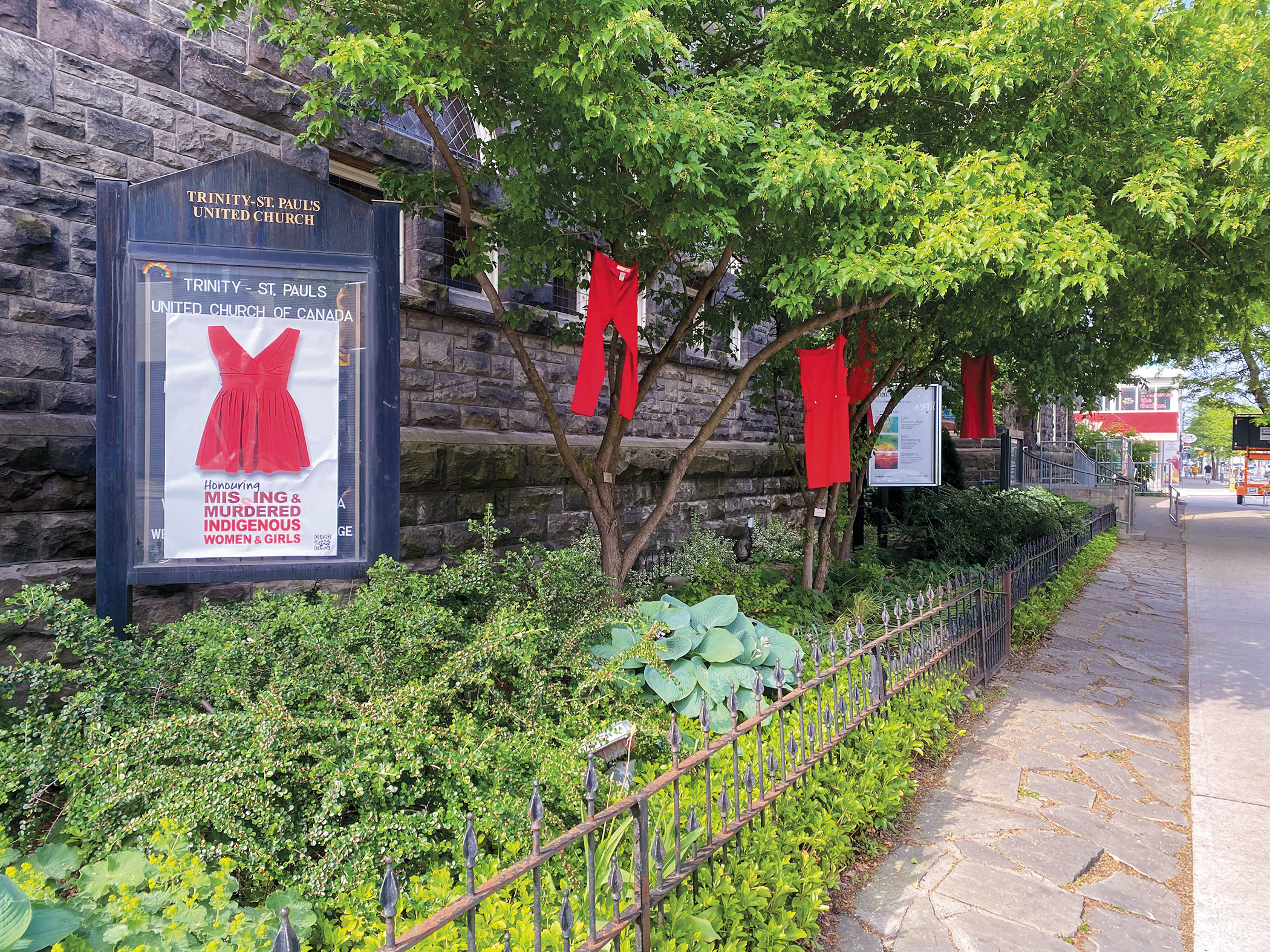
Red dresses hang on the exterior of Trinity-St. Paul’s Church in a show of solidarity with those seeking justice for Canada’s Missing and Murdered Indigenous Women and Girls. The REDress Project started as an art installation by Jaime Black at the Canadian Museum for Human Rights in 2014, and has since spread across the country as a reminder of the shocking number of women and girls lost. For more information, visit jaimeblackartist.com. BRIAN BURCHELL/GLEANER NEWS
June 15th, 2021 · Comments Off on NEWS: Brunny Rexall to shutter (May 2021)
Closing comes as a surprise after only 3 years in operation
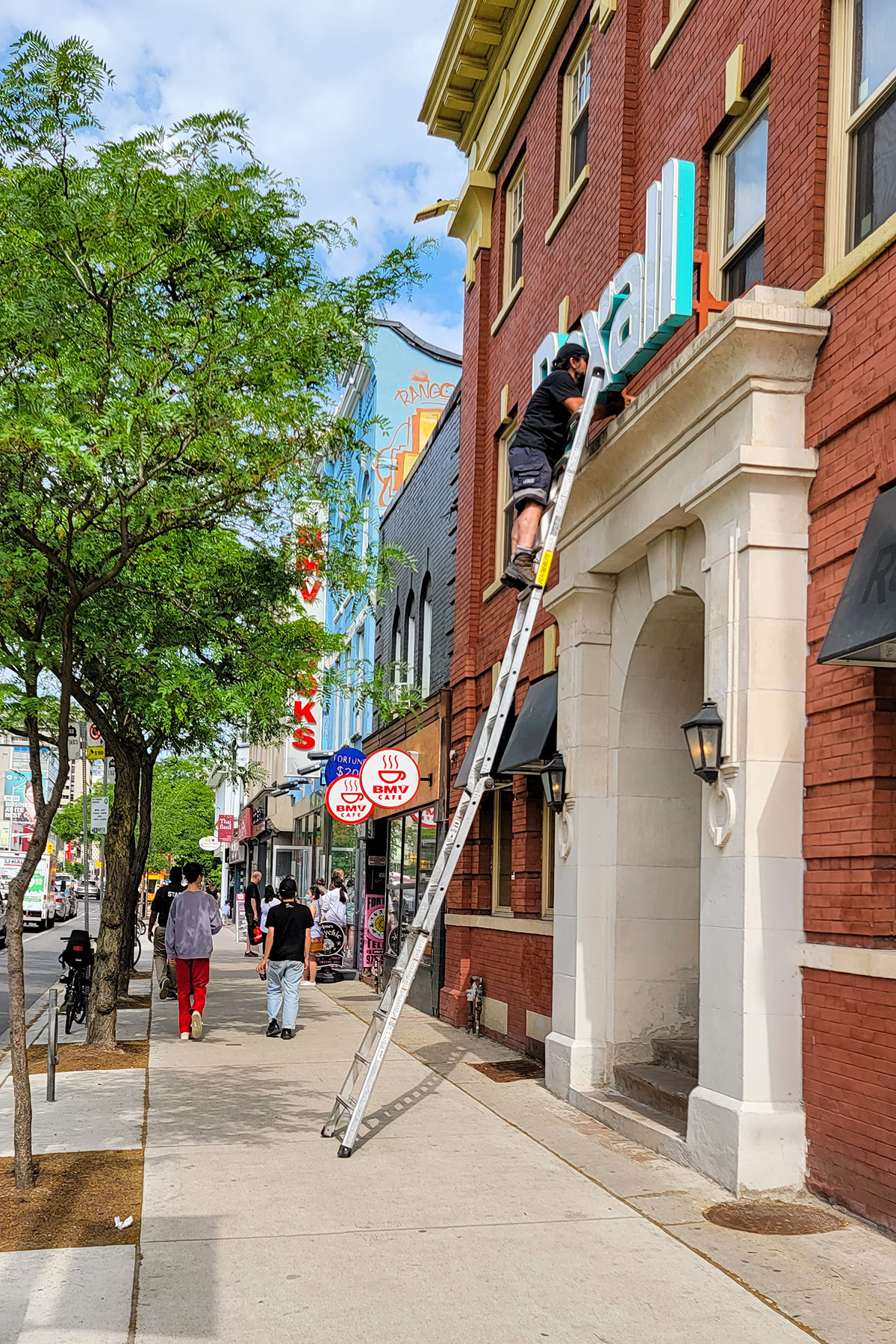
On June 11, as many patios and retailers reopened, Rexall’s sign came down. NEILAND BRISSENDEN/GLEANER NEWS
By Nicole Stoffman
Rexall Pharmacy in the former Brunswick House is closing after only three years, on June 11. Employees will be re-assigned by the corporately-owned store, but the future of management is uncertain, according to an employee.
The move comes as a surprise to Bloor BIA Chair (and publisher of this newspaper), Brian Burchell, especially after Rexall’s extensive restoration of the heritage building.
Founded in 1874 as The Brunswick Hotel when Bloor Street was just a wagon road, by the 60s the “Brunny” was a legendary beer hall and blues venue.
Mementos of its storied past now grace the Rexall pharmacy’s interior.
“That is a real credit to the retailer who was under no obligation to offer that historical glance for their patrons,” said Burchell. “We’re sorry to see them go.”
Rexall’s American parent company, McKesson Corporation, has been thriving in this pandemic, earning $238.2 billion in revenues in 2020, a 3% increase from the previous year. So, it might be hard to believe Rexall’s official statement that the closure is due to lower sales resulting from pandemic restrictions.
There may be other reasons why the Brunny Rexall didn’t thrive. There are six pharmacies within walking distance.
According to Professor David Soberman, Canadian National Chair in Strategic Marketing at Rotman School of Management, the pharmacy needed to draw 50% of its competitors’ business to be viable.
High rent, financing the renovation, and a storefront that shoppers can’t see into may also have played a role.
The Gleaner spoke with customers who said that high prices and the lack of an accessible entrance on Bloor, were reasons they didn’t frequent Rexall too often.
McKesson Canada closed 40 of its 450 stores in 2018, citing falling prices for generic drugs and higher minimum-wages that cut into profits.
“When you’re a big network like Rexall, you’re going to be opening and closing franchises all the time,” explained Soberman, who added that in order for a large corporation to work, every piece needs to generate profits. He adds that Rexall may have seen the Brunswick House location through “rose-coloured glasses.”
What about the eight billion McKesson Corp. has to pay over the next 18 years to settle opioid litigation in the U.S.? As distributors, they have been accused of fanning the flames of the opioid crisis by not adequately vetting suspicious orders.
“If you’ve got a location that is generating money independent of what liabilities you have,” responded Soberman, “you’re going to keep it open.”
Soberman speculates that the company plans to sublet its lease to a tenant that could make a profit at the storied location.
The building is owned by Larry Sdao, a board member for the Bloor Annex BIA.
June 15th, 2021 · Comments Off on NEWS: City moves forward with Garden Suites (May 2021)
Plan could allow homeowners to build additional housing in rear yard
The city is looking at garden suites located in rear yards behind a single detached house, a semi-detached house, and a townhouse or low-rise apartment block. COURTESY THE CITY OF TORONTO
By Joshua Chong
Some Toronto residents may soon be allowed to construct a detached housing unit in their rear yard. Under the City of Toronto’s new Garden Suites project, which is currently being developed, eligible homeowners will be permitted to build an ancillary building that can be rented out or used for additional housing.
Part of the city’s Expanding Housing Options in Neighbourhoods initiative, Garden Suites is meant to complement the existing Laneway Suites project—which was adopted city-wide in 2019—and to address the lack of rental housing options in the city.
Garden suites, like laneway suites, remain on the same title deed as the main house. All public utilities, such as electricity, water and sewer, are provided through a connection from the primary housing unit.
The program was developed in light of changes to the Ontario Planning Act, which now requires the city to permit the construction of ancillary detached housing units on low-rise residential lots.
However, not all houses with backyards will be eligible for a garden suite, which must be at least five metres away from the main dwelling and no more than 45 metres from the street. Additionally, they cannot cover more than 40 per cent of the rear yard area. These criteria, among others, are meant to prevent shadowing, ensure emergency services can access the unit, and protect green space and privacy.
The city held a series of three public consultations between May 11-13 to solicit feedback on the policy. They were led by David Driedger and Allison Reid, co-leads of the Garden Suites study team. Among those in attendance was Councillor Ana Bailão (Ward 9, Davenport).
Bailão stated that the new program would help address Toronto’s housing crisis.
“We need to give Torontonians more housing options,” she said. “Our city is growing quite fast [and] we know that there’s going to be 700,000 new residents moving into our city over the next 30 years.”
She also highlighted that these supplementary units can help facilitate intergenerational living and allow seniors to live close to their families—a topic of interest amid the senior long-term care crisis.
Based on a preliminary survey of 2,700 residents from across the city, presented by Reid, there is significant support for the Garden Suites program: 56 percent of respondents strongly support the policy, while 13 per cent somewhat support it. A third expressed interest in potentially building a garden suite on their property one day.
However, 28 per cent of those surveyed worried about the potential impacts of the project. Concerns with how the suites would affect privacy, shadowing, and the natural environment were most often cited.
“It’s concerning because of how our mayor implements net-zero and greening [policies] … and [yet] here we are developing and building buildings in the back gardens,” said one participant in the question-and-answer portion.
In response, another participant argued that the benefits of the policy outweigh its potential impacts on the environment and density. “There’s a lot of great neighborhoods and people can’t live in them, [even though] they want to live in them. People, I think, should take priority over trees and cars, and I just want to make sure that we all keep that in mind as we move forward.”
In an email statement to the Gleaner, Councillor Mike Layton (Ward 11, University-Rosedale) wrote that he has not yet taken a position on the policy, since consultations are still ongoing.
“I have spoken with a number of residents and their respective associations and their support and concerns are varied,” he stated.
Anne Fleming, chair of the Harbord Village Residents’ Association, wrote in an email to the Gleaner that the association is still studying the proposal and has not taken an official position on it. She did note, however, that few houses in Harbord Village would be eligible to build a unit under the Garden Suites program, since most back onto a laneway, and thus would be covered under the Laneway Suites program.
The Gleaner also reached out to the Annex Residents’ Association for comment. Chair Rita Bilerman wrote in an email that the association’s Planning and Development Committee is still reviewing the policy and examining its implications for residents of the Annex.
June 15th, 2021 · Comments Off on NEWS: Appeal against 225 Brunswick Ave. (May 2021)
Developer seeks “middle ground” to resolve dispute with neighbour
This architect’s rendering depicts how this one-time synagogue located on Brunswick Avenue might look if it’s converted to residential units. COURTESY SUULIN ARCHITECTS
By Madeline Smart
The approved development plan for the one-time synagogue at 225 Brunswick Ave., whose plan required nine bylaw variances, has been appealed by a nearby neighbour.
After a virtual hearing in March, the Committee of Adjustment (CoA) made the decision to approve the variances requested by the developers plan on April 6 on the condition that no other variances were made.
By April 30th, neighbour Simon Wynberg had filed his appeal. In that appeal he represents 30 other residents within a 60 metre radius of the development.
The appeal restates the multiple variances of the proposed development that do not meet the city’s zoning standards in an attempt to have the plan’s approval reconsidered.
Some of the variances include not providing parking for future residents, no waste enclosure, decreasing the natural landscaping, possibly damaging some trees and most importantly to Wynberg, a proposed density that is 3 times larger than what is usually permitted.
“Our sticking point has always been the volume,” said Wynberg. “It’s just out of proportion.”
Developer Jeff Kopas said they have adjusted their plans to include waste storage, added parking for bikes, and received support from transportation services.
However, Kopas says only so much can be done about the density because renovating an older building is already expensive.
“To convert this building to residential is extremely cost prohibitive,” said Kopas in an emailed statement. “We are absolutely willing to do what we can, but it has to be reasonable.”
According to the developments’ website, they had looked into creating fewer units which may have reduced the density but it “wouldn’t have covered the hard and soft costs associated with renovating this structure.”
In order to turn the current two and a half storey building into three storeys with seven apartment units, the plan is to increase the building depth by five metres more than the permitted maximum depth. The plan also increases the floor space to over three times the area of the lot due to the addition of the third floor, when the applicable bylaw states it should only be one time the size.
Overall the community isn’t opposed to 225 Brunswick Ave. being turned into a residential building, but some just wish it were being done differently.
Another resident, Margaret Zeidler, prominent city builder, and President and creator of 401 Richmond Limited, is worried that that the development will set a harmful precedent for the neighbourhood as well as older buildings in the city.
“Yes it is an unusual development but it’s not unusual in the way it faces someone’s backyard,” said Zeidler. “And if they’re allowed to do that then why isn’t the next guy allowed to do it?”
Though 225 Brunswick Ave. was never officially designated as a heritage building, Wynberg wishes it would be treated with similar respect. “Nobody is objecting to it being housing, we would just like to see proper treatment of a heritage building,” said Wynberg.
Originally a gospel mission hall in 1911, the building went on to become a synagogue that hosted one of Toronto’s oldest Jewish Orthodox communities in the 1930s. It has long since become a commercial building but the character and history still remain.
However, Anne Fleming who is chair of the Harbord Village Residents’ Association (HRVA), says that 225 Brunswick Ave. will not set any precedent for the area. “225 was an absolute anomaly, it’s a completely unique situation,” said Flemming. “It’s a unique building to the neighbourhood and so whatever happens here is not a precedent for anything else.”
Kopas was disappointed to hear about the appeal, stating that he believed his company had done their best to work with the community. “This is an incredibly challenging building and we have been working on finding a proposal everyone could support for over three years now,” said Kopas.
According to Kopas, the building hasn’t had a legal use as a commercial building since the 1980s and was only being used as one conditionally because the previous owners could not afford to renovate it into a residential unit. So Kopas will keep fighting for their plan if the appeal is approved, because they don’t have another option. They hope to find a middle ground with the neighbours that makes everyone happy.
Wynberg and the other neighbours he represents for the appeal are still open to negotiations and finding a middle ground with Kopas, but for now they are taking the legal steps and hoping to see the process take place fairly.
The virtual hearing for the appeal is set for August 24.
June 15th, 2021 · Comments Off on CHATTER: Farmer’s Market returns to the Annex (May 2021)
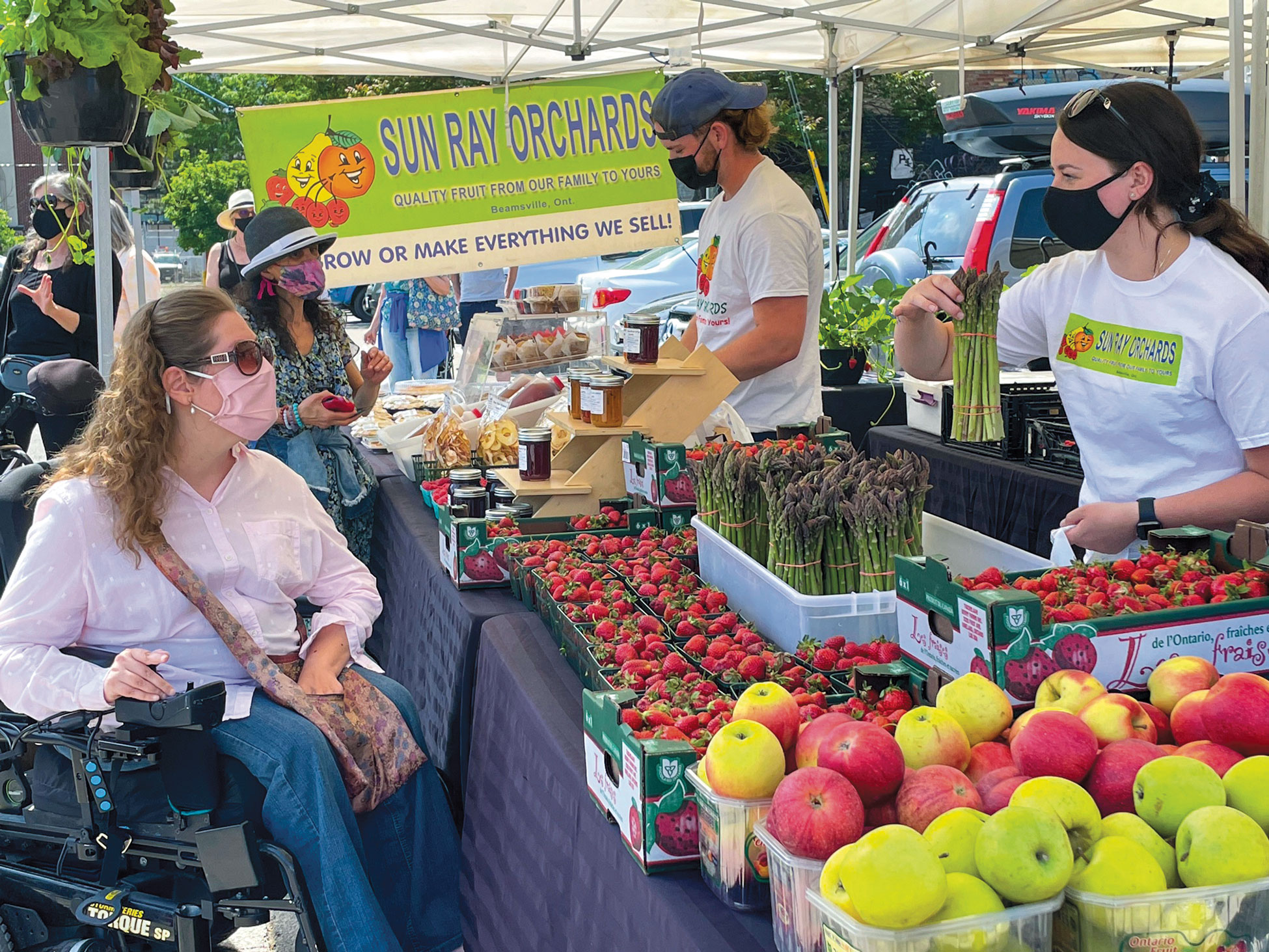
Cameron and Shaylynn from Sun Ray Orchards in Beamsville, Ontario were happy to be serving customers at the first Bloor-Borden Farmer’s Market of the season. NICOLE STOFFMAN/GLEANER NEWS
The Farmer’s Market returns for a 14th season with 16 organic food vendors, which is the same number found there during pre-pandemic times.
Gus Sinclair, a long-time organizer of the popular market told the Gleaner the market begins June 2 and runs between 3 – 7 pm. They will continue every Wednesday until October 28.
The layout this year will feature farmer’s stalls on the periphery of the east end of the Green P parking lot off of Borden Street. All staff and customers must wear masks while on site allowing the safe operation of a market during COVID-19. At the centre of the market will be live instrumental music.
A new feature this year will be an organic craft beer supplier offering samples allowing shoppers to perhaps get a little tipsy while buying turnips.
The market’s survival is completely dependent on volunteers. To join the team that makes it happen email bloorbordenmarket@gmail.com.
—Brian Burchell/Gleaner News
Comments Off on CHATTER: Farmer’s Market returns to the Annex (May 2021)Tags:Annex · News · Food
June 15th, 2021 · Comments Off on EDITORIAL: Ford chooses wrong path, again (May 2021)
And this month in Ontario politics: Premier Doug Ford, yet again summons the experts for their advice, and pledges to follow their lead. And yet again, once advice is received, promptly goes off in a wildly different direction. This month, the experts told Ford it was safe to re-open schools for the month of June. They told him schools need to be opened not just for the sake of education, but for the sake of mental health. Yet here we are, with schools closed until September.
When pressed by reporters as to why Ontario is the only jurisdiction in the country with schools still closed, Ford blamed the federal government. Ugh? Constitutionally, it’s the provinces that look after education. Besides, Ontario had 15 months to get education workers fully vaccinated, 15 months to get schools properly ventilated and class sizes reduced. We are so far behind on these fronts that Ford has stopped short of promising a return to normal schooling this coming September. Somehow, according to Ford, it’s Trudeau’s fault because Ontario has a porous border with the United States. Six other provinces share the same border and their schools are open. When confronted by reports on this discrepancy, he attributed Ontario’s position to the fact we have a relatively large population. Does he make this up as he goes?
What’s actually happening here is that Ford is skipping ahead to next year’s election campaign and is allowing internal polling to guide health policy decisions. In a survey commissioned by the Conservatives, of 1,246 people across the province asked whether Ontario should “re-open schools for three weeks in June even if that means Ontario’s re-opening plan is delayed by one week,” 56 per cent rejected that trade-off.
So when he tells us, “the health of Ontario’s children is our top priority,” some of us might have a hard time swallowing it.
When schools were open, he refused to release the rapid testing units. The government promised 50,000 school COVID-19 tests would be done weekly, a program he called “robust.” However, tests never exceeded 8,213 per week, which is less than 17 percent of what was promised. Now all those rapid tests (provided for free by the federal government) are sitting in some provincial warehouse waiting to expire. What a shame.
In an opinion piece published in the National Post, Dr. Alanna Golden and Dr. Kwadwo Kyeremanteng argued that many students attend school to be fed and to get support. They also noted that school is where a majority of domestic abuse gets reported. Here we are in a situation where families are stressed financially, domestic violence is on the rise, and students are literally dropping off of ZOOM radar. But schools won’t open until the end of summer.
The decision to not prioritize educational workers at the outset, including administrative and caretaking staff, is at the heart of the problem. Even now most have only received their first vaccine doses. If schools do re-open now and something goes wrong, the Conservative’s chances of forming another government will be further diminished. Ford’s bias against teachers is coming back to haunt him. His playing politics in a pandemic is pathetic.
June 15th, 2021 · Comments Off on FORUM: Premier Ford’s land use planning agenda is a big worry (May 2021)
The good, the bad, and the ugly of a government run amok on planning policy
By Jessica Bell
Since becoming premier, the Doug Ford government has rewritten many of the laws and regulations that decide how we build and what we build. These developer-friendly changes help Doug Ford’s donor base reap record profits, but their impact on people, the environment, democracy and our affordable housing goals is mixed. And I’m being nice here.
Here’s a roundup of the good, the bad and the ugly changes to Ontario’s planning laws:
Abusing Ministerial Zoning Orders
Ministerial zoning orders (MZOs) are the nuclear bomb of planning. MZOs give the provincial government the power to override local planning rules and establish their own rules on a piece of land.
Doug Ford has issued about 40 MZOs, and has faced considerable community opposition in response. City councillors and local residents were furious that the government made a secret deal with a big developer to build on the provincially-owned Foundry site at 153 to 185 Eastern Ave.
The government backed down fast and is now negotiating with the city. In other cases, MZOs have been justifiable. I am at peace with MZOs that are formally requested by the city for projects that benefit the public good, like reducing the number of required parking spots at the new affordable housing development at 877 Yonge St.
Opening up farmland to single tract homes
In response to pressure from developers, the Ford government has been quietly forcing municipalities to review and expand their municipal boundaries to permit urban sprawl on thousands of acres of nearby farmland, and reduce density requirements within the municipal boundary. This is a huge issue that could lead to the paving of thousands and thousands of acres of greenspace across Southern Ontario.
The government says expanding municipal boundaries is necessary to meet the housing needs for projected population growth until 2051, but critics say the government’s population and job growth estimates are grossly exaggerated.
Environmental Defence, residents and councillors are campaigning to protect farmland, stop any needless expansion of a municipalities’ boundaries, and meet housing and job needs by increasing density within existing neighbourhoods first. This is an issue I’m following closely.
Transit-oriented development
Ford has embraced transit-oriented development by building above and nearby major transit stations. To transition to zero-carbon transit-friendly neighbourhoods, more housing should be built near transit.
Here’s the problem. The Ford government is making deals with developers to build above and near transit sites in return for partially paying for transit station construction, but the public doesn’t know how much money will go to station construction, what sized units the developer will build, how many of them will be truly affordable and for how long, and what profit margin the developer is permitted to make.
Is this truly the best we can do with our precious provincial land? No.
Instead of selling off land to big developers that we’ll never get back, we should keep our land and build housing and services, from affordable housing to community centres to daycares, that truly meet the needs of our city.
Changing LPAT rules
This year, the Ford government made changes to the Local Planning Appeal Tribunal (LPAT) that gives community members and municipalities even less say over land use planning. The tribunal can now dismiss a proceeding without a hearing if the adjudicator believes the proceeding has no reasonable prospect of success.
Third parties – mostly residents – can no longer testify at a hearing, and can only submit written comments. The government has also removed the right to a judicial review or an appeal except in very exceptional circumstances.
Restricting inclusionary zoning
Of the over 230,000 units built or approved in the last five years within Toronto, only about 2% were affordable. Increasing supply will not solve our housing affordability crisis. Government needs to regulate and invest. The City of Toronto is developing an inclusionary zoning policy that would require new residential developments to include affordable housing units. The Ford government put hard limits on inclusionary zoning through Bill 108, which limits inclusionary zoning rules to major transit stations. Inclusionary zoning should be allowed beyond these transit stations.
We must increase our housing supply. Instead of building single tract homes on prime farmland, we should plan for walkable, transit-friendly neighbourhoods and housing. Our city truly needs affordable housing, supportive housing, community housing, and missing middle housing for families. This is how we create a truly livable and green city and protect our farmland and greenspaces for generations to come.
Please reach out to our office if you have feedback, have questions, or need help.
June 15th, 2021 · Comments Off on FORUM: Exclusionary planning must stop (May 2021)
The lack of affordable housing is the other crisis of our time
By Mike Layton
When asked to name the single biggest issue that is facing Torontonians, the most common answer is how hard it is to find affordable housing.
Not a week goes by when we don’t hear about a major condo or luxury rental development changing the face of our neighbourhoods, and generally driving up prices.
With the power that the current provincial government gives to developers, our ability to require that new developments include community benefits, such as affordable housing, is extremely limited. But now is the moment to change that.
In September 2021, a final report on inclusionary zoning (IZ) will be coming to the Planning and Housing Committee, and then to city council, where members have the chance to vote and implement its recommendations. This was the follow-up to the interim report on IZ that was released back in the fall of 2020.
If Toronto had strong inclusionary zoning a decade ago, we could have added over 30,000 new units of affordable housing. This is eight times the amount of affordable units that were created in the same number of years.
Our current pattern of development is highly exclusionary. We’re seeing the majority of newly built housing being bought by investors and rented out at extremely unaffordable rates.
At the Planning and Housing Committee in 2020, members accepted my motion calling on City Planning to explore whether it would be possible to significantly increase the amount of affordable housing that would be required of new developments, with options that would achieve a range of 10-30% of new condominium developments’ floor area and 5-20% of new purpose-built rental developments’ floor area.
I would like to see these higher numbers achieved.
The interim report from 2020 proposed anywhere between 3%-5% of new rental of IZ developments and 5%-10% of new condo developments to be set aside as affordable, depending on the areas of the city where IZ is required.
I, alongside numerous housing advocates, have made it clear that we need to do better to help address our housing crisis and have called for at least 20% to 30% affordable housing in new developments.
I have been fighting for this change since 2015, and I believe that we are at a critical moment.
Short of significant intergovernmental investment in affordable housing – the likes of which our city has not seen in decades – IZ is Toronto’s best chance to finally build the units desperately needed by our low- and moderate-income residents.
Implementing the strongest possible IZ framework this year is especially important now, as I am seeing countless first-hand examples of how the pandemic is threatening Torontonians’ housing stability. Many who have lost their jobs or had their hours reduced have been unable to make rent, and the provincial government is continually allowing landlords to evict them.
Without significant government intervention, finding affordable alternatives will become next to impossible for most.
I personally know families where four or more individuals have been forced to share a one-bedroom apartment; this type of situation will only become more common, which is especially dangerous during a pandemic.
There is a lot that city staff have gotten right so far.
The affordability period for units created through IZ is now proposed to be 99 years, which means this housing stock would be protected for future generations.
IZ housing would also comprise a mix of sizes, ensuring that affordable family-sized units are built.
We need to make sure we follow the lead of cities like Montreal and New York, which have both set ambitious requirements for the percentage of units in each building.
City studies have demonstrated that developers would still be able to make their buildings – and their profits – with set asides as high as 20-30% in many areas of the city. This is why I will continue to push for the highest targets possible.
In the coming months, residents must let the city know it’s imperative that we take this moment to shift the power from developers to people, so we can begin to turn the tide of the housing crisis.
Let me know if you would like to join me in pushing for IZ to become a permanent part of Toronto’s housing landscape.
As always, please don’t hesitate to get in touch with my office with your questions or concerns at Councillor_Layton@toronto.ca.
Mike Layton is the city councillor for Ward 11, University—Rosedale.
June 15th, 2021 · Comments Off on LIFE: Enough with beg buttons (May 2021)
It’s time to give pedestrians their due
By Terri Chu
Steven’s Grocery is easily my favourite corner of our neighbourhood. Helen’s flowers are always a welcome sight as we walk by, but the one thing I HATE about that corner is the beg button.
If I’m not quick enough, I have to stand there for an entire light cycle while gas guzzlers spew toxins in my kids’ faces.
The era of prioritizing cars is long over and the city, (actually, the entire country), needs to catch up.
Every time cyclists or pedestrians ask for just a little bit of space, either through bike lanes or expanded sidewalks, the city rushes off to do a traffic study. WHO CARES?
So what if it takes cars an extra 30 seconds or two minutes for a driver to reach his destination? Prioritizing the least efficient mode of transportation is so 20th century.
The city needs to keep up with the times and make a drastic shift in their priorities.
I don’t care if it takes a car an hour to get 10 blocks. Unless the roads are under construction, they probably can just as easily get there by transit or bike. It shouldn’t even be on the radar.
Every single effort of every planner and every engineer needs to be focused on getting people into alternative modes of transportation. Make bikes safer. Accommodate E-bikes. Widen pedestrian spaces so moms with strollers can walk side-by-side and enjoy each other’s company.
If people still insist on using energy to haul 2000 lbs of machinery to get them and their laptops 10 blocks, they can wait.
What about people with disabilities you say? Why are cars their only option? Why not golf carts that can safely get them from point A to point B? Why not rickshaws?
Why are we so obsessed with a singular mode of transportation our imaginations don’t let us imagine a better world with viable alternatives where cars aren’t out to kill us at every corner?
We need to dedicate a network of streets for the safe navigation of golf carts, bikes, and pedestrians where cars are restricted. Businesses in these corridors would boom. Think about the pedestrian districts in Old Montreal.
Put people first! Let’s start with getting rid of beg buttons. Lights should automatically turn for pedestrians. Cars should be made to stop and slow down even if nobody wants to cross.
During COVID times, it is only polite to keep your distance from fellow pedestrians waiting at a corner. Inevitably, kids end up bunched up on the sidewalk, even stepping onto the curb, closer to speeding traffic than any parent wants to see.
Meanwhile, people pointlessly burning fossil fuels, spewing toxins into our city’s air are treated with importance, a reminder that the city was built primarily around their needs when it was only the rich who could afford vehicles and the poor really did need to beg to even cross the street.
Classism is built right into our urban infrastructure and it will take decades to rid ourselves of this legacy.
The last thing we need is to continue this nonsensical servitude to the oil gods of old.
Provincially, Ford wants to continue this legacy by building another pointless highway that will be clogged within a few years.
He is doing it in the name of a make-work project to boost economic recovery. He won’t bring back permanent sick days but he’ll build us a highway.
If any new roads are to be built by anyone, they absolutely need to be restricted to small/light vehicles and bikes.
The plans for the new super highway should be a bike super highway where parents can safely travel with the kids large distances at moderate speeds and not be worried about getting crushed by a middle-aged man with a midlife crisis driving his new pickup truck with a 15-foot frontal blind spot he doesn’t know about.
If Premier Ford truly cared about a robust economic recovery his make-work projects would at least have an eye toward the economy of the future.
Light vehicles need their own space.
Though mass transit should be invested in heavily, there will likely be reluctance to go back to shared spaces right away.
If Ford wants to get people moving and the economy running, the focus needs to be on transportation that is efficient and will not further tax our limited energy resources.
What oil we have left should be reserved for applications that require high energy densities (like airplanes, though flights should be restricted).
We should be building infrastructure for the future.
Sadly, our leadership are stuck in Happy Days when Greased Lightning was still cool. It’s time to move on.
June 11th, 2021 · Comments Off on ARTS: Enjoy Annex-based opera online (May 2021)
From ‘park and bark’ to click and stream – opera is evolving locally
Don Alfonso (Alex Bowie) and Despina (Bahar M. Harandi) plotting and laying bets on what will happen with the young couples whom they serve. From the Long Reach Opera Workshop’s 2018 production of Mozart’s Cosi fan tutte. COURTESY ANDY WRIGHT ONLY1ANDYWRIGHT.COM
By James McLean
As a singing teacher, I am constantly listening to and watching for the development of students. When I went to see Long Reach Opera Workshop perform Floyd’s Susannah in the summer of 2016, I was knocked out. The young performers sang beautifully and I could see how far they had advanced after a short workshop in stage acting. As soon as the performance was over I spoke to founder Michael Donovan and asked to be put on the board.
Since that time I have been supporting Long Reach’s growth as a music organization, which now attracts students from across North America to work with an outstanding team of instructors.
Voice students in graduate programs from Boston to California are drawn to Toronto to receive first-class instruction in stage performance.
As the pandemic drags on and the risk of languishing increases, the timeless music of the great composers offers us a chance to tap into a joy that has lifted spirits through the centuries.
Townspeople praying at a revival in The Long Reach Opera Workshop’s 2016 production of Susannah by Carlisle Floyd. From front to back: Thera Barclay, Nune Ananyan, Lori Mak, Taylor Gibbs, and John Schneider. COURTESY ANDY WRIGHT ONLY1ANDYWRIGHT.COM
I hope you can join us on Friday and Saturday, June 18 and 19 at 7:30 EDT, for an online performance of arias and concert songs. Music by Mozart, Handel, Schubert, Schumann, Duparc, Brahms, and many more will be performed by Long Reach Opera Workshop (LROW) students.
The workshop was founded in 2014 by siblings Michael and Anne-Marie Donovan to fill a void they noticed while teaching post-secondary voice students.
“I felt that many of my voice students would benefit from more stage experience and more interaction with other singers and professionals,” explains Michael, who now teaches at Acadia University in Halifax. “So, I asked my sister to come in and work with them and stage a few scenes.”
Anne-Marie, who was teaching in the drama department of the University of Waterloo, jumped at the idea of joining her brother in Toronto’s Annex to help developing opera singers.
“LROW was created to develop the whole person, the singer-actor, on the road to a professional career,” explains Ms. Donovan, who will be directing the live-streamed June concerts.
Michael made his home in the Annex while teaching at York University and completing his doctoral studies.
That notion of the singer-actor is leading edge in vocal training today. It takes the singer beyond marching onto the stage to, “park and bark,” as the old saying goes, to a performance where the singer’s musical skills, emotional connection and acting ability make opera accessible to a broader audience.
The name, Long Reach, originates in New Brunswick where Michael and Anne-Marie have spent many summers with family on the banks of the St. John River.
It reflects their commitment to helping young singers strive for their goals and realize their dreams. This commitment, along with their leading-edge approach to opera pedagogy is attracting top teaching talent too.
“I was very pleased to both give a master class for Long Reach Opera as well as hear several of my students in lead roles in their production,” said Lorna MacDonald – Professor of Voice Studies, Vocal Pedagogy, and Lois Marshall Chair in Voice at the Faculty of Music, University of Toronto. “Everyone was open to suggestions and willing to take risks, and that shows the friendly, safe atmosphere that the leaders have cultivated.”
Long Reach has its roots in the Annex and plans to keep growing here. The workshop gave its first performances of opera scenes in the Heliconian Club on Hazelton Avenue. As they grew, they have shifted to the larger Walmer Road Baptist Church, then Trinity-St. Paul’s Church, and in 2022 they will perform in the newly renovated Knox Presbyterian Church on Spadina Avenue.
I sincerely hope you can join us online in June for what will be exquisite performances of songs and arias from the French and German classical repertoire. There will be no parking and barking.
Tickets are $10 for students, seniors, and culture sector workers, $20 for the general public, and go on sale June 1 at sidedooraccess.com.
James McLean has sung over 100 operas and oratorios across Canada, throughout Europe, Israel, and Russia in a career which spans over four decades.
He teaches singing privately in the Annex and at Wilfrid Laurier University in Waterloo. He serves on the board of the Long Reach Opera Workshop.