August 16th, 2021 · Comments Off on FORUM: Leaders must take real action on climate (July 2021)
We must all join the chorus for change before it’s too late
By Jessica Bell
Since I was in elementary school, I have been listening to scientists and activists sound the alarm about the threat of climate change. Now my children are in elementary school, and the threat is horrifyingly real. Canada is battling deadly heat waves, volatile weather, intense humidity, epic storms that threaten to overwhelm our city infrastructure, and catastrophic forest fires that are making our air so unhealthy to breathe. Yet we still have leaders who are failing to take the bold steps necessary to lead humanity out of this environmental crisis.
Doug Ford is the worst political culprit. The annual budget is the most important legislation the government passes each year, but in this last budget, the PC government didn’t use the term climate change once. That says everything about the Ford government’s priorities. The premier has spent millions of taxpayer money cancelling viable renewable energy projects and scrapping Ontario’s modest cap and trade program, and even took the federal government to the Supreme Court to fight the federal carbon tax, just so the conservatives could score political points with their base. Ford even threatened to fine gas stations if they didn’t put government-mandated anti-climate change stickers on their pumps.
As a community organizer and lawmaker, my goal is to work with people to push for and implement big and just solutions to the climate crisis. What is so special about our riding is that so many of us deeply care about the most pressing issue of our time. Despite the enormity of the issue and the resistance we face from fossil-fuel corporations and the politicians that back them, so many of us are strategically advocating for a positive and green future.
The Ontario NDP has developed a Green New Deal policy platform to reduce greenhouse gas emissions to net zero in line with the Paris Climate Agreement. Our plan includes putting an effective price on carbon, phasing out the use of gas-powered plants to generate electricity, ending the production of gas-fueled vehicles in Ontario, dramatically improving active transit and public transit options, reforming land use planning to ensure sustainable land use patterns, improving the energy efficiency of buildings, and funding a just transition for communities and workers impacted by climate change. That is what we, as an NDP government, will do.
We will have the chance to evict Ford from the premier’s seat in June 2022, but until then there are many practical steps we can take together, right now, to push for real climate solutions.
The Ontario Clean Energy Alliance is calling for the Ontario government to cancel its latest plan to extend the life of gas-powered plants in Mississauga, Windsor and Sarnia, and increase electricity production from gas by 300% in nine years.
Ontario’s electricity grid can and should be fossil fuel-free.
Fridays for the Future Canada is organizing a global climate strike for September 24.
Peaceful direct action plays a crucial role in every social movement for change. It is inspiring and important.
The City of Toronto has approved an ambitious climate action strategy to reduce local greenhouse gas emissions called TransformTO.
The goals and strategy are good, but what is lacking are implementation and funding.
That is why it is critical for us to participate in the City of Toronto’s budgeting process – which starts in November – to ensure these climate solutions are funded and prioritized.
Climate change is an emotionally challenging issue to work on as the stakes are so high and the required changes are so great. That’s why I believe it’s best to join a group and work with others, as our neighbours can provide support and ideas.
Our office works on these issues regularly, and we can also connect you with advocacy groups in our area that are taking action.
The issue of climate change requires all of us to care, and act.
August 16th, 2021 · Comments Off on ARTS: Culture and community outdoors and free (July 2021)
When a museum is more than a building
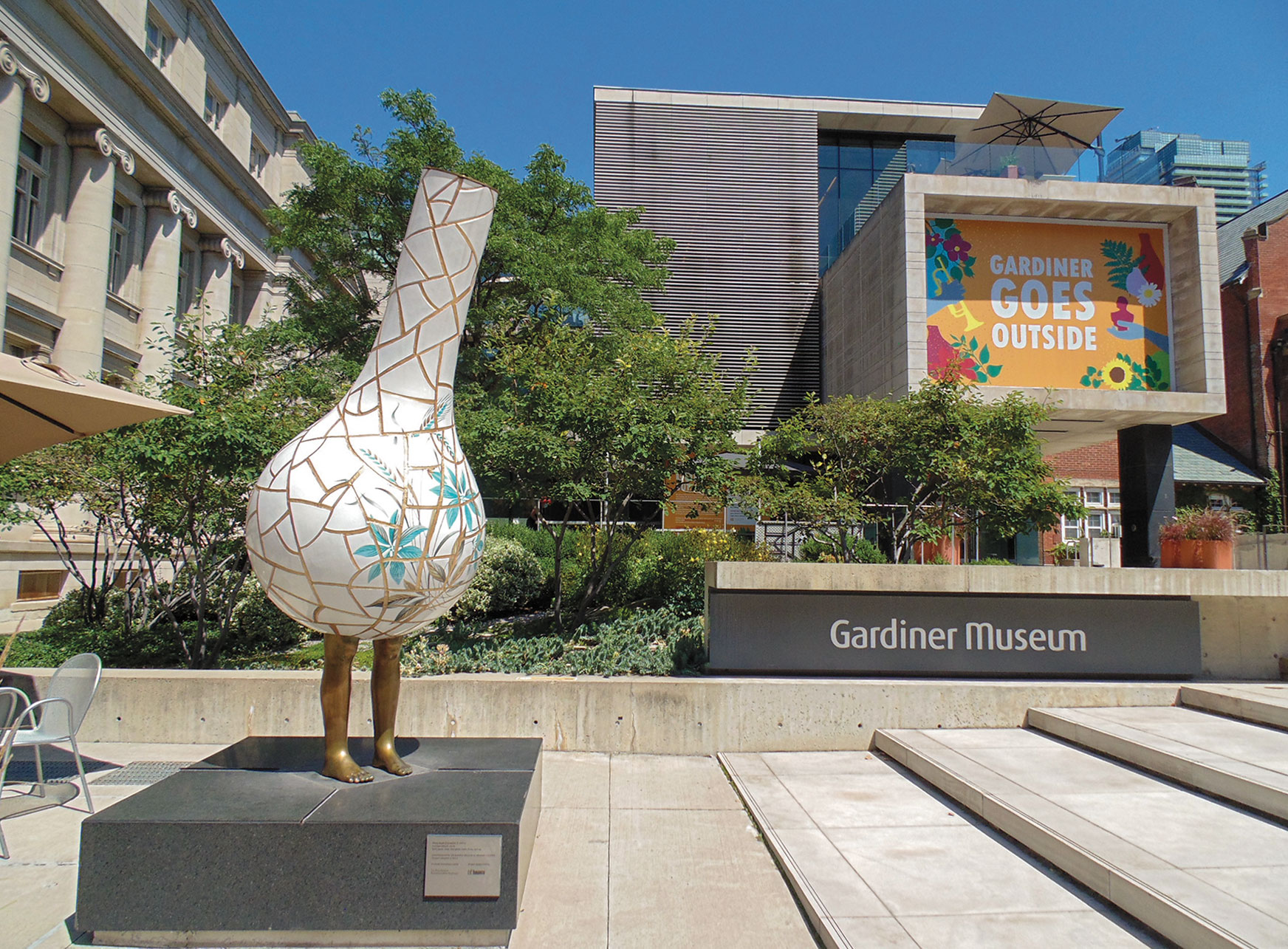
The sculpture, “Cracked Wheat,” by Shary Boyle, is included as part of the Gardiner Museum’s audio walking tour of the Linda Frum & Howard Sokolowski Plaza. BRIAN BURCHELL/GLEANER NEWS
By Meribeth Deen
The Bloor St. Culture Corridor can be found within the bounds of five subway stops. It is a collaboration of arts and culture organizations offering: museum experiences, films, concerts, art exhibitions, theatre performances, family events, classes and culture talks, and opportunities to experience some of Toronto’s cultural diversity, including French, Jewish, Italian, Estonian, Japanese and Aboriginal arts and culture.
The Gardiner Museum is one of those collaborators. It’s long-form name is the Gardiner Museum for Ceramic Art, which offers a pretty solid description of the kind of work they show, but as they say, they see museums as more than buildings, but also as communities, that’s why they’re offering free exhibitions, public art projects, family clay activities, outdoor dining, wellness workshops, performances, and more all summer. Better yet, they’re all outside.
One thing you can enjoy at any time is a free audio walking tour of the Linda Frum and Howard Sokolowski Plaza. Take a little extra time to look at a Shari Boyle’s sculpture, Cracked Wheat, a 7 foot high vase standing on two bronze legs, and consider Canadian identity. Learn about the plaza’s vertical garden, and the giant head you’ve probably wondered about if you’ve ever walked passed.
Get your hands gloriously dirty with drop-in clay making workshops for both children and adults every Wednesday to Friday between 1-3:30pm. Make clay birds and contribute to David Constantino Salazar’s project Forever (Bird-Botanicals). In this exhibit, Salazar uses the symbol of the bird to explore themes of hope, freedom, and growth while reflecting on personal tragedy and collective trauma. Kids can also enjoy colouring activities earlier in the day (Wednesday to Friday) inspired by the Gardiner Museum’s collaboration with No. 9 Contemporary Art + Environment. Sundays are family days for outdoor art making at the plaza.
The Gardiner Museum and others continue to offer great online workshops and exhibitions. Be sure to check out their webpages, follow them on social media or just go straight to the hub of all things arts and culture at www.bloorstculturecorridor.com.
Comments Off on ARTS: Culture and community outdoors and free (July 2021)Tags:Annex · Arts · Life
August 16th, 2021 · Comments Off on LIFE: A baseball ironman of a different sort (July 2021)
Making the rounds with Alan Ross, the Toronto Maple Leafs ticket vendor extraordinaire
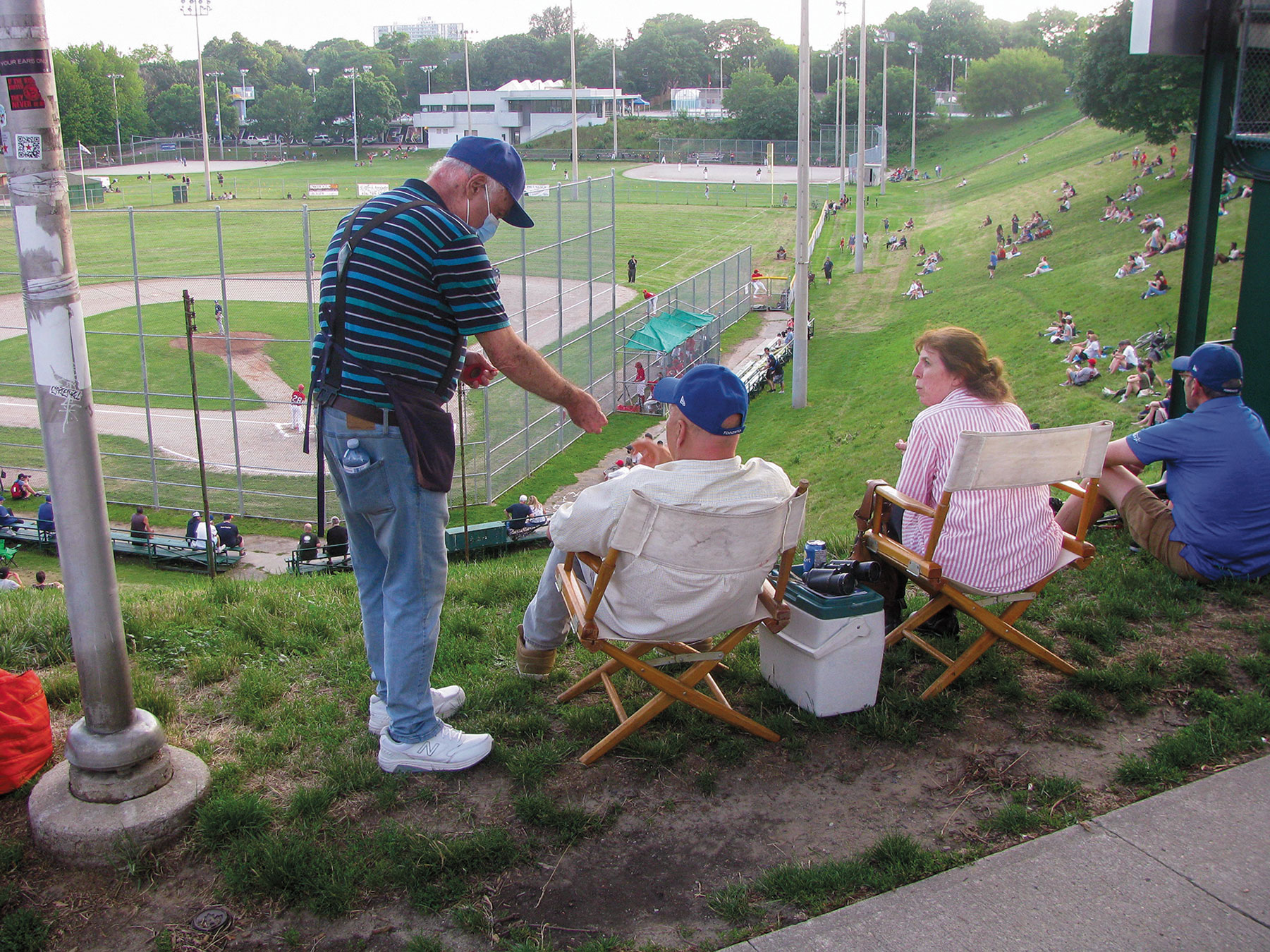
“Al the Ticket Man,” (Alan Ross, left) sells raffle tickets at a Toronto Maple Leafs Intercounty Baseball League game at Christie Pits. The team is the only one in the IBL that doesn’t charge admission. R.S. KONJEK/GLEANER NEWS
By R.S. Konjek
It’s a Sunday afternoon in July at Christie Pits Park. Standing near the baseball diamond, Alan Ross leans back and casts his gaze around the field.
“I want you to make a note that I’m doing this under protest,” he says with tongue in cheek, in response to a request for an interview. “I’m not an interesting person.”
Baseball fans at the Pits would beg to differ. To many, “Al the Ticket Man,” is a living legend.
Ross, 69, can be found at every Toronto Maple Leafs home game selling raffle tickets to fans.
The draw happens midway through the seventh inning and prizes are modest – usually a regular rotation of t-shirts, oil changes and restaurant gift certificates.
The proceeds help keep the club operational, as the Leafs do not charge admission to games.
From pre-game warmups to the top of the seventh inning, Ross walks around the entire ballpark with his roll of raffle tickets.
He moves at a gentle pace, circling the diamond and hiking up and down the hillsides.
Along his meandering path, he exchanges a few ducats for a bit of hope, and stops to chat with familiar faces in the crowd.
You could say he has racked up more walks at Christie Pits than any ballplayer.
He’s a lifelong Torontonian and baseball fan, even though he admits he was never a great player.
“I couldn’t run, couldn’t throw, and couldn’t play the outfield, but other than that I was okay,” says Ross.
One day in the early seventies, he was invited by his friend Sheldon Plener to watch a game at the Pits. Back then, the Leafs were the only baseball team in town.
“I followed him to a game and fell in love with it.”
His enthusiasm for baseball, people and sales made him a perfect fit, and in 1973 Ross became a club employee, selling raffle tickets.
When the Toronto Blue Jays began operations in 1977, Ross moved up to “the big leagues” and got a job in the Jays’ ticket sales department. He spent the next 22 years there, and was with the organization when they won the World Series in 1992 and 1993. As an employee, he received the same elaborate championship rings as players do. He gifted one to a nephew and sold the spare.
When his career with the Blue Jays wrapped up, Ross immediately returned to his ticket selling gig at Christie Pits.
“I came back like Minnie Minoso,” he says, referencing the Cuban ballplayer who, in 1980, made a brief return to major league baseball at age 54.
Ross says he hasn’t missed a game since 2006. The community atmosphere at Leafs games is a strong pull. Most raffle tickets are bought by the same people, week after week.
The allure of Leafs baseball is so strong that Ross makes road trips to follow the team. “I much prefer driving to Kitchener or Guelph than taking the subway to a Jays game,” he says.
Like most fans, Ross was thrilled to hear that his beloved Leafs would return to action this summer and he resumed his duties selling raffle tickets.
However, time and a year-long absence from the park have taken their toll. “This is my final year, the hills are getting too steep,” he says, immediately adding: “I say it every year.”
Ross will celebrate his seventieth birthday later this summer. He knows, like every ballplayer, he will have to hang up his cleats someday, but perhaps not just yet. “I’m like a camel, give me a little water and I’m fine.”
This summer, the Leafs have neither flown nor stumbled out of the gate. At the end of July, they were playing .500 ball. Win or lose, Ross will be there. Buy a ticket and join him for the ride.
The Maple Leafs’ complete 2021 season schedule can be found at www.mapleleafsbaseball.com.
July 15th, 2021 · Comments Off on ON THE COVER: Vaccine Pow Wow at Varsity Stadium (June 2021)
Dancer Miryan Rutledge performs at a Vaccine Pow Wow on Jun. 19 at Varsity Stadium. The event was hosted by Aduzhe Mino Nesewinong, a First Nations COVID-19 response program. “We’ve been experiencing a little hesitancy among our community members,” said Steve Teekens, Executive Director of Na-Me-Res. “In February, all our clinics were full, but in June we had a dip, so we’re raising awareness.” Indigenous peoples can contact appointments@healthybreathing.com or call 416-654-4184 to book a vaccine. Walk-ins are welcome. NICOLE STOFFMAN/GLEANER NEWS
Comments Off on ON THE COVER: Vaccine Pow Wow at Varsity Stadium (June 2021)Tags:Annex · News
July 15th, 2021 · Comments Off on NEWS: High times on Bloor Street West (June 2021)
Five pot shops operating or set to open on Bloor within 450 metres
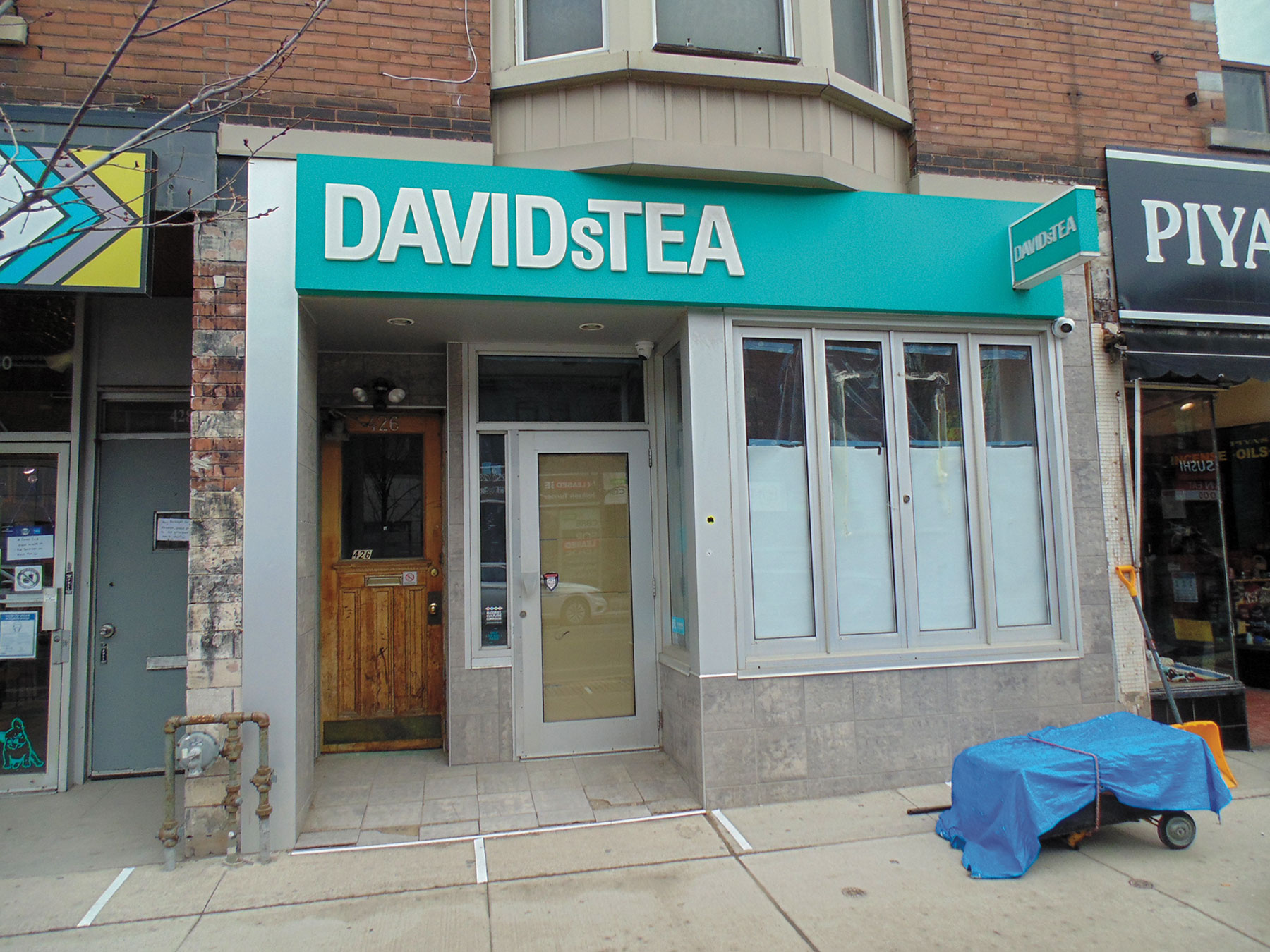
424 Bloor St. W. opening soon.
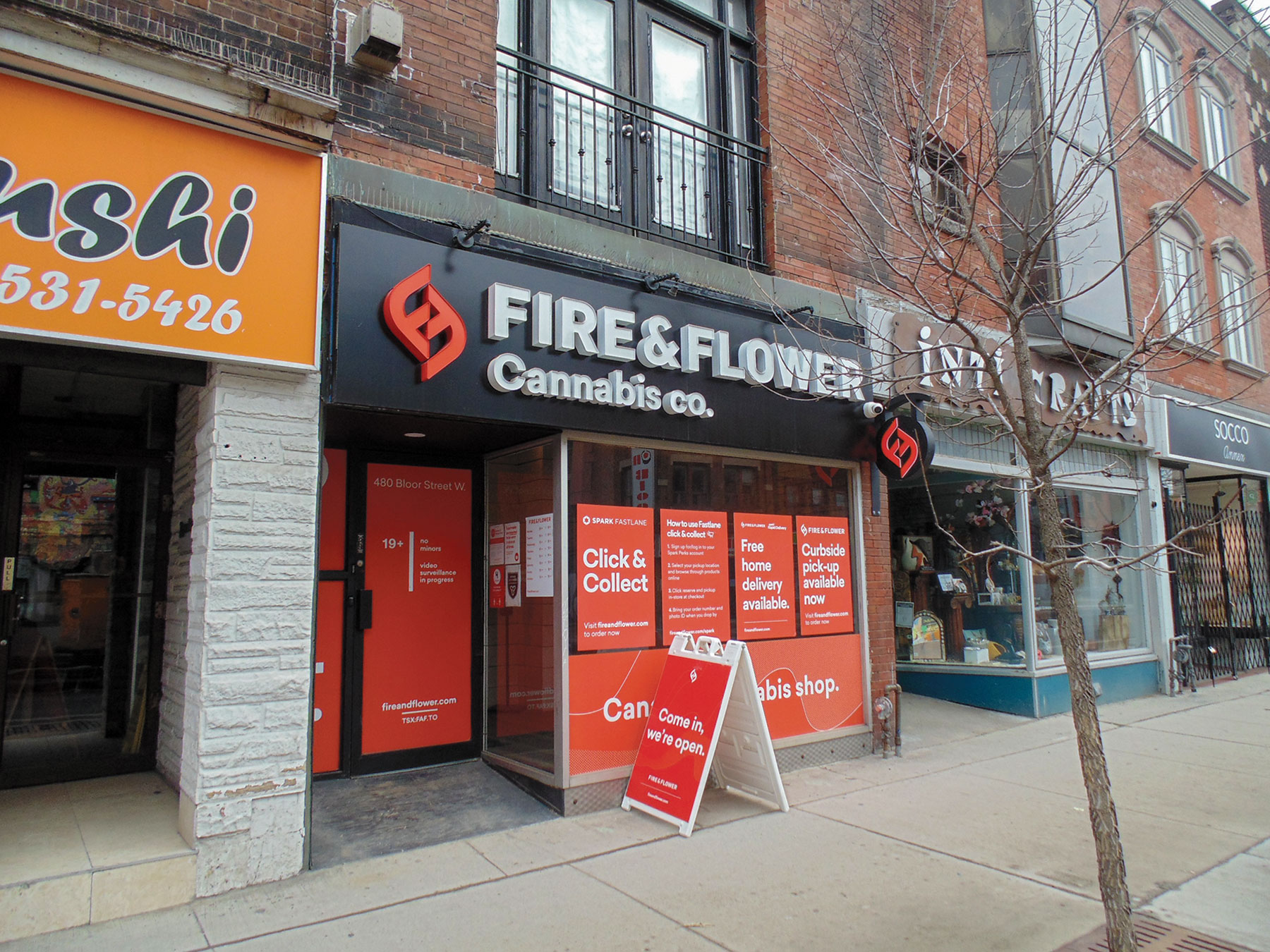
Fire & Flower at 480 Bloor St. W.
461 Bloor St. W. also coming soon.
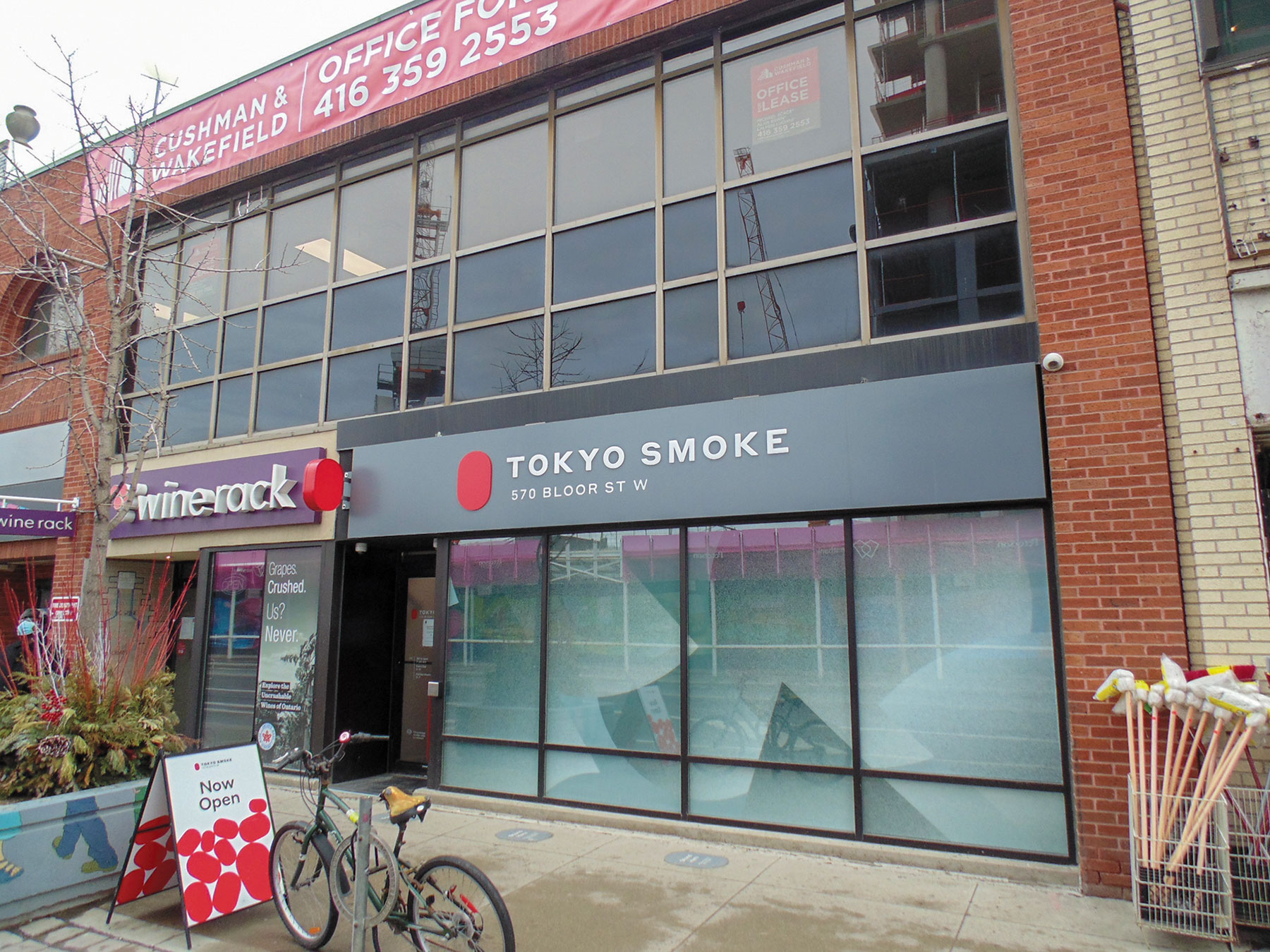
Tokyo Smoke at 570 Bloor St. W.
496 Bloor St. W. under renovation.
By Joshua Chong
The Annex is seeing a rapid increase in the number of legal marijuana dispensaries. There are five stores either operating or set to open on a stretch of Bloor Street West between Markham and Major streets. All are within 450 metres of each other.
Tokyo Smokes and Fire & Flower are already open, while Value Buds, Cannaverse, and Green Merchant are awaiting authorization from the Alcohol and Gaming Commission of Ontario (AGCO).
This surge in cannabis stores across the city in recent months is due in part to the acceleration of the processing of applications by the AGCO. In February, the commission increased the number of authorizations each week from 20 to 30.
“Increasing the number of Retail Store Authorizations (RSA) is part of that strategy to ensure that stores across Ontario can open and operate with honesty, integrity and in the public interest,” wrote an AGCO spokesperson in a statement to the Gleaner.
They also noted that this expedition in approvals is in line with the Government of Ontario’s approach of creating an “open market” for cannabis retail, and is meant to combat the illegal market.
This increase in pot shop authorizations, paired with regulations on where these businesses can open, has led to dense clusters of dispensaries across the city—like what residents are seeing in the Annex.
Under the Education Act, cannabis retail stores are prohibited from opening within 150 metres of a school. Many pot shops are clustered in the downtown core, along busy throughways such as Bloor, Queen, and Yonge streets.
In Kensington Market, there will soon be eight dispensaries within 350 metres of each other. Last November, the local BIA, along with Councillor Mike Layton (Ward 11, University-Rosedale) and MPP Jessica Bell (University-Rosedale), sent a letter to the AGCO asking for local residents and businesses to have more say in the licensing process.
They also requested that the public consultation process be extended to 30 days. Currently, community members have 15 days to submit comments or complaints on a proposed location. According to a spokesperson, the AGCO receives approximately 12 public submissions per store application. Most express concern about the dispensary’s proximity to a residential area, park, or community centre.
In June 2020, city council adopted a motion tabled by Councillor Paula Fletcher (Ward 14, Toronto-Danforth) requesting that the AGCO enact additional regulations surrounding cannabis store locations, including rules that prevent the clustering of pot shops.
Layton, who voted in favour of the motion, wrote in a January 2021 Twitter thread that he supports local cannabis stores, but that there needs to be tighter regulations in place to ensure that pot dispensaries do not push out other local businesses.
“Make no mistake, cannabis is big business and investors can afford rents that are higher than bakeries and coffee shops can afford,” he wrote. “Ford’s complete deregulation has resulted in landlord speculation which hurts the sustainability of our mainstreets.”
“That isn’t to say we shouldn’t have local cannabis shops. But their [sic] is a saturation point when a diverse offering of businesses would be more sustainable and desirable.”
The Gleaner has contacted Layton and the Mirvish Village BIA for additional comment. They did not respond by press time.
Jeff Pang, CEO of Green Merchant, wrote in an email to the Gleaner that the number of pot shops in the Annex is alarming. “We would be lying if we said we weren’t worried about the intense competition,” he wrote. “For us, we’re betting that providing value through our exceptional service and unique offerings that no other dispensary is offering will allow us to remain successful even in a crowded market.”
Green Merchant is one of several dispensaries awaiting approval to open a store in the neighbourhood. The shop will be located at 461 Bloor St. W., the former home of Frames N’ Graphics Inc.
“Each of our stores is uniquely built for the community,” he wrote. “We are the friendly neighbourhood dispensary that welcomes you to hang out and treats you with new experiences you can’t get anywhere else. We believe the Annex will appreciate our effort to create something special.”
When Green Merchant opened their first store, they were met with some resistance from local residents. But Pang noted that they have worked hard to become contributing members of the communities they are in by supporting other small businesses.
“Those that don’t know us yet have been a bit resistant to what they see as yet another dispensary in town,” he wrote. “We hope for the opportunities to have open conversation with those that are worried.”
July 15th, 2021 · Comments Off on NEWS: Mural reveals eco-anxiety (June 2021)
Musician Scott Helman’s song Evergreen is basis for images
The Scott Helman Mural by Kaya Buium explores climate anxiety from a youthful, Gen Z perspective. NICOLE STOFFMAN/GLEANER NEWS
By Nicole Stoffman
At first glance, the brightly coloured mural in Karma Lane behind Palmerston Avenue appears to be a children’s project. But a closer look reveals it to be a Gen Z manifesto to eco-anxiety: a skull’s empty eyes gaze in terror as the earth is engulfed in flames, a larger-than-life thermometer glows red, and a plastic cup bobs in the ocean waves. “I’m so scared,” are the only words.
Yet this new addition to Annex laneway art is not all doom and gloom, as a happy flower springs forth from inside a trendy, lug-soled work boot. The colour palette evokes orange and pistachio sherbet on a summer day.
“It still offers a message that through change, there’s hope,” said Karma Manager, Talia McGuire. “I really see this as giving young people a platform to be able to voice those concerns and fears.”
The Scott Helman Evergreen mural was created by artist Kayla Buium over five chilly hours in November, 2019. The occasion was the release of Helman’s single “Evergreen,” about climate change. The song expresses the singer’s anxiety about “rising seas and a world on fire,” but concludes with the hopeful thought, “maybe I can make it if we plant seeds in dirt.”
Helman is a Toronto-born singer-songwriter who grew up in North York and attended Earl Haig. He is represented by Warner Music Canada, and his albums have earned three platinum and two gold certifications. He has been nominated for seven Juno awards.
The 25-year-old had invited fans to share their feelings about the climate crisis to use in the “Evergreen” video and was astonished when he received hundreds of responses.
He decided to use his celebrity to amplify these voices with a mural, and has published their testimonials as “The Evergreen Manuscript,” which he is sharing with elected leaders across the globe. He invited fans to attend the live-streamed mural painting, and to sign their names on it.
Is the Evergreen mural effective activism, experiential marketing, or a bit of both?
“It was a genuine, heartfelt action on his part,” said McGuire. “We had lots of conversations inside the store about certain things you can do to help reduce waste.” Helman was impressed by Karma Co-op, which is owned by its 600 members. He has called the only food co-op in Toronto a, “dope, anarchist grocery.”
First identified in 2017, eco-anxiety is defined by the Canadian Mental Health Association as “a deep fear of environmental doom and human catastrophe,” for which doom-scrolling youth are the most at risk. The kinds of actions offered on that day by the Evergreen mural project are recommended by the CMHA as a healthy response: joining others in hopeful activism, and sharing your feelings. Other CMHA recommendations include learning social media literacy and striving for a small environmental footprint, something Helman encourages his fans to do.
The mural painting was supported by the Sierra Club Foundation, Greenpeace Canada, Environmental Defense, We Movement, and The Laneway Project. The Laneway Project is a non-profit social enterprise on a mission to bring Toronto’s 2,400 laneways to life. They connected Helman’s production company with Karma Co-op, whose laneway the Project had helped animate in celebration of Karma’s 45th anniversary in 2017. The Evergreen Mural is the Laneway Project’s third laneway improvement in the Annex, the other’s being Croft Street and Willowvale Lane.
As the Annex becomes more densely populated, its laneways could offer a network of walkable streets. The Laneway Project has installed road murals, street art, and improved lighting, greening, and traffic calming to turn laneways across the city into high quality mixed-use space.
“Laneways are officially mixed-mode spaces,” explained Laneway Project Executive Director Michelle Senayah. “Everyone assumes they are car-only spaces but they’re actually not.” When a laneway hosts block parties or pop-up festivals, it is closed to traffic, but a drive-aisle is always kept free for emergency access.
“Especially in the Annex where there are so many different family structures, living in many different sizes of units, I think there is real potential to add depth to the local public realm by activating this other layer to provide human-scaled outdoor space,” said Senayah.
She adds that laneway housing, especially as it becomes more standardized and therefore affordable, will go a long way to making Annex laneways feel more welcoming.
The Gleaner was shocked and saddened to hear of Michelle Senayah’s sudden passing from a pre-existing health condition on June 29th. Our condolences to her family and colleagues at The Laneway Project.
July 15th, 2021 · Comments Off on NEWS: PARA AGM talks revitalization (June 2021)
Sustainable and green neighbourhood also on the agenda
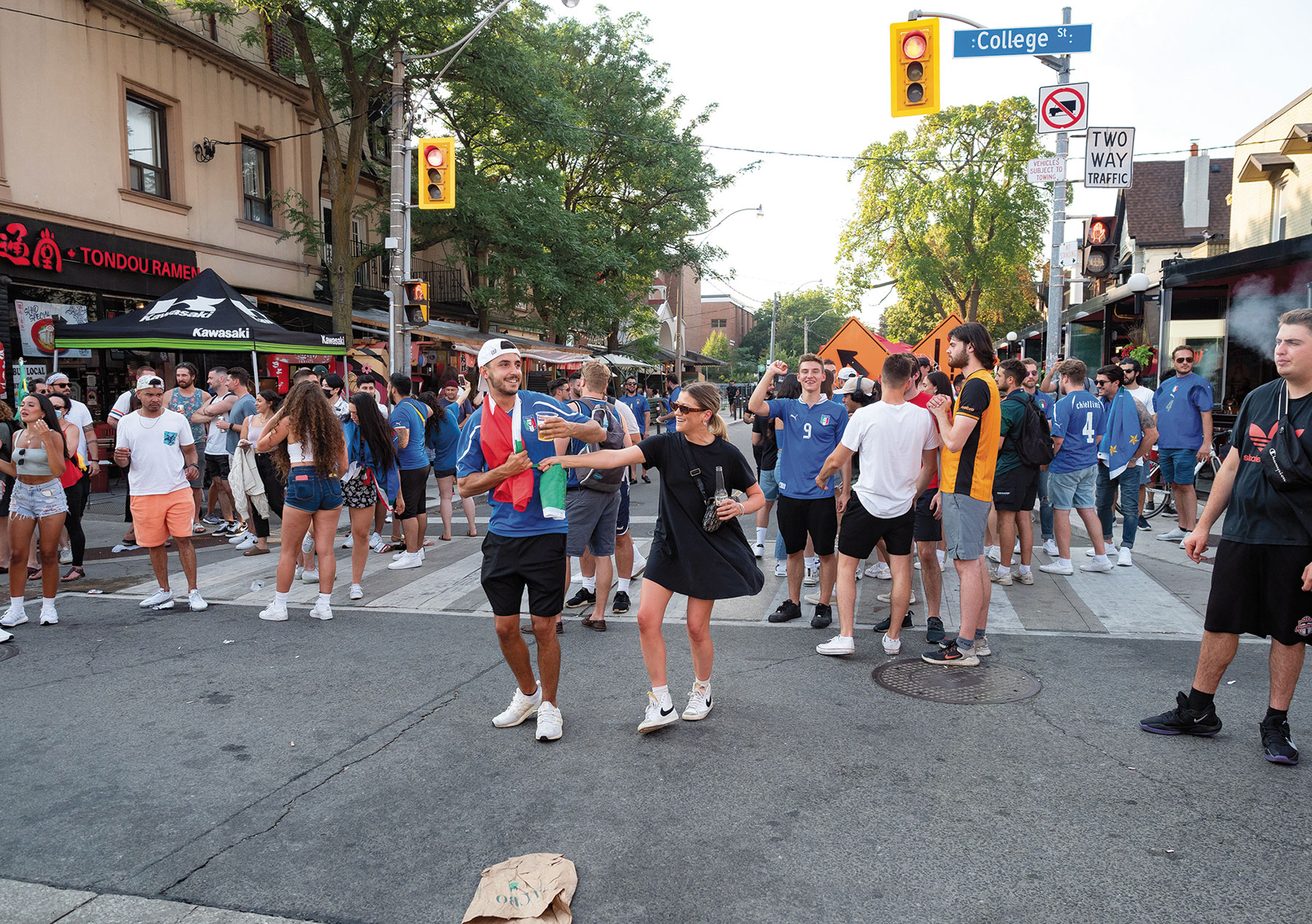
Football fans brought College and Clinton streets to life following Team Italia’s victory over Spain. ARLYN MCADOREY/GLEANER NEWS
By Madeline Smart
After months of lockdowns, revitalization was at the top of the agenda for the Palmerston Area Residents Association’s (PARA) annual general meeting on June 2.
A sustainable and green neighbourhood was second on the agenda for the Association whose boundaries are Bloor, Bathurst, College and Grace.
At the well-attended virtual meeting, attendees heard presentations from Gord Pridham of the Little Italy Business Improvement Area (BIA) and Jimmy Lu of PARA’s Green Committee. Both spoke of their plans to breathe life back in the neighbourhood.
“We want College to be as vibrant as it once was but we need the community’s help,” explained Pridham to the meeting attendees, highlighting the lack of foot traffic in the area especially around College and Clinton streets since the pandemic.
Pridham explained how many small businesses in the area were pushed out during the COVID-19 pandemic due to the real estate market and the raising of rental prices, while others were left struggling financially due to extended lockdowns.
As a result, the main focus of the Little Italy BIA became supporting the small businesses that remained and working on reinvigorating the neighbourhood.
Some of these initiatives took shape as commissioned murals by local artists, others involved re-allocating money usually spent on outdoor food festivals towards helping restaurants be a part of CaféTO.
Pridham says they have more things planned for this summer, pop-up shops from local retailers, for example, to make the area a popular destination again. Now with restrictions being lifted Pridham says he is confident that it will have a successful rebound.
The pandemic did not get in the way of green initiatives.
“It kind of amazed me that so many great programs already existed, and the fact that tons of stuff started during COVID,” said Lu about the sustainability programs that have been cropping up all over the city over the course of the pandemic.
PARA launched their Green Committee and Green Plan in February 2020, which has since been approved by the Toronto and East York Community Council as an official planning document. Some of the goals they hope to achieve are working with the city to improve the tree canopy, maintaining the gardens at Healey Willan Park and restarting the PollinatorTO project with Harbord Collegiate.
Lu, who works on climate change policy and sustainability is on the Green Committee and has also been named Ward 11’s Climate Action Champion. As part of the city’s TransformTO climate action strategy, a leader from each ward was selected to lead their area in community-focused climate action.
Lu presented his initiative, Ecobuds, at the AGM. The goal of Ecobuds will be to work to connect residents that are already knowledgeable about sustainability with those who wish to learn more in a mentorship type program matching people based on shared interests.
Ecobuds will hopefully be up and running later this summer and Lu hopes to partner with local sustainable businesses to provide incentives for participants.
In the meantime, Lu encourages anyone who is interested in sustainability to just simply start getting involved.
“So much stuff has happened and come to fruition in recent times and I think it’s a great time for people to take advantage of all these new and the expanded initiatives,” he says.
July 15th, 2021 · Comments Off on CHATTER: Annex Residents’ Association holds virtual AGM (June 2021)
Over 40 people were in virtual attendance at the Annex Residents’ Association’s (ARA) Annual General Meeting on April 22. Because of the pandemic, it was the first AGM in two years, but participation was up thanks to Zoom.
Chair Rita Bilerman recapped the ARA’s proudest moments of the year, including defeating the development at 64 Prince Arthur, fighting for a safer Avenue Road, and advocating for more and better bike lanes.
Guest speaker Tamara Anson-Cartwright from the city planning department announced the launch of the West Annex Heritage Project, part of a city-wide heritage survey. If your property becomes listed on the heritage register, you cannot demolish it without a heritage impact assessment (HIA). Professional heritage consultants will be hired to help the ARA gather material to determine which parts of the Annex could become heritage districts. The ARA will also be holding a public consultation about the study in September. Look for details in the next issue of the Gleaner.
The planning and development committee is monitoring 25 projects at various stages of development, according to co-chair Edward Leman. These projects will result in an increase of 2,225 dwellings and 3,300 residents to the Annex. Leman announced the launch of quarterly town halls on development issues. (For more information, contact planninganddevelopment@thearea.org).
Gardener Paul Richard announced that the aboriginal eco-restoration team has secured funding for work on the Paul Martel Park. This will allow them to do spring and fall plantings with native plants they’ve been growing at The Stop Green Barn. The Bloor BIA has applied for a mural for the park, and Richard remains hopeful this will also be approved. He found a clean copy of the original Ecology Park map in the toolshed which will replace the old one.
Designer Johan Harteveld unveiled a new and improved ARA logo and website, to be implemented this summer.
Terri Chu, Chair of the Parks, Trees and Environment Committee announced a plan to hire forestry students to update the ARA’s tree database, completed in 2014. Learn about the 10,000 Annex trees in the inventory at theara.org.
Councillor Mike Layton topped off the evening, urging Annexonians to make more deputations to city council.
“People have to start holding us to account. Ask your representatives what their strategies are to reach the goals they set, and stay plugged-in with what’s going on in the city,” he said. “The ARA will show you the avenues. I’m on the budget committee. We don’t hear enough from people. It takes sustained efforts from community to make politicians actually invest more. I’m here for you, if you need advice about how to speak to the rest of council, or you can just say it to me, and it will give me a little more spirit.”
July 15th, 2021 · Comments Off on EDITORIAL: Doug Ford plays the joker card (June 2021)
Doug Ford has become the first Ontario premier to invoke Section 33 of the Constitution, the so-called notwithstanding clause. This allows him to ignore an Ontario court ruling that quashed Ontario’s new law limiting third-party advertising ahead of the provincial election. It is a tantrum by a premier who will do anything to silence his critics including violating the Charter of Rights and Freedoms.
In the interest of fairness, limits on election spending are something all parties can agree is necessary in a free and democratic society. According to Elections Ontario third-party advertising made up 14 per cent of all political advertising in 2007. By 2014, it was up to 41 per cent. In 2017, Premier Kathleen Wynne introduced a cap that passed constitutional muster.
Until recently the law on the books limited third-party advertising to $600,000 in the six the months before election day. Left-leaning, union-sponsored third-party advertiser Working Families is a foe to Conservatives and has targeted ads against them in previous elections. Working Families initiated a court action to reduce the six-month limit. Lawyers for the province defended the six month limit describing it as “reasonable.” Those were this government’s own lawyers. Whilst they were in court, the province was crafting amendments to the law further restricting the spending time period cap to twelve months. The election is next June. The net effect is to cut off their critics at the knees.
The Ford government’s hasty disingenuous move undermined its own case defending the existing legislation. Justice Morgan responded by overturning the new law writing “skepticism of [the] government is not misplaced where new election procedures are concerned.” The new 12-month limit is much longer than in other provinces or at the federal level, it is tailored specifically as part of Doug Ford’s re-election plan.
This was a lower court decision. The province could have appealed it to the Ontario Court of Appeal, sought a stay to the initial ruling, and asked for expeditious consideration. Or, they could have reverted to the six month limit by recalling the legislature. But why do that when you are holding a joker card that trumps the whole game and exempts you from due process? The notwithstanding clause gives Ford a get out of jail free card that he has threatened to use before. In 2018 he slashed the size of Toronto’s city council in the middle of their election. He then threatened to use that card if the courts chose to disagree with him.
“Political speech is fundamental to an informed political discourse during an election,” said Paul Cavalluzzo, the lawyer for Working Families. “This government is acting like the Republicans in the U.S. by trying to muzzle and suppress the speech of persons they view to be their political enemies.”
Every time a province uses the notwithstanding clause it tramples rights of Canadians afforded by the Charter. It diminishes us as a country and waters down what defines us as a people. In Quebec, it is often used to try and defend a fragile French culture. Doug Ford’s use of it is simply to try and stay in power. Ford’s play is egregious.
July 15th, 2021 · Comments Off on FORUM: It’s time to walk the walk (June 2021)
Action not just “reflection” is needed as more burial sites are found
By Mike Layton
The discovery of several burial sites of Indigenous children killed in residential schools across Canada must move our country and our governments beyond words of condolences and toward actions that advance truth, reconciliation, and justice. As flags are lowered across the country, and vigils and moments of silence are observed, we need to recognize that these symbolic measures are important, but not nearly enough.
Residential schools operating in Canada for more than 160 years, up until the late 1990s, were federally funded and church-run. The last school closed in 1996.
Children stolen. Families are broken. Communities, robbed. This discovery has retraumatized many First Nations, Métis and Inuit across Turtle Island, who have long been dealing with the intergenerational trauma and lasting impacts of being forcibly removed from their families and communities, put into residential and day schools, and forced to abandon their traditions, cultural practices and languages in order to assimilate them.
The discoveries are shocking and disturbing, but all was predicted by the Truth and Reconciliation Commission of Canada (TSC) and the Calls for Justice from the MMIWG2S Final Report – Reclaiming Power and Place: The Final Report of the National Inquiry into Missing and Murdered Indigenous Women and Girls. Not enough resources have been committed to continuing their work and taking necessary steps towards reconciliation
We must recommit to advancing these Calls for Action. These actions must be far-reaching and must work to advance access to housing, clean water, prosperity and justice for all Indigenous people, in partnership with Indigenous communities. The dedication to reaching these goals must last longer than a news cycle.
The TRC made recommendations on efforts governments, justice systems, and church officials should take to try to locate, name, and commemorate the children who died. Six of these recommendations specifically list the actions the commission determined should be done to address missing children and burial information, including funding and coordination support to locate and protect school burial sites, both known and unknown.
In council I worked with the mayor to pass the following recommendations to move us toward truth, reconciliation and justice:
First we requested the federal and provincial governments to support Call to Action 82 of the Truth and Reconciliation Commission of Canada. More specifically, we asked for capital funding to the construction of Indian Residential School Survivors (IRSS) Restoration of Identity Project on Nathan Phillips Square – this is a publicly accessible, highly visible, residential schools monument to honour survivors and families. It could be replicated in every provincial capital. It is being completed in partnership with Toronto Council Fire Native Cultural Centre.
In addition, earlier this year, city council allocated $13 million towards the construction of the Spirit Garden to honour residential and day school survivors and all the children who were lost to their families and communities, and those that are living with the trauma. The Spirit Garden will be a peaceful, contemplative space to help advance truth and reconciliation between Indigenous and non-Indigenous peoples in Toronto.
We also requested the federal and provincial governments to take action now on Calls 71 to 76 of the TRC to address missing children and burial information, including funding and coordinating support to locate and protect school burial sites, both known and unknown.
Finally, we joined the House of Commons in calling on the federal government to drop the Federal Court appeals related to compensation for First Nations children separated from their families.
On a local level, city council requested the Director, Indigenous Affairs office, in consultation with relevant staff, to report to the Aboriginal Affairs advisory committee and executive committee on what further actions are needed to advance truth, reconciliation and justice, how the city will hold itself accountable to community in advancing these actions, and whether additional resources and funding are required to further the City of Toronto’s work on reconciliation.
I will work to update you on advances to these actions as things progress.
As always, please don’t hesitate to get in touch with my office with your questions or concerns at Councillor_Layton@toronto.ca.
Mike Layton is the city councillor for Ward 11, University—Rosedale.
July 15th, 2021 · Comments Off on FORUM: Ford is no friend of affordable housing (June 2021)
Bill 108 cements opposition to inclusionary zoning
By Jessica Bell
Housing affordability crisis requires action
Housing prices are now so high that the National Bank of Canada calculates that only the top five percent of income earning households can afford to buy an average Canadian home. Housing affordability is one of the defining issues of our era, and it threatens the very soul of Toronto.
To build a thriving, green, livable and truly affordable city, we must pass laws to make housing more affordable for all. Here are some measures the city and province can take to make that a reality.
Build affordable housing
Directing police and security to forcibly move desperate people into temporary shelters and hotels is no solution.
Governments need to invest, build and buy more community housing, modular housing, and permanently affordable housing, including publicly-owned housing on provincial public land.
Ontario has ample suitable land, and the programs already exist – they just need funding.
Clamp down on speculation
There was a justifiable outcry when the Globe & Mail reported on developer Core Development Group’s intention to buy $1B of single family homes to rent.
Core Development is part of a wave of investors, from REITs to Wall Street firms to pension funds, who are investing in the housing sector, driving up prices and forcing first time home buyers to rent the very homes they want to buy.
Homes must be for people first, investors second.
That’s why I introduced a motion calling for Ontario to bring in a two percent annual speculation tax on homes owned by people who don’t pay the majority of their taxes in Ontario, as well as a GTHA wide two percent annual vacant homes tax to motivate investors to sell or rent empty homes.
Toronto is also developing its own vacant home tax (the proposed rate is one percent), and the public is able to provide input now.
Better protection for renters
While the pandemic has softened rents, they still remain high.
Our office regularly hears from renters who are being evicted, facing unfair above-guideline rent increases for superficial renovations, and being subjected to noisy and dirty renovations – 666 Spadina Ave is the notorious example – that is driving them to give up and move out.
Being a renter is precarious and expensive. It should be safe and affordable.
That’s why I am calling for better government enforcement of illegal evictions, as today there is next to none.
I am calling for real rent control, including a cap on the amount a landlord can raise the rent if a former tenant leaves.
Toronto has begun assessing whether an effective renoviction law from New Westminster, B.C. can be applied here.
The bylaw requires landlords to get a business license, prove proposed renovations require the tenant to leave, and pay the tenant for alternative accommodation until they can return.
Build new housing
The Greater Toronto Housing Authority needs new housing supply.
The real question is what do we build, and where?
Developers make the most profit by building high rise condos of bachelor and one bedroom units, and single family homes on greenspace – so that’s what they build.
The Ford government is encouraging urban sprawl by forcing municipalities to expand their boundaries to permit new development on nearby farmland.
Increasing urban sprawl will destroy our ability to meet current climate goals, as this kind of low-density development locks families into car dependency.
It should be easier to construct missing middle housing, like garden suites (the city is developing guidelines for garden suites right now), and more affordable duplexes, triplexes and townhomes within existing neighbourhoods.
It is incumbent on governments to expand and improve services to meet any increase in population. Funding for parks, community centres, a healthy tree canopy, transit, and schools ensure liveability needs are met for all.
Allow inclusionary zoning
Toronto is developing an inclusionary zoning policy that would require new residential developments near transit zones to include affordable housing units.
But will the units be affordable for a few decades or permanently? What percentage of units in a new building will be classified as affordable? And what definition of affordable will the city use?
Toronto is seeking feedback from you to answer these questions now. Premier Ford put hard limits on inclusionary zoning through Bill 108, which limits inclusionary zoning rules to transit stations.
Inclusionary zoning should be allowed beyond these transit stations.
Housing can be affordable, and it’s upon us to change the laws to make it so.
The perfect medicine to de-stress from the pandemic
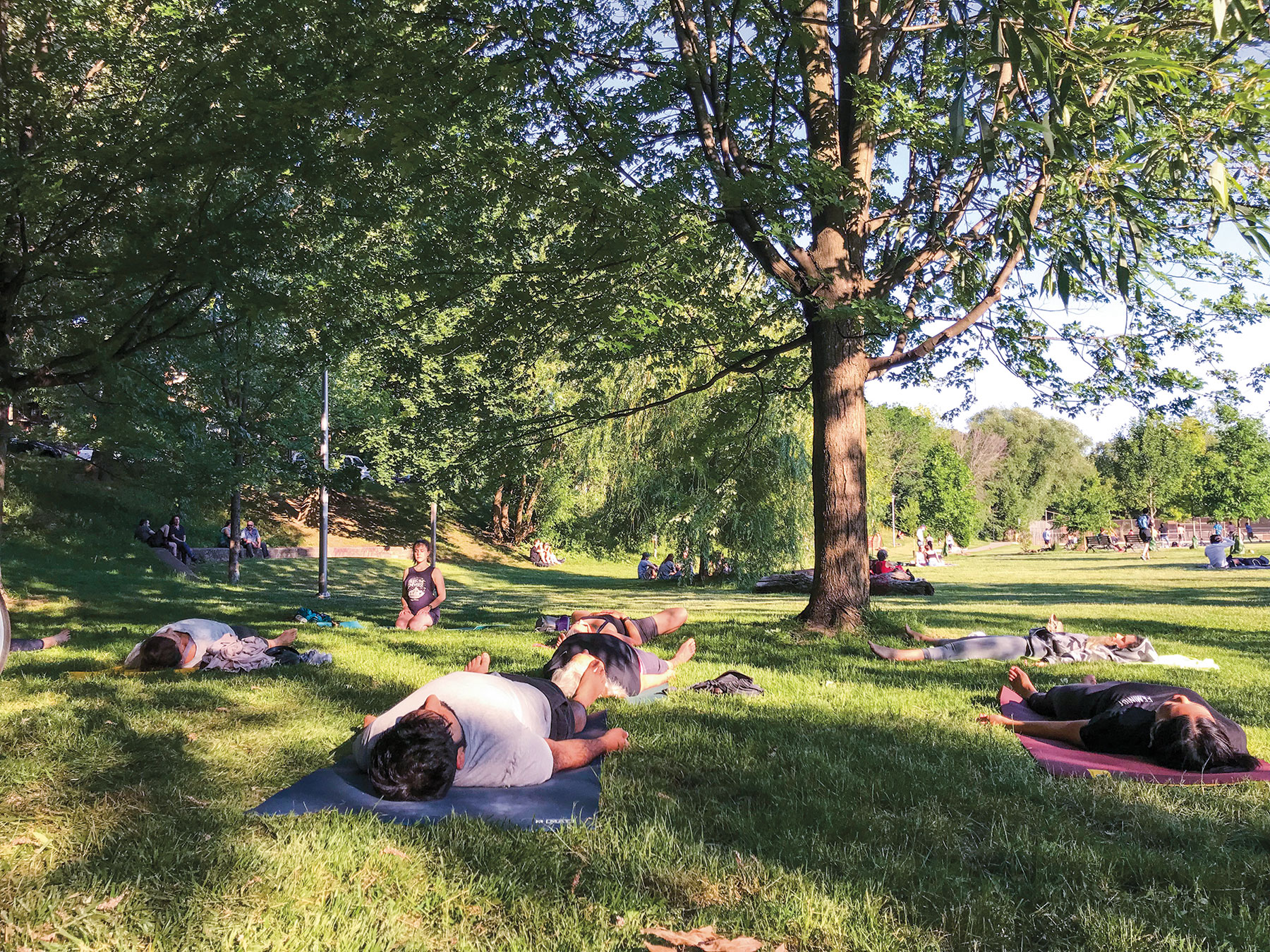
Instructor Montana Skurka (left centre) leads yoga participants through a few last deep breaths before completing their practice for the day at Bickford Park. NABAHAT HUSSAIN/GLEANER NEWS
By Nabahat Hussain
Yoga in the park was put on hold in April due to a province-wide lockdown, but as of June, it’s in its third summer.
Teachers Montana Skurka and Michelle Karunaratne have seen their small group classes grow exponentially since leading their first park yoga sessions in 2019.
Karunaratne says that last summer, classes had to be broken up in accordance with city guidelines, as the amount of people wanting to attend exceeded the number of people allowed in a single outdoor gathering.
Another issue posed by the pandemic was being unable to practice for two months, however online yoga sessions were available and many attended.
Keeping classes small and keeping distance between yoga mats are some precautions being taken during this time.
Roxanne, an attendee since 2020 says, “If I put on a YouTube video, I’m still having to do more work myself,” says Roxanne, a Yoga in the Park attendee. “With a teacher, I get the chance to let go, and have someone else take care of me for an hour.” Karunaratne sees a whole other appeal to the sessions. “People were missing that communal experience,” she says.Community is something that both instructors stress as a part of their mission.
“Everyone is included and welcome,” says Skurka, who has a background in education and mental health.
Both instructors aim to infuse their classes with different benefits. Skurka hopes to “empower people to feel agency over their own bodies and mental health,” while Karunaratne’s practice centres around challenging the body.
Being in the park is also decidedly more enjoyable after a stay-at-home order, as being in a space with several activities going on the background helped people reconnect with one another.
On one occasion, says Skurka, the group turned around for a certain pose and came upon a double rainbow.
Sometimes there’s music in the background, and people playing sports, all keeping the environment lively in accordance with the Annex’s character.
Skurka says mindfulness is integral to eradicating any stress and anxiety brought about during the pandemic.
In simple terms, it’s about grounding yourself in the present moment, in the same vein as a “taking it one day at a time” view on life. With deep breathing techniques, movement, interactions with others, and a connection to nature, Skurka says doing yoga outdoors works in several ways to make people feel better.
As intimidating as starting a new sport or hobby may seem, the instructors reassure that yoga is not complex at all — all you need is a mat, and even without one, deep breathing is enough to develop that “mindfulness muscle” as Skurka calls it.
Currently classes are being held three times a week – Tuesdays at 6pm, Thursdays at 6pm and Sunday at 11am, all at Bickford Park.