November 11th, 2021 · Comments Off on FOCUS: Gleaner sits down with Jessica Bell (Fall 2021)
With less than a year before the provincial election our MPP reflects
MPP Jessica Bell has had an eventful first term serving her riding of University-Rosedale with the pandemic likely affecting at least half of her four years. Over a year into COVID-19 and less than one year left before the next election, Bell reflects on her term thus far and what’s to come. MADELINE SMART/GLEANER NEWS
By Madeline Smart
MPP Jessica Bell has spent her first term representing University-Rosedale mostly serving throughout the unprecedented times of the COVID-19 pandemic but she hasn’t let that dampen her experience.
Elected in 2018, Bell is also the NDP critic for urban planning and transit.
In an interview with the Gleaner, Bell said the pandemic has been challenging especially when the community engagement work that a politician would typically do like in-person events, door-to-door canvassing, and having people to testify at Queen’s Park, has been banned for a year-and-a-half.
“It’s been such an honour [to serve University-Rosedale],” says Bell. “I’m lucky because Queen’s Park is in the University-Rosedale area so I get to live and breathe legislative work and the community work at the same time every single day.”
With regular heat advisories happening in the city, MPP Jessica Bell (University-Rosedale) and MPP Suze Morrison (Toronto Centre) co-mediated a virtual tenant town hall to help renters know their rights when it comes to keeping cool during the summer.
The meeting was a forum for renters struggling to have an air conditioning (AC) unit in their apartment. Helle Hulgaard, a paralegal at West Toronto Legal Services, attended to debunk some of the legal misconceptions on installing an AC unit in your apartment. Prophetess Reid, a tenant organizer, spoke about the process of starting the tenant organization in her own building, the benefits of having one in these situations.
“Toronto city bylaws are very clear that tenants are allowed to have a window [AC] unit,” said Hulgaard.
The consensus of the meeting was that there are no bylaws against having AC in apartments and everyone is able to exercise that, despite what a landlord might say.
Being a long-term community advocate and the NDP critic for housing and tenant rights, this kind of tenant town hall fits perfectly into Bell’s wheelhouse.
The pandemic also created problems for her constituents and the riding’s economy that she could have never predicted when she was elected. Still, Bell says she’s grateful the pandemic made existing problems impossible to ignore so that resolutions could be made, like the situations in long-term care homes.
“The public’s awareness of the failings of our long-term care system has risen, people understand that we need to do a whole lot better,” said Bell.
One of her most memorable moments of serving during the pandemic was hearing first-hand about how dire the situation was in long-term care homes, not just for the residents but also for the people working in them. She adds that successfully petitioning the government into increasing the number of direct care hours residents of those facilities receive to four a day was a highlight.
Now with just under a year left of her first term, Bell’s main goal going forward is to push the NDP’s Green New Deal and get re-elected in order to “rapidly implement it.”
Her second goal is to address the city’s affordable housing crisis.
“There are whole generations of people, young people, newcomers, middle-income people. Even upper middle-income people who can no longer afford to rent or buy a home in our city,” Bell said. “The provincial government has the jurisdictional authority to take groundbreaking steps to make housing more affordable and we need to do it.”
Current polls are showing Liberals leading in popularity with 35.2 per cent, Conservatives have dropped down to 29.8 per cent and the NDP are sitting at 17.9 per cent despite being the official minority. Bell says she stands by her party and is confident that they will succeed in raising those numbers by the next election.
Bell also highlighted the drop in popularity for the Conservatives and Premier Doug Ford due to their handling of COVID-19.
“People no longer trust Doug Ford to do the right thing, he’s shown that he’s incapable of listening to public health, putting people first, as he navigated us through this pandemic,” said Bell.
“That is clear, his popularity is dropping and it should be our goal as a party to make it very clear that Andrea Horvath should be the next premier.”
Bell says she tries to ignore the polls and chooses to focus on being the best representative for her riding that she can be.
“It’s the voters’ job to decide,” she says. “My hope is that they will choose me but my job is to just do the best job I can.”
The next provincial election is set to happen on or before June 2, 2022.
November 11th, 2021 · Comments Off on ARTS: Get other-worldly at the Toronto Reference Library (Fall 2021)
Fall of 2021 is as good a time as any to escape planet earth
Science fiction writer Judith Merril in the Spaced-Out Library, then located at 566 Palmerston Ave., 1975. Courtesy Toronto Star Photograph Archive from the Toronto Public Library website
By Meribeth Deen
Back in 1969, Judith Merril, “the little mother of science fiction,” wanted to escape a world where anti-war demonstrators were persecuted, so she crossed the border and made Toronto her home. In that first year living in Toronto, she founded a library at Rochdale College, a free university where students and teachers lived together and learned from one another. In 1970, Merril donated the 5,000 books that made up that library to the Toronto Public Library to create what is now fondly known as the Spaced Out Library. From now until January 2, 2022, you can explore the vast repository of weird, wonderful otherworldly books at the Toronto Reference Library (789 Yonge St).
The Merril Collection of Science Fiction, Speculative Fiction and Fantasy, as it is officially known, has grown to include more than 80,000 items and is recognized as one of the world’s premier collections of the genre. It covers parallel worlds, dystopias, epic fantasy, horror, space fiction, ESP and more. The collection included not only fiction books, but also non-fiction critical works, biographies, pulp magazines, graphic novels, manuscripts, periodicals, original art and role-playing game books. Highlights include the first editions of Bram Stoker’s Dracula, and HG Wells’ War of the Worlds. If you find yourself at the Spaced Out Library, you can also check out rare books like the Codex Seraphinianus, by the Milanese designer and artist Luigi Serafini, which is an encyclopedia of an imaginary world.
To get prepped for your visit to Spaced Out, staff at the Merril Collection have created a reading list of speculative fiction that spans 18 sub-genres. Maybe you’ve never considered yourself a fan of fantasy or sci-fi – but why not give it a try with some of these recommendations? And if you just want to step cautiously out of this world – just pick up a short story. The long-time head of the collection, Lorna Toolis (who passed away in August, 2021) said Ray Bradbury’s The Sound of Thunder was the most requested short story ever.
Authors including Neil Gaiman, Cory Doctorow and Lois Bujold have all visited this collection, so why not count yourself among them?
If you really don’t want to – but really love books, the Bloor St. Culture Corridor has plenty of other bookish events and activities to offer this month. Between October 14 and 16th, A Different Booklist will host the Black and Caribbean Book Affair Online, showcasing new books by some of the country’s foremost Black educators, poets, and novelists. Each event (live-streamed over Facebook) will host bold discussions on issues of race, colour, education, discrimination, identity, COVID-19, self-empowerment and more.
The Miles Nadal JCC will be hosting a book launch on October 14 for author David Weitzner, celebrating his new book, Connected Capitalism: How Jewish Wisdom Can Transform Work.
To find a complete list of events and offerings being put forward on the Bloor St. Culture Corridor, go to bloorstculturecorridor.comRoc and look on the “Things to Do” page.
Comments Off on ARTS: Get other-worldly at the Toronto Reference Library (Fall 2021)Tags:Annex · Arts
November 11th, 2021 · Comments Off on SPORTS: IBL Maple Leafs fall one win short of championship (Fall 2021)
Baseball’s return to Christie Pits provided fans with thrills and great memories
On Sept. 30 at Domicio Field, Sean Reilly is mobbed by his teammates after hitting a walk-off home run that gave the Toronto Maple Leafs a 6-5 win over the London Majors to force a deciding game in the IBL Championship Series. R.S. KONJEK/GLEANER NEWS
By R.S. Konjek
Toronto Maple Leafs baseball returned to Christie Pits this summer after a year away because of the COVID-19 pandemic.
For fans who weathered doldrums for 23 months, it was like the sun bursting through on an overcast day. At a recent game, many were happy to express what Leafs baseball means to them.
Brent Ruttan has been a regular attendee of Leafs games for over 20 years.
“Oh terribly,” he replied when asked if he missed watching live baseball. “There wasn’t anything to do.”
Like many, Ruttan was first drawn to the Pits out of curiosity, having heard that there was an Intercounty Baseball League team with the “Maple Leafs” moniker. Like many, he was hooked right away.
“It’s free for one thing,” he said. “The baseball is good, and it’s a terrific league.”
Unlike most sports clubs, the Maple Leafs do not sell tickets to games. This means that fans can sit, stand, or sprawl out anywhere around the diamond.
Craig Aikin loves the laissez-faire arrangement. Since attending his first game in 2010, Aikin has been bringing his camera kit to the Pits, where he can indulge his dual hobbies of both watching and photographing baseball.
“I like being this close to shoot baseball,” he said before aiming his camera over a fence planted mere metres away from third base. “You can’t do it with the Jays, and there’s no other pro league near here that would let me get this close.”
For newer fans, the unique character of the below-ground ballpark resonates.
Ken McFadden’s first visit to Christie Pits was in 2019. He tagged along to watch his friend – Leafs outfielder Marcus Knecht – take the field for the home team. After a summer away, he and Knecht were both back.
“It feels like you’re in a bowl, an amphitheatre” he said as he gazed around from the seats behind home plate. “It feels like you have sixty thousand people over you.”
The Leafs neither announce nor tally attendance, but when fans turn out in numbers as they did this summer, it can feel to some like being surrounded by multitudes.
Club owner Jack Dominico and general manager Damon Topolie treated their returning fans to a team that was big and brash. The 2021 Leafs featured a lineup of sluggers the likes of which has not been seen at the Pits in some time.
They signed a couple of big-hitting players from other clubs: 2019 league MVP Jordan Castaldo from the Barrie Baycats, and the league’s all-time leader in hits, home runs, and runs-batted-in, Sean Reilly from the Guelph Royals.
Each Wednesday night and Sunday afternoon in July and August, the Christie faithful watched their Leafs blast more home runs than any other team in the league – 59 in total, almost twice as many as the next-closest team.
The Leafs finished second in the regular season standings, their best finish since 2011.
August gave way to September and the IBL postseason.
In their opening round best-of-three series, Toronto faced the Hamilton Cardinals.
On September 9 at Christie Pits, the Leafs got the series off to a booming start. Sean Reilly did what he was signed to do, hitting two home runs en route to racking up five hits and five RBIs. The Leafs recorded 21 hits in total and won a 21-6 blowout.
The following night, Game 2 was played in Hamilton and it was clear that the Cardinals had not recovered from being demolished in the previous encounter. The Leafs took an early lead and cruised away to an 8-2 victory. The win sealed a series sweep and the Leafs advanced to the semifinals.
The Leafs’ next opponent was the Barrie Baycats, who were looking to win an unprecedented seventh straight championship.
The series opener was September 15 at Christie Pits. The Leafs hit three home runs and emerged with a 10-5 victory to wow the largest, noisiest home crowd of the year.
Wind at their backs, the Leafs travelled to Barrie three days later. There, they won a 13-11 nail-biter to sweep away the defending champions and their biggest rivals.
The Leafs advanced to the IBL Championship Series looking to with their first league title since 2007.
They faced the London Majors, who had finished the regular season in first place with a 22-8 record, six games better than the Leafs.
The best-of-five series was a back and forth battle.
After dropping the opener in London, the Leafs returned to Christie Pits on September 26 for Game 2. Powered by home runs by Justin Marra and Johnathan Solazzo, the Leafs won 6-4 to tie the series.
After losing again in London, the Leafs were back at the Pits on September 30 for Game 4. Facing elimination and down 4-0 in the sixth inning, the home nine forged a memorable comeback to tie the game and send it to extra innings.
Ten, eleven, twelve innings went into the books and the score remained tied 5-5. Finally, in the bottom of the thirteenth Sean Reilly hit an electrifying walk-off home run. The Leafs won 6-5 and forced a final deciding game in London the following night.
On October 1 in London, the Leafs season ended in disappointment. Despite taking an early 3-0 lead, the Leafs were unable to hold off the Majors and fell 8-4.
Even though the Leafs lost their final game and the championship, fans would be hard pressed to argue this season was unsuccessful. Baseball was back at Christie Pits.
After a year of doldrums, it was a glorious return. Hopefully next year will be even better.
September 8th, 2021 · Comments Off on ON THE COVER: PANDALAND lightens the atmosphere in Seaton Village (Aug. 2021)
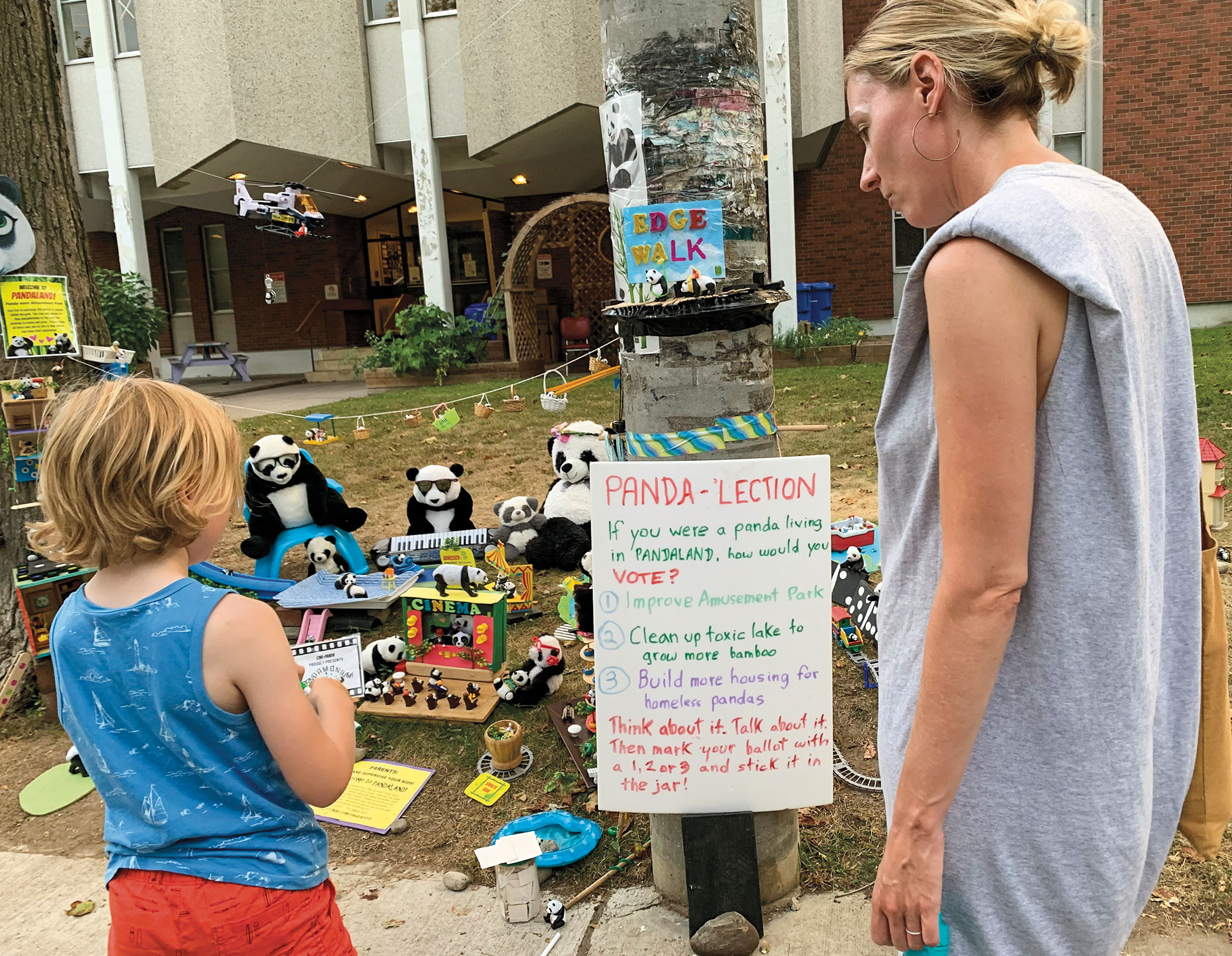
Seaton Village neighbours enjoy PANDALAND created by Martha Davis to amuse and educate children. The installation includes over 70 toy pandas, along with a cinema, tea room, amusement park, and even a homeless encampment. COURTESY MARTHA DAVIS
It started with seven wicker baskets, seven plastic pandas, and a piece of string. In early June, Seaton Village resident Martha Davis created a panda zipline between a hydro pole and a tree on a stretch of public green space in front of St. Peter Catholic School.
Over the summer, the installation began to grow: community members donated toy pandas to the site, while Davis built a burgeoning mini-city around the zipline.
Today, PANDALAND—as it is now affectionately called—includes over 70 toy pandas, along with a cinema, tea room, amusement park, and infirmary. There’s even an encampment for pandas experiencing homelessness.
Davis, who lives across the road from the installation, originally built the zipline as a creative project for her enrichment program for young children. But now, the site has attracted children and families from across the Annex and beyond.
“Some children now visit two or three times a day, and parents sit behind them on the lawn,” she noted. “I do feel it has drawn the neighbourhood together.”
Davis usually observes the action from her front porch, and occasionally comes down to explain the installation to onlookers. As a retired second grade teacher, interacting with young children is second nature to Davis. She asks them probing questions about the site, and encourages them to think critically about the issues affecting PANDALAND and how they relate to the real world.
Her most recent addition to the installation is a white board with a referendum asking children how they would improve PANDALAND if they were a panda living there. They can vote to expand the amusement park, clean up the toxic lake and grow more bamboo, or build more housing for pandas experiencing homelessness. According to Davis, more than 30 kids cast votes on the first day of the “panda-lection.”
Meagan Saunders-Zappia, who stops by the site every other day with her three-year-old son Luca during their evening walks, is always surprised by the exhibit’s new additions.
“It seems every time we visit there is something new to see,” she said. “It’s quite amazing the effort and care [Martha] has taken in curating the experience.”
Lisa Taharally lives down the street from PANDALAND and also visits the installation almost every day with her two children Jasper and Violet.
“For people to have something fun to look forward to during such a hard time, with kids being at home for so long, this is fantastic,” she said.
For Davis, PANDALAND is meant to take people’s minds away from the pandemic, but is also a reflection of our shared lockdown experiences. The exhibit’s name alludes to its panda residents, but also has a double meaning as a portmanteau of “pandemic” and “land.”
“Everything [in the installation] is in flux, precarious, waving in the breeze,” she explained. “Like the little pandas, children have to keep going and make the best of it. And so do adults.”
Davis plans to take down the installation after Labour Day, when children are set to return to school.
—Joshua Chong/Gleaner News
Comments Off on ON THE COVER: PANDALAND lightens the atmosphere in Seaton Village (Aug. 2021)Tags:Annex · News
September 8th, 2021 · Comments Off on FEDERAL ELECTION 2021: Candidates queried (Aug. 2021)
Gleaner asks University-Rosedale hopefuls five key questions
Questions are compiled by the Gleaner editorial board and edited for length and clarity. Election date is September 20, 2021. For more information on voting, please visit elections.ca.
Question 1: In recent years, municipalities across Canada have declared a climate emergency. This summer’s heatwave and forest fires have made that emergency very real for many Canadians. How will your party respond to the climate crisis and the need for immediate action? Specifically, what measures will you advocate for in University-Rosedale and how will you lead locally?
Nicole Robicheau, New Democratic Party:
One reason why I made the jump into politics is that I am tired of seeing and experiencing the devastating effects of climate change while governments stand by and refuse to take action to help those most in need. As a humanitarian worker, I’ve been on the frontlines of climate change, seeing first-hand how natural disasters keep increasing year after year. And no matter where the disaster, it’s always the same people most severely impacted: those already marginalized, living in precarious conditions to begin with.
A New Democrat government will set a target of reducing Canada’s emissions by at least 50% from 2005 levels by 2030, reaching further wherever possible to account for Canada’s fair share. We will improve where we live and work, because these improvements help reduce carbon pollution, save money, and make life better for everyone. This means retrofitting all buildings in University-Rosedale (and Canada for that matter) by 2050. We will change how Canadians get around, because improving transit and getting our transportation infrastructure right will create jobs, strengthen communities, and reduce our carbon footprint. We will support local transit by permanently doubling the Canada Community-Building Fund and we will develop a public inter-city bus program. We will power our communities with carbon-free energy, and pursue a clean-energy revolution to power Canada into the future. To do this we will set a target of net carbon-free electricity by 2030, and move to 100% non-emitting electricity by 2040. An NDP government will also end all federal fossil fuel subsidies. Instead of subsidizing the profits of oil companies while they destroy our planet, we’ll use those billions to invest in clean energy, and we’ll place a wealth tax on the ultra-rich as well. Climate justice is economic justice and social justice.
Steven Taylor, Conservative:
Conservatives will fight climate change and protect the environment. We will also meet Canada’s commitments to the Paris accord and reduce emissions by 2030. But unlike Mr. Trudeau’s Liberals who want to do it by tripling their carbon tax and making gas and heating fuel more expensive for everybody, we won’t do it on the backs of hard-working Canadians. Particularly, we will not drive jobs and investment out of the country and thereby hurt the economy we all depend on.
The most efficient way to reduce our emissions is to use pricing mechanisms. Our market-based plan to combat climate change will therefore study the imposition of a carbon border tariff, to reflect the amount of carbon emissions attributed to goods imported into Canada. Producers in countries with emissions reductions mechanisms that are compatible with our own will be exempt.
Any serious plan must avoid hurting Canada’s growth, while the worst climate offenders do nothing. The present state of global trade allows some of the world’s worst polluters to become free riders to the detriment of Canadian workers. And carbon pricing should not result in Canadians sending billions of dollars of new tax revenue to the government – revenue it will be increasingly tempted to spend.
The Conservative plan brings the provinces together to talk about the next steps in climate action and how we can work together to meet Canada’s goal. This is the plan we put to the provinces as a federal partner and it is the plan that will give Canada the best chance to be a leader in climate action.
Tim Grant, Green Party:
Mission Possible, our 2019 climate action plan, was judged by Navius Research to be the only plan that would enable Canada to meet its international obligations of a 50 per cent reduction in greenhouse gases by 2030. This CBC-funded study concluded that none of the plans of the other parties came close. Today, a big reason to be skeptical of the latest promises from the Liberals, NDP and Conservatives to reduce carbon emissions is that they all support new oil and gas pipelines, which will do the opposite.
Among many measures, Mission Possible called for the following: a bus and rail grid that would provide hourly bus service between communities and deliver passengers to train stations, thus allowing Via Rail to run faster trains and more of them; a national retrofit of all buildings to dramatically improve their energy-efficiency and in the process create millions of jobs across the country; and an end to fossil fuel subsidies. The Liberals have given $28 billion to fossil-fuel companies since 2018, $10 billion alone since the pandemic began.
Here in University-Rosedale, I currently chair the NetZero Carbon project of the Harbord Village Residents’ Association. We are working on an ambitious 10-year project to demonstrate that a single neighbourhood can reduce carbon emissions by 50 per cent by 2030 from transportation and home heating. We hope to meet this goal by making it easier – and cheaper – for residents to replace their cars with electric bikes or cars and to make their houses more energy-efficient and comfortable. Each year, we’re organizing bulk purchases of these products and services and extending the opportunity to participate to 26 other Toronto neighbourhoods. We are doing this because of the absence of the federal and provincial leadership we need.
Chrystia Freeland, Liberal:
Climate change is real and it is important that Canada meets this moment with urgency and with the understanding that we are currently undertaking the most profound economic shift since the industrial revolution. That is why our Liberal government has put climate policy and the green transformation at the heart of our agenda. Unlike other political parties, we have a real plan to promote clean growth and ensure Canada is at the forefront of the global fight against climate change. Canadians cannot afford anything less than bold leadership on climate.
By 2030, our Liberal plan will have ended plastic pollution and thermal coal exports, and reduced methane emissions from oil and gas companies by 75 per cent compared to their 2012 levels. By 2035, all passenger vehicles sold in Canada will be zero emission, and all Canadians will have access to clean electricity thanks to a net-zero electricity grid. We will also support oil and gas workers across the country as Canada transitions to clean energy, and help train more firefighters to make communities more resilient to the impacts of climate change.
These commitments will help us meet our ambitious climate targets of reducing greenhouse gas emissions by 40-45 per cent by 2030, and build on the work we have accomplished over the past six years. Here in University—Rosedale, this has meant support for the Toronto Ravine Strategy under the $200 million Natural Infrastructure Fund, a program we will double in funding if re-elected; better public transit thanks to our $10 billion investment in the GTA to help TTC streetcars go green and to build line expansions; and more bike lanes with the National Active Transportation Strategy.
We also made Canada a world leader with the price on pollution, which will go up to $170 per tonne by 2030. It is a powerful driver of our green economy because it incentivizes lower emissions while giving money back to families. And, since 2015, our Liberal government has invested over $100 billion to ensure Canadian families and businesses are able to make the shift toward renewable energies. With green home retrofits, electric charging stations, preserving land and oceans, and the $8 billion Net Zero Accelerator Fund, which helps large industries go green, we have been there to support our country’s essential transition.
2. An overwhelming majority of Canadians support some form of vaccination passport program for access to non-essential services, while most provinces have done nothing to support such a move, forcing many organizations to create their own. Will your party step in to create a national standard?
Tim Grant:
Yes, we would. Vaccine certificates or passports will help to protect those in the most vulnerable situations and alleviate stress on an already over-burdened health-care system. Equally important, by reducing the transmission of COVID-19, it will help businesses and schools stay open.
While no one should be forced to get vaccinated, we must require it for those working in essential services, like health care. Ditto college and university students, and not just those living in residence. Making vaccination mandatory for those working in institutional settings will reduce anxiety levels and help to keep everyone safe and focussed on what they need to do.
While not getting vaccinated is a right, it comes with a responsibility to avoid doing harm to others. It is a privilege – not a right – to be able to go to a movie or a concert, or to eat in a restaurant. To avoid the mixing of the vaccinated with the unvaccinated in these non-essential settings, a vaccine passport must be a requirement for entry into all indoor settings.
The certificate we need should be standardized for the whole country and available in an electronic format. It must be simple and easy for use. We’ll also need options for people who don’t have smartphones. The focus of the federal and provincial governments has to be to make the rules as clear, simple, and fair as possible.
A pan-Canadian vaccination certificate would be ideal, given the amount of interprovincial travel, and to help overcome a patchwork of different policies from one province to another.
Those with and without vaccine passports will still face inconveniences in the months ahead, but that is the price of returning to work or studying in a school setting, versus not being able to do either.
Steven Taylor:
Vaccines are the single most important tool in the fight against COVID-19, and our party strongly encourages every Canadian who can to get vaccinated.
However, unlike our Liberal opponents, Conservatives also respect and support the right of all Canadians to make their own health choices – as long as unvaccinated people accept that with that right comes an obligation to respect the rights of others who chose vaccination. So, those who choose not to be vaccinated must also be prepared to accept additional workplace safety measures.
Conservatives recognize that provincial governments will continue to set their own public health measures, as is their constitutional right and obligation. Three Canadian provinces have already done so.
Chrystia Freeland:
Our position on vaccines is clear – they are the single most important economic and public health policy. If you are not fully vaccinated and eligible for a vaccine, please book an appointment today. Thanks to our procurement efforts Canada has an abundant supply of vaccines.
A re-elected Liberal government will absolutely support provinces and territories, including Ontario, looking to implement vaccine requirements for public spaces and non-essential businesses, through a $1 billion COVID-19 Proof of Vaccination Fund. And I am proud that we are requiring all Liberal candidates to be vaccinated, and that as a government we are making vaccines mandatory for federal workers, and people travelling on planes, trains, and cruise ships. It is the minimum commitment that anyone seeking to form government should make to their fellow Canadians.
Vaccines are the only way that we will be able to avoid an aggressive and devastating fourth wave. Making sure that all eligible Canadians get vaccinated is the only way to be sure that our children can go back to school in-person and see their friends safely.
Nicole Robicheau:
Canadian families should be able to access vaccine passports as easily as possible. New Democrats have called on the Liberal government to get all provinces to sign on to a vaccine passport, and ensure the passport is in place by Labour Day.
Question 3: The pandemic shone a light on the housing and affordability crisis in Toronto as well as other major cities across Canada. It also exposed the inadequate support we give to the houseless population. How would your party move forward and work to correct these issues? Would you advocate for federal investment in affordable housing – specifically, would you provide federal operational funding to assist TCHC with its capital repairs as well as provide capital for more affordable units?
Tim Grant:
In this election, all of the parties will promise to fund large amounts of affordable housing. We’re no different. In 2019, we proposed a ten-year plan to annually build 25,000 units of affordable new housing and rehabilitate another 15,000, such as those maintained by Toronto Community Housing Corporation (TCHC). And we showed in our budget how we would pay for it.
While that promise remains, I want to answer this question differently. Since housing is a provincial responsibility, we propose a federal Minister of Housing be appointed to work with the provinces to ensure that annual targets of building and renovating affordable housing units are met.
We would cancel first-time homeowner grants. As election promises, they sound great. But they are counter-productive because they drive up housing costs for the very people they were designed to serve.
We also advocate for an additional way to increase the supply of affordable housing. That is to require cities that receive federal funds to mandate that 30 per cent of units in every new condo building be affordable and available for those with special needs. This would create 30,000 affordable units in Toronto per year. Beside the benefit of having rich and poor riding the same elevators, it would allow tens of thousands of low-income Torontonians to live closer to their workplaces, thus reducing congestion on the TTC and our roads.
Housing co-ops and church-led public housing projects are another key part of the solution. Both have proven to provide better governance than large municipal projects and should be supported with federal funds. Similarly, many non-profits with programs that support the homeless have achieved excellent results and they too deserve federal funding.
Finally, we also advocate for cities to receive more than the 10 per cent of all tax dollars, in order to better address homelessness in their midst.
Chrystia Freeland:
We know that the recent and rapid rise in housing prices has made it difficult for Canadian families, very much including people here in our community, to find an affordable place to call home. And we are absolutely committed to helping Torontonians, and all Canadians, achieve their dream of becoming homeowners. That is why housing affordability is a core pillar of our Liberal platform.
We will help young Canadian families become homeowners, by creating a First Home Savings Account (in which Canadians under 40 will be able to save and withdraw up to $40,000 tax free) and by doubling the First-Time Home Buyer’s Tax Credit. We will also build and repair 1.4 million homes over the next four years. And we will continue the important work started in our recent budget to ensure Canadian homes are for families, not passive investment vehicles. We will expand the new tax on vacant housing owned by non-resident, non-Canadians to include vacant land, and we will put in place a two-year ban on foreign ownership of Canadian homes.
And, importantly for our community, we will more than double the current funding of the National Housing Co-investment, which has provided $1.34 billion to Toronto Community Housing Corporation’s (TCHC) aging social housing portfolio.
This is in addition to the $200 million we invested to build six residential buildings with 916 rental units at Mirvish Village. 366 of these units are provided at rents at or below 30 per cent of the median household income, including 100 units secured at 80 per cent of Average Market Rent for the City of Toronto. We have also put in place the $70 billion National Housing Strategy, and the $2.5 billion Rapid Housing Initiative which has provided the City of Toronto with over $300 million to build affordable housing. We have been working since 2015 to make life more affordable for all Canadian families, including those who live in the Annex, and that is exactly what we will continue to do.
Nicole Robicheau:
A New Democrat government will create at least 500,000 units of quality, affordable housing in the next ten years, with half of that done within five years. This will be achieved with the right mix of effective measures that work in partnership with provinces and municipalities. We will build capacity for social, community, and affordable housing providers, provide rental support for co-ops, and meet environmental energy efficiency goals. In order to kick-start the construction of co-ops, social and non-profit housing, and break the logjam that has prevented these groups from accessing housing funding, we will set up dedicated fast-start funds to streamline the application process and help communities get the expertise and assistance they need to get projects off the ground now, not years from now. We’ll mobilize federal resources and lands for these projects, turning unused and under-used properties into vibrant new communities. New Democrats believe that housing is a human right, and we’ll ensure it’s treated as such.
Steven Taylor:
Conservatives believe all Canadians should have a chance to build the life they dream of and to live on a street with good neighbours. Unfortunately, while housing prices continue to soar to historic highs, Mr.Trudeau’s Liberals are failing to make homes more affordable for Canadians, especially for young, first-time home buyers. It’s a crisis and Mr. Trudeau’s flashy announcements and promises of ever-increasing spending will not fix it. We need a housing plan in Canada that gets homes built and empowers Canadians to be able to own a home in their lifetime.
A Conservative government will therefore create or free up a million homes in the next three years by releasing as much as 15 per cent of federally-owned buildings into the housing market, placing a two-year moratorium on foreign investors who live outside the country and making changes to the mortgage stress test. We will also be looking at converting office space into housing and to help the equally important rental market, our housing plan will allow developers to defer capital gains taxes – if they reinvest in rental properties.
Question 4: The pandemic has hurt our country’s economy and many of Ontario’s small businesses took the brunt of it. How will your party work to support small businesses as we continue through the COVID-19 pandemic?
Chrystia Freeland:
Small and medium-sized businesses are the cornerstone of Canada’s economy. So, it has been our Liberal government’s priority to help them weather the pandemic and rebound in the recovery. This is a key focus of our recent budget and platform.
When the pandemic hit, we introduced targeted support to help hard-hit businesses and organizations. These include the wage subsidy, which has protected over 2.1 million jobs in Ontario, and the rent subsidy and lockdown support, which have provided over $1.8 billion in support to Ontario businesses. And, while our economy has already started to come roaring back, we know that we must continue to support small business owners and workers as we finish the fight against COVID, and into the recovery.
To jumpstart economic growth, our Liberal government implemented the Canada Recovery Hiring Program which encourages businesses to take on the risk of hiring new workers by helping cover their wages. If we are re-elected, this support will be extended until the end of March. We have also put in place a digital adoption program, which gives micro-grants and zero-interest loans to businesses looking to adopt new technologies. And businesses are now also able to expense up to $1.5 million of their capital investments over the next three years to help them grow. For hard-hit sectors like tourism, hospitality, arts and culture that are still unable to fully reopen, we will provide further targeted support to help them get through the next few months.
We will always be there for those hardest-hit by the pandemic, including through the recovery, to ensure no one is left behind.
Nicole Robicheau:
We know there’s so much more to do to help the small businesses that our communities rely on. That’s why New Democrats pushed the Liberal government to create stronger small business wage and rent subsidy programs than the Liberals had originally planned, and we know these programs saved people’s jobs. We’ll make sure these continue until small businesses are able to fully reopen. To help small businesses get people back to work, we’ll put in place a long-term hiring bonus to pay the employer portion of EI and CPP for new or rehired staff. New Democrats will keep working hard for small businesses to tackle issues that impact their bottom line. As more and more small businesses rely on credit card and virtual transactions, we’ll put an end to gouging by capping high credit card merchant fees at a maximum of 1%.
Steven Taylor:
Small business is the engine of the Canadian economy. There are nearly a million enterprises with fewer than 100 employees and nearly 70 per cent of working Canadians work for them. Together they produce more than 40 per cent of Canada’s wealth. Yet, contra the ‘we’re all in this together’ slogan, small businesses right across Canada has indeed ‘borne the brunt’ of official COVID-19 responses. Often deemed ‘non-essential,’ small businesses were disproportionately shut down, the employees sent home and years of sweat equity destroyed in a few days. Under Mr. Trudeau’s watch, tens of thousands of these businesses closed for good, even as they watched massive competitors like big-box stores and online web-giants stay open, make record profits and pay huge dividends to their shareholders.
Mr. O’Toole’s Conservatives will rebuild the struggling main street. And we will rebuild the streets behind main street where the small industries are, by providing incentives to invest in, rebuild and even start new businesses.
Our plan to put small business back on its feet includes:
The Main Street Business Loan that would make available loans of up to $200,000 to help small and medium businesses in hospitality, retail, and tourism get back on their feet, with up to 25 per cent forgiven.
The Canada Investment Accelerator tax credit, a 5 per cent investment tax credit for any capital investment made in 2022 and 2023, with the first $25,000 to be refundable for small business
To make it easier to hire new talent, the Conservative Job Surge Plan will pay up to 50 per cent of the salary of net new hires for six months following the end of CEWS
The Rebuild Main Street Tax Credit will provide a 25 per cent tax credit on amounts up to $100,000 that Canadians personally invest in a small business over the next two years
Mr. Trudeau’s supposed business-relief programs were too little, too late, and often hard to access. The Conservative plan puts the power of credit, wage support and tax relief behind Canada’s entrepreneurs. And, it will be sufficient, quickly delivered, and easy to access.
Tim Grant:
During the worst of the pandemic, small businesses relied on federal support programs to survive. Similar federal supports will be needed to enable those same businesses to emerge from the pandemic. But this time – to reduce the cost – financial support should no longer be given to large, profitable corporations.
Several key Green programs would provide less obvious support to small businesses. Our pharmacare plan will reduce the time lost to sickness by employees. (We propose to pay the provincial share for the first 2 years so a national plan can be implemented right away.) Our proposal for a guaranteed liveable income would increase consumer spending, enable thousands to start new businesses, and bring increased investment to existing, small businesses. Our national retrofit program will make all buildings more energy-efficient, thus reducing energy costs.
And of course, a shift away from fossil fuels will create opportunities for hundreds of thousands of innovative new businesses to emerge, whether selling electric bikes or more durable consumer goods.
We would require successful bidders on federal infrastructure contracts to maximize the spin-off community benefits of such contracts. This will strengthen opportunities for Indigenous, Métis and Inuit-owned businesses, social enterprise, co-operatives and diverse suppliers in nearby communities to benefit from those infrastructure projects.
Finally, because cities receive only 10 per cent of all the tax dollars collected by all levels of government within their borders, they are too reliant on property and small business taxes. We are committed to enabling cities to gain charter city status, so that their decisions can’t be overturned by provincial governments and they have the funds they need to fulfill all the responsibilities placed on them, without being so reliant on homeowners and small businesses.
Question 5: The People’s Republic of China has detained two Canadians, Michael Kovrig and Michael Spavor, for over 1,000 days – what is your plan for saving these victims of hostage diplomacy in particular, and more generally, how will you hold Beijing to international norms on human rights?
Nicole Robicheau:
As a humanitarian worker with a background in human rights, I firmly believe all nations should be held to account in terms of upholding human rights, including Canada. A New Democrat government will stand up to China with a strong and coherent strategy to defend Canadian interests at home and abroad. We will work with our allies to lead a robust and coordinated international response to China’s disregard of the rule of law. New Democrats will call out human rights abuses by China, stand with Hong Kong pro-democracy asylum seekers, and provide coordinated support for those facing threats by Chinese entities here in Canada.
Steven Taylor, Conservative:
We must show we’re willing to stand up for our interests, our citizens and our values, sometimes with tough and difficult decisions – like sanctions. What you don’t do is pretend everything is fine, as Mr. Trudeau has done.
You therefore don’t host the People’s Liberation Army for training exercises in Canada or try to joint-venture a COVID vaccine with Beijing and get dumped in the process, or stay silent as Hong Kong democracy is suppressed and the Muslim Uighur minority is persecuted. And you don’t say that among all the governments of the world, you most admire China’s because it knows how to ‘get things done.’
We need to be clear what China does. It is rapidly building up its capacity to make war, and to extend its influence in the South China Sea. It threatens Taiwan. It steals intellectual property, dictates the terms of trade and as in the case of Michael Spavor and Michael Kovrig, kidnaps non-citizens to exert leverage over their countries. In fact, even as Canadian athletes train for next year’s Winter Olympics in China, Mr. O’Toole warns ‘we are approaching a point where it won’t be safe for Canadians, including Olympic athletes, to travel to China.’
China does not act like a partner or a friend. The cases against Spavor and Kovrig are outrageous and contrived. There are no magic solutions and to the degree their detention is related to the case of Huawei executive Meng, detained under a U.S.-Canadian extradition treaty, the solution is not even entirely in our hands.
However, for the first nine months of their imprisonment, we didn’t even have an ambassador in China, thanks to Mr. Trudeau’s hand-picked, Liberal insider John McCallum.
So, the first necessity is a serious, professional approach. Inaction, weakness and self-delusion have not worked.
Tim Grant:
Canada needs to take two important steps to confront China for the imprisonment of the two Michaels, the imprisonment of more than one million Uyghurs, and the suppression of democracy in Hong Kong. The first is to develop a coalition of countries that can apply collective pressure on China to improve its dismal human rights record. Many other countries also face retaliation by China, so forming a large coalition will not be difficult. Multilateral efforts have a much greater impact than if countries like Canada act alone.
The second step is to reduce trade with China and any other country that routinely violates human rights. While China is our second largest trading partner, they represent only 4 per cent of our imports and 6 per cent of our exports. It will be easier to reduce our economic dependency on that large country if we succeed in building a coalition of countries willing to stand up to it.
Much of what we export to China are raw materials. We’ve long known that more – and higher-paying – jobs would be created if we processed those raw materials into finished and semi-finished products. But we’ve lacked the political leadership to make that happen. To reduce trade with China, we’ll need to re-develop our manufacturing base, which will in turn help to reduce the supply chain problems that have plagued much of our economy since the pandemic began.
China’s abysmal human rights record now provides another incentive to do what we’ve long needed to do. If we follow both steps, we’ll be a much stronger position to free the two Michaels, and more broadly, force China to start respecting human rights.
Chrystia Freeland:
Michael Kovrig and Michael Spavor are two very brave Canadians, who are behaving with incredible decency and incredible courage in very difficult circumstances. I want to assure all Canadians that we will not rest until both Michaels are able to come home. We condemn in the strongest possible terms China’s arbitrary detention and sentencing of the two Michaels.
In February 2021, we launched the Declaration Against Arbitrary Detention in State-to-State Relations, which has been endorsed by 66 countries. We will continue to implement domestic measures to protect Canadians and work closely with our friends, allies, and partners to respond to illegal and unacceptable behaviour by authoritarian states, including China, Russia, and Iran.
-Compiled by Nicole Stoffman
READ MORE FROM THE 2019 FEDERAL ELECTION:
FOCUS: Federal election candidates queried (Oct. 2019)
September 8th, 2021 · Comments Off on NEWS: Palmerston Avenue garden razed (Aug. 2021)
TDSB staff face a wall of criticism from neighbours and volunteers
Once full community gardens along Palmerston Avenue Junior Public School now empty. MADELINE SMART/ GLEANER NEWS
By Madeline Smart
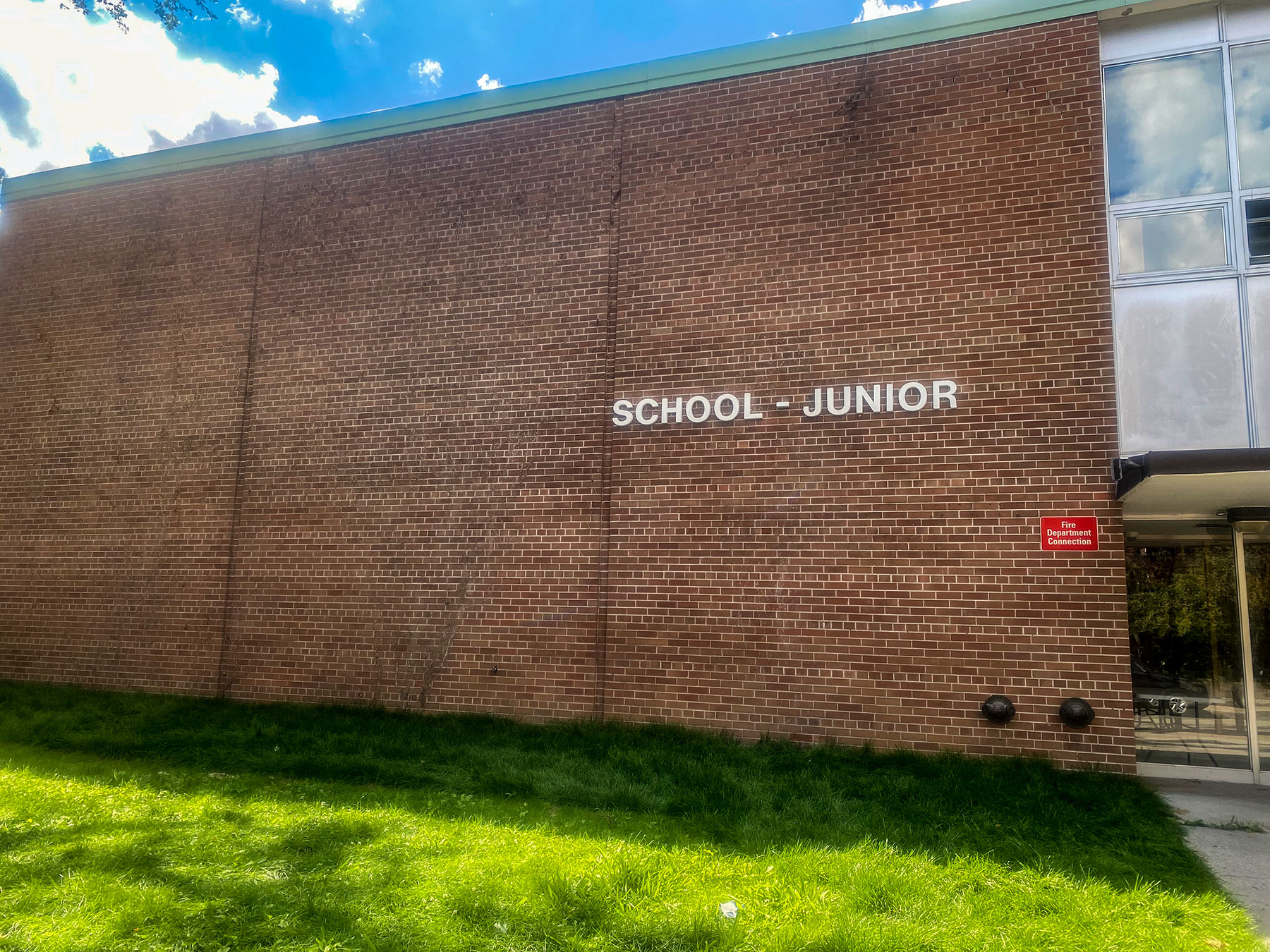
On July 16, the community gardens at Palmerston Avenue Junior Public School which had stood for over 20 years were reduced to stubble without warning. The gardens have been a labour of love for generations of students, parents and community members since its inception, and were also a cornerstone of the school’s environmental education program.
The site of the former community garden, now turf. BRIAN BURCHELL/GLEANER NEWS
On the day of their removal, the school’s principal, Rory Sullivan posted to the school’s community blog that the gardens had been removed by the Facilities Team due to “health and safety issues.” The post added that “evidence of vermin, syringes, blocking windows, roots getting into the foundation,” were all issues that led to the decision to remove the gardens. However, no one at the school or in the community was made aware of these issues prior to this post.
“We were all surprised,” said Trustee Chris Moise, who said that neither he nor the principal and the superintendent knew what had happened to the gardens until members of the community made them aware of it.
“For me the lesson learned is that we don’t want that to happen again to any of our schools, ‘’ Moise said.
The community wants the same but they also want some accountability.
A community engagement policy made by the TDSB in 2012 outlines that the community is to have a role in planning and decision-making within the education system and should be consulted when changes to it are made. The community at Palmerston Avenue Junior Public School feel as if this policy was violated when the gardens were taken down without their knowledge.
“It felt as if they just said to us ‘thanks for a hundred plus hours of labour but we’re going to destroy it’ and it’s unfair,” said Howard Law. Law and his wife Henny Markus have been working on the school’s garden since their daughter first enrolled in 2000 and have continued in the years after her graduation.
Markus, a professional gardener, was integral in expanding the gardens to include multiple plots. She just wished there had been a conversation, she said. She and other community members tending to the gardens kept in regular contact with the school and its grounds team – even during the pandemic. According to the couple, around half a dozen volunteers had been working on maintaining the gardens during COVID-19. They feel that if there were any issues, these volunteers could have fixed them.
“The most I’ve ever found [in the garden] have been pencils, pens, tennis balls and the occasional soccer ball,” said Markus. “You target the area where you think there’s problems with the foundation, you don’t completely destroy the garden.”
Law and Markus don’t know if they or other volunteers will return to working on the gardens when they get replanted.
The school and the trustee say they want to rectify the situation as much as anyone else.
“My intention here is really to have a meeting with the community and the principal and the superintendent to talk about their concerns and more importantly find a way forward because we want to replace the gardens and frankly it shouldn’t be at the cost of the community, it should be at the cost of the TDSB,” Moise said.
“For me this is a systemic issue that we need to address in a systemic way,” he added.
Moise predicts that the meeting will take place sometime early in September once school is back.
Comments Off on NEWS: Palmerston Avenue garden razed (Aug. 2021)Tags:Annex · News
September 8th, 2021 · Comments Off on NEWS: Report urges reduction of traffic lanes on Avenue Road (Aug. 2021)
Cyclist death spotlights lack of bike lanes in the plan
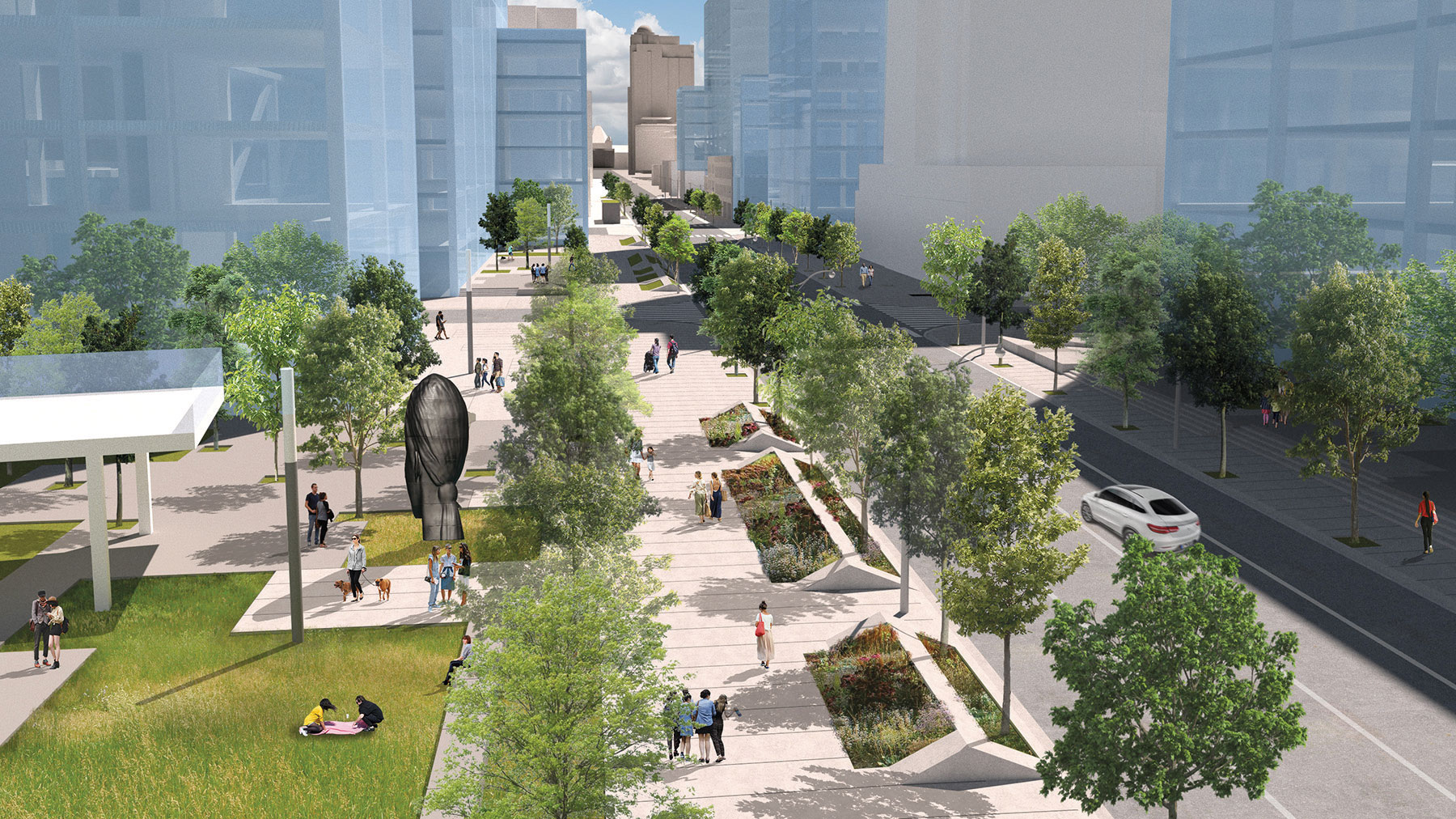
The Avenue Road Safety Coalition proposes reducing Avenue Road from six lanes to four and adding a linear park. COURTESY BROWN AND STOREY
By Madeline Smart
Toronto architecture firm Brown and Storey have teamed up with the Avenue Road Safety Coalition (ARSC) to transform Avenue Road into a safer and more enjoyable place for pedestrians, but what about cyclists?
Avenue Road is known for its narrow sidewalks and expressway-like street. The City of Toronto found that on average 60,000 cars speed on the road in a week, which is unsafe – but not just for pedestrians. On August 18, an 18-year-old cyclist was struck and killed by a cement truck on Avenue Road. Both the young cyclist and the truck were traveling northbound past Bloor Street in the curb lane. Police suspect that the cement truck may have not given the cyclist enough room and didn’t even realize he had been in a collision until witnesses grabbed his attention. This was 2021’s first fatal bike collision in the city, but there have been fifteen other serious and fatal collisions on Avenue Road between Bloor Street and St. Clair Avenue since 2006, according to police data.
The report from Brown and Storey imagines removing the outer two lanes of traffic, reducing the current six lanes to four. It outlines asymmetrically distributing the spaces gained from removing the lanes so the west sidewalk can be widened by 3.5 metres while leaving just over eight metres of space for the east side, allowing a linear park to be created which could provide potential linkages to the Green Line and strengthen the connection to Ramsden Park. However, protected bike lanes were left out.
Their goal is to restore the balance between pedestrian and driver needs by bringing the street back to what it was in 1950 before the extra lanes were created to accommodate more cars.
Albert Koehl, a coordinator with ARSC says the chosen plan will not only be more consistent with the area and its needs but also with current city policies.
“It provides an opportunity for us to further achieve city policies in terms of climate change, road safety, even equity and public health,” said Koehl.
Ry Shissler, communication manager for cycling advocacy group Cycle Toronto and an Annex resident, believes the accepted plan sends the message to cyclists that they aren’t a priority.
“They say they want to take a step back to the 1950s when the road was last changed and to me, you’re setting the precedent if you don’t address cycling that for the next 50 years cycling isn’t welcome there,” Shissler said.
Koehl is also an avid cyclist and cycling advocate. From his perspective, making the temporary Yonge Street bike lanes permanent is more important than what’s happening on Avenue Road.
“We want to see the pedestrianization of Avenue Road,” Koel said. He added that Avenue Road isn’t in desperate need of a bike lane because there are not many shops on the street compared to Yonge Street, and with a bike lane on Poplar Plains Road and the one on Davenport Road scheduled for improvements, putting one on Avenue is less of a priority.
“Equally important is that Avenue Road will be 100 percent better for everyone with this plan – on a bike, on foot or on transit because it would be a much, much, much friendlier, slower community-oriented street than it is now with its six speeding lanes.”
The recent cyclist accident has sparked an outcry from cycling advocates and politicians for protected bike lanes on Avenue Road and other major roads in the city. Council passed a pilot safety program last year that involved adding a temporary cycling lane to the street, but that initiative ended up being put off because of ongoing construction in the area. The plan will however be re-examined this fall.
Correction:
Ry Shissler, who uses they/them pronouns, was misgendered in the story “Report urges reduction of traffic lanes on Avenue Road.” The error occurred in both the August 2021 print issue of the Annex Gleaner, as well as the initial online version, which is now corrected. The Gleaner regrets the error.
September 8th, 2021 · Comments Off on CHATTER: India-sourced, Annex-available rugs (Aug. 2021)
Rose Garden and Rain patterned rugs by Annex-based Mark Krebs get hand washed in Mirzapur, India. Designer Davin Cowper works with about 40 people in the state of Uttar Pradesh for each production run of his all-natural, handmade rugs. COURTESY MARK KREBS
When Davin Cowper launched a rug company out of his apartment at Harbord and Bathurst in January, 2020, he wanted to appeal to millennials ready to upgrade from mass-produced products and “actually do something with their interiors.”
Cowper’s goal was to create rugs and other housewares that would be multi-generational, rather than wind up on the curb, like so much IKEA furniture. He works directly with independent, traditional weavers from Uttar Pradesh in northeast India, who use only natural fibres to make his modern and minimalist area rugs, runners, and spot rugs that are made to last.
The former Umbra and EQ3 product developer designed the neutral Aquarius Birch and Aquarius Coal rugs, and collaborated with Indian weavers to come up with the colourful Chanterelle, and Rose Garden patterns. The weavers, inspired by traditional, Moroccan, and Turkish styles, send him photos of samples which Cowper digitally manipulates to his satisfaction. “I really wanted to do something loud, interesting, and really compelling, in terms of colour palettes,” he said.
He named the company Mark Krebs (markkrebs.ca), his online pseudonym since high school, to avoid becoming the brand himself, and to share authorship with the artisans. “It’s really a partnership,” he said.” They’re the ones who know the techniques, and I’m guiding them.”
Mark Krebs’ rugs come in two styles of weave: flat weave or kilim weave. Flat weaving creates a softer, thicker rug, and uses linen and New Zealand wool. Kilim rugs are thin and tightly woven, and use Indian wool and cotton. He keeps his prices low by selling directly to the consumer, and working with an Indian exporter instead of a Canadian importer. He stores the rugs in a 10-foot container in his backyard.
On the issue of fair pay and labour conditions, Cowper implements multiple checks and balances in his production process. He looks forward to partnering with certification agencies as his business continues to grow. “It is impossible to pay rug weavers lower than the highest going rate in the region,” because they are independent contractors, he explained. He has hired a quality-control team based in Delhi to do random checks throughout production for child, forced and bonded labour, a rampant problem in India. In addition, his exporter must comply with Indian labour laws to hold an export licence. In the meantime, Cowper is supporting a hospital’s COVID-19 response in the town of Mirzapur, where a large portion of his rugs are produced.
View the complete rug collection at, markkrebs.ca.
—Nicole Stoffman/Gleaner News
Comments Off on CHATTER: India-sourced, Annex-available rugs (Aug. 2021)Tags:Annex · News
September 8th, 2021 · Comments Off on EDITORIAL: Ford’s flawed passport (Aug. 2021)
Doug Ford emerged this week after weeks of summer slumber to announce a “vaccine certificate system” which is both late and lame. He then prorogued the legislature, lest he be answerable to it, and headed back into seclusion.
“It’s no secret – this is something I did not want to do,” the Ontario premier said recently. The last time we heard from him in July he was asked if he would support a vaccine passport system.
“The answer is no, we’re not gonna do it… hard no,” he said.
But we all know what happens when the premier draws a hard line: he waits until the problem becomes unmanageable, does a flip-flop, blames others (usually Justin Trudeau) and flies in to attempt to rescue us from a crisis that he himself helped create. He is both an arsonist and wannabe firefighter.
Currently, 23 per cent of the eligible Ontario population are not fully immunized. Within that group are the vaccine-hesitant and vaccine-opposers. If they do not “get the jab” the new Delta variant of COVID-19 will spread, mutate, and lead to full ICU beds and morgues. This has the net effect of creating more dangerous strains of the virus and displacing other necessary medical procedures from happening in hospitals. Sound familiar?
The ‘incentive’ to get vaccinated is now a stick. Effective September 22, if you fail to provide proof that you received your second shot more than 14 days ago, you will be denied access to restaurants, bars, movie theatres, casinos, gyms, and professional sporting events. Inexplicably, you can still avail yourself of personal care services such as nail salons, tattoo parlours, barber shops plus any and ALL retail services or churches – no vaccine required. It’s a sort of, ‘passport-lite’ approach.
The staff at the establishments where vaccine proof is required to enter do not have to be vaccinated themselves. Ford is leaving it up to employers to come up with their own policies on this. Businesses, Universities, and Colleges are all over the map on rules for staff, patrons, students, and guests. It’s a patchwork that invites the anti-vaxxer movement to target establishments that take a hard line on public health safety.
Still, this new program is better than nothing and vaccinations have gone up since Ford’s announcement.
Both Quebec and British Columbia saw similar spikes when they announced their passport programs, but that was some time ago and those provinces have the advantage of getting people fully vaccinated at least 14 days before school starts.
Thanks to Ford’s dithering, we are way back in the pack in Canada’s most populous province.
Our QR code proof of vaccine system will not be up and running until at least Oct 22 because Ford derailed its planning last December. Quebec’s QR code is in use today.
Proof of vaccination here will come in the form of the PDF emailed to you after receiving your second shot. Why are we waiting until Sept 22 to make use of this insecure form of documentation?
The provincial plan is most glaringly deficient in that fails to require health care workers and educators to be vaccinated. So workers are free to be unvaccinated while caring for the most vulnerable, those in hospital, old-age homes, or for kids under age 12 (who can’t be vaccinated). But they can’t go see a Blue Jays game?
As usual, the premier is playing catch up after developing policy on the fly. And typically, Ontarians are faced with chaos.
September 8th, 2021 · Comments Off on FORUM: Looking to the feds to save cities (Aug. 2021)
So many municipal issues require a national strategy
By Mike Layton
This federal election, the focus for cities must be on social justice and the recovery.
Cities are where the majority of the country’s population lives and for years, important programs to support residents such as child care, protecting the environment, and substantial investment into deeply affordable housing have been underfunded.
All of this would be made easier for Toronto to implement with a new legislative relationship for cities.
As with the municipal budget, at its core, the debate this election is about services for people, and you need not look further than the budget to determine the government’s priorities.
As we recover we will also be faced with choices as to the kind of jobs we are creating, what infrastructure investments we are making, and the projects we are funding.
It is critical for our future as a city that we invest in measures that address, not compound, the climate crisis and inequality. We must build resilience.
Earlier this year the government announced a plan for universal child care which was met with substantial support across the political spectrum.
As a recovery tool, child care will be a massive boon for the economy and ensure many women and parents are able to return to the workforce knowing that they have safe, affordable child care.
There will be no recovery without women and steps must be taken to see the funding of universal childcare through to implementation.
The city also needs support investing in measures that improve resilience and protect against future threats including the climate crisis.
We must recognize that climate action can accelerate economic recovery and improve social equity.
There must be commitments that national governments (not just our own), regional, and international institutions provide cities with the necessary supports to deliver a healthy, equitable, and sustainable recovery.
The City of Toronto will be reporting on TransformTO’s next stage in October and support for the initiatives detailed in that report will be monumental in the climate change fight on a local level.
Finding affordable housing in Toronto continues to be a major challenge for the majority of residents.
We simply do not have enough supportive, and deeply affordable housing to meet their needs. The city needs help acquiring and operating more housing options that will help keep people off the streets and in safe, secure living arrangements.
We can quickly replicate the modular housing initiatives, and build out a more robust support system with substantial investment from the federal government.
Raising the floor of the most precariously housed will benefit all residents as affordable housing options appropriate to one’s income will become more readily available. This is an oversimplification, but we need to start with those who are in the most need.
Lastly, the province’s ability to control and meddle in municipal affairs must come to an end.
If they are unwilling to support municipalities to make the changes that will better serve residents, then they need to stop micromanaging our decision-making processes.
From MZOs to approve developments on the whim of the minister, to suspending our noise by-laws, to the control over planning processes and interference in the election cycle, none of this is making life easier for current and future residents.
We need a new relationship that will support Toronto and other municipalities fairly.
Please visit www.mikelayton.to for the latest goings-on in Ward 11 and to sign up for my e-newsletter..
Mike Layton is the city councillor for Ward 11, University—Rosedale.
September 8th, 2021 · Comments Off on FORUM: Five provincial issues to follow this fall (Aug. 2021)
Provincial election is just months away
By Jessica Bell
With the provincial election coming fast and COVID in resurgence, this fall session at Queen’s Park will be impactful. Here are five issues to follow.
Our response to the fourth wave
Since my children returned to daycare, our household has caught colds. Subjecting my children to the painful PCR test and then self-isolating is necessary – and disruptive. It’s just one of many experiences I’m sure we are all having during this endless pandemic that leads us to ask, ‘surely there’s a better solution here?’
It is a milestone that 77 per cent of Ontarians have been fully vaccinated, but we need to reach 85 per cent to blunt Delta’s spread.
The Ford government continues to be a laggard and not a leader in making the wise, tough decisions that will protect more Ontarians from COVID-19. We are calling for the government to implement a paid sick day program to limit spread in the workplace, a fair and logical vaccine passport program, and a safe school plan that includes smaller class sizes, good ventilation standards, and easy access to free rapid testing for the school community and more.
Healing civil unrest
I have encountered anger and distrust of mainstream media, public health, and government at the door during this federal election. Our office is also receiving calls from constituents and businesses, especially in the Kensington and Chinatown area, who have been harassed, pushed, and insulted by people because they are wearing masks or implement public health rules in their workplace.
To protect businesses from harassment, we are calling for the introduction of safety zones, similar to what exists around abortion clinics.
Long term, there is a need to heal the growing social and economic divide in our society through a comprehensive economic recovery program, and more. I welcome suggestions on how our office can address this growing intolerance, and social and economic divide.
Condo sector to be investigated
This October, I will be responding to the Auditor General’s investigation into the condo sector.
This is important because many University-Rosedale residents, from Yorkville to Bay St, live in condos.
The Auditor General found that condominiums are poorly regulated, and condo dwellers have little recource if they have complaints, from rigged board elections, to faulty construction, to big hikes in maintenance fees.
My goal this fall is to introduce legislation to provide condo dwellers with better protection, and improve governance of the entire sector.
Real rent control and speculation clamp down
Housing affordability remains a top issue. I will be introducing a real rent control bill that places a cap on the amount rent can be increased between tenancies.
My real rent control bill aims to stabilize housing costs for the 60 per cent of University-Rosedale residents who rent, and disincentivize landlords who illegally evict long-term tenants in order to raise the rent to market rents.
Canada’s real estate sector is a global hotspot for money laundering and fraud, as wealthy people are legally able to set up numbered corporations, trusts and partnerships in order to buy and sell property anonymously.
This activity drives up housing prices well beyond what Ontarians can afford.
To clamp down on tax evasion, fraud and housing speculation, I will be introducing a bill to establish a land owner registry that will list individual owners of all property across Ontario.
Health care backlog
Ontario has a huge health care backlog caused by COVID-19 and chronically underfunds health care.
The Ontario Medical Association calculates that over 477,000 people are waiting for an MRI, and a quarter of a million people are waiting for surgery, including cardiac surgery.
These people are often depressed and in pain. To help us raise this issue in the legislature, we have a survey at www.jessicabellmpp.ca/surgerywaittimes that residents waiting for surgery can complete.
We are calling for the Ford government to take meaningful action to reduce the health care backlog, just like the B.C. government has done.