February 4th, 2022 · Comments Off on GREENINGS: The disproportionate impact of inflation (Jan. 2022)
Examining the interconnectivity of consumption, labour, and the environment
By Terri Chu
The richest among us earned record profits during another COVID-19 year while the poorest among us are risking their lives in understaffed service jobs.
Is it any wonder that there’s a general labour shortage? Inflation is being blamed, in part, on this labour shortage and it is hitting the food business particularly hard. Let’s take a moment to think about how this relates to climate change.
We are used to being a highly wasteful society. In the last half century, we have introduced more and more single use items into our lives.
We have an expectation of cheap food. Historically, about a third of labour went into producing and acquiring food. I am guessing most people reading this paper spend nothing near a third of our incomes on food in a year.
Food prices have not inflated in line with other things for a variety of reasons, though we are likely to see this change. In the second half of the 20th century, crop yields around the world increased dramatically due in large part to petrochemical use. This has come at the cost of both water and soil contamination.
Growing more than we need has kept prices low, but they have come at a tremendous cost. That cost has been largely hidden to consumers, who have come to expect cheap food delivered to their doorsteps for next to nothing.
However, we have normalized food being cheap. This leads to two more issues to discuss: cheap labour and material waste.
There’s no polite way of look at the issue of cheap labour. Cheap labour is made possible by racism.
In the 1990s, mediocre food at Kelseys cost about half of what my family could afford to charge at our Chinese restaurant.
We had a really nice, fancy, clean place that was in no way inferior to the mid-tier brand names.
The expectation that ethnic food be cheap persists to this day. The labour of minorities was never worth more than a pittance in the eyes of the ruling elite.
Thankfully for my generation, public education has leveled this playing field. As we become educated, get better jobs and leave the lower end labour behind, the ethnic majority is no longer willing to let themselves be abused and has left this undervalued sector of the economy behind them.
Now let’s consider the materials that our food comes in when we get take out.
Pumping oil from the ground, using its by-products to make a container, delivering that container, and throwing it out is somehow viewed as less labour intensive than bringing back containers and washing them.
I am more than confident that nobody who reads these columns needs me to spell out how environmentally destructive this practice is, especially when we now know that plastic recycling is nothing but a sham.
Cheap materials have been another area where we replaced labour, requiring even fewer people to do the same job.
We are used to being a highly wasteful society. In the last half century, we have introduced more and more single use items into our lives.
The milkman who delivered milk in glass bottles and took away the empties to refill no longer exists. They have been replaced with 4L plastic bags that ultimately clog up our landfills and waterways.
As we transition away from fossil fuels, we will see further increases in material costs and hopefully, a shift back to reusing.
As climate change decimates our established growing regions, it will take time to adjust our agricultural practices.
The increase in food prices will hopefully decrease food waste, but I am not hopeful we have learnt any lessons from our monocultural ways.
The dependency on fossil fuels and petrochemicals has come at a very high cost to water quality and human health.
Valuing one’s labour does not necessarily have to come at an increased cost if only the CEOs were willing to take lower salaries and profits.
A $2/hour wage increase for front line staff causes us to collectively clutch pearls at what it will do to consumer prices, but rarely do they question the impact of a $4M pay package, as received by the head of Canada’s largest grocer.
February 4th, 2022 · Comments Off on ARTS: Getting on line with the Japan Foundation (Jan. 2022)
An artistic movement to counter Omicron: beauty, simplicity, constraint
The Japan Foundation boasts over one hundred woodblock prints by Horoshige, depicting Tokyo in the 1850s. Enjoy the meticulous sophistication of these prints when the gallery reopens. The Foundation is located on the 3rd floor of the Hudson’s Bay Centre on Bloor Street. (Pictured: Flower, 1857). COURTESY THE JAPAN FOUNDATION
By Meribeth Deen
Five, seven, five.
Three lines of writing, each with a precise number of syllables in each; and there we have the critical constraints that define haiku.
In sixteenth century Japan, the beginnings of renga poems, which were hundreds of stanzas long, broke off into their own form. The century following brought peace, artistic flourishing, and a master of this new form. Thanks to Basho, haiku became a widely accepted form of artistic expression.
Over the centuries, poets have routinely broken the rules of haiku. The International Convention on World Haiku in 1999 stated that seasonal words are not necessary in “global” haiku, and that the content of the poems would not be independent from the cultural backgrounds of the poets.
The one tenet of this form that remains firmly intact is simplicity, which is why haiku is such a popular way to introduce children to the world of poetry.
A world of dew, And within every dewdrop, A world of struggle.
—Kobayashi Issa
The Japan Foundation (2 Bloor St. East) is currently closed until further notice, but is still operating online. One opportunity it is promoting this month is the 17th World Children’s Haiku Contest. Entrants (under the age of 15) are asked to use the form to express their memories with an overarching theme of “towns,” and to draw or paint a piece of art to accompany their poem.
Submission to the contest is free, and its deadline is February 28.
The Foundation is also promoting registration for JF Standard” term 2 online language classes, which can be taken from anywhere in Canada. Central to this philosophy of language education is the idea that in a global society, cross-cultural communication can lead to mutual understanding among peoples. Classes focus on competencies such as reading a short, rehearsed statement, such as proposing a toast, to presenting a complex topic to an audience unfamiliar with that topic.
And while the Foundation’s print library remains closed, they are still offering e-books and audiobooks in both Japanese and English.
If you are looking for some visual inspiration for young poets in your life, look up the work of Utagawa Hiroshige, whose wood-block prints were featured in the Japan Foundation’s gallery prior to shutdown (and may still be there when it opens up again).
These prints, first published in the late 1800s, are “serene, poetic expressions” of the artists’ hometown, Tokyo.
Whether or not you (or your child) embark on the art of haiku, these images will remind you to seek out the beauty of nature in your own metropolis.
Comments Off on ARTS: Getting on line with the Japan Foundation (Jan. 2022)Tags:Annex · Arts
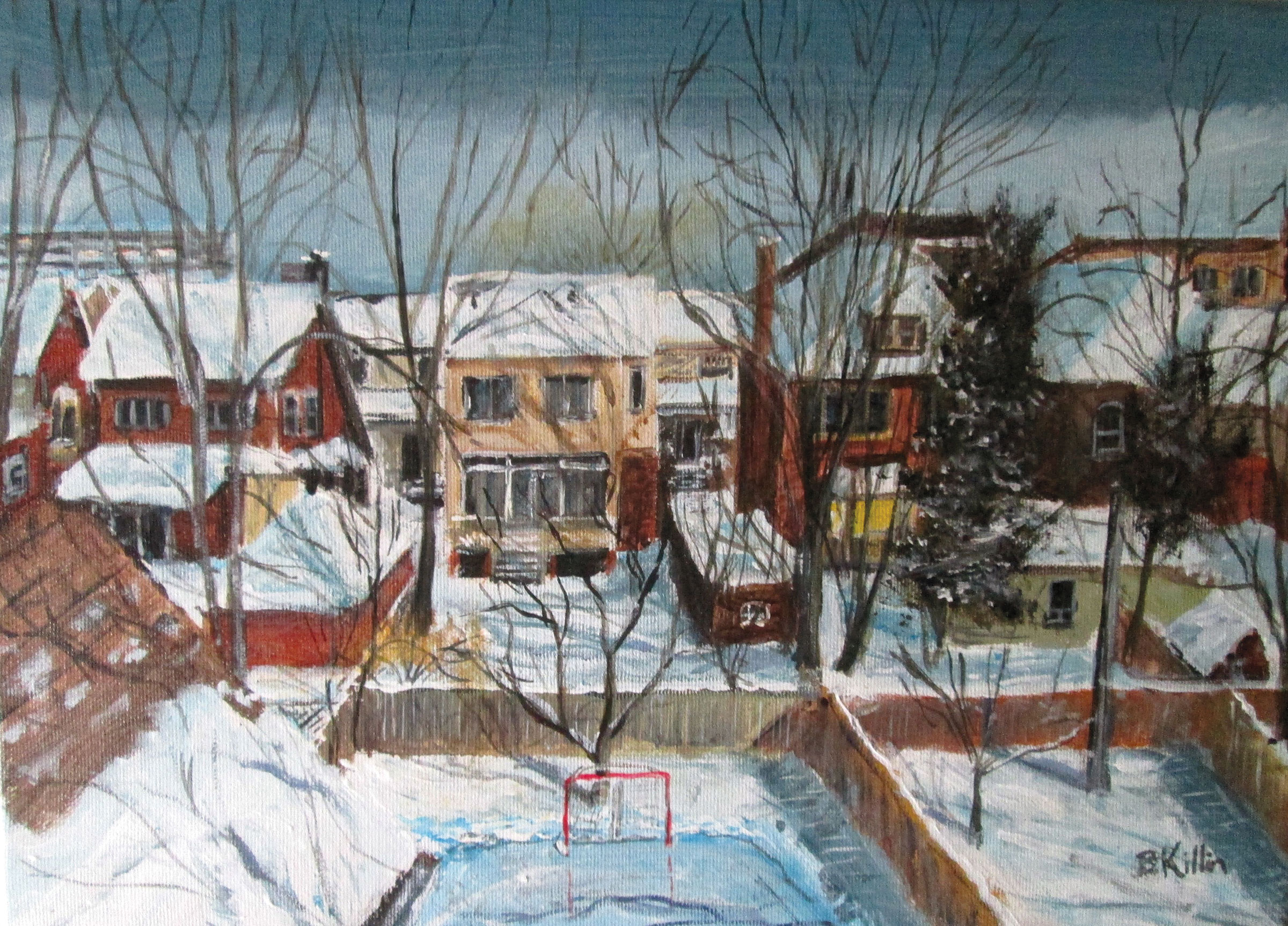
Artist Brian Killin finds inspiration in everyday Canadian life, both rural and urban. His favorite subjects include; a late-night shinny hockey game, a fresh snowfall in northern Ontario, the hustling urban landscape of downtown Toronto, and the peaceful beaches of Prince Edward Island. The breadth of his subject matter is an exploration of Canadian identity. Brian models his artwork after the great Canadian artists, Cornelius Krieghoff and Ken Danby. He has shown his artwork over the past thirty years throughout Toronto.
December 17th, 2021 · Comments Off on NEWS: A tribute to Edward Leman (Dec. 2021)
Modest yet forceful ARA volunteer left his mark
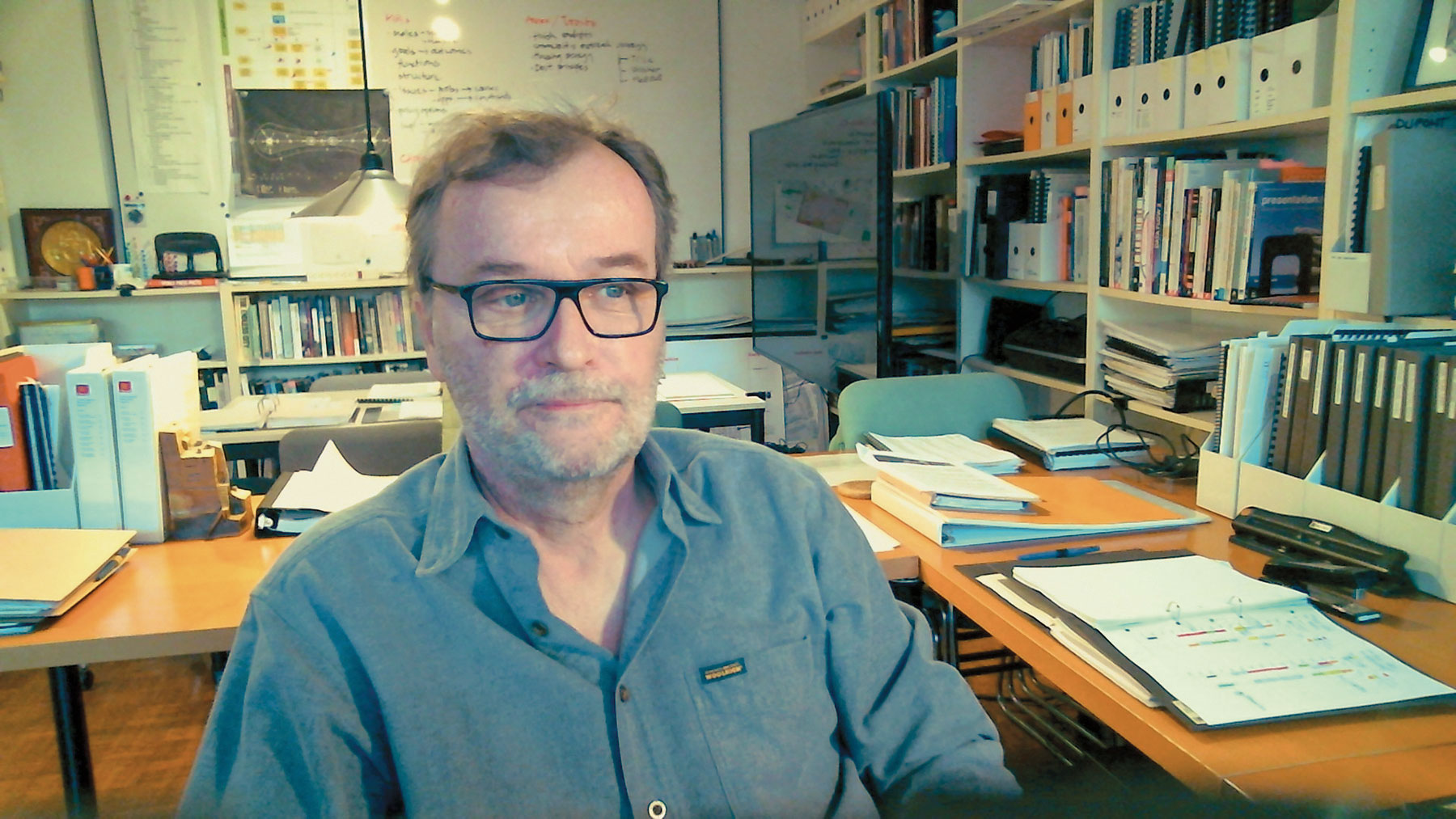
Never a NIMBY, Edward worked hard to persuade developers to work with the community and make adjustments and improvements to their proposals.
COURTESY THE ANNEX RESIDENTS’ ASSOCIATION
By David Harrison
Edward Leman gave more time and expertise to protect the Annex community than any other volunteer director in the modern era of the Annex Residents’ Association (ARA).
Educated as an architect, Leman switched his allegiance early on to urban planning and international development, establishing his consulting firm, Chreod, in 1985.
The biography posted on the company website records an impressive body of international work in development policy and risk analysis.
Leman’s typical aversion to self-promotion means that the website biography is sorely out of date and incomplete. His services were sought across the planet from Chicago to Ho Chi Minh City, from Seattle to Shanghai, from Vancouver to East Java.
He was at heart a modest man who valued family and home above all. And we had the great good fortune that he called the Annex home.
Leman brought all his experience and skills to his role as Co-Chair of our Planning and Development committee.
He held this position for almost 10 years and was able to build a superb group of other like-minded professionals (architects, lawyers and planners) and community leaders to create what has surely become a gold standard for other associations.
A long-time renter at 50 Prince Arthur, he lived and worked there at different times in his life both as a young man and as an adult.
He put to rest the notion that only homeowners can have a proprietary interest in the future of their community.
His aim with the ARA was to ensure that the Annex remained a livable community, and, in between his work that took him to such faraway places as China, Mongolia or Nepal, this occupied ever more time than he likely anticipated.
Never a NIMBY, Leman worked hard to persuade developers to work with us and make adjustments and improvements to their proposals.
This was never easy work but Leman devised the “Working Group” approach which often found the ARA, the city and developers sitting together and making compromises towards a better plan.
Leman’s approach was so successful that it was adopted by other communities.
We were able to make many significant improvements to development plans. The Bloor Street United development would be an excellent example as would the rejection of the proposal at 64 Prince Arthur.
Naturally, success is never guaranteed but even with the testiest of developers Leman kept prodding.
There are, at present, some 30 development proposals in play affecting the Annex, and Leman built remarkable software to keep track of these so they are available for all of us to review.
It is not apparent who of us now will have the skills to carry on maintaining this sophisticated software.
The work he started is not finished and others will take the baton.
Clearly, 145 St. George looms largest and soonest in proposals to be assuaged.
Our bench strength will be able to continue the work he began but will sorely miss his unique skills and insights that always ensured a more interesting point of view.
We offer our sincerest condolences to his wife Dilys and their two daughters.
David Harrison is the former chair of the Annex Resident’s Association.
Comments Off on NEWS: A tribute to Edward Leman (Dec. 2021)Tags:Annex · News
December 17th, 2021 · Comments Off on CHATTER: Tango mesmerizes crowd (Dec. 2021)
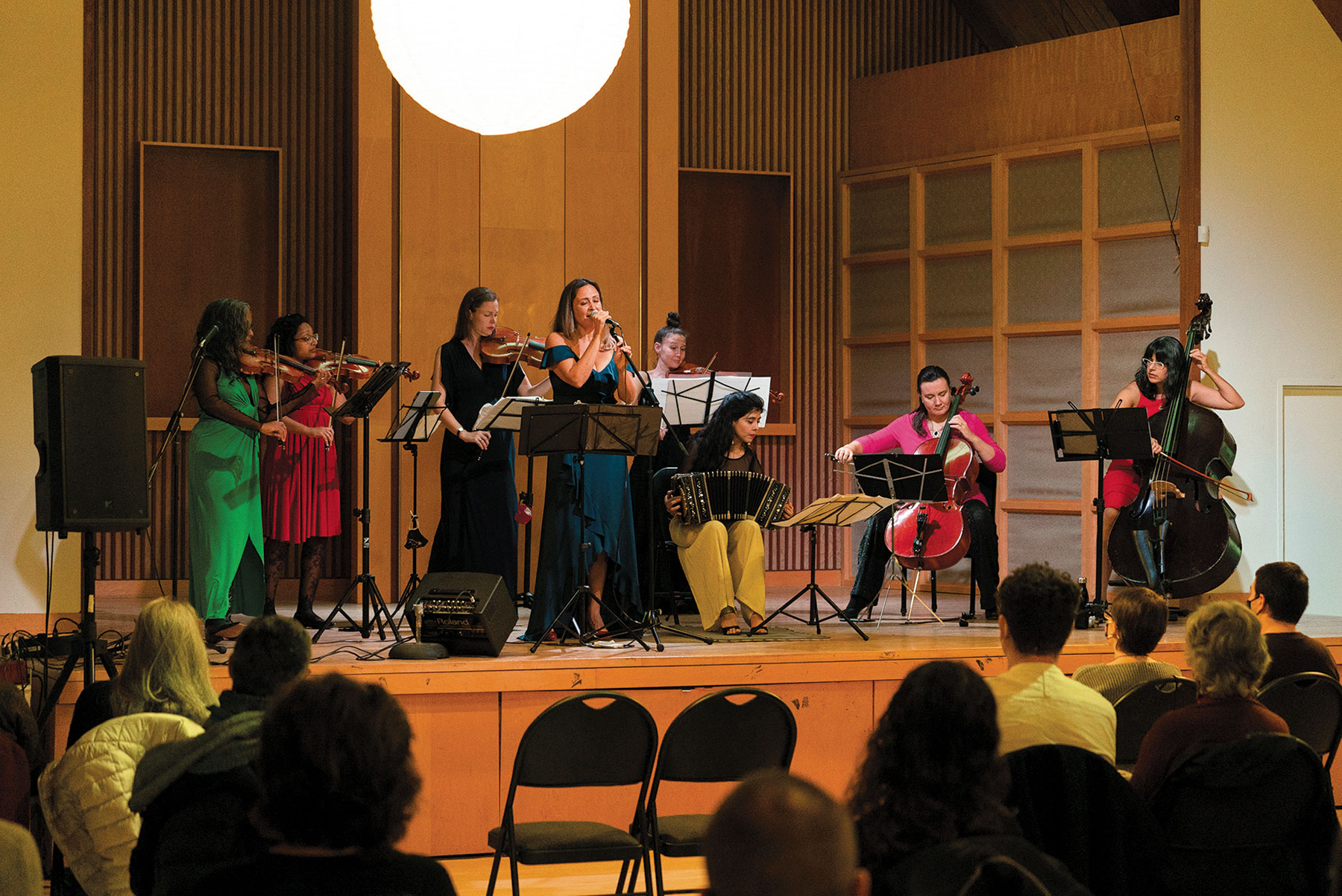
Solidaridad Strings performed their first live concert to a sold-out audience on Nov. 14. From left: Aparna Halpé and Suhashini Arulanandam (violin), Esme Allen-Creighton (viola), Valeria Matzner (vocals), Adriana Arcilla Tascón (viola), Heyni Solera (bandoneon), Sybil Shanahan (cello), Shannon Wojewoda (double bass). COURTESY MICHAEL WOJEWODA
The string ensemble of Orquesta Solidaridad Tango, a new all-women tango orchestra, performed their first live concert to a sold-out audience at 918 Bathurst on November 14th. The physically-distanced crowd gave the musicians two standing ovations after enjoying an evening of contemporary and classic tango music. It is a style infused with longing and mystery.
A highlight of the programme was “On the TTC with Troilo,” an original composition by Annex resident Aparna Halpé, co-founder and lead violinist. The song is about her experience of being stuck on the TTC on her way to a milonga, tango’s social dance.
Tango was born in the 1880s in the dance halls and brothels of Buenos Aires, Argentina. Orquesta Solidaridad Tango was founded in December 2020 by violinist Aparna Halpé, formerly of the Sri Lanka Philharmonic, to celebrate the diversity of women in tango, and to create great tango in Canada. Members of this all-women collective come from diverse backgrounds.
Halpé also had a growing frustration with the treatment of women in tango ensembles.
“Heyni Solera [co-founder] and I were talking about this one evening,” said Halpé. “And she suggested that I channel my frustration into creating an actual ensemble. The thought was terrifying at the start, but here we are!”
Orquesta Solidaridad Tango has already won a $50,000 grant from the Canada Council for the Arts to produce music videos on their YouTube channel. They will have two albums out in 2022, the first of which will feature original compositions by Halpé, “which touch on our collective experiences during the pandemic.”
They have been invited to play in New York, Philadelphia, and Washington DC. They hope to hit the road soon to share their music and their story..
—Nicole Stoffman/Gleaner News
Comments Off on CHATTER: Tango mesmerizes crowd (Dec. 2021)Tags:Annex · News
December 17th, 2021 · Comments Off on EDITORIAL: Ford rolls dice with 413 (Dec. 2021)
The currently ruling Progressive Conservative party of Ontario is looking ahead six months – and strategizing at how to win an election despite a long line of mishaps behind them. They’ll be looking to win support in the 905, and they’ll use wedge issues to get it. A 59 kilometre highway we don’t need is one of the big ones, and the party is already painting Premier Doug Ford as the only leader “that will say yes to growth in the GTA.”
Highway 413 is a proposed four to six lane highway that would connect highway 400 in Vaughan in the east to the Mississauga-Brampton border where highway 407 and highway 401 intersect. The Ford government has not included any cost estimates for the highway in their fall economic outlook, but the previous Liberal government pegged the price at more than $6 billion before abandoning the idea.
According to an expert panel brought together by the Liberal government, Hwy. 413 would reduce travel times by no more than 30 seconds. Ford’s promise of a 30-minute time savings in commute time is an implausible claim given that the route is roughly the same distance as what’s available on existing highways, so achieving that time savings would require that vehicles travel at 180 km/h on the 413.
Ford likes to say that anyone opposed to his plan is just “a downtown activist from Toronto, who thinks people should hop on their bicycle.” While it may be true that downtown activists may want to hear initiatives more aligned with 21st century realities, Ford’s spectacle falls apart when we learn that municipal councils in Mississauga, Vaughan, Halton Hills, and Halton Region are on record opposing the highway proposal. All have called for a federal environmental assessment before it gets the green light. The noted “downtown activist,” Bonnie Crombie, mayor of Mississauga, said “the proposed highway will have a disastrous impact on the environment, encourage residential sprawl, and increase our dependence on cars.”
The 905 mayors get it. They live with the reality of urban sprawl. They appreciate the phenomenon of induced demand, which has been known to researchers since the 1920s. An example is the Katy Freeway in Houston Texas which was expanded in 2011 to make a 26-lane road which did indeed make commute times quicker. However, by 2014 commute times were taking even longer than in 2011. Expanding the highway incentivized car travel and caused new subdivisions to be built. The Ford government has refused to discuss the impact of induced demand if their plan comes to fruition.
The aforementioned environmental assessment will need to deal with the myriad of ecological impacts on watersheds and wildlife if the highway is built. Ford is planning to pave over 400 acres of the Greenbelt, plus 2,000 acres of farmland, 6 km of forest, and cut a wide swath through the Nashville Conservation Area. According to a letter filed by Ecojustice with the federal government, species at risk which could meet their end due to the proposal include migratory birds such as the Chimney Swift, Bank Swallow, Barn Swallow, Bobolink, Eastern Meadowlark, Eastern Wood-Pewee, Loggerhead Shrike, Wood Thrush and Grasshopper Sparrow. No terrestrial wildlife surveys have been prepared for the location and no mitigation measures have been proposed for the protection of these species. It is also anticipated that the Redside Dace, an already endangered species of fish, could be extirpated from its natural habitat should the project proceed.
Ford’s sudden love for a new highway is not well conceived, it is a desperate attempt to stay in power by dangling the shiny object of a quick commute to 905 residents whose votes he needs. But highway 413 is a bad idea for all of us.
Thank you for the recent edition and in particular the area park reviews conducted by your writer Madeline Smart, I really loved the coverage of our parks.
I do wonder, however, why Paul Martel Park has such a bad rating? Have you been there recently? It is just wonderful. The indigenous community has been given a grant to add native plantings and they have done a wonderful job creating a very harmonious space and to top it all off a gorgeous mural has just been added to the entire rear wall of the park. The mural is stunningly beautiful.
Perhaps the park review was complete prior to these improvements? Please take another look and thank you again for the Gleaner.
—Carole Alexander, Annex resident
(summarized from a voicemail message with permission)
Comments Off on LETTER TO THE EDITOR (Dec. 2021)Tags:Annex · Opinion
December 17th, 2021 · Comments Off on FORUM: Tackling the climate crisis at a city level (Dec. 2021)
All levels of government must be engaged in a solution
By Mike Layton
Years ago, I moved a motion asking the city to begin its work to tackle climate change and the request for this report became TransformTO. The first report was received in 2016 with regular report-backs scheduled in the years ahead, but never have the recommendations been finalized into a plan to tackle the climate crisis until now. Finally, after two years of delays due to the pandemic and other issues with finalizing the recommendations, a plan has been put forward to promote the end of surplus carbon emissions in Toronto, ten years sooner than originally proposed.
This is a critical moment in Toronto’s history. This month the city released TransformTO – Critical Steps for Net Zero by 2040. City Council will debate and vote on new climate targets and actions for the first time in years.
We are facing this vote at a time when what the climate crisis means for real people’s lives could not be clearer. The whole country is watching as residents in British Columbia grapple with the impact of devastating floods. This past summer we saw record breaking heat and wildfires. It is clear we are facing an emergency and we need to act like it.
The targets set out in the report are the right ones and I am proud that our city is making a firm commitment to net zero emissions by 2040 – this is something that I helped fight for, alongside many of my residents and those involved in climate policy, when we passed our climate emergency motion in 2019. There have been other successes along the way as well, including the introduction of a climate lens on all capital budget decisions moving forward, and a stronger dedication to building and investing in alternative forms of transit to support our growing city in a sustainable way.
However, what is clear when looking at TransformTO and the report before council this month, is that we are lacking many of the specific actions needed to reach these targets. It is like heading on a road trip, but having big pieces of the map missing. This worries me greatly.
It is not too late. Toronto can still get it right and show bold leadership on climate change. We can learn from cities like Vancouver who have passed detailed and ambitious plans this year and from the many dedicated, smart and ambitious climate scientists and environmental organizations who are calling for faster action. We can make the realistic, and incredibly necessary changes we need so that when this comes to city council in December, I can vote knowing that I am doing everything in my power to build a better world for my daughters and everyone else who will outlive the politicians and leaders who will be deciding the world’s fate for them.
I will be moving motions to fill in the pieces of the map with strong positions and policies that reflect the urgency to change and support efforts to accelerate our progress as quickly as possible. Further, the budget debate will occur in the new year and this is where we need to show that our commitment to TransformTO goes beyond press releases and pretty images. We need to make decisions in our budget to reflect our policies and begin immediate work to fight the climate crisis.
Mike Layton is the city councillor for Ward 11, University—Rosedale.
December 17th, 2021 · Comments Off on FORUM: Premier Ford gets an “F” (Dec. 2021)
Auditor general’s report shows Ford is failing the environment
By Jessica Bell
On November 24, the auditor general released her annual report on the environment. It reads as a dry and horrifying account of Premier Doug Ford’s assault on our natural environment, health and future. Here are the lowlights.
Ontario’s new Minister of the Environment David Puccini likes to wax on about his participation in Canada’s delegation to the Glasgow climate negotiations in the legislature, but the government is on track to meet just 20% of its promised carbon reductions by 2030. Ontario’s elected leaders are failing to do their part to stop climate change.
Furthermore, the Ford government is failing at tracking and reporting on the health of our environment. The auditor general’s report says that currently, our government ministries do not adequately track and report on water quality, greenhouse gas emissions, soil health, pesticide use, pollinator health, hazardous spills, and wetland preservation. Doug Ford doesn’t want to know the harm he’s causing, so we’re not allowed to know either.
The Ontario government is regularly violating the Environmental Bill of Rights (EBR). Ontario’s EBR law enshrines our right to information and public consultation on environmentally significant decisions, as well as the right to ask for a review or to appeal these decisions.
The government didn’t use the EBR process when it approved Ministerial Zoning Orders to bypass land-use planning rules, nor did they use the EBR process when it gutted conservation authorities’ power to protect us from flooding. Our EBR law should be strengthened, not ignored.
Now on to waste management. Our province is a competitor for most waste per person in the world, and we do a very poor job of recycling and reusing the waste we create. Condos, apartments, industry, business, and big institutions, like schools, are the worst offenders. The vast majority of this industrial and commercial waste ends up in landfill. Materials that have been separated into recycling and compost bins are often re-diverted to landfill by the poorly regulated waste management industry.
To incentivize recycling and reuse, provinces like Nova Scotia and Quebec have increased the cost of landfill use by banning the dumping of certain products and increasing landfill fees. There is also huge value in taking upstream measures to reduce the production of waste in the first place: banning single use plastic, strengthening consumer protection and warranty rights to improve the quality of products sold in Ontario, and instituting right to repair rules to stop companies from stymieing the production and sale of generic replacement parts, can all help.
Ontario companies spill hazardous materials about 8,000 times a year into our air, land and water. Most of these spills are from the oil and gas sector. The Environment Ministry does not tell Ontarians where a hazardous spill has occurred, who caused the spill, or what specific impacts a spill could have on human health and the environment. The government has also reduced its inspection and enforcement power to stop companies from repeatedly spilling. In 2021, companies operating in this province can spill with near impunity. This is immoral.
If we don’t take meaningful and bold measures to protect and respect the living world, the people of this province face a harsh and miserable future. You and I know this. It is our responsibility to guide Ontario towards a sustainable, thriving and fair future. It’s why our Green New Democratic Deal platform to transition to a truly sustainable and green society and economy is a priority for us. Doug Ford is clearly incapable of doing anything close to this. His time in the premier’s office should end.
December 17th, 2021 · Comments Off on LIFE: Honouring son in area parks (Dec. 2021)
Suicide seen as collateral damage during COVID-19
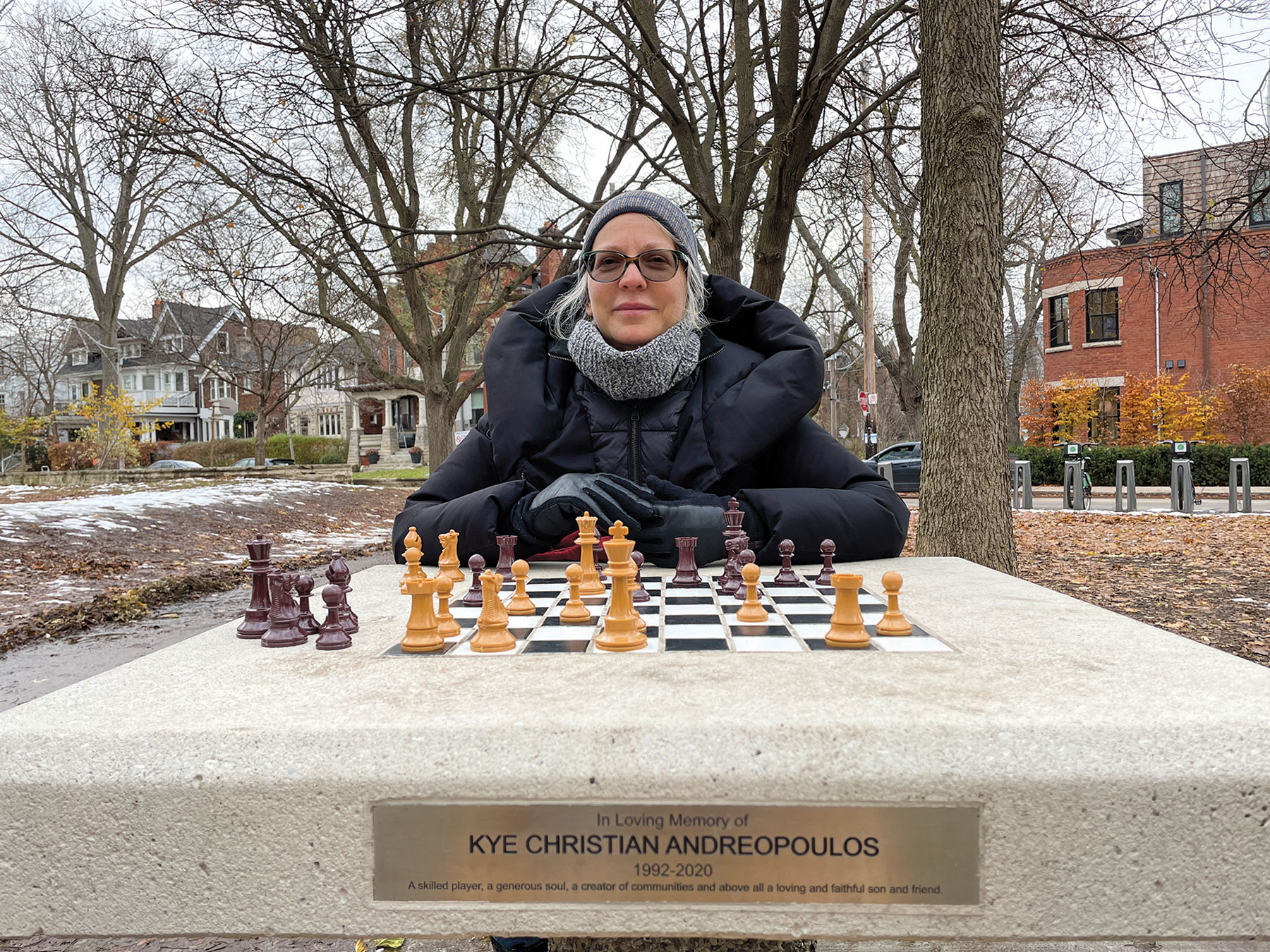
Christine Andreopoulos plays chess at the table she donated to Jean Sibelius Square in honour of her son, Kye Andreopoulos, “a loving and faithful son and friend.” Kye took his own life, age 28, due to failures in our under-resourced mental health system, stretched to the breaking point by the pandemic, she said. “That psychiatrists couldn’t see their patients in-person. To me, that was the wrong part.”
NICOLE STOFFMAN/GLEANER NEWS
By Nicole Stoffman
Local park goers may have noticed a new chess table at Jean Sibelius Square. It is dedicated to the memory of Kye Christian Andreopoulos, “A skilled player, a generous soul, a creator of communities, and above all, a loving and faithful son and friend.”
Mr. Andreopoulos took his own life during the second wave of the pandemic, due to failures in our under-resourced mental health system, stretched to the breaking point by the pandemic, said his mother, Christine. “I truly think that if it wasn’t for COVID, he would be here,” she said.
He developed bipolar disorder (BD) a few years into a promising career as a business analyst. According to his mother, the stress of working in IT, running a business on the side, experiencing a break-up, and smoking pot to self-medicate triggered his first episode in 2017.
There is no known single cause of BD, but research points to changes in how some nerve cells in the brain communicate. This increases vulnerability to stress, so that upsetting experiences or substance use can trigger episodes, according to the Mood Disorders Association of Ontario.
A 2020 survey conducted by the Canadian Mental Health Association showed that suicidal thoughts or feelings rose 27% during wave 2, among people with pre-existing mental health conditions. Ms. Andreopoulos told the Gleaner that she believes his life could have been saved if he had access to appropriate care.
Ms. Andreopoulos described getting help for her son during the pandemic as a “horror story.” As an outpatient at CAMH, she says, he would have to wait five or six hours every week to see a different psychiatrist. Those appointments would usually last for 20-30 minutes.
She says she finally screamed and cried for one psychiatrist to work with her son. In response, a third-year student resident in the Moods and Disorders clinic was assigned to work with him that very same day.
Mr. Andreopoulos had 30-minute online appointments with the resident, every 2-3 weeks. His mother persisted in asking for in-person, more frequent psychotherapy. On their website, CAMH recommends psychotherapy, alongside medication, as the treatment for BD. Before the pandemic, Ms. Andreopoulos said her son had been “on a good road,” while getting in-person care at the Stratford Hospital, where he had travelled during a manic episode.
“Kye needed therapy to deal with everything that was going on in his life,” she said. “He was getting divorced, living with his mom, feeling dependent. He needed to cope with his thoughts and his depression and his weight gain. He was obese. He needed so much more than medication.”
Kye Andreopoulos took his own life, Dec 29, 2020. He was 28 years old.
He left his mother a suicide note. “The tragedy is that he didn’t feel there was anyone who could help him,” she said. “And that’s what he said. And that’s the unfortunate thing, is to die thinking that way.”
Ms. Andreopoulos says that she was looking for alternatives to CAMH prior to her son’s death, but could not get him into residential long-term care because they were not accepting patients due to COVID-19. She adds that she was not able to get him in to see a private therapist, because he was an adult, and had to make the request himself and was not motivated to at the time. She was not told by the resident that she could apply to be a Substitute Decision Maker (SDM), for this purpose.
The Gleaner was unable to corroborate Ms. Andreopoulos’ story because CAMH declined to comment on the case, citing patient confidentiality. CAMH also declined to answer the Gleaner’s more general questions in relation to their suicide protocol, and whether they experienced a shortage of psychiatrists during the pandemic.
Ms. Andreopoulos says she came up with the idea of the chess tables one day as she was walking through Sibelius Park.
“Kye loved the chess culture in cities like New York, where strangers can meet over a game. I think Kye would have sat down, and he would have played anybody,” she said. “And maybe if he made that one connection in the park one day, maybe that would have been it. A mom can only do so much.” Kye’s father, Chris, passed away from cancer in 2007, when Kye was 14.
She reached out to Councillors Layton and Bilão in June. By September 16, the project was complete. Two chess tables and a bench were placed in Dovercourt Park, Kye’s local park, and one chess table was at Jean Sibelius Square, his childhood park.
“It should not need to take an increase in deaths to act,” Councillor Layton told the Glaner. “And the province continually works to reduce access to these integral supports.”
Ms. Andreopoulos buried Kye’s baby teeth under the bench in Dovercourt Park. She says she hopes the community will enjoy the chess tables, but also be reminded that it’s ok to talk openly about mental health.
“I think what she did is pretty amazing,” said Michael Sutton, at the Chess Institute of Canada. “There’s a huge mental health aspect to chess. It’s a great way to teach kids about decision-making. You can stop kids from going down these dark paths, and making choices they can’t come back from.”
Ms. Andreopoulos has sold her house and is off on a journey. She is going to hike a rock formation in Scotland that her son didn’t finish climbing when he was studying at the University of St. Andrews. She will walk the Camino de Santiago, beginning on Kye’s birthday, and plans to work on a turtle reservation. She will scatter his ashes everywhere she goes.
If you or someone you know is experiencing suicidal thoughts or behaviours, call Distress Centres of Greater Toronto at 416-408-4357 or text 45645. If it is an emergency, call 911.
Comments Off on LIFE: Honouring son in area parks (Dec. 2021)Tags:Annex · Life
December 17th, 2021 · Comments Off on LIFE: Finding tombstones in your yard (Dec. 2021)
Palmerston area resident traces origins of Hebrew headstones
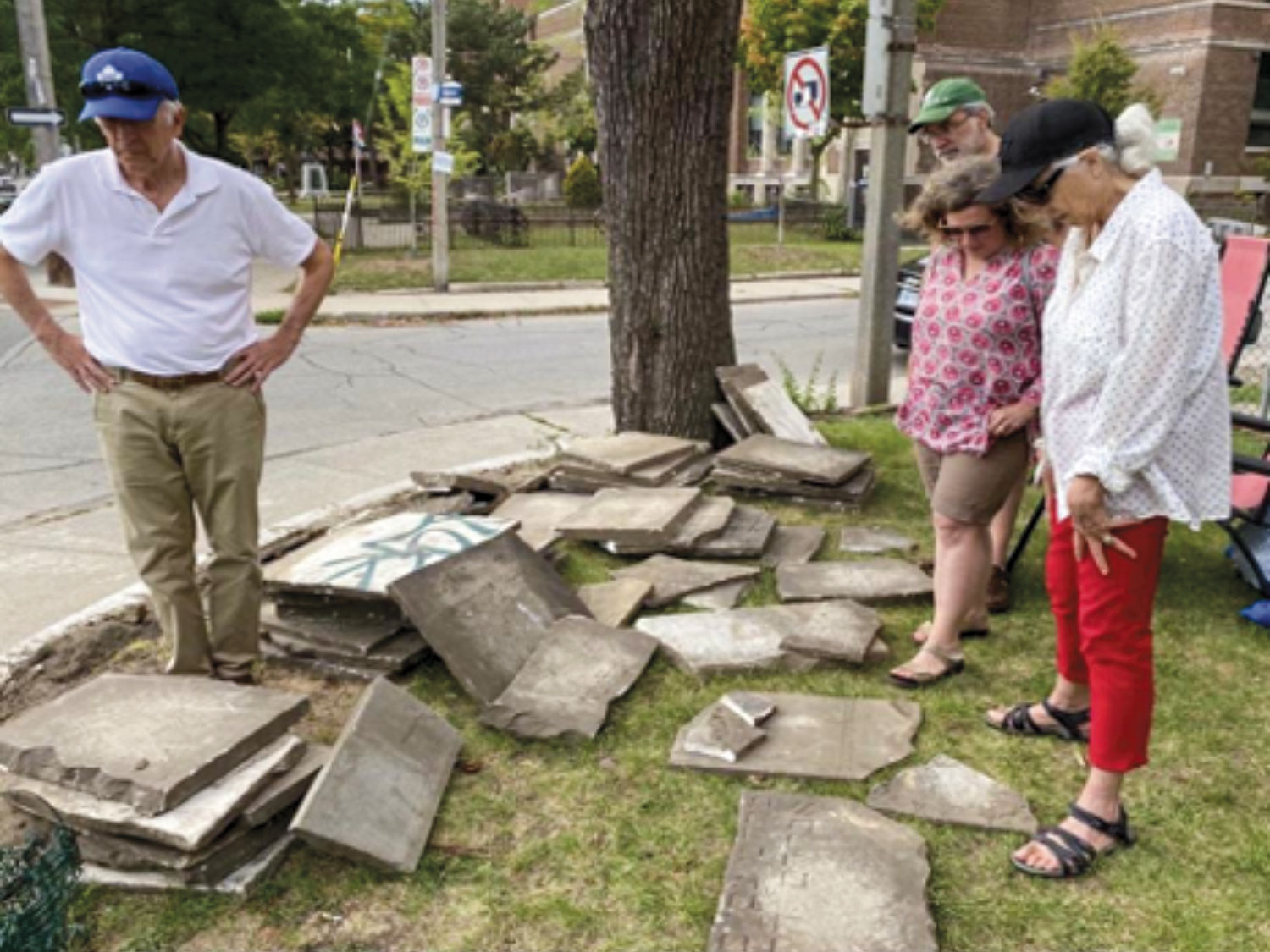
(From left) Doug Reeve, Greg Beiles, Yael Schacter, and Melanie Reeve inspect about 50 flagstones mysteriously engraved with Hebrew lettering. The stones were found on Miriam Schacter’s front lawn, and she is asking for community input to identify their origin.
COURTESY OF MIRIAM SCHACTER
By Margarita Maltaceva
In September, Palmerston area resident Miriam Schacter noticed Hebrew engravings on flagstones that her landlord dug up while working on her front lawn.
When she realized that the inscriptions were in fact names, she started to wonder if they had found gravestones.
“The ground beneath my feet literally changed,” she said, describing her feelings when she noticed the Hebrew lettering. Now she is looking for family members of the people whose names are engraved on the stones.
“It’s out of respect for a community that existed in the past,” Schacter said. “Their stories are important, even if this is the tiniest memorial that signifies that someone lived and someone died.”
Schacter gathered a small group of people to help her lift the heavy stones and spread them on the lawn. Some of the lettering was done by hand and resembled carving from the early 20th century.
One stone had the family name “Kirschenboim,” while the rest had Hebrew patronymics referring to the father’s name. Some of them were made of marble, and the stones had different sizes and thicknesses.
Schacter learned that unlike traditional Jewish gravestones, these stones lacked important features including dates of birth and death; as well as the Hebrew letters peh and nun, meaning “here lies.”
Howard Goldstein, the coordinator of the JGS Toronto Cemetery Project, assessed the stones and concluded that they might have been “first drafts” of headstones, which a stonemason did not complete because the family did not like them.
Alternatively, the stonemason may have been practicing his carving skills on the stones.
Goldstein does not think that the stones were ever placed on a grave.
“With the exception of any historical value, there’s no need for these stones to be treated as anything other than rubble,” he wrote by email.
Nevertheless, Schacter, who is the only Jewish person in her building, continues her search to unravel the history of the Hebrew rocks.
After she posted the pictures, a volunteer named Carolynne Veffer offered to match the only full name on the stones – Samuel Kirschenboim – with names in Jewish cemeteries.
She said she used a powerful tool called JewishGen to look for a match.
In its Worldwide Burial Registry, Veffer matched Kirschenboim‘s name with one of the graves located in Roselawn Cemetery in Toronto.
However, when Goldstein compared the headstone from Roselawn cemetery with the stone found on Schacter’s lawn, he said they bore “no resemblance.”
Although the mystery of the rocks has not been resolved, Schacter refuses to throw them away. She wants to find a proper place to keep the stones out of respect for the people whose Hebrew names are carved on them.
Schacter added she wants to create a website to post the pictures of the flagstones with translated Hebrew inscriptions.
She’s also gathered a group of six people to help her decide what to do with the stones next.
For more information or to get involved in the project, email Miriam Schacter at danceabilitiescanada@gmail.com.
—With files from Nicole Stoffman
Comments Off on LIFE: Finding tombstones in your yard (Dec. 2021)Tags:Annex · Life