March 14th, 2022 · Comments Off on FORUM: Building a progressive city budget (Winter 2022)
Affordable housing, climate initiatives, road safety all on the agenda
By Mike Layton
The 2022 budget process will have wrapped up by the time this publication goes to print, but I still thought I could provide an update on some of the policy pieces I have been working on advancing through my role on the budget committee.
My focus in budget committee has not wavered from working to ensure we are building a more just, green, safe, and equitable city.
Some things that have already been accomplished include the expansion of services to Indigenous residents in Ward 11, and by extension city-wide through 2 projects.
First, we are looking to build Indigenous affordable housing in the parking lot at 19 Spadina Road (and I will have more information about this in future updates) and secondly, plans for the Thunder Woman Healing Lodge, a little further north on Spadina, are close to being fully realized.
On climate, council has agreed to, as part of developing a climate lens on budget decisions, establish a process for identifying projects that produce net positive and net negative climate impacts.
I still need to work to have council support funding for more city planners assigned to improving the Toronto Green Standard and ensuring our future builds are as green as possible.
Unfortunately, there are still major holes in the budget when it comes to housing and road safety.
The need for affordable and supportive housing units has never been greater and the province must provide the City of Toronto with the funding necessary to meet our targets.
While council has a commitment to ensure these funds are available to us, I worry about what will happen should the province decide not to fund our supportive and affordable housing targets, and the budget has no contingency built in to support this.
Safety in existing units continues to be a concern for many tenants and I tried to increase funding for RentSafeTO enforcement, but this failed on a vote of 5-1.
Council must stop pretending that renters and tenants do not exist and start funding the services they need properly.
We must also be looking to further expand the Multi-Unit Residential Acquisition Program to support the acquisition of housing by community agencies in order to provide housing.
I attempted to remove $2.6 million from the Toronto Police Services budget to put toward enforcement of poor rental property standards and protection of the health and safety of Toronto’s tenants. Unfortunately, this did not pass.
Throughout the budget deputations from the public, I consistently heard calls to address the police budget, but council has not yet shown any indication or willingness to decrease this budget.
We must work to fund alternative service response models.
Lastly, road safety continues to be a priority in every transportation related decision I make.
While the budget continues to prioritize Gardiner rehabilitation over the majority of other capital needs on our road infrastructure, there are actions council can take to limit the danger and exposure on our roads by increasing Automated Speed Enforcement and lowering speed limits.
Council will be looking to expand Community Safety Zones on all arterials in all of Toronto, but a study is not truly action.
We must find creative ways to hold those driving dangerously to account.
My hope is that by the time this is published, in addition to all of the above, council will have approved: waiving library late fees; increasing the senior’s digital literacy program; capital funding for the TTC to expand their fleet; providing free menstrual products across all service agencies; reallocating resources from the Toronto Police Service to support community services and alternative response models. We will see.
I provide more frequent and timely updates through my e-newsletter and encourage everyone to visit www.mikelayton.to and sign up to receive bi-weekly updates on the goings-on in Ward 11.
As always, please contact me at councillor_layton@toronto.ca if you have any questions, or concerns.
Mike Layton is city councillor for Ward 11, University–Rosedale.
March 14th, 2022 · Comments Off on FORUM: Ford’s antics fill Pink Palace (Winter 2022)
MPPs return to Queen’s Park in final controversial legislative session
By Jessica Bell
Canadian-content rules lowered for Ontario Line
Premier Ford is allowing companies who would like to build vehicles for the Ontario Line to cut their Canadian-manufactured content from 25 per cent to 10 per cent.
Fewer government dollars will now go to creating good green jobs at Ontario’s public transit manufacturing plants in Kingston and Thunder Bay.
Despite the rhetoric and the colourful maps, Premier Ford’s track record on improving transit is poor.
The government canceled the shovel-ready Relief Line in 2019, has allocated minimal funding to building its four priority transit projects, and has done nothing to reform the provincial transit agency, Metrolinx, by making it more accountable, transparent and cost-effective.
To build a prosperous green economy and a green transportation sector, Ontario must fairly fund public transit, build new transit lines and ensure that Ontario dollars are directed to creating good green jobs in Ontario.
The Ontario Line also needs to be built right, which means choosing a route that serves our city, and not just big developers, delivering the project using the public delivery model, and fully integrating the new transit line with the TTC so it costs a TTC fare to ride.
Housing affordability task force doesn’t address affordability
Ontarians are being crushed by the skyrocketing price of housing. With just four months left of their mandate, in January the government-backed Housing Affordability Task Force released a report on how to address housing affordability in Ontario.
The report includes 55 recommendations to speed up the construction of new homes, Lands Tribunal reform, giving the province greater power over construction and planning approvals, increasing density, and opening up farmland to urban sprawl.
We support building new homes to meet the needs of Ontarians. We have long called for zoning reform to increase density and spur the construction of thousands of missing middle homes within existing neighborhoods and municipal boundaries.
The government-backed report fails to address affordability. The report makes no recommendations to build new affordable housing, stabilize rent, help renters get repairs done, or protect renters from eviction.
Nor does the report make any recommendations to address foreign and domestic speculation, even though investors are the biggest purchaser of homes in Ontario today.
We expect the government to introduce legislation this session to enact some of the recommendations in the government-backed report, and I look forward to working with University-Rosedale residents to ensure housing affordability is a priority.
Licence plate fees ending
The Ontario government has introduced legislation – Bill 84 – to end the license plate sticker renewal fee of $120 a year, resulting in a loss of almost $1 billion in government revenue.
This is revenue that should continue to be used for health care, education, and public transit so Ontario can transition to a green transportation sector. The cancellation of license plate fees is a decision that I do not support.
Health care surgery backlog described as catastrophic
We are lucky to have some of Canada’s best hospitals near us, including Princess Margaret, Toronto General, Toronto Western, Mount Sinai, Sick Kids, and Women’s College. University-Rosedale is also home to many of the health care workers who are responsible for healing us when we are sick. Thank you.
I’m very concerned about the state of health care today.
Up to 400,000 Ontarians are waiting too long for necessary surgery – a surgery backlog that doctors are describing as catastrophic.
This means people are experiencing anxiety, pain and a reduced quality of life as they wait too long for cataract surgery, MRIs, hip replacements, heart bypass surgery, and even cancer surgery.
We support the Financial Accountability Office’s recommendation to invest $1.3 billion to address the surgery backlog.
Instead of investing, the Conservatives continue to underfund health care and suppress health care workers’ wages well below the rate of inflation.
The exodus of exhausted and demoralized health care workers and nurses will continue until Bill 124 is repealed and health care staff are properly paid for their heroic work.
We are a healthier and more prosperous province when we all have access to universal public health care when we need it.
As your MPP, it’s my job to fight for this vision.
Please reach out to our office if you need help, or have questions or concerns.
February 4th, 2022 · Comments Off on ON THE COVER (Jan. 2022)
A four-alarm fire at 828 Shaw St. on January 15 displaced all 11 occupants. Four were sent to hospital, one in life threatening condition. The building is owned by Rakesh Gupta of Gupta Realty, who has been charged 12 times since 2018 for not completing city-issued work orders at the site in a timely fashion. ARLYN MCADOREY/GLEANER NEWSNeighbours have rallied to raise $28,000 from a GoFundMe campaign to support the former tenants of 828 Shaw St. The building was already being investigated following a smaller fire January 5, and had been the source of 53 registered complaints between 2018-22, according to a CBC report. NICOLE STOFFMAN/GLEANER NEWS
Comments Off on ON THE COVER (Jan. 2022)Tags:Annex · News
February 4th, 2022 · Comments Off on NEWS: Honouring the past in future planning (Jan. 2022)
Declaring the Annex a heritage district vetted by community
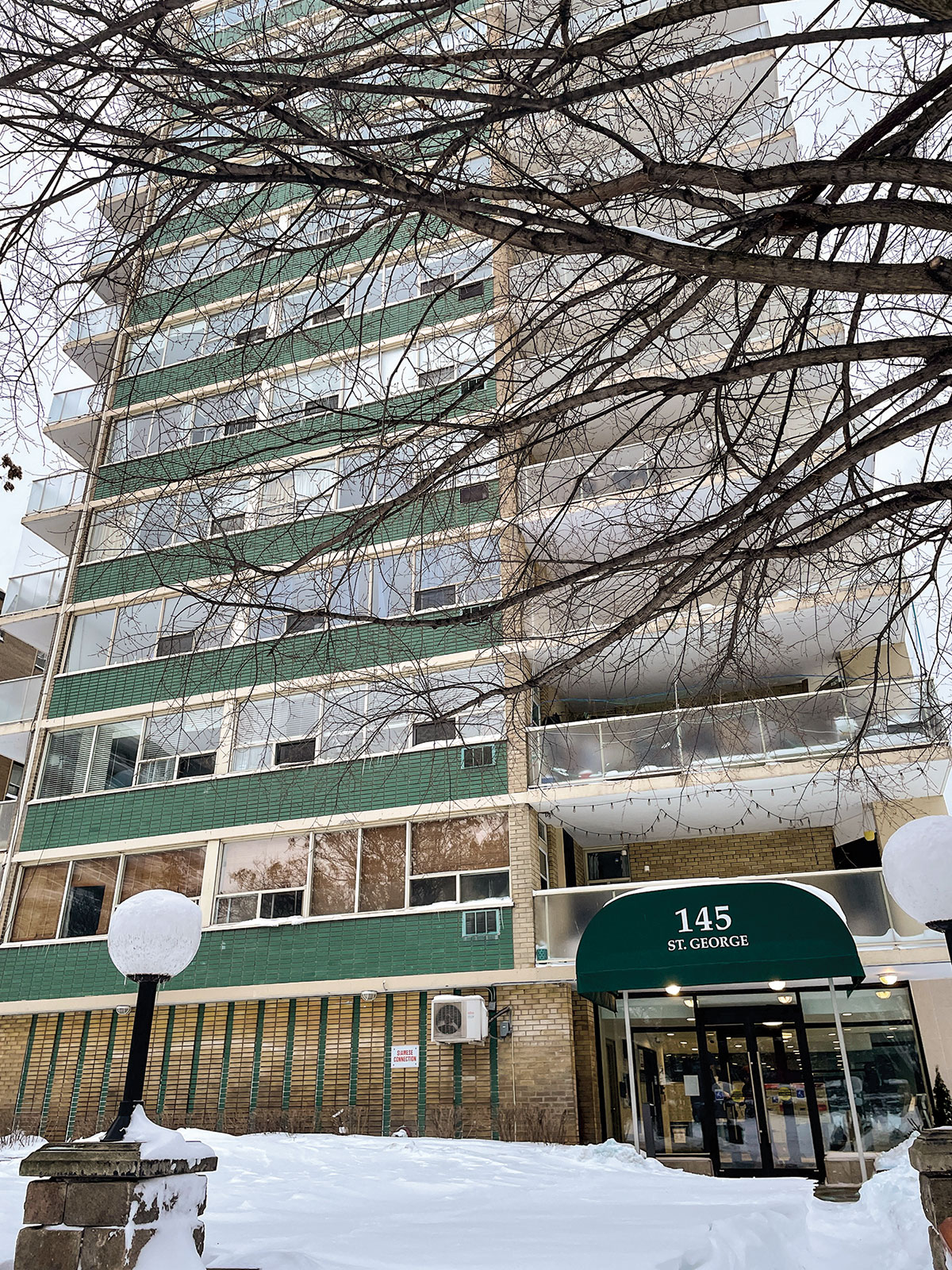
An HCD would apply a broad definition of heritage that could include any building that contributes to the neighbourhood’s character, such as the mid-century modern apartments on St. George Street. NICOLE STOFFMAN/GLEANER NEWS
By Nicole Stoffman
If the West Annex Heritage Project follows in the footsteps of the East Annex, the area between Bedford Road and Bathurst Street could become a Heritage Conservation District (HCD) as early as 2024. In September and October, consultants connected with local residents at two virtual meetings to discuss the project and the changes it might bring. While few questions brought forth solid answers, participating residents had plenty of thoughts on what makes the Annex special.
A community member at a Sept. 23 meeting wanted to know if a heritage designation would mean increased renovation costs that could be passed on to tenants. Annie Veilleux of Archaeological Services Inc. (ASI) did not provide a direct answer, instead she offered that the historical report her team will write will include reference to the high number of renters in the area.
Paul Rezler wanted to know how an owner could go about demolishing a designated property if more rental housing is needed in the future. Rebecca Sciarra of ASI replied,
“Ultimately, as part of a conservation district, the study and plan phase would go through a process of understanding which buildings contribute to this place, identify them, and put in place policies and guidelines to best retain those buildings to the fullest extent possible.”
Tamara Anson-Cartwright from Heritage Planning at the City of Toronto was in attendance at the Sept. 23 meeting, yet moderator Josh Fullan did not call on her to answer any questions pertaining to the city’s heritage planning policies.
As noted in the Gleaner’s July article on the project, any demolition proposal for a building that is designated as a heritage building would see a representative from the city’s heritage planning department at the table from the application stage. Appropriate massing, materials and scale would need to be incorporated in any redesign of a heritage property within the HCD.
Should the West Annex become an HCD, the HCD bylaw will be registered on the title of each property. However, not all buildings will be treated equally, Sciarra clarified in a follow up email to the Gleaner. A building that is considered to contribute to the character of the district will have greater restrictions on it, than one that isn’t. Owners should understand that in an HCD, a demo permit application for any building would have to go through a heritage permit system.
Daniel Bain, a participant at the Oct. 14 focus group expressed concern about the invasion of high rises on St. George Street, and asked how an HCD will preserve the neighbourhood. Instead of answering his question, consultant Eleanore Rae asked him to elaborate on his concerns.
The project consists of taking an inventory of every building within the West Annex, and compiling a history of the area that will seek to define what makes it unique.
ASI is looking for the public’s help in defining the West Annex from the 1990s to the present. Moderator Josh Fullan asked the 16 focus group participants how they’d describe the Annex in a single word, and the answers were; friends, bohemian-cosmopolitan, diversity, established, quirky, diverse, liveable, lively, and historic.
Adaptive reuse of housing stock emerged from the group discussion as a defining feature of the Annex’s heritage. The majority of late 19th century single family homes were converted to rooming houses after the war as a response to increased demand for housing. Rooming houses have also been converted to public housing, group homes and shelters, which are remarkably well-integrated into the community.
“How that has worked is worth looking at,” noted Annex resident Catherine Oliver. Sciarra replied that focus group discussion has brought this theme to light, and ASI will report back on it at the next focus group in March.
Many rooming houses were renovated back into single family dwellings starting in the 1970s. Marjorie Harris, celebrity gardening author, recalled how resented they were as the first renovators on Albany in 1967. She now describes her neighbours as, “a safety net.”
To this day, 75% of residents are renters, noted Tim Hadwen, a retired public servant. Renters tend to be quite active in the arts, he noted, and contribute to the neighbourhood’s artistic flare, past and present. Hadwen also noted that proximity to cultural institutions like the Tranzac club, Koerner hall, and Tafelmusik enhance the pedestrian experience in the West Annex.
“The sacred core of the Annex is beautiful people who care about others,” said Elliott Shulman, from the Avenue Road Food Bank, commonly known as “The Avenue.” To illustrate, he shared a story about how artist Lynne Dagliesh donated “thousands of dollars,” to the food bank, the proceeds from the sale of her pandemic mural posters.
Parks and gardens emerged as another defining feature of the Annex. “The Vessel,” by Ilan Sandler at Taddle Creek Park, has made an impression on Maxine, a resident of five years. “There’s this immense beauty, with the flowers cascading around it,” she noted. Shulman admitted “I never really noticed flowers until the pandemic. They really stood out as symbols of hope.”
Bain, CEO of Thornmark Asset Management and a 20-year resident, noted that the Annex is diverse, liveable, central, and relatively well-preserved. “These are all the things that make the Annex an attractive place, and a place worth fighting for.” he said.
The West Annex Heritage Project’s final report will be submitted to city council by August 2022.
A third focus group will involve a walk through the neighbourhood. A focus group in March will delve even deeper into the issues. Email info@ara.org with “West Annex Heritage project,” in the subject line, to have your say.
February 4th, 2022 · Comments Off on NEWS: They come for the grub but leave with much more (Jan. 2022)
The Avenue Foodbank strives to put itself out of business
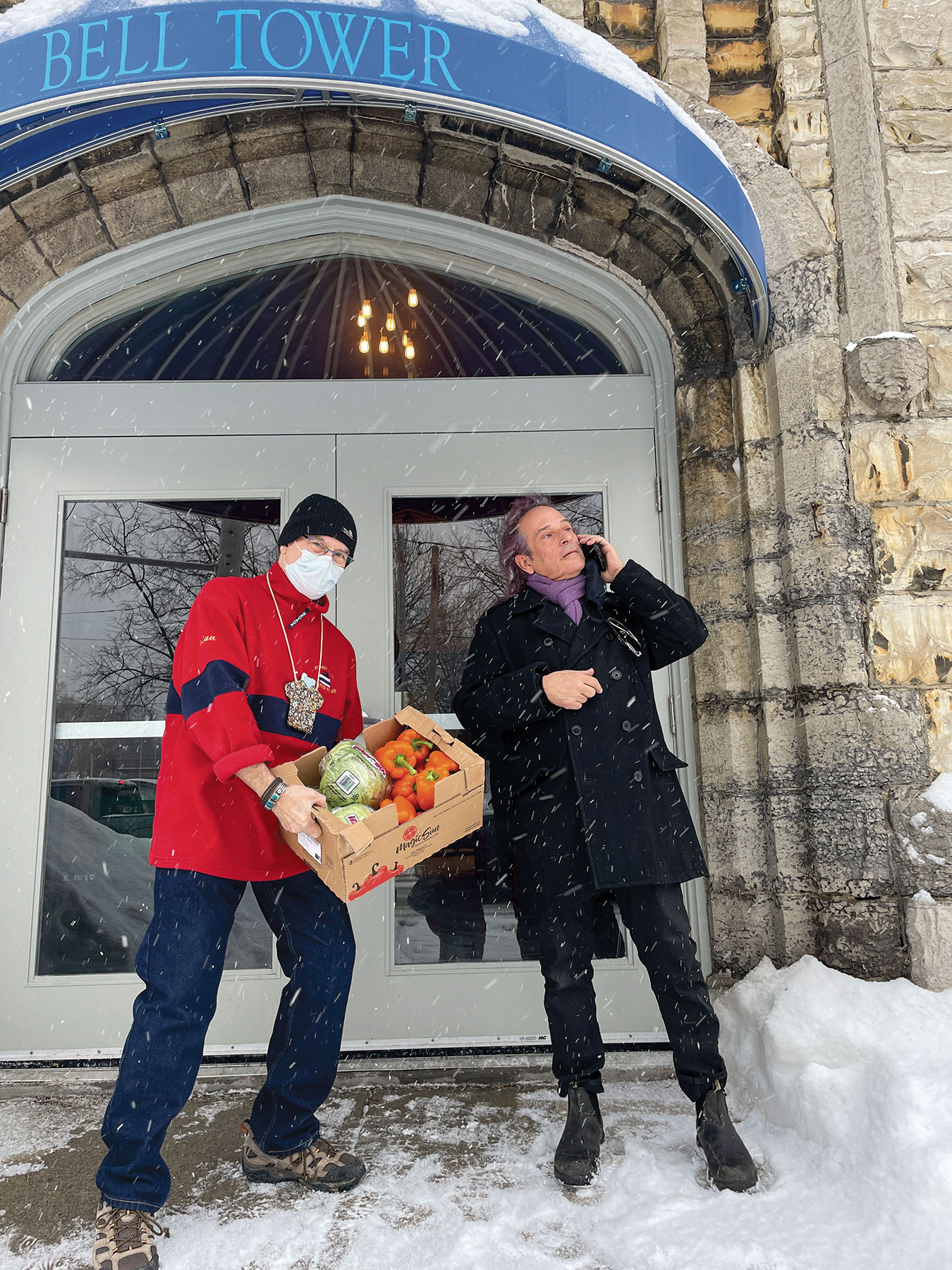
Bob Mandel (left) and Elliot Shulman helped keep 13,465 people fed in 2021. It was the Avenue food bank’s busiest year yet. NICOLE STOFFMAN/GLEANER NEWS
By Nicole Stoffman
If you step into the Avenue, you’ll be greeted with a sandwich, a pastry, and a coffee. You’ll feel like an honoured guest, and just might forget that you are visiting a food bank. The Avenue, located at the Church of the Messiah on the corner of Dupont and Avenue Road, moved from Walmer Road Baptist Church in 2018. This past year, they helped to feed 6,484 households. However, the people behind this institution are hoping the food bank can put itself out of business – they want to do more than give people food when they’re having a rough time – their goal is to build relationships and help people re-build their lives.
“We have to end the word ‘foodbank’,” says Elliot Shulman, cofounder and community coordinator at the Avenue, and cofounder of the Guild of the Next Step, a peer to peer support group available to Avenue guests. “Food banks are an antiquated, albeit important resource, but they can be so much more with a slight change in the mission, and the mission is to help people overcome.”
Shulman and hospitality coordinator Bob Mandel, have led the transformation of this food bank. They call themselves “the people guy,” and “the food guy,” and seem to both have a well of boundless compassion and energy to dedicate to their task.
Shulman used to be a production director at Astral Media and punk rock drummer. Then, a cocaine addiction led him into poverty. Mandel was the owner of The Cajun House, a high-end restaurant in Montreal that served alligator and crawfish imported from New Orleans. He also taught at Montreal’s Culinary Academy before moving to Toronto, where a heart attack forced him to lose his job as operations manager for The Kitchen Table. So, he found himself at a food bank too.
“As I was waiting for groceries at the food bank, I realized that it would be seven-thirty or eight-o’clock by the time everybody who was waiting got home. Who wants to start making dinner at that time? So, the next week I made a ton of sandwiches, brought them into the food bank and set up a table. And while people were waiting, they got fed. This is at Walmer, you know, going back eighteen years, and ever since then, I’ve been doing it. And you know, I eventually took over the whole food program.”
Mandel ensures food safety by sifting through all donations, and looking for dates on canned and packaged foods. “My motto is always, ‘If I won’t eat it, I won’t serve it,’ and that was when I was in the restaurant business and it hasn’t changed since,” he says. Dented cans are safe he says, just a “grocer’s nightmare.”
He also attends the food trade shows and leverages his expertise in food services to solicit food donations from the industry. This, combined with generous food donations from Annex residents, has put the Avenue, “on the map,” said Shulman. Word got out on Facebook, and people now travel from afar to avail themselves of the Avenue’s plentiful food hampers, a pandemic pivot.
The Avenue is also succeeding at helping people, as Shulman says, “get back on the grid,” as the relationships they form there connect to them to The Guild of the Next Step.
It all started when Shulman decided to organize a bartering system at the Walmer food bank, where regular food bank guests could exchange their skills. Their first meeting included a bike mechanic, jewelry maker and media specialist, but it soon became clear, that what was really needed was a support system so people could get their careers and lives back on track. This evolved into weekly peer-to-peer meetings, meaning there is no “expert,” telling people what to do, or how to live.
For example, when one Guild member showed up groomed, announced it was his first-year anniversary of being clean, and that he’d gotten into a course, over the next month, people started to show up groomed, and being optimistic. “No one told them to do this, they picked it up via osmosis,” Shulman explained in an interview with the Disability Channel.
A year after its founding, the Guild was an incorporated nonprofit. Today, it is supported by LOFT, the Church of the Messiah, and Fred Victor. “I can see a good number of people that come through the guild’s processes and move forward, becoming community leaders, activists, ambassadors for positive change,” Shulman told the Gleaner.
Oleana, who requested the Gleaner not print her last name, was an abuse survivor when she came to the Avenue, started volunteering, and joined the Guild’s weekly meetings.
“Coming from a place of isolation and reclusiveness, the Guild helped me build a network that brings joy and meaningful purpose to my life and to my daughter’s,” she said. She is now an Executive Assistant at the Guild, which will be expanding in partnership with OASIS, a community services agency.
Food bank patrons who are new to Canada or have been out of the workforce can also gain valuable experience by volunteering at the Avenue.
Many food bank users are already working full time, without benefits or affordable housing, leaving little or no money for food. As the CEO of the Daily Bread Food Bank, Neil Hetherington told the Gleaner, food banks will be needed until the government can assure the “right to food” through equitable systems. To this end, the organization’s Who’s Hungry report recommends improved protections for workers, raising the minimum wage to a living wage, giving ten paid sick days to all workers, and affordable childcare.
“For decades I’ve been able to work alongside individuals who are experiencing poverty,” said Hetherington. “And I can tell you unequivocally, they are the most resourceful individuals, and nobody ever chooses to live and experience poverty.”
Post-pandemic, Bob Mandel would like to publish a book out of the recipe program he launched “to make sure people know what to do with the food that is on our shelves.” He’d also like to start a food program to bring hot meals to the homeless in a heated truck.
“To me, it was always a question of dignity,” he says.
Comments Off on NEWS: They come for the grub but leave with much more (Jan. 2022)Tags:Annex · News
February 4th, 2022 · Comments Off on NEWS: Peddling the E-bike option (Jan. 2022)
HVRA educates residents on a greener mode of moving
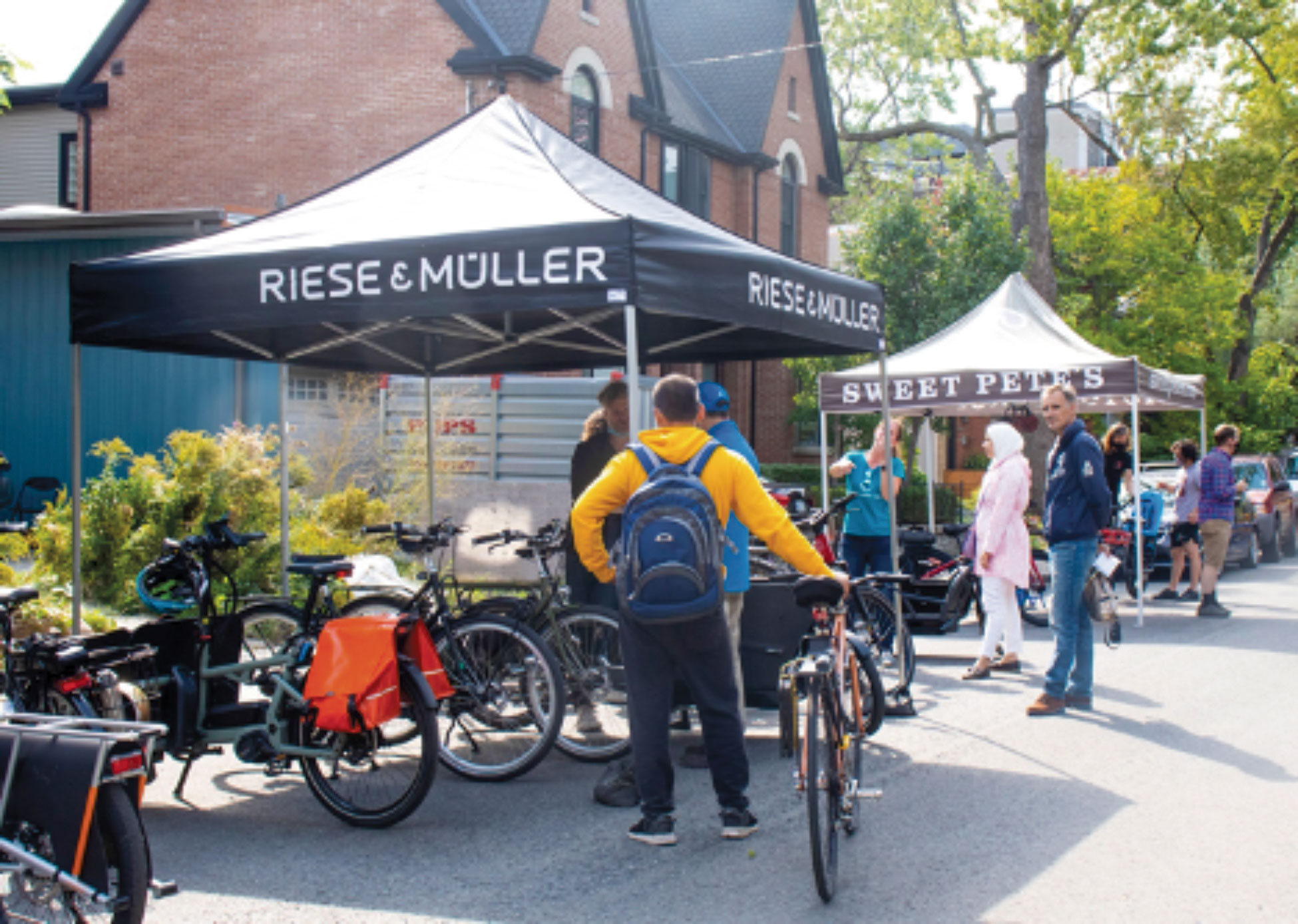
Experts from different bike shops presenting their collection of electric bikes at Pedal Power Fair on Sept. 25. MARGARITA MALTCEVA/GLEANER NEWS
By Margarita Maltceva
TransformTO, adopted by Toronto City Council in 2017, aims to reduce the city’s greenhouse gas emission levels to 65 percent below 1990 levels by 2030, and reach carbon neutrality by 2050. The Harbord Village Residents Association (HRVA) is on board with these goals, and is advocating for the adoption of electric bikes as one way of reducing dependence on gas-powered vehicles.
In late September, the HVRA shut down Sussex Avenue between Borden Street and Brunswick Avenue for a day to host the Harbord Village Power Pedal Fair, offering people the opportunity to try different styles of electric bikes.
Nicole Schulman, HVRA volunteer and fair organizer, said people need to make significant changes in their lifestyles to reach that goal, including switching from gasoline cars to electric vehicles.
“(TransformTO) goals seem doable, but it’s a different mindset that Torontonians have now,” she said. “People have to make lifestyle choices and start using more active transport, which is what TransformTO is advocating for.”
Although the price of an e-bike, which can vary from $1,000 to $10,000, may seem steep, Schulman says the purchase is justified by looking at it as an inexpensive car. She adds that the fair hoped to show that e-bikes work well for both families and older adults.
“The market is for retirees who have been riding bikes all their lives and want to continue. And because electrification will make it easier to ride, they can rely on cars and TTC much less,” said Tim Grant, the head chair of HVRA’s NetZero Committee and former Green Party candidate for Trinity-Spadina and University-Rosedale.
He also said electric cargo bikes can help small families to commute and do groceries.
“We want to help people appreciate that electric bikes are suitable for any lifestyle,” Grant said. He adds that while the e-bikes make cycling much easier, they still offer riders a workout.
The HVRA is planning to organize bulk purchases of electric bikes in order to help make them more affordable for people considering the purchase.
February 4th, 2022 · Comments Off on CHATTER: Treasuring the Gleaner at the Palmerston Library (Jan. 2022)
BRIAN BURCHELL/GLEANER NEWS
Anyone interested in an in-depth history of the Annex will find a rich source in 24 bound volumes of the Annex Gleaner available at the Palmerston Library. The series, beginning with the very first issue from May 1995, is available for reference just behind the front desk in the “local history” section, which is one of thirty such sections at libraries across the city.
“You can gain an understanding, even of the political atmosphere of the community,” said Tara Gonzales, Branch Head. “And the local goings on, day to day, month to month, because the Gleaner has all the ads for shows and things that are going on in the churches. It’s really in-depth.”
A spirit of citizen activism in the neighbourhood stands out through the decades. The Gleaner covered the campaign against the Dupont Loblaw’s, which resulted in Weston’s promising to allow visitor and neighbourhood parking after hours. Then came the “Friends of Dooney’s” who protested the threat of a Starbucks replacing the beloved café. Following the Gleaner’s breaking-news coverage of the story, the multinational Seattle-based Starbucks reversed course, allowing Dooney’s to continue their tenancy in situ. Starbucks then placed a full-page ad in the paper apologizing for offending the community.
Locals have been arguing about whether Bloor Street has too many restaurants since 1995. That same year, a task force was set up by local councillors to determine how to improve the area, with many residents saying restaurants keep the strip lively.
Gleaner contributors of years past, a list that includes such wordsmiths as Evan Solomon and Alfred Holden, can rest assured they have achieved immortality. Once the Palmerston librarians have a year’s worth of the Gleaner in hand, they send the issues to the Special Collections Liaison, who gets them bound, but not before scanning each one to microfiche. These are held in the Toronto Reference Library, in the Local History and Genealogy section.
—Nicole Stoffman/Gleaner News
Comments Off on CHATTER: Treasuring the Gleaner at the Palmerston Library (Jan. 2022)Tags:Annex · News
February 4th, 2022 · Comments Off on CHATTER: Business owner/former Tibetan refugee helps new refugees (Jan. 2022)
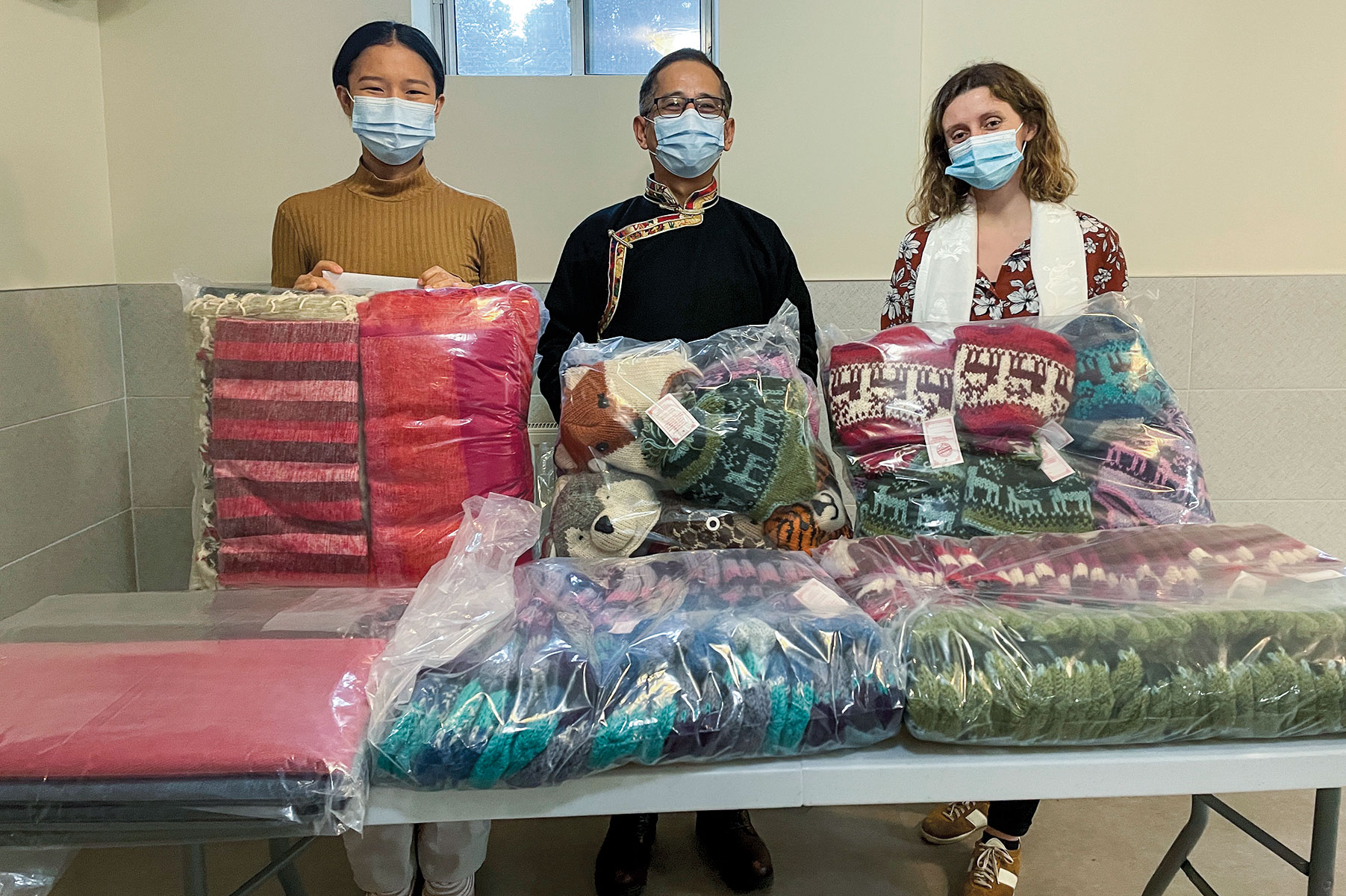
From left: Phurbu’s daughter Tsering Dolkar, Phurbu Tsering, and Alana Meier. NICOLE STOFFMAN/GLEANER NEWS
Phurbu Tsering donated $2,000 worth of hats, mittens and shawls to the Christie Refugee Welcome Centre (CRWC), at 43 Christie St. on December 9th. The owner of Tibetan Paper and Handicraft at 609B Bloor St. W. did so just in time for winter, International Human Rights Day, and the 32nd anniversary of the Dalai Lama’s receiving the Nobel Peace Prize on Dec 10, 1989.
“Because I was a refugee, I understand the hardships they go through,” said Tsering, who came to Canada from Tibet 21 years ago. “I know this is a wonderful country, and they will be received very well.”
Fifty hats and mittens made of Himalayan and New Zealand Wool, as well as 25 yak wool shawls, will help keep the centre’s clients warm.
“For many families, this is their first snow,” said Alana Meier, donor relations coordinator. “this level of warmth will be really appreciated.”
The CRWC is an emergency shelter that welcomes 300 homeless refugee claimants from war-torn countries every year.
—Nicole Stoffman/Gleaner News
Comments Off on CHATTER: Business owner/former Tibetan refugee helps new refugees (Jan. 2022)Tags:Annex · News
February 4th, 2022 · Comments Off on EDITORIAL: Ford stalls, families suffer (Jan. 2022)
Under the questionable leadership of Premier Doug Ford, Ontario is now the only province in Canada which has not signed onto the federally funded daycare plan that would see fees cut to $10 per day per child by 2025. The federal formula would give Ontario $10.2 billion over five years which is its per capita share. But Ford says that’s not enough and Ontario deserves more than other jurisdictions.
The new national Early Learning and Child Care (ELCC) program originated as an election promise, a key plank in the federal Liberal party platform, in the last election. The plan is budgeted to spend $30 billion over five years.
The federal government is clearly flustered with Ford as it is so close to achieving a nationwide goal and our premier is playing the spoiler. Every province and territory except Ontario have found a way to make this laudable national program work within their respective frameworks. Karina Gould, the federal minister for Families, Children and Social Development said the federal government sent a term paper to provinces and territories ten months ago asking for a strategy to reduce fees and create child-care spaces – but has yet to hear back from Ontario.
It appears that the Ontario government, ever mindful of its requirement to hold a general election by June, would like to hold our province’s parents and children hostage for a while longer so he can try and claim a victory lap as near to the election date as possible. It’s all about him.
The need for affordable, accessible, quality child-care has been around for a very long time, but two years of pandemic shut downs have made this need even more obvious. Parents working from home have struggled to simultaneously keep their jobs and care for their children. Women have by far borne the brunt of these burdens as our economy still functions on the basis of a massive wage gap, with women earning roughly 89 cents for every dollar earned by men, and the cost of child-care is quite simply, prohibitive. The federal government estimates that at least 16,000 women left the job market because of the pandemic, many to care for their children.
Daycare costs range from $450/month in Winnipeg to about $1,600/month in Toronto. That’s the median, many pay much more if they are lucky enough to find a space. For lower income families, affordable child-care would make a massive difference, allowing both parents to enter the workforce.
Indeed, according to Armine Yalnizyan, an economist at the Atkinson Fellow on the Future of Workers, getting more women into the work force will help the economy overall, “it’s a domino effect.”
The Province of Ontario has argued it is entitled to more money than other provinces because it has full-time kindergarten and it wants the federal government to assume the cost of that too.
“I can’t figure why Minister Lecce [Ontario’s education minister] and Doug Ford think that this child-care money should help the provincial government’s bottom line instead of a family’s bottom line,” said NDP Leader Andrea Horwath. Ontario’s Coalition for Better Child Care agreed that the funding sought to offset existing provincial programs is misguided, “the money is for lowering child-care fees [to $10 per day], not for giving Ontario a cookie!”
February 4th, 2022 · Comments Off on FORUM: Many achievements despite the pandemic (Jan. 2022)
Government must be proactive to protect cyclists, pedestrians
By Mike Layton
Moving into 2022, and as hard as things are right now, I am incredibly grateful to represent a community that is full of people who work so hard to take care of their families, their neighbours, and everyone in our city. As I write this, I know that many of you are facing the stress of another hard winter season with rising COVID-19 cases and frequently changing plans when we were all really looking forward to time in the New Year with loved ones after another long year.
COURTESY MIKE LAYTON
I want to extend a huge thanks to all the city staff and healthcare workers who are right now working through difficult circumstances to run vaccine clinics and help keep us safe. If you have not already booked a booster shot, please considering doing so as quickly as possible.
At the council level, I want to thank all of you who have helped advocate for a more equitable city this past year. We have made huge changes in Toronto.
The sheer number of improvements makes it hard to list, but my personal highlights include a made-in-Toronto climate action plan that commits to net zero by 2040, a huge expansion of affordable housing across the city (including hundreds of units in our ward), a vacant unit tax to target dwellings left sitting empty to begin this year, a massive expansion of permanent bike lanes across all major routes in our ward, a number of park renewals finished or wrapping up across Ward 11 including Art Eggleton Park and Joseph Burr Tyrrell Playground.
These achievements are something to be proud of, but 2022 will be no time to rest and we must keep pushing the City of Toronto and the mayor to continue to build a better city. That particularly means keeping pressure on Doug Ford to deliver on expanded access to rapid tests and vaccines in the immediate. It means keeping up the fight with Doug Ford to make him sign a deal with the federal government for universal and affordable childcare for all families. Neither of these pieces can wait and are key to a strong economic recovery.
I want wish you moments of peace this winter, and a renewed spirit for 2022. There’s so much to do going forward, and I am honoured to work with all of you to get it done.
Mike Layton is city councillor for Ward 11, University–Rosedale.
February 4th, 2022 · Comments Off on FORUM: Omicron demands leadership, not indecision (Jan. 2022)
Ontario suffers while Ford dithers
By Jessica Bell
As the Omicron wave overwhelms Ontario, University-Rosedale residents are facing big challenges. Parents are wracked with the decision over whether to send their children to school. Hospitals are near capacity. You can’t get a PCR test. Surgeries are being canceled. Demand at food banks is at record levels, driven by rising poverty, job loss and inflation. The science is rapidly evolving, people are exhausted, and there is no public consensus on how to proceed.
This is the time for leadership. Government has a responsibility to make choices that are both tough and wise – for the public good. There are no easy answers.
Here’s our take on the big issues we’re hearing from constituents.
Schools and daycaresshould open safely
Ontario’s two million parents and one million children have endured some of the world’s longest school shutdowns, placing unbelievable strain on our kids’ learning and mental health, and parents’ ability to work.
Education is a human right. It is a shocking indictment of Premier Ford’s priorities that schools remained closed while critical measures that effectively control COVID-19 spread – like paid sick days, effective and properly enforced workplace safety measures, and vaccine mandates – were not implemented.
The Conservatives have had over 600 days to make schools as safe as possible, but their response has been cheap, reactive and confusing. Ford hoarded federal money earmarked for education, and just cut another $500 million from the school budget this year. Some school boards are still waiting for their HEPA filters – fortunately Toronto schools have received theirs’. Class sizes are the largest they’ve ever been. It took weeks of advocacy for education workers to be fast-tracked for booster shots, and it is simply astonishing that the government is doing away with public testing and reporting of COVID-19 in schools and daycares.
We must move mountains to keep schools open and make them as safe as possible. We are calling for school vaccine clinics, vaccine mandates for education workers, smaller class sizes, proper tracking and reporting of COVID-19 cases, free rapid tests for the school and daycare community, improved ventilation, N95 masks for all workers, and support for teachers and staff to help address critical learning gaps caused by previous shutdowns. The measures we take today will prepare us for future waves so we are less likely to be presented with an urgent no-win crisis situation like we’re in today.
Our hospitals are struggling
Despite Omicron being less virulent than the Delta variant, hospitals are near capacity, and staffing shortages are impacting care. Ontario has paused many surgeries, including cancer and heart surgeries. Tragically, people will die.
Staffing issues can and should be addressed by increasing pay for front-line health care workers, and that starts with repealing Bill 124, which capped wage increases for public sector workers to one percent. I also fully support the government’s decision to allow internationally trained nurses to work in Ontario’s hospitals. This should have happened years ago.
The best thing you can do to stop overcrowding in hospitals is to get your vaccine and your booster as soon as you are eligible. Vaccines are very effective at preventing people from severe illness, hospitalization and death, and vaccines are safe.
Small business needs our help
Every time I walk by Kensington, Bloor, Dundas and College, I see another empty storefront with a “for lease” sign in the window. Many businesses, especially restaurants and tourist businesses, are struggling and going under because they’ve done the right thing and followed public health guidelines.
To help small businesses survive the economic sacrifice they have made, it is our duty to provide help. Along with government financial assistance, we are also calling for a reinstatement of the commercial eviction ban, which was lifted in January. In response to our pressure, the Ontario government has announced another round of funding for small businesses that have lost income. Our office is able to help eligible small businesses access this program.