April 11th, 2022 · Comments Off on FORUM: A budget brief from the trenches (Spring 2022)
Many progressive gains come out of city council
By Mike Layton
The 2022 budget process concluded in late February, followed by a few quick council meetings to address regular business. With the help of my colleagues, and the advocacy of many of you, we achieved notable improvements to a budget that began with glaring gaps in services, while continuing to work to improve safety in our communities.
The successes during the budget process included: expanding supportive and affordable housing options, adding enforcement officers for RentSafeTO and increasing fees to support the expansion of this service, increasing funding for SafeTO, implementing the Fair Pass Transit Discount program sooner, and establishing the Multi-Unit Residential Acquisition program that will help keep properties affordable long-term.
However, council continues to put off difficult and essential decisions. As a result, new revenue tools that could diversify the city’s revenue streams have once again been punted indefinitely into the future.
Unfortunately, motions that lost by a wide margin include funding for the purchase of TTC buses through increasing debt, establishing a housing commissioner, and reallocating less than one per cent of the Toronto Police Services budget to rent supplements for 1000 people.
We cannot continue this way. Our shelter system is in crisis, parks are lacking investment to keep them in a state of good repair, and enforcement of noise, property standards, and safety has fallen behind.
Toronto is a thriving city, and it is important that our policies reflect and share this wealth.
As your city councillor, I will continue to fight for a budget that reflects and addresses the issues of greatest importance to my constituents.
In other news, council has approved the installation of an additional 25 Automated Speed Enforcement cameras, which will increase road safety. They should become operational this year.
Transportation Services will expand the program by developing a request for proposal that will consider all possible technologies.
As our city continues to struggle with a housing affordability crisis, council has asked the province to curb foreign and domestic investment in real estate through the implementation of new taxes on home flipping and land speculation. I am hopeful for a positive response to our request.
Further, in an effort to expand the supply and type of housing available in Toronto, council adopted amendments to the Official Plan and zoning bylaw to allow construction of garden suites on most residential properties in the city.
A garden suite is usually located behind an existing house, but it is separate and detached. They are generally smaller and are a way to create rental units or homes for extended family.
Finally, a new community crisis support service is set to launch in two phases this year, as one of SafeTO’s key priority actions.
The four pilot areas were selected based on where apprehensions under the Mental Health Act and 911 calls for individuals in crisis were highest.
The pilots in the northeast and downtown east will launch in March 2022, and those in the northwest and downtown west by June 2022.
The service will provide an important community-led response to mental health crisis calls and wellness checks.
A third-party evaluator will evaluate the pilots, and the data will inform the delivery and expansion of the service citywide by 2025.
If you have questions, or want more information on any of these topics please do not hesitate to contact my office.
You can also visit www.mikelayton.to for the latest, and other city-related issues.
Mike Layton is city councillor for Ward 11, University–Rosedale.
April 11th, 2022 · Comments Off on FORUM: Celebrating our local leaders (Spring 2022)
MPP Jessica Bell pays homage to community contributors
By Jessica Bell
Our Community Recognition Awards recognize the people who help make University-Rosedale a wonderful place to live. Here’s some of our recent award recipients.
Seniors’ Advocate
The residents of Mon Sheong Home for the Aged suffered horribly during the COVID-19 pandemic. As chair of the home’s family council, Helen Lee led the fight to improve care and save residents’ lives. She organized vigils, spoke to the media, and worked to secure more staffing, masks and health care.
Tragically, Helen’s grandmother, and Toronto activist, Foon Hay Lam, died of COVID-19 in Mon Sheong, in 2020. Helen continues to organize for higher pay and more staffing in long-term care homes.
Diversity and Inclusion
Alan Miller has been volunteering at the ArQuives for 41 years, often volunteering five days a week. His work has helped the ArQuives become the largest independent LGBTQ2+ archive in the world. It is recognized internationally for its extensive periodical collection. Thank you, Alan, for preserving our history.
Business Leader
For more than 40 years, the Lee family has been running the iconic Korean grocery store, P.A.T Mart Central, in Koreatown. Mr. Lee has supported various cultural events and organizations that celebrate Korean culture, including organizing the painting of the large mural showcasing Korea’s history on the side of their store.
Safe Streets Advocate
Samantha VanClieaf is a school crossing guard on Harbord Street. She keeps our children safe as they walk to and from school every day, and she adds sunshine to our community with her compassion for people and animals. Once the kids are safely in school, you often find her on the corner petting her doggy friends and chatting with their owners. We’re so grateful to have her as part of our lives.
Environmental Advocate
The Palmerston Area Residents’ Association (PARA) green committee advocates for the city’s TransformTO plan, while hosting park cleanups, encouraging residents to protect and grow our precious tree canopy, and partnering with schools and churches to plant pollinator gardens. They are so busy. For inspiration, I encourage you to read PARA’s thoughtful and practical Green Plan at https://palmerstonara.org/.
Safe Streets Advocate
Cycle Toronto is a charity that works to make Toronto a healthy, safe, and vibrant cycling city. They build political and public support for high-quality, protected bike lanes in all 25 wards, and they champion and promote road safety initiatives like the Vision Zero Road Safety Plan and Bill 54, The Protecting Vulnerable Road Users Act. Thank you, Cycle Toronto, for making our streets safer for all.
Housing Advocate
Kensington Market is under tremendous economic and development pressure. Renters are being pushed out. Food sellers are losing their stores. Diversity and affordability—the very soul of the market—are under threat. In response, the Kensington Market Community Land Trust (KMCLT) was established to buy land for the benefit of the community, not to generate profit. The KMCLT celebrated its first purchase of a residential and commercial building at 54-56 Kensington St. in 2021: what an accomplishment.
COVID-19 Heroes
Marcia Palmer and Beverley Gay have worked as Personal Support Workers (PSWs) at St. George Care Community for decades. Both worked long shifts and nights, with no respite, throughout the pandemic.
Due to staffing shortages and cuts, one PSW would often be responsible for an entire floor of residents during the night. They both contracted COVID-19 and suffered greatly.
In response to our advocacy, Premier Ford announced that PSWs will receive a permanent pay increase, and long-term care home residents will be guaranteed four hours of staffing care a day. For Marcia, Beverly, long-term care residents and healthcare workers, let’s keep organizing to ensure these promises are funded in the upcoming budget.
Community Leaders
The Avenue Road Food Bank helped feed over 13,465 people in 2021. I visited the food bank at the Church of the Messiah at 240 Avenue Rd. in March, and I was struck by the volume and quality of the food, the dedication and care of the volunteers and staff, and the team’s commitment to treat people who use the food bank as true guests. Special recognition goes to Robert Mandel and Elliot Shulman for their commitment to helping people in need.
Until the end of this month, walk over to 327 Bloor St. W. and check out the exhibition “Art & Innovation: Traditional Arctic Footwear from the Bata Shoe Museum Collection.” Yes, this might throw you back a few weeks in terms of the weather, but you can stay warm while dipping your toes into the beautiful and innovative footwear created by various arctic cultural groups so they could thrive in an extreme landscape.
The red kamiks from Kalaallit, Greenland, could make a serious splash on any runway.
These boots exemplify the way footwear in traditional Greenlandic culture communicates gender differences. While men’s boots typically only reach mid-calf, women’s boots, can be thigh-high. Also, women’s footwear is usually white and red, while men’s footwear is typically black.
It’s hard to imagine being anything but toasty in the polar bear kamiks from Iglulingmiut, North West Territories. These demonstrate the fur inlay technique, whereby Inuit seamstresses match the direction of different furs to create complex designs. Fur-soled footwear from Siberia reveals the secret to walking on ice.
If you are not yet ready to step inside a museum, you can find this exhibition online, along with a short video, which is part of the BSM web series “The World at Your Feet.”
If fur is not your thing, you might want to wait until May to visit the BSM when a new exhibit opens: “Future Now: Virtual Sneakers to Cutting-Edge Kicks.” This exhibition will explore the future of footwear: how sustainable materials (leather made from mushrooms, soles from reclaimed ocean plastics) and technologies, such as 3-D printing, are changing shoes as we know them.
Register now for the webinar A Conversation with Jeff Staple on April 20. Jeff Staple, graphic designer and founder of the streetwear brand STAPLE will be in conversation with museum Director and Senior Curator, Elizabeth Semmelhack. Staple is famous for causing a “sneaker frenzy” when he collaborated with Nike on a limited edition shoe, and he is hoping to rock the shoe world again by producing digital shoes which will be sold as non-fungible tolkens (NFTs). Intrigued yet?
There’s so much more to see and do along the Bloor St. Culture Corridor. You can’t go wrong by strapping on a pair of actual shoes and discovering it for yourself.
Comments Off on ARTS: Hello April! (Spring 2022)Tags:General
March 14th, 2022 · Comments Off on ON THE COVER: Show Bloor Annex Love (Winter 2022)
With many COVID-19 restrictions being lifted, small businesses are ready for some love. To help promote main street, a #ShowLoveTO heart has been installed in the Bloor Annex BIA parkette at Bloor Street and Brunswick Avenue. Stop by and take a selfie with the heart and post it to social media for your chance to win $100 to spend at any BIA business. Full details available at bloorannex.ca. NEILAND BRISSENDEN/GLEANER NEWS
Comments Off on ON THE COVER: Show Bloor Annex Love (Winter 2022)Tags:Annex · News
March 14th, 2022 · Comments Off on NEWS: Dominico’s vision changed Toronto sports history (Winter 2022)
Late baseball owner loomed large over amateur sports scene
Owner and lifelong fan at heart Jack Dominico ran the Maple Leafs baseball club for over 50 years. COURTESY TORONTO MAPLE LEAFS BASEBALL
By R.S. Konjek
As local lore will have it, the Toronto sports scene was forever changed one afternoon in the summer of 1968.
A newspaper man – on the sales side, not the writing side – happened to drive past Christie Pits Park on Bloor Street. Circling the curious sunken playgrounds, he cast his gaze over the baseball diamond nestled in the northeast corner of the park.
“That’s where I want my team to play,” Jack Dominico announced.
The Toronto Maple Leafs were not his team quite yet. Pieced together from the remains of the Triple-A International League ballclub that left town for Louisville, Kentucky after 1967, a new team bearing the same “Maple Leafs” name would begin play as the amateur Intercounty Baseball League’s newest franchise in 1969.
Alex Stanley, a local amateur baseball star, led the ownership group that brought the new Leafs into existence. Dominico was involved from the start, handling the advertising side of things.
The ballclub needed a new home. The departed team had played in Maple Leaf Stadium at the corner of Lakeshore and Bathurst. Old and rickety, the stadium was demolished in early 1968.
Whether Dominico’s fateful spin around the Pits is apocryphal or not, the new Leafs took the field in May, 1969, and Christie Pits has been their home ever since.
Dominico and his wife Lynne assumed full ownership in 1970. They operated all facets of the club together: recruitment and player signings, advertising and sponsorships, publications and game-day operations.
Playing in a public park instead of an enclosed private stadium kept the Leafs from charging admission to games, a situation that remains to this day. From the very beginning the onus was on Dominico to keep the club afloat. A relentless hustler, he sold ad space in club publications and on banners that hung on the outfield fences at the diamond. Not only did he keep the club afloat, he kept it profitable, year after year.
Lynne passed away in 2008 and Jack continued as sole owner of the club until he died on January 11 at the age of 82.
Dominico loomed large over Christie Pits, literally. On game days, his customary place was inside the press box perched on top of the hillside behind home plate. From there he was master of all he surveyed, and he let everyone know it.
He was an assertive salesman and skillful organizer, but as soon as the first pitch hit the catcher’s mitt, Dominico became a fan like anyone else. Not a game went by – sometimes not an inning – without hearing his booming voice react to the action below.
If an umpire (in his opinion) blew a call, they heard about it. If one of his players messed up, they heard about it. If his manager let a game slip away, they heard about it. His trademark groans and gripes rang around the Pits without needing the PA system.
“It was mostly an act,” said longtime Leafs raffle ticket seller Alan Ross.
Dominico’s outbursts may have been part of the game day entertainment, but to many, he had a heart of gold.
“He found jobs for many players,” said Ross. “Even people who didn’t like him agreed that without Jack there wouldn’t be a league.”
While overseeing the league’s flagship franchise, Dominico quietly steered financial support to struggling clubs. He did so without seeking fanfare, but to keep the league going in tough times.
“He knew everybody,” said Ross, citing an example from late in the 2021 season, which lasted deep into September and far beyond its usual ending point.
The Leafs were playing in the IBL’s championship series, but the City of Toronto kept to its seasonal parks maintenance schedule and removed the portable restrooms at the park just before a game at Christie Pits. Ross raised the issue with Dominico, who placed one phone call. The following day, the port-a-potties were back.
In 2010, in recognition of his contributions to local sports, the city officially named the Leaf’s home Dominico Field at Christie Pits.
The trophy presented to the IBL champions at the end of each season also bears Dominico’s name, in tribute to his unparalleled contributions to the league’s success.
In recent years, ailing health limited Dominico’s mobility and his final appearance at the ballpark was in 2019.
He maintained communications with his staff and players by phone, doting over them like a father figure.
Dominico may be gone but the Leafs will go on. Damon Topolie, the club’s general manager, will continue to assemble the roster and manage the team on the field. Christie Pits will be the home of Leafs baseball this summer, as it has since 1969.
In the long term it remains to be seen what will become of Dominico’s estate, including the ownership of the Leafs. One thing for certain is that his vision for baseball at Christie Pits changed Toronto sports history.
Comments Off on NEWS: Dominico’s vision changed Toronto sports history (Winter 2022)Tags:Annex · News · Sports
The site of the former Just Desserts restaurant is slated to be the new home of Designers Walk Building, a 22-storey “vertical forest” with trees on every terrace. The condo tower by Cityzen and Greybrook Realty Partners will be the first of its kind in Toronto. COURTESY CITYZEN AND GREYBROOK REALTY PARTNERS
By Nicole Stoffman
A new condo neighbourhood is rising on Davenport Road between Dupont Street and Avenue Road. With the completion of the 35-storey AYC condos and townhouses at Bedford Road, and another seven builds ranging in size from 7 to 35 storeys, the L-shaped curve at the northeastern edge of the Annex is set to boom. But the Annex Residents’ Association is concerned that a liveable neighbourhood has not been planned for.
Corinna Prior, planner at the City of Toronto, would disagree with that assessment. The qualities of a liveable neighbourhood, such as appropriate built form, community services, a welcoming public realm, and “the creation of a comfortable microclimate,” have been planned for, she told the Gleaner in an email.
When reviewing applications along this stretch of Davenport, the city was guided by the 2019 Downtown Plan which concluded that there is sufficient social infrastructure, like schools and libraries, to accommodate growth, she said. Planning staff also referenced the 2018 Davenport Triangle Guiding Principles, a 2018 vision statement for the triangle bounded by Dupont Street, Davenport, Bedford Road, and Designer’s Walk Lane.
However, the Davenport Triangle Guiding Principles were at times overruled by the province, and a 22-storey tower was approved for the northwest corner of Davenport and Bedford, even though the principles advocated only midrise buildings for the triangle.
“This is a classic example of spot zoning,” said Henry Wiercinski, co-chair of the Annex Residents’ Association’s planning and development committee. “This is site by site. No vision.” The ARA prides itself on working with developers to ensure builds that contribute to the neighbourhood, “We are not anti-development,” said Wiercinski. But without a visioning study for this stretch of Davenport, he thinks there’s been a lack of construction management logistics. “You wouldn’t have one [building] under construction and three that will be in construction in a short period of time,” had such a study been done, he said.
The city adopted a motion on Jan 19, 2021, to remove parking minimums in new developments, to reduce dependence on cars and promote affordable housing (parking is expensive to build and the cost gets passed onto the buyer.) Yet two of the new towers on Davenport will have four levels of underground parking each, and another will have three levels. Wiercinski thinks Davenport is a good candidate for increased density, but doubts the roads will be able to accommodate such a dramatic increase in traffic. Prior said planners coordinate with other city divisions, such as transportation, when reviewing planning applications.
He would like to have seen a visioning study for Davenport similar to the one adopted in 2011 for Dupont between Kendal and Ossington. Developers are adhering to its nine-storey height limit and public realm considerations, he said, because the developers took part in the negotiations between the city and residents.
Councillor Layton told the Gleaner that there is already a backlog of planning study requests to his office. City staff take adjacent guidelines and apply them to applications along this stretch of Davenport. Like Prior, he cited the Davenport Triangle Guiding Principles as well as the Annex Heritage Conservation District.
“This area of Ward 11 is exceeding the provincial targets,” adds Layton. Furthermore, three of the four corners at Davenport and Bedford will have high rises, which the ARA thinks represent too much density.
However, when checked against the 2020 density target as set out in the provincial Growth Plan, “A Place to Grow,” the davenport condo boom seems to be underachieving. The minimum density target set out for downtown Toronto is 400 people and jobs per hectare by 2031. This is the same target from the previous 2015 Growth Plan put in place by the Liberal government. There will be a total of approximately 1,200 new residents along this 550-metre stretch of Davenport, when all 7 builds are complete. Therefore, the growth target would be 4,000 for this 5.5 hectare stretch of arterial road, assuming five hectares of land on each side.
Nonetheless, Oren Tamir in the city planning division confirmed Councillor Layton’s observation in an email to the Gleaner: “If the density trends continue, it is likely that Downtown will exceed the Urban Growth Centre density target well before 2031.”
Consideration has been given to the public realm on Davenport, despite the lack of a visioning study, in the form of Joseph Tough Park and two publicly accessible spaces on Pears Avenue and Designers Walk Lane. Prior told the Gleaner it adds up to “more than $2.5 million in-kind contributions toward public realm improvements.”
Improvements have also been made to social services in the area, thanks to the $1.8 million collected in cash contributions since 2016 from Section 37 funds. These were spent on improvements to food security, health services, and amenity spaces in local social housing, such as at 250 Davenport Road. “Additional public benefits are anticipated in connection with other applications still under review in the area,” Prior told the Gleaner.
Of a total of over 800 units, there are no affordable units confirmed among the 7 new builds. The one exception is the 35-storey tower at 148 Avenue Rd. Planner Bruce Hawkins told the Gleaner in an email that the developer has not yet proposed any affordable units, but that the city is exploring opportunities for incorporating affordable housing into the proposal.
The target markets for these dwellings range from mid-market to luxury. For example, 321 Davenport by the Alterra Group is aimed at “affluent end-users and downsizers,” said Dagmar Caine, Assistant Marketing Manager. “It is people looking for a lifestyle change and the comfort and security condominium living provides while also maintaining their current luxuries.”
It remains to be seen if this stretch of Davenport Road will feel like a complete community, but some will welcome it with open arms. “I happen to love higher density development,” said John De Porter, owner of Misto Lino Linen Shop on Avenue Road.
“This area is not the most vibrant, so a new project, like a very tall, glass tower, brings in a lot of excitement and a lot of buzz, so I’m all for it.”
March 14th, 2022 · Comments Off on NEWS: Main Street gets some relief (Winter 2022)
New Small Business tax class see property taxes drop by 15%
By Carly Penrose
The benches outside Emily Rose Café at Palmerston Square and Follis Avenue were filled with patrons. Mothers and daughters, friends coming together over food. Although it was late November and the café had yet to introduce indoor seating, patrons were undeterred by the cold late-fall air as they waited patiently for their coffees and baked goods.
The toasty smell of coffee greeted customers at Emily Rose at almost the same time owner Alessia Peluso did. Interrupted by a beeping oven, she removed a tray of blueberry white chocolate scones between hellos.
The success of Emily Rose comes after delays in getting city permissions that rescheduled the café’s opening from summer 2019 to January 2021, amid the COVID-19 pandemic.
“Support local” has been a COVID rallying cry, but business groups say owners like Peluso faced bureaucratic and financial challenges before the pandemic. And they are saying the city’s new 15-per-cent property tax reduction goes some way toward addressing barriers for small businesses and repairing a strained relationship with the city—but it’s only a start.
“This is good news. This is progress, and I hope it’s the beginning of redress, where we’re not going to overtax businesses,” said Brian Burchell, chair of the Bloor Annex BIA (and publisher of this newspaper), which represents 250 small businesses in University-Rosedale.
John Kiru, executive director of the Toronto Association of Business Improvement Areas (TABIA) says small businesses’ challenges date back to 1998, when changes to Toronto tax laws disproportionately affected the commercial class. After 23 years advocating for small business tax reform, in November 2020, the province opened the door for municipalities to offer property tax relief to local businesses.
Kiru said TABIA worked alongside the city, quickly creating a policy to benefit small businesses, though it wasn’t easy. “Trying to define a small business is like herding cats, just when you think you’ve got everybody in there, you’ll find one or two outliers,” he said.
In the end, geography and property size were used. The city predicts approximately 25,000 small businesses in Toronto will receive the benefit in 2022.
In the Bloor Annex area, the most recent property value assessment says the average commercial property is valued at $2.4 million, with property taxes of roughly $49,000. A 15 per cent reduction would mean $7,300 in savings per year. “That’s not a drop in the bucket,” said Burchell.
The tricky part, Burchell says, is whether any of the savings will be passed on to tenants. While city staff say most commercial leases display property tax costs in tenants’ rent, others don’t. “The key here is to ensure the landlords communicate the savings,” said Burchell, who says some members have told him they’ve never seen a tax bill for the property they rent.
The city promises to release a list of properties eligible for relief so owners can address inconsistencies with their landlord.
But Burchell says the relationship between tenants and landlords is complex and this isn’t necessarily a solution. “There’s all kinds of reasons why they may not want to have a confrontational conversation with the property owner,” he said.
The owners of commercial properties will automatically qualify for the new tax break so neither applications nor overwhelming amounts of paperwork are required, which Burchell said was true for previous municipal programs.
Kiru acknowledges the policy is imperfect, but it and a concurrent bylaw in Ottawa are the first of their kind in Canada.
“Any new policy is going to have some flaws in it,” Kiru said, adding that he didn’t want to sacrifice 25,000 small businesses by drawing out the process in Toronto.
Kiru says there are ways to improve upon the tax measure.
He says that an appeals process should be put in place so businesses that do not currently qualify for relief, like stores in strip malls, can apply to be considered.
This tax cut is being funded within the commercial class, meaning larger businesses will see tax increases to pay for it. Kiru recommended increasing residential taxes to provide support, though acknowledged it would be a politically unpopular move.
“The average home would pay 26 dollars more per year to fund the benefit being given to small businesses,” said Kiru. “I would suggest for many of those people that live next to iconic main streets like the Danforth, Little Italy…$26 is not too much to pay.”
Business owners, meanwhile, are less concerned with the ins and outs of city policy and more focused on their daily operations.
Rebecca Daniels, co-owner of First Kiss Vintage and Tattoo on Bloor Street, said she’s had challenges receiving municipal relief in the past. “When COVID hit, the only commercial rent relief was the responsibility of the landlord to apply for it. Ours did not. From what I understand most other commercial landlords also didn’t.”
A business owner and mother of one, Daniels says she doesn’t have time to closely monitor city initiatives. “I haven’t done a ton of research to find out what’s available. If there are resources, they have not been made clear to me at all.”
Daniels’ complaints about the challenges involved with city bureaucracy aren’t unique.
Peluso, for instance, said her problems began before the COVID-19 pandemic when she found the location for Emily Rose Café.
She had to apply for a “minor variance” to rezone the property for interior alterations and an outdoor patio. The application, approved 14 months after she found the property, was long and costly, she said, adding she had to hire a lawyer and architect to navigate municipal policies. “You get the feeling no one is on your side,” said Peluso.
Burchell, for his part, said an announcement the city made prior to the most recent COVID-19 outbreak, calling itself a “model” for bringing all municipal employees back to physical workspaces in January was eye-opening. “It struck me the city might be a bit [out of touch] on the subject for the rest of us who have been coming in to work every day, for 18 months,” he said.
Burchell says business owners’ frustrations with the city are real. “People have their hearts and souls sunk into their businesses… They are deeply financially, emotionally intertwined with them.”
This bylaw reducing costs for small businesses may begin to repair the relationship.
Comments Off on NEWS: Main Street gets some relief (Winter 2022)Tags:Annex · News
March 14th, 2022 · Comments Off on CHATTER: Groundbreaking at Sussex (Winter 2022)
The University of Toronto officially broke ground at the site of a yet-to-be-named 23-storey student residence at Spadina and Sussex. Concessions to city planning and the HVRA allowed the development to proceed: preserving the heritage building at 698 Spadina, and creating the new Robert Street Park. U of T is pleased to be able to offer 509 additional future students the experience of on-campus living, which has been shown to improve their academic performance and mental health. The residence will use an innovative geoexchange system for heating, cooling and hot water, dramatically reducing emissions. (From left), Scott Mabury (VP, Operations), Mitchell Cohen (President & CEO, The Daniels Corporation), Meric Gertler (President, U of T), Brian Lawson (Chair of the Governing Council, U of T), Rose Patten (Chancellor, U of T), and Vishar Yaghoubian (Student Governor, Governing Council). NICOLE STOFFMAN/GLEANER NEWS
March 14th, 2022 · Comments Off on CHATTER: Unlock the secrets of Canadian history (Winter 2022)
Did you sleep through history class? Never fear — this month there’s a lot that you can catch up on, particularly in commemoration of Black History Month. Prepare to explore the stories you thought you knew alongside the ones you were never told through books, movies, and coins.
Your first stop should be A Different Booklist (ADBCC) at 779 Bathurst St. to pick up “literary gems from Canada’s cultural mosaic” that will keep you reading until next this time next year. Unfortunately, you will have to order these online, but fortunately, finding the perfect books you didn’t know you were looking for will be easy because the online store has carefully curated categories such as: juvenile, pandemic-related, Black feminist, gender, Black History month 2022, and more.
While exploring the site before placing your order, be sure to register to attend one of the upcoming events hosted by the bookstore and cultural hub. There’s sure to be a fabulous lineup for March, April, and May.
Next, if you do not yet have a Hot Docs account, you will get one. You’ll make some popcorn and settle in to explore The Black Light Series: A Celebration of Canadian Filmmakers. Maybe you already know John Ware’s story, but filmmaker Cheryl Foggo seeks to set his story free in John Ware Reclaimed. Maybe, you got caught up in Olympic fever this month, and need to keep the excitement rolling. You’ll find it in Charles Officer’s film, Mighty Jerome. Maybe, you feel like digging into family history. In that case, you’ll want to watch Finding Sally, about filmmaker Tamara Dawlit’s search for her long-lost Aunt; or Hardwood, by Hubert Davis, which explores his father – Harlem Globe Trotter Mel Davis – and the impact of his choices on the family.
COURTESY ROYAL CANADIAN MINT/MINT.CA
And finally, make your celebration of Black history (Canadian history) a life long commitment by considering the Royal Canadian Mint’s coin commemorating the Underground Railroad, released February 1. The image on the coin was designed by Toronto artist Kwame Delfish.
—Meribeth Deen/Gleaner News
Comments Off on CHATTER: Unlock the secrets of Canadian history (Winter 2022)Tags:Annex · News
March 14th, 2022 · Comments Off on CHATTER: Pax prays for peace (Winter 2022)
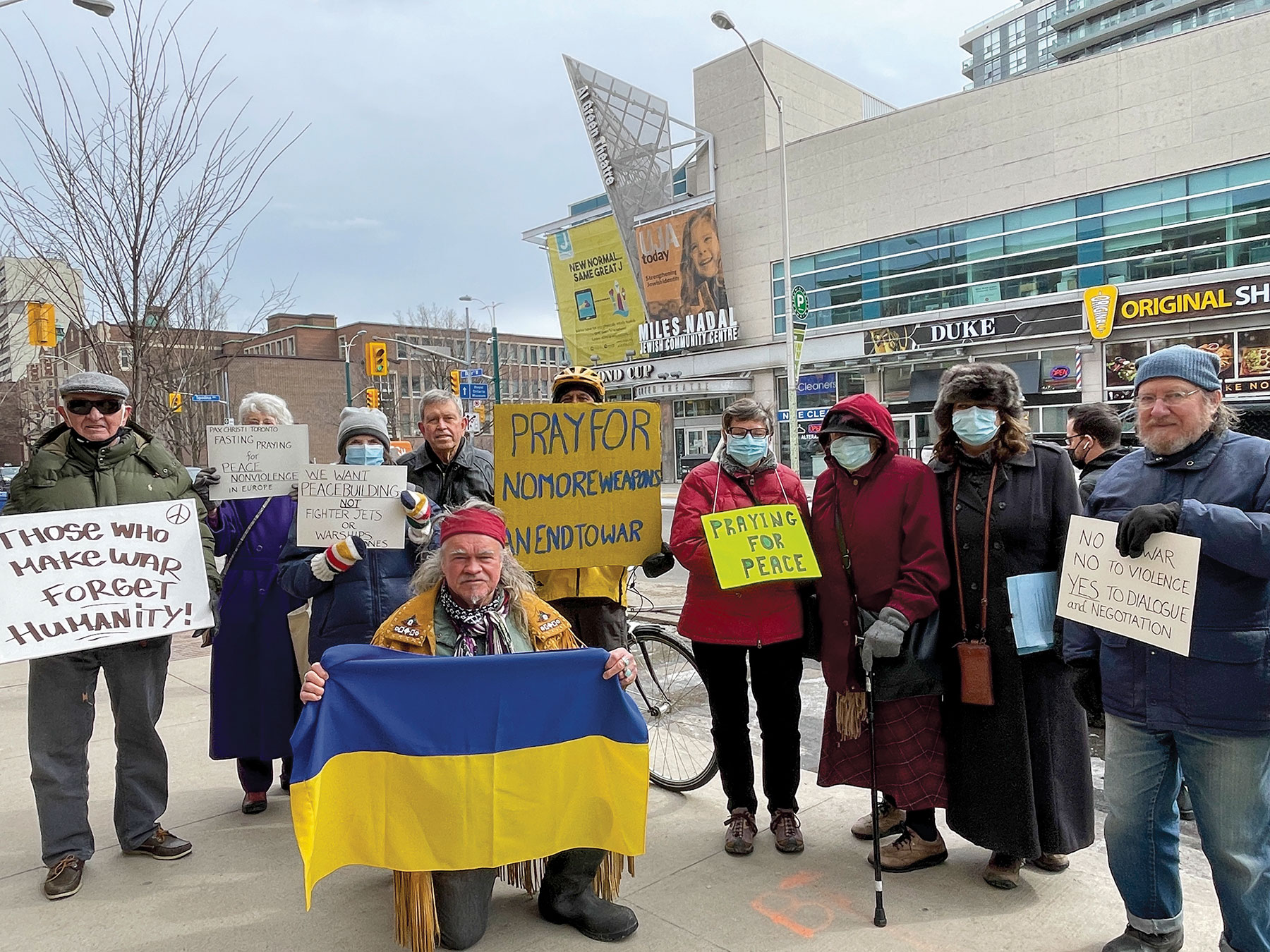
An estimated twenty protesters from Pax Christi Toronto gathered in front of Minister Chrystia Freeland’s office, at Bloor Street and Spadina Road, on March 2. The international Catholic organization chose Ash Wednesday to pray and fast for peace in Ukraine. “We would like Canada to sign the UN treaty for the prohibition of nuclear weapons,” said Mary-Ellen Francoeur.” A whole new architecture for common security needs to be developed, where every country, including Russia, feels secure.” Pax Christi stands for lasting peace through dialogue, diplomacy, negotiation and treaties. NICOLE STOFFMAN/GLEANER NEWS
Comments Off on CHATTER: Pax prays for peace (Winter 2022)Tags:Annex · News
March 14th, 2022 · Comments Off on EDITORIAL: Ford should be first (Winter 2022)
Policing is largely a provincial matter, but faced with massive trucks and bouncy castles clogging up central Ottawa, plus blockades at key border crossings, Prime Minister Justin Trudeau had to invoke the Emergencies Act. As usual, Ontario Premier Doug Ford was too focused on the next election to do his job, and he should have to answer for it.
Any invocation of the Emergencies Act requires Parliament to “check” the government’s action. This comes in two forms: a quick look by a parliamentary committee and an in-depth look that could take many months. Both reviews should subpoena Mr. Ford and ask him why Ontario required the federal government to employ powers beyond the scope of existing criminal law, provincial statutes and regulations, municipal by-laws, court orders, and the province’s own emergency powers.
The longer inquiry should seek to determine the chain of events that led to the blockade of Ottawa and how the Ottawa Police Service allowed it to be established and failed to dismantle it even after three weeks. Ontario delegates powers to local police services who report to local police service boards appointed by municipal governments but these are all creatures of the province.
At its core, this so called “freedom convoy” was nothing but a prolonged fit by those upset that the government is encouraging them to spend a little time and energy to help keep their own communities safe. They don’t have to get the jab, of course, but if they did not they have a duty to not risk harm to others.
These people are not suffering, nor are they protesting some historical injustice against an authoritative regime. This protest does not compare to advocacy for abortion rights, indigenous rights, or equal marriage. In comparison, this convoy is simply an embarrassment. Social media and the power of rage gave these actions faux legitimacy and Ford was apparently afraid to confront it.
Ontario, like other provinces, is supposed to have a ladder of responses to emergencies. A local police chief who feels overwhelmed can seek help from the OPP commissioner. The OPP can, in turn, brief the solicitor general, and the solicitor general then briefs the premier and provincial cabinet.
What is clear is that while all this was happening, Doug Ford decided to cajole Ottawa’s occupiers with, “come on folks, enough is enough, time to go home.” He also thought it would be a good time to relieve Ontario of the need for license stickers and dropped tolls on some highways. In other words: while the crisis rose to a boiling point, he sought to distract Ontarians with shiny objects.
One way that the Province of Ontario could have helped is to pressure heavy tow truck operators to heed the request from the Ottawa Police Service to help remove trucks. Apparently, these operators refused as it would adversely impact their future business relationships with truckers. Under his own emergency orders, he could have forced this provincially regulated industry to do its job. Ford instead waited until the situation in Ottawa had become an international embarrassment and let the federal government do the heavy lifting on the file. A leader he is not.
Our premier is focused one thing only: re-election in June. He wants to keep everyone happy including anti-vaxxers who reside in his base, perhaps especially them. Order and good governance are not his focus and perhaps never have been, Ford’s inaction on this file makes this glaringly obvious. If Ford had done his job, it is doubtful that the Emergencies Act would have been invoked.