November 22nd, 2022 · Comments Off on NEWS: Taking the pulse at campaign parties (Nov. 2022)
Gleaner writer visits the top three candidates on election night
By Marisa Kelly
I arrive at the Pilot Tavern at 8:00 pm on Monday, Oct. 24. The former Yonge Street club and jazz bar now resides in Yorkville. It’s now a restaurant venue offering live music, and there is a pride flag proudly in the window—this is a welcoming spot, and tonight it plays host to Robin Buxton Potts’ election party.
Upon arrival, I make my way to the upper deck and move around the partly-filled room engaging with attendees. Many folks present are a tight-knit group of supporters. Many hold the position of both politician and friend. There are some family members and some people in between. I chat with Robin and some of her friends who work in Toronto politics. They talk about the way they consider problem solving in their jobs and how they try to turn ideas into tangible action: it always seems to involve meeting with the right people and politicians. Politics is an emotional job, someone remarks.
Potts comes from a political family and watched both her grandfather and father play roles in Toronto politics. She tells me she’s proud of this election and sees the outcome as positive regardless of who takes the seat of Ward 11 councillor.
Nearly an hour into the night I’m speaking with Potts’ campaign manager, Angelina. We’re discussing the complexity of world politics as she refreshes her browser for the election results. Suddenly, she says Potts has not been elected. Soon the TV rolls the results out too, and the room switches from buzzing and anticipatory to accepting and calm. Folks hug Potts, and it’s clear she understands but is disappointed at the results. Before I tie up my conversation with Angelina, she acknowledges that University-Rosedale is an area straddling the line of very rich and very poor. Working together to put proper social services in particular areas of the neighbourhood is going to be key to help the community.
Again, I contemplate the importance of housing and third party spaces. As I turn my gaze to the door, I catch the TV screen and see the mayoral results are in. John Tory has been re-elected. I leave to attend Diane Saxe’s party.
I head to the Bay Street subway entrance and catch the line two train heading west to Bathurst Station. Three stops later, I hop off and head to Victory Café, where Dianne Saxe’s election party is ongoing. Saxe, the former Ontario environmental commissioner whose platform concerns climate action and affordable housing, is up against Norm Di Pasquale, who has campaigned on increasing mental health services and affordable housing. I arrive at Victory Café and everyone is buzzing. The polls just jumped ahead in Saxe’s favour, changing the course of the election in an instant.
I get chatting with two long-time Annex community members who tell me about their experience witnessing the 2022 municipal election play out in their neighbourhoods. One of them remarks that it was the worst they have ever seen in terms of the neighbourhood response to local politics, with frequent vandalism and the removal of an election sign supporting Saxe from her front lawn.
Suddenly, someone starts chanting, “Give me an S! Give me an A! Give me an X! Give me an E!” The whole room joins in. What does that spell? “SAXE!”
As the evening comes to a close, the excitement is gripping. I bid goodbye to the people I’ve met and walk to Old School, a restaurant on Dundas Street West, to catch the end of Di Pasquale’s party. People are on the sidewalk, the patio, and chatting amongst themselves. The atmosphere is filled with the familiar faces of politicians from different wards who are chatting and congratulating one another on their efforts.
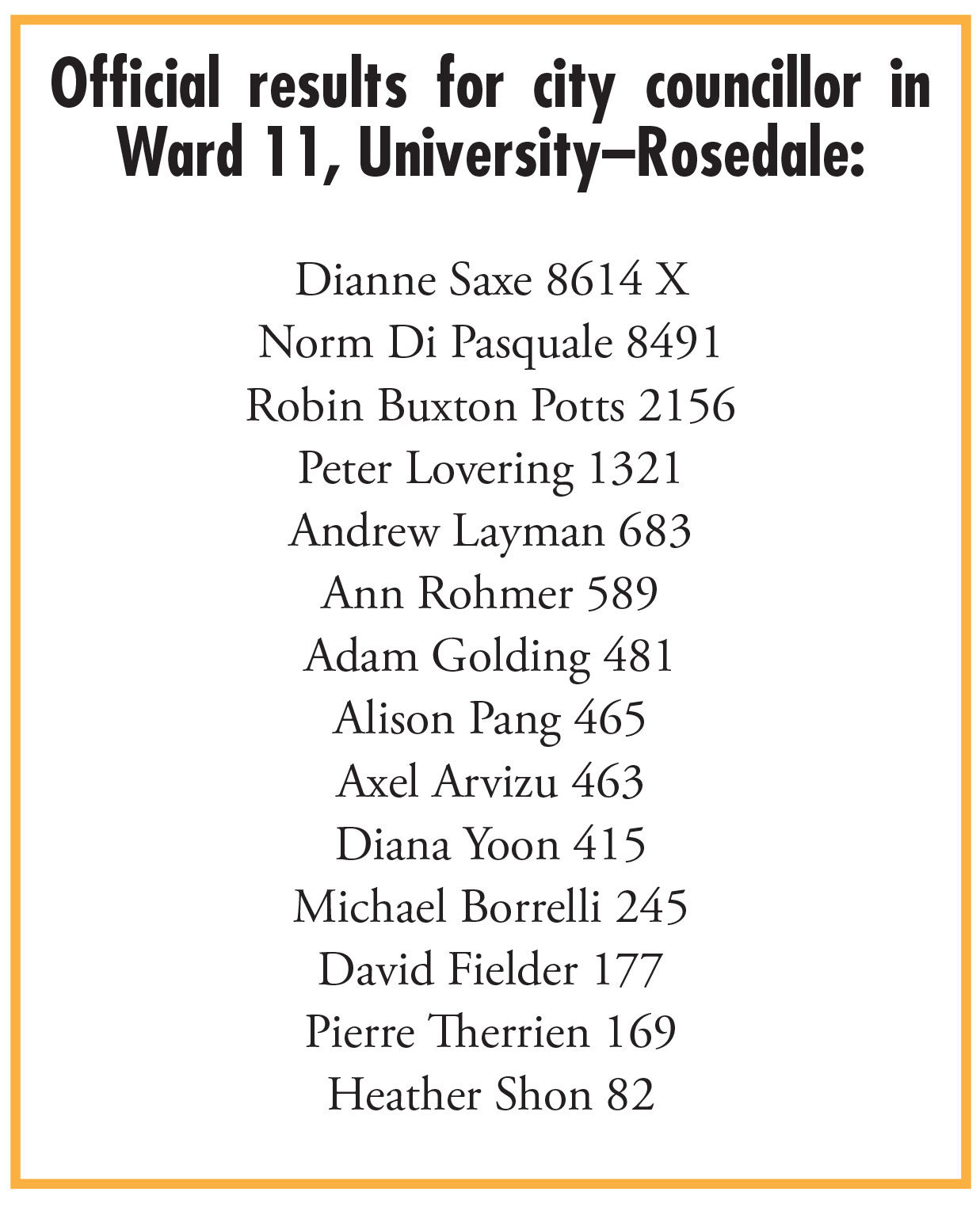
Di Pasquale came in at 8491 votes (34.87 per cent), while Saxe came in with 8614 votes (35.37 per cent). Saxe won by a slim margin with a just a 123 lead.
We can’t say for sure what Saxe and her Green Party roots will bring to the city, but we can hope for an increase in affordability and that services will go to the neighborhoods where they’re most needed.
November 22nd, 2022 · Comments Off on NEWS: Reflecting on the campaign (Nov. 2022)
Two unsuccessful candidates share their thoughts
Compiled by Brian Burchell
The Gleaner reached out to the top performing candidates to get their take on such a competitive race.
What are your thoughts about the campaign and in particular the challenge of running against other “progressive” candidates?
Norm Di Pasquale: I was proud to have earned the support of Progress Toronto in Ward 11 as one of their supported progressive champions. I would like to thank the residents of University-Rosedale for responding so well to the progressive vision that my team outlined for the ward. The result wasn’t what we had hoped for, but I appreciate the faith many University-Rosedale residents had in me.
Of the eight or nine people who were serious, I was surprised how much I liked and admired them all.
—Peter Lovering
Peter Lovering: The campaign was exciting and very interesting. My thoughts on the crowded slate is that the city should vet candidates before the “proof” of the ballot is sent out (mid-September). In this election, there were two people who officially left the campaign prior to the “proof” being finalised; so, why were they not removed? That cost everybody 1004 votes alone and perhaps Norm the victory? Three other candidates had no contact information on the city site; yet, they got another 969 votes. Lastly, it was not the crowd that affected the results; it was very much the deep political party tactics and resources pumping the top three candidates that had the most effect. The city needs to crack down on NDP, Liberal and Green party involvement at the municipal level if they want to be serious about fair elections. I have a list of over a dozen fixes if you need an op-ed sometime.
Of the eight or nine people who were serious, I was surprised how much I liked and admired them all.
What did you learn about the University-Rosedale ward during the campaign and did you glean any Annex-specific polling data that you could share?
Norm Di Pasquale: University-Rosedale overall has one of the finest tree canopies in old Toronto. It was wonderful after a stressful day at work to canvass underneath the canopy. We should ensure that everyone can enjoy such a fine tree canopy across the city. I also cycled over 300 kilometres in protected University-Rosedale bike lanes over the campaign. We must continue relentlessly to add safe protected bike lanes across the ward and the city.
Peter Lovering: University-Rosedale is vast. The thing that surprised me the most about the Annex is how dense it already is. When you walk up to every door, you see the number of doorbells and hydrometers. I fear for greater densification in the Annex; it is bursting at the seams.
What’s next for you?
Norm Di Pasquale: I am now the co-chair of Ontario Place for All. I was a founding member of the grassroots organization that has so far saved the Cinesphere, pods, and Trillium Park from destruction by the Ontario Government. Learn more about us and support the cause at ontarioplaceforall.com.
Peter Lovering: Back to my business of publishing, consulting, and art.
Will you consider running again?
Norm Di Pasquale: Yes! You may see me back on the campaign trail in 2025 or 2026. Stay tuned for what’s next!
Peter Lovering: I would in the right circumstances.
The Gleaner reached out to each of the top performing candidates who finished behind Dianne Saxe: Norm Di Pasquale, Robin Buxton Potts, and Peter Lovering. Buxton Potts did not respond in time for publication.
November 22nd, 2022 · Comments Off on CHATTER: Harbord Village’s Pumpkin Festival returns (Nov. 2022)
Children gather around glowing jack-o-lanterns at the Pumpkin Festival on Harbord Street. HAILEY ALEXANDER/GLEANER NEWS
Harbord Village’s cherished pumpkin festival is back in full swing. On November 1, dozens of pumpkins lit up the neighbourhood along Harbord Street from Spadina Avenue to Borden Street. Between 6:00 and 9:00 p.m., people paraded the street with hot apple cider, baked goods from Harbord Bakery, and the last of their Halloween spirit. Pumpkins carved at homes in the neighbourhood are brought to Harbord for a “re-showing.”
A lot of effort goes into this green community event every year. Sponsored by the Harbord Business Improvement Area and the Harbord Village Residents’ Association, event staff hire athletes from the University of Toronto to prepare and clean up after the festival. “We call them the Pumpkin Heads,” says Neil Wright, chair of the Harbord Street Business Improvement Area. Local businesses provide free food and drink for the public along with their own admirable creations. At the end of the night, the City of Toronto collects and recycles the artwork.
Over the past two years, the pumpkin festival was celebrated locally and shared virtually. This year, Harbord Village opened the event up again to anyone and everyone willing to share their jack-o-lanterns at the parade. The more, the merrier at this family-oriented event.
—Hailey Alexander/Gleaner News
Comments Off on CHATTER: Harbord Village’s Pumpkin Festival returns (Nov. 2022)Tags:Annex · News
November 22nd, 2022 · Comments Off on CHATTER: Adam Vaughan headlines HVRA AGM
The Harbord Village Residents’ Association (HVRA) held their 2022 Annual General Meeting (AGM) on Oct. 18. Guest speaker Adam Vaughan spoke after members of the HVRA discussed administrative, financial, and area reports.
The AGM began with the approval of the agenda and minutes of previous meetings, followed by a brief chair’s report. Treasurer Lena Mortensen delivered the 2021-2022 financial statements and said that the residents’ association is in a “good financial state.” The meeting broke into groups based on each resident’s address within Harbord Village. Residents discussed problems with their area representatives. Solutions presented for these issues included removing a parking spot that infringed on road safety and fixing a faulty storm drain that had caused a side street to flood. Area representatives were then elected, and other commentators shared their concerns with the HVRA.
Former Trinity-Spadina MP and Councillor Adam Vaughan opened his segment by saying that “residents’ associations in the city are under attack in a way I have never seen before.” This stems from journalists dismissing any actions that residents’ associations take as “nimbyism,” even when residents are just exercising their democratic rights to have their voices heard, said Vaughan. This opposition to residents’ associations harms citizens’ abilities to act on important issues, such as the housing crisis.
Vaughan zeroed in on affordable housing by poking holes in the idea that building more housing in the Annex is an efficient way to create affordable housing. Vaughan shared the University of Toronto’s School of Cities’ conclusion that knocking down existing homes in the Annex to build duplexes and triplexes will only raise housing prices due to the cost of land, houses, and labour; however, “residents’ associations…have been sidelined (and) citizens have been disempowered,” said Vaughan. This makes it difficult for the city and developers to plan neighbourhoods effectively due to the community’s suppressed input. Vaughan encouraged people to vote, to lean into residents’ associations, and to grow community councils to re-empower citizens’ voices in the future.
—Fox Oliver/Gleaner News
Comments Off on CHATTER: Adam Vaughan headlines HVRA AGMTags:Annex · News
November 22nd, 2022 · Comments Off on CHATTER: Santa returns (Nov. 2022)
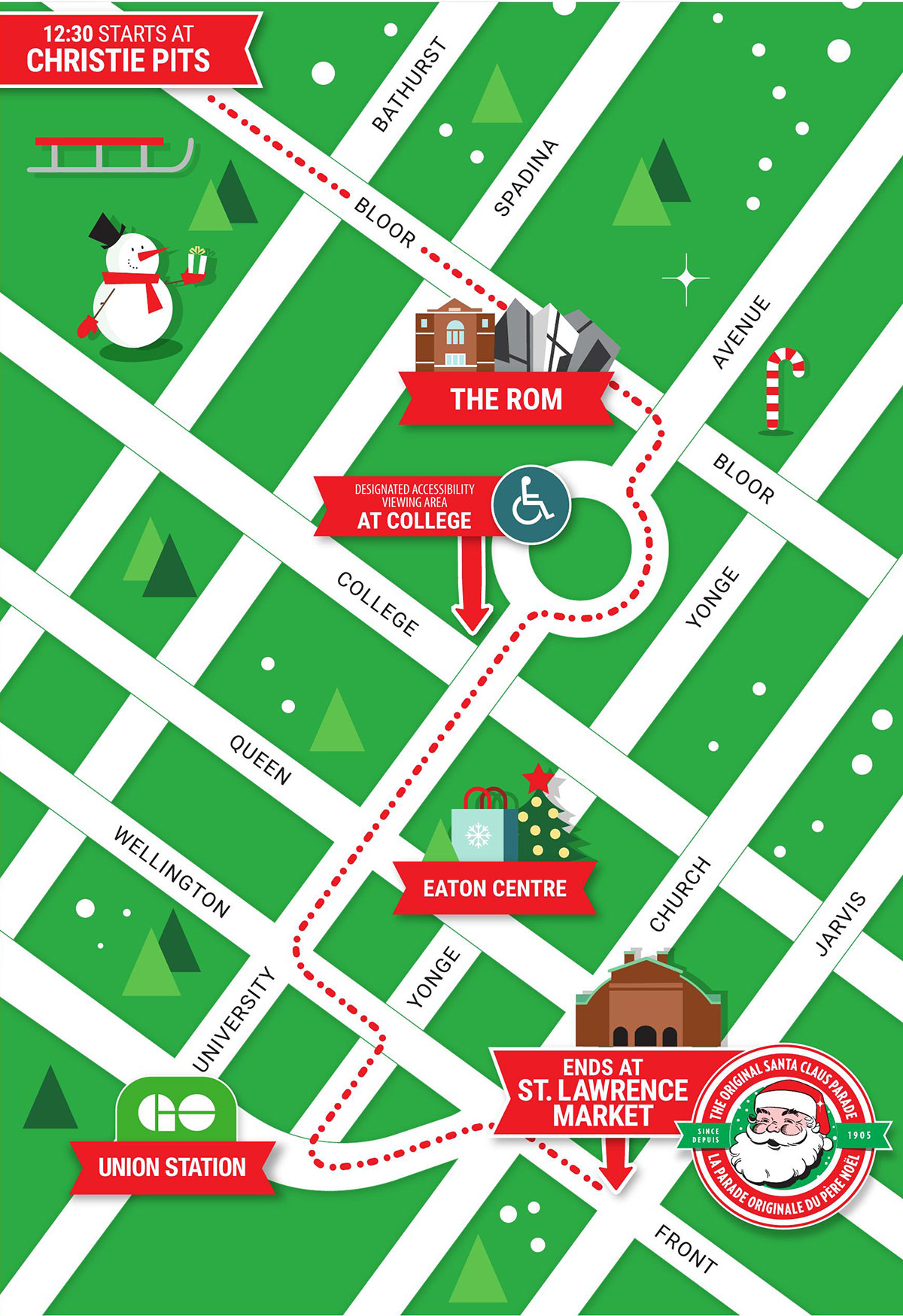
Santa Claus is officially bringing his magic back to the city this year on Sunday, November 20. The season will finally feel complete again as Mr. and Mrs. Claus return with their annual parade of marchers, bands, runners, and festive floats. The Santa Claus Parade will begin at 12:30 p.m. on Bloor Street West and Christie Street, finishing off by 4:00 p.m. at Maple Leaf Square.
—Hailey Alexander/Gleaner News
Comments Off on CHATTER: Santa returns (Nov. 2022)Tags:Annex · News
November 22nd, 2022 · Comments Off on EDITORIAL: Leaders show up (Nov. 2022)
The Public Order Emergency Commission (POEC) is reviewing Ottawa’s use of the Emergencies Act to break up the “Freedom Convoy” in Ottawa and at border crossings last winter. Their work involves hearing the testimony of people involved, including senior civil servants. In the past, premiers have testified in such commissions, despite the fact that the commission’s mandate is to hold all levels of government to account for the events that led to Prime Minister Trudeau’s invocation of the Emergencies Act last winter.
Why didn’t Ford testify?
Back in June, he said he would. On Oct. 17, a CBC reporter asked why he was not at the commission, and he responded, “because I was not asked.”
According to the commission counsel, it appears that Ford was indeed asked to testify on Sept. 17 and several times thereafter.
Ford lied to that reporter and to the people of Ontario. The POEC was left with no choice but to summon Ford to participate.
He fought that in court and won arguing “parliamentary privilege” and said it would cause “irreparable harm to Ontario should he be away from the legislature.”
He’s also said that this is strictly a federal matter and a policing matter; that is a perverse interpretation of events.
When Ford claims to have sent 1500 Ontario police officers to deal with Ottawa protestors, and the mayor of Ottawa tells the commission it was more like 50, that claim deserves some scrutiny.
Ford is impeding the process; clearly, he just wants to put this mess, and his role in it, behind him. According to testimony at the commission, Ford refused to meet with the federal government or impacted mayors during the height of the conflict.
He was AWOL and hoped the federal government would do the heavy lifting. It was cowardly of him to avoid confronting those who might vote him back into office.
The province of Ontario used its own emergency legislation, but unlike the federal rules, no postmortem is required here. Sujit Choudhry of the Canadian Constitution Foundation, a party which stated its objection to Trudeau’s use of the Emergencies Act, told the commission they wanted to ask the premier why he did not use all of his emergency powers under the Ontario Emergency and Civil Protection Act to address the Ottawa protests. It’s a pretty important question. If Ford, for example, had used all the powers at his disposal, like forcing heavy tow trucks (who are licensed by the province) to heed a request from police to remove trucks from protest sites, would the feds have needed to act at all?
We should all be asking Premier Ford this question, and we need him—at the very least—to show up.
Doug Ford has a moral and ethical duty to participate in this process. Other Ontario premiers before Ford have willingly testified at public inquiries and courts, including Kathleen Wynne, Dalton McGuinty, and Mike Harris.
Interim Liberal leader John Fraser said, “they did not have to go. People need to have trust in their leaders, and not showing up and not giving you reasons or explanations or being accountable for your decisions or those decisions you didn’t make is not what we expect from a premier.”
Ford did not lead us during the convoy protest, and he is certainly not prepared to lead us in the aftermath.
Until he shows some willingness to take responsibility for his part, we will not learn from him how we might respond differently and better in the future.
That is what leadership is about Mr. Ford, and for better or worse, own it.
Grading Our Greenspace (by Fox Oliver, Annex Gleaner, August 2022) is most interesting but rather cruel to The Doctors’ Parkette which rates it as Grade C and describes it as “easily missed” and “doesn’t particularly stand out or offer any unique amenities,” with no mention of the Major Street Parkette, or its kidnapped erratic.
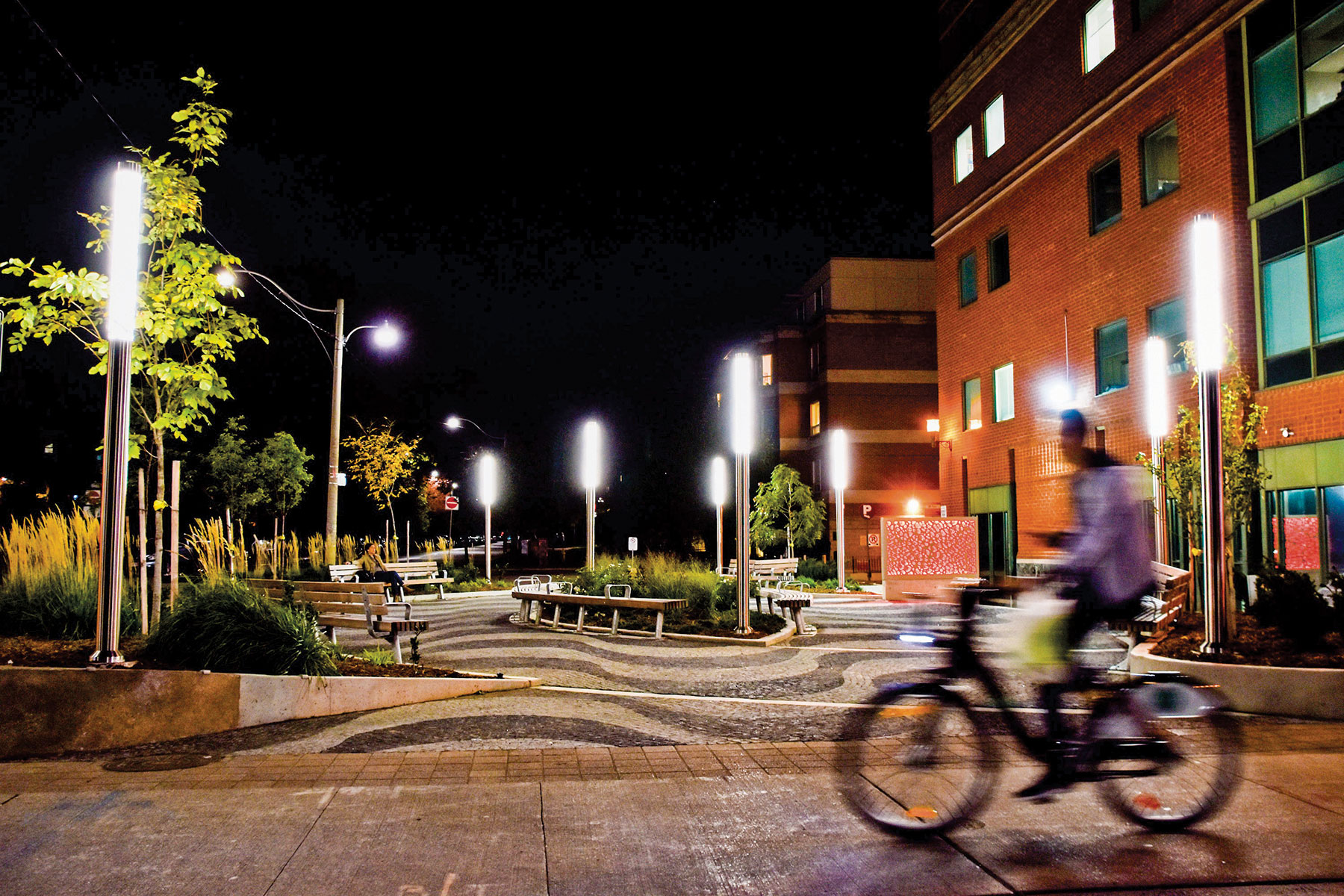
The Doctors’ Parkette, located at College and Brunswick, welcomes passersby as a place just to sit and relax. COURTESY RICHARD LONGLEY
The Doctor’s Parkette (named for its association with St John’s Hospital for Women, The Doctors’ Hospital, Kensington Health and the many doctors of all disciplines who live or have lived in its neighbourhood) is the product of a 13-year Harbord Village campaign (backed by generations of councillors) to rehabilitate the squalid scrap of its predecessor at Brunswick and College, the messy little parkette that remained after the demolition of McBean’s Hall and the building of Kensington Health Centre.
An international design competition produced eight entries from 27 countries.
The choices of a team of landscape architects were matched with those of Harbord villagers and incorporated into the plan of the parkette that stands today.
Its location is tricky: the land is owned partly by Kensington Health and partly by the city, with hydro vaults beneath. Sorting that out required much engineering and legal ingenuity. Considering its location (and the presence of Margaret Fairley Parkette at Brunswick and Ulster that is regularly packed with kids), The Doctor’s Parkette was never intended to be a children’s playground.
But it does serve its visitors well—passers by, readers, writers, sleepers, staff and residents of Kensington Gardens, and the homeless.
Litter can be a problem, but all in all, The Doctors’ Parkette is a striking example of what a tiny urban parkette can be and can do.
Major Street (at Bloor, not mentioned in Grading Our Greenspace) is a beneficiary of the parkette building campaign mounted by the Annex BIA that has improved the neighbourhood enormously.
It is also the site of a geological kidnapping of the Major Street erratic that was found during excavation for the parkette.
Pleas to incorporate a multibillion-year-old rock that had lain there since the end of the ice age produced – long before construction had begun – insistence that the parkette’s design was so advanced, no place could be made in it for the ancient boulder. It had to go; a home would be found for it at the far end of the Howland parkette.
There it now sits, forlorn, unmarked, undistinguished while, on Major Street, an alien rock of near-identical shape and size lies in what had been the erratic’s bed for 13,000 years.
If we’d known at the time that the parkette’s design would include a rock similar in size to the erratic, that the most ancient piece of history in Harbord Village would be exiled – at needless expense – to obscurity, that its place would be taken by a usurper, our requests would have been louder: that the erratic remain on Major Street as the marvellous thing it is.
Too late to reverse that switch? No. Bring the erratic home.
Transfer the rock that is its unwitting imposter to its place of exile on Howland.
I enjoyed reading this month’s paper, with its discussion of election issues and parks, but particularly appreciated your editorial.
Spelling out the small business taxes and how they work in local terms gave me a clearer understanding of the issues than I have derived from the generalizations I usually read about.
Thank you. —Brydon Gombay
Comments Off on LETTERS TO THE EDITOR (Nov. 2022)Tags:Annex · Opinion
November 22nd, 2022 · Comments Off on FORUM: Ford unleashes his sprawl agenda (Nov. 2022)
This sets province back to the 1940s
By Jessica Bell
Now that the provincial and city elections are over, the real Doug Ford has stepped out from behind the veneer of moderation. The Premier has unleashed his aggressive plan to spur suburban sprawl, parking lots, and highways across the Greater Golden Horseshoe area, at the expense of farmland, renters, municipal services, and all-important climate change goals.
Ontario’s significant housing supply shortage and affordability crisis will not be solved by giving the market unfettered domination over where to build, what to build, and who to build for. That’s Ford’s plan.
—Jessica Bell
Here’s what he’s doing.
Premier Ford is greenlighting sprawl on the Greenbelt. On a late Friday afternoon, the housing minister, Steven Clark, announced the government is permitting the construction of 50,000 homes on 7,400 acres of Greenbelt. Premier Ford has been publicly saying for years that he will never develop on the Greenbelt, while quietly trying to do exactly that and getting caught. Now that he’s won a four-year mandate, he’s stopping hiding his true plans.
The Conservatives are gutting municipal official plans, like Hamilton’s, to permit sprawl on farmland. Every five years municipalities update and submit their official plan to the province for review and approval. An official plan documents how a municipality will use its land to meet housing, job and growth needs. Hamilton City Council voted to keep its current urban boundary and meet its growth needs by increasing density within areas already zoned for development. Hamilton’s plan should be lauded as an archetype, not mauled.
The government also introduced Bill 23 which is a sweeping pro-development bill that undermines housing affordability, municipal budgets, and democracy.
Bill 23 eviscerates Toronto’s rental protection bylaw that requires owners of big properties to return a tenant to their rent-controlled apartment for about the same rent once construction of the new, bigger condo is complete. Bill 23 will make it far easier for developers to evict tenants and demolish buildings to make way for condos. This is exactly what’s happening at 145 St. George St., and I am worried and angry that the residents of 145 St. George might lose their right to return to their homes because of Bill 23.
Bill 23 weakens Toronto’s landmark inclusionary zoning law, the first of its kind in Ontario. Inclusionary zoning requires developers to build a percentage of affordable homes in all big buildings near transit stations. Bill 23 lets developers use a far weaker definition of affordable housing than was set by the city and exempts the developer from paying any development charges.
Bill 23 also takes away conservation authorities’ authority to protect the environment and stop developers from building on flood plains and pretty much bans everyone but the municipality and a developer from appealing a project to the controversial Lands Tribunal.
On the positive side, Bill 23 makes it easier to build homes in existing neighbourhoods. The bill requires municipalities to rapidly pre-zone areas near transit stations for higher density and permits three homes as of right on each residential property. Municipal approval is required to increase the property’s height or square footage.
Ontario’s significant housing supply shortage and affordability crisis will not be solved by giving the market unfettered domination over where to build, what to build, and who to build for. That’s Ford’s plan. A 600 square foot condo is great for an investor. A 1400 square foot accessible apartment is great for a family. The market isn’t building the latter.
Housing is for people first. That’s why I believe the government should play a greater role in shaping the housing sector to ensure home construction meets the needs of Ontarians, not investors. I am calling for a public builder to construct homes at cost on public land, far greater investment in non-profit, deeply affordable and supportive housing, a clamp down on domestic and foreign speculation so more first-time home buyers can buy a home, and stronger rent control to stabilize rent for Ontario’s 1.4 million renter households. To ensure every Ontarian can live in a safe and affordable home, a bold and comprehensive approach like this is necessary.
Jessica Bell is the MPP for University-Rosedale and the Official Opposition’s Housing Critic. She can be reached at jbell@ndp.on.ca 416-535-7206.
November 22nd, 2022 · Comments Off on ARTS: Fusion Art Show at Wychwood Barns (Nov. 2022)
Live performances by clay and glass blowing artists
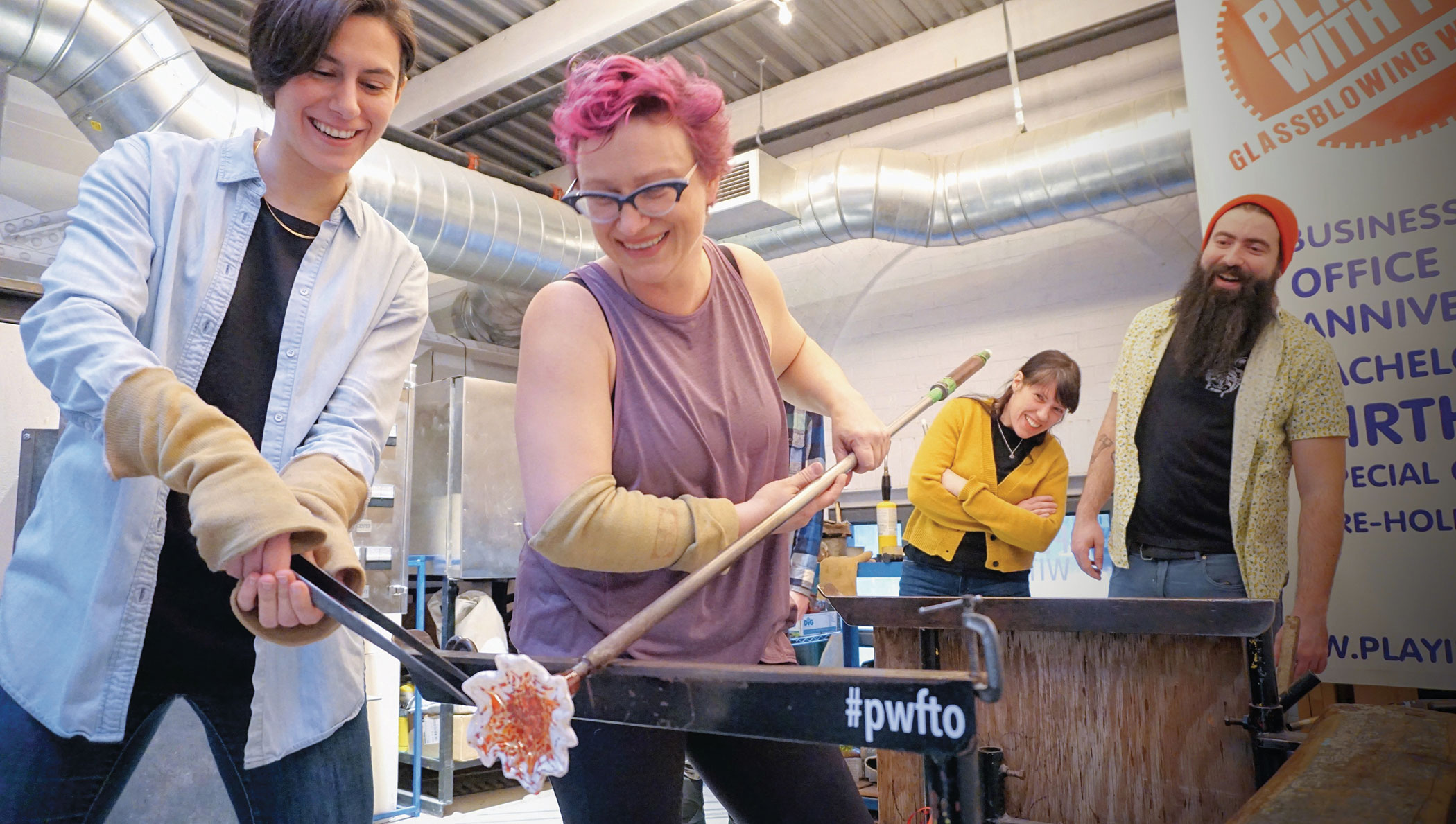
Minna Koistinen demonstrates her skillful techniques in live glassblowing art. COURTESY PLAYING WITH FIRE GLASSBLOWING WORKSHOPS
By Hailey Alexander
Fusion Clay & Glass Ontario kicks off the holiday season with a brand-new virtual exhibition at their two-day art show starting Nov. 19 at 9:00 a.m. in Artscape Wychwood Barns at 601 Christie St. This event offers the perfect opportunity to purchase handmade gifts and support local clay and glass artists in their creative endeavours.
Alongside a website redesign, Fusion will be launching their Connect Online virtual exhibition at this year’s art show. This means that the event will no longer be exclusive to local visitors but will be broadcast on an international platform. Catharina Goldnau, president of Fusion, says she hopes this new approach will support artists looking for virtual outreach.
“We [Fusion staff] feel that virtual presence is important. We’re hoping to interest people beyond Ontario, even beyond Canada. It’s great to see people connect with each other.”
Catharina adds that the pandemic has changed people’s perception of art and that people seem to value involvement both in-person and online. By reaching out beyond a local audience and “making art accessible,” more artists and admirers can connect with one another.
Fusion has admitted 40 clay and glass artists to share their talent at the show this year. An array of polished art and live performances will be on display.
Minna Koistinen, founder of Playing with Fire Glassblowing Workshops, will be leading live glass blowing presentations and sharing new pieces with the community. This year marks her 25th anniversary of working with glass. As a seasoned artist, Minna says that patience produces refined results. “It’s like learning how to fine-tune an organ. There are many things that you need to learn to control your craft.”
Adeline La, this year’s juror, says she is excited to see the artist community come together again after the pause COVID-19 put on local showings. Clay and glass art rely on the 3D element to be appreciated, which makes physical events all the more important.
Adeline will be jurying entries and presenting awards at this year’s showing. As manager of the Gardiner Museum shop on Queens Park, she sees how people respond to art of different mediums. “It’s like storytelling,” she says, adding that what makes an art piece special is, “how the artist executes that storytelling and how the creative process is reflected in the art itself.”
Comments Off on ARTS: Fusion Art Show at Wychwood Barns (Nov. 2022)Tags:Annex · Arts
October 19th, 2022 · Comments Off on ON THE COVER: Bill Bolton Arena celebrates 50 years (Oct. 2022)
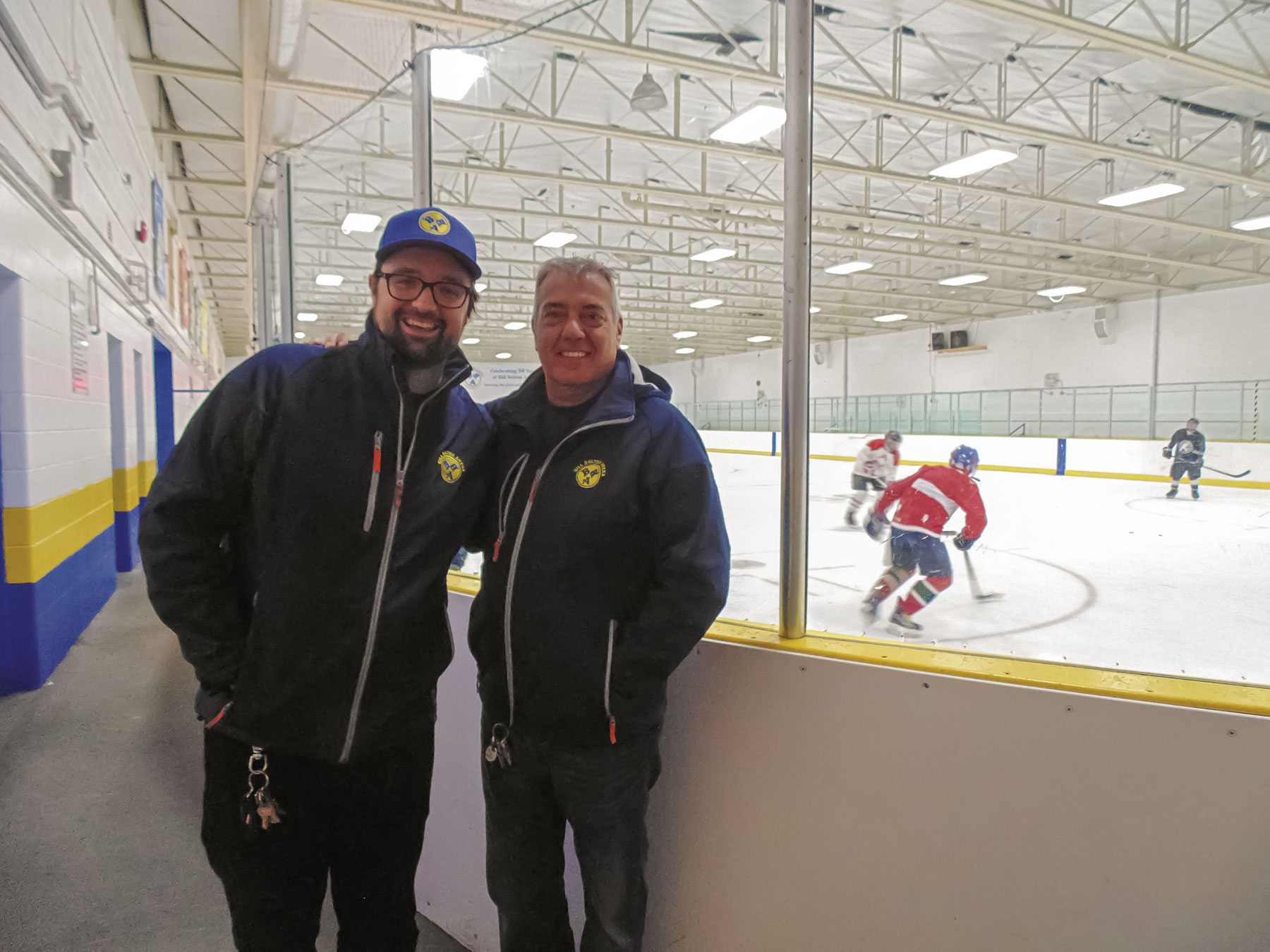
Programs coordinator, Chris Quinn (at left), and veteran arena manager, Mario Carpino, reflect on Bill Bolton Arena’s success in serving skaters of all walks of life for the past 50 years. HAILEY ALEXANDER/GLEANER NEWS
On September 23, Bill Bolton Arena hosted an evening of free food and skating in celebration of their 50th anniversary. Tucked away behind a busy park on 40 Rossmore Road, a block south of Dupont and two blocks west of Bathurst, Bill Bolton Arena is a hidden gem for many skaters.
According to the arena manager, Mario Carpino, a lot has changed since he started working at the arena 38 years ago. Back in 1985, Bill Bolton Arena mainly ran adult house leagues and beer leagues. Dave Pim, the programs coordinator from 1988 to 2018, sought more involvement from the rink’s surrounding community. Children and adults grew to value this recreational centre as it’s in a residential neighbourhood. Now the arena runs over 20 programs every year for men and women of all ages. “Over the years, our achievements come from the service we offer our community,” said Carpino. “I know some people would call us a local arena or a rink rat, but we get noticed by a lot of people.”
In all their years of service, Bill Bolton staff have not been short of commitment. Jim Oreto, the first manager from 1974 to 2010, oversaw arena expansions. What used to be an outdoor rink became an indoor arena thanks to his efforts to construct a sand floor. Bill Bolton Arena now houses programs every season which is a huge milestone they are celebrating this year. With Oreto’s vision and the right people, the arena has become a place of relaxation for everyone. “All our programs are really successful,” said the new programs coordinator, Chris Quinn. “But our learn-to-skate program hosts almost 1,200 kids a year. Youth spring and summer leagues are crazy now.” Quinn is most proud of the youth’s growing interest towards hockey. He and other staff are eager to share the joy of skating with younger generations.
Bill Bolton Arena staff are proud of the efforts they make to serve the Seaton Village community. “We’re in a residential neighbourhood, no parking area, and four dressing rooms, and we’re still that busy,” stated Carpino. “The community appreciates us, and we appreciate the community.”
—Hailey Alexander/Gleaner News
Comments Off on ON THE COVER: Bill Bolton Arena celebrates 50 years (Oct. 2022)Tags:Annex · News · On the cover
October 19th, 2022 · Comments Off on CITY ELECTION 2022: Q & A with councillor candidates (Oct 2022)
The Gleaner gets answers from prospects for Ward 11 seat
Compiled by Brian Burchell
In every election, the Gleaner asks local candidates a series of relevant questions about where they stand to allow the reader, and presumably the voter, to comparison shop. These are their answers. The election is Oct. 24.
1. Do you support the “strong mayor” legislation that the province is enacting for Toronto?
Axel Arvizu – I believe that the current system in place provides a greater set of checks and balances for the mayor of Toronto.
While the strong mayor system has its benefits, like advancing time sensitive projects, it gives too much control over the city to a single person.
Essentially, the mayor could use his office to further his political agenda, ignore council members, and even veto any council decision.
Regardless of my position, we’ve learned that there is little the city can do about the province’s move towards a strong mayor system, and I hope that we as councillors learn to work together to keep the mayor in check and accountable to Torontonians.
Robin Buxton Potts – I agree with the assessment of our former city mayors. The “strong mayor” legislation eliminates any meaningful role of city councillors and therefore the voice of the local residents who elect them.
While I am confident that the current mayor, should he be re-elected, wouldn’t abuse this power, who knows about future mayors? The City of Toronto is already a creature of the province with them controlling much of what we do.
Tying the mayor more closely to provincial premiers means we will have even less control of our city, including when and where development happens.
Norm Di Pasquale – No. A better city is built through consultation and working together, not by any individual wielding authority over other elected officials.
The mayor already has substantial power on council through powers of appointments and the direct support of many city staff on day-to-day dealings.
The measures being proposed by the province are unnecessary.
Adam Golding – Absolutely not. The so-called “strong mayor” legislation turns the mayor into Ford’s B*tch.
They only need it because they fear a Tory defeat, either literally in terms of the mayor losing his seat or in the more practical sense of “Team Tory” losing members.
(Be sure to check the “Team Tory Percentages” calculated by Matt Elliot in “City Hall Watcher,” and check out my anti-Tory picks for council on twitter: https://twitter.com/adamgolding/status/1574818492158824449 #EvictJohnTory!!!!
Tory whips the vote today meaning he gets what he wants. He functions doing what people think a “strong mayor” would be capable of without the additional strings to the province.
We need the opposite. We need a diverse vote on council and independent thinkers who listen to everyone, not who vote as a bloc. The “strong mayor” legislation seeks to further codify the layers of COLLUSION we have in Toronto government including:
collusion between councillors and the mayor (team Tory)
collusion between council and media (via Tory’s job at Rogers!)
collusion between council and police (via former police in the city manager’s office— fire Tracey Cook and do not vote for Jon Burnside).
collusion between the city and the province (via strong mayor legislation)
END THE COLLUSION.
Peter Lovering – I will support every mayor with council members for the betterment of the city.
Toronto needs to get things done, especially when it comes to affordable housing, transit, and homelessness.
There is no better reflection of what the population wants—the mayor of Toronto. No matter what individual councillors want, they need to work together and with the mayor (whoever it is) to get things done.
If there is an issue with a mayor, we as the council, have the ability to veto.
We have to work together.
Dianne Saxe – The “strong mayor” legislation is now in force. This makes it even more important that Ward 11 elects someone like me who can work collegially and effectively with the mayor and the city’s full range of stakeholders. Our big problems require a big tent approach, now even more than before.
In my long career, I have worked for, and with, most city stakeholders. My expertise, character, and experience allow me to speak the language and understand the needs of stakeholders such as elected officials, public servants, businesses, and community groups. In turn, this allows me to find common ground and solutions by translating between different stakeholders.
Plus, I know Mayor Tory and believe I have earned his respect. We will be able to work together.
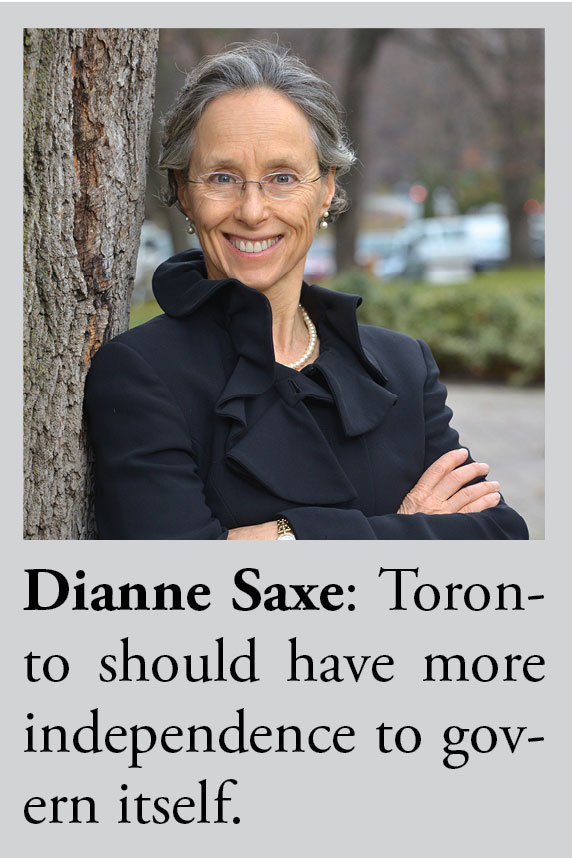
As great cities go, Toronto city government’s powers are weak. Toronto should have more independence to govern itself. It is harmful for the provincial government to impose unilateral changes like this, especially without notice or consultation; however, under Canadian constitutional law, cities are under the thumb of the province.
The fact is councillors have to work within the legal system the province creates. I am focussed on what city council and the mayor can do together within that system.
2. There are approximately 30 high-rise developments in the Gleaner’s coverage area, but similarly to other parts of the city, the supply of affordable housing is becoming increasingly scarce. How would your policy on housing and development impact this situation?
Axel Arvizu – Our generation is facing a housing crisis. We need to build inventory.
I am going to improve alternative housing options such as laneway and garden suites so that families can stay together and/or cool down the renters’ and sellers’ market conditions. I also plan to advocate and work with building departments to ease basement apartment conversions.
We need to take a close look and fix the backlog at the Landlord and Tenant Board. Investors and homeowners are scared to put their house or apartment in the market because they are afraid that they will have no recourse if they get a bad tenant. This goes both ways. Landlords and tenants should not have to wait more than a year to get a hearing.
I want to put a cap on rent increases, and resources to subsidized housing should be allocated to people who need it.
Robin Buxton Potts – Finding the balance between building a mix of new housing options quickly and affordably that doesn’t overwhelm existing neighbourhoods is critical to solving the housing crisis.
Super tall towers, often touted as a solution to the housing crisis, are incredibly disruptive to neighbourhoods and often displace residents and small businesses.
Rather than relying on a few affordable units in high rises, I would facilitate the ability for homeowners to create secondary units within their homes which would open access to thousands of empty bedrooms without having to add height and make it more affordable for people to stay in their homes.
We must ensure that these units are safe and well-made, but facilitating the construction of new units is an easy way to add new units to the city.
Laneway suites or backyard rentals are not sufficient to solve the problems alone. Allowing for safe, regulated multi-unit homes to be built or converted on existing properties is a great way to help homeowners stay in their homes and provides much-needed housing stock.
Norm Di Pasquale – City hall does not influence how quickly we receive development applications or the density and height being proposed.
This is largely driven by market forces. Applications we do receive need to have approvals completed more quickly, but we cannot ignore local voices when planning our neighbourhoods.
Many residents in the Annex and joining communities have strong processes through which development is reviewed. I think their insight and expertise is invaluable and present an opportunity to leverage their support and energy toward something positive. As with any political issue, I believe in building consensus and working together to find solutions.
I would guide this process toward a discussion on maximizing the affordable housing component, working to approve softer density and mid-rise proposals much more quickly, and directing more public investment into housing starts so we are not building condominiums that only a select few can afford.
These are just small pieces to address the housing crisis, and I encourage residents to learn more about my housing policies on my website.
Adam Golding – You can see the details at platform.adamgolding.ca, we propose a number of measures:
Give Khaleel the key to the city. Name him a COVID hero.
Aggressve vacancy taxes which double monthly.
End vacancy decontrol (After Jessica Bell’s Rent Stabilization Act. This removes a perverse incentive to evict.)
The beginning of a modest universal rent subsidy (indexed to Toronto rent prices, reducing the rate of evictions.
Ban mass evictions and arbitrary relocations.
Daily public meeting on houselessness and evictions.
Limit rent control exemption on new developments to developments which do not replace functioning units — this provides a cash incentive to spread out as a city.
Peter Lovering – To solve our housing affordability issue we’re going to need a multipronged approach and collaboration across the city. Many of those ideas are also multi-governmental. There are several actions we can do now.
Get the full inventory of Toronto Community Housing working at full capacity. Quickly repair and get needed housing units back into circulation.
Accelerate and expand the Toronto Housing Now program designed to create mixed-income communities on public lands. Prioritize creative land use such as adding affordable housing above city libraries, arenas, subway stations and other underused city properties.
Consider carefully curated additional density in our residential and heritage neighbourhoods such as garden and basement suites.
Many seniors I talk to are scared. With inflation, taxes, and fixed incomes the city needs to provide permit fast-tracking for affordable secondary apartment rentals and even consider property tax rebates for those who qualify.
Focus on sensible growth and partner with developers to include affordable housing. An “if you build this” then “you have to build that” approach.
Having worked with many commercial owners over the years, there is an incredible opportunity for “micro-residential retail.” This needs to be explored and could very easily be subsidized through commercial tax incentives.
Work with residents in Ward 11 to develop an “Invest in our Neighbourhoods Plan.”
Dianne Saxe – Hundreds of thousands of people are growing up in the GTA or moving here.
Since sprawl is the worst solution, we need to create good places for them to live, work, and play within existing urban boundaries, in a way that isn’t just for the rich. Young people, parents, nurses, and teachers have to be able to live well in our city without being priced out.
This won’t happen without a lot of new homes, both market and subsidized housing. I’ll work to create a larger, more varied supply of homes to moderate prices and increase affordable options and to improve the public amenities we all share.
I’d make it much easier to build low-rise neighbourhood-scale multi-unit housing by ending restrictive zoning. As Edmonton shows, this can unlock a rapid increase in “missing middle” homes to rent or own; for example, basement apartments, townhouses, garden suites, triplexes, walk-up apartments, and properly regulated rooming houses.
Provincial laws mean many mid and high-rise buildings will also be built. Ward 11 is such a great place to live that there are about 120 active proposals for such buildings. I’ll work to ensure they include various sizes of affordable units that are well designed, sustainable, and appropriately located (near arterial roads or transit hubs) and I will increase public amenities, such as ground-floor retail, wider sidewalks, schools, libraries, and parks.
I’ll support deeply affordable housing through inclusionary zoning, inexpensive use of public land, and density bonuses for permanently affordable nonprofit rentals.
3. In Toronto, the property tax burden is disproportionately borne by commercial taxpayers. Do you support raising the relative rate that homeowners pay to support the city’s budget?
Axel Arvizu – I agree that commercial taxes in Toronto are disproportionately borne many times, not by
landlords, but by small businesses trying to stay alive.
No one likes taxes, but these are necessary to pay for services the city needs. I do not want to see residents’ taxes go up, but I want to explore alternative ways to generate revenues such as increased fines, parking rates, parking permits, new condominiums, and imposing highway tolls on commuters from outside Toronto boundaries.
Robin Buxton Potts – Residential property taxes in Toronto have been at or below the rate of inflation for over a decade and we are seeing the outcome of that in services that do not meet our expectations.
Property tax assessments are based on the highest and best use, so properties, especially commercial properties near large developments, are seeing much higher assessments each year.
I would like to see a review of how MPAC assesses property taxes to help correct those increases, while also incorporating a larger mix of revenue tools that don’t rely solely on property taxes.
Norm Di Pasquale – The city is currently working toward making these payments between commercial and residential homeowners more equal with a freeze on commercial rates.
I will continue to support the freeze until the property tax burden can be shared. I will reject austerity budgeting and support increases to the residential mill rate.
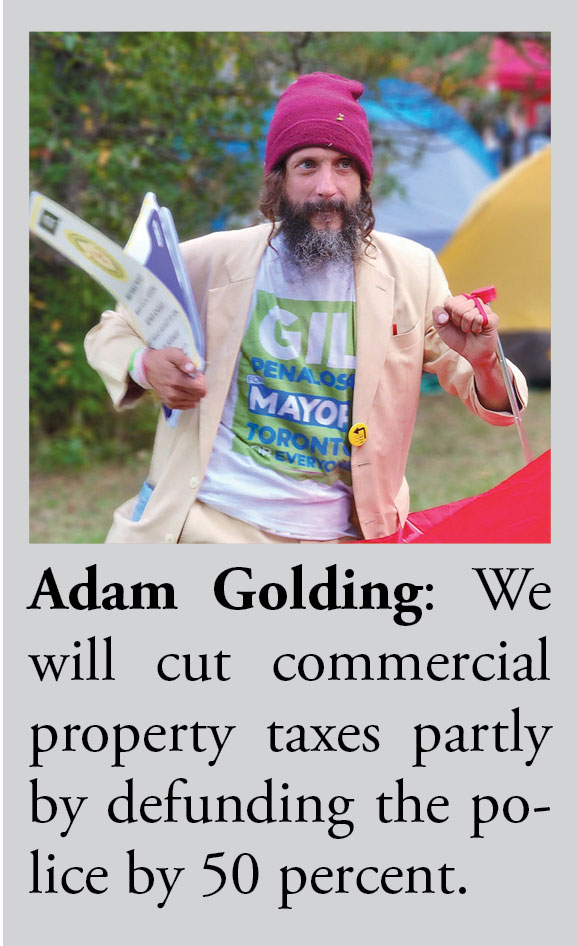
Adam Golding – We will cut commercial property taxes partly by defunding the police by 50 percent. Residential property taxes will be frozen until the evictions crisis is over. Did you know homeless deaths have doubled since 2017?
Peter Lovering – The city needs to be accountable, sensible, and transparent. We must prioritize accountable financial management, balanced budgets, and sensible taxes, all the while monitoring our financial resource allocation, so we continue to maintain and enhance the quality and diversity of our city services. I would like to find as many efficiencies as possible before we consider raising taxes.
Dianne Saxe – Yes. A vibrant city needs neighbourhoods such as thriving local retail which should not be choked off by an unfair tax burden on top of the pandemic. But when we ask residents to pay more, they also must get more. The fundamental contract between government and the community is that government must reliably meet people’s basic needs and that taxes have to be commensurate with services.
That’s not what’s happening. People tell me they see Toronto services and infrastructure in decline. Parks are shabby, sidewalks are littered with trash, water fountains are broken, and so many are homeless. This breaks the social contract.
Services and infrastructure that work are essential to a good quality of city life and cannot be provided without adequate revenue. Toronto residential property taxes are much lower than those of nearby municipalities and are too low to keep the city in good repair. To have a city that works, city revenue will have to rise, coupled with careful programs to protect low-income Torontonians.
Importantly, the city should not be relying so heavily on property taxes and should take the advice of the former city manager to pursue other types of revenue such as a land transfer tax, vehicle registration tax, and highway tolls.
4. What is your favourite Annex green space and why?
Axel Arvizu – Even though it’s small, my favourite green space is St Alban’s Square. I walk Blu, my husky dog, very early in the mornings, and going to St. Alban’s Square is always a great start to our day.
Robin Buxton Potts – I was honoured to be at the name unveiling for Paul Martel Park and it remains one of my favourite places in the city.
The new mural is such a welcome surprise and adds so much life to the space. I love the park because of the involvement of community members in its maintenance and restoration and the focus on preserving the ecological history.
Paul Richard is such a wealth of knowledge, and his passion for the park and his work to restore it are everything I love about neighbourhoods like the Annex.
Norm Di Pasquale – The city recently refinished Joseph Burr Tyrrell Park and I have to say that I am a huge fan.
I know it is not the biggest space, but I saw the condition of the playground before and what Councillor Layton and residents were able to transform this into is inspiring. The park still smells of fresh cedar, over a year later.
The park speaks to what is possible in all of our public spaces if we can dedicate ourselves to solid design, safety, and inclusivity.
This need not apply to parks and green spaces alone. We can challenge the status quo on our roads, sidewalks, and other public spaces and make them greener, and more importantly, safer.
This park speaks to the opportunity we have to transform Ward 11, and I look forward to applying the lessons we can learn in other areas of the city.
Adam Golding – Sibelius Park. I love it! I remember the day I discovered the new rope structure with my friends as we walked out from a party I was hosting at Tartu College, in my student days, across the street from the former Rochdale where my mom had lived.
I’m showing films about Rochdale this Tuesday, 3-6 p.m. at Film Cafe in Kensington!
Peter Lovering – I would have to say Taddle Creek Park. It’s actually pretty cool because it is named after the underground river that went from St. Clair all the way down to the Distillery.
Philosopher’s Walk is part of the Taddle Creek Ravine. It is also located on the spot of Sir Frederick Banting’s house.
The park itself has a great playground, and the art is visually interesting because it represents the buried river. Worth a visit!
Dianne Saxe – Jean Sibelius Park. I particularly like the community-made skating rink that gets built there in the winter (when the weather cooperates) and the annual corn roast. They are inspiring examples of neighbours coming together and building on the foundation of public infrastructure to support joy and an enhanced sense of community.
The park has a great playground that my grandchildren love to get sandy and muddy in. There are shared toys. The public bathroom has a shade and rain cover and provides a critical public service.
The Bike Share station makes the park a useful node in our public transport network. The shady trees, benches, and tables make it a gathering place for people of all ages. I’ve been to family birthday parties and community gatherings in Jean Sibelius Park over the years and look forward to attending many more.
5. If you are elected, what issue or policy will you address first? What’s at the top of your personal
agenda?
Axel Arvizu – The top of my personal agenda is wanting to see Ward 11 as a place where we can raise our children and have a sense of community and safety and make Toronto a brighter city. This begins by addressing the affordability, mental health, and drug crises.
Robin Buxton Potts – Fixing a washroom or removing garbage and graffiti might not be the flashiest part of the city government but these are the nuts-and-bolts issues that I am most eager to focus on. These are small things that really help build pride in a neighbourhood and a city.
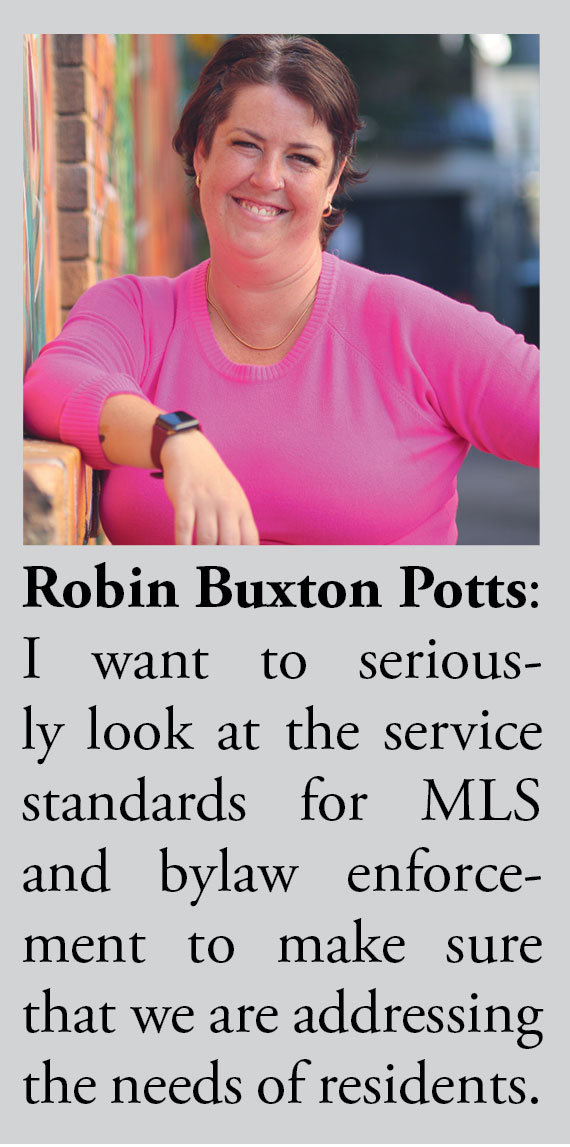
I want to seriously look at the service standards for MLS and bylaw enforcement to make sure that we are addressing the needs of residents while we tackle the big systemic challenges around housing, transit, and climate.
Norm Di Pasquale – It is difficult for me to pick one issue or policy when we are faced by so many issues at city hall.
Failing public services, meaningful action on climate change, and the state of our parks and washrooms are all important issues.
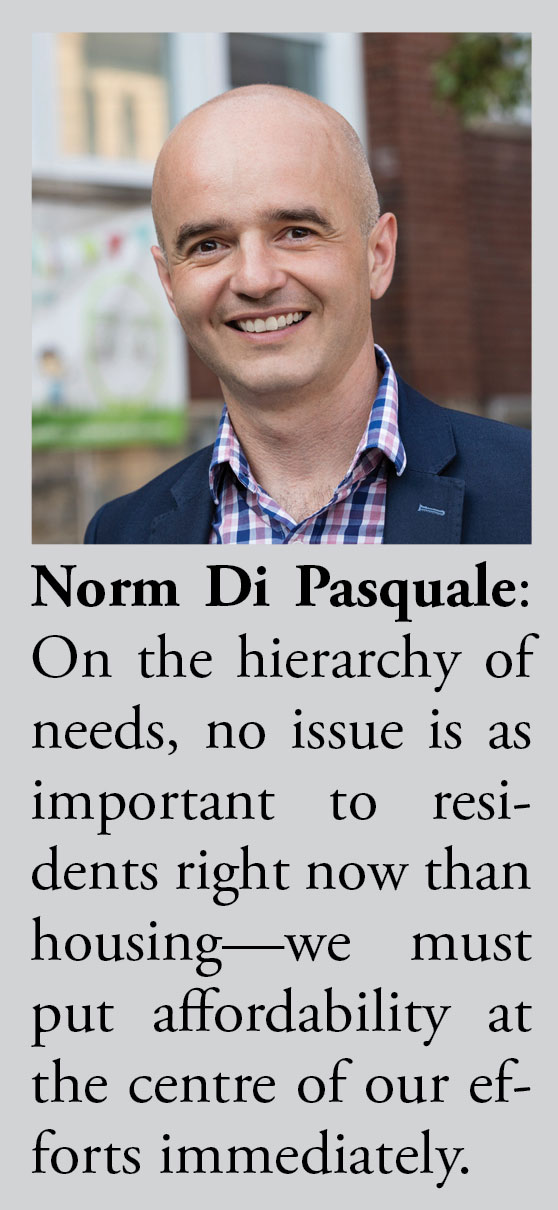
However, on the hierarchy of needs, no issue is as important to residents right now than housing. From supportive housing for those currently experiencing homelessness and choosing encampments, to the lack of new units to keep up with a growing population, we must put affordability at the centre of our efforts immediately.
We cannot allow our most vulnerable and marginalized residents to live without safe, stable, and supportive housing.
We saw how quickly we could mobilize during the pandemic to provide housing for those in need, and we can do it again.
Homelessness is a policy choice we do not have to accept.
Adam Golding – Basic needs. One of the wealthiest cities in the world should be able to address everyone’s basic needs before we waste any more cash.
Please join me in turning us into a “Maslow’s Hierarchy” city. #EvictJohnTory (Please learn the song and look up the #EvictJohnTory playlist on youtube [https://www.youtube.com/playlist?list=PL_-Kd_WSmEAEX2DbvZPb3y2vSRygtJO-v] which documents the moral crime of the mass evictions last year in which hundreds were assaulted, charged, ticketed, injured, or otherwise violated at Tory’s behest.
To be clear, this was the chain of command: Cops, Burnside, Cook, Tory. They all have to because they and their authoritarian ilk divert money from basic needs to their control freak fantasies.
Peter Lovering – We’ve lost our curb appeal as a city, and we have to fix that. Creating a cleaner, safer, and more efficient city is my top priority.
It starts with listening to residents and ensuring our core city services such as parks, waste, bylaw enforcement, safety, and transportation are held accountable to you the resident.
Dianne Saxe – 1. To provide more low-rise and affordable housing by working with the mayor and council to legalize missing-middle housing and rooming houses.
2. To cut deaths and injuries on the roads by implementing Vision Zero and putting people before cars on dangerous streets such as Avenue Road.
3. To bring back good maintenance of public space and infrastructure.
4. And to do it all with a realistic climate lens so that we limit catastrophic damage and become more resilient to our changing future.
There are 14 candidates on the ballot for Ward 11 University—Rosedale. The Gleaner reached out to each candidate for whom contact information was available. The following individuals either did not supply contact information or did not respond in time for publication: Michael Borrelli, David Fielder, Andrew Layman, Alison Pang, Ann Rohmer, Heather Shon, Pierre Therrien, and Diana Yoon.