December 13th, 2022 · Comments Off on CHATTER: Annex Art Centre’s Arty Market (Dec. 2022)
The Annex Art Centre is opening their Let it Snow Art & Craft Market on Dec. 10 from 10:00 a.m. to 7:00 p.m. at 1075 Bathurst St. in celebration of the festive season. Look forward to crossing some gifts off your holiday shopping list while enjoying warm apple cider and other treats with the friendly Annex community.
This two-day event offers unique items handcrafted by the Annex Art Centre’s artists and artisans. An array of beautiful home decor, ceramics, jewelry, and artist gift packs will be on display and available for purchase. Michele Morgan, art instructor and owner of the Annex Art Centre, is excited to share her jams as well as other host gifts.
“We look forward to the few days the market runs,” said Morgan. She sees this event as a wonderful opportunity to meet new and familiar faces in the neighbourhood.
Don’t miss your chance to share your holiday cheer with the Annex Art Centre before they close their arty market on Dec. 11 from 11:00 a.m. to 6:00 p.m. “Although we are a small space, we manage to fill it quite nicely with lots of goodies,” said Morgan, excited to see both new and familiar faces this year.
—Hailey Alexander/Gleaner New
Comments Off on CHATTER: Annex Art Centre’s Arty Market (Dec. 2022)Tags:Annex · News
December 13th, 2022 · Comments Off on LETTER TO THE EDITOR (Dec. 2022)
Re: Grading our Greenspaces – Margaret Fairley Park
I always enjoy getting the Annex Gleaner and have appreciated your Grading our Greenspace for many years…good for the neighbourhood and good for the parks department.
So here are my two cents when it comes to Margaret Fairley Park. Having lived in the neighbourhood for years, I was glad when it was renovated/changed. There are lots of nice things about it; but, when you do your grades, please have a look at the furniture. The park furniture, looking rustic with old wood benches and tables, is certainly the most uncomfortable way to sit anywhere, for both children and adults; the proportions are terrible.
There’s no place comfortable to sit in the park, whether you’re an oldie like me, or a young parent, or even a child. Maybe someone likes this naturalistic “look” but it does not function well at all. Try sitting down at one of those tables and imagine you’re bringing some food or a drink.
This is just something Marisa and Hailey [authors of this year’s park reviews in the Gleaner] can take into consideration.
Thanks again for your wonderful community service.
—Michael Kerman
Comments Off on LETTER TO THE EDITOR (Dec. 2022)Tags:Annex · Opinion
December 13th, 2022 · Comments Off on EDITORIAL: Bill 23: A housing plan built on corruption (Dec. 2022)
Back in 2018, Doug Ford spoke his truth and it was caught on camera. The reaction to that video was so swift and forceful that the premier was forced to make a promise: he would never touch the Greenbelt, he said. If we’ve learned anything about Doug Ford since then, it’s that saying one thing and doing another is standard practice, and promises are meant to be broken. In breaking his promise on the Greenbelt, Ford is inflicting incomparable damage on this province that extends from the land to our trust in democratic systems.
Current plans to pave the Greenbelt come under the auspices of solving the housing crisis. Announced by housing minister, Steve Clarke, Bill 23 is tagged as the More Homes Built Faster Act. Never mind the fact that Ontario’s own Housing Affordability Task Force reported last February with the following clear and concise conclusion: a shortage of land isn’t the problem.
Despite this, more than 7000 acres of formerly protected land will be sacrificed to construct 50,000 new homes. The developers who bought the land back in 2018 will cash in while the province’s ability to combat climate change, manage watersheds, and protect wildlife will be greatly diminished.
Bill 23 does so much more than allow for homes to be built where they shouldn’t. Bill 3, the Strong Mayor Act, and Bill 39, the Better Municipal Governance Act, are companion laws to Bill 23. They allow the mayors of Toronto and Ottawa to adopt bylaws with the support of just one third of a council vote. This runs afoul of the fundamental tenet that legislation and bylaws should only be adopted by a 50 per cent plus majority and strips citizens of effective representation; it’s an affront to democracy in the name of a crisis.
Under the auspices of building more homes faster, provincial conservation authorities will lose their powers to comment on projects and be locked out of the process. Ford and his cronies will move as fast as they can to lay pavement—both for houses and the highway that no one wants but them.
Bill 23 also deprives municipalities of development fees needed to finance growth. According to a recent staff report, Toronto will lose $230 million a year due to Bill 23. That’s a 20 per cent reduction over current rates. That’s less money for sewers, roads, and new green spaces.
Ostensibly, Bill 23 is about giving us more roofs over our heads that we can afford. Yet the province has dropped the “affordable” requirement for new developments to a maximum of five per cent. Compare that to the Westbank redevelopment of Mirvish Village at Bathurst and Bloor where the affordable component will be 40 per cent. We can thank the federal government for that one.
Wealthy developers, meanwhile, will get wealthier. After Ford’s first mention of the Greenbelt back in 2018, a group of them purchased $278 million worth of Ontario farmland—but they didn’t need to justify their purpose with any claims about growing food.
The Ontario government should be answering questions about how it selected the choice 11 parcels of Greenbelt to be “liberated” for development. But they won’t, instead Premier Ford will keep hiding behind his majority.
Ontario Green Party leader Mike Schreiner spoke about Bill 23 and said, “this all smells,” and it does—in fact it stinks, of corruption and greed at its worst.
December 13th, 2022 · Comments Off on FORUM: A fall economic statement from the Minister of Finance (Dec. 2022)
So far this year, our economic growth has been the strongest in the G7
By Chrystia Freeland
I know that it has felt like one thing after another since COVID first reached our shores. We turned the economy off, and then we turned it back on again. Vladimir Putin illegally invaded Ukraine. And now we are all dealing with the impacts of global inflation at the checkout counter and the gas pump.
Interest rates have been rising as the Bank of Canada steps in to tackle inflation. And that means our economy is slowing down. That is the case in Canada. That is the case in the United States. And that is the case in economies big and small around the world.
This is a challenging time for millions of Canadians. It is a challenging time for many of our neighbours here in Toronto, too. But while we cannot avoid the global economic slowdown, our economy is ready for it—and we have been ensuring that Canadians are prepared for it, too.
The major enhancements we have made to Canada’s social safety net since 2016 will be there for those who need them—including the Canada Child Benefit, the boosted Guaranteed Income Supplement, and enhanced Old Age Security. Critically, the benefits and pensions that so many Canadians count on are indexed to inflation.
And in the Fall Economic Statement I tabled in November, we introduced new measures to strengthen our social safety net and provide important inflation relief to the Canadians who need it most.
We are permanently eliminating interest on the federal portion of Canada Student Loans and Canada Apprentice Loans. We are delivering dental care to make sure that families don’t need to choose between taking their child to the dentist and putting food on the table.
We are creating a new, quarterly Canada Workers Benefit to deliver advance payments to our lowest-paid—and often most essential—workers, providing up to a total of $2,400 to a couple working full time. This enhancement means the Canada Workers Benefit will now support 4.2 million Canadians who do very important jobs for very little money.
We are providing hundreds of dollars in new, targeted support to low-income renters who are struggling with the cost of housing. And for the Canadians who need it the most, we are doubling the GST Credit for the next six months. Hundreds of dollars have already started to arrive in the bank accounts of 11 million Canadian households to help them cope with higher prices.
We are providing targeted inflation relief because it’s the right thing to do. And we can do it because while we are compassionate, we are also responsible.
In fact, Canada has the lowest deficit and the lowest debt-to GDP ratio in the G7. A few hours after I tabled the Fall Economic Statement, Moody’s reaffirmed our AAA credit rating with a stable outlook. And in October alone, employment in Canada rose by 108,000 jobs—meaning there are 513,000 more Canadians working today than before COVID first hit.
Our economy is now 103 per cent the size it was before the pandemic. So far this year, our economic growth has been the strongest in the G7.
All of this shows that our pandemic spending worked. It means we are entering the global slowdown from a position of fundamental economic strength—with more Canadians employed, and with the fiscal firepower we need to respond to whatever the global economy may throw at us.
As we provide important support to the Canadians who need it most today, we are also looking forward—at how we can ensure our economy creates good jobs and prosperity in the years to come.
Which is why, in the Fall Economic Statement, one of our key pillars was a focus on growing Canada’s economy—on making investments that will encourage businesses to grow and create good jobs for Canadians right across the country.
We focused on that because we know the global economy is changing—and because we know that a changing global economy represents a generational economic opportunity for Canadian workers.
We believe this for two reasons. First, the global green transition is the most significant transformation since the Industrial Revolution. And here in Canada, we have a fortunate abundance of the goods and resources that will power that transformation. And second, since Putin’s illegal invasion of Ukraine, we have entered a period of friendshoring. Our allies and their leading businesses are moving to build their supply chains through democracies rather than dictatorships, and they are looking to Canada to provide them with the goods and resources they need.
That is why we have been working to make Canada a leader in electric vehicle manufacturing, and the democracy that is prepared to provide our allies with the critical minerals and energy they need.
That is why we are investing in innovation and in helping Canadian businesses take risks and grow in a net-zero world. That is why we are launching a new Canada Growth Fund that will help attract the billions of dollars in private capital required to fight climate change and create good jobs across industries here in Toronto and from coast-to-coast-to-coast.
That is why we are ensuring that Canadian workers have the skills they need to do good jobs, and why we are bringing to Canada more of the skilled workers that our growing country needs.
And that is why we are working to make housing more affordable and to build more of the homes that a growing economy requires—more of the homes that Toronto desperately needs.
Canadians are tough and the Canadian economy is resilient. And that is why we can all be confident we will get through this, just as we have got through so much over these past two and a half years.
The Fall Economic Statement was about helping our most vulnerable friends, family, and neighbours weather the challenges that the global economy is presenting at us. And it was about building a brighter future and an economy that works for everyone.
Chrystia Freeland is MP for University-Rosedale, Minister of Finance, and Deputy Prime Minister of Canada.
December 13th, 2022 · Comments Off on FORUM: Ford takes aim at democracy and the Greenbelt (Dec. 2022)
It’s power for power’s sake not about sound policy
By Jessica Bell
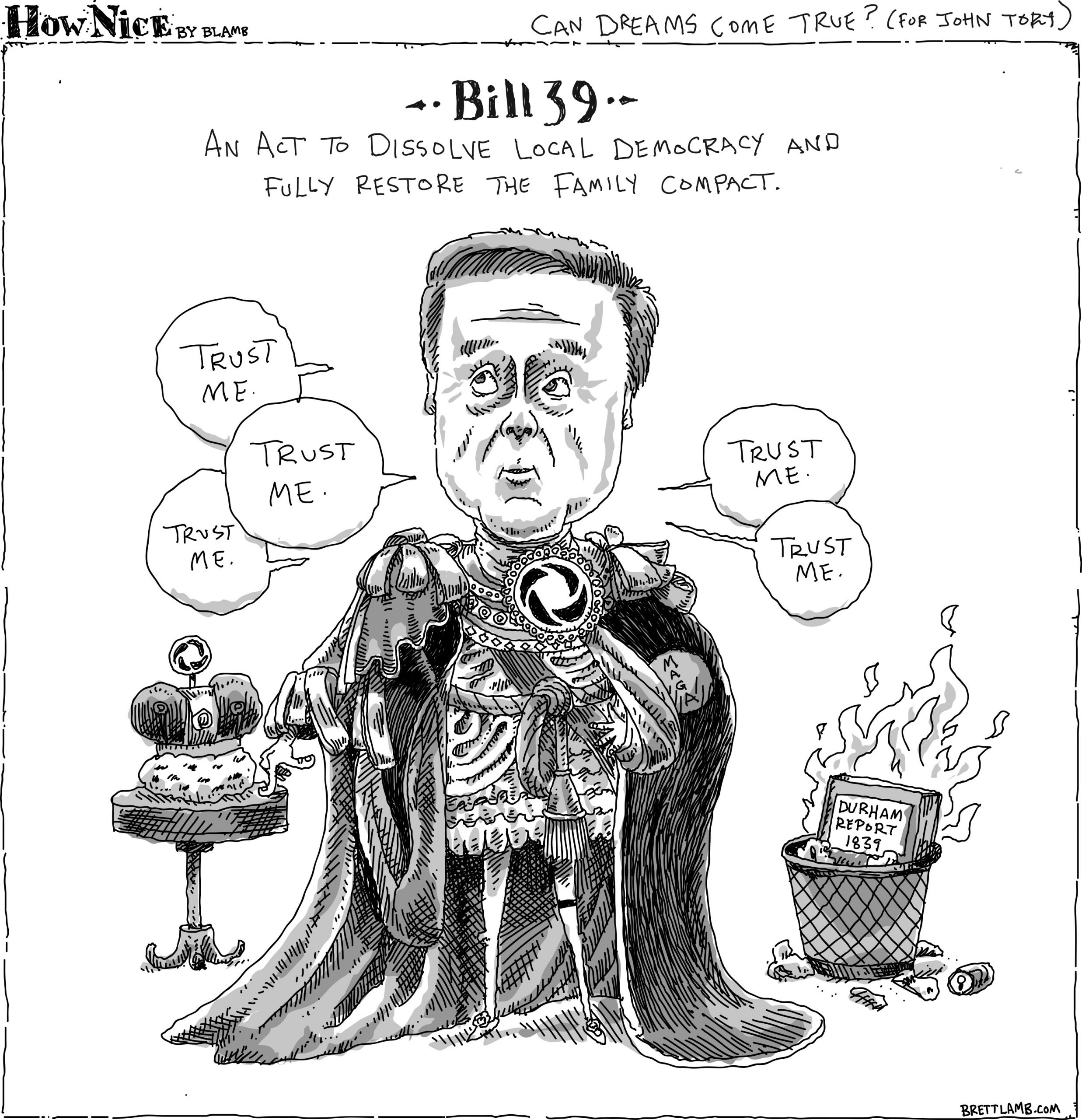
The Ford government’s Bill 39 is a direct attack on representative democracy. The bill bulldozes local decision-making so Doug Ford can wield more power while making it easier for his developer friends to get rich paving over the Greenbelt.
Bill 39 is a short and devastating document. Schedule 1 amends the City of Toronto Act to give the mayor the power to pass laws that align with provincial priorities with the support of just eight out of 24 councillors. The premier has yet to define its provincial priorities in regulation or law, but we can guess it will be about development, housing, and transit. This schedule is an attack on citizen power, the authority of our elected officials to represent us well, and majority rule, which is a basic tenant of representative democracy.
I walked down from Queen’s Park to city hall on the first day of city council. I, along with hundreds of others, watched Mayor Tory sitting entrenched in his corner seat, eyes forward, studiously avoiding the hundreds of citizens watching the proceedings. It astonishes me that Mayor Tory asked for this minority rule power under the pretense that he needs to address the housing crisis that has been made worse by his decisions over the past eight years. Really, this is all about power.
Schedule 2 permits development on an area of the Greenbelt called the Duffin Rouge Agricultural Preserve. Over 1300 acres in this area are owned by the De Gasperis Family, one of the PC party’s biggest donors. The De Gasperis family bought the land cheap when it was zoned for farmland. With the passage of Bill 39, the developers stand to make untold profit because the land will be zoned for development. Given the huge amount of money PC party donors stand to gain from Bill 39, we have asked the auditor general to investigate for corruption or conflict of interest. On the face of it, it stinks.
Schedule 3 gives the Ministry of Municipal Affairs and Housing the authority to appoint regional council chairs in Niagara, Peel, and York, overriding municipal elections. This is all about reducing oversight over sprawl. Regional municipalities co-ordinate planning and development for a region; they get to decide what gets built and where, from homes and employment lands, to sewerage and roads. Giving Ford permission to appoint his yes people will make it easier for him to approve development on farmland.
For over 50 years, governments of all political stripes, from Bill Davis to Dalton McGuinty, worked to strengthen and expand the Greenbelt. They, like us, understood the economic, social and environmental value of preserving Ontario’s farmlands, forests, rivers, and wetlands.
Ford’s plan has nothing to do with solving the housing crisis. The government’s own Housing Affordability Taskforce stated that access to land is not limiting new housing supply. The taskforce called for ending exclusionary zoning, building more affordable missing middle homes, and increasing density on transit routes. These are “yes in my backyard” measures that I support, along with government investment in building affordable homes and supportive homes, and far stronger protections for renters.
It took thousands of years to secure representative democracy. It wasn’t given to us—our ancestors worked for it, agitated for it, and died for it. Torontonians and Ontarians: it’s time to work together to defend and strengthen our democracy again. Reach out if you want to get involved or want to tell our team what you’re working on.
Jessica Bell is MPP for University-Rosedale and the Housing Critic for the Official Opposition at Queen’s Park.
December 13th, 2022 · Comments Off on FORUM: Bill 23 is the province’s Big Lie (Dec. 2022)
Residents’ associations come together to condemn move
By the HVRA and the ARA
Bill 23, the provincial government’s promise to build 1.5 million homes by 2031 is nothing short of an early Christmas gift to developers.
There’s no guarantee homes will be built, there’s nothing to ensure they will be affordable, and there’s no help for renters.
Here’s what Doug Ford delivered on his pre-Christmas sleigh to his developer buddies:
the right to evict existing tenants with no obligation to take them back
the right to demolish buildings that are listed heritage unless the city designates them
the sole right to appeal planning decisions
relief from $200 million in city charges that currently ensure new residents have basics like sewer, water and parking spaces
a pass on making new buildings energy efficient which means Toronto won’t meet its climate change emergency targets
The province has even expanded the boundaries of some cities to allow for building and given a green light to pave over parts of the Greenbelt, an area the size of the City of Guelph.
Little wonder radio ads from the development industry are exultant. In return for this grab bag of blessings, developers are not required to deliver on anything.
They now say they will start building to serve newcomers and give people hope. Which newcomers and what hope? Without built-in social services and communities to support adjusting to Canadian life, this bill is promoting ghettos in the sprawl, serving only prosperous Canadians and rich immigrants who can afford their own transportation.
It’s scattershot legislation designed to rid the development industry of the perceived notion of price penalties, land frustrations, meddling neighbours, and interfering bureaucrats.
Last year in Toronto, the city reported 17,000 rental units built, with a further need for 40,000, including 18,000 deeply affordable. In the first six months of 2022, 1,436 rental units were started.
Where is the requirement that any of the proposed housing be rental, affordable, or deeply affordable? This is the housing that is required for students, low-income and fixed-income tenants, newcomers, and residents on the street.
The 2021 census showed that renters make up 48.1 per cent of the population of Toronto. According to Bullpen Research, average rents have increased by 27 per cent in the last year. A CBC home financial columnist tells her clients that the income needed to carry the average $2,474 rent on one-bedroom units in the open market in Toronto would now be more than $120,000. For cheaper accommodation, the Nov. 6, Rentals.ca website listed 15 units available between Dufferin Grove and Leslieville under $1500, and one at 230 square feet for $1475.
Until now, Toronto bylaws guaranteed that tenants displaced by development would receive a subsidy from landlords during construction and that they would have the right to return to the new building to a unit of the same size for the same rent.
A few days ago, the minister of municipal affairs removed similar protections from the Ottawa official plan to allow developers to evict and leave tenants to the mercies of the overheated rental market. Toronto will not be far behind.
The 130 tenants who will be displaced if the 145 St. George St. development is approved, will be hard-pressed to remain in Toronto, let alone return home once the new building is complete. This means Bill 23 will almost certainly reduce the lower income renter population—at least in the parts of the city of interest to developers. We will lose our residents. They will lose their homes, their communities, and us.
The bill further diminishes the capacity to create affordable rentals in new buildings even though cities can pass bylaws to create such housing. The changes in the city cannot require more than 5 per cent of affordable units in those areas. By comparison, the Mirvish Village development, which has become the poster child for progressive city building, has set aside 40 per cent of its 916 units as affordable, with contributions from the developer and CMHC.
The bill also acts on the chronic but unproved complaint that zoning appeals have stood in the way of development; however, the Ontario Land Tribunal reports that its caseload is down 50 per cent over the last four years, and that a minority of appeals were launched by individuals.
Where is the justification for taking away the rights of the public or interest groups to appeal when there are tens of thousands of units ready to be built?
Between 2016 and 2020, 140,848 residential units were approved but only 76,513 built—a completion rate of 54 per cent. Close to 600 units between 316 Bloor St. West and the Just Desserts site at 306-326 Davenport are stalled.
Three years later, the existing house form building at Just Desserts has been demolished and replaced by a surface parking lot. Are developers banking permissions and playing the market for better gains?
The province does not put up a dime to build the housing it says it wants.
Instead, it has put existing Toronto taxpayers on the hook for $200 million in lost revenue—fees that were charged to developers to pay for necessary upgrades to vital services like subways, water and sewage for new residents.
Likewise, parks and other infrastructure for the benefit of new and existing residents are now up to local taxpayers to finance. The only added rental in the amalgamated cities of Toronto from Bill 23 will be in scattered basement units and granny suites—and those will be up to individual property owners to finance.
Finally, 3,973 buildings in Toronto have heritage listing status which protects them from demolition for 90 days to allow time for Heritage Preservation Services to decide whether a time-consuming and exhaustive full heritage designation is warranted.
Under new rules, unless the city designates the property as a heritage site, present listings would expire in two years and the affected property would be exempt from heritage consideration for the next five years.
This bombshell of changes to planning and heritage was brought down without any hint or signal to the provincial electorate who voted only five months ago. It was introduced the day after a municipal election (instead of during the election when these ideas would have been hotly debated) and at a time when new councillors were still trying to find their new offices.
Bill 23 is an avalanche of random change. It is incoherent, seemingly vengeful, autocratic, and tailor-made for a single sector that does piecemeal violence to coherent city plans that have emerged after years of consultation; it rips asunder the democratic process.
We all agree sensibly-priced housing of all kinds is an urgent need. Our priorities are simple: we need to plan cities in considered ways and protect our most vulnerable.
The province needs to put money in the game and build the rental housing we need. There should be a full-scale public consultation process before Bill 23 becomes law.
Jointly submitted by Henry Wiercinski, vice chair, Annex Residents’ Association and Sue Dexter, board member, Harbord Village Residents’ Association.
Comments Off on FORUM: Bill 23 is the province’s Big Lie (Dec. 2022)Tags:Annex · Opinion
December 13th, 2022 · Comments Off on GREENINGS: It’s time for climate truth not trinkets (Dec. 2022)
Support organizations that actually care about our children’s future
Usually around Christmas I like to write about ways to lower our personal environmental footprints during the holidays, but none of that matters in the face of the complete political failure we are facing. This year, rather than buying gifts for kids or grandkids, they need you to get out there and fight for them.
We know that climate change is harming children’s mental health, but what’s harming them isn’t the fact that we had yet another record-breaking warm autumn, it’s that the adults in their lives go about their days like nothing is happening. Kids are rightfully scared about what the future holds for them. They don’t need another set of Lego or the latest gaming console; they need the adults in their lives to show them that their future matters.
Never underestimate the intelligence of children, especially teenagers. They understand that Pakistan is flooded and crops can’t get in the ground. They know what drought in California means for the future of agriculture there. They know that forest fires are destroying crucial carbon sinks.
What’s most important though, is that they know that COP27 was yet another fossil fuel-dominated intentional failure. They know that John Tory won’t do anything to reduce fossil fuel car emissions. They know that Doug Ford is razing the Greenbelt. They hear the news and the adults around them, and they seek information themselves. They know that we, the adults, are doing nothing. They know we handed Ford a majority to take away food-growing capacity—their best chance at surviving the coming food shortages. They know we, the adults who are supposed to protect them, have failed them.
This Christmas, show the kids, especially the ones old enough to understand, that you care about them. No more pointless toys that have a three-month life span. If you can’t get out there and protest on their behalf, donate in their names to organizations that are fighting to protect the Greenbelt and other worthwhile environmental causes.
Environmental Defence (environmentaldefence.ca) is doing some great work to protect the Greenbelt in the face of destruction. This must be fought tooth and nail. Ford using immigrants as an excuse to raze farmland is on par with his racist track record, but we all know it’s just another gimmick. This daughter of an immigrant is here to call out this racism. Instead of razing farmland, he could prioritize density in existing transit corridors, or, get this, reverse the Harris-era cuts that downloaded community housing to cities in the first place.
Thanks to the Star and the Narwhal, we now know that developers who moonlight as party donors bought “undevelopable land” shortly after Ford’s win and now suddenly stand to profit. This is textbook corrupt behaviour. We are living it, and our children will pay the price for it. The media needs to be brave and use the word corruption—dishonest or fraudulent conduct by those in power. This man was on record saying that he would not allow development of the Greenbelt. His party accepted money from developers, and without any public consultation, he did a 180 and opened up ecologically sensitive wetlands for future flooded basements.
Another great place to donate this Christmas is a charity called Nature Conservancy (natureconservancy.ca). This organization buys and protects large swathes of land, usually ecologically sensitive ones, and manages them. Governments have proven themselves untrustworthy. Organizations like Nature Conservancy can at least be a buffer against the kind of developer land grab we have in the Greenbelt. They depend on donations to buy and maintain land that will be essential for us to have any hope of mitigating the worst of the climate crisis.
This Christmas, look the young people in your life in the eyes and tell them exactly why you aren’t buying them the latest gadget that will be next year’s e-waste. Tell them why you will do everything within your means to fight for them to enjoy even a taste of the luxuries we currently have as we age, like adequate food supplies. Tell them that your immediate desires—like flying off to Cancun for a week—are secondary compared to their future of floods and forest fires. Tell them you love them. Tell them you care, and show them by your actions.
Terri Chu is an engineer committed to practical environmentalism. This column is dedicated to helping the community reduce energy and distinguish environmental truths from myths.
December 13th, 2022 · Comments Off on LIFE: Save Karma Co-op (Dec. 2022)
Pandemic dealt a blow but with your help we are poised to recover
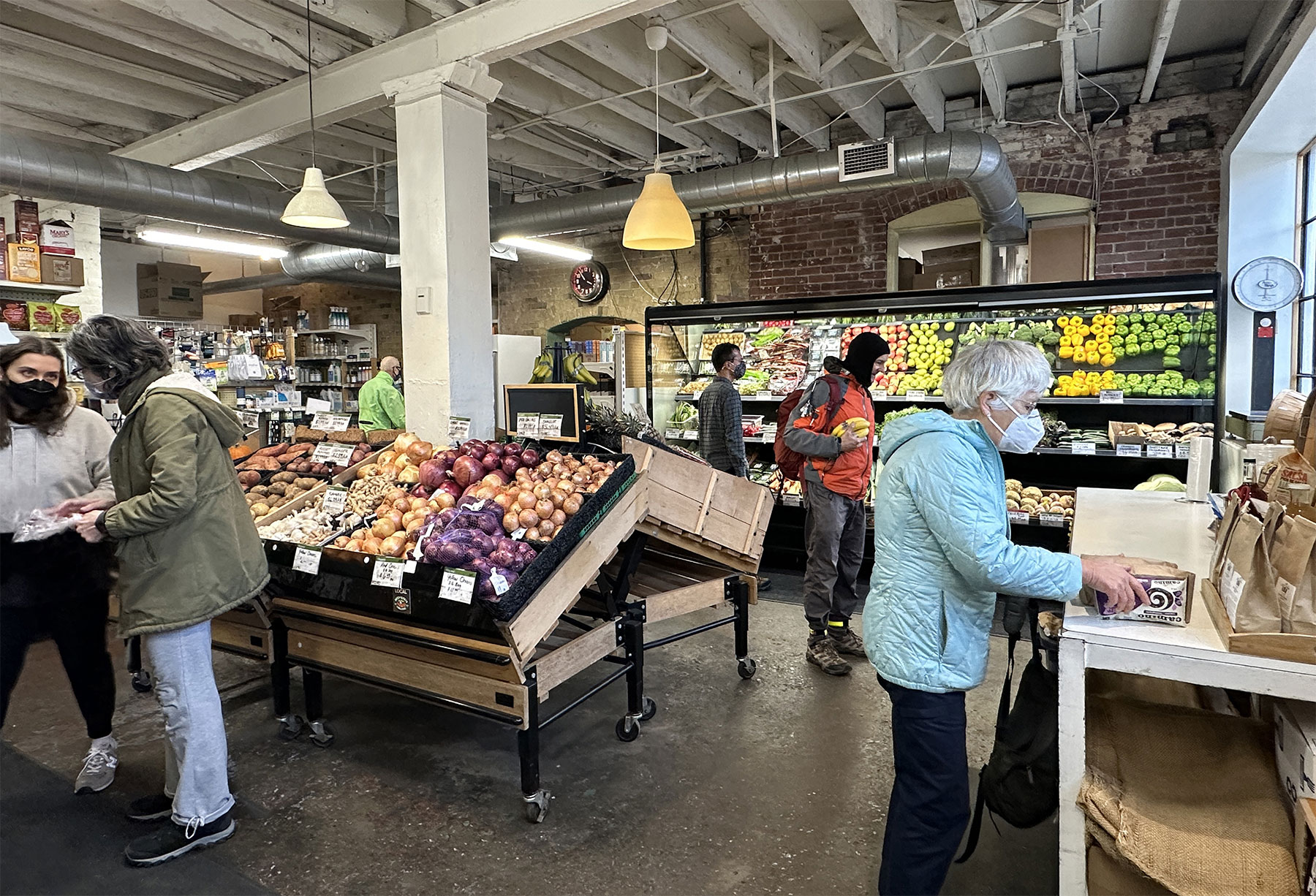
Shoppers in Karma’s produce section helping to keep the beloved brand viable. COURTESY KARMA CO-OP
By Bob Biderman
Although Karma Co-op Food Store has been my treasured second home for many decades, this gem of a neighbourhood grocery store is still not as widely known as it deserves to be. We’ve been operating since 1972 and have grown to provide a full-service, one-stop shopping experience for food, body, and homecare needs! Since 1978, our member-owned, democratically run, not-for-profit store has served customers at 739 Palmerston Ave., just north of Barton in Karma Lane. Open to the public and supported by members, Karma is the only member-owned co-op food store in Toronto.
To this day, I look forward to doing a weekly shop at our co-op. My partner and I are delighted by Karma’s long-standing focus on organic, bulk, zero waste, and fair-trade products, and its willingness to process special orders for its customers’ needs. We’re proud of the co-op’s competitively priced products and its emphasis on sourcing from local farmers, small producers, and other co-op businesses. While many of its members live nearby, I am far from alone in travelling some distance to do my shopping: a testament to the co-op’s services and values.
For me, Karma is more than just a food store; it is community. Since our earliest days, Karma members have organized picnics in the park, music in the parking lot, as well as cooking, craft, health, and music workshops. They have initiated friendships and arranged playdates for their kids. As a long-time member I’ve seen Karma kids grow up and shop at the co-op with their own children. Jane Jacobs, the urbanist activist who was a Karma member until she passed, was quoted as saying, “What we need is a Karma-like co-operative in every neighbourhood in North America.”
When I think back to how Karma was born and how it has grown, the phrase that fits is collective action. As members, we pooled our resources to buy the building that Karma operates out of to this day. With volunteer labour, we removed the large brick ovens in what used to be a bakery, converting it into a food store. Volunteering remains a strong component of Karma’s values and membership requirements, with an option for members to opt out as needed and pay commensurate dues.
In these ways, Karma had been chugging along, but the pandemic really knocked us for a loop. Despite sales going through the roof for a short time, Karma had no choice but to suspend in-store volunteer efforts. Moreover, to protect the health and safety of the local community, Karma instituted a strict COVID protocol by limiting the number of shoppers in the store at any given time and insisting shoppers wear masks and shop at a distance from one another. Karma also asked members to shop no more than once a week.
Of course, with stringent rules around shopping and reduced volunteer contribution, the sense of community and social cohesion at Karma was temporarily lost. Karma has always had a considerable number of new people wanting to join the co-op, but COVID negatively affected the growth of our membership. As someone who runs orientation events for new members at Karma, I had few, if any people to interact with.
At the same time, chain stores pivoted aggressively to online shopping and delivery which Karma did not. It should come as no surprise then that revenue started to fall behind operational costs. Matters came to a head when recently our board of directors communicated to the membership that the co-op was in financial trouble and that unless the situation reversed, we would be unable to continue.
The good news is that our members and supporters in the community have responded wonderfully, and sales have recently begun to approach pre-pandemic levels. Management is hard at work improving store operations. Members performed a price comparison with Fiesta Farms and Farm Boy which showed once again that Karma Co-op is the place to shop if you are looking to save money on groceries. The board has responded with a variety of measures which includes a plan to simplify membership and offer a discounted option for students, a partnership with another local co-op (Urbane Cyclist), outreach campaigns, and a two-month ‘no strings attached’ trial shop for those who want to check out what is new and what endures at Karma.
Do come, see for yourself, and don’t forget to sign up for an orientation session. This retired teacher derives great pleasure in meeting people new to Karma and talking about the co-op he is passionate about.
November 22nd, 2022 · Comments Off on ON THE COVER: Pumpkin Festival returns (Nov. 2022)
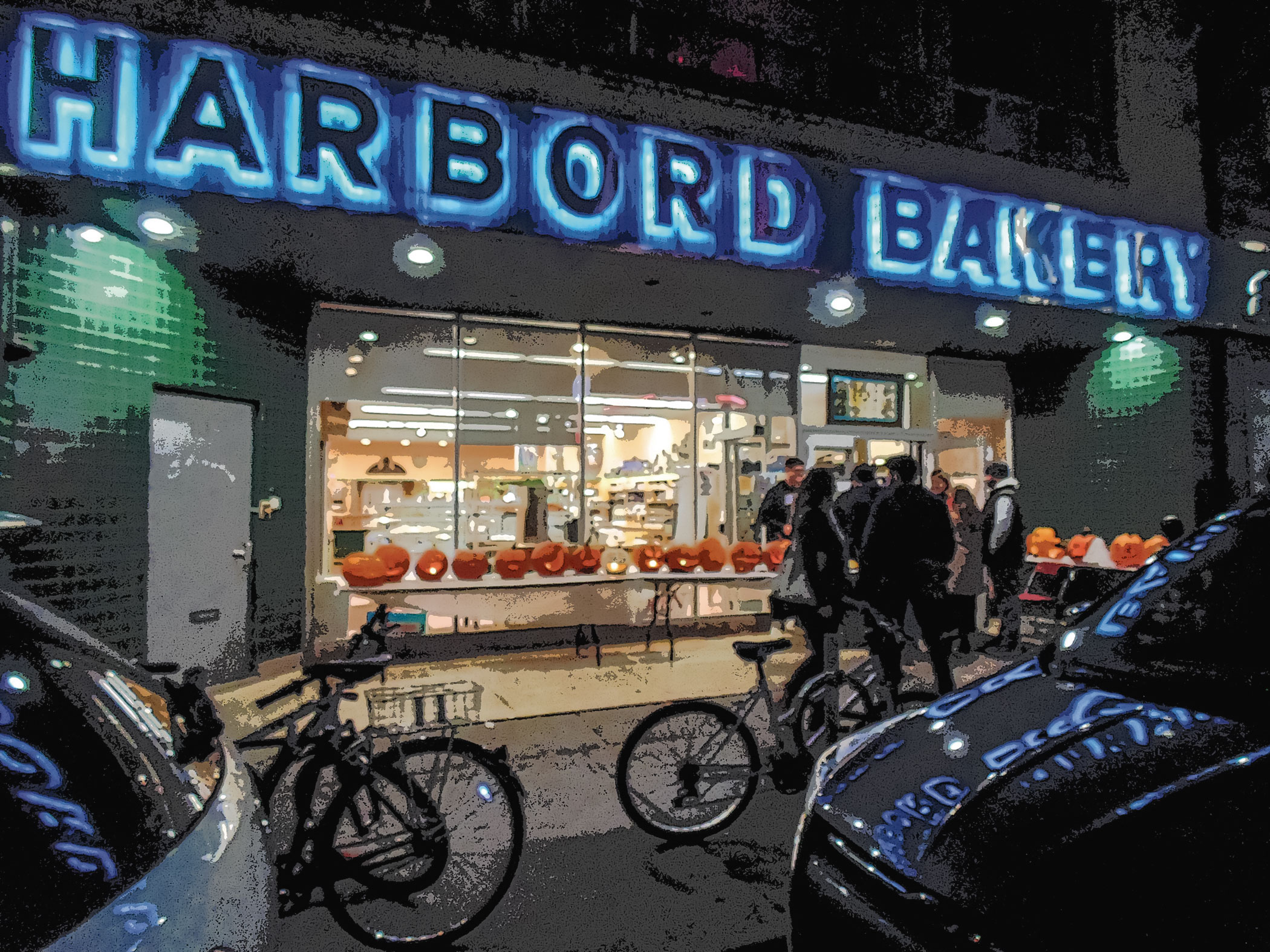
Harbord Bakery shares fresh baked goods during the Harbord Village Residents’ Association’s Pumpkin Festival on Nov. 1. PHOTO ILLUSTRATION BY HAILEY ALEXANDER & NEILAND BRISSENDEN/GLEANER NEWS
Comments Off on ON THE COVER: Pumpkin Festival returns (Nov. 2022)Tags:Annex · News · On the cover
November 22nd, 2022 · Comments Off on NEWS: Small business tax break scheme not available to everyone (Nov. 2022)
No mechanism to force landlords to transmit the savings
Just some of the businesses who have been deemed ineligible for the small business property tax subclass. NEILAND BRISSENDEN/GLEANER NEWS
By Carly Penrose
Since council passed the small business tax break one year ago, 29,020 commercial properties across Toronto (just over 80 properties in the Bloor Annex area) have been deemed eligible for this tax credit which reduces property taxes for commercial properties housing small businesses by up to 15 per cent. John Tory was re-elected mayor of Toronto using the policy as one of his talking points, even promising to increase the rebate to 20 per cent.
While the break in taxes for small businesses is a welcome change for those who received it, for the 36 per cent of commercial properties that didn’t qualify, there are questions about how the legislation defines a “small business” and how to ensure small businesses—and not their landlords—are receiving the savings.
“The pandemic delivered a knockout blow to many of our small businesses,” NDP MPP Jessica Bell said in an email. “The city’s small business tax credit program is good in principle, but flawed in practice,” she wrote.
To qualify for the tax relief, a property must be on a main street, must be 7,500 square feet or less, and must have an assessed value of $7 million or less according to the Municipal Property Assessment Corporation (MPAC).
The way the legislation was crafted means that the tax reduction applies to certain commercial properties, not the small businesses themselves. The benefit is delivered via property tax reductions, with no action required on the part of the property owner, if they qualify.
Casey Brendon, director of revenue services at The City of Toronto, says the emphasis with this legislation was speed. “Because of the pandemic, businesses were suffering so there was some urgency to do it.”
In the push for getting relief to businesses quickly, “we knew where we weren’t going to get everybody. But we felt the criteria we had was easily understood, easy to administrate from the city’s perspective, so it could happen sooner than later,” Brendon says.
But, Brian Burchell, general manager of the Bloor Annex Business Improvement Area (BABIA) (and publisher of the Gleaner), is an outspoken critic of how the legislation has been implemented.
He says the city’s use of MPAC property value assessments is a “blunt instrument,” that “unfairly excludes” small businesses in the Annex which should be eligible for the benefit.
Burchell says the eligibility criteria unfairly excluded 23 properties in the Bloor Annex BIA and prevented business owners from receiving tax savings of between $1,800 and $20,000.
In an editorial in the Gleaner, Burchell wrote that using the MPAC assessment as part of the criteria means businesses like By The Way Cafe, on Bloor Street, do not qualify. The restaurant’s landlord owns multiple properties that were assessed as one parcel, putting the total MPAC value above the $7 million threshold to qualify as a “small business.” Meanwhile, the Scotiabank at Bloor and Spadina received the tax benefit.
“The city should change the program to ensure the tax break reaches all eligible little businesses—not a national bank or international fast food outlet,” said Bell.
Brendon says that 34 properties took the opportunity to appeal their exclusion from the benefit before the deadline of July 4, and of those, only four were then added to the list of 29,020 eligible properties. He added that none of the other 30 who were rejected in the first round pursued their appeals any further.
“Those numbers are pretty compelling,” said Brendon. “People were generally satisfied. Nobody felt they needed to go and complain that they weren’t included.” Brendon attributes the small number of appeals to the factual, clear, and objective definition used in the policy.
But, Burchell notes that many properties were not told if they didn’t qualify for the rebate, so wouldn’t know to appeal. He also says the criteria are too limited, which makes the appeal process futile.
“The city doesn’t care that these specific properties should qualify because they’ve chosen a yardstick that says they don’t qualify,” said Burchell.
Once a property qualifies for the benefit, there’s the next challenge—ensuring the savings actually go to the small business.
Most small business owners rent and don’t own their commercial property. “What we’ve heard is that some landlords have chosen not to pass the savings on down to their tenants,” said John Kiru, president of the Toronto Association of BIAs. “The program was never meant to be landlord support. This program was always meant to be a small business support program.”
In Toronto, an estimated 85 per cent of commercial tenants have a net lease which itemizes taxes, maintenance, and insurance costs. The others are on a gross lease and agree to a set dollar amount to be paid monthly without indication of the landlord’s costs. Tenants on a gross lease may never see those savings and may not know they qualified for the rebate.
Brendon says the city is trying to understand its authority to intervene in the contractual relationship to compel the landlords to communicate the benefit to their tenants. In a memo from late May, they recommended “education initiatives” for landlords and tenants to inform both parties about the tax.
Brendon maintains that despite imperfections, overall, the program has been successful. “People have received tax relief. They’re happy with the tax relief they received and they didn’t have to do anything to receive that tax relief,” said Brendon.
“I wish I could have made everybody qualify,” Kiru said. But, due to time sensitivity and budgetary constraints, “there are people that were in and there are people that were out.”
“The idea was, let’s give this this year. Let’s see how it works, and then we can revisit it,” said Kiru.
Burchell, though, doesn’t feel that the program was so successful. “If it was 2 per cent on the fringe, I get it,” Burchell said. “But this is just needlessly flawed, and it could be fixed.”
There are many ideas for how the legislation might be fixed, and when passed in 2021, council committed to reassessing the tax benefit and adjust the program after one year.
Kiru says he hopes to expand the definition for the program in future years. “I think that geography should be removed,” said Kiru. “Any business in Toronto should be able to qualify, not just those on avenues or in the downtown core.”
He also says increasing the maximum property size could provide benefits to more businesses.
Brendon says it might be possible to create a special class of eligibility for “industrial malls” that would benefit businesses within strip malls or under the same property roll.
Bell says it is imperative that the city change the policy to mandate landlords to pass down the savings and change the policy to support more businesses.
“A thriving small business sector is good for jobs, good for our local economy, and good for making Toronto one of the most liveable and interesting cities in the world,” she wrote.
Dianne Saxe won with a margin of just 123 votes. She replaces Mike Layton who chose not to run in order to spend more time with his young family. The Gleaner approached Councillor-elect Saxe and asked about her reflections on the campaign, the riding, and what University—Rosedale residents can expect.
Now that you are elected and soon to be sworn in as a city councillor what is your first major priority?
Saxe: Getting the office set up to provide good service to constituents and beginning a methodical program of outreach to residents’ associations, BIAs, and other stakeholders.
How will being a former Green Party candidate differentiate you from the other councillors?
Saxe: Key factors that may distinguish me include:
I am a determined climate and environmental champion.
I am proudly independent.
I have 46 years of experience in government, law and business, and in holding government to account.
In that work, I have developed subject matter expertise on many of the city’s core services, including water, wastewater, waste management and recycling, energy, and transportation.
I am proud of my past work with the Ontario Green Party; however, my experience as a public servant, as a lawyer, as a small businessperson, as a board member and as the environmental commissioner of Ontario are far more relevant to my work at Toronto Council.
What did you learn about the University–Rosedale ward during the election?
I have learned, worked, shopped, eaten, volunteered and played in Ward 11 for many decades. I felt I knew it well, but the last two years of campaigning took me to streets, stores and restaurants that I had never visited before.
Knocking on thousands of doors year round gave me a closer look at people’s homes and lives. This ward contains extremes, both great wealth and much poverty. There are beautiful homes cared for by passionate gardeners and others in desperate need of repair, sometimes side by side. I enjoyed seeing the pride so many people take in their homes and the beautiful decorative touches that people put on their front doors or porches, including hand-painted tiles and stained glass. I also met a lot of enthusiastic dogs.
It is worrisome that so many residents of this exceptionally well-educated ward feel too busy and too disconnected to pay much attention to politics. It can also be challenging to reach voters. Many homes have no working doorbell and no way to reach the inhabitants by knocking, while fewer read local media. It is encouraging, on the other hand, that many of those who are not permitted to vote are anxious to do so.
In the recent provincial election, you ranked fourth. In this election, you won. It’s the same electorate. What do you deduce about democracy from these disparate results?
Saxe:
It is very difficult to unseat an incumbent.
People are more willing to judge a candidate on their merits when there is no party affiliation listed on the ballot.
It takes people a little while to feel comfortable with a new person. A second election gave me more time to introduce myself.
What do you hope to accomplish in the next four years to consider your term a success?
Saxe: Efficient oversight of the services that residents need and which make Toronto a good place to live.
Serious progress implementing TransformTO, especially in terms of a carbon budget, city procurement and how we get around.
At the end of my term, I hope to see Ward 11 flourishing with “15 minute neighbourhoods,” better sidewalks, more transit and more bike infrastructure so that far more local trips are made without requiring a personal motor vehicle and so that fewer pedestrians and cyclists are killed or injured.
Together with more trees and better green space, that will mean better air quality, less noise, more customers for local stores and a better quality of life.