August 8th, 2023 · Comments Off on ON THE COVER (April 2023)
University of Toronto Schools (UTS) held their annual Day of Pink anti-bullying celebration on April 12. This is a drone photo of the event held at their recently renovated building facing Huron Street. COURTESY MAXIMILLIAN HUDDLESTON (UTS)
August 8th, 2023 · Comments Off on NEWS: Rally for those facing “demovictions” (April 2023)
145 St. George has become poster child for renters facing eviction
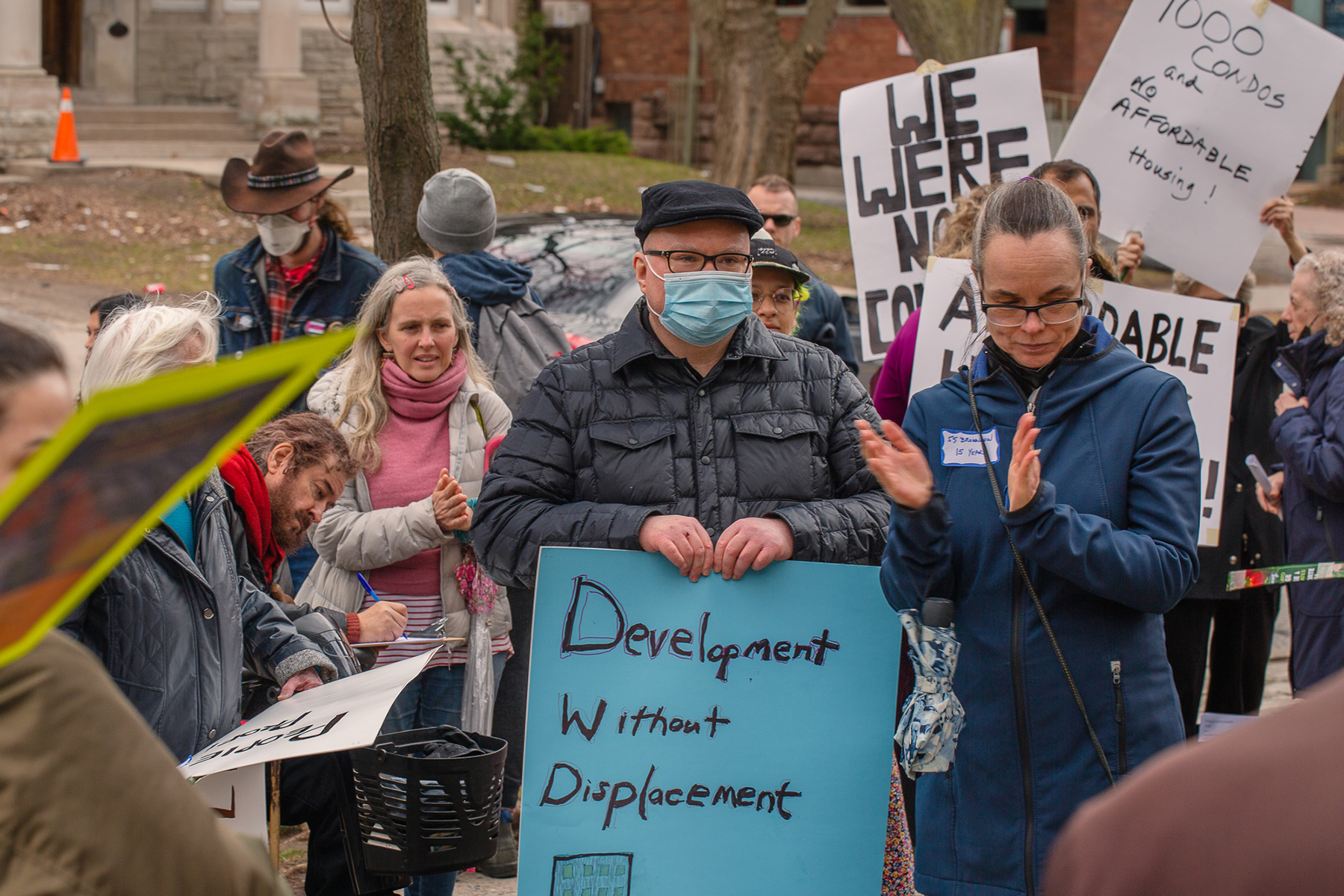
Tenants and protestors rallied on April 1 to voice opposition to their pending evictions due to demolitions. COURTESY VANESSA JUNG
By Carly Penrose
On April 1, close to 80 people gathered outside a mid-rise apartment building at 25 St. Mary St. with name tags displaying their building of residence and the length of their occupancy. Their timelines ranged from a few years to multiple decades in one of three apartment buildings that will be demolished to make way for higher-density condominium towers. The event was organized by the buildings’ tenants’ associations and the Federation of Metro Tenants Associations (FMTA) and is the first of a series of planned demonstrations.
Rebecca Gimmi, a resident of 145 St. George St., a mid-rise building constructed in 1959, helped to organize the rally. She says she’s been in the building for more than 15 years and knows all her neighbours.
Roughly two years ago, tenants in the building found out that it had been approved for demolition.
Plans for the building that will replace it include a 29-storey condo building with 130 “revitalized units” and 211 “new housing units” according to the project website.
According to a speech by NDP MPP Jessica Bell, the building at 145 St. George St. is one of 3441 buildings across the City of Toronto slated for so-called “demoviction,” and in September 2021, the Annex Residents’ Association submitted an official position statement to the city protesting the project at 145 St. George St.
Then, last November, the Ontario legislature passed Bill 23, The More Homes Built Faster Act. The bill amends the City of Toronto Act of 2006 and the Municipal Act of 2001, which gave the City of Toronto the ability to impose conditions and regulations on construction projects. Bill 23 enables the province to limit a municipality’s power to regulate development and makes it easier for the province to approve and build more housing faster. Proponents of the bill say this is necessary to address the housing crisis in Ontario.
But residents at 145 St. George, 25 St. Mary, and 55 Brownlow have concerns about what the bill means for tenants’ rights, affordability, and for their homes.
Antoinette Fricassi lives at 25 St. Mary St. and her daughter lives at 145 St. George St. “There’s 256 units in here,” she said, referring to her building. “Almost 1000 people, and where are we supposed to go? There’s a vacancy rate of less than two per cent and all the rents are higher because these are below market at the moment.”
According to Canadian Housing Statistics Program data released in February, over 40 per cent of condominium apartments in Ontario and 36 per cent in Toronto, are purchased as investment properties.
Though increasing housing supply is an important part of solving the housing crisis, Gimmi said reverting to “simplistic” conversations about supply and demand isn’t accurate. “I push back on that because you’re not comparing the same things. If some of the supply is actually just investment products, it’s not apples to oranges. It’s like apples to NFTs.”
Fricassi notes that waiting in limbo has been challenging.
“Uncertainty is really bad for you mentally because you don’t know what’s going to happen and when it’s going to happen. Sure, they’re going to give you notice, but is it this year? Is it next year or the year after that?” she asked. “You can’t make decisions because this is hanging over your head.”
Local politicians showed up in support of the rally. At the end of the march, at 145 St. George St., Bell spoke to a crowd that had grown to over 100 people. “We want a city that’s affordable for us, for the people who live here and work here and make the city wonderful. And that’s what’s at stake right now,” Bell told the crowd.
Bell was joined by NDP MPPs Kristyn Wong-Tam (Toronto-Centre) and Jill Andrew (Toronto-St. Paul’s). All three spoke at the rally and criticized Doug Ford and Bill 23. Prospective mayoral candidate Chloe Brown spoke, and Gil Penalosa was in attendance at the rally. Another rally is being planned for April 29.
Gimmi hopes these rallies will put housing on the agenda as the municipal by-election approaches. “We think that all the mayoral candidates should be able to speak to what their housing plans are,” said Gimmi. “Seventy per cent of the Annex is renters. So, what are their plans for us?”
August 8th, 2023 · Comments Off on FOCUS: Saxe: Net-zero is possible (April 2023)
Town hall stresses carbon-emission accountability
By Fox Oliver
On April 20, Dianne Saxe (Ward 11, University-Rosedale) spoke to her constituents about carbon budgets, the expansion of sustainable vehicle fleets, and support for cyclists—her vision for the future of Toronto and what is possible for the city.
“For a long time [I’ve been pushing] to treat climate emissions seriously, like we treat money,” said Saxe.
She explained that the kind of thinking required to balance a cheque book is the same that is required to manage carbon emissions; we must limit our emissions with the same seriousness that we limit our spending. The goal, she said, is to reach net-zero emissions by balancing the amount of greenhouse gases being released into the atmosphere with the amount being removed from the atmosphere.
The City of Toronto plans to “demonstrate carbon accountability locally and globally by establishing a carbon budget for its own operations and the community as a whole.” Toronto’s first climate budget will likely take effect in 2024, contingent on the city’s and future mayor’s support. If the city creates and remains within a specific carbon budget, it will reach the goal of net-zero emissions by 2040.
Saxe says she will remain vigilant to make sure the city does not “greenwash” when striving for net-zero emissions.
“The Sustainable Fleets Plan is an area of success, and the staff [working in the field] are some of the most enthusiastic [in the city],” said Saxe. The plan builds on the city’s earlier Green Fleet Plan which was implemented in 2008. The goal is to transition vehicles in the city’s fleet (including TTC and emergency vehicles) into low-carbon vehicles for the purpose of reducing overall emissions.
Saxe says that large diesel engines from 2008 and earlier disproportionately affect the climate and people’s health as they were purchased before the city’s Sustainable Fleets Plan.
There are at least 160 major diesel engine vehicles from before 2008 in the city’s fleet, which Saxe wants replaced.
Thirty pumper fire trucks with diesel engines, purchased in 2008, need to be replaced as these vehicles are uninsurable after 15 years of use. Though the city has designed a fully electric version of these fire trucks, they are still undergoing testing, as the electric motors must be capable of both moving the truck and pumping the water.
“[It is] too late to be buying diesel anything,” said Saxe, “[but] to my enormous frustration, we are going to have to approve the buying of 30 new diesel trucks.” These vehicles will be replaced by electric ones after their 15-year insurable window is over, which will still be before the 2040 net-zero emission deadline.
Bikes are also being set up for city staff as an environmentally conscious alternative to cars. Bike couriers are becoming more popular, and due to their fast delivery speed compared to vehicles, they are now supported by Uber. Saxe is motioning to increase fines for blocking bike lanes and wants to expand bike, e-bike, and car sharing infrastructure.
Saxe is pushing for the requirement that bike couriers wear an identifier while working. This motion is meant to disincentivize bike couriers from speeding on sidewalks or committing road crimes. The identification is not meant to act as a licence to only permit certain people to work as couriers, but rather to hold dangerous couriers accountable. Uber is planning to add more warnings to drivers, bikers, and passengers in streets with bike lanes to ensure they know how to act safely on the road.
Community members asked for Saxe’s response to the Therme Group’s application to construct a spa on a 12-acre plot of Toronto’s waterfront where Ontario Place used to be. “I think it’s an outrageous use of public space on the lake shore,” responded Saxe.
Currently, the city is working to open park facilities such as washrooms and water fountains early. Many residents’ associations and other community groups are working hard to organize litter pick-ups in the upcoming weeks as the city warms up.
Comments Off on FOCUS: Saxe: Net-zero is possible (April 2023)Tags:Annex · News
August 8th, 2023 · Comments Off on NEWS: Unveiling ceremony in honour of Sam Richardson (April 2023)
Central Tech student competed at 1936 Berlin Olympics
Sam Richardson passes the baton during the men’s 4×100 relay during the 1936 Summer Olympics in Berlin. Like Jesse Owens, who became a friend, he proudly represented his nation while facing the institutionalized racism of Nazi Germany. PHOTO COURTESY CENTRAL TECHNICAL SCHOOL ARCHIVES
By Hailey Alexander
On May 11, Central Technical School (CTS) will hold an unveiling ceremony in honour of Olympian and CTS alumnus Sam Richardson. This event celebrates the installation of Richardson’s plaque on the school ground’s south lawn which faces Harbord Street and is east of Bathurst Street.
While still a student at CTS, Richardson competed at the 1934 British Empire Games where he won a gold medal in long jump and a silver medal in triple jump, all the while being one of the youngest competitors.
The following year, he set a national long jump record that stood for several decades.
In the 1936 Berlin Olympic Games, he participated in the 4×100 metre relay event in which the Canadian team finished fifth. He raced against Jesse Owens who won four golds at those games. Richardson and Owens, fellow athletes of African descent, went on to become lifelong friends.
Fernanda Pisani of the CTS Alumni Association describes Richardson’s participation in the 1936 Berlin Olympics as “controversial” within the Black community because people saw his attendance as “enabling” and “supportive” of Germany’s racist policies.
However, with the support of his family and school, Richardson took a stand for the inclusion of Black athletes. “I don’t know if that was really on Sam’s mind,” Pisani said. “The sense we get is that he did what he knew, and he did it very, very well.”
In 1936, Germany wanted their Olympic Games to be a class act so they would be regarded with respect. This established many Olympic traditions including the opening and closing ceremonies.
“A lot of that ceremony script started at the Berlin Olympic Games,” Pisani said. “Without athletes like Sam Richardson and Jesse Owens, racism in relation to the Olympic Games may not have been as fought against.”
In reaction to his athletic accomplishments, several universities offered Richardson scholarships to support his studies.
He chose not to pursue a post-secondary education due to family responsibilities, as stated by CTS.
The plaque states that Richardson retired from sport in 1937 and worked in carpentry on television sets for the Canadian Broadcasting Corporation. He also mentored young athletes, participated in the Harry Jerome Awards, and toured with the Canadian heavyweight boxer George Chuvalo.
Since Richardson’s passing in 1989, CTS has taken steps to commemorate his legacy. The school provided bursaries to two graduates at the 2020 CTS commencement ceremony, and it would like to raise funds so these bursaries could be awarded on an ongoing basis. One of the bursaries went to a student athlete while the other was awarded to a trade student in honour of Richardson’s multiple talents. Pisani said she hopes and trusts that CTS’s acknowledgement of Sam Richardson continues beyond his plaque.
In addition to Sam Richardson Way, a path in front of the school that connects Lippincott Street, CTS plans to plant a garden surrounding Richardson’s plaque.
August 8th, 2023 · Comments Off on CHATTER: 30 years of Hot Docs Cinema (April 2023)
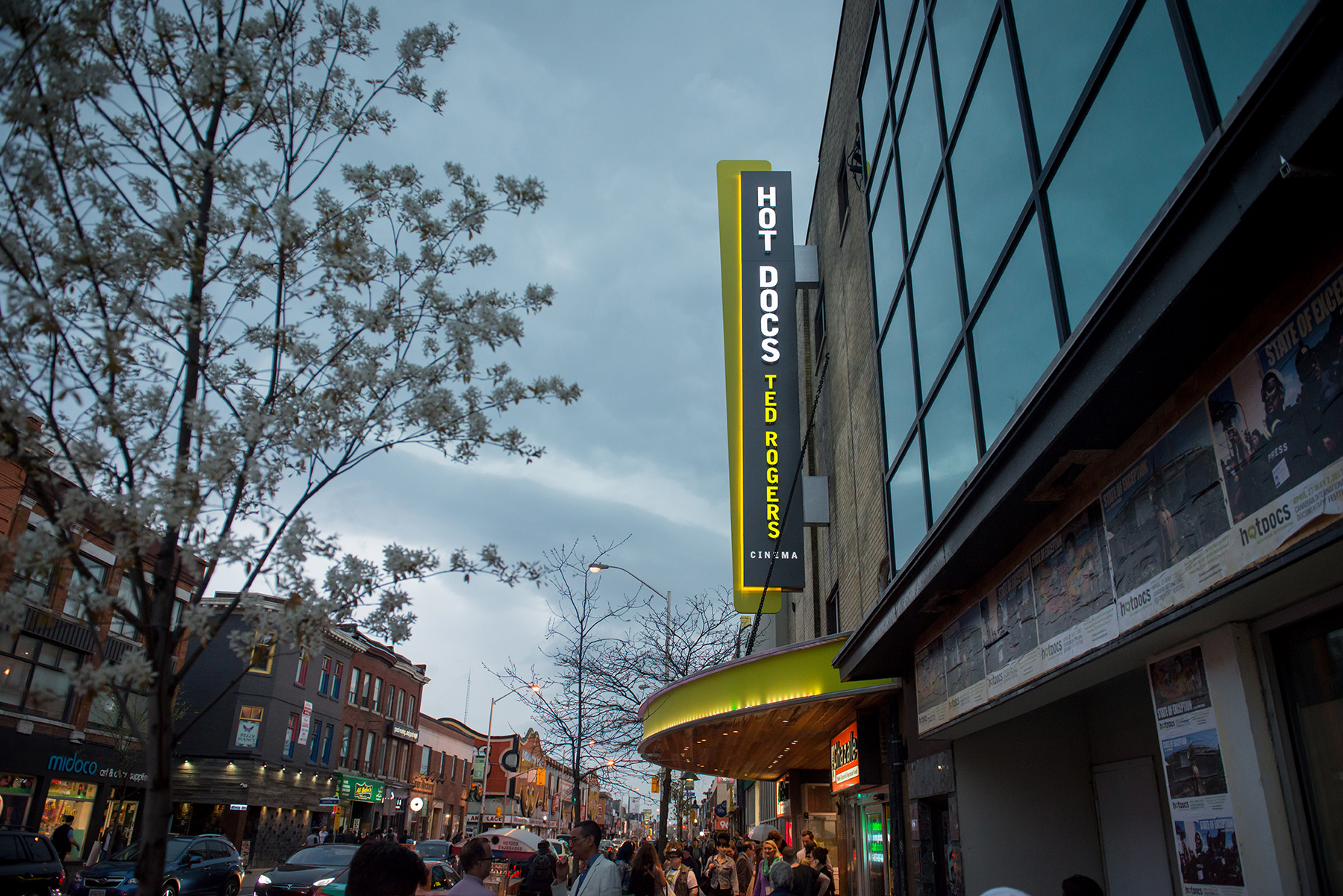
The hugely successful Hot Docs Cinema celebrates 30 years of programming built on a century long cinematic history on Bloor Street West. COURTESY HOT DOCS CINEMA
As they celebrated their 30th anniversary, Hot Docs screened 214 films from 72 countries over 11 days (April 27 – May 7) “We wanted to bring the most diverse range of films possible to Toronto. People from all of these countries live in Toronto, and we know curious minds will be interested in their films,” said Shane Smith, artistic director of Hot Docs.
Nonfiction podcast events and author/filmmaker talks were included in the festival. The Hamburg film collective, A Wall is a Screen, presented an interactive walk through Ontario Place, during which an audience followed a moving crew that projected short films onto different walls in the area.
Hot Docs offered free admission to films before 5 p.m. every day to students and seniors during their 30th anniversary festival.
Between 1995 and 2023, documentaries only held 1.04 per cent of the market share of film revenue, despite having more theatrical releases than any other genre, reports film data collective, The Numbers. Hot Docs was founded in 1993 by a group of filmmakers who noticed the under appreciation of documentaries in cinema and wanted to share these films with a larger audience.
“The core mission to showcase documentaries is built into Hot Docs’ DNA, but we have grown and evolved since then to foster an ecosystem of filmmakers,” said Smith. Hot Docs now offers funding for filmmakers, provides workshops, and partners with production companies to give commonly overlooked documentaries the chance to hit the silver screen.
The Hot Docs Ted Rogers Cinema (formerly the Bloor Cinema, previous to that: the Madison Theatre) opened in the Annex in 1913 and was renovated and reopened in 2012 under Hot Docs’ management. The theatre shows documentaries year-round, providing additional screen time and funding for the not-for-profit organization.
“[When you come to Hot Docs] it’s a really powerful and fantastic communal experience,” said Smith. “A lot of documentaries won’t be in other theatres or going to streaming services either, and there’s something for everyone to enjoy.”
Thank you for the complimentary copy which arrived in my mailbox on March 20. I found it an interesting read, but must take exception to the “Forum” column by Dianne Saxe.
I am a resident in Ms. Saxe’s ward. As with any other area of Toronto, the traffic situation is a disaster. Along with the constant construction of condominiums, road-hogging streetcars, and the necessary maintenance of our aging infrastructure, we have whole stretches of roadway being taken away from those of us who must use our cars in favour of the two per cent of citizens who prefer to use bicycles. Ms. Saxe’s assertion that “two-thirds of deputants passionately supported the bike lanes” sounds like wishful thinking on somebody’s part. Who were these deputants? (My spell-checker doesn’t even recognize the word.)
The attached photos show a major junction in Ms. Saxe’s ward taken during rush hour (which now runs from about 2 p.m. till dark) at the junction of Yonge Street and Belmont Street. This is a really busy area, and Yonge leads north from here to Summerhill and beyond. As the pictures show, there is total chaos for vehicular traffic–and not a bike in sight.
Ms. Saxe also addresses safety, and mentions “preventing illegal and dangerous behaviour by reckless drivers, like driving on sidewalks.” I’ve never yet been hit on a sidewalk by a driver, but I’ve had many scary moments at the hands of cyclists, who seem unaware of the fact that it is unlawful to ride a bike on the sidewalk if you are over the ag of 14.
The bottom line is that, for the 98 per cent of us who stopped riding bikes as children, today’s adult cyclists are a lawless breed who are being treated like royalty.
They routinely ignore traffic signs and rules while the rest of us are required to give way to them at every turn (no pun intended). For those of us who must use our vehicles to function, it’s time to make our priorities more realistic.
—Dave Ashby
Comments Off on LETTER TO THE EDITOR (April 2023)Tags:Annex · Letters · Opinion
August 8th, 2023 · Comments Off on EDITORIAL: Bleed it and then blame it for dying (April 2023)
Mayoral candidate Anna Bailao launched her campaign with a plan to move the Science Centre to Ontario Place and replace it with housing. Premier Doug Ford promptly seized the moment by saying this was his plan all along, for three years now! This is hard to believe; it’s a scheme fraught with problems and a scheme that must absolutely be challenged.
NDP MPP Chris Glover, whose riding encompasses Ontario Place, called the premier’s comments “bizarre…this sort of back-of-the-napkin planning without any meaningful public consultation or even a conversation with the impacted communities is not uncommon for this government.”
Should this plan move forward, Ontario taxpayers will pay for it. “It” includes a five-storey underwater parking garage for 2700 cars to support the patrons of the private spa, other amenities, and ostensibly the Science Centre—though most of those attendees arrive in a school bus. Apparently, we can’t expect the spa customers to take public transit after all.
One of Ford’s favourite political strategies is to distract the voters with shiny objects so that they don’t look too closely at what’s actually going on. This plan is a case in point, and if it’s true that he has been considering it for years, he should know that the site is jointly leased by the city and the Toronto and Region Conservation Authority (TRCA) to the province for the Science Centre for one dollar a year until 2064. Under lease terms, the province can replace this historic building, but only to build a new science centre. Even if the province seeks to override the agreement, the ravine where the Science Centre is located is considered hazardous, with its steep slope and flood plain. The land is also home to several species of turtles, mammals, birds, and amphibians.
Cue the following narrative: the province balks at the city’s opposition to new housing in Don Mills, paints opponents as anti-housing, takes over the City of Toronto and the TRCA (both by the way are mere creatures of the province), builds houses with provincial funds and then doles them out to the premier’s developer buddies. Always scheming, this is how he got to be premier, after all.
The province has frozen Science Centre funding for 10 years now but blames the Science Centre for its brokenness. This narrative sounds an awful lot like what’s happened in health care. Ford says attendance is down 40 per cent when in fact on-site attendance for 2021-22 well exceeded the Centre’s target of 142,078 for that year. Attendance on Family Day and March Break exceeded the 2019 pre-pandemic numbers. Though the long-term numbers are down, the Centre’s annual reports blame a zero budget for marketing: you bleed it, and then blame it for dying. It’s okay, Doug is here to rescue us with a new building proposed to be half the size.
There is currently unbearable gridlock near Ontario Place, and Ontario Place is closed indefinitely. Can anyone imagine what it will look like with the private spa, the Budweiser Stage expanded to 20,000 seats, plus Echo Beach, the Science Centre, and 2700 cars leaving at the same time? As city planners have noted, this whole plan, “overwhelms the public realm.”
Ford’s Infrastructure Minister, Kinga Surma says she has a business case for all of this, but she is conveniently unable to share it. She has told the legislature that there is “a train planned to move people around the island,” which no one has heard of before, and a “year-round marina where people can socialize.” Apparently, the province is banking on global warming to keep Lake Ontario ice-free.
This may be urban planning by impulse, but you can’t blame the public for imagining it might be something more sinister.
August 8th, 2023 · Comments Off on FORUM: Leveraging a green agenda (April 2023)
Finding impactful uses for community benefit funds
By Dianne Saxe
I hope you are well and enjoying the warm spring weather. I am thrilled to report that over the past few months, I have had the pleasure of collaborating with many of my council colleagues on a range of important initiatives. These initiatives are aimed at improving Ward 11 and our city.
I am grateful to Councillors Morley and Colle, as well as Deputy Mayor McKelvie, for supporting my motions on slope stabilization for ravines, setting a schedule for a restoration plan for the Vale of Avoca, and piloting e-bikes in Bike Share memberships for 100 people on the Ontario Disability Support Program. In addition, Councillor Carroll joined me in a motion to improve snow clearance, with a special focus on sidewalk safety, while Councillor Bravo supported my motion to extend the College Street bike lanes to Lansdowne.
At council, Councillor Myers seconded my motion to invite OMERS to appear at the Infrastructure and Environment Committee to provide a detailed explanation of its plans for climate risk and opportunities while investing our pensions, and Councillor Ainslie seconded my motion to further reconciliation by allowing an Indigenous group to erect storage and meeting structures in a locked corner of Paul Martel Park.
Collaboration is the cornerstone of success for any city, and I am proud to be working alongside my colleagues to make Toronto a better place. Our collective efforts to improve the city are truly inspiring, and I am grateful for everyone who is committed to making a positive difference.
In addition to my other efforts, I have dedicated significant time to examining the complex records of community benefit funds held by the city. My goal is to identify impactful uses for these funds by collaborating with various groups. To this end, I have urged each residents’ association to propose a heritage plaque for their respective areas and recommend ways to enhance the inclusivity of our local parks for girls and women.
This could involve improving lighting and visibility, providing amenities such as washrooms and programming, and addressing key safety concerns that discourage women and girls from using the parks. By leveraging the available funds from sections 37 and 42, I will be able to initiate positive changes that will benefit Ward 11 as a whole.
It is worth noting that the Annex is home to 13 beautiful green spaces, which serve as valuable assets for the community. These green spaces include parks such as Joseph Burr Tyrrell Park, Paul Martel, and of course, Jean Sibelius Park. Each park offers a unique environment and provides a space for community members to relax, play, and connect with nature. As a community, it is important that we take care of these green spaces and work to ensure they are accessible and inclusive for everyone.
At present, one of my primary areas of focus is Jean Sibelius Park where I am working to drive much-needed improvements. Some of the initial items on my agenda include enhancing the big kids’ playground by introducing new features such as a junior bamboo jungle, monkey bars, and a climbing rope. Additionally, I am advocating for step benches to be installed in the corner of the little kids’ playground, an inground trampoline next to the bike share, and a balance beam and body curl bench halfway along Wells, between the hydrant and the vault. By advocating for these improvements, I aim to create a more dynamic and engaging environment that will encourage children and families to spend more time in the park.
At the same time, I am constantly searching for opportunities to protect human health and the natural systems on which our lives depend. I am working with Fleet Services to phase out the city’s use of pre-2008 diesel engines because of their disproportionate damage to human health, while making bikes available for city staff use as they perform their day-to-day duties. We look forward to Municipal Licensing and Standards bylaw officers volunteering to utilize these bikes at their earliest convenience.
Collaboration and community involvement are essential for creating a vibrant and inclusive neighborhood. Through working with my colleagues on the city council and partnering with local groups and organizations, I have been able to drive positive changes in the community, including improvements to green spaces and initiatives that promote inclusivity and accessibility for all residents.
As we move forward, I remain committed to working towards a more vibrant and welcoming ward that benefits everyone. By continuing to collaborate and engage with community members, we can make Toronto welcoming, safe, and enjoyable for all.
Dianne Saxe is city councillor for Ward 11, University-Rosedale.
August 8th, 2023 · Comments Off on FORUM: Ford boosts sprawl, brings in meek renter protections (April 2023)
Annex area renters face a very specific risk
By Jessica Bell
The Conservatives have just introduced some good, bad and ugly legislative changes that impact renters and how we plan and build for our future. Here’s the lowdown.
The government’s Housing Bill 97 allows the Ministry of Municipal Affairs and Housing to not just weaken and eliminate municipal rental replacement bylaws—which is the power they gave themselves in Bill 23—but also strengthen them, which is a modest improvement.
Toronto’s rental replacement bylaw requires developers to return that tenant to their rent-controlled apartment at about the same rent after construction of the new bigger condo and properly compensate a tenant during construction.
This law affects the thousands of our neighbours who live in big purpose-built rentals around Spadina, St. George, Walmer, and Prince Arthur. Eliminating or weakening rental replacement bylaws will make it far cheaper for landlords and developers to set their sights on these buildings and convert them to luxury condos. The affordability of our riding is at stake.
It is essential we pressure the province to bring in a strong provincial rental replacement bylaw and permit municipalities to set their own strong standards. The Annex Residents’ Association and local renters’ associations are working with us to protect these tenants.
In a positive move, Bill 97 also doubles the maximum fine for violations under the Residential Tenancies Act, requires landlords to get a report justifying that renovations can only proceed if the tenant leaves, and gives tenants up to six months after renovations are complete to apply to the Landlord Tenant Board for justice if a landlord refuses to let them move back in, which is their right.
Currently, the tenants only have up to two years to file a complaint which means a landlord can just extend the renovations beyond two years and get away with an illegal eviction.
The residents of 11 Walmer, who have been waiting for years to return to their renovated apartments, could benefit from this change.
The Conservatives, however, have failed to fix the massive loophole of enforcement.
For a landlord to be fined, a tenant must be a volunteer private investigator and good Samaritan for at least a year to make a case to the Landlord Tenant Board.
Successful tenants never get their home back because a landlord can just move a new tenant in, and the maximum compensation tenants get is modest: moving expenses and any additional rent they had to pay for a year.
Since the tenant gains very little from fighting an illegal eviction, the landlord almost never gets fined. To curb illegal evictions, this enforcement loophole must be closed by bringing in stronger rent control and government enforcement of eviction.
In a shocking move, the Conservatives have proposed to radically rewrite Ontario’s planning laws to double down on building more expensive and unsustainable sprawl.
The Conservatives are rewriting official plans and forcing municipalities to open thousands of more hectares of farmland to development, and they are giving municipalities permission to more easily expand their urban boundary and permit more development on farmland in the future.
The Conservatives also want to eliminate density targets that municipalities need to meet in areas already zoned for development.
These radical planning changes could turn the Greater Golden Horseshoe Area into a concrete jungle of highways and low-density, expensive single-family homes that are shockingly expensive for municipalities and taxpayers to service with infrastructure.
Our climate change targets will go up in smoke.
Our office, as well as organizations like Environmental Defence and Greenbelt Promise, are effectively organizing to say no to sprawl and yes to protecting our farmland, our Greenbelt, and building the 1.5 million homes we need in areas zoned for development.
Please connect with us if you want to know more or wish to get involved.
Jessica Bell is the MPP for University-Rosedale and the Official Opposition’s Housing Critic. She can be reached at jbell@ndp.on.ca 416-535-7206.
August 8th, 2023 · Comments Off on LIFE: Harbord House turns 15 (April 2023)
Gastropub caters to a loyal audience
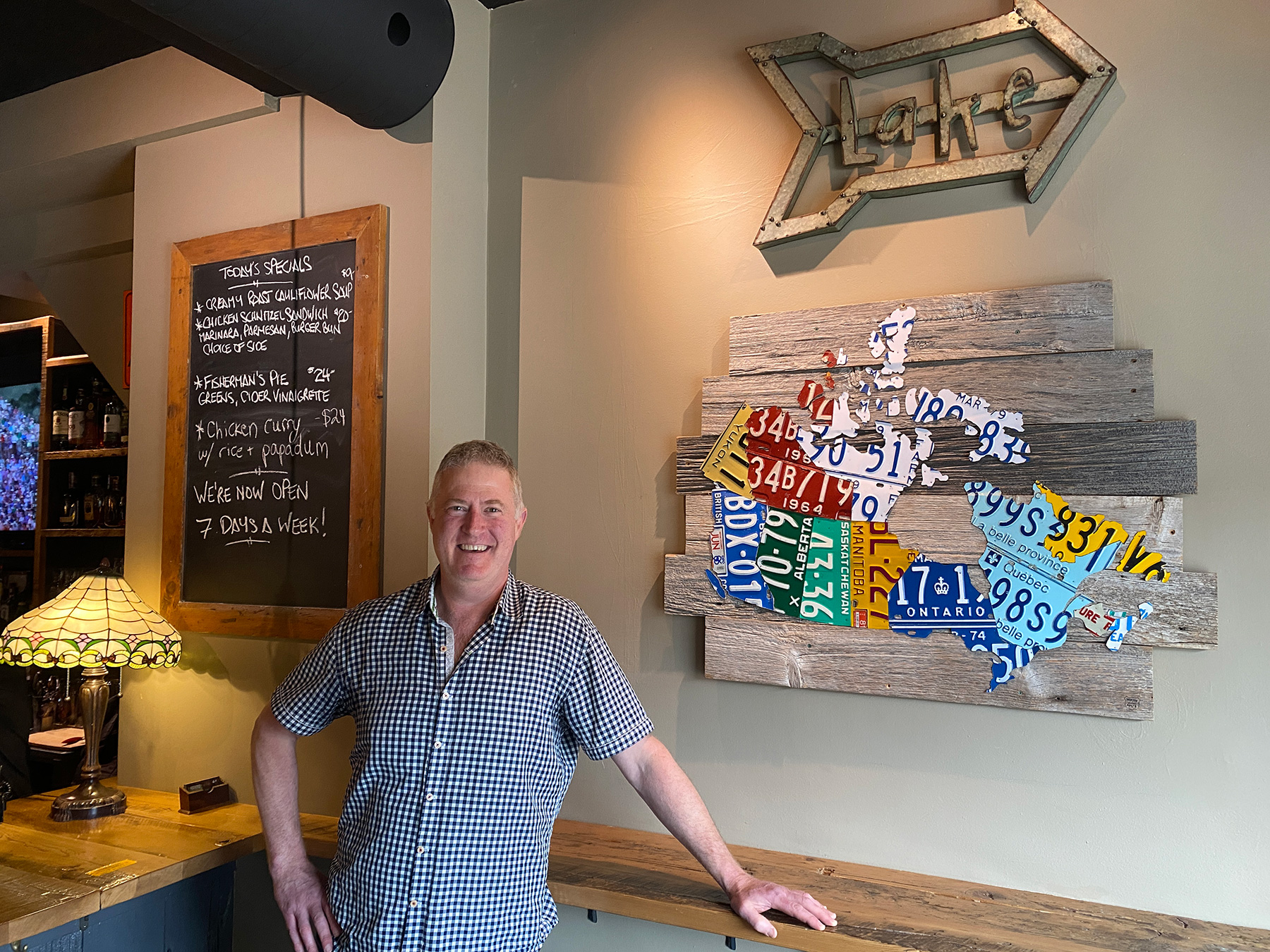
John Oaks, proprietor of Harbord House an adored gastropub on Harbord Street, is all smiles as he celebrates a 15-year anniversary. FOX OLIVER/GLEANER NEWS
By Fox Oliver
Harbord House is the Annex’s very own gastropub. The establishment has been a local favourite for 15 years and draws in the community with elevated takes on classic homestyle dishes.
On March 15, 2008, John Oaks founded Harbord House which now hosts up to 169 people inside and out, seven days a week. “The Harbord House is a local Canadian gastropub featuring homemade comfort food, craft beers, and creative cocktails. We do dishes that everybody recognizes, but we take them to a different level by making nearly everything from scratch in-house with locally sourced ingredients,” said Oaks.
The term gastropub was coined in 1991 by David Eyre and Mike Belben, owners of the Eagle Pub in London, England, when they decided to advance the quality of their food in an establishment that traditionally emphasized drinking over good cuisine.
“I really enjoy people, and I enjoy working with and getting to know them. I’ve been in the pub business for twenty years prior to opening on my own, and I realized there was a market for food that is a little bit more elevated,” said Oaks, on why he chose to open a gastropub.
“I love the idea of a pub, the sense of community that comes from it, and getting to know your guests,” concluded Oaks. Harbord House was originally located at 150 Harbord St., the former site of Rower’s Pub, but was in the process of moving to 124 Harbord Street when the pandemic hit. This provided an opportunity to set up this new (and current) location properly.
The new location was formerly home to Harvest Kitchen, and before that, Kensington Kitchen. All these establishments had the intention of bringing good food to the community, and Harbord House continues to execute this goal with style.
The seasonal and secluded second-storey patio at 124 Harbord St. that seats 40 has always been a favourite throughout the current and previous iterations of the space. A winding Manitoba maple tree weaves through the custom fencing on the patio, furthering the restaurants’ connection with the area.
The pub has a rotating lineup of three to five daily specials, which “lets the chef get creative, and lets the excitement in,” said Oaks. However, the bulk of the menu remains constant, letting the familiar crowd opt-in to their favourites (like the blackened salmon tacos and lamb and rosemary sausages).
“When we opened, we were one of the earlier adoptees of craft beer, a niche that had not been really explored,” added Oaks.
Harbord House also hosts an array of events, including weddings, music launch parties, a monthly sci-fi and fantasy book club (now on their 100th read), and anything else their customers express interest in.
“I love the idea of a pub, the sense of community that comes from it, and getting to know your guests,” concluded Oaks. That passion is what makes Harbord House into a Harbord Home.
Comments Off on LIFE: Harbord House turns 15 (April 2023)Tags:Annex · News · Life
April 12th, 2023 · Comments Off on ON THE COVER: Toronto’s only Black and minority-owned comedy club (Mar. 2023)
Sashka DC performs her comedy set at The Comedy Lab during their Thirsty Thursdays show. COURTESY THE COMEDY LAB
Danton Lamar opened The Comedy Lab at 298 Brunswick Ave. in February 2022 to showcase comics whom he felt weren’t receiving enough stage time.
“When I first got to Toronto in 2019, and when I started trying to get booked in town, I was surprised that every show was (made up of) five straight white dudes and one token minority,” said Lamar.
His reaction, ultimately, was to push back against an industry that felt like an “old boys’ club.”
Lamar has produced comedy shows in Germany, Holland, The Czech Republic, the U.S., and Russia. In Toronto, he started producing acts in different bars before an opportunity came up at Lab416. After a successful test show, the bar’s former overflow space in the basement was transformed into The Comedy Lab where Lamar now runs 24 shows per month. A typical week at The Comedy Lab features two shows a night, Thursday through Saturday. These shows are a mix of professional talent and open-mic nights, both of which welcome and prioritize comics from different minority groups.
They’dies Night, for example, is a themed, monthly open-mic night prioritizing female, nonbinary, and LGBTQIA comics. However, many nights aren’t themed or focussed on a specific demographic because Lamar wants to remind people that comics who are minorities aren’t limited to performing on special events.
“Once you get the room rolling (with laughter), there’s no feeling like having the whole room laughing with you; there’s something ethereal about it,” said Lamar. The audience at The Comedy Lab has similar demographics to most comedy bars and everyone is welcome.
“We are very much an indie club focussed on promoting voices,” said Lamar. “A lot of comics have come (to The Comedy Lab) to do their first sets because they figure it will be a more supportive comedy club than others.”
Lamar finds a lot of his comics through open-mic nights hosted at The Comedy Lab, as well as through peer recommendations. A rotating lineup of commonly underrepresented comedians has allowed The Comedy Lab to grow a reputation for being a welcoming space for new comics of all backgrounds. Setting a tone early on that the space doesn’t tolerate hateful comedy has also let the community know that The Comedy Lab is a safe space for all.
The Comedy Lab is in the lower level of 298 Brunswick Ave. Lamar extends the code WERDCREW to local residents to receive a discount on all of his shows.
—Fox Oliver/Gleaner News
Comments Off on ON THE COVER: Toronto’s only Black and minority-owned comedy club (Mar. 2023)Tags:Annex · News · On the cover