September 14th, 2023 · Comments Off on FORUM: Shelters overwhelmed by refugee seekers (Summer 2023)
Crisis underscores a larger housing crisis that Ford refuses to help fix
By Jessica Bell
Refugees and asylum seekers who arrive in Canada have been forced to flee their homes for many reasons, including war, violence, and natural disasters made worse by the climate crises.
Toronto is also seeing refugees who have fled violence because of their gender or sexual orientation.
Over the past few weeks, we’ve been working with local housing providers, including Street Haven and the Christie Refugee Centre, who don’t have enough shelter beds available to keep up with demand. These providers are turning people away, forcing more newcomers and established residents to sleep on the street which is contributing to our already acute homelessness crisis.
The roots of today’s crisis date back decades. In the early 1990s, the federal and provincial governments were building 10,000-15,000 affordable homes a year, including mixed-income co-ops, public housing, and supportive housing for people with mental health and addiction challenges. In the mid-1990s, the federal Liberals canceled the federal housing program, and the Ontario government downloaded the responsibility of providing housing to cities.
The Conservatives have made the problem worse. Last winter, the auditor general reported that the Ford Conservatives “have no plan to reduce or prevent homelessness,” despite sitting on over $22 billion of unspent money, some of it from the federal government. Over the past five years, the Conservatives have been quietly cutting homelessness and housing initiatives.
The latest affront is the government’s decision in this year’s budget to cut funding to the Canada Ontario Housing Benefit (COHB). People living in shelters or waiting for affordable housing are eligible to enroll in the COHB which provides a rent top-up to help people pay rent in a private market home. This funding cut meant the City of Toronto was unable to enroll hundreds of new recipients into the program which means people stay in shelters for months instead of weeks, unable to rebuild their lives in a permanent home.
Ontario’s homelessness and housing affordability crises have also been aggravated by the erosion of rent control laws. In 1996, the provincial government scrapped vacancy control which gave landlords a financial incentive to kick out long-term, rent-controlled tenants and increase the rent to any amount they could get. In 2018, the Ford Conservatives eliminated rent control on new units. Today, it costs more than $3,100 a month to rent a modest two-bedroom unit in Toronto.
With these prices, not even moderate-income workers can find a home they can afford.
Homelessness is a complicated issue, often requiring mental health, health care, and addiction treatment, but it’s fundamentally about housing. All levels of government need to do so muchmore to address housing affordability.
As an MPP, my job is to pressure the Ford government to step up. We have been calling for the Ontario government to increase funding to the COHB program to help people move out of shelters and into private market rental homes, increase funding to shelter providers, and quickly purchase rental buildings to house people in need. In response to pressure, the Ontario government recently contributed $6.67 million more to the COHB program, which is a start.
Long term, we need to get serious about lowering housing prices and rent prices in the private market by clamping down on rampant investor-led speculation and bringing in strong rent control.
It’s also time to resume government leadership in affordable housing construction. Developers need to be legislated to build a percentage of affordable homes in new condo projects. The city has already passed a law requiring this to happen, but the province is refusing to permit the city to implement it.
Other cities, from Vienna to Vancouver, have established a public builder, responsible for building homes at cost on public land. Instead of continuing our current practice of selling off public land for luxury condos, let’s use our public land to build affordable homes for people, including people in real and desperate need.
If you would like to work with us on these issues, please contact our office.
Jessica Bell is the MPP for University-Rosedale and the Official Opposition’s Housing Critic. She can be reached at jbell@ndp.on.ca 416-535-7206.
September 14th, 2023 · Comments Off on FOCUS: Bloor’s Hungarian chapter closes (Summer 2023)
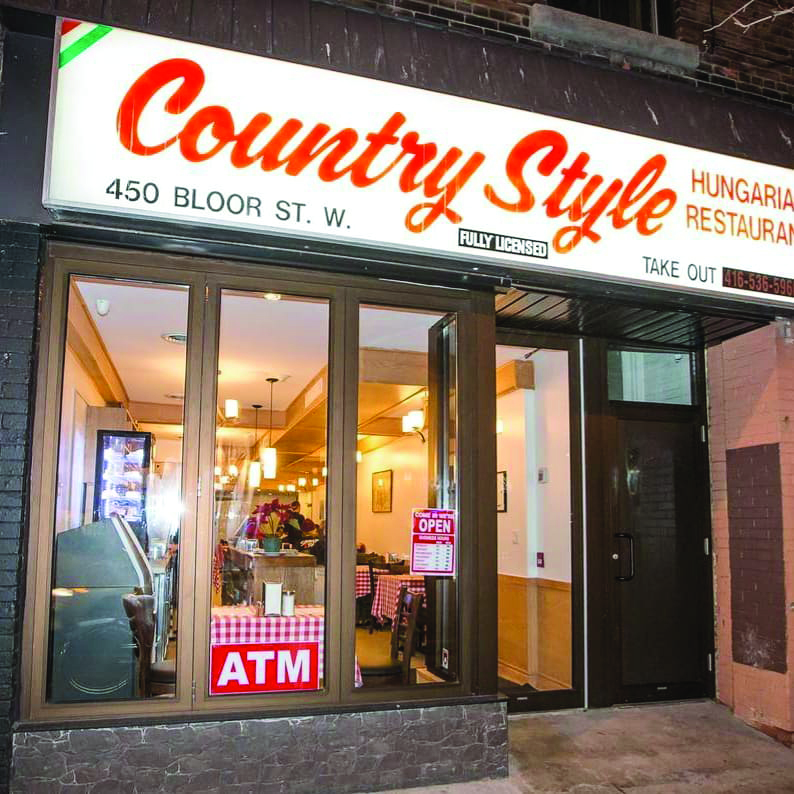
Country Style restaurant closes after serving Annex for 62 years
COURTESY COUNTRY STYLE HUNGARIAN
By Chloe Robinson
Back in the 1960s and 1970s, a stroll down the stretch of Bloor Street running west from Spadina Avenue may as well have been a stroll down a cobblestoned boulevard in Budapest. Between 1956 and 1957, an astounding 37,000 Hungarians immigrated to Canada, fleeing the Hungarian Revolution and the Soviet takeover under a Stalinist government. These Hungarian immigrants sought refuge, opportunities, and a chance to rebuild their rich culture in a foreign land. Toronto was a favoured destination. By 1960, 8,700 Hungarians called Toronto home, with a large majority settling in the Annex.
Many of these Hungarian immigrants proceeded to open storefronts: barber shops, bookstores, delis, and most of all, cafes, bars, and restaurants. For many immigrants, access to comfort food from their homelands serves as a crucial cornerstone in preserving their culture and heritage. This is replicated all over Toronto, with Little Portugal, Little Italy, Danforth Greektown, and Chinatown. From bustling cafés serving rich espressos and flaky pastries to the lilting melodies of Hungarian folk music floating through the air, the Annex was soon dubbed the “Goulash Archipelago.” These Hungarian settlers wove their heritage into the fabric of our eclectic enclave, blending their unique history and warm hospitality into the Annex’s already captivating tapestry.
Over the years, further waves of change came to the Annex, slowly diminishing the presence of Hungarian culture. Gone are the streets lined with Hungarian restaurants serving schnitzel, goulash, and wooden platters piled with sausage. The Hungarian community in the Annex gradually dispersed to Toronto’s suburbs during the 1970s and 1980s, resulting in the closure of many local Hungarian businesses by the 1990s. Only one restaurant remained standing—the beloved Country Style which served the Annex for 62 years. On June 15, owner Katalin Koltai announced the upcoming closure on Facebook. According to Koltai, it was one of the first Hungarian restaurants on Bloor Street. In an interview with CBC news, Koltai expressed her desire to retire despite her still-booming business.
“For so many years of my life, I did what the restaurant [wanted] me to do. Now I do what I want to do.”
After completing high school in Hungary, Koltai immigrated to Canada in 1971. She worked at a bank for five years, before transitioning to a waitress position at Country Style. With the support of her family, Koltai purchased the establishment and building in 2000, and she ran it for the past 23 years with the help of her daughter. The whopping 263 Facebook comments on the restaurant’s closure announcement are testaments to the many loyal customers Country Style embraced over the years. “They came with their family for years and years and [the] years when they were in university. Now they bring their grandchild[ren], everybody. Sixty-two years is a long time,” Koltai said.
Growing up at College and Bathurst, Sarah Fowlie was one of Country Style’s longtime, loyal customers, and a witness to Bloor’s Hungarian past.
“When [my family] moved to the neighbourhood in ’85, there were many Hungarian restaurants up on Bloor. There was the Korona restaurant, there was the Blue Cellar, there was Capital…Country Style was there too.”
Fowlie said that as a student, she would head up to Bloor for a movie and then head to Korona or Country Style to split big plates of schnitzel with her classmates. Although Korona eventually closed, Fowlie continued to visit Country Style over the years.
“[Once my wife and I had kids], we’d buy our Christmas trees at Sunny’s Christmas Lot. While we waited for it to be delivered, we would always go to Country Style. We had been doing that with the kids for 20 years. It’s a family tradition. It’s usually a dark Monday or Tuesday night after school. We’d go pick up the tree, then schlep it over to Country Style.”
Fowlie no longer lives near the Annex, but she still treasures her fond memories of its Hungarian past.
Although the Annex continues to change, Country Style did not change much over the past 62 years. Vibrant red and white chequered tablecloths and a menu brimming with authentic Hungarian delicacies transported all those who entered into a realm of enchanting nostalgia set in Central Europe.
“I think my fondest memories of Country Style [are] just [visiting] on a cold night,” she said. “You open the door. It’s bustling. It’s full of people. The mother and the daughter greet you at the door and there are so many different types of people. You have a table of punk rock anarchists, then a table of U of T professors, then people who probably came in ’58 from Hungary. The door to the kitchen would open and close, and you get excited from the smells. It’s always there. It never changes, and every time you go, you have the same experience. It’s a really kind of magical thing.”
Although Budapest’s spirit no longer dances quite as loudly on the streets of the Annex, many residents and visitors took the opportunity toglimpse Bloor’s Hungarian past and got a chance to taste their sought-after wooden platter before Country Style’s August 1st closure.
August 8th, 2023 · Comments Off on ON THE COVER (May/June 2023)
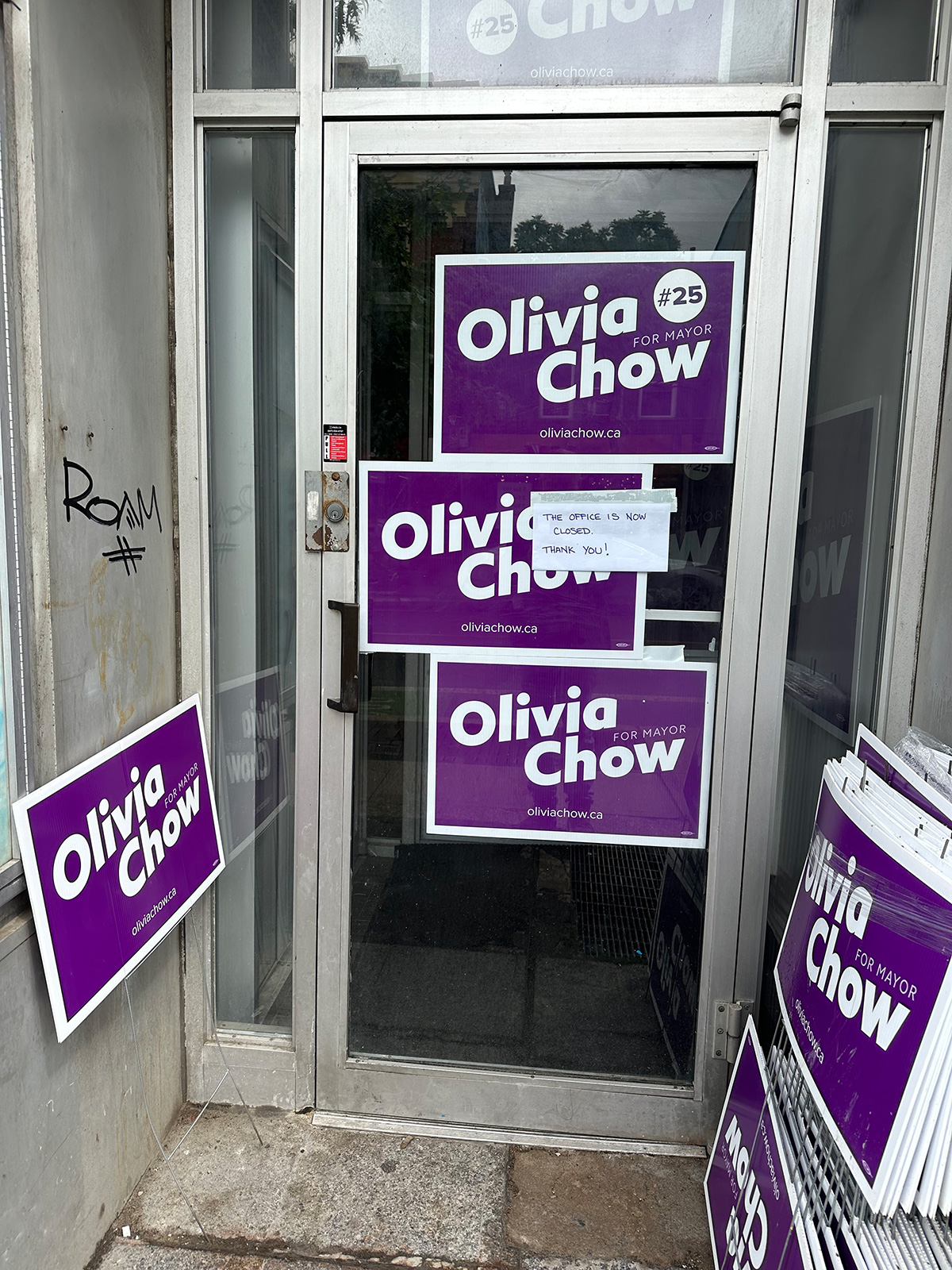
Olivia Chow’s campaign office on Bloor St. stands closed as she prepares to move to city hall as mayor. Chow previously served the Annex area as city councillor for 13 years, and then 8 as a member of parliament. BRIAN BURCHELL/GLEANER NEWS
August 8th, 2023 · Comments Off on NEWS: Retail suffers as developments loom (May/June 2023)
Goodness Me!, formerly Noah’s, closes after 39 years
By Fox Oliver
On Saturday, May 20, Goodness Me! Natural Food Market (formerly Noah’s Natural Food), located at 322 Bloor St. W, closed their doors for good. The store opened in 1984, but as large chunks of Bloor and Spadina are set to be demolished to make way for condominium towers, existing retail is being pushed out.
“It’s sad to see it close. I’ve worked here for 14 years and have a lot of regular customers,” said Farshad Sahim, an employee of the food market.
The owners and staff at Goodness Me! have known about the planned development for 320-332 Bloor St. W since shortly after it was proposed on Nov. 5, 2021.
However, staff at Goodness Me! were only told they were closing two months before the scheduled close date which was originally in mid-June.
On its last day open, Goodness Me! was filled with empty shelves, liquidation sales adverts, and a few staff and customers. “The people here are nice and they make it an easy place to shop, so I am disappointed they’re closing,” said Patricia, a regular customer. “I’m not looking forward to even more construction on Bloor Street,” she added. “The Annex has a unique culture which new high-rises will damage,” said Sahim. “People keep coming back because they have history, and their parents went there years before them,” he added, with regards to why it’s important to support small businesses.
A Second Cup located in the same building as Goodness Me! and a Pizza Pizza adjacent to it have also recently shut down. Both properties are owned by First Capital, the developers of the high-rise planned for 320-332 Bloor St. W. First Capital declined an interview, but provided the following statement:
“First Capital REIT is actively leasing the retail and office availabilities at Spadina/Bloor. We look forward to bringing exciting new tenants and retailers to the properties while progressing our development applications for this important transit node.”
However, there is no evidence that First Capital is seeking to rent these storefronts through any multiple listing real estate services. Further, there is no signage on these vacant storefronts suggesting they are for lease. After repeated attempts to contact the manager of Goodness Me! to discuss the reason for their early closure, they did not reply.
The proposed high-rise, according to the building application, will be 37-storeys tall and will have 377 residential units, 628 square metres of commercial space, 61 parking spots, and 447 bicycle spaces. Currently there are approximately 2000 square metres of retail and office space on the site, meaning the new development would provide roughly two-thirds less commercial space than what currently exists.
The developer, BDP Quadrangle, lists 2026 as the potential completion date for the project; however, the application for the development is still under review, and a building permit has not yet been issued. If this application is approved, it will still take approximately 36 months to complete the building if there are no further complications, making a completion date of 2026 unlikely, but not impossible.
There is no mention of affordable housing units in First Capital’s application. The average monthly rent for a one-bedroom apartment in the Annex has increased to $2,475 in 2023, while the city’s average market rent for a one-bedroom has grown to $1,538. The city cannot force developers to include affordable housing in their buildings, meaning it’s unlikely the developers will forgo this valuable rent to provide affordable housing.
The building proposed at 320-332 Bloor St. W. is one of many tall structures in the works for the area. A 29-storey mixed-use building has been approved directly to the east, and there is a 35-storey condominium approved for the northwest corner of the Bloor-Spadina intersection. On the southeast corner, the University of Toronto plans to build The Gateway, a development that will feature residential, academic, and commercial space across multiple buildings. The Gateway will significantly address the university’s strong need for housing and intends to link the university with the surrounding neighbourhood.
Goodness Me! is just one of many small businesses that will have to leave the Annex as new developments stack up. It may only be once the developments are complete and businesses fill these vacant spots that the Bloor-Spadina intersection will feel whole again.
Comments Off on NEWS: Retail suffers as developments loom (May/June 2023)Tags:Annex · News
August 8th, 2023 · Comments Off on NEWS: Annex honoured for pioneering Bloor bike lanes (May/June 2023)
BIA selected by advocacy group for foundational work
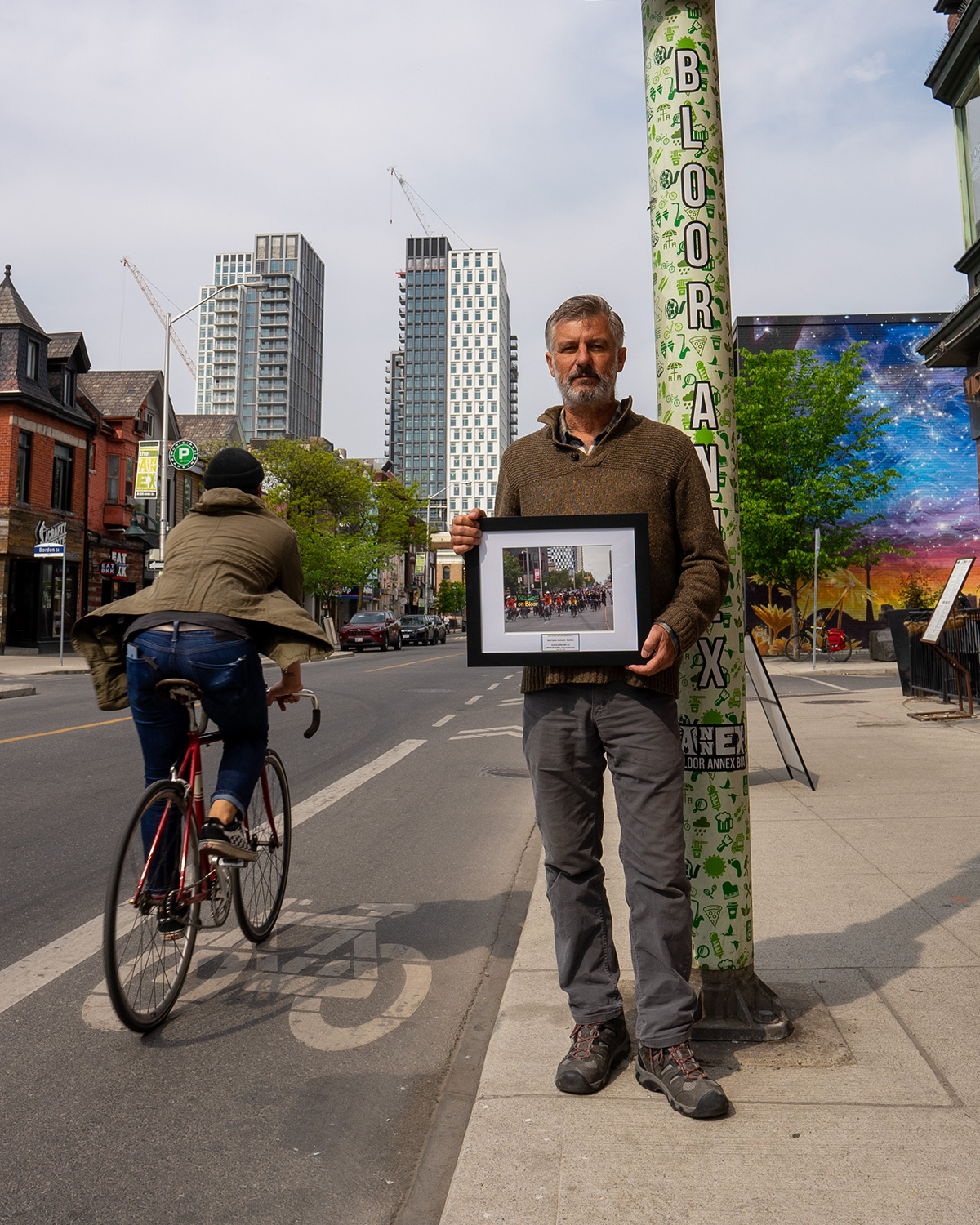
Brian Burchell received the Business Road Safety Champion award for his work advancing bike safety on a busy mainstreet along with the Bloor Annex BIA. NEILAND BRISSENDEN/BLOOR ANNEX BIA
By Fox Oliver
On May 19, the Toronto Community Bikeways Coalition (TCBC) presented their Business Road Safety Champion Award to the Bloor-Annex Business Improvement Area (BIA) and to its general manager, Brian Burchell, for supporting pilot bike lanes and cycling advocacy. (Burchell is the publisher of the Gleaner.)
“In the spring of 2016 there were essentially no bike lanes, except stubs, on any arterial road in Toronto,” said Albert Koehl, coordinator of the TCBC. “We want to recognize Brian and the BIA for fighting for bike lanes, for being the first BIA to support the pilot bike lane, and for supporting permanent bike lanes.”
In August 2016, a 2.4 km pilot bike lane was installed along Bloor Street between Avenue Road and Shaw Street. The project was led by the Toronto Centre for Active Transportation to investigate the economic and travel impacts of the bike lanes, and it soon became the most studied stretch of biking infrastructure in North America. “This study showed that they (bike lanes) can be good for business. Brian and the BIA were instrumental in this study,” commented Mary Ann Neary, coordinator of the TCBC.
The pilot bike lanes on Bloor Street increased cyclists’ sense of safety on Bloor Street. The percentage who felt safe increased from 17 per cent, prior to the bike lanes, to 61 per cent after the bike lanes. The largest shift in perception was found in women whose sense of safety increased from 12 per cent to 58 per cent. While women are typically underrepresented as cyclists in North American cities, this pilot project narrowed the variance between men and women on bikes.
Some merchants interviewed during the study on Bloor Street expressed concerns and said bike lanes were “bad for business.” However, the pilot study showed that pedestrians and cyclists were the groups of people most likely to spend over $100 a month and were also the most frequent shoppers in the Annex, as opposed to motorists and people who use transit.
The pilot project showed that merchants along Bloor Street misunderstood how their customers commuted to their stores, with 58 per cent believing more than a quarter of their customers drove. In reality, only nine per cent of customers shopping on Bloor drove there, demonstrating the importance of bike lanes, sidewalks, and public transit for businesses and their customers.
“This was the longest fight for bike lanes anywhere in the city, going back to the 1970s,” said Koehl. “If you don’t have (bike lanes on) Bloor Street, you can’t have a real cycling network, so this was our foot in the door. We always thought if you get it here, then you can show the city how good it is.”
The research and experience from the pilot project will be used to push for the expansion of Toronto’s cycling network. Burchell has been active in the debate about bike lanes on Yonge Street and has shared his positive experience from the Bloor Street pilot project. The TCBC is pushing to extend the bike lanes on Bloor-Danforth even further east and west, as they currently end at Victoria Park and Runnymede avenues.
Though the pilot project has been a success, there is still work to do in the Annex regarding motorists creating dangerous biking conditions. “We have to, as a community, recognize we have a duty to protect the bike lane users,” said Burchell. “We confront delivery truck drivers when they park in the bike lane, and they are slowly learning they can park on side streets to pose less danger to cyclists.”
However, Uber Eats drivers and other food couriers still routinely park in bike lanes. “Passersby need to alert those drivers to the dangers they are causing, and politely urge them to find a safer place to park for their food pick-up,” said Burchell. Slowly these drivers will also change as it becomes socially less acceptable to endanger lives for the sake of 30 seconds of convenience.”
August 8th, 2023 · Comments Off on ARTS: Diorama Dramas displayed at photography exhibition (May/June 2023)
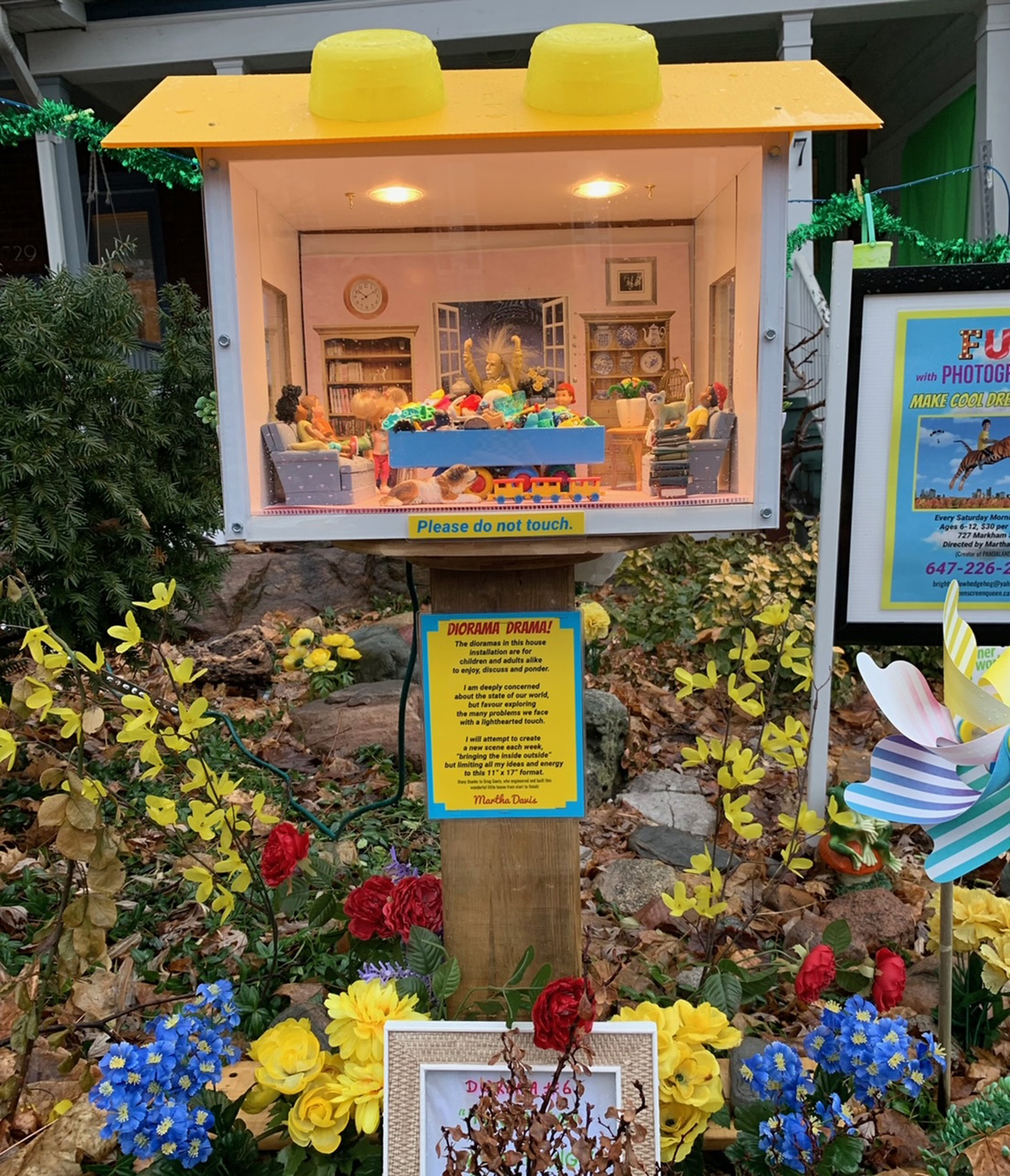
The light box pictured here in Martha Davis’ garden allows children to discuss difficult subjects with trusted adults. COURTESY MARTHA DAVIS
Since retiring from her career teaching elementary school five years ago, photo artist and independent filmmaker, Martha Davis, has found opportunities to work with children outside the classroom. This May, she joined the Scotiabank Contact Photography Festival with her Diorama Dramas.
From May 16 to May 29, Davis presented her artwork at 918 Bathurst. Her station included six physical dioramas, 18 photographs of her pieces, and an area for children six and older to build and photograph their own creations on weekends. Invitations to her exhibition were extended to school groups as well as all interested guests.
Davis’ dioramas started on her front lawn on Markham Street. She first installed a total of 24 different dioramas in a lightbox display. Throughout the week, she observed that parents would bring their kids along to talk about each piece.
According to Davis, her dioramas open a window for kids to discuss important topics with parents and trusted adults. She is concerned about children struggling with their mental health.
“It’s hard for them to process everything going on in the world,” she said. Her dioramas consist of three-dimensional spaces through which heavy subject matters can be playfully explored. Using miniature animals, dolls, and toys in colourful environments, Davis explores themes like climate change, habitat loss, homelessness, food insecurity, animal welfare, loneliness, addiction, and much more. With “innocent childhoods” disappearing day after day, she believes these interactions will allow mature topics to be discussed creatively and productively by children and adults together.
The Gleaner previously recognized Davis’ award-winning film PANDALAND: Making IT Count on civic engagement through the multimedia installation of over 70 toy pandas in her neighbourhood. She continues to produce art for all age groups to enjoy. Her green screen art programme has reached schools, daycares, seniors’ residences, and long-term care homes. In 2019, she shared her green screen photography at the Scotiabank Contact Photography Festival, but she decided to consider her dioramas’ growing fanbase for the festival’s return.
August 8th, 2023 · Comments Off on EDITORIAL: Ford’s poor planning will hurt us all (May/June 2023)
Back in 1973, when Ontario Premier Doug Ford was just nine years old, Conservative Premier Bill Davis brought in the Niagara Escarpment Planning and Development Act. This was the foundational legislation for what we now call the Greenbelt—2 million acres of farmland, forest, wetlands and watersheds in southern Ontario. Every premier since then, of every political stripe, has fought to protect that—until now. Premier Doug Ford is bent on tearing the area apart despite whatever promises he made in the last election, and that destruction is justified by a false premise.
As of last year, over a million housing units were approved or proposed according to a report from the Regional Planning Commissioners of Ontario (RPCO); many are in the Greenbelt.
The RPCO report was based on data obtained before the province came up with “solutions” to deal with the housing crisis. It turns out the government’s remedy is not the right pill at all.
“I think [the report] starts to tell the story that the housing supply challenge isn’t really a land supply or development approval problem,” said RPCO chair Tom Hunt. “The bigger problem is how do you compel to build? How do you increase the rate of construction?”
Bill 23 contains a number of controversial elements including waiving development fees for municipalities to build roads, sewers, and schools. This is a plan with serious holes; there are no incentives to build affordable housing and no partnerships with other levels of government to do so. Doug Ford is notoriously unable to play well in a sandbox with others: see the $10-a-day federal day care plan where Ford was so late to the party that this province is still playing catch-up.
Blaming the now very former Liberal government is a familiar go-to for the premier who is apparently unable or unwilling to come up with good policies to govern on his own. Constantly blaming your predecessor is a tired excuse for poor leadership. Looking at the housing crisis solely through the prisms of “a lack of land” and “a lack of municipal approvals” constitutes a failure to analyze the problem. We have the land and the approvals but lack the incentives to actually build. The real issues are rising interest rates, which make building more expensive, rising inflation, which makes supplies more expensive, and an ongoing labour shortage. Toronto’s chief planner, Gregg Lintern, said the city approved an average of 30,000 residential units per year from 2017 to 2021. During that same period, an average of 16, 000 per year, or just over half, were actually built. Of course, these pressures have only increased since 2021, so the disincentives to build are exacerbated.
Destroying the Greenbelt does not make the housing problem go away; it only makes matters worse on many other fronts. We don’t need more highways leading to more single family homes in suburbs.
We need to safeguard the resources that keep our and water clean, reduce the risk of flooding, and provide a home to southern Ontario’s wildlife.
Ontario is currently losing 319 acres of farmland daily, according to the 2021 Census of Agriculture. That’s roughly one average family farm lost every day to unwise development. Farmland is finite, and treated properly, can be a perpetual source of food for Ontario. Phil Pothen, a Toronto planning and environment lawyer for the group Environmental Defence said that, “we’re kneecapping the country’s food security.”
Ford’s Greenbelt assault appears only to be popular with his developer buddies with whom he has close ties. They somehow knew ahead of time that buying up farmland there was a wise investment. The rest of us will pay for their gains.
August 8th, 2023 · Comments Off on FORUM: Navigating a strong fiscal recovery (May/June 2023)
Battling inflation and the challenge to create a clean economy
By Chrystia Freeland
Canada has made a remarkable recovery from the COVID recession.
Our economic growth was the strongest in the G7 in 2022, and 900,000 more Canadians are employed today than before the pandemic. The Bank of Canada predicts inflation will fall to 3 per cent this summer and 2.5 per cent by the end of the year. Our unemployment rate is near its record low, and, supported by our Canada-wide system of affordable early learning and childcare, the labour force participation rate for working-age women has reached a record high of 85.7 per cent.
The 2023 federal budget, which I introduced in March, builds on this important progress—and addresses both the challenges and opportunities facing Canada in the months and years to come.
Our budget is a fiscally responsible plan that will mean new, targeted inflation relief for the Canadians who need it most, stronger public health care and affordable dental care across Canada, and historic investments to build Canada’s clean economy and create good jobs for Canadians from coast-to-coast-to-coast.
The budget delivers a new Grocery Rebate to 11 million Canadians and Canadian families to help make up for higher prices at the checkout counter—providing up to an additional $467 for eligible couples with children; an additional $234 for single Canadians without children; and an average of an additional $225 for seniors.
We are also taking action to crack down on junk fees, such as extra event and concert fees or telecom roaming charges, lowering credit card transaction fees for small businesses, and delivering a range of new measures to make life more affordable for people across Canada.
Our budget will also ensure that all of us can rely on a world-class, publicly funded health care system—one that is deserving of its place at the very heart of what it means to be Canadian.
We are delivering a historic $198.3 billion investment in public health care—including $76.83 billion to Ontario—to reduce backlogs, expand access to family health services, and enable provinces and territories to provide the high quality and timely health care Canadians expect and deserve.
And just as we are reinforcing the public health care system we have today, we are also expanding its reach with a new Canadian Dental Care Plan for Canadians with a family income of less than $90,000. The Canadian Dental Care Plan will cover up to nine million Canadians by 2025—meaning that you will no longer be able to tell how much money someone makes, or how much money their parents make, by their smile.
Over the long term, Canada must also navigate two fundamental shifts in the global economy.
First, in what is the most significant economic transformation since the Industrial Revolution, our friends and partners around the world—chief among them, the United States—are investing heavily to build their clean economies and the net-zero industries of tomorrow. Second, following Putin’s illegal and barbaric invasion of Ukraine, our allies around the world are accelerating efforts to friendshore their economies by building their critical supply chains through democracies like our own.
Today, and in the years to come, Canada must either meet this historic moment—this remarkable opportunity before us—or we will be left behind as the world’s democracies build the clean economy of the 21st century.
That is why our budget makes transformative investments to build Canada’s clean economy, fight climate change, and create new opportunities for Canadian businesses and Canadian workers.
This includes significant measures that will make Canada a clean electricity superpower and deliver cleaner and more affordable energy to Canadians and Canadian businesses, bring investment to our communities and create good-paying jobs, and ensure that Canadian workers are able to produce and provide the goods and resources that Canadians and our allies need.
As we make these important investments, we are also upholding Canada’s proud tradition of fiscal responsibility by ensuring Canada maintains the lowest deficit and the lowest debt-to-GDP ratio in the G7. By exercising fiscal restraint, we are ensuring that we can continue to invest in Canadians and in the Canadian economy for years to come—just as we have done since 2015.
The budget is our plan to build a stronger, more sustainable, and more secure Canadian economy—for everyone.
We have the remarkable good fortune to live in the greatest country in the world. And that is why our budget invests in the possibility for every single Canadian to share in the incredible opportunities that Canada provides—and in the new era of prosperity that we will build together.
Chrystia Freeland is member of parliament for University-Rosedale, deputy prime minister, and minister of finance for Canada.
August 8th, 2023 · Comments Off on FORUM: Addressing a housing shortage (May/June 2023)
Building a greener, safer city
By Dianne Saxe
If you’re anything like me, June means enjoying fine weather with fine people, and I hope that all of you are able to enjoy the summer to its fullest.
My fellow councillors and I have been busy at city hall taking important steps on a wide range of critical issues, and I would like to thank my fellow councillors for their dedication and hard work as we close off the first half of 2023.
Knowing the struggles that many of our neighbours face in securing long-term housing, I was proud to second Councillor Pasternak’s motion for the development of a comprehensive homelessness response plan.
There are over 10,500 people experiencing homelessness in our city and convening a Mayor’s Roundtable is the opportunity we need to secure lasting change.
And with the assistance of Councillor Bravo, I forwarded a request for an additional $20,000 to construct a healing garden at 144 Roxborough Ave. which I look forward to visiting once it has been fully completed.
My colleagues Councillors Fletcher and Perks put forward a successful motion to oppose the expansion of fossil fuels for our power generation.
In the same motion, a request was made to the province to immediately invest in programs that will deliver energy efficiency and proper conservation management.
The urgency of this matter has been driven home by the heavy pollen and smoke from forest fires that have negatively impacted our air quality.
Toronto’s worsening climate issues necessitates immediate action, and I am committed to advocating for sustainable practices in city operations.
Eco-friendly modes of transportation such as green spaces, walking, cycling, and public transport are measures I am actively pursuing and promoting. It’s early days yet, but there is also an initiative in the works that would enable city staff, like bylaw officers, to access bicycles as part of their daily routine.
The final update I’ll provide from city council is the amendment to the city-wide zoning bylaw that allows four dwelling units on each residential lot (multiplexes). Until recently, most residential lots were limited to a single-family home, keeping prices high and population density low.
As a result, many parts of the city, including University-Rosedale, have been losing population for a generation, with younger people leaving the city for lack of a place to live. Now, existing houses can be subdivided, renovated, or replaced by new purpose-built multiplexes. Most of the new homes will be in three-storey buildings, with four storeys allowed in a few areas with higher existing height limits.
The multiplex amendment is one of a series of zoning changes that are expected to transform Toronto and re-establish the “missing middle” between tall towers and sprawl.
So far, these changes authorize laneway houses, garden suites, rooming houses (multi-tenant housing) and multiplexes. Still to come are more flexible rules for small apartment buildings. More accountability for the committees of adjustment would be good too.
At Toronto East York Community Council, we agreed to explore community benefits that will include public realm improvements to the Dupont TTC subway station entrances at the northwest and southeast corners of Spadina and Dupont.
These improvements could take the form of seating, vegetation, wider sidewalks, and public art, all of which I am excited to see come to fruition as the streetscape continues to beautify and improve.
Progress on Toronto’s Vision Zero goal of eliminating traffic-related fatalities and severe injuries on our city streets continues.
Achieving this goal requires a multi-pronged approach, including investments in road safety infrastructure, increased education, awareness campaigns, and the rigorous enforcement of traffic laws. I am always looking for ways to address safety issues for the most vulnerable users of our transportation system—pedestrians, school children, older adults, and cyclists.
With all of that said, I’d like to thank you for taking the time to stay informed about what my team and I are working on at city hall.
To get more information about my office’s progress, additional ward updates, and to register for my monthly town halls, please visit my website at diannesaxe.ca or contact me at Councillor_Saxe@toronto.ca.
Dianne Saxe is city councillor for Ward 11, University-Rosedale.
August 8th, 2023 · Comments Off on FORUM: New density is landing where there are few schools (May/June 2023)
Province allowing density but forgetting about education
By Jessica Bell
As an MPP and parent of two children who attend TDSB schools, I am personally and politically concerned about the quality of education University-Rosedale’s 33 schools provide to our children.
The pandemic has been very hard on our kids and their learning. Many of our kids have fallen behind their grade level. They’re struggling to read and write and keep up in math and STEM. Many students are having an emotionally challenging year. They are struggling with behavioral issues, learning disabilities, and mental health challenges.
Here’s an update on some pressures facing our schools and what we are doing about it.
More cuts could be coming. The TDSB is facing a huge $61-million shortfall for next year and is looking at cutting 522 staff positions. Lunchroom supervisors, elementary school teachers, secondary school teachers, social workers, and caretaking positions will be lost.
This funding shortfall is partly because enrollment has temporarily dipped, partly because the Conservatives are refusing to cover all the costs the TDSB incurred during the pandemic to meet provincial rules, and mostly because the provincial funding allocated to schools is not adequate to improve our schools. The TDSB is preparing its final budget now, and we’ve joined the call for more investment.
The Ontario Autism Coalition is raising serious concerns over the Conservative’s decision to reduce funding for 4,000 children with autism and move them into the school system, starting in May. We’ve heard from parents who are understandably concerned about the move because they fear their kids are being thrown to the wolves without the extra education assistants in the classroom to help their kids learn and stay safe.
Every parent has seen that TDSB sign on a construction fence warning them that due to resident growth their local school could be too full to accommodate their child.
We are a rapidly growing city. We have more cranes in the sky than any other city in North America. Without additional revenue, our school system will not be ready to educate the 30,000 additional children who are expected to enroll in the TDSB.
University-Rosedale, Spadina-Fort York, and the Eglinton-Yonge area have been identified by the TDSB as areas experiencing overcrowding. Whitney School in particular is overcapacity.
Other school boards in Ontario have the right to collect developer fees for new schools, and it’s time for the Conservatives to give the Toronto District School Board access to that funding stream as well. In June, I introduced a motion to call on the Conservatives to do exactly that to ensure developers pay their fair share to Toronto schools. The TDSB estimates education development charges will bring in approximately $500 million in revenue over the next 15 years.
These are just some of the issues we’re hearing about. Others include the TDSB’s new system for selecting students for speciality schools and the troubling decision by York Catholic District School Board to vote against flying the Pride flag during June, which is Pride Month. We are calling on the Ontario government to intervene because this is about ensuring all kids are valued at school regardless of how they identify.
As school boards finalize their budgets, every grandparent, parent, education worker, and student should be contacting their Conservative MPP and calling on them to make wise decisions for our kids and properly fund our schools. We are organizing on this issue, and please contact our office if you, your school, or parent council wants an update or wishes to share information.
Jessica Bell is the MPP for University-Rosedale and the Official Opposition’s Housing Critic. She can be reached at jbell@ndp.on.ca 416-535-7206.
August 8th, 2023 · Comments Off on FOCUS: Porch View Dances returns (May/June 2023)
12th annual Seaton Village event runs Aug. 9 to 13
Choreographed by Karen & Allen Kaeja, dancers Jim and Owen Adams perform during 2018’s iteration of PVD: Real People Dancing. COURTESY 2018_PVD_SV PHOTOGRAPHY
By Hailey Alexander
Kaeja d’Dance returns to Seaton Village in full swing for their 12th annual Porch View Dances (PVD): Real People Dancing in Real Spaces from Aug. 9 to 13. Angela Poon, communications manager at Murray Paterson Marketing Group, described the event as a “90-minute walking and wheeling tour” with pay-as-you-wish ticket prices.
Co-artistic director of Kaeja d’Dance, Karen Kaeja, said her creation is “somewhat reminiscent of the professional choreographer’s aesthetic with infiltrations of the everyday folk they work with,” and is performed in a creative and fun way—dancing. The festival starts on London Street, north of Bloor Street W. between Euclid and Palmerston avenues. The event begins every day at 7 p.m., from Aug. 9 to 12, and at 2 p.m. on Aug. 13.
Karen Kaeja founded PVD with the intention of taking dance from theatres to the streets in a “celebration of movement and community.” She said this concept came to mind as she dreamed of her neighbours’ stories flowing from the front doors of their homes onto porches, lawns, and into the streets.
She says she envisioned local choreographers collaborating with residents and participants to create dances that expressed their unique life narratives.
She then refined her vision with the help of co-artistic director and partner, Allen Kaeja.
Their first festival launched in 2012 and has since returned to the Seaton Village community every year.
The PVD experience turns everyday people, many of whom have never danced before, into “creators, storytellers, and performers.”
Neighbourhood residents dance for an ever-changing audience that moves from place to place, and they use their homes as stages. The traditional tour then concludes in a “flock landing” at Vermont Square Park where people of all ages and mobility levels are invited to participate in the dance. This culmination aims to “bridge the gap between professional art and the general public,” said Karen. With engagement from hundreds of participants every year, Kaeja d’Dance continues to spread the message that “art is for everyone, anywhere and everywhere.”
Along with its productions in Seaton Village, PVD has travelled across Ontario. In 2015 and 2016, they partnered with the Canada Dance Festival in Ottawa. In 2016 and 2017, they partnered with the Registry Theatre and shared their concept in Kitchener. In 2017, they partnered with Lakeshore Arts and took to Etobicoke with PVD Long Branch. In following two years, Lakeshore Arts produced PVD New Toronto and PVD Mimico.
In 2020 and 2021, PVD retreated to a virtual experience and the festival gained international attention online. PVD returned to the streets in 2022 with PVD: Discovery Walk in a blend of live and virtual performances. In 2023 there will be even more in-person action as people continue to recover from the pandemic. The tour in August features four new dances along with three dance vignettes in unexpected places. Karen explained that these vignettes hold the artistic space of each creator and are performed by professionally trained dancers. Each year, three vignettes are featured at the festival. “This year we’ve hired an incredible dance artist, Matt ‘Snoopy’ Cuff,” she mentioned. Matt will perform in his carefully crafted Vogue dance style.
PVD focuses on a diverse team of creators by broadening their community and highlighting underrepresented identities. Karen believes diversity has always been a natural part of their company, and their fFIDA -Fringe Festival in 1991 was the first of its kind in Canada. “Back then, we were marginalized. We were not funded,” Allen said. This festival was one of the first to invite dance artists of all practices and ages and is now recognized as Canada’s largest international dance festival. Allen said that the idea of diversity was never in their minds because “for us, it was all about community.”
PVD has received several awards and recognition over the years, including the Canadian Dance Alliance (CDA) COMMUNITY Award and the King East Neighborhood Association’s Arts and Culture Award in Kitchener.
On the opening night of their 8th annual festival in 2019, the City of Toronto honoured PVD by renaming a Seaton Village laneway after them. Porch View Dances Lane is located off London Street between Euclid and Manning avenues, north of Bloor.