December 4th, 2023 · Comments Off on EDITORIAL: An insincere mea culpa (Fall 2023)
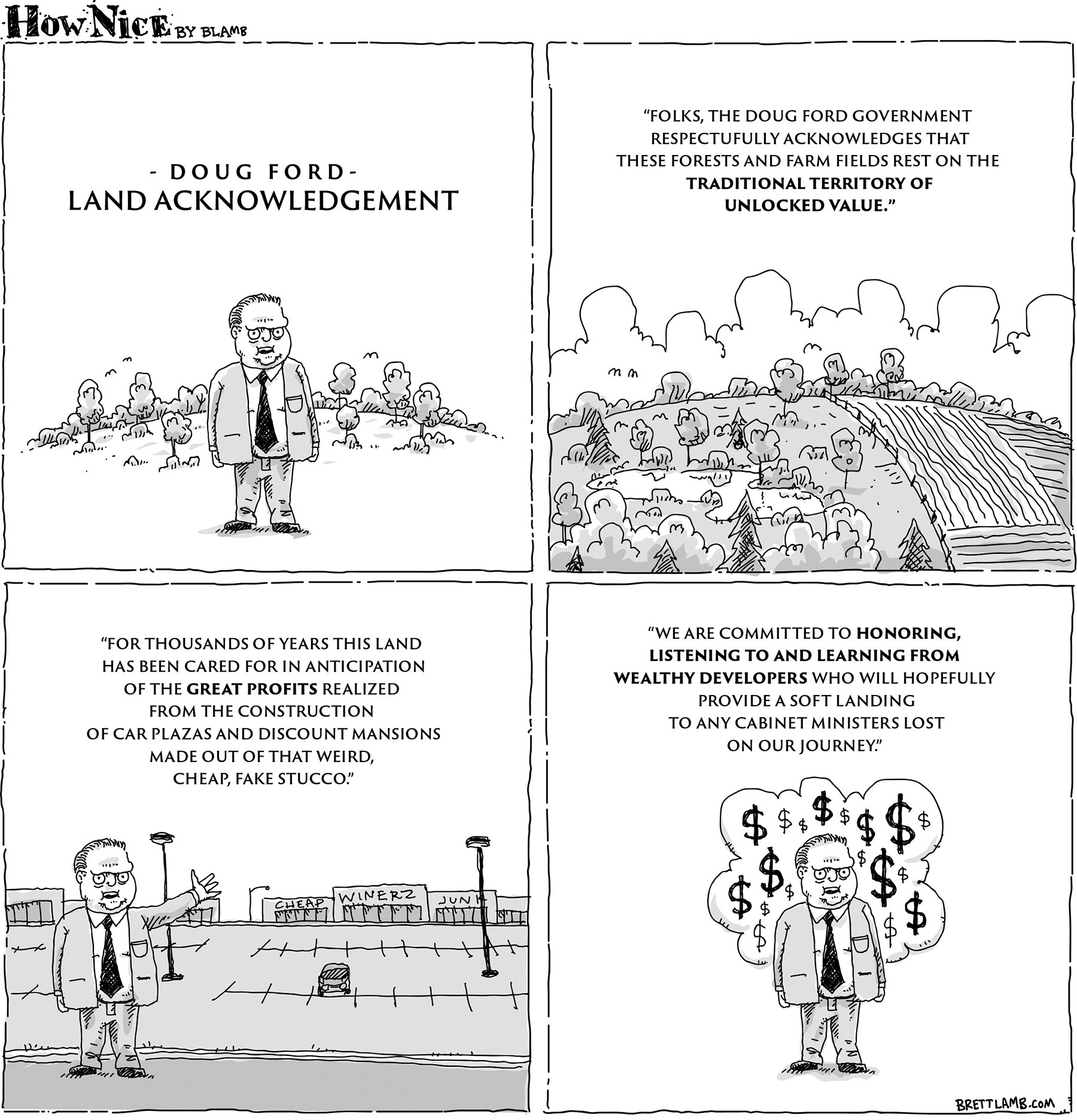
When announcing his latest reversal of plans to develop parts of the Greenbelt, Premier Doug Ford said he was “very, very, sorry.” It’s not clear what exactly he is sorry for, or if he is indeed sorry at all. After months of ignoring his critics, including damning reports from the Auditor General and the Integrity Commission, Ford forced his flying monkey cabinet to line up behind him to try and rationalize his latest u-turn on the Greenbelt file.
The late September change was a reversal of his reversal of his previous reversal of his original 2018 plan. Confused? You should be, that’s the way he likes it.
“To earn back your trust, I’ll be reversing the changes we made, and won’t be making any changes to the Greenbelt in the future,” he said, and without stopping to take a breath he added, “I’ve been very clear: I believe opening the Greenbelt can make a big difference.” I should clarify, he didn’t say these words, he read them, from a teleprompter. Some communications expert thought it would be clever to continue to argue for subdivisions in the Greenbelt whilst running madly from the same idea.
Then the Economic Development Minister took the stage to praise Ford’s “best of intentions,” but that “doing the right thing isn’t always the right thing to do.” The take away they want is that the public believes Ford will be caught doing the right thing.
“When faced with making tough decisions,” Ford said “we’ll always choose to do what is right”. Except when right is wrong, apparently.
What we do know is that the government removed selected parcels of land from the protected zone; some 7400 acres in 15 parcels. No one knows why these specific parcels were chosen, as that process was for insiders only. We do know from the Auditor General’s report that the developers themselves got to pick which properties would be liberated by Greenbelt restrictions in ninety-two per cent of the parcels. The Auditor General says the move enriched these land owners by a cool $8.7 billion.
The government’s own housing panel, alongside municipalities argue that the there is enough land already available for development to meet the province’s housing goals. These lands, they say, are close to infrastructure and transit. In other words, though Ford still argues his ends justify his means, he cannot reconcile this with the fact that the ends themselves, which make no sense, unless the real goal is to enrich your friends. The province has 630 requests for rezoning in hand from landowners within the Greenbelt; it chose to consider just these 15.
How much will this flip flop cost Ontario tax payers? Ford declined to “predict the future,” and chose instead to refer reporters to the housing minister for these “details.” He is eager to not be associated with an answer to that question. Will the developers sue the government, or perhaps be offered something else on the sly?
The scandal of the Greenbelt isn’t about the Greenbelt at all of course, it’s about the stench of corruption that still lingers. Did anyone in the Ford government benefit? The OPP decided the file was too hot for them and passed it to the RCMP The RCMP decided there was enough evidence to warrant a criminal investigation. Now that dark cloud hovers over the government and this premier. No amount of remorse, sincere or otherwise, or spin will derail that process.
Ford has a history in making formulaic requests for forgiveness. Back in 2012, when he was Toronto city councillor, he delivered a personal attack on the radio against the City’s Medical Officer of Health, David McKeown. He was ordered by the city’s integrity commissioner to apologize. He told a reporter “if it makes him feel any better to say sorry, and I don’t mean it, so be it.” He added that we he was considering sending the commissioner ten letters that say “ I, Doug Ford, apologize to ________ and to _______ t, for anything I’ve said in the past and anything I’ll say in the future.”
December 4th, 2023 · Comments Off on FORUM: Keeping it green and safe in University-Rosedale (Fall 2023)
Over 100 development files pending in this ward alone
By Dianne Saxe
I hope you are enjoying the beautiful fall weather as much as I am. Thank you to everyone who helps to look after Toronto school children returning to school, including teachers, cleaners, cooks, bus drivers, and crossing guards.
My office has undertaken a number of important initiatives impacting the Annex over the last couple of months. Here are some highlights:
I have approved the use of section 37 funds to transform the Bloor and St. George intersection into Toronto’s first “Dutch junction” by the summer of 2024. This innovative intersection design prioritizes pedestrian and cyclist safety, making them highly visible and protecting them from turning cars. The project is part of the Bloor Street reconstruction from Spadina to Avenue Road. I am actively working to minimize construction impacts while ensuring improved safety measures for pedestrians and cyclists.
Extensive negotiations between my office and the TTC have led to plans to repair damage at Dupont Station. The initial phase involves replacing mismatched glass entrance panes and purchasing replacement stair and penny tiles. Additionally, a collaborative effort involving myself, the TTC, the Dupont Castle BIA, and the Annex Residents’ Association is underway to enhance the station’s exterior entrances with improved lighting and seating, in partnership with Plaza Partners.
As a result of my motion to improve pedestrian safety on Avenue Road between Bloor and St. Clair, important consultations have been taking place in September and October. If you care about this issue, please make your voice heard. Details can be found here: https://www.toronto.ca/community-people/get-involved/public-consultations/infrastructure-projects/avenue-road-study/.
Two staffers from my office recently met with Head Gardener Paul Richard at Paul Martel Park for a Circle Garden Teaching session, enjoying the beautiful autumn weather. The park, originally designed as Ecology Park by Paul Martel, serves as a native memorial to the lost Taddle Creek, with a natural landscape and canoe-shaped beds paying tribute to the Ojibwa people who once lived along the creek.
Important work awaits us this fall. At the top of the list is ensuring adequate revenue tools to fund city services. I had a lively town hall at the end of September where the subject was addressed with residents. There is widespread agreement: the city has a revenue problem, not a spending problem, and should act accordingly. Increased parking levies, a modest share of provincial sales tax, and property taxes in keeping with the provincial average are all on the table. Mayor Chow has taken office with a clear focus on this issue, and I look forward to supporting her work.
There are other recent victories that should become apparent as you traverse the Annex. I coaxed Fleet Services and Municipal Licensing & Standards into letting some field staff perform their duties on bikes. This will save time, money, pollution, and congestion while actually making city work flow more promptly. It was great to see the first 21 service staff at work in their new city uniforms. I am also working to require the vehicle-for-hire industry to operate zero emission vehicles by 2030, and I am working with Toronto Hydro and the Toronto Parking Authority to make charging facilities available for EVs and e-bikes.
Finally, there is another major issue that never escapes the attention of my office: the frenetic pace of development. Total development files on my desk are consistently in excess of 100.
Every condo tower that seeks my approval is having to up their game on liveability, affordability, and climate action. For instance, they now have to try to deliver actual parks, not just give the city a meager cheque.
Approving new large residential developments while measurably increasing housing stock is a critical priority. Watch this space for strong new measures to require an increase in rental units as part of developments going forward.
Dianne Saxe is city councillor for Ward 11, University-Rosedale.
December 4th, 2023 · Comments Off on FORUM: Engage in the political process and change can happen (Fall 2023)
A Greenbelt victory
By Jessica Bell
Ontarians were outraged when the Conservatives reversed their election promise and approved development on 15 parcels of Greenbelt land owned by developers with ties to the government.
Now Ontarians are celebrating because the Ford government has reversed course and agreed to return the land to the Greenbelt and enshrine the land’s protection in legislation. You don’t need to be a political strategist to predict that no government is ever going to touch the Greenbelt again. This is a victory. Thank you, Ontario.
It took teamwork to get the Conservatives to back down. Environmentalists and citizens sent emails, made phone calls, and attended and organized protests and lobbying campaigns in the 905 and beyond.
Farming associations publicly chastised the government, which is a rare move. Municipal leaders, including the heavy hitter, the Association of Municipalities of Ontario, spoke up and questioned why the Greenbelt was being opened up, when there is already 88,000 acres of land available for development.
The First Nations Chiefs of Ontario asked the minister for Municipal Affairs and Housing to resign. We held the government to account in the legislature, formally requesting the integrity commissioner and the auditor general to investigate—which they did, with shocking and stunning impact.
We’re back in the legislature now, and you can feel the Conservatives are still reeling from the crisis.
No one believes the Conservative’s tired message that opening up the Greenbelt will solve the housing crisis.
Building million-dollar homes on farmland with no infrastructure in sight won’t help anyone but land speculators.
Three ministers are missing. Minister Kaleed Rasheed resigned in response to the integrity commissioner’s probe, which revealed he took a trip to Las Vegas with developers who had land removed from the Greenbelt.
Rasheed and the developer even had massages at a luxury hotel at the same time. Rasheed called the meetup a coincidence, but no one’s believing that.
Aspiring Conservative leader Minister Monte McNaughton quit for the private sector— my guess is because he doesn’t want to be tarnished with this scandal.
And the minister for Municipal Affairs and Housing, Steve Clark, left his post because someone had to take the fall. I predict they won’t be the last MPPs to be ousted or demoted.
Where do we go now? The Greenbelt scandal is just the tip of the iceberg, when it comes to corruption and this government. We’ve also been demanding answers from the government in question period.
What was Premier Ford’s involvement in the decision to open up Greenbelt lands? When exactly did developers know the Greenbelt was going to be opened up? Are policy decisions really being made on massage tables in Las Vegas where a Conservative minister and key developers met “coincidentally” to chat?
We have called on the auditor general to formally investigate other land-use planning decisions this government has made that benefit the wealthy few. We want to know if more secret deals were made before the Conservatives decided to redraw municipal boundaries in Hamilton, Waterloo, Halton, and Ottawa and greenlight sprawl on 35,000 hectares of farmland.
We want to know about the government’s enthusiastic use of minister’s zoning orders (MZOs), enabling developers to bypass municipal planning processes. Or what about the secret deal the Conservatives gave Therme to build an exclusive spa on Ontario Place? Where there’s smoke there’s fire, and it’s awfully smoky right now.
“If you don’t mess with politics, then politics will mess with you.” This was the wise slogan on a button I was given at a recent protest to stop the forced eviction of the residents of 145 St. George Ave. Governments need to be trustworthy, accountable, and work for us, and we must remain vigilant and engaged to ensure they do. Keep up the great work everybody.
Jessica Bell is the MPP for University-Rosedale and the Official Opposition’s Housing Critic. She can be reached at jbell@ndp.on.ca 416-535-7206.
September 14th, 2023 · Comments Off on ON THE COVER (Summer 2023)
On Aug. 16 Toronto Police Service Deputy Chief Rob Johnson, Councillor Dianne Saxe, Mayor Olivia Chow and MPP Jessica Bell were among the many dignitaries in attendance at a commemorative baseball game including the Italian and Jewish communities that marked the 90th anniversary of the Christie Pits Riot. COURTESY THE CITY OF TORONTO
September 14th, 2023 · Comments Off on NEWS: Remembering the race riot (Summer 2023)
90 years ago Jewish and Italian neighbours defended community against antisemitism
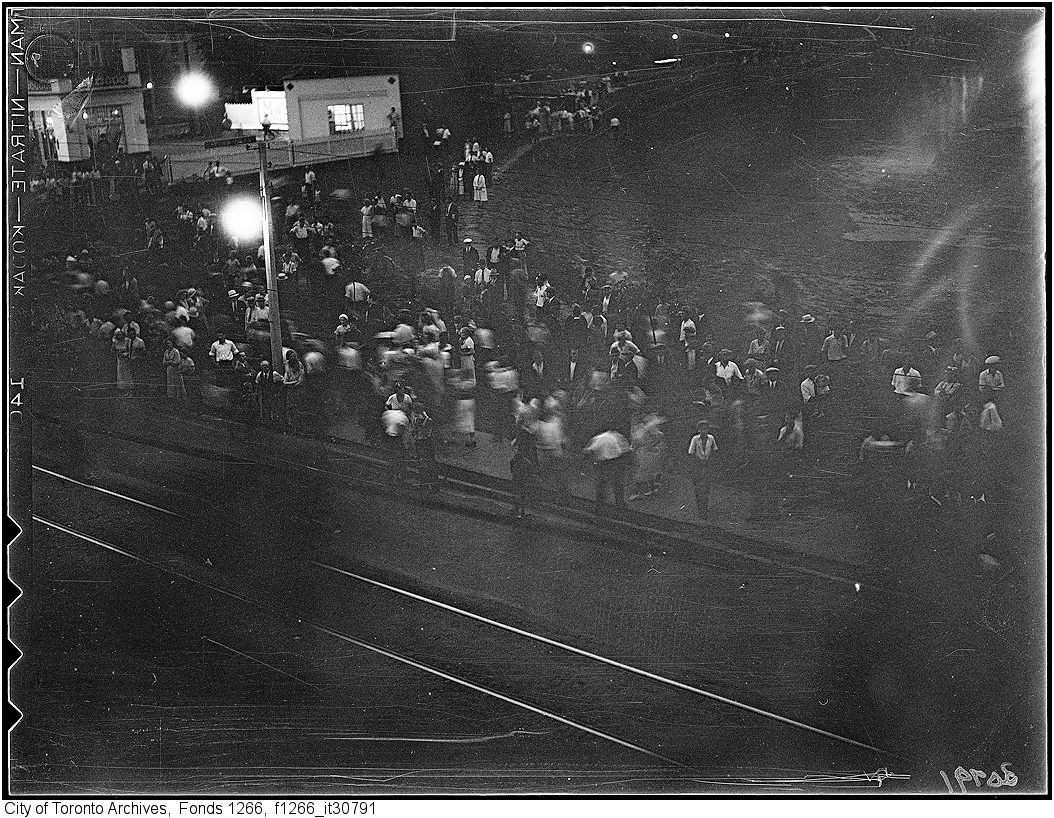
Taken by an unknown photograher, this is the only known photo of the riot on August 16, 1933. City of Toronto Archives, Globe and Mail fonds, Fonds 1266, Item 30791.
By Fox Oliver
In the 1930s, Toronto was predominantly British and anti-Semitism was commonplace and permeated all neighbourhoods in the city. In an already difficult depression-era city, Jews had an even more difficult life. They were routinely excluded from high-paying jobs, from attending universities, and from buying homes in certain neighbourhoods. Many Canadians used Jews as scapegoats for the cause of the ongoing economic depression.
Newspapers in Toronto, such as the Toronto Daily Star, reported on Hitler’s rise to power and the atrocities committed in Nazi Germany in great detail. “Torontonians probably knew more about what was occurring to Jews in Germany during those fateful months than most Berliners. For the Jews of Toronto, the swastika immediately became a symbol of persecution, torture, and death,” wrote historian Cyril H. Levitt in The Riot at Christie Pits.
Swastika clubs, groups of Toronto youth flaunting the swastika began to form in Toronto. One swastika club told the Toronto Evening Telegram that “[w]e, the members of the Swastika Club do hereby declare that we are in no way connected with any political or racial organization.” Another told The Globe that the club was an “orderly and strictly legal campaign to clean up the beaches.”
However, it was clear these “clubs” were a way for Toronto youth to spread anti-Semitic hate throughout the city under the masquerade of do-gooding. “Secretiveness about the club’s organization masked its real purpose, which was to capitalize on the dissatisfaction of the Beaches’ residents … in order to organize a Nazi movement in Canada,” wrote historian David Rome in Clouds over the Thirties. Swastika clubs regularly harassed and initiated needless violence against Toronto Jews in the summer of 1933.
On Aug. 16, 1933, during a baseball game in Christie Pits (Willowvale Park until 1983) tensions were high, and thousands of people gathered on the hills to watch the game.
As the game ended, members of swastika clubs flew a large swastika flag across the baseball diamond and yelled cries of “Hail Hitler.” This sparked outrage and violence, and a large brawl in the park broke out.
Italians and other persecuted minorities fought alongside the Jews against the swastika clubs and other Anglo-Canadians for control of the swastika flag, which was eventually torn to shreds.
“An unusually large number of mounted men and constables were stationed nearby,” reported the Toronto Evening Telegram, suggesting police were prepared for the riot. However, it was only at 8:45 p.m., an hour after the first blows were struck, and nearly three hours after the game had started, that mounted police arrived at the park.
Even then, the brawl raged on through the night and only ended the following morning.
Police were harshly criticized by many, including the Toronto Daily Star, for their lack of preparation, slow response time, and apparent disregard of warnings of expected violence.
September 14th, 2023 · Comments Off on SPORTS: Baseball in full bloom at the Pits (Summer 2023)
Returning veterans, deep roster raise hopes for elusive championship
Toronto Maple Leafs outfielder Gregory Carrington connects on a pitch on July 30. The Leafs defeated the Hamilton Cardinals 9-5. (R.S. KONJEK/GLEANER NEWS)
By R.S. Konjek
Third time’s the charm.
Fans of Toronto Maple Leafs baseball are hoping that’s the case this summer.
In the past two seasons, the Leafs fell just short of winning the Intercounty Baseball League’s championship series. After an offseason that saw some major changes within the organization, the boys in blue are primed for another run at the title.
Jeff Lounsbury should know. As the club’s new general manager, he assembled the team that plays at Christie Pits every Sunday from May through August.
Lounsbury was hired by the Leafs after longtime player, manager, and team executive Damon Topolie announced his departure last December.
A former collegiate head coach and general manager of the Hamilton Cardinals, Lounsbury set out to preserve the heart of the existing Leafs roster while adding much-needed depth to the bench.
“Keeping the core together was paramount,” he said.
The Leafs boast one of the most experienced rosters in the league. Some players have been with the team close to a decade or more.
Lounsbury’s efforts were successful. The veteran infield of Justin Marra, Jordan Castaldo, Dan Marra, Jose Vinicio and Johnathan Solazzo returned. Young outfielders Gregory Carrington, Ryan Dos Santos and Aiden McAskie came back. Marek Deska, Zach Sloan, Adam Marra, Sam Greene, Chris Nagorski and Ryan Wells were among the returning pitchers.
Many a Leaf postseason run has been disrupted by lack of depth at key positions. Past managers have been left looking through their fingers when they reached for help from the bench or bullpen.
Lounsbury filled the holes in the Leafs roster with a mix of local youngsters and import players from the Caribbean, and they fit right in.
New manager Rob Butler has been overseeing the action on the field. The first-time skipper is a veteran of the game. Butler spent part of four seasons in the Major Leagues and is the only Canadian to win the World Series while playing for the Toronto Blue Jays. In 2001, Butler joined the Maple Leafs and played five seasons at Christie Pits. In that sense, his hire by the Leafs has been a kind of homecoming.
Lounsbury described the thinking that went into the Butler hire.
“We wanted someone with IBL experience and some veteran experience because of our older team,” he said. “It can be tough for a young guy to coach 35-year-olds. We reached out to Rob and it clicked really fast. He checked all the boxes. He has a great baseball mind; he’s calm and has a sense of humour.”
Entering August, the Leafs were in fourth place in the standings with a 15-14 record. Lounsbury is not concerned.
“We had a great start offensively, but some struggles with the bullpen,” Lounsbury said. “Rob is a new manager and trying to learn which kids fit into which role. Sometimes you lose a game trying new things out.”
As the season progressed, the Leafs bolstered their bullpen by signing four additional pitchers including returning fan favourite Dustin Richardson, a six-foot-six mountain of a man from Kansas.
“Richardson coming back is huge for us,” Lounsbury said. “He’s healthy, he’s lights out, he’s motivated.”
As are the rest of the Leafs. The 2023 IBL postseason will commence at the end of August. There is a “now or never” vibe in the team clubhouse. Some players, like former league MVP Jordan Castaldo, have indicated that this will be their final season of play.
The Leafs are in their second year of caretaker operations following the passing of longtime owner Jack Dominico. In late July, the club announced that it was officially for sale and welcoming interest from prospective buyers.
While the future of the club is to be determined, Lounsbury is focused on the present. He is confident that he has assembled a Leafs team that could win its first championship since 2007.
“It’s really wide open,” he said of this year’s postseason race. “It’s as open as it’s ever been, but I think we’ve got the most depth. I don’t think other teams can go as deep as the Leafs.”
As for the Leafs’–and his own–future beyond this year, Lounsbury is not looking too far ahead.
“I knew why I was doing it,” he said about his decision to take on the job. “[It was] to continue Jack’s legacy. I really like working with Rob. He’s more than willing to stick it out for the future, so we’ll play out this year and see what happens.”
As always, the Maple Leafs play home games every Sunday at Christie Pits with the opening pitch at 2:00 pm. The regular season wraps up on Aug. 20 and the playoffs will begin soon after.
More information about Maple Leafs baseball, and their regular and postseason schedules can be found at: www.mapleleafsbaseball.com.
September 14th, 2023 · Comments Off on NEWS: Pits Riot: A teaching moment (Summer 2023)
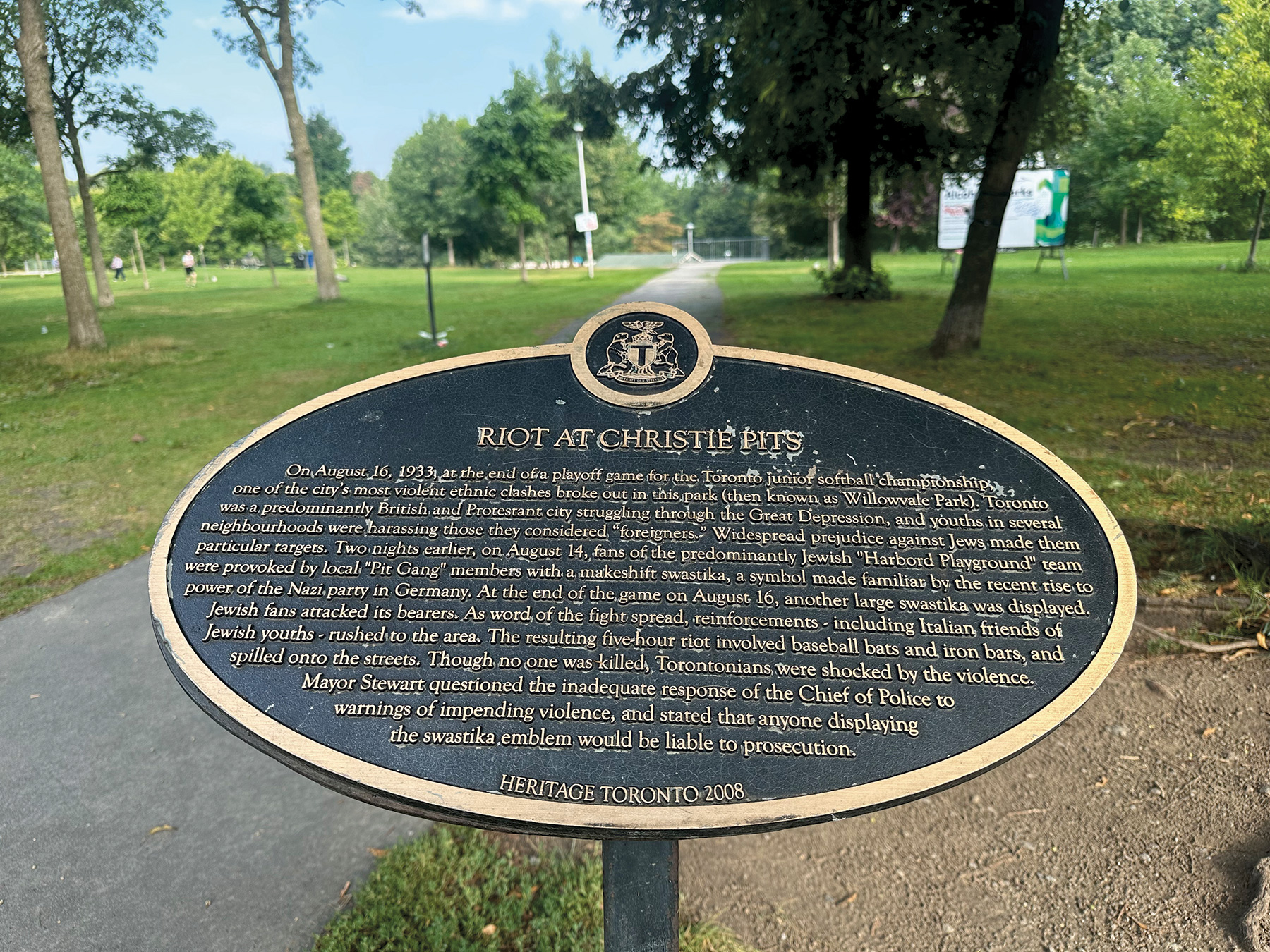
A plaque in Christie Pits reminds passersby of a dark time in Toronto history worth remembering. BRIAN BURCHELL/GLEANER NEWS
By Fox Oliver
A local theatre group is telling the story of the Christie Pits Riot, which involved 10,000 people, on the same soil where it happened.
Sam Rosenthal and Drew Carnwath created the play, The Christie Pits Riot, to tell the story of Toronto’s largest race riot to students in Toronto middle schools and high schools. The play is from the perspective of Joey Rosenthal, a young Jewish boy living in Toronto during the week leading up to the Christie Pits Riot on Aug. 16, 1933. The immersive play is performed entirely outside and leads the audience throughout Christie Pits to tell the human story of the often overlooked Christie Pits Riot.
The riot, which was sparked by the unfurling of a swastika flag during a baseball game in Christie Pits, involved Jews and similarly oppressed minorities battling swastika clubs and anti-Semites. The riot was an explosion of the tension that had been building for weeks between Jews and the swastika clubs.
Though the brawl lasted until morning and was under-policed (there were only four police officers for 10, 000 people), no one was killed and only one person was convicted.
“The riot is a part of Toronto’s history that’s never discussed; it’s just a forgotten piece of history,” said Sam Rosenthal, creator of the play. “The idea came from my dad, Joe Rosenthal, when we were talking about our family history.” Sam Rosenthal’s grandfather, of the same name, owned a drugstore at Bloor Street and Manning Avenue at the time of the riot and experienced 1930s Toronto firsthand.
Rosenthal spent a year and a half researching the riot which included holding community consultations and gathering individual stories from Jewish families in Toronto. In 2021, Rosenthal and Carnwath created an audiobook about the riot with The Hogtown Collective, a Toronto-based theatre group.
After receiving funding from the United Jewish Appeal, The Hogtown Collective was ready to perform The Christie Pits Riot for student audiences in the park.
The play was performed eight times weekly between May 9 and June 16, mostly for Grade 8 and 9 students. The Hogtown Collective is working hard to obtain further funding so they can host performances of The Christie Pits Riot for the general public in the coming year.
“It was really important for us to humanize the story and show how it affected people day-to-day,” said Rosenthal. “This isn’t a wax museum; these are real people.” Sam Rosenthal chose a young Joey Rosenthal, inspired by his father, to be the play’s lead. Joey’s innocent questions throughout the play, such as “Why do they hate us?” and “What would you do?” connects the audience to the actors and provokes thought.
“I [had] never heard of the riot before; I didn’t know this could even happen in Toronto,” shared Jordan, a Grade 8 student, after watching the play. “It’s important because it was really dangerous and harmful to people…and it shouldn’t happen again,” said Kaila, another student who watched the play.
In the fall of 2022, the Ontario government announced they will be implementing increased mandatory education on the Holocaust, beginning in Grade 6. “We are taking action to counter anti-Semitism and hate because those that fail to learn from history are doomed to repeat it,” said Ontario Education Minister Stephen Lecce.
These changes stem from the results of a study completed by Western University and Liberation75 which revealed that 33 per cent of a sample of Grade 6 to Grade 12 students believed the holocaust was fabricated, exaggerated, or didn’t happen at all. Education around the Christie Pits Riot will also be added to the curriculum for Toronto schools next year.
“Toronto is an incredibly diverse and wonderful city, but I think we all have to learn more about where we come from. Toronto has a dark side of it that has to be told, but it has to be told in a way that’s not harsh and has human and emotional appeal,” said Rosenthal.
The 90th anniversary of the Christie Pits Riot was on Aug. 19.
September 14th, 2023 · Comments Off on NEWS: University Women’s Club of Toronto celebrates 120 years (Summer 2023)
Over a century of events and philanthropy
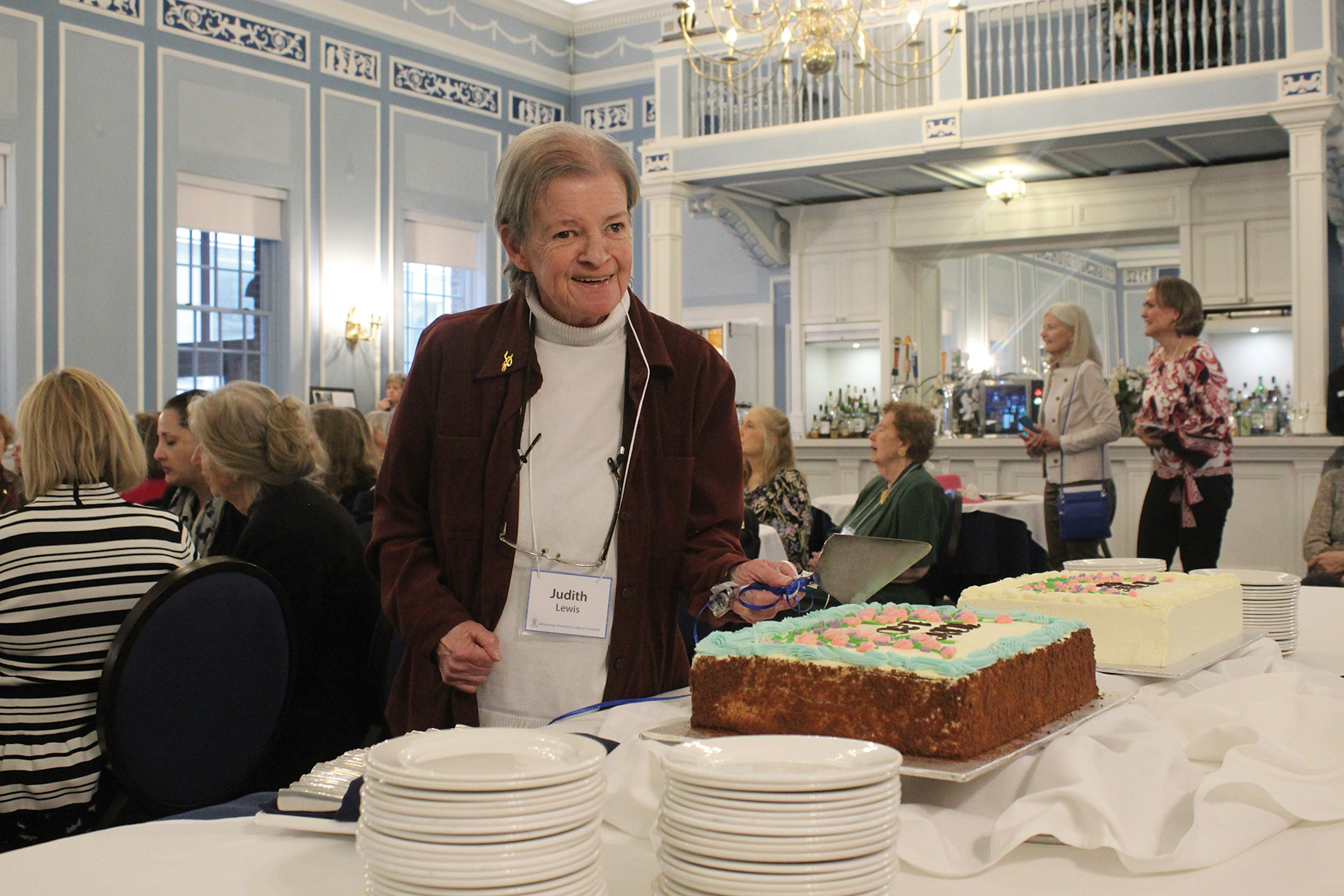
Past President Judith Lewis doing the honours of cutting the UWC’s anniversary cake. She was president from 2002 to 2004 and again from 2008 to 2017. HAILEY ALEXANDER/GLEANER NEWS
On April 23, the University Women’s Club of Toronto (UWC) celebrated 120 years with over 160 members. The celebration took place on May 1 at the University of Toronto’s Faculty Club at 41 Willcocks Street, east of Spadina, where the club holds its events.
The evening began with a toast to the club’s ongoing accomplishments from Susan Freeman, former club president. The group enjoyed sandwiches and cake as Chris Ward, director of scholarships, joined Freeman in a walk down memory lane. Ellen Thompson, co-director of communications, distributed booklets (generously provided by The Printing House) in memory of the club’s past 120 years. After a night full of laughter, the members left with a “happy birthday” from Ward and Wendy McCallum, current club president.
Founded in 1903 by 22 young women, this club was the first of its kind in Canada. Their initial objective was to support women with opportunities to advance in intellectual, cultural, and social pursuits. Jane Hamer, current club member, said these women achieved their ambitions “with distinction” despite gender-based inequities. Today, former UWC members continue to serve as “models of vision, perseverance, and determination.”
When it was first established, the club met in tea rooms, churches, and members’ homes. They purchased a house at 162 St. George Street in November 1929. At the time, there were limitations on women’s ability to own property, so the club set up a holding company in order to legally own their clubhouse. In 2010, the UWC sold their building to the University of Toronto and relocated as a tenant at 41 Willcocks Street, the University of Toronto’s Faculty Club.
Throughout its history, the UWC’s activities have reflected the times. During the Great Depression, they provided activities for children, hosted sewing classes and baby clinics, collected books, offered financial support to various organizations, and provided whatever they could to children in need. During World War II, they made hundreds of sewn and knitted garments and collected materials like coupons and stamps. In recent years, the club has reached out to organizations in need of support, provided scholarships to young women pursuing a post-secondary education, hosted book groups, invited guest speakers, and explored games like bridge and mahjong.
Prior to the pandemic, the UWC added around 15 new members every year. McCallum said there has been substantial growth recently with over 60 new members since January 2022.
“Covid is relaxing. This is drawing people out, and we’ve had many [newcomers],” McCallum said.
The club’s demographic has changed from 60 and older to much younger, with some members still attending university. Lucia McCurdy, director of membership, introduced many new faces to the group during the club’s 120th anniversary celebration. Over 80 guests were there to welcome them.
According to Hamer, the club continues to honour their mission by “supporting women on the margins” and providing scholarships for “young women pursuing a post-secondary education.”
In May, the club awarded a $6,000 scholarship to nine female Toronto high school students entering their first year of university in the fall. McCallum said the club has come a long way from awarding roughly five scholarships of similar value to nearly double that amount this year.
While these awards are non-renewable, the UWC also offers multi-year scholarships to female high school students pursuing post-secondary education across Canada.
In 2019, the club began hosting receptions for scholarship recipients and their families. “We couldn’t do it during the COVID years, but we did it last year and we’re going to do it again this year,” McCallum said.
The 2023 scholarship reception was held in June.
Comments Off on NEWS: University Women’s Club of Toronto celebrates 120 years (Summer 2023)Tags:Annex · News
September 14th, 2023 · Comments Off on EDITORIAL: Ford exploits housing crisis (Summer 2023)
Ontario’s auditor general, Bonnie Lysyk, and now, protests across the province, have the Ford government playing their best defensive game. In a scathing investigative report released in August, Lysyk showed more of the same in terms of the Ford government’s approach to decision-making and democracy. For those of us who have been paying attention, none of it comes as a surprise, but we can only hope that this spells the end of a corrupt regime, and that these Greenbelt decisions won’t move forward.
Lysyk’s report, released Aug. 9, shows that in the process of removing more than 7,400 acres of land from the Greenbelt, planning rules were bypassed. Housing Minister Steve Clark’s chief of staff, Ryan Amato, was communicating directly with specific developers about 14 out of the 15 Greenbelt sites slated for rezoning. These communications, in part, came in plain manilla envelopes delivered to him over dinner, which Amato claims he waited until he got home to open. The developers gained a 3,400 per cent increase in land value as a result of the zoning changes recommended in those communications.
In June of 2022 the premier mandated the housing minister to conduct “swaps, expansions, contractions and policy updates” related to the Greenbelt. These did not happen in accordance with planning rules and regulations, but the premier touts this as a proactive response to the housing crisis. This is hard to believe, when even his own housing task force said the Greenbelt lands were neither necessary nor desirable for housing development. The auditor general agrees with that perspective and says that the province can meet the target “without the need to build on the Greenbelt…most of the land removed from the Greenbelt may not be ready for housing development in time to meet the government’s goals.”
The province had criteria to determine which land could be removed from the Greenbelt. The proposed sites could not be “in a designated specialty crop area or part of the Natural Heritage System,” and they should be “adjacent to already developed or planned infrastructure.” When the selected lands could not pass those tests, the criteria were changed. Of the 7,400 acres removed from the Greenbelt, 92 per cent was removed as a direct result of requests made by developers—over dinner with the housing minister’s chief of staff. Meanwhile, the province has 630 requests for rezoning in hand from landowners within the Greenbelt; it chose to consider just these 22.
The landowner set to enjoy the largest windfall benefits in the former agricultural preserve are companies linked to prominent GTA developer and PC donor Silvio DeGasperis. Ontario’s Integrity Commissioner is still investigating this connection, and the Ontario Provincial Police indicated they were aware of the AG’s report and that the file is subject to an “ongoing review” by the OPP’s anti-rackets branch.
Ford claims: the means justify the ends. His means are blatant corruption; his ends, he claims, are to solve the housing crisis—but for those of us who have been watching, we all know this deflection is just another steaming pile of lies. The ends here are not valid, and the means really stink. The means are so egregious (drawing the public through the stench of a legal and ethical sewer), that it’s hard to imagine that getting 30,000 homes one day is really worth it. The government is exploiting the housing crisis to help its wealthy friends first.
Who will stop this? The federal government has the power to do so on a myriad of environmental grounds including the protection of endangered species and watersheds—but we are stuck in the world of wait and see. Ontario’s First Nations’ leaders are asking for the housing minister and his chief of staff to step down, and a spokesperson from the David Suzuki Foundation says this level of public opposition to a government policy is unprecedented. It’s time to push the Ford government out of office and bring democracy back to the table.
September 14th, 2023 · Comments Off on FORUM: Fighting on five fronts (Summer 2023)
No sleepy summer in University-Rosedale
By Dianne Saxe
I hope you’ve had a good summer, even if it has been the hottest in at least 120,000 years. Here are a few of the issues we have been working on for you.
First, you’ve undoubtedly noticed the reconstruction of Bloor Street between Avenue Road and Spadina, starting with the north side. By next July, this section of Bloor will be safer for everyone, with better sidewalks, raised cycle tracks and a protected intersection at Bloor and St. George. Raised cycle tracks protect cyclists from careless or aggressive drivers; “magic” painted lines do not. In the meantime, though, the construction is a challenge, especially because it interrupts Toronto’s major cycling route just as more and more people are getting around by bike. Pedestrians with disabilities have also been adversely affected. Ahead of time, city staff promised me multiple precautions to keep walkers and cyclists safe through the construction zone; many of these were not yet realized at the time of writing. I continue to press senior staff on this and hope you will see gradual improvements.
Second, we have heard from many constituents about the heart-wrenching scenes of asylum claimants camped on the sidewalk. While the federal government has taken responsibility for asylum claimants in Montreal, they refuse to do so in Toronto. In two years, a 500 per cent increase in asylum claimants has flooded our shelter system, leaving no beds to offer anyone. The new mayor’s extraordinary efforts in July, adding 250 new refugee beds, didn’t change much; the new beds were filled within days. We literally have no space for the new asylum claimants who continue to arrive.
Moreover, this prevents the city from responding effectively to the hundreds of angry, anguished complaints I receive about encampments, including about open criminality, fires, trash, aggression and harassment. While I always immediately ask city staff to take action, there is little they can do for either the homeless or the general community when the shelters are full. This is unacceptable.
Mayor Chow continues to work hard to break the impasse with the federal and provincial governments. You can help. Chrystia Freeland is our MP. She may not be listening to the city, but she has to listen to her constituents. This would be a good time for you and your neighbours to contact her office. Let her know how important it is that the federal government looks after refugee claimants so that the city can provide shelter space to those who are homeless here.
Third, I’m working with Parks on the two new parks that will be built next year—a beautiful new Huron-Washington playground and a quiet park for adults at Sussex and Spadina. Consultations on both designs should begin shortly. I’m pushing for new playgrounds that are different from each other, with more natural materials and more challenges for older kids. Adults, too, tell me they would like to have access to outdoor fitness equipment in parks, not just places to sit. Don’t miss the chance to have your say.
Fourth, as the effects of climate change become more obvious by the day, council supported several of my climate-related motions, including:
tying CEO compensation at city agencies and corporations to implementation of TransformTO, Toronto’s ambitious and essential climate action plan.
phasing out loud, polluting two-stroke engines, such as leaf blowers.
evaluating the opportunity for a publicly-controlled micro-mobility rental pilot project that puts sidewalk safety first.
Fifth, Christie Pits and Queen’s Park are part of the Alcohol in Parks Pilot Project where alcohol may officially be consumed until Oct. 9. This allows residents without the luxury of a private backyard to responsibly enjoy a drink outdoors, alone or with friends, as they do in Vancouver. So far, it seems to be going well, except that many people dislike the absurdly large signs that announce the pilot.
Thank you again to those constituents who help to make University-Rosedale a great place to live and work.
Dianne Saxe is city councillor for Ward 11, University-Rosedale.