July 19th, 2024 · Comments Off on SPORTS: Maple Leaf Mystique thrills Pits (June 2024)
Newcomer Martini-Wong the Leafs’ hero on a memorable night
Keiran Martini-Wong celebrates with his teammates after scoring the winning run for the Toronto Maple Leafs on May 22 at Christie Pits. CRAIG AIKIN/GLEANER NEWS
By R.J. Konjek
At Christie Pits, baseball season is in full swing.
The home of the Toronto Maple Leafs has been reborn with new sights and sounds.
For gameday ballpark atmosphere, a small village of pop-up tents now surrounds Dominico Field. Each tent offers something: team merchandise, beer and snacks, raffle tickets, or VIP exclusivity (basically, a place in the shade in a park otherwise exposed to the elements).
The park’s booming new sound system is a cut above its semi-reliable predecessor.
The fan experience now includes between-innings trivia contests, on-field races and a chance for youngsters to run the bases. A seventh-inning stretch routine is performed by staff of Innovative Fitness, and an ongoing series of promotions has featured themes like Women in Sport, Bark at the Park and Pride Day.
The club’s new ownership group has invested in these new features and the initial results are positive. The Leafs charge no admission and attendance is not tracked, but crowds have been noticeably larger than in the past few years.
An early highlight was a game that took place on May 22.
After a sluggish start, the 0-4 Leafs hosted the 0-3 Kitchener Panthers. At stake was a chance for one club to reset its season with a win.
All evening, the home side struggled. Facing Cuban pitcher Yadian Martinez, the Leafs were held to just one run over the first seven innings. Things looked dire as they fell behind 7-1 with last place staring them in the face.
Longtime Leafs fans speak of this enigmatic thing called the Christie Mystique. It posits that no lead is ever safe, and the most insurmountable deficit can be overcome. At least once a year, Christie Pits validates the theory by playing host to a comeback victory that defies the odds. This was one such night.
After seven innings, Martinez handed the ball to his bullpen and things immediately fell apart for Kitchener. A calamitous combination of hits, walks, hit batsmen and wild pitches saw the Panthers surrender four runs to make it a 7-5 game going into the ninth.
A crowd that had little to cheer for all night was now on its feet. With each run that crossed the plate, the Leafs players whooped it up and urged each other on. The fan group known as the Bushmen provided cheers and heckles from their perch amid the trees on the slopes beside Christie Street. The ballpark became a cauldron of noise. The Christie Mystique was taking hold.
Twenty-year-old Keiran Martini-Wong witnessed all of this from a unique spot in the ballpark: the Maple Leafs’ bench. The Etobicoke native is a member of the Leafs’ junior call-up roster. What that means is that he plays full-time for High Park Junior Baseball, but when the Leafs find themselves short of players, he gets a call or text to suit up and join them wherever they may be playing. Martini-Wong made his first-ever appearance for the Leafs in Guelph the week before. This evening, the young player who rides the TTC to Christie Pits made his home debut.
As the ninth inning rolled around, several veteran players were scheduled to bat, and Martini-Wong was aware that he might be called upon to pinch-run. He started stretching on the bench and went for a little jog along the left field line.
In the bottom of the ninth, the Leafs put two men on base with a walk and a single. First baseman Jordan Castaldo waged an 11-pitch battle with one of Kitchener’s pitchers before hitting a two-run single to tie the game 7-7.
The Pits was now at full volume, including the Panthers whose outfielders could be heard screaming at their rattled teammates to hold it together. All in vain. Another walk moved Castaldo to second base.
At that moment, Leafs manager Rob Butler turned to Martini-Wong and informed him that he was entering the game as a pinch-runner, representing the winning run.
Before the youngster went to take his place at second, Butler imparted some gentle words of advice: “Don’t get picked off.”
“Yes sir!”
The Panthers continued to unravel. The Leafs’ next batter was hit by a pitch, moving Martini-Wong to third base. The very next pitch bounced away from the catcher and clattered around the backstop. Martini-Wong was off like a shot. He sprinted home, dove headfirst and slid across the plate with the winning run.
The Leafs won an 8-7 walk-off victory. The junior call-up became the newest hero of Toronto baseball. Martini-Wong was mobbed by his teammates and embraced by the affectionate cheers of the home audience. Leaving the field on a high, he soaked up the atmosphere of a memorable night.
“I’ve never seen something like that before,” he said later. “The fans are absolutely unreal. That was really, really cool.” The Mystique had worked its magic again.
July 19th, 2024 · Comments Off on EDITORIAL: Ford’s boozy billion-dollar blunder (June 2024)
Who is clamouring so much for beer and wine in corner stores and at every grocer that the province feels compelled to exit its deal with The Beer Store early? The financial penalty to leave the contract now is between $225 million and $1 billion depending on whose numbers you buy. The current arrangement with The Beer Store (TBS) is set to expire in 16 months, with no penalty from Ontario taxpayers. Could it be that Premier Doug Ford is planning an early election, wants to get this campaign promise fulfilled ahead of time, and doesn’t mind a bit wasting taxpayers’ dollars to check that box?
Ontario’s 10-year agreement with the conglomerates that own TBS expires in December 2025. The controlling owners are global beer giants Molson Coors and Anheuser-Busch InBev. These are foreign companies. The president of the Retail Council of Canada, Diane Brisebois, called the move “a sweetheart deal for the big multinational beer companies” that actually compounds the business of selling beer and wine at grocers by seeking to offload recycling costs (of beer cans and wine bottles) onto grocery stores. Undoubtedly, consumers will end up paying the stores to manage the returns. Among the changes now coming by Sept. 5, 2024 is TBS will no longer have the exclusive right to sell 12 and 24 packs of beer and consumers will have an additional 8,500 retail locations to purchase beer. The current arrangement caps the number of grocers selling beer and wine at 450, but that limit disappears with the new deal.
For the announcement of this deal, Doug Ford selected a gas station which features a convenience store near his Etobicoke home. Apparently, filling up your car and buying some chips and a six-pack of Coors will now go hand in hand. The province is also allowing the sale of hard cider and mixed alcoholic drinks to be sold in convenience stores. The Centre for Addiction and Mental Health (CAMH) warned that increasing the number of places to buy alcohol would “significantly increase” the 6,000 annual deaths in Ontario attributed to drinking. CAMH urges the province to permit municipalities to opt out of the plan as it did for legal weed stores.
The Ontario Liberal Party pegs the cost of Ford’s move at closer to $1 billion. This includes the $225 million the government acknowledges, a rebate of $375 million in fees The Beer Store currently pays to the LCBO, and $300 million in lost revenue from licensing fees from retailers which also appears to be scrapped. Additionally, those grocers and convenience stores that will be allowed to purchase product at the LCBO at a ten per cent discount will cost the provincially owned corporation $150 million annually. The whole deal does appear to cost over $1 billion, and that is without considering the loss of revenue to the LCBO. The LCBO is Ontario’s cash cow, not unlike the provincially owned lotteries. Ford is at once raiding state coffers and crippling Ontario’s ability to govern in the future.
Bonnie Crombie of the Ontario Liberals offers a long list of where the government could spend $1 billion more wisely: 10,000 more nurses or teachers, funding for school repairs, a 25 per cent rebate on development charges to make new homes more affordable, a $25 per hour minimum wage for PSWs, a 50 per cent rebate on new heat pumps, 7000 public electric vehicle (EV) chargers, etc.
As some will remember, Ford ordered the EV chargers removed from Ontario’s 400-series highway service centres when he first came to office.
The nurse who is making their way home after seven 12-hour shifts does not lament that they can only buy a six-pack in the grocery aisle instead of a whole case; they just wish there were more nurses. But listening to that nurse, seeing the myriad of other problems, and seizing investment opportunities to solve them is not within Doug Ford’s DNA. He has evolved very little from his “buck-a-beer” platform and does not really care about governing; he only cares about power.
July 19th, 2024 · Comments Off on FORUM: Tackling road congestion, noise, and safety (June 2024)
City council working through the summer
By Dianne Saxe
Thank you to everyone who turned out for our two Environment Days in May and June at Central Technical School and Fred Hamilton Park! I hope you have also enjoyed our first long weekends as we kick off the summer weather. I have managed to plant some cherry tomatoes and herbs in pots this year; so far they are withstanding the hungry rabbits.
Toronto city council had another productive session in May, with progress made on mobility and housing. I’m pleased to see council’s growing consensus in favour of road safety. This allows us to keep approving complete streets, including preliminary approval for Avenue Road from Bloor to Davenport, plus the 2025-2027 Cycling Network Plan. I also worked hard to ensure that the city reached a new financial agreement with the Toronto Parking Authority so that Bike Share and EV charging rollouts can continue as planned.
When there are good alternatives to cars like walking, cycling, or taking transit, we leave more space on our roads for critical vehicles: emergency services, buses, construction trucks, delivery vans and cars on necessary trips. We are also working on slowing traffic in our neighbourhoods: speed humps, red light cameras, and automated speed enforcement where residents request them. Thank you to everyone as well who attended our May town hall on the topic. Check this space next month for a summary of the June and July city council sessions.
I continue to work with other councillors to tackle congestion problems. In most areas, the TTC needs the city to adjust parking rules, turn restrictions, etc… to let the streetcars and buses run on time. In Ward 11, this problem is most acute for the Dundas streetcar between McCaul and Spadina, and immediate action is necessary while the Spadina streetcar line is under construction. For this reason, the city is implementing temporary parking and turning changes on Dundas Street West between McCaul and Spadina for the rest of 2024. Later this year, transportation staff will recommend appropriate long-term parking, loading and turning rules for this area.
Our June town hall took on solutions for noise. We know that noise is a huge health problem, especially in a downtown ward like University-Rosedale. I have been working with city staff and “No More Noise Toronto” to improve bylaws and enforcement, with the first changes going through on July 1. Thank you to everyone who contributed to helping us do this.
On the housing front, council has approved townhouses and six-storey apartment buildings within residential neighbourhoods along our major streets. While standard approvals will still be needed, no official plan or zoning changes will be necessary. This should allow more affordable housing to be built quickly on streets like Christie and Dupont across the city. This is another small but meaningful victory in Toronto’s pursuit of new housing close to transit.
Did you know that we’re building the equivalent of two brand new cities, each with the population of Pickering, near Downsview and East Harbourfront? Toronto city council has just approved the Downsview Secondary Plan. East Harbourfront will come to the June council. I made a key amendment to ensure that the roads for these new communities will be designed to be consistent with TransformTO and a high quality of life, for example, that at least 75 per cent of local trips won’t need a personal vehicle.
The turn of spring to summer is a wonderful time of year in University-Rosedale. The Pride Parade runs through our neighbourhood in June, part of the month’s festivities. I was happy to take in Taste of Little Italy and its delicious food and patios. Ward 11 is also home to the Jazz Festival, which had a successful run at the end of the month. South of the ward, I want to highlight the Na-Me-Res Traditional Pow Wow that took place at Fort York in mid-June. It is the centre piece of the city’s Indigenous celebrations for the summer.
A reminder to everyone that the city’s events and festivals need your support! When you put down the Gleaner, choose a few events in July and August and book your tickets.
Dianne Saxe is city councillor for Ward 11, University-Rosedale.
July 19th, 2024 · Comments Off on FORUM: A view from inside the pink palace (June 2024)
Elections, housing, and schools are the hot topics
By Jessica Bell
Is it election time?
The Conservatives closed the legislature a week early and extended our return date to Oct. 21.
This isn’t a matter of politicians taking a 137-day vacation. MPPs work in their ridings in summer. The issue is it’s harder to hold the government to account if they don’t have to respond to our questions in question period, reporters’ questions in media scrums, and debates in the legislature. And with the RCMP investigation hanging like a specter over Doug Ford, we know they’ve got a lot to hide.
We hear the premier might call an early election, possibly this fall or spring. Our response is bring it on. In the last election, the Conservatives did not tell voters they planned to build on the Greenbelt and further privatize surgery delivery and primary care, even though that’s what the government did after they won. Voters deserve to vote for the government’s true legislative record.
It’s time for a cell phone ban
I recently visited a civics class at a school in our riding, and it was an eye-opener.
We talked to the students about politics, how Queen’s Park affects their lives, and how to influence what happens at Queen’s Park by working together. The power of politics got personal when we discussed the government’s move to ban cell phones in classrooms.
Every student in this class had a cell phone. Almost all of them checked their phone at least once during class, and two students spent literally the entire class looking at their phones, doing their makeup, and taking pictures of themselves.
I fully support a cell phone ban in classrooms. The TDSB is inviting parents to provide input into their new cell phone policy right now. We all know how addicted many children—and adults, including this one—are to their cell phones. It is hard for any teacher to compete with the lure of Instagram for a student’s attention. Cell phones in the classroom harm learning.
That said, we need to do a lot more than ban cell phones if we want kids to succeed at school. I asked the students what they would like to see changed in their school, and one student immediately raised her hand and said, “I want soap in our bathrooms.”
This isn’t the first time I’ve heard about how the lack of resources is affecting our schools. I recently spoke to another teacher who said she brought her own paper to the photocopy machine because paper was rationed, and there was frequently no toilet paper in the bathrooms at her high school.
The lack of investment in our schools has gotten that bad. And it could get worse because the TDSB has a budget deficit of over $20 million dollars for the coming year.
To improve education outcomes for our kids, we need to invest in our public schools, lower class sizes, hire more teachers and staff, fix our school buildings, and yes, ban cell phones in classrooms.
Housing issues
This month, the Ontario NDP debated a bill called the “EV-Ready Homes Act,” which calls for changes to the building code to require all new homes to have rough-ins for electrical vehicle charging stations. Installing these rough-ins during construction is significantly cheaper than retrofitting homes later.
Ontario needs to complement its electric vehicle-manufacturing program with measures to transition the vehicles Ontarians use from gas-powered to electric. Although the government voted against our bill, I believe these changes to the building code will eventually be made into law because demand for electric vehicles is surging.
The Conservatives have responded to our call to expand the power of the Condo Authority Tribunal so the tribunal can adjudicate disputes about condo board governance.
Many condo residents in University-Rosedale have worked with our office to advocate for a cheap and effective way to deal with issues they have had with their condo board, including undemocratic elections and infrequent condo board meetings.
We will continue to call for broader reform to Ontario’s condominium rules to ensure condo buildings are well-managed and well-maintained places to live.
Please reach out to our office if you have questions or concerns, or would like to invite me to an event or meeting.
Jessica Bell is the MPP for University-Rosedale. She can be reached at jbell@ndp.on.ca or 416-535-7206.
July 19th, 2024 · Comments Off on ARTS: Wheeling Through Toronto book launch (June 2024)
Albert Koehl launches first book
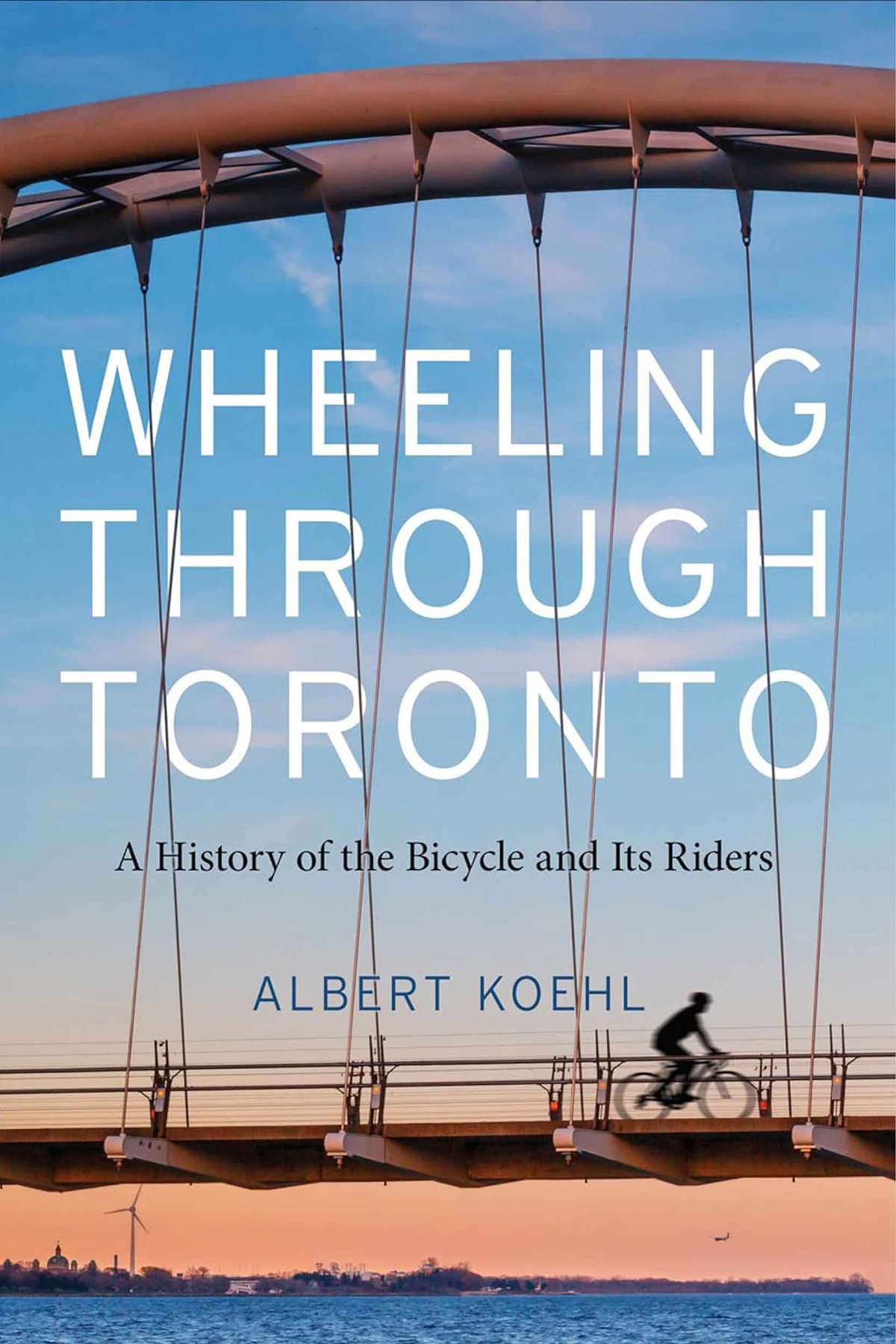
The book launch for Wheeling Through Toronto by Albert Koehl took place on May 27 at L’Espresso Bar Mercurio at 321 Bloor St. W. COURTESY BRAD MARLIN
By Meredith Poirier
The groovy L’Espresso Bar Mecurio, a bright Italian cafe at the intersection of Bloor and St. George streets hosted Albert Koehl’s book launch on May 27.
The location was fitting, as Albert, along with members of Community Bikeways Coalition, helped make the installation of bike lanes on Bloor Street possible.
L’Espresso Bar Mecurio quickly filled up with attendees all there to support Albert and his new book.
The crowd of 155 people, composed mainly of those over 40, as well as many families, was a testament to the community Albert has created around biking, bike safety, community justice, and more.
Among the crowd were Albert’s neighbours, family members and friends, and those with whom he collaborated or volunteered throughout his advocacy work. Many bike helmets littered the café, as many people chose to bike to the event, which is very on brand and perhaps because of Albert’s influence.
Wheeling Through Toronto was on sale throughout the night. It was being sold by the University of Toronto Press (UTP).
So many people bought copies that UTP sold out, and Albert had to grab more copies for them to continue selling. Throughout the night, Albert was the main attraction, and everyone wanted a chance to congratulate him and get him to sign their books. It’s a rare treat to meet an author and have them sign your book.
About halfway through the event, the crowd moved to the lovely outdoor patio to hear Albert and his wife Emily give speeches.
Emily started the speeches off and shared her gratitude for all the support that Albert has received. She also shared her immense pride in her husband and the feat it is to write a book. “I’ve watched Albert write this book and it takes courage. The biggest obstacle in life is belief in yourself.”
Albert then got up to share his speech and thanks.
He started off with a land acknowledgement. He spoke with grace and warmth as he shared his thanks.
It was clear to anyone in the audience how passionate Albert is about cycling, his community, and climate justice.
He shared an anecdote about learning to ride a bike on his back lawn as a child: “All of a sudden I could fly.”
His book aims to recreate the feeling we all had as children learning to ride bikes. Readers will certainly feel inspiration and awe when reading Wheeling Through Toronto.
The book itself is an in-depth look at the history of the bicycle in Toronto and a discussion about the role of the bicycle in the way forward in the climate crisis.
The book is a historical timeline. It starts in 1896 and takes readers all the way to the 2020s, including the pandemic. It ends in 2023.
His discussion of the history of the bicycle includes archival footage, photographs, excerpts from Albert’s own experiences, and more.
Readers won’t find a more in-depth and engaging book about cycling in Toronto.
If you’re passionate about cycling, climate justice, Toronto, or community, this book will not disappoint.
Grab a copy through the University of Toronto Press website or take a bike ride to your favourite local bookstore to grab a copy!
June 14th, 2024 · Comments Off on ON THE COVER (May 2024)
Justin Marra slides home to score a run for the Toronto Maple Leafs at Christie Pits on May 12. The Leafs dropped their Intercounty Baseball League home opener to the London Majors, 7-5. COURTESY CRAIG AIKEN
June 14th, 2024 · Comments Off on NEWS: Plan to protect Kensington Market (May 2024)
Land trust aims to preserve affordability of unique neigbourhood
By Merideth Poirier
At Cafe Pamenar, located in the heart of Kensington Market, community members came out in droves to support the Kensington Community Bond Campaign.
The Kensington Market Community Land Trust had weather on its side on Monday, April 29, as they hosted their Community Bond Campaign launch party on the lovely back patio at Cafe Pamenar, a mainstay cafe and bar in Kensington Market. The Kensington Market Community Land Trust (KMCLT) is an organization with the simple goal of “protecting the social and economic diversity of the neighbourhood.”
The KMCLT comes out of the Friends of Kensington Market organization. Friends of Kensington was founded by Dominique Russel, co-chair of KMCLT, in 2013. The Friends of Kensington and the organizations that have come since are run by community members who simply want their neighbours to have safe affordable homes to live in and to keep big corporations out of Kensington Market. The energy and drive of the KMCLT comes from fighting for neighbours and residents, but also working to build support and momentum. Dominique Russel shared some history of the work. “Initially it [the KMCLT] was really around the commercial, we [wanted to] protect the vibrant commercial part of the market, and then some of our neighbours got their doors ripped off. The housing crisis just reached into the neighbourhood, [as did] Airbnb and displacement and [the] violent disruption of people’s lives.”
The housing crisis in Kensington and the almost overnight changes are what caused the KMCLT to start to focus on residential properties as well.
In 2019, the KMCLT was supporting neighbours living at 54-56 Kensington Ave. who were being threatened with eviction. The KMCLT, along with the Friends of Kensington Market, Kensington Bellwoods Legal Clinic, the provincial MPP at the time, as well city councillor (at the time) Mike Layton fought on behalf of the residents and told them not to move. The tenants didn’t move, and two years later (2021), the building went up for sale and was bought by the KMCLT. This building has 12 residential units and five commercial units.
The KMCLT is looking to raise $2 million to be able to acquire another property in Kensington Market to continue their mission; however, support is needed from the community to raise these funds. This is where the Community Bond Campaign comes in. The KMCLT is offering neighbours and community members the opportunity to purchase a bond to invest in the purchase of the property. Their purchase of a bond will be an investment and will put money back in community members’ pockets once the piece of property is acquired. A community bond is a unique and innovative way for non-profits to get support from those who have the financial ability to contribute. The community bond can be purchased by individuals or organizations, and they will earn a fixed interest rate. , Promotors of this initiative say it’s a way for people to invest in their communities while earning income.
A range of people were at the event at Cafe Pamenar. The crowd of about 60 was composed mainly of twenty-somethings and folks over the age of 60. Everyone was abuzz with excitement around this new campaign and many connections were being made between people of all ages and backgrounds.
Declan Inghan, 28, a community member and a union researcher with CUPE, spoke about the importance of this event and why he chose to attend. “I’m excited about the decommodification of housing and property in Toronto. I feel like our city is sort of under an onslaught of a housing crisis that makes it increasingly unaffordable for working people to live. I was really excited about what the land trust is doing.”
Attendees were willing and eager to do what they could to help with the campaign. A donation jar was passed around and people gave their spare change and bills to make donations to the campaign. More importantly though, many attendees spoke to staff members of the KMCLT to figure out how they could purchase a bond and make the best financial decision for them.
James, 25, an IT worker in Toronto spoke about what community members can do. “So, the most immediate and obvious opportunity is to invest and purchase bonds if you have the means available to you. Volunteer efforts are always appreciated, and always important. But at the end of the day, this is a game of money and having the money to purchase sites to invest in the land trust is what makes this thing run.”
The KMCLT has two full-time staff members: Zack Bradley, development manager, and Angela Ho, community investment manager. Zack and Angela were incredibly busy throughout the launch party, speaking to community members and sharing their excitement about the Community Bond Campaign.
Angela shared the campaign’s status and hopes for the future. “I’m really excited for where we’re going to go with this campaign. It seems really promising. We have already raised $100,000 in investments so far, and almost $300,000 [has been] committed from community members. So, it’s really exciting to see, you know, where this campaign will take us. And I’m hopeful that we will be able to buy a second building in the fall.”
If you are interested in learning more about the Kensington Market Community Land Trust or the Community Bond campaign, check out the KMCLTs website at: https://kmclt.ca/.
June 14th, 2024 · Comments Off on NEWS: Should vape stores be near high schools? (May 2024)
Vape World on Bloor parks itself on pathway to Central Technical High School
By Ammara Khan and Meredith Poirier
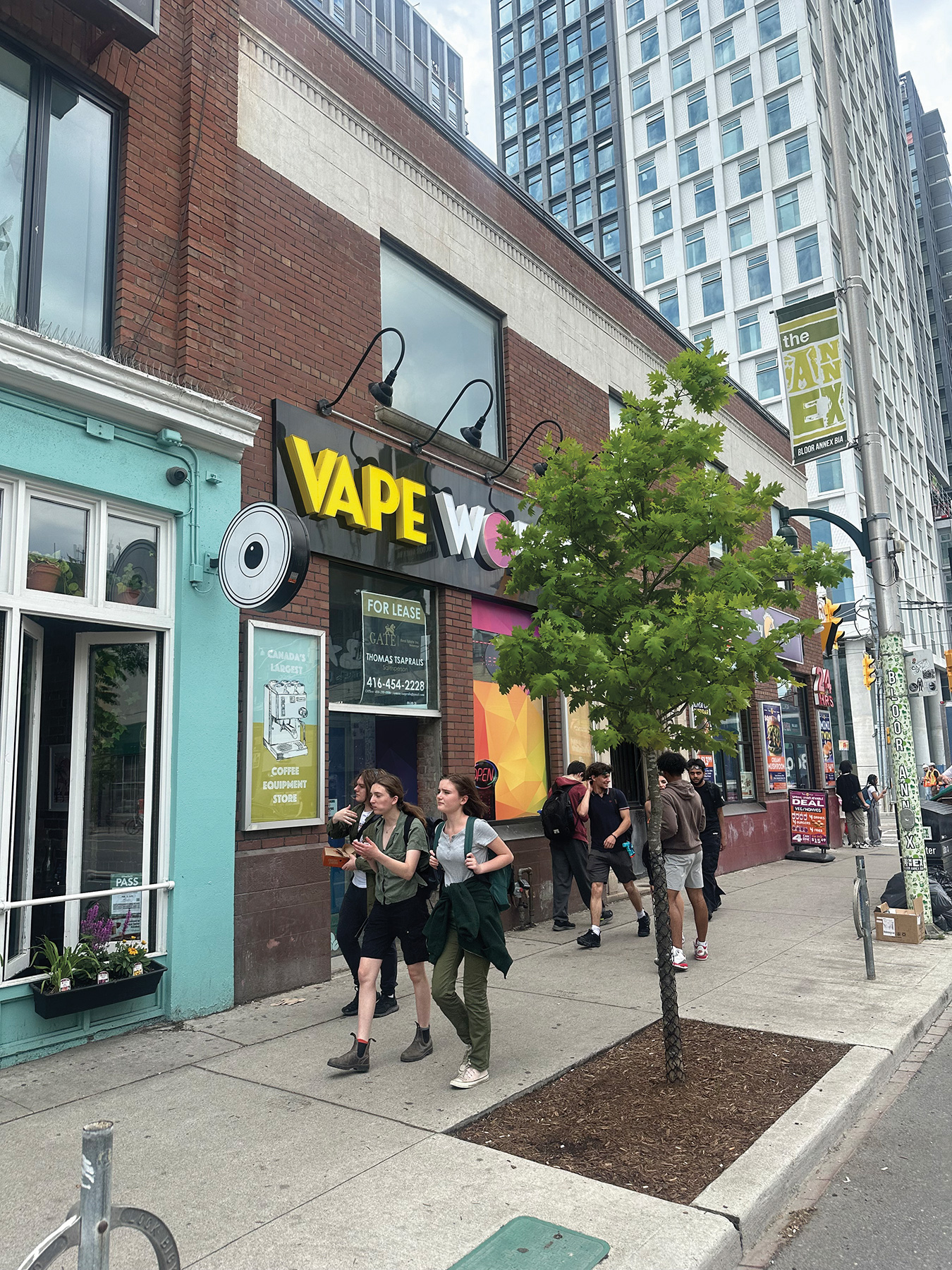
High school students stroll past Vape World location. BRIAN BURCHELL/GLEANER NEWS
Central Technical High School is conveniently located about a 5-minute walk from Bathurst Station in downtown Toronto. Many students commute to the school via subway. On their walk from Bathurst Station to school each morning students will pass by Vape World. Vape World, located on the corner of Bloor Street West and Bathurst Street, is one of 350 vape stores in Ontario. Toronto is littered with vape shops. It seems every corner you turn there’s somewhere to get your vapes. Vape World is open from 8:00 am – 2:30 a.m. which coincides nicely with when high school students would be heading to school to beat the morning bell.
Central Tech High School students were interviewed for this story, and they say that it is not uncommon for their peers to be vaping. The familiar shapes and bright colours of vape pods fill garbage cans around the school.
Paupers Pub, located very close to Vape World, at 539 Bloor St. W., is managed by Chris Haslett. He has two teenage sons aged 15 and 17, and he has strong opinions about the product being retailed so close to a high school.
“We are in a truly terrible place,” said Haslett. He feels that the federal government made a mistake legalizing these products. “I think the fact that there are flavours geared exclusively towards children and people that are in high school, we should adopt the same policies as Quebec has now, where it is only tobacco flavoured products and nothing else. I just think that our governments have failed us completely on this product,” he said.
Though the federal government legalized vaping products as a cessation strategy, it left the provinces and municipalities to regulate their sale. Nothing in Ontario or City of Toronto regulations prevents a specialized vaping retailer, such as Vape World, from putting itself near a high school. Something interesting to note is that there are restrictions around vape shops within university and college settings. One cannot sell tobacco or vapour products in areas that are owned or leased by a postsecondary institution. As many postsecondary schools span large areas of the cities they are in, this leads to vape stores being further from a university or college than they are from high schools, as we see with Vape World.
The NDP, which is the official opposition party in Ontario, has strong feelings about the regulations surrounding vaping in Ontario; in fact, NDP Health Critic France Gélinas reintroduced a bill in May of 2023 titled Vaping is not for kids. There are a few different aspects to this bill, but of note is that it would change the minimum age from 19 to 21, and it would prohibit the promotion of vaping products.
According to Statistics Canada’s Canadian Tobacco and Nicotine 2022 Survey, 30 per cent of youth (aged 15-19) have tried vaping once in their lifetime. Vaping has been prevalent among youth, and the numbers have stayed consistent since 2021.
The Preventing kids and teens from smoking and vaping section of the Government of Canada website lists the dangers of vaping for adolescents. While vapes are a healthier substitute for the more dangerous tobacco cigarettes, they contain nicotine, a highly addictive substance which can lead to physical dependance, especially for youth. It also can interfere with the healthy development of a teen brain. Once a person grows physically dependent on the substance, it becomes extremely difficult to quit. At Vape World they carry both nicotine and non-nicotine products. They offer pods with 0mg, 10mg, or 20mg of nicotine.
Vape World does not break any regulations as set out by the City of Toronto for a vapour product retailer. They have a sign outside the entrance that clearly states shoppers must be 19 and over to enter, and they do not display their products in display windows or outside the building. If it weren’t for the large Vape World sign, passersby likely wouldn’t even notice the store. However, even though the store doesn’t break any regulations, there’s leniency around the rules depending on who’s working. Upon entering the store, the writers of this story (who could easily pass for “school age” individuals) were not asked for ID. Attempts to reach Vape World head office for comment on this story were not successful.
Students outside Central Tech said that some of their peers do manage to make purchases from retailers when they are not asked for identification. In addition to vape stores, students also described the ease with which they can access weed shops, some of which are on Bloor Street West near their school.
While vape product companies do not intend to market their products to youth, the products have become attractive due to the colourful packaging, the interesting flavours, and the lack of education and warning surrounding the dangers of its use.
It can’t help but be noted that not only do the flavours and the packaging appeal to youth, but also the convenience with which they can access weed shops, some of which are on Bloor Street West near their school. While vape product companies in theory do not intend to market their products for youth, the products have become attractive due to the colourful packaging, the interesting flavours, and the lack of education and warning surrounding the dangers of its use.
Comments Off on NEWS: Should vape stores be near high schools? (May 2024)Tags:Annex · News
June 14th, 2024 · Comments Off on HISTORY: Lane name pays tribute to a mare named Crestfallen (May 2024)
Early vaccine for diphtheria developed in local laneway
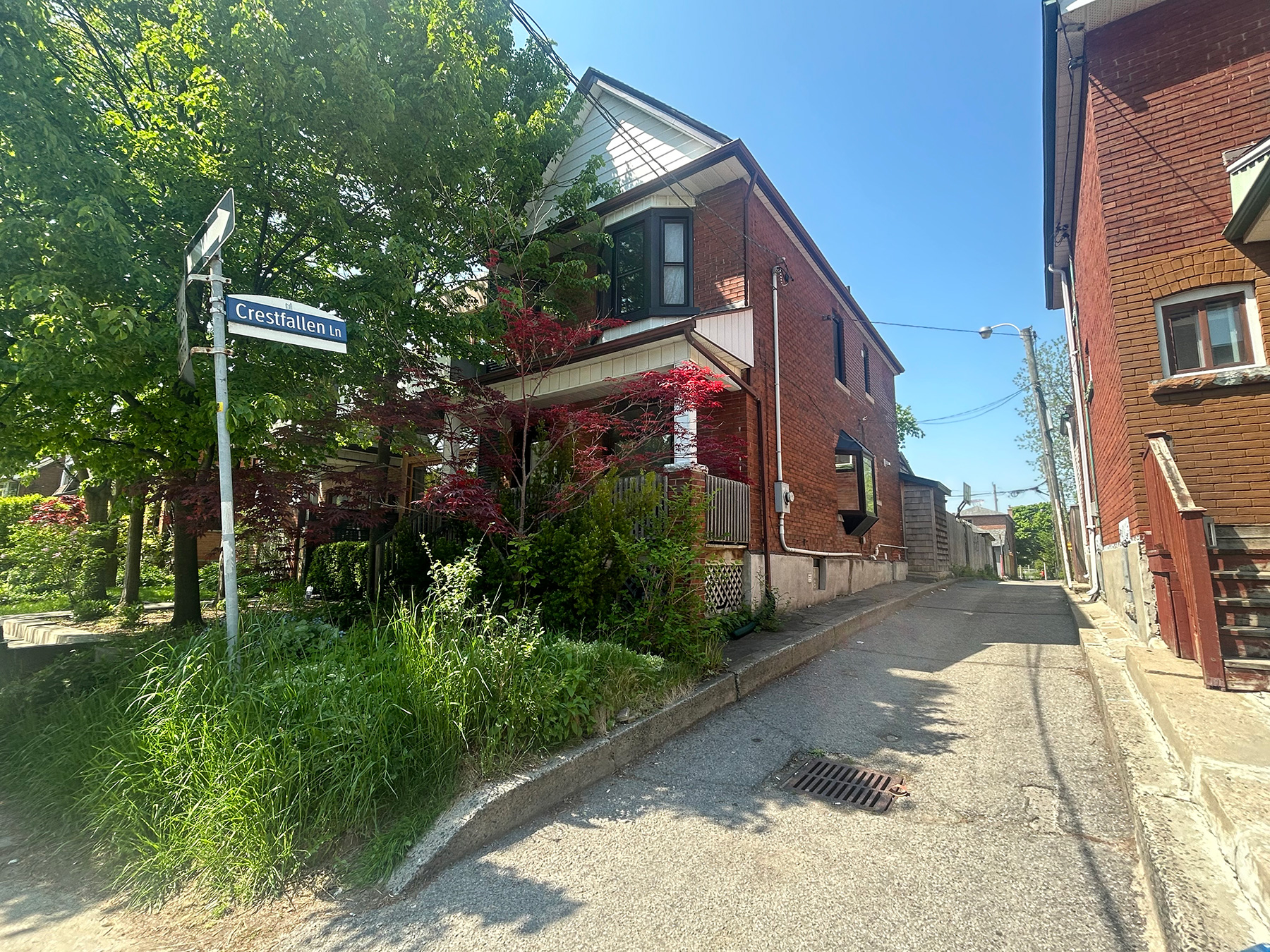
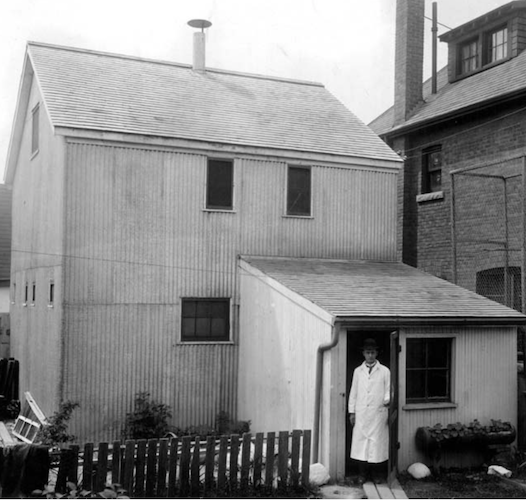
The Annex laneway where Dr. Fitzgerald kept a stable and developed a diphtheria vaccine. MIA KESKINEN/GLEANER NEWS
By Mia Keskinen
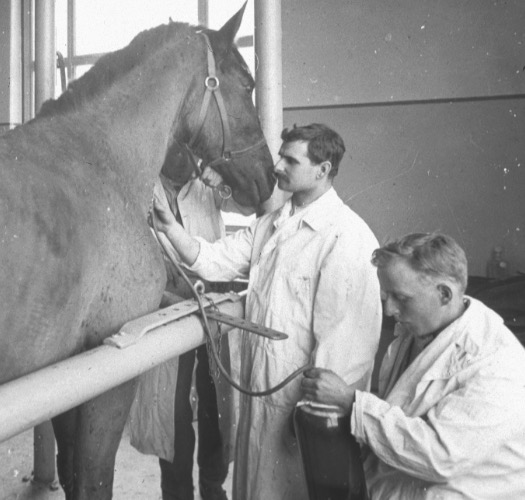
Crestfallen Lane, located between Bathurst and Christie streets, north of Bloor, has a unique history, and its name pays homage to a horse, a doctor, and a vaccine. The lane name commemorates a mare named Crestfallen, a “miracle in a stable” purchased in 1913 by Dr. John G. Fitzgerald, who played a pivotal role in solving a public health crisis and developing vaccines.
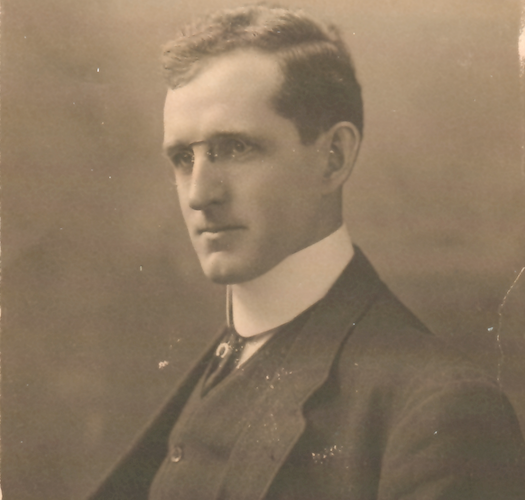
More than 100 years ago, John Fitzgerald returned to Toronto after studying abroad and found the city amid a public health crisis: a diphtheria epidemic.
At the turn of the 20th century, diphtheria was considered the single greatest killer of children. Respiratory diphtheria is an upper respiratory tract illness which is sometimes deadly and causes serious health issues later in life.
The lower classes suffered the most; medicines imported from the United States were priced at extortionate costs, leaving many without means to fight the virus. “The city was rife with infectious diseases. Canadians forget how bad it was,” said Dr. FitzGerald’s grandson, James FitzGerald, in a Toronto Star article published in 2014.
Crestfallen, the famous mare. COURTESY OF JAMES FITZGERALDSite of stable where experiments occurred. COURTESY OF JAMES FITZGERALDDr. John G. Fitzgerald in 1912. COURTESY OF JAMES FITZGERALD
Fitzgerald was determined to help the public in their time of need. He began by pitching his vision to the University of Toronto. He hoped to create a diphtheria antitoxin and distribute it freely to all Canadians as a public health service.
Given the University’s hesitance, the doctor took matters into his own hands.
In 1913, Fitzgerald took $3000 from his wife’s dowry and built a horse stable with a lab for developing an antitoxin on 145 Barton Avenue. He then saved several elderly horses from a local glue factory. He named one of the horses Crestfallen because of her sad eyes.
On Dec. 11, 1913, Fitzgerald injected Crestfallen with a small dose of diphtheria. The horse built an immunity to diphtheria over four months due to gradual injections of diphtheria.
The blood was processed to create an antitoxin and tested on guinea pigs. After positive testing on humans, the vaccine was distributed to the lower classes as a public health service.
Fitzgerald single-handedly solved the diphtheria epidemic, and his work in the Canadian health-care industry helped to change the system.
James Fitzgerald said that “my grandfather’s inspired vision was transforming Canada’s public health system into a world leader.”
In 2014, the neighbourhood between Bathurst and Christie streets where the original lab was built, faced a public safety concern.
The houses within this neighborhood were built with little space separating each building, so homeowners accessed their properties through laneways behind their houses, each of which were unnamed.
When a house in the residential area caught fire, emergency crews struggled to find the location of the burning building, given the confusing labyrinth of unnamed laneways. Following this incident, several arsons occurred, and firefighters again struggled to find the location of the fire.
This prompted the Seaton Village Residents’ Association to create the Seaton Village Lane Naming Project. Local residents felt it was important to create street names that commemorated the historic significance of the neighbourhood. In 2014, after a local resident read James Fitzgerald’s book, the lane was officially named Crestfallen Lane to commemorate the memory of Dr. John G. Fitzgerald, Crestfallen the mare, the “miracle in a stable.”
Comments Off on HISTORY: Lane name pays tribute to a mare named Crestfallen (May 2024)Tags:Annex · History · Life