October 15th, 2024 · Comments Off on FORUM: Saxe and the City (Summer 2024)
Councillor debuts podcast; Avenue Road safety improvements are on the way
By Dianne Saxe
Summer’s heat doesn’t slow things down in beautiful University-Rosedale! Celebrations raise spirits across the city, and our ward plays host to some of the best. I proudly celebrated love and diversity by dancing in this year’s Pride Parade (Thank you for all the cheers!). I was also glad to see so many of you enjoying this year’s Taste of Little Italy, the Toronto Jazz Festival, and Yorkville’s Exotic Car Show. A special thank you to everyone who came out to our June Environment Day. During summer in the Annex, I always look forward to being inspired and surprised at the Toronto Fringe Festival. Don’t miss my conversation with the new heads of the festival on my new podcast, Saxe and the City!
At June city council, we were able to address unsafe conditions for pedestrians and cyclists on the most dangerous road in our ward: Avenue Road between Bloor and Dupont. After months of intensive work in conjunction with the Avenue Road Safety Coalition, community members, my colleagues and staff, I am delighted to deliver the largest number of pedestrian and cyclist safety improvements that can be achieved without reconstructing the road (which could take decades). These measures strike a careful balance between the needs of pedestrians, cyclists, motorists, businesses, residents, visitors, the TTC and emergency services, transforming this section of Avenue Road into a more pedestrian-friendly corridor while maintaining traffic flow and a reasonable amount of parking. Installation south of Davenport began in July; Dupont to Davenport should begin this fall.
Unfortunately, council did not approve a staff-recommended median to physically bar dangerous maneuvers from Roxborough to Avenue to Dupont, which leads to a crash about every 12 days. The median would have made this particular intersection safer, but at the cost of more neighborhood traffic infiltration, and longer travel times for those who use Roxborough as a shortcut to the west.
Meanwhile, I continue to support measures to improve housing affordability and stability for Toronto’s renters. This includes turning a parking lot in the heart of Kensington Market into over 60 affordable, sustainable, supportive units; a proposed renovation control bylaw; and a new Rental Housing Supply program to construct purpose-built, rent-controlled homes. If the province does its part, we could build 65,000 more homes by 2030, including 6,500 much-needed rent-geared-to-income (RGI) homes in mixed-income developments.
We are also working to improve TTC fare enforcement which should reduce the numerous delays caused by “disorderly patrons,” many of whom did not pay for their ride.
As climate damage visibly worsens around the world, I am relieved that Toronto is still making slow but steady progress. I continue to work hard on climate action and to take the initiative whenever possible, and I am proud to report several landmark results from last month.
The biggest win was a landmark equity investment in Toronto Hydro. This long overdue investment will keep Toronto Hydro’s debt-to-equity ratio and borrowing costs within reasonable bounds while keeping pace with population growth and electrification. I am also looking forward to working with our new CEO and four new board members to lead Toronto Hydro through this exciting time. Two of them, Joyce MacLean and Ersilia Serafini, are respected climate leaders, and I expect that we will be able to do much more together than I could do alone.
Toronto city council also adopted my motion calling on the Independent Electricity System Operator to dramatically reduce gas generation by 2035 and allow Toronto Hydro to lead the transition. Now I’m working with the Clean Air Partnership and Environmental Defence to encourage other municipalities to do the same.
We can dramatically reduce our climate pollution by tackling two significant sources of it here in Toronto: car pollution and gas emissions from existing buildings. To these ends, we are pushing for buildings to eliminate their emissions by 2040, in line with the aims of TransformTO. I am also continuing to work on making it safer and more convenient to get around Toronto on foot, by bike, or by transit, and I am thrilled council also approved the 2025 to 2027 cycling network plan, plus more 2024 sidewalk and bike lane projects.
Dianne Saxe is city councillor for Ward 11, University-Rosedale.
October 15th, 2024 · Comments Off on FORUM: The heat is on (Summer 2024)
The Ontario government is AWOL on the existential threat that is climate change
By Jessica Bell
This year has been a defining moment in our global climate crisis because the devastating and life-threatening impacts of climate change have arrived in Canada. It’s no longer an inconvenience that affects someone else; it affects us.
This summer the extreme weather event is heat. Lengthy extreme heat waves are making life a misery for people without A/C, mostly renters. I worry about the low-income seniors and vulnerable people living alone. People are dying of heat stroke.
Workers are sweating it out in dangerous heat, from firefighters to farmers, to construction workers. Heat stroke can strike fast. Many workers are not able to refuse work because they can’t risk being fired.
Our public services, energy grid, and infrastructure are not ready to withstand our electricity needs during an extreme and lengthy heat wave. Demand on our electricity grid reached a record high this June during an unprecedented heat wave that occurred early in the summer. Our future will look like what’s happening in Houston, where 800,000 people are without power during the insufferable heat.
Because we have delayed taking serious action on climate, humanity now faces three huge challenges at once: we must get to net-zero emissions as soon as possible; we must take on the herculean task of preparing ourselves to survive in a world marred by extreme weather events and ecological disruption, from bolstering our healthcare system to making our farming and food sector more resilient; and we need to do all this while coping with frequent crises, like entire towns being razed by wildfires or epic rainfalls that endanger lives, bring our city to a standstill, and flood our roads, stations, and basements, just like we recently experienced.
Given the high stakes, it’s tough to watch the Ontario government’s clumsy, reluctant, and contradictory response to the climate crisis. To be fair, the Conservatives are investing in new transit lines and the electric vehicle manufacturing sector. They’re obsessed, however, with opposing any price on carbon to incentivize people and industry to go green. You can’t go through a question period without the Conservatives asking their MPP colleagues to “axe the tax.”
We need a response to the climate crisis that matches the enormity of the challenge. That will involve replacing the Conservatives’ car-centric sprawl approach to planning with a sustainable planning mandate, where we build more employment zones, homes and services in existing towns and cities.
We need to invest in electric vehicle, transit, cycling and walking infrastructure.
We need to protect our farmland, Greenbelt, and forests, and restore power to our conservation authorities to ensure we don’t build on floodplains.
It’s time to invest in a large building retrofit program and upgrade our building code so all existing and new buildings and homes are resilient, green, and well-made.
It means greening our electricity grid, investing in energy efficiency, wind, and solar, and moving away from gas-powered gas plants.
It means bringing in rules to protect people from extreme heat, such as a minimum temperature standard for rental homes in summer and protections for workers in extreme heat. We have solutions.
When I canvass, I occasionally meet residents who feel despair, grief, and a sense of defeat about the climate crisis and what we can do to usefully respond to the many crises we face.
These feelings are common, especially since so many of us are exhausted from the pandemic times.
I am inspired by the work of Joanna Macey, an Australian activist who helps people feel and channel their grief and despair about the world and recommit to useful social change. She writes books with titles like Active Hope: How to Face the Mess We’re in Without Going Crazy.
“The most remarkable feature of this historical moment on Earth,” says Joanna Macey, “is not that we are on the way to destroying the world—we’ve actually been on the way for quite a while. It is that we are beginning to wake up, as from a millennia-long sleep, to a whole new relationship to our world, to ourselves and each other.”
These are words for hope and for taking useful action.
Jessica Bell is the MPP for University-Rosedale and the Official Opposition’s Housing Critic. She can be reached at jbell@ndp.on.ca or 416-535-7206.
October 15th, 2024 · Comments Off on GREENINGS: Paris can do it, why can’t we? (Summer 2024)
Addressing climate change is a matter of will, not lack of means
By Terri Chu
Addressing climate change is a matter of will, not lack of means
Political leadership is rare these days. I want to give a shout out to the mayor of Paris for doing what those of us in Toronto can only daydream about.
In the 10 years since holding power, Mayor Anne Hidalgo has closed over 100 streets to motor vehicles. In a move sure to enrage car manufacturers, the parking fees for oversized murder machines such as SUVs have tripled. Torontonians can only salivate at the idea of removing 50,000 parking spots. The concessions we give to car drivers are unbelievable in this city.
Paris has also constructed more than 1300 kilometres of bike lanes since Mayor Hidalgo has held office. Meanwhile Toronto boasts less than 300 kilometres of on-street cycling paths as of the end of 2022. Those changes in Paris have contributed to a 40 per cent decline in air pollution—something Toronto desperately needs.
Toronto has its own challenges, starting with the car culture that sees residents whining loudly at the prospect of losing a single street parking spot. There’s the privilege of taking up public space with their vehicles for a song, meanwhile homeless encampments regularly get cleared by police. The use of public space has always been for the wealthy it seems…at least wealthy enough to own a car. Despite having extremely low capacity (rarely do cars have more than two people and usually only one), cars are rarely asked to give up space for public transit. Most of our major streetcar and bus routes see cars intermingled with public transit vehicles. A vehicle carrying dozens of people only has designated road usage on a small handful of lines.
Drivers were up in arms over parking ticket rates going up to $70, meanwhile skipping a $3.50 TTC fare can land you a fine of $400.
The concessions that we give to car and car drivers are part of a system of oppression that favours the rich. Now that we have enslaved the bulk of the population to cars, giving them no choice but to use them for mundane tasks to simply live, keeping those car concessions has turned into a rallying cry for advocates of the poor because public transit is so horrible in poor areas that they really have no choice. We are stuck in a horrible cycle that I do not see our political leadership having half the gall of Mayor Hidalgo to deal with. Both sides of our political spectrum favour continued car ownership. On the right, those who shill for the billionaire oil barons of course want us to keep driving. On the left, the unions have a huge number of auto and oil industry jobs they are keen to protect. This leaves people like you and me suffering the consequences of a system designed to take away our quality of life but too economically important to get out of.
The answer? We can’t just keep paying lip service to climate targets. We have no idea how many people in India have died in the latest heat wave. Just declaring a climate emergency while doing diddly squat does not cut it. Transition means some people will get hurt. The ones hurt most will be the poor oil barons who may need to scale down their mega yacht plans. The humanity!!
Next are the jobs dependent on the oil industry. We can have complicated schemes to ensure there is a just transition or we can do something simple like implement a universal basic income (UBI) scheme so that nobody is beholden to work that they hate or has no escape from a planet-frying job. Again, the ones hurt the most will be the billionaires. The injustice!
The city can’t implement these schemes alone, but if governments were serious about preventing mass death events from climate change, they would start with removing car-centric policies and a UBI plan. It’s simple policy, but hard politics.
October 15th, 2024 · Comments Off on SPORTS: Baseball feels the chill at Christie Pits (Summer 2024)
Maple Leafs and their racing mascot both search for elusive wins
Vanquished and unmasked, Gustavo Carvalho congratulates the latest fan to defeat him in the Freeze Race on July 7 at Christie Pits. The race is part of the in-game entertainment at Toronto Maple Leafs ball games this season. COURTESY CRAIG AIKIN
By R.S. Konjek
Gustavo Carvalho has a secret identity.
A native of São Paulo, Brazil, this soft-spoken 19-year-old now lives in Toronto and studies sports management at Brock University. He hopes his studies will provide a springboard to a career in the sports industry.
“My dream job is to be a general manager of a professional team,” he said. “I don’t really care what sport or what team it is.”
From an early age, sports has been in his blood. He played soccer as a youth, as well as basketball and baseball. His interest in the latter led him to an interesting gig at Christie Pits.
This spring, Carvalho found himself tagging along when his roommate was hired by the Toronto Maple Leafs baseball club to be part of their new fan experience team. Led by gameday host Michael Roudbari, the team is 10 to 15 members strong and puts in a seven-hour shift each day the Leafs play.
Among the fan experience team’s tasks are setting up of tents and banners before the game, selling merchandise and raffle tickets, and coordinating between-innings entertainment during Leafs games. This includes time-honoured activities like trivia contests, dance-offs, food-themed races, and leading kids for a run around the bases.
On certain days, another activity is added to the lineup. It’s called the Freeze Race.
While Roudbari introduces the contest and seeks out a volunteer to participate, Carvalho ducks into the Leafs’ clubhouse like Clark Kent into a phone booth. Moments later, the figure that emerges is no longer Carvalho, but the Freeze.
Some context: the Freeze is a character first introduced in 2017 by Atlanta’s Major League Baseball club. Dressed in a spandex skinsuit and cowl, the Freeze is a lightning-fast sprinter. The Freeze Race is a simple premise. A volunteer from the crowd tests their speed against the stadium’s champion in a race across the outfield. The fan is even given a generous head start. Several seconds after they are sent on their way, the Freeze takes off in pursuit. With uncanny precision, the Freeze always overtakes the fan right before the finish.
This summer, the Leafs decided to add their own version of the Freeze Race to the Sunday schedule. When Carvalho applied to be part of the fan experience team, the race caught his eye.
“When I played baseball the one thing I loved was running the bases and just doing a lot of running,” he said. “I made it very clear in my interview that [for] anything involved with running, call me in.”
That’s how a teenager from Brazil found himself spending the summer pelting across Christie Pits clad in a mint-green skinsuit.
There is an unexpected twist to the story: this Freeze has lost every race.
As of mid-July, the Freeze has a record of 0-5. The man behind the mask is taking it in stride.
“I always get close,” Carvalho said with a laugh. “I may not win but I always catch up. A couple more metres, and I would overtake them.”
Carvalho has endured some good-natured ribbing from his fan experience teammates. One of them suggested that perhaps the Freeze should be given the head start, but he’s not letting the losing streak or the teasing get him down.
“I’m determined to win one. I can’t go undefeated, [but] at the end of the day it’s all about the fun and good experiences for the fans.”
If the Freeze does finally win one?
“You will never hear the end of it,” Carvalho said with a smile.
As for the Leafs, their season so far has mirrored that of the Freeze. They have struggled through multiple losing streaks and at the midpoint of the 2024 Intercounty Baseball League season, they find themselves in last place.
The Maple Leafs’ complete 2024 season schedule can be found at www.mapleleafsbaseball.com.
July 19th, 2024 · Comments Off on ON THE COVER (June 2024)
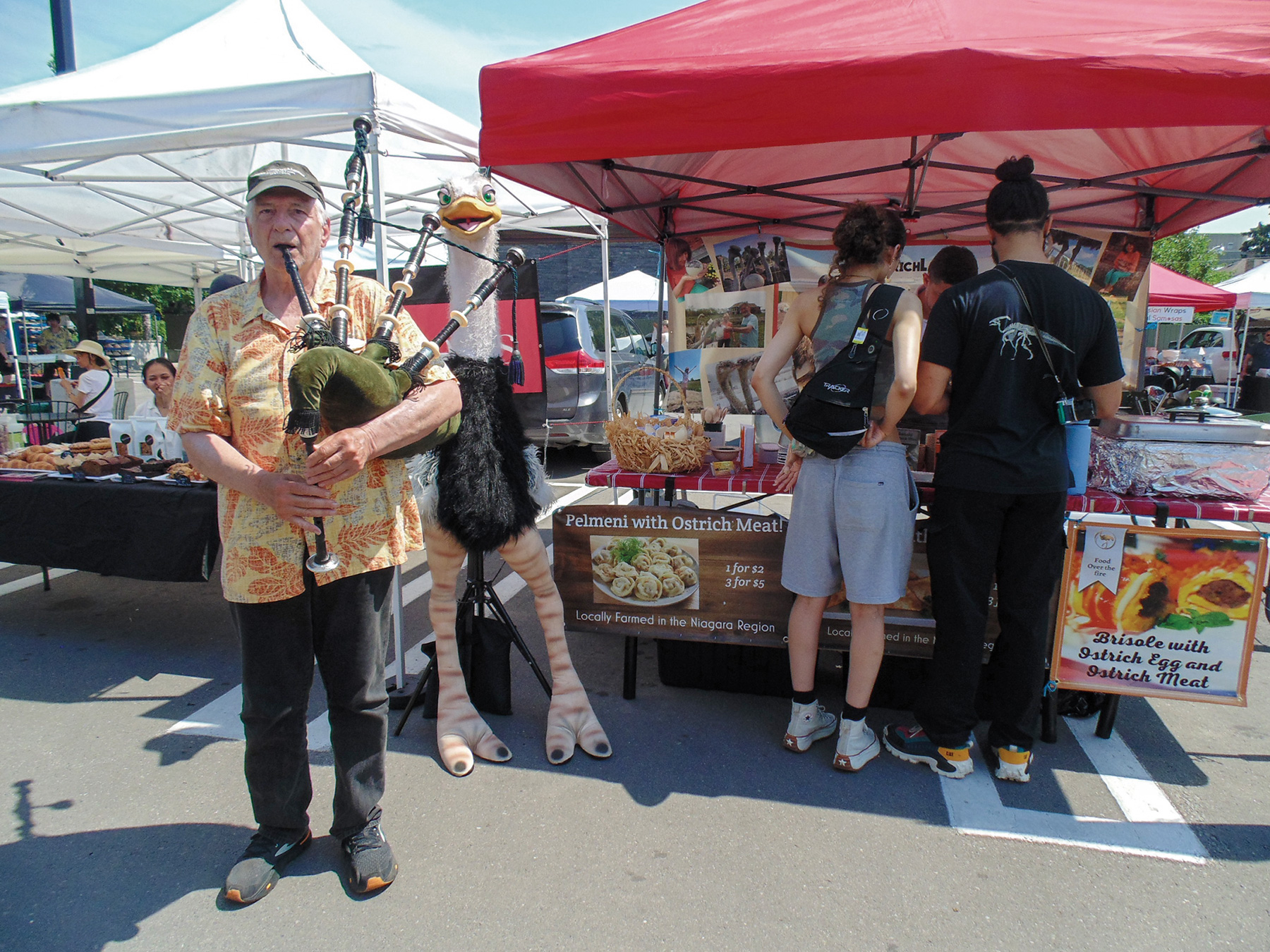
Harbord Village resident Rory “Gus” Sinclair has been piping in neighbourhood events for nearly 30 years, including his 18th year of opening the Bloor Borden Farmers’ Market, on June 19. BRIAN BURCHELL/GLEANER NEWS
In his first public performance Gus opening the Sussex Ulster Fall Fair on September 21, 1997.
July 19th, 2024 · Comments Off on NEWS: Screen now dark at the Hot Docs Cinema (June 2024)
Hot Docs closes doors for a review
By Meredith Poirier
For anyone who’s ever taken a walk along the long stretch that is Bloor Street West you’ve definitely seen the looming Hot Docs Ted Rogers Cinema sign outside the theatre.
Its bright green colour and white letters are unmistakable. The bright lights of the sign won’t be shining quite as bright though come June 12.
After co-owning the venue from 2011 to 2016, Hot Docs purchased the cinema, but the revered theatre opened in 1913 under the name the Madison Picture Palace.
The historic building and theatre is a staple for documentary filmmakers and those who enjoy documentaries. Hot Docs’ mission is to showcase Canadian and international documentaries.
On top of regularly scheduled programming, community events, and more, Hot Docs runs an annual festival showcasing unique and eclectic documentaries.
The Hot Docs Canadian International Documentary Festival typically takes place in the spring, and this year it ran from April 25 – May 5.
The festival showcased over 100 films and hosted Q&As with filmmakers both online and in person.
This year’s festival was quite successful and boasted attendance numbers that almost matched pre-pandemic numbers.
The box office also saw revenue exceed targets by 12 per cent; however, despite this success, Hot Docs will close its doors on June 12 for about three months while the leadership team creates a strategic plan to increase revenue and allow them to sustainably run operations for years to come. This closure will also mean temporary layoffs for staff. While the announcement of this temporary closure on May 22 may have been a shock to some and a huge disappointment to many loyal fans, the news is not entirely surprising for those who have been following the news surrounding Hot Docs these past few months.
Early in March, Hot Docs president, Marie Nelson, released a statement that detailed the financial struggles Hot Docs has been experiencing post-pandemic: “We are currently facing a significant operational deficit that threatens our long-term sustainability.” The statement urged audiences to support in whatever way they could. “You are essential to all that we do, and we need your support now more than ever.”
The statement emphasized that the need for financial support is directly related to the longevity of the theatre. “Hot Docs’ urgent need for support is not just about the festival; it’s about safeguarding a cultural institution and supporting the next generation of storytellers.”
On top of the post-pandemic financial struggles, Hot Docs missed out on some major funding this year; it was not selected as a recipient for 2024 funding from the federal government. A $38 million investment was made in the arts sector and recipients of that money were the Toronto International Film Festival and the Shaw Festival Theatre.
Things took a surprising turn in March when news came that Hot Docs artistic director Hussain Currimbhoy was stepping down from his role due to personal reasons.
Following his departure, 10 festival programmers left their roles as well.
They released a joint statement via social media saying they “were expected to work in an ever-changing, chaotic, unprofessional and discriminatory environment.”
In a statement released to the community via their website on April 6 the Hot Docs board of directors reported that, “When issues were raised by the programming team at the end of January, Hot Docs and the board acted in accordance with these policies and procedures, including conducting a thorough internal investigation, with all due diligence and speed to address their concerns.
Despite numerous proposed solutions to seek a path forward, offers to mediate were declined.”
Over the next three months programming will not be offered and the leadership team “will undertake an extensive review of the cinema—its mission, programming and operations—to determine a path back to profitability,” as shared in a May 22 announcement via the website.
For those who are currently members all memberships will be placed on hold. Any tickets purchased for dates after June 12 will be refunded and events are in the process of being rescheduled.
July 19th, 2024 · Comments Off on FORUM: A primer on changes to the capital tax (June 2024)
Finance Minister interprets tax changes made in recent budget
By Chrystia Freeland
If we were creating our tax system from scratch, what choices would we make as Canadians? Would we give the greatest tax advantages to those who make the most money? Or would we insist on each of us paying our fair share to keep Canada strong?
I’m confident most of us would choose fairness. It’s the Canadian way. That’s why our government introduced changes that will result in a small number of well-off Canadians paying a little more tax when they sell a successful investment.
That revenue will, in turn, pay for investments that will help all Canadians, especially our younger generations.
It will help fund our plan to build more homes, faster, so more younger Canadians can achieve the dream of home ownership. It will allow us to expand $10-a-day childcare, which is already saving young parents thousands of dollars a year. And it will support important new programs like national pharmacare, which will provide free diabetes medication and free contraceptives, and the Canadian Dental Care Plan, which is already helping two million Canadians across the country go to the dentist.
Canada could finance these critical investments by taking on more debt. But that would put an unfair burden on younger generations. Fiscal responsibility matters— and our fiscally responsible approach is in part what enabled Canada to lower interest rates this past week— the first G7 country to do so.
As I walk you through the details of the coming tax reform, I want to start by emphasizing that the changes are focused exclusively on investment profits known as “capital gains.”
When someone sells an investment that has appreciated in value—like a portfolio of stocks or a rental property—they accrue a capital gain. In Canada, these gains are taxed below the rate that we pay on income. Today, in fact, only half of the gain is taxed. So, if someone makes a $2 million profit on a stock sale, they pay tax on only $1 million of that gain. (One million is entirely tax free.)
Here’s one consequence of this preferential treatment of capital gains: many of the wealthiest Canadians make most of their money through investments, not income. And we applaud their success. But because of how investment gains are taxed, well-off Canadians can wind up paying a lower overall tax rate than a nurse or a carpenter.
That’s not fair. And so, beginning June 25, well-off Canadians will need to pay tax on two-thirds of their capital gains, instead of just one half.
A few important points about this change:
Canadians will continue to pay no capital gains tax when they sell their principal residence. Any money you make on the sale of your home is yours to keep.
The tax changes do not apply to the first $250,000 of capital gains every year. The higher rate only applies to gains above this $250,000 threshold. Most Canadians will still be able to sell successful investments without paying a higher rate. For example, a couple who own a rental apartment will pay no additional tax on their first $500,000 in profit from a sale.
We’re increasing the lifetime capital gains exemption for those who sell their small business or fishing or farming property. Gains up to $1.25 million will now be tax-free.
To encourage innovation and job creation, we are introducing a new incentive for entrepreneurs that will reduce the amount of tax they pay on capital gains and increase the lifetime exemption on the sale of all or part of their business.
Brian Mulroney’s Conservative government raised the capital gain inclusion rate to 75 per cent—higher than we are proposing. And the rate was 75 per cent throughout the 1990s, a decade of strong economic growth.
In the end, we estimate that only 0.13 per cent of Canadians—with an average annual income of $1.4 million—will be affected by this change in any given year. But millions more, especially younger Canadians, will benefit from it.
Our proposed reform to the tax system was voted on in the House of Commons last month. It is telling to see which members of Parliament voted against the principle of more tax fairness for Canadians and shifting a system that confers significant benefits to those at the top.
Chrystia Freeland is MP for University—Rosedale and Deputy Prime Minister and Finance Minister of Canada
July 19th, 2024 · Comments Off on CHATTER: The Bloor-Borden farmers’ market is back! (June 2024)
Thanks to the dedication of a few hard-working volunteers, the Bloor-Borden market is here for another year. Helen, the market matriarch, can be found at the volunteer table virtually every Wednesday from 3 – 7 p.m. making sure that the market runs smoothly and answering questions from new and old shoppers. When you visit the market, be sure to thank her for her tireless efforts that brought this important community event back to the Annex and Harbord Village neighbourhoods.
“The market is now in its 18th season, again transforming the Green P into green peas!” according to market volunteer Jim Jacobs. Shopping at a farmers’ market supports farmers and food vendors directly without a middleman taking the bulk of the profits. This is vital for small farmers who want to grow using sustainable methods and avoid packaging their produce in ocean-bound plastic. Buying local also reduces the fossil fuels used in transporting foods, and there is an incredible variety of vegetables that typically can’t be found in supermarkets, making it easier to eat more fruits and veggies and less climate-destroying meat and dairy.
This year one can find some incredible baked goods, spicy samosas, out of this world quiches, and even ostrich dumplings! As spring moves into summer, there will be more produce available. Eat seasonally and take this opportunity to get to know the farmers. Ask them about their farming practices. Ask them what sprays they use. Ask them how their animals are raised and if they use hormones or antibiotics. Be knowledgeable about where your food comes from and thank the farmers directly. Shopping at a farmers’ market is good for the farmers, but as city dwellers, it’s good for us too. It’s a good reminder that good food takes effort and time and doesn’t just come out of plastic containers. Eat well by knowing what you eat. “While the focus of the market continues to be on fresh Ontario produce sold by the farmers who grew it, there’s also a rotating cast of vendors showcasing new product ideas, new ventures,” according to Jacobs.
The market is in the Green P parking lot south of Bloor, between Borden and Lippincott, every Wednesday from June to October, 3 to 7 p.m.
—Terri Chu/Gleaner News
Comments Off on CHATTER: The Bloor-Borden farmers’ market is back! (June 2024)Tags:Annex · News
My mother survived the two World Wars and the Great Depression (I’m pretty old, myself!).
Amongst her stories there’s one I’ve never forgotten; the acute pain she suffered as a child with diphtheria. That’s one reason I’ve been so glad my own children and grandchildren have been protected from such misery.
Glad, too, that the speed of research led to vaccines which protected so many of us from COVID-19.
It was so interesting to read that the diphtheria vaccine was developed so close to where I live now. Thank you for your article, Mia Keskinen. I’m glad Dr. Fitzgerald’s wife brought him such a well-spent dowry.
I love the paper and think local papers are so important for the world and information.
But just a note on the vape store story. 0JJJ’s, the corner variety store across the street from Harbord Collegiate, sells vape products that are advertised in big bold letters in its window. It’s really atrocious. Will they be allowed to sell alcohol!?!
One has to wonder who cares about the kids today—gambling, alcohol and vaping—all with age limits; oh yes, but we all know kids get around them.
No one cares as it is all about making money for Dougie and his cronies.
—Mary Bredin
Comments Off on LETTERS TO THE EDITOR (June 2024)Tags:Annex · Letters · Opinion
July 19th, 2024 · Comments Off on SPORTS: Maple Leaf Mystique thrills Pits (June 2024)
Newcomer Martini-Wong the Leafs’ hero on a memorable night
Keiran Martini-Wong celebrates with his teammates after scoring the winning run for the Toronto Maple Leafs on May 22 at Christie Pits. CRAIG AIKIN/GLEANER NEWS
By R.J. Konjek
At Christie Pits, baseball season is in full swing.
The home of the Toronto Maple Leafs has been reborn with new sights and sounds.
For gameday ballpark atmosphere, a small village of pop-up tents now surrounds Dominico Field. Each tent offers something: team merchandise, beer and snacks, raffle tickets, or VIP exclusivity (basically, a place in the shade in a park otherwise exposed to the elements).
The park’s booming new sound system is a cut above its semi-reliable predecessor.
The fan experience now includes between-innings trivia contests, on-field races and a chance for youngsters to run the bases. A seventh-inning stretch routine is performed by staff of Innovative Fitness, and an ongoing series of promotions has featured themes like Women in Sport, Bark at the Park and Pride Day.
The club’s new ownership group has invested in these new features and the initial results are positive. The Leafs charge no admission and attendance is not tracked, but crowds have been noticeably larger than in the past few years.
An early highlight was a game that took place on May 22.
After a sluggish start, the 0-4 Leafs hosted the 0-3 Kitchener Panthers. At stake was a chance for one club to reset its season with a win.
All evening, the home side struggled. Facing Cuban pitcher Yadian Martinez, the Leafs were held to just one run over the first seven innings. Things looked dire as they fell behind 7-1 with last place staring them in the face.
Longtime Leafs fans speak of this enigmatic thing called the Christie Mystique. It posits that no lead is ever safe, and the most insurmountable deficit can be overcome. At least once a year, Christie Pits validates the theory by playing host to a comeback victory that defies the odds. This was one such night.
After seven innings, Martinez handed the ball to his bullpen and things immediately fell apart for Kitchener. A calamitous combination of hits, walks, hit batsmen and wild pitches saw the Panthers surrender four runs to make it a 7-5 game going into the ninth.
A crowd that had little to cheer for all night was now on its feet. With each run that crossed the plate, the Leafs players whooped it up and urged each other on. The fan group known as the Bushmen provided cheers and heckles from their perch amid the trees on the slopes beside Christie Street. The ballpark became a cauldron of noise. The Christie Mystique was taking hold.
Twenty-year-old Keiran Martini-Wong witnessed all of this from a unique spot in the ballpark: the Maple Leafs’ bench. The Etobicoke native is a member of the Leafs’ junior call-up roster. What that means is that he plays full-time for High Park Junior Baseball, but when the Leafs find themselves short of players, he gets a call or text to suit up and join them wherever they may be playing. Martini-Wong made his first-ever appearance for the Leafs in Guelph the week before. This evening, the young player who rides the TTC to Christie Pits made his home debut.
As the ninth inning rolled around, several veteran players were scheduled to bat, and Martini-Wong was aware that he might be called upon to pinch-run. He started stretching on the bench and went for a little jog along the left field line.
In the bottom of the ninth, the Leafs put two men on base with a walk and a single. First baseman Jordan Castaldo waged an 11-pitch battle with one of Kitchener’s pitchers before hitting a two-run single to tie the game 7-7.
The Pits was now at full volume, including the Panthers whose outfielders could be heard screaming at their rattled teammates to hold it together. All in vain. Another walk moved Castaldo to second base.
At that moment, Leafs manager Rob Butler turned to Martini-Wong and informed him that he was entering the game as a pinch-runner, representing the winning run.
Before the youngster went to take his place at second, Butler imparted some gentle words of advice: “Don’t get picked off.”
“Yes sir!”
The Panthers continued to unravel. The Leafs’ next batter was hit by a pitch, moving Martini-Wong to third base. The very next pitch bounced away from the catcher and clattered around the backstop. Martini-Wong was off like a shot. He sprinted home, dove headfirst and slid across the plate with the winning run.
The Leafs won an 8-7 walk-off victory. The junior call-up became the newest hero of Toronto baseball. Martini-Wong was mobbed by his teammates and embraced by the affectionate cheers of the home audience. Leaving the field on a high, he soaked up the atmosphere of a memorable night.
“I’ve never seen something like that before,” he said later. “The fans are absolutely unreal. That was really, really cool.” The Mystique had worked its magic again.
July 19th, 2024 · Comments Off on EDITORIAL: Ford’s boozy billion-dollar blunder (June 2024)
Who is clamouring so much for beer and wine in corner stores and at every grocer that the province feels compelled to exit its deal with The Beer Store early? The financial penalty to leave the contract now is between $225 million and $1 billion depending on whose numbers you buy. The current arrangement with The Beer Store (TBS) is set to expire in 16 months, with no penalty from Ontario taxpayers. Could it be that Premier Doug Ford is planning an early election, wants to get this campaign promise fulfilled ahead of time, and doesn’t mind a bit wasting taxpayers’ dollars to check that box?
Ontario’s 10-year agreement with the conglomerates that own TBS expires in December 2025. The controlling owners are global beer giants Molson Coors and Anheuser-Busch InBev. These are foreign companies. The president of the Retail Council of Canada, Diane Brisebois, called the move “a sweetheart deal for the big multinational beer companies” that actually compounds the business of selling beer and wine at grocers by seeking to offload recycling costs (of beer cans and wine bottles) onto grocery stores. Undoubtedly, consumers will end up paying the stores to manage the returns. Among the changes now coming by Sept. 5, 2024 is TBS will no longer have the exclusive right to sell 12 and 24 packs of beer and consumers will have an additional 8,500 retail locations to purchase beer. The current arrangement caps the number of grocers selling beer and wine at 450, but that limit disappears with the new deal.
For the announcement of this deal, Doug Ford selected a gas station which features a convenience store near his Etobicoke home. Apparently, filling up your car and buying some chips and a six-pack of Coors will now go hand in hand. The province is also allowing the sale of hard cider and mixed alcoholic drinks to be sold in convenience stores. The Centre for Addiction and Mental Health (CAMH) warned that increasing the number of places to buy alcohol would “significantly increase” the 6,000 annual deaths in Ontario attributed to drinking. CAMH urges the province to permit municipalities to opt out of the plan as it did for legal weed stores.
The Ontario Liberal Party pegs the cost of Ford’s move at closer to $1 billion. This includes the $225 million the government acknowledges, a rebate of $375 million in fees The Beer Store currently pays to the LCBO, and $300 million in lost revenue from licensing fees from retailers which also appears to be scrapped. Additionally, those grocers and convenience stores that will be allowed to purchase product at the LCBO at a ten per cent discount will cost the provincially owned corporation $150 million annually. The whole deal does appear to cost over $1 billion, and that is without considering the loss of revenue to the LCBO. The LCBO is Ontario’s cash cow, not unlike the provincially owned lotteries. Ford is at once raiding state coffers and crippling Ontario’s ability to govern in the future.
Bonnie Crombie of the Ontario Liberals offers a long list of where the government could spend $1 billion more wisely: 10,000 more nurses or teachers, funding for school repairs, a 25 per cent rebate on development charges to make new homes more affordable, a $25 per hour minimum wage for PSWs, a 50 per cent rebate on new heat pumps, 7000 public electric vehicle (EV) chargers, etc.
As some will remember, Ford ordered the EV chargers removed from Ontario’s 400-series highway service centres when he first came to office.
The nurse who is making their way home after seven 12-hour shifts does not lament that they can only buy a six-pack in the grocery aisle instead of a whole case; they just wish there were more nurses. But listening to that nurse, seeing the myriad of other problems, and seizing investment opportunities to solve them is not within Doug Ford’s DNA. He has evolved very little from his “buck-a-beer” platform and does not really care about governing; he only cares about power.