May 18th, 2010 · Comments Off on Cycling towards complete streets: Debates on biking heat up as more lanes are added

Perry King/ Gleaner News
By Jacob Arnfield
It’s no surprise that as the election year proceeds, the question of how best to improve our streetscapes is rearing its head.
Recently, the Board of Trade ranked Toronto’s long commutes worst among global cities of comparable size, the TTC is under heavy scrutiny, and bike lane proposals are being met with vehement support and vehement opposition.
While streetscapes include many different aspects, how and where to accommodate cycling on our streets has the greatest ability to turn animated debate into outright animosity—something many cycling advocates have come to lament.
Councillor Adam Vaughan (Ward 20, Trinity-Spadina) is a cyclist and a proponent of increase cycling infrastructure, but said he is not happy with how debate occurs. “I’m tired of this war on anything. It’s not a war on cars anymore than it’s a war on pedestrians, anymore than it’s a war on cyclists,” he said. “What it’s a war on is this unnecessary argument that one has to exclude the other. We can build complete streets, and balanced streets, and beautiful streets, but we have to be prepared to lead by design, and not simply create thoroughfares all the time giving priority to one form over another.”
Local cycling advocate Hamish Wilson, is one of the Annex’s loudest proponents of increased bike safety. He said he understands why the process can take time, but he says that regardless of the difficulties, it is crucial that critical pieces are built in the now, not ten years from now: first up is a safe route for cyclists travelling east/west through the Annex.
“I’m less dogmatic about ‘Must-have-bike-lanes-on-Bloor’ because obviously bike lanes can be contentious,” Wilson said. He added that because increased cycling infrastructure must necessarily disrupt either a traffic lane or street side parking so it can be accommodated, “a logical place to put it is parallel to the subway and it’ll help the subway as well.”
There are several new upgrades to cycling infrastructure planned for implementation this summer in the ward to be finalized at City Council this month.
The signed route on Harbord Street will be completed. Sharrows will be painted in the existing gaps and chevrons will be added through intersections.
Bike boxes—an intersection treatment that reduces conflict between cyclist and right-turning motor vehicles—will be installed on Harbord Street at the major intersections: Bathurst Street, Spadina Avenue, St. George Street, and Queen’s Park Avenue.
Regarding these improvements, Vaughan said, “We’re upgrading that facility to make it a strong cycling route and a safer one. It’s not perfect and you have to do these things in balance with competing interests.”
A potential lane on Bloor Street waits for the completion of a design proposal. As someone who has been involved in cycling advocacy for decades, Wilson is not confident these ongoing talks and plans will ever amount to significant upgrades. “Motorists tend to be pretty vocal and politicians tend to be on the craven side quite honestly for the most part. They’ll say good things about climate change and bike travel, but when it actually comes to putting facilities in where we need them it’s a different matter,” Wilson said.
Vaughan explained the lack of progress for a lane on Bloor Street during his first term. “The work wasn’t done between 2001 and 2006. We’ve started to get the work done. We’ve asked for the detailed plans to come forward. We’re acting on the recommendations, but when I took office in 2006 they hadn’t done the design work yet,” Vaughan said.
He emphasized the need for a strong design over “ad hoc white stripe painting” to accommodate all user groups on Bloor Street. As an example of the design challenges, he referenced the need to ensure the integrity of the pick-up and drop-off area for Senator D. Croll apartments (address), which complicates the design of the bike lane.
North-south trips have more minor upgrades heading to council this month. The proposal for a contra-flow lane on Brunswick Avenue has been deferred for 2010, due to local concerns over pedestrian safety and whether Brunswick Avenue is the best street for the proposed lane.
A new bike lane will be added to Spadina Crescent. The rest of Spadina Avenue from Bloor Street to Bremner Avenue will have the existing white lines, which are less than a metre from the curb, replaced with sharrows.
Additionally, there are bike lanes proposed for portions of Bay Street. The plan for Bay extends from Queen’s Quay West to Yorkville Avenue. Lanes will be included from Queen’s Quay to Front, from Dundas Street to College, and sharrows will be painted for the remainder of the route.
Bike lanes are not the only potential street improvements. The Harbord Village Residents’ Association (HVRA) spent four years working for wider sidewalks on College Street between Spadina Avenue and Bathurst Street and worked to create a trapping maze in the neighbourhood to slow down vehicle speeds along the long residential blocks between Harbord Street and College Street.
Gus Sinclair, who chaired HVRA while they worked for these improvements said, “We had a standing committee that basically fought with the city. The problem at that point was it took fourteen departments all not saying the same information … It was a byzantine Kafkaesque nightmare of trying to get something done, but in the end we got these really big sidewalks.”
Sinclair said the only way to accomplish their goals required “strong residents associations working in tandem with the councillor. Between the two of them you give the councillor political force to approach the individual city departments.”
Tags: General

Perry King/ Gleaner News
By Emina Gamulin
Snowdon Pharmacy (264 Bloor St. W.) has had many tough times in its 104-year history, but the changes the provincial government proposes to cut drug costs may be the biggest challenge the community institution has faced thus far.
The government announced its plans that as of May 15, pharmacies will no longer be able to receive “professional allowances” from generic drug makers, which amount to $800 million a year for Ontario pharmacies.
Contrary to the notion that the rebates are kickbacks, Anneke Allen of Snowdon Pharmacy says they go directly back to the consumer. Every three months, she sends a report to the government proving that the money goes to patient care.
“When some of the elderly get confused, rather than give them ten bottles and have them flush them down the toilet, or only take the pretty pink ones, we’ll make them a blister pack,” said Allen, describing one free service.
She offers other examples. “If you just came from Shoppers and say ‘The pharmacist didn’t have time to talk to me but I need a little more information,’ he [Snowdon] doesn’t kick you out, he pulls out the book hell make the photocopies for you because that’s what a pharmacist does—they care.”
The money has also gone towards things such as providing free deliveries, hiring students in the summer, holding customer appreciation days and flu shot days, amongst other things. “Are you getting the gist of what this money did for pharmacies?” she asked, adding that all these things will go out the window if this becomes law.
“If you want to speak to your pharmacist I’m going to have to say to you, ‘It will be 45 minutes and it will be $25.’”
Allen said that the government led pharmacies along to believe that there would be some sort of a negotiation process.
“We were about two weeks into our campaign saying, ‘Give pharmacists a chance, don’t take away our money’ when the McGuinty government threw their hands up and said. ‘Please call off the dogs we’ll negotiate with you.’”
Next thing they knew, a 16-page report outlining the changes was announced.
“They haven’t seen the full impact of how pharmacies, pharmacists, employees, patients and anyone associated with a pharmacy will react to this.”
MPP Rosario Marchese (Trinity-Spadina) says that while drug costs have been skyrocketing in Ontario and they need to be reduced, he believes the government went about it in an entirely inappropriate way. “I’m not sure they thought it through very well,” he said.
“The problem with this measure is that it is sort of buried in the budget bill, so there are no hearings. People have 30 days to comment on it, but it’s not a reasonable debate where you allow people to come and give their personal stories, and then legislatures on the basis of this say ‘That’s interesting, we never thought of that, how do we deal with some of those problems that we didn’t anticipate?’
“We are worried about how many pharmacies might be affected. Because when you take $800 million to a billion dollars out of the system someone is going to be affected by it. Clearly the dispensing fees are going to have to go up we know that. But will the dispensing fees first be enough for some pharmacists to recover those costs? We suspect in most cases it may not be.”
Snowdon Pharmacy invited Marchese to visit their store but he declined.
Allen says that the $1 increase to the current $6.99 that the government pays them will not be anywhere near enough to cover the difference, and in some cases doesn’t even cover their current drug costs, saying some products cost $10 that the government only gives them $8 for. “So we took a loss from the get go, that’s just one example.”
For now, Snowdon is going to try to keep all their staff but may have to cut hours. Allen is busy setting up a system to show customers exactly what they will have to pay extra for if the changes pass as planned.
Larger pharmacies like Shoppers Drug Mart have already started cutting pharmacy hours and introducing fees for deliveries.
On April 21, pharmacists in white lab coats came in droves to Queen’s Park to protest the proposed cuts. Health Critic Christine Elliott (Whitby-Ajax) brought forth a motion to protect seniors from the increased costs and reduced services that may result from the cuts that day. It was voted down.
When asked about the possibility of Snowdon having to close because of this, Allen replied, “That’s a hard one to say. We’re going to fight the fight.
“As a community pharmacy in this community they fought long and hard to keep it here, so we are going to fight to stay here for them.”
Snowdon Pharmacy has asked those with concerns with the cuts to contact Deputy Minster of Health Helen Stevenson or Premier Dalton McGuinty. Or contact the pharmacy at 416-922-2156
Tags: General
May 17th, 2010 · Comments Off on When you say it fast it sounds like fifty: The Annex Gleaner celebrates 15 years
By Jacob Arnfield
The brainchild of original editor Deanne Fisher, The Annex Gleaner originally had a mandate to represent and foster our local community and we’ve stuck to our guns.
This month marks 15 years of the paper being published. Fisher recounted why she felt it necessary to start a local paper back in 1995. When it came to various local concerns she said there were, “Issues that seemed to interest all my neighbours and me and there wasn’t a place where these were being written about. I was also interested in holding our elected officials at the very local level accountable for what they were doing and knowing what they were doing.”
While at the time the Gleaner was the only game in town, competition from larger news conglomerates began in the Annex when they realized they could cash in on the lucrative local market. But we remain the only independently owned community paper in the neighbourhood.
Brian Burchell, our publisher since the paper’s inception, said a large part of the Gleaner’s staying value could be attributed to being a paper that calls it like it sees it. “We’ve done that frequently and we’ve faced the consequences to the bottom line. It’s not a bottom line business. We’ve done it for all the right reasons. We firmly believe in the craft and we believe in the community we’re serving,” he said.
Another part of our success is a business model of giving people something they didn’t know they wanted, right at their doorstep. “In an iPod driven world, people know what they want to hear, they go get it, they put it on their iPod, they get on the subway,” said Burchell. “We’re providing information to people they don’t know they want to glean.”
Fisher said an early addition to the paper she made—our annual parks reports—is something she’s glad to see is still around. “I think that’s what local coverage is all about,” she said, adding that by focusing on small things like parks, communities can grow strong.
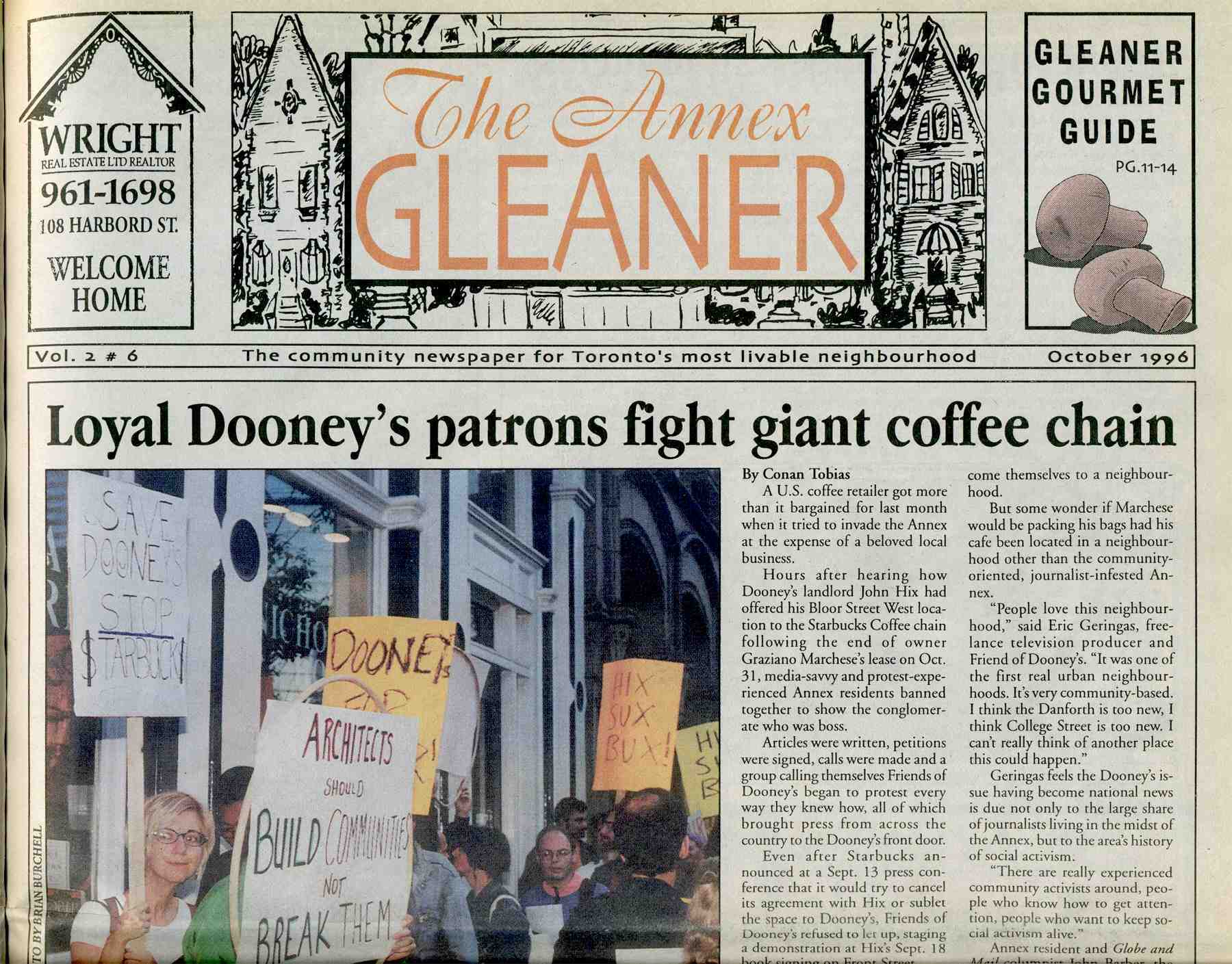
Burchell said he was proudest when the Gleaner was able to successfully champion the cause of local businesses. The most prominent example he mentioned was helping save Dooney’s Cafe (which sadly closed last year) from becoming a Starbucks in the Gleaner‘s early days. The response from the community to our article was so strong that Starbucks backed out and took a full-page ad in the paper “apologizing to the community for daring to try and take away their treasured café.”
“We saved the business and we got to champion community values, which are buy local and not being terrible thrilled about a big corporation pushing the little guy around,” he said.
And our relationship with local businesses is reciprocal. Fisher said one of the reasons the Gleaner was able to flourish is, “there’s a lot of local advertisers who don’t have anywhere else to showcase their mom-and-pop-type businesses and who really are catering to the local community.”
And what would a story trumpeting ourselves be without a little community response? We spoke to a few residents and they said such nice things we felt obligated to share them.
“If someone wants to make a statement or communicate to the community, the Gleaner‘s always been there,” said Neil Wright, a local real estate broker and advertiser since day one. “You have excellent reporting. You’ve always been unbiased. You’ve taken the stories and you’ve looked deeply into them. You’ve had excellent writers and at times you’ve even scooped the national newspapers on stories because of your research.”
Another advertiser, Larry Freedman, a dentist and resident of the Annex for the past 21 years said the Gleaner, “Echoes the neighbourhood and let’s us know what’s going on about some stuff because we’re all living way too busy lives.”
Freedman added, “There’s always an article that I actually read in the Gleaner. There’s a bunch that I glance over, but there’s always something that I read. So that’s cool. I think that’s a good thing, for a community paper. I think that’s actually pretty good.”
Gus Sinclair, former chair, and long time member of the Harbord Village Residents’ Association had equally wonderful things to say. “To have a paper… to tell people about what’s going on in the community with a strictly local interest, it’s incalculable how good it is.”
While the Internet has changed the media landscape irrevocably, it seems community papers like the Gleaner are still thriving where major metropolitans are suffering.
“Community newspapers have fared very well over the recession because they’re hyper local. They are the main communication source in their communities,” said Anne Lannan, executive director of the Ontario Community Newspapers Association.
Still, changes have been necessary over the years. The Gleaner has introduced a web page and has incorporated social media as a communication tool, although Burchell notes that these are still “adjuncts to the primary vehicle.”
“We’ll continue to evolve. We’re not so arrogant to think that we can be in a position to ignore changes going on around us,” he said.
Here’s to the next fifteen years.
Tags: General
April 21st, 2010 · 1 Comment

Courtesy: Nick Snow
By Perry King
With U of T’s bittersweet playoff loss to against York University Feb. 24, Nick Snow capped a memorable university athletics career that almost did not happen.
The last five years were a maturing experience for Snow. The basketball program gave Snow the chance to see and compete in basketball games worldwide, and connect with other academically gifted athletes. “It’s been fantastic. It’s like I have 12 brothers to share all my experiences with,” said the six-foot-eight centre. “The program has supported me when I’ve been through health problems, and that’s very important to me. I’m not sure where I would be without Varsity Blues Basketball.”
In 2005, after high school, the London, Ont. native was diagnosed with auto-immune hepatitis—a condition where his immune system attacks the liver as if it were not his own. Because of those problems, Snow’s spleen became enlarged.
But it did not stop Snow.
“When I first came to U of T, the doctors said I would never be able to play any contact sport again because it was dangerous to do so with an enlarged—and thus unprotected by the ribs—spleen,” wrote Snow in an email.
After a rough summer, Coach Mike Katz, along with Dr. Doug Richards at U of T’s Sports Medicine Clinic (55 Harbord St.) and Nirtal Shah, the team’s physiotherapist, “helped put together the first ever documented ‘spleen protector,’” said Snow.
Developed from composite materials into a shell, made to fit around his left rib cage and midsection—to protect him and his opponents on the court—Snow was able to play for five seasons.
“He continued to soldier on that way, but that became a given, you know. It certainly didn’t hold him back physically or ability wise,” said Katz.
When Snow played, he was integral part of the offense and defence. This season alone, he was a stable defensive player, averaging 11 points a game and 4.4 rebounds in nine league games.
But this season was an odd one for both the Blues and Snow. Although the team went 9-1 against the CIS and was ranked in the CIS Top Ten for much of the early season, they almost crumbled. They sustained four tough losses to perennial opponents in University of Ottawa and Carleton University. After winning five of their last six OUA games, they let a poor 21–3 start dictate the rest of their playoff game against York, eventually losing 86–79.
“The loss to York was very tough to handle. We had high expectations of ourselves as a team, with lofty goals. Unfortunately, we didn’t attain those goals. I give York credit though, they really came out ready to play, and hit some really tough shots down the stretch that won them the game,” said Snow.
Snow’s season was about as unpredictable. “I first had someone land on my ankle in a pre-season tournament, then after one game back I got the H1N1 flu, and over Christmas I injured my knee, getting a bone bruise that would keep me out about six weeks,” said the resilient Snow.
“He’s been a starter for the last three years, he’s been an integral part of the team. Unfortunately, this year, he was chronically injured and that upset the dynamic of the team and it didn’t make for a good year for him,” said Katz. “It was very disconcerting for everybody.”
For Katz, Snow’s best basketball was about to bloom in his senior year on the team. “Leadership notwithstanding, it’s about the fact that he wasn’t able to play. And we missed his skill and experience; he’s a big guy. He’s our big man, and if we get him to play enough, that’s what this is really about.”
The Blues are losing four starters to graduation. For Katz, the summer is a crucial time to develop many of the returning and incoming players who have developed their skills and gained high performance experience.
As for Snow, he is opting for rest. “For now, I’m just lifting weights, swimming and cycling. I’ll get back into playing a bit more seriously later on, but for now, just healing and training.”
But his love for the game will always be strong, injuries or not. “I’ll always play basketball, to what extent I’m not sure. I would love to work around basketball and sports, in the sports administration side of things, so we’ll see if there are any jobs for me out there!”
[Read more →]
Tags: Sports · General
April 17th, 2010 · Comments Off on Beaton the brave: Activist wins national award for protecting the planet

Courtesy: Sharon Weatherall
By Beth Macdonell
“All the skills I have, I use to protect mother earth,” said Danny Beaton as the early morning sun shines across our table at Future Bakery (483 Bloor St. W.).
The photographer, filmmaker, flautist, writer, and teacher has kept an office at the corner of Brunswick Avenue and Bloor Street for 20 years, and it’s obvious when we walk into the bakery that the staff know Beaton.
“I’m going to have my latte,” said Beaton to the smiling young man behind the counter.
Beaton said his office started off as a place for him keep his photo negatives and “was a good place for me to have a telephone.”
Two decades later, Beaton refers to his office as “the headquarters” of his environmental activities.
It’s stacked full, not just with negatives, but a lifetime of memories and work devoted to environmental justice. Pictures of Beaton and colleagues are pinned up on the door and walls from some of his most passionate projects.
On March 26, Beaton was awarded a National Aboriginal Achievement Award for Environment and Natural Resources. As a member of the Turtle Clan Mohawk of Grand River Six Nations Territory, he was one of 14 remarkable Aboriginal Canadians to receive this special distinction, presented on Global TV from Saskachewan.
This Earth Day, Beaton said action is the most important way to protect the environment. “Sacred Mother Earth needs to be protected if we and all species are to survive,” he said.
One of Beaton’s early accomplishments was in 1991, when he successfully organized a gathering of North and South American Natives in Toronto to share their concern for the environment and the need for society to return to spiritual values. With the support of the Ontario Secondary School Teachers Federation, the Toronto Board of Education, and the United Nations Program for the Environment, Beaton and others were able to speak publically and directly to Toronto students about the environment and the need to protect it at a time when the threat of climate change was being scientifically validated, he said.
In 1992 he received the Governor General’s medal for outstanding contributions to his fellow Canadians.
Since then, Beaton hasn’t just worked locally. He’s helped successfully defend great caribou herds in Alaska, help save sacred remains in Florida, worked with the indigenous in the Amazon, and many aboriginal peoples across North America. He’s also given talks and played his flute for audiences as far the United Kingdom and Japan.
Over the past year, Beaton also worked diligently to stop the construction of a landfill site in Tiny Township, Ont., near the shores of Georgian Bay. It’s been a battle between the county, residents and activists for over 20 years and threatened contamination the Alliston Aquifer know for having some of the cleanest and purest fresh water in the world. Some say it was Beaton’s support that made all the difference. People “saw him as a leader. It was almost like he was in the background being very comforting,” said Gisela Benke, a real-estate agent and Tiny Township resident who was opposed to Site 41, on the phone from her home.

Courtesy: Sharon Weatherall
In the summer of 2008, Beaton organized a walk from the site to Queen’s Park to raise awareness. Months later, Danny was arrested at a protest outside the dump, and spent a weekend in jail. Benke said he was never aggressive and “just played his flute.”
“I believe it’s really long overdue,” she said on Beaton receiving the environmental award. “There isn’t anyone more deserving.”
Robertjohn Knapp, one of the elders that came to Toronto back in the 1990s, said he agreed that Beaton was totally deserving of the award. “What’s beautiful about Danny is there is no pretence about him. He just keeps going,” he said on the line from Claremont, California. Knapp said one of his best memories of Danny was two years ago when the two of them walked though the Chattahoochee river in Georgia, what is said to be one of the dirtiest rivers in the United States. He said Danny has an incredible energy, that despite severe heat and humidity, he was able to just “keep walking and talking,” focusing on the task. “That’s why I love him.”
But having this kind of success wasn’t always the case for Beaton. Until the 1980s, Beaton struggled with being addicted to alcohol and drugs. “I was stoned for 19 years… it’s something I’ve struggled with all my life.” Beaton said the turning point was when he “felt like dying.”
“My body couldn’t handle it anymore. I had to re-evaluate my life.”
Beaton said it was after a dream he had of an Orca whale in pain that he was able to follow a path devoted to protecting the planet. “It was a vision of pain and suffering and that’s when my life started.”
Beaton said receiving this award is going to help his work because it reinforces the work of environmentalists and helps spread his message about the environment.
“If society would focus on the positive instead of the negative, there would be more creativity and less destruction,” said Beaton. He said the most important thing now is advice he got from his wife. “We all know what’s going on. We all know the facts now. What we need now is action.”
Beaton said it’s time the Kyoto Protocol gets enforced, action is taken at the international earth summits and fossil fuels, such as the tar sands, are cut back.
But on a personal mission moving forward, Beaton said what’s next is making sure the waters of Georgian Bay are protected. “The great lakes are the largest fresh body of water in the world.”
He said he’s working with the Canadian Environmental Law Association to stop the certificate of approval on Site 41, which would prevent Simcoe council and the Ontario government from restarting construction for a landfill.
He will also continue to work out of his Annex office.
“I have stayed in the Annex because my office is in a respectable area and it is in the heart of Toronto, the people here are down to earth and I have always loved it here.”
Tags: General
April 17th, 2010 · Comments Off on Storming the Barnes: First novel a classically spun noir story set in 1960s Toronto

- Courtesy: Lily Barnes
By Emily Landau
To outside eyes, Lilly Barnes may be a woman of the world, but her world ends in the Annex.
“My kids tease me—they say I act as if I get a nosebleed north of Dupont,” she chuckles. Barnes has lived in the Annex for almost six decades, where she has thrived as an activist and writer in many forms. This past winter, she published her first novel, Mara, set in Toronto in 1964, a city on the cusp of a worldwide countercultural revolution.
The novel, at once a stylish thriller, historical fiction, and complex character study, tells the story of a young jazz musician’s obsession with Mara DeJong, an enigmatic Russian classical pianist. As the novel gets underway, Mara stands accused of a bizarre crime: cutting off her dead daughter’s earlobes. Some of the biographical details of the title character were based on Barnes’s mother, a graduate of the Leningrad Conservatory, but Barnes insists that Mara’s mysterious, slightly sinister personality bears little resemblance to her mother’s.
“I [didn’t] want to spend years in my mother’s head. Who does?” she muses. “What came to me was that I could write about her life without being in her head if I was using a different narrator.”
As told by Ted O’Sullivan, a jazz pianist struggling to understand Mara, the novel is a classically spun noir that immerses the reader in a vividly remembered Toronto. In addition to the whodunit element, the novel also looks at how history and circumstances were capable of trapping women in post-war Europe.
“To me, the entire trajectory of a very smart, very talented, very, in many ways, courageous woman, got curtailed, got chopped short by historical events,” suggested Barnes. “She goes where her choices are, and it becomes almost perverted.”
Barnes herself has been blessed with a plethora of choices—high achievement seems to run in the family’s female gene pool. “I have one aunt who was a partisan fighter against the Nazis in Germany during the Second World War and [was] decorated for it,” she said. Another aunt was Russia’s first female parachutist. “Isn’t that great? I love that,” she laughed.
Born in Russia to a German father and Russian mother, the family moved to Germany before World War II. “We lived in plain sight, but in hiding,” said Barnes, explaining that although her mother was Jewish, she was not raised as a Jew and didn’t speak German with a Jewish accent, which likely saved the family from detection.
While Barnes prefers not to identify herself in terms of ethnicity, she recognizes that this composite cultural background contributed to shaping the beliefs she has fought for as an activist.
“I’m half-German and half-Jewish. This is something like being half-black and half-white in South Africa during Apartheid days,” she comments. “I know that it’s my particular ethnic mix that … put me into the perfect place in this universe to fight prejudice and racism of any kind.”
After living on an Israeli kibbutz for three years, Barnes came to Canada and landed on Ulster Street. She married a Canadian and briefly studied in Europe, but soon planted her feet firmly in Annex soil with her husband and children, where she studied English literature and philosophy at the University of Toronto. “It was at university that I discovered I had a brain. Nobody had mentioned it to me before,” she said.

Courtesy Lily Barnes
Barnes says she always knew she would be a writer. For its entire run between 1967 and 1996, she was a senior scriptwriter for Mr. Dressup, a show that will make everyone from baby boomers to Gen-Yers nostalgic for the halcyon land of puppets and make-believe. For her body of work on the show, she won a Gemini award in 2007. She has also worked as an arts journalist for CBC Radio and has published a variety of poetry and short stories.
Despite her impressive resume, writing Mara was still brand new territory for Barnes. “I remember writing about a third of it in one summer in a big heat,” she said, adding that the novel went through many incarnations over a number of years. “I was basically learning to write the novel while I was writing the novel.”
In between lucrative writing gigs, Barnes has moonlighted as a strident activist, particularly for local issues affecting her community. For example, she was one of the strongest voices against the creation of the Spadina Expressway, which she argues would have “cut a community in half.” Some ventures were less successful. At one point, she was briefly jailed for protesting the development of a nuclear power plant just east of the city, which ultimately got built.
“It made no difference in the end.” she sighed. But, she said, “I [didn’t] want my grandchildren to ask me, ‘You knew this was happening. What did you do about it?’ You know? I don’t want to ever be in that position, which is why I’m still an activist.”
For Barnes, writing is an outlet for activism—Mr. Dressup, for example, was a conscious exercise in educating children about tolerance. “From the very beginning, we made sure that there was no racism, no sexism, no ageism,” she says proudly. “We basically worked against stereotype and against prejudice of any kind.”
Even Mara, while not an explicitly political text, speaks to causes that were just beginning to gain steam in the 1960s, like feminism, the civil rights movement, and art for art’s sake, as well as emerging issues of post-war culture-clash. “We were drawn to the [novel] because it pushes the social and cultural expectations of Canadians by bringing into question the assumptions we have of cultural backgrounds and social norms,” writes Sandra Huh, Barnes’s editor at Variety Crossing Press, in a statement.
In Barnes’s experience, Canada “is a great place to be any kind of writer,” and for her, no place embodies this spirit better than the Annex. She praises its greenspace, walk-able terrain, and communal atmosphere as creating a fertile breeding ground for the arts.
“The pace [here] is very different than if you’re working or living in the suburbs and do everything by car,” she argues. “And I think that it is a lot more conducive to creative thinking.”
When it came to releasing Mara, she was determined to publishing the novel in Canada. “I wanted to be published where my life is, where my people are,” she said. In a fortuitous turn of events, Barnes became friendly with the owner of a Harbord Street flower shop who was starting an independent press. After publishing some of her poetry, Variety Crossing Press took on Barnes’s novel.
For Barnes, the story of how her novel was published exemplifies the organic community and camaraderie she has experienced in the Annex, where she says she lives as she would in a village.
Mara is the first title in Variety Crossing Press’s Stories that Bind imprint, and Barnes will continue to write and live in her little corner of the Annex, where, she declares, “I can be exactly as I am without bending myself out of shape in any way whatsoever. In the Annex I am most completely me. It’s my turf.”
Tags: Arts · General
March 12th, 2010 · 1 Comment

Courtesy Library and Archives Canada
By Leigh Beadon
Mutual friends arranged that we meet in a respectable downtown restaurant in Toronto. She wore a black, crushed velvet jump suit and a sultry pink tam over hair that was still thick and blonde nearing 70. She stole the wine glasses
That’s how Roy MacGregor described Elizabeth Smart in an Ottawa Citizen column published shortly after her death in 1986. Like many who had met her, he could not claim to know her well, but he found every glimpse of her personality captivating. This was Elizabeth Smart’s way —not just with people, but also with places. Though the Annex only knew her for a year near the end of her life, she made her mark on the neighbourhood as she did on all the places she visited in her extensive travels.
Elizabeth Smart is best known as the author of By Grand Central Station I Sat Down and Wept, a poetic story based on her affair with English poet George Barker, the father of her four children.
It was famously described by literary critic Brigid Brophy as one of the “half a dozen masterpieces of poetic prose in the world,” and has remained popular since it was first published in 1945. Smart published a handful of other poetry collections and prose pieces throughout her life, but none would achieve the same degree of fame. Smart’s true poem was her life, which she lived without reserve.
That life would take her from her birth in Ottawa in 1913, to countless places around the world, first as part of her job as a travelling secretary and later in pursuit of George Barker, with whom she fell in love after reading a book of his poems.
It wasn’t until 1983 that she moved to Toronto on a Canada Council writer’s grant and settled in the Annex.
Rosemary Sullivan is the Director of the M.A. Creative Writing Program at the University of Toronto, and wrote the 1991 Smart biography By Heart. A long-time author of fiction and non-fiction, she was part of the Toronto writing community that welcomed Smart with open arms in 1983.
Sullivan, who had met Smart in London a few years earlier, found her an apartment on Lowther Avenue that had recently been vacated by fellow Canadian author Ian Adams.
“She loved it,” Sullivan said, recalling the spacious attic apartment that would become both Smart’s writer’s getaway and her social venue. “It had a balcony that looked out on a tree in the back. She called it a “Tree of Heaven.””
Smart spent a lot of her time outside the apartment—she was an avid gardener, and had written a gardening column for Harper’s Bazaar in London, England, where she lived for most of her life. She also immediately fell in love with the Annex’s culture of yard sales, and would scour them for silverware and decorations and various odds and ends to add to her home. And these hobbies were put to good use, as she would regularly hold parties and invite the many locals she met and befriended every day.
Sullivan recalled the time Smart was courted by an 85-year-old man. Though she was rather charmed by him, Sullivan remembers her simple reason for turning him down: “I can’t imagine standing at the altar and saying ’til death do us part’ without laughing.”
During Smart’s year in Toronto, the Theatre Passe-Muraille on Ryerson Avenue held an evening in her honour. It was hosted by famed Canadian author Michael Ondaatje and attended by an array of Canadian literary greats. Among them was Leonard Cohen, who gave a speech for Smart in which he lovingly compared the pace and style of her prose to an escaped ski.
Smart felt perfectly at home in the community of Canadian authors, not only because of their warm welcome, but because of their writings, with which she felt a certain connection, though she had not lived in Canada for nearly 40 years. She once told Sullivan “they had a voice that was her voice.”
Smart returned to London in the spring of 1984, and died only two years later at the age of 72, but new generations can still get to know her through the vivid and honest prose that was her way of exposing herself to the world. She lived a life guided by passion and art. Whether she was chasing the love of a married man who would become the father of her children, or meticulously tending the flowers in her gardens, she stole many hearts and minds—and perhaps a few wine glasses —along the way.
Tags: General
March 12th, 2010 · Comments Off on A good fight deserves a plaque

By Rebecca Payne
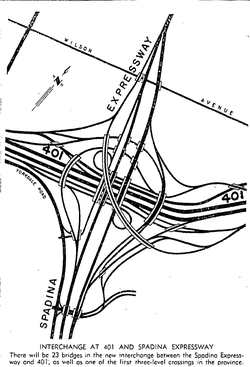
This June, the Annex Residents’ Association and the Heritage Toronto will dedicate two plaques to commemorate the grassroots community action that helped halt the construction of the planned Spadina Expressway. One is proposed for the northeast corner of Spadina Road and Bloor Street West, and the other for the Kendall Street subway entrance.
The expressway would have cut through the heart of many of the city’s neighbourhoods (including Cedarvale, Forest Hill, and the Annex), and many homes would have been razed to accommodate it—not to mention the increase in noise, traffic, and pollution it would have caused.
“If we are building a transportation system to serve the automobile, the Spadina Expressway would be a good place to start. But if we are building a transportation system to serve people, the Spadina Expressway is a good place to stop,” said then-premier Bill Davis.
Notable luminaries of the time became involved in the fight, including: historian, philosopher, and literary critic Lewis Mumford, communication theorist and academic icon Marshall McLuhan and the much-lauded writer and urban theorist Jane Jacobs.
In the Annex, the Stop Spadina, Save Our City Coordinating Committee (SSSOCCC) was formed in 1969.
The group organized petitions and public lectures, eventually banning together with other opposition groups in the city under the moniker The Spadina Review Corporation (SRC). In 1971 the project was over budget and had only been completed to Lawrence Avenue. Metro Council opted to apply to the Ontario Municipal Board for approval to secure funds.
At subsequent hearings, the SRC went head-to-head with Metro Council; Metro’s case was based on studies showing that the project was needed to handle the predicted increase in traffic and the SRC’s case raised the concerns of citizens. The SRC lost the vote, but then appealed to the provincial cabinet, which reneged its support—and stopped the Spadina Expressway.
The plaques will honour notable leaders of the community who were involved, and suggestions for the text will be solicited from those who played a role in this important period in our city’s history.
Tags: General
February 19th, 2010 · Comments Off on Trash talking: Kensington businesses scratching their heads after city reduces garbage collection
By Beth Macdonell
In the early 1990s, residents and merchants of Kensington Market successfully organized to increase garbage pickup days from two to three days a week.
Now, it will be seen if the newly formed Kensington Business Improvement Area (BIA), will be able to make a similar move by reversing a decision by Toronto Solid Waste to cut garbage pickup in the market from two days to one.
“I get an earful about it every time I walk through the market,” said Councillor Adam Vaughan (Ward 20, Trinity-Spadina). “It was a decision that staff made and we have been playing catch up ever since.”
Vaughan said he was notified about the scaled-back garbage collection shortly before the Nov. 1 decision in an email.
Rob Orpin, director of collection operations, said the decision to harmonize commercial collection was made citywide. He said it was reviewed by Public Works and approved by city council.
Under the new pick up schedule, businesses can sign up for a premium organic collection five or six days a week that will cost businesses $1,200 or $1,600 a year respectively. “It works out to $4 a day. It’s a cheap way of diverting waste from landfill,” said Orpin.
“The whole premise and city explanation is three fold: It’s a cop out, a tax grab and phony as Swiss cheese with no holes,” said Ozzie Pavao, one of the founding members of the Kensington BIA and owner of Casa Acoreana. “The economy is so bad … and you want to pull another $1,200 out of us. I can’t believe it.”
Other businesses that handle food said the reduction makes no sense. “I don’t understand,” said Alfonso Segovia, one of the owners of Segovia Meat Market (218 Augusta Ave.). “For some reason, the city doesn’t pay attention to us.”
Segovia’s family has been doing business in the market since 1978. He said he’s perplexed how health issues alone didn’t motivate the city to keep the two pickup days. The more garbage, the more “bacteria there is, rodents—these are big problems. I can’t leave anything outside.”
To cope, Segovia stores his garbage indoors in sealed bins until garbage day.
“I could never wait a week for garbage pickup”, said Kim Choo, owner of the New Seaway Fish Market (195 Baldwin St.). He said he has so much garbage, he can’t store it in bins. Instead, he and a group of other businesses pay for private garbage pickup. “I could afford to hire another worker, if the city picked up my garbage,” said Choo.
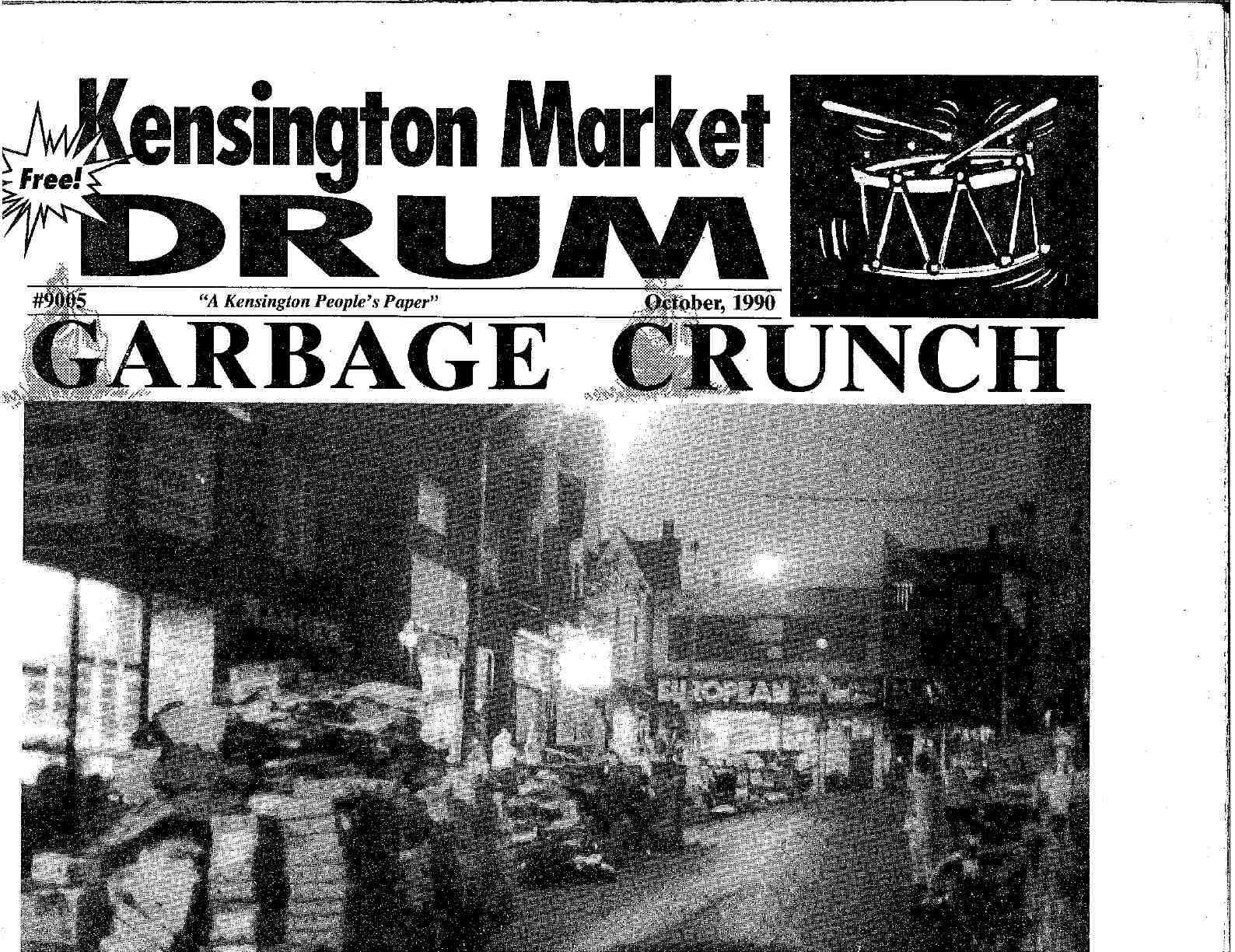
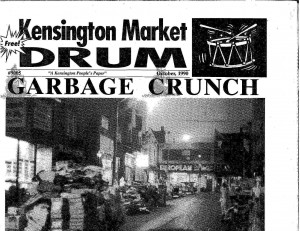
The problem goes all the way back to when Kensington grew into a market, said David Perlman, a resident in the market for the past 25 years and the former publisher of the Kensington Drum, a community newspaper in print from 1986 to 1996 which followed the battle to increase garbage collection in the paper’s monthly column “Garbage Crunch.”
Kensington Market started as a residential neighbourhood and eventually “people just decided, this is where I’m going to have my store and this is where I am going to shop,” said Perlman. He said the lanes and the narrow streets were never intended to be a business area, which is one of the reasons garbage collection issues linger today. It took years for the city even to recognize Kensington as a mixed-use area, which made getting appropriate garbage collection difficult.
What’s striking today is that in contrast to the days when Perlman covered garbage collection in the Drum, there are a lot more restaurants and bars open late, changing the garbage pick up needs in the market.
But the ability of the BIA to drive change and come up with a solution is debatable.
“There are so many stores and hardly anyone goes to the meetings,” said Segovia, referring to meetings among storeowners over garbage issues in the past.
Perlman, who is also a founding member of the Kensington Market Action Committee, is worried the BIA may create a wedge between storeowners and residents in the market. “This BIA loses the notion that we are all ‘people of the market.’”
Back in the early 1990s, “it was a common front,” he said. For example, residents don’t want the noise of garbage trucks going through the neighbourhood, he said.
Still, Perlman says Vaughan has really supported the BIA and admires the work of the councillor. “This is an issue for people to sink their teeth into. It will be interesting to see what comes of it.”
Pavao is more confident that the BIA will make a difference.
“We (the BIA) can voice our opinion. We can try and make them change their mind. We have to stand up to these so-called representatives of the taxpayer,” he said.
“We need a made-in-Kensington solution,” said Vaughan. “It can’t operate along suburban guidelines.”
Choo suggested the city open a 24-hour drop-off centre where merchants could bring excess garbage for an extra fee. At least, this way he said, it would give businesses another option to keep their establishments and the streets cleaner.
In the meantime, Orpin thinks stores should give the new system a chance and time.
Tags: General
February 19th, 2010 · 3 Comments
By Claude Saravia

Matt James/Gleaner News
Chad Mutchler was watching from a friend’s roof that cold Feb. 20 when a fire ripped through the Queen West neighbourhood just before dawn.
It took 150 firefighters in 30 trucks to extinguish the six- alarm inferno that destroyed a section of Queen Street West, between Bathurst Street and Portland Avenue in 2008.
He never imagined that two years later, nothing would have been done with the site.
Mutchler is the manager of Shanti Baba, a store that directly faces the vacant lot.
Today, he shrugs and says he has no idea if, or when, any of the previous stores will come back.
“The neighbourhood has gone downhill since the fire,” Mutchler said. “Business has been affected. A lot of the stores that were there, especially Duke’s Cycle, brought a lot of business. It seemed like the neighbourhood itself was going a little downhill before, and then once the fire hit, it just finished it off.”
The strip was once a heritage site with some of the buildings destroyed built as early as the 1860s. It housed 25 people and 14 businesses—some which had been in the area for generations. Now it is a boarded up lot, which residents and business owners say has turned the heart of Queen Street West into an eyesore. While everyone hopes for change, many remain skeptical that it will happen any time soon.
“Basically the only thing the neighbourhood can do is go back up, because it sucks right now,” said Mutchler. “They have to get something built across the street to bring more people back here, because the neighbourhood is just falling apart.”
Mutchler said not only has business been down, but also the lot now attracts a lot of questionable people and activities.
“They need to do something,” he said. “Crackheads, prostitutes, drunks—you name it—have camped out in there, especially last summer. It was just disgusting back there. There was a pile of rubble that was at least ten feet tall, and all during last summer, there were weeds growing out of it, and it stunk. People were dumping garbage back there, long before the garbage strike, and they still do now.”
Graffiti and posters line the boarded-up lot, and piles of garbage and rubble are still visible.
Councillor Adam Vaughan (Ward 20, Trinity-Spadina) is aware of local business concerns, believing progress will be made soon. He also said the city is aware of the site’s current problems.
“We are concerned about some of the anti-social behavior that’s been on display in that area.
“I live in the area and walk by the spot virtually every day that I come to work. For a while the barricades were being broken down, there has been a bit of vandalism with sort of tagging, as well as illegal dumping,” he said.
“The only way to solve that problem is to get the buildings built, and we expect a couple of the major buildings to come online very shortly, and once that starts to happen, we think activities will return to normal.”

Matt James/Gleaner News
Neither Mutchler nor Vaughan believe the city will be able to put condos up, as many residents and business owners suspected. Both are hopeful the old businesses will return.
Luis Ceriz, owner of Suspect Video, said his business has no plans to come back to the former site. There were originally two locations for Suspect Video, with one being at the Queen Street location, the other being at its current location on Markham Street in the Annex.
“I have no idea what plans they have for the reconstructing of the neighbourhood, but we are just going to keep our current location for now,” he said.
Ceriz said one of the main reasons for not returning was that his old manager opened his own video store near the site, Eyesore Cinema, which increases the competition he would face if he came back.
“I wouldn’t open now mostly for that reason. When I had both places my attention was always divided between the two. I didn’t realize how much I missed being so hands-on,” he said.
“The optimist in me says that construction will begin as soon as summer,” said Vaughan when asked when the neighbourhood could expect to see improvements. “I think that all of the property owners are aiming for something to happen as quick as possible. Two of them are pretty confident that they have proposals coming forward that they think they can get processed in terms of excavation, and foundation work can be started as soon as summer.”
Still not everyone is convinced any progress has been made or will be made anytime soon.
Mutchler said he had hoped Vaughan would have done more.
“He said he was going to help the neighbourhood but no action has been done, so that just proves that he couldn’t or wouldn’t,” he said. ”He promises a lot of good things but nothing ever comes of it, and I know a lot of people around here feel the same way.”
“I know at the beginning he tried to be very helpful,” said Mark Newman, manager of Dukes Cycle’s. “But how much help has there been recently, I couldn’t comment on that.”
Randall Duke, owner of Duke’s Cycles lost both his home and business in the fire. The store is currently located on Richmond Street West, but Newman says the store plans to make a return to Queen West by the summer.
“We were open within six weeks after the fire and we have been there since then,” said Newman. “The current situation is that we are planning to start construction at the old location in March, so we are going to move back.
“There are still some fine details to work out with the city, but we sort of have gotten a general approval to go ahead with construction.”
Although he is excited about the prospect of returning, Newman said he was absolutely disappointed in how long the process took, and he blames the insurance companies mostly for the length of time it has taken.
Vaughan agreed, saying a lot of the delays were not necessarily the cause of the city, but rather delays in finding a cause for the fire, as well as insurance companies not doing their part.
He also said the city has been doing whatever possible to help recreate the essence of the neighbourhood’s charm. He cited Abraham’s Antiques and Pizzaiolo as two businesses that were able to rebuild and have had successful returns to the neighbourhood. Preloved also relocated in the area, across from Trinity-Bellwoods Park.
“We had a lot of trouble with insurance companies not fully honouring their policies and the property owners were given a very difficult time trying to get progress,” said Vaughan.
There are six different property owners who lost their buildings in the fire. Each owner had their own specific insurance policies and coverage levels.
Nearly ten months after the fire, the Ontario fire marshal declared that the cause of the fire would never be known, but it was believed to have started above National Sound.
“The investigation took a long time to make a determination as to what caused the fire,” said Vaughan. “When no determination was issued by the fire marshal, well the insurance companies had been waiting for some sort of declaration. It put things into another realm of ‘Okay, now we have to figure out what that means.’ And the insurance companies sort of dragged their feet and made things somewhat difficult for the property owners.”
Wayne Romaine from the office of the Fire Marshal was reported as saying that the fire’s estimated cost was $10 million.
Vaughan is hopeful things will start improving soon.
“Every time I walk by there and don’t see a Duke’s Cycle, it just doesn’t feel like my neighbourhood, and it won’t ever feel like my neighbourhood until Duke’s is back on Queen Street.
“These stores were as vital a part of Queen Street as the Cameron House or any other institution on that street. They are part of the neighbourhood, and we miss them, and we want them back.”
Tags: General
February 11th, 2010 · Comments Off on February Gleanings
Filthy dirty homemade fun
It’s probably a fair bet that St. Valentine, whosoever that borderline-apocryphal personality might be, probably didn’t think of his life’s work as culminating in an excuse for greeting card makers and confectioners to have a one-day sales bonanza. And yet, here we are.
But probably even further still from his mind would be wooden bespoke dildos.
And yet, Feb. 13 at The Gladstone, these things and more will be on display at the Erotic Arts and Crafts Fair. Basically, if it’s somehow sex-related, and made by someone on a small and/or local scale, it will be at this fair. And since all the Valentine’s Day consumerism is really just a thinly-veiled effort to get into someone’s pants (unless, of course, one is drinking alone on that day—a highly recommended alternative to awful heart-shaped candies), the least a roped-in Valentiner could do is get something a little less corporate.
And since the day is celebrated for something already a little bit off from what its namesake probably would’ve liked, celebrants are encouraged to give a syncretistic shrug and buy some wearable balloon art.
The end of an era
It sure isn’t 2003 anymore; in fact, there are those who would say it never even was 2003.
Long gone are the days of Gordon Downie and other CanCon luminaries showing up on a Sunday night to Sneaky Dee’s to check out the hubbub and buzz surrounding a local new music series. Long since launched are the careers of Torontonian superbands with a billion members, sleepy folksters, acoustic chanteuses turned sequenced dance mistresses, and more violinists and glockenspielists than can be counted in the limited space provided here.
Over a decade which saw the rise of the VICE aesthetic, the fashion-shrinkage of pants, and the death of so many previously assumed goods and institutions, the good folks at the Wavelength Music Series established their own place in the city’s consciousness.
Some say that the dwindling attendance numbers at its weekly music series, along with the proliferation of other promoters and venues catering towards a similar audience, are an indication that it has succeeded—and in doing so made itself irrelevant.
Others might say that the shine on bands that can barely play their instruments is off. Regardless, after ten long years, the weekly Wavelength series is calling it a decade.
The organization will still continue to promote one-off events, but the time it spent at Ted’s, Sneak’s, and now, The Garrison making Monday mornings difficult for the hipster in all of us, is at a close.
To mark this occasion, Wavelength presents five days of concerts, from Feb. 10 through 14.
Fun for the respectable folk
Say you actually have to show up for a job on a Monday? Not hung-over, even?
Or that buying amusing bawdy novelty items, no matter how de rigeur their craftsmanship, has long since lost its lustre?
If you are one of those respectable individuals for whom Family Day will actually be used to spend with your family, the Gleaner hasn’t forgotten you. Campbell House Museum has a full afternoon of 19th century fun and games for the entire family, including baking, dancing, and arts and crafts.
The programs run from 1 through 4 p.m. on Feb. 15.
Tags: General
February 3rd, 2010 · 1 Comment
Cinema has worn many hats over the century, online doc shows

Inside The Bloor Cinema with filmmaker Robin Sharp. In 2005, he and fellow filmmaker Peter Kuplowsky pieced together the history of The Bloor Cinema for your viewing pleasure.
By Matt James
The Bloor Cinema (506 Bloor St. W.), like a lot of centarians, has shrunk with age.
Back in 1941 when it was known as the Midtown, it could seat 1,125 people. You could catch a flick for 35 cents, and if you threw in an extra dime, they would let you smoke in there.
These days it seats around 800, smoking is not allowed, and while this revue theatre is still affordable, most trips to the movies will cost you upwards of $15, minus the popcorn.
A good way to learn about this historical building and keep some money in your pocket would be to watch The Bloor, a 20 minute documentary available online about the Annex institution.
When Toronto filmmakers Robin Sharp and Peter Kuplowsky learned the theatre was celebrating its centennial anniversary in 2005, they decided to create an homage to the past of the building. The Bloor was filmed between summer 2005 and winter 2006.
While a film soundtrack boomed from behind the thick doors of the theatre in mid-December, Sharp agreed the bowels of The Bloor were best for a quiet and uninterrupted interview. Walking down a maze of small, narrow and uneven hallways with tight tricky turns, any visible open space was rimmed with aging and forgotten film paraphernalia languishing in the dark.
It was that historic ”waste” that drove Sharp and Kuplowsky to make their film. Both employees of the theatre, they were surrounded by constant reminders of its history; the stunning architectural design, the yellowed photos hanging from the walls. Backstage, old reels and cases lie still untouched, and letters once used on the marquee lay thick with dust that’s literally been there since the 1940s.
We made our way down to the basement and entered a room that smelled predictably damp, settling into old chairs at an old table. Sharp told me what the most complex part of making the film was.
“The trickiest part was to sort of unearth all these old documents,” he said.
They spent countless hours in the library searching for documentation on the cinema.
As a youngster, Sharp grew up in the neighbourhood and became an oft-paying customer at The Bloor long before staring working there as an 18-year-old. Nearly five years later, he still enjoys a weekly shift on Sundays. He feels he’s come to know the building like you would a friend.
The end product Sharp and Kuplowsky put together is a short, catchy film worth watching—especially for those with any appreciation of history and great music.
The soundtrack and voiceovers take the viewer back through some of the most unforgettable decades of music.
“The music was extremely important in setting the film’s tone,” said Sharp. Because of the historical nature of the documentary, it was important that the tracks matched the times.
While the film allows the viewer to travel back in time, there is a slight focus on the building in the 1940s. A decade dubbed as those who lived it, “the golden age” of the theatre.
Personal experiences from dozens of colourful characters such as past and present managers, owners and employees are shared—from a general manager reminiscing of the first time the theatre showed The Rocky Horror Picture Show in 1981, to the time when soft-core porn dominated the big screen, to when it was managed by Ed Bruce as The Eden.
“It was before porn on video,” said Sharp. “Everyone would come out to this communal theatre situation—it’s so bizarre.”
What began as a vaudeville theatre would get a number of name changes over the years. And like many of its patrons, The Bloor and it’s predecessors endured change and overcame much adversity. Today it stands as the city’s oldest original-screen movie theatre.
The Bloor is available for free online here. Or simply visit YouTube for Part 1 and Part 2). For more information call Sharp at the theatre at 416-516-2331.
Tags: Arts · General