
On June 26, the Gleaner documented the Queen’s Park protests through photography. Check out these photos on our Flickr page. Perry King/Gleaner News

On June 26, the Gleaner documented the Queen’s Park protests through photography. Check out these photos on our Flickr page. Perry King/Gleaner News
Comments Off on The Queen’s Park G20 protest [PHOTOS]Tags: News

G20 Security reaches a fever pitch. Tomasz Bugajski/Courtesy blogTO
By Emina Gamulin
Contrary to the apparent opinions of most Canadians released in a recent poll, we at the Gleaner see a lot of bad and little good coming to Toronto communities as a result of the G20 summit.
Designated free speech areas, random police checks, razor-wired security fences, surveillance cameras, tear gas, sound cannons, rubber bullets, business closures, school closures, school bus cancellations, and trees ripped from the ground, are only a few of the provisions.
A fellow Toronto-based media outlet joked that soon the cops would start smashing bank windows so the protesters didn’t get to them first. That was before the banks boarded up their own windows.
That it is ludicrous to host such an event downtown, rather than in a more remote and easily secured area seems like such a no-brainer that we don’t want to dwell on this point. The notion of having a designated place for protests is contrary to the very idea of free speech, but hey, it’s only two days, right?
CSIS agents have allegedly been stopping by the homes and work places—yes, not all protesters need to “get a job”—of known activists trying to intimidate them into staying away from the demonstrations.
On June 18, one of our freelancers went to take photos of the security fence and was stopped by the police. They made him give them his ID, phone number, and address, and told him that if his pictures were going to “help the protesters” he’d be in trouble. But again, it’s just two days, right?
For two days, we can tell ourselves that we need protection from some vague enemy— anarchists hellbent on destruction, terrorist threats. While citizens being followed for expressing dissent, and police intimidation for snapping photos are hardly what we expect in a free democratic society, we can perhaps forgive this in the short term. But what about the long-term? The federal government has refused to compensate businesses and residents for any closures or damages that may result from the G20.
Councillor Adam Vaughan has started a petition signed by all of the front-runner mayoral candidates asking them to reverse this decision. It’s the least they could do.
Then there is the larger question of why people calling themselves fiscal conservatives would spend over a billion dollars in security for a two-day summit (last year’s G20 in Pittsburgh cost $18 million) unless—as many have speculated—they are using it as an excuse to go on a military, police, and surveillance spending spree.
Police say that the 77 surveillance cameras they have put up will be taken down after the summit, but as journalist Jonathan Goldsbie pointed out in the National Post, police put up CCTV cameras along Yonge Street three years ago to monitor Caribana, promising they would come down after the festival. They are still there.
To that, many people might say ‘So what? The cameras are in public, as long as you’re not doing anything wrong you have nothing to worry about.’ We don’t agree, and neither does the Information and Privacy Commissioner of Ontario, who called CCTV cameras an inherent violation of privacy.
Whether you plan on marching on the streets with placards, camping out in your apartment, or taking off to the cottage to avoid the whole mess, we ask all residents to pay attention to what happens afterward. This is our community, and we shouldn’t let outside interests dictate its direction.
→ 1 CommentTags: General

A map of the security zones for the upcoming G20 summit, June 25-27. Courtesy G20 Integrated Security Unit
By Jacob Arnfield
At a price of $1 billion dollars, with international financial leaders, media, police, and protestors all congregating downtown, the G20 will be an event unlike any other the city has ever seen.
In case some of the disparate accounts have left you confused, here are some details for how the summit will alter the downtown core during the June 25 to 27 weekend.
The Integrated Security Unit (ISU) policing three separate zones will organize security. A separate entity from the federal government, the ISU brings together the RCMP, Toronto Police Services, Peel Regional Police, the Canadian Armed Forces, and the Canadian Coast Guard.
The Security for the G20 summit will include three separate zones.
The most secure zone—the red zone—includes the interior of the Metro Toronto Convention Centre (MTCC, 255 Front St. W.) and some hotels where the delegates are staying. This zone will be patrolled by RCMP and can only be accessed after going through an intensive accreditation process.
According to George Tucker, a member of the community relations division of ISU, the inner perimeter “won’t have a very big impact on people and the business in the downtown core.”
TPS will patrol a secondary perimeter, which will be fenced. That zone will be accessible by anyone unless the ISU receives notice of a security threat. If that occurs, the gates in the fence will be closed and the outer perimeter will become inaccessible. If you work or live within the perimeter you can voluntarily register with security to receive a pass for the zone. This is intended as an “express pass,” because those without passes will be stopped at the fence and asked questions by police.
The ISU anticipates that a line will form and the registration card will allow holders to bypass that line. Registration will not require the background check process that accreditation does. The information stored for the registration is intended to be discarded after the summit concludes.
The majority of the space between Wellington Street and Lake Shore Boulevard, Bay Street and Blue Jays Way will be inside the fenced perimeter. For full details, see the included map.
After the summit, the ISU estimates a week will be required to remove the fence.
The third zone, —a traffic control area—will be bounded by Yonge Street, Spadina Avenue, King Street, and Lake Ontario. There will be no fence to designate this area, but police will be stationed at major intersections.
It has been reported that all mailboxes, bike rings, and other street furniture will be removed from the traffic control zone for the summit. Seventy-seven new security cameras are being installed in the area for the summit. The cameras will be removed after the summit ends, but it has been reported that police will keep them to be redeployed for future use.
The arrivals and departures for “Internationally Protected People” before and after the summit are likely to cause significant traffic disturbances. Many of the dignitaries who receive this designation will, according to Tucker, be attending the G8 summit in Huntsville and not the G20, which will be visited mainly by international finance ministers and bank managers. However, all traffic will be shut down for the passage of the motorcades of any internationally protected person, including the subway lines underneath. These motorcades are likely to entangle not only the downtown core, but the highways leading from the MTCC to the airport. Additionally, the G8 takes place on June 25 and 26, and it’s likely some of the most prominent international leaders will visit the G20 on June 27.
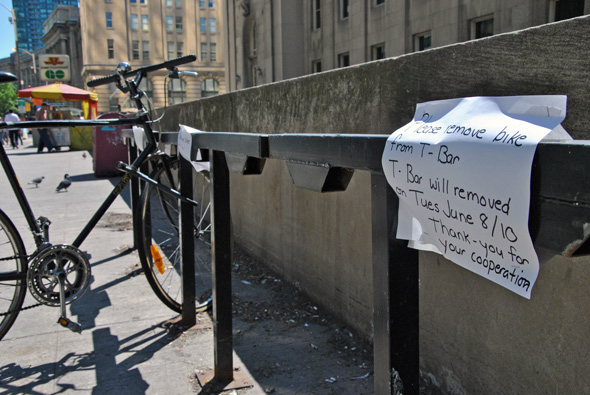
Tomasz Bugajski/Courtesy blogTO
Recent reports estimate the total cost for security for the G8 and G20 summits have greatly exceeded their initial $179 million dollar budget, soaring to $833 million, with room in the budget for an additional $100 million.
Local councillors asked the federal government to post a bond that would cover property damages caused by the G20, but their request was denied, and local businesses and residents will need to collect through their own insurance for all third party damages.
There are a number of other prominent areas that will be affected by the summit.
Obvious sites near the MTCC will be closed. The CN Tower will not be open and Toronto Blue Jays moved their weekend series out of the Rogers Centre. The Direct Energy Centre (100 Princes’ Blvd.) will be the home of the International Media Centre for the roughly 5,000 journalists expected to attend. Kensington Market’s Pedestrian Sundays was denied a permit for June 27 due to concerns it could become a rallying point for demonstrators.
Queen’s Park will be the site for the Designated Speech Area (DSA). The DSA is legally mandated by the Supreme Court of Canada to give a site where demonstrators can be seen and heard by the summit’s participants.
A stage with cameras and audio will be erected. Those feeds will be displayed within the MTCC so that demonstrations can be viewed within the summit.
Trinity Bellwoods Park was originally announced as the home of the DSA, but due to public concerns, the ISU chose to move the area to Queen’s Park.
The move to Queen’s Park was not without consequences. It has been reported that upon hearing of the new location, U of T has decided to close the St. George campus from June 23 until the end of the summit because of its proximity to the DSA. This includes relocating those who live in residences on campus for the four days.
Dozens of demonstrations are planned beginning as early as June 18, but the bulk of them are scheduled to take place on the days of the summit.
If you plan to attend demonstrations that weekend, a new concern are the four long-range acoustical devices—more commonly referred to as sound guns or sound cannons—that Toronto police recently purchased for the summit. These cannons can cause significant pain and even hearing damage, and the Council of Canadians will be giving away earplugs to combat its effects.
Comments Off on Summer summit: Everything about the G20 you were afraid to askTags: News · General

Purrr play the Bread & Circus June 19. Courtesy Christopher Wadsworth.
By Karen Bliss
More than 2,500 artists applied for a spot at the 2010 North By Northeast music festival, which takes place all over the city from June 14 to 20, so the 650 bands and solo acts that were accepted have obviously been given the thumbs up from the organizers.
“We have a jury that goes through all the [online] Sonicbids [entries] that we receive and then they’re marked by a rating system and at a certain level it will be a no,” explained Yvonne Matsell, director and music programmer of NXNE. “As soon as they’ve gone through them all, I usually come in from January and start working on the schedule.”
Matsell, who is also the year-round booker at the El Mocambo, works alongside NXNE’s Crispin Giles on the enormous task of placing the 650 acts in the 40-something venues, determining who plays where, when, and if the line-up makes sense.
“Generally, we have a master list of the clubs we’ve used in the last couple of years and then we’ll go through them and decide, ‘Does this work again?’” says Matsell. “Sometimes, some of the places have closed but then others open too. So it’s a case of going to check out the new clubs, or the club people will contact us.”
The artists come from all over Canada and many from the United States, but there are also some that make the trip from Israel, Denmark, Ireland, Japan, England, Australia, Hungary, Norway, Iceland and France. But if you want to stay strictly local Matsell has some recommendations.
On June 17, Matsell says the alt. folk/country band Elliott Brood and indie rockers Dinosaur Bones at The Horseshoe Tavern should be a good one.
That same night, Modernboys Moderngirls, fronted by Kensington resident Akira Alemany, play The Boat at 1 a.m. “He’s a hardworking guy, that one,” she said. “It’s indie pop rock.”
If you can’t make it out to that show, there is also the chance to check them out at The Rivoli the following night at 2 a.m.
Also on the 17th is a great bill at Lee’s Palace, called Outlaws & Gunslingers featuring such notable singer-songwriters as Blue Rodeo’s Jim Cuddy and Greg Keelor, Hawksley Workman, Colleen Brown, Justin Rutledge, Oh Susanna, Andy Maize, and Amelia Curran.
On June 18, Rancho Relaxo hosts a “very cool psychedelic blues rock band” called Revolvers and the El Mo has the much loved indie pop/rockers The Golden Dogs.
The Cadillac Lounge hosts “a lot of good stuff,” that same night, including The Heartbroken, which is the new band formed from Damhnait Doyle (Shaye); and folk act Flashlight Radio, comprised of singer Suzy Wilde and bassist Ben Whitely, the offspring of Nancy White and Ken Whitely, respectively. The following night, the same venue has highly touted rock band Five Star Trailer Park and a jaunt east on Queen at the Horseshoe CBC Night features Attack In Black, now based in Toronto.
Also on June 19, producer/composer Byron Wong hosts the night at Bread & Circus and featured on the bill is Purrr, an intense rave-rock trio that is mesmerizing live.
Tickets/wristbands are a steal for all the talent one will get a chance to see. The five-day pass is $50 and one day is $25. They are available online at www.nxne.com, as well as at various locations, such as Rotate This (801 Queen St. W.) and Criminal Records (493 Queen St. W.). The full schedule is also on the web site.
NXNE is now in its 16th year and has expanded from the music festival and conference (June 17 to 20th) with panels, keynote speeches and interviews to include more than 40 music-centric film screenings (June 16th to 20th), an interactive media conference (14 to 16th), and charity soccer game (20th) between the Rockers and The World.
The music festival also includes stages at Pearson International Airport and Union Station, and free open-air concerts at Yonge-Dundas Square.
Comments Off on Choosen ones: local acts worth checking out at NXNETags: Arts · General
By Tim Legault
A proposal to build a massive 42-storey academic residence at 245 and 253 College Street, between Spadina and University, was met with a general unease from local residents during a May 18 community meeting.
“Nice building, wrong location,” said Ceta Ramahalawansingh, who has lived in the area since 1971. She added that the building does not seem to fulfil its promise of providing a quality community for students. “What I see is a very traditional, ordinary floor plan, which will not do.”
The site is currently home to a five-storey storage warehouse and a smaller two-storey building used by U of T Press.
The University of Toronto and Knightstone Capital Management Inc., a real estate development company, own the buildings. The proposed development would be a private venture by Knightstone.
“This is not a U of T residence, but rather a building to house students,” said Lucy Fromowitz, assistant vice-president of Student Life at U of T. “Quality student housing in close proximity to our campus is something we would support.”
Knightstone said the building provided a solution to U of T’s ever increasing demand for student housing in the area.
The building would be composed of two- and four-bedroom units to house roughly 1,200 students. There would be zero parking and there are also plans to relocate the U of T bookstore, currently at the Koffler Centre (214 College St.).
Knightstone’s development team suggested they would likely create a drive-thru connecting College Street with Glasgow Street—a small residential street adjacent to the proposed site—sparking anxiety from a local woman who has lived on Glasgow for over 40 years. “I’m not looking forward to stepping outside of my house and looking at this big tall building with 1,200 new neighbours every year moving in, moving out,” she said.
Some residents expressed fewer objections to the building’s size if it meant that the residence would swallow up a large number of students who currently dominate the area and occupy the area’s stock of rental units.
Other proposals for high-rises in the area have met similar resistance. In 2005, public outcry from U of T and the local community led to the cancellation of a 40-story condominium that was to go up where the former Planetarium sat.
Councillor Adam Vaughan (Ward 20, Trinity-Spadina) was in attendance to moderate the event. He held no official position on the proposal and insisted his role was to facilitate discussion between the developers and the community.
Vaughan did warn that such a large building with a high density could impact the Municipal Property Assessment Corporation’s (MPAC) assessment of the areas property taxes, causing them to increase.
Vaughan and the developers stressed that there is still a long way until building plans are officially decided upon and the end product may be radically different from the initial proposal.
“As you can understand, we shared some very early stage conceptual drawings at the meeting, solely to introduce the project to those in attendance as a way to help create context for a productive dialogue,” wrote Danny Roth, a PR representative for Knightstone, in an email. “Of course, the renderings are only in their earliest design stages and are under ongoing review.”
Comments Off on U of T, locals butt heads over 42-storey proposalTags: News · General

It puts a smile on our face, yes it do … Art students Nari Heo, left waving, and Young Wook Lee are two members of S.Y.S.N, a design group of art students who volunteered to help the Koreatown BIA paint dozens of planters along Bloor Street. Matt James/Gleaner News
→ 2 CommentsTags: General
By Jacob Arnfield
Is there a difference between a fraternity and a rooming house?
Historically, municipalities with rooming house laws say yes. When Toronto’s rooming house legislation was first instituted, fraternity and sorority houses were exempted, but this is not likely to be the case for much longer.
Earlier this year, Councillor Adam Vaughan (Ward 20, Trinity-Spadina), passed a bill through Planning and Growth to remove the exemption. Because of a bureaucratic error, the bylaw revisal never made it to city council, and has yet to be fully enacted as law. Vaughan disagreed with the original exemption, which he said was made by a previous councillor who thought he was doing students a favour by not regulating fraternities and sororities.
The fact that the law has yet been passed did not stop Vaughan from discussing the alterations as if they had already been enacted. “We’ve stripped them of that exemption and they are now to be regulated as licensed rooming houses and will have to come forward and comply with all the bylaws,” said Vaughan, citing a need for increased regulation of fraternity housing property standards and fire safety.
Beyond ensuring a safer environment in fraternities, and providing their parents with an increased sense of security, the removal of the exemption is also aimed at curtailing what Vaughan says is some of the worst frat boy behaviour. “They’re going to have behave themselves like adults, or at least like teenagers, or maybe like 12 year-olds, but they can’t act like 8 year-olds and disturb and destroy and violate virtually every bylaw in the city,” said Vaughan.
When asked whether this change was necessary, Vaughan listed some of the worst recent offences. “I had a fraternity house in the ward that got a half-dozen pig heads and stuck them on spits and left them out over a long weekend during the summer. I’ve had park benches stolen and put on frat property. I’ve had parties and beer kegs and people shooting flaming balls out of windows.”
Vaughan said the fraternity and sorority houses have been notified.
Dovi Henry, a sociology and philosophy student responsible for public relations for his fraternity, Delta Upsilon (182 St. George St.), had not heard about the proposed changes that would affect his house. “It sounds pretty fishy,” he said.
When the Gleaner met him at his frat house and explained what Vaughan was proposing, he did not agree with the changes. He said his brothers understand they live in a residential neighbourhood, and make an effort to be good neighbours. Henry said at his fraternity will soundproof the house for large parties, and if an issue arises they are willing to alter their behaviour when approached by neighbours.
“Complain to us, you know. Come to me and say ‘Look, you’re having parties, you’re loud. I don’t like it.’ Don’t go to the government. Come to us at first at least,” Henry said.
He said there are significant differences between a rooming house and a fraternity. To start, the fraternity owns the property, which creates a different dynamic between landlord and tenant than a regular rooming house. Also, Henry said the communal relationship between fraternity brothers makes living in a frat house a different prospect than living in a rooming house.
“We’re just a group of friends who have an awesome mansion that we all hang out in basically,” he said. “If we were a rooming house, we’d all be here to live here, and that’s pretty much the extent of it.” He continued to say he felt the communal nature of their living arrangements were both the cause of the councillor’s ire, and the reason they should be exempted. They live in and maintain their house and conduct various fraternity activities together. That relationship, working together as a group body living in a shared space, is different from a collection of individual renters and makes licensing and supervision unnecessary, he said.
When asked about who is in charge of managing the property, Henry said the brothers vote two to three times a year to elect a property manager from their brothers.
An additional concern for local residents is non-fraternity members who live in fraternity houses, particularly in the summer time when school is recessed. Frank Cunningham lives near two frat houses at St. George Street and Lowther Avenue, and said during the year when he has a complaint he will approach the house directly. But, during the summer the people who choose to live in these houses are not as amenable to their neighbour’s concerns. Henry confirmed that his fraternity does rent rooms to non-fraternity members.
Cunningham supports the change. He said he is not as upset by fraternity house behaviours as others in his area. He understood the fraternity’s concerns about the need to be licensed, but said: “they can’t have it both ways and say, ‘You can’t apply rooming house laws ‘Cause we’re something different’ and then rent out as a rooming house.”
→ 7 CommentsTags: News · General
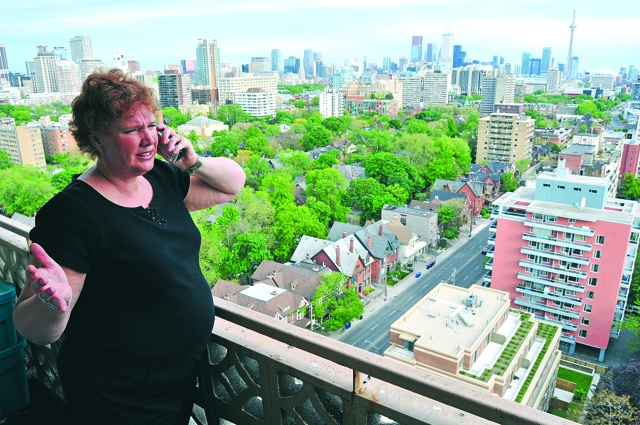
Matthew James/Gleaner News
By Darko Milenkovic
Residents of a 22-storey building in the Annex found themselves with neither electricity nor water during a weekend-long power outage last month.
During a windy morning on May 8, a tree limb fell on top of a power fuse creating sparks and causing a partial power outage at 100 Spadina Rd, owned and managed by Park Property Management Inc.
The superintendent of the building, Eva Ostrihon, witnessed the event. “It was very windy that day,” Ostrihon said. “I saw it—I was showing an apartment—so I was right on the balcony in front of the tree. It just sparked, and then banged, and then the electricity went down.”
Elevators also lost power. A woman on the 16th floor was in one of the elevators at the time of the outage, and remained there for about an hour until elevator technicians arrived to help her out. “One of the assistant supers came running up the stairwells, knocking on the elevator doors,” said building resident Leslie MacNeil.
MacNeil, a tenant on the 22nd floor, had no power for essential home appliances including her refrigerator and her computer. Many others suffered a similar power loss.
“My neighbour across the hallway had her fridge working, but her stove wasn’t working, whereas I had my fridge not working and my stove was working.”
The residents used extension cords alongside the few working power outlets to keep their critical appliances operational.
Lights in apartments, hallways, and stairwells went out simultaneously, locking those without flashlights, or the ability to traverse up and down multiple floors, trapped within their homes. “We were held hostage by this,” MacNeil said adding that there are a lot of seniors in the building above the 14th floor.
One woman on the 17th floor was expecting her son and his family to visit her for Mother’s Day and take her out for lunch, but couldn’t get down the long flight of stairs due to her frail physique and broken hip.
While people below the 11th floor were lucky enough to still have running water, the upper floors didn’t even have flushing toilets. “The water comes without pumps to the 11th floor,” Ostrihon explained.
The outage began around 11 a.m. Saturday morning, and initial calls were made to Toronto Hydro within the next two hours.
Tenants said they made over a hundred calls to Toronto Hydro over the weekend. Power was finally restored at around 5 p.m. on Sunday.
“People were in the hallways here, during the night, in their nightgowns wandering around,” MacNeil said. “Some were crying ‘Nobody’s paying attention, nobody’s coming.’ Time and time again we tried phoning Toronto Hydro.”
For every call, tenants were asked to identify their address and postal code before waiting for a representative. Tenants were told by representatives to go to sleep and that the issue would be resolved before morning. “At no time did they give us a time frame—they just said that they were on the way,” MacNeil said.
Offering possibilities about why the outage lasted as long as it did, Ostrihon said its partial nature may have placed the building in lower priority. “But this is still a high-rise building,” she said.
Toronto Hydro finally arrived to work on the building around 4:30 p.m. Sunday afternoon. The forestry crew was sent in first to ensure a safe work environment at the site. Within half an hour the power to the building was restored.
“When they were here and working on the lines I went out to speak to them.” MacNeil said. “I was very polite, I wasn’t blaming them. I said ‘I know you guys have worked very hard to get this done.’ I said, ‘Did you know how long we were out of power here?’ No, they did not. There was a breakdown in communication.”
Tanya Bruckmueller, public affairs consultant for Toronto Hydro, said that it was an unfortunate occurrence, and that the windstorms that weekend had caused outages in many areas of Toronto. “There were a number of factors,” she said, when asked why it took so long for Toronto Hydro to respond. “For instance, public safety calls are always dealt with first, and unfortunately incidents like this one will have longer outage times than others.”
She said Toronto Hydro attempted to deal with outages caused by the storms as quickly as possible, and successfully made sure that all outages were dealt with before the weekend was over.
Bruckmueller also made note that Toronto Hydro crews required permission from the property management in order to access the building, and failure to make swift contact with Park Property Management led to a further delay in solving the power outage.
MacNeil said she was not pleased with the way Toronto Hydro handled the situation. “It was negligent, very neglectful, and just terrible,” she said. “Should anyone have had an emergency, or a fire happened, or someone had a heart attack, or broke their leg going down the stairs, who would have been able to get here in a timely fashion?”
MacNeil said many tenants felt helpless and distraught, and she is looking for compensation and reassurance from Toronto Hydro that such an incident will not happen again.
→ 1 CommentTags: News · General
 Perry King/Gleaner News
By Perry King
Beverly Horii, owner of Jinja Ninja cookies, has been making her designer treats since September. Before that, she was moving up in the world of architecture, a place that she grew tired of.
“After 22 years, I was at the top of where I could go in my career. What ends up happening is that when you become more senior in this field, you end up becoming business development, which means you have to go out and look for work—which isn’t what I really love to do,” said Horii, an Annex resident of 15 years.
Horii did not buy into the idea of selling architecture. But, becoming the creator of “mookies”—designer cookies for special occasions—was not something she immediately jumped to. She had always loved to bake—particularly cookies—and her discovery of mookies came by coincidence. “I spelled out my friend’s name, ‘Farewell Pam’—it was a going away party—and I put stars, but I placed them individually and stuck them to a sheet,” she remembers.
“You know how you bake cookies, if you put them too close together, they stick together. I thought, ‘that’s interesting.’” Her cosy idea led her to create cookies with collage-like elements, and eventually she left her previous position to start her own company.
“I’m very hands-on. I do a lot of the work here. I hire people when I need the help and I design everything. I love the design part, and I love baking and cooking so that’s what got me going initially,” she said.
The Gleaner asked Horii to combine her design and baking skills by making a cookie replica of local landmark Bloor Street United Church. She agreed, as long as we kept her cookie-designing techniques and gingerbread recipe a secret.

Perry King/Gleaner News
Horii has a passion and desire to keep creating. She noted that she has dabbled in other pastries, like cupcakes and three-dimensional cookies. “When people see it, they’re just blown away. The kind of satisfaction you get from that is what keeps me going,” she said.
Her passion has not gone unnoticed. “I think it’s her passion that drives her courage,” said Edwina Low, who has worked with Horii in the kitchen, but has recently left to pursue interior design at Ryerson University. “She has been courageous enough to leave the safety of being employed to foray into a completely different field, and not only that, she’s set out to merge her passion for design and food. Her energy and excitement is contagious when she talks about her new ideas, and you see her courage when she’s persevering to make her ideas a reality.
“With all things great and worthwhile, making designer gourmet cookies isn’t cut and dry. She’s put in a lot of muscle and a lot of hours to get her business to where it is today,” said Low.
Horii’s favourite part of the challenge was the icing of the cookie. “This is where the mookie comes to life,” she said. “That’s because you give them life through colour and detail.”
She used two shades of a butter cream-based frosting, coloured brown, as the main colours for the church, and regular frosting to decorate the surrounding design. She used a royal white icing to add the finer window and building details to the church.
In the end, the Annex mookie took 90 minutes on the dot.
The challenge was a diificult one, but she persevered and produced a beautiful and yummy cookie.
To learn more about Jinja Ninja cookies, visit the Jinja Ninja Facebook page.
Correction: It is mentioned in the article that Edwina Low, Horii’s former assistant, is pursuing interior design at Ryerson University. In fact, Low graduated from Ryerson’s Interior Design program in 2006. She now works as a set dresser and designer in television production. The Gleaner regrets the error.
Comments Off on Tough cookie: Architect turned baker gets put to the testTags: General
By Sandra Ferrari
A scantily defined Toronto bylaw has raised concerns in the local burlesque community after bylaw officers were called in to investigate an event held at Revival nightclub (783 College St.) last month.
Because of the vague wording, it is unclear whether the performances violated the law. Only verbal warnings were issued and no charges were laid.
Under article XXXII of the bylaw, a burlesque entertainer is defined as an attendant whose services appeal to, or are designed to appeal to, erotic or sexual appetites or inclinations.
According to long-time promoter in the burlesque community Chris Mysterion, the wording is extremely vague and could potentially apply to number of different performances and events held and supported by the City of Toronto.
“If the authorities were to follow this bylaw, they would also have to go after CHIN picnic organizers because of the bikini contest; Gay Pride because of dancers on any given float; or the number of theatre dance groups that use any form of seductive dance in their routines.”
The Ridiculesque event on April 11 went from salacious to solemn in tone as some performers left the venue out of fear that they may be fined under accordance with the bylaw.
“A lot of us have other jobs during the day,” said Sauci Calla Horra, who performed that evening and is also a mental heath worker in the city. “I don’t have a problem with what I do, but some performers have concerns around applying for work and having this show up in a background check.”
For some performers, it is not only a question of the protecting the rights of those involved in the community, but also about maintaining the integrity of the art form.
“Years ago erotic dancers were considered burlesque dancers. Fifty years later the word burlesque has a different meaning. The wording is outdated as it is used in the bylaw, just like the word ‘gay’ used to mean being happy,” said Mysterion.
Not only is the wording outdated, but the bylaw blurs the lines between definitions of adult entertainers and modern day burlesque performers.
“Burlesque often tries to challenge social mores and social codes. There is real confusion between what a stripper is and what burlesque is. There are still pasties and g-strings in burlesque, but more attention is paid to the theatrics,” said Calla Horra.
According to Bruce Robertson, director of Licensing Services for the city, there is no real cause for concern on the part of the burlesque community. However he does acknowledge that fines may be up to the discretion of the bylaw officers called in to investigate a particular event.
“It’s certainly possible that people could get charged. It’s not outside the realm of possibility, but if that happens it would be up to the courts to decide what to do.”
The prospect of potential arrests remains unsettling for some members of the burlesque community.
“What this does is raise a red flag. When there is a red flag you have to be aware of your rights,” said Mysterion.
Though some performers were worried, this is the first known bust of its kind according to both Calla Horra and Mysterion, leaving no real sense of panic among burlesque performers in the city.
Both of these prominent members of the burlesque community note that what the situation has done is opened the door to issues of fickle bylaw enforcement, threat to artistic license, and the potential for negative impact on the burlesque community of Toronto—especially in light of the upcoming Toronto Burlesque Festival, a high-profile event featuring international performers.
Comments Off on Lascivious licensing: Toronto burlesque community says bylaw is vagueTags: General

Brodie Merill, 2009 MLL Defensive Player of the Year. Courtesy: Tracy Johnson
By Perry King
When a sports team wins a league title in their inaugural season, they’re going to get some attention.
But somehow, the Toronto Nationals, an expansion franchise of Major League Lacrosse (MLL)—the National Lacrosse League’s (NLL) outdoor lacrosse counterpart—did the deed in the quietest way possible.
“We came together at the right time. We had been inconsistent throughout the regular season, but really, it came down to that last weekend and we felt like we gelled,” said Brodie Merrill, a Nationals defenseman. “We were able to keep a large corps of players that played together in Rochester the year before and won the championship. That helped, but Coach Huntley and his staff came in and established a new philosophy where the players bought into it.”
Successes aside, there was little appetite for the Nationals because they were relatively unknown last season. “It’s funny, living in Toronto, I think we’re the best kept secret: the best players in the world playing for the city and we were successful—especially in the landscape of Toronto sports. It’s really something the city can get behind,” said Merrill.
“The everyday, working class person can really identify with the game of lacrosse and lacrosse players. It’s a fun and inexpensive way to spend your entertainment dollars, and the fans are really recognizing that.”
The Toronto Nationals evolved out of the Rochester Rattlers, an MLL charter member, which decided to temporarily dissolve to better foster competitive lacrosse for the league. The team itself can be reactivated, but in the meantime, the Rattlers’ core members had to deal with Coach Dave Huntley’s system, a new stadium and city.
The transition was a rough one. “We had some stretches of good games and a few sub par games last season. I think when we were successful last season, we were playing as a team, and really moving the ball around offensively,” wrote Delby Powless of the team’s attack unit in an email.
Eventually, the team developed an identity on the field—an up-tempo, offensive identity. “Our defence and midfielders do a great job of pushing the ball up the field creating odd-man opportunities, which as a fan is much better to watch,” said Powless.
“I think our transition from defence to offence really caused problems for some of the teams who like to slow the game down.”
That identity certainly showed up on the stat sheet. The Nationals scored 184 goals in 12 games in 2009—about 15 goals a game.
2010 will be a challenging season for the well-tested squad. Defending a title is a lot to ask for, but for the first time, the Nationals will also be playing their home games at Lamport Stadium (1151 King St. W.), after a strong season at BMO Field.
BMO Field, after implementing natural grass on their pitch, became Canada’s largest soccer-specific facility last winter, forcing teams like the Nationals to make new plans.
Dan Dawson, an offensive stalwart of the NLL for nine years, says transitioning from the box-style lacrosse of the NLL to the outdoors of the MLL has been a challenge. “Field lacrosse has a lot more athleticism than the indoor game, a lot more stick skills. So there is a bit of transition, but at the end of the day, it’s still lacrosse and I’m still learning and trying to become a better player at this level,” said the offensive guru, who has averaged 32 goals in eight pro seasons in the NLL.
Dawson currently works as a fire fighter, but wants to play pro lacrosse for another five to 10 years. “I’m forever in debt to the sport of lacrosse, I have so many fond memories. I have friendships forever because of the game. I represented my country three times, won a world championship in Canada. You know, I get to play in my hometown in Toronto. There is so much I’m grateful for because of the sport,” he said.
As for this season, the players are ready to go. All the players said they would defend the title. “One of the toughest things in sports is to really have a good season after a championship, so we’re trying to avoid complacency, that kind of ‘championship hangover’ so to speak,” said Merrill.
“You try to avoid all the distractions and just focus on prep and the finer details of the game.”
Defence Talks
Brodie Merrill, the heart of the Nationals defence, is no novice when it comes to his job. In fact, since he began his career, he has been the MLL’s premier defenseman.
For more information about the Toronto Nationals, visit http://nationalslacrosse.com/.
Comments Off on National treasure: Lacrosse squad revs up for regular seasonTags: Sports · General
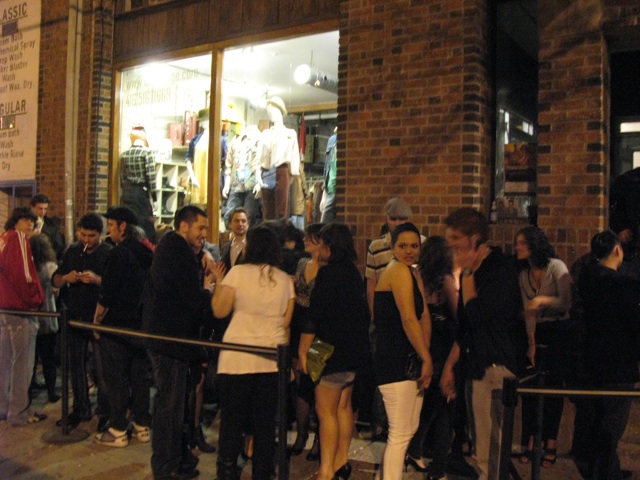
Neighbourhood residents have complained about The Social's crowded sidewalks. Beth Macdonell/Gleaner News
By Beth Macdonell
In what seems to be a response to the city issuing an increased number of fines last year, Richard Lambert, co-owner of The Social (1100 Queen St. W.), is asking the city to rezone the address to allow it to operate as a nightclub.
The Social previously operated under a restaurant license, as nearly all bars in the city do.
Between January 2009 and November 2009, The Social was ticketed for violating their operating licence eight times, Bruce Robertson, manager of Toronto’s Municipal Licensing and Standards Division (MLS). For their first offence, The Social received a $250 fine. Robertson said the other violations will be heard in court September 10.
In fact, Robertson said The Social has been operating without a valid license since November, “essentially” open illegally for business. He said The Social did not reapply for its yearly license. Robertson said the city was likely waiting for the accumulated violations to be processed before they took further action, adding that this sort of thing was not usual.
City Planning confirmed the applicant submitted a rezoning request January 13, 2010. Staff said apart from the Entertainment District, there are few addresses in the City of Toronto granted a license to operate as a club.
Lambert turned down several phone, email and in-person interview requests with the Gleaner. On one attempt, he bursted out, “Oh, it’s the Gleaner girl,” and instructed his staff not to speak with the newspaper. Phone calls to the applicant’s lawyer were not returned.
A big part of the problems stems from the fact that there is no such thing as a bar license in the city of Toronto. Businesses can apply for licenses as restaurants or entertainment facilities. Restaurants are obligated to have a certain number of tables and chairs, have limited “dance floor” space, and serve food.
If The Social were to be approved for the change in license and be allowed to operate as a night club, “they would face stricter requirements”, said Toronto city planner Jamaica Hewston. Among other things, Hewston said the new license would require The Social to set up a metal detector.
Residents fear if the re-zoning request is granted, a precedent for other clubs to open in the area will be set. Hewston confirmed that fear at a community meeting held April 19. “Ultimately we do have to think of the use of the building, if Richard leaves in ten to twenty years, the use would still be the same,” said Hewston.
Similarly, she said if the city allowed The Social to be a club, other establishments could reference the decision as argument to also rezone as an entertainment establishment.
“The problem is that there are too many people partying in the neighbourhood”, said Misha Glouberman, founding member of the Queen Beaconsfield Residents Association. Glouberman said the group opposes the expansion of bars in general, so this is not just about The Social. “The biggest problem I have is trying to sleep.”
Hewston said the city wants to give licenses to new restaurants along the West Queen West strip to help diversity the neighbourhood, but said they never know when one of the ‘restaurants’ actually intend to run the business as a late night bar. “We don’t want to refuse restaurants from opening,” Hewston said.
“It’s not simple, unfortunately,” said Lambert at the meeting. When The Social opened, it operated as a restaurant, he said. “You can’t always control people and the direction.”
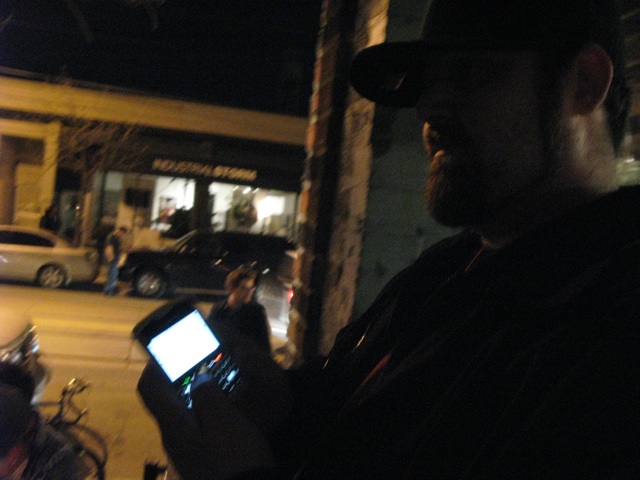
Morgan Taylor, head of security for The Social, texts staff to turn music down and lights on at 2:45 a.m. Beth Macdonell/Gleaner News
Lambert said The Social was totally unaware they were violating their operating license until two years ago. He said if The Social were to shut down, 30 people would lose their jobs, having a negative impact on the community.
When city staff asked at the meeting why The Social would not comply with the current rules until decision was reached, Lambert said he was “not at liberty to discuss the inner workings of my business.”
A lot of residents said they did not know if he would show up to the meeting, but he stayedfor the entire duration, cordially answering questions and addressing concerns. Many residents thanked Lambert for his openness during the meeting.
Several residents said the lack of enforcement by the city was the root of the wider problem along the Queen West strip, namely the level of noise at night and the number of what are in reality bars, but designated as restaurants operating.
“There is no overnight solution, said Joe Magalhaes, District Supervisor of MLS at the meeting. He said the licensing department was bound by the courts and has to wait for violations to be heard, a process he pointed out which can take months, sometimes years. “But I don’t want people to think we are not actively investigating.”
“I know there is a lot of frustration”, said Councillor Adam Giambrone (Ward 18, Davenport), also present at the meeting. He was sympathetic to the length of the court process for establishments caught violating their licenses. He said he planned to support the refusal of The Social’s re-zoning request.
“We would like to see a variety of small businesses open up,” wrote Michelle Gay, an artist who has lived and worked in the West Queen West neighbourhood for 13 years in an email to the Gleaner. “It’s meaningless for us to have bars move into the neighbourhood and remain closed until 9 p.m. It doesn’t create an interesting and vibrant place to live.”
Hewston said the city planning department is writing a report which will be presented to community council May 25. City council will then vote on The Social’s request in early June. If the request is declined, Lambert can appeal the decision to the Ontario Municipal Board.
Comments Off on Becoming anti-Social?: Queen West hot spot operating without a licenseTags: General