September 3rd, 2010 · Comments Off on Vigourfest wants to make you healthy through music

Dan Dwoskin plays the Trane Sept. 3. Image courtesy Dan Dwoskin.
By Brendan Hair
Vigour Projects, a new Toronto-based not-for-profit organization will be presenting its first health music concert called Vigourfest at Trane Studio on Sept. 3.
Founder and president Dr. David Alter, a cardiologist and researcher who has been writing songs since his teens, merged his love for music and health to create the project.
Alter’s plan for Vigourfest is to improve the health of communities through music. And the project’s drive is generating health awareness by presenting musical genres ranging from indie to adult contemporary.
As a doctor, Alter believes music is the most “primal therapeutic tool.”
“Music has a lot of impacts on individuals and on communities,” says Alter.
According to Alter, medical research shows music impacts blood pressure, heart rate, behaviour, and emotion.
But he also hears artists say that music has an ability to break down social barriers.
Dan Dwoskin, an indie musician participating in the inaugural Vigourfest believes that music is a universal language, that can connect complete strangers.
Dwoskin says music is especially impactful on health because of the way people emotionally and physically react to it.
“[People] are swayed to dance, smile, sing, or cry when they hear something powerful enough to dictate the mood. Music can inspire action, heal a broken heart, allow love to blossom, and calm our nerves,” he says.
Proceeds for Vigourfest will support the Heart and Stroke Foundation of Ontario.
Vigourfest will not only promote great music, but great food too.
The organization will be receiving support from The Toronto Vegetarian Association and samples from local food vendors. Cooking demos will also be supplied courtesy of Karma Co-op.
Tags: General
September 2nd, 2010 · 3 Comments
By Perry King
At 9:47 p.m. on Aug. 25, Toronto city council voted 37–0 to approve the hotly debated harmonized zoning bylaw.
The new bylaw, arising from an eight-year harmonization exercise, now regulates the use of land and buildings, including their height, size, bulk, and location. Written with a common terminology and set of defined zoning terms, the bylaw consolidates 43 former bylaws that were grandfathered from pre-amalgamation Toronto.
The new bylaw maintains current development standards —like height and density—as much as possible in order to preserve and protect existing neighbourhoods.
Key parts of the bylaw include a transition protocol that aims to protect existing development permissions and prevent development application delays, and regulations that protect ravines.
The bylaw was the first item tabled by Mayor David Miller for city council’s last session before municipal elections in October. If the bylaw were not approved, the matter would have been deferred to a committee meeting in February 2011.
“Staff have laboured four years, invested some $7 million in that labour, to produce a document that will help this city prepare itself for the challenges of the 21st century,” said Councillor Norm Kelly (Ward 40, Scarborough-Agincourt), who chairs the Planning and Growth committee. “This is one of the foundation blocks of this city that will enable it to face the many and varied and complex challenges.”
In November 2009, the matter of approving the bylaw was deferred for further consultation and revision. Although a final draft was released in late May—and a final public meeting for June was arranged—the matter was further delayed because deputees exposed numerous problems with the bylaw.
In the final Planning and Growth management public meeting Aug. 19, 68 deputees, residents and lawyers—mostly representing commercial properties—brought forward their site-specific concerns.
Signe Leisk, a U of T legal representative, wanted clarification on how the bylaw would change the definition of a post-secondary institution. Councillor Adam Vaughan (Ward 20, Trinity-Spadina) said that a university plan was under way to assess the capacity for student housing for post-secondary institutions.
Adam Carson, who represents 20 fraternity and sorority houses in the Annex, had two objections: the matters of classifying these houses as rooming homes, and regulating these houses, which he said would interfere with the operation of the Greek houses. “These properties do not fall under the definition set out in the bylaw, and the planning act does not allow for class of property by association or gender,” he said.
Rules applying to rooming houses, including those set out for fraternity and sorority homes, are replicated from existing provisions in the new bylaw. Vaughan says the fraternity exemption was removed from the rooming house bylaw earlier this year.
“This bylaw will never be perfect. It’s the reason why we have the committee of adjustment, it’s the reason why we go through re-zonings. Every property owner wants exceptional conditions to apply to their property. This bylaw proposes to change some of the dynamics, the metrics, the language, to make it more consistent,” said Vaughan to city council. “There will be problems where people pull billing permits and suddenly realize that problems that they thought they wrapped up and approved suddenly trip into variances and we’re going to have to deal with it.”
Tags: News · General
August 16th, 2010 · Comments Off on Great Voices at Festival at the Fort
Written By Rick Salutin
August 10 to 22 at Fort York, 100 Garrison Rd.
-
By Beth Macdonell
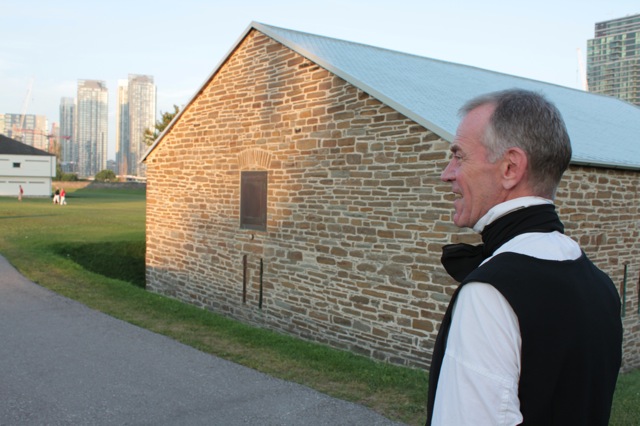
On now through Aug. 22, Festival at the Fort presents Great Voices, a play that tells the story of the Battle of York during the war of 1812 between America and British Canada.
Written by columnist and author Rick Salutin, Great Voices is an enriching and fun journey into one of the most violent periods between the Yankees and the Canucks.
Arriving at the fort, the audience is encouraged to stroll through the grounds before taking their seats on benches by the campfire. As you listen to bagpipes clash with the city soundscape and admire two centuries-old British military buildings, the play begins. The audience is told to “forget the Gardiner, forget the sounds of traffic.”
Instead, you are to imagine it’s the spring of 1813, and America has just decided to attack.
-
Seems hard to imagine, given the massive condos, billboards, and highways that surround the national heritage site today, but Great Voices, as it turns out, gives an educational and entertaining portrayal of the attack and the era.
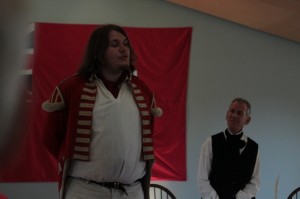
For over 90 minutes, the audience is guided outdoors around the fort where they are introduced to giant puppets, music, and plenty of humour, including a rendition of a song called “Stew Again,” mocking the monotony of the soldiers’ diet.
A mixed native and white cast tell stories that give detailed information on famous historical events. One informs the audience of the alliance between Sir Isaac Brock and Tecumseh, the leader of a large native confederacy, that caused the American base at Fort Detroit to surrender.

-
Leuitenant-Govenor John Graves Simcoe discusses introducing the first piece of legislation which moved to abolish slavery in the British empire.
Simcoe established York in 1793. He feared an attack from the United States, and felt Niagara, the former capital of Upper Canada, was situated too close to the U.S., and eventually choose Fort York because of its strategic location.
At the time, Toronto Islands still formed a peninsula, creating what was then called Toronto Bay, which Simcoe saw as a natural protective barrier in case war broke out. To the south, the old walls that surround the fort mark the original coastline of the city.
When the war came to York, it was still a small town of about only 1,500 residents. The play pokes fun at what it was like living in York at the time, being surrounded by thick woods and flurries of mosquitoes – a distant memory of the now expansive urban sprawl.

There was only one day of fighting at Fort York. The Americans captured the site quickly. Both barracks were destroyed. One by the American fighters, the other by a smouldering fire left burning by the militia that defended the fort. The barracks were rebuilt a year later in 1814. The parliament was also burned down.
Great Voice is well orchestrated through the different scenes, moods and locations. The play was able to integrate and engage the audience without distracting the audience away from the history.
The cook, played by James Gordon wins my vote for favourite character in the play. He researched and wrote the songs, performing them with spunk and enthusiasm. Simon Richards played the powerful British men in the story. He brought out the surprising introspective nature to which these characters were given. Tecumseh was evocative and emotional. The host, Hendrick Bruyn, lead the audience with energy and wit. My only criticism is that the performance was very male centric lacking a strong female role on either the Native, British or American sides. It would have been interesting to learn how the women of York were living.
Go see Great Voices to buff up on your history in advance of the war’s 200th anniversary in 2012 and learn about the birth of Toronto. It’s a wonderful opportunity to interact with the past and present in a creative unique way.
Photos by Sean Baker
Tags: General

- The popular graphic novels make use of many Annex locations. Image courtesy Oni Press.
By Tim Legault
As Bryan Lee O’Malley, creator of the Scott Pilgrim graphic novels, sat signing a stack of his sixth and final volume in the series (Scott Pilgrim’s Finest Hour) in preparation for the book’s launch party, he recalled Publishers Weekly’s review of his first volume six years ago.
“Scott Pilgrim is 23 years old, lives in a cold, unnamed Canadian town …” began the review.
“I’m like, ‘No, it’s named. It’s not a town. It’s Toronto!’” reflected O’Malley, whose graphic novels prominently feature the Annex. “So I think I might have taken a bit of offence by that and tried a little harder to make it more Toronto-ish.”

-
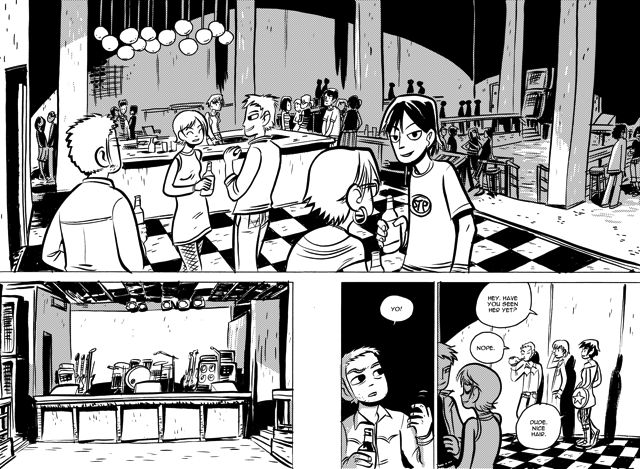
Scott and his friends lounge around Lee’s Palace. Image courtesy Oni Press.
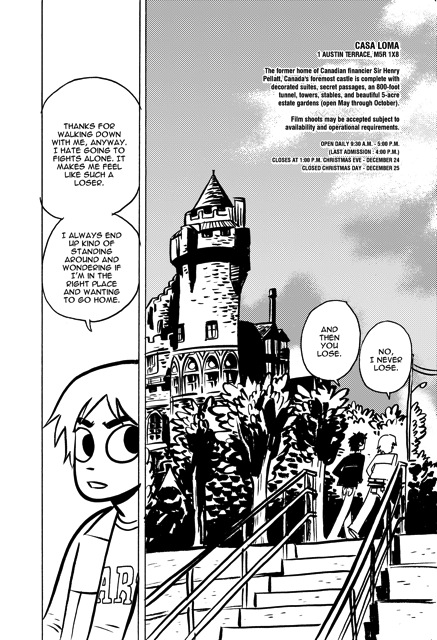
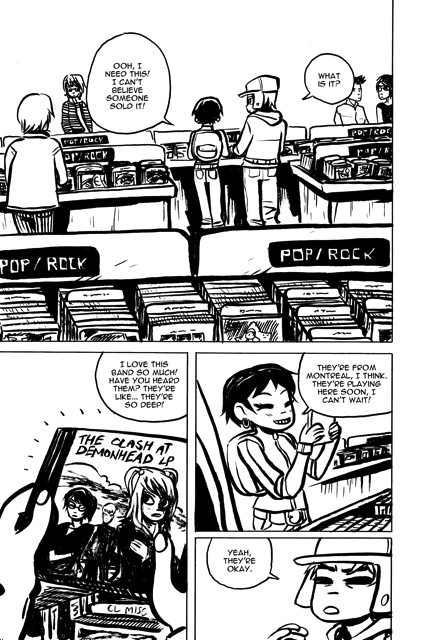
Toronto has since become almost a secondary character in the series. The titular hero spends his time hanging out with friends at Sneaky Dee’s , fighting his girlfriend’s evil ex-boyfriends at Casa Loma or Lee’s Palace, shopping for CDs at Sonic Boom, or dodging late fee’s at No Account Video (a stand-in for Suspect Video).
“I think in the beginning, it was more like I just used [those locations] because they were all around me,” said the 31 year-old artist. “It’s the locations that I was kind of wandering around through when I was depressed. They have a personal significance to me.”
Since then, his books have been optioned and turned into a high-budget, summer blockbuster, starring Brampton-born Michael Cera and directed by Edgar Wright, the British director behind cult favourites Shaun of the Dead and Hot Fuzz. The movie, released Aug.13 to coincide with the Scott Pilgrim video game, was filmed mostly in Toronto.
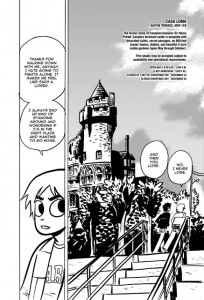
- Scott Pilgrim visits Casa Loma. Image courtesy Oni Press.
The book’s midnight launch party, which took place at The Beguiling (where O’Malley once worked), The Central, Rocco’s Plum Tomato, and other surrounding stores, brought in a large enough crowd to fill up Mirvish Village. Some fans even dressed in costume and lined up to meet O’Malley, who was there signing books.
The series centres on Scott Pilgrim (named after a song by indie-band Plumtree), an unemployed twenty-something who falls for a girl, Ramona Flowers, who he can only continue to date on the condition that he defeats her seven evil ex-boyfriends. The series is defined by its esoteric video game and indie rock references, as well as it’s oscillation between moments of mundane naturalism and surreal, manga-influenced battle sequences. For example, a visit to the Toronto Reference Library quickly turns into an epic battle between Flowers and Scott’s ex-girlfriend. A party might be interrupted with a battle between Scott and an evil robot.
O’Malley was born in London; Ont. but grew up in northern Ontario. He later returned to London, where he went to a Catholic high school. After what he describes as “an unsuccessful stint” at The University of Western Ontario, he moved to Toronto in his early twenties.
“I was only here from 2001 to the middle of 2005,” said O’Malley, who now lives in Los Angeles with his wife Hope Larson, also an acclaimed cartoonist. “It was the first time I was out on my own. I was just very sheltered.”
O’Malley first started Scott Pilgrim after a long-distance relationship with a girl fell apart two months after his move to the city. He lived at Davenport and Ossington, and then later moved to Bathurst and St. Clair.
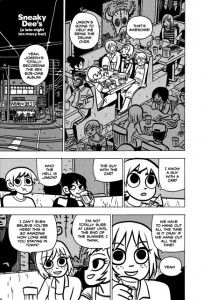
- Scott and his friends regularly meet for drinks at Sneaky Dee’s. Image courtesy Oni Press.
“I was really moping around the whole summer and started writing these ideas for Scott Pilgrim,” he reflected. “Fortunately, I met another girl, became happier, and the story kind of took off on its own.”
Readers familiar with The Annex will certainly appreciate a pivotal scene in the third volume in the series, Scott Pilgrim and the Infinite Sadness. In it, Scott and an evil ex-boyfriend must test their strength by running through Honest Ed’s. When Scott is asked is he has been to the department store before, he replies, “No. Well Once, but I almost died.”
Smiling, O’Malley says that Honest Ed’s is “a bit of scary place.”
“I think people from other places, they don’t necessarily understand what [Honest Ed’s] is, but they get the feeling of it. People have come to Toronto from out of town after reading the book and go to Honest Ed’s and they’re just like ‘Ahh! He’s right!’”
It took O’Malley just six months to complete the first volume. As he has progressed as a storyteller and a cartoonist, each book has taken him longer and longer. “It took less time at the beginning because I was naïve and young and could stay up all night and just draw and draw and draw,” said O’Malley, “The better I get at drawing, the longer I take. I feel like I’ve got to work harder and try harder. So I feel like I could write something on the side, like a screenplay or whatever.”

- Running through Honest Ed’s proves to be a tough challenge for Scott. Image courtesy Oni Press.
When the Scott Pilgrim movie began to take shape, O’Malley says there was never any talk, at least to him, of changing the setting of the story. In what would have been a suitably ironic twist, there was one moment where there was talk of shooting in New York and having it double as Toronto (“Which I can’t even imagine”).
“I feel like in those days, when we were first starting to talk about it, I was just a starving artist and I would have just taken anything. I would have been like, ‘Sure, set it in, you know, rural Nebraska—I don’t care.’ However, they didn’t.”
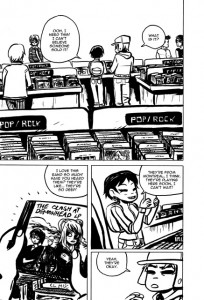
- Scott visits Sonic Boom, the local music store by Bathurst and Bloor. Image courtesy Oni Press.
After O’Malley finishes his grueling promotional work (a recent tweet of his read: “If you’ll excuse me, I have 50,0000,000000,000,00 more interviews to do”), he plans to relax for a little bit and do some writing.
“I’ve got these ideas in my head. I’m trying to write a script with a friend. I think I’ll probably just take it easy for a bit.”
Tags: Arts · General
August 2nd, 2010 · Comments Off on Castle under siege?: Casa Loma management under scrutiny
By Jennifer Farncomb
Is it time for new management at Casa Loma?
Recent events have called into question the management and finances of the castle, which some say are lacking in transparency and the ability follow through on agreements made with the city in 2008.
“Now what staff is identifying is that we have a problem—and it’s a big problem and we need it resolved,” said Councillor Joe Mihevc (Ward 21, St. Paul’s) who sits on the Casa Loma Board of Trustees ex officio. “We need to focus the city’s attention on it and we need to focus Kiwanis’ attention on it.”
On July 7, city council voted in favour of adopting recommendations about the management and operations of Casa Loma made by the city manager: that the castle’s board of trustees meet monthly; that Kiwanis develop a revised financial plan; that a joint working group be established, and that the chair be removed by the end of July. The chair of the Board of Trustees of Casa Loma, Richard Wozenilek, is facing allegations of a conflict of interest. His law firm performed $111,000 worth of legal services for Casa Loma.
Kiwanis Club of Casa Loma (KCCL) president Joachim Gerschkow agreed to the first three recommendations but said they were unwilling to oust Wozenilek. Failure to comply with the city could result in eviction for KCCL.
Representatives for KCCL declined to comment on the matter, but did send the Gleaner a written response to the city report. The response defends the KCCL against the allegations in the report. “The Kiwanis Club has remained in compliance with the financial requirements of the Management Agreement,” it reads.
Trelawny Howell, the great grand niece of Sir Henry Pellatt (the builder of Casa Loma) has always been skeptical about the way the castle was run. “We were suspicious of whitewashing the financial papers,” said Howell. “The Kiwanis club had one set of financial papers, and Casa Loma had another set, and between the two, they were never properly audited.”
In 2007, KCCL faced the possibility that their lease with the city would not be renewed, so they proposed a plan for improvements with timelines and dollar amounts for the next five years, called the Strategic Vision.
In 2008, council decided to renew their lease under the Management Agreement, which included implementing the Strategic Vision. A joint board was established made up of half Kiwanis delegates, half city appointees, ex officio members and a Kiwanian chair.
To assist with the costs of the Strategic Vision, the city exempted Casa Loma from property taxes ($175,000) and capped annual payments. The proceeds from the financial break were to be placed in the Casa Loma Improvement Fund (CLIF).
“So the Kiwanis sold city council on the new vision and the problem is that, two years have passed, they haven’t delivered,” said Rita Davies, Toronto’s director for cultural services who sits on the Casa Loma board.
According to the city report, the KCCL have been using the CLIF to supplement shortfalls in operating revenue and only $335,000 of the projected 1.5 million dollars will be available for improvements by the end of 2011. They are also behind schedule in implementing the Strategic Vision.
Governance concerns were also raised in the city report. “Certainly, at this point there is a feeling from the staff report that Kiwanis has not fulfilled its obligations as the representatives of half the board,” said Mihevic.
In response to the city report, the KCCL did provide some reasons for their financial difficulties. For example, they have not received a partial property tax refund for 2008, which meant they had to adjust their cash flow planning. In addition, Casa Loma did not receive any aid during the recession like many publicly-owned attractions.
Mihevc does not believe that the city has reached the stage where they will begin looking for a new operator, yet, but said, “Kiwanis do great work in the area of arts and culture especially with their music festival. They are not, though, in the business of running large tourist attractions like Casa Loma.”
Links to city reports regarding Casa Loma from 2005 to 2010 can be accessed here.
Tags: News · General
By Perry King
Bill 21 is now officially law, but local retirement homes are still unsure how the new regulations will affect them.
“We do not know at this point how much change there will be in terms of regulations,” said Anne Walton, vice president of operations for Diversicare, the overseeing body for Hazelton Place Retirement Home (111 Avenue Rd.).
“Certainly the legislation is consumer protection legislation and we support that.”
Bill 21, or the Retirement Homes Act, is broad legislation that will create a regulatory authority that will license retirement homes and conduct inspections. The act will also establish blanket care and safety standards, and establish residents’ rights, promoting zero tolerance for abuse or neglect.
In addition to curbing incidents of abuse and providing consistent standards of care, the legislation aims to prepare for the upcoming increased retirement population, who may outnumber children by 2015 according to a Stats Canada report in May.
“I think everyone has heard situations where residents may feel they weren’t getting what they were supposed to be getting or being addressed, where the retirement wasn’t doing what it promised,” said MPP Gerry Philips (Scarborough-Agincourt) and Minister Responsible for Seniors.
There are roughly 40,000 Ontarians that live in 700 retirement homes across the province. In our neighbourhoods, there are eight retirement homes that vary between short and long-term care, caring for hundreds of residents.
Similarly, Bill Boggs, the administrator for Eden Manor (251 St. George St.), said it is still early in the transition, and that the residence is also trying to figure out what changes would come out of the new rules.
Philips said that those rules will made clear soon. Annex-area retirement homes will be affected very little by the legislation he said. Implementation—including forming the regulatory authority and setting care and safety standards—will take about a year to put into place.
The Liberal government has been working to make this bill law for four years, and the feeling of finally having the bill passed has been that of relief. “It’s a sense of accomplishment that it’s the first time ever that retirement homes will be registered in the province, licensed, inspected, required to meet standards, and required to provide the residents with strong rights,” said Philips.
Rosario Marchese (MPP, Trinity-Spadina) thought the legislation should go further. “If retirement homes were simply residential facilities, this piece of legislation would be okay. But, the reality is that increasingly what we’re noticing is Ontarians are living in these facilities when they have serious healthcare issues,” said Marchese. “Because of that, we need to have better regulations that we believe are not going to be in place to take care of these people as we do in long term care facilities.”
According to the new law, a retirement home is where a minimum of six or more unrelated persons aged 65 or older purchase accommodation and care. Marchese is concerned that the private operators will move to the public sector, where there will be “less stringent” rules on how to operate.
Coupled with an “industry-dominated board,” the situation could lead to two-tier healthcare, he said. “There’s a potential for the healthcare of these individuals that live in these facilities to be undermined. We’re worried that we see no mechanisms for ensuring adequate transparency or accountability.”
Marchese added that he will propose the expansion of oversight duties for the current ombudsman, Andre Marin, to ensure the regulatory board will have proper impartial oversight.
Philips understands the concerns, but says he has ensured that those concerns have been answered. “We, the government, appoint the chair, the four of the nine members. The other five members have to be selected using the criteria that we will have to approve. This is a regulatory authority that has to look after the interests of the residents, that has to fulfill the legislative mandate.”
For Philips, debates naturally follow from these kinds of situations. “Whenever you introduce legislation to regulate an area that hasn’t been regulated, ever, there are always divergent views on exactly how to do it because you’re heading into new territory.”
Tags: News · General
Hamish Wilson sends more letters to the Gleaner than anyone else (except Rudolph Manook, but that’s another story). Wilson’s letters are invariably about cycling issues. This month, it seems he went on the offensive with Councillor Adam Vaughan, who hit right back:
Wilson:
Thank you for your coverage on Annex biking issues. It is assuredly one of the ways that we have been able to somewhat determine what Councillor Vaughan is up to—as some of us don’t have a lot of regard for his talking, as he tends to cater to a limited group within residents’ associations rather than a broader public.This broader public makes a great deal of use of the public streets through the Annex, as we are not a village, but a small area within a dense city core crammed with many attractions. The biggest travel demand is met by the subway—though motorists get the bulk of the public road. Many others travel by bike, and the City has clearly documented the high levels of bike travel in the east-west directions. But, the provision of basic bike safety has been quite lacking in the Annex/Harbord Village area with occasional challenges.
The way to bike safety is with giving us extra width either with wider curb lanes or bike lanes, though how we do bike lanes here is less ideal compared with European cities. On both Harbord and Bloor, that will mean squeezing car parking off of one side of the street, as I doubt that the province will narrow the car travel lanes to 2.5 metres, though most vehicles do fit in that space, and arguably most fit into the 1.5 metres space of a bike lane as some do daily.
While Councillor Vaughan has a very intense set of issues to deal with as a rep for the core, it’s pretty appalling that we haven’t seen any improvement for east-west cycling on either Harbord or Bloor in his term. Bloor Street has a ton of off-street parking available to replace the on-street parking, and Vaughan’s support for the pushed-through Bloor Visioning Study (that didn’t see bike lanes) is beyond reprehensible—given the high degree of bike traffic here, the proven rate of injuries that pedestrians don’t have, and the need to actually do something about climate change (instead of pass unanimous motions about the Toronto target).
There was also a significant issue with the Bloor/Danforth environmental assessment (EA) study in Mr. Vaughan’s turf. The City specifically instructed the consultants to avoid looking at bike lanes between Avenue Road and Christie Street, citing the outcome of the Bloor Visioning process, though it only went to Bathurst, and the changes proposed (and now within an OPA) were only in the narrower part of Bloor within the Annex, (and these will tend to make cycling more hazardous in winter months). While Ms. Duncan and Mr. Vaughan have indicated that the study will now be more inclusive, our lack of progress towards putting in bike lanes where we need them indicates there’s lots of reason to be suspicious of more words, and the plans that arise. And the again-huge Bells on Bloor ride showed again wide public support for Bloor bike lanes, perhaps the most logical place in Southern Ontario due to the subway.
While we don’t always need bike lanes for safety, merely adding sharrows with the bike boxes as is proposed for Harbord is inferior. The real needs are for greater width for bike travel in that missing four blocks of Harbord between Borden and Spadina, then smooth pavement, and why can’t we put down coloured paint on the road to mark our bike lanes?
Going through the back alleys near Harbord and Spadina indicates that we have ample off-street room for parking cars, and to avoid providing bike safety on Harbord Street to keep a small minority of merchants happier, while placing many hundreds of cyclists at greater risk, is more supportive of smog and climate change than clean air.
Yes, cyclists can be non-stop, quick and quiet passholes, but Mr. Vaughan’s not been good at providing support for bikes at City Wall in the right ways and places.
Hamish Wilson
Brunswick Ave.
Vaughan’s response:
Hamish, every time this issues comes up you insist on dredging up past half-truths and mis-represent my record. It’s tiresome and ultimately undermines your arguments. Specifically;
“we haven’t seen any improvement for east-west cycling on either Harbord or Bloor in his term.”
Not true. Where there are no lanes there will be sharrows. Additionally I took steps to nominate Harbord as the street to pilot the first bike boxes in the city and to further improve cycling along Harbord this street will now have the first bike lanes in the city that will be painted through all intersections along the route improving safety in particular at Bathurst, Spadina and St. George. This proposal has now been approved by council.
“There was also a significant issue with the Bloor/Danforth EA study in Mr. Vaughan’s turf as the City specifically instructed the consultants to avoid looking at bike lanes between Avenue Road and Christie Street”
Not a problem—claiming that there was a problem, acknowledging that it was fixed by my office and then raising it again as sign that the city is not working towards bike lanes on Bloor is a little disingenuous. The reality is; the terms of reference were drafted using a preliminary version of the Bloor Visioning study. When the oversight was discovered the stretch of Bloor in question was rolled into the study area without any trouble.
“Vaughan’s support for the pushed-through Bloor Visioning Study that didn’t see bikes is beyond reprehensible”
Originally the planners who worked on the Bloor visioning study, and in fact several residents on the steering committee for the project opted to not include bike lanes on Bloor. As the study progressed and as alternatives were discussed the final report which I did help get passed called for bike lanes to be considered once a design was produced. We await the design.
” Mr. Vaughan’s not been good at providing support for bikes at City Wall”
Mr. Wilson cannot produce one vote that shows I don’t support bike lanes, bike infrastructure or bike safety. At council I have voted in favour of every bike route proposed. I have added bike lanes in my ward, improved bike lanes in my ward and taken steps to approve innovations that hopefully improve cycling safety. As a member of the Police Service Board I have worked with the cyclists union to enforce and hike fines for parking in bike lanes. At planning I moved the motions to increase bike parking standards in new developments. Later this month we will install the first on-street parking stands for bikes on Spadina. A move that eliminates a car parking space and uses the spots for two-wheelers. Short of imposing everyone of Mr. Wilson’s requests I don’t think there is a stronger councillor at City Hall.
The sentence in his letter I take most offence at however has nothing to do with me. It’s this line about people who walk in the neighbourhood not being worthy of consideration because cyclist are being hurt and are subject to “injuries that pedestrians don’t have”. Whether you are on two feet or two wheels a collision with a car is a devastating event. Suggesting that cyclists matter more is cruel.
My role as a Councillor is to make sure the city builds complete streets . I don’t care who is at risk, nor do I care who has been hit more, we must build streets that are as safe as they are beautiful. Bloor Street is no exception.
Adam Vaughan
Wilson’s rebuttal:
Dear Councillor Vaughan,
Thanks for taking the time to write back—I do have respect for your workload.
And at times, yes, you have voted for many biking things, just many of the bike lanes are of less merit, and some of the other initiatives tend to be feel-good measures where the real needs are for safer passage. You may feel very good about voting for bike lanes on the wider part of Bloor West of Dundas Street West, but the real needs for bike safety and bike lanes are far more acute in the narrower segments from Dundas Street West over to Ossington.
And there is one very salient vote that you did not support biking on—the Bloor Street Transformation project that has failed to provide adequate width for cyclists even though this was the best place for an east-west bike lane in 1992, though you diss the study.
Your vote for this project also removes the bike parking near Bloor/Yonge over to at least Bay, and worse, sets the tone for privatization of the street and planning processes as well as perhaps constrains the remnant portions of wide Bloor between Avenue Road and Spadina. This portion of Bloor is getting pretty ripped up and trashed and dangerous—and what are your plans for this street? Will you try to repeat the disaster of the Boor Street work and neglect bike safety? Or will there be bike lanes on this portion of Bloor in your ward over to Spadina?
No, we have not actually seen any on-street improvements. There are plans, yes. But I am fairly cynical about the gap between plans and the doing of them, and then there are the major issues of quality. With Harbord for instance, the real need is for dedicated and continuous bike lane space in that missing four blocks—and sharrows are a relatively feeble substitute.
I had thought that the plans for extending bike lanes to the corners would need to have Council approval, and Harbord bike lanes were not on the batched bike lane agenda item at PWIC, so it is news that these have been approved by Council. It’s too bad that the detailed plans have again not been available to the public for comment and criticism, and that is a major issue now with what gets done (I have been unable to open the two attachments which may be the relevant plans, and I will try again, but I am somewhat of a Luddite).
I have real reservations about the quality of the plans that the City can offer, given the Bloor Street mess, as Dan Egan’s name was on the front cover of that 1992 report, the Brown and Storey plans originally had bike lanes I believe, and even Councillor Rae promised us bike lanes on Bloor in the last election. The City has also proven itself unable to put down coloured paint on the road, and has also not been able to measure the road width on a portion of Wellesley correctly, 30 years after Wellesley was first studied for bike lanes. And then there was Buttongate.
With Harbord Street, bike boxes everywhere will not necessarily provide extra safety, and may well antagonize others towards bikes if they are not well thought out, and I suspect that will be the case, as bike boxes at every stoplight will delay all other vehicles along this route, especially if they are the thing du jour.
We do not need the bike boxes on Harbord if there is not going to be a bike lane leading up to the intersections, and I think more cyclists would like the safety of a continuous lane rather than feeble sharrows through those missing four blocks, especially when there are perhaps twice as many varied off-street parking spaces in the near-Spadina area as might be removed for bike safety.
The one spot I can really see a usefulness of a bike box is westbound Harbord from the Spadina corner towards the pinch point at the bank, and well out of your area at the end of Harbord westbound at Ossington, in turning left.
And the pavement quality of Harbord is getting rougher too, with quite rough pavement patching from drainwork at the top of Major, which is replicated up on Bloor too.
And there is often a significant delay between Council OK of a bike facility and its doing. We’re still awaiting some needed changes on the Viaduct, and fixing up the dangerous Wellesley curve, which has been very uphill to even get acknowledged by the City (with an FOI, and no fix yet, 1.5 years after installation).
With the EA study—it’d be really nice to have the faith in the system that bike lanes will be considered as an option—but the City was quite incompetent, perhaps deliberately, at lowballing the Bloor Transformation into a rubber stamp EA category even though I think you would figure out a disparity between $2.2 million and $25 million (though it’s now $30 million). That extension of the Bloor Visioning study over to Christie when it ended at Bathurst is still smelly though.
The Bloor Visioning Study fails bikes. It is status quo risk, and will likely make it worse if the indented parking design is ever implemented since the City is unable to plow out the snow of these parking bays and thus everyone parks further out into the roadway to squeeze the cyclists badly.
The falsehood of “widening” sidewalks is less realized – it is only at corners that there are bulb-outs, and cyclists will still have door prize risks. And given your weakness at even thinking of pushing car parking off of Harbord Street despite the high bike traffic, it is most unlikely that with a small reduction in parking through the indented bays occurring, that you would push to remove on-street parking altogether on the other side of the street for bike safety.
The streetscaping portion of the BVS is very bad for cyclists, even though the intensity of the bike traffic and parking is amongst the highest in the City, and the risks are very well known and documented, and of all the places to put in bike safety in the City, it should be the easiest with all the mobility of the subway, as well as the great amount of off-street parking.
If Harbord were made continuous, I personally would relax about bike lanes on Bloor in this portion, and settle for a wider curb lane with sharrows and perhaps a center median to aid in informal crossings as it is simply extra width to a travel lane that makes it much safer for cycling in my view.
And to your last point of supporting overall cycling, yes, I am somewhat wrong in that there are a lot of procedural and bylaw things that can help support cycling that are not obvious on-road things. But I am very focussed on the actual reality of biking on the roads, and how cyclists get to the bike parking, and travel through the ward, and reach the ward, and things are rough, and deteriorating, and dangerous and the realities do NOT match your rhetoric, nor anybody elses’ either.
The proof is in the painting and the paving, and there are scads of documents showing that the real needs for bike travel safety are east-west.
And given how tightly the CU Ward 20 group is with your office I am less sure of how well it really represents cyclists’ opinions, and in my view, we really need to have the Network subcommittee restored to the TCAC (Toronto Cycling Advisory Committee), as well as having it expanded.
So I am somewhat wrong in not acknowledging that you have supported many “off-street” bike initiatives and some on-street like the bike parking, but in terms of actually making a difference for many hundreds, if not thousands, of cyclists from the west end especially, nope, I don’t see it.
And cyclists do have a set of risks that pedestrians don’t have; pedestrians already have a fairly dedicated space called a sidewalk and yes, that is transgressed upon by cyclists who often fear for their lives on the road, or seek a smoother set of conditions off-road.
It would be interesting to actually chart/measure the numbers of pedestrians hurt by all forms of other mobility along Bloor between Bathurst and Spadina, and also measure the harms to cyclists, if the police can be bothered to actually respond, as I’ve heard some complaints about near-doorings etc. that no blood, no need for response.
Perhaps tomorrow I will find time to revisit that letter to the Gleaner, depending on their publishing schedule, but for the most part I feel it is fair comment and fairly accurate.
And thank you for your time again in response—and I’ve heard that the darned summit may well be removing a lot of the post and ring bike parking? Incredible!
Hamish Wilson
Tags: Editorial
July 21st, 2010 · Comments Off on World-renowned pianist opens TSM Festival with a stunning all-Schumann program
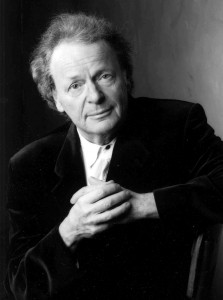
Austrian-born pianist Anton Kuerti delivered an awe-inspiring opening night performance for the TSM Festival at Koerner Hall on Tuesday July 20. Courtesy Toronto Summer Music Festival
By Emily Dontsos
If master pianist Anton Kuerti’s spectacular opening night performance for the Toronto Summer Music Festival on July 20 is any indication of what to expect from the festival’s 12 remaining concerts, then classical music lovers are in for a treat.
Held at the architecturally and acoustically astounding new Koerner Hall in The Royal Conservatory of Music’s TELUS Centre for Performance and Learning (273 Bloor St. W.), Kuerti’s all-Schumann program kicked off the festival’s fifth season with a brilliant display of masterful interpretation, impeccable timing, and truly awe-inspiring musicianship.
Preceded by proud and heartfelt opening remarks from TSM president Barbara Thompson and outgoing artistic director Agnes Grossmann, the mastermind behind the festival’s inception and growth within a city previously lacking access to classical music during the summer months, Kuerti’s performance opened with three dramatic and highly varied movements from Schumann’s Novelettes, Op. 21.
Bent over Koerner Hall’s beautiful new Hamburg Steinway piano, with his shock of white hair and matching jacket adding an air of drama to the already charged atmosphere, Kuerti delved into the opening pieces with utter commitment to his music. Fully concentrated and emotionally involved, the pianist’s rendering of Schumann’s exhilarating, playful and deeply moving compositions captivated the audience completely.
The three Novelettes were followed by the soaring Fantasie in C major, Op. 17 and the powerful Toccata in C major, Op. 7, with the towering Grand Sonata No. 1 in F# minor, Op. 11 as the closing piece. Punctuated by dramatic moments of seemingly impossible silence between movements, Kuerti’s interpretation of each piece reflected a deep respect for Robert Schumann’s emotionally complex and highly intricate work. Masterfully perfecting the frequent and sudden transitions from building crescendo to peaceful melody that are characteristic of the Romantic composer’s music, Kuerti’s performance was nothing short of brilliant.
Born in Austria, Anton Kuerti was raised in the U.S. but has spent the majority of his adult life in Canada. He has toured 39 countries and has performed with most major U.S. orchestras, including the New York Philharmonic, as well as the Toronto Symphony and Montreal Symphony orchestras. A leading performer of Schumann’s works, Kuerti was honoured with the 2007 Schumann Prize of the Schumann Gesellschaft in Germany, and is also a recipient of the National Arts Prize of the Banff Centre in Canada (2007) and the Governor General’s Lifetime Artistic Achievement (2008).
The TSM Festival’s opening night performance by one of the world’s greatest living pianists was an unequivocal success. With 12 concerts featuring some of the best established and up-and-coming international artists still to go, the festival’s fifth season is truly a cause for celebration.
As she prepares to move on from the festival to pursue her international conducting and concert schedule more fully, Maestra Grossmann can rest assured that what she set out to accomplish has been achieved: the TSM Festival is quickly becoming an anticipated fixture in Toronto’s classical music scene, an institution unto itself, and an integral part of city residents’ summer plans.
The TSM Festival runs from July 20 to August 13.
Tags: Arts · General
July 20th, 2010 · Comments Off on G20 Annex snippets
No justice, no grease
Annex resident and former Gleaner editor Liivi Sandy called the police after she heard “violent and very unnerving” smashing at 2 a.m., on the eve of the G20.
She initially thought her home was being broken into. Sandy then looked out her window and saw a person dressed in dark clothing smashing the windows of KFC (636 Bloor St. W.). The vandal then ducked into the Green P parking lot on Euclid Avenue.
“There was no way I was going to let those vandals take my poutine,” said Sandy.
Within minutes, a police officer arrived at her door to take a statement. While there, he told her that there were two perpetrators, who had already been caught, and that the incident was likely G20 related.
Windows at the nearby Bank of Montreal were also smashed. Both businesses had replaced the damaged windows by the end of the weekend.
—Emina Gamulin
Well spent, well spent, one dollar
The G8/G20 Alternative Media Centre had a run-in with the law during the G20 weekend.
Police visited the centre on June 27 to investigate complaints from neighbours of possible squatting and/or breaking and entering.
“[The police] came and they wanted to talk to people and we said ‘You don’t have a warrant, we don’t want to talk to you,’” said Gwalgen Dent, a spokesperson for the centre.
Dent remained skeptical that any neighbours had actually complained in the first place.
“I’m not sure how a complaint could have been made by a neighbour given that we had flyered every single neighbour in this area and informed them of why we’re here and what we’re doing.”
Dent says the last thing that police said as they left the AMC was “You’re only making this more difficult than it has to be.”
The owner of the space, David Patrick, who also owns the adjacent Linux Cafe, explained to police that he was renting out the space to the organization.
Patrick welcomed the AMC after members of the group—who had been using his cafe as a meeting place this spring for their campaign efforts against Canadian mining company injustices—approached him to use the cafe as a meeting place for citizen journalists covering the G20.
“[The people at the AMC] aren’t activists, they’re journalists,” explained Patrick, who rented out the space to the AMC for $1.
The AMC was a temporary set-up of independent media organized by The Toronto Community Mobilization Network. The group operated out of a workshop on Jersey Avenue, just north of Harbord. It launched on the 21st and operated 24 hours a day, seven days a week, until it closed its doors on June 29.
—Tim Legault
The media, united, will always be invited
Due to the closure of the University of Toronto campus during the G20, CIUT 89.5 fm radio made a temporary home at the Gleaner office (720 Bathurst St.).
CIUT started their emergency programming on June 24 and had what will likely be their last broadcast from the Gleaner on the Monday after the summit, with their regular local morning news program Take 5.
Amy Goodman, founder and host of Democracy Now, was a guest host for CIUT’s G20 special. The Gleaner caught up with Goodman after her talk for a fundraiser for CIUT radio at Trinity St. Paul’s United Church (427 Bloor St. W.). She spoke of the importance of independent media and communities. She urged communities to get organised, get informed and share that information.
“Understand that the experts are the experts in your community,” she said. “Don’t be fooled by the corporate networks that bring us this small circle of pundits, who know so little about so much, explaining the world to us and getting it so wrong. The experts are in our communities, on every issue. People who are living the reality on the ground—they are the ones with wisdom, and that’s why local media is so important.”
Democracy Now can be heard on CIUT every weekday. For a full schedule, click here.
—E.G.
Tags: General
July 14th, 2010 · Comments Off on Z’s by the C: Public napping project hits Toronto
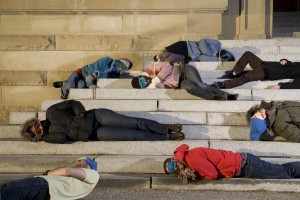
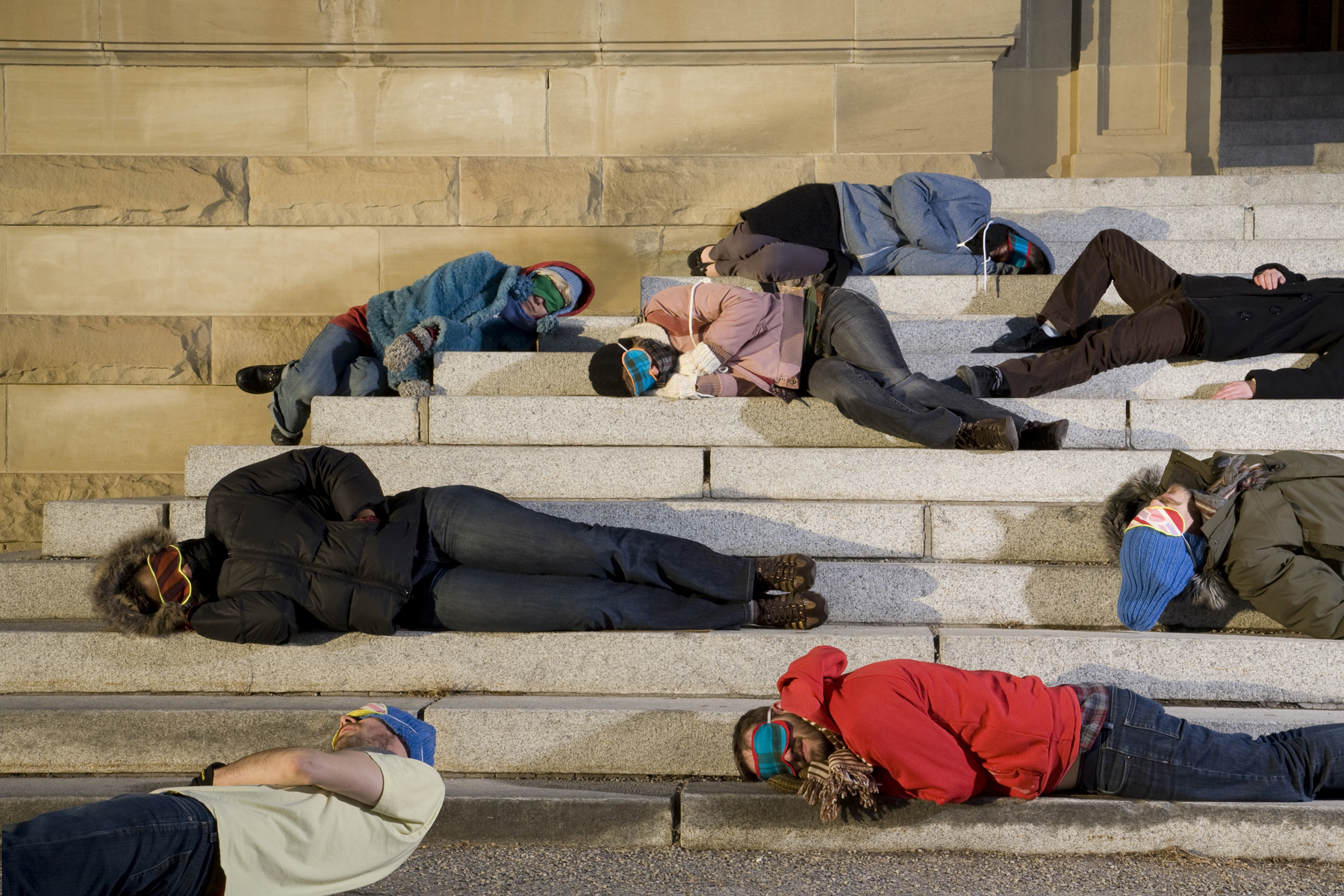
Artists Eric Moschopedis and Mia Rushton are turning parks into bedrooms. Courtesy The Theatre Centre
By Brendan Hair
On July 17 and 18 The Theatre Centre in partnership with Cooking Fire Theatre Festival will be presenting a public napping project called Z’s by the C.
At this event residents can craft their own sleeping mask and have a sweet dream or catch up on lost sleep from the hectic work week.
The project, founded by artists Eric Moschopedis and Mia Rushton in 2008, began in Calgary when anti-loitering bylaws were passed. According to Moschopedis, the bylaw restricted the amount of time people could spend in parks without a specific purpose and prohibited feet resting on benches. Eventually these laws led to public napping becoming illegal.
Since then, Moschopedis and Rushton have used this project as way to protest the privatizations of public space.
He believes public sleeping is viewed by many socially unacceptable behaviour. According to Moschopedis, public sleeping is often seen as threatening behaviour. And since it’s usually a private activity, Moschopedis sees this project as one that’s “transgressing social norms.”
Theatre Centre Director Franco Boni previously participated in the project at the Magnetic North Theatre Festival in Ottawa.
“I’m looking at it as a performance piece but I’m also looking at it as a community event because that’s what this kind of work can do,” said Boni.
Moschopedis believes that as a community, if we’re not acting in a genuine manner then we’ve lost our grip on public space.
“I think that’s the risk,” said Moschopedis.
Moschopedis believes dreams differ depending where you sleep. To him dreams are a site-specific activity.
“When you’re in your bedroom you have [a] certain type of dream and when you move to a different environment [like] a hotel or camping your dreams change.”
Besides Calgary and Ottawa, the project has stopped in New York and Zurich. But what makes Moschopedis excited about Toronto is the event’s setting at the proposed Lisgar Park. While the site is currently just a parking lot with sod, Moschopedis believes it suits the concept of this project.
“People can come to this park and dream what might be possible [and] what this new public space [might] look like.”
Tags: Arts · General
July 9th, 2010 · Comments Off on Off the chain: Toronto celebrates Mad Pride Week
By Min Kang
Mayor David Miller has officially proclaimed July 12 to 18th Mad Pride Week.
“It’s throwing the word back in the face of the general public who think mad is a horrible kind of state to be in, so we throw it back into the face of society, just like gays throw queer back, and there are various groups in Mad Pride who take different positions on the whole matter. Some are psychiatrized, some are just ‘normal people’,” said Mel Starkman, a co-organizer of Mad Pride.
Borrowing from Gay Pride, Mad Pride attempts to reclaim terms that are used against them as a source of empowerment, giving the self-proclaimed mad community the opportunity to celebrate their own difference, and raise awareness of the obstacles that they face including the stigma attached to being in the psychiatric system
The Mad Pride organizing committee comprises of a group of psychiatric survivors and friends within the city including The Friendly Spike Theatre Band (TFSTB), an artist-run community theatre dedicated to encouraging theatrical expression for psychiatric and consumer survivors.
Heinz Klein, a co-organizer and technical director for Mad Pride explains that the psychiatric survivor community in Parkdale is strong because many survivor migrated to the area after deinstitutionalization.
“Parkdale in itself was really close to Queen Street and to the old Lakeshore hospital. So people gathered here together and they really created a life for themselves here. That’s why there is a high population of psychiatric survivors and others who have been affected by the mental health system in this area. There are certain services here that other parts of the city don’t have or only sporadically have, like the Parkdale Activity Recreation Centre (PARC), created to accommodate people who have been pushed out of hospitals just simply to give them a place to hang out.”
Starkman added, “Basically it grows out of poverty. You know, when you are poor and you can’t cope with society you get into a situation where you’re strung out and more and more people are entering that stage in this failing economy, and more and more people are turning to the whole concept of madness to express themselves—they are angry they have to live in such a way that they are oppressed, and that’s a very dangerous way to live.”
Klein believes that Mad Pride Week is just the right outlet for channelling that expression.
“To celebrate Mad Pride and make it a weeklong event is actually using something which I call, ‘creative resilience’. That means we are overcoming the obstacles in the kind of creative way that claims for us the label mad as something positive, whereas everybody else is looking at that and says it’s something negative.”
The big event at this year’s festivities will undoubtedly be the “Bed Push,” on July 17, involving survivors in pyjamas pushing a gurney dressed like a bed with sheets covered in words of empowerment. Ruth explains that the bed push—originating in 2006 by Rufus May, a psychiatric survivor and activist in England—is a metaphor for Mad Pride.
“We push out of the medical model of understanding difference and into the community,” said Ruth Ruth, community theatre director with TFSTB. The Bed Push starts on the grounds of CAMH, down Queen West, into Parkdale and stops at PARC.
Though this may sound “crazy” to some, Klein observes that there are much crazier decisions going on in the world.
“We have over a hundred thousand homeless people living in the city, and yet the government wants to spend over a billion dollars to accommodate 20 people instead of spending only ten percent of this money to accommodate a hundred thousand of their own kind in this country. That is madness. And they call us mad. But what they are doing is madness.”
Every year The Friendly Spike Theatre Band develops a community based play. This year they will be staging, The Dega and the Delbasid, at 20 Westlodge Ave. on July 16 at 7 p.m. To find out more details of events happening on Mad Pride Week, click here.
Tags: Arts · General
July 9th, 2010 · Comments Off on The Euclid-Dundas Fire [PHOTOS]

It isn’t pretty but Cafe Brasiliano & Columbia—west of Musa Restaurant at the corner of Euclid Avenue and Dundas Street West—becomes the likely victim of water and smoke damage when a fire erupted on July 4, 2010. We photographed the occasion and put it on our
Flickr page. Matt James/Gleaner News
Tags: News