December 29th, 2010 · 3 Comments

Despite the many offers he has received, Paul McCaughey will be keeping the Matador’s iconic sign at his new community living space. Plans for the building include a live music venue, a restaurant, a fitness centre, and perhaps a Russian steam room. Beth Macdonell/Gleaner News.
Exclusive to the Gleaner
By Beth Macdonell
It has been years since the last mickey of rum was served and the last band performed, yet those who frequented the legendary booze can will never forget the Matador (466 Dovercourt Rd.).
After showcasing more than 40 years of some of Canada’s greatest country and folk music, the venue narrowly escaped the indignity of becoming a parking lot. But with new ownership comes a new lease on life.
Paul McCaughey, 52, founder and master teacher of T’ai Chi at The Rising Sun School of T’ai Chi Ch’uan (908 Bathurst St.) took ownership of the historic venue in March 2010.
Speaking exclusively to the Gleaner about the future of the building, the Annex resident said it is being renovated into a multi-purpose, mixed-use space focused on active community living. “Its mandate is all living arts,” said McCaughey, who has taught T’ai Chi for 30 years. “Fitness, food, music, lifestyle, [and] education.”
Wellspace, the name of the new enterprise, was chosen based on the idea of the well, “a place that can be resourced and draw a deeper sense of living.”
In addition to his T’ai Chi accomplishments, McCaughey is also an expert in Russian Martial Arts where he teaches at Systema Downtown (927 Dupont St.), and is a doctor of Traditional Chinese Medicine.
McCaughey said he’s been looking for the right space for his plans for the last decade. “The old Matador is the perfect place.”
Although still a work in progress, McCaughey said Wellspace is set to open by the end of 2011, and will have three main components. There will be an event space in the 4,000 square foot ballroom. It will be equipped with a stage, bar, and a catering kitchen, able to accommodate musical acts and private gatherings. There will also be a restaurant at the front at the mezzanine level and a 1,200 square foot dance studio in the basement, available for classes and workshops—ranging from pilates, to dance, to t’ai chi. “We’re looking at activities that are non-equipment… that really only require using your own body.”
McCaughey said he also has plans for an artist-in-residence type program and would like to one day incorporate a spa and, possibly, Russian steam rooms, where “people can come to the waters.”
In 2007, when the Matador closed its doors, the city tried to expropriate the property, have the building torn down and made into a parking lot. After the community rallied against the move and well-known voices, such as author Michael Ondaatje and members of Blue Rodeo, spoke out against the plans, the decision was defeated in council.
McCaughey said he’s working to preserve the building’s past. Despite many offers, he is keeping the iconic Matador sign. He will also be keeping the signature wall in the ballroom, which carries the signed names of some of North America’s most celebrated country and folk singers who visited the Matador, including Johnny Cash, Leonard Cohen, K.D. Lang, and Stompin’ Tom Connors. “It’s 45 years of history,” he said, adding that there must be at least a thousand signatures on the wall.
McCaughey is also planning to pay tribute to the building’s original use, a dancehall for soldiers during World War One. Open until 1920, McCaughey said it was likely the last dance soldiers had before going overseas. Recently, he found an old ticket in the crawlspace of the building from one of these dances, which had a chaperon’s name written on it.
Today, the space is still as unique as it is beautiful. “The floor is hundred-year-old sprung hardwood maple. There are two skylights, ceilings are 26 feet high. It’s hard to find a ceiling that high in Toronto that isn’t a church,” he said.
Charmaine Dunn is the daughter of Ann Dunn, the long-time owner and operator of the Matador, who passed away in June at 81. She said the family “couldn’t be happier” about the building’s new prospects. “I definitely think Paul has the creative energy to do something great with that space. I was very pleased that he was the purchaser of the building,” she said.
Ann opened the Matador in 1964 with the desire to create a music venue. Charmaine said her mother fell in love with the building immediately, especially the archways, which reminded her of Spanish architecture, which inspired the venue’s name.
At the time it had been renovated into a bowling alley. When Ann ripped out the lanes, the original hardwood dance floor was revealed.
“She didn’t want to let it [the Matador] go,” said Charmaine, now in her 50’s. “I mean she held on to it into her 80s, that’s almost her entire life … I think she was pretty heartbroken that it was the end of the era. Truly, her whole life was that venue.”
“My mom used to be all dressed up to the nines with glitter,” she continued, reminiscing about the old days. “My favourite act was when Tom Petty and the Heartbreakers were in town doing a show. Tom Petty didn’t come in, but the Heartbreakers sure did.”
Charmaine said her mother’s driving force was her love of music, and she was committed to promoting local acts. Musicians, bartenders and other late-night revellers would come to the after-hours spot and dance the night away.
“The saddest thing about the club is that my mom never really received the recognition she deserved for her contribution to the whole country music scene in this country,” said Charmaine. “She really did promote Canadian country music and that was her whole thing.”
Jason Wydra, 38, a music promoter and Queen and Bathurst resident who used to frequent the venue, said the closing of the Matador was sad. “It had a real party vibe,” said Wydra, remembering his first visit back in 2001. “It was very dark in there and there was a band playing.”
Oddly, he said it was at the Matador where he first heard the song “Sweet Caroline.” He said the feel of the building was very nostalgic. “You could really relate how people threw down in old days honky-tonk style. It’s not a vibe I’ve experienced anywhere else. I think Toronto has really lost something.”
Despite the loss, Wydra said that Wellspace sounded interesting and is looking forward to seeing it open.
“I’m hoping it’s an example, a model for urban renewal,” said McCaughey. “The greening of a building—a place to study, eat, live, learn, and celebrate, all of these things.”
Tags: News · General
December 29th, 2010 · 3 Comments
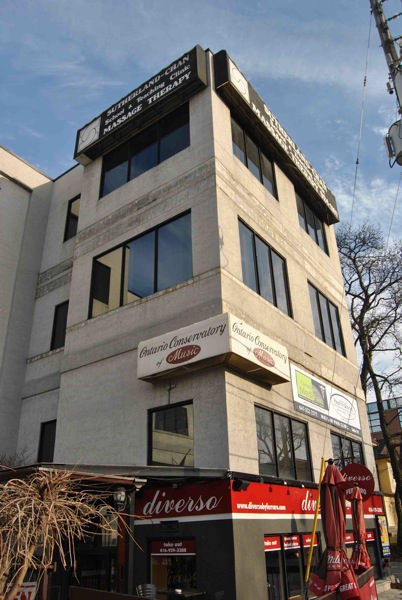
328 Dupont Street is one of six properties referred to in an Official Plan amendment application. Perry King/Gleaner News
By Perry King
The Wynn Group is moving forward with its plans of developing a 29-storey hotel and condominium on a strip of Dupont.
An application to amend the Toronto Official Plan, that will change the designation of six Dupont properties from an employment to a mixed-use site, was submitted by the Wynn Group in May, but was only given public notice in October.
The application was submitted in conjunction with the proposed hotel-condo project that the Wynn Group ultimately wants to develop on the site.
If the Wynns’ applications are approved for amendment and rezoning, the development will be the largest on Dupont Street since the Loblaws supermarket (650 Dupont St.) came to the neighbourhood in the mid-1990s.
The Wynn Group, led by Paul and Les Wynn, have been proposing a mixed-use development on the site for years. According to an article from the January 2008 edition of the Annex Gleaner, Paul Wynn sought community feedback on a proposed 22-storey residential property with commercial entities and professional offices. “The issue, right now, before the city, is whether or not the land should only permit employment uses, and the reality is within employment areas of the city, it’s a pretty narrow range of employment uses,” said Mark Flowers, the Wynns’ legal representative.
Perceived by local residents and the Annex Residents’ Association (ARA) as “precedent-setting” at the time, the Wynns retained counsel in 2009 and have been doing their own research into the feasibility of mixed-use.
The Wynn Group, operating for 40 years, is based out of an office at 330 Dupont St. They have over 2,000 residential properties and 2 million square feet of commercial space in the GTA. Those include high-rise buildings in Parkdale, including the notorious West Lodge Apartments. The Wynns were awarded the runner-up “Golden Cockroach Award” by the Parkdale Tenants Association (PTA) in 2004. They also have a retail chain for furniture and appliances.
The amendment application, to be taken up by community council as early as January, only publicly refers to 328 Dupont but also applies to 330, 332, 344, 358, and 374. These properties are mainly filled with businesses that rent the spaces, including a few massage therapy schools, a DNA testing centre, and an office for the Ontario Conservatory of Music.
The city has traditionally rejected residential applications on the north side of Dupont because it is provincial policy to have cities protect these lands since they are economic generators. The Wynns originally wanted to apply the amendment to the entire north side of Dupont to Bathurst, feeling the land was not being used to its fullest capacity. Since there is already a limited number of residential tenants, they believe it is already a de facto mixed-use area. However, consultants recommended keeping the application specific to properties the Wynns own, as well as the adjoining auto shop at 374 Dupont.
Barry Brooks, the city planner handling the Wynn’s application, is pessimistic about their chances. “We have some concerns, obviously, because changing the Official Plan designation from employment area to mixed-use area is a substantial change. We’re interested at looking at what’s appropriate, and we’re still making that determination at this point,” he said.
Brooks will be reporting the status of the amendment application in the new year. “Staff are taking a close look at the application and are evaluating it against the context of the city’s official plan and provincial growth plan for the Golden Horseshoe, and we’ll be reporting to council on that,” said David Oikawa, Brooks’ superior in the city planning department.
Should council adopt the position of rejecting the application, Flowers said the Wynns will likely appeal at the OMB. “I would fully expect that we would then appeal that, and the Ontario Municipal Board would have to make a decision on the land use issue.”
Community opinions on the matter vary. In 2008, locals expressed concerns about traffic congestion, proximity to the CP rail corridor, and the possibility of obstructing the sight lines from Casa Loma (1 Austin Ter.).
Those height concerns are echoed today by ARA chair David Harrison, who finds the 29-storey height to be “crazy” and “a mistake.” He hoped that a Dupont Visioning Study, similar to the previously completed Bloor Visioning Study, could be developed before Wynn’s proposal was considered. “I am told nothing will go ahead with the Wynn brothers until after that. Who knows, we got a new team downtown, but that’s the last I heard,” he said.
The ARA’s position is that height restrictions for buildings on Dupont should be capped at seven storeys.
While Harrison said that the local community would not be in favour of a residential development on-site, there are some who see a benefit to it. “There are a lot of mixed feelings, people that live around the area are happy because their property values will go up,” said Robert Chee, who manages the Diverso restaurant and cafe (328 Dupont St.).
“I personally think the area needs it. There’s not much on this strip from here to Bathurst, or just past Howland. There’s no banks or hairstylists or convenient places to shop. It might be good for this area.”
A Dupont revisioning study, a project to be taken up by Councillor Adam Vaughan’s office (Ward 20, Trinity-Spadina), the Planning and Growth Management Committee, and city planning, has been talked about for years, but the city planning department has been stalled by lack of revenue. But with the Bloor Visioning Study completed, the time may be right to get the study underway.
“We’re hoping to have some discussion as to what would be the appropriate form for development on Dupont. Obviously it’s going to be mixed-use, but I think we would very much hope that height restrictions would be in place. We’ve seen some height restrictions now on some developments,” said Harrison.
The Wynns have not yet submitted an application for the rezoning of the development, but plan to do so if their amendment application is approved.
Tags: Annex · News
December 15th, 2010 · Comments Off on Sweeping up Bellevue: Community lukewarm over month-long blitz
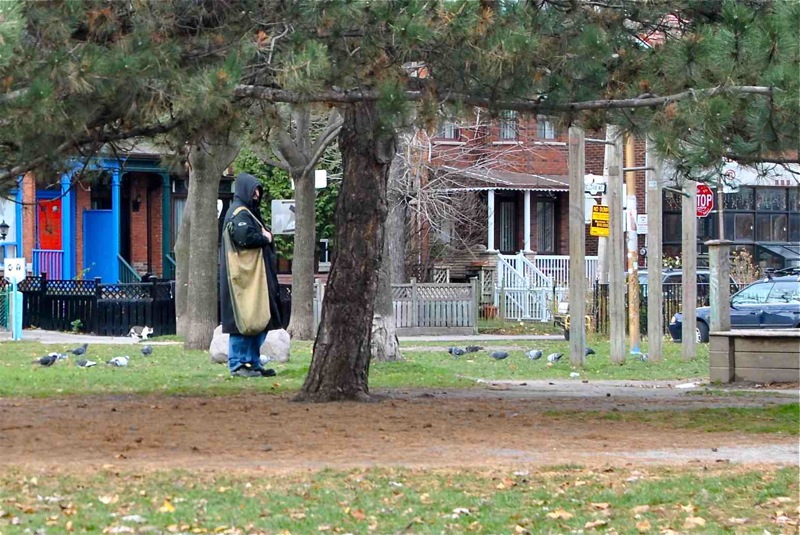
Bellevue Square Park was the site of a month-long crime blitz this fall. Perry King/Gleaner News
By Perry King
Out of the 68 arrests that were made in a Kensington-area drug blitz, police Sergeant Jeff Zammit remembers one arrest that bothered him.
“We dealt with one guy that was trafficking, and he was with a woman and a baby in a stroller—it was his girlfriend—while he was selling,” said Zammit, who is a part of 14 Division’s community response unit.
“He said, ‘You know, I know I sell weed, but it’s not serious. Why don’t you go after the crackheads?’”
Targeting street level drug dealers of marijuana was the main focus of a crime blitz in Bellevue Square Park. 14 Division began preparing for the blitz this spring as a result of concerns raised by local businesses and residents at a 14 Division community police liaison committee meeting. It lasted from mid-September to mid-October.
Coordinated by Sergeant Daren Halman, 40 plainclothes and uniformed officers were present in the park, following up on tips.
Police also cracked down on other illegal conduct. “It’s not strictly drugs [we were enforcing], it was alcohol, dogs off their leash, and people breaking smoking bylaws—people were smoking beside a kid’s area,” said Zammit.
After 14 Division reported an initial 55 arrests on Sept. 28, Halman updated that number to 68 at a community police liaison meeting Oct. 13.
Police have laid various charges, including Trafficking in Marijuana, Possession Marijuana, Assault Police, Proceeds of Crime, Fail to Comply Probation, Fail to Comply Recognizance, Fail to Appear Court, and Possession of Ecstasy. Police is withholding information about the accused, including names, ages and future court dates.
Through their sources, 14 Division was also able to execute a drug seizure at an Augusta Avenue home. With the help of the Toronto Drug Squad, about $1 million in marijuana was seized. “They seized a large quantity of plants, which we believe was supplying the area as well,” said Zammit.
The search warrant, which applied to several homes in the neighbourhood, was executed Sept. 29. It was one of a dozen citywide search warrants issued as a part of Project Shuffle, a separate police drug enforcement blitz that began in July. 14 Division solely executed the 14 Division blitz.
The month long blitz was the first in the market since 2009. That year, two blitzes were undertaken. In July 2009, Project Escape saw plainclothes officers arrest 76 street dealers primarily in Kensington, but also on King, Queen and Dundas streets. Project Escape was also prompted by neighbourhood complaints. Besides marijuana, cocaine, hashish, heroin and oxycontin were seized. Many of the people arrested had previous convictions. In the fall, Project Sunshine arrested 60 street dealers in Kensington and other major downtown areas.
But the police and the community still see a “revolving door” of drug problems. “I find the problem with Kensington Market is that people think it’s carte blanche to smoke and sell marijuana in that area. They think it’s like a drug zone, when in fact it is illegal to use it or sell it,” said Zammit.
Some members in the community seem less than pleased with the blitz. “If the police walked a beat like they used to, instead of staying in their cars all the time, the city would be a much safer place,” wrote Grey Coyote, of Kensington Market Action Committee in an email.
“Kensington is far from the only area of the city with problems. We are diverse and unique and St. Stephen’s feeds hundreds of homeless people every day. As long as they are doing that, we are going to have a higher than average crime rate.”
Others recognize the drug problem, but say it is a part of what defines the neighbourhood.
“I think there are eyes on us at all times,” said Mika Beraket, who chairs the Kensington Market BIA. “Yeah, there are drugs in the market, particularly in Bellevue Square, but that’s part of the culture here. I’ve never felt frightened walking through that park. I felt more frightened walking on College Street, with all those high heels parading around.”
Recognizing a need to improve safety, the BIA is considering capital funding for improved street lighting at night. Those plans will be explored in the new year.
Tags: News · General
December 15th, 2010 · Comments Off on Ward 18 defeated cry foul
By Rebecca Payne
Multiple campaign managers of Ward 18 (Davenport) candidates claim questionable tactics were used in the race, and are pointing their fingers at newly elected Councillor Ana Bailao’s campaign.
Bailao edged out Adam Giambrone’s former executive assistant Kevin Beaulieu by 1,366 votes.
Beaulieu’s campaign manager, as well as fellow Ward 18 contender Kirk Russell, allege that the election was marred by the presence of phoney city translators, proxy forms being sent to people who never requested them, and campaign office lines being tied up by calls about an offer for free pizza. In all but the last case, the allegations are directed at Bailao’s campaign, or it is insinuated that she was involved.
Bailao denies all accusations of wrongdoing.
An article written by Roger Brook, a volunteer for Beaulieu’s campaign, published in Now Magazine raised questions as to a possible link between Senso Magazine, a Portuguese publication, and Bailao’s campaign. In response to the article, Bailao said, “Well, that magazine published an article on me like many other Portuguese-Canadian newspapers and magazines. I was on the cover of a couple other newspapers.
“I’m somebody that the community knows. When you’re in an ethnic community they tend to talk about what their people are doing. That’s what happened. That’s all I have to say.”
Bailao was also quick to point out that the writer of the article neglected to mention that he was working on Mr. Beaulieu’s campaign when he called her, and others quoted in the article, for comments. She also added, “After I won, I was on the cover of another three community newspapers.”
A later article Brook wrote, also published in NOW, says there were reports of phoney volunteers on election day, and refers to “Bailão’s campaign tricks.”
“We had several reports of volunteer translators working inside polling stations,” wrote Michal Hay, co-manager of Beaulieu’s campaign, in an email. “City staff told our scrutineers that they had been sent by the city to help translate and a few of them had shirts that read “I speak Portuguese” in Portuguese. Given that the translators were not wearing credentials we asked the elections staff to call their supervisor, who confirmed that the translators were not sent by the city, but were impostors,” said Hay.
Although the translators were asked to leave, Hay said that many continued speaking to voters. “One had even been sitting with the clerk who was signing in voters and simply moved to the front entrance and continued addressing voters.”
Elizabeth Pereira, campaign manager for Kirk Russell, said that on election day she received a phone call from Beaulieu’s campaign manager, telling her to “get down to Poll 22 immediately.” Pereira said that the Russell campaign team were in contact with Beaulieu’s team all day long.
“People were there trying to claim they were translators … they were asked to leave. Then these two gentlemen [who] were trying to go in as translators, once they left, they went to Poll One and registered as scrutineers for Ana Bailao. Apparently there was a lot of that going on; going from poll to poll to poll,” said Pereira.
When asked about this issue, Bailao said, “All our volunteers had my forms to sign in as scrutineers, so that’s the people that signed in as scrutineers. Whoever was working for the city I don’t know, whoever was working for me. I mean, I have my volunteers and they were scrutineering and pulling out the vote like any other campaign.”
There are other, more serious allegations that some are making against Bailao. According to Russell, a few days before the election he received a call from an elderly woman who was distraught because she had received a proxy form she had not requested. “She said Ana’s campaign had given it to her. They called her and told her it was in the mailbox.” The woman, who is housebound, was under the impression that she would be able to vote from home, as she had done in previous federal and provincial elections—not that she would receive a proxy. “[She said] she was told by Ana’s camp that ‘Everybody else had received their forms.’ [They] didn’t use the word proxy,” said Russell. The police were called, but since the woman had not signed the proxy, charges could not be pressed, although a complaint was filed.
According to Bailao, “If she got it in the mail, that’s all she got, right? Whatever she does with it it’s up to her … I can’t comment, I don’t know who that person is.”
Proxies were a contentious issue in this election. At Poll 12 (St. Anthony’s Catholic School), police were called on election day. Vince Demasi, a scrutineer for Russell’s campaign, was there.
“There was a high volume of people there, usually at a poll you get 300 to 400 people, I just thought the volume was too high. [Someone] had a proxy mailed to someone who lived at Ana Bailao’s house.” This set off alarm bells for Demasi, and he challenged the proxy. “Why would you, as a candidate, have someone mail a proxy to you? I just thought that smelled.” Despite police questioning, the person with the proxy was allowed to vote.
When asked about this proxy, Bailao said, “I’m not the only person who lives in my house. There’s some people that live here, and people vote where they live and people receive mail where they live.”
As for the police being called, Bailao said it was her understanding that the police were called because “[the person making the complaint] intimidated to city official so much that the city official felt like they had to call the police.”
Demasi’s response to this accusation was, “She’s out to lunch!”
Demasi said that police were called because of the possibility of election fraud. “Do you honestly think an election official who has the power to shut down a poll would be intimidated by a scrutineer challenging a proxy? No. She’s lying.”
“We know that her [Bailao’s] camp had a tremendous amount of proxies,” said Pereira.
Pereira also filed a complaint on election day, regarding a poll clerk at Poll 12. “As I was coming in to St. Anthony’s, one of the ballot clerks was conversing with Ana Bailao’s people. When they saw me, they quickly dispersed.”
Bailao’s response to this account was: “I have no idea what that is. I did not come across any information like that.”
This same poll clerk also had an encounter with Demasi. While on duty as a scrutineer, an elderly woman, a neighbour of Demasi, was told that she had already voted. “She said ‘Can you help me? They say I’ve voted already.’ I went to the DRO, and said ‘She said she never voted.’ Then the poll clerk says, ‘I’m the one that took the vote.’ I said, “She’s 80 years old! She’s not coming down here [to vote] twice.” The woman was eventually issued a ballot.
“I’ve been involved in a lot of campaigns, this one just didn’t go right,” said Demasi.
Russell echoed this sentiment: “We all worked together because we wanted a fair election, and unfortunately, I don’t think we had one.”
YouTube videos that aim to damage both Bailao and Beaulieu surfaced leading up to the election.
In one, a volunteer canvassing for Beaulieu is caught with a bag that the creator of the video alleges contains Ana Bailao literature, with the implication that it was stolen.
Another is a video spliced with footage of Bailao at a debate and footage of an interview, conducted by Kirk Russell, with a bakery owner. This video attempts to discredit Bailao’s comments at the debate, but it is obviously cut in an amateurish attempt to discredit Bailao.
Another questionable event on election day—which on any other day would have been benign—was someone was distributing flyers at Yonge and Eglington offering free pizza.
It turns out that the phone number on the flyer was not for a pizzeria, but for Beaulieu’s campaign office. “We had seven phone lines in our office and a full phone bank of volunteers calling voters reminding them to vote. In the final hours of election night phone calls starting pouring in, tying up our lines, preventing us from calling voters,” said Hay. According to Hay, the name of the pizzeria “didn’t exist.”
Tags: News · General
November 30th, 2010 · 1 Comment

The Tollkeeper's Cottage is the only restored and operational one of its kind. Matt James/ Gleaner News
By Susan Oppenheim
I met Jane Beecroft in 2008, when she brought flyers into my shop for the opening of a nearby historical restoration.
At the time I knew nothing of heritage work, the Community History Project (the group she founded), or the Tollkeeper’s Cottage, and I had little interest in the undertakings at the corner of Davenport and Bathurst.
From Jane, I have since learned that Davenport Road is one of the oldest and largest First Nations trails in the world, at over 10,000 years old. The tiny (20 by 30 feet) 19th century cottage on the northwest corner has been salvaged, moved five times and restored with over 1,500 volunteer hours of labour, fundraising, and lobbying.
This is a treasured feature of the Annex, and, as the only restored and operational tollkeeper’s cottage of its kind, it also holds an enormous significance on the world’s stage as well.
Jane was one of five children born to working class parents in Oshawa. “I was born in 1932 at the beginning of the depression, and there were lots of periods in my life when I went without, but that does not colour the way I look at the world,” she said. “I am able to think, and so I do not act as a deprived person. I learned things by osmosis; by being around people.”
At age 51 she was living alone, commuting to Toronto from on top of a mountain outside Bancroft, as an established freelance writer for the CBC. On those trips she sat listening to her short-wave radio, learning about global-issues.
Gazing down and seeing how progress was eroding the heritage of Canada’s largest city, she and seven others banded together to form the Community History Project (CHP).
After decades of lobbying city hall, she has earned the nickname the Dragon, but Mississauga First Nations, Toronto’s earliest residents, call her the Truth Speaker. “Without the help of the Indians, the settlers would never have even survived. You can’t possibly know where you are going until you know where you’ve been,” said Jane.
A quarter century later, the areas CHP services now include the Annex, Seaton Village, and Yorkville.
When they started out, they had no idea where to focus themselves, so they preserved and collected any historical assets and documents of heritage buildings, ravines, rivers,photos, letters, anything they could get their hands on. “I realized that history was not taught properly in the schools; it was compartmentalized, not fluid. Most people knowvery little about history—you have to delve deeper to understand the layers of communities.”
Today, I am sitting with Jane, who still chairs the CHP, surrounded by historical materials at their generously donated offices, which span the 2nd floor of the 97 year-old historical noted Bank of Nova Scotia (at Church and Queen).
Listening is not something many of us do often or well enough, but Jane holds my attention. She is not only very well informed but also generous with stories—stories that rarely begin with “I,” but rather with “they” or “we.”
Successful volunteer coordinators must possess the art of engagement, and Jane certainly does. “We are, all of us, volunteers,” said Jane, “[that] rely on the funds we must generate ourselves. We apply annually for a grant from the Ontario Ministry of Culture based on what was already spent. We receive only $1250 a year for maintenance and upkeep and the rest we have to raise ourselves.
“It is not about individuals, or me. It is about the responsibility felt to further our understanding of ourselves as a city and as a part of a nation, using history as the model.”
If this is of any interest you can:
1. Become a member for $20 annually.
2. Come to the cottage Saturdays between 10 a.m. and 5 p.m. and meet the indomitable Jane. If you live in the Annex, I assure you she can tell you about the history of your street and community.
3. Arrange group visits on Tuesdays, and find out about collecting tolls—the lives lived, risks taken, and hardships endured in 1835.
4. Attend their events—invited speakers’ series, seasonal festivals.
5. Join the board of directors or volunteer; offering your expertise, fundraising abilities, and much appreciated hours of time.
6. Offer writing and computer skills.
When you visit, there are pamphlets outlining other projects, docents on hand (skilled volunteers), and authentic recipes and other small items for sale.
For more information visit the web site or phone (416) 515-7546.
Tags: People · General
November 23rd, 2010 · Comments Off on Shootings shock community: Police say recent violence mostly targeted
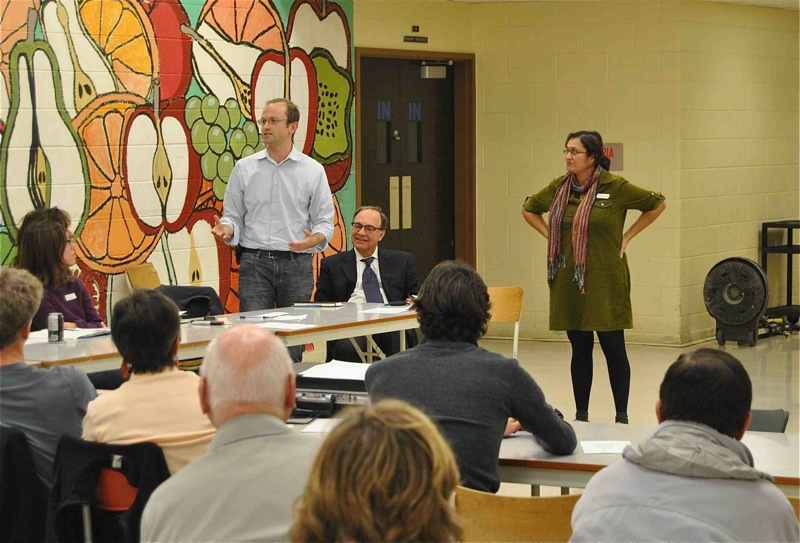
A day after the Oct. 25 Toronto election, Councillor-elect Mike Layton (Ward 19, Trinity-Spadina) attended this community meeting. Perry King/Gleaner News.
By Perry King
Investigations on three of four recent shooting incidents in the Annex area are still open, according to updates from 14 Division.
At a meeting on Oct. 26, over 50 people packed into the Bickford Centre cafeteria (777 Bloor St. W.) to hear Inspector David Vickers and Detective Sergeant Brian Kelly announce that investigations for shootings on Sept. 26, Sept. 30, Oct. 8, and Oct. 20, are progressing but police still need help with information.
The meeting was organized by the Friends of Christie Pits Park (FCPP) and the now renamed Christie Pits Residents’ Association—formerly the Christie-Ossington Residents Association (CORA)—in response to growing resident concerns.
Business owners, local residents, and Councillor-elect Mike Layton (Ward 19, Trinity-Spadina) were in attendance.
Two of the higher profile shooting incidents—at Central Technical School (725 Bathurst St.) on Sept. 30, and Toronto Brazilian Jiu Jitsu mixed martial arts gym (813 Bloor St. W.) Oct. 20—were targeted attacks. Both incidents resulted in a short-term lockdowns of local schools.
At Toronto BJJ, a suspect shot at three men multiple times in the Banjara restaurant (796 Bloor St. W.) parking lot. The suspect, who fled south on Montrose Avenue, has yet to be caught.
“It’s important for you to know that the victims of the gun violence, almost 100 per cent of them, are people who live lifestyles that are consistent with violence. I’m talking drug dealing, gang violence, putting themselves in positions, relationships, and conflicts that cause these types of gun violence incidents to occur,” said Vickers. “I’m happy to say that citizens are not being gunned down on the street.”
Josh Rapport, director of Toronto BJJ, attended the meeting to clarify that the shootings were not connected to his business.
“A quick Google, and a little bit of intelligence told me he was a known to police in Vancouver,” he said. “A little rumour mill around the gym, after the fact, was that this was his third time being a victim of gunfire and that his other buddy who also came down from B.C., and likes to train in martial arts, lost his wife to a similar shooting.”
Rapport cancelled two memberships as a result of the incident and the Vancouver man is banned from the gym. He assured those in attendance that his business is not involved in these types of activities.
The other two cases are still being investigated.
On Sept. 26, a tourist was shot in the midst of a robbery during a party at Pero (812 Bloor St. W.), but survived. Kelly said that everyone at the business is cooperating with the investigation.
Kelly is having less cooperation with an Oct. 8 shooting at an apartment building at Melville Avenue and Shaw Street, north of Christie Pits.
“I can’t speak to that a whole lot. There has not been an arrest, and that investigation is continuing and progressing,” he said.
Vickers adds, “What can you do? We need your help. You folks are the eyes and ears of the community. We need you to communicate with us, to do it by calling us, telling us directly,” he said.
“Part of our biggest challenge is getting people to share info, to become witnesses. I understand that there are parts of being a witness that are uncomfortable. I understand that, but it should not prevent you from providing us with info, so we can move forward.”
The meeting was devoted to putting 14 Division crime in perspective, discussing community initiatives, and other strategies that may deter criminal behaviour.
Vickers confirmed that overall crime in the division is down 30 per cent compared to 2006. Shooting deaths have also decreased 15 to 12 per cent, compared to numbers in 2002 and 2003.
Despite this, 14 Division has the fifth highest crime rate out of 17 divisions in the city, with 18 shooting incidents occurring this year alone.
Many parents, including FCPP chair Monica Gupta, wanted clarity on what lockdown policy was for schools.
One parent, Alice, commented that while high schools were locked down during the Central Tech situation, elementary schools—including the school her children attend—went about their business. “I trust the police to know where and who to lock down but it felt a bit odd that high schools were locked down and elementary [students] were playing outside,” she said.
Another parent was concerned that the lockdown protocol was not applied consistently to Catholic schools.
While he could not specifically comment on those lockdown decisions, Vickers assured the parents that the police were doing their best to keep everyone safe with the information they had.
Vickers recommended the TPS Links program, which is a community automated notification system that sends texts and phone calls to inform of emergencies, road closures, and amber alerts. Gupta mentioned the LOFT graffiti art program, street beautification projects, and parks programs that the local residents associations can undertake to prevent crime.
The Bloorcourt BIA, which covers Dufferin Street to Montrose Avenue, was criticized for being weak, with only a few participating businesses. Joe Perketa, the BIA’s vice chair, said that the budget is small because the area between Ossington and Montrose is “nearly abandoned.”
He said that because landlords are happy to collect the apartment rent and apply for exemption from full business taxes while the storefronts lie vacant, many landlords do not contribute to the BIA budget.
Layton said he would look into reining in bad landlords and ways to help grow the BIA.
Perketa also discussed long-term plans for a streetscape improvement program.
Tags: News · General
November 23rd, 2010 · 1 Comment

Erica Brisson's latest work consists of line drawings inspired by the Toronto landscape. Courtesy Erica Brisson.
By Liivi Sandy
Every environment is a new palate to explore for artist Erica Brisson. The 27-year-old grew up in the Annex with the neighbourhood driving her creativity.
Erica has been on the road for eight years, studying art history and studio art at Concordia University in Montreal, and then working at the Banff Centre for the Arts. But now upon returning, her latest works explore the question: what has become of the community?
“I’m back, having been away for awhile and I’m interested in that question right now,” Erica says. “I’m seeing positive things that have popped up. I’m enjoying new things I’m seeing [since] being back, and I’m interested in reconsidering things I saw when I was younger.”
Her latest exhibit, “I’ll Look Around,” was a part of this year’s Queen West Art Crawl, and featured line drawings that Erica describes as a “poetic documentation of people and places from my everyday life in Toronto.”
“I’m perplexed by the visual cacophony of the city,” Erica says. “It’s bewildering.”
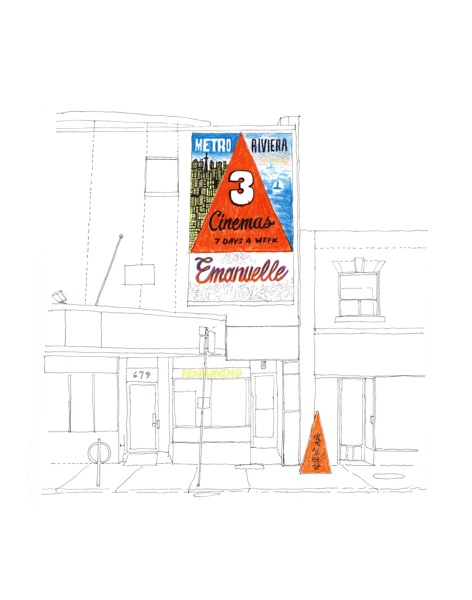
Courtesy Erica Brisson.
The artsy intellectual was curious about broadening her horizons from a young age. Attending Concordia University in Montreal allowed her to adopt the Francophone culture.
“I was living in French Montreal, meeting people from different places, encountering a culture you wouldn’t in Toronto. And then I was in Banff, the Wild West, meeting other artists in nature.”
Erica says her curiosity was similar to that of anyone in his or her early 20s, though her dedication provides an example of someone who is not only talented, but also wise beyond their years.
“I am continually impressed by Erica and her creative output, which she manages to keep focused yet dynamic, just like she is,” art critic Pandora Syperek said in an email.
“When I first met her I was surprised, not only by her level of achievement for such a young woman, but also by her eloquence and composure. I also learned that apart from being self-possessed and enterprising, Erica is kooky and a bit off the wall in a really fun way. I think it’s this combination that she brings to her creative projects.”
She was an active participant in the arts community while in Banff, always finding herself absorbed in one project or another.
Pandora was struck by the colouring party Erica had at the Banff Centre, where she let a bunch of friends “go wild” with markers on drawings she had made of inspirational 20th century women.
“It was great because it dispersed the emphasis from her as sole author of a lovely group of delicate line drawings to a communal forum where everyone was able to exercise their creativity without limits,” said Pandora.
Another quirky endeavour was Erica’s YouTube dance party, which consisted of people dancing to their favourite YouTube videos, projected and amplified.
But perhaps Erica’s idiosyncratic nature is best exemplified by her pointed disdain for the array of disjointed three-part windows that line some of Toronto’s streets. “For me, that is an example of a hideous window that is not functional … like a Cyclops eye. Maybe there was a supplier—it is everywhere.”
Creating an environment where community building becomes the focus seems to be tantamount to Erica’s work.
After art school in Montreal, working at the Banff Centre for the Arts, running a temporary art space in Calgary, and travelling throughout Europe, Erica is ready to be home. She is now sharing her ideas and talent with another artist collective called Friends of Churchill, a shared studio space project. The group has informal life drawing nights, where they work together and come up with fresh ideas.
“I grew up on Brunswick Avenue and it was fun to represent the neighbourhood,” Erica says. “You meet so many people and you meet people that you wouldn’t otherwise.”
Tags: Arts · People · General
November 23rd, 2010 · Comments Off on Mad House: Madison dweller alleges harassment over heritage home
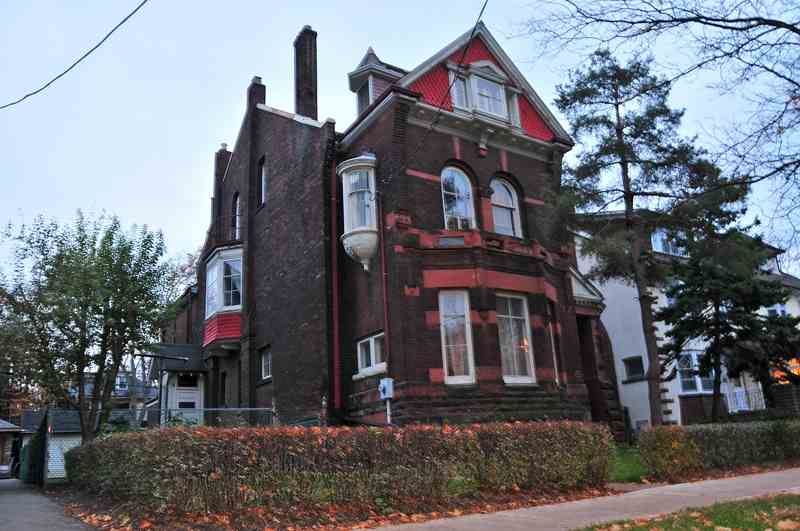
The heritage property at 145 Madison Ave. Matt James/Gleaner News
By Eddie Mumford
‘Majestic’ would be a word to describe the house at 145 Madison Ave. With its uniformity of smooth brick and irregular shape, the massive, detached home stands out amongst the neighbouring houses. But the house, declared a historical site (under the Heritage Act) in 1974, has recently become a source of anxiety for its owner.
Richard Kruk recently contacted the Gleaner concerning an inspection that took place at his mother’s residence on Madison Avenue. “[They said we have] ten people living here,” said Anne Kruk, nearly laughing.
Richard explained that these “ten people” were simply a few family members that had stayed for a short visit. “It’s like we’re being watched,” he said, speculating about the short time between the family visit and the municipal inspection.
Richard and Anne were fearful that their home was being targeted with complaints made to the city asking inspectors to determine whether the home was in fact a rooming house or a single family dwelling. Both mother and son said that it’s like someone is trying to intimidate and exhaust them to the point where their home of more than half-a-century is too much of a burden.
According to Elizabeth Glibbery, manager of the East York Municipal Licensing and Standards (MLS) division, the complainant cannot be named, but the Kruks have established their own theory, connecting this inspection with troubles from the recent past.
The trouble, it seems, may have risen first from a dispute in August 2007. It was then that Anne alleges a Mr. Irving Garten, with his wife Vivian and son Joel entered her home, with the intention to buy it from her. “[At first] they were real friendly,” said Anne, recalling the day they asked to come inside. “He came on the Thursday, when I had friends coming over, inquiring about the house.”
“They followed her into the kitchen,” continued Richard, “but my mother was preparing for guests, so they said they’d come back on Saturday… [On Saturday] they showed up late, all three of them again. They made her walk through the house before they sat around her kitchen table; he was sitting where my dad sat and then they got her three-on-one.”
It was on that visit that Mr. Garten allegedly told Anne to sign a purchase and sale agreement for the house. “They wouldn’t leave until I signed,” said Anne, “I told them, ‘No, I’m too tired to sign now, I can’t even read my own writing,’ but he said ‘Sit down and sign it.’”
Currently both parties are in litigation over the contract signed that day by Anne; the Kruks are contesting the contracts legitimacy, while Garten is suing over its breach.
“My lawsuit was brought to enforce a contract,” Garten said in a written statement, adding that, “because this lawsuit continues to be pending in the courts, neither party should be commenting about this for a newspaper.”
In an affidavit sent to the Gleaner, Garten builds a very different frame of reference from the Kruks. In the document, Garten insists that he “did not take advantage of Mrs. Kruk,” and that a selling price of $1.5 million had been agreed upon before the final visit. “Mrs. Kruk invited us into her house twice. She wanted to sell. A deal was struck. A contract document was signed. It sets out accurately what we agreed on. It is not ambiguous,” stated Garten in his sworn record before the courts.
Garten’s document continues to say that Mrs. Kruk said she planned to move into 143 Madison Ave., the smaller, neighbouring house, of which she is also the owner.
Also gleaned from this testimony were Garten’s intentions for the house as “both a close-by home for [his] children and a ‘canvass’—a rare and expensive one—for [him] to engage in the Victorian era house restoration work that [he is] passionate about.”
But Anne, who is now 88 years old, alleges that there was no intention to sell and that the price was never agreed upon or finalized. “He sat here and said ‘What will you be asking for the house?’ and I said ‘A good two million,’ and he said ‘That’s too much’… I thought we were just talking, I never expected him to come and buy the house like that … As soon as they got up from the table I had a heavy chest; I knew I did wrong, but it was signed.” When asked if she currently has any aspirations to sell her house, Anne answered that she’s not even sure that she has a house anymore. “I don’t really know where I stand with it,” she said.
The Kruks accordingly believe that it is through the will of Garten that the municipal complaint and subsequent inspection occurred. “The visit was the result of a complaint made to Metro Licensing and, according to the inspector, was not from Garten,” said Richard, recalling a conversation between himself and the inspector. Richard is mainly suspicious because of Garten’s holdings and influence in the world of real estate as a developer and as Garten notes in his affidavit “historical preservationist.” Numerous messages left with MLS Inspector Alistair McCrae were met with no response.
When asked if the city will be taking a closer look at whether city-resources have been exploited, Glibbery responded that no action will be taken at this time. “Not unless someone is alleging harassment, [however], we wouldn’t be initiating a review of that [per se ITAL]; those complaints usually go through the auditor general’s office, or something of that nature.” Glibbery added that the inspection found the house to be a single family unit and, as the complaint suggested, not a rooming house.
The house itself, cited by city council for its exceptional architecture, is undeniably special. It stands as one of the defining houses on Madison Avenue, the whole of which may soon be charted under the Heritage act as a conservation district. While this allows for the protection of the property, this protection does not extend to the occupants.
Time and the judicial system will be finishing this story, while the house, hopefully, still stands majestically.
Tags: News · People · General
November 22nd, 2010 · Comments Off on Earning his stripes? “Social transformation” art project not supported by hospital
By Perry King
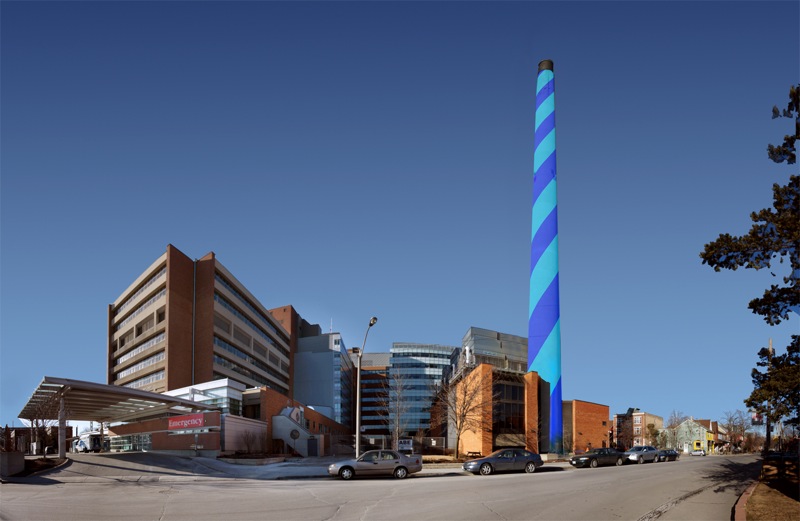
- Artist Miklos Legrady wants to paint candy stripes on Toronto Western Hospital’s smokestack, at the cost of $675,000. Courtesy Miklos Legrady
After years of being a sticking point for local residents, the Toronto Western hospital smokestack (399 Bathurst St.) may get a facelift, if a local artist has his way.
Inspired by art projects like OCAD’s (100 McCaul St.) Sharp Centre, Miklos Legrady, at a cost of about $670,000, wants to paint the hospital’s smokestack in a candy-stripe pattern using two tonnes of blue paint.
A visual artist who works with the Centre for Contemporary Canadian Art, Legrady has been researching and discussing the Blue Spiral project with the hospital for two years. “It’s this huge industrial piece of cement and it affects the neighbourhood,” he said.
“Then after a couple years of walking by and thinking that no one will ever fund it, I started working on the documentary website for Nuit Blanche, and realized that Scotiabank spends a million and a half [dollars] on that one night of Nuit Blanche,” he said. “So it’s doable.”
Legrady’s cost estimate comes from his contact with Dynatech, an industrial painting company, that has painted the hangars at Billy Bishop Toronto City Airport. In the most likely case, Dynatech would undertake the project, providing the workers, equipment, and the insurance. Legrady says that broadcaster Dini Petty is willing to help with the fundraising, which he estimates would take two years.
[pullquote]“Social transformation is not necessarily their business, so they’re a little bit cautious”—Miklos Legrady[/pullquote]
The Kensington Market Business Improvement Area has also expressed interest in the project.
“I think it’s a magnificent idea,” said chair Mika Beraket. “It would draw a lot of positive attention to the hospital for doing something so magical and childlike.
“It’s not a lot of money, it’s just paint really, and his time is free. It shouldn’t amount to a whole lot for what it would do for the neighbourhood and the city.”
But after two years of lobbying the hospital, talks with the community, and encouraging letters from the city, MP Olivia Chow’s (Trinity-Spadina) office, and the local arts community, the hospital’s position remains the same.
“I don’t think it’s a good idea to collect the money without consultation,” said Gillian Howard, media liaison for the University Health Network. Howard says that the hospital has prioritized medical research, and that a project of Legrady’s magnitude and cost could confuse corporate donors about where their contributions are being spent.
According to the hospital, even if the project was fully funded, they would still want to approach the matter systematically. This would include public consultations, filing a request for proposals and board approval. This process could take several years.
Legrady is frustrated by the hospital’s position, but he is still motivated to see the project completed. “Everybody that sees it is quite enthusiastic, except the hospital,” he said. “[The hospital] has two things going on, one is that they’ve got all kinds of people who want to have their children paint happy faces on this thing. And then, I think in a sense they are pushing me to get my political and financial backing.
“Social transformation is not necessarily their business, so they’re a little bit cautious.”
The smokestack, located at the southeast area of the property, has been at the centre of community protests for decades.
According to reports dating back to 1991 by the now-defunct [Kensington Drum ITAL] newspaper, the smokestack once emitted biomedical exhaust with no known pollution controls. Constructed in 1972, the smokestack was a regional incinerator burning waste for, at its height, 20 hospitals and 150 clinics. David Perlman, a local resident and the paper’s former editor, said the hospital had been burning toxic yellow cadmium waste bags, among other medical wastes.
Lead by the Action on Hospital Incineration (AHI) neighbourhood group, residents demanded the shutdown of the incinerator and a move to non-polluting methods of waste disposal at the hospital. By 1995, the incinerator was shut down.
According to Howard, the smokestack is now attached to the building’s mechanical system and emits only non-toxic gas.
To many local residents, the smokestack is still an ugly nightmare, but opinions on Legrady’s idea vary.
Perlman would prefer the smokestack be painted as a cigarette as a reminder of its lung polluting history, or that it be demolished altogether, but says that the project could work out if Legrady can gain a rounded view of what the community wants.
“I think it’s a weak idea,” said Peter, 60, a local artist in the neighbourhood who refused to provide his last name. “If it’s going to be painted … they should talk about the kind of medical research being done, the money being spent, all the breakthroughs and government allocations, and have that put around [the smokestack].”
“They could put a design on, but at the same time they could put out a message to people. They want to gain the people’s trust? Do something that sends a substantial message.”
Whatever the opinions, Legrady says he is doing this to help the neighbourhood transform socially. “What I’m concerned with is literally the social transformation, that people should feel a boost of positive energy and happiness when seeing this thing,” he said.
Tags: News · People · General
November 19th, 2010 · Comments Off on Façade facelift: Lee’s Palace iconic mural is back

Al Runt stares down one of his monster creations. Beth Macdonell/Gleaner News
By Beth Macdonell
In 1987, Al Runt was working behind the bar at Lee’s Palace (529 Bloor St. W.). He was let go for drinking on the job, but the owner, “Mr. Lee,” noticed Runt was a talented painter.
According to Runt, Mr. Lee was looking to attract cool eyeballs from Queen to Bloor. Mr. Lee noticed that many of the trendy bars and clubs such as the Bamboo Club and Cameron House had murals, and wanted to bring the same aesthetic to Lee’s.
“I was a much better artist than a waiter,” says Runt. “I was doing a lot of different murals around the city … I did the side of the Bamboo Club and there was a couple of murals (I did) in Kensington Market.”
“Make it pretty,” were the only instructions Mr. Lee gave Runt. He was paid $1,500 for the job.
Lee’s distinctive facade has been synonymous with the bar since its early days but the mural has been replaced twice, the most recent version completed on Oct. 8.
It took Runt over four months, working every good-weather day, to complete it. He pencilled in the drawings, retraced them with marker, and then filled in the colour with two coats of paint. Lastly, he did a thick black outline and used a sponge for shading.
He says painting on the scissor lift with lots of people walking by was tough. The pigeons were also a nuisance.
“One pooped on my tongue and on my lip,” Runt explains. “I went and bought some mouthwash and gargled for the next two hours.”
Over the summer Runt says he got the chance to talk to lots of Annex locals. One regular came by almost every day and brought him a beer. He even made some $15 in tips per day thanks to his “tips” paint tray that was left on the sidewalk.
Sometimes he would hear people describing the history of the mural while he was sitting right there painting it.
“I would be in the middle of something and people would just have this need to tell me what they think of it,” Runt says. “I would try and be courteous… my favourite is when they think it’s the same mural. I just say no, it’s the same style.
“I only got one negative reaction the whole time, and someone just walked by and said it’s too busy, but I can’t really help that,” he laughs.
“I knew people liked it, but I didn’t know people liked it that much. It’s more the people in the area that really like it. They’d say, ‘Oh I’m so glad it’s back. I was almost going to stop going to Lee’s or the burrito place,’” Runt recalls. “It’s amazing how people really connected with it.”
Runt never attended art school. He is a carpenter who does art when there’s work available.
“I think he saw other artists making murals and said ‘I can do something similar,’ and it took off,” says friend Robert McGirr, adding that his style can be linked to a love of comics.
In 1992, while sick and undergoing cancer treatment, Mr. Lee called Runt up to do another mural because the wall had been painted over.
Lee was also asked to spruce up the washrooms and McGirr helped him. “The washroom was not in the best shape,” he says. Overall though, “I just remember Runt and I having a good time, listening to music on his boom box and having a few beers after work in various places around the neighbourhood.”
Mr. Lee saw the completion of the mural, but died about a year later.
The second mural was torn down in the fall of 2009. For a while, it was unclear if a new mural would be re-painted.
“When the mural wasn’t there I was really thrown off,” says Ruhee Dewji, 21, a flute and tenor sax player in the band Entire Cities, that play at Lee’s. “I always associate (Lee’s) with this crazy mural. It was so bizarre that it was existing without that mural there. It was just one of those things that made it a landmark.”
“The shock of it going down affected a lot of people … It totally lacked a certain vibrancy,” Lisa Shepard says.
Shepard is the co-owner of Big Fat Burrito, which moved into the front area of Lee’s last year. Shepard and her husband Mike jump-started the effort to replace the old mural, with the support of Lee’s.
The 2010 mural is bigger and goes higher on the facade than the previous mural. All three were we painted in the same style, but all are different. Al Runt says it’s like “cartoon art.”
“It stems from a whole bunch of influences… there’s a certain juvenile aspect that I like as well… tonnes of boobs up there and penises, but nothing really shocking,” he says.
Some of his favourites include “rock-out head” and a woman with several breasts waving her arms.
Proud of his completed mural, Runt says that with three coats of protective urethane, it should last for a long time.
Unlike the previous murals Runt has painted on Lee’s, it was done on a stainless steel background with high-quality paints.
“It’s my Titanic, or my Avatar,” he says.
Runt is surprised more requests for his work haven’t come through since this mural was so successful.
“I haven’t got one job out of this. I thought with this I’d get hired to do someone’s room or something.”
Runt believes the mural is helping to define the Annex neighbourhood. “It’s right up there with the Honest Ed’s sign. It’s unbelievable how photographed it is. There have been times when I’ve seen five or six people photographing it at the same time.”
Without the mural, “the Annex would get by and it would be sort of sad but I think it’s just one little thing that makes the area interesting.”
If you would like to hire Al Runt to paint your room, or a wall, or anything, contact him at runster2001@yahoo.com.
Tags: Arts · People · General
November 19th, 2010 · Comments Off on Sam James makes good joe
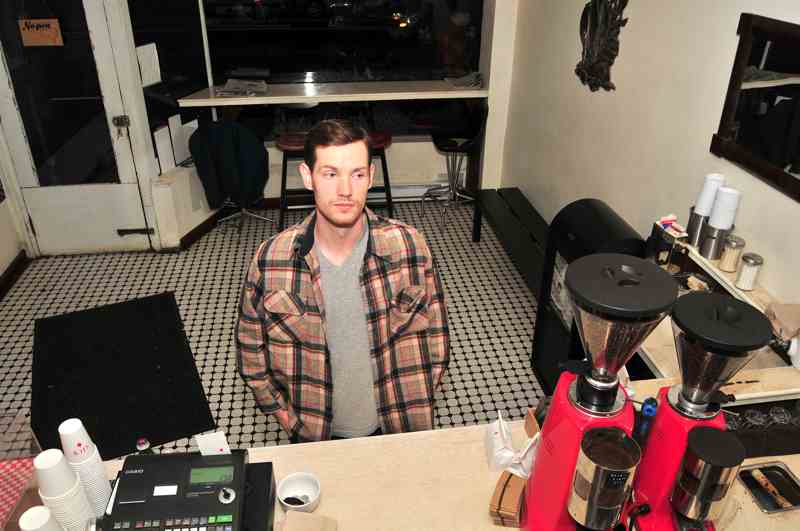
Sam James' self-titled coffee shop has been brewing up good business. Matt James/Gleaner News
By Karen Bliss
The lattes at Sam James Coffee Bar (297 Harbord St.) are a work of art and it has little to do with the carefully poured rosetta design that decorates each cup.
The staff that make the coffee are trained on the bean, the temperature, and the method, making each sip something to be savoured, like a rich dessert. “You have to have passion for it and care about what you serve,” says owner and namesake Sam James. “For me, the coffee I make is an expression of how I feel about it. I couldn’t live with putting out poor-grade coffee.”
Besides lattes, the small menu offers other espresso-based drinks and the pure Siphon coffee, a fun and informative vacuum process involving an open flame, narrow tube and upper and lower glass vessels.
There are also teas, cold drinks, plus an assortment of pastries he gets fresh daily from J.P. Challet at Ici Bistro (538 Manning Ave.).
The tiny coffee shop, with just four stools at a window counter and one small bench (plus four stools, outside weather permitting), is widely considered to be one of the best in the city. There is a constant flow of customers.
“When you integrate as part of a community, rather than just another brick in the wall on a commercial strip, you get recognized as for the neighbourhood,” says James. “So people that live around here really take possession of it—‘This is my local.’”
James, who has lived in the area for seven years since moving to Toronto, tried his first coffee at age 5, “terrible instant coffee” of his dad’s. “I didn’t like coffee again until I was 19,” he says.
James “fell into” the coffee business. He needed a job and a friend hooked him up at Cherry Bomb on Roncesvalles, but there’s something quite impressive about James: no matter what the job, he wants to do it exceptionally well.
“I sought out people who were really knowledgeable or well-reputed in the coffee business and picked their brains,” James recounts. “I realized there was a lot more depth to it than just making it and serving it. There’s a science behind it and there’s an art of doing business really well.”
At home, he also experimented, buying a cheap grinder and French press, trying different coffees and playing around with ratios and temperatures and brew time to see which worked best. “It’s a very low tech and simple approach. You can control all the variables that way by doing it manually,” he explains.
From Cherry Bomb, he honed his barista skills at other notable shops, Dark Horse and Manic, before deciding to open the Sam James Coffee Bar in 2009. He now has one full-time barista and four part-time, all fully trained and as expert and enthusiastic as himself.
“For me, a coffee shop should be about quality and service and it should be very utilitarian,” says James. “I had enough experience going into this that I knew exactly what I want to serve — and that’s serving a product really well.
“The nature of doing one thing really well is you gain an appreciative market, especially if you’re off the beaten path. People go out of the way and want to go out of their way to get something good and the majority of our customers are very educated about the product and that’s why they come back every day.”
Visit www.samjamescoffeebar.com to view James’ guide to brewing the perfect cup of coffee at home.
Tags: People · General
November 11th, 2010 · Comments Off on Holiday wish list and cover art
Every holiday edition, the Gleaner features community and holiday-themed artwork on our cover. We are also continuing a new tradition that we started last year, where we are soliciting holiday wishes from the community, for the community.
Here are the stipulations:
For artwork:
-We are looking for two pieces of artwork to feature on our covers, one for our Annex edition and one for our Liberty edition.
Bonus points if you are an artist from the area or the art features something from the area.
-The artwork will take up the full cover of the Gleaner, fitting into a 10 inch by 10 inch space. Please submit in a jpeg, or psd format. It must be at least 300 dpi.
And wishes:
-We are seeking an infinite number of wishes. They can be whimsical or practical. They can be personal, political, or community related. Past wishes have included everything from “I wish there was a hot dog stand in the Annex,” to resurrecting a beloved tree that was cut down, to starting a community gardening club.
-While we want world peace just as much as everyone else, please try and keep your wishes local.
– Wishes must be between one and 250 words. Visual interpretations of wishes are also welcome.
Please submit your wishlist or artwork to gleanereditor@gmail.com by Nov. 25 at the stroke of midnight; include your name, and either your professional title or the street that you live on. We reserve the right to edit wishes for space, spelling and grammar.
We really hope you all can take part! Tell your neighbours and friends!
REMEMBER Wishes and artwork by Nov. 25!
Tags: General
