September 13th, 2011 · 4 Comments
By Michael Radoslav

Seats are a hot commodity at Simpsons trivia night. Courtesy Mike Wrobel.
Packing in a crowd of hundreds to standing room capacity, with virtually no advertising or promotion, Andrew Ennals and Amanda Factor must feel like the man who single-handedly built the rocket and flew to the moon. What was his name, Apollo Creed?
Ennals and Factor are the creators of the insanely popular Simpson’s trivia night, held the second Tuesday of every month at the Gladstone Hotel.
The two friends are huge fans of the show themselves, so much so that Ennals described their get-togethers as just “throwing Simpson’s quotes at each other in whatever conversation we were having.”
Factor said their emails would turn into “quote-a-thons,” and this led to the idea of starting a trivia challenge.
“It came along at the right time because trivia is so hot right now,” Factor said. “We were on the cusp of the whole explosion.”
The two were shocked that a Simpsons trivia night was not already being held in Toronto, and began one at The Ossington last year. With an unexpectedly high turnout, they quickly moved to the Gladstone two months later.
The new venue has not fared much better. “We thought there would be enough space,” Ennals said with a laugh. “There was for about 15 minutes.”
“It’s awesome,” said Jeremy Vandermeij, the Gladstone’s creative director. “Every single seat in the Melody Bar is taken, and we put in extra seats.”
The night is about entertaining the fans that congregate to bask in the warm glow of their favourite episodes from seasons 1 through 11. The hosts pick three episodes to play throughout the evening; in between each episode, they ask a round of questions.
The winning team receives the highly sought-after prize of a table for their team on the stage—a valuable commodity on a busy night that doesn’t take reservations.
John Semley started coming out last September and has been back every month since. Semley says it’s intense among the teams at the top to the point where it’s almost like a professional league. “I don’t play sports so to be honest it’s nice to have something I’m good at,” he said.
Regardless of the competition, participants revel in watching episodes together, reciting quotes in unison, singing songs from the show, and relaxing in the company of fellow Simpsons nerds.
The lively crowd is also fuelled by alcohol, which Homer Simpson once famously described as the cause of—and solution to—all of life’s problems. For the night, the Gladstone renames one of its regular draughts Duff Beer in honour of the occasion, Vandermeij said.
Due to its overwhelming success, the Gladstone is putting together a Futurama trivia night, a tribute to another Matt Groening creation, which is scheduled to begin Tuesday, September 27.
To find out more about Simpsons trivia night check out their blog or follow them on Twitter.
Tags: Liberty · General
September 10th, 2011 · 2 Comments
By Julia Hennessey
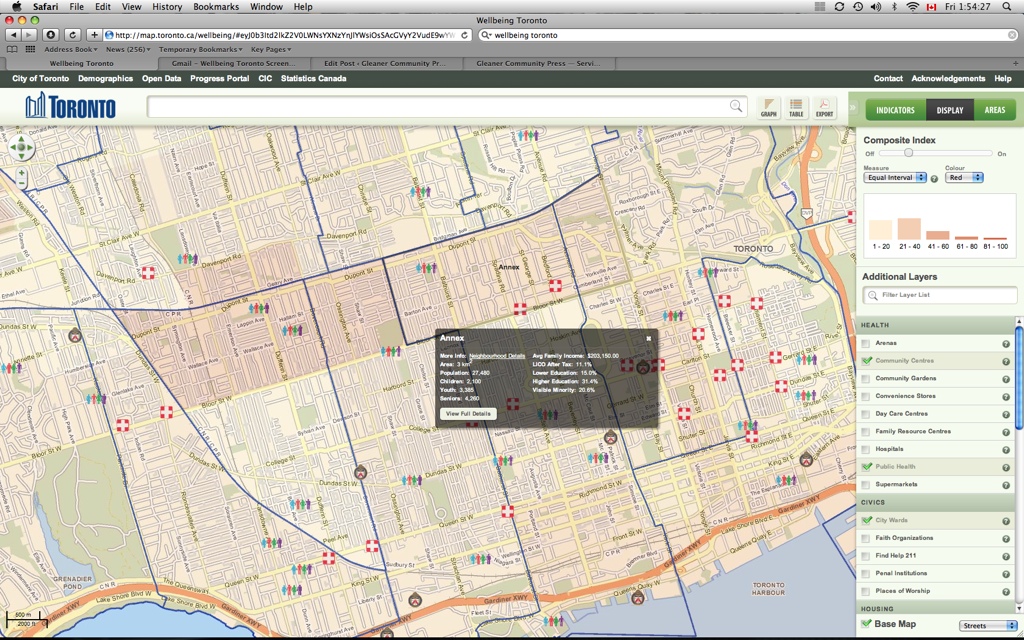
Wellbeing Toronto allows the user to select multiple indicators for a neighbourhood at one time. Screenshot courtesy of City of Toronto.
After two years of development, Wellbeing Toronto website launched this summer and received close to 20,000 hits on its first day.
The City of Toronto, along with partners that include the United Way and Toronto’s school boards, have contributed to the development of the online application that allows users to view and compare Toronto neighbourhoods based on personally weighted criteria and create on-the-fly maps.
The tool may change how government funding is allocated, the way nonprofits will operate, and will inform business owners and residents about their neighbourhoods.
“We wanted to create a system that looked at neighbourhood well-being across all of Toronto’s neighbourhoods, not just a certain number or a priority number of neighbourhoods,” said Harvey Low, manager of Social Research and Analysis for the City of Toronto.
Information is provided for 140 neighbourhoods in Toronto and users can select up to 20 indicators for a specific neighbourhood at a time. The weighted indicators allow users to evaluate areas based on the criteria they deem most important.
Options go beyond typical demographic information such as population, to provide data ranging from tree cover to voter turnout, and pinpoint the locations of amenities. Low hopes Wellbeing Toronto will offer new insight into neighbourhoods like the Annex by providing “information that we’ve never reported on before in this format-on cycling and pedestrian traffic, accidents, and access to public transit.”
Criteria were selected to illustrate all aspects of a neighbourhood. “We decided to include indicators that could potentially look at the assets of communities as well as the challenges.”
While Wellbeing Toronto has the potential to serve a wide range of users including academia, NGOs, and government, the site may be especially interesting to businesses when positioning themselves, and residents shopping for a home.
Low said businesses and corporations can use the website to find information about potential clients, including income level and languages most commonly spoken when deciding on a location and how to target their services. “If you’re doing service planning and you want to locate a new convenience store, use Wellbeing Toronto to find out where the existing ones are so you don’t locate right next to an existing one.”
The website also offers information to business operators about community support for their employees. “The Annex has a variety of restaurants, many different retail outlets along Bloor. It would provide not only information about those retail establishments and where they are located, but also the human supports in that community from child care to seniors homes.”
People looking to purchase homes can use Wellbeing to investigate area information including the location of schools and the average annual income of homeowners, says Low. “[People] want to be near public transit, which the Annex is, they want to be near great parks, which the Annex has,” but they may weight these characteristics at different levels of importance. Wellbeing Toronto allows these users to “pick the same indicators but weight them differently.”
However, Low suggests that the application is one of a number of tools that those shopping for a home can use. “In order to really get a feeling of a community like the Annex you need to walk the streets, you need to feel the neighbourhood, you need to smell the air, look at the trees.”
Elden Freeman, Vice President of Freeman Real Estate, agrees that the applications usefulness in the real estate sector is limited. “People buy homes on an emotional basis. If the schools are good and their peer group is buying in the neighbourhood—statistics don’t add anything.”
He says Wellbeing may also stigmatize neighbourhoods whose positive characteristics statistics may not be illustrated by statistics and is concerned the website will increase the divide between neighbourhoods. “It really is creating ghettos of rich and poor, and that’s what this whole map reinforces.”
Renny Cannon, a homeowner who shopped for a home in the Annex in 2006, says he would have tried the website, but is not convinced it would have been useful. “The areas are so large. I mean—when they define the Annex [to include] from Christie Street to Avenue Road—the area surrounding Christie Pits is very different from the area surrounding University Avenue, so I don’t think it provides too much insight into a neighbourhood.”
Visit the Wellbeing Toronto Website at map.toronto.ca/wellbeing.
Tags: News
September 9th, 2011 · Comments Off on Kung Fu monks & barbecue beef at this year’s Chinatown Festival
By Sanam Malik

Performances, including lion dances, have featured prominently in past Chinatown Festivals. Courtesy Chinatown BIA
The Chinatown BIA is getting ready to host the annual Chinatown Festival this weekend, and organizers said that they wanted to make sure that the celebration has mass appeal. “We like to stage a festival that is organized by Chinatown BIA, but we want to share with everyone and get everything on one stage,” said Tonny Louie of the BIA.
With more than 100,000 expected in attendance and attractions that will include cuisine from around the world, cricket, and perhaps even some Kung Fu monks (visas permitting), the free event should have no problem meeting its goals.
The cuisines are one of the most important features of the festival. Louie stresses that there will be “not just Chinese food, but different kinds of food,” from Arabic-styled wraps and barbecue beef, to Taiwanese cultural food and Malaysian murtabak chicken.
Moon cakes, Chinese bubble tea and ice cream will also be available.
This year’s festival will also have both a beer garden and a children’s play area. Mariama Barrie, organizer of the games segment, says that “[we] are planning to have different performances from different community centres across the city, as well as carnival games.”
A bouncing castle and martial arts demonstration and workshop are in the works for the kids.
Organizers say that a performance by a dozen Shaolin Monks of China is “70 per cent” confirmed. The world famous Shaolin Monastery of China occupies a special place for the Chinese culture and history. “We have had other forms of martial demonstrations in past festivals but not Shaolin style,” said Louie. We’ll keep our fingers crossed.
The Chinatown Festival takes place Sept. 10 and 11 on four blocks of Spadina between College and Dundas.. For more information, please visit www.chinatownbia.com.
Tags: Liberty · General
September 7th, 2011 · Comments Off on Original Honest Ed’s signage up on eBay: help us buy a new printer
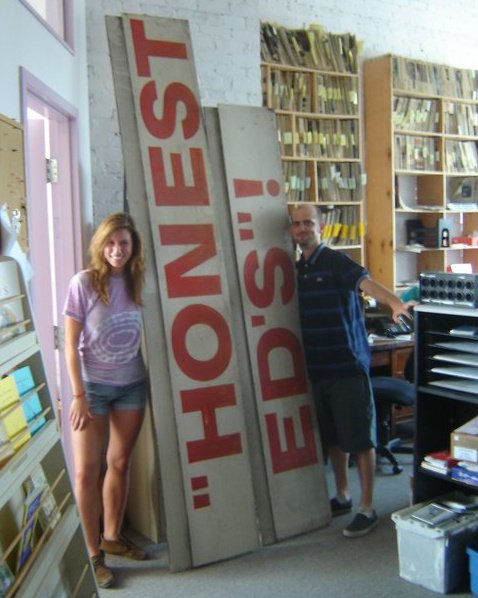
We've got one week to auction off these iconic and original hand-painted Honest Ed's signs. All proceeds will go to buying a badly needed new printer. Help us spread the word! Thanks!
http://www.ebay.ca/itm/ws/eBayISAPI.dll?ViewItem&item=280735667662#ht_500wt_1093
Tags: General
September 1st, 2011 · Comments Off on Daycare Records brings new talent to the Toronto music scene
By Síle Cleary

The Danger Bees. Courtesy Luther Mallory.
They may be new in town, but Daycare Records are showing just how feisty they are by utilizing the tag line “babysitting your stupid band.”
The record label is the brainchild of music journalist Karen Bliss (whose work is published in numerous publications, including the Gleaner, Billboard, RollingStone.com and MSN) and musician/producer Luther Mallory, who say the tag refers to an industry inside joke. “It’s not supposed to offend anyone, but everyone in the music business understands that if you’ve tried to work closely with bands it can be demanding and thankless,” says Bliss. “It can even get to the point where they may ring you up in the middle of the night for something that can clearly wait until morning.”
Daycare Records, which currently runs out of Bliss’s Annex home, launched in July of this year and has already signed two reputable Canadian artists: indie pop band The Danger Bees and renowned Canadian battle rapper Kid Twist.
The Danger Bees, which hail from Nova Scotia, solidified in Toronto in 2010 after Mallory (of the band Crush Luther) heard them and convinced them to relocate to the hub of the Canadian music industry.
Since hooking up with Daycare, their song “Why Won’t You Listen,” appeared in an episode of Degrassi this July, while another of The Danger Bee’s songs, “Awkward Guy,” is in the film Moon Point directed by Sean Cisterna.
The video for their single “Good Year” has received a lot of attention as a result of it being shot in just one take by director Gavin Michael Booth.
The video shows frontman David Macmichael being battered by objects and screamed at by his crazy “girlfriend.”
“They had one try to get it right and luckily they managed to pull it off,” said Bliss.

Kid Twist. Courtesy Luther Mallory
Daycare Records’ other act, Kid Twist, is a phenomenal wordsmith with a huge following in the battle rap scene.
Kid Twist, who has humorously named himself after “a Jewish mobster who stabbed people in the brain with an icepick,” is currently working on his first music release with Mallory which will be more humorous than edgy.
Daycare Records is planning on utilizing online resources to help promote the music on their roster.
“The music business is changing so rapidly and new companies are cropping up all the time that offer creative and inexpensive ways for independent artists to get their music out there,” said Bliss.
“Daycare Records is exploring all those [options], from music licensing to online gigs.”
Tags: Annex · Liberty · Arts · General
September 1st, 2011 · 4 Comments
By Michael Radoslav
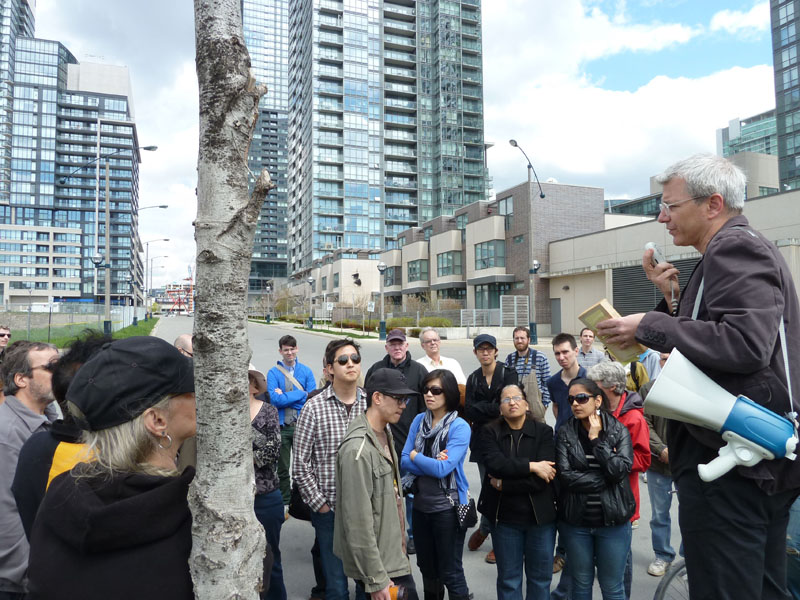
Councillor Adam Vaughan leads a Jane’s Walk through CityPlace. Courtesy Gary Pieters.
While condo projects have dotted the Toronto skyline for years, at CityPlace some see more than just construction underway—they see the potential for a great community.
“CityPlace is a great development and that’s what it was before we started here, a development,” said Dean Maher, president of the recently-formed CityPlace Residents’ Association. “Our goal is to make a house a home.”
The residents’ association wants CityPlace—a group of condominium developments located south of the rail corridor between Spadina and Bathurst—officially recognized as a neighbourhood by the City of Toronto, much like Kensington, Chinatown, and other areas. In addition they are working on a host of community-building initiatives.
Maher is a founding member of the association, helping to aid its formation last January after an unsuccessful bid to become a councillor in last fall’s municipal election.
The residents’ association has been working with Councillor Adam Vaughan (Ward 20, Trinity-Spadina) to achieve their goal of obtaining official recognition.
“Very few neighbourhoods are created out of nothing, and that is why this is so exciting,” said Vaughan. “It is a great opportunity to create this new community in the downtown core.”
Community-building initiatives are sprouting organically based on resident feedback said Steve Kee, the association’s vice-president of communications. Such initiatives include declaring a portion of Canoe Landing Park a dog park and starting up neighbourhood sports leagues at the turf field. For a part of town rich in rooming space, but lacking communal facilities, Maher said more restaurants or a community library would help make the area more attractive.
The group has also started hosting public meetings, including a recent one with Metrolinx regarding future projects.
However, the association’s work is not without its challenges. A lack of longevity is a hurdle in growing a community, said Sandeep Agrawal, an urban planning professor at Ryerson University. Downtown condos generally attract young professionals and young couples, groups not known for staying in one place too long. “At the moment what I see is that it’s more of a transitory place,” said Agrawal. “It is families and kids that make a neighbourhood lively and rich and give it more of a sense of permanency.”
Jack Kiatmysack, 26, a CityPlace tenant, reaffirmed that notion. “We’re leasing and we’re leasing on purpose,” he said.
Many of Kiatmysack’s neighbours say they do not see this as a long term destination point, he said, but rather a stop along the way.
“They have to find a way to keep everybody here,” said Korhan Kinazi, 33, a real estate agent who lives at CityPlace. “I think there’s an age aspect of living here, after you get settled and have a baby, I see people moving away.”
Maher said that perception of temporary residence is something the association is fighting to change. “If that’s the mentality we’ll never have people sit down, have a coffee and meet their neighbour.”
Future developments, such as the Toronto Community Housing project slated for the area, will help the area by adding more long-term residents, he added.
In addition to the transient nature of life in CityPlace, the group also has 12 official members that represent the interests of 12,000 people, which may prove to be another challenge. The residents’ association is currently made up of eight board members and four people working on projects, according to Kee. He said the group has “no immediate goals” of seeking mass membership from the greater CityPlace community, saying their focus is currently to “build up, be solid, be consistent, and build infrastructure,” but they want to “continue to make inroads into buildings and talk to people.”
While the group is not currently focused on membership drives, they are happy to work with residents who have suggestions and intend to find a representative from each building to widen their network. “We have to demonstrate that we’re building value, and I believe that we are,” Kee said. “We feel that we’ve made great strides.”
Ultimately to build a neighbourhood people need a reason to come together, Agrawal said, whether out of desire or necessity. In the past, neighbourhoods have united when a large construction project, such as highway, was built nearby, a tragedy has struck, or a group looked to occupy a specific piece of land together. Maher is confident a strong connection can and will be established among residents living at CityPlace.
“We won’t be Little Italy or Little Portugal since we are a condo community,” Maher said, “but we will form a new community.”
Tags: Liberty · News
August 31st, 2011 · 1 Comment
By Michael Radoslav
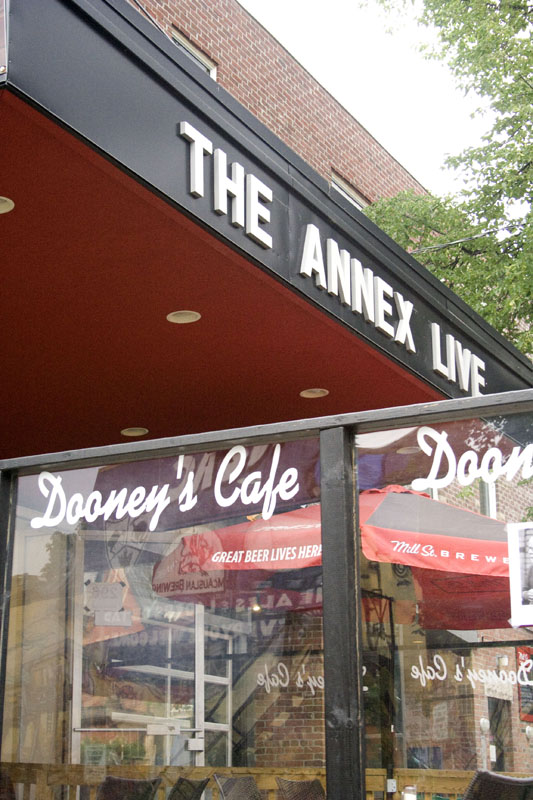
- Signage has begun to change over at the Annex Live. Photo by Michael Radoslav/GLEANER NEWS
After a three year hiatus, a legendary Annex hangout is reborn. Dooney’s Café, a once popular destination for artists and politicians in Toronto has returned, replacing the Annex Live.
However, owner Graziano Marchese (brother of Trinity-Spadina MPP Rosario Marchese) has no easy feat returning Dooney’s to its former glory. With a loyal but aging cast of regulars, a new location off highly trafficked Bloor Street, and plenty of seating presently available most afternoons, the café that was once an Annex institution will have to work hard to reclaim its title as community hub.
As the original owner of Dooney’s Café, Marchese left the Bloor Street location in 2008, selling the rights to the Dooney’s name along with it. Under new management Dooney’s ran a short while before becoming the T Café. Marchese opened the Annex Live in the location of the former Poor Alex Theatre.
Originally he intended to cater to an older, more upscale crowd. However, the new establishment struggled to find an identity in the neighbourhood. “The Annex [Live] wasn’t sure what it wanted to be,” Marchese said, “whether it wanted to be a restaurant, or a music venue, or a breakfast place.”
Following more than a year of negotiations, Marchese regained the rights to the name Dooney’s Café. The original Dooney’s was renowned as a popular hangout catering to the local artistic and political community. It famously staved off an attempted takeover by Starbucks in 1995—the words “Save Dooney’s” remain etched in the sidewalk on Bloor, in front of the old establishment. It became a central meeting place for many in the Annex.
As time passed, the crowds began to shrink and, when Dooney’s finally closed its doors, the halcyon days had already passed. Marchese said he wants to recreate that old atmosphere and reconnect with the community in his new location. “[Dooney’s] success wasn’t necessarily the food or the coffee,” he said. “I think it was based on that social part of it.”
“Some left, but the larger community is starting to come back,” said Peter Fawcett, a Dooney’s regular since the early 1990s, who wrote the book Local Matters: A Defence of Dooney’s Café and other non-globalized places, people, and ideas in 2003.
Author and screenwriter Ian Adams has been a loyal Dooney’s patron since day one. “It’s not like its identity is through corporate logos, it was, and still is, about community” he said. “It’s getting to be interesting again.”
“It really means something, something totally different than a [coffee chain], which has the aroma of sitting in an airport watching passengers walk by.”
Unlike its previous location, the new Dooney’s is tucked away on Brunswick Avenue, which will pose some challenges. “Seeing as we’re a bit off the beaten track we’re going to have to work a bit harder,” said Marchese.
Fawcett said the café has lost the “see and be seen” element it once had. There is a small patio out front and a larger one in the back, but it is not the same as the days on Bloor.
There was also a younger crowd that frequented the old Dooney’s at night, Fawcett said, but young customers are few and far between at the new location. New patrons, and in particular younger patrons, will be “necessary in the long run” for the café.
While admitting the importance of drawing a youthful element, Marchese said he has no plans yet to specifically target a young audience.
Regardless of whether Marchese can rekindle the popularity of the original venue or not, Marchese said he is just glad to work under the name Dooney’s again. Ultimately, he said success will depend on how the community embraces this new location.
“I don’t think I can create the culture, I just have two doors. Whoever comes in creates the culture,” he said. “You just leave the doors open for whatever people want.”
Tags: Food
August 30th, 2011 · Comments Off on Seaton Village lawyer Lucas Lung awarded for work in social justice
By Cara Waterfall

Lucas Lung has the best of both worlds: the amenities of being a downtown lawyer coupled with the gratification of doing public interest work. Photo by Cara Waterfall/GLEANER NEWS
Lucas Lung has an aura of unflappability: he is tall, distinguished, and speaks in a carefully modulated voice. This unruffled persona has served him well in the courtroom, where he has battled Internet hate crimes and elder abuse, among other issues.
But the Seaton Village resident is unsettled by the attention he received for his Young Advocates’ Award for achievement in social justice this summer. “I don’t think what I’ve done in the last several years has been all that extraordinary,” he says. “I think it’s hard to put my record up against other people I know who devote a great deal more of their time and energy to this type of work.”
Lung, 38, sits in an airy boardroom, light flooding through immense windows. The sleek, modern office is one of the perks of being a “downtown lawyer” although his portfolio is anything but ordinary, with about a third dedicated to pro bono files. “Whatever I do, there’s always going to be some public interest component to it,” he says. “I have a very strange practice profile, but Lerners [LLP] has been ridiculously supportive of the work that I do.”
It has been a big year for Lung, who also won a landmark case in immigrant sponsorship this June. The Supreme Court declared that family members who sponsor relatives must support them, regardless of changed circumstances. He modestly describes the outcome as one of “divided success.”
His interest in social justice and strong work ethic stem from his upbringing. After his mother’s marriage “ended quite violently,” she emigrated from China to raise him and his two siblings on her own. Seeing her hard work provided him with the template for how he would conduct his life.
At the time, Vancouver was a city struggling to find its identity amid the influx of Asian immigrants; Lung experienced racism there and his overseas travel exposed him to a host of poverty-related issues.
In 2003, he accepted a three-month internship in Cairo with the Human Rights Commission to produce a report on the insecurities of the Burundian refugee community in that city, who had fled the Rwandan conflict. He was struck by the suffering of a young woman who had been raped by a group of soldiers. “There are things that happen in Canada as well, but certainly not to the extent where there’s an expectation,” he says. “What’s more frightening is that she accepts that that’s just a part of life, and here we would view that as completely extraordinary.”
The Cairenes’ treatment of “foreigners” like the refugees was eye-opening. “[They are] like many other cities in the world that are in countries that don’t have an immigrant history like we do here: they struggle with foreigners.”
It made Lung appreciate Toronto—with its cultural diversity and conveniences—even more. Although his relationship with the city got off to a rough start (as a law student, he stayed at a “dreadful hostel” in Kensington Market where he slept in a chair), he eventually met his future wife in the neighbourhood.
Lung remembers feeling like “a bit of a nomad” in law school compared to his classmates. “A lot of students were very linear in their thinking in terms of their careers,” he says. “There was an expectation that you would end up at a firm, you would keep going, you would become a partner, and you would die, and that’s it.”
Now his focus is “much more community-based.” His calendar has become even more crowded since he became a board member for St. Jude’s Community Homes, a non-profit agency that provides housing to individuals with mental health issues.
He sees all of his files within the context of his practice at the firm. “I don’t really distinguish between my paid clients and my unpaid clients. Your pro bono files have to be viewed as just any other file.”
Lung sees the law primarily as a platform for his public interest work, but it’s also a form of storytelling that fits as organically into his personal life as his professional one. “When I’m standing in court, obviously there’s the legalese, [but] I’m really not saying anything differently than what I would have been saying before I was a lawyer.”
For more information, contact: Mary Ann Freedman, Freedman & Associates Inc. for Lerners LLP
Tags: People
It’s that time again!
The Gleaner is interviewing MPP candidates for Trinity-Spadina and Parkdale-High Park in advance of the Oct. 6 provincial election. We are soliciting questions from our readers that we will compile and pose to candidates on your behalf.
The major party candidates in Trinity-Spadinaare incumbent Rosario Marchese (NDP), Sarah Thomson (Liberal), Mike Yen (PC), and Tim Grant (Green). In Parkdale-High Park the incumbent Cheri DiNovo (NDP) is running against Cortney Pasternak (Liberal), Joe Ganetakos (PC), and Justin Trottier (Green). We are currently trying to track down other candidates, if applicable.
If you have an inquiry for candidates in Trinity-Spadina and Parkdale-High Park please send it to us no later than Friday, August 19 by the stroke of midnight (technically the 20th).
When you send the question, please make sure to include your name (and name of organization, if you are asking the question on behalf of a group or business). Feel free to submit as many questions as you like, though we will likely only publish one. You can send us your questions via Twitter, Facebook, email, snailmail, phone or in person.
Thanks, and we promise we won’t ask you to do this again for another three years!
The Gleaner
(The Gleaner is non-partisan; we do not endorse candidates, and we ask all candidates, including “fringe” candidates, the same questions.)
Tags: General
By Karen Bliss
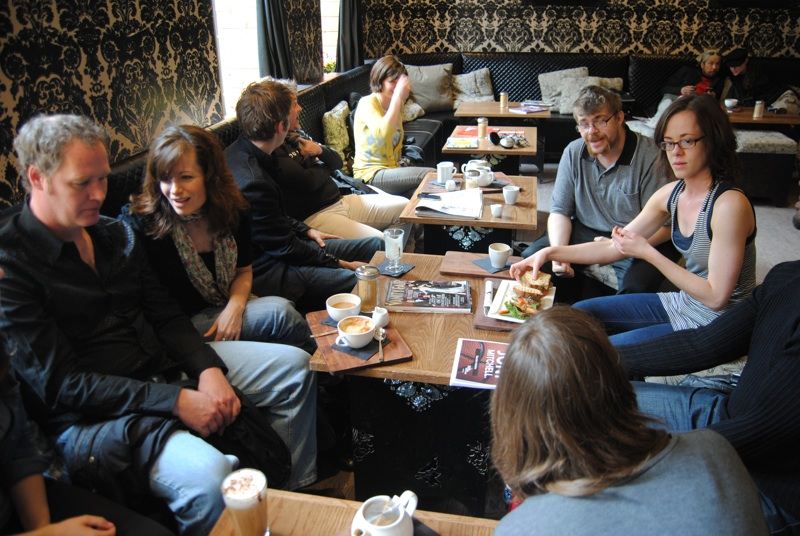
On BS Fridays, local musicians and artists shoot the breeze. Perry King/Gleaner News
A meeting at a local Starbucks with “Steal My Sunshine” hit maker Marc Costanzo from the pop group Len gave Barbara Sedun, EMI Music Publishing Canada’s senior vice-president, the idea to host a free weekly networking event in the Liberty area.
She dubbed it “BS Fridays,” which stands for her initials and brainstorming. An expletive also comes to mind, but BS Fridays is about exchanging information—not BSing.
“I was having tea with Marc at Starbucks and he needed some information that I felt Erin [Kinghorn, a music marketing expert] could provide to him,” says Sedun, who signed Costanzo many years ago to EMI’s stable of songwriters. Len is returning with a new album after a very lengthy hiatus.
“I called Erin to see if she could join us and I thought, ‘Wouldn’t it be a great idea for people to be able to share information like this on a regular basis?’ so I decided to start a little networking group.”
The first meeting was on January 28, held at the very same Starbucks (732 Queen St. W.) and after about a dozen meetings it moved to Atelier Cafe Lounge (510 King St. W.) for another dozen. It then moved to Veritas in the east end, but will return to Atelier for Aug. 5 and 12 (to keep on top of location changes, join BS Fridays’ Facebook Group).
Daniel Maclean, who runs Atelier and also works in film, has designed the space for daytime meetings and has WiFi and even a projector available, both free. He offers BS Fridays participants a 10 per cent discount on their food and beverage orders.
When Sedun, whose job involves signing songwriters, is travelling, Kinghorn and Scott Honsberger, music journalist and consultant, keep up the meetings. A Facebook group and Twitter account keep everybody informed of changes, but to date, it is held consistently from 2 to 4 p.m.
“I feel that I’ve got a lot of information in my head that I’d like to share with people that are beginning to establish themselves,” explains Sedun. “I thought that a lot of musicians and songwriters are afraid to approach the music industry, so it would be a really good opportunity to bridge that gap a little bit, to see that the industry is more easily accessible and nicer than they think they are. And it gives them a really casual atmosphere to come and ask questions and get to know people in the industry.”
That particular Starbucks, Sedun noted, had open-mic nights, so she spoke with the manager, Joe Boyd, about holding these meetings there and giving singer-songwriters the option to bring their guitars and play their songs. “I realized that he was pretty community and music-friendly and I wanted to help support him,” says Sedun, “but I told him if it grew too big, we would move it elsewhere.”
Besides Sedun, Kinghorn, and Honsberger, members of the BS Fridays contingent have included Costanzo; Yvonne Matsell, who books the El Mocambo and is co-founder of North By Northeast; Cam Carpenter, a manager and publicist from Cool Planet; his partner, Todd Arkell; musician/video director Hill Kourkoutis and her manager mom, Terry Delaportas; and singer-songwriter Angela Saini.
“Basically, we get together and socialize. No agenda, no mandate, no formal structure,” says Honsberger. “Each week we go around the table—or tables—and do a quick introduction of what everyone does. We try and make it simple for new folks to come out and help us grow the group. Inevitably, the conversation steers towards the music industry, and ideas tend to get thrown around.”
“Every single week, there’s at least one introduction that’s made—that is, one person in attendance hasn’t met one other person in attendance,” he says. “These are the types of real connections that are happening each and every week.”
Tags: Liberty · Arts · General
By Rebecca Payne
The stretch of Queen Street between Dufferin and Roncesvalles will be under the city’s microscope as a restaurant concentration study begins, a move that may prove to be divisive for the neighbourhood, if a recent community meeting is any indication of things to come.
At a heated meeting on June 28 at May Robinson Auditorium (20 West Lodge Ave.), city planner Dan Nicholson and Councillor Gord Perks (Ward 14, Parkdale-High Park) hosted the first meeting to hear residents’ thoughts about the developments in their neighbourhood in the past few years—namely, a growing number of bars in the area that some residents say has had a negative impact.
Some residents were concerned a concentration study would have a negative impact on the neighbourhood, while others complained about noise and drunken behaviour in relation to bars in the area (the only one specifically referred to by name was Parts & Labour).
Two restaurant owners showed up to the meeting to make the case for their businesses. A man affiliated with Local Kitchen & Wine Bar said he had not been approached by the city, or any residents, before receiving notice of this meeting about “the negative impact of restaurants.” He suggested the city needed to work more closely with those in the restaurant industry.
Another restaurateur, who did not give his name, said the “little guys” might be affected negatively by the results of the study. He felt his business was of benefit to the community, and that he was out there making the community more safe. “Sometimes we’re the only people who are asking drunk [people] to stop and getting people to stop fighting [on the street],” he said.
Some residents agreed that the increase in activity in the area was making it a safer place to be.
“[I’ve been] in the area for the last ten years, and … [it’s a] hell of a lot better now than it was ten years ago, that’s for sure,” said one resident. “And I don’t know one restaurant in Toronto that doesn’t play music when people are eating,” he continued. “Let them dance!”
One Cowan Avenue resident, who has lived in the neighbourhood for 12 years, said “I think it’s a great place to live, [with] people of all different ethnic and economic backgrounds. By and large people get along. It’s becoming posh and they want to throw out dive bars and make it more posh … [I’d like to see] a mix of bars, restaurants, and other stores.”
A similar study was conducted in 2009 for the strip of Queen between Dovercourt and Gladstone, where between 2004 and 2009, 13 new restaurants opened.
In the final report from the 2009 Dovercourt-Gladstone study, several recommendations were made to stop an over-concentration of “late night drinking establishments” in the area, including reducing maximum size of ground floor area for new businesses.
Although members of the working group wanted a new “hybrid” zoning bylaw definition for restaurant/bar establishments, the city did not agree. According to the report, the AGCO “requires at least five entreé items (food) to be available for purchase,” which means these establishments will, in theory, have space dedicated to food preparation, and thus be difficult to distinguish from restaurants. (Although, as noted by Perks, some establishments will merely “have a couple Hungry Man dinners in the freezer” to get around the required food service.)
Perks proposed that a “working group” made up of representatives from interested parties be set up to discuss concerns in detail. This is the same process that was undertaken for the Dovercourt-Gladstone study. Perks’ suggestions for members of the working group included representatives from Toronto Police, the AGCO, MLS, the BIA (one being a restaurant owner and one not), and the Parkdale Residents’ Association.
Some in attendance seemed to feel Perks’ choices for representatives would result in a status quo result. To wit, one attendee suggested they “get a clubber” to participate in the working group. (Perks’ then joked, “I’m so old, no clubber would ever speak to me.”)
The working group will meet at least three times to discuss the issues brought forth at this meeting, and then another public meeting will be held where the group’s findings will be presented.
“Change always prompts concern,” said Nicholson. “A lot of what’s happening on Queen is positive—but there are concerns.”
For more information contact Dan Nicholson at 416-397-4077
Tags: Liberty · Food
July 15th, 2011 · Comments Off on Marat/Sade ambitious spin on classic Peter Weiss tale

Soup Can company’s interpretation of Marat/Sade examines psychiatric testing at McGill University in the late 1950’s. Photo courtesy Scarlet O’Neil
By Síle Cleary
It may only be their second production, but precocious theatre company Soup Can Theatre have taken on a mammoth challenge by reinterpreting the classic Peter Weiss play The Persecution and Assassination of Jean-Paul Marat as Performed by the Inmates of the Asylum of Charenton Under the Direction of the Marquis de Sade— or Marat/Sade for short.
“Our mandate is to reinterpret older theatrical works for a 21st century audience,” said Parkdale resident Sarah Thorpe, artistic director of the Soup Can company.
“We thought we’d give it a more contemporary setting in order to make it more interesting and relevant to a contemporary Canadian audience.”
Marat/Sade, written by legendary German playwright Peter Weiss in 1963, received worldwide acclaim after it was performed on stage by the Royal Shakespeare Company under the direction of Peter Brook in London in 1964.
The musical/drama tells the story of the 15 years following the French Revolution, through a band of inmates in a Parisian mental institution, who perform a play about revolutionary leader Marat, under the direction of fellow inmate the Marquis de Sade.
As if the play wasn’t complicated enough, given its play-within-a-play structure, Soup Can Theatre have decided to make life even harder for themselves and stripped Marat/Sade of its early 19th century mise-en-scene and placed it in the world of the McGill University Psychiatry Department, circa 1957.
Thorpe explained that it was at McGill University that Dr. Donald Ewen Cameron, the first chairman of the World Psychiatric Association, performed psychologically-torturous experiments (including the administration of high voltage electroshock, hallucinogenic agents, and paralytic drugs) on non-consenting patients.
The experiments were performed under the umbrella of Project MK-ULTRA, a covert CIA operation which sought to explore the possibilities of mind control, memory erasure, and involuntary information extraction.
Although the play will be shown in the east end, the cast spent the last few months rehearsing in Parkdale in a converted storefront on Queen Street West called Fixt Point.
“Parkdale didn’t inspire me to put on the play, but it has inspired our creative process; Parkdale is dotted with colourful characters, and they certainly have provided a lot of material for our actors,” said Thorpe. “Since we’ve rehearsed not too far from CAMH, passing by there and by Parkdale’s rooming houses on a regular basis reminds us that the mentally ill are not ‘lunatics’ or ‘boogeymen’ and that we have a responsibility as artists to portray them with as much consideration and tact as the script allows.”
In an effort to avoid stereotypical and insensitive depictions of the mentally ill, each ‘patient’ in the Soup Can Theatre production of the play has been assigned a medically recognized mental disorder appropriate for their character, and has been encouraged to inform their performance based on that disorder’s behavioural symptoms.
“The patients in the play represent a range of mental illnesses, including schizophrenia, paranoia disorders, and Asperger syndrome,” said Thorpe.
Thorpe admits that directing such an intricate piece of work has proved challenging at times; however, she says she is doing her utmost to effectively depict the two contrasting worlds present in the work of Marat/Sade. “It’s a little tough at times to try to distinguish between the world of the play and the director, Marquis de Sade and the world of the patients and how they are being treated by doctors in the institution.”
“But at the moment we’re definitely fine tuning and showing how these two worlds can be distinguished.”
Marat/Sade marks Soup Can Theatre’s return to the stage after their Kurt Weill inspired cabaret show Love is a Poverty You Can Sell which took the 2010 Toronto Fringe Festival by storm.
The company sold out nine of their 11 shows and were selected to be a part of the coveted ‘Best of the Fringe’ series at the Toronto Centre for the Arts.
In noting the comparison between the two productions, Thorpe said, “This Marat/Sade is much larger in scope than any previous productions.”
“We have a six-piece orchestra and a full set so it will be a lot a lot more challenging.” Nevertheless, Thorpe is confident that her highly talented cast will “bring this play to life” on July 19 (opening night) at the historic Alumnae Theatre.
“Marat/Sade is a play about empowering society’s forgotten,” said Thorpe. “There are a lot of “forgotten” citizens in Parkdale and I hope that our production might inspire them to stand up for themselves.”
(Tickets for the July 19-24 performances can be bought online from the Marat/Sade website here)
Tags: Arts

