By Cara Waterfall
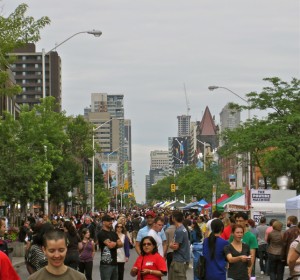
Festival on Bloor (FoB) originally began with a disagreement between Andrew Kilgour and former James Joyce Irish Pub (386 Bloor St. W.) owner Robert Costello.
“I said having a street festival would be a great way to bring the community together,” said Kilgour, owner of Kilgour’s Bar Meets Grill (509 Bloor St. W.). “Robert bet me that I couldn’t get Bloor Street closed. The chair of the Metropolitan Transit Committee said ‘Go ahead and do it.’ It was very simple to start, and I won my bet.”
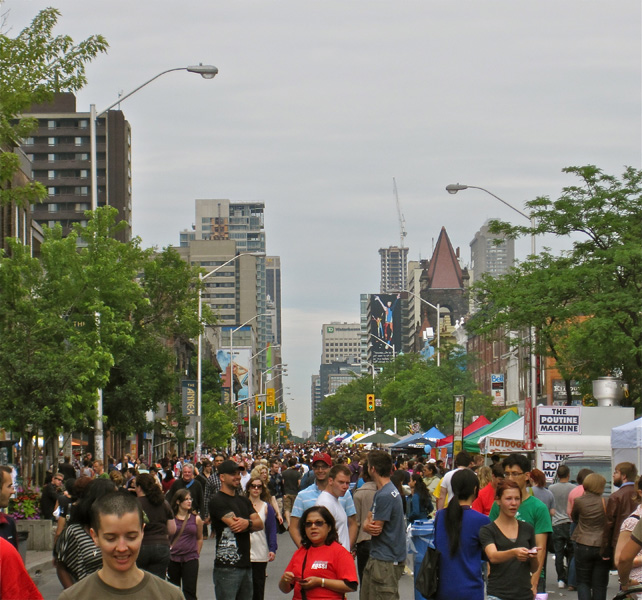
Bloor Street will once again be transformed into a pedestrian party on June 12 for the 15th annual FoB. Maxine C. Bailey, FoB coordinator at the Miles Nadal Jewish Community Centre (MNJCC, 750 Spadina Ave.), is running the show for the third year in a row. “I just love the different vendors, performers, and people coming together,” she said. “I’m a Caribana baby, so I love that kind of party atmosphere.”
Community is at the heart of this event, which attracts 15,000 attendees each year. Local merchants (including The Annex Gleaner), live music and theatre acts, and children’s entertainers line the street from Spadina Avenue to Bathurst Street. This summer, Nintendo 3DS and marketing company Inventa World will be launching their interactive game from a 20 by 20 truck. The Toronto Cyclists’ Union will be promoting green transportation by offering free valet service to anybody who cycles to the event.
Local performers will hold court at the Tranzac Club’s (292 Brunswick Ave.) outdoor stage, which will be broadcast live by CIUT FM 89.5 radio. Live music acts include folk/funk artist Jaron Freeman-Fox & the Opposite of Everything, and No Fish, a group of high school musicians and several of their fathers who play everything ranging from Klezmer (secular Jewish music) to Balkan music.
Juno award-winners Donné Roberts and Adam Solomon will bring their take on world music to the festival main stage. Solomon got his break as a “subway player” in Toronto. At 1 p.m., the Battle of the Bands begins. Other street performers like The Toronto FRINGE (344 Bloor St. W.) theatre artists, and the Ecuadorian ensemble The Imbayakunas will keep the crowds energized.
Shutting down one of Bloor Street’s busiest sections induces headaches, but the MNJCC and local businesses cooperate to ensure the festival runs smoothly. The MNJCC supplies most of the volunteers and some of the entertainment in the form of choirs and fitness demonstrations.
Kilgour, the street festival’s first co-chair, believes the MNJCC is integral to the event’s success. “It does take a crapload of people,” Kilgour said. “Without the [JCC’s] support, I don’t think anybody would be capable of running it.”
YoYos Yogurt Café (417 Bloor St. W.) will be participating in FoB for the first time. “It’s a nice way to welcome us to the community,” said employee Tyler Ball, 30. But the festival is not only for Annex residents. “Even if you don’t live in the area, it’s still a chance to meet a lot of people who live and work in the area, and see what other businesses are available here,” Bailey said.
While Kilgour is excited about this year’s festival, he is nostalgic for the early days of FoB. “There was a great motto that seemed to be coming from the city which was ‘It’s better to ask for forgiveness than to beg for permission.’
“As it’s gone on, it’s become more regulated, all kinds of codes that need to be met.”
The MNJCC and Bloor Annex BIA are co-sponsoring the event. For more information, contact FOB Coordinator Maxine Bailey at (416) 924-6211 ext. 121 or by email at maxineb@mnjcc.org
Tags: Arts · People
June 6th, 2011 · Comments Off on Locals say Kensington Market shooting outside after-hours an isolated incident
By Julia Hennessey

Six shots were fired in an alley adjacent to Augusta Avenue. Julia Hennessey/Gleaner News
The Kensington Market community was back to its peaceful self just two days after three men were wounded from gun shots fired in an alleyway.
Just after 4:30 a.m. on the morning of Sunday, May 29, police responded to a distress call in Kensington Market. Six shots were fired in an alley near an after-hours club at 213 Augusta Ave., leaving three men wounded.
The events occurred just hours before the first Pedestrian Sunday of the spring, where the streets of Kensington Market are closed to cars and there are food stands, music and performances.
Partial street closure for the police investigation was necessary for a thorough analysis of the site. “There were casings and bullet fragments and blood all over the sidewalk and the street,” said Detective Chris Chilvers, lead investigator on the case. “In order to do a proper forensic investigation, and to make sure that it’s done properly, we need space.”
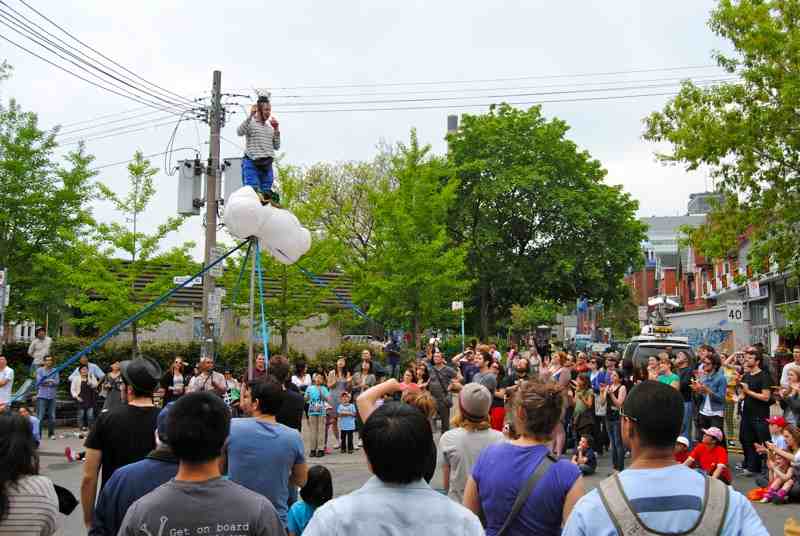
The triple shooting did not disturb the Market's first Pedestrian Sunday of the year on May 29. The street festival featured buskers, live music, and dance. Perry King/Gleaner News
The gunfire and resulting investigation delayed the opening of nearby businesses. Liv Luna, an employee at La Tortilleria Mexican restaurant, located at 198 Augusta Ave., arrived to work a few hours after the crime had occurred. “We had to open almost two hours late, the street was closed and I wasn’t able to open the store” she said.
The effect on Kensington Market’s stores, restaurants, and cafes was temporary. Later that day, it was business as usual. “People started to come here,” Luna said, “eating and everything, two hours later.”
The violence is especially unsettling given the reputation Kensington Market has for peaceful, community-oriented activity. However, according to Luna, the event did not defeat the positive energy of Pedestrian Sunday. “Sunday was, as always, packed with people. A lot of people having fun, eating outside, walking, dancing.”
This type of crime is so out of the ordinary for Kensington Market that most visitors to the neighbourhood probably did not even realize the shooting had taken place, she said. “It’s not something common, this is the first time I know of something like this happening.”
Michael Vit, employee at Funky Junky furniture store, located at 206 Augusta Ave., up the street from the site of the shootings, holds firm on Kensington Market’s reputation for peacefulness. “I don’t think it will change what people think of Kensington Market, it’s still a good area” he said. “This is an isolated incident, as far as I’m concerned.”
None of the victims’ injuries were life-threatening. One man was hit in the arm, and another in the leg. The third man suffered a more serious injury when he was struck in the stomach. All of the victims were taken to a local hospital.
Police currently have no suspects but are conducting a full investigation into the incident and following up on leads.
Police are requesting the public’s help with the investigation. Numerous patrons may have witnessed the event and fled before giving a statement to police. If you have any relevant information contact 14 Division at 416-808-1400.
Tags: News · General
By Beth Macdonell

The Annex Cat Rescue cautions that feral cats are never safe to pet. Beth Macdonell/Gleaner News
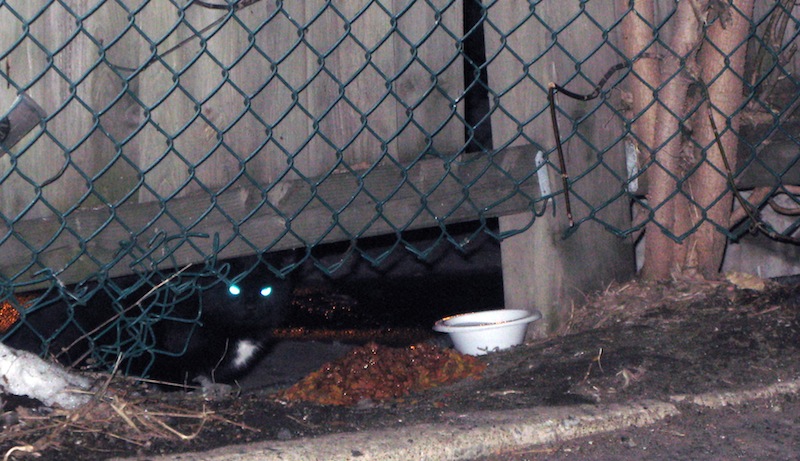
Look down one of the Annex’s many laneways and all may appear lifeless. But according to Janine Denney-Lightfoot, 47, a volunteer with the Annex Cat Rescue, living in and around our garages and sheds are hundreds of feral cats.
These wild felines live largely independent lives with no permanent home and no owner, yet depend on people daily to feed and care for them.
“There are so many homeless cats in the city of Toronto,” says Denney-Lightfoot, as she gathers supplies from the trunk of her car and prepares to take the Gleaner along her route near Christie Station. Every night, she follows the same path stopping at specific locations where the ACR knows feral cats are living.
“Most people are unaware the feral cats are even there,” she said. “You don’t see them because you don’t look for them … but go through laneways late at night, you start to see them. They come out largely after dark, when it’s very quiet.”
Along the route, Denney-Lightfoot stops at a dozen locations to fill bowls of water and leave food for cats. Some cats look on and wait for us to step back, others rush over immediately.
“It’s a very hard life for them,” she said. If no one were to feed the cats, “they would probably find another food source eventually, but would be extremely hungry and might die.”
Because the local feral cats were either born outside or lived most of their lives outside, Denney-Lightfoot said it’s unlikely they can ever be domesticated. It’s why the cats need to be fed and their populations monitored. She said even if feral cats are taken in by an animal shelter or adoption agency, no one will want them because of their un-nurtured tendencies. “They don’t know anything about people being kind to them, they are afraid of them, just like a wild animal would be because they’ve never been socialized, touched, or handled.”
Beyond food and water, Denney-Lightfoot said she would like to provide shelters for the ferals, but since most of the cats living along the route live in laneways or on public property she’s unable to.
A volunteer with the ACR since the organization’s inception in 1997, Denney-Lightfoot said she got involved soon after she started feeding some feral cats on her own near her home. “One day there was an ad in The Annex Gleaner that was looking to start a cat rescue group in the Annex, so I phoned,” she said. Today, she manages three routes in Toronto’s west-end and has four cats of her own. By day she works in management at a law firm and is a mother to a 7-year-old son.
Beyond making sure identified feral colonies are fed and have water to drink, volunteers also trap cats that are injured or sick. Once caught, they are rehabilitated in volunteer-run foster care homes, before being released back on the streets. One of the most important roles the organization plays is trapping cats and having them spayed and neutered so populations don’t continue to breed.
As we continue along the route and Denney-Lightfoot talks about the various feeding stations, it’s apparent she knows almost all the cats she feeds. She knows which cats have been pregnant, when they were born, if they’ve been spayed or neutered, even their individual personalities. Some of the cats she talks about are extremely wild and very timid, some more friendly, but she emphasizes that they are never okay to pet.
“There are cats that we have fed in the ACR for 12 years and still can’t touch. We can get really close to them, they know the sounds of our voices, they know the sounds of our cars. They’ll come running out as soon as you call them, put the food down, but you have to stay a bit of a distance back.”
One time she said she tried to pet a feral she had been feeding for years, but it “just jumped a mile gave me a look that said, I had crossed a boundary.” Another time she accidentally cornered a cat that reacted by hissing. “It’s really hands off.”
Despite not being able to touch the cats, Denney-Lightfoot said she truly enjoys her nighttime work with ferals. “It’s my me time, it’s away from the hustle bustle,” she said. “Ferals are almost wildlife, they are a part of nature. It’s a little bit of time out in the city. It’s some quiet time with the animals, and I find that very relaxing and very rewarding.”
She says one of the most difficult parts of the job is worrying that comes with it. “One of the challenges with the feral cats is that they just disappear, and then you never know what happened to them,” she said. “You don’t think you would, but you do, you do get attached to them.”
Attached as she is, Denney-Lightfoot needs help feeding the cats every night, year-round. The organization is always looking volunteers to help feeders along various routes; a job she says is very worthwhile and satisfying.
“After all these years of feeding I find it really rewarding to have a hungry cat and watch it have a good meal,” she said. “It still makes me smile.”
If you would like to get involved with the Annex Cat Rescue or know of a feral cat or colony in need of help please visit their website at annexcatrescue.ca.
Tags: People · General
By Nathaniel G. Moore
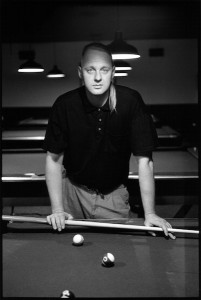
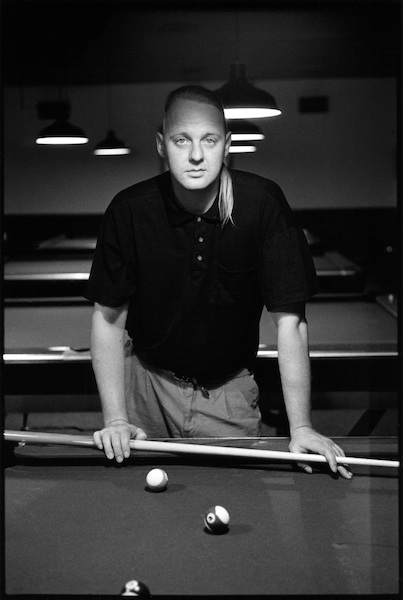
Daniel Jones was a self-proclaimed alcoholic writer. Courtesy Sam Kanga.
This month, two works by the infamous late-Annex writer Daniel Jones are being reissued.Coach House’s The Brave Never Write Poetry comes with a brand new New Order record sleeve-inspired cover, while Three O’Clock Press’ remix of 1978 is slightly more sophisticated than its original release over a decade ago.
Born in a working-class district of Hamilton in 1959, Daniel Jones moved to Toronto to attend the University of Toronto in 1977. Before graduating, he embarked on a traveling expedition that saw him visit the United States and Central America. He then returned to Toronto where, according to a close friend, he lived in the Annex at various locales, including a house Vermont Avenue, but the one place he lived longest in Toronto was at College and Grace.
Jones divided his time between writing, performing at alcohol-fuelled poetry readings (on some occasions naked), and editing various small press micro-journals. He spent some of his time hospitalized, on welfare, or working at low-paying jobs to subsidize his writing career.
In 1985, The Brave Never Write Poetry (edited by one of Canada’s most distinguished poets, David McFadden) was published, and according to Jones’ highly autobiographical short story “In Various Restaurants,” the poet describes, with heart-breaking vitriol how “Nicola” never showed up to the launch, and was scared of him, which only fuelled Jones into more chemical debauchery and dangerous introspection.
Before his death, Jones did briefly attempt to make the most of his writing output, teaching at York University for two years. According to an article published just months after his death in Open Letter by Clint Burnham, the prospect of teaching was a brutal wake up call for Jones.
“For most of this country, these sub-occupations of the general label ‘intellectual’ mean almost nothing, a fact brought brutally home to Jones the two years he taught a fiction-writing course at York University when he would try to teach students, bedazzled by Hollywood ideas of creativity and writing, that most writers are not Stephen King.”
Jones turned his back on poetry, and in addition to editing many fledgling small-press journals in Toronto, began writing fiction before taking his own life in 1994, the day before Valentine’s Day.
“In Various Restaurants” epitomizes what Jones’ work did; ripping life right out of the red-hot embers of individuality, without extracting the emotional turmoil, or creating superficial misplaced energies lost in the transference from life to literature.
His extractions were exact DNA replications of both his own purpose and meaning, and those around him, who also appeared in his hazy horizons. It was never a simple literary construct with Jones, these characters lived and breathed and were fully realized, as likeable, unlikable, loveable monsters.
Though in “In Various Restaurants” Jones is a self-described alcoholic writer, it’s the tender versions of his character via Nicola in which we fall in love with both of them and their sprawling, waning unclear love affair. Unclear in the sense that it is perhaps nontraditional, mutually exploitative, narcissistic, and to a lesser extent, doomed.
In addition to these new titles, Jones’ work appears in two fiction books published by Mercury Press: Obsessions and The People One Knows.
Yet other work still remains in limited edition quantities. Mark McCawley, editor of Edmonton’s Greensleeve Editions and the underground literary journal Urban Graffiti, published Jones just before his death. “I published a chapbook of Jones’, The Job After The One Before, in 1990. Ever since, I have endeavored to keep the chapbook in print, re-printing whenever necessary.”
McCawley describes the chapbook as “a suite of interconnected, semi-autobiographical stories about various jobs the Jones persona experiences during his day passes from the Queen Street West psychiatric hospital—stories which would find further realization in his posthumous book, The People One Knows.”
Like all of Jones’ work, the stories are about real life, an almost Xeroxed facsimile of those who touched him. Though unnamed in the stories, the pot-smoking editor in “Occupational Therapy” is none other than the late Ted Plantos, and the silent, smoking editor in “The Birth of a Minor Canadian Poet” is David McFadden—who edited Jones’ sole trade book of poetry from Coach House Press in 1985, The Brave Never Write Poetry.
In 2003, Chelsea Ireton, a first-year York University drama student, was stage manager for a play called Poet based on Daniel Jones’ poetry, written by Robert Wallace. According to an archived issue of student paper Protem from November 2003, Ireton was asked to describe the play in one word, and she responded, “different,” adding “oh that sounded bad, but it isn’t that, it’s different in a good way.”
The play, in which “Wallace and his tremendously talented students explore Jones’ poems, extending them into powerful acts producing stellar moods birthed from the very poem itself,” ran for a week that fall.
Ireton described Jones’ poetry as having a “dark mood, yet he also has a dry humour,” and it was the hope of both Ireton and Wallace that the play’s vibrancy would encourage people to seek out the late poet’s original work.
With the two Jones reissues hitting stores this month, perhaps a whole new generation of readers may be waiting around for his words, as we speak, in various restaurants.
Nathaniel G Moore is a poet, novelist, essayist, and columnist with Open Book: Toronto. He has worked with the Toronto literary scene for over a decade.
Tags: Arts · People · General
By Perry King
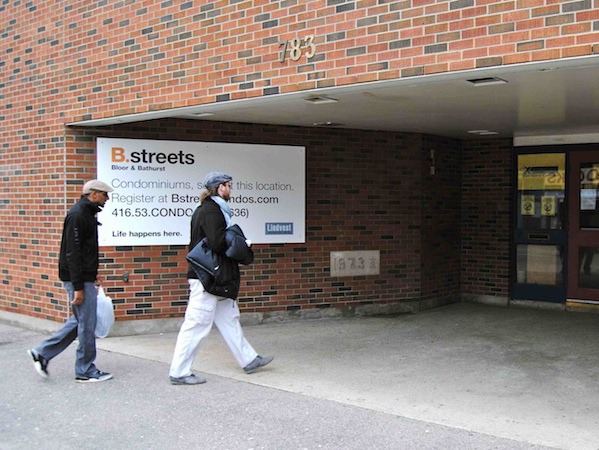
Unlike many development disputes across the city, talks between developers and residents have been so healthy for a proposed Bloor-Bathurst condo that the project has already been scaled down considerably.
“We had a couple of meetings—the councillor, some of his office staff and HVRA (Harbord Village Residents’ Association) board members—and basically I said ‘We weren’t committing anybody to anything, and we couldn’t speak for either the board or for the community, because we had no authority to speak,” said Sue Dexter, who was in on the initial meeting between the HVRA and H&R Developments.
In 2008, H&R purchased 783 Bathurst St., and came forward with a proposal for a 15-storey condominium at the site.
For Councillor Adam Vaughan (Ward 20, Trinity-Spadina), “[15 storeys] was one of the options we looked at. We looked at what would happen if you massed all the density to the north end of the site, what would happen if you moved it to Bathurst Street. We played with massing models to try and create as strong a proposal as possible,” he said.
The informal talks have created a working group consisting of developers, Vaughan’s office, and local residents. The developers “came into it with a really open mind,” said Vaughan. “I think they’ve done some amazing stuff around the laneways. They are animating Bathurst Street, and the architecture through this process got better and better.”
783 Bathurst, formerly Loretto College’s south campus, has been sparsely used since the school combined its two campuses—the other campus was located at Brunswick and Barton—and moved to the Dufferin and St. Clair neighbourhood in 2006.
The building was most recently used as Trinity Spadina’s federal election returning office.
“I think the school turned its back to Bathurst Street. I think [the area] will have a little bit of personality and a bit of activity at street level, and I think that‘s a good thing for everybody. Hopefully, out of all of this, we end up with a bit of a renaissance on Bathurst Street when we start returning some of the services that are needed in the neighbourhood,” said Vaughan.
The project finally moved forward in March with Official Plan rezoning and site plan approval applications for a nine-storey, 196-unit proposal.
Regardless of the progress made, the public consultation, to be set in the near future, will bring more concerns from local residents and businesses. “I think that living with construction morning, noon, and night is going to be really disappointing, and I think it will draw a lot of business away from the Annex because [the area is a] small little community to itself,” said Sheena Wallace, a local resident who works at the condo-neighbouring Trove apparel store. “If you start bringing all that in, you’re starting to change the whole dynamic, and I already pay high enough rent.”
Wallace says she understands the neighbourhood is not immune to development, but is concerned about how the changes will influence architecture for the worse. She has already considered moving from the neighbourhood once her current lease expires. “It seems that everywhere I’ve moved, I have construction following. This [condo proposal] is pretty disappointing, actually.”
The project’s influence on businesses could mean growth, but Cito Ramos, who manages the nearby Midas auto shop, foresees the woes that come with higher density. “People are occupying a nine-storey condo, so that’s going to increase traffic flow in the area. So be it. The city and the school board want to take advantage of the property and flip it for something and make some pay out of it. I can understand that, I see an impact,” he said.
Ramos was managing the shop when the TTC replaced the streetcar tracks on Bathurst several years ago, and it was “murder” for the business. “Sometimes, people, rather than wanting to come down here because the parking might be a bitch—maybe they’ll go somewhere convenient for them.” But, Ramos is confident the shop can adjust to traffic congestion.
Demolition for the old school is expected to occur later this year.
Pre-mapping developments key to “progressive change”
By Perry King
“There’s been a progressive change in the way development applications are being handled in the ward, and basically what happens is a lot of things were arriving at a public meeting,” said Sue Dexter. “[Before] the neighbours had no way of putting any input ahead of that, and these cases ultimately wound up at the OMB, which would not turn out well.”
It’s a culture that Councillor Vaughan says he has been looking to change since he took office in 2006. His office has mapped all possible development sites in Ward 20. “We found a way in the ward, not just in the north end, but in the south end, to highlight areas that we expect growth to happen in.”
New projects are being measured against expectations based on the mapping.
According to Vaughan, the approach has fostered cooperation, and all sides are better able to push staff to get approvals quicker. It is a tactic that works, compared to “a divide and conquer tactic—which has defined other wards”. He says he plans on working with colleges and universities in this same exercise soon.
Tags: News
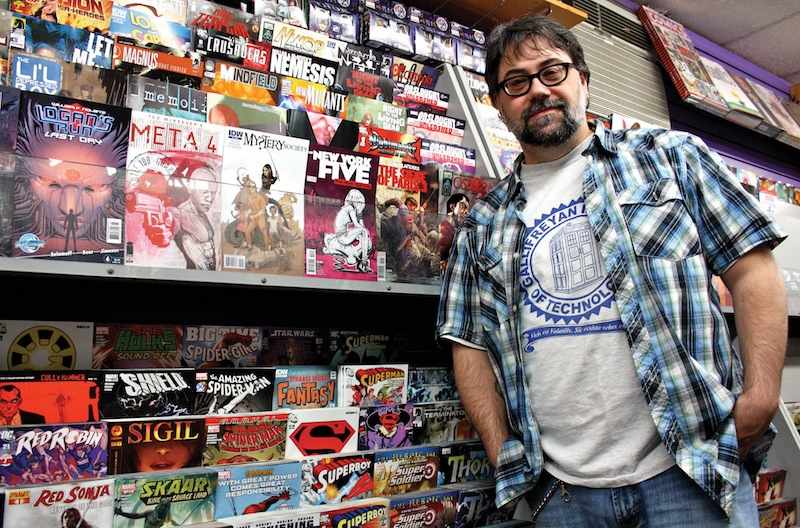
New owner George Zotti describes the Silver Snail as a destination store at its current location on Queen. He is looking into moving the store to the Annex. Photo credit: Adam Carter/Gleaner News.
By Adam Carter
After decades of calling Queen West home, Toronto’s famed comic shop the Silver Snail is being sold along with their building, and is looking for a new location.
Incoming co-owner George Zotti has been working at the shop for over 20 years, and said the Annex could be ideal as a new location for the iconic store.
“I’d love to go to the Annex, I think it has that counterculture feel that Queen Street used to have,” Zotti said. “Now Queen Street is all big business and fashion. When I was coming down as a kid, it was an event to come to Queen Street.”
Zotti said he thinks clients will follow the business to a new location.
“We’re pretty much a destination store here on Queen anyway,” Zotti said. “The Snail has been there from the beginning—most of the stores that were around back then are gone. Silver Snail has been that first ‘niche mecca’ and now it’s just turned into this Toronto pop culture icon.”
Zotti said the building holds a lot of memories—though some are stranger that others. ”I’ve opened our back door to people urinating on our doorstep,” he said. “And once in the middle of February a car pulled up into our back alley, a dude steps out of the back seat totally naked, runs up the alley, back to the car, and drives away. Somebody lost a bet that day.”
Comic aficionado Toby Orr has worked at the Snail on and off since 1995, and said the move was fairly inevitable.
“Queen Street now is not what Queen Street used to be,” he said. “The Annex seems like a reasonable choice. People do buy books up there—it’s near to the school and near to the hipsters.”
Orr said the legacy of the store through the years has been to offer a place much more welcoming than what many perceive a comic shop to be.
“We’re not a crummy underground dust hole, as so many comic shops are,” he said. “The Snail will always be a haven for science fiction and comic book fans, and hopefully the kind of place where somebody who is new to the hobby can feel welcome. It’ll be a place where you can come and dip your toe in without having to know everything about Batman before walking in.”
Orr thinks competition could be an issue in the already bookstore-strewn streets of the Annex. Even before the Silver Snail’s possible move, comic book lovers in the area already have the option of going to the Beguiling, Labyrinth Books, or BMV Books.
“But a little healthy competition helps everybody—at least that’s the theory, right? Hopefully having more stores in the neighbourhood will just attract more customers for everybody and we’ll all do better,” Orr said.
Peter Birkemoe, owner of the Beguiling, said he doesn’t see a move by the Snail as detrimental to his businesses.
“The great comic stores in Toronto have all historically had different specialties, so they don’t really compete with one another that much,” Birkemoe said. “Whereas we’ve taken a very graphic novel and literature focus to our store, the Snail has taken a much more merchandise and memorabilia thrust to theirs.”
Birkemoe said the real issue is not another store moving into the Annex, but what this move will mean for the southern half of Toronto that now has no comic shop.
“It might have a small effect on the Annex, but all of a sudden you have an entire half of the city that isn’t really being serviced by a local comic shop at all,” Birkemoe said.
“Even though Queen West is not what it used to be in terms of a cultural centre or hub, that part of Toronto now has a much denser population. You still have a bunch of people there that just want to buy their comics.”
Tags: News · People

The Captain Wallace app began as an idea between three dads who work in Liberty Village. Courtesy Ken Reddick.
By Gurpreet Ghag
According to his Twitter account, Captain Wallace is an adventurer, a mustache enthusiast, a pith hat collector, and a friend to all animals. He once spent a week in the belly of a whale with only a ginger beer and a loaf of bread.
You may be surprised to know then, that the travelling Captain’s roots are here in Liberty Village.
Yes, as it happens, “Wallace, the fictional guide of ‘Captain Wallace’s ABC expedition,’” an iPad app that helps children learn their alphabet through familiarizing themselves with animal names, is the creation of three fathers who work out of Meldmedia Inc. (360 Dufferin St.).
It all began in 2008, when soon-to-be father Chris Barrett was preparing his nursery.
“I was looking for an animal print that could be put around the room, but I didn’t find one that I liked,” said Barrett, “So, I made one myself.”
Then he took the idea to Adrian Newbould, who tried to help come up with a name for the prints and turn them into a book.
“At the time, I was just calling it ‘Alphabet Zoo,’” said Barrett.
Newbould then shared this idea with Ken Reddick, the owner of Meldmedia, who was doing advertising and design at the time, but liked the prints very much and wanted to help produce something interactive out of them.
The illustrations then turned into animations, but what to do with them was still in the air.
“We thought it would be some bumpers for kids television programming, or some kind of animated web experience, but then I woke up one morning and realized that we had an app on our hands,” said Reddick.
The next morning, Barrett threw together an interface for an iPhone app.
“It was small, but it worked,” recalls Reddick, explaining that the app was functional and enjoyable, but the resolution didn’t allow the pictures to be fully appreciated. “And then halfway through the development, the iPad came out and we were like, ‘We have an iPad app on our hands.’”
Slowly all the pieces started coming together. The developers’ children acted as testers to the app, telling their fathers what they did and did not like. In fact Adrian’s seven-year-old daughter, Emina, is actually the voice that is heard when a letter is pressed on the app.

Courtesy Ken Reddick.
After careful work on animations, voices, and interface, the ABC Expedition was released on February 3.
Sales were slow at first, but recently the team got some much-deserved recognition when the American Apple store featured the app on their staff favourites list.
“Sales have gone up eight hundred percent since then,” said Barrett, “and we’re currently staff favourites in Mexico, Brazil, China, Costa Rica, South Africa, and the United States, which is huge.” The app has now sold over 2,500 copies, and the team couldn’t be happier.
“We’re not some big company cranking out apps, we’re three dads who are doing this out of passion, and we really wanted to put out something we love. There could have been a ton of shortcuts made, but we kept going back and making sure the animations were perfect, and the voices were perfect, and the interface was perfect; we just put a lot of care into this and said if we were happy with this other people would feel the same,” said Newbould.
The team hopes to get started on a mathematics version of the app soon.
To find out more about the Captain and his alphabet adventures, you can follow him on Twitter.
Tags: General
By Susan Oppenheim

Rosario Marchese, right, has been a sitting MP in Trinity-Spadina since 1990. Photo credit: Perry King/Gleaner News
From his beginnings in Toronto 50 years ago as a 9-year-old Italian immigrant, to his position today as the NDP Caucus Chair at Queen’s Park, not much in Rosario Marchese’s approach to life seems to have changed. He has remained solidly grounded to family, community, and Canada. His career has centered on education and advocacy, first as a teacher of English and French, then eight years as a school board trustee, and 21 consecutive years as an MPP, the last 17 in Trinity-Spadina.
One can easily find Marchese’s accomplishments online, but I want to know how some events in his life as an immigrant, as a family member, and as a public servant have affected him. I had lunch with Marchese in the dining room of the Queen’s Park legislative building.
Susan Oppenheim: Your first memory in Canada?
Rosario Marchese: We walked immediately through the snow, immediately from Dovercourt and Dundas to get fresh bread at a big Italian bakery on Euclid Avenue.
He, his mum, and brother arrived by plane after waiting five years to join their father and siblings. The six of them stayed in a second-floor flat owned by relatives of relatives from their town in Calabria, until they were able to buy their home on Shaw south of Bloor, where his brother Graziano lives today. In 1961 under Diefenbaker, they faced a recession and immigration options shutting down, and finding work, any work, was exceptionally hard. Acculturation was also not easy.
R.M.: I was in grade 4 in Italy and they put me in grade 3 in Canada .The teacher asked me a math question and I didn’t know what she was asking—not because I didn’t know what to do, because math was easy for us—but because I couldn’t understand the question. They moved me back to grade 2—that was a very painful memory. It was a tough experience, and it was silly and stupid because kids can learn a language very quickly. I skipped grade 6 but by then the new math had come in and the teacher said, ‘Here, read the book,’ and I couldn’t do it on my own. There was no support in transition, and it affected me terribly, and a lot of other immigrants. From time to time I raise this personal experience in the legislature.
S.O.: You have described your wife Evelyne as your companera—not wife, not partner, but partner in everything. How did you meet?
R.M.: I was working at the TDSB and she was working there too. I remember seeing her at the [Cafe] Diplomatico one day coming in. We would always go to Sicilian and Bar Diplomatico on College. It was a cold day and she was wearing a poncho and she raised her arm to unfurl the poncho—that was so, so stylish—I must admit I fell in love that day. We started working together. She arrived in the late ’60s from Chile after the coup with General Pinochet killing the Socialist democratically elected President Allende. Evelyne was the most political of the family, and her mother was a humanist to the core who knew everybody.
That is where Evelyne gets a lot of her personality from. It is a frightening thing to think about. It raises the hair on your arms and your face. Chile had had a history of left elections and electing left leaning politicians, but America was instrumental in bringing Pinochet to power and bringing Allende down. When you think about the history, I don’t know how they survived it. I don’t think I could have.”
S.O.: Dooney’s, an Annex institution, owned and operated by local celebrity Graziano Marchese, and frequented by writers, intellectuals, and media types, fought off Starbucks’s attempted takeover in 1995 (“Save Dooney’s” is still scribbled in the concrete on the corner of Borden and Bloor). Tell me about this.
R.M.: It was one of the most fascinating stories because no one has ever won a fight against Starbucks that I am aware of. The owner Mr. Hix wanted to kick my brother out after 15 years and the rent was incredibly high. His sister came in, with a smile, and said “Graz, it’s only business, you’re out of here.” It was a terrible shock. The woman used to come to eat at the restaurant—it was free. It was exceptionally ugly to have her come with a smile on the day the lease came up. The point is commercial tenants have no rights—once your lease is up they can let you go without any notice. So we talked, and we talked to friends, and we started to organize to embarrass Starbucks because the owner had made a deal with Starbucks for ten years. We mounted a public relations campaign and we had a lot of good people.
We demonstrated at Hix’s book launch and then in front of every Starbucks that was in the riding—about 22 articles were written and it created such an embarrassment for Starbucks that they decided to pull out. And Hix said “If you pull out I am going to sue you.” So Starbucks and my brother united against the landlord and they won that legal battle and I am happy to report that the owner had to pay $175,000 in legal fees and it made me feel good. I thought it was wonderful retribution and my brother stayed there for another ten years and then set up Annex Live on Brunswick.
S.O.: When Steven Lewis’ son Avi was asked “Why did you become a journalist and filmmaker? Why didn’t you become a politician?” He answered, “I saw what it did to my family.” You will run again this year—this time with your recently retired wife actively at your side. Any comments?
R.M.: Avi is absolutely right. For that reason a lot of children who come from a very political family end up not running because they do not want to be part of it. They end up being progressive like their parents, but they want the freedom to do what they like. Politics engulfs you for a very long time. It isn’t just the media that could be after you depending on what you say, or who you are, it is consuming because you have to be out there very, very often.
You have to be in the community. You have to go to all sorts of meetings within the party and outside the party and once you are elected, if you want to stay elected, you really have to be out there a lot. So between obligations at Queen’s Park, being the critic for something or other, and serving your community where there are over 125,000 people, it’s not easy. It can be very, very challenging. You have to maintain the energy levels to be out there—to be visible. You have to have good staff who help you to put out the word. If you don’t have that support, you are on your own. The work we do is highly political and people get burned out, they don’t stay long, and you have to retrain over and over.
S.O.: I understand constituents can receive updates about events and issues through the website as well as by calling your offices on Dundas Street and at Queen’s Park. Many events are posted on Facebook and updated in local papers like the Gleaner and people can attend at the legislature or watch TV when the house is in session as well. So why do people still say, “Well, what is he doing?”
R.M.: Often we say people don’t know what we are doing, and we have to get out there, but we don’t have franking privileges [the ability to mail things for free]. We have to work provincially within a budget. If you hire staff, you do not have the money for a $17,000 newsletter every year. Seventy-five per cent of the 125,000 mailings can simply get thrown out. Emailing is helping, but gathering those addresses is a slow process, one email at a time. I was able to persuade the premier that MPPs need a newsletter and we all got $11,000 towards that, so we are putting one out after May 2.
S.O.: We will certainly be looking forward to this newsletter and keeping track of everything you are doing. By the way, I thought the lunch was delicious. Thank you Rosario.
Rosario Marchese is currently the NDP Critic for Education, GTA Issues and Training, Colleges and Universities. For more information, visit www.rosariomarchese.ca or find him on Facebook.
Tags: General

Grand Touring Automobiles, located at 740 Dupont Street, sells luxury cars from Rolls Royce, Jaguar and Land Rover. The property was bought by RioCan in October for $10.9 million. Perry King/Gleaner News
By Perry King
RioCan, Canada’s largest real estate investment trust, has purchased a 1.4 acre property in the Christie-Dupont area.
740 Dupont St., currently occupied by luxury car dealership Grand Touring Automobiles, was one of four Canadian properties purchased by RioCan in late 2010.
Acquired for $10.9 million, RioCan announced the purchase in January.
“The idea of a box store going into that plot caught my attention because, who knows? It could be a Walmart,” said local Mark Evans, who informed the Gleaner of the acquisition. “But a box store on Dupont? There’s issues of traffic and parking. There’s no doubt in my mind that Dupont needs some TLC, the question is: does it need a box store? Is that the best use of that piece of land, considering there is the Galleria Mall, which is not that far away and could probably be redeveloped?”
While officials for RioCan, including CEO Edward Sonshine, could not be reached for comment, their intentions to expand US-based retail stores in downtown Toronto are well documented.
According to a January Globe and Mail article, RioCan and Tanger Outlet Centers Inc. agreed to a $1 billion partnership that would help RioCan attract more US retailers to Canada. Tanger has a number of retail clients, including Saks Fifth Avenue and Nieman Marcus.
Centrally focused on developing big box retail stores, and with a portfolio of 296 properties across Canada, RioCan’s top retailers include Walmart, Famous Players theatres, and Canadian Tire.
“I think it’s worrisome that things like this happen and neighbourhoods don’t know about it,” said Seaton Village Residents’ Association (SVRA) chair Jennifer Hunter, who was informed of the aquistition by the Gleaner. Hunter said she will avoid being “alarmist” about what this will mean for the area.
She notes that there is already a Walmart franchise closeby, and a number of grocery stores like Sobeys (840 Dupont St.), Loblaws (630 Dupont St.), and Fiesta Farms (200 Christie St.) to serve the community.
Hunter says she hopes to better understand RioCan’s plans. “At what point does it become something that the community does get to actually comment on and have some kind of decision making ability in? It’s not to say I’m being fatalistic and thinking that they can do whatever they want because it’s their property. At the same time, I don’t want to get my knickers in a knot.”
Councillor Mike Layton (Ward 19, Trinity-Spadina) hopes the community makes sure the new development “fits the neighbourhood”.
“You want to make sure it doesn’t overwhelm the existing neighbourhood. Just north of the tracks, it’s the same deal. It’s not all big buildings around there, so you want to keep some kind of balance,” said Layton.
While space for big box retailers in downtown Toronto is scarce, RioCan has witnessed a rising demand from retailers to travel up to Canada. US retailers were telling Sonshine as early as spring 2010 that they could not find adequate space for expansion.
Last year, Layton was contacted by Riocan and asked for his opinion about a “car dealership” on Dupont. They did not allude to Grand Touring specifically, but they asked whether Layton would be open to changing a property to include a residential component.
“We don’t want to take away all the areas that provide services to our residents,” said Layton. “Could it be better used? Probably. We could probably find some kind of use that would be a little more suitable and contribute more to the neighbourhood. What that exactly is, I’m not entirely sure.”
Because Grand Touring is still operating, specific plans for development have not been tabled at this time. Layton met with officials from RioCan in March, who confirmed they have no immediate plans for the property. “These statements [acquisitions] are not guarantees of future events or performance and, by their nature, are based on RioCan’s estimates and assumptions,” reads a RioCan news release.
The release adds that management are confident that further development is possible, and will proceed with the acquisitions under the “reasonable assumption” that the purchase would lead to some future endeavour.
Dupont-Christie residents are no strangers to big retail. In the 1990s, the Seaton Village neighbourhood and George Weston Limited had a long documented dispute about the Loblaws property at the northeast corner of Dupont and Christie. Led by the SVRA, neighbours were primarily concerned about increased traffic and density from the grocery store, and consultation between parties took many years. Many of those same issues may arise again if RioCan moves forward with a similar development.
The Gleaner reported last December on plans for a hotel and condo by the Wynn Group at Dupont and Walmer Road.
“We need more people to help create better and more dynamic businesses. Instead of it being industrial, of that nature, maybe if we had some more [small] stores, it could be a good thing,” said Hunter.
BIA advisor David Hessels says that Dupont is a city planning challenge. In Toronto’s Official Plan, it is currently zoned for employment lands on the north side and for mixed-use, mostly residential, on the south side. “It’s not your typical mean street area, where you can get a real shopping atmosphere, it doesn’t have that,” he said.
The Dupont property is set to be the third significant RioCan project in downtown Toronto. RioCan Hall—which houses the Scotiabank Theatre and Chapters bookstore in the Entertainment District—and the Loblaws store at Queen and Portland are two other RioCan-owned downtown developments.
Tags: News
May 3rd, 2011 · Comments Off on NDP wins big downtown
By Lindsay Tsuji
The General Election on May 2 proved to be a historic evening. From news of a Conservative majority, the Green Party winning a seat in Parliament to the naming of the NDP as the new opposition party, it was nothing less than shocking.
Locally, Trinity-Spadina NDP incumbent Olivia Chow won with a cushy 54.1 per cent over Liberal contender Christine Innes who came in with 23 per cent. This was in contrast to the 2008 election where Chow won by a mere 3, 484 votes. Conservative candidate Gin Siow followed third with 17 per cent and Green candidate Rachel Barney came in with 5 per-cent. Voter turnout was 65,560, up from 54,179 during the 2008 election. Chow was first elected in 2006 when she beat incumbent Liberal MP Tony Ianno. Both Libertarian candidate Chester Brown and Marxist-Leninist candidate Nick Lin received less than 1 per cent of the vote.
NDP gained new ground in the Parkdale-High Park riding with a win by Peggy Nash. Nash won with 47 per cent of the vote over incumbent Liberal Gerard Kennedy coming in second with 32.5 per cent. Conservative candidate Taylor Train came in third with 15.8 per cent followed by Green candidate Sarah Newton with 3.3 per cent. Although the riding has historically been Liberal since 1988, Nash won during the 2006 election upsetting the Liberal strong hold in the area. Voter turnout was 50,902, up from 48, 384 back in 2008. The Christian Heritage Party candidate Andrew Borkowski, Marxist-Leninist candidate Lorne Gershuny and Radical Marijuana Party candidate Terry Parker all came out with less than 1 per cent of the vote.
Another Gleaner riding turned a sea of orange with the win of NDP candidate Andrew Cash in the Davenport riding, beating out Liberal incumbent Mario Silva. The riding has been consistently Liberal since 1962.
One of the few ridings to break the trend of the downtown going NDP was St.Paul’s. Incumbant Carolyn Bennett came out with 40.6 per cent of the vote. The Liberal influence has been strong since 1993 and Bennett has been a favourite since being elected first in 1997.
The Gleaner congratulates all who participated.
Tags: General
April 29th, 2011 · Comments Off on A bird’s eye view: A look at the west downtown ridings
To further help with your decision to vote today, the Gleaner has compiled an interactive map with information about the ridings that we cover: Trinity-Spadina, Parkdale-High Park, Davenport, and St. Paul’s.
To see complete coverage of the candidates for Trinity-Spadina and Parkdale-High Park, click here and here.
For more coverage about the race in Davenport, visit this page, brought to us by our friends at the Bloordale Press.
For more coverage from St. Paul’s, visit this page from OpenFile.
View Canada Federal Election 2011 in a larger map
Tags: Liberty · News
Compiled by Emina Gamulin, Perry King, Beth Macdonell, Rebecca Payne and Lindsay Tsuji
The Candidates
Question One: mental health
Question Two: family reunification
Question Three: the Canadian Forces
Question Four: electric trains
Question Five: prisons or poverty?
The Riding
Parkdale-High Park is one of the most diverse ridings in Canada in terms of income and ethnicity. It is slightly higher than the national average in terms of unemployment, and significantly higher in number of seniors, immigrants, and renters. The riding has been Liberal since 1988, except between 2006 and 2008, when the NDP upset the Liberal winning streak. The last time a conservative candidate won was in 1984. The Gleaner covers the Parkdale portion of the riding, which also includes Roncesvalles, Bloor West, the Junction, Swansea, High Park, and parts of Brockton.
Population: 102,150
Immigrant population: 39 %
Median age of population: 38.1 years
Median income: $49,127
Political History:
2008 Election: Liberal
2006 Election: New Democrat
2004 Election: Liberal
Source: Statistics Canada
The Candidates

Elected in 2008 as the MP for Parkdale-High Park, Liberal candidate Gerard Kennedy is the Critic for the Environment. Kennedy has regular local meetings and initiatives on mental health, the arts, Metrolinx, and seniors. As the Ontario Minister of Education, Kenendy led a province-wide turnaround in public-funded education. His public service began with the first Canadian food bank in Edmonton and then Toronto’s Daily Bread Food Bank. He has been a part of the riding since 1986 and lives with his wife and two children in west Toronto.

Peggy Nash
Raised in Rexdale, and an alumnus of the University of Toronto, Peggy Nash was the NDP Member of Parliament for Parkdale–High Park from 2006 to 2008. Prior to that, as a senior Canadian Auto Workers negotiator, Nash was the first woman union representative responsible for major auto negotiations in North America. Nash has received two awards from the Sierra Club of Canada for the NDP Green Car Strategy with Greenpeace and the CAW. In 2009, Nash received the 2009 YWCA Woman of Distinction Award. She currently sits on the board of directors for Invest Toronto.
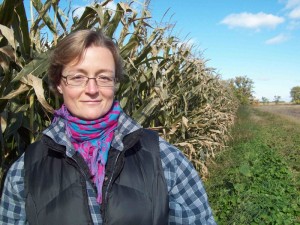
Sarah Newton
Green candidate Sarah Newton has lived in the GTA for ten years. She is a research assistant, an executive assistant, a server at Annapurna (1085 Bathurst St.), and a belly dance teacher. She has an Honours BA in Humanities and Communications, and an Associate Degree of Arts and Science. Newton takes part in many organizations including debating for the model UN and Model Pugwash. She also supports the Lake Ontario Waterkeepers and is a member of the Council for Canadians. She is an advocate of yoga and veganism.
Terry Parker
Terry Parker has run as the Parkdale-High Park representative for the Marijuana Party since 2000. Parker credits marijuana as the substance that changed his life for the better. According to an article in Cannabis Culture magazine, Parker, a patient of severe epilepsy, was on a steady diet of pills, before a fellow patient introduced him to marijuana. In 1987, an Ontario Court found him not guilty of possession, citing that the drug did in fact help Parker’s disability. In 1980, Parker was elected assistant national executive director for the National Organization for the Reform of Marijuana Laws (N.O.R.M.L.) in Canada.
Taylor Train
Conservative Party candidate Taylor Train has lived in Parkdale-High Park for 15 years. After graduating from Queen’s University, Train served in the Canadian Armed Forces Primary Reserve. His work in the financial services sector has led him to work in communities across North America and the British Isles. Taylor has both his Elder Planning Counsellor designation and Instructing Adults Certificate. He has held a number of senior executive positions with major Canadian financial institutions, and is currently a director and lecturer of Seneca College’s Centre for Financial Services.
Also running in the riding are Andrew Borkowski of the Christian Heritage Party and Lorne Gershundy for the Marxist-Leninists. The Gleaner was unable to contact these candidates in time for the story.
Back to top
The Questions and Answers
1. Recently there were a string of attacks against people with mental illness in Parkdale, with the last attack resulting in the death of George Wass. At the same time, a small percentage of people who suffer from mental illnesses commit violent crimes due to their illness. How should the federal government deal with these complex health and crime issues? If elected, how will you advocate for mental health services and people with mental health issues in our riding?
—Beth Macdonell, Contributing editor, Gleaner Community Press
Kennedy: The last six months we’ve been trying to make Parkdale-High Park a mental health stigma-free zone. Fourteen hundred different people have made the pledge in our area, and part of the pledge is a role for the federal government to equalize funding. The problem with the Canada Health Act is that it doesn’t recognize the way we need to treat mental health now. We need people to deal with their stigma, but we also need funding in the community. The Canada Health Act only funds hospitals of a kind that we used to use as the main treatment for mental health, which have now closed down.
The federal government is really not that involved. They pay for doctors, but they don’t pay for a whole range of community care that people need to have good lives and participate more fully in society. We’ve worked a lot, most closely with a group called the Dream Team. They are people who are living with mental illness and they’ve come out to every meeting that I’ve held where we’ve signed people up. The idea is that Parkdale-High Park will become the country’s first mental health stigma-free zone. So the Federal government’s role is important, but the community’s role is just as important. My basic approach would be to continue to do that and to bring it to fruition. It’s a yearlong process. We want to sign up 10,000 people from the area. We think there is a lot of empathy there and we hope that incidents don’t create fear. The only way you deal with violence is community resolve. Right after this interview I’m talking to the police, and they’ve asked me to send out another bulletin. We’ll be doing that even though it’s the middle of an election because we need to deal with this and get to the bottom of this. The community has a constructive role to play in supporting people, we don’t want to spread the fear that is out there for folks.
You mentioned equalized funding and you said the federal government funds hospitals, but not community care. By equalizing funding do you mean giving more money to community initiatives?
Mental health funding is about 60 per cent of what it needs to be. In other words, we don’t have a lot of primary mental health available. If you break your arm or leg you’re going to get treatment in a fairly short amount of time. If you need help with a mental health problem, you often end up on a waiting list. The funding should come from the federal government by expanding the Canada Health Act. It should start to cover community mental health. Most people who used to be treated in hospitals are now treated in the community. Yet those services are not paid for by the federal government. Every time someone signs the pledge, they are also signing a petition to parliament asking them for equality of funding. All we’re asking for is the same funding for mental health as well as physical health issues. There are very good indications that the health system in terms of emergency rooms and long term stays could be avoided if we just got people mental health treatment in the first place. Then we can focus our concern on the very small number of people who could be a danger. That’s also the thing that comes through having a better, more complete system for mental health. But it doesn’t mean we treat everybody as somebody to fear or someone to victimize because of a lack of understanding. That’s the theme of our [initiative]: time to change your mind about mental health.
Nash: First, let me say that I have worked very closely with the Parkdale Activity Recreation Centre and have been a big supporter of Edmond Place, which reaches out to people who are low income and suffering from mental health problems.
I think this government, both the provincial and federal governments, have done a very poor job in supporting people with mental health problems. The de-institutionalization of people with mental health [problems] was supposed to be combined with strong [levels] of support, and there are massive holes in any kind of safety net to protect people. I support Senator Michael Kirby’s recommendation for a national mental health strategy. I believe that our focus should be on outreach and prevention with strong community support for people with mental health problems. Many of the people who are living on the street or locked up in our jails have serious untreated mental health problems. I think our priority has to be on prevention, rather than dealing with the fallout from problems—whether it’s with the criminal justice system or all kinds of frictions in neighbourhoods.
It has to be multi-faceted. It has to deal with housing, counselling, and the ability for people to take control of their lives through community involvement. PARC is a great example of what can be achieved locally, but we need to expand that kind of approach nationwide, through community-based initiatives.
People are very worried in South Parkdale because of the George Wass murder. Police do have a role to play. But I believe we can do a better job with prevention, whether it’s mental health or job creation for young people—so they don’t feel isolated and alienated in society and fall into criminal activity. I think if people have a decent income, a place to live, and they can lead a normal life, most people would choose that, and that’s where we should be investing our money. Youth programs the federal government promised with these new criminal justice bills: we’re not seeing that.
Newton: First and foremost, by making government money available for programs again. I believe in the talent of people that work with people with mental health issues and I want to mobilize as many programs that are needed to make sure that people with mental health issues are treated to all of the opportunities they deserve. Having worked with people with mental health issues at Famous People Players, their plight has my heart.
Parker: Legalize marijuana, number one. If we didn’t have a prohibition we wouldn’t have problems with people with schizophrenia and ADHD and other mental illness. You could use marijuana as a resource. If you use it as a resource I have no doubt that people with mental illness will greatly benefit from marijuana consumption to control their anxiety; depression. Marijuana is wonderful.
Train: Millions of Canadians are affected by mental health and addictions issues and their families are affected by it. I know the cost both emotionally to the families and certainly to the victims themselves. These folks need our help. It’s obvious to me that any government has an accountability to lead, a responsibility to look after those that really have these challenges and to give them the type of services, help, and dignity that they are going to need to engage in society in the way that they can. My family has been touched with mental illness. I know how when you see someone you love very very much going missing in a lot of ways you feel very frustrated. I mean there are people with these issues all over Canada. I think one of the things the federal government should be doing—and I think Gerard is right on this—there is a certain stigmatization to folks with these types of challenges and we need to de-stigmatize society in that way. We have to educate that people with mental illnesses are people that need our help, not our approbation. We need to recognize what the challenges are and create an environment where people can have dignity and respect. As far as services are concerned, I know that there’s a huge amount of money that’s spent every year helping people like this and we have to make sure that those folks have access. This is where some of the problem may lie. That they are aware of the access they have and their care givers are aware of the access that they have to the existing capabilities that we have in the community and certainly to help them live well and healthy or hopefully get better or better enough that they can get back in to what’s going on.
Back to top
2. I list among those who applied to migrate to Canada after Canadian consulate representatives campaigned in American Universities, to recruit new skilled immigrants. They also sold us on the fact that in Canada we can sponsor our parents. The backlog in processing parents sponsorship applications however ranges from 3 to 15 years. Where do the candidates stand on effective family re-unification?
—Hala Chaoui, Agricultural Engineer and entrepreneur
Kennedy: The conservatives have put a quota in this country on family reunification and it is bar none the most frustrating thing that exists in terms of the immigration system. We’ve announced in our platform that we would expand the resources, if available, and we would take the quotas off. The basic thing comes to this: with family reunification—especially the immediate family of parents and so on—people have to be successful, they have to be able to sponsor, there is no reason to have them wait five and six and seven years like this government has.
Because what [the Conservative government is] basically saying is, yes, we want you to come, but we’re not giving you the respect of being able to have access to your family. The government put their attentions on temporary immigrants, and now we have up to 200,000 temporary immigrants, people who work here but have no rights in Canada. Many of them end up going underground so we are building problems with the Conservative approach. We would much rather see something constructive that allows people to come forward. So we have set some very specific policies that will allow people to repatriate their parents within a certain number of months and we would increase the resources available for that. This government has shrunk it down so significantly that every part of the process takes enormous lengths of time. That’s probably as much of a disrespect as the policies themselves. They’re kind of officially misleading people about what they can expect, and we find out daily as MP’s, so it’s important that we get a different way of showing respect.
Nash: Our immigration critic, Olivia Chow, has been front and centre in advocating greater focus on family re-unification and a reduced emphasis on the temporary foreign worker program. It started under Mr. [Paul] Martin, and has been exploding under the Conservative government. Personally, I introduced a bill—called the “Once in a Lifetime” bill—which was designed to help with family reunification, especially for family members like adult children, adult brothers and sisters, to help families reunite. I have also worked extensively with the Filipino community to assist people working in the foreign caregiver program, who come here and face special restrictions. But this is work that is essential for Canadians: caring for children, seniors, for people with disabilities. Yet, we make foreign caregivers jump through special hoops. Ultimately, they can become citizens. The working conditions that they face are extremely difficult. They live in their employer’s home and there are terrible abuses in terms of pay and hours of work. We saw with Jocelyn Dulnuan, who was murdered in her employer’s home. I was with [the Filipino community], in fact, on Saturday to try and make the foreign caregiver program a safer program for people who work here on that.
You know, we place great emphasis on skilled immigrants. We accept people because of their qualifications, then in many cases they come here and they can’t use their qualifications. It’s complicated because there are professional associations and provincial governments that are involved—it’s not totally the federal government’s responsibility. But, we would reach out to the provinces and the professional associations to try and reduce the wait times and fast-track the recognition of foreign credentials. Also, because we appreciate that not every job here requires you to set up a small business or to have a PhD or a medical degree, that there are lots of jobs that require unskilled work. Right now, often, these are filled under the temporary workers program. We believe if we put greater emphasis on family reunification, especially through my bill—which would allow more adults to come in , not just seniors and children— they could take some of these less skilled jobs if they happen not to have higher qualifications. But, then they have the support of the family. They have a home, a community, a language, people they can rely on. We think it would make for stronger communities, and help people integrate better into Canadian society. They’re not just a disposable workforce that comes and leaves. As governments dictate, they actually have a commitment to this country and they’re going to stay here. They bring their families and their children grow up here.
Newton: Our campaign has never been about making false promises, and she seems to be the victim of false promises. That hurts me, that the Canadian reputation has been marred internationally by past candidates promises that they had no intention of following through on. There is obviously a backlog and by keeping tax dollars at home I’m confident we can reinstate social programs for our talented immigrants in the next five to ten years. Bare with us and accept our apologies.
Parker: I’m for family re-unification. My brother in law is from China and I have no objection to it. As long as they abide by our Charter rights and laws I have no objection.
Train: Well, obviously the Conservative party position and my position is that family reunification is essential. I believe the family unit is the mainstay of our society, whatever that family unit may be consisting of and I think we have to care for families no matter where they are. As far as family reunification goes, I think it makes us stronger and happier. I really think Canada is a nation of immigrants and we are building a nation that is even more deeply a mosaic. They bring wonderful cultures, experiences and they bring wonderful skills and We want those people to be secure.
We all know that immigration has to go through processes. But to reach the conclusion that we need to have and that’s the good conclusion that people get in here and live here and participate in Canada. But I also know, that as the member of parliament for Parkdale-High Park, I certainly will be spending time with the Minister of Immigration because when I am in government I will be able to wok with the Minister of Immigration. I certainly want to work with him and his department to ensure the immigration process for family reunification is efficient, effective and serves the people of our riding as much as possible.
Back to top
3. Given the role of the Canadian Forces over the past decade, do you think that the Forces are currently over funded, underfunded or funded appropriately? Please offer at least one reason for your choice.
—Gordon Oliver, Parkdale Resident
Kennedy: I guess I would say that they are funded adequately in the sense that they’ve had the highest increase in spending of any federal department. They may be over funded if we change their mission—in other words, I look forward to them coming back from Afghanistan. There should be a peace dividend from that, if you ask me about their present situation I don’t know of any excess amount of money that we are spending to support them; we can’t put people in harms way. The future is different. The future is about making sure we question military expenditures just as much as any others. The number one thing we need is not more money, but a public debate on the role of the military going forward. These stealth planes, for example, are based on a role that traditionally Canada has not had, which is attack. You only have stealth jet fighters if you are attacking someone. That debate has to take place before we make any other major investments in the armed forces. If we were to go ahead with the jets that would be a case where it was over funded, because it’s not a prudent expenditure, there was no competition bid held. When you buy large very expensive military equipment—this could be in the order of 20 to 30 billion dollars—than you make sure there are benefits to the country.
You mentioned the Afghanistan mission. Do you have a position on what should happen with that mission going forward?
I agree the mission should wind up the military component completely. The follow-up role should be time limited as well and it shouldn’t be expandable. I don’t know what Mr. Harper would do if he were to gain a majority, but it’s clear now that we don’t have a plan for Afghanistan that requires us to be there for longer than what we’ve already committed to. The fundamental issues in Afghanistan are going to be fairly difficult because of the degree that they depend on opium in that economy. The fact that we didn’t get enough development going in that country in the beginning. Not just us, but all of the NATO allies. That’s a role that I would have liked to see Canada play but I don’t think its one that we can see Canada play given where they stand.
Nash: I think that when it comes to the treatment of our people in the military, they are underfunded. We made an announcement just this week to provide better support and benefits for military personnel who are surprisingly quite shabbily treated by our federal government. If people are willing to risk their lives for their country, they should be paid decent wages and benefits while they’re actively in service. When they’re in Canada, they should be offered strong support and settlement opportunities. Military personnel who have been injured, who face physical or mental barriers because of their service, are not getting the support they need, and we would beef that up significantly. Jack Layton was just in Halifax to make that announcement.
On the other hand, we are not in favour of a massive expansion of military hardware, like the F-35s. We would rather invest our money domestically—in terms of investing in the welfare of Canadians—and internationally, in aid programs and support for peace initiatives around the world. We support the 0.7 [per cent] GDP support that many countries have committed to but almost none have lived up to, in terms of foreign aid. I just spoke at an Oxfam hunger banquet, talking about the growing global hunger crisis that has been made worse by increasing wars, the number of people who are becoming refugees, but also by the increasing cost and treatment the food as a basic commodity. There’s a lot of speculation going on with the pricing of that, making food more costly and less accessible.
I don’t think Canadians want to see us as a growing military force in the world. I think we took pride in our ability to be an advocate for peace. I’m not saying we don’t need defence. We believe in having a military defence but I don’t think we see ourselves as a major aggressor in the world. A lot of people feel very uncomfortable with our continued presence in Afghanistan. Unfortunately, the Liberals and Conservatives have now extended our mission in Afghanistan and we strongly oppose that.
Newton: I know that $21 billion has been allocated to the forces over the next ten years and that that money is never going to properly fund anything until we can reinstate our sense of traditional values, and recommit our forces to the act of peacekeeping.
Parker: I would imagine by reading the papers over the past few years that they are underfunded. The resolve there for the underfunding of the military is to legalize marijuana so we can use the money there to fund any necessary spending on jets or tanks or whatever it takes to protect our country. But if we were to legalize marijuana we could use the revenue from that to fund a number of different things
Train: Here we go, thanks for the gimme. I served my country in the Forces. I remember and during is during a little things called the Cold War. I remember I had went out with my first paycheque when I was 17 years old, and bought equipment because the government had not provided us with the proper web, hadn’t provided us with the proper combat gear, certainly not weapons obviously. We had to take out money out of our own pockets, because the government has not invested in the armed forces. I also remember that in 1973, I was firing 3.5 rocket launcher on a training exercise and when I fired the 3.5, the ammunition was faulty and the backblast wounded me in the face. The ammunition that we were firing that day had been built in 1951 and this was 1973, so you do the math. I believe in our armed forces. I’m very proud of our forces, that many of us would never ever consider in their lives doing. They represent Canada, they represent what we believe in, and they represent our responsibility to the international community who do a fantastic job. We have international commitments, we have a commitment to our own sovereignty, to protecting people who cannot protect themselves and I believe we need to have the right type of equipment and the right type of training, so when we take our young men and women, I want to make sure those folks, have the best stuff, for their own safety and they can do the job to the best of their ability for Canada. It’s not a matter of throwing more money at something, it’s matter of making sure we fund something for the needs that arise, but we anticipate those needs, that we know that what will happen, next week, 5 years from now, 10 years from now, you and I can never say. We have to anticipate investment in the types of equipment that makes the job safety for them and make it affective so we can protect ourselves so that we can live in this fantastic country.
You’re not going to pick one?
You can’t. That’s too simplistic, you know to say it’s either a, b, or c. In a world like this, over funding is stupid, the right type of funding is right.
Back to top
4. Although the greatly expanded use of diesel trains is more a provincial issue, residents have looked to politicians at all levels of government for leadership in the fight for clean electric trains. Virtually all politicians say that they oppose more diesels—why should we believe that you will move beyond words and take concerted action on the issue?
—Rob Fairley, Brock Avenue resident, Clean Train Coalition supporter
Kennedy: We worked with residents in the Junction to stop the pile-driving. It was really disrupting their neighbourhood and it involved getting the Canadian transportation commission to exercise its authority. We also supported the group when Metrolinx appealed, winning that appeal, and setting precedent that communities have to be taken into account and I believe that that can also apply to health factors. In addition, I wrote to the Prime Minister and Premier McGuinty looking for cooperation in getting funding because there has to be funding to make electrification happen. I’ve been trying to engage other levels of government for the last two years on this because that was the foreseeable outcome of the review that Metrolinx was doing and I still think that was the preferred option. I know that they’ve contracted for diesel trains and I know for a million dollars each they can convert those trains. The bottom line is health. For some time electric has been a preferred way of moving people especially on short [distance] trains so in some ways this is just Metrolinx’s bad planning and in some way they should have taken this more into account from the beginning. We’re going to have to work together—three orders of government to have a transportation plan. I think Metrolinx had a different outcome it terms of electrification partially because of leadership from the Federal level about what we would like to see done. I think the point now is, is there any way to have electrification take place so that we don’t need to do this switch over from diesel trains? For me the key is funding so that’s what I’m working for. My pledge is this: I will ensure that there are no negative health impacts for our neighbourhood.
Nash: Rob’s right, that this is primarily a provincial decision. But what I have done is work very closely with the Clean Train Coalition, and I initiated a petition to the federal government, which many in the community have signed. The petition was introduced in the House of Commons, federally, and have taken it to the former transportation minister at the time. I believe we send a lot of our tax dollars to Ottawa, and we should be calling on them to help with the electrification of the lines, so we can actually get electric trains instead of diesel. I think that a lot of people are paying lip service to this. I have worked very closely with the community—literally have gone door-to-door for months getting people to sign this petition, pressuring the federal government on this. I think people do have to look at not just what people say but what they do. I have never stopped working with the community to try to get electric trains. We are not giving up, we’re in a federal election now, it is an issue. It will be an issue during the provincial election. We finally have Metrolinx to agree electrification is the better route, but they’re saying ‘we’ll do it down the road’ which no one believes. It’s a waste of money because it’s going to cost to buy diesel and then to convert them to electric. We say build it once, build it right, go electric, and the federal government should be apart of that.
As an MP, I had a bill on the national transportation policy. I’ve been given two awards from the Sierra Club on this, and Olivia Chow has now taken this [a national transportation policy] up. Toronto is an economic engine for Canada, and it shouldn’t just be the citizens of Toronto to pay for the TTC. It shouldn’t just be us to pay for inter-urban transportation. It is of national importance and I believe we need a national vision for transit in our major urban centres, and inter-urban transit. Our TTC is 30 years out of date. We should have a cutting-edge transit system, it should be one of the best in the world, with the geography as vast as Canada. Transportation used to be, and ought to be, one of our core strengths. I’m on the board of Invest Toronto, which is a Toronto agency designed to encourage business to invest in our city. I talk about our strengths, whether it is our diversity, social programs, education system. But, clearly, a major drawback in Toronto is our poor transportation system. Board of Trade is right on the money when they argue that it’s an economic drag on our city. Commute times, delivery times are among the worst on the continent. We’ve got to invest in transit both urban and inter-urban to really maximize and take advantage of Toronto as an economic hub, to make life livable for our community and improve the air we breathe.
Newton: The first reason I believe the Green Party is going to make effective change on this issue is our integrity. We will treat every offer for growth and expansion without an agenda. Elizabeth May’s program to use Canadian technology to develop a high-speed rail corridor between Montreal and Windsor is a good indication to our commitment to innovate at home, and it’s that commitment that will ensure that all these projects will come front and centre, as reflected in the hearts of Canadians, in the near future.
Parker: Why not hemp ethanol for our trains? If we legalize marijuana we could have hemp ethanol to create clean fuel.
Train: I lived in England a little over 3 years and British rail is predominantly electric. First of all, let me tell you… Most politicians tell you they are for electric. Of course they are for electric, because electric is fantastic. It’s just wonderful. You just can’t take a diesel locomotive and run her into a shop one day and suddenly convert it into electric. Just can’t be done. You can’t change a line suddenly that was designed for fossil burning fuels to electric overnight. There is a huge infrastructure issue. There is also an environmental issue and a lot of people don’t know this, in a lot of places you have to have a clearance on either side of an electric line and I quote you the exact distances, but electricity has a, can have a tendency to interfere with things when it is used, they have to be very careful, that pacemakers, electric appliances, anything electrical in the zone where the electric train is running won’t be impaired. So that’s an issue. It’s a huge huge thing. I know the provincial government is committed to going electric, so I believe the line that runs up the east end of our riding needs to be electric, it’s just good sense that that occurs. But we have to realize at the same time, it’s a matter of what’s it going to take to get this thing done as effectively as possible, in the shortest amount of time as possible. I’ll give you an example. Roncesvalles has been under construction for 3 years. Do I need to make my case further? What the government should be doing is ensuring that when a project goes forward, that it is watched, that it has oversight, that it has people looking at it to ensure that what is said is going to be done, is done. So that we have the situation that we can make sure as the process of electrification moves forward, that we’re not surprised by something, that there wasn’t something untoward that wasn’t thought of needs to occur, that it won’t have a negative impact rather than a positive impact on the neighbourhood, all of those things need to have that oversight. If I see something that going south, something that isn’t going right, something that is not going according to plan, you better believe I’ll be having a chat with whoever it is, whatever level of government it is. How come? Because the people that voted me in here are the people that I have to answer to, that I have to represent so that we make sure the things are done when they said they were going to get done, by who they said it was going to be done by, for the right results. That’s what I believe.
Back to top
5. Which do you think is more important: building prisons or eliminating poverty?
—Christine de Groot
Kennedy: Eliminating poverty. We’re doing that way two ways in our platform. One is giving low-income kids a bigger boost to go to University so every year they graduate Grade 9 they get 1,500 dollars put aside to go to school. We’re also using the money that would otherwise go to prisons to build an income geared supplement of $1,500 for seniors because that’s a group we need to keep lifted out of poverty. There is no where else they can turn. Basic costs have gone up more than inflation, more than their pensions. The prisons thing plays to our fears, there’s no need for that policy. The California government is just about bankrupt by its fixation on three strikes and you’re out and filling the prisons with all kinds of people that don’t need to be there. They are not one iota safer. My crime policy is simple; we will prevent crime from happening in the first place. Poverty elimination is not a direct [correlation] because people who are poor are also decent, upstanding citizens, but it does help. We’ve got a national housing strategy that we’re bringing forward, and national housing platform that we are committed to. It’s one of the best ways to help people in our riding, and that is far more important than building prisons.
Nash: Eliminating poverty. Slam dunk. I think a measure of a strong society is the relative equality of its citizens—the less inequality, the healthier the society. In fact, there was a recent study in Britain that showed that more unequal societies are less healthy, even for those of higher income. The more cohesive a society, the more people feel that they’re working together. There are going to be income differences and differences in wealth, the less unequal societies are healthier. If we’re afraid to take the streetcar because we don’t like to be with poor people on the streetcar, how healthy is that?
The great social democratic initiatives in our country, whether it’s our Canada Pension Plan, our healthcare system, our transit systems, these are the things that bring people together. They get us working together as communities, that have us rely on each other. To me, that’s what strengthens society. In this election, I think people really have to ask themselves: who do they trust? Not just to say they support clean trains or making things more affordable for families or reduce poverty. Who do they actually trust to deliver for them in their everyday lives? People can say they support things, but it’s what they actually do that matters.
Jack Layton said that, the other day we were at an event, Liberals often in the election, they use an invention called a photocopier and they Xerox the NDP platform. After the election, they use another machine called the shredder and they shred the NDP platform. They go on and they become more like Conservatives. I think it really is important for people to think about their principles and who they trust to actually enact their principles. We’ve seen throughout our modern history as a country that social democratic vision has really relied on social democrats to implement it.
Newton: Eliminating poverty.
Parker: Eliminating poverty. And more advocacy for victims of crime. I would also like to say that if the Marijuana Party were to be voted in on a majority basis, I would give everybody a clean slate if you have been charged with marijuana and for those who have been wrongly convicted, they would somehow be compensated.
Train: Let me tell you about prisons. I get this a lot at the door. Have you been down to Kingston Penitentiary lately? Well when I went to Queen’s University, the women’s prison was right across from McArthur hall, the teaching college. That facility was built in the late 1800s. A large stock of prisons that we have are old, decrepit, unsafe, leaking, and it’s not right. It isn’t a matter of, ‘Oh we are building more prisons to throw more people in jail’— wrong. That’s not what it’s about. It’s about taking the existing prison stock that we have in this country, and ensuring that it’s upgraded so that they can get treatment. Where they can get safe and humane and secure. This is secure environments. I’m not talking about secure security; I’m taking about within the institution itself. So the prison talk is like anything else. The amount of money we spend on maintaining this stock can be used and applied effectively so that we have a modern, humane institution that we need within the context of our incarceration system.
Now as to poverty, I know, there is poverty in Canada. I know the problem of poverty in Canada. I know Parkdale. I know what goes on there. I know how poverty hurts people and how poverty takes people out of things. It debilitates people. I think our best weapon to fight poverty is education. I think education, as a teacher and with my business background, I know that when you take a person and invest in their education, you can give them skills. You can give them dignity, you can give them the types of things they want to have so they can engage in society, get back to society, and at the same time have pride in who they are and what they do. So I believe our investment in education at the provincial level, the money that the federal government invests in the provinces, need to be, needs to ensure we are reaching out with the proper type of program, with the proper type of access to information, that people need so that they can take themselves and bring themselves out of poverty, but we have to invest in that.
Can you say, is one more important than the other?
Both are things that confront all of Canada. It’s like saying is my left foot or my thumb more important, they both are. One is an institution and one is a social situation.
Back to top
Tags: Liberty · News