November 17th, 2011 · 1 Comment
Help us spread the word on a couple of things we do every December here at the Gleaner: a holiday-themed cover and an Annex-centric wishlist.
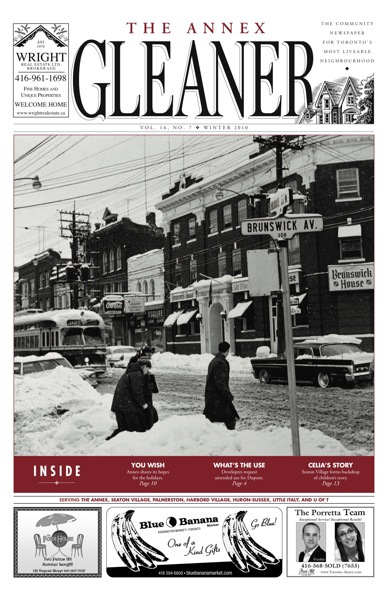
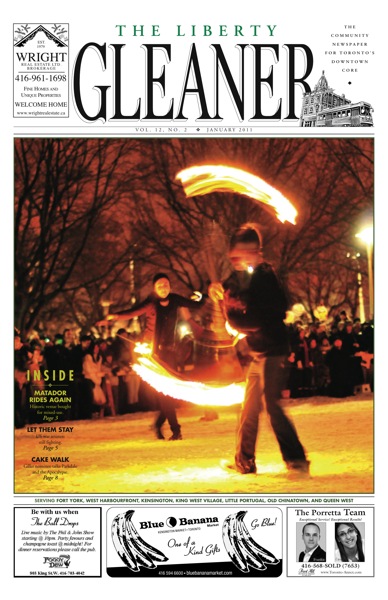
Every December edition, the Gleaner features community and holiday-themed artwork on our covers for both our Annex and Liberty editions. We are currently looking for submissions reflecting this theme.
In the past, covers have generally been traditional interpretations—snowy Annex streetscapes, snowmen and Santa Claus–but we are open to any and all images that say holiday and community. Photos, painting, collage, mixed-media, comics, drawings, installations, etc. are all welcome. Bonus points for local artists or the art is neighbourhood-centric.
And wishes:
-We are seeking an infinite number of wishes. They can be whimsical or practical. They can be personal, political, or community related. Past wishes have included everything from “I wish there was a hot dog stand in the Annex,” to resurrecting a beloved tree that was cut down, to Rob Ford looking good in a Speedo.
-While we want world peace just as much as everyone else, please try and keep your wishes local.
– Wishes must be between one and 250 words. Visual interpretations of wishes are also welcome.
Please submit your wishlist by November 21 at the stroke of midnight to gleanereditor@gmail.com. Please include your name, and either your professional title or the street that you live on . We reserve the right to edit wishes for space, spelling and grammar. Artwork must be recieved no later than Nov. 21 for the Annex and Nov. 30 for the Liberty.
We really hope you all can take part! Tell your neighbours and friends!
Tags: General
November 7th, 2011 · 1 Comment
By Michael Radoslav

Nathaniel Moore has collected works of art, including this sketch, to commemorate the late "Macho Man" Randy Savage. Courtesy Roberto Alicea.
Nathaniel G. Moore vividly remembers attending a “Macho Man” Randy Savage wrestling match 20 years ago with his father. Following the death of Savage earlier this year, Moore decided to honour the man he calls an “aging hero” that always seemed to be there by his side while he grew up.
When Savage passed away in May, Moore said he received numerous emails from friends who always associated him with the Macho Man. “They asked ‘What are you going to do?’ so I said ‘Well, I guess I’m doing an art show.’”
The wrestling icon will be immortalized this November at the White House Studio Project in Kensington Market (277½ Augusta Ave.).
A local author and Gleaner contributor, Moore formed connections with members of the professional wrestling community, recently helping Bret “the Hitman” Hart’s ex-wife Julie Hart complete her book. Writing a novel loosely based around Savage and wrestling himself, Moore put an ad on Craigslist for artistic interpretations of the Macho Man for his book.
“Over the last couple years I’ve been collecting drawings of Savage for what I perceive to be the inside covers, just repeated black and white images.”
He received submissions from a wide array of skill levels, ranging from “people who like to sketch” to “professional artists.”
“What I noticed was when I started putting the idea of pictures together, it was like I was creating my own Google image search,” he said. “And that’s kind of what this show is, me pointing an artist in the direction of a subject.”
Members of the White House Studio vote on potential exhibits and Moore’s received a unanimous yea vote, said Vanessa Rieger, an executive administrator at the studio.
“We’re all very excited about it,” she said, “especially since Nathaniel came with artists secured and also had an open call for more people to contribute.”
White House is a not-for-profit, artist-run studio that receives no grants or funding. The studio makes money by renting out their space to artists, holding events, and selling art. News of the Savage show spread quickly online, Reiger said, and exploded after Terry “Hulk” Hogan retweeted one of Moore’s messages promoting the event.
“It’s really cool that it’s generating this kind of interest,” she said, “because it is publicity and because we are honouring [Savage].”

Courtesy Ryan McClure.
Authors Greg Oliver and Michael Holmes, who have both written books based around professional wrestling, will perform readings at the event. A comedy troupe created a song and a local video game retailer will display old wrestling video games that include the Macho Man. Music and food will also be provided.
“I wanted a fun show, but I wanted the art to be good, and I also wanted to sort of challenge people’s interpretation of what I’ve been doing so far with Savage and the book,” Moore said.
Sherwin Tijia, a professional artist from Montreal with a piece in the show, said he enjoys exhibits that are atypical. “Most art shows are pretty specific and include pretty pictures for rich people because those are the people who can afford it,” he said.
Floating in the same literary circles as Moore for years, Tijia is happy to be involved with such a unique event. “An artistic wake for a fictional person is very bizarre,” he said.
Having received such great interest online, Moore said he may take the show on tour but ultimately he would like to send photos or videos to Savage’s brother, another wrestler himself, “Leaping” Lanny Poffo.
There have been two tribute wrestling shows to Savage over the past couple months and Moore said “they’ve both been terrible” for different reasons. He hopes this serves as a fitting tribute to the Macho Man. “The fact that people stopped and made the art is a tribute to him, and his memory,” he said.
The Savage Art Show runs from Nov. 12 to 15, coinciding with Savage’s 59th birthday. For info about the White House Studio, www.theotherwhitehouse.ca.
Tags: Liberty · Arts · General
October 31st, 2011 · Comments Off on What is ‘What Is goth?’: Encyclopedia provides comprehensive guide to goth subculture
By Karen Bliss

Liisa Ladouceur is the author of the goth reference book Encyclopedia Gothica. Courtesy Liisa Ladouceur.
Liberty-resident Liisa Ladouceur doesn’t sleep in a coffin or only come out at night, but there are a few tip-offs that she is a goth.
Her hair is jet black and straight and she fancies corsets and fishnet stockings, but there’s much more to goth culture than aesthetic.
Ladouceur, a well-respected music and ‘unpopular’ culture journalist, has penned Encyclopedia Gothica. Published by ECW Press and illustrated like an old tyme dictionary by Gary Pullin, the book is an A to Z of all things goth, from absinthe to zombies.
For the truly uninitiated, Ladouceur introduces the book with the chapter “What is ‘What Is goth?’”
“It’s the number one question that outsiders ask and people within goth ask themselves all the time — Is this goth? Is that goth? It’s kind of a joke,” she says. “That’s why I wrote the book, so that if you read it, you will have your own understanding.
[pullquote]“[Goth] is a very hard working word”—Liisa Ladouceur, writer, goth[/pullquote]
“The way that I would explain it is that it is a subculture and a lifestyle, just like being punk rock or a skateboard kid or a hip hop kid. It’s heavily revolved around music and then books and fashion and then art would come after that.
So what is goth? “It’s music; it’s literature; it’s fashion; it’s history; it’s romance and death.”
Ladouceur, who doesn’t give her age, says she is a lifelong goth, but “not with a capital G,” or what she calls in the book “ubergoth: “Most definitely, excessively, exquisitely Goth. The epitome of Gothness.”
“I don’t put on my eyeliner and my cloak to go out and buy milk in the middle of the day,” she tells the Gleaner.“That’s not me, but I am a long time fan of goth music. Goth is the way I identify myself in the way that someone would say, ‘I’m a B-boy or I’m a punk-rocker.’”
Ladouceur isn’t old by any means, but she’s not a teenager anymore, which is when she first became infatuated with the subculture in Penetanguishene, Ontario.
“I was just an ordinary kid. I played Loverboy cassettes on my ghetto-blaster as I roller-skated to school,” she says. “I liked whatever was popular and then I saw the video of ‘She Sells Sanctuary’ by The Cult on MuchMusic and it totally changed my life. So it was The Cult, Love & Rockets, The Cure, Sisters of Mercy, all those bands that were on MuchMusic in the mid to late ’80s and I said, ‘Oh, I like this.’”
Music is a big part of the goth culture. Ladouceur includes a “Goth Band Tree” at the back of the book with sub-genres horror punk, punk, new romantics, industrial leading to psychobilly, post-punk, batcave, synth-pop and more. But [Encyclopedia Gothica ITAL] touches on far more than music.
“[Goth] is a very hard working word,” says Ladouceur. “It describes a type of architecture, a type of literature, a font, a type of film, a tribal hoard from Eastern Europe. It’s been used to describe many things over the years, but in terms of the goth subculture, it really is it’s own unique thing.
“Yes, there is an entry in the book on the Church of Satan but then there’s also an entry on Mary Shelley. It’s a mix.”
Flip open to any page of the encyclopedia and there are wonderous and sometimes humorous entries. The entry on Doom Cookie, reads in part: a derogatory term for a goth poseur, someone who tries hard to look and act goth but comes off like a walking cliché of overwrought poetry and misguided fashion choices with no understanding of the music or subculture … See also: Mall Goth.
Blue Nun, Ladouceur explains, is a German wine, popular with some goths because Wayne Hussey from The Mission used to drink it onstage all the time. And of course, Sunglasses: Don’t leave home without them.
Encyclopedia Gothica is out just in time for when the romantic goths, cyber goths, perky goths, death rockers, rivetheads, doom cookies and other goth and fake goth types intermingle with costume-wearing fairies, French maids, Spidermen and devils: Halloween.
“You can buy goth costumes now on Halloween, which actually quite hurts my feelings,” Ladouceur admits. “I imagine how Native people feel when they see an Indian costume. ‘Really? Is that a joke?’”
Just avoid going trick or treating at her house in a goth costume — or she might sic her zombies on you.
For more information about Ladouceur and the encyclopedia, visit www.liisaladouceur.com.
Tags: General
October 14th, 2011 · Comments Off on Montessori-style alternative school expected to be approved by TDSB
By Perry King
A group of Annex-area educators and parents are eagerly awaiting the TDSB’s response to a proposal they put forward two weeks ago.
The working group—based at Annex Montessori school at Trinity St. Paul’s Church (427 Bloor St. W.)—formally told the board of their intent to bring a new alternative school to Ward 10 (Trinity-Spadina).
Although there are many Montessori-style programs in kindergarten programs across the TDSB, there is no specific school dedicated to a Montessori curriculum, or one that’s available for grades 1 and up. “These are for parents who want to support the public system or can’t afford the private system. There’s many different reasons why families don’t go on and continue into the elementary Montessori private school system,” said Aidan Roman-Crossland, co-chair of the working group.
Montessori schools, of which there are 7,000 worldwide, are particularly known for mixed-age classrooms, where students learn at their own pace (teachers attend to students individually rather than by class), and are traditionally located in in places of worship—although many of the schools are non-religious in nature.
[pullquote]
“The teachers could have Montessori training, but they need to be teachers from the Toronto District School Board”—Chris Bolton, TDSB chair
[/pullquote]
Tentatively named Vista Alternative School, the school wants to provide a more self-directed, independent approach to teaching than currently offered by the TDSB, and orient more project-based activities for students. But, the school will have to comply with the TDSB’s policies and procedures for employment, and has to be cost-free for applicants.
“The teachers could have Montessori training, but prior to that they need to be teachers from the Toronto District School Board. Philosophically, we can work within certain parameters, but it does present a problem for people who may think that it’s simply going to be a Montessori school [that’s] inside the Toronto District School Board,” said Ward 10 trustee and board chair Chris Bolton.
Cristina Juarez Nilsson, outreach coordinator for the working group, says that the document will go through the TDSB’s local and central feasibility committees, who will make recommendations and referrals about how the school will be shaped. Once approved, the board and the school will look into surplus space that could house the school.
With a projected enrollment of 60 students ranging from Grades 1 to 3, and expectations of expansion once these students reach Grade 4 and up, Bolton notes the school needs to prepare long-term growth and sustainability. “We may have the space now but will we have the space in the future, and will we have the space to move from three classrooms to four or five or six in the future? Not necessarily,” said Bolton.
Given the precedent of numerous local alternative schools and a supportive local trustee, the proposal is expected to be approved.
Enrollments for Vista could begin as early as the 2012–2013 school year.
In our print version of this article, it was reported that Bolton had referred to the Waldorf Academy as a school that operates as an alternative school in the TDSB. In fact, the Waldorf Academy is a privately-operated institution.
Tags: General
October 5th, 2011 · Comments Off on Coach House new book launch takes on Dance Cave
By Nathaniel G. Moore
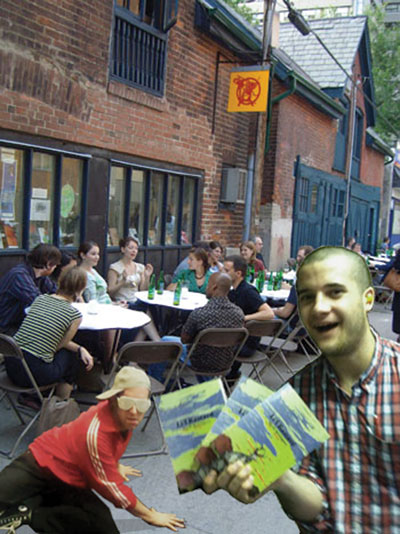
Simulated party atmosphere at the Coach House Books event at the Dance Cave (529 Bloor St. W.), a change from the norm for the popular publishing house. Courtesy Evan Munday.
The fall is a maelstrom of literary frenzy: the International Festival of Authors, Giller and Governor General Award nominations, Word on the Street, and a flood of book launches. But where in this vast city do publishers tend to roll the dice with their new heady wares?
The Gladstone Hotel, Supermarket, Garrison, Parts & Labour and Dora Keogh are among favourites with publishers. This fall, however, the ever-radical Annex-area publisher Coach House Books, known for their well-attended and it-status seasonal launches, have switched things up from their usual location.
Instead of having their new books and authors showcased at Revival (783 College St.), they have moved their fall launch to the heart of the Annex and the most unlikely of venues: the Dance Cave (529 Bloor St. W.).
So what will happen on Wednesday, October 5 when worlds collide?
The literary community was aghast at first, because it’s such a dark and seemingly contrary space to your average, meek book launch crowd. When the news hit Facebook, the comments went flying: “So who is DJing the new-wave hits after the readings?” or “Book dance party? Hells yes!” and “Well spin my head sideways. Coach House launch at ol’ Dance Cave? I remember being in University, working at a bar near Brunswick and afterwards, writing poetry in an old notebook, heading over to the Cave for a drink and dance, blacking out to high heaven, met my wife Deborah there too,” wrote Ray MacClaghlan, a poet.
The announcement caused a minor ruckus within the book community as they teleported themselves to the dank dance floor. “I can’t wait to dance to “The Book of Love” by The Monotones, and other such literary hits at the Coach House fall book dance party,” said Laurie Fuhr, a poet and editor from Calgary.
“Not only will we have readings from all our fabulous fall authors, it will be in the Dance Cave, so you can relive the glory days of your youth—if you’re not currently still living them,” said Evan Munday, Coach House’s publicist. “Also, we’ll have a mini photo booth. It will be like the best wedding ever, but with fantastic readings instead of the usual boring speeches and vows.”
Munday says he is confident that the space is right for two reasons: size and emotional impact. “For a lot of people, this is the first club they went to and actually enjoyed. A lot of people have fond memories of The Dance Cave.”
With six books launching, the night should be a full dose of literary bravado and excitement, plus the temptation of stealing a few dances with the wallflower book community. According to Munday, some authors are making a trek to attend. “Leigh Kotsilids from Colorado, Hughes is coming in from Wales, and Sina and David are coming in from Montreal,” he said.
Former longtime Annex resident Jenny Sampirisi, (who also works as managing editor of Book Thug) will take the TTC from her new digs in Bloor West Village to read from her new book of poetry Croak.
“I am absolutely nervous. This is my second book, but it’s my first book of poetry. After so many years in the poetry scene watching some phenomenal books enter and exit the spotlight, I know how little time a book has to make an impression. I’m also honest with myself about the content of the book. I know not everyone will have encountered something like it before and so I feel the pressure of giving life to the pages through my readings and performances of the book. I’m working right now to create an onstage Frogirl persona.”
There will be a musical element to the night as well. Comedian, poet and musician Dave McGimpsey, and Rob Benvie from the band the Dears will launch Li’l Bastard and Maintenance, respectively.
“I can’t believe it’s been seven years. In my defense, I’ve been busy, even if the results only trickle out. I tend to keep multiple things on the go at the same time, which leaves some on the back burner in the meantime,” Benvie explains. “While working on this book I’ve also been working on a bunch of other things, which might be an inefficient process but it keeps the coals fuming, if you know what I mean. I also tend to aim ambitiously with writing projects and make more work for myself than I should.”
Nathaniel G. Moore is the author of Wrong Bar a finalist for the 2010 Relit award. canadiansadcore.tumblr.com
Tags: Annex · Food
September 30th, 2011 · 1 Comment
By Jonathan Lee
Courtesy Deb Wiles
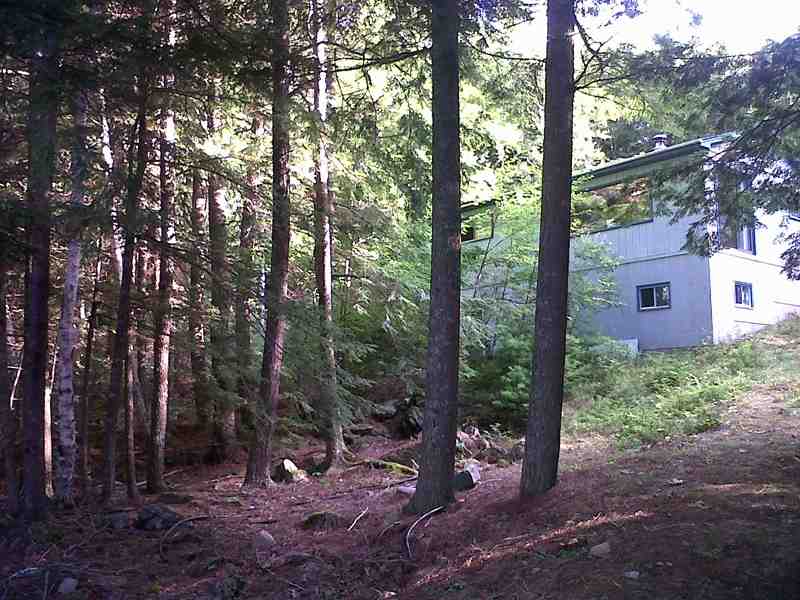
Annex painter and art instructor Deb Wiles had been looking at photos of a lake out in rural Nova Scotia, taken by her friend Tim Young, when she drew in her breath in response to the beauty in front of her.
From that moment, the Trident International Artists’ Retreat in Nova Scotia was born.
Wiles will offer week-long training at the retreat for any novices who sign up, as well as space for established artists. It will also act as a summer camp for students at her Annex-based arts school, Marks of Perception (69 Olive Ave.).
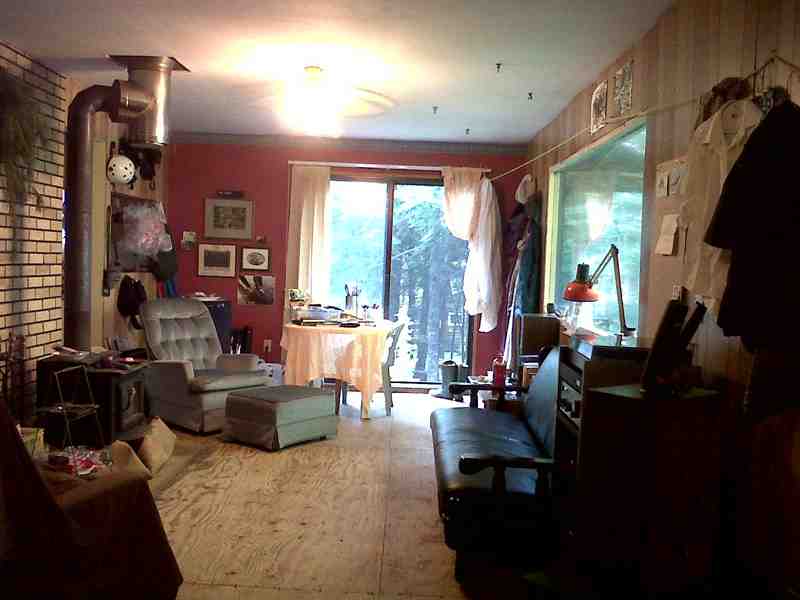
While Wiles remains tight lipped about the exact whereabouts of the retreat, it is a small cabin surrounded by several bucolic acres of land. There is lots of forest space and it sits by a lake.
“We spend most of our lives playing roles, being for others, the retreat is a place to just be who you are, for yourself,” she said.
The Trident International Artists’ Retreat is still a budding idea. Construction began in early August. Electricity is up and so is the plumbing, but there are still gas tanks to be replaced, a deck to be designed and built, and a multitude of other tasks. “I feel like I’m nurturing the growth of the project.” Wiles said.
Courtesy Deb Wiles.
There is still a lot of growing to do. Wiles is looking to raise $20,000 to aid in the construction, so she’s been drumming up support and fundraising where she can.
One fundraising method is through something Wiles calls “clowning.” Those who request to be clowned can email Wiles a photo of themselves and, for a fee of $50, she will doll it up and send it back to you—clown style.
Wiles has clowned many people, including Gleaner alum Nadja Sayej, who now writes for the New York Times and “leads the new wave of art criticism” as the host and producer of the online show ArtStars*.
“It’s true, Deb clowned me,” wrote Sayej from Berlin. “Far more strange than a caricature artist, she took a photo of me, revved it up in her Willy Wonka technicolor palette and splashed her signature in the bottom corner. Funny, rude and explosive, I couldn’t believe my eyes. She goes where most of would never dare to go in terms of portraits—so many people are afraid to insult, to ridicule, to even have fun with a person’s features. Not Deb. She left me laughing. On the floor.”
To contact Wiles about the retreat or to get “clowned,” visit Wiles’ blog.
Tags: Annex · Arts · People · General
September 27th, 2011 · 1 Comment
Compiled by Emina Gamulin, Perry King, and Rebecca Payne
Check out the links below about our Q & A with candidates for the Parkdale-High Park riding.
The riding
The candidates
Question One: The state of health care in PHP
Question Two: Poverty
Question Three: Clean trains
Question Four: Energy inflation
Question Five: the Ontario Arts Council
The riding:
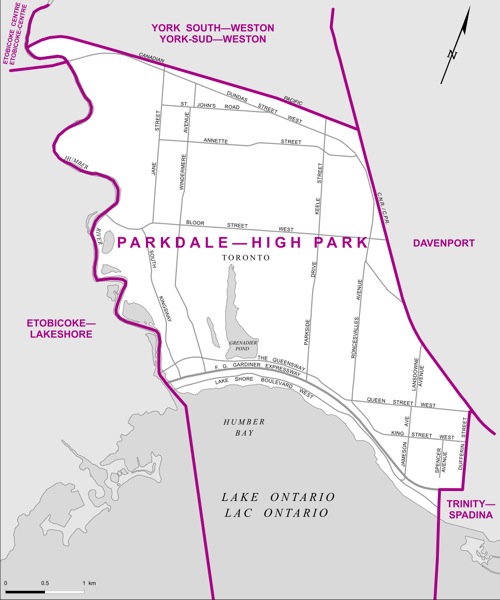
Parkdale-High Park is composed of seven neighbourhoods: Swansea, High Park North, the south half of The Junction, Runnymede-Bloor West Village, Lambton-Baby Point, Roncesvalles, and Parkdale directly to the south.
The statistics:
Population = 102,142 *
Electoral = 71,954
Political History
2007 = New Democrat **
2003 = Liberal **
1999 = Liberal **
* Cited from StatsCan 2006 Census
** Cited from Elections Ontario
back to top
The candidates:

Rev. Dr. Cheri DiNovo is the Member of Provincial Parliament for Parkdale-High Park and the Deputy Speaker on the Ontario Legislative Assembly. DiNovo was first elected into the legislature in 2006 in a by-election and re-elected in 2007. An award winning author, DiNovo is an outspoken social justice activist and a former United Church Minister who was voted Best MPP by NOW magazine. In addition to being described by the Toronto Star as a “spark plug” at Queen’s Park and a leader who “personifies an emerging consensus,” Cheri DiNovo was named “Favourite Politician” by the Parkdale Liberty for her ongoing pledge to donate her monthly MPP salary raise to local organizations and charities.

Having devoted his career to technology innovation, Progressive Conservative candidate Joe Ganetakos and his wife Mary are now looking to give back to their community through public service. Used to working under tight deadlines while helping to design some of Ontario’s most advanced electronic games, he’s remained steady under pressure, never shirking away from challenges. Joe pledges to work passionately on any efforts he’s involved with on behalf of the residents of Parkdale-High Park. Joe believes that the taxpayers of Parkdale-High Park deserve a strong voice in government, and this has led him to commit to helping Tim Hudak giveback to Ontarians the strong economy that he believes they have always had with Progressive Conservative governments.

Liberal Party candidate Cortney Pasternak is a professional broadcast journalist. She also teaches journalism at the university and college level. She served as both the Global TV Queen’s Park Bureau Chief and CTV’s National Parliamentary Correspondent reporting from around the globe on a range of topics including politics, health care, education, human rights, environment, poverty, and crime. She currently runs a small, home-based business. Cortney is married with two young children and shares her home with three cats with great personalities.

Justin Trottier has dedicated his life to balancing his love of science and technology with his interest in public education, community service, and social advocacy. He studied engineering at the University of Toronto and worked in research and development in alternative energy systems. He then founded the national educational charity the Centre for Inquiry. Justin speaks regularly in the media in defence of fundamental freedoms, civil and human rights, and participates in public events bringing together groups from different backgrounds to discuss ethics and social policy. He also volunteers with youth-focused community groups, including Pathways to Education and tutoring at the Parkdale Library.
Also running in PHP are Redmond Weissenberger for the Freedom Party Of Ontario, Thomas Zaugg of the People’s Political Party of Ontario, Rod Rojas of the Ontario Libertarian Party, and four independent candidates: George Babula, Cecilia Luu, Bohdan Ewhen Radejewsky, and Istvan Tar. The Gleaner was unable to reach the remaining candidates in time for this Q & A.
back to top
The Questions
1. What is the most important issue for our health care system? What will you do to improve the health of residents in Parkdale-High Park?
—Perry King, senior editor, Gleaner Community Press
DiNovo: Right now if you visited any of the retirement homes or long-term care facilities in our riding they would tell you the same thing—they don’t get enough from the provincial government to provide quality care. The provincial government actually pays more to feed prisoners right now than it does to pay for long-term care residents. We’ve had a government in Ontario that has chipped away medicare at the edges rather than expand it. We need dental health care, not just for a few, but for many who cannot afford it. Many Ontarians cannot afford dental care, and don’t get it. This is unconscionable.
Ganetakos: I was of another party stripe, and one of the [things] that attracted me to the PCs was the plan to invest heavily in health care. But the difference with what we want to do is invest it directly into front line care. So if you are a doctor or nurse we want to basically make sure that the money goes to those direct staff. If you are working with a patient, you are going to be getting our full support. In the pasts it has not gone that way. Our view is that the provincial bureaucracy has been not effective and has acted as a political shield. [We will] invest $6.1 billion into health care, but ensure that it gets front-line staff.
Pasternak: As someone who has used the health care system, who has three family members in and out of St. Joe’s over the last year, there are more problems than I’d like to think. I think that the investments that this government has made have been unbelievable. We’ve lowered wait times, we’ve improved access to family doctors. We have to start treating more people in the community, and the Liberal Party is making investments there. We’re talking about community health centres, places like Runnymede. Aside from covering, as a reporter, many issues around mental health, I’ve also advocated and had to take care of people with mental health issues. These are things that need to be addressed and not in the emergency rooms.
Trottier: Within all the broad priorities of the health care infrastructure, I think the one we’re addressing the least well is mental health. The Canada Health Act and other pieces of legislation haven’t done a very good job to integrate mental health into the rest of its purview. Medicare, when it was set up, was set up to deal mostly with accidents and to keep people having a family doctor. It wasn’t really structured to deal with chronic or acute conditions, and certainly not mental health. We’re very much a party that sees the importance of empowering local communities to make health care decisions, and one way to do that is to make sure that the physical proximity of health care hubs are as close as possible to the neighbourhoods that need them the most.
back to top
2. What will you (really) do about the appalling levels of poverty amongst your constituents, if elected? Not just vague promises but real, deliverable, time-dated action?
—Ken Wood
DiNovo: You’re talking to the woman who brought in the $10 minimum wage bill. And thanks to that bill, in our riding, a million Ontarians got a twenty-eight per cent raise. So that’s significant, and that was within the first six months of my being elected, and that’s as a member of the Opposition in a ten-person caucus, in a 107-person government. I’m part of the provincial legislature and I sit in Opposition Government primarily because of poverty issues. One in six children in our riding, and in our city, and in our province, live in poverty. We would definitely reassess the ODSP rates and raise them. We’ve also promised that we would be building at least 10,000 new [units] in housing every year. Also, introduce legislation to allow municipalities to call for inclusionary zoning.
Ganetakos: One of the things we’re offering that I’m really happy about is support for those who are on OW and ODSP. There are those that are working part-time and are trying to improve their quality of life and they are trying to takes steps forward. But the Liberal government claws back moneys from their paycheque. It’s a disincentive to try. Our plan is to let those on OW and ODSP to keep more of their money. It may not be possible for some, and we understand that, but we want them to have more money that they work for so that they can have more dignity in their lives.
Pasternak: Daycare is a huge issue in this riding, and one that I will be championing to make sure we have lots more, we desperately need them in this riding. Full-day kindergarten is a real, measurable investment made by the McGuinty government that helps alleviate the poverty cycle in so many ways. The other thing that we’re doing is, people may not be able to feel it, but the fact is that we just went through one of the worst recessions since the Great Depression, and we’ve come out stronger, we’ve created more jobs than the other provinces combined. The truth is, when the economy is lifted up, everyone gets lifted up.
Trottier: One Green policy area that I really think is important is the idea of taxing resource use and property use, and taxing less income and earned value. For us, we would seek to reduce income tax and one of our policies is to reduce it by a certain percentage dependent on the amount of income a person is bringing in, but in such a way that those with the smallest income, the poorest among us, would benefit the most in income reduction. We would offset [those decreased tax dollars] by increasing the tax on property and on resource use. This has the benefit of encouraging the use of currently vacant property, which is an issue right along Queen Street.
back to top
3. Does the political party that you represent support the Clean Train Commitment? (If not, why not?). The Clean Train Commitment: “Scrap the plan for a diesel Air Rail Link (ARL) and start construction on an affordable, accessible, electric ARL which connects with local communities and local transit.”
—Rob Fairley, Clean Train Coalition supporter
DiNovo: Absolutely. I’ve been a huge proponent, a member of the Ontario CTC, and the only one at Queen’s Park by the way. The only hurdle standing in our way between electric, clean trains in our neighbourhood and the diesel that they’ve already inked the deal for, is Dalton McGuinty and the Liberal government. Even Rob Ford has come out saying that electric trains are what we need. The Conservatives have said electric trains are what we need. Literally only the Liberals stand between us and electric clean trains.
Ganetakos: This is tricky. The dirty diesel trains are a concern, and I don’t think it’s a NIMBY issue. Here’s the problem for me: as a former NDP who came over, I would love to say, ‘Yes we’ll do it,’ but the expense is just immense and there is some conflicting information as to how we may have to move people to do it. I have knocked on several thousand doors, and no word of a lie, no one—no one—has brought that up as a priority for them. It’s not that I don’t care, I don’t want dirty diesel trains, but it’s not resonating as an immediate issue. We’re in a really large hole, what else would have to suffer for it?
Pasternak: I’m a mother of a 5-year-old with asthma. Up to two weeks ago, my son couldn’t go out on smoggy days. It’s been very difficult for us. To me, as a mother, I fully support the electrification, but the truth is two things. One, yes, I support electrification, but we do need to do more than just talk about [it]. The fact is that we need to make this area a hub, we need to make it one in order to revitalize the main streets, and we are moving towards that. Electrification is good on so many levels, it’s not just about the environment, it’s about being able to create more than one stop—because the trains can stop here.
Trottier: I was just reviewing the recent news on the airport link and electrification dilemma that we’re in. My understanding is that all the stakeholders involved approve the move to electrification. The question is how to do it in a timely manner. I think we should do that immediately, it would save us money in the long run. I don’t understand why it’s taking, apparently now, a few years to do an environmental assessment on the move to electrification, when it’s taken less time to assess the $1 billion original building plan. We should be able to move a lot faster than we are, it would save us money, save us emissions. I definitely support the Clean Train Coalition.
back to top
4. How does your party plan to protect Ontarians from energy inflation related to home heating and electricity in the near and long-term and why?
—Chris Chopik
DiNovo: We have promised to take the HST off essentials like home heating and hydro. We think the way forward is not nuclear, because it’s expensive. We think the way forward is to really ratchet up our reusable and recyclable programs. We’ve also promised as government we would introduce an extra $5,000 for the retrofitting program per home owner. We’re going to close the coal-firing plants. McGuinty still hasn’t done it and promised to do it in 2007.
Ganetakos: Removing the Ontario portion of the HST on home energy bills and heating, we know will have a positive impact. We’re not anti anything. We’re pro green, pro solar, pro wind—we’re just anti lousy, lousy deals. That’s the honest truth. I come from the private sector and my experience is, if you only have one bidder on the contract, you are not going to get the best price. You’re not even going to get something competitive. This deal stinks and it’s also been very concealed. By getting out of that energy experiment, and just ensuring that we have highly efficient, very safe, very well-regulated nuclear energy, which is the bulk of power by a country mile.
Pasternak: We’re giving a 10 per cent rebate off all electricity bills and hydro bills over the next five years to help people adjust to the increasing costs of energy. The truth is hydro actually went up more under the last provincial government, the Harris Conservatives, than they have under us. We’ve got to recognize that we are some of the biggest consumers in the world for energy. To say that we should just have cheap energy—it’s well-known that we have some of the cheapest energy anywhere in the world. Let’s come back to Ontario Clean Energy Benefit, reductions on all hydro bills for families, for farmers, for seniors and small businesses. That’s about $150 per family, $1,700 for small businesses.
Trottier: I think it’s important to give an honest assessment of what’s actually happening. I don’t think any party can honestly commit to stopping energy inflation, the rise of energy prices. I don’t think that’s realistic. I think there are a lot of things that we can do to conserve better, I think every dollar we invest in conservation is worth much more than the amount of money we would have to spend on expensive nuclear reactors, to offset the increasing energy needs, or coal-fire power plants—that sort of thing. Our party is very much in terms of tax benefits and tax credits, which would promote home retrofitting. We have the Green Energy Building Plan, which would tax credits back to homeowners and business owners for energy audits that would seem to make these kind of retrofits—that we could produce. Thirty per cent is our general proposal.
back to top
5. Please comment on the adequacy of the Ontario Arts Council at its present level of funding.
—David Perlman
DiNovo: The simple answer is one word—it’s inadequate. We need to make Ontario a hub for artists. I used to be the culture critic, and as such I brought in a Status of the Artist legislation, which was not passed. We have no Status of the Artist legislation in Ontario, not for children, not for adults. We need to have income tax averaging for them, because, as most artists know, sometimes you earn a lot of money in one year the other year you earn nothing, and yet you pay a whole lot of taxes one year. We should definitely fund the arts better, including tax credits. Instead of spending their valuable time writing proposals, they should be able to count on a certain amount of money coming from Queen’s Park and it certainly should be more than they get now.
Ganetakos: As a person who is not on the Ontario Arts Council, who is not witnessing its current funding, all I can tell you is that I’m an OCA grad, I’ve worked in the arts on the digital side of things for ten years and I’m raring to go to be champion for the arts. I believe you can make a solid return on investment for the arts, but unfortunately right now, door-to-door, that’s not what people are telling me. I’ll bet you I am more directly connected to the arts than many, many candidates, federally or provincially, and I would fight for it tooth and nail. But right now our priorities are what’s in the Change Book.
Pasternak: The Liberals are known to be very good to the arts community. I come from broadcasting, my husband used to produce documentaries, and they needed to access funding. I know that moving forward, the government is very big on digital media and investing a lot more into digital media. I come from a artists’ background. I think it’s not just about supporting artists, it’s an economy. It brings people here to work, and I’m a huge supporter.
Trottier: I understand competing priorities, and how everybody sort of wants to increase the chunk of the pie for their particular area. I can’t make lofty promises about increasing budgets for any one area. All I can say is that I understand the importance of all of the those different stakeholders, and the Green Party would do what it can to provide all sorts of financial benefits to local community hubs and leave it to those community centres and hubs to decide on allocations into the community like social service projects, artistic brands, that sort of thing.
back to top
All answers have been edited for space. Candidates’ bios are their own.
Tags: Liberty · News
September 22nd, 2011 · Comments Off on Alex is on fire: Former gymnast wins award for community service
By Perry King

When first notified she was receiving an award for her work with kids, Alexandra Orlando immediately thought back to her work with the Pan Am Games bid.
“We did a community outreach summer, and I lead the youth portion of that,” said Orlando, the program coordinator for the bid’s Youth Program. “I set up days where I brought in ten to 15 athletes, and we had a whole day or half-day [where we] went to summer camps and did all different kinds of sports demos, and had athletes speak to [kids]. It was really incredible.”
In June, Orlando was awarded the 2011 Everest Foundation Adult Leadership Award for her work. In an email to the Gleaner, Farell Duclair, the founder of Everest Foundation and a former Calgary Stampeder, says that she received the award “for her ongoing contribution to youth and sports, particularly her active role as an ambassador for Right to Play.
“Alexandra exemplifies how the rigour and diligence of sports develops not only an athlete but also leadership qualities that reach beyond personal achievement,” he wrote.
Orlando, an Annex resident, was more than speechless when she was informed about receiving the award. “It showed me that what I’m doing is actually making a difference, and I’m actually affecting lives and making a change in the lives of youth. They’re our future, and everything I’ve learned I’ve wanted to give back and give to my community,” she said.
Orlando, 24, has been working in the community since she was 16. Early in her career, she developed a passion for working with school-aged children. “I had a unique experience, when I was younger, to work with a lot of older athletes and I saw how even little gestures can go a huge way with kids,” she recalls.
“Whether it’s answering a question or getting water for them, they’re so blown away by someone who actually cares. What’s really important, when you’re working with kids, is that even if you’re tired and had a long day—especially athletes, when they’re doing a million things—you know it’s a great cause and you go and give it your all. They can feel that, and they know that you’re really there for them.”
Describing herself as a “pretty outgoing, fun person,” Orlando wants to etch an identity as a community organizer. “Every time I create a summer camp or help with programming or sports demos within my community, I make sure I really do bring my A game when I go, and I want to make it as fun for them as possible.”
Before she retired as a rhythmic gymnast after the 2008 Beijing Olympics, Orlando was a five-time senior National Champion, six-time Commonwealth Games gold medalist and a three-time gold medalist at the 2007 Pan Am Games in Brazil.
Orlando was the only rhythmic gymnast from the Americas to qualify for the 2008 Olympics.
Since retiring, Orlando has mentored the Canadian Youth Olympic Team and is an ambassador for the international NGO Right to Play. She also instructs at Havergal College and sits on the Canadian Olympic Committee’s Women in Sport and Youth and Education Committees. “There’s so much that I want to do. My friends describe me as someone who ‘falls off the face of the earth’ a lot, I’m extremely busy,” she chuckled.
“I love to keep myself busy and I always love to learn, so I’m always throwing myself into situations where it will be challenging for me. The world is a huge place, and there’s a tonne of opportunities for me to go. Working in sport now, it opens up all these doors, so I want to see where that takes me.”
Tags: Sports · General
September 20th, 2011 · Comments Off on Ben Griffin: a candidate you can trust
By Emina Gamulin
More than a few eyebrows must have been raised in August when Trinity-Spadina residents received a surprise copy of the Women’s Post food and wine issue in their mailboxes.
An image of MPP candidate Sarah Thomson, the same image she uses in her election materials, is found on the cover of the magazine she publishes under the cover line: “Sarah Thomson weighs in on the tough choice facing Ontario voters.”
This was the second time she featured herself on the cover. The first time she more boldly declared herself “Toronto’s next mayor” in advance of the municipal election, provoking one blogger to dub her “Toronto’s queen of all vanity media.”
Whether this move breaks any elections rules seems to be a grey area. Candidates are technically not allowed to spend personal money on their own campaigns exceeding $1,240. They are also not allowed to advertise during the blackout period preceding the election.
However, Thomson said that she checked to make sure she was not breaking any rules. Under the law, it could be argued that this is not technically advertising and that the piece had news value. Having read the editorial where she recounts a supposed dream she had about ships captained by leaders of political parties as she decides on which one to board, the Gleaner would disagree, but it is unlikely that Elections Ontario will follow-up and penalize Thomson.
Her defense that she graced the cover because there was a lack of suitable subjects is laughable, but to say, as some have, that this move will not give her a political advantage does not hold up in the face of the evidence. Advertising works, the elections laws are in place for a reason, and name recognition is a huge component of how voters make their decisions.
According to a study by political scientists Cindy Kam and Elizabeth Zechmeister, it gives candidates a strong advantage. In their field research, they placed lawn signs for a fictitious candidate by the name Ben Griffin near a local school during an actual election in Nashville, Tennesee. Nearly a quarter of those exposed to the signs placed Griffin in their top three choices.
Of course, Thomson is not the first political candidate in history to use space in a publication to their advantage. Councillor Gord Perks (Ward 14, Parkdale-High Park) stayed on as an environmental columnist for Eye Weekly (now The Grid) when he ran for city council, a move considered controversial at the time. Frank Stronach put himself on the cover of a publication he owned, Focus on York, in 1988 when he was running for MP. Stronach lost the election, and according to an unofficial biography, he also lost the support of his editorial staff, who walked out in protest to what they saw as his shameless self promotion.
While election legislation could use clarification in dealing with grey areas such as this one, perhaps the best defense against the name recognition effect is an informed voter. Kam and Zechmeister found that recognition became a less prominent decision making factor when more politically relevant information was presented.
In other words, don’t blame us if you vote for Ben Griffin.
Tags: General
September 19th, 2011 · Comments Off on The latest premiere: Bloor Cinema opens new era with documentary theme
By Katie O’Connor
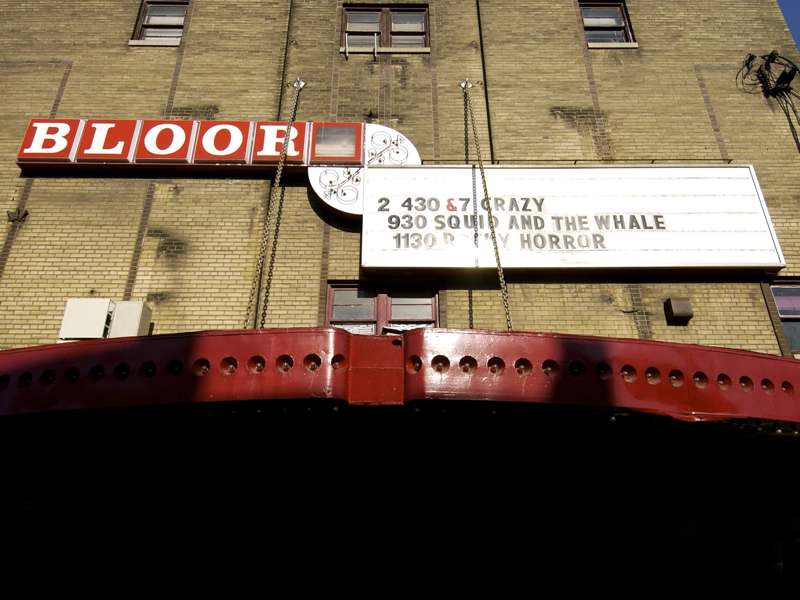
Chris Alexander had just settled in for one of his last screenings at the Bloor Cinema when he spotted something, or rather someone, who didn’t belong.
Alexander, editor-in-chief of Fangoria magazine, hosts a monthly film series titled ‘Film School Confidential’ where he showcases cult, horror and sci-fi films.
Invasion of the Body Snatchers had just begun when Alexander noticed some movement out of the corner of his eye. “I was sitting there in my seat and at the stage there was a spilled container of popcorn from the previous screening. What was either a very small rat or a very large mouse kept coming out from under the stage, eating popcorn and disappearing back into its hole.”
For Alexander, incidents like this, that make up what he calls the theatre’s “not ready for the ball” aesthetic, are what initially drew him to the Bloor. “It had that art deco feel to it, it was a little rough around the edges,” he said. “It still had a kind of 42nd street vibe about it but it was still evolved enough that you could bring your mom there.”
Alexander and others who enjoy the Bloor’s “rough around the edges” vibe may have to look elsewhere when the legendary Annex theatre re-opens under the helm of documentary festival powerhouse, Hot Docs.
Hot Docs announced in July that they would be partnering with Blue Ice Films, a Toronto-based sales and acquisitions company, to own and operate the theatre.
Blue Ice Films purchased the building for $3.25 million, and under a joint-venture agreement, Hot Docs will manage the theatre and provide programming for the Bloor year-round.
“We want to make sure the Bloor keeps the same role in the community,” said Hot Docs executive director Chris McDonald, speaking to the local business community at a BIA meeting in July. “It has been one of our beloved homes for ten years.”
However, the theatre will be revamped significantly both in appearance and philosophy. Programming will be split 80/20 between documentaries—including the festival’s Doc Soup series—and a combination of second-run films and festivals that previously screened at the Bloor.
Renovations will include new seating, lighting, carpets, snack bar, sound system, screen and digital projection, as well as improvements to the exterior. Accessible washrooms will be added on the ground floor, and the rake of the balcony will be adjusted to ensure better views. McDonald said they have also applied for a liquor licence. Renovations began in mid-September and Hot Docs say they expect to complete them in December at the very latest.
Hot Docs is only the latest step in what has been a long and storied history for the 106-year-old theatre which has seen its days as a 1920s vaudeville theatre, a 1940s movie palace, a 1960s grindhouse, and a 1970s porn theatre. A family-run business for many years, it has seen its share of love, laughs, and drama.
Originally known as the Madison, the Bloor Cinema was built in 1905 as a vaudeville theatre for the Annex, according to the archives of Ontario.
By the early 1940s, it was in major need of repairs. The theatre was closed down and rebuilt from the ground up, and re-opened in 1941 as the Midtown, complete with a new art deco façade. The Midtown had a lot of competition, said Robin Sharp, who co-directed a short film titled The Bloor, which was released back in 2005 to celebrate the theatre’s 100-year anniversary. Three other theatres clamoured for movie-goers attention at the corner of Bloor and Bathurst, including the original Bloor Theatre, where Lee’s Palace is now located.
The Midtown lasted almost three decades and according to the archives of Ontario, in 1967 it became the Capri, showing popular grindhouse-style films.
The Capri didn’t last long as hard times hit Toronto, and the theatre took on a new persona. In 1973, it opened as the Famous Players-operated Eden, showing soft-core pornography.
“It was definitely an interesting time in the Bloor’s history,” said Sharp.

Robin Sharp, inside the Bloor Cinema. File Photo, Matt James/Gleaner News.
The Eden was eventually put out of business by neighbouring theatre the Metro (677 Bloor St. W.), who showed the same fare for lower prices.
During the late 1970s, Tom Litvinkas and Jerry Szczur of Festival Cinemas took over the theatre.
They had the idea to buy out old theatres in Toronto and turn them into second-run cinemas. They partnered with Carm Bordonaro, and renamed the theatre. The Bloor Cinema opened its doors in December of 1979. Bordonaro proposed the idea of selling tickets for 99 cents and charging a membership fee.
Initially, the Bloor was a great success, with screenings selling out weekend after weekend.
“That first night I sold 160 memberships just sitting up here in an office by myself with a little note on the box office window and the door open,” said Bordonaro. “The community was so welcoming, it was phenomenal. It felt like It’s A Wonderful Life.”
The theatre prospered, with 1,500 people streaming through its doors a night, according to Bordonaro. “We were able to play two different films every night for eight weeks without repeating one.”
However, the theatre suffered ongoing financial conflict and in 1999 Festival Cinemas’ lease was terminated.
Despite the fall of Festival Cinemas, the Bloor remained firmly in the hands of the Bordonaro family, with Carm Bordonaro taking over management.
Speculation that the Bloor was financially struggling surfaced in 2004 after a chunk of plaster fell from the ceiling during a screening of The Corporation.
The Bloor continued to draw in crowds through a variety of events. One of these events was ‘The Wright Stuff’ with Edgar Wright, director of Scott Pilgrim vs. the World. Wright showcased his movies Hot Fuzz and Shaun of the Dead. Director Kevin Smith also attended the theatre in a special organized event. A popular Fringe event called ‘The Silver Stage’ was created, where actors performed shadow casts of the film Blue Velvet by David Lynch and a double bill of Buffy the Vampire Slayer’s musical episode “Once More With Feeling” and Doctor Horrible’s Sing Along Blog by Joss Whedon. Shadow casts involve actors reenacting scenes on stage while the film or TV program plays behind them.
Alex Woodside and Nigel Agnew, who now run the Toronto Underground Cinema, were two of the minds behind these events. They departed from the Bloor in 2009 after reportedly butting heads with the Bordonaros.
“The Bloor was like a really tight knit family,” said Peter Kuplowsky, who worked at the theatre and was involved with the Kevin Smith event. “With families, there is always lots of drama.”
Kuplowsky said staff often clashed with the Bordonaros over programming, with the drama coming to a head over funds from the Silver Stage Fringe event. With Fringe events, performers normally receive 100 per cent of the proceeds, which didn’t happen in this case.
“At that point the staff had become a really tight family, and the owners, they sort of weren’t really paying attention for a year, so we kind of took over,” he said.
“The Fringe show made a lot of money and there were verbal agreements that were made that certain parties didn’t think were being honoured. That’s what started the fighting. Because there was the weird case that the Bloor had distribution fees to pay for, they expected to get money. The owners were out of the loop so much that they didn’t realize that the performers would be getting money. They ended up doing a split. Because there was bad communication between both parties, nobody was trusting each other and it led to arguments that shouldn’t have happened and very bad feelings from both sides.”
Carm Bordonaro declined to comment on the event, saying it was a legal matter.
The last two years saw the Bloor hit hard times, and the family began to look for ways to reinvent the theatre. “We had to work really hard just to pay the bills and keep everything going,” said Bordonaro.
In June 2010, with their lease ending, the family purchased the theatre for $1.6 million in an effort to ensure its survival as a cinema.
Bordonaro said they had many offers from developers but they wanted to find the right person or company who would allow the space to stay as a theatre.
Bordonaro was approached by Hot Docs and Blue Ice in May of this year. Initially, both parties remained tight lipped as they worked out the deal. Many people speculated on the fate of the Bloor after it was announced that the theatre would be closing for renovations at the end of June.
Misty Pusztai was working at the theatre when the renovations were announced, and said that staff were given very little notice. “It was really slow, and we were all kind of wondering what was going on, and then two or three days before the renovation posters went up in the windows, we were told that the cinema was going to be renovated and that we’d all be out of a job at the end of the month. They gave us a really nice termination letter and supplied us with all of our paperwork but nobody was informed really, with proper notice. It was all kind of shocking to a lot of people.”
Bordonaro said their hands were tied. “We weren’t allowed to say anything. The closing date was June 30, and we hadn’t really even officially closed, so we weren’t in the greatest position to reveal anything earlier than we did.”
Adam Lopez, festival director of the Toronto After Dark Film Festival, said they were also given very little notice. “We weren’t really told what was going on,” said Lopez. “I understand why, because it was a confidential situation.”
Toronto After Dark announced last month that they would be moving this year’s festival to the Toronto Underground Cinema (186 Spadina Ave.), but that they would be back at the Bloor in 2012.
“There was no way of being 100 per cent sure that the renovations would be done in time,” said Lopez. “They are hoping to have the renovations done in October, two weeks before the festival. As a festival director, that was terrifying.”
Amy Taylor, of Excited Mental State, the group that performs monthly Rocky Horror Picture Show shadow casts at the Bloor said that the whole process has been really positive, and that Hot Docs has been welcoming. “They want us to be there, they want the neighbourhood to have a sense of continuity.”
However, many people, including Chris Alexander, are unsure what a revamped Bloor Cinema will be like. Alexander is permanently moving his ‘Film School Confidential’ night to the Revue Cinema (400 Roncesvalles Ave.). “It’s a double edged sword,” said Alexander. “You bring an A-list filmmaker in town or a big movie, you won’t have to worry about creatures running around.”
Hot Docs held a community meeting in August where members of the public were invited to voice their questions and suggestions.
One of the main concerns brought up at the meeting was that the building would be “over-glammed.”
Concern was also voiced over a possible name change for the theatre. McDonald said they would be changing the name, but that the word ‘Bloor’ would be prominently featured.
Kuplowsky, who attended the meeting, said he was not worried at all about the fate of the theatre. “The fact that you have a very specific type of festival taking over means its going to have its own kind of identity that is going to be iconic and people are going to latch on to that,” he said. “I don’t think the stuff that everybody loves about that place is going to disappear. The community doesn’t want it to disappear and [Hot Docs] are smart businessmen.”
Kuplowsky likened the Bloor to a TV series. “There was always lots of drama, and it was kind of like a revolving door with people coming in and out. I hope with Hot Docs it will be like a new season.”
If you have any questions or feedback regarding the Bloor Cinema, please email feedback@hotdocs.ca.
Where are they now?
Although the Bloor is currently closed, you can still catch your favourite flicks at these other Toronto locations:
- The Toronto After Dark Film Festival: this year’s festival will take place at the Toronto Underground Cinema (186 Spadina Ave.) on October 20 to 27.
- Rocky Horror Picture Show shadow cast: They will be performing at the Revue Cinema in September, and are expected to be back at the Bloor once renovations are completed. For more information, please visit www.excitedmentalstate.ca.
- Chris Alexander’s Film School Confidential: making the Revue Cinema (400 Roncesvalles Ave.), its permanent home, Film School Confidential will continue to screen horror, sci-fi, and cult film. Prom Night will be screened on September 22, time TBD. For more information, visit chris-alexander.ca
Tags: Annex · News · People
September 16th, 2011 · Comments Off on Polaris Prize winning band Karkwa headlines first Toronto show at Lee’s
By Karen Bliss

Karkwa, 2010’s Polaris Music Prize winners, will screen a documentary at U of T on Sunday, Sept.18. Courtesy Karkwa.
Francophone indie rock act Karkwa had little presence outside its native Quebec when its fourth album, Les Chemins de Verre, was selected as winner of the 2010 Polaris Music Prize—a $20,000 cheque that went to the year’s Best Album, as determined by media from across the country.
The award landed the band immediate attention in English-speaking Canada, and coverage in top publications NME, Rolling Stone, Huffington Post, The Guardian, Los Angeles Times, and Billboard.
“We sell a lot of albums during the two or three weeks after winning the prize outside of Quebec, in all the provinces in Canada,” said the band’s French-speaking manager Sandy Boutin. “The Polaris have a big impact and it have a big impact too on our sales in Quebec. Quebec we are really not huge, but everybody know about Karkwa. Our last album Le volume du vent, we sold 30,000 copies only in Quebec and with Polaris all the Anglophone media talk about Karkwa after winning the prize.”
As the next Polaris ceremony takes place on Sept. 19 with a private gala at the Masonic Temple, Karkwa will be in Toronto, as it crosses the country on its first headlining tour. The band’s concert at Lee’s Palace (529 Bloor St. W.) is Sept. 17 and the five-piece band will stay in the city to present the cheque (this time $30,000) to the 2011 Polaris winner.
A day after the concert, there is also a screening of Les Cendres de Verre, the art-documentary for Karkwa’s fourth album, Chemins de Verre, at the University of Toronto’s Innis Town Hall (2 Sussex Ave.) at 2:30 p.m.
Directed by Nat Le Scouarnec (La Blogotheque), the film features live clips and behind the scenes footage of Karkwa during the release of that breakthrough album.
Formed in 1998, Karkwa—singer-guitarist Louis-Jean Cormier, drummer Stéphane Bergeron, keyboardist François Lafontaine, bassist Martin Lamontagne and percussionist/singer Julien Sagot—have sustained a healthy career in Quebec alone, where the majority of its albums sales have been. In 1999, the band played at the Cégeps en spectacle contest in Montreal and were subsequently invited by a France-Quebec youth exchange organization to perform at the Printemps du Québec cultural expo in Paris.
In 2001, Karkwa made the finals of the seventh Francouvertes music competition and hit the road for the next two years, honing their songs in preparation for their debut album, 2003’s Le Pensionnat des Établis.
There followed some 75 shows across Quebec. The follow-up album, 2005’s Le tremblements s’immobilisent earned the band a 2006 Félix-Leclerc Award and jointly received the Félix for best singer or composer alongside Pierre Lapointe.
In November 2007, the French launch of Les tremblements s’immobilisent prompted a number of tour dates overseas. In April 2008 came Karka’s third album, Le Volume du Vent. The two years that followed were hectic with hundreds of performances for the band around North America and Europe, including Canada, France, and Switzerland. The album was released in France in March 2009.
Their fourth album, Les Chemins de Verre, was partly recorded at La Frette studios in Paris, a venue dating back to the 19th century. Put together without pre-production for a more organic and impressionist sound, the album came out in March 2010. That September, they won the Polaris.
Since then, Karkwa took home the 2011 Juno Award for Francophone Album of the Year, and performed Leonard Cohen’s “Dance Me To The End of Love” with the Royal Winnipeg Ballet on the live broadcast of the Genie Awards.
They will also return home on Sept. 22 to open for Arcade Fire at the free show celebrating the 10th Anniversary of Pop Montreal. The two acts have never shared the stage in their hometown.
Tags: Annex · Arts
September 15th, 2011 · 10 Comments
By Julia Manoukian
287 Brunswick Ave.

287 Brunswick Ave. was once home to one of the area’s wealthiest real estate owners. Anne Racz, better known as Annie of the Annex, invested in a great deal of real estate in and around Toronto with her husband, Leslie Racz. Her entire estate, which is rumoured to be valued at $80 million, was left to her common-law partner, Rich Martyniuk, after she passed away in July 2004. Strangely, the property is listed as occupied, under Leslie Racz’s name.
The problem: while locals can only speculate why a 2,810.40 square foot prime real estate space on the corner of Brunswick and Bloor West has been vacant for so long, a title search of the property revealed it might be the tax value of $658,000. Martyniuk, who could not be contacted for comment, has no plans to sell, maintain or develop the space, according to his currents tenants at Grassroots.
Current state: looks like the grass hasn’t been cut in nearly a decade, and weathering has taken its toll on the exterior—undoubtedly a handyman’s dream.
400-408 Bloor St. W. (upper floors)
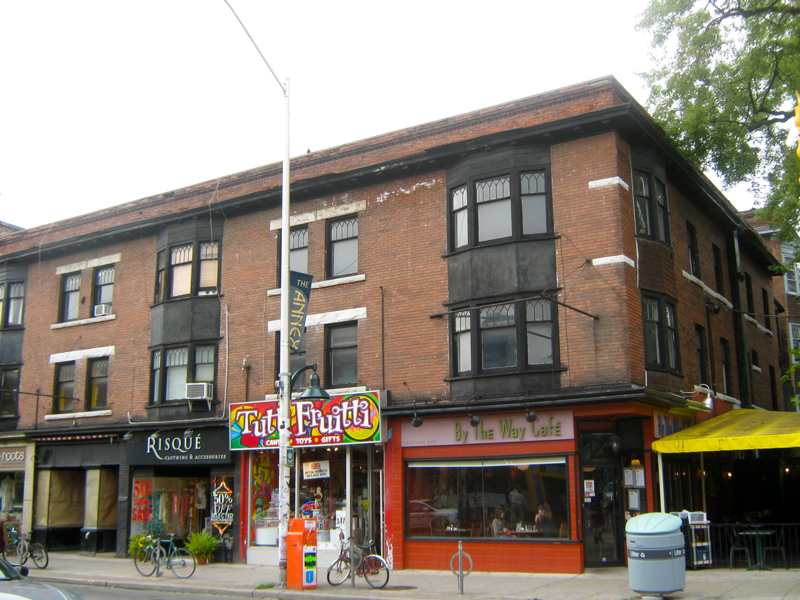
With the exception of a hair salon, the top floors, which served as office space in the `60s and small apartments in the `70s, have been empty for about 20 years, according to Amir Benedict, owner of By The Way Café.
The problem: similar to Racz’s house, Martyniuk disregards any interest in occupancy for unknown reasons. Although some locals suspect his health is to blame for the abandonment, Benedict says because the space is privately owned, “It’s not anybody’s business.”
Current state: these Old Victorian spaces need a lot of work, but are known to still contain bronze fireplaces and original architecture. While some locals complain that loose bricks pose a problem for the street below, no one has been hurt—yet.
310 Brunswick Ave.

This empty residential apartment building has been the source of much speculation, because of a prolonged vacancy for nearly 20 years. Real estate values place the whole corner at almost $10 million.
The problem: it’s always been impossible to make any sort of deal, says Bela Halasz, a Hungarian real estate agent who knew Racz in her early days. “These people are a little bit woo-hoo! If he [Rich] would sell that corner, I would have a buyer.”
Current state: the side is covered in graffiti, and a broken side-door beckons animals inside. This once handsome building is dying for a makeover.
252 Dupont St.
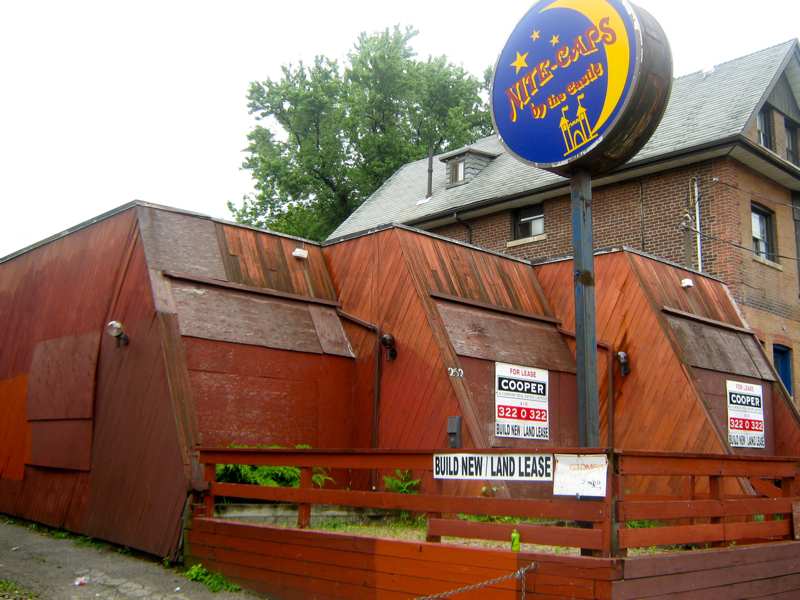
Both Nite-Caps by the Castle and Madoka Japanese Restaurant have occupied this address, but it has remained empty since spring 2005 and its windows are currently boarded up. The landlords reportedly want to use the 14,000 square foot property for a retail structure (for lease only), but have not been able to find a suitable tenant.
The problem: possibly the landlords asking price of $4,500 a month rent, minimum. Or according to the realtor for the property, Harvey Cooper, it could be indecision since “they’re not sure what they want to do with the site.”
Current state: it’s far from move-in ready. The new tenants will have to tear down and rebuild the entire property, including the rotted garage at the back.
420 Dupont St.

Though it may seem vacant, this large warehouse, once occupied by Mono Lino Typesetting Company Limited, is now owned by Wing’s Food Productions along with the neighbouring warehouse at 275 Albany Ave. The oriental noodle manufacturer took over shortly after Mono Lino closed its doors in 1985, due to a technology shift in the publishing industry. Even over two decades later, the famous lettering still hangs above the door.
Interesting fact: the exterior of the TV station in the film Hairspray was shot at the Mono Lino site.
Tags: Annex · News