March 16th, 2012 · Comments Off on Liberty Village 2.0
NEIGHBOURHOOD’S NEW RESIDENTS’ ASSOCIATION PROVIDES COLLECTIVE VOICE
By Sean Frankling
It has only been in the last decade or so that Liberty Village has been a residential area, but newly-built condominiums have brought a massive influx of people. They in turn have brought their views on how their new neighbourhood should be run.
The Liberty Village Residents’ Association (LVRA) was formed to represent these views and has been gaining momentum in the new year.
“It seemed when I was living in Liberty Village that a lot of people were really passionate about the area,” said Todd Hofley, the organization’s founder and president, who started the organization this past October. “Nobody was asking us what we wanted to happen … I thought we needed to speak with one voice instead of yelling with a thousand voices.”
Hofley is a new resident. He says that starting the organization was a matter of building connections between the condo buildings, which had already become close-knit communities in their own right.
[pullquote]“The one unique thing about the area is that they still have a lot of neighbours coming. This will actually be a growing association …”—Councillor Mike Layton [/pullquote]
The association plans to deal specifically with traffic and parking policies in the area, get involved in development choices and improve contact between residents and local businesses.
To accomplish this, the LVRA is organized into three committees. The Neighbourhood Planning Committee is involved in infrastructure, development and traffic management. The Design and Business Development Committee is charged with working with developers and businesses to build a “cohesive” design vision for the Village as a whole. The Social Events Committee is tasked with bringing the community together by planning gatherings and events.
“They decide which [issues] they want to tackle, priority-wise and my job as president is to help them achieve the goals that they set,” said Hofley.
The organization plans to work closely with Councillor Mike Layton (Ward 19, Trinity-Spadina) as well as the Liberty Village BIA. “The one unique thing about the area is that they still have a lot of neighbours coming. This will actually be a growing association … You’re about to add 4,000 new people to the neighbourhood.” said Councillor Layton.
“[In other neighbourhoods] they’ve fought against this, they’ve rallied around that. They really have a history, whereas we’re building that new history, that second generation, that Liberty Village 2.0 right now. To have a strong group with a strong leader, that’s really the energizer.”
Layton says the residents need to think about what issues will attract people to the community, specifically echoing Hofley’s stance on traffic and parking as well as improved public transit.
In the coming year, the LVRA plans to take a role in the building of the new pedestrian bridge between King and Liberty Streets, encouraging movement toward creating an intersection at Lynn Williams and East Liberty Street, and improving traffic safety along East Liberty Street. The organization has several events planned for 2012, including a massive neighbourhood garage sale, a food truck day and an as-yet unspecified community-wide event in the late spring.
The LVRA can be visited at their facebook page or on twitter, @libertyresident.
Tags: Liberty · News · General
March 11th, 2012 · 1 Comment
CRITICS SAY InfoToGo PILLARS ARE MERELY ADS

Many InfoToGoPillars are standing at spots around the downtown core. Perry King/Gleaner News
By Mike Shulman
The growing presence of pillars with reduced information and more advertising have drawn the ire of public space advocates, city councillors, and local residents and businesses.
Critics of the pillars, installed by Astral Media, say they give priority to advertising while neglecting safety, sidewalk access, and their ostensible purpose of providing a way-finding system to local area residents and tourists.
“They are basically advertising pillars. The information is on the spine of the pillars that supports the advertisement. People who have tried to use the maps are complaining that they’re basically confusing and completely ineffective,” said Jayme Turney, executive director of the Toronto Public Space Initiative (TPSI).
The majority of the issues surrounding the pillars have surfaced since a redesign was proposed by Astral and approved by city council last July.
The controversial redesign features a reduction in the information panel by 50 per cent and an increase of the size of the advertising panel by 60 per cent.
The previous design, titled InfoToGo Pillar, featured a 3×5 advertising panel and a large information component. Only five of these were built in total before the redesign was pursued.
According to public space activist Gord Brown, the InfoToGo design was meant to be installed in parks, outside major buildings, and tourist areas, but it was “never really intended that they were going to try and jam them onto narrow downtown sidewalks.”
The city’s public works and infrastructure committee (PWIC) asked that a report be developed on the viability of design changes, and contractual obligations in order to address the concerns raised by the public and create a better way-finding strategy. On Jan. 4, public works voted unanimously at their meeting prevent the installation of further pillars. Council will vote on Feb. 6. on whether the pillars should have additional approval before being installed.
Councillor Adam Vaughan (Ward 20, Trinity-Spadina) is against the pillars and says this is what occurs when “the city has sold its sidewalks to an advertising conglomerate.”
Ron Hutchinson, senior vice president of real estate at Astral, concedes that “yes, the ad-panel is larger than it was in the original design,” but according to him, “it is the same size as the transit ad-panel and there is no increase in the amount of advertising in square footage that is on the street—that is governed by the contract as well.”
The city’s Vibrant Street Guidelines—established through public consultation and laid out to pre-emptivily deal with issues related to the Street Furniture Program—specify that “no furniture shall obstruct pedestrian, cyclist, or driver sightlines.”
According to the Harbord Village Residents’ Association (HVRA), pedestrians clearways have have been reduced to about half a metre less than the minimum guideline calls for. HVRA representatives said the pillars’ perpendicular placement to the curb design and its standardized construction does not account for the various widths of downtown sidewalks.
This reduced sidewalk space has the potential to increase congestion and issues for those with mobility or visual impairment. “If you create bottlenecks in the sidewalk, that’s a problem, but especially if you’re a new family with stroller or you’re in a wheelchair, or if you have a visual impairment—that creates all kinds of problems” said Turney.
Herb Van den Dool, a resident cyclist representing Ibiketo, noted the pillars’ effects on sightlines. “While cycling on the street I have also noticed how imposing the info pillars are as the lighted ads draw attention away from the street and can be distracting.”
Vaughan argues that the current design “has made it harder to walk down the sidewalk, harder to ride a bicycle, and a bigger challenge even for people driving cars because they block sightlines.”
The pillars are the latest product of Astral’s 20-year Street Furniture Program, signed in 2007. The contract provided the city with an upfront payment and the contract secured the greater of either an annual minimum guaranteed fee or a previously assigned percentage of gross advertising revenues from Astral.
The company plans to have 120 pillars up in the city by the end of the year.
Tags: Annex · News · General
COUNCILLOR TALKS TUNNELS, TAXIS, AND CASINOS AT TOWN HALL MEETING

uncillor Adam Vaughan (Ward 20, Trinity-Spadina) speaks with residents of the Bathurst and Queen’s Quay area at Windward Co-operative Homes on Feb 29. Rasheed Clarke/Gleaner News.
By Rasheed Clarke
The Bathurst Quay Neighbourhood Association hosted a town hall meeting with Councillor Adam Vaughan (Ward 20, Trinity-Spadina) on Feb. 29 to give area residents a chance to discuss the issues affecting the neighbourhood with their city hall representative.
Inside the Waterview Room at Windward Co-operative Homes (34 Little Norway Cres.), Vaughan provided residents with updates on construction, development, and traffic management for the area.
One of the most pressing concerns identified by neighbourhood residents was the planned construction of an underwater pedestrian tunnel to Billy Bishop Toronto City Airport, which is now only accessible by ferry.
While residents have opposed the tunnel for fear of increased congestion, according to Vaughan the underwater pedestrian passageway is imminent. “The tunnel project has been approved, it’s moving ahead, it’s been tendered and there is a constructor on contract,” he said. The next step is the creation of a construction liaison committee, which will outline a construction management agreement. “The agreement will ensure the neighbourhood is as protected as it can be from noise, dust, and trucks driving through,” said Vaughan. “We’ve already achieved some agreements on that. The trucks are not to cut through this neighbourhood as they take waste away or deliver material to the construction site.” Additional airport-related construction is about to get underway, according to Suzanna Birchwood, spokesperson for the Toronto Port Authority. “We are now starting to put up a noise barrier that will reduce noise for this immediate area,” she said. “It did take a very long time (to put up the barrier) but there are different levels of government at work trying to come up with solutions, so it’s not a pretty or quick process.”
While construction plans move forward in the neighbourhood, residents remain frustrated with taxi congestion. “Taxis are always an issue in our area,” said Sandra Taylor, who owns two condominiums in the neighbourhood. She worries that the pedestrian tunnel to the island airport will mean more taxis jamming local streets. A number of parents who attended the town hall also expressed their concern that the increased taxi presence was posing a risk to children on their way to and from The Waterfront School (635 Queens Quay W.).
Vaughan’s response was a planned proposal that cars travelling northbound from the island airport on Eireann Quay not be allowed to make left or right turns onto Queens Quay W. Additionally, Vaughan stated that crossing times at intersections would be examined. “We want to make sure that kids and people who need to cross, and who don’t move at the speed of light but rather move at the speed of people, can get across safely,” he said. Vaughan revealed that community council had approved a plan for speed bumps to be installed on Eireann Quay. However, the Toronto Port Authority took that decision to court, arguing that speed bumps would impede emergency vehicles from reaching the island airport in the event of a plane crash. “The day to day safety of the children walking on that street has to be spoken to,” said Vaughan. “The safety of children in this neighbourhood trumps everything.
“We’ll stop at nothing to make that street safe, I don’t care how many lawsuits the Port Authority throws at me.”
While activity increases around the island airport, residents were also interested to hear about the future plans for the now quiet Ontario Place lands. The construction of a casino on the grounds is one of the ideas being mulled by the province, which owns Ontario Place. Vaughan expressed his outright opposition to a casino, which he believes could nurture gambling problems, amidst other drawbacks. “It’s not a moral issue to me, although there are moral implications, but it’s an urban fabric issue, it’s a planning issue. Casinos are really bad in big cities. “It would transform the social dynamic on the street, it would transform the way people use this neighbourhood.”
Vaughan added that the provincial government has stated that it will not put a casino in a community that is not willing. Plenty of heads around the Waterview Room nodded to Vaughan’s comments, suggesting this neighbourhood would not welcome a casino in their community.
Tags: Liberty · News
TENNESSEE WILLIAMS’ THE NIGHT OF THE IGUANA COMES TO HART HOUSE
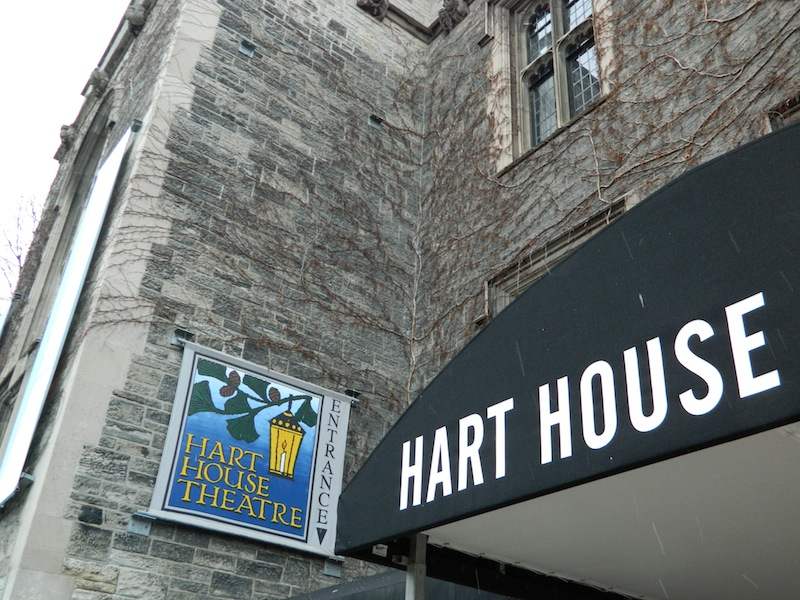
Hart House Theatre will warm up this March with the American classic, The Night of the Iguana. Rasheed Clarke/Gleaner News.
By Rasheed Clarke
When winter’s frigid fingers are desperately clinging onto you this March, Hart House Theatre (7 Hart House Circle) will offer up an escape down to Mexico; the sweaty setting for Tennessee Williams’ play The Night of the Iguana.
The performance will mark the final show of Hart House Theatre’s 2011/2012 schedule.
The story follows Reverend T. Lawrence Shannon, a disgraced minister who works as a tour guide in Mexico after being expelled from his American church. As the Reverend struggles with his broken faith, he leads a group of female tourists through Mexico and begins a romantic relationship with a young girl in the tour group, Charlotte Goodall.
Shannon brings the group to a hotel run by his friend Maxine Faulk, who lusts after the Reverend. Add one more woman into the mix, the spinster Hannah Jelkes, and you get a complex tale of interwoven relationships between seemingly unrelated people who work towards accepting their lives, as flawed as they may be, and moving on.
Director Jeremy Hutton has been charged with the responsibility of bringing Williams’ play to the stage. He is also in his second year as Hart House Theatre’s artistic director. Hutton says the time was right to perform The Night of the Iguana.
“We almost always do a Shakespeare, we almost always do a musical, and then the other shows in the season are left freer in terms of all the different things we can do with it. We had never done an American classic that wasn’t a musical, so it just seemed like a good time to tackle some Tennessee Williams.”
As director of Iguana, Hutton says that his job is not to exhibit any particular thematic angle, but to ensure that the play’s distinctive characters stand out for the audience.
“It’s a character piece, not a director piece. There are no huge interpretations or spins that a director can put on it. You have these really deeply damaged people who are on the precipice of their lives, they’re all ready to crack, but there’s a potential that these characters can attain something real, that they can get past the issues and damages that they have. Maybe not find something perfect, but something acceptable.”
The production enlists some top talent, with David Ferry taking on the role of Reverend Shannon. Ferry won the 2011 Barbara Hamilton Award for excellence in the performing arts, and has featured in Richard III and Titus Andronicus at the Stratford Shakespeare Festival.
Starring alongside Ferry will be Allegra Fulton, who plays Maxine Faulk. Her long list of credits includes performances at the Stratford Shakespeare Festival, Tarragon Theatre, SoulPepper Theatre, and the Canadian Stage Company.
Andrea Wasserman, marketing coordinator at Hart House Theatre, says that the show’s added star power will likely bring in a diverse crowd.
“With the inclusion of David Ferry and Allegra Fulton we’re going to get a lot of folks coming from the theatre community at large, as well as general playgoers.”
“One of the great things of this particular production,” adds Wasserman, “is that a lot of the folks who study English or Theatre will have looked at this play or at least the plays of Tennessee Williams, and that will attract a student audience absolutely.”
The Night of the Iguana is on stage from Mar. 2 to 10 at Hart House Theatre. For tickets and showtimes, visit www.harthouse.ca/hart-house-theatre.
Tags: Annex · Arts · General
March 3rd, 2012 · Comments Off on Dancing on porches
LOCAL PERFORMER WRAPS UP MANGA-INSPIRED ENSEMBLE
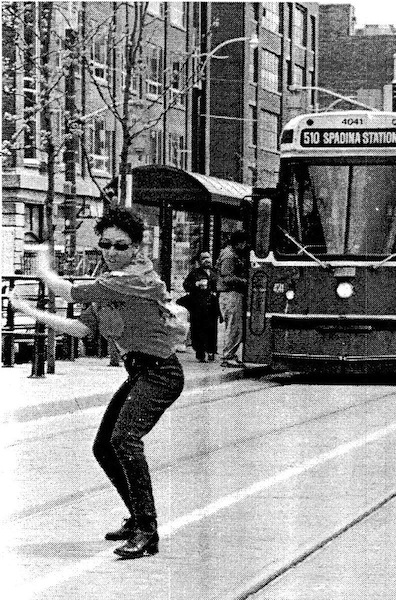
Maxine Heppner has lived in the Annex since the late '70s. Courtesy Maxine Heppner.
By Rebecca Payne
Maxine Heppner has been involved in dance her whole life. The choreographer, performer, and teacher has been an Annex resident since the late ’70s.
“I wouldn’t want to live anywhere else in the city, quite frankly.”
She says the diversity of the neighbourhood is what makes it such a vibrant and inspirational place for artists. “If you stop to pay attention, there’s a lot of material.”
A run of Heppner’s latest project my heart is a spoon, which she choreographed and directed, just concluded at The Theatre Centre (1087 Queen St. W.). She began to develop the piece almost six years ago, when she was touring Asia. During her time performing in Tokyo, she was introduced to manga, a Japanese style of cartooning. The manga books inspired her because “the books are really energetic and they are powerful when you open up a page. The artists are really free in the way they draw.”
[pullquote]“If you take this amazingly difficult experience and you swallow it, you hold it inside”—Maxine Heppner [/pullquote]
Modern manga is a direct development from traditional drawings and wood etchings, also known as manga, that have been dated back to the 17th century. Heppner also studied these traditional works of art, and was stirred by the difference between the two. “It seemed to me that they kind of sucked you in; all the soft colours, you look inside the painting to see all the detail. Whereas the [modern manga] kind of leapt out at me.”
The differences in the energies of these two forms interested Heppner, and this lead her to consider and observe how people contain and release energy.
my heart is a spoon also explores the condition of rage, which she notes is, from a psychological perspective, more about a release of pressure than the violent-anger definition that usually comes to mind. According to Heppner, this release can happen in many ways, which the piece explores. In putting it together, she spoke to psychologists, sociologists, political scientists, and those in the medical field.
She also spoke to survivors of Hiroshima. “I was told that they, and [other survivors] were told that they should swallow their rage, and this was a strong statement to me. [Because] it meant that if you take this amazingly difficult experience and you swallow it, you hold it inside. But at the same time I thought, it’s interesting because if you swallow something then you digest it, and it becomes a part of you. This was the beginning of my thinking about alternate ways we live with difficulties in our lives.”
In the spring, Heppner will be leading various workshops, as well as contributing to a project with Kaeja d’Dance Company. She is one of five choreographers who will be creating dances that are to be performed in the Porch View dance series. These performances will take place, as the name suggests, on community members’ porches and front lawns in the Seaton Village area, and will be free for the public to attend.
For more information on Heppner and her upcoming workshops, please visit www.acrossoceans.org. For more information on the Porch View series, please visit www.kaeja.org.
Tags: General
February 27th, 2012 · Comments Off on Crime is down, changes abound
14 DIVISION TO OPEN NEW HEADQUARTERS THIS SEPTEMBER
By Perry King

14 Division's new headquarters on Dovercourt Road is to open this fall. Perry King/Gleaner News.
Toronto police’s 14 Division may have had a great 2011, but New Year’s Day was not a time for them to rest on their laurels.
The New Year’s stabbing death of Mike Pimentel in Liberty Village “was only one isolated event that raised concerns to me on New Year’s Eve. There were other events as well that raised concerns for me,” said 14‘s Superintendent Mario di Tommaso, who, with Inspector Dave Vickers, sat down with the Gleaner at their headquarters (150 Harrison St.) to review 2011 and discuss changes for 14 in 2012.
With parties going on throughout the division, 14 wanted to to stay proactive that night, and planned as best as possible for every scenario. “Those issues come to my attention, they come to Inspector Vickers’ attention, and we formulate plans around ‘What could we have done better? Was there anything that could have been done better to prevent this?,’” said di Tommaso. The division calls weekly planning meetings between Homicide, crime analysts, and his constables to plan ahead.
With a year where Mayor Rob Ford emphasized cost-cutting and making all police divisions more financially equitable, the division has been focusing on “improving service delivery” for some time.
“We are very cognizant that we have to employ the resources that we do have in a cost effective basis, but that money is there to be spent and it is there to be spent wisely. This money belongs to the taxpayers, and when you spend that money, we try to do it as effectively and efficiently as possible,” says di Tommaso, who deploys his squad based on facts developed through the division’s relationship with the local community.
Pimentel’s death on Liberty Street the morning of Jan. 1 was the first homicide in 14 this year. The investigation, as of press date, is still open and no arrests have been made.
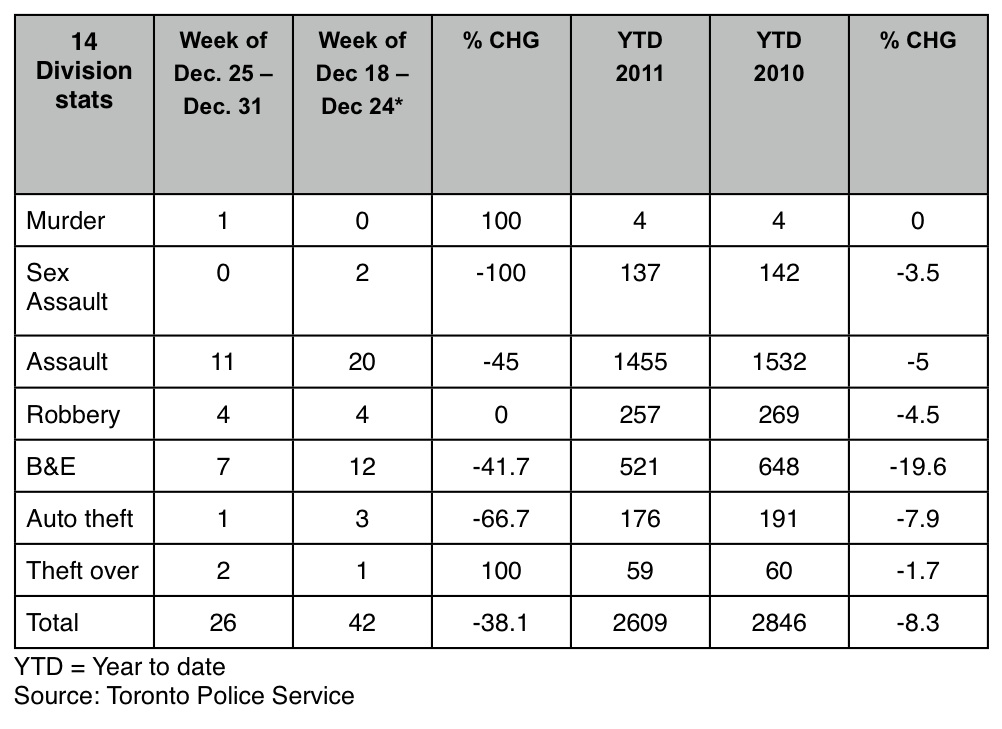
But, the homicide rate in 14 is not a high one. In 2011, there were four, the same amount in 2010. In fact, crime across six major statistical categories all dropped in 2011, including assaults (down five per cent), auto thefts (eight per cent) and break and enter offenses (20 per cent). “The major crime indicators is a really good representation of what crime’s doing in a particular area or a city. We’ve dropped about 20 per cent over the last two years, and that’s a reduction from three years ago,” said Vickers.
A NEW TOP DOG
The division was able to do their job amidst many changes in the ranks.
The most glaring change in the ranks has come at the top. The departure of unit commander Ruth White and the arrival of di Tommaso in November may mark a significant shift in how the division will be shaped moving forward.“Every unit commander is in charge of their station and their community and every unit commander—either a superintendent or staff inspector in Toronto—has the autonomy to have a look at what the issues are of that particular community, and create and lead initiatives to make sure that the service is being provided to [the community] and that the safety of the community is paramount ,” said Vickers.
“Historically, I think that can be said for all unit commanders, that we all have the same common goal, but how we go about it could be a little different.”
Di Tommaso, with two-year stints in Toronto’s 52 Division, the Intelligence Unit and the Drug Squad, says that he will incorporating that experience into the community policing approach that 14 has instituted and the knowledge of his staff, who have been the division much longer. “It’s a very effective and efficient unit [Ruth White has] left, and that was her legacy to me,” said di Tommaso.
14 Division saw the execution of several drug sweeps, including Project Blue Rabbit (a project di Tommaso was involved in), and Projects Klondike and Decepticon—which resulted in the arrests of 49 people combined, and the seizure of illicit drugs, valued in the thousands of dollars.
[pullquote]We are very cognizant that we have to employ the resources that we do have in a cost effective basis—Superintendent Mario di Tommaso[/pullquote]
Blue Rabbit, which was executed through an increased presence in various locations in the division, saw the reduction of robberies by 44 per cent, break and enters by 73 per cent, and assaults by 72 per cent over ten weeks. “I draw upon a lot of those experiences to help me here. I also rely on the good judgment and advice of Inspector Vickers and all of my senior section heads. We run this unit collectively as a team, but at the end of the day, the buck stops here, I am in charge.” he said.
SETTING BOUNDARIES
On Sept. 26, 14 division also changed their western borders with 11 Division. They now border at Dufferin Street, and monitor further west and south on Queen Street to Roncesvalles Avenue. The feedback on the changes have been positive so far. “We have lots of consultation with the communities that are involved there … the people of South Parkdale feel like the policing has increased their feeling of satisfaction from the service they’ve been provided,” said Vickers.
However, as a result, the division handed over 30 constables and a sergeant to 11 Division, and the Community Response Unit will be leaving their base at the Exhibition Place sub-station. But, “This process is not yet over,” said di Tommaso. “What we’re doing, on a monthly basis, is evaluating the data that comes in.”
In a few months, the neighbouring divisions will take into account that data—including the calls for service, which is way down in 14 but higher in 11, the amount of arrests and the enforcement strategies—in a comparison of pre- and post-boundary changes, and determine whether the deployment changes have been adequate and effective.
As well, 14 Division wants to, with the city’s blessing, retain the Exhibition Place building rather than close and sell, as it can still be “an operational asset,” says di Tommaso.
The Community Response Unit, like everyone else, is moving into the new 14 Division headquarters this fall, one of the many changes that di Tommaso and Vickers are excited to see this year. They are also excited to see other initiatives gather momentum, including the growth of the Youth Community Policing Liaison Community (Youth CPLC).
“During the initial meetings, there were some growing pains,” says di Tommaso, but the perspectives from these young people—from bullying to mental health issues—can definitely help the division plan and work with others down the road.
DOWN, DOWN, DOWN
How much had the crime rate decreased in 14 Division in 2011? Check out this graph below.
Tags: Annex · Liberty · News · General
February 27th, 2012 · Comments Off on Of bats and bees
ANNEX-BASED MUSIC DUO PUT ON INTERACTIVE SHOW
By Alexa Huffman

Alex McMaster plays on her cello-courtesy Sarah Mackie
Two Annex-based musicians will be busting out the cello, gong, and glockenspiel while they sing and perform in a new show.
Alex McMaster and Ed Reifel will be immersing themselves in a powerful performance inEverything Under The Moon, which tells the story of a bat and a bee trying to save themselves and their respective species. It touches on the themes of environment, loss, adaptation, friendship and community.
McMaster and Reifel are working together with fellow musician Christine Fellows and artist Shary Boyle.
“It’s nice because I have a bit more of an input creatively,” said Reifel. “We all kind of contribute, work together, and add suggestions.”
McMaster agrees. “It’s definitely fun to be part of a show where you have something to do with the end result.”
The two are heavily involved in Everything Under The Moon. They will be playing the instruments they are known for—McMaster on her cello, and Reifel on a variety of percussion instruments including the gongs, glockenspiel and more unusual ones like cans and a water gong, with McMaster also on the clarinet and trumpet.
The two will also be dressing as a variety of characters. McMaster will be an owl and the bat. Reifel is the bee and an Inuit elder.
“The show is accessible to people of all ages and is open to interpretation,” said Reifel. “It’s interesting, reading it over lately, there is a friendship theme, growing up looking back to your roots. Even though you had different relationships in your life, different relationships with your family, you always look back to your early years.”

Ed Reifel plays percussion in the show-courtesy Sarah Mackie
Both musicians are able to recall music being an influential part of their own early years. McMaster has been playing the cello for 33 years, starting when she was in kindergarten. Reifel actually started off playing the cello, but by Grade 7, he saw a drum set in the band room at his school and never turned back.
He has now been on percussion for 26 years, mostly playing in orchestras. McMaster mainly records classic albums live.
Both have played around North America but are now based in the Annex area.
“The subway is right outside my front door,” said McMaster “There are three health food stores and countless restaurants. It’s sad but true, I seldom leave the area.”
Since she enjoys listening to music so much, McMaster regularly checks out Lee’s Palace (529 Bloor St. W.) and Trinity-St. Paul’s Church (427 Bloor St. W.). Reifel also praises the church, saying there is a real atmosphere about the place, a fact he noticed when he played at a service.
Not only do Reifel and McMaster praise the Annex, they admire Toronto as a whole. Reifel sees his career expanding in the city and McMaster feels the same way.
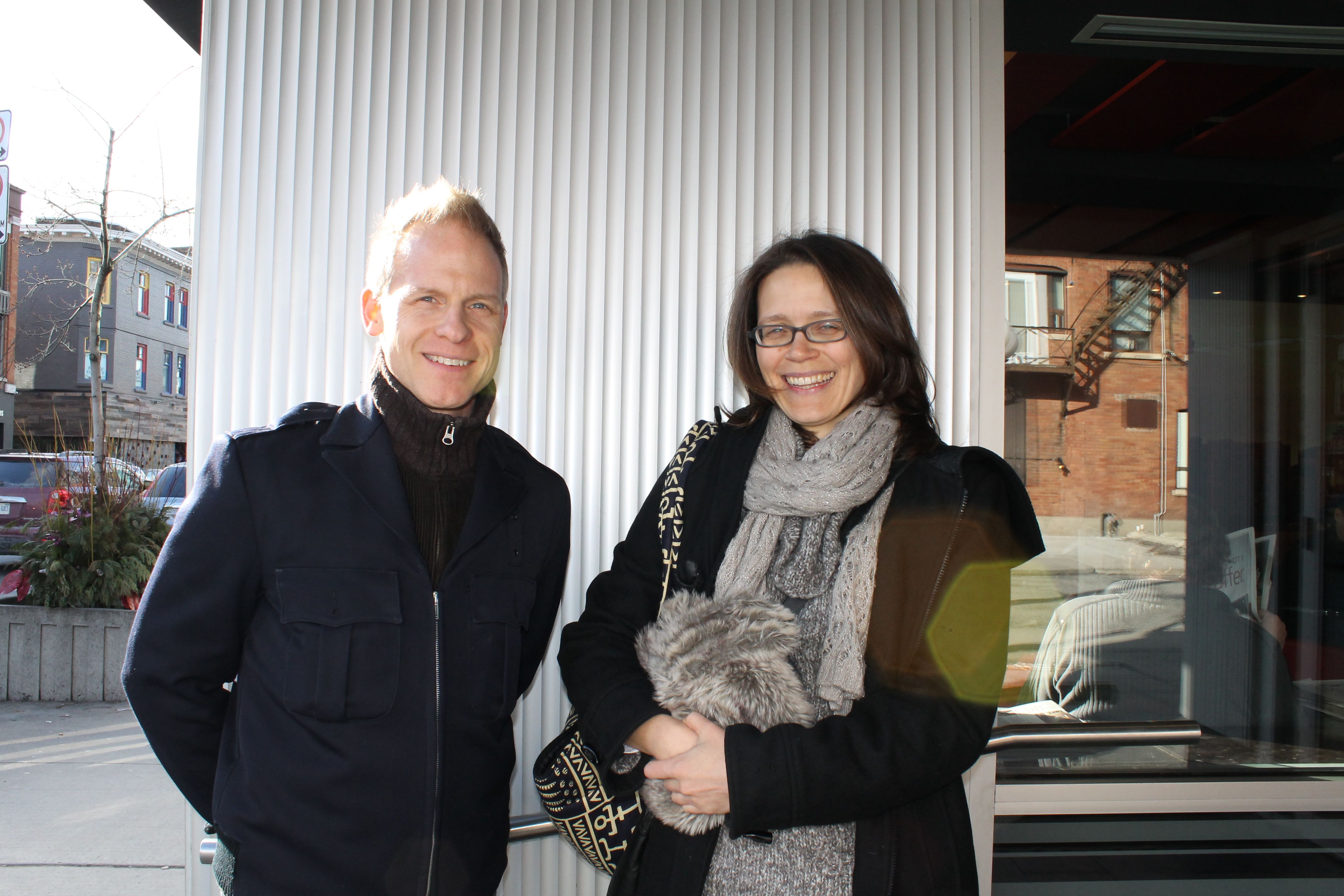
Ed Reifel and Alex McMaster outside the Aroma Cafe in the Annex
“Toronto seems to be the place where you can make a living doing interesting things,” said McMaster. “I don’t think there’s any other place like it in Canada.”
Currently they are focused on getting ready for Everything Under The Moon, which will run on Feb. 18 to 23 at the Enwave Theatre. The cast did three workshops in early December where they recorded the live music from the show. The rehearsal will continue in February including a full week of rehearsals on Toronto Island and two full days in the theatre.
McMaster and Reifel are enthusiastic about this current project as it is so visually appealing and interactive compared to some of the other gigs they have played. They praise Boyle, who puts on visuals on projections and has designed paper cut outs for the performance including totem poles that are cardboard animal heads.
The show is about creating art on the spot and the music follows what you see on the screen.
“I know that not all the work we end up doing will be super challenging, or rewarding, or creative, but even if one of these things comes along every year, stretches the brain, it’s great,” said McMaster.
Tags: General
February 27th, 2012 · Comments Off on Rethinking Eating Disorders
NEW ANNEX-BASED CENTRE TO USE INNOVATIVE TREATMENTS
By Alexa Huffman

Kyla Fox opened the centre in February-courtesy Kyla Fox.
Kyla Fox is bursting with excitement at the thought of opening her very own building for the treatment of eating disorders.
Fox knows first hand how hard getting healthy can be. She struggled with an eating disorder when she was younger. She feels there are gaps in the medical community and challenges including long wait lists and limited services
“I feel like I’ve had this building in my heart, mind and soul for a long time because it’s the idea of what I would have wanted for myself,” said Fox.
The Kyla Fox Therapy Centre (174 Bedford Rd.) will be an innovative new facility that treats eating disorders by using clinical therapy and a holistic approach that includes treatments such as acupuncture, massage, and yoga.
The spacious location on the third floor of an old house, opened on Feb. 6. It is 2,200 square feet and U-shaped. It is a bright open space with arched ceilings and skylights where people who are affected by eating disorders, either directly or indirectly, can go to utilize resources.
[pullquote]I feel like I’ve had this building in my heart, mind and soul for a long time because it’s the idea of what I would have wanted for myself—Kyla Fox, founder of The Kyla Fox Therapy Centre[/pullquote]
The location is ideal because it is the centre of the city. Fox, also a family and couples therapist, says that having it located it in Toronto allows people to heal close to home.
“It really makes it easy for people to go to get everything in one place,” said Fox. “The hard part is struggling with the disorder. We don’t want to make getting help complicated.”
There are many different types of therapy available including private therapy for individuals, families, and couples. In addition, there are drop-in groups.
“They are through the days and evenings. The clients will get to choose which groups they want and they can plan out their weeks,” said office manager Jamie Johnson. “We trust the clients know their bodies and will help us to guide them.”
Group therapy sessions include a binge eating group, a teen group and even a group for kid’s aged 10-13, not found anywhere else except at SickKids.
“The symptoms of an eating disorder may be similar but everyone heals differently. There should be more options and we are offering them,” said Fox.
The centre also boasts a kitchen where holistic nutritionists can help clients during drop in meal times. Fox, who often eats meals with her patients, feels renewing the relationship with food is an important part of healing.

Yoga Studio in The Kyla Fox Therapy Centre
“We are helping them see how food is safe, wonderful thing,” said Fox.
Fox has hired other experts in the field including therapists like Margaret Powell, who has worked with Fox at Sheena’s Centre, another place in Toronto that focuses on eating disorders, and Joanna Anderson who has worked at SickKids.
There is also a volunteer program that is an opportunity for people who are recovered to be part of the centre.
“Each person working here has extensive experience with eating disorders,” said Fox. “It’s a community to come and be safe. There are amazing, strong women all around.”
The process to get in is simple. An appointment is made through either a phone call or an email. Then there is a consultation with a therapist and volunteers to see what type of therapy they need.
There will also be free information nights for anyone in the community dealing with eating disorders, like teachers. The centre does operate for profit, although for the month of February all the drop-in groups are free.
“The people who live with eating disorders and the families and loved ones who are affected, need more support and attention.” said Debbie Berlin-Romalis, one of the centre’s therapists.
The goal is to have busy place that people want to come back to. In the future, Fox would like to see intensive program and perhaps a residential location.
“I feel I was put on this planet to change the way we view eating disorders and how we heal them,” said Fox. “My vision doesn’t stop here.”
For more information on centre’s programs, visit kylafoxtherapy.com.
Tags: General
January 7th, 2012 · Comments Off on Mario vs. Pac-Man: video game characters to rumble in squared circle
By Nathaniel G Moore

The Combat Opera event is a vibrant tribute to video games, with familiar characters wrestling at the Toronto Underground Cinema. Courtesy Midnight Matinee.
I didn’t exactly know what WrestleCrisis was until someone tweeted to me about it because it had to do with wrestling. You see, people think I want to read about all things related to the squared circle. Perhaps it doesn’t help that I curate art shows and write about wrestling from time to time for national newspapers.
Regardless, I felt a kinship with local Ross Aitken, indie wrestler and local promoter who has been developing his unique brand of mayhem over the last two years. His most recent event, scheduled for this coming Sunday at 4 p.m., is his latest installment of WrestleCrisis at the Toronto Underground Cinema (186 Spadina Ave.).
At first, I thought the concept of the event was a tribute to wrestling video games—a festival of game playing throughout the ages, the evolution of wrestling video games, tournaments, that sort of thing.
Oh how I was wrong. This is real wrestling and real video game characters battling out in a real wrestling ring. It’s like a lazy Saturday morning cartoon and video game session on an acid trip.
Imagine your favourite video game characters entering the squared circle and wrestling each other in front of a live audience? The themed Combat Opera event is a vibrant tribute to video games, specifically of the 8-bit but not exclusively) generation.
Simply put, the event boasts pro wrestlers wrestling in character as classic game characters live. “For many it might be a shock to see the full sized wrestling ring in the theatre,” Aitkens explains. “We rented the from the wrestling school Squared Circle Training.” A facility in North York where Aitkens has been training for the last six years.
“I wrestle as Buck Gunderson,” Aitken says, “I’ve been doing that for two-and-a-half years, most weekends.” The indie wrestling circuit takes him all over Ontario, and he has even captured some regional championships.
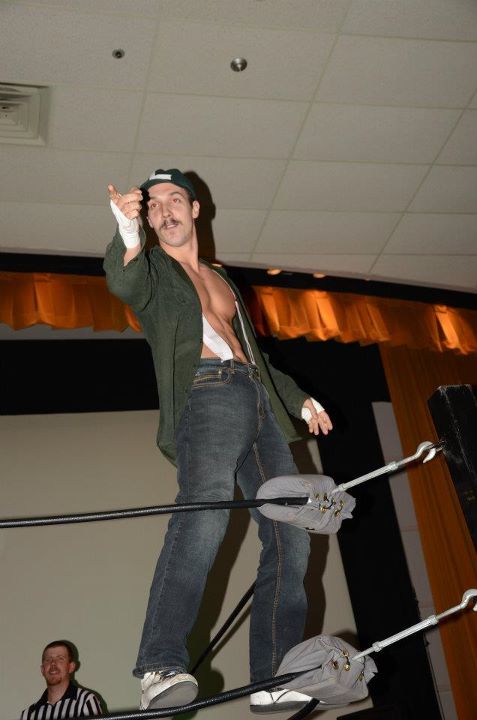
Luigi is set to wrestle this Sunday. Courtesy Midnight Matinee.
The concept for WrestleCrisis grew from Anime North, a festival of Anime curiosity in which Aitkens first booked video game characters in a live wrestling match as a side show.
Last April in Toronto, fans were privy to a much anticipated showdown with Pac-Man and Mario. However, things didn’t turn out quite as one might think.
“The biggest surprises on the first show was when pac man turned on super Mario and revealed himself to be Luigi, which lead up to main event later that night,” Aitken explains. The brother versus brother match (Mario vs. Luigi) ended in a disqualification when Wario ran in and interfered. Next Sunday’s show hopes to settle the score when Mario teams with a mystery opponent and faces Luigi and Wario.
The doors are at 4 p.m. and the action gets underway at 4:30 p.m. with music video game remixes—or “chip tunes”—will be presented. As for what patrons can expect for this, the first WrestleCrisis of 2012, Aitkens is cagey at first, but then reveals some old issues may get resolved.
I, for one, will be holding on the edge of my seat and cheering the baddies on all the way. Screw Mario and his mystery partner!
Tickets to WrestleCrisis are on sale for $10 in advance at Silver Snail (367 Queen St. W.) or $15 at the door. For more information, visit wrestlecrisis.com.
Tags: General
December 22nd, 2011 · Comments Off on Looks like a book, feels like a book … local literary gift picks
By Nathaniel G. Moore
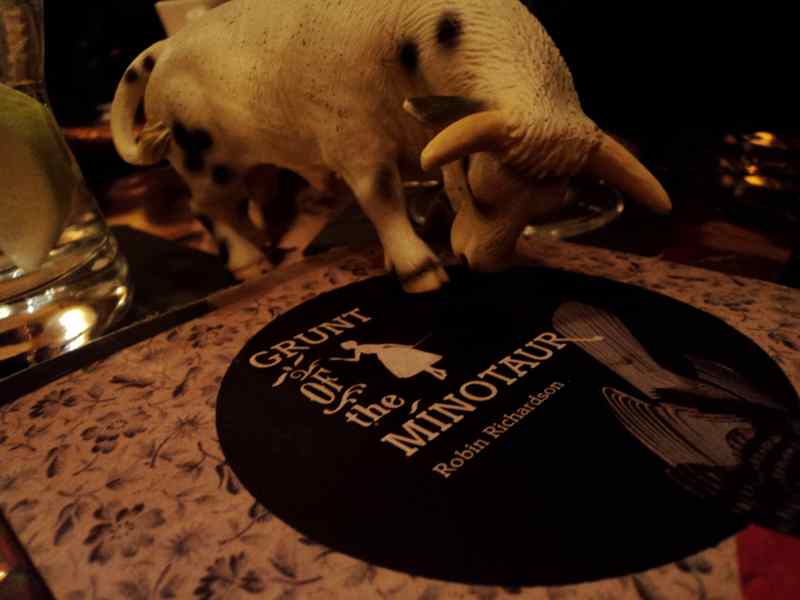 Grunt of the Minotaur is described by its author Robin Richardson as having “all the naked women, natural disasters, talking hogs, cannibals, and crooked cowboys you need to make your holidays bright … with just a touch of baffling.”
’Tis the season of chocolate, stuffing, and gravy stains, of holiday work-party planning meetings, secret Santas, and loved one’s subtle gift hints. ’Tis the season of bus and train stations, mistletoe, gift receipts, egg nog, and humbug.
And now that the sludge of quotidian questions has hit the office break room like static, you know, “What are you doing for Christmas? Staying in town, going to visit family? You done all of your shopping? Why are you crying?” it’s time to face the retail music.
So just buy these books, will you?
Evan Munday, who spends his days marketing for Annex-area publisher Coach House Books just released his debut young adult novel The Kid Detective Agency, (ECW Press, $19.95) that explores the world of the undead, detective work, and high school anxiety.
When asked who he thinks who would like to receive this book as a gift, the author replied: “Any tween/early teen children who like Nancy Drew books but wish she were more goth and had more friends that were dead.”
As for Munday’s own desires for gifts this holiday season (listen up Coach House authors), “A T-Pain Microphone and a DVD of the Kolchak: The Night Stalker television series.”
Munday plans on spending his holidays “drinking himself sick on eggnog in the company of friends and family.”
Robin Richardson just returned from Sarah Lawrence College in New York. She also just released her debut poetry book Grunt of the Minotaur ($15.95, Insomniac Press).
Richardson describes her debut poetry collection with an wide range of panache and nuance, “Grunt of the Minotaur has all the naked women, natural disasters, talking hogs, cannibals, and crooked cowboys you need to make your holidays bright … with just a touch of baffling.”
Richardson plans on a relaxed atmosphere this holiday season with family and loved ones, “and playing kid’s arcade games and going through haunted houses in Niagara Falls. “Please don’t tell my family,” Richardson muses. (She also hopes someone will get her a copy of Songs of Unreason by Jim Harrison.
Sherwin Tjia had a busy fall as well, just releasing his new choose-your-own-adventure style graphic novel You Are A Cat ($19.95, Conundrum), which tells the story of urban realities through the perspective of a feline. So for whom in the world is this book the perfect gift?
“This book is for cat people! I do not think dog people will like it,” said Tjia. “Also, it is not for children. There are some mature themes. As a cat, the humans in the story expose you to some things that they do not share with the other humans in the story. Mature things. But you don’t care, because you’re a cat.”
Liz Worth, on the tail end of her promo work on her non-fiction oral history of punk and the release of her debut poetry collection, had a busy year herself. She explains the difference for the discerning shopper, “Treat Me Like Dirt: An Oral History of Punk in Toronto is an obvious for punk fans, but it’s also for people who like their stories to be wild and raw and real,” says Worth, hoping readers who love and appreciate the city will learn something new about its recent past.
“Amphetamine Heart is punk rock and heavy metal that you read instead of listen to. Technically it’s a poetry collection but I think it’s better described as a book that appeals to people who like to hear about heavy nights of drinking, strange dreams, and stranger secrets. This is a good book for people who want to like poetry but feel it’s inaccessible.”
Worth is hoping for bright red lipstick and Duff McKagan’s new memoir It’s So Easy under her tree this December.
So head to Book City (501 Bloor St. W.), but if they don’t happen to have any of these titles, why not head online to the publisher’s websites themselves (they might be able to offer competitive shipping rates and local discounts, and hey, you can start a book-buying revolution!) and pick up these must-have reads for that special someone on your ever-growing list as you mutter to yourself down the subway stairs: “What am I gonna get Jim, I mean Jack, I barely know him!” Now you know—and knowing is half the battle.
Area man Nathaniel G. Moore is the author of Wrong Bar and Let’s Pretend We Never Met, both perfect for any aspiring weirdo writer in your life. In early 2012 he will (along with Burner Magazine) be releasing The Chelsea Papers, an unofficial prequel to Wrong Bar.
Tags: Annex · People · General
December 21st, 2011 · Comments Off on Local designer Illyria’s dresses perfect for the holiday season
By Karen Bliss

Illyria Design creations are elegant with a bit of an edge. Copyright Rhett Morita.
Working out of the studio in her Liberty-area home, Illyria Pestich of Illyria Design creates dresses that are classic enough to be worn year after year.
“It’s strictly a dress collection,” Pestich tells the Gleaner. “It’s always very classy, but sexy with a bit of edge. It’s definitely different than your regular dress, very chic and streamlined for a sophisticated fashion-forward bold woman.”
“I never follow what’s trendy at the time,” she says. “I try to create design lines that accent and highlight the best parts on a female form on every single dress so it’s very flattering.”
While next spring and summer looks have already been put to bed and she is working on fall 2012, Pestich is currently selling her fall/winter designs, which are perfect for the holidays. Her colour choices were mainly black, navy, plum and grey.

Courtesy Rhett Morita.
“This season, I mixed a lot of different fabrics all in one dress,” Pestich says. “I’ve got a few pieces that have a skirt done in suiting, waistband does in jacquard and then the blouse of the dress is chiffon. There are several dresses done in suiting accented in some chiffon or a modern trellis lace. There are also some jersey dresses with three-quarter-length sleeves and over-sized pockets and a funky edgy cut that you can definitely take from day to night.”
Pestich, who was born in London, Ontario, where she attended a high school for fashion arts, knew exactly what she wanted to do upon graduation. She moved to Toronto to study fashion technique and design at Sheridan College in Oakville and premiered her first Illyria Design collection in 2001. She has been building a loyal clientele ever since.
She frequently dresses top Toronto publicist Danielle Iverson and recently outfitted producer Julia Pacino (Al’s daughter) for the screening of Billy Bates at the Toronto International Film Festival. She also custom designs and is frequently asked to do entire wedding parties. “Having my personal clients has always been great for me,” she says. “I’m always happy to entertain new clients and have them come by.”
Pestich loves working from home—“especially in the winter,” she laughs—but is working towards a bigger dream. “Skies the limit,” she says, “ to get into bigger department stores and boutiques with multiple locations. Just to expand and be a household name and wholesale everywhere and eventually start opening up boutiques.”

Courtesy Rhett Morita.
Her dresses can be purchased at select boutiques across Canada, including local shops Pho Pa (702 Queen St. W.) and Naked Red (171 East Liberty St., Unit 143), as well as directly from Pestich who lives opposite Trinity Bellwoods Park (phone: 416 -471-5936 or email illyria@illyriadesign.com). Prices range from $200 to $400 and are available in sizes 2 to 14. For more information, visit www.illyriadesign.com.
Tags: General
November 25th, 2011 · 3 Comments
By Karen Bliss
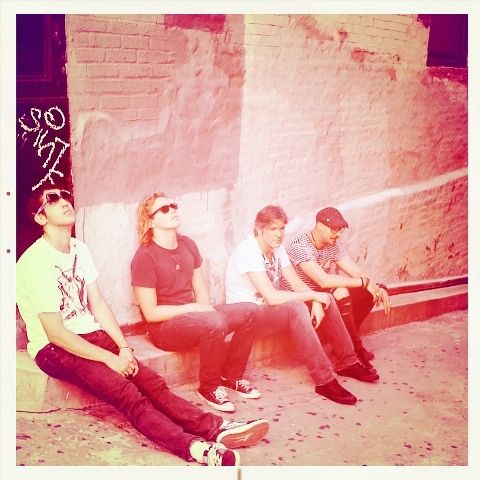
The Bloody Five will be releasing an 11-song album in the new year. Courtesy Martin Wojtunik
The Bloody Five frontman Kevin “KD” DeFreitas, a former Annex resident who is now a high school teacher living in suburban Toronto, is lining up a giveaway for his band’s show at Lee’s Palace (529 Bloor St. W.) on Nov. 26.
KD is happy to be playing in his former ’hood. “I used to be a student at U of T so I lived there when I was in teacher’s college, at 666 Spadina.”
The members of the alternative rock band—including KD, guitarist Tomi Fear, bassist Chris Hau, and drummer “Raw Beats” Sedran—have an 11-song album in the can, produced by Brighter Brightest singer Derek Hoffman, but won’t be releasing it until the new year.
Instead, KD says, “We are planning a surprise for fans who show up at Lee’s Palace that will be related to our upcoming single, video, and album releases.”
Chances are it will be a download card or CD with the single and maybe a few extra tracks.
The multi-generational band—Hau and Sedran were both students of KD’s and would perform at their Catholic school’s talent shows or in the liturgical band—has been together since 2009.
“We’ve got a heaviness to us; we’ve got a melodic flavour as well, kind of a trippy sound in some places,” said KD.

They released a five-song EP in June of 2010 that included songs “Never Again” (also available on the video game Rock Band in the “grunge” category), “And Me For The Forest,” “Bedroom Music,” “Under This Mountain,” and “Just Joking.”
The Bloody Five’s cover of “(I Wanna Go To) New York City” by Canadian punk band the Demics (1977-1980), the forthcoming single on the still untitled album, is a departure from the band’s other material.
“The guy who owns Autoshare.com [Kevin McLaughlin] is our guitarist’s step-brother,” says KD. “He grew up in the ’70s and loved that song. When Tomi was a kid, for one of his birthday presents [he said], ‘When you try to get into this music business, I’m going to give you one music video.’ And that’s what this is. He wanted this song.”
The video, directed by Martin Wojtunik, was shot last summer in New York and has a rather amusing premise.
“We start off [with] us running around the Manhattan area taking things. ‘Oh, here’s sunglasses; here’s a wig; here’s a leather jacket,’” recounts KD. “We end up at Bowery and Bleeker which is the location where [legendary punk/new wave venue] CBGB used to be, and that’s where we posed as the Ramones.
“So we’re looking like ourselves and throwing on the costume as we run around and end up as poseurs,” he laughs.
The cover art for the single was designed by another former student of KD’s, Krista Arnold, now at OCAD University.
KD says the punk song fits The Bloody Five’s sound because “one thing that definitely is in common with the rest of the album is the rawness of the guitar sound. That’s something Tomi is trying to put across.
He’s more into that heavy side and I’m more into the Beatles. I like the harmonies.”
Tags: Annex · Arts · People · General
