ANNEX COMMUNITY CELEBRATES WITH RIBBON CUTTING, BBQ
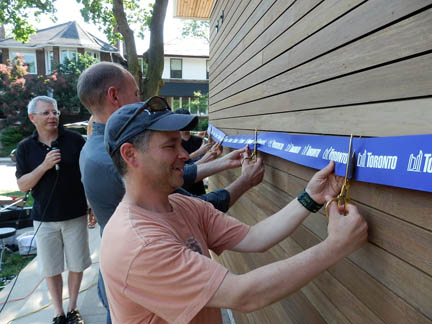
Councillor Adam Vaughan introduces some of the members of the Sibelius Square Working Group as they cut the ribbon and officially welcome the reopening of the park on June 10. Richard Frankel/Gleaner News
By Richard Frankel
The Sibelius Square Working Group, along with hundreds of people from the community and councillor Adam Vaughan (Ward 20, Trinity-Spadina), came out on the sun-filled Sunday afternoon of June 10 to officially open the redesigned Jean Sibelius Square Park.
The redesign took six years of consultation with the community, city parks officials, and working with the city councillor’s office.
“The residents in this neighbourhood taught the rest of the ward how a community can lead the design and build process,” said Vaughan. “It’s always been a park with a lot of challenging memories for me—in the construction, in the management, and the process of getting it built was its own challenge.”
Vaughan has his own memories of the park, too. When he was a child living in the neighbourhood, he would sometimes hide in the park after running away from his nearby school.
The result of the hard work is a new playground, field house, playing field, pathways, and central plaza.
“None of this would have been possible without some very strong leadership from the councillor’s office around moving the vision for Sibelius forward,” said Patrick Kennedy, the chair for the working group, who thanked the Annex community for coming to community meetings and filling out many surveys.
Vaughan said there are 16 parks under construction in Ward 20 including Seaton Park, Bellevue Square, Clarence Square, and Taddle Creek Park.
“We’ve been looking at parks and rebuilding parks and using communities to lead that process right across the ward,” he said. “But this one started first but finished a little late but that’s because it’s rewritten the rulebook at City Hall on how to let a community not only lead the design process, but help manage the construction process to make sure the park arrives here and that it’s the park the neighbourhood wants. I’m enormously proud of the residents here. They have really, really rolled up their sleeves.”
Sibelius Square was in trouble six years ago. The park lacked green space and had reportedly become a regular locale for drug dealers. It posed many challenges to the community, as the parks department had never allowed residents to sit in on the evaluation process.
“It’s normally a bureaucratic process that even councillors don’t sit in on,” he said. “This neighbourhood asked to be part of that process to make sure that they got the best out of every decision. That was a real challenge and a credit to the parks department. They found a way to work with the residents and I think they began to understand the need to have people at the table so that was part of it.”
There were issues with transportation services around the construction of the edges of the park and where the new wall was going to be placed.
“Because the residents were here watching every bucket of concrete get poured, as soon as they made a mistake, we fixed that problem before it became unsolvable so as a community building process and as a city building process, this neighbourhood has really stepped up.”
A statue of Finnish composer Jean Sibelius stands in the centre of the park as part of a memorial presented to the City by the Finnish people of Canada on Sept. 20, 1959.
Tags: Annex · News · General
RESIDENTS HIT NEIGHBOURHOOD STREETS TO COLLECT, DISPOSE OF WASTE

A mother and her son remove old posters from a light post during the Harbord Village clean-up event held on Apr. 21. Justin Crann/Gleaner News.
By Justin Crann
As part of the mayor’s city-wide initiative, Harbord Village residents have come together with local businesses to clean up their community.
“We started a few years ago with no sponsors, and then we had Pizza Nova,” said organizer Neil Stephenson, “In 2011, it started [to be] a Harbord Village neighbourhood thing, and of course now it’s really grown into something larger.”
The clean-up, which occurred on Apr. 21, was organized with the assistance of the Harbord Village Residents’ Association (HVRA) ,and sponsored by 37 neighbourhood businesses, banks and restaurants, including Scotiabank, Starbucks, Krispy Kreme, Mirvish Productions, and Loire restaurant (119 Harbord St.), which hosted a catered after-party for participants.
“[We] wanted to do something for the neighbourhood because we’ve been here for four years and we get very good support,” said Sylvain Brissonnet, co-owner of Loire. “And so we decided this year to organize the party here, just to thank the neighbourhood.”
The event drew a crowd of more than 80 people, including MPP Rosario Marchese (Trinity-Spadina), who emphasized the importance of community-wide clean-ups.
“It’s part of a community service. It’s part of showing people that we care about keeping our streets clean, and if they see many of us in the streets, hopefully many people will realize that throwing garbage or recyclables [on the street] is not the right thing to do,” Marchese said.
Marchese was also pleased to see the level of involvement from businesses in the area.
“It means it’s a community. It’s not just those of us who go out and clean, but it’s the businesses who realize this is an important part of community service,” he said, “It’s good to see it all come together.”

Several dozen bags of garbage and recycling, an old mattress, and other waste were removed from Harbord Village streets by more than 80 volunteers during the community-wide clean-up. Justin Crann/Gleaner News.
The spring clean-up was the second community-wide event, following in the footsteps of one that Stephenson had organized last fall, but was substantially larger, involving more than triple the sponsors and volunteer participants.
Stephenson has also been working with Central Technical School (725 Bathurst St.) to involve students in the community events.
“[Neil] knocked on the door,” said Sheryl Freeman, principal of Central Tech. “I have to say that Neil’s been the one who has been persistent, because it’s busy every day here… but I think as a school and as a school staff, we’re very committed to this idea of connectivity in the neighbourhood.”
Part of Stephenson’s endeavour to involve Central Tech students in their community was to get them out to help clean up last fall, Freeman said.
“That was Neil’s idea… last fall, Neil said, ‘Hey, this is what we can do,’ and then he was the one that went out and got community support,” said Freeman. “That worked very, very well.”
This year, Stephenson organized the student clean-up for the day prior to the community-wide event, Freeman said, but students and staff of Central Tech remained enthused.
The same was true for community members who expressed enthusiasm about cleaning up their neighbourhood.
“I think it’s a great initiative,” said Simon Bennett, “I think if we get the community to clean up, then we’ll get other people to clean up as well, and to think twice about littering.”
It is in the spirit of involving others that Stephenson hopes the HVRA endeavour spreads to other neighbourhoods in Toronto.
“Harbord Village is quite a strong group … I think that we would like to use our influence in the city as a pretty high-profile group to influence other people so that they can get involved and do something similar,” he said.
“There’s not much point in us having a really clean neighbourhood [if] the rest of the city isn’t doing the same.”
For those thinking of organizing an event, Stephenson had a few words of encouragement.
“What we did here is really simple. We just went around to all of the businesses and all of the companies and shops and restaurants and said, ‘Look, this is something that’s really great for the community. It brings everyone together, it’s a social opportunity to network and connect with people,’” he said.
“And when I went around to all of the sponsors, the restaurants, the bank, Splendido and Mirvish … nobody said no … any group in the city could do something similar with their local businesses, neighbours and community organizations, and I would imagine most people would probably get pretty excited about it.”
“People just need to be asked to do it,” he said, “and then they’ll do it.”
Tags: Annex · News · People · General
June 12th, 2012 · Comments Off on They called it Edwin’s
HONEST ED’S GETS WEEK-LONG NAME CHANGE
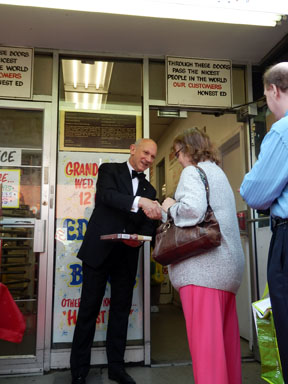
David Mirvish greets customers enthusiastcally as he hands out chocolate to the first 200 customers. Richard Frankel/Gleaner News
By Richard Frankel
It is May 23 at high noon, and the sun is burning on a gorgeous day. Hundreds of bright eyed and enthusiastic customers stand in line on Bloor Street. They stand on a rolled out ceremonial red carpet borrowed from the Royal Alexandra Theatre for the grand opening of a week long event at Honest Ed’s (581 Bloor Street W.) called “Edwin’s Of Bloor Street.”
It is a temporary name change and a celebration of both the store’s 64th year of being in business as well as a recreation of a favourite of the late Ed Mirvish’s fun and affordable events.
Mirvish’s son, David, the show business entrepreneur, is decked out in a tuxedo. He is wearing his father’s cufflinks, and is visibly pleased by the positive energy of the hundreds of customers who have lined up.
As he moves through the throng of people to take his place at the front of the line, he stands underneath the new makeshift sign on Bloor’s southwest corner, and takes his time to pat customers on the back and smile. He makes sure to shake each and every hand and exchange pleasantries, as he hands out boxes of chocolates to the first 200 people that walk through the Honest Ed’s doors.
“It’s always exciting to open something new,” said Mirvish. “My father did this every few years but I think the last time we did it was 15 years ago. So Edwin’s of Bloor Street has returned at least for this week.”
Russell Lazar, Honest Ed’s general manager for the past 54 years, said he and his team had been working on the event for the past six to seven weeks.
“It was the right time, and nice weather and it is the 64th year of the store. This is a special event for David and his late father,” he said.

Hundreds of Honest Ed’s customers line up for the grand opening of ‘Edwin’s Of Bloor Street’, a five day sale and celebration of Honest Ed’s and its 64 years in business. Richard Frankel/Gleaner News.
The featured buys during this five-day event are items priced from 25 cents all the way up to $10,000, with some opening day door crasher specials ranging from 10 cent TVs and tickets to the theatrical production of War Horse given to various customers who stand on the “right spot” in the lineup.
However, the promise of chocolate and the low sale prices were not the reasons why Pat Weller, a lady with long blonde hair and thick rimmed glasses, came out to the grand opening event. For Weller, a deeply rooted, and almost reverential combination of nostalgia and dedication to the Mirvish brand brought her here.
“He’s changing it to Edwin’s? I gotta go check it out! The name change is just in fun,” she said. “I myself come to every event that David has. Even when Ed was alive, I would come to every event because I grew up with the store. It was before we had all the malls and all these discount stores.”
Weller said the store has a lot of history with the city and brings people together.
“That’s what it’s all about. That’s the story with this store. I really like it. I really enjoy it.”
David Mirvish said it is a privilege for him to come to these events because people say nice words about his dad.
“It reminds me of other times that I’ve been here with him and it’s fun. It’s nice to have some continuity with the past.”
Tags: Annex · News
June 10th, 2012 · Comments Off on Deska, Arias Lead Charge as Maple Leafs Drop Majors
TORONTO MAPLE LEAFS 6, LONDON MAJORS 5
By Jonah Birenbaum
Marek Deska threw six-plus solid innings, while Branfy Arias led the way offensively, as the Toronto Maple Leafs defeated the London Majors 6–5 at Dominico Field on Sunday.
Deska, the 27-year-old pitcher, allowed just three runs on six hits and three walks while striking out five to pick up his third win of the year, and help the Maple Leafs collect their second win in as many days.
“I call him Roy Halladay,” Toronto centre fielder Glenn Jackson said of Deska. “He’s the Halladay of our staff. Any time you got Deska on the mound, you got a shot.”
Flattering comparison notwithstanding, things got off to an inauspicious start for Deska when London tallied a pair of runs—neither of them earned—to open the scoring in the top of the second.
London first baseman Cleveland Brownlee, who singled to lead off the frame, scored the game’s first run on an RBI groundout from Derrick Strazalkswiski after a fielding error by Arias, Toronto’s shortstop, put him on third base with one out. The Majors would tack on another run in the inning on second baseman Chris Stewart’s RBI single.
But Toronto responded quickly, posting a pair of their own in the home half of the third to tie the game at 2–2. After London starter Jordi Amargos plunked Jackson to lead off the inning, Arias promptly redeemed himself for that defensive miscue the inning prior with a two-run homerun that sailed well over the fence in left field.
An inning later, Toronto exploded for another four runs to create a deficit that proved insurmountable for the Majors. After consecutive walks to Dan Marra and Justin Gianfrancesco, Rob Gillis singled to load the bases for Jackson. The Toronto native would work the count full before blooping a single into shallow right, plating Marra. Arias, the next batter, then punched a single into centre field to score Gianfrancesco.
“Today was a good day for me,” said Arias. “I feel good swinging, and [it was] good we won, too. We needed that game.”
Toronto would tag on another run on an RBI groundout from third baseman Jordan Castaldo before a wild pitch from Amargos allowed Jackson to scamper home, extending the lead to 6–2.
Amargos, saddled with his first loss of the season on Sunday, would last just one more inning before giving way to Mike Henry. London’s starter allowed six runs on six hits and five walks over five innings of work.
Meanwhile, Deska managed to settle down nicely after that shaky second, holding the Majors scoreless for four consecutive innings before an RBI triple from Brownlee chased him from the game in the seventh.
“He pitches in the small park but still gets it done,” Jackson said of his team’s ace.
Brett Lawson would come in to relieve Deska, making just his second appearance of the season out of the bullpen. Despite making it interesting in the ninth after surrendering a two-run homerun to Brownlee—who finished the day 4-for-5 with three RBI and fell just a double short of the cycle—Lawson was able to get pinch-hitter Jason Schneider to ground out to end the game with the tying run on second, consequently picking up his first save of the year.
For Toronto, the win represents the team’s first winning streak of the season, an accomplishment Jackson attributes in part to a better outlook.
“We are trusting ourselves and the guys we have out there,” he said. “We’re playing as one, we’re playing positively.”
Tags: Annex · Sports · Maple Leafs Baseball
MARKET RETURNS TO THE ANNEX THIS SUMMER
By Victoria Prouse
“You shop differently in a farmers market than a supermarket,” says Gus Sinclair, former chair of the Harbord Village Residents’ Association (HVRA) and co-founder of the Bloor-Borden Farmers’ Market. “In a farmers’ market, people pause; they stop over tomatoes and talk about how the kids are doing at school.”
Afternoons of food, fun, and fellowship will return once again to the Annex. June 6 marks the kickoff of the weekly farmer’s market. The Green P Parking Lot at Lippincott and Borden streets will be transformed into a dynamic neighbourhood meeting place, hosting about a dozen farmers with local goods.
Over 30 farmers’ markets are interspersed throughout the city. However, the Bloor-Borden Market is unique. It is one of only five in Toronto that have been granted the “MyMarket” certification by Farmers’ Market Ontario. While vendors at conventional farmers’ markets are able to resell goods from the food terminal, acquiring the “MyMarket” certification mandates all goods sold are produced by the vendors themselves.
Farmers wishing to sell their goods at a “MyMarket” must undergo a stringent certification process. Sinclair emphasizes the importance of this certification as a guarantor that the items purchased at the market are fresh and of the highest quality.
The market’s return to the Green P will be greeted with significant fanfare. However, its fate was less than secure earlier in the year. In the past, the market had benefited from $5,000 in funding from “MyMarket”—funding Sinclair describes as ensuring a “soft landing” for guaranteeing the market’s welfare. This year, however, the funding regime was withdrawn. Fortunately, contributions from the HVRA, the Annex Residents’ Association (ARA), and the Harbord Street and Bloor-Annex business improvement area (BIAs) have alleviated this deficit, thereby enabling the market to cover its administrative and promotional costs.
This investment affirms this market’s significant contribution to community vitality—both socially and economically. Sinclair identifies the relationship between the vendors and surrounding businesses as inherently “symbiotic.” Anne Freeman, project coordinator at the Toronto Farmers’ Market Initiative (TFMI) shares Sinclair’s perspective. “There is a spinoff benefit in terms of spending in the neighbourhood,” Freeman says. “It’s usually a very complementary effect.”
Since its inception in 2008, the market has transcended its role as a hub for produce in the Annex. Rather, Sinclair, envisions it as a cultural, community-building, and commercial enterprise. Musicians contribute to the lively atmosphere, and the Children’s activity tent ensures visitors of all ages look forward to a trip to the market.
The activities at the Bloor-Borden market represent a commitment to community stewardship. It has the largest volunteer base of the five “MyMarket” farmers’ markets in Toronto. Additionally, the market hosts “Lemon and Allspice,” an initiative by Common Grounds Cooperative that provides adults with developmental disabilities an opportunity to gain skills by selling coffee and baked goods.
As Freeman states, “The great thing about Farmers’ Markets is they give people a reason to come out and meet their neighbours.” Indeed, every Wednesday from June 6 to Oct. 24, the vibrant heart of the Annex will be found on top of the asphalt at Borden and Lippincott. It is a “must-see experience” for anyone who wants to see life as it is intended to be lived: wholesome food from healthy soil, an amiable and welcoming atmosphere, and a community successfully working together for a common cause.
Tags: Annex · News · General
June 8th, 2012 · Comments Off on Coming this Sunday: the Festival on Bloor
BLOOR ANNEX GOES ON DISPLAY JUNE 10

The Festival on Bloor takes place this Sunday between Bathurst and Spadina. Come on out enjoy the music, food, and atmosphere. Courtesy Bloor-Annex BIA.
By Victoria Prouse
June 10 marks the kickoff of summer in the Annex. Making a strong case for the Annex as Toronto’s friendliest neighbourhood, the Bloor Annex Business Improvement Area and the Miles Nadal Jewish Community Centre are co-hosting the Annex Festival on Bloor—a lively street party to which the entire city is invited.
From 11 a.m. to 6 p.m., Bloor Street West between Bathurst and Spadina will be closed to vehicular traffic. “This is Bloor Street—a busy street—and to see it transformed is amazing,” says Maxine Bailey, festival organizer. “It’s going to be so animated.”
Bailey anticipates 15,000 to 20,000 people will attend this festival, now in its 16th year. The diverse array of activities, events, and performances planned indicates this party will be great entertainment for everyone.
The Tranzac Main Stage (292 Brunswick Ave.) will serve as the centre of the action. Michael Booth from Tranzac will ensure the energy levels remain high through his role as host of an afternoon of musical enjoyment. University of Toronto’s CIUT Radio will be broadcasting on site the entire afternoon.
Artists will perform a variety of genres and styles, infusing the festival with a multicultural flavour. Confirmed acts include the Randolph Academy Show Choir, Makossa-style Central African music by Fojeba, traditional Cuban music by Los Caballeros Del Son, klezmer entertainment by Dia and the Kishkes, violin folk by Jaron Freeman-Fox and the Opposite of Everything, Son Jarocho Mexican music by Café Con Pan, and singer-songwriter Calamity Royale.
Energy and excitement will by no means be limited to the Tranzac Stage, but will permeate throughout the entire street. A parade, led by multi-instrumentalist Dave Clark and idiosyncratic jazz collective GUH, will kick off the festivities. Visitors will be entertained all afternoon by more than 15 unique performances—acts to be featured in the upcoming Toronto Fringe Film Festival. Notable groups include Paul Watson Productions and the Kokus Dance Company.
A medley of over 70 specialty arts, crafts, and street vendors will enhance the existing array of patios, cafes, and boutiques along Bloor that are set to welcome guests to the area. The cultural adventure continues with the many activities planned to take place along Bloor Street. There will be booths offering henna art, shiatsu demonstrations, a Tai-Kwan Do workshop, life-sized chess game, along with representatives from the Miles Nadal Jewish Community Centre, CIBC, and Pepsi. Street buskers will also be interspersed throughout this interactive milieu.
Recognized as one of Toronto’s most popular festivals, the Festival on Bloor is exceptional in its offerings of diverse activities and entertainment suitable for all ages. The Children’s Village will surely be a highlight for young attendees. This year, the Children’s Village will feature a plethora of activities—including a blow-up castle, sports, and a face-painting station—that will undoubtedly satisfy the interests of all kids for the entire afternoon.
Bailey identifies this aspect–the liveliness and unbridled energy of the children—as her favourite part of the festival. “Seeing the kids with their faces painted, the Children’s area, it’s the animation of the site,” says Bailey.
Do not miss this great multi-cultural event celebrating the diversity and talent in the Annex and Toronto.
Tags: Annex · General
June 6th, 2012 · Comments Off on From the pen of Brett Lamb—May 2012
Brett Lamb chimes in on the issue of casinos…

Brett Lamb/Gleaner News
Tags: Annex · Editorial
June 6th, 2012 · Comments Off on For Joel’s Benefit
MONTHLY COMEDY SHOWS RAISE FUNDS FOR CANCER RESEARCH
By Melania Daniel
Your average Joe would most likely break down in fits of crying when coping with a recent diagnosis of cancer. But Joel Taylor took to laughing.
The 33-year-old comedian, who learned in February that he had pancreatic cancer, began planning for a regular series of comedy shows in response to the devastating news. The monthly laugh-fest, For My Own Benefit, kicked-off at Parts & Labour (1566 Queen St. W.) in March. Since its second showing Apr. 25 at the Comedy Bar (945 Bloor St. W.), the Bloor-Ossington venue has become For My Own Benefit’s permanent home.
Taylor had two goals in mind for the event—to make patrons die laughing (figuratively), and to raise funds for pancreatic cancer research. “Because of my cancer diagnosis, I wanted to do something more community-oriented, something philanthropic,” said Taylor. “I wanted to do something for a greater good while doing what I like, which is to write comedy and perform it.”
[pullquote]“It’s not French farce, it’s not slapstick; it’s a highly verbal, absurdist, literary comedy. And we tried to find acts that are like us.”[/pullquote]
He performs as one half of the New Humourists, alongside Jordan Himelfarb, his stage partner of over 10 years. When they got together to rework old routines and write new material for the charity undertaking, they wanted to make sure the focus was on fun, said Himelfarb.
“We didn’t want it to be about the charity, or about cancer, or Joel,” said Himelfarb. “It’s not a secret that Joel has cancer, but we never mention it on stage.”
Himelfarb said the duo “made a serious effort” to ensure their act, which runs for about one hour, “is a lot of fun, so people are not thinking of cancer but experiencing something very, very, funny.”
What Taylor and Himelfarb put on is indeed “hysterically funny,” said publicist for the New Humourists, Ivy Johnson. Johnson points to video clips of past performances of the pair, available at www.formyownbenefit.com, as proof that hers is not just the word of a self-interested promoter. In fact, there is nothing self-interested about For My Own Benefit, and Taylor profits only indirectly, Johnson said. The deadpan humour of the title of the comedy fundraiser hides the fact that all profits from the shows are pledged to the Princess Margaret Hospital to fund cancer research and care.
Taylor and Himelfarb treat audiences to a night of “wild hilarity” with what Johnson calls an “incomprehensible” style of humour.
“We perform a very wordy comedy,” explained Himelfarb. “It’s not French farce, it’s not slapstick; it’s a highly verbal, absurdist, literary comedy. And we tried to find acts that are like us.”
The package of scripted performances, improvisations and sketch comedy has not found a permanent home so far.
“We’re testing out a few different venues to find the right one,” said Taylor.
The New Humourists are joined for each show by a rotating cast of other comedy players that has included acts like Personals, Mark Little of Picnicface, Anders Yates, Tony Ho, and host Dan Beirne of the side-splitter sitcom The Bitter End.
“No one’s handling their material with kid gloves,” Taylor said of the supporting acts.
So far, the response has surpassed expectation. About 80 people turned out for the first benefit, and about $3,000 was raised from the $10 per head event, according to Taylor. “We had a very enthusiastic audience who really enjoyed themselves.” Money was also raised through donations on their website.
That’s a far cry—or laugh—away from the New Humourists’ first foray on stage at a Stand-up Comedy Club in Montreal years ago, which saw Taylor performing material written jointly with Himelfarb. “We were met with a very aggressive silence,” says Himelfarb. But Himelfarb calls their learning pains “a symptom of a comic cause.”
Or schooling in using comedy for a good cause.
The next show takes place at the Comedy Bar on July 11 at 9:30 p.m.
Tags: Liberty · People
June 3rd, 2012 · Comments Off on Leafs get crowned by Royals
GUELPH ROYALS 4, TORONTO MAPLE LEAFS 2
By Mike Radoslav
On a rainy afternoon at Dominico Field, the Maple Leafs continued their slide down the IBL standings, posting a 4–2 loss to the visiting Guelph Royals.
A sparse crowd braved the dark clouds and intermittent rain to come out and support the Leafs, but a lack of run support once again came back to haunt the Toronto side.
Guelph pitcher David Hatt had the Leafs number for much of the game. Toronto’s Rob Gillis was the only player who found some success against Hatt. Gillis singled and scored in the third inning off a Glen Johnson hit, and connected on a solo home run in the fifth.
Beyond that the Leafs failed to pose much of a threat, registering eight hits on the day, but also finding their baserunners picked off, thrown out at the bag or hitting into double plays.
“You have to give [Hatt] credit, it was a pretty good ballgame he threw at us,” said Leafs manager Tim Harkness. “They legitimately beat us.”
While the Leafs are still searching for a way to reawaken their bats, the Royals found success with the long ball off Toronto starter Marek Deska.
Three Guelph players hit solo home runs. After the Royals opened the scoring in the third off lead-off hitter Frankie Hare’s RBI single, Josh Garton hit a solo blast in the fourth. Hare followed by Tyler Wheeler, also cranked back-to-back solo shots in the fifth inning to open a 4-1 lead.
Deska pitched six innings in the loss, allowing four runs on seven hits, with seven strikeouts and two walks. He was relieved by
Hatt went eight plus innings for the Royals, allowing two runs on eight hits, striking out four and walking two batters. Andrew Van Wout came in during the ninth inning to record the save for Guelph.
Harkness said the Leafs are showing signs of a team in a slump, and they simply have to find a way to work themselves out of it.
“We lost [Dan] Gibbons, I think he was the leader of the team, we lost him and it took something out of us,” Harkness said. “We get down and we seem to stay down.”
Centre fielder Gibbons was injured in a game against the Brantford Red Sox on May 20 and was out of the lineup for the game.
Harkness said he does seem some daylight with a couple of the players.
“We just have to keep plugging away,” Harkness said. “I’ll never quit on these guys, and hopefully we’ll get something going.”
The Leafs now sport a 3–8 record, sitting at the bottom of the IBL standings.
Tags: Annex · Sports · Maple Leafs Baseball · General
BLOOR HOT DOCS CINEMA, ROYAL St. GEORGE’S, TRINITY ST. PAUL’S OPEN DOORS FOR FIRST TIME
By Kristin Eliason
Doors Open Toronto gave residents and tourists the opportunity this weekend to get outdoors and in doors of some of the city’s most unique and stunning buildings.
Doors Open, originally conceived of in France in 1984, quickly spread throughout Europe. Today, Doors Open is celebrated in 48 European countries. Toronto followed suit in 2000.
Intended as a one-time celebration of the millennium, the popularity of the first Doors Open Toronto led to its becoming an annual event in 2002.
Held the last weekend of May each year, this year’s Doors Open Toronto commemorated the bicentennial anniversary of the War of 1812, by opening up over 135 of Toronto’s most historically significant buildings.
Some sites unlocked doors normally closed to the public, while others waived entrance fees charged for access to their grounds.
Twenty-three sites in all participated in the Annex. Among them, the familiar: Casa Loma (1 Austin Terrace), Spadina Museum (285 Spadina Rd.), and the Church of the Redeemer (162 Bloor St. W.).
But, there were also the unfamiliar, opening their doors for the first time. Among them were the recently renovated Bloor Hot Docs Cinema (506 Bloor St. W.), the Chapel of St. Alban the Martyr and Royal St. George’s College (120 Howland Ave.), and Trinity-St. Paul’s United Church (427 Bloor St. W.).
The event was a huge success for both participants and patrons, new and old alike.
“It was a great weekend”, says Karen Edwards, museum administrator for the Spadina Museum, where nearly 3,000 people passed through.
Rosalie Villanueva was one of those patrons, and pleased with her overall experience.
It had lovely gardens and gorgeous rooms, she says. Friendly volunteers, informative staff and video presentations helped make the experience positive. “It might have been my favourite destination of the day.”
Bloor Hot Docs Cinema was likewise successful. This year marked the cinema’s first participation in Doors Open since its renovation and reopening to the public on May 16th, 2012. Heather Belot, marketing and communications manager for the cinema, says this opportunity has given the staff a chance to meet and receive feedback from their community.
“We let people know how their input helped shape the Bloor Hot Docs Cinema,” she says, “and they provided us with very positive feedback about the renovations.”
Former owner and manager, Carm Bordonaro, was on hand to chat with guests, while executive director Chris McDonald and managing director Brett Hendrie welcomed them in. Projectionist Rob, a staff member with the cinema for over 30 years, treated guests to a special behind-the-scenes tour into the projectionist’s booth, an area normally off-limits to the public.
Over 1,100 people came by the cinema this year, and next year there will surely be more. In 2013, the building will celebrate its 100th year anniversary as a cinema.
With positive feedback of Doors Open Toronto in the Annex, guests had very few suggestions to make to improve their overall experience.
Making official event guides and electronic apps available further ahead of schedule would aid planning, they say, and longer hours at the sites would be welcome.
“I wish there were buildings that were available for both days during the weekend,” says Joanne Angelina, lifestyle blogger for The Painter’s Studio, who had planned on visiting nine sites over the weekend, “it would be nice to worry less about time and observe more in the places you explore.”
And exploring, after all, is what Doors Open Toronto is all about.
An introduction to hundreds of buildings brings recognition that no matter what neighbourhood you live in, wherever and whenever you have the time, there is always a exceptional building and the opportunity to stop on by.
Tags: Annex · General
May 29th, 2012 · Comments Off on TTC seeks information in Dupont Station shooting
REWARD IS FIRST OF ITS KIND FOR TTC

Security camera footage catches a glimpse of the suspect wielding a gun on October 2, 2011. Police are appealing for any information regarding the individual's identity. Courtesy TPS.
By Richard Frankel
As leads dry up, the Toronto Transit Commission (TTC) is offering its first-ever reward for information leading to the arrest and conviction of a suspect that fired three shots at a Dupont station fare collector, hospitalizing him, last Feb. 26.
“We’re putting up this reward so the staff in general feel supported,” said TTC CEO Andy Byford. “This shows the TTC means business. We’re serious about backing our staff and supporting our staff and protecting our staff.”
This was the third robbery of the station’s collector booth since 2011. All three robberies occurred during weekend evenings over a span of four months from each other.
According to a Toronto Police Services (TPS) news release, investigators believe the same suspect is responsible.
“Same collector booth by the same individual and we’re on the eve of the fourth month which gives us great concern also,” said Staff Inspector Mike Earl of the Hold Up Squad.
Earl says during the third robbery, a witness followed the suspect down Spadina Road to MacPherson Avenue. The witness observed this individual get into a four-door silver vehicle and speed northbound on Spadina, but the individual who chased the suspect still has not come forward.
“Maybe the $25,000 will bring him out of hiding,” said Earl, who also appealed to the media and the public’s assistance to call Crime Stoppers or the Hold Up Squad with any information to catch the suspect.
Earl describes the suspect as white, between 35 to 40 years old, with a heavy and stout build. He said the suspect carried a revolver type handgun in the left hand in each robbery.
He said police want to be “gender non-specific” in case it is a female.
Byford said his member of staff, William Anderson, 52, who was shot in the neck and shoulder last February and is making a good physical recovery. His time-frame to return to work is unclear.
“The recovery is going well and he’s been given good treatment by the hospital but mentally this is a traumatic event that has happened to him so for obvious reasons he’s still pretty cut up about it,” said Byford. “We are giving him every assistance in coping psychologically with what’s happened.”
He said the TTC has taken steps to improve safety and security by reducing the amount of cash that is kept in the booths and increasing the amount of debit transactions. In addition, there are also increased patrols by uniformed police, uniformed transit officers, and plainclothes officers.
Tags: Annex · News · General
May 27th, 2012 · Comments Off on Early Deficit Costs Maple Leafs
BURLINGTON TWINS 7, TORONTO MAPLE LEAFS 4
By Jonah Birenbaum
The pitching woes continue for the Toronto Maple Leafs, who couldn’t overcome another rocky outing from starter Brett Lawson on Sunday as they fell to the Burlington Twins 7-4 at Dominico Field.
Lawson, who has yet to win a game in 2012, laboured through a rough first inning that put Toronto in a substantial hole before they even had a chance to swing the bat. The imposing right-hander surrendered four runs on four hits—including two for extra bases—and a walk in a disastrous opening frame.
After Lawson issued a walk to centre fielder Phillip Steer to lead off the game, first baseman Jamie Lekas ripped a single up the middle to put runners on first and second with nobody out. Second baseman Jeff Kosta promptly ripped a bases-clearing, opposite-field double to give Burlington an early 2-0 lead. The Twins would tag on two more runs in the inning by way of a Jeff MacLeod sacrifice fly and a two-out double from Aberdeen Chan.
The Maple Leafs offense worked admirably to chip away at the early lead, managing to plate a run in each of the second, third, and fourth innings, but the inability to come through with runners in scoring position—a recurring theme this season—proved costly once again. Toronto stranded eight baserunners in Sunday’s contest.
“It’s frustrating,” said Toronto third baseman Jordan Castaldo, who went 1-for-5 with an RBI. “It’s disappointing. Some things aren’t going our way. I mean we got to do everything—pitching, hitting, defense—we got to do everything better.”
And while Lawson did manage to settle down after a shaky start—he allowed just one run in his final three innings of work while striking out three—the early deficit was simply too great. Lawson gave up six earned runs on seven hits and three walks over five innings of work before giving way to Clay Caulfield, who struck out five and surrendered just a lone unearned run in three solid innings of relief.
Lawson has now surrendered 13 earned runs over his last seven innings as his earned run average balloons to 9.00 for the season.
Connor Smith picked up the win for Burlington after pitching a clean fifth inning in relief of starter Matthew St. Kitts, who surrendered three runs—two earned—on six hits and no walks in his four innings of work. St. Kitts also helped supplement his team’s offensive efforts with a solo homerun to centerfield to lead off the second inning.
Kurtis Robinson pitched the final three innings for the Twins, giving up one run, to pick up his first save of the season.
“Our pitching did a fantastic job, you can’t say enough about them,” Twins manager Jeff Lounsbury said.
With the loss, the Maple Leafs drop to 3-6 and sink to second-last in the Intercounty Baseball League standings as their struggles at home persist. Toronto hasn’t won a game at Dominico Field since the season opener on May 6, when they defeated the Ottawa Fat Cats in dramatic fashion.
Castaldo also lamented the missed opportunity to pick up a win against one of the few teams looking up at Toronto in the standings. Heading into Sunday’s contest, the Twins sat a game back of the Maple Leafs at 2-5.
“It’s frustrating against a weaker opponent that we could only put up four runs today,” he said. “We should be able to score more than four runs against a team like that.”
Burlington’s victory represents the team’s first winning streak of the season. Sunday’s triumph over Toronto comes on the heels of a 7-5 win over the Kitchener Panthers the day before to give the team victories in consecutive games.
“It’s amazing considering we’re missing five players from our lineup,” Lounsbury said. “These guys really stepped up … it was a huge win for us.”
Tags: Annex · Sports · Maple Leafs Baseball · General
