Though construction crews hit Toronto streets as soon as the snow melts, it’s still a sight to behold when a major intersection gets ripped up beyond recognition.
The TTC has shut down Queen Street West and Spadina Avenue for major repairs, closing off the crossroads from July 9 to July 23.
Photographer HiMY SYeD (special to the Gleaner) took photos of the intersection over the course of a week. A look at the big machines and big digs currently dominating the intersection:
July 10, 2012

The destruction begins under blue skies.

A panoramic view of the concrete removal, a dusty process that had to happen before re-construction could begin.
July 13, 2012

Crew members lay down a section of track, which is pre-assembled in a TTC Work Yard elsewhere in the city. The sections are brought on site and laid down pre-built (this saves time). One of the site supervisors said Queen and Spadina is perhaps the most complicated track reconstruction in the city because it’s a true four-way track intersection. Streetcars can turn left, right, or proceed ahead from each of the four directions.

Blueprints for the tracks.
July 15, 2012

The almost unrecognizable northeast corner.

Looking west down Queen Street from Peter Street. Notice the rubber from the track reconstruction in the mid-1990s in the middle of the shot. One of the TTC crew members who worked on that job mentioned how ‘temporary’ that was.

Crew members in the ‘trenches,’ right in the middle of the intersection.
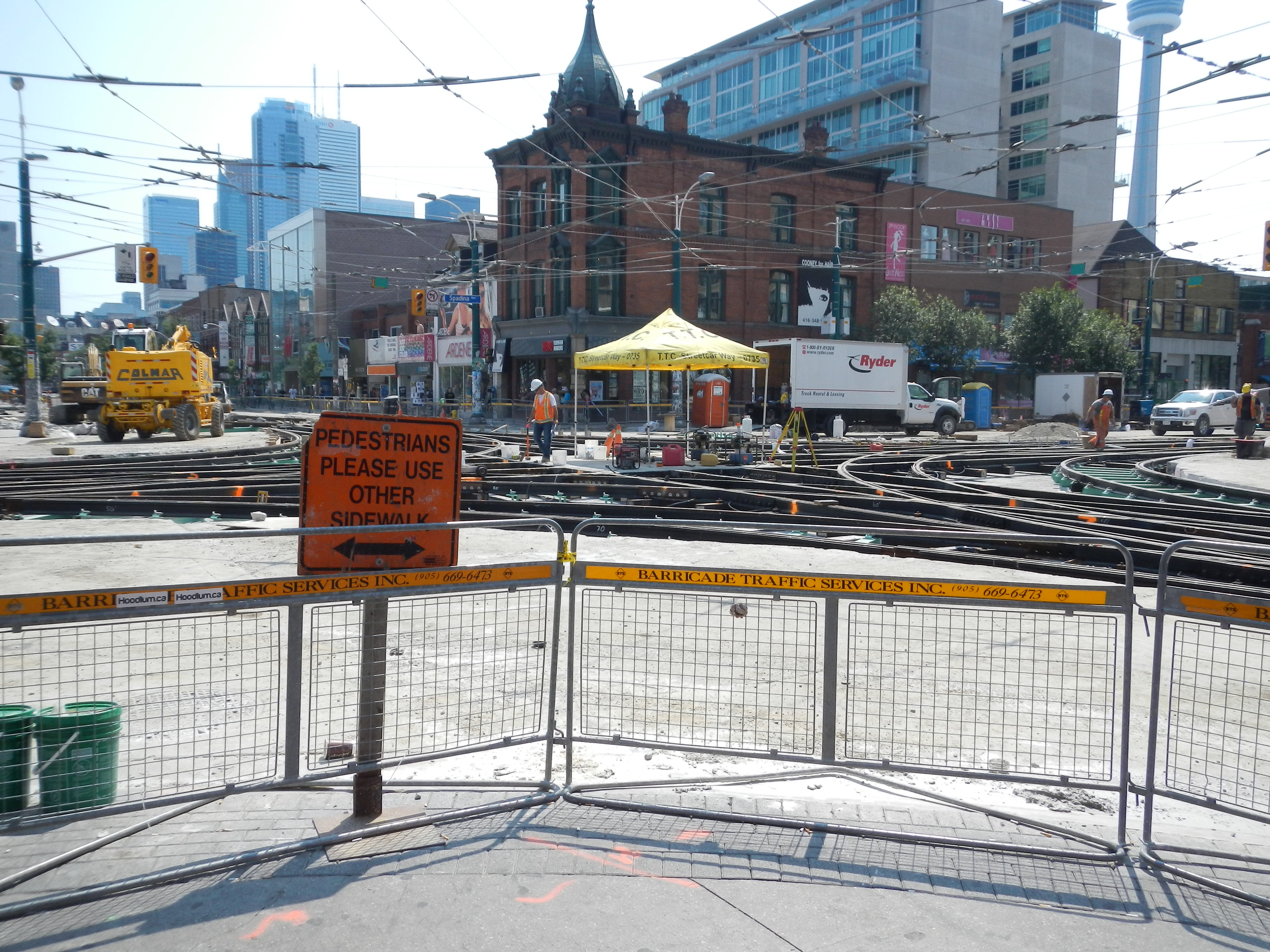
Looking southeast from the corner near the McDonalds. Pedestrians are being re-routed from all four corners of the intersection.

One more panoramic shot of the intersection.
Tags: Liberty · News
July 13th, 2012 · Comments Off on From the pen of Brett Lamb—June 2012
Our cartoonist takes a look at the development issues around the University of Toronto.

Tags: Annex · Editorial
July 13th, 2012 · Comments Off on Karma Co-op celebrates its 40th anniversary
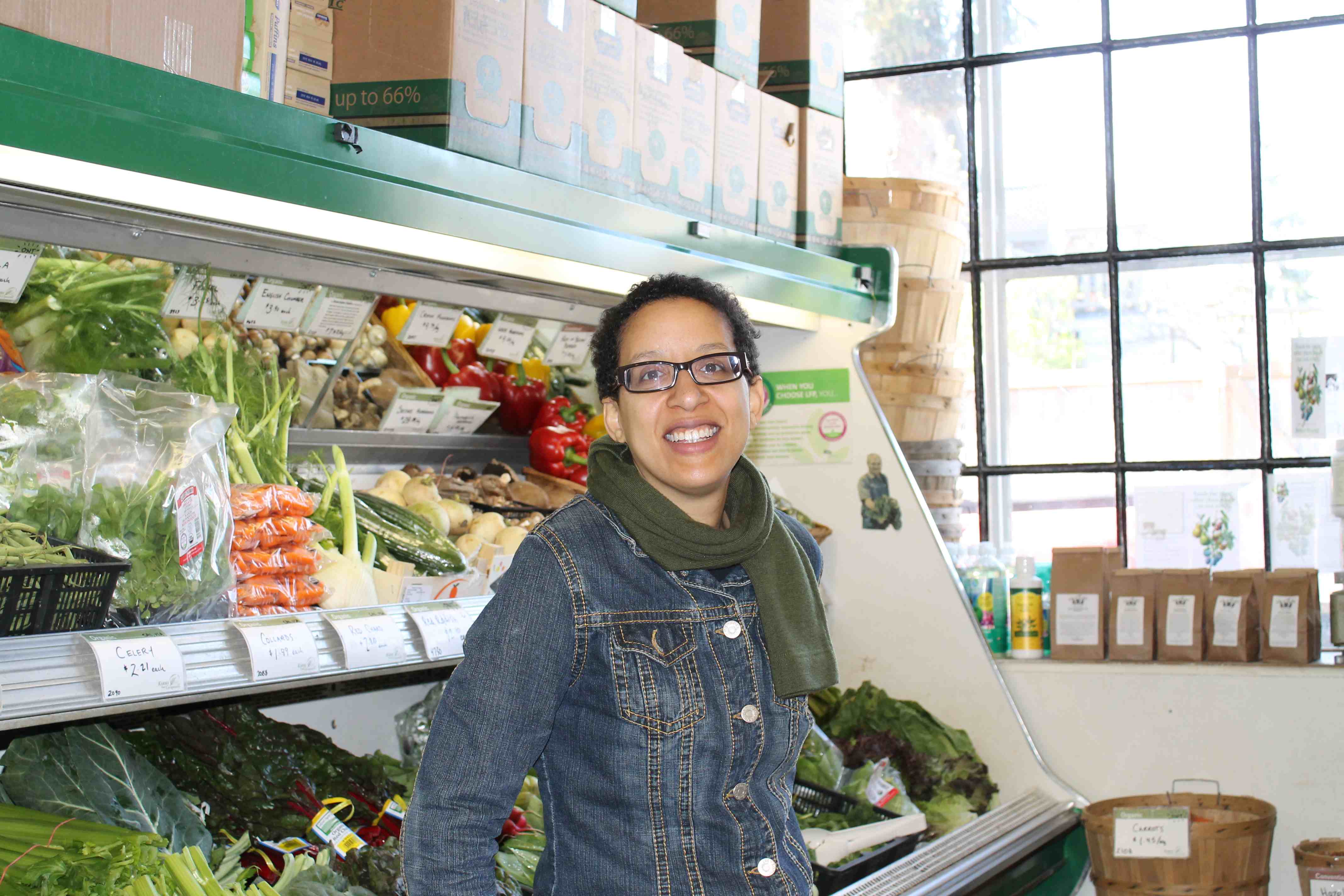
Inside the food co-operative. Photo: Alexa Huffman/Gleaner News
By Alexa Huffman
Smart shoppers can find a second home at Karma Co-op (739 Palmerston Ave.). The non-profit food co-operative is celebrating 40th anniversary and is eager to share its success.
Amy Andre, the shop’s general manager, loves being one of the eight employed staff at the store.
“Although I am the manager, I do work for the members,” she said. “The members own the business and the employees serve them.”
With over 1,000 members, the democratically-run co-operative has grown from when it started out of a basement in 1972 to its current incarnation—where the spacious building is fully-owned. The members help out with the costs by paying annual dues.
There are different levels of membership. The first is paying $40 annually, the second is $10 every season and if they put down a $100 loan, there is a discount on annual dues.
“We even have a trial run where anyone can come in and shop for one time,” said Andre. “However, some people just choose to join right away.”
There is a good reason people are drawn to the store that may appear small to some but is filled with plenty of local, fairtrade, and organic products. Andre says there is a sense of conscientiousness in the community. It’s a place for alternatives for people looking for packages, processed foods. They feel good about what they put on the shelves and feel it is not only helping the health of their bodies but also has a positive environmental impact.
“Our jewel in the crown is definitely our produce,” said Andre, speaking with pride while looking around the store. “We have a deep relationship with the local farmers that has taken years to develop.”
There is food for people who care about what they put in their body, Andre describes. There are vegan, vegetarian and gluten free diets among others. There are also classes including nutrition workshops with a registered nutritionist who works at Karma.
“It’s a great community feeling,” said Andre. “We’ve built a good relationship where the customers have come to trust us.”
However, it isn’t just the food that attracts people to the store. There is also a lounge with comfortable wooden benches and chairs, a lending library, kitchen, computers, and Wi-Fi.
“It’s really not like any other store,” said Andre. “You don’t often come down to shop for groceries and sit down to talk to someone you’ve known for 20 years.”
These customers come from all over the Annex. There are students from the nearby University of Toronto, family and retirees. They come for the selection and the price, as Karma has a rigid protocol about how prices are set. The savings are passed to the members where any of the wholesale products bought are only marked above a certain price.
“We don’t do gimmicks,” said Andre. “In the end, it’s a better deal for members who don’t have to worry about a ridiculously overpriced experience.”
With Karma being selected for Doors Open Toronto, which ran May 26 and 27, Andre said this will be a great way to share what Karma is about.
“We have always been a leader in the food movement. We push the envelope. Now the mainstream is catching up and we get to decide what is the next thing for consumers with a conscious.”
Tags: Annex · Food · General
The recipe for these lemon squares is a two-step recipe. Just follow the simple instructions.

Tart and tasy lemon bars. Photo: Innis O’Grady/Gleaner News
By Susan Oppenheim
After moving to Costa Rica—a country known internationally for its produce—I was stunned to find out one cannot buy lemons. There are enormous varieties of limes—green, orange, even yellow ones—but, oddly, no marketed lemons.
After four years of living there, when a neighbour brought me a bag of unsprayed, misshapen, gnarly lemons from his garden, I was so overjoyed I cooked, baked, and shared everything I could think of with my circle of friends. I generously shared lemon curd, lemon sauce, lemon meringue pie and the best recipe of all Lemon Bars.
I used to love lemons simply for their vibrant taste, but the complexity of this fruit is fascinating. There is an essential oil derived by cold pressing lemon peels that is available in specialty stores like The Body Shop, Whole Foods, and other health food stores. This can be applied topically to abolish acne, and treat canker sores.
By adding a little honey to it you can treat itchiness of a bug bite. Lemon oil also has pain-relieving qualities that inhibit inflammation and ease pain. One would massage the affected area daily with several drops of lemon oil mixed with one tablespoon (15ml) of jojoba oil.
Pain Issues? Drink the freshly squeezed juice of one lemon in a glass of lukewarm water 3 times a day and if you experience severe pain add the juice of two lemons three times a day.
For stomach ailments, drinking 1 freshly squeezed lemon in a glass of lukewarm water after each meal will stimulate the production of stomach acid and the activity of stomach muscles. Lemon juice relieves anxiety, reduces fever symptoms, fights fatigue, and helps treat the winter blues.
Halitosis? Chew a lemon slice. And if you want to whiten your white clothes,soak them in hot water with a slice of lemon for 10 minutes
When choosing lemons, pick the heaviest ones as they have the most juice. Soaking them in hot water for an hour or microwaving on high for 20 seconds releases twice the juice.
Lemon peels or the zest contain as much as five to 10 times more vitamins than the lemon juice. By freezing the whole lemon, then grating it on top of your dishes, you can consume all of those nutrients and get even healthier. Lemon peel is good for making you slimmer, or adding healthy fat if you are skinny. Lemon peels are health rejuvenators in eradicating toxic elements in the body and boost the immune system,aiding in the recovery of of flu and colds. Grate the rind or zest before tossing the shells after juicing, and store in your freezer in tightly tied baggies.
Many professional chefs are using the entire lemon, wasting nothing. They simply place a lemon in the freezer, grate the whole lemon once frozen—no need to peel it—and sprinkle it on top of prepared foods. Everything will develop a more complex taste, something that you may have never tasted before in your life.
And for the sweet tooth: lemon bars.
Norene Gilletz’s Lemon Squares, with an Oppenheim Touch
Base
1 cup cold butter cut in chunks
2 cups all purpose flour
1/2 cup white sugar
Topping
4 large eggs
1/4 cup fresh lemon juice
2 cups white sugar
1/4 cup all purpose flour
1 tsp baking powder
2-3 tablespoons roughly grated zest (outer peel)
Preheat oven to 350 degrees Fahrenheit.
This is a 2 step recipe. For the base, process the ingredients in a food processor until crumbly, about 20 seconds. If you do not have a processor you can cut it fine with pastry blades. Press into a sprayed or greased and floured rectangular 9 by 13-inch baking pan. Place pan in center of oven and bake for 20 minutes. Remove from oven and add the topping.
For the topping, process those ingredients with a hand mixer or blender until blended, about 10 seconds. Scrape the sides to blend smoothly. Pour evenly over the base. Bake 25 to 30 minutes, or until golden. Cut when cool.
Tags: Annex · Food
July 13th, 2012 · Comments Off on Observatory gets the Munk Touch
Munk Centre expands to Bloor-Devonshire site
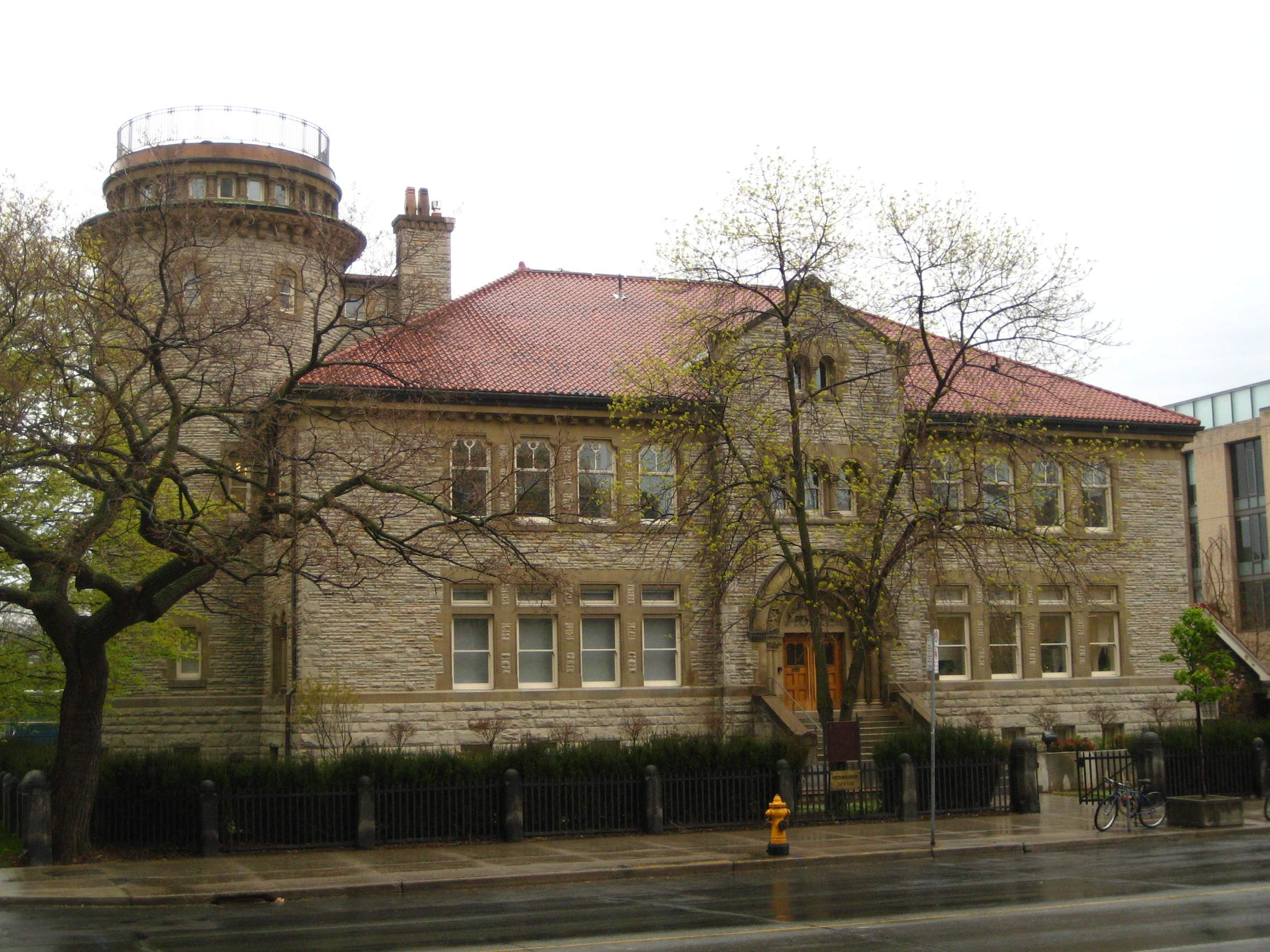
The classic architecture of the old observatory at Devonshire Place and Bloor Street West was preserved quite well in the new Munk Centre renovations. Photo: James Murdoch/Gleaner News
By James Murdoch
An old but familiar building at the corner of Bloor Street and Devonshire Place is now the “new face” of the University of Toronto’s northern entrance.
The building once housed the Dominion Meteorological Services but is now home to the University’s Munk Centre for Global Affairs.
The original Romanesque Revival style building opened in 1909 and was home to this country’s weather service until the mid 70’s when the University acquired it.
Its exterior has been scrubbed clean, revealing golden tan sandstone and the round turret where the early weather service kept their huge telescope has been re-purposed into three floors of extraordinary meeting space.
A recent gift to the University of $35 million by Peter and Melanie Munk spurred a further $50 million in funding from the provincial and federal governments allowing the University to renovate the building over two years and expand its programs of Global Studies and Cyber Security.
Janice Gross Stein sits in her second floor office and beams. That’s understandable because as the Centre’s director, Gross Stein had a hand in helping to design her new digs. She was consulted at every step of the renovation process by well known architect Thomas Payne of the firm Kuwabara Payne McKenna Blumberg (KPMB) and E.R.A. Architects, which specializes in historic buildings. Gross Stein enjoyed the consultative process. “I think there was a wonderful give and take through the whole phase, right down to the furniture.”
Many of the original building features from the gargoyles guarding the entrances to the art deco style floor tiles in the front foyer and the staircase and banister were kept.
Gone are the false ceiling tiles and the reclaimed open space has added a sense of soaring height in the hallways and offices. “Everybody who comes in remarks on it so that part is truly wonderful,” says Gross Stein. The new modern double height doors round up to points giving them an almost medieval look. It is a “marvelous experience,” adds Gross Stein, to see “these wonderful doors that both reflect the past but are contemporary in design.”
Walls that used to close off rooms now roll away to create large public meeting spaces. The main floor houses administration and meeting rooms and a library, while the basement contains student spaces and seminar and project rooms. The third floor, which requires a security pass, buzzes as the Cyber Security Studies Centre. Its once dark, windowless hallway is now bright with the addition of large skylights. The building is Leadership in Energy and Environmental Design (LEED) certified. It is wired for internet and other communication needs, and is fully accessible with the addition of an elevator.
A small cottage at the rear of the property will be transformed into a seminar room this summer while the terraces fronting Bloor Street have been landscaped and will be available to host functions as well.
In Gross Stein’s words, “It’s wonderful repurposing of the building where we were able to respect its integrity, which is very important, but adapt it to new challenges and new uses.”
Tags: Annex · News
By Councillor Adam Vaughan (Ward 20, Trinity-Spadina)
Not convinced? Then check out what’s happening in every corner of the continent. Google “No Casino” and see what comes up. Whether it’s Vancouver or Miami, Manhattan, Gettysburg or Pawtucket, city after city, town after town, everyone seems to be fighting a casino proposal.
Now Google “Casino debt.” Just as quickly, you find out why, from Nevada to Nantucket, from Windsor to Niagara, casinos all over North America are going broke. And when they fail, the cities they reside in fail too.
Like the compulsive gamblers they create, casinos all over the continent are losing big right now. Instead of walking away from their losses, they are upping the ante by trying to open new operations in more cities. What they are hoping to find is a new generation of gamblers to keep the house afloat. Let’s keep Toronto as far away from this mess as possible.
There are good reasons to avoid a casino. The facts and experience of other municipalities make the case pretty clear. In Montreal, virtually 93 per cent of the casino’s revenue came straight out of the local economy (MacIasac 1994:38). This means that money bet at the casino wasn’t spent on clothes, rent or food locally, it was sent to the multi-national operator of the gambling facility. Money spent on dining and drinks wasn’t spent in local bars or restaurants, it was also sent to the multi-national casino operators.
In Atlantic City, 40 per cent of the bars and restaurants near the casino went bankrupt (Corelli, Memeth and Driedger, 1994b). St. Louis had a similar experience. The most quoted expert economist, Earl Grinols of Baylor University, says that as economic drivers or job creators, casinos are “at best a wash for every job created there is a job lost.”
If the business case doesn’t scare you, consider the impact on the city’s quality of life. From a social perspective, crime goes up. Street crimes, fraud, loan sharking and prostitution rise when a casino comes to town. Before the casino, Atlantic City was rarely made the top 50 list of crime ridden cities. Since gambling came to town they almost always rank near the top.
Casinos are inward looking complexes. Windows are rare; food and drinks served cheap and on site to keep gamblers betting. The head of MGM, when talking to Toronto City Council said that a casino requires one parking spot for every slot machine. Five thousand are forecast in Toronto. Sound like your vision for the waterfront?
One study reports that property values close to a casino drop by about ten per cent. Based on the meagre amount the province shares with local municipalities, the drop in municipal tax revenue will likely outpace whatever cut of the take Toronto gets.
The casino industry isn’t even contemplating paying market-value for public land. The head of MGM has said that if they got a deal on the land, the City could get a bigger slice of the take. This is coming from a company that’s losing money hand over fist in Las Vegas right now.
Finally, there is the impact on the folks who purport to enjoy gambling. A 2003 report by Grinols calculates the social cost at $289 for every $46 of government revenue. That is over $6 in social cost for every $1.00 generated! While most of these costs are tied to crime, there is a significant impact on healthcare costs. Addicted gamblers cost a lot to cure, they often blaze a trail of financial ruin at work and home, and require treatment to manage their affliction. It’s next to impossible to get this type of help in Toronto now. Manufacturing more problem gamblers will not help. Proximity to a casino is the most significant risk factor related to problem gambling.
Torontonians have considered this issue before and reached the right conclusion. The province is back again and talking up dreams of Celine Dion and Cirque du Soleil tents, conventions and luxury hotels. They won’t produce a business plan, won’t release the studies that support their case, won’t tell us what the city’s cut might be, and they have just passed legislation removing the requirement to hold a referendum on this issue.
Cynical as that might be, it’s probably the only smart part of the proposal because it’s clear that if it did go to a vote, Toronto would say no again. That you can bet on.
Tags: Annex · Editorial
July 13th, 2012 · Comments Off on Trane Studio celebrates a near decade of jazz
The Bathurst music venue has seen plenty of top talent grace the stage since it opened nine years ago.

The Sharron McLeod Fauxtet performs as part of the anniversary celebration of the jazz club and restaurant. The night was hosted by dub poet Clifton Joseph. Photo: Sadie McInnes/Gleaner News
By Sadie McInnes
In April, the Trane Studio (964 Bathurst St.) hosted its ninth anniversary dinner and concert event.
Named one of the “Top 150 Jazz Venues of the World 2011” by DownBeat Magazine, the Trane merits the title. Though its exterior is simple, with a small sign and dark windows, inside it’s a different story.
The walls hold simple portraits of John Coltrane, the studio’s namesake. Well-worn sofas, and upholstered chairs nicely complement exposed brick, and an ornate-pressed tin ceiling. At night candlelight bounces off installations of local artists’ work and as the small stage illuminates, the Trane truly comes alive, transforming into a warm and bustling hub for Toronto’s biggest jazz fans.
For their anniversary, founder and manager Frank Francis kept things running smoothly while still providing personal welcomes to each guest, making anyone feel welcome to join in their celebration of success. He seems to know everybody there, demonstrating the sense of community that exists among the Trane’s many supporters.
Francis has been involved in the production of live music events for several years, but only decided to open up this space in 2003. When asked why he created the Trane, he looks back on his own experiences as a Toronto artist.
“I had a concert at a venue in the city and they double-booked us. We had about 400 people lined up to see the show and it was a problem, I thought at the time that the city needed a space that was respectful to artists,” he said, adding that he is “a big fan of Coltrane.”
Since then, Trane has been hosting artists from far and wide. Greats like Wynton Marsalis, Kahil El Zabar, and Waleed Abdulhamid have graced their stage, as well as many local artists. “We have a great deal of local supporters who are musicians who live in the Annex area for example, Scott Marshall has been a great local talented saxophone player, Jordan Klapman, Julie Michaels … ” he adds.
Plenty of local supporters showed up to celebrate on Apr. 28. The evening was hosted by Clifton Joseph, two-time winner of the Best Dub Poet Award and friend of The Trane, and featured a performance from local band the Sharron McLeod Fauxtet. They played tribute to the great jazz vocalist Abbey Lincoln who passed away in August 2010.
“For us, it [the anniversary] is to remember Abbey’s music, and to commemorate our nine years. It’s to acknowledge our past and to talk a little bit more about moving forward into the future,” said Francis. Singer Sharron McLeod found the perfect balance between past and future, switching without hesitation between songs that inspired recollection and sorrow to far more celebratory pieces.
McLeod has known Francis for almost 15 years, and has been involved at the Trane since day one. She had a great success with her performance of For the Love of Abbey at the Trane in December 2010, who brought her back to once more honour Lincoln’s achievements. This year she featured songs from her project: The Trilogy Remix, which included pieces that have been performed by the likes of Nina Simone and John Coltrane himself.
McLeod says she thinks it would be nice to see The Trane stick around for at least another 9 or 10 years. “It’s a wonderful space. It’s holistic. I love that jazz exists there alongside other kinds of music,” said McLeod of the Trane. “It makes me feel at home.”
When asked what makes year nine so special, Francis says “it’s taken nine years, but I think internationally the venue is now being a little more recognized.”Already planning for the future, Francis chuckles, saying “I think every year after nine is going to be bigger, because apparently it’s an achievement for a jazz club in Toronto. I think after two years you better start celebrating!”
The Sharron McLeod Fauxtet will be at The Trane Studio again on June 28th for the Toronto Downtown Jazz Festival. Several other events, including CD releases, band performances, and actors’ monologue nights are frequently held.
Tags: Annex · Arts
July 12th, 2012 · Comments Off on “We are not for sale”

From left to right, Inspector Sandra Richardson, Reg Ayre, Lance Cumberbatch, Deborah Simon, and Councillor Cesar Palacio at the TCH town hall meeting at the Senator D. Croll Apartments on Apr. 25. Photo: Rasheed Clarke/Gleaner News
Public housing residents voice opposition to selling off units
By Rasheed Clarke
Holding a microphone to his lips, Clive Williams sat up straight at the edge of his chair and posed the question, “Why do I sit on a $650 toilet?”
“It’s not special. It doesn’t hook up to the ceiling or something,” Williams continued. “It just shows that the construction department is warped.”
The construction department he was referring to was that of the Toronto Community Housing (TCH), the largest social housing provider in Canada, which accommodates approximately 164,000 low and moderate-income tenants across the city.
Williams’ comments were the first of many complaints from TCH residents directed at board members at a town hall meeting held at the Senator D. Croll Apartments (341 Bloor St. W.) in April. Members from Toronto Public Health, bylaw officers and police representatives were also on hand.
Of prime concern among residents was the possibility that their homes would be sold to help TCH pay for a growing list of repair orders. Last February, TCH’s interim chief executive officer, Len Koroneos, proposed selling off 675 single-family homes to generate some of the $750 million needed for repairs.
When his turn to speak came about, Wallace Simpson stated bluntly, “Suggesting that selling off some homes is the only solution for dealing with repairs is not only bad business sense, but disrespectful to tenants.
“It’s not the tenants’ fault that TCH has this repair crisis, and tenants shouldn’t be the ones responsible for solving it.”
Simpson’s comments were greeted by chants of “we are not for sale” from a handful of residents.
TCH chief operating officer Deborah Simon said that limited funding makes repair work a challenge for the housing corporation.
“We’re working with a little over $50 million a year to support some very old structures, and to stretch those dollars in the best possible way is a difficult task,” she said.
“We get thousands of work orders per year, and we prioritize life safety as the most important thing to address, and we try our best to look after the other issues as they come, so that means in some cases we’re not getting to all the issues that are important to people.”
An alternative funding option raised by resident Harvey Pinder was to increase tenants’ rent-geared-to-income rate from 30 to 35 per cent of gross income. That suggestion was met with scattered shouts of disapproval.
Dan King, a tenant representative for the Senator Croll Apartments, suggested that the best way forward for TCH was to tear down old buildings and construct new ones, as they have in Regent Park.
Other issues raised by tenants revolved around safety and sanitation.
For five years, Keith Lancaster has tried unsuccessfully to have a known drug dealer removed from his building.
“In the last year he’s spent nine months in jail. Each time he gets out he walks right back into his apartment and [tenants] have to put up with his nonsense,” he said.
“I have requested a move, but my psychiatrist, my doctor and my case worker all say the same thing, ‘Why should you move? You’re not the troublemaker.’”
Concerns about hygiene brought Sandra Markov to the meeting. She said that rats had been tunneling into her building, and that unemptied garbage bins had attracted raccoons and flies to her neighbourhood.
Councillor Cesar Palacio (Ward 17, Davenport), sits on the board and chairs the tenant and community services committee. Addressing tenants’ security concerns, he said, “We recognize we have areas in the city where the level of crime is worse, and that’s where we need to focus our attention in terms of providing 24/7 security on site.”
Not all residents at the meeting came to reprimand TCH, however. Kathy Lee said that she loves her home, feels a sense of community, and feels safe—partly due to the fact that she lives steps away from Toronto Police 52 Division headquarters.
TCH held town hall meetings with residents at three other locations around the city in April.
Tags: News · General
Both have their environmental benefits, but how do you know which too choose?
By Terri Chu
Organic greens have expanded from a niche, farmers’ market item into the mainstream. I consider anything found at Loblaws–where about one in three grocery dollars in Canada are spent–mainstream.
Organic growers will tout their eco-friendly street cred by citing studies that show pound for pound, they have a lower carbon footprint for their goods compared to conventionally-grown food. While this may be true for some goods, I wouldn’t assume it translates to every type of produce. A study done by some industrious students right here at the University of Toronto however, did confirm that for popular local goods such as carrots and potatoes, organic trumped conventional. What these students also found though was that the carbon savings of organic production was quickly overshadowed by transportation.
To be honest, ever since I learnt about systemic pesticides (pesticides that are absorbed in the plant effectively making the plant poisonous to insects), I cringe at the thought of purchasing conventionally-grown foods. Something that kills a bug at first bite no longer seems appetizing to me. With media reports of conventional farmers claiming they would not eat their own food, trust in the food system isn’t exactly at an all-time high.
However, let’s not paint all non-organic food with the same broad brush. There are many responsible farmers who don’t compromise food standards, yet can’t afford the very expensive and time-consuming certification process. It’s important to know your farmer and get food from a trusted source, not just a label.
Luckily for us living in the Annex, the time has come for us to enjoy our local farmers’ market again. (Full disclosure, I’ve been volunteering on the market committee for several years now). All farmers at this market are local and have been vetted by Farmers’ Market Ontario. In order to sell beans here, someone checked out their farm and confirmed they saw beans in the ground. The local production ensures that what you buy here is has as low carbon emissions as you will get. Nothing travelled very far and no supermarket was air-conditioned for it to be displayed in.
The farmers themselves staff most of the stalls. You can look your farmer in the eye and ask her what pesticides were used (if any), if her cows were free to roam and eat grass, and most importantly, would she feed the food to her own kids.
Living in the city, it’s hard to stay connected to where our food comes from and how it’s made. Meat comes in Styrofoam containers while milk comes in boxes. By shopping at local farmer’s markets, us city dwellers can reconnect with our food, feel good about what we eat, and at the same time, rest assured that by buying local, we’re minimizing our impact on our environment.
The Bloor Borden Market runs every Wednesday from 4 p.m. to 7 p.m. rain or shine in the Green P parking lot at on the south side of Bloor and Borden.
Tags: Annex · Food
July 12th, 2012 · Comments Off on More than a Parking Lot
Bloor-Borden farmers market returns
By Victoria Prouse
“You shop differently in a farmers market than a supermarket,” says Gus Sinclair, former chair of the Harbord Village Residents’ Association (HVRA) and co-founder of the Bloor-Borden Farmers’ Market. “In a farmers’ market, people pause; they stop over tomatoes and talk about how the kids are doing at school”.
Afternoons of food, fun, and fellowship will return once again to the Annex. June 6 marks the kickoff of the weekly farmer’s market. The Green P Parking Lot at Lippincott and Borden streets will be transformed into a dynamic neighbourhood meeting place, hosting about a dozen farmers with local goods.
Over thirty farmers’ markets are interspersed throughout the city. However, the Bloor-Borden Market is unique. It is one of only five in Toronto that have been granted the “MyMarket” certification by Farmers’ Market Ontario. While vendors at conventional farmers’ markets are able to resell goods from the food terminal, acquiring the “MyMarket” certification mandates all goods sold are produced by the vendors themselves.
Farmers wishing to sell their goods at a “MyMarket” must undergo a stringent certification process. Sinclair emphasizes the importance of this certification as a guarantor that the items purchased at the market are fresh and of the highest quality.
The market’s return to the Green P will be greeted with significant fanfare. However, its fate was less than secure earlier in the year. In the past, the market had benefited from $5,000 in funding from “MyMarket”–funding Sinclair describes as ensuring a “soft landing” for guaranteeing the market’s welfare.
This year, however, the funding regime was withdrawn. Fortunately, contributions from the HVRA, the Annex Residents’ Association (ARA), Harbord Street Business Improvement Area, and the Bloor-Annex Business Improvement Area have alleviated this deficit, thereby enabling the market to cover its administrative and promotional costs.
This investment affirms this market’s significant contribution to community vitality–both socially and economically. Sinclair identifies the relationship between the vendors and surrounding businesses as inherently “symbiotic.”
Anne Freeman, project coordinator at the Toronto Farmers’ Market Initiative (TFMI) shares Sinclair’s perspective.“There is a spinoff benefit in terms of spending in the neighbourhood,” Freeman says. “It’s usually a very complementary effect”.
Since its inception in 2008, the market has transcended its role as a hub for produce in the Annex. Rather, Sinclair envisions it as a cultural, community-building, and commercial enterprise. Musicians contribute to the lively atmosphere, and the Children’s activity tent ensures visitors of all ages look forward to a trip to the market.
The activities at the Bloor-Borden market represent a commitment to community stewardship. It has the largest volunteer base of the five “MyMarket” farmers’ markets in Toronto. Additionally, the market hosts “Lemon and Allspice,” an initiative by Common Grounds Cooperative that provides adults with developmental disabilities an opportunity to gain skills by selling coffee and baked goods.
As Freeman states, “The great thing about farmers’ markets is they give people a reason to come out and meet their neighbours.” Indeed, every Wednesday from June 6 to October 24, the vibrant heart of the Annex will be found on top of the asphalt at Borden and Lippincott. It is a “must-see experience” for anyone who wants to see life as it is intended to be lived: wholesome food from healthy soil, an amiable and welcoming atmosphere, and a community successfully working together for a common cause.
Tags: Annex · News · Food · General
July 12th, 2012 · Comments Off on Everything on top of one roof
The Annex is home to a new form of green roof
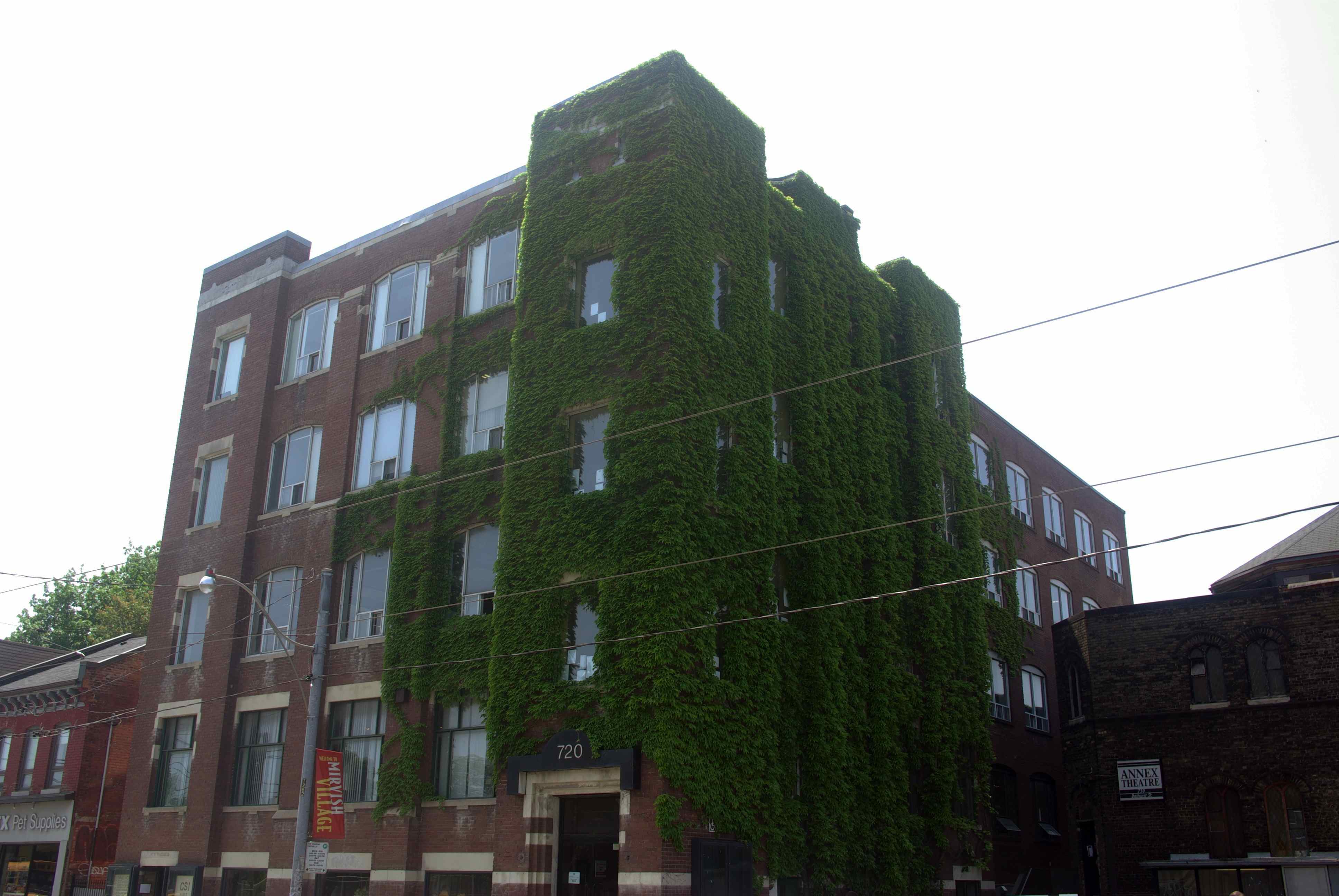
The greenery of CSI Annex (720 Bathurst St.) will slowly extend up, to even the roof. Photo: Innis O’Grady/Gleaner News
By Innis O’Grady
It is said that a roof is often a source of untapped potential. They might be large, flat spaces but remain completely unused by its residents.
The City of Toronto took note of this about two years ago when they transformed the roof of City Hall (100 Queen St. W.) into a green roof, with diverse local species of plants. Completely covering the roof with bins of growing, green plants, the roof of city hall essentially became a new city park overnight.
The Annex is getting its own little piece of green roof at CSI Annex (720 Bathurst St.), where slowly the Everything Roof is beginning to take shape.
“We came to CSI with a proposal, and we were looking for a great location for a new rooftop project,” says Everything Roof co-founder Lauren Pirie, who collaborated with Natalie Boustead of The About Face Collective on the project.
“This project is focused on growing an urban farm,” says Pirie. According to Pirie, there are proposed plans to create community events that bring together the local eco-activist and artist communities to present clean, innovative and most sustainable lifestyles. Ideas for including these two distinct groups coming together are “including leading artist workshops but with recycling elements!”
“The idea is that we want to focus on is community workshops and half day programming for schools and community groups,” adds Pirie. The Everything Roof is pushing to be an education on ecology even in the heart of the city. Details on these workshops go into teaching about how everyone can make their own home more eco-friendly and sustainable.
The urban farm concept has stemmed off of the green roof, what on its own increases a building’s heat and sound insulation, and protects the roof from water erosion.
“We have had great support from the community, from both the area and the city” Says Lauren when asked about support for the urban farm, “we have had Councillor [Mike] Layton out for our events, and we’ve traded a lot of ideas with him.”
The Everything Roof has indeed its own share of community support. It’s page on Indiegogo.com, a website dedicated to interested contributors to donate money towards niche projects, generated over $10,000 in donations for the Everything Roof. This money is going to cover initial costs of the project.
“We hope to engage the community through the process of building, we have been continuing to find funding, as well as spreading the word about our fundraising,” said Pirie. The project is currently in production and is not looking to open until next year.
The About Face Collective is seeking funding support, particularly for the urban farm. Current sources of funding for the farm comes from ecological and artistic grants, and support from the community itself for this dual-purpose project.
“The city has been supportive, we applied for a green Toronto grant and working toward applying next year.” Currently the City of Toronto has been supporting the growth of green roofs and the similar solar reflective “cool roofs” through grants given to large industrial or commercial buildings that stand equipped.
Making the Everything Roof a reality is a fair bit away, but its founders are excited about the urban farm coming together. “We are constantly changing plans, new ideas are moving in and out depending on funding, components may come in phases, but we are aiming for next year!” said Pirin.
Tags: Annex · News · General
July 12th, 2012 · Comments Off on Spring is here
And so are the locally-grown spring books!
Book City has them. The authors have them. The publishers have them. The internet has them. Poke around online at Open Book: Toronto—a government funded unbiased guide to Ontario-based book publishers, updated daily with news of new authors, book events, readings and more. You too could be the proud owner of any number of these and other Spring 2012 books, brought to you by the hard-working, marginalized world of the Canadian independent publisher.
So to quickly contextualize this for you, in Canada there are two basic swimming pools for books. There are the multinationals—including Penguin, Random House, McClelland and Stewart—local and independent publishers such as Coach House Books, Pedlar Press, Anvil Press, Insomniac Press, Brick Books, Tightrope Books, Talon Books, Snare Books, and dozens of others nationwide.
Each season these publishers produce no less than four books. They all have websites, covers, content, punctuation, and they all want you to not only know they exist, but buy them, and then tell your friends how much you enjoyed them.
Out of the hundreds of books that came out this spring in Canada, I’ve decided to tell you about four; one novel, a memoir, a book of poetry, and a collection of short stories.
Metal writer, poet, and cultural writer Natalie Zina Walschots is set to release her second book of poetry, DOOM: Love Poems for Supervillains (Insomiac Press), which realizes her nearly four year Odyssey of immersion in the world of supervillain devotion. Illustrated by Coach House Books publicity guru Evan Munday, DOOM “addresses the results of abuses of power and presents a case study on the pathology of villainy.” I’m sure Natalie will be wearing capes for most of the spring and cackling.
Heather Birrel returns to short fiction for the first time in seven years with Mad Hope (Coach House Books). The stories range from a science teacher and former doctor forced to re-examine the role he played in Ceauescu’s Romania after a student makes a shocking request; to women in an online chat group share (and overshare) their anxieties and personal histories; and a story about the chance and mysterious nature of pedestrian encounters and their meaning.
Set in the 1980s in Montreal, political cover-ups, drug dealing, and ending with the tragic massacre, Mount Royal by Basil Papademos (Tightrope Books) is a raunchy, aggressive and dark novel heralded as “a bittersweet romance, a love letter to a time and a place.”
Having a father you barely knew is one thing, but when that father happens to be Irving Layton, arguably Canadians greatest poet of all time, how are you supposed to feel about the city you grew up in, the people you know, and the father you didn’t? Here we are among the Living by Samantha Bernstein (Tightrope Books) is a memoir written in epistolary form, chronicles the honest and heartbreaking examination of a life head on.
[pullquote]So yes citizens, the bookstores might be falling down like dominos, but the industry is still strong.[/pullquote] So put down your iPad and iPods and park your bikes and lock them twice, and stroll through a local bookshop for this Spring’s newest locally grown reads.
And if you don’t know, now you know.
Tags: Annex · Arts · General